CHAPTER 5
Soil Classification
SOLUTIONS TO QUESTIONS AND PRACTICE PROBLEMS
5.1 What kinds of soils are contained in loam as the term is used in the USDA classification
system?
Solution
5.2 The USDA classification system pays very little attention to gravel sized portion of a soil.
Why?
Solution
This classification system was developed by the USDA to provide indications of a soils
5.3 What is the purpose of the group index in the AASHTO classification system?
Solution
The group index is numerical index property for the used as an aid in the evaluation
5.4 You have been asked to determine if the soil at a given site is suitable for use as a
pavement sub-base material. What laboratory tests would you recommend performing on
the soil samples taken from the site?
Solution
As a minimum a sieve analysis is required. If more than 10% passes the #200 sieve then
5.5 Is it ever necessary to conduct a hydrometer analysis when classifying soils according to
the USCS, or is a sieve analysis always sufficient?
Solution
No, it is not necessary to perform hydrometer analysis to determine the USCS
5-2 Soil Classification Chap. 5
5.6 Explain the difference between a silty sand and a sandy silt in the Unified Soil
Classification System.
Solution
In the unified soil classification system, the noun represents the primary component, and
5.7 How would you determine if a soil was a silty sand or a sandy silt if:
(a) Laboratory test equipment was available?
(b) Laboratory test equipment was not available?
Solution
If laboratory test equipment is available, we would simply perform a sieve analysis and
Data for Problems 5.8-5.11
As part of a site investigation program for a residential development project you
retrieved four different soil samples. None of the soils appear to be organic. At your
laboratory you performed grain-size analyses and Atterberg limit tests on the samples.
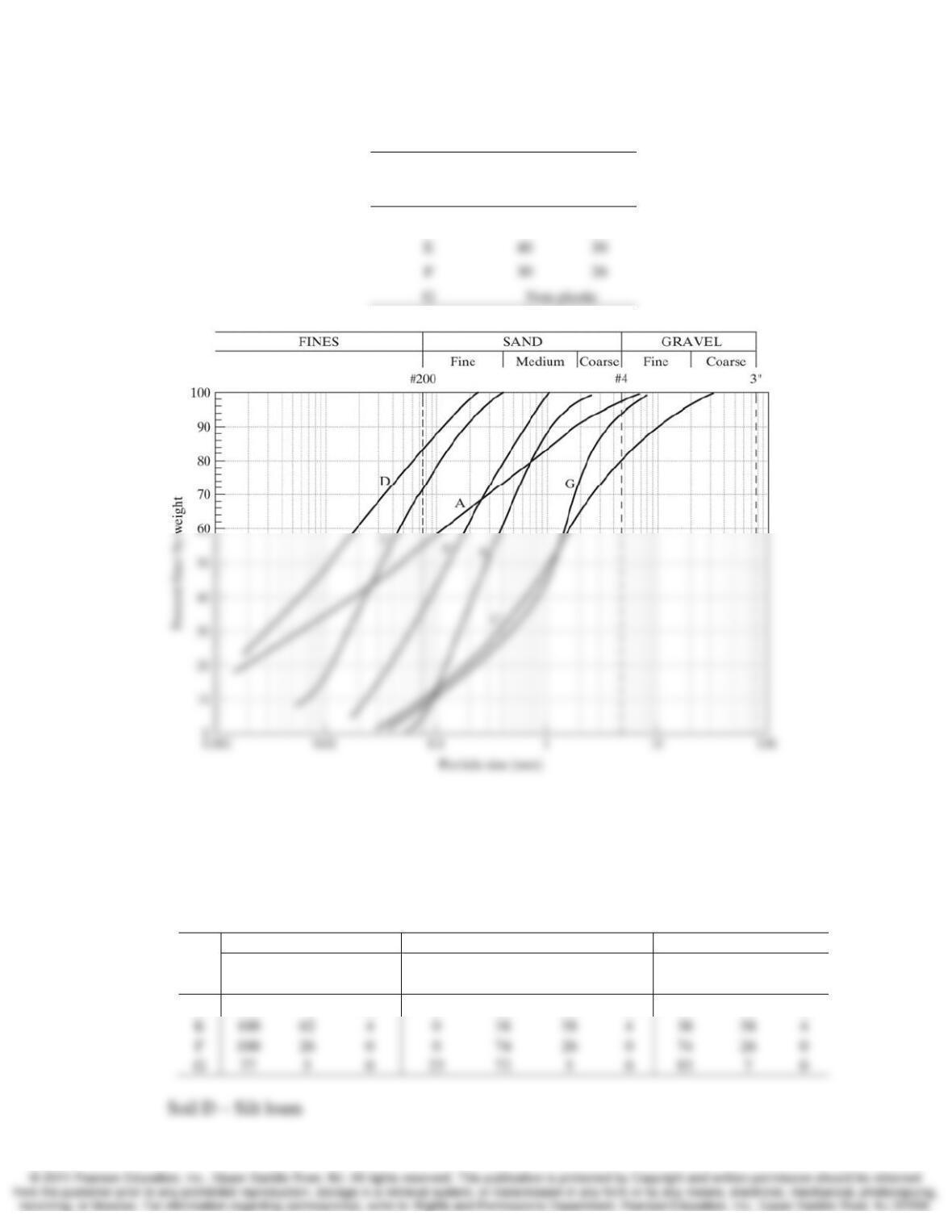
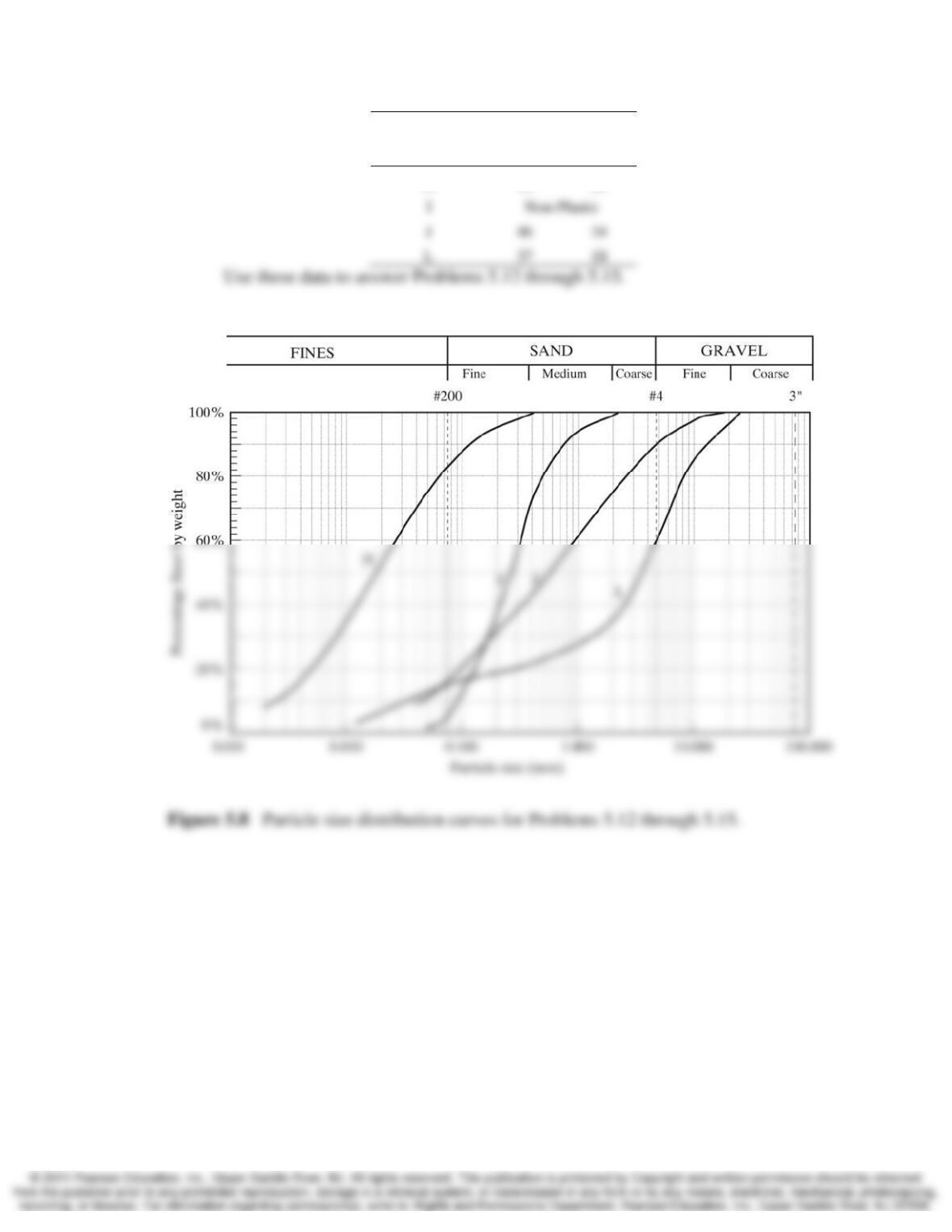
The grain-size distribution data for the four soil samples are shown in Figure 5.2 as
curves D, E, F and G. From your Atterberg limit tests on the -40 portion of theses
samples, you measured the following data
Chap. 5 Soil Classification 5-3
Soil Sample
Identification Liquid
Limit Plastic
Limit
D 60 33
Figure 5.2 Particle size distribution curves.
5.8 Determine the USDA classification for soils D through G
Solution
Soil Percent Passing Percent of total Percent of -2.0 mm
2.0 0.05 0.002
Coarse Sand Silt Clay Sand Silt Clay
mm mm mm
D 100 76 24 0 24 52 24 24 52 24
5-4 Soil Classification Chap. 5
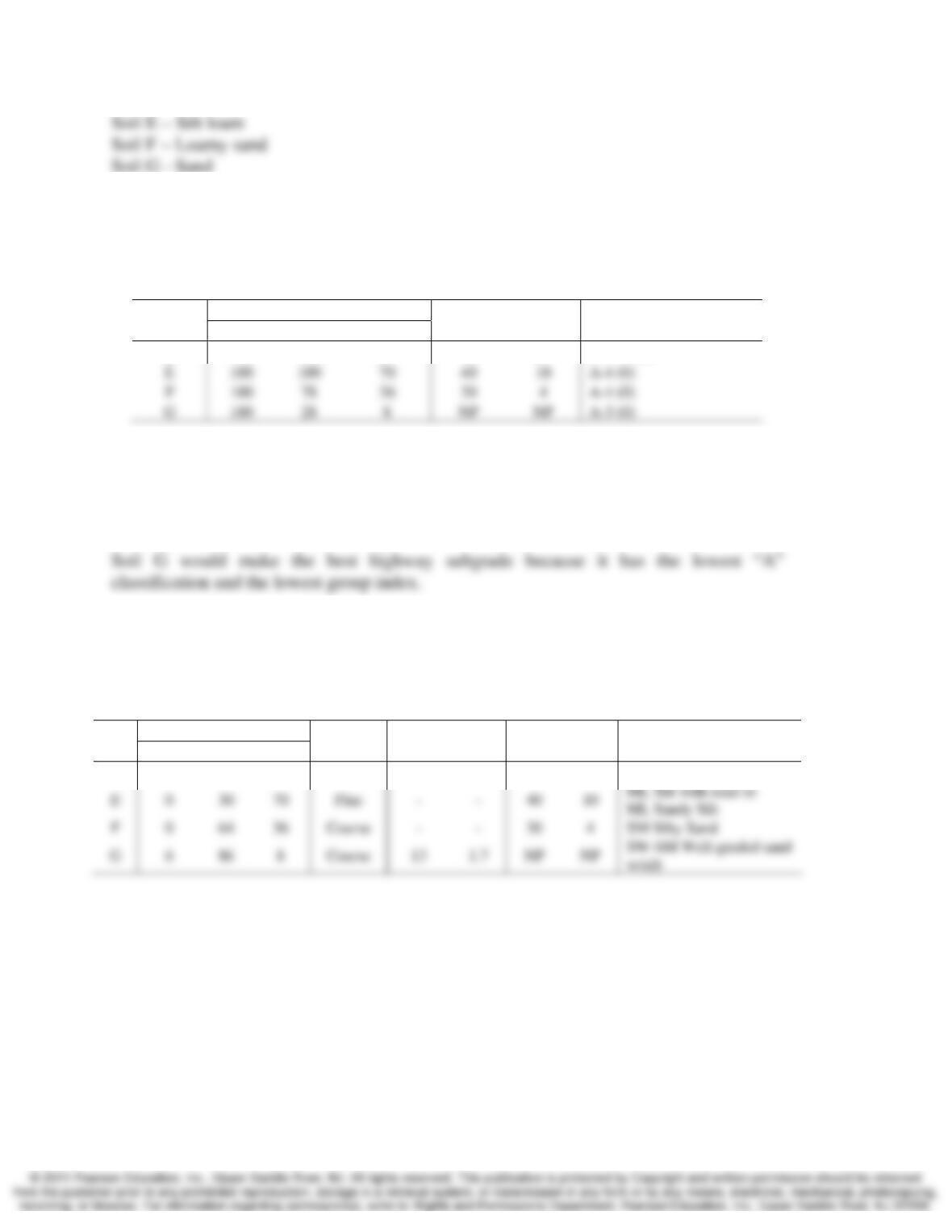
5.9 Determine the AASHTO group classification and group index for soils D through G
using the data given above.
Solution
Soil Percent Passing wL I
P AASHTO Classification
#10 #40 #200
D 100 100 84 60 27 A-7-5 (26)
5.10 Which of the soils D through G would make the best highway subgrade according to the
AASHTO classification system?
Solution
5.11 Determine the USCS group symbol and group name for soils D through G using the data
given above.
Solution
Soil Percent Type Cu C
C w
L I
P USCS Classification
Gravel Sand Fines
D 0 16 84 Fine – – 60 27 MH Elastic silt w/sand
Data for Problems 5.12-5.15
You have collected soil samples as part of the investigation for a dam project.
The grain-size distribution data for the four soil samples are shown in Figure 5.8 as
curves H, I, J and L. Soil H has a strong organic smell but contains no fibrous material.
The other soils are nonorganic. From your Atterberg limit tests on the -40 portion of
theses samples, you have measured the following data
Chap. 5 Soil Classification 5-5
Soil Sample
Identification Liquid
Limit Plastic
Limit
H 60 26
5-6 Soil Classification Chap. 5
5.12 Determine the USDA classification for soils H through L. The gravel portion of soil L
consists predominately of well rounded granitic material.
Solution
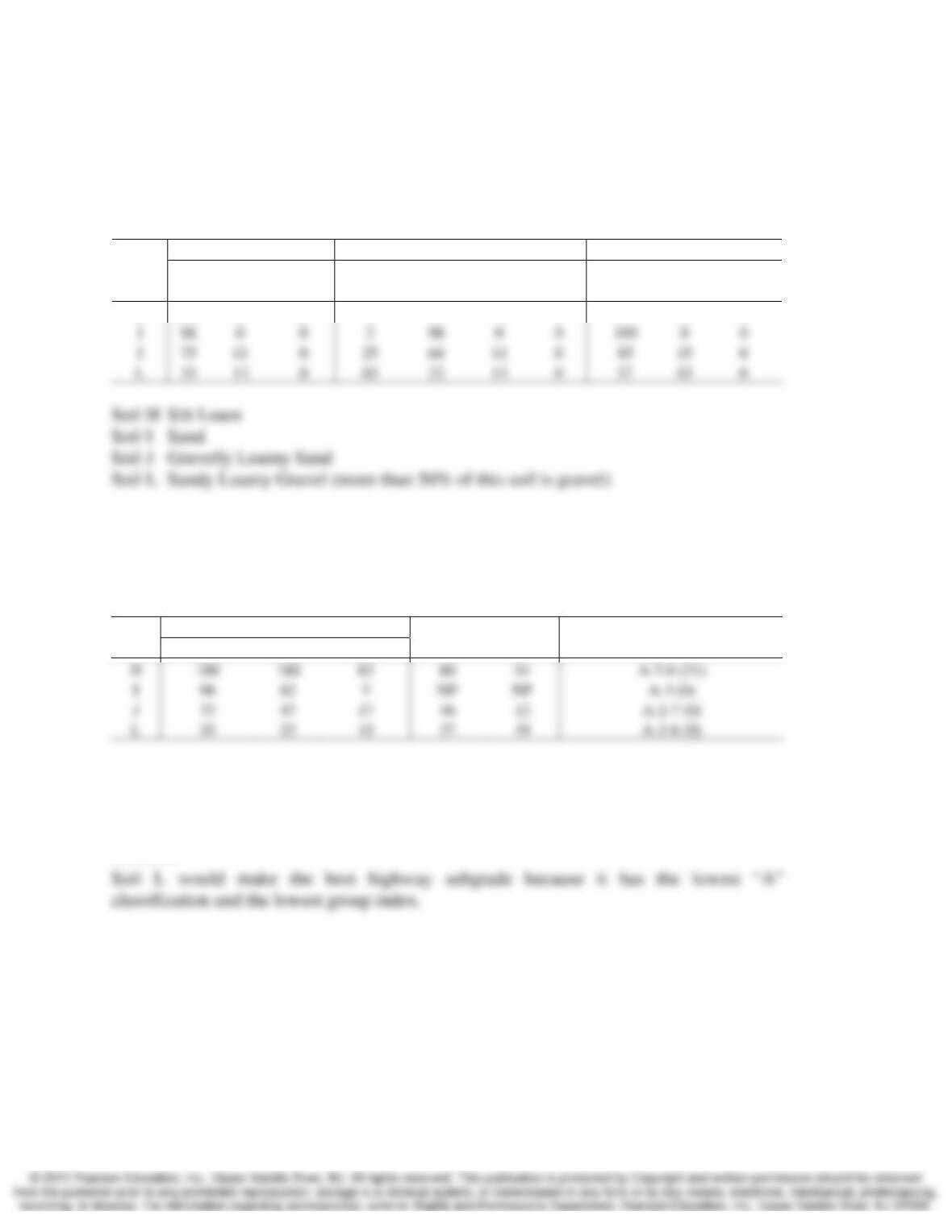
Soil Percent Passing Percent of total Percent of -2.0 mm
2.0 0.05 0.002 Coarse Sand Silt Clay Sand Silt Clay
mm mm mm
H 100 75 8 0 17 75 8 17 75 8
5.13 Determine the AASHTO group classification and group index for soils H through L using
the data given above.
Solution
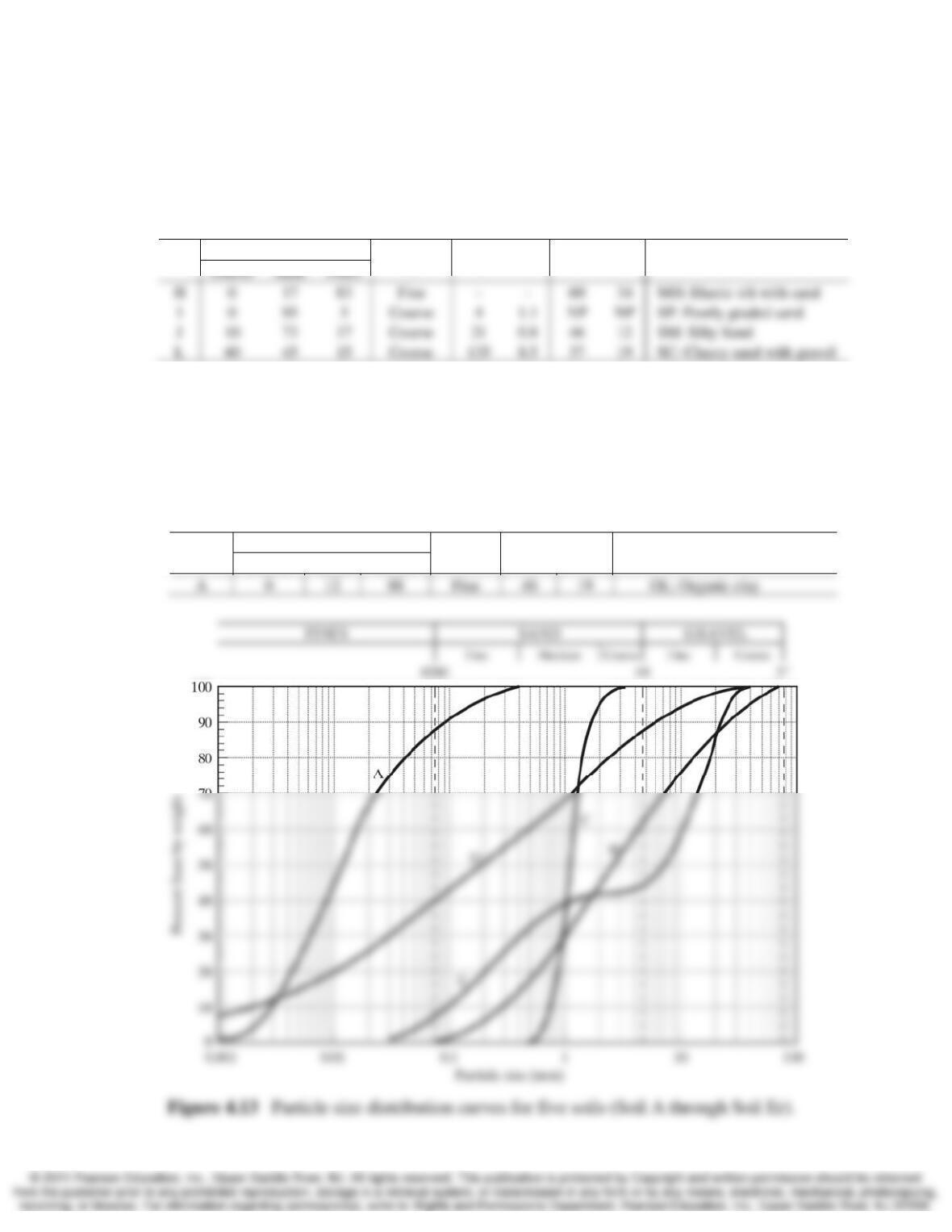
Soil Percent Passing wL I
P AASHTO Classification
#10 #40 #200
5.14 Which of the soils H through L would make the best highway subgrade according to the
AASHTO classification system?
Solution
Chap. 5 Soil Classification 5-7
5.15 Determine the USCS group symbol and group name for soils H through L using the data
given above.
Solution
Soil Percent Type Cu C
C w
L I
P USCS Classification
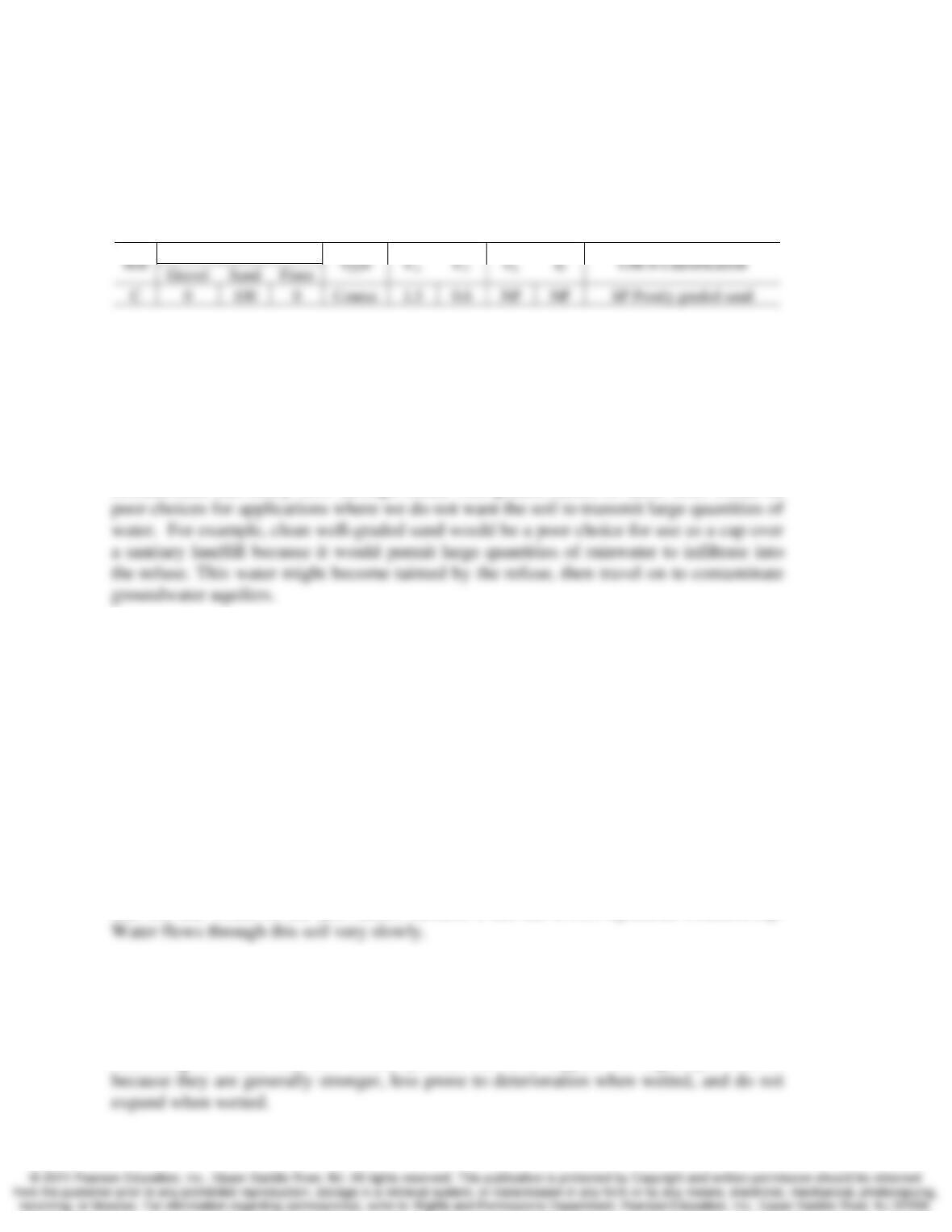
5.16 You have performed a hydrometer test on a soil and measured the particle size
distribution shown in Figure 4.13 as Soil A. The soil has an organic smell but does not
contain any plant fibers. The Atterberg limits test on the -40 portion of the soil
measured a plastic limit of 21 and a liquid limit of 40. Determine its unified group
symbol and group name.
Solution
Soil Percent Type wL I
P USCS Classification
Gravel Sand Fines
5-8 Soil Classification Chap. 5
5.17 You have performed a sieve analysis on a soil sample and measured the particle size
distribution shown in Figure 4.13 as Soil C. The fine portion of the soil was clearly
nonplastic so you did not measure the Atterberg limits. Determine the unified group
symbol and group name for the soil.
Solution
5.18 A clean well-graded sand would rate very high in the AASHTO soil classification system,
and thus be considered a good soil for use as a highway subgrade. However, it would be
a very poor choice for certain other applications. Give one example of a situation where
this soil would not be a good choice.
Solution
Groundwater can easily flow through clean, well-graded sands, so these soils would be
5.19 A sanitary landfill project needs an import soil for use as an impervious cap over the
refuse. The following soils are available for this purpose:
Soil 1: GC
Soil 2: SC
Soil 3: ML
Soil 4: CL
The design engineer desires a soil with a high clay content because it will help
keep water out of the landfill. Which of the available soils appears to be most promising?
Why?
Solution
The CL soil would be the best choice because it has the lowest hydraulic conductivity.
5.20 Which of the following USCS soils would probably receive the best rating for use as a
highway subgrade per the AASHTO classification: CL, SM, ML, or SW? Why?
Solution
According to Table 5.2, SW would provide the best support for highways. This is

Chap. 5 Soil Classification 5-9
5.21 You are drilling and sampling at a site in an arid region. You encounter a fine grained
soil that is dry and hard. You are able to break chucks of the soil with your fingers but
only with difficulty. You add water to soil until it is in a plastic stated and then form a
ribbon out of the plastic soil by squeezing it between your thumb and forefinger. It is
easy to form a long thin ribbon out of the moistened soil. Is this soil a silt or a clay?
Explain.
Solution
The soil is a clay because of the high dry strength and the ability to form a long ribbon.
5.22 You are examining a soil sample retrieved during drilling. The sample has little or no
plasticity, the particles are very uniform and about the size of the period at the end of this
sentence. What is the most likely USCS classification for this soil?
Solution
No plasticity makes it safe to assume little or no fines. Since the period at the end to