5-1
Chapter 5
Activity-Based Costing
Concept Questions
1. (LO 1—ABC and Cooper’s Hierarchy)
The four categories of overhead are unit level, batch level, product level, and
2. (LO 2—ABC and Cooper’s Hierarchy)
Activity-based costing, or ABC, assigns costs based on activities that drive costs
3. (LO 2—Basic ABC: Stage 1 and Stage 2)
The first stage of cost allocation is the identification of activities and the tracing of
4. (LO 2—The choice of cost driver)
The choice of cost driver impacts the costing of products and services. The
5. (LO 2—ABC in a JIT environment)
Factories are typically redesigned in a JIT environment such that most overhead
Solutions Manual
5-2
6. (LO 2—ABC for selling and administration activities)
ABC can be adapted and used to allocate the costs of selling and administrative
7. (LO 3—Eliminating cross subsidies using ABC)
Cross subsidies occur when a product is allocated less (more) overhead than it
actually consumes resulting in other products being allocated more (less)
8. (LO 4—Benefits of ABC)
The following are benefits of activity-based costing:
• ABC systems provide more accurate cost information that focuses managers
9. (LO 4—Limitations of ABC)
The primary downsides of activity-based costing are the time and expense
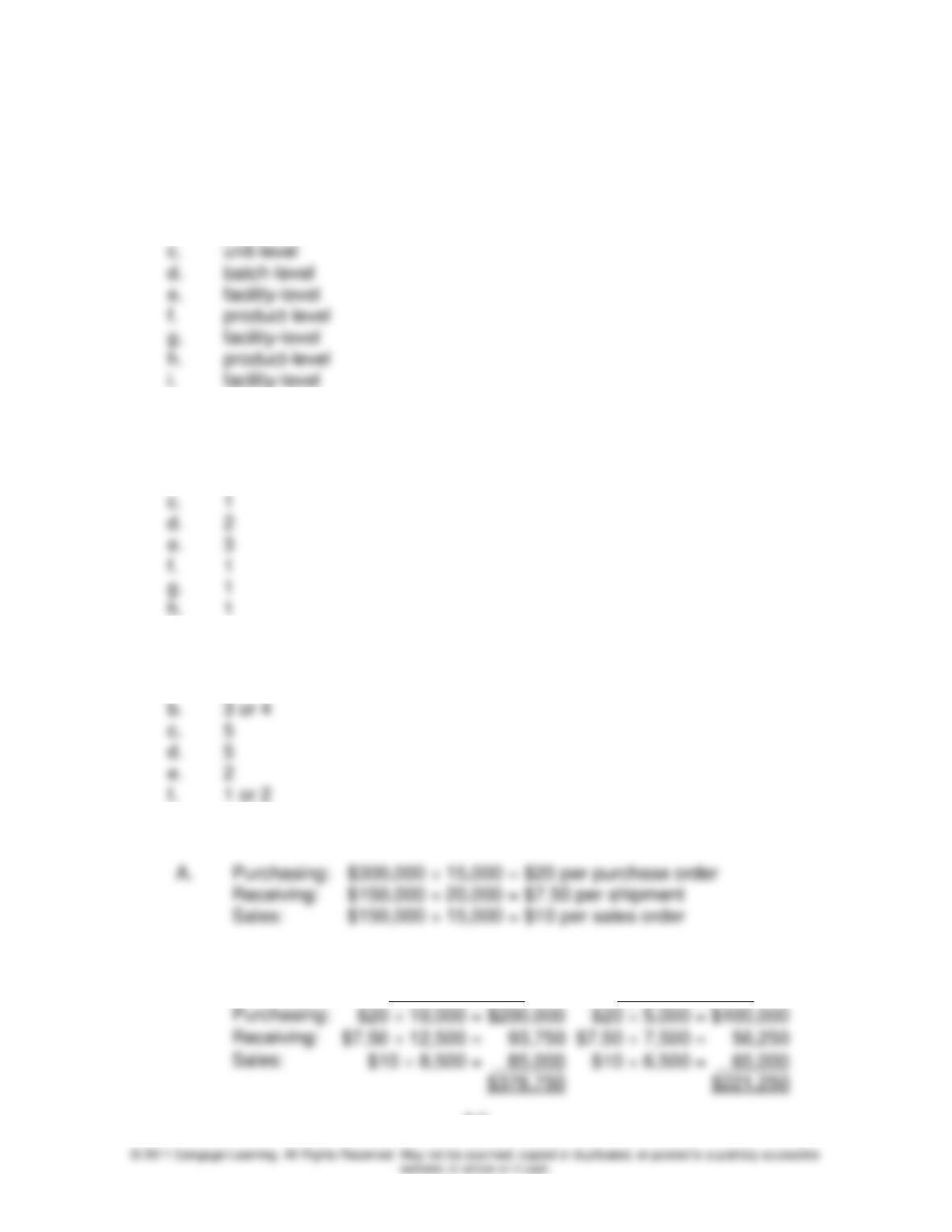
A.
Purchasing:
$150,000 ÷ 15,000 = $10 per sales order
Receiving:
Sales:
Chapter 5: Activity-Based Costing
5-3
Exercises
1. (LO 1—Cost classifications)
a. batch-level
b. product-level
2. (LO 2—ABC activities and cost drivers)
a. 1
b. 1
3. (LO 2—ABC activities and cost drivers)
a. 3
4. (LO 3—ABC overhead calculation)
B.
Small Umbrellas
Large Umbrellas
5-4
5. (LO 3—ABC overhead calculation)
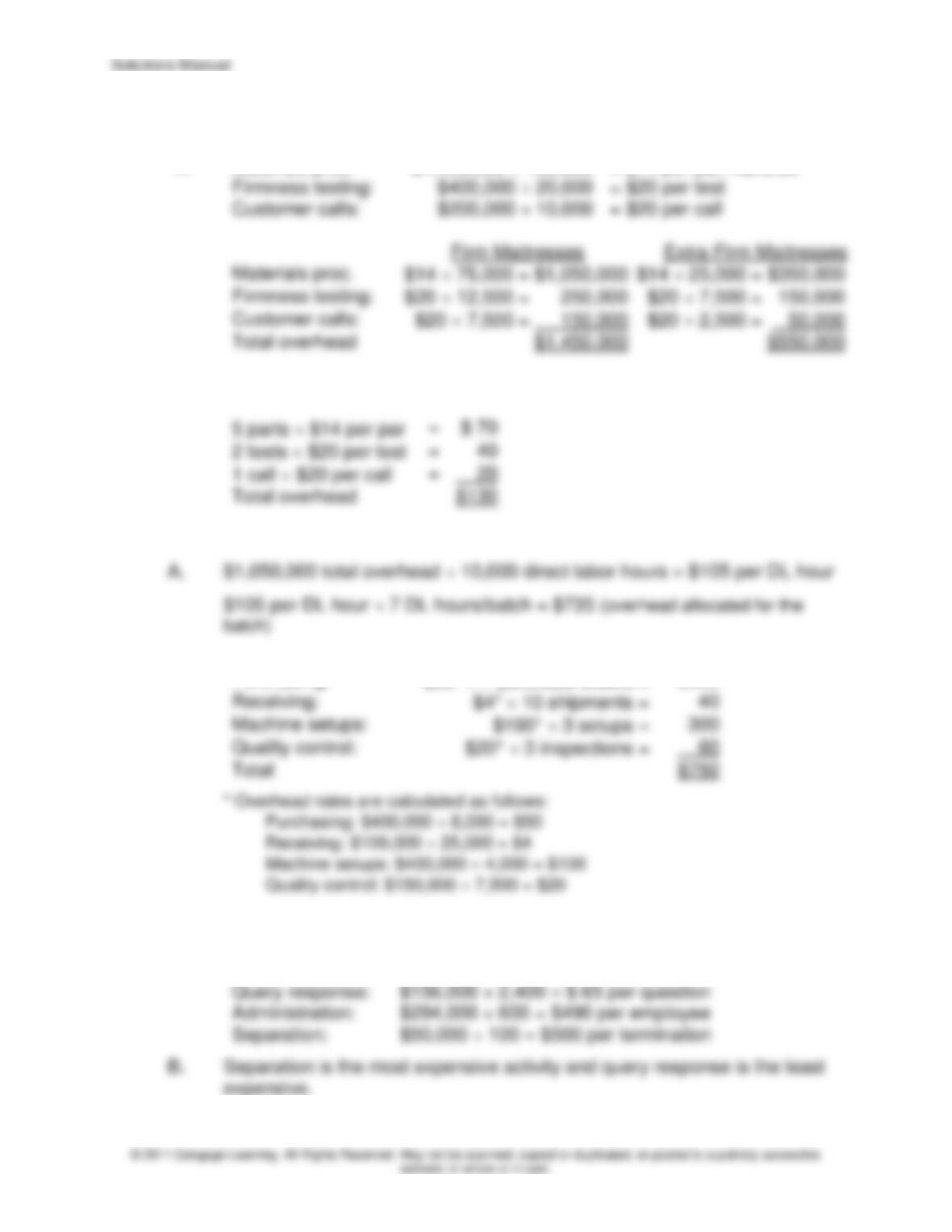
A.
Materials proc.
$1,400,000 ÷ 100,000
= $14 per part handled
Firmness testing:
= $20 per test
Customer calls:
= $20 per call
Extra-Firm Mattresses
Firmness testing:
Total overhead
B.
Overhead assigned to a specific mattress:
=
=
Total overhead
$130
6. (LO 3—ABC overhead calculation: Traditional vs. ABC)
B.
Purchasing:
$50* 7 purchase orders =
$350
Machine setups:
Total
$750
7. (LO 2, 3, and 4—ABC overhead calculation)
A.
Recruitment:
$250,000 ÷ 2,000 = $125 per applicant
Query response:
$156,000 ÷ 2,400 = $ 65 per question
Administration:
$294,000 ÷ 600 = $490 per employee
Separation:
$50,000 ÷ 100 = $500 per termination
Chapter 5: Activity-Based Costing
5-5
Problems
8. (LO 2, 3, and 4—ABC: Comparison to traditional costing)
A. $1,664,000 ÷ 50,000 = $33.28 per direct labor hour
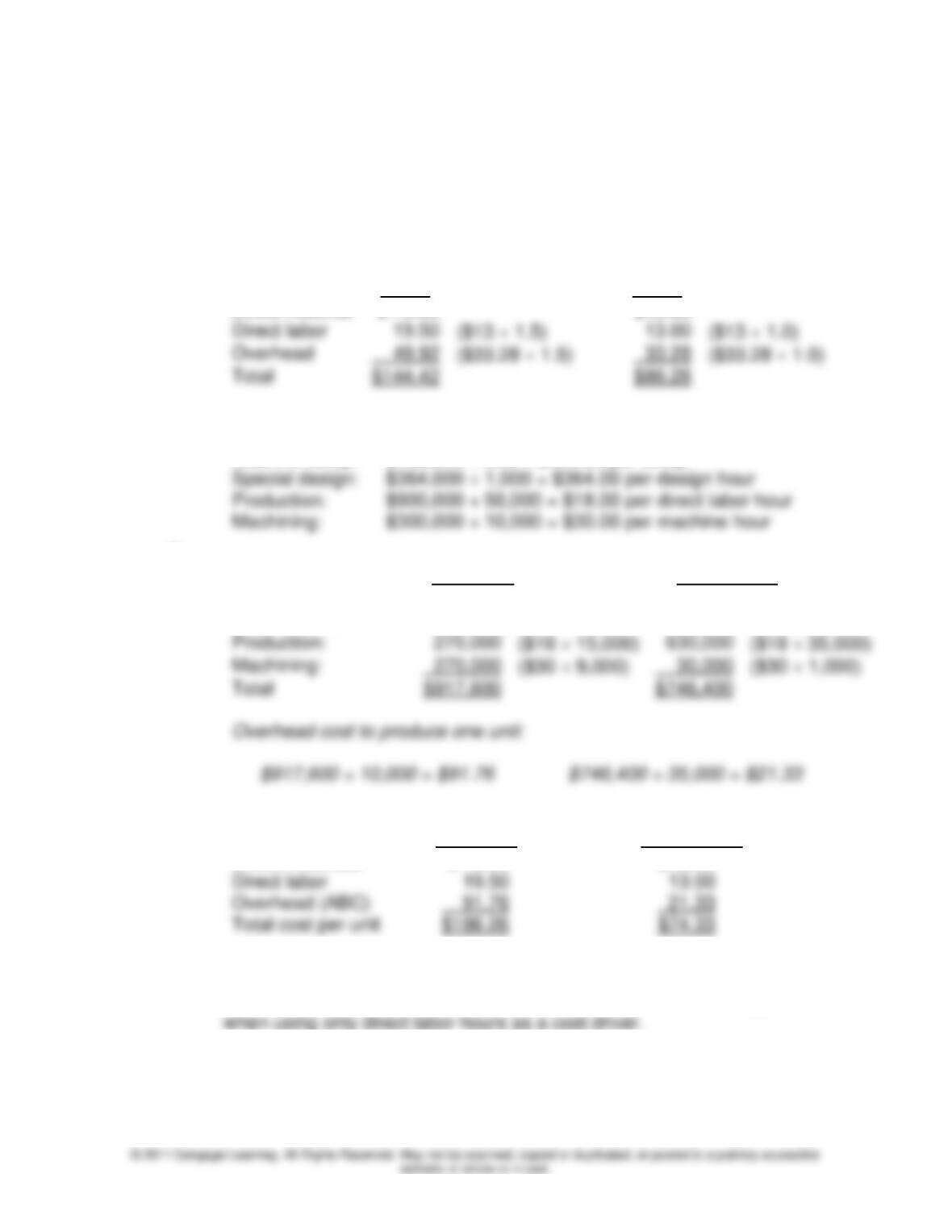
B. Using traditional costing, the cost to produce one unit of each product is:
Big
Board
Small
Board
Direct material
$ 75.00
$40.00
Direct labor
($13 1.5)
($13 1.0)
Overhead
($33.28 1.5)
($33.28 1.0)
C. Using ABC, the overhead rates for each activity center are:
Machine setup:
$100,000 ÷ 200 = $500.00 per setup
Special design:
$364,000 ÷ 1,000 = $364.00 per design hour
Production:
$900,000 ÷ 50,000 = $18.00 per direct labor hour
Machining:
$300,000 ÷ 10,000 = $30.00 per machine hour
D.
Big Board
Small Board
Machine setups:
$ 50,000
($500 100)
$ 50,000
($500 100)
Special design:
327,600
($364 900)
36,400
($364 100)
Machining:
($30 9,000)
($30 1,000)
Total
$746,400
Total cost to produce one unit:
Big Board
Small Board
Direct materials
$ 75.00
$40.00
Direct labor
13.00
Total cost per unit
E. The shift in overhead cost is the result of implementation of the ABC
system. More specifically, the low-volume (and more complex) big board
requires a disproportionate amount of design costs. This fact is ignored
Solutions Manual
5-6
9. (LO 2, 3, and 4—Traditional costing vs. ABC)
A. The conventional costing system allocates overhead costs based solely
on machine hours while the ABC system used by Fairchild, Inc., allocates
B. If prices are based on the cost of the product, profits will be lower using