ACCOUNTING, ANALYSIS, AND PRINCIPLES
Accounting
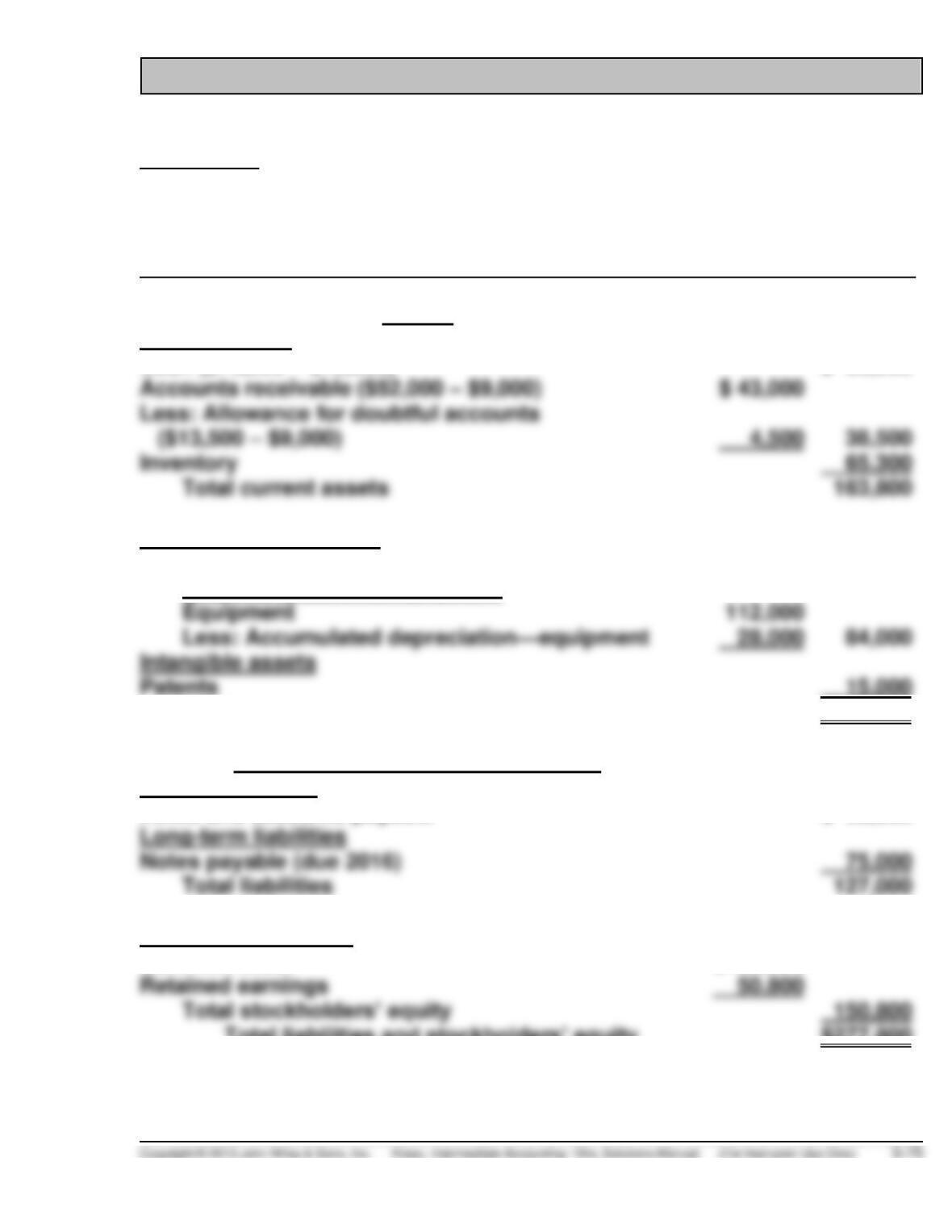
Hopkins Company
Balance Sheet
December 31, 2014
Assets
Current assets
Cash ($75,000 – $15,000)
$ 60,000
Inventory
65,300
Total current assets
Long-term investments
Bond sinking fund
15,000
Property, plant, and equipment
Equipment
Less: Accumulated depreciation—equipment
84,000
Intangible assets
Patents
15,000
Total assets
$277,800
Liabilities and Stockholders’ Equity
Current liabilities
Notes and accounts payable
$ 52,000
Long-term liabilities
Notes payable (due 2016)
75,000
Total liabilities
Stockholders’ equity
Common stock
$100,000
Retained earnings
50,800
Total stockholders’ equity
Total liabilities and stockholders’ equity
$277,800
ACCOUNTING, ANALYSIS, AND PRINCIPLES (Continued)
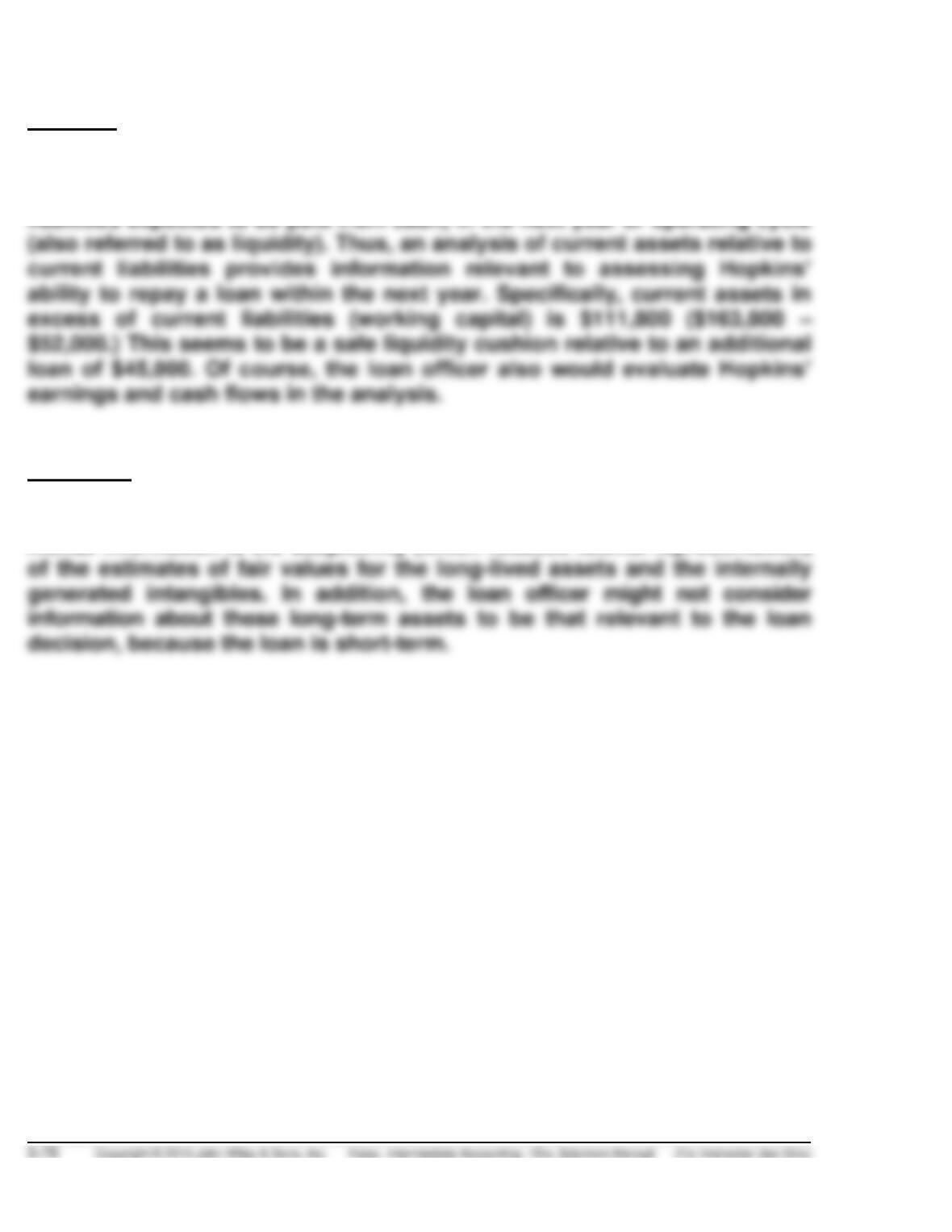
Analysis
The classified balance sheet provides subtotals for current assets and
current liabilities, which are assets expected to be converted to cash (or
Principles
The primary objection that the bank is likely to raise about this supple–
mental information is the subjectivity (which reduces faithful representation)
PROFESSIONAL RESEARCH
(a) Codification String: FASB ASC 235–10–05—Presentation > 235 Notes
(b) Codification String: Presentation > 235 Notes to Financial Statements
> 10 Overall > 05 Background
05-3 The accounting policies of an entity are the specific accounting
principles and the methods of applying those principles that are
(c) Codification String: Presentation > 235 Notes to Financial Statements
> 10 Overall > 50 Disclosure
50-3 Disclosure of accounting policies shall identify and describe the
accounting principles followed by the entity and the methods of
applying those principles that materially affect the determination
of financial position, cash flows, or results of operations. In
general, the disclosure shall encompass important judgments as
PROFESSIONAL RESEARCH (Continued)
(d) 50-4 Codification String: Presentation > 235 Notes to Financial
Statements > 10 Overall > 05 Background
Examples of disclosures by an entity commonly required with
respect to accounting policies would include, among others,
PROFESSIONAL SIMULATION
FINANCIAL STATEMENT
SOLO HOPE COMPANY
Balance Sheet
December 31, 2014
Assets
Current assets
Cash ($50,000 – $20,000) ………………………………….
$ 30,000
Accounts receivable ($38,500 + $13,500) …………..
Less: Allowance for doubtful accounts ………..
Inventory ……………………………………………………….
65,300
Total current assets …………………………………….
Long-term investments
Plant expansion fund ………………………………………
20,000
Property, plant, and equipment
Equipment ………………………………………………………
Intangible assets
Patents …………………………………………………………..
Total assets ………………………………………………..
Liabilities and Stockholders’ Equity
Current liabilities
Notes payable …………………………………………………
17,000
Accounts payable …………………………..……………….
Income taxes payable ………………………………………
Total current liabilities …………………………………
PROFESSIONAL SIMULATION (Continued)
Long-term liabilities
Bonds payable (9%, due June 30, 2022) ……………
Total liabilities …………………………………………….
Stockholders’ equity
Common stock ($1 par) ……………………………………
50,000
Additional paid-in capital …………………………………
Retained earnings ……………………………………………
ANALYSIS
Z =
Working capital
X 1.2
+
Retained earnings
X 1.4
+
EBIT
X 3.3
Total assets
Total assets
Total assets
+
+
Total assets
+
X 1.4
+
X 3.3
+
X 0.99
+
X 0.6
PROFESSIONAL SIMULATION (Continued)
Hope’s Z-Score is above the “likely–to–fail” level of 1.81 but also below the
unlikely-to-fail value of 3.0. Hope should be concerned about his
company’s situation.
RESEARCH
Search string: “accounting policies” and disclosure
APB 22: Disclosure of Accounting Policies
12. Disclosure of accounting policies should identify and describe the
accounting principles followed by the reporting entity and the methods of
a. A selection from existing acceptable alternatives;
b. Principles and methods peculiar to the industry in which the reporting
Examples of disclosures by a business entity commonly required with respect
to accounting policies would include, among others, those relating to basis
of consolidation, depreciation methods, amortization of intangibles, inventory
IFRS CONCEPTS AND APPLICATION
IFRS5-1
In general, the disclosure requirements related to the statement of financial
position (balance sheet) and the statement of cash flows are much more
IFRS5-2
Among the similarities between IFRS and U.S. GAAP related to statement of
financial position presentation are as follows:
• IAS 1 specifies minimum note disclosures. These must include
information about (1) accounting policies followed, (2) judgments that
IFRS5-3
The IASB and the FASB are working on a project to converge their
standards related to financial statement presentation. This joint project will
establish a common, high-quality standard for presentation of information in
IFRS5-4
Rainmaker Company will report a net revaluation gain of $165,000 ($200,000 –
$35,000), which will be recoded as an adjustment to these assets with the
IFRS5-5
(a) Some of the differences are:
1. Report form and subtotals—Tomkins uses a modified report form
with current liabilities deducted from current assets to determine
net current assets and remaining liabilities deducted from total
assets less current liabilities to arrive at “net assets”. This amount
IFRS5-5 (Continued)
(b) Although there are differences in terminology and some groupings and
subtotals are different, the British balance sheet does group assets and
Note to instructors: A final difference not mentioned above is the “Capital
redemption reserve” account in the Capital and reserves section of
Tomkins’ Balance sheet. This account in the U.K. corresponds to “Additional
Paid-in Capital—Treasury Stock in the U.S. setting.
IFRS5-6
(a) International Accounting Standard 8 covers the disclosure of
accounting policies.
(c) An entity shall select and apply its accounting policies consistently
for similar transactions, other events and conditions, unless an IFRS
specifically requires or permits categorisation of items for which
An entity shall change an accounting policy only if the change:
a. is required by an IFRS; or
IFRS5-6 (Continued)
(d) Disclosure
When initial application of an IFRS has an effect on the current period
or any prior period, or would have such an effect except that it is
impracticable to determine the amount of the adjustment, or might
have an effect on future periods, an entity shall disclose:
a. the title of the IFRS;
b. when applicable, that the change in accounting policy is made in
f. for the current period and each prior period presented, to the
extent practicable, the amount of the adjustment:
(i) for each financial statement line item affected; and
(ii) if IAS 33 Earnings per Share applies to the entity, for basic and
diluted earnings per share;
g. the amount of the adjustment relating to periods before those
IFRS5-6 (Continued)
When a voluntary change in accounting policy has an effect on the
current period or any prior period, would have an effect on that period
except that it is impracticable to determine the amount of the
adjustment, or might have an effect on future periods, an entity shall
disclose:
a. the nature of the change in accounting policy;
b. the reasons why applying the new accounting policy provides
Financial statements of subsequent periods need not repeat these
disclosures (para. 29).
IFRS5-7
(a) M&S could have adopted the account form or report form. M&S uses
the report form.
(b) The techniques of disclosing pertinent information include
(c) Investments are reported on M&S’s statement of financial position as
non-current assets. Note 1 (Accounting Policies) states that Invest–
IFRS5-7 (Continued)
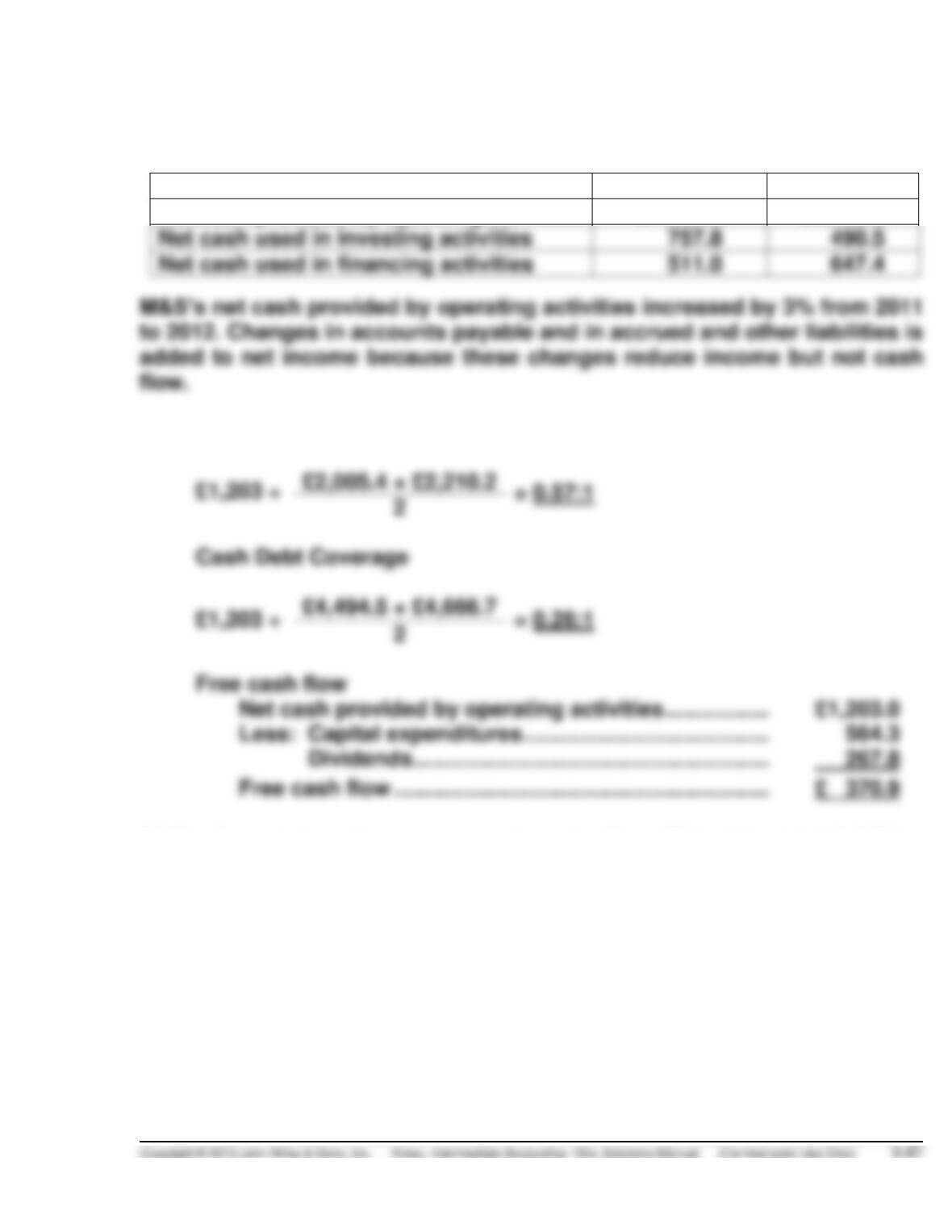
(d) The following table summarizes M&S’s cash flows from operating,
investing, and financing activities in 2012 and 2011 (in millions).
2012
2011
Net cash provided by operating activities
£1.203.0
£1,199.9
Net cash used in investing activities
490.5
Net cash used in financing activities
647.4
(e) Current Cash Debt
M&S’s financial position appears adequate. Over 26% of its total liabilities
can be covered by the current year’s operating cash flow and its free cash
flow position indicates it is easily meeting its capital investment demands
and the current level of dividends from current free cash flow.