5 – 1
Chapter 5
Plant Tissues and the Multicellular Plant Body
CHAPTER OUTLINE
Plants’ structure and life span
Cells and tissues of the plant body
The ground tissue system is composed of three simple tissues
Parenchyma cells have thin primary cell walls
Plant meristems
Primary growth takes place at apical meristems
Secondary growth takes place at lateral meristems
Plants in the Environment: Plant Life-History Strategies
CHAPTER OBJECTIVES
1. Discuss the plant body, including the root system and shoot system.
2. Describe the ground tissue system (parenchyma tissue, collenchyma tissue, and
LECTURE OUTLINE
I. Distinguish between annual, biennial, perennial, herbaceous, and woody plants.
II. What are the two systems that make up the plant body? What organs comprise each
system?
III. What are the three tissue systems found in plants?
A. What is a tissue?
B. What is the difference between simple and complex tissues?
D. What two types of complex tissues make up the vascular tissue system?
1. What is the function of the xylem tissue?
a. What kinds of cells are found in the xylem tissue?
2. What is the function of phloem tissue?
a. What kinds of cells are found in phloem tissue of flowering
plants?
e. Are any of the phloem cells dead at maturity?
E. What two complex tissues make up the dermal tissue system?
1. What kinds of cells are found in the epidermis?
a. What the functions of these cells?
IV. Where does plant growth occur?
A. What three processes are involved in plant growth? Explain each one.
B. What is different about the location of growth in plants compared to animals?
2. How does the plant body change due to primary growth?
KEY TERMS
annual, p. 92
apical meristem, p. 105
biennial, p. 92
bud, p. 106
lateral meristem, p. 107
leaf primordium, p. 106
meristem, p. 105
organ, p. 94
secondary cell wall, p. 94
secondary growth, p. 105
shoot system, p. 92
sieve plate, p. 99
TEACHING TIPS
1. Discuss the relation between form and function of plant cells.
2. Have students consider the structural differences between tracheids and vessel elements, then ask
them which they would expect to be more efficient at supplying water to the above–ground parts
of the plant. Someone is bound to make the comment that vessels must be better because they are
larger in diameter and have open ends. Now ask why conifers and other gymnosperms which
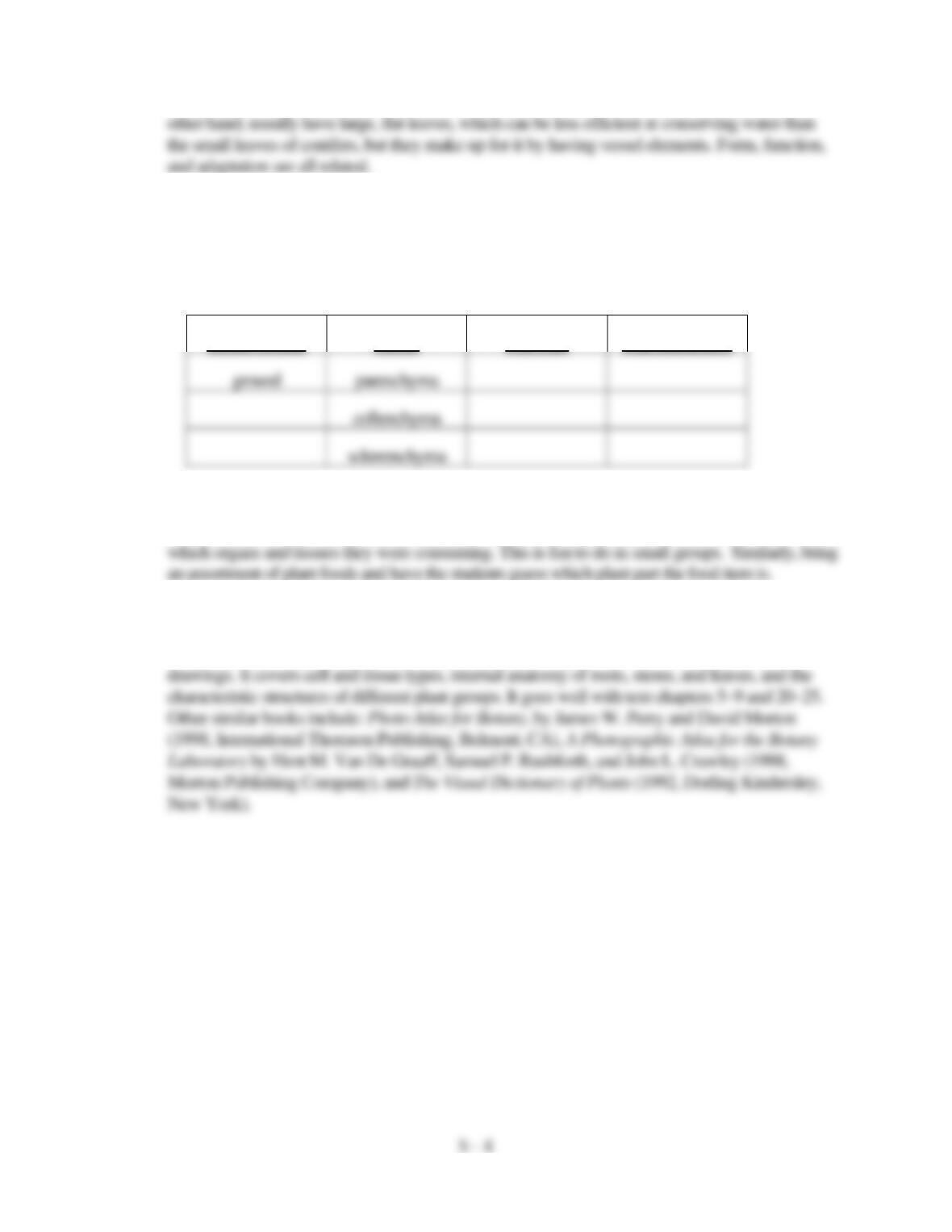
3. Many students have trouble keeping track of all of the terms for cells and tissues. Prepare a table for
the students to complete in order to help them to sort all of the terms apart. Such a table might look
like this (only a partial table is included here). The table could be completed as a group project in
class and the answers shared at the end, or it could be used as a homework assignment.
Tissue system
Tissue
Cell type
Cell function(s)
4. Ask students to list several plant foods they have eaten in the past day, and then try to determine
5. An excellent book to have available in the lab room is An Atlas of Plant Structure, Vol. 1 by
Brian Bracegirdle and Patricia H. Miles (1971, Heinemann Educational Books, Ltd, London). It
is a pictorial reference of plant structure with photomicrographs and accompanying line