SOLUTIONS TO CONCEPTS FOR ANALYSIS
CA 5-1
1. The new estimate would be used in computing depreciation expense for 2014. No adjustment of
the balance in accumulated depreciation at the beginning of the year would be made. Instead, the
2. The additional assessment should be shown on the current period’s income statement. If material
it should be shown separately; if immaterial it could be included with the current year’s tax
expense. This transaction does not represent a prior period adjustment.
3. The effect of the error at December 31, 2013, should be shown as an adjustment of the beginning
4. Generally, an entry is made for a cash dividend on the date of declaration. The appropriate
CA 5-2
1. Unclaimed payroll checks should be shown as a current liability if these are claims by employees.
2. Debt investments (trading) should be reported at fair value, not cost.
6. Land should not be depreciated.
7. Buildings and equipment and their related accumulated depreciation balances should be separately
disclosed.
CA 5-3
Criticisms of the balance sheet of the Sameed Brothers Corporation:
1. The basis for the valuation of marketable securities should be shown. Marketable securities are
valued at fair value. In addition, they should be classified as either trading securities, available-for-
sale securities, or held-to-maturity securities.
4. A stock investment in a subsidiary company is not ordinarily held to be sold within one year or the
5. Treasury stock is not an asset. It should be presented as a deduction in the shareholders’ equity
section of the balance sheet. The class of stock, number of shares, and basis of valuation should
be indicated.
“Investments.”
8. Reserve for Income Taxes should appropriately be entitled Income Tax Payable.
9. Customers’ Accounts with Credit Balances is an immaterial amount. As such, this account need
not be shown separately. The $1,000 credit could readily be netted against Accounts Receivable
without any material misstatement.
13. Earned Surplus should appropriately be entitled Retained Earnings. Also, a separate heading
should be shown for this account; it should not be shown under the heading “Common Stock.” A
more appropriate heading would be “Shareholders’ Equity.”
CA 5-4
(a). The ethical issues involved are integrity and honesty in financial reporting, full disclosure, and the
accountant’s professionalism.
(b). While presenting property, plant, and equipment net of depreciation on the balance sheet may be
acceptable under GAAP, it is inappropriate to attempt to hide information from financial statement
users. Information must be useful, and the presentation Keene is considering would not be. Users
CA 5-5
Date
President Kappeler, CEO
Kappeler Corporation
125 Wall Street
Middleton, Kansas 67458
Dear Mr. Kappeler:
I have good news and bad news about the financial statements for the year ended December 31, 2014.
The good news is that net income of $100,000 is close to what we predicted in the strategic plan last
The corporation made significant investments in equipment and land. These were paid from cash
reserves. These purchases used 75% of the company’s cash. In addition, the redemption of the bonds
improved the equity of the corporation and reduced interest expense. However, it also used 25% of the
corporation’s cash. It is normal to use cash for investing and financing activities. But when cash is used,
it must also be replenished.
CA 5-5 (Continued)
There are several possible remedies for the current cash problem. First, prepare a detailed analysis of
monthly cash requirements for the next year. Second, investigate the changes in accounts receivable
and inventory and work to return them to more normal levels. Third, look for more favorable terms with
FINANCIAL REPORTING PROBLEM
(a) P&G could use the account form or report form. P&G uses the account
form.
(b) The techniques of disclosing pertinent information include (1) paren-
schedules.
(c) While there are no Investments reported on P&G’s balance sheet, Note 1
(Significant Accounting Policies) states that Investments are readily
marketable debt and equity securities. These securities are reported at
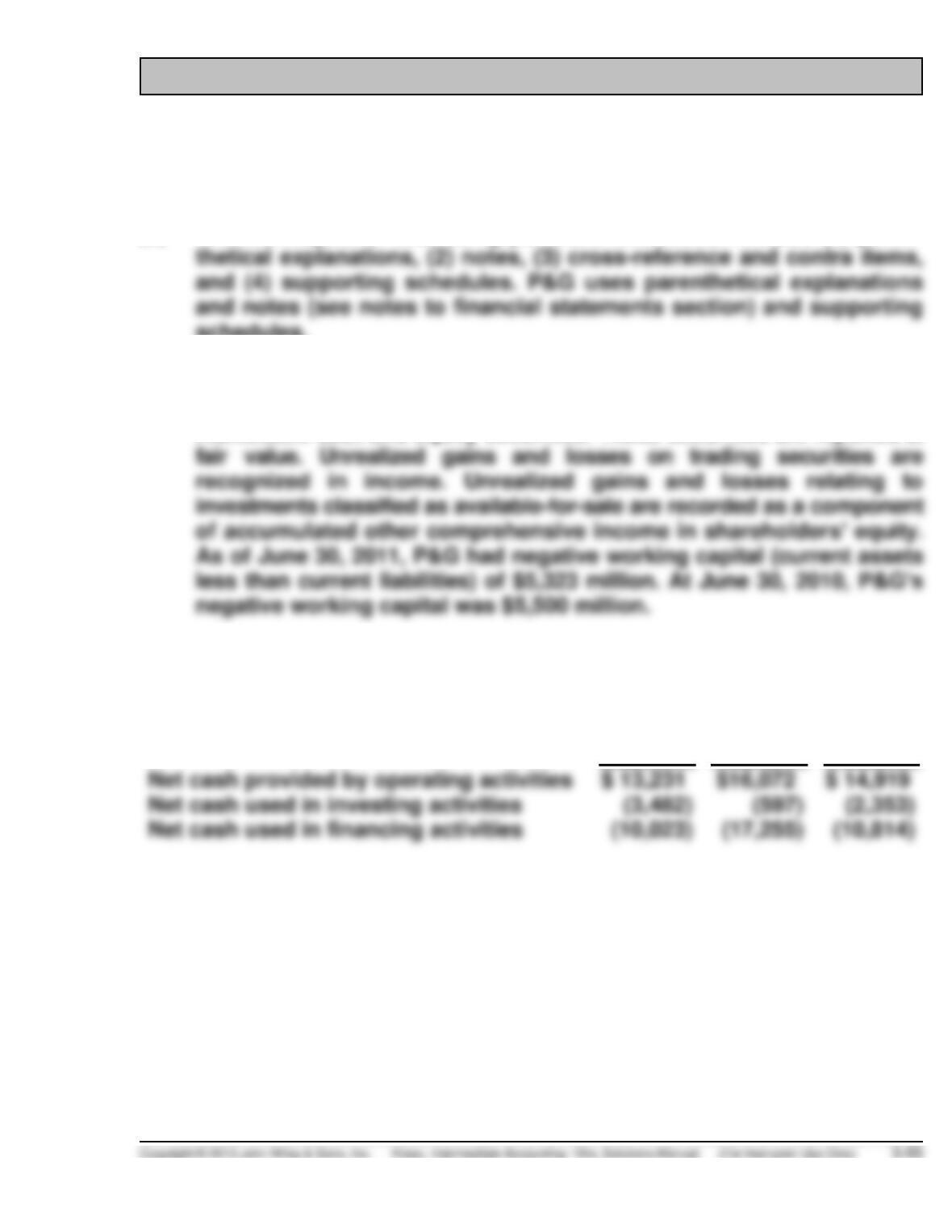
(d) The following table summarizes P&G’s cash flows from operating,
investing, and financing activities in the 2009–2011 time period
(in millions).
2011
2010
2009
Net cash used in financing activities
FINANCIAL REPORTING PROBLEM (Continued)
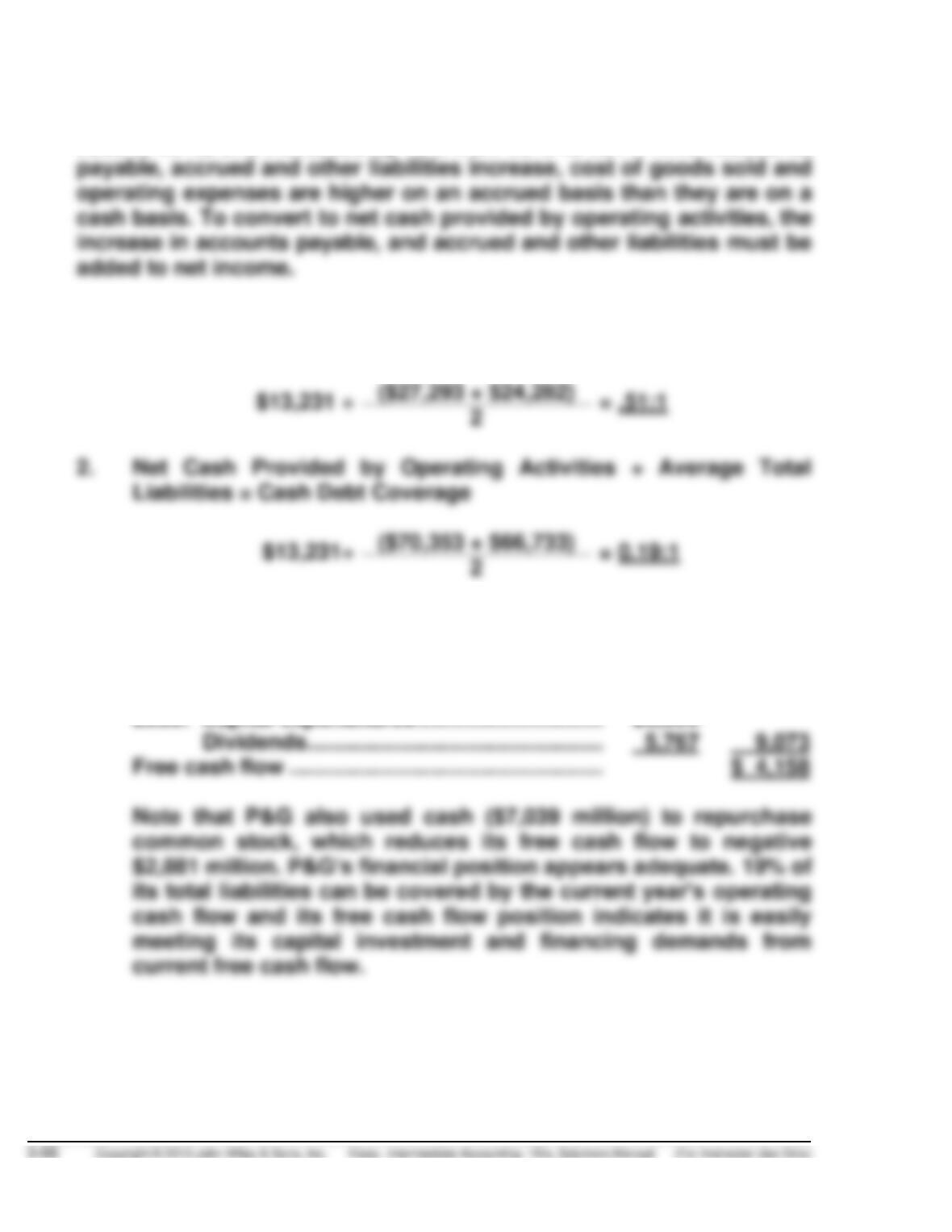
P&G’s net cash provided by operating activities increased slightly from
2009 to 2010, and increased by 18% from 2010 to 2011. When accounts
(e) 1. Net Cash Provided by Operating Activities ÷ Average Current
Liabilities = Current Cash Debt Coverage
3. Net cash provided by operating activities less capital expenditures
and dividends
Net cash provided by operating activities …….
$13,231
Less: Capital expenditures …………………………
$3,306
Free cash flow …………………………..……………….
$ 4,158
COMPARATIVE ANALYSIS CASE
(a) Both the Coca-Cola Company and PepsiCo, Inc. use the report form.
(b) The Coca-Cola Company has working capital of $1,214 million
($25,497 million – $24,283 million): PepsiCo, Inc. has working capital of
(c) The most significant difference relates to intangible assets. The Coca–
Cola Company has Trademarks, Goodwill, and Other Intangible Assets
(d)
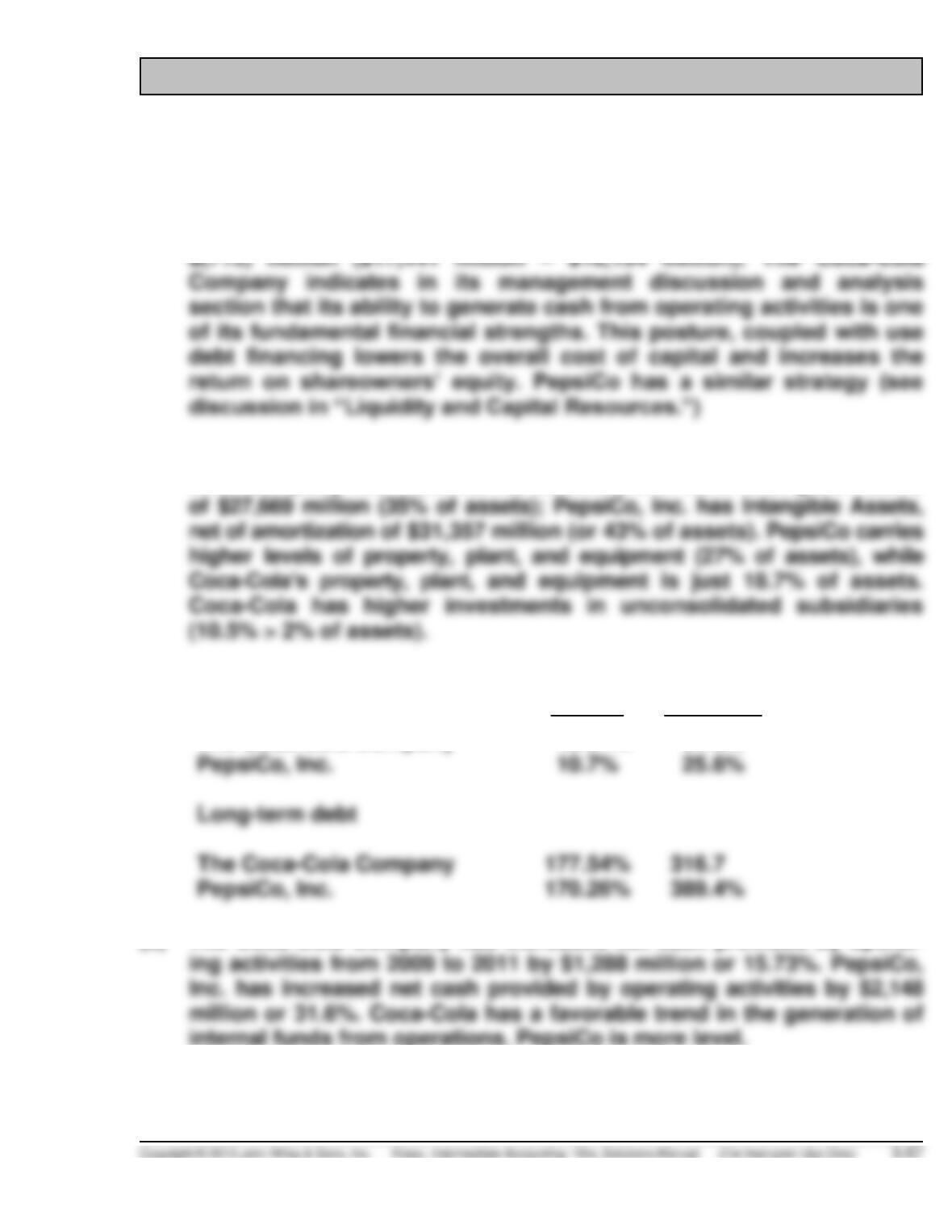
Total assets
Annual
Five-Year
The Coca-Cola Company
49.81%
84.8%
PepsiCo, Inc.
10.7%
25.6%
Long-term debt
The Coca-Cola Company
PepsiCo, Inc.
(e) The Coca-Cola Company has increased net cash provided by operat–
internal funds from operations. PepsiCo is more level.
COMPARATIVE ANALYSIS CASE (Continued)
(f) The Coca-Cola Company
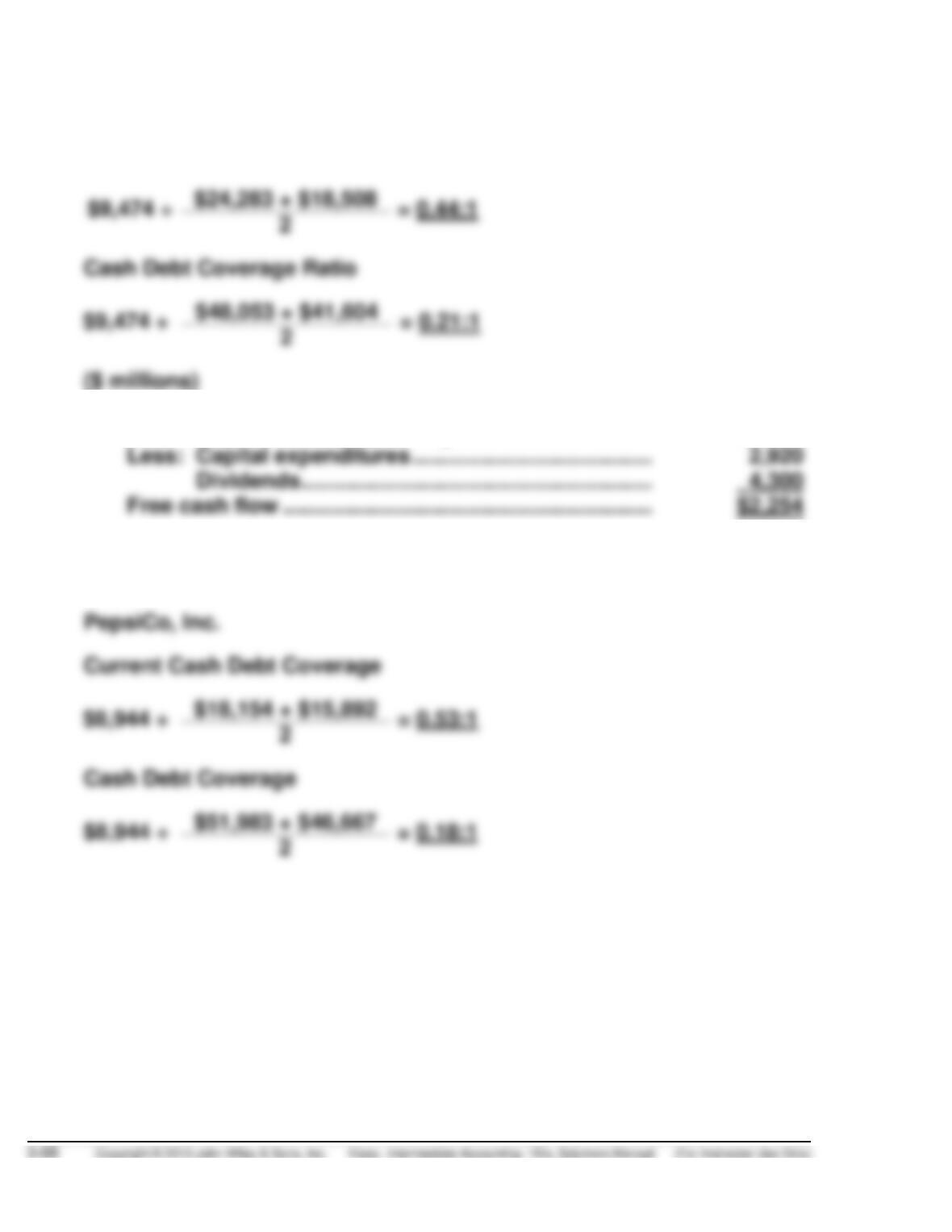
Current Cash Debt Ratio
Free cash flow
Net cash provided by operating activities …………….
$9,474
Less: Capital expenditures …………………………………
Coca-Cola Company’s free cash flow is $2,254. Note that Coca-Cola is
also using cash to repurchase shares ($4,513 million in 2011).
COMPARATIVE ANALYSIS CASE (Continued)
Free cash flow
Net cash provided by operating activities ……………….
$8,944
Less: Capital spending …………………………………………
FINANCIAL STATEMENT ANALYSIS CASE 1
(a) The raw materials price increase is not a required disclosure. However,
the company might well want to inform shareholders in the management
discussion and analysis section, especially as a means for company
(b) The information in item (2) should be reported as follows: The $4,000,000
outstanding should, of course, be included in the balance sheet as a
FINANCIAL STATEMENT ANALYSIS CASE 2
(a) These accounts are shown in the order in which Sherwin-Williams
actually presented the accounts. The order shown may be modified
somewhat; however, cash should certainly be listed first and other
than that shown.
CURRENT ASSETS
Cash and cash equivalents
Short-term investments
LONG-TERM ASSETS
Land
Buildings
Machinery and equipment
Intangibles and other assets
CURRENT LIABILITIES
Accounts payable
LONG-TERM LIABILITIES
Long-term debt
Postretirement obligations other than pensions
Other long-term liabilities
FINANCIAL STATEMENT ANALYSIS CASE 2 (Continued)
(b) There is some latitude for judgment in this question. The general
answer is that the assets and liabilities specific to the automotive
division will decrease and that cash will increase. Some students may
be aware that retained earnings will increase or decrease, depending
upon whether the assets were sold above or below historical cost.
Finished goods inventories—decrease
Work in process and raw materials inventories—decrease
Long-term debt—decrease
Retained earnings—increase or decrease, depending on whether
the assets were sold above or below cost
FINANCIAL STATEMENT ANALYSIS CASE 3
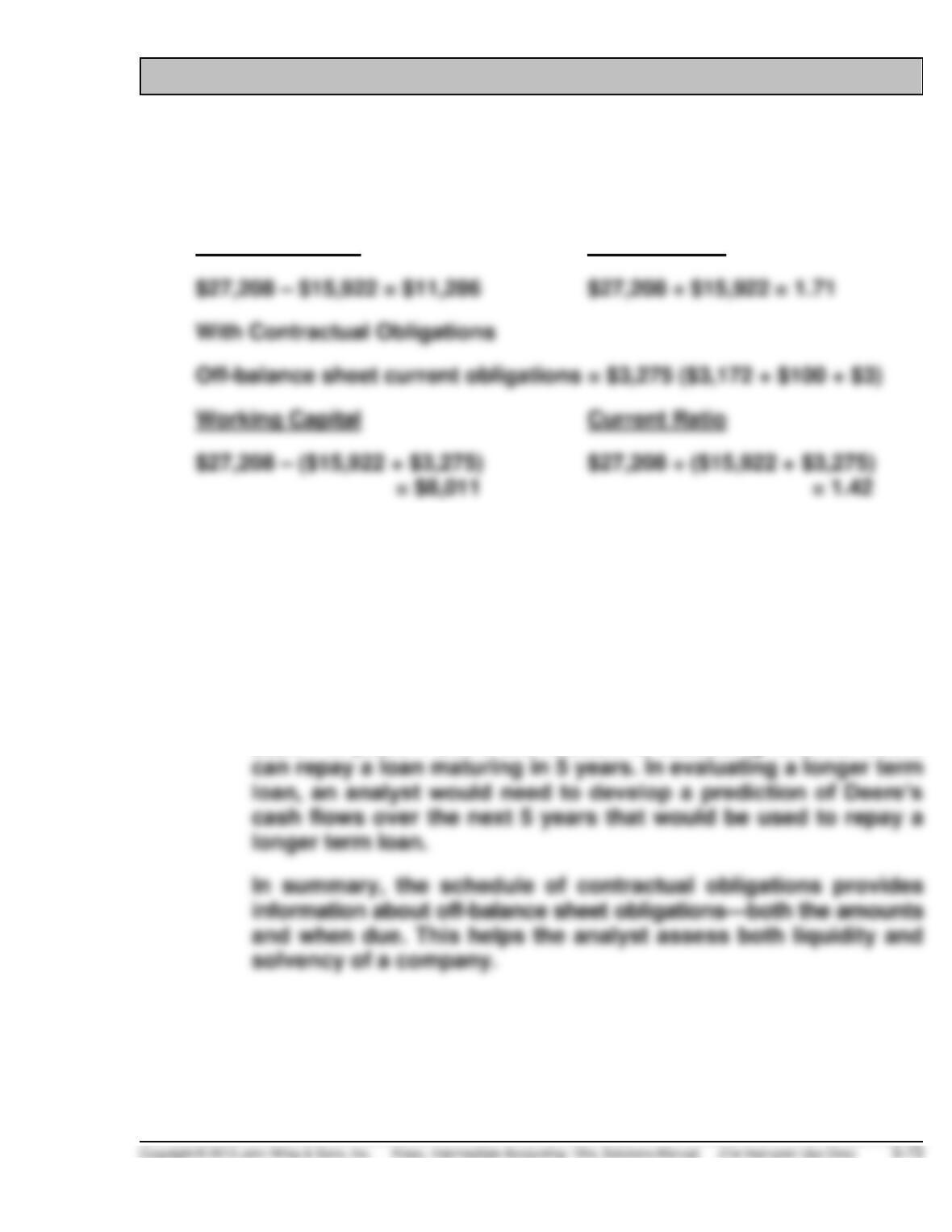
(a) Working Capital, Current Ratio
Without Contractual Obligations
Working Capital Current Ratio
Without information on contractual obligations, an analyst would
overstate Deere’s liquidity, as measured by working capital and the
current ratio.
(b) 1. Based on the analysis in Part (a), Deere has a pretty good liquid-
ity cushion. It would be able to pay a loan of up $8,011 billion, if
due in one year.
2. Additional contractual obligations of $8,600 in years 2 and 3 and
$3,631 in years 4 and 5 are relevant to assessing whether Deere
FINANCIAL STATEMENT ANALYSIS CASE 4
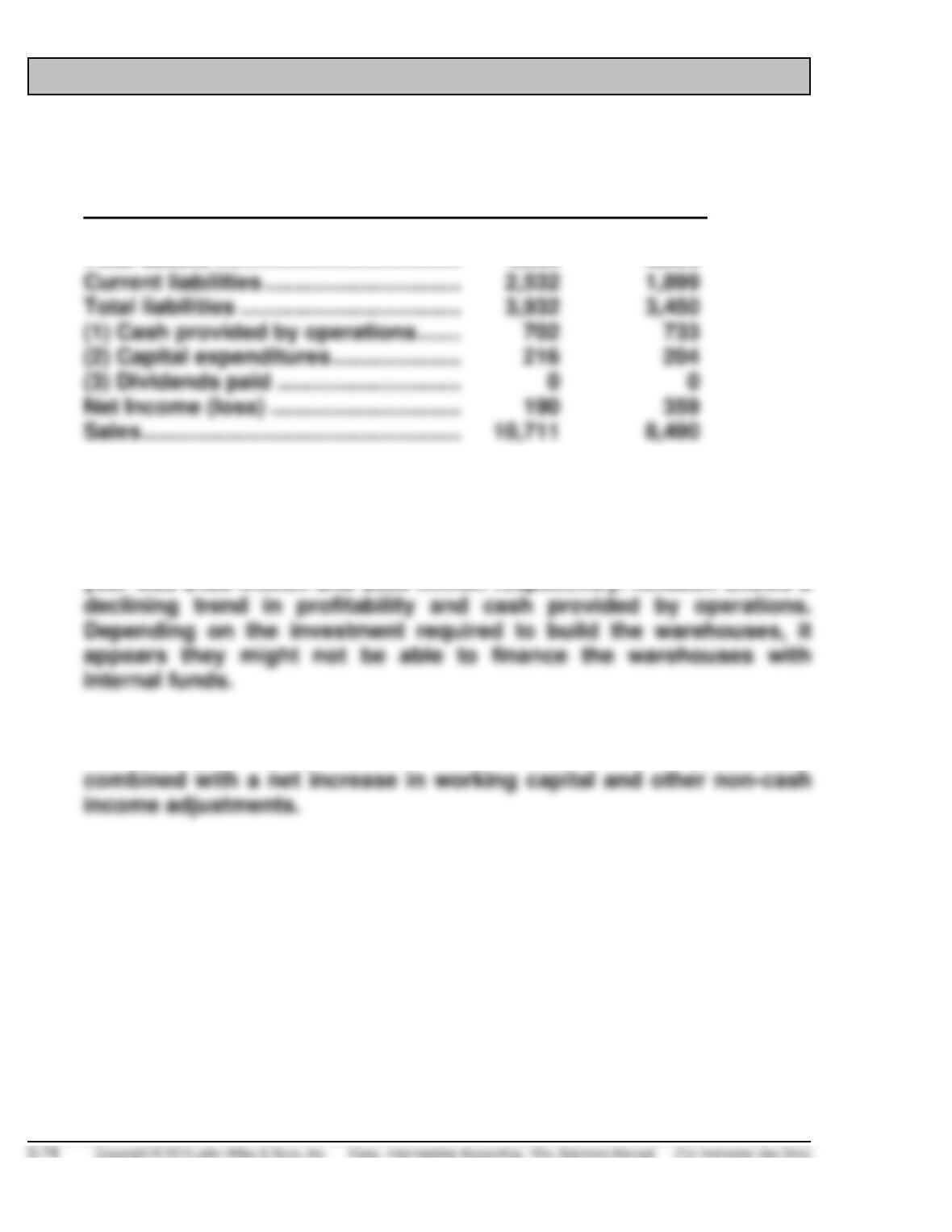
(a) ($ in millions) Current Prior
Year Year
Current assets ……………………………… $3,373 $2,929
Total assets …………………………………. 4,363 3,696
Free Cash Flow …………………………….. 486 529
(1) – (2) – (3)
As indicated above, Amazon’s free cash flow in the current and prior
year was $486 million and $529 million respectively. Amazon shows a
(b) Cash provided by operations has decreased in current year relative to
the prior year by $31 million. This is due to lower profitability