PROBLEM 5.53
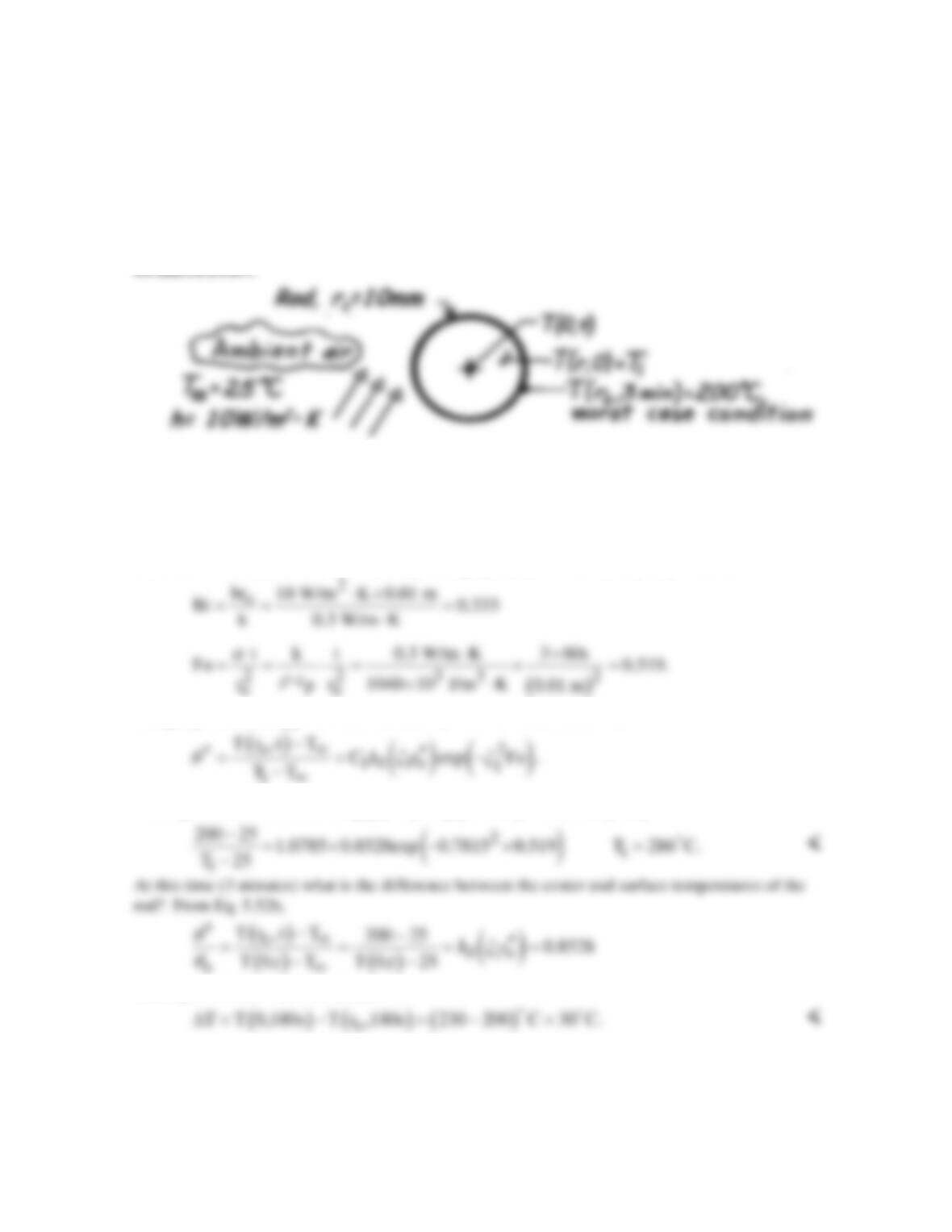
KNOWN: Long plastic rod of diameter D heated uniformly in an oven to Ti and then allowed to
convectively cool in ambient air (T∞, h) for a 3 minute period. Minimum temperature of rod should
not be less than 200°C and the maximum-minimum temperature within the rod should not exceed
10°C.
FIND: Initial uniform temperature Ti to which rod should be heated. Whether the 10°C internal
temperature difference is exceeded.
SCHEMATIC:
ASSUMPTIONS: (1) One-dimensional radial conduction, (2) Constant properties, (3)
Uniform and constant convection coefficients.
PROPERTIES: Plastic rod (given): k = 0.3 W/m⋅K, ρcp = 1040 kJ/m3⋅K.
ANALYSIS: For the worst case condition, the rod cools for 3 minutes and its outer surface is at
least 200°C in order that the subsequent pressing operation will be satisfactory. Hence,
Using Eq. 5.52a and
10.7815
ζ
=
rad and C1 = 1.0785 from Table 5.1,
With
o
r 1,
∗=
from Table B.4,
( ) ( )
01 o
J 1 J 0.7815 0.8528,
ζ
×= =
giving
which gives T(0,t) = 230°C. Hence,
Hence, the desired max–min temperature difference sought (10°C) is not achieved.
COMMENTS: ∆T could be reduced by decreasing the cooling rate; however, h can not be made
much smaller. Two solutions are (a) increase ambient air temperature and (b) non–uniformly heat rod
in oven by controlling its residence time.
PROBLEM 5.54
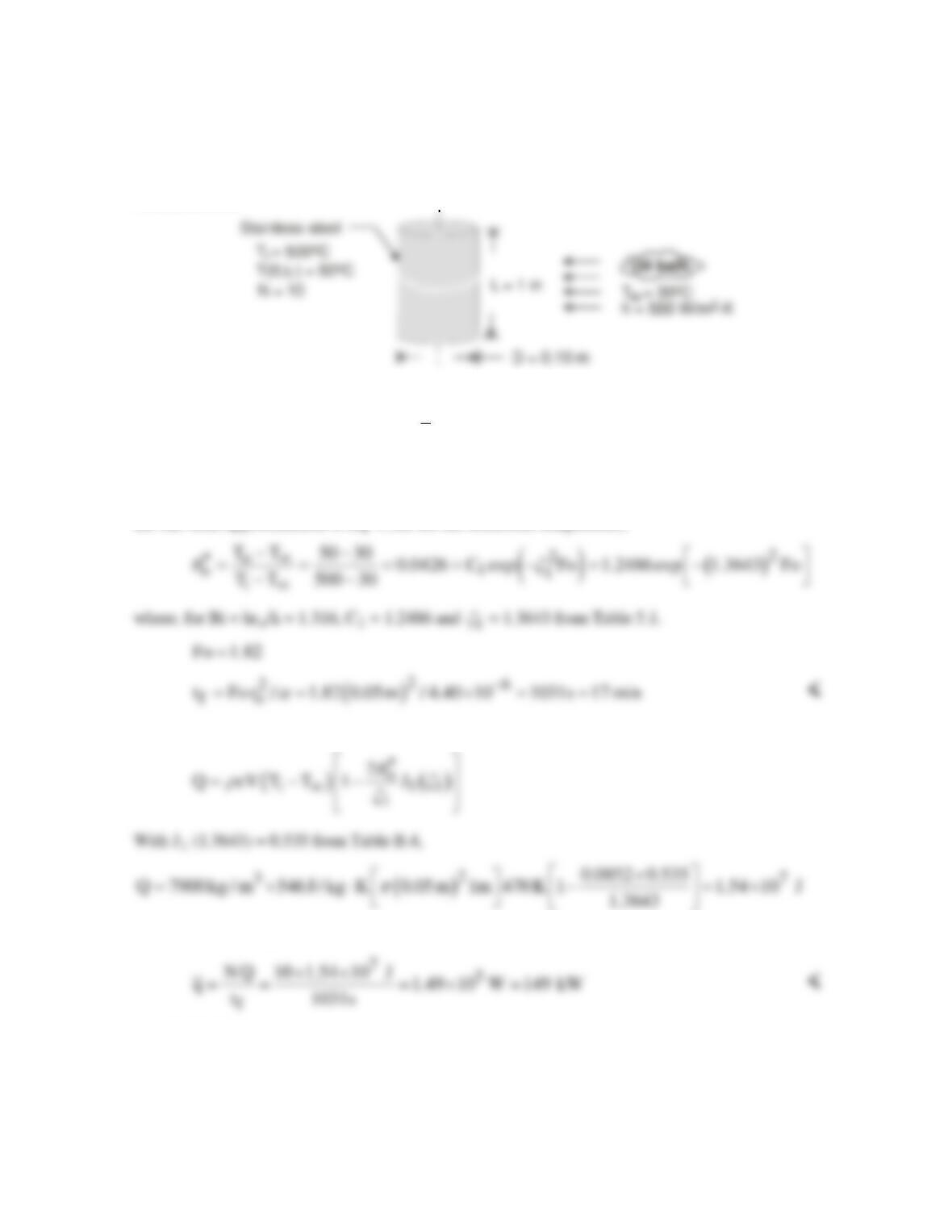
KNOWN: Diameter and initial temperature of roller bearings. Temperature of oil bath and
convection coefficient. Final centerline temperature. Number of bearings processed per hour.
FIND: Time required to reach centerline temperature. Cooling load.
SCHEMATIC:
ASSUMPTIONS: (1) One-dimensional, radial conduction in rod, (2) Constant properties.
PROPERTIES: Table A.1, St. St. 304
( )
T 548K :=
ρ=7900 kg/m3, k = 19.0 W/m⋅K, cp = 546
J/kg⋅K, α = 4.40 × 10⁻⁶ m2/s.
ANALYSIS: With Bi = h (ro/2)/k = 0.658, the lumped capacitance method can not be used. From
the one-term approximation of Eq. 5.52c for the centerline temperature,
From Eqs. 5.47 and 5.54, the energy extracted from a single rod is
The nominal cooling load is
COMMENTS: For a centerline temperature of 50°C, Eq. 5.52b yields a surface temperature of
( )
( ) ( )
o i oo 1
T r , t T T T J 30 C 470 C 0.0426 0.586 41.7 C
∗
∞∞
= + − = °+ °× × = °
θζ
PROBLEM 5.55
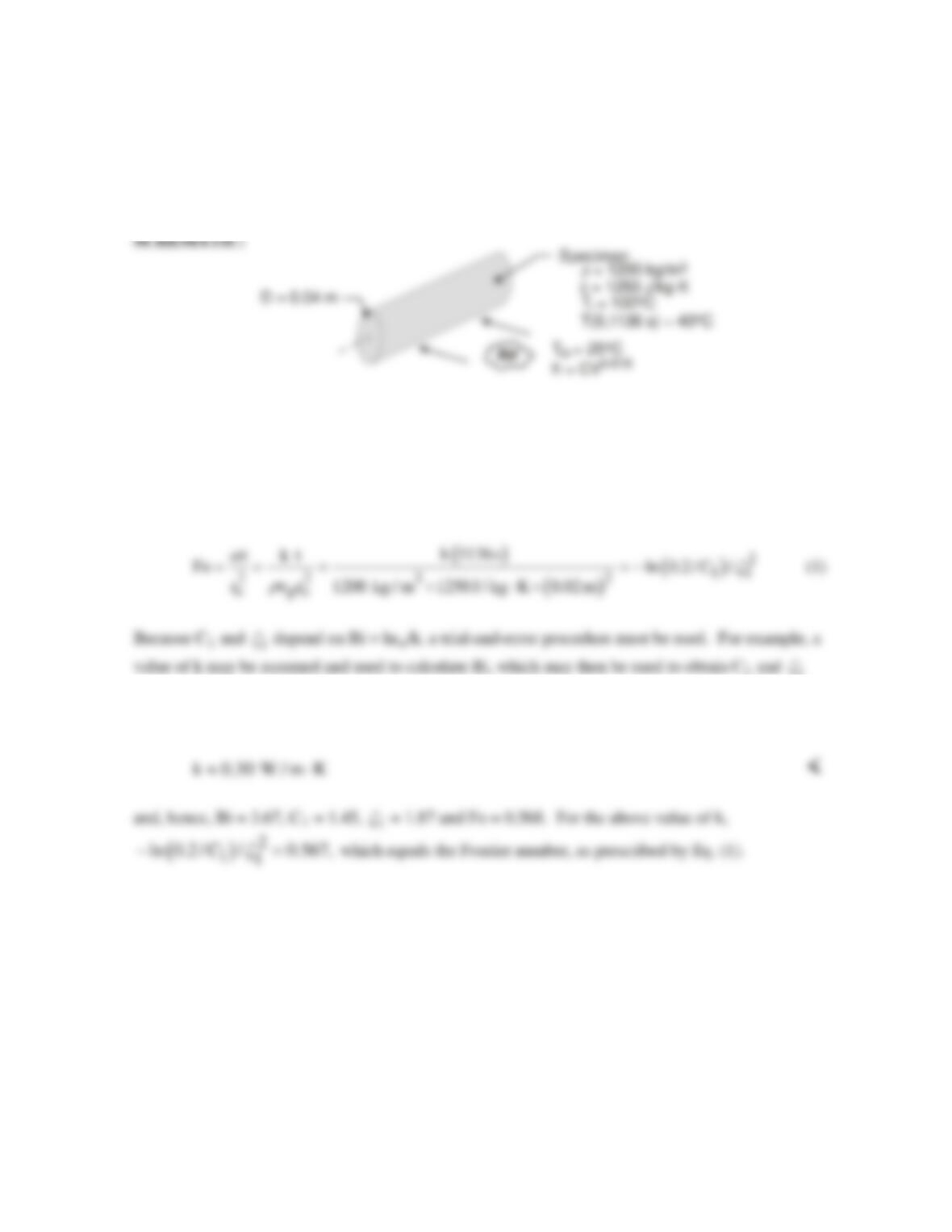
KNOWN: Initial temperature, density, specific heat and diameter of cylindrical rod. Convection
coefficient and temperature of air flow. Time for centerline to reach a prescribed temperature.
Dependence of convection coefficient on flow velocity.
FIND: (a) Thermal conductivity of material, (b) Effect of velocity and centerline temperature and
temperature histories for selected velocities.
ASSUMPTIONS: (1) Lumped capacitance analysis can not be used but one-term approximation for
an infinite cylinder is appropriate, (2) One-dimensional conduction in r, (3) Constant properties, (4)
Negligible radiation, (5) Negligible effect of thermocouple hole on conduction.
ANALYSIS: (a) With
o
θ
∗
=[To(0,1136s) – T∞]/(Ti – T∞) = (40 – 25)/(100 – 25) = 0.20, Eq. 5.52c
yields
1
1
from Table 5.1. Substituting C1 and
1
ζ
into Eq. (1), k may be computed and compared with the
assumed value. Iteration continues until satisfactory convergence is obtained, with
1
ζ
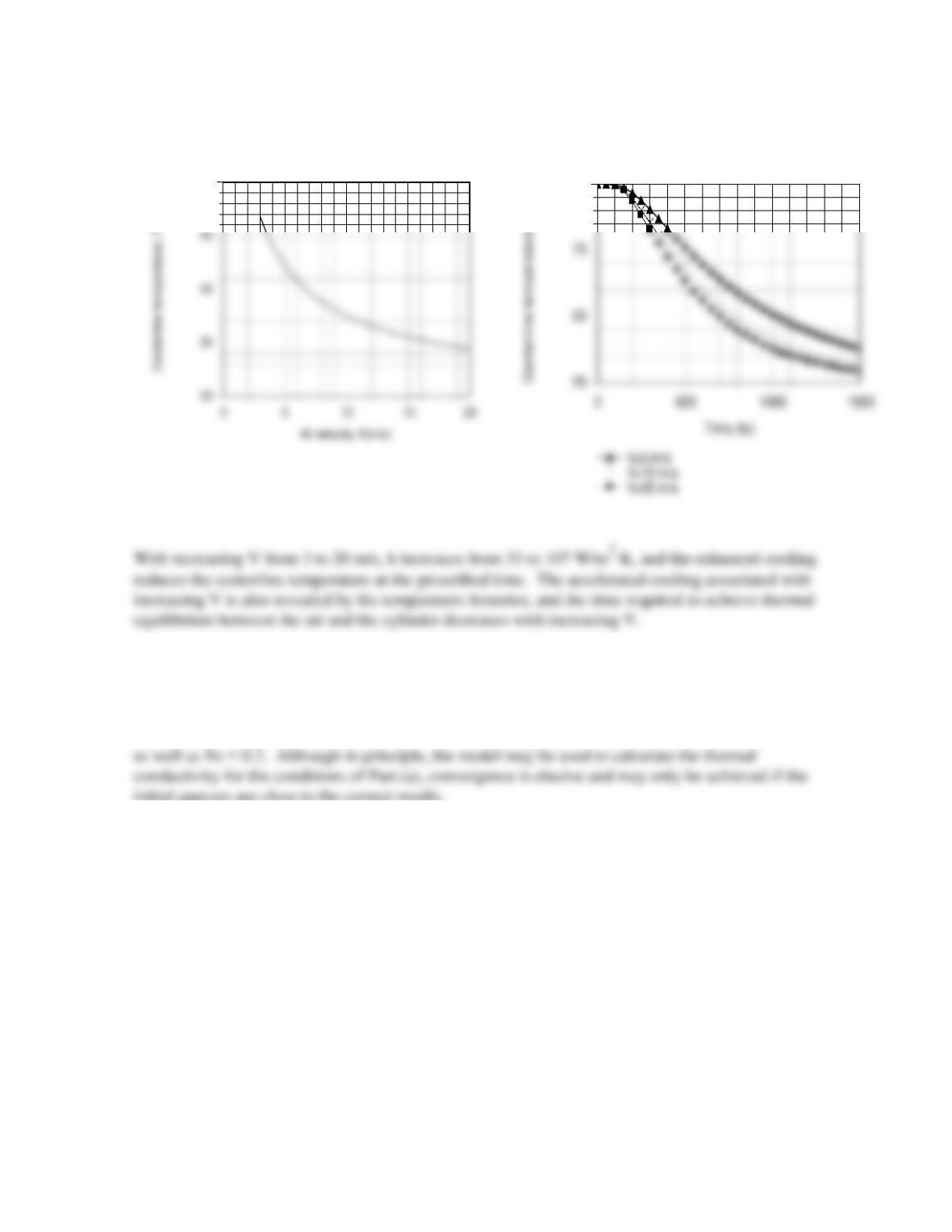
(b) With h = 55 W/m2⋅K for V = 6.8 m/s, h = CV0.618 yields a value of C = 16.8 W⋅s0.618/m2.618⋅K.
The desired variations of the centerline temperature with velocity (for t = 1136 s) and time (for V = 3,
10 and 20 m/s) are as follows:
Continued …..
PROBLEM 5.55 (Cont.)
COMMENTS: (1) For the smallest value of h = 33 W/m2⋅K, Bi ≡ h (ro/2)/k = 1.1 >> 0.1, and use of
the lumped capacitance method is clearly inappropriate.
(2) The IHT Transient Conduction Model for a cylinder was used to perform the calculations of Part
(b). Because the model is based on the exact solution, Eq. 5.50a, it is accurate for values of Fo < 0.2,
50
100
PROBLEM 5.56
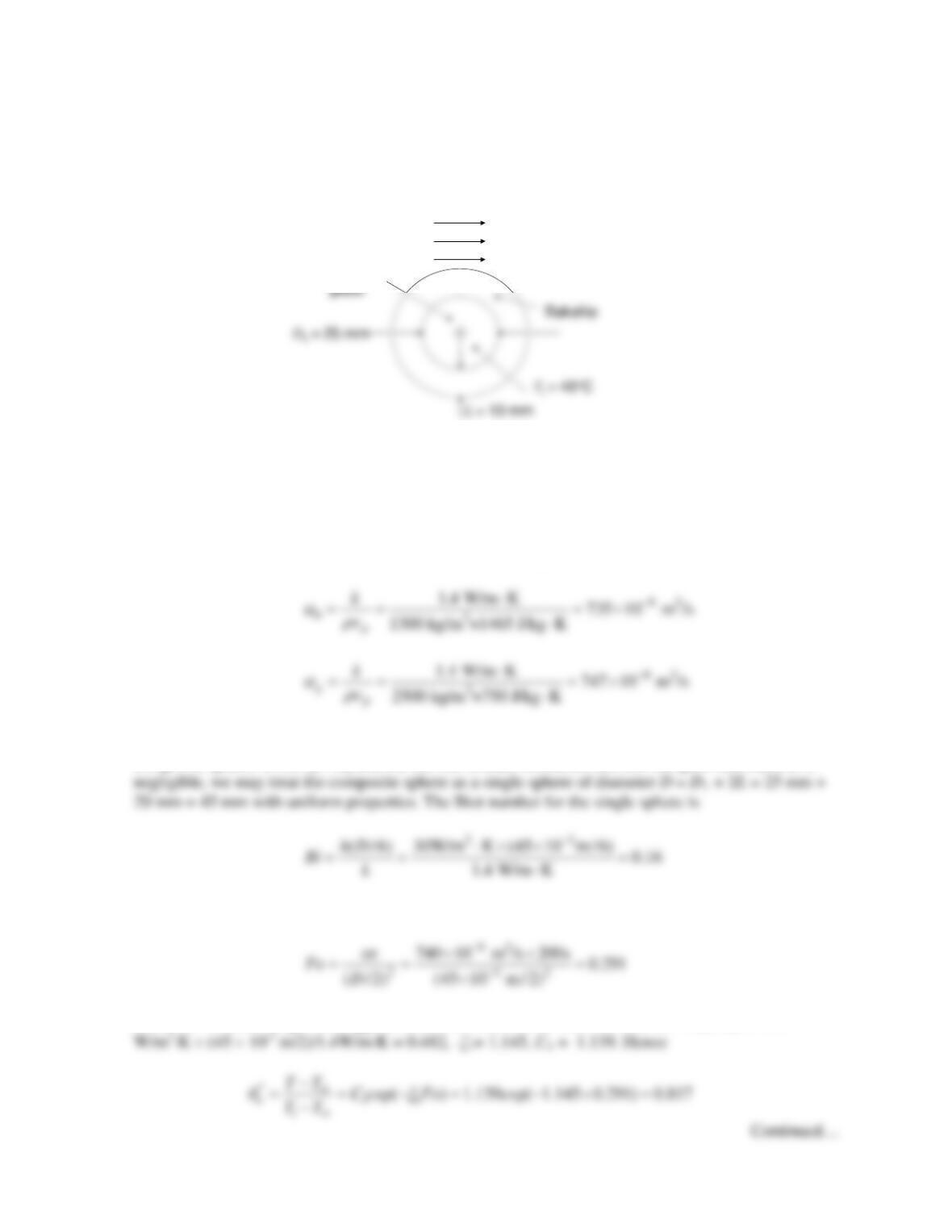
KNOWN: Glass sphere diameter and bakelite shell thickness. Initial solid temperature, fluid
temperature, convection heat transfer coefficient, and heating time.
FIND: Center temperature of glass sphere after specified heating time.
SCHEMATIC:
ASSUMPTIONS: (1) One–dimensional conduction, (2) Constant properties, (3) Negligible contact
resistance.
PROPERTIES: Table A.3, soda lime glass (T = 25°C),
ρ
= 2500 kg/m3, k = 1.4 W/m⋅K, cp = 750
J/kg⋅K. Table A.3, bakelite (T = 25°C),
ρ
= 1300 kg/m3, k = 1.4 W/m⋅K, cp = 1465 J/kg⋅K.
ANALYSIS: The thermal diffusivities of the bakelite and glass are
Since ab ≈
α
g, it is reasonable to assign a uniform thermal diffusivity of
α
= 740 × 10-9 m2/s to the
composite sphere. Since kb = kg and the thermal contact resistance between the glass and bakelite is
Therefore the lumped capacitance approximation is not valid. The Fourier number is
Since Fo > 0.2, the single term approximation is valid. From Table 5.1 with Bi = h(D/2)/k = 30
Soda lime
T∞= 10°C,
h= 30 W/m2·K

PROBLEM 5.56 (Cont.)
COMMENTS: (1) If the thermal diffusivities and thermal conductivities of the bakelite and soda
lime glass were of sufficiently different value, or the thermal contact resistance was not negligible, a
more detailed analytical or numerical solution would be required. (2) The Biot number used in
conjunction with Table 5.1 is based upon the sphere radius.
PROBLEM 5.57
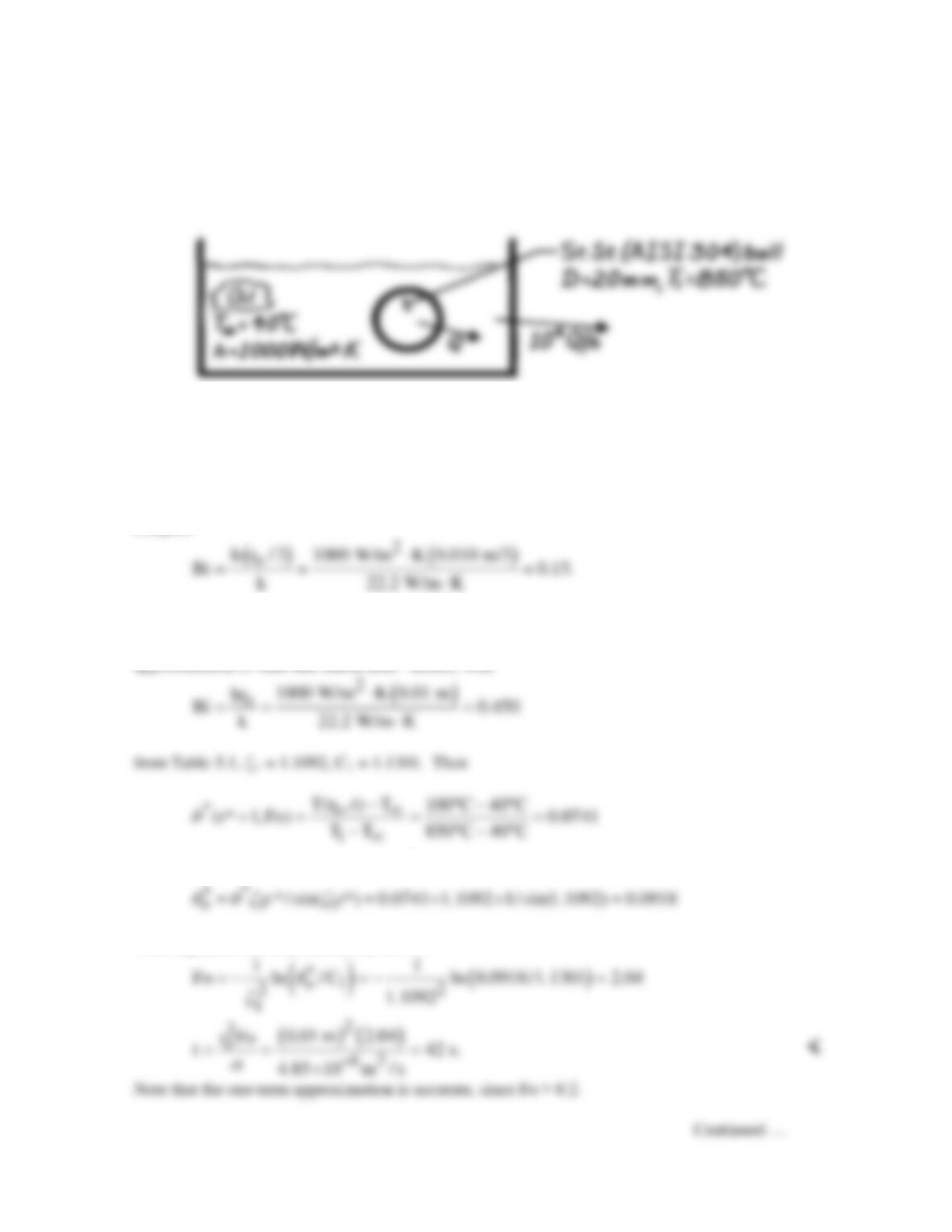
KNOWN: Diameter and initial temperature of ball bearings to be quenched in an oil bath.
FIND: (a) Time required for surface to cool to 100°C and the corresponding center temperature, (b)
Oil bath cooling requirements.
SCHEMATIC:
ASSUMPTIONS: (1) One-dimensional radial conduction in ball bearings, (2) Constant properties.
PROPERTIES: Table A-1, St. St., AISI 304, (T ≈ 500°C): k = 22.2 W/m⋅K, cp = 579 J/kg⋅K, ρ =
7900 kg/m3, α = 4.85×10⁻⁶ m2/s.
ANALYSIS: (a) To determine whether use of the lumped capacitance method is suitable, first
compute
We conclude that, although the lumped capacitance method could be used as a first approximation,
the exact solution should be used in the interest of improving accuracy. We assume that the one–term
approximation is valid and check later. Hence, with
and Equation 5.53b can be solved for
o
θ
∗
:
Then Equation 5.53c can be solved for Fo:
PROBLEM 5.57 (Cont.)
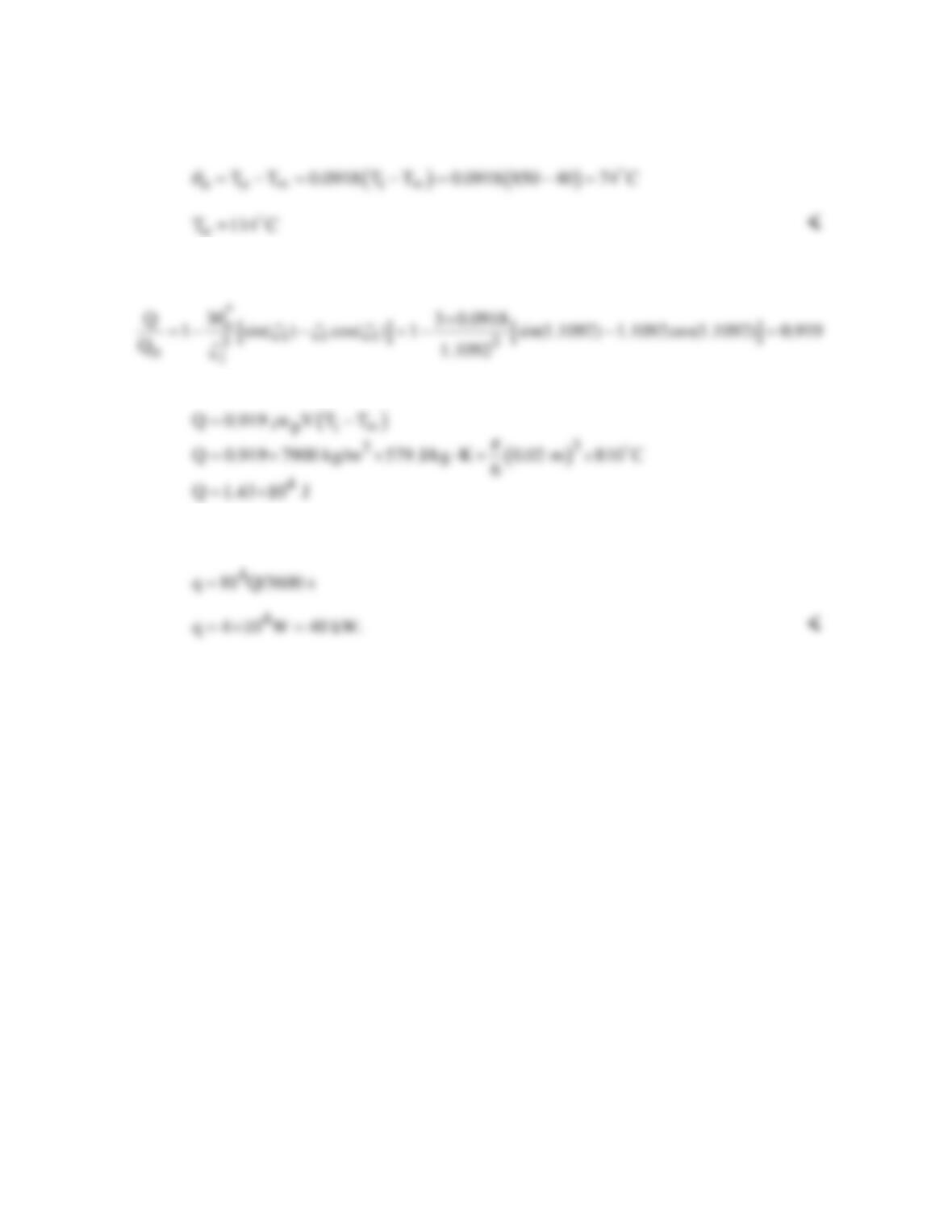
Also,
(b) Equation 5.55 can be used to calculate the heat loss from a single ball:
Hence, from Equation 5.47,
is the amount of energy transferred from a single ball during the cooling process. Hence, the oil bath
cooling rate must be
COMMENTS: If the lumped capacitance method is used, the cooling time, obtained from Equation
5.5, would be t = 39.7 s, where the ball is assumed to be uniformly cooled to 100°C. This result, and
the fact that To – T(ro) = 15°C at the conclusion, suggests that use of the lumped capacitance method
would have been reasonable.
PROBLEM 5.58
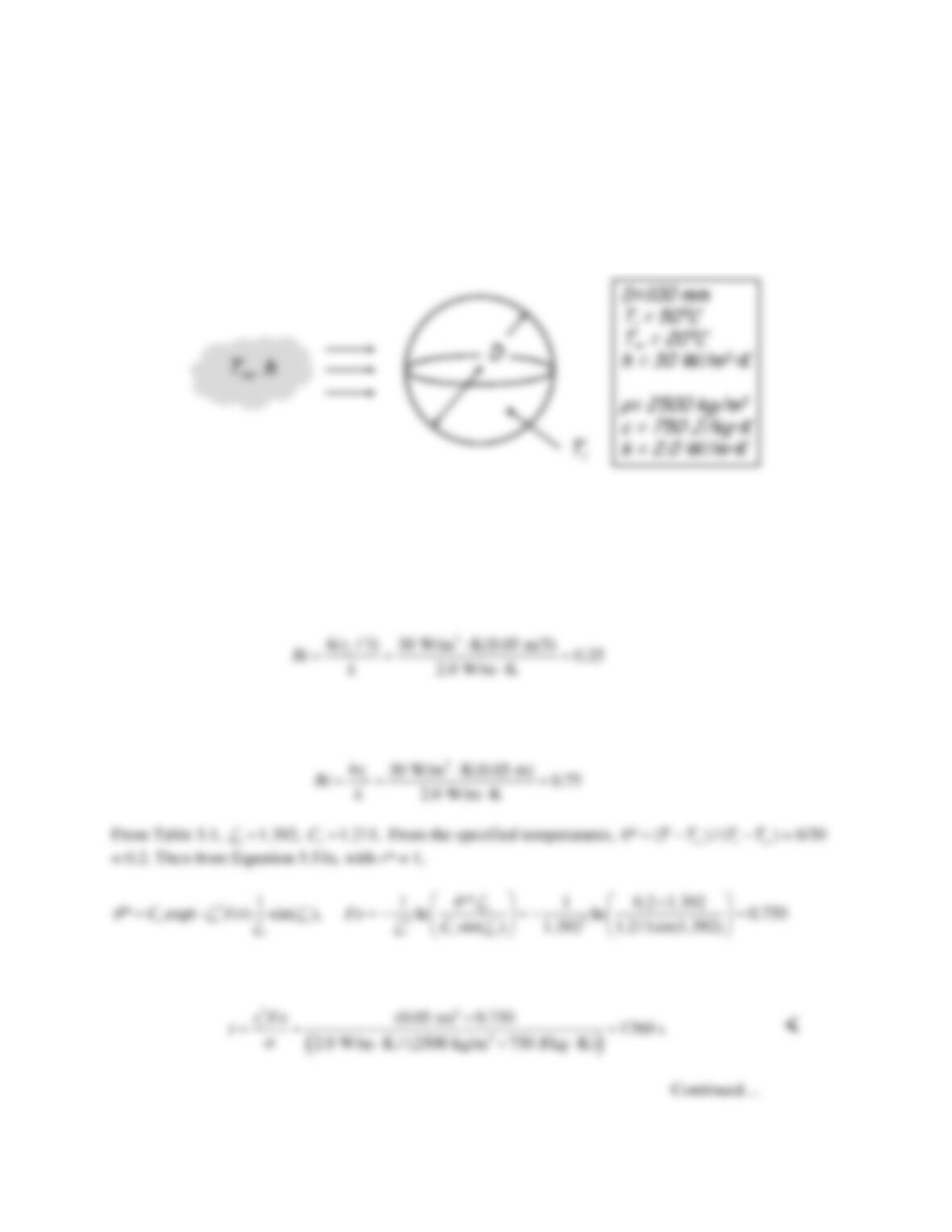
KNOWN: Properties, diameter, and initial temperature of sphere. Environment temperature and heat
transfer coefficient.
FIND: Time for sphere’s surface temperature to reach 26°C. Energy transferred from sphere up to that
time.
SCHEMATIC:
ASSUMPTIONS: (1) One-dimensional (radial) conduction in sphere. (2) Uniform properties. (3)
Negligible radiation.
PROPERTIES: Given,
ρ
= 2500 kg/m3, c = 750 J/kg⋅K, k = 2.0 W/m⋅K.
ANALYSIS: The Biot number is first calculated to determine if the lumped capacitance method is valid.
The lumped capacitance method is not valid and the radial dependence of temperature must be accounted
for. We try the one-term approximation and will check the Fourier number later.
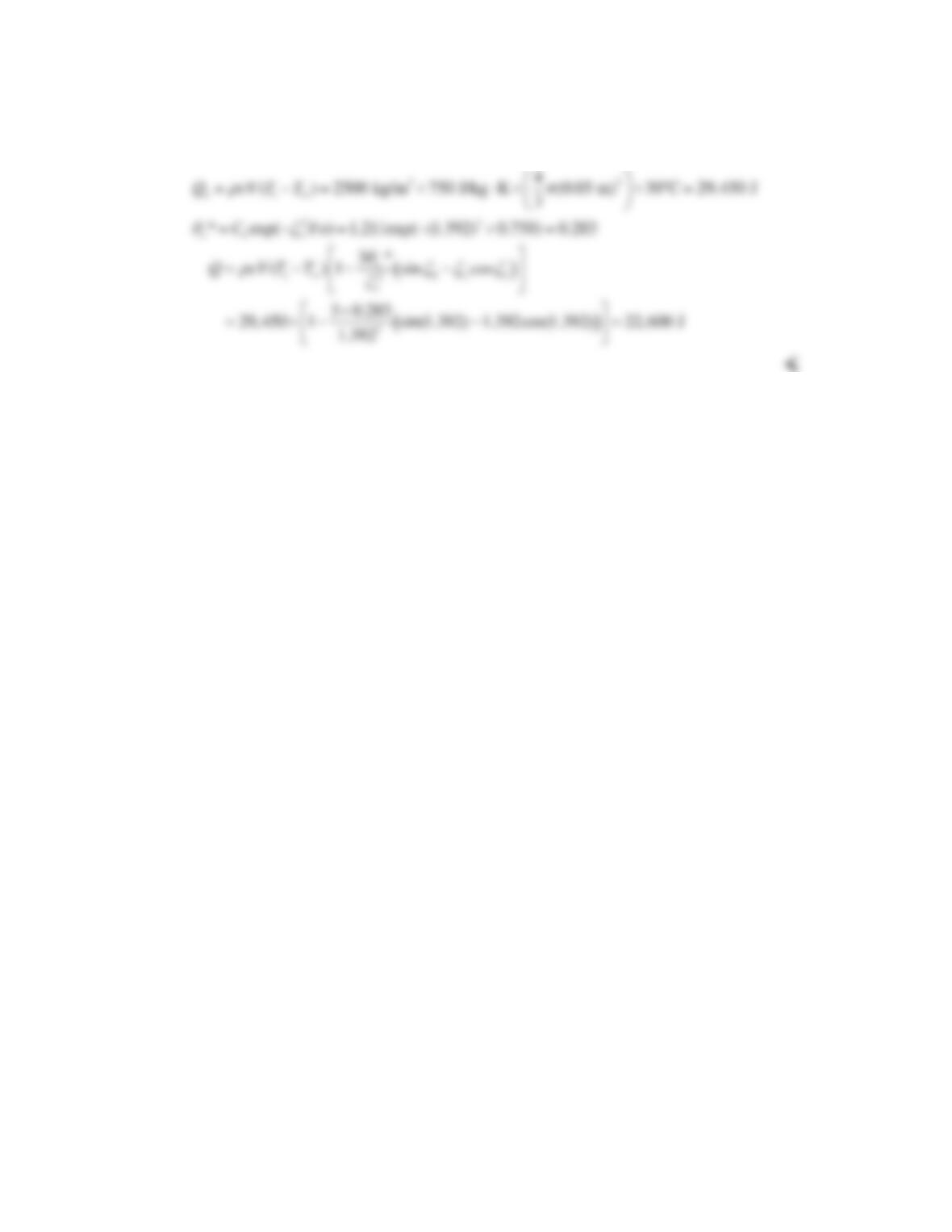
Since Fo > 0.2, the one-term approximation is valid. Finally,
PROBLEM 5.58 (Cont.)
The energy transferred can be found from Equation 5.55, with Qo =
ρ
cV(Ti – T∞) and
*
o
θ
from Equation
5.53c:
<
COMMENTS: If the Fourier number had been smaller than 0.2, more terms would have been required in
the infinite series of Equation 5.51a, and an iterative solution would have been required to find Fo.
PROBLEM 5.59
KNOWN: Sphere quenching in a constant temperature bath.
FIND: (a) Plot T(0,t) and T(ro,t) as function of time, (b) Time required for surface to reach 415 K,
t′
,
(c) Heat flux when T(ro,
t′
) = 415 K, (d) Energy lost by sphere in cooling to T(ro,
t′
) = 415 K, (e)
Steady–state temperature reached after sphere is insulated at t =
t′
, (f) Effect of h on center and surface
temperature histories.
ASSUMPTIONS: (1) One-dimensional radial conduction, (2) Constant properties, (3) Uniform initial
temperature.
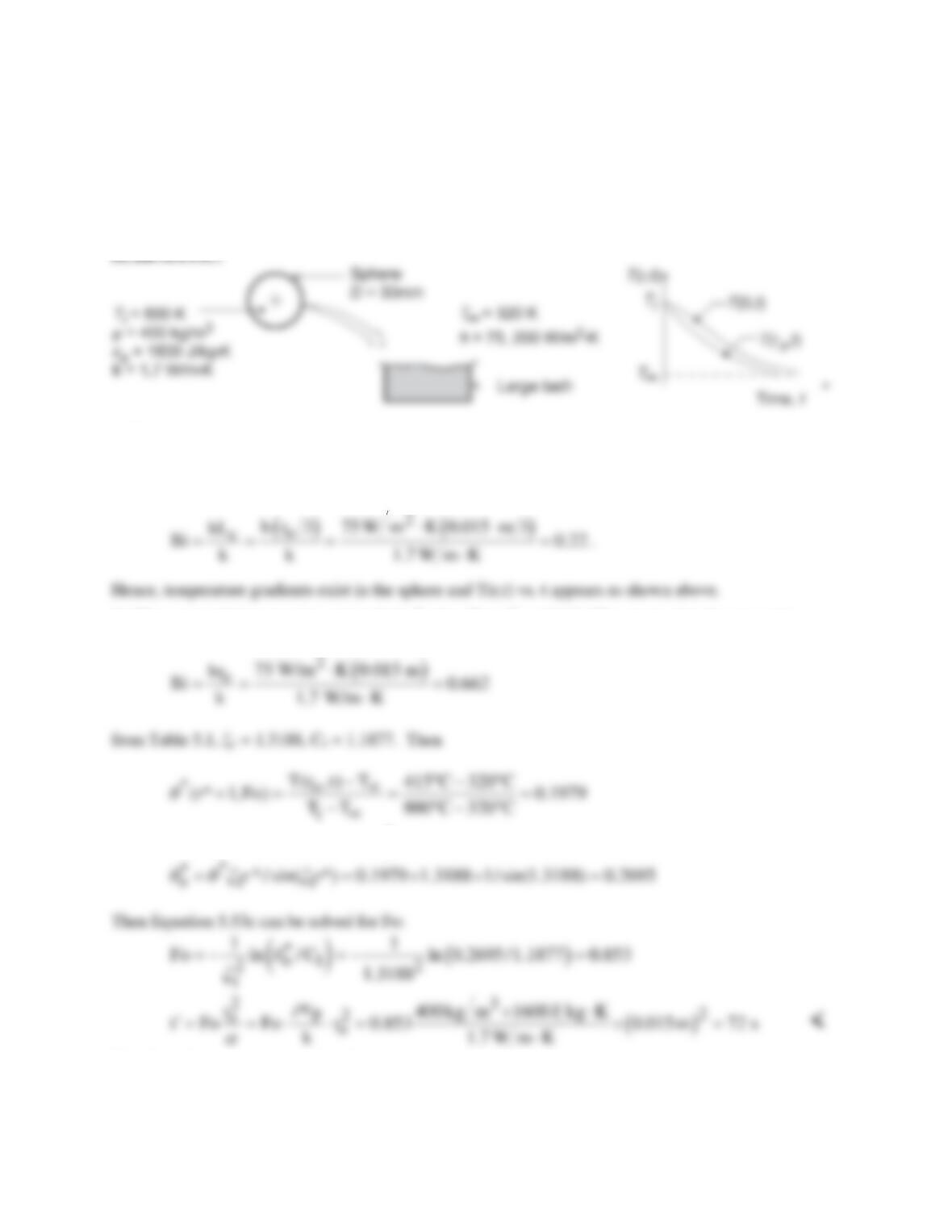
ANALYSIS: (a) Calculate Biot number to determine if sphere behaves as spatially isothermal object,
(b) The exact solution may be used to find
t′
when T(ro,
t′
) = 415 K. We assume that the one–term
approximation is valid and check later. Hence, with
and Equation 5.53b can be solved for
o
θ
∗
:
Note that the one-term approximation is accurate, since Fo > 0.2.
Continued…
PROBLEM 5.59 (Cont.)
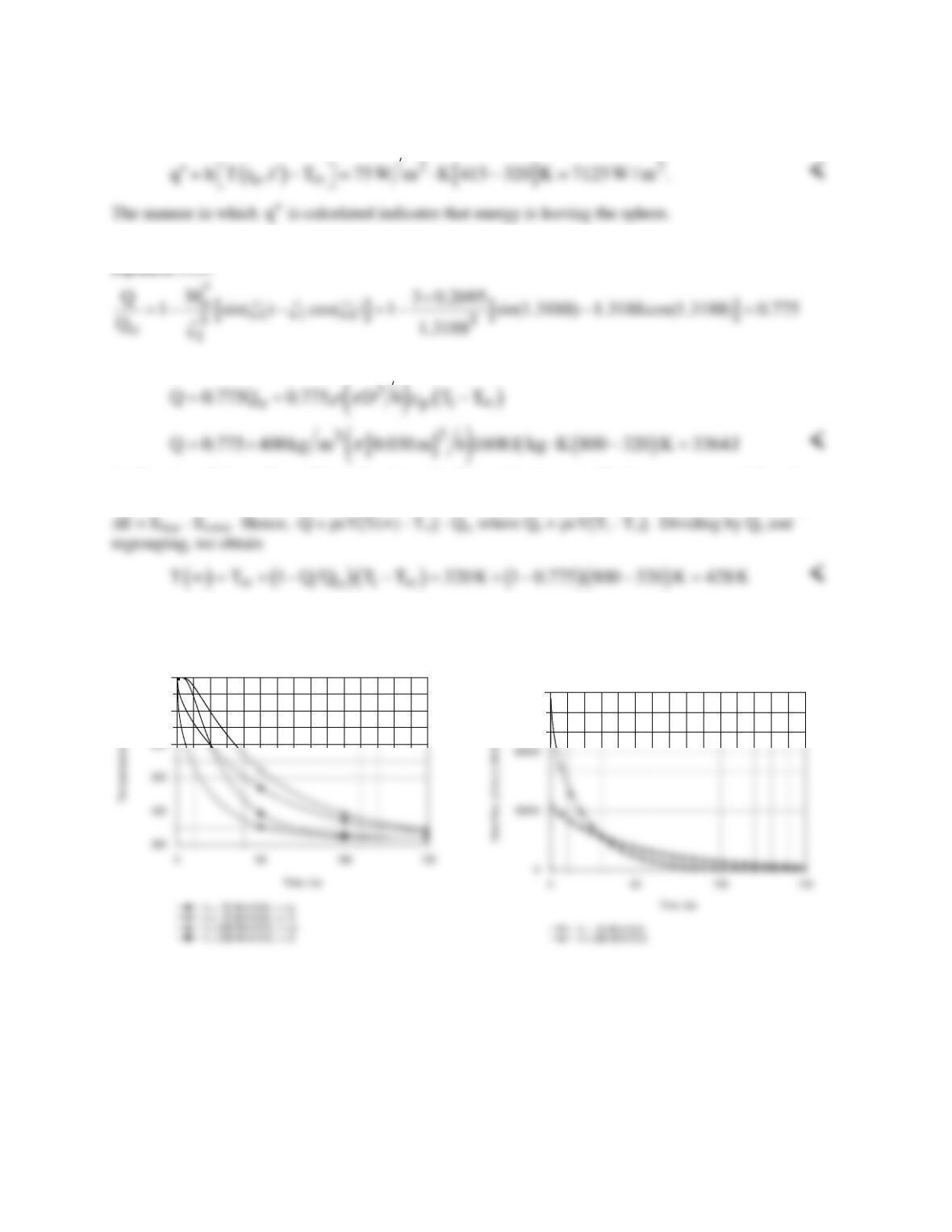
(c) The heat flux at the outer surface at time
¢
t
is given by Newton’s law of cooling
(d) The energy lost by the sphere during the cooling process from t = 0 to
t′
can be determined from
The energy loss by the sphere with V = (πD3)/6 is therefore, from Equation 5.47,
(e) If at time
t′
the surface of the sphere is perfectly insulated, eventually the temperature of the sphere
will be uniform at T(∞). Applying conservation of energy to the sphere over a time interval, Ein – Eout =
(f) Using the IHT Transient Conduction Model for a Sphere, the following graphical results were
generated.
700
800
90000
The quenching process is clearly accelerated by increasing h from 75 to 200 W/m2⋅K and is virtually
completed by t ≈ 100s for the larger value of h. Note that, for both values of h, the temperature
difference [T(0,t) – T(ro,t)] decreases with increasing t. Although the surface heat flux for h = 200
W/m2⋅K is initially larger than that for h = 75 W/m2⋅K, the more rapid decline in T(ro,t) causes it to
become smaller at t ≈ 30s.
COMMENTS: Using the Transient Conduction/Sphere model in IHT based upon multiple-term series
solution, the following results were obtained: t′ = 72.1 s; Q/Qo = 0.7745, and T(∞) = 428 K.
PROBLEM 5.60
KNOWN: One-dimensional convective heating of sphere of radius ro, with Bi = 1 for a dimensionless
time of Fo1.
FIND: (a) Sketch of the dimensionless center and surface temperatures of the sphere as a function of
dimensionless time over the range 0 < Fo1 < Fo < . Relative value of Fo2 needed to achieve a
steady-state center temperature equal to the center temperature at Fo1. (b) Analytical expression for,
and value of Fo = Fo2 – Fo1 for Bi = 1, Fo1 > 0.2, Fo2 > 0.2. (c) Value of Fo for Bi = 0.01, 0.1, 10,
100 and .
SCHEMATIC:
ASSUMPTIONS: (1) One-dimensional conduction, (2) Constant properties, (3) Approximate, one-
term solutions are valid.
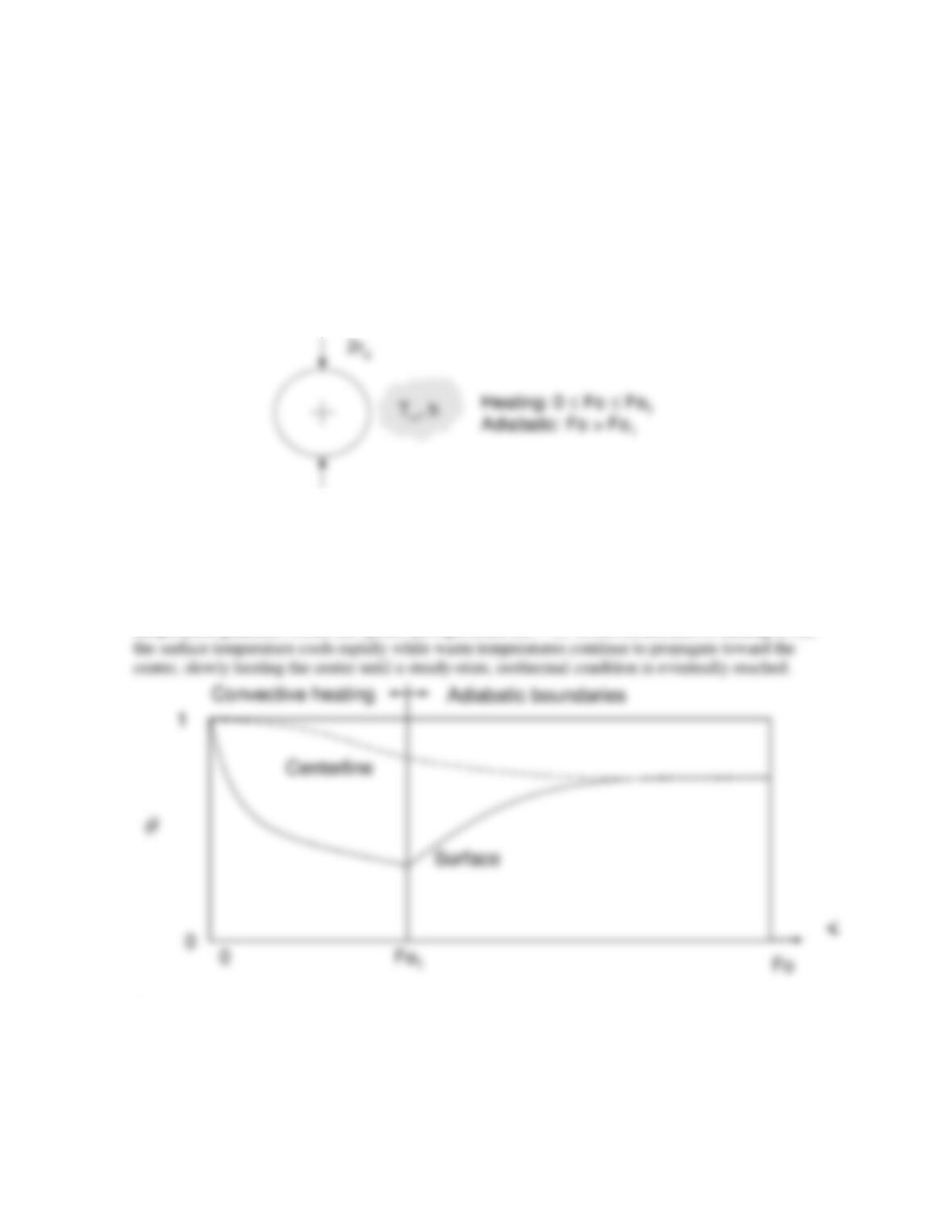
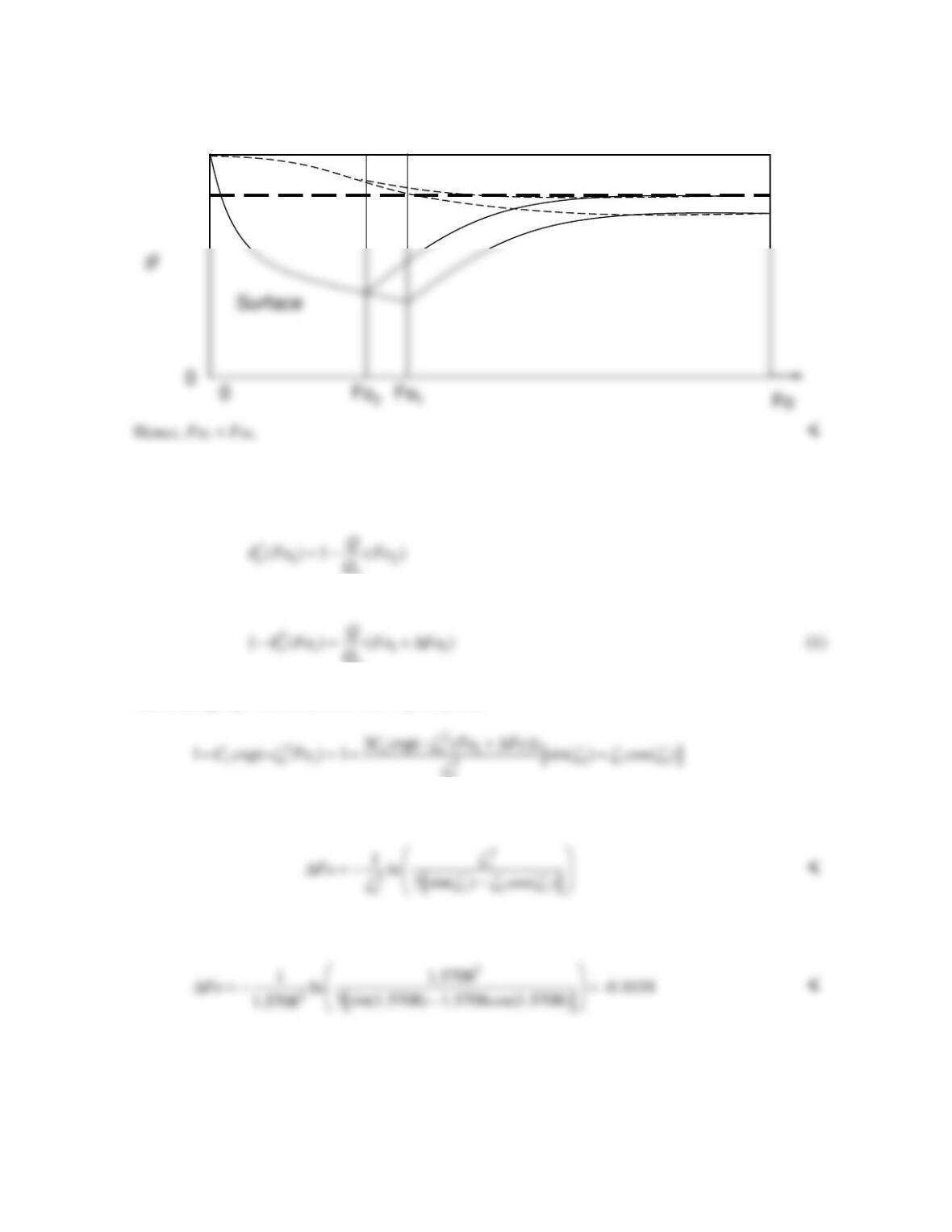
ANALYSIS: (a) A sketch of the dimensionless center and surface temperatures is shown below.
Note that, at Fo1, the surface of the sphere will be warm (smaller
) relative to its center since
temperature gradients within the sphere are significant (Bi = 1). At the curtailment of heating (Fo1),
Based on the sketch above, one could achieve a steady-state center temperature equal to the center
temperature at Fo1 by reducing the duration of convective heating to Fo2, as shown in the sketch
below.
Continued…
PROBLEM 5.60 (Cont.)
(b) Using the approximate solutions of Sections 5.6.2 and 5.6.3, and noting that the steady-state
temperature of the sphere is uniform and related to the energy transferred to the sphere,
o
or,
o
Substituting Eqs. 5.53c and 5.55 into Eq. (1) yields
1
which may be simplified to
From Table 5.1,
1 = 1.5708 rad at Bi = 1. Hence,
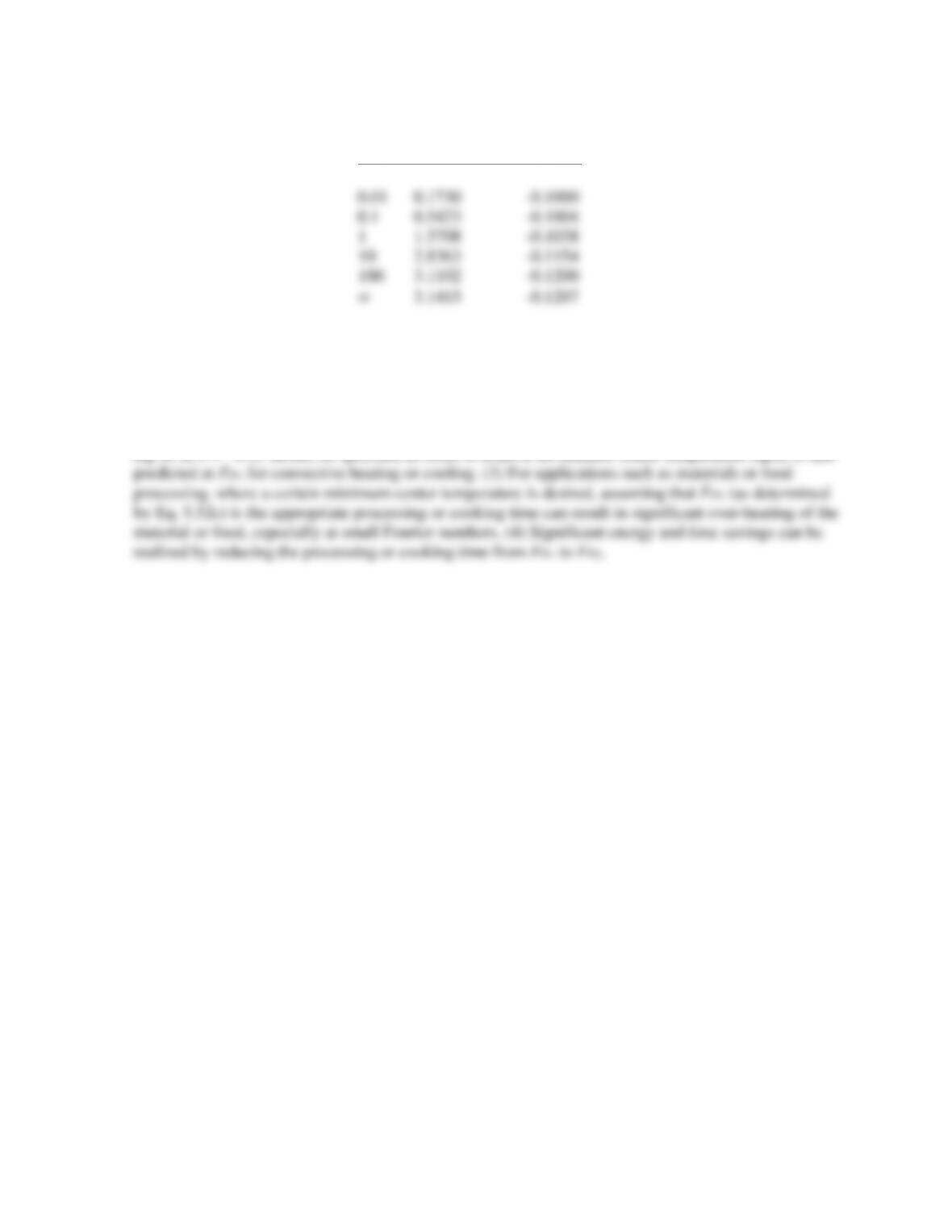
(c) The expression for Fo may be evaluated for a range of Bi, resulting in the following.
Continued…
Centerline
1
PROBLEM 5.60 (Cont.)
Bi
1 Fo <
COMMENTS: (1) Note that the dimensionless temperature,
*2
11
exp
oC Fo
, is defined in a
manner such that for sphere heating, increases in actual temperature correspond to decreases in the
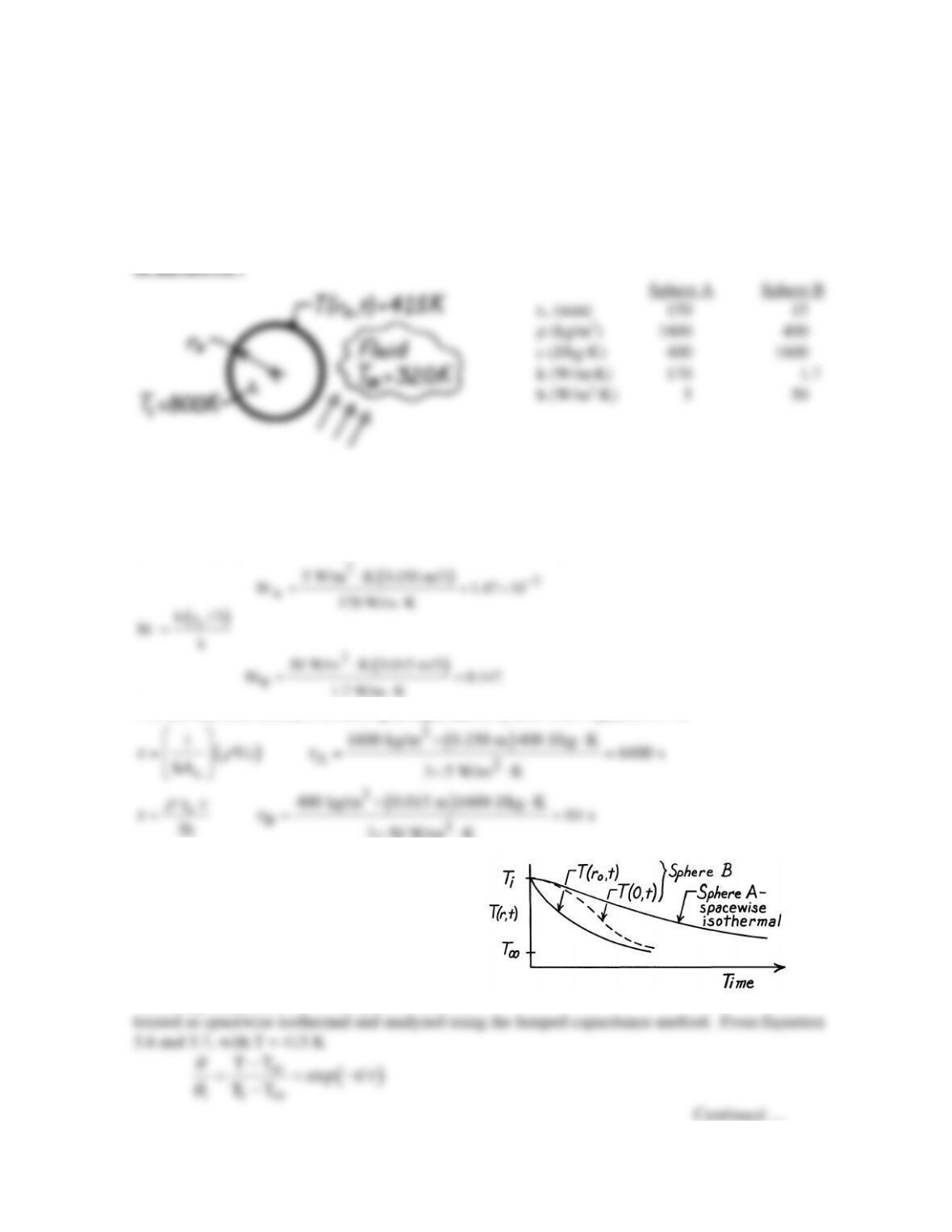
dimensionless temperature. (2) The dimensionless time lag, Fo, is weakly-dependent on the value of
the Biot number and is independent of the heating time. Hence, a general rule-of-thumb is that a time
lag of Fo – 0.11 should be specified in order to achieve an ultimate center temperature equal to that
PROBLEM 5.61
KNOWN: Two spheres, A and B, initially at uniform temperatures of 800 K and simultaneously
quenched in large, constant temperature baths each maintained at 320 K; properties of the spheres and
convection coefficients.
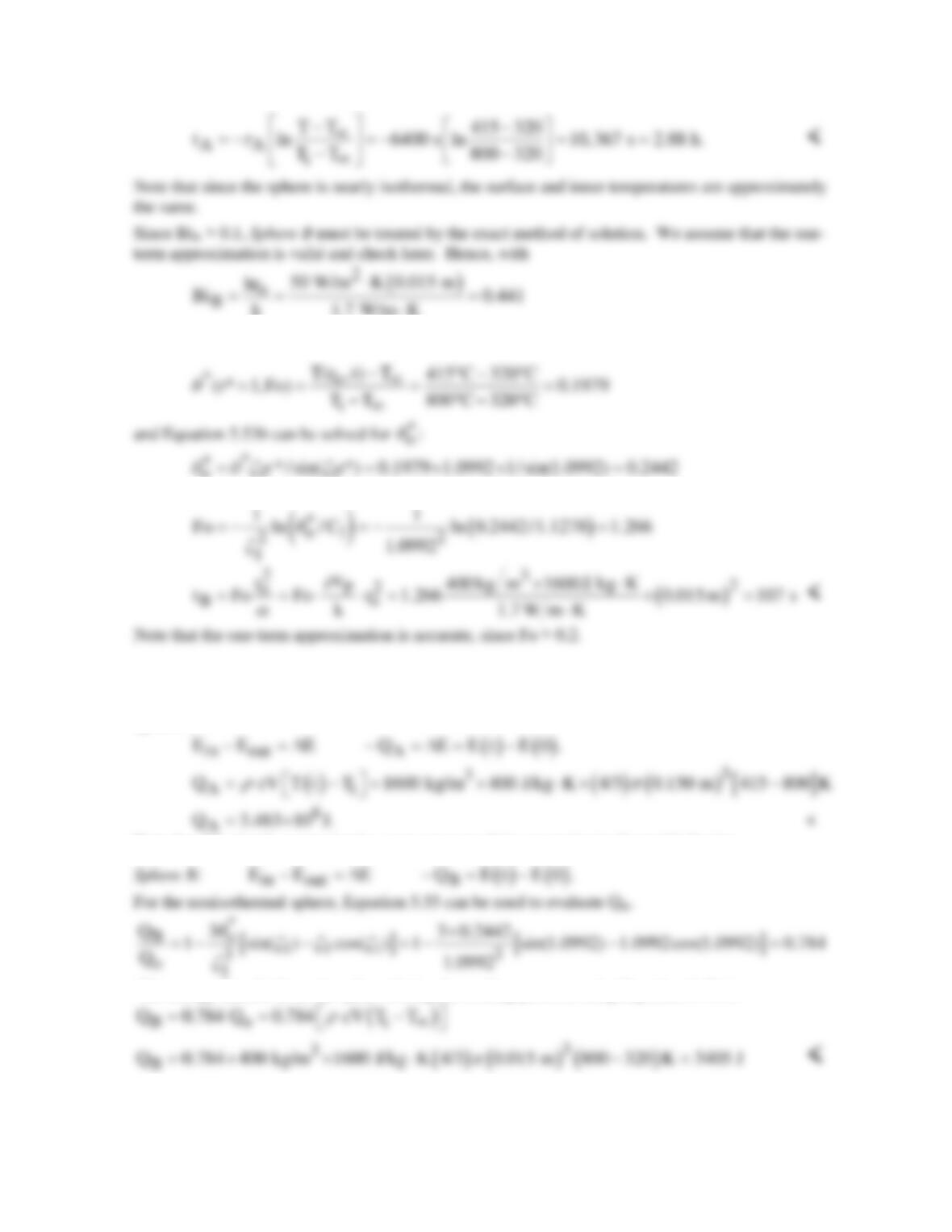
FIND: (a) Show in a qualitative manner, on T-t coordinates, temperatures at the center and the outer
surface for each sphere; explain features of the curves; (b) Time required for the outer surface of each
sphere to reach 415 K, (c) Energy gained by each bath during process of cooling spheres to a surface
temperature of 415 K.
ASSUMPTIONS: (1) One-dimensional radial conduction, (2) Uniform properties, (3) Constant
convection coefficient.
ANALYSIS: (a) From knowledge of the Biot number and the thermal time constant, it is possible to
qualitatively represent the temperature distributions. From Equation 5.10, with Lc = ro/3, find
The thermal time constant for a lumped capacitance system from Equation 5.7 is
×⋅
When Bi << 0.1, the sphere will cool in a
spacewise isothermal manner (Sphere A).
For sphere B, Bi > 0.1, hence gradients will
be important. Note that the thermal time
constant of A is much larger than for B;
hence, A will cool much slower. See sketch
for these features.
(b) Recognizing that BiA < 0.1, Sphere A can be
PROBLEM 5.61 (Cont.)
k 1.7 W/m K
⋅
from Table 5.1, ζ1 = 1.0992, C1 = 1.1278. Then
o1 1
Then Equation 5.53c can be solved for Fo:
(c) To determine the energy change by the spheres during the cooling process, apply the conservation
of energy requirement on a time interval basis.
Sphere A:
Note that this simple expression is a consequence of the spacewise isothermal behavior.
The energy transfer from the sphere during the cooling process, using Equation 5.47, is
COMMENTS: In summary: Sphere Bi = hro/k
τ
s
bg
t(s) Q(J)
A 4.41×10⁻³ 6400 10,370 3.48×10⁶
B 0.44 64 107 3405
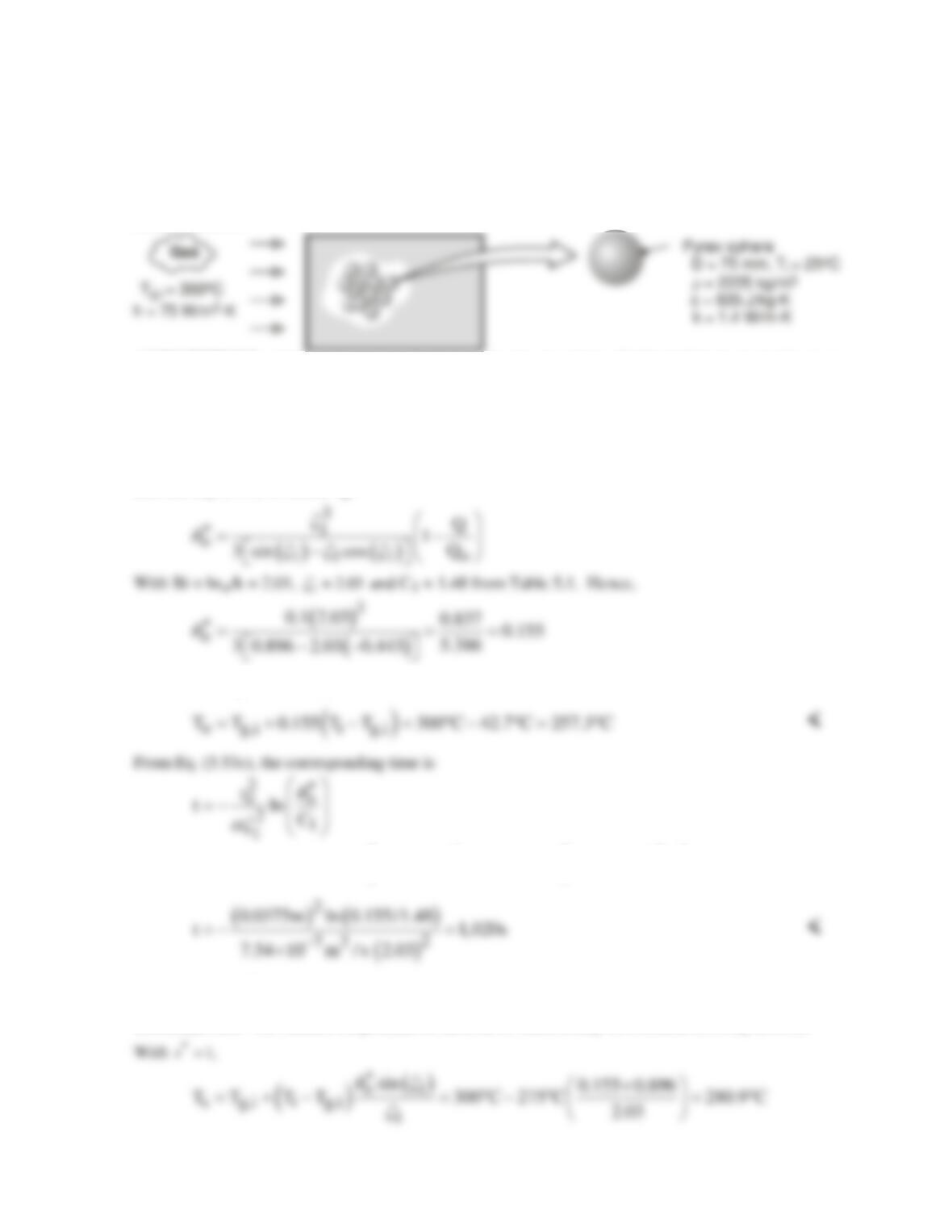
PROBLEM 5.62
KNOWN: Diameter, density, specific heat and thermal conductivity of Pyrex spheres in packed bed
thermal energy storage system. Convection coefficient and inlet gas temperature.
FIND: Time required for sphere to acquire 90% of maximum possible thermal energy and the
corresponding center temperature.
SCHEMATIC:
ASSUMPTIONS: (1) One-dimensional radial conduction in sphere, (2) Negligible heat transfer to or
from a sphere by radiation or conduction due to contact with adjoining spheres, (3) Constant
properties.
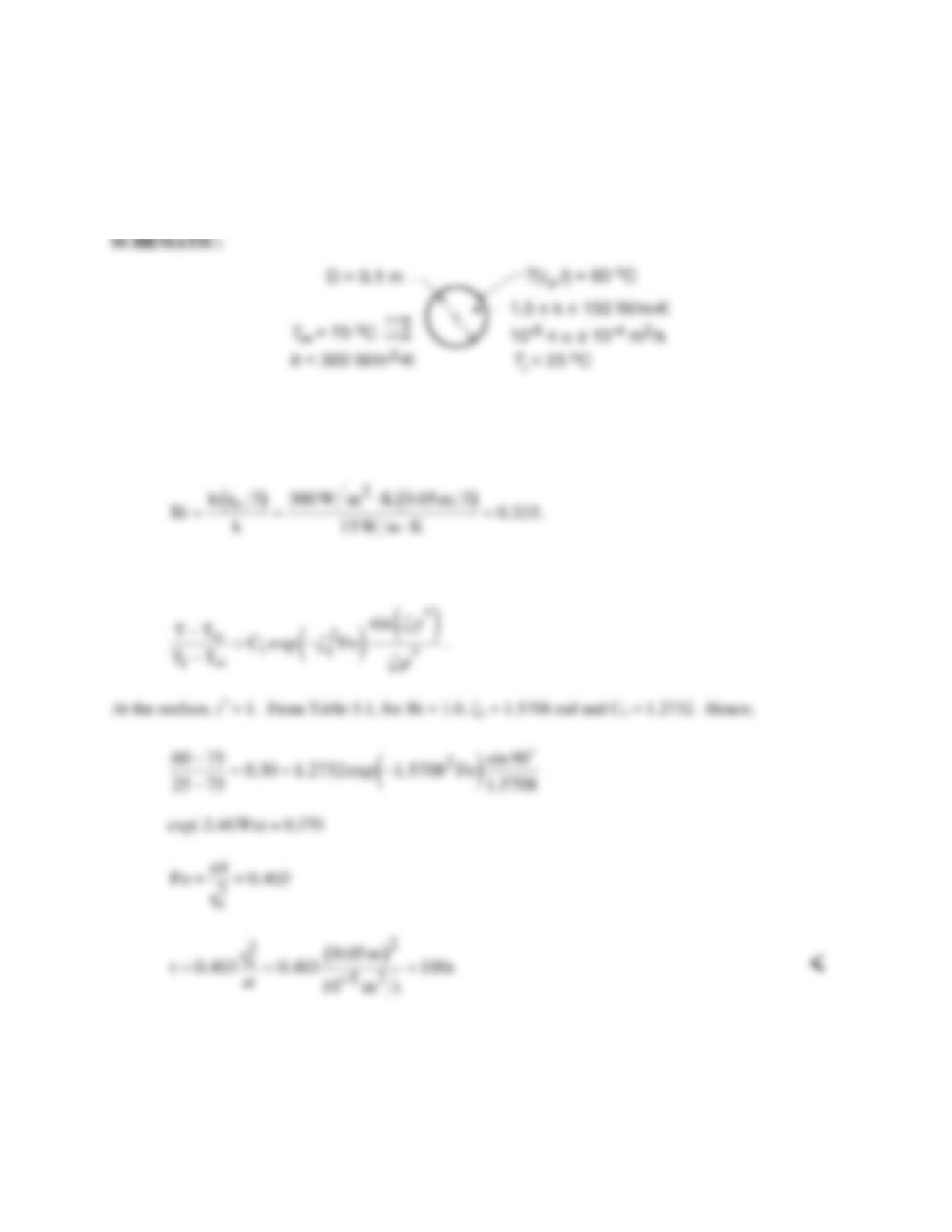
ANALYSIS: With Bi ≡ h(ro/3)/k = 75 W/m2⋅K (0.0125m)/1.4 W/m⋅K = 0.67, the approximate
solution for one-dimensional transient conduction in a sphere is used to obtain the desired results. We
first use Eq. (5.55) to obtain
o
.
θ
∗
The center temperature is therefore
where
( )
3 72
k / c 1.4 W / m K / 2225 kg / m 835 J / kg K 7.54 10 m / s.
αρ
−
= = ⋅ × ⋅= ×
Then
Fo t / r2
o0.55 0.2,
α
= = >
so the approximate one-term solution is valid.
COMMENTS: The surface temperature at the time of interest may be obtained from Eq. (5.53b).
PROBLEM 5.63
KNOWN: Initial temperature and properties of a solid sphere. Surface temperature after immersion in a
fluid of prescribed temperature and convection coefficient.
FIND: (a) Time to reach surface temperature, (b) Effect of thermal diffusivity and conductivity on
thermal response.
ASSUMPTIONS: (1) One-dimensional, radial conduction, (2) Constant properties.
ANALYSIS: (a) For k = 15 W/m⋅K, the Biot number is
Hence, the lumped capacitance method cannot be used. From Equation 5.53a,
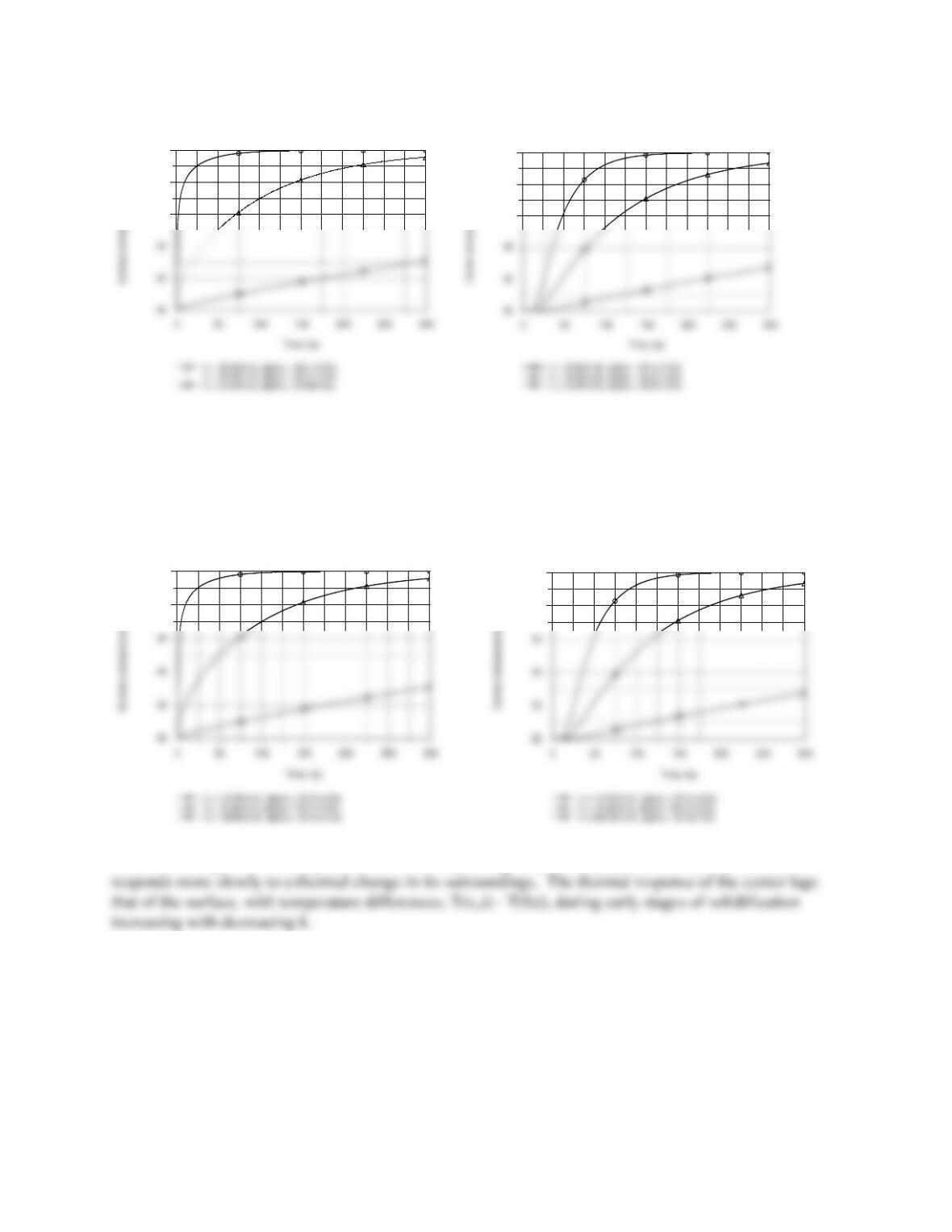
(b) Using the IHT Transient Conduction Model for a Sphere to perform the parametric calculations, the
effect of α is plotted for k = 15 W/m⋅K.
Continued…
PROBLEM 5.63 (Cont.)
55
65
75
55
65
75
For fixed k and increasing α, there is a reduction in the thermal capacity (ρcp) of the material, and hence
the amount of thermal energy which must be added to increase the temperature. With increasing α, the
material therefore responds more quickly to a change in the thermal environment, with the response at
the center lagging that of the surface.
The effect of k is plotted for α = 10-5 m2/s.
65
75
65
75
With increasing k for fixed alpha, there is a corresponding increase in ρcp, and the material therefore
COMMENTS: Use of this technique to determine h from measurement of T(ro) at a prescribed t
requires an iterative solution of the governing equations.