RECOGNIZING REVENUE FOR CONTRACTS
WITH MULTIPLE PERFORMANCE OBLIGATIONS
➢ Goal: Separate complex contracts into parts that can be viewed on a stand-alone
basis. Steps 2 and 4 are critical to this process.
➢ Step 2: Identify the performance obligation(s) in the contract.
A good or service is distinct if it is both:
▪ Capable of being distinct. The customer could use the good or service on
not highly interrelated with other goods and services in the contract.
➢ Step 4: Allocate the transaction price to each performance obligation.
Allocate based on relative stand-alone selling prices. If stand-alone selling
T5-8
CONTRACT CONTAINING
MULTIPLE PERFORMANCE OBLIGATIONS
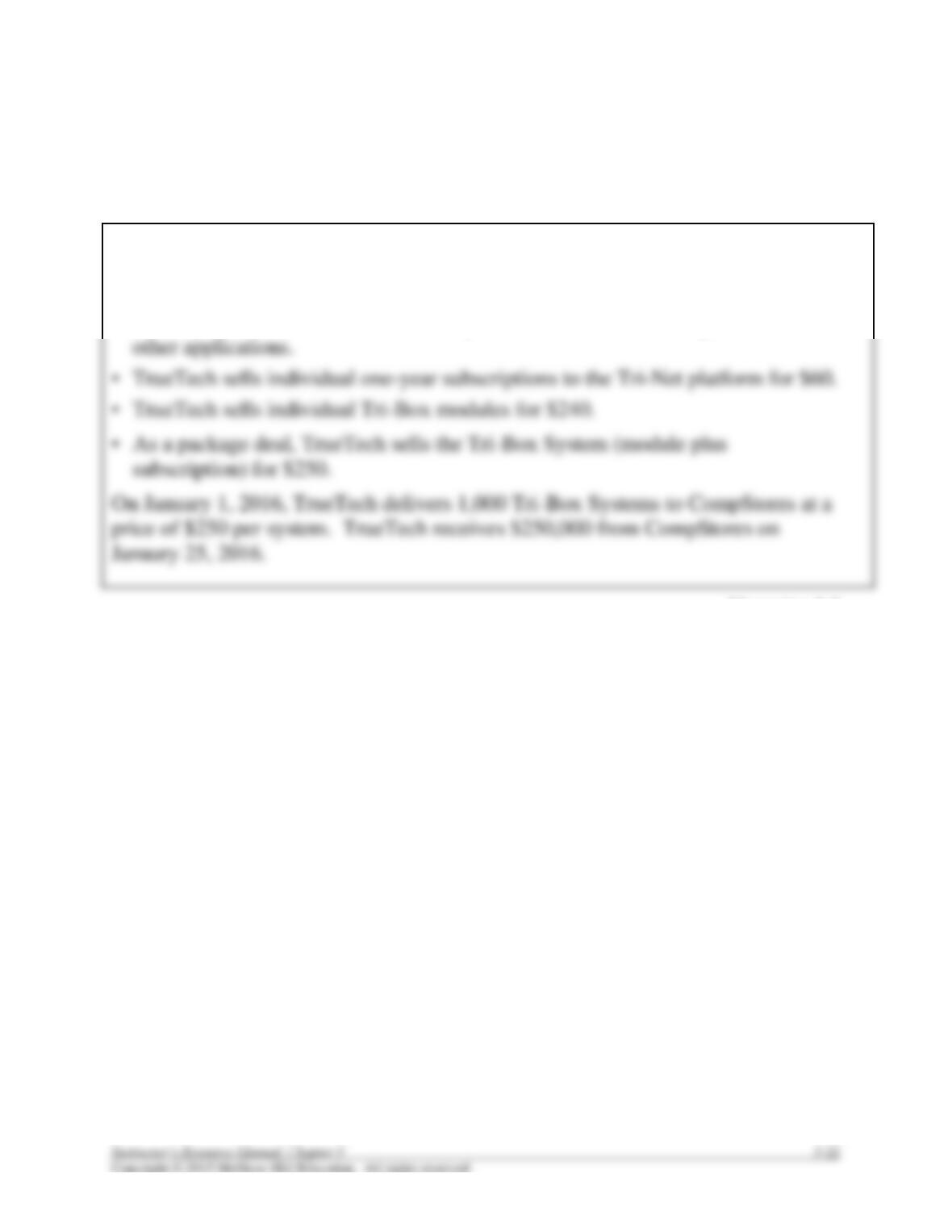
TrueTech Industries manufactures the Tri-Box System, a multiplayer gaming
system allowing players to compete with each other over the Internet.
• The Tri-Box System includes the physical Tri-Box module as well as a one-year
subscription to the Tri-Net multi-user platform of Internet-based games and
Illustration 5-7
T5-9
DETERMINING WHETHER GOODS AND SERVICES
ARE DISTINCT
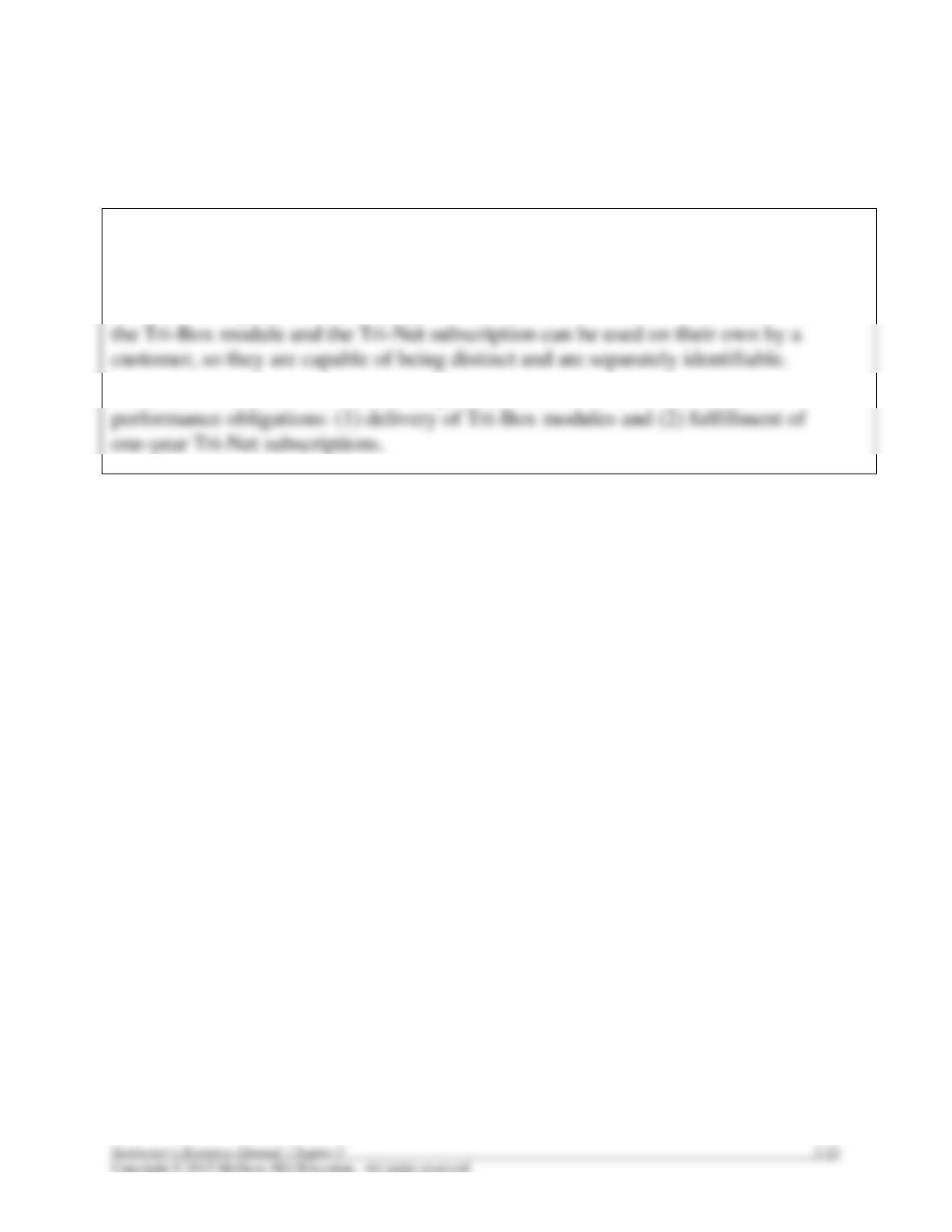
Assume the same facts as in Illustration 5-7. Do the Tri-Box module and the Tri-
Net subscription qualify as performance obligations in TrueTech’s contract with
CompStores?
Which of the goods and services promised in the contract are distinct? Both
Conclusion: The module and subscription are distinct so the contract has two
Illustration 5-8
T5-10
ALLOCATING TRANSACTION PRICE TO
PERFORMANCE OBLIGATIONS BASED ON
RELATIVE SELLING PRICES
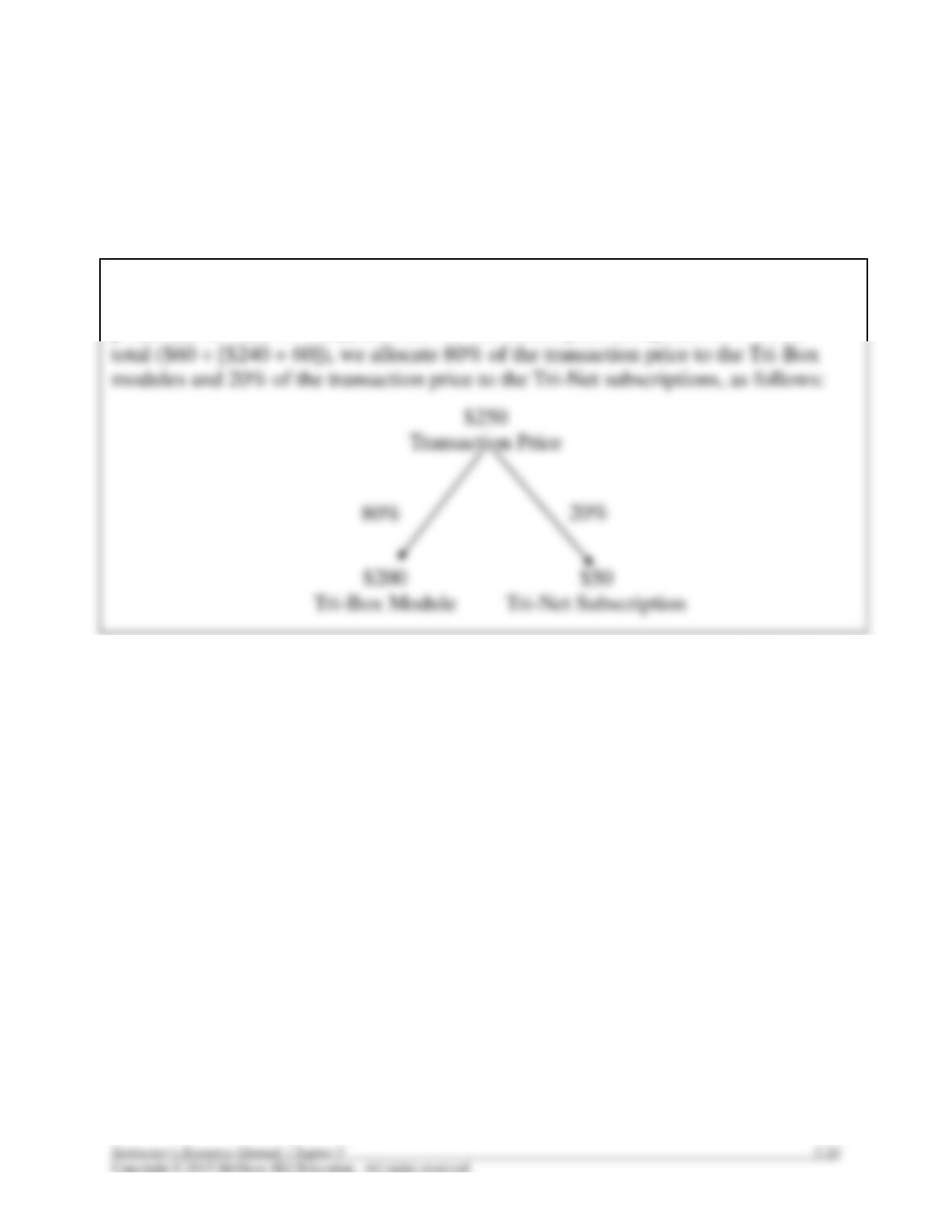
Assume the same facts as in Illustration 5–7. Because the stand-alone price of the
Tri-Box module ($240) represents 80% of the total of all the stand-alone selling
prices ($240 ÷ [$240 + 60]), and the Tri-Net subscription comprises 20% of the
Illustration 5-9
T5-11
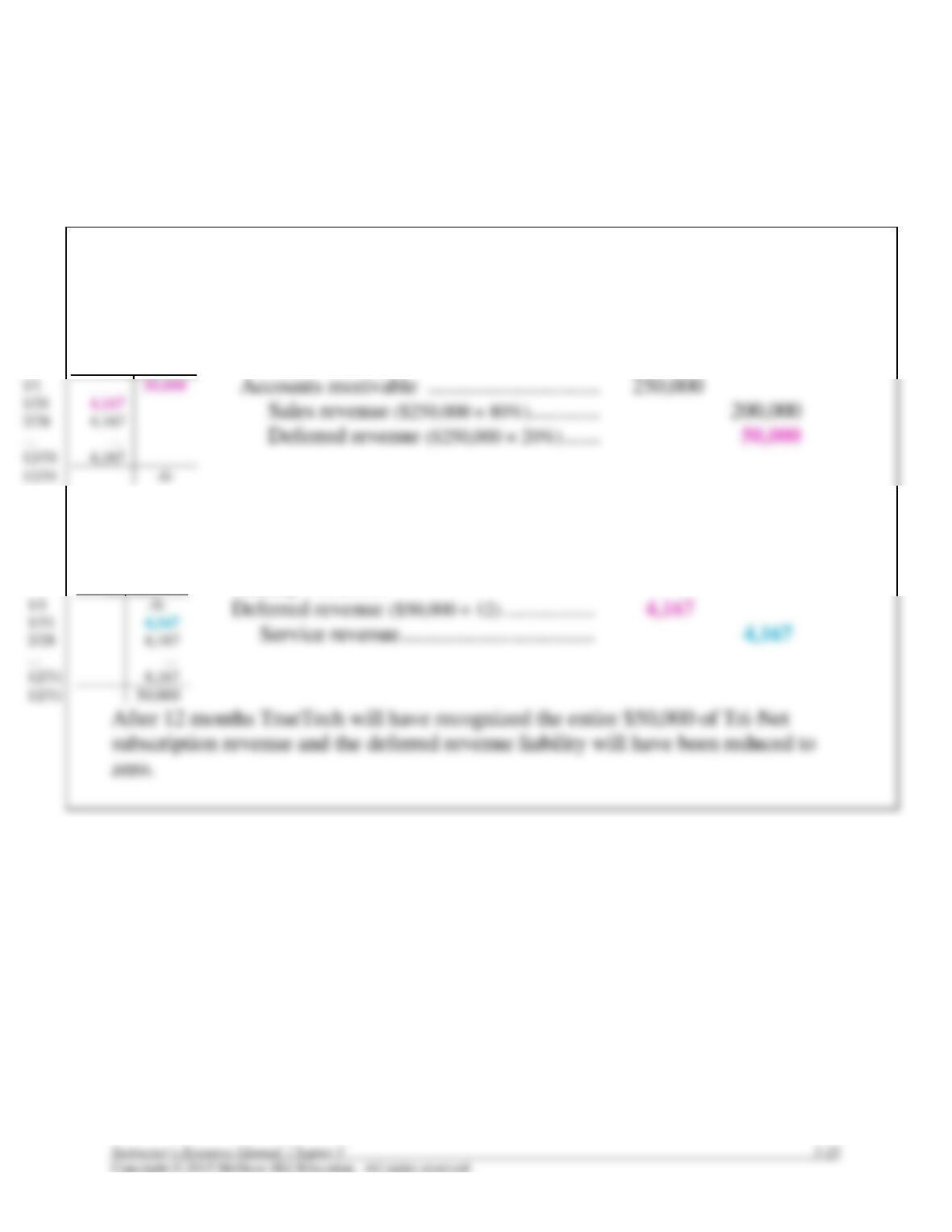
RECOGNIZING REVENUE FOR MULTIPLE
PERFORMANCE OBLIGATIONS
Assume the same facts as in Illustration 5–7. TrueTech records the following
journal entry at the time of the sale to CompStores (ignoring any entry to record
the reduction in inventory and the corresponding cost of goods sold):
January 1, 2016:
In each of the 12 months following the sale, TrueTech records the following entry
to recognize Tri-Net subscription revenue:
January 31, 2016:
Illustration 5-10
T5-12
Deferred
Revenue
Service
Revenue
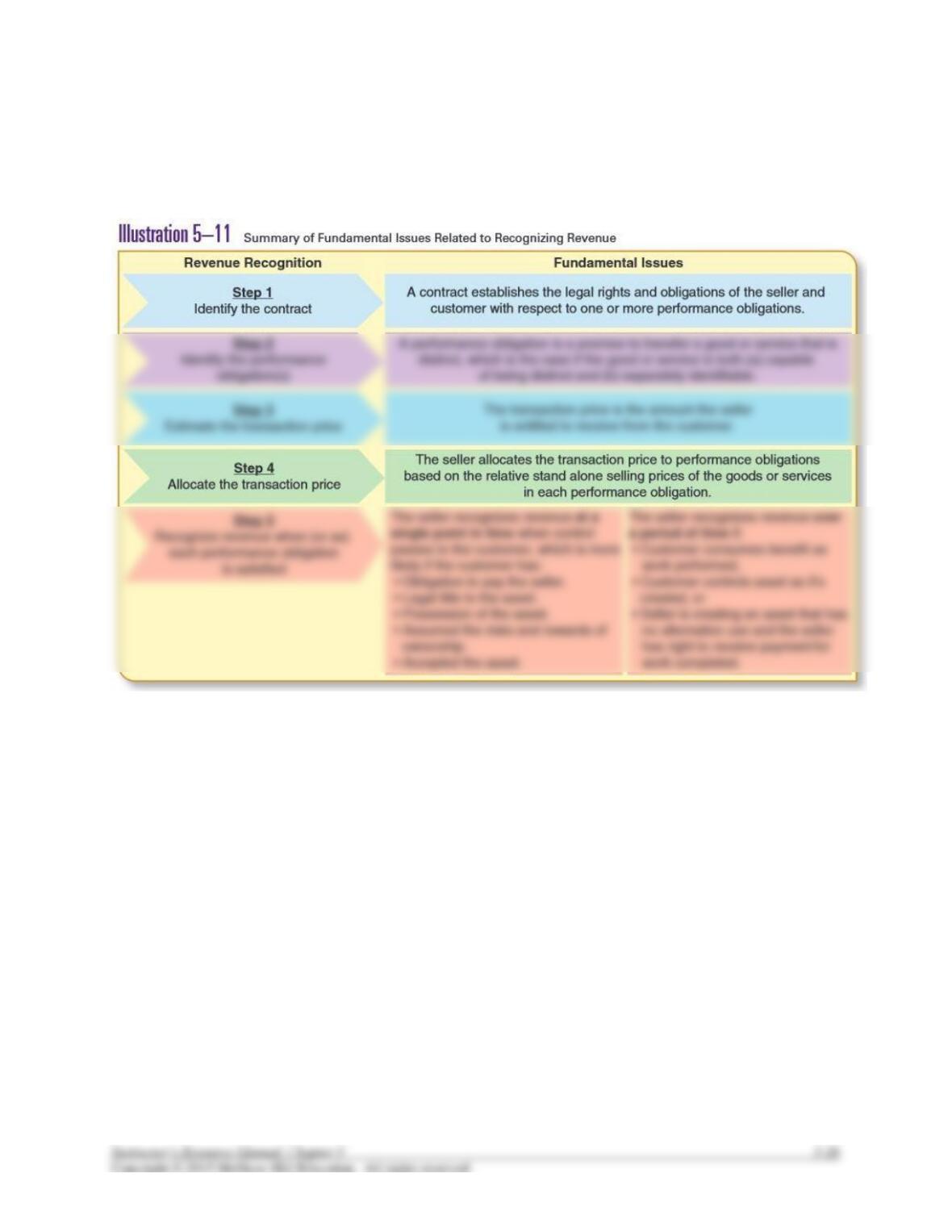
SUMMARY OF REVENUE RECOGNITION CONCEPTS
COVERED IN PART A
Illustration 5-11
T5-13
STEP 1: WHEN DOES A CONTRACT EXIST
FOR PURPOSES OF REVENUE RECOGNITION?
➢ A contract is an agreement that creates legally enforceable rights and
obligations.
➢ A contract exists for purposes of revenue recognition only if all of the following
are true:
it has commercial substance, affecting the risk, timing or amount of the
seller’s future cash flows,
➢ A contract also does not exist if both of the following are true.
neither the seller nor the customer has performed any obligations under
T5-14
DETERMINING WHETHER A CONTRACT EXISTS
FOR REVENUE RECOGNITION PURPOSES
Recall from Illustration 5-7 that CompStores ordered 1,000 Tri-Box systems on
December 20, 2015, at a price of $250 per unit. Assume that CompStores and
TrueTech can cancel the order without penalty prior to delivery. TrueTech made
delivery on January 1, 2016, and received $250,000 on January 25, 2016. When
does TrueTech’s arrangement with CompStores qualify as a contract for purposes
of revenue recognition?
The arrangement qualifies as a contract on January 1, 2016. That’s the date
Illustration 5-12
T5-15
STEP 2: IDENTIFY THE PERFORMANCE
OBLIGATION(S)
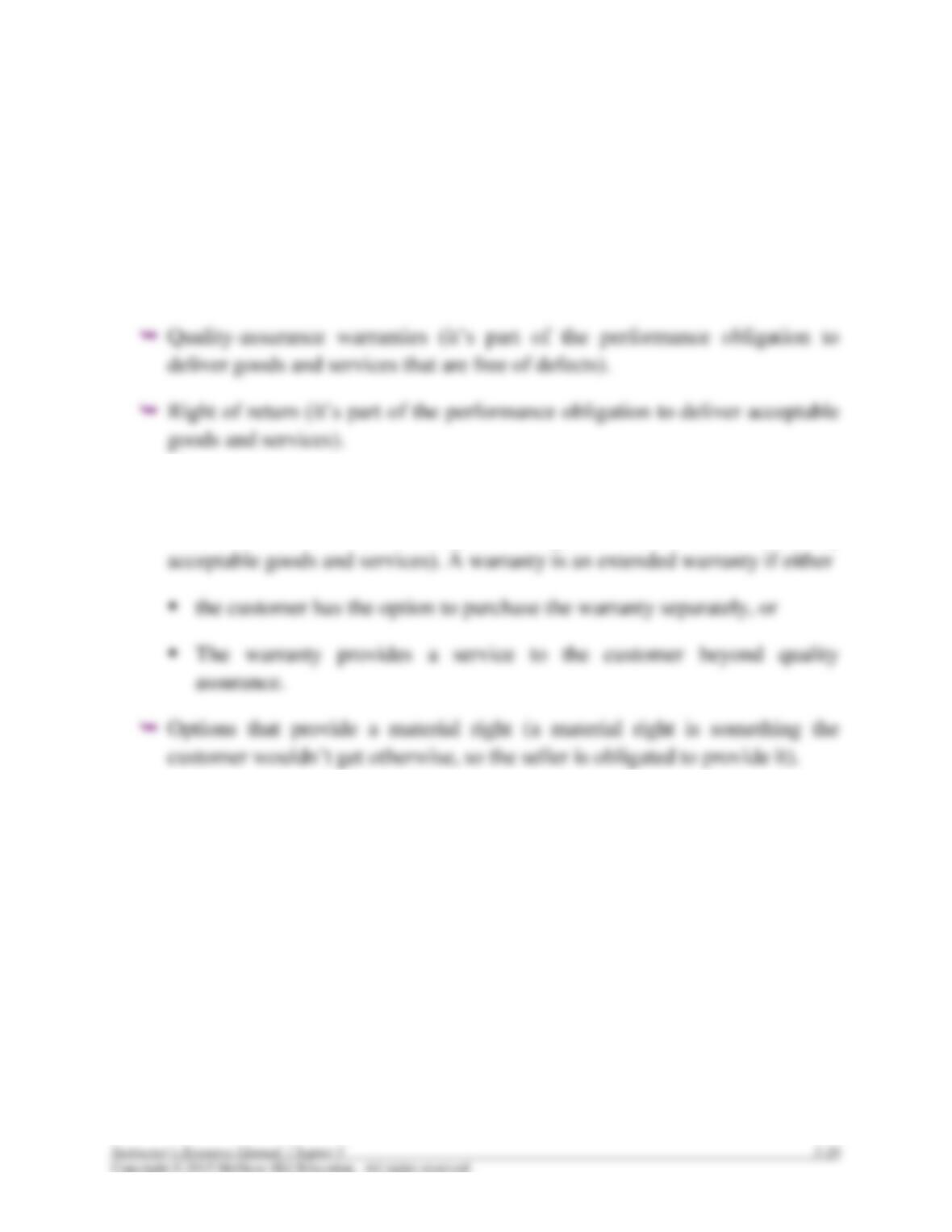
➢ Examples of common parts of contracts that are not performance obligations:
Prepayments (it’s part of the transaction price).
➢ Examples of common parts of contracts that are performance obligations:
Extended warranties (it’s a separate obligation distinct from delivering
T5-16
CUSTOMER OPTIONS
FOR ADDITIONAL GOODS AND SERVICES
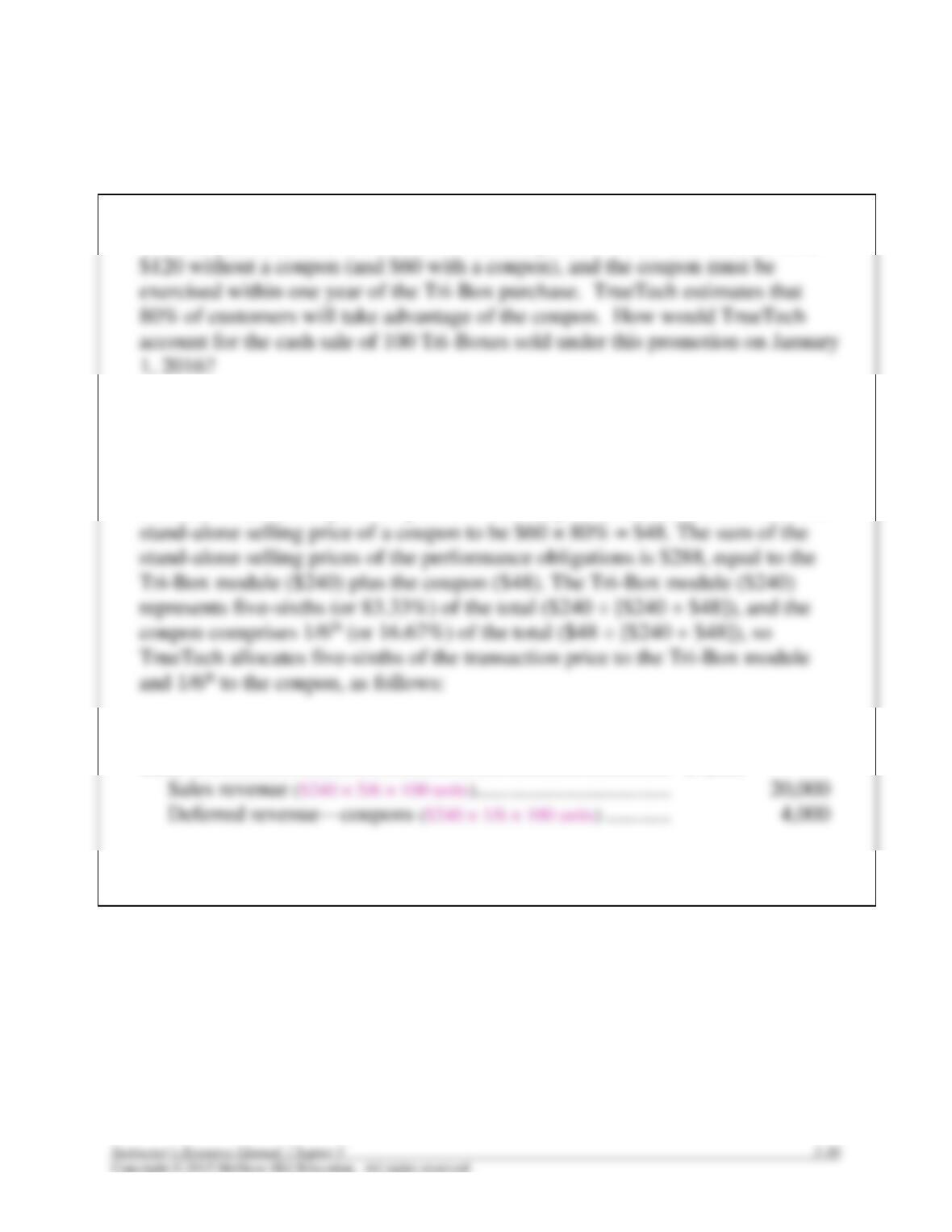
• As a promotion, TrueTech Industries offers a 50% coupon for a gaming headset
with the purchase of a Tri-Box for its normal price of $240. The headset costs
• The coupon provides a material right to the customer, because it provides a
discount of $120 × 50% = $60, so it is a performance obligation. Therefore,
TrueTech must allocate the $240 transaction price to two performance
obligations: the Tri-Box and the coupon.
• Because TrueTech expects only 80% of the coupons to be used, it estimates the
January 1, 2016:
Cash …………………………………………………………………………….. 24,000
• When the coupons are later redeemed or expire, TrueTech will debit deferred
revenue—coupons and credit revenue.
Illustration 5-13
T5-17
STEP 3: DETERMINE THE TRANSACTION PRICE:
VARIABLE CONSIDERATION
➢ Occurs when some of the contract price depends on the outcome of a future
event.
➢ Examples:
➢ Estimate variable consideration using either
➢ Constraint: Sellers only include an estimate of variable consideration in the
transaction price to the extent it is probable that a significant revenue reversal
will not occur when the uncertainty associated with the variable consideration is
resolved.
Intended to avoid severe revenue overstatements.
➢ The seller should update estimates of variable consideration (and whether the
constraint is required) prospectively, adjusting revenue and other accounts as
necessary in the period in which the estimate is revised.
T5-18
ACCOUNTING FOR VARIABLE CONSIDERATION
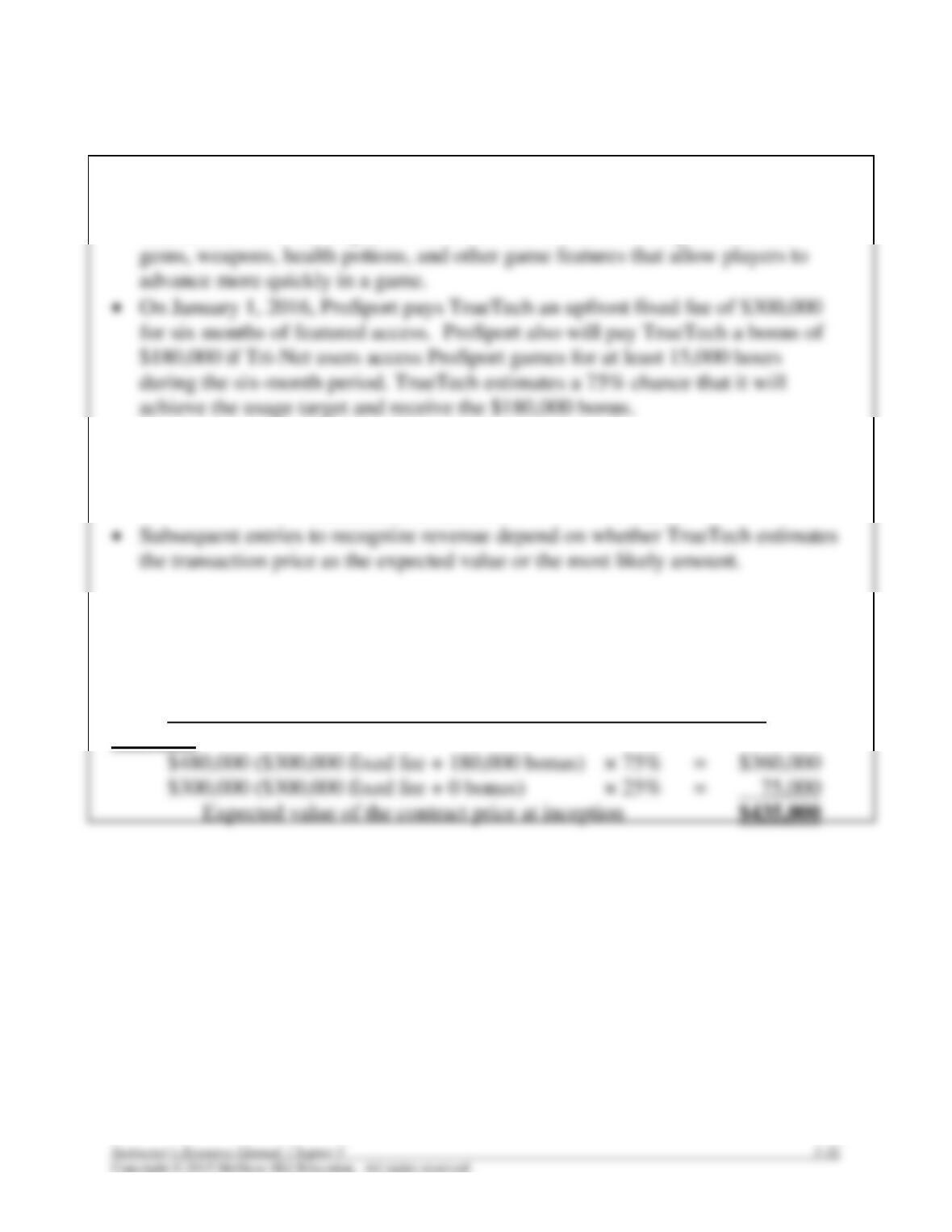
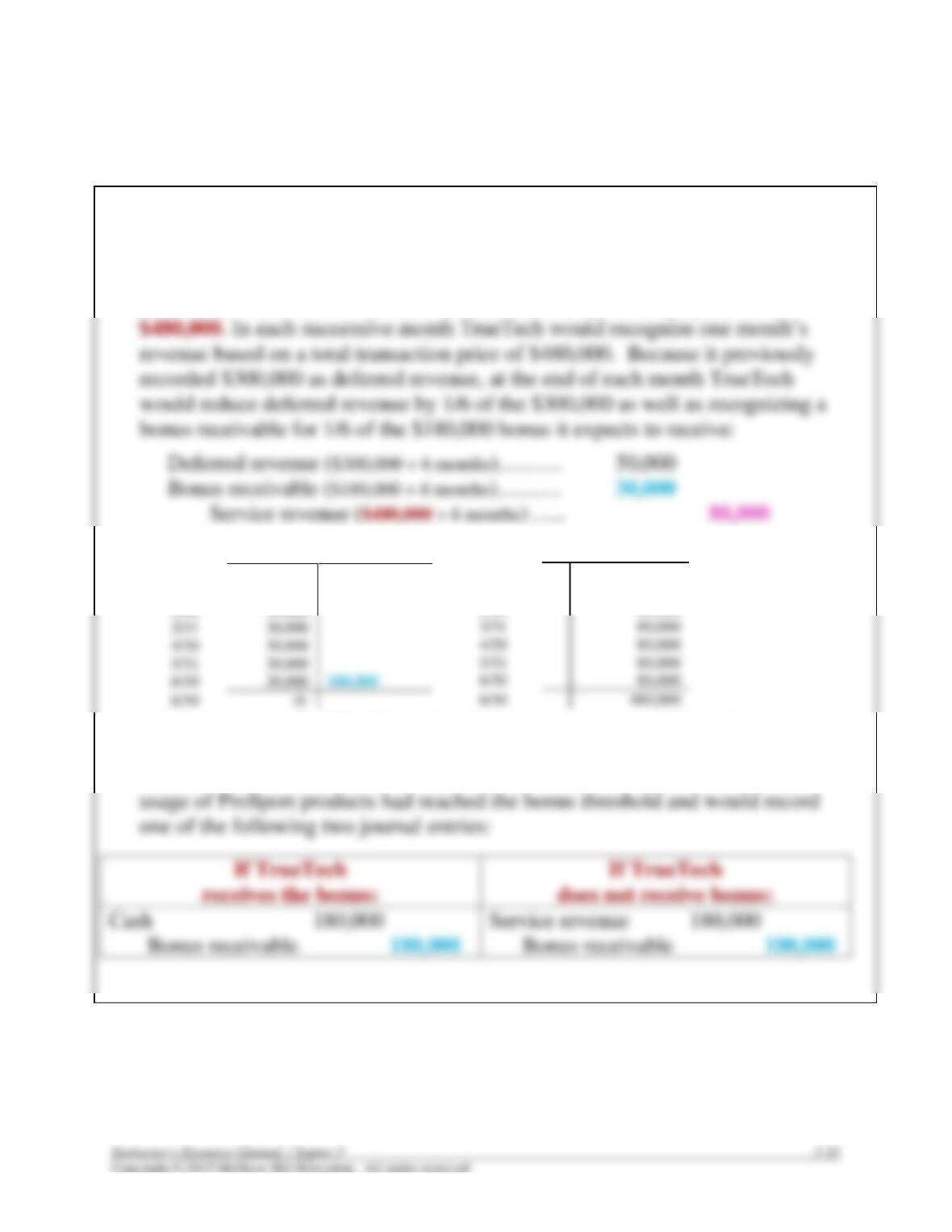
• TrueTech enters into a contract with ProSport Gaming to add ProSport’s online
games to the Tri-Net network. ProSports offers popular games like Brawl of
Bands, and wants those games offered on the Tri-Net so ProSports can sell
• TrueTech would record the following entry for the receipt of the cash on
January 1, 2016:
Cash …………………………... 300,000
Deferred revenue …….. 300,000
Alternative 1: Expected Value
• The expected value would be calculated as a probability-weighted transaction
price:
Possible Amounts Probabilities Expected
Amounts
Illustration 5-14
T5-19
ACCOUNTING FOR VARIABLE CONSIDERATION
(continued)
Alternative 2: Most Likely Amount
• Because there is a greater chance of qualifying for the bonus than of not
qualifying for the bonus, a transaction price based on the most likely amount
would be $300,000 + $180,000, or $480,000.
• Let’s assume that TrueTech bases the estimate on the most likely amount,
3/31
4/30
5/31
6/30
6/30
2/28
3/31
4/30
5/31
6/30
6/30
-0-
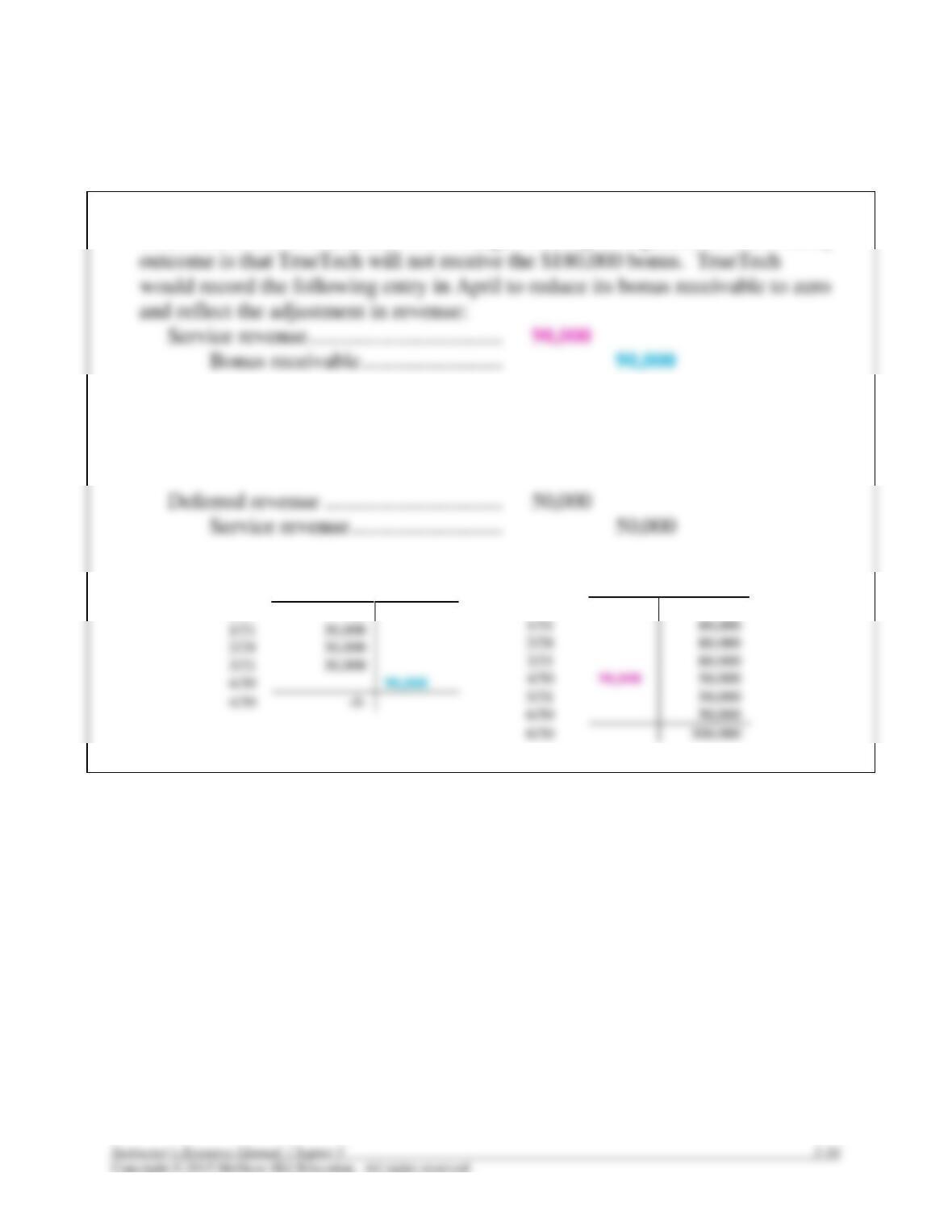
• After six months, TrueTech’s deferred revenue account would have been
reduced to a zero balance, and the bonus receivable account would have a
balance of $180,000 ($30,000 × 6). At that point, TrueTech would know if the
Illustration 5-14 (cont.)
T5-20
Service Revenue
1/1
-0-
1/31
80,000
2/28
80,000
Bonus Receivable
1/1
-0-
1/31
30,000
ACCOUNTING FOR VARIABLE CONSIDERATION:
CHANGES IN ESTIMATES
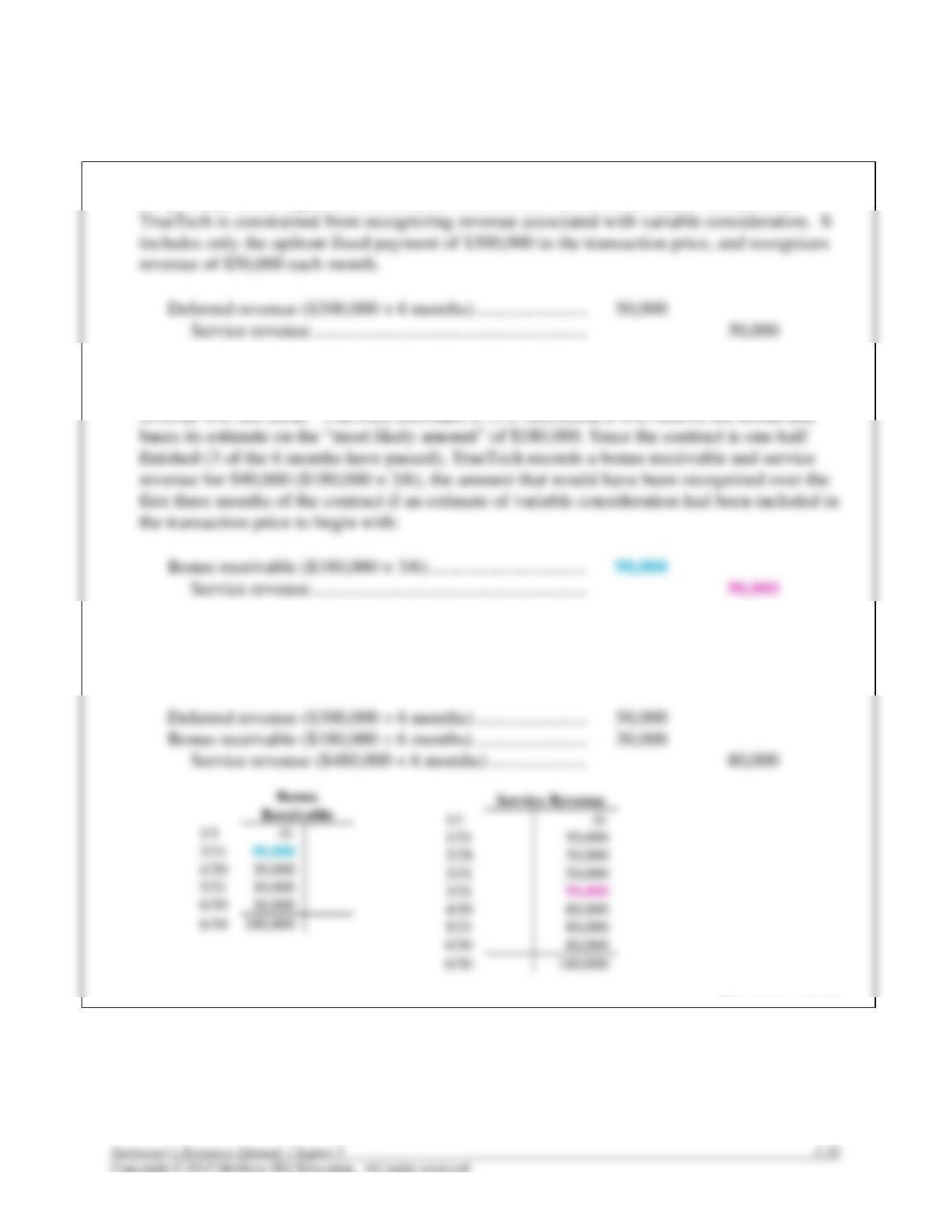
• Assume the same facts as in Illustration 5-14, but that after three months
TrueTech concludes that, due to low usage of ProSport’s games, the most likely
• For the remainder of the contract, TrueTech only recognizes $50,000 of revenue
in each of the six months associated with the upfront fixed payment of
$300,000.
1/31
2/28
3/31
4/30
5/31
6/30
6/30
1/31
2/28
3/31
4/30
4/30
-0-
Illustration 5-15
T5-21
Service Revenue
1/1
-0-
Bonus Receivable
1/1
-0-
CONSTRAINT ON VARIABLE CONSIDERATION
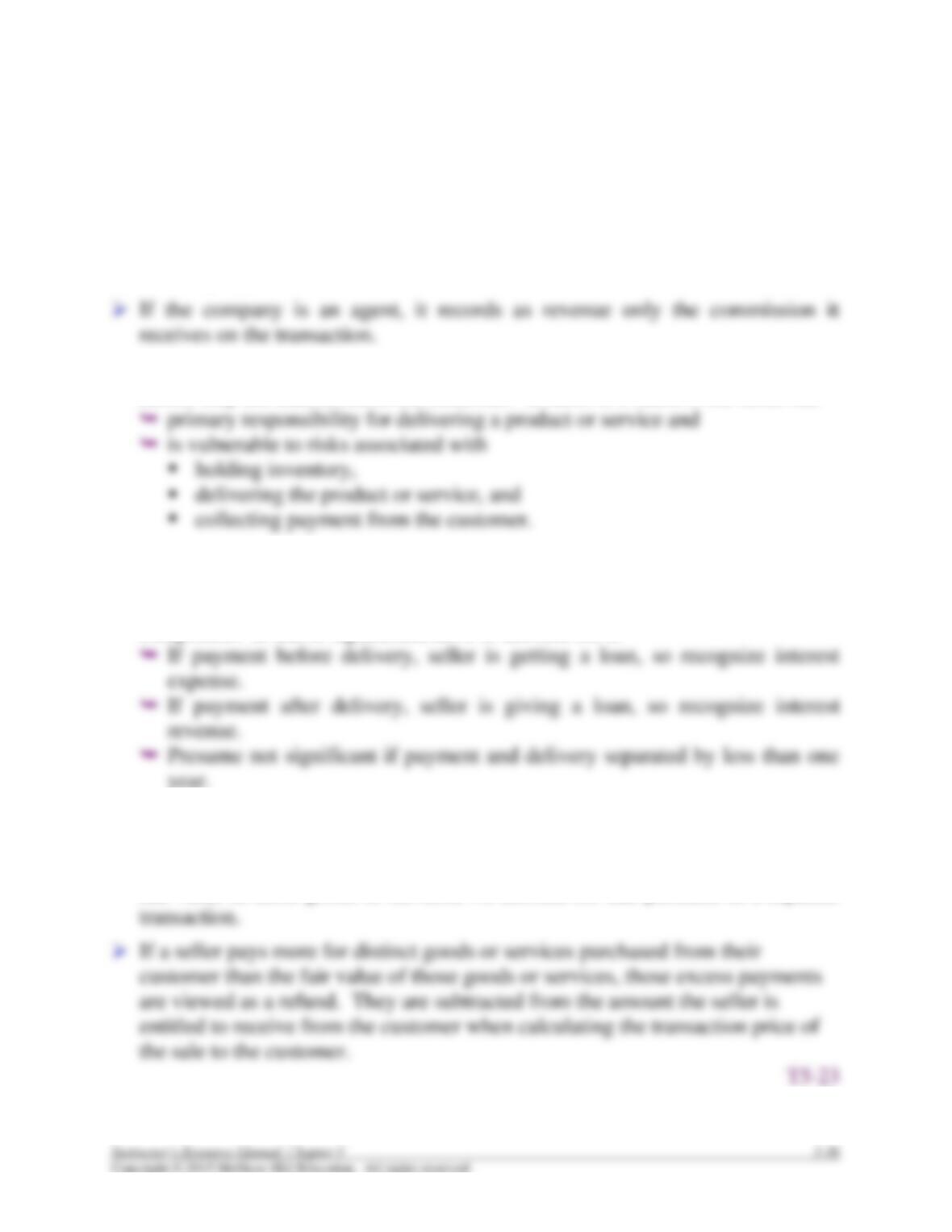
• Assume the same facts as in Illustration 5-14, but that TrueTech initially concludes that it is
not probable that a significant revenue reversal will not occur in the future. In that case,
• On March 31, after three months of the contract have passed, TrueTech concludes it can
make an accurate enough bonus estimate for it to be probable that a significant revenue
• In the final three months of the contract, TrueTech recognizes the remaining revenue
assuming a transaction price of $480,000, exactly as if it had included an estimate of variable
consideration in the transaction price all along:
Illustration 5-16
T5-22
OTHER TRANSACTION PRICE COMPLICATIONS
Principal v. Agent:
➢ If the company is a principal, it records revenue equal to the total sales price
paid by customers as well as cost of goods sold equal to the cost of the item to
the company.
➢ We view the seller as a principal if it obtains control of the goods or services
before they are transferred to the customer. Control is evident if the seller has
Time Value of Money:
➢ If payment happens before or after delivery, transaction has a financing
component. If that is significant, have to account for it.
year.
Payments by the Seller to the Customer:
➢ If the seller is purchasing distinct goods or services from the customer at the
fair value of those goods or services, we account for that purchase as a separate
REVENUE RECOGNITION BY
PRINCIPALS AND AGENTS
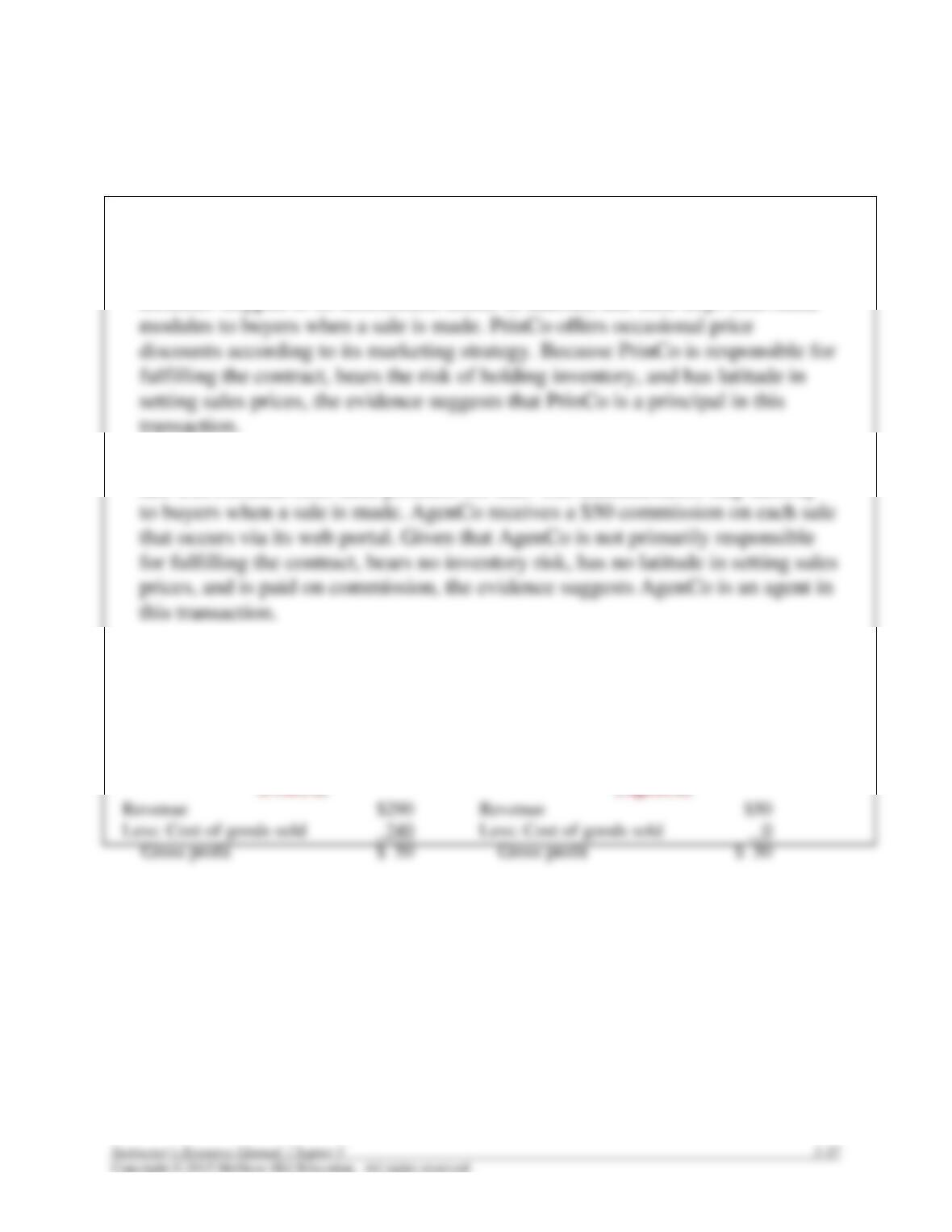
Mike buys a Tri-Box module from an online retailer for $290. Let’s consider
accounting for that sale by two retailers: PrinCo and AgenCo:
• PrinCo purchases Tri-Box modules directly from TrueTech for $240, has the
modules shipped to its distribution center in Kansas, and then ships individual
transaction.
• AgenCo serves as a web portal by which multiple game module manufacturers
like trueTechcan offer their products for sale. The manufacturers ship directly
The first part of the income statement for each retailer is shown below. Notice that
the same amount of gross profit, $50, is recognized by the principal and the agent.
What differ are the amounts of revenue and expense that are recognized and
reported.
A Principal Records Gross Revenue
(PrinCo)
An Agent Records Net Revenue
(AgenCo)
Illustration 5-18
T5-24
STEP 4: ALLOCATE THE TRANSACTION PRICE
TO PERFORMANCE OBLIGATIONS:
ESTIMATING STAND-ALONE SELLING PRICES
Three methods are recommended for estimating stand-alone selling prices that are
not observable:
1. Adjusted market assessment approach: The seller considers what it could sell the
3. Residual approach: The seller estimates an unknown (or highly uncertain) stand–
alone selling price by subtracting the sum of the known or estimated stand-
alone selling prices from the total transaction price. Only allowed if the stand-
alone selling price is highly uncertain, either because
T5-25
ALLOCATING TRANSACTION PRICE
TO PERFORMANCE OBLIGATIONS
USING THE RESIDUAL APPROACH
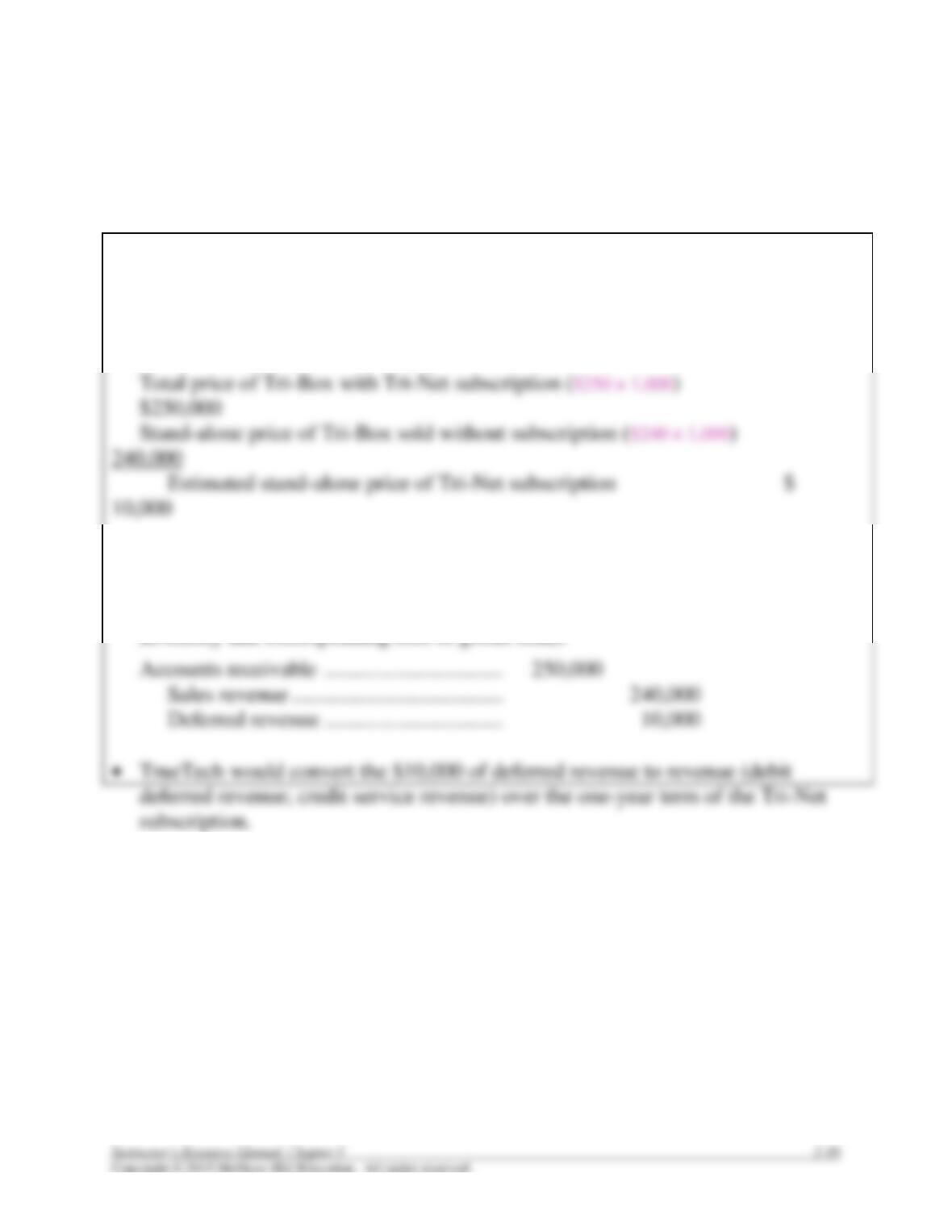
• Assume the same facts as Illustration 5-7, except that the stand-alone selling
price of the one-year Tri-Net subscription is highly uncertain because TrueTech
hasn’t sold that service previously and hasn’t established a price for it. Under
the residual approach, the value of the subscription would be estimated as
follows:
• Based on these relative stand-alone selling prices, if CompStores orders 1,000
Tri-Box Systems at the normal wholesale price of $250 each, TrueTech records
the following journal entry (ignoring any entry to record the reduction in
inventory and corresponding cost of goods sold):
Illustration 5-19
T5-26
STEP 5: RECOGNIZE REVENUE WHEN (OR AS)
EACH PERFORMANCE OBLIGATION IS SATISFIED
➢ Licenses
Right of use: Transfer a right to use the seller’s intellectual property as it
exists when the license is granted. Revenue recognized at the point in time
➢ Franchises
In franchise arrangements, the franchisor grants the right to sell the
franchisor’s products and use its name for a specified period of time.
➢ Bill-and-hold sales
Exist when a customer purchases goods but requests that the seller not ship
➢ Consignment arrangements
Exist when a “consignor” physically transfers the goods to the consignee but
➢ Gift Cards
Seller records a deferred revenue liability when the card is sold.
T5-27