Section 5.4
5.4.36 We want
a
b
c
such that
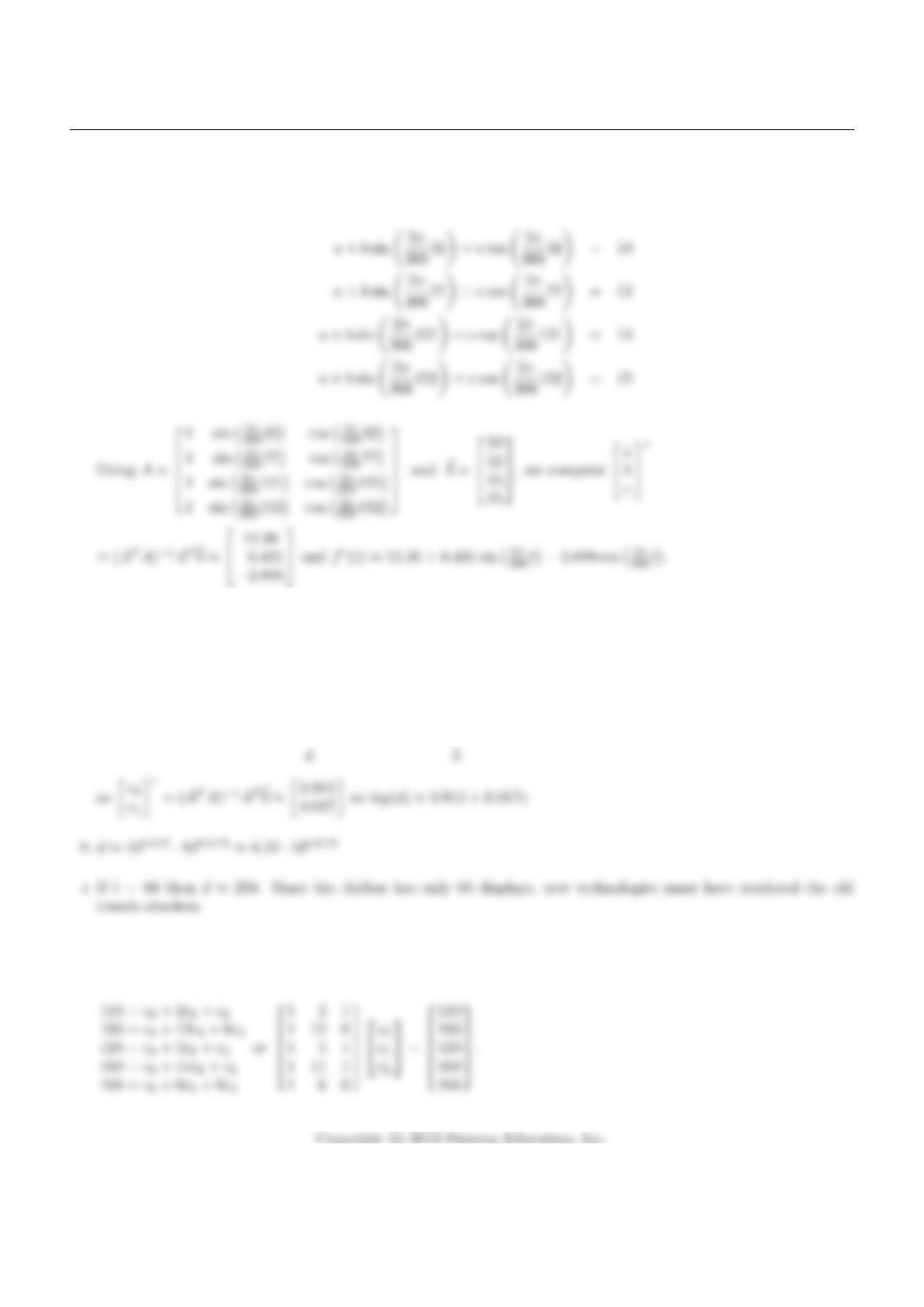
5.4.37 a We want c0, c1such that
c0+c1(35) = log 35
c0+c1(46) = log 46
c0+c1(59) = log 77
c0+c1(69) = log 133
or
1 35
1 46
1 59
1 69
c0
c1=
log 35
log 46
log 77
log 133
↑ ↑
5.4.38 We want
c0
c1
c2
such that
263
Chapter 5
5.4.39 a We want c0
c1such that
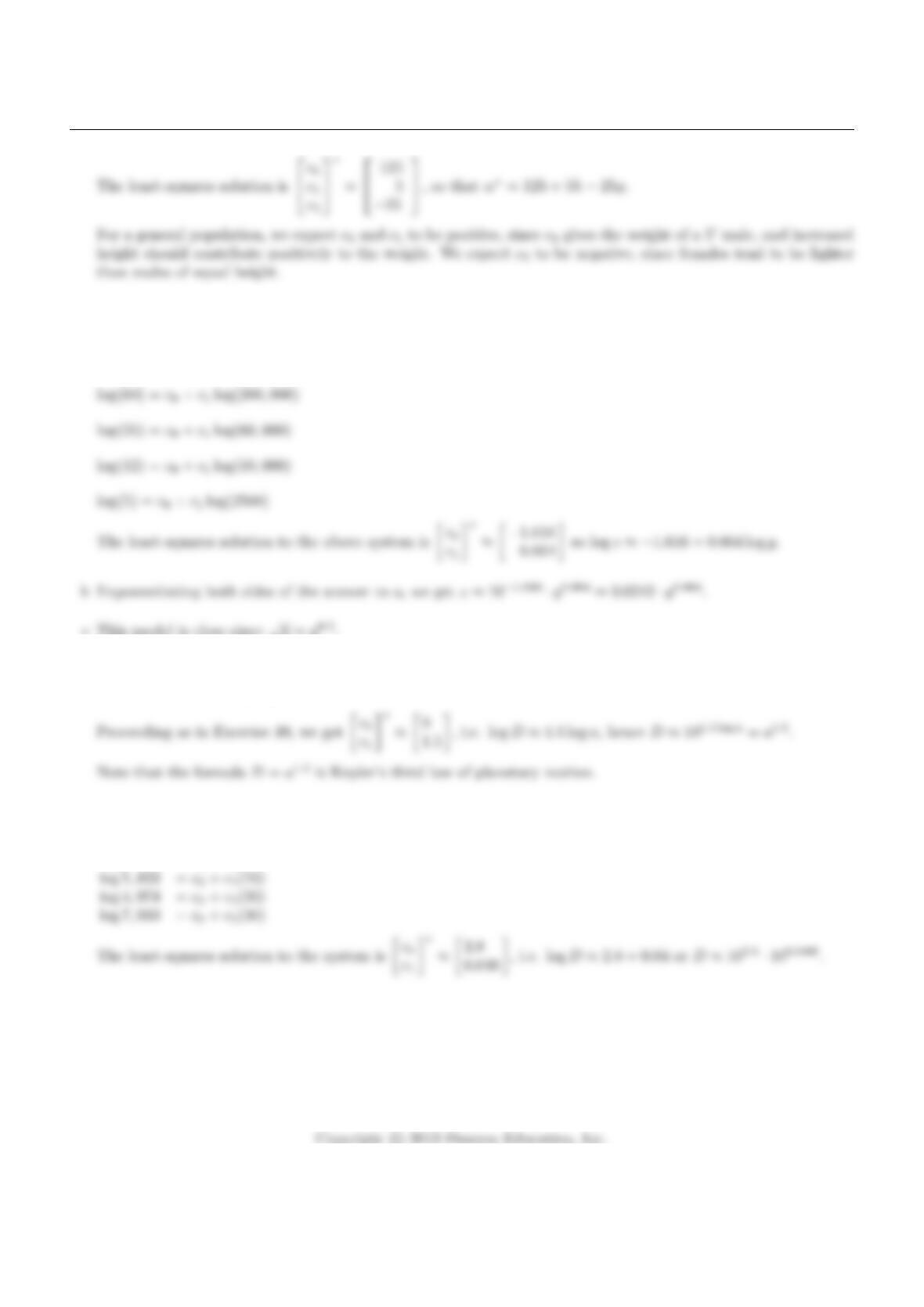
log(250) = c0+c1log(600,000)
5.4.40 First we look for c0
c1such that log D=c0+c1log a.
5.4.41 a We want c0
c1such that log D=c0+c1t(tin years since 1975), i.e.
log 533 = c0+c1(0)
b In the year 2015, we have t= 40 and D≈24,200. The formula predicts a debt of about US$24 trillion.
5.4.42 Clearly, Lis a linear transformation. We will use Theorem 4.2.4a and show that ker(L) = {~
0}and im(L) =
im(A). Now ker(L) = ker(A)∩im(AT) = {~
0}, by Theorems 5.4.1 and 5.1.8b. Also, im(L) = {A~v :~v in im(AT)}=
im(AAT) = im(A), by Exercise 6.
264
Section 5.5
Section 5.5
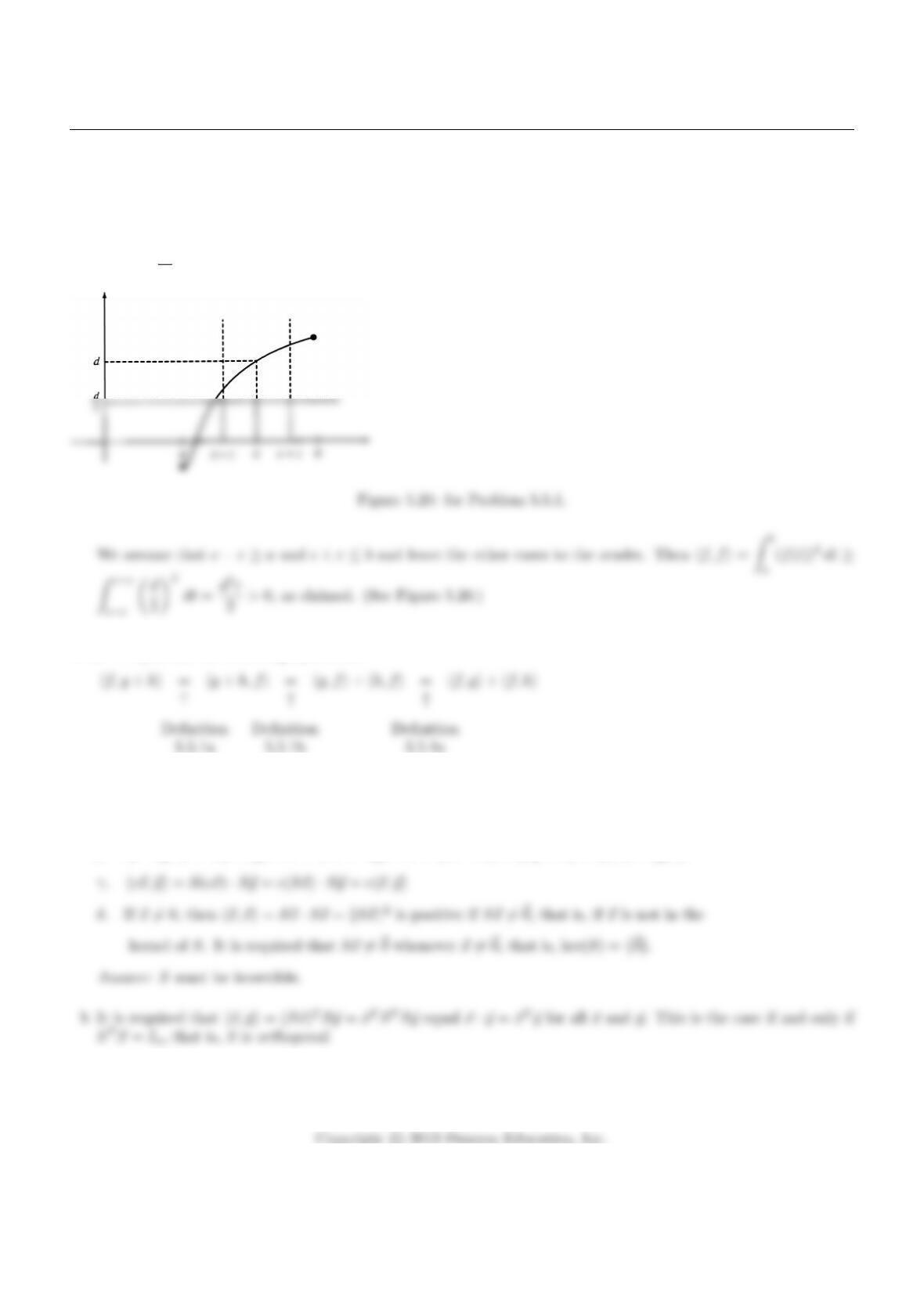
5.5.1Since fis nonzero, there is a con [a, b] such that f(c) = d6= 0. By continuity, there is an ε > 0 such that
|f(x)|>|d|
2for all xon the open interval (c−ε, c +ε) where fis defined (see any good Calculus text).
5.5.2We perform the following operations:
5.5.3a Note that h~x, ~yi= (S~x)TS~y =S~x ·S~y. We will check the four parts of Definition 5.5.1
α. h~x, ~yi=S~x ·S~y =S~y ·S~x =h~y, ~xi
β. h~x +~y, ~zi=S(~x +~y)·S~z = (S~x +S~y)·S~z = (S~x ·S~z) + (S~y ·S~z) = h~x, ~zi+h~y, ~zi
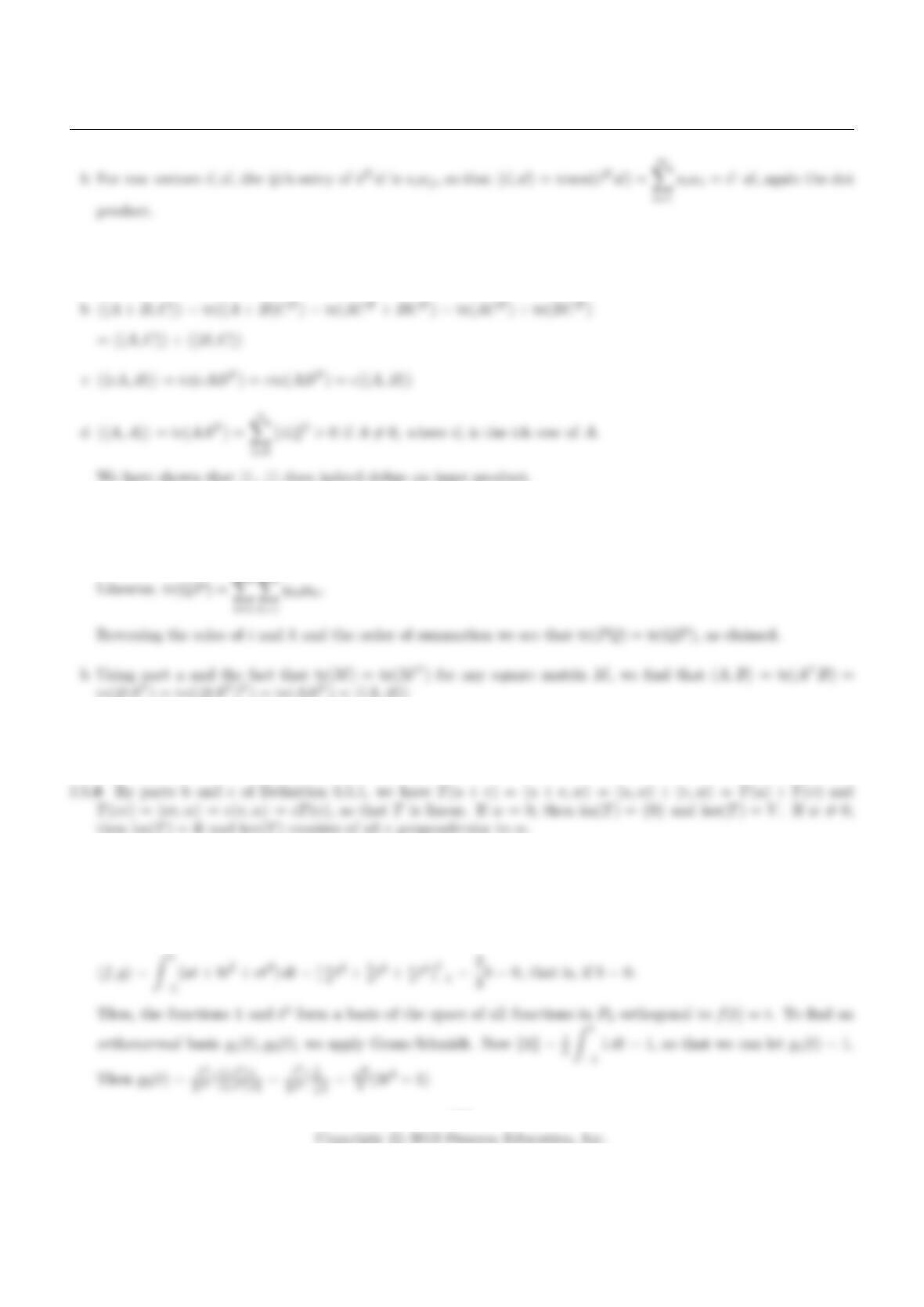
5.5.4a For column vectors ~v, ~w, we have h~v, ~wi= trace(~vT~w) = trace(~v ·~w) = ~v ·~w, the dot product.
265
Chapter 5
5.5.5ahhA, Bii = tr(ABT) = tr((ABT)T) = tr(BAT) = hhB, Aii In the second step we have used the fact that
tr(M) = tr(MT), for any square matrix M.
5.5.6a The iith entry of PQ is
m
X
k=1
pikqki, so that tr(P Q) =
n
X
i=1
m
X
k=1
pikqki.
m
X
n
X
5.5.7Axioms a, b, and chold for any choice of k(check this!). Also, it is required that hhv, vii =khv, vibe positive
for nonzero v. Since hv, viis positive, this is the case if (and only if) kis positive.
5.5.9If fis even and gis odd, then fg is odd, so that hf, gi=Z1
−1
fg = 0.
5.5.10 A function g(t) = a+bt +ct2is orthogonal to f(t) = tif
266
Section 5.5
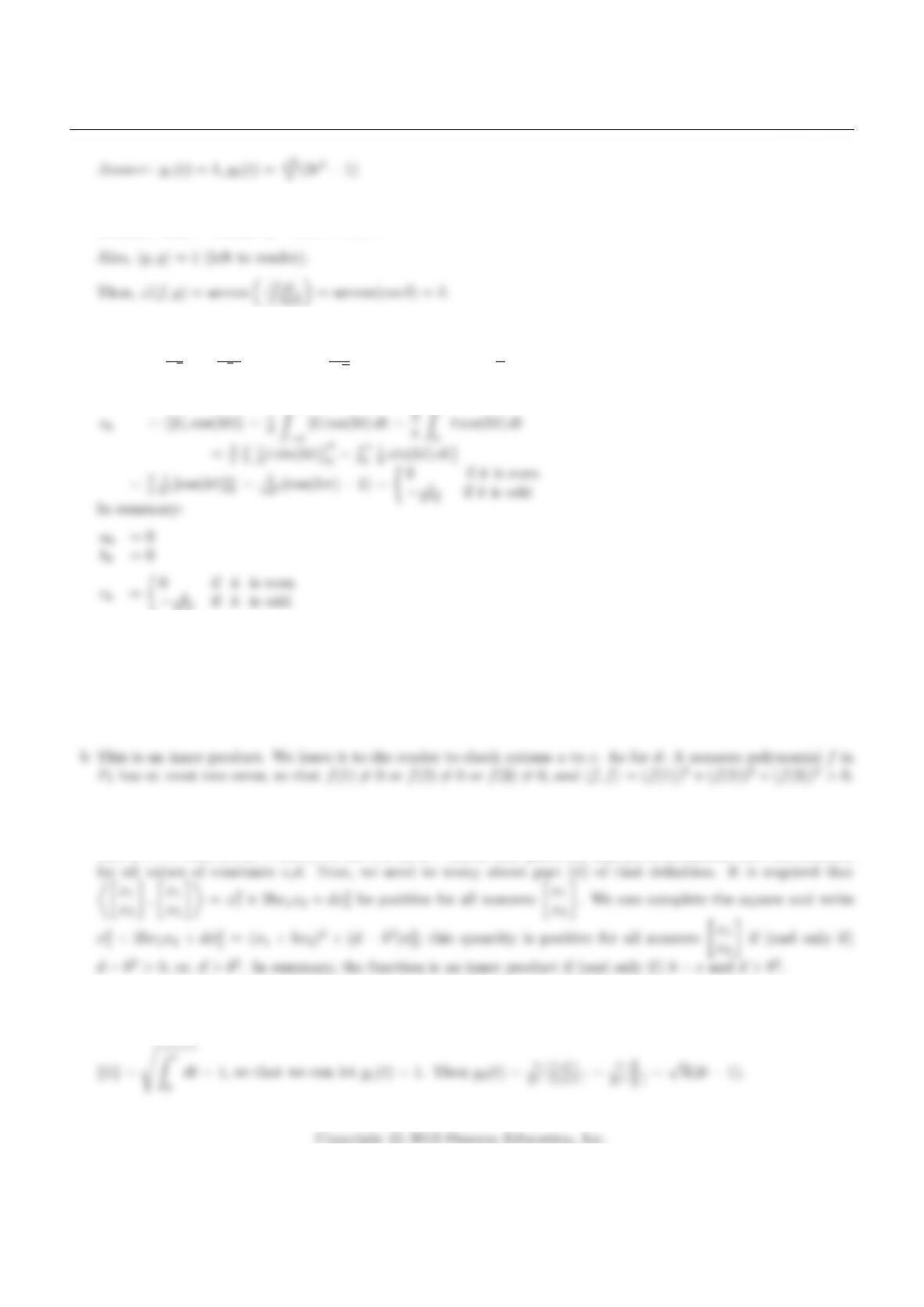
5.5.11 hf, gi=hcos(t),cos(t+δ)i=hcos(t),cos(t) cos(δ)−sin(t) sin(δ)i= cos(δ)hcos(t),cos(t)i − sin(δ)
hcos(t),sin(t)i= cos(δ), by Theorem 5.5.4.
5.5.12 By Theorem 5.5.5
a0=D|t|,1
√2E=1
√2πZπ
−π|t|dt =π
√2, bk=h|t|,sin(kt)i=1
πZπ
−π|t|sin(kt)dt = 0, since the integrand is an odd
function.
5.5.13 The sequence (a0, b1, c1, b2, c2,…) is “square-summable” by Theorem 5.5.6, so that it is in ℓ2. Also, k(a0, b1, c1, b2, c2,…)
a2
0+b2
1+c2
1+b2
2+c2
2+···=kfk2, by Theorem 5.5.6, so that the two norms are equal.
5.5.14 a This is not an inner product since there are nonzero polynomials f(t) in P2with f(1) = f(2) = 0, so that
hf, f i= (f(1))2+ (f(2))2= 0. (For example, let f(t) = (t−1)(t−2).)
5.5.15 First note that b=1
0,0
1=0
1,1
0=c, by part a of Definition 5.5.1, so that b=c. Check
that if b=cthen h~v, ~wi=h~w, ~vifor all ~v, ~w in R2. Check that parts (b) and (c) of Definition 5.5.1 are satisfied
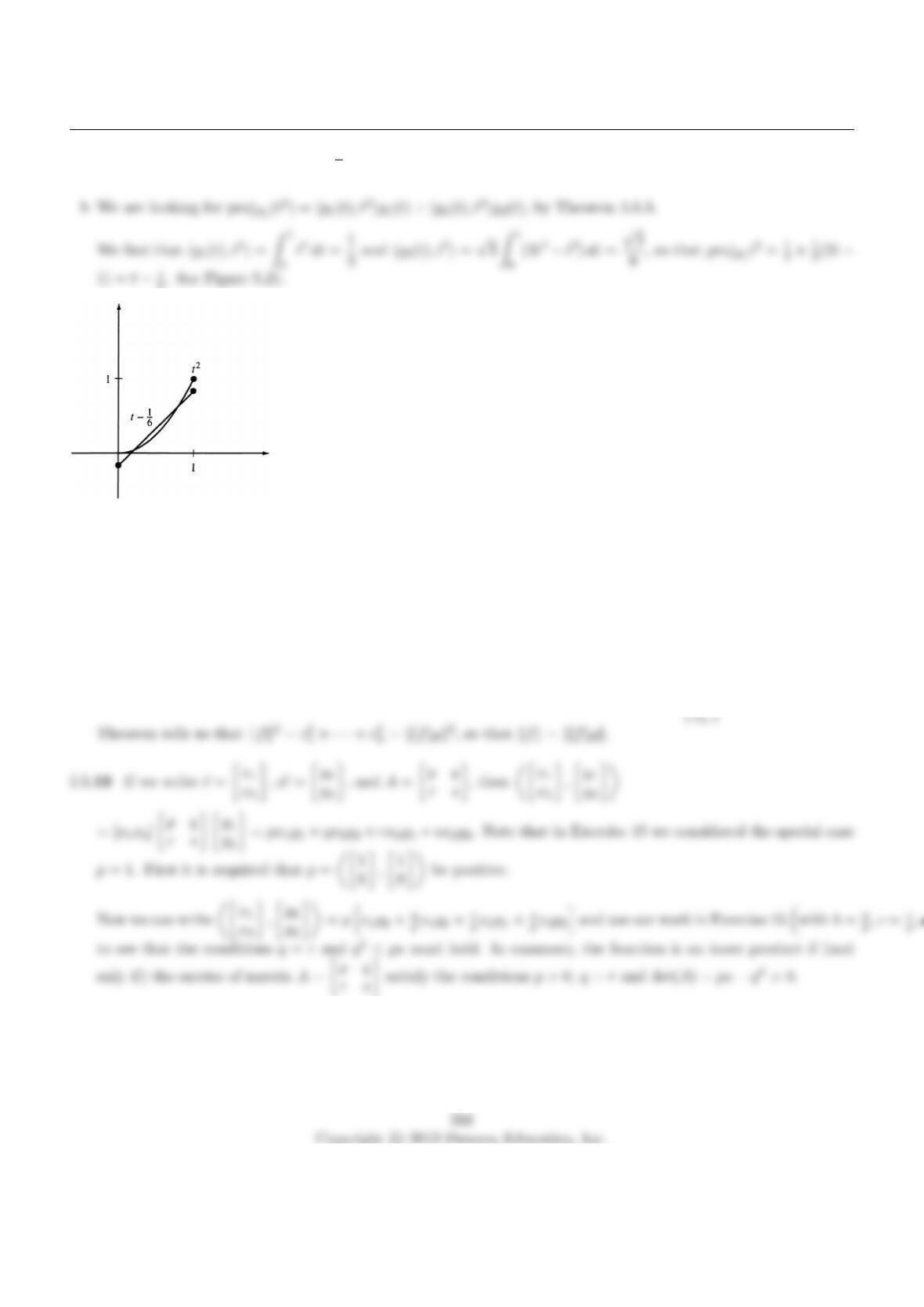
5.5.16 a We start with the standard basis 1, tand use the Gram-Schmidt process to construct an orthonormal basis
g1(t), g2(t).
267
Chapter 5
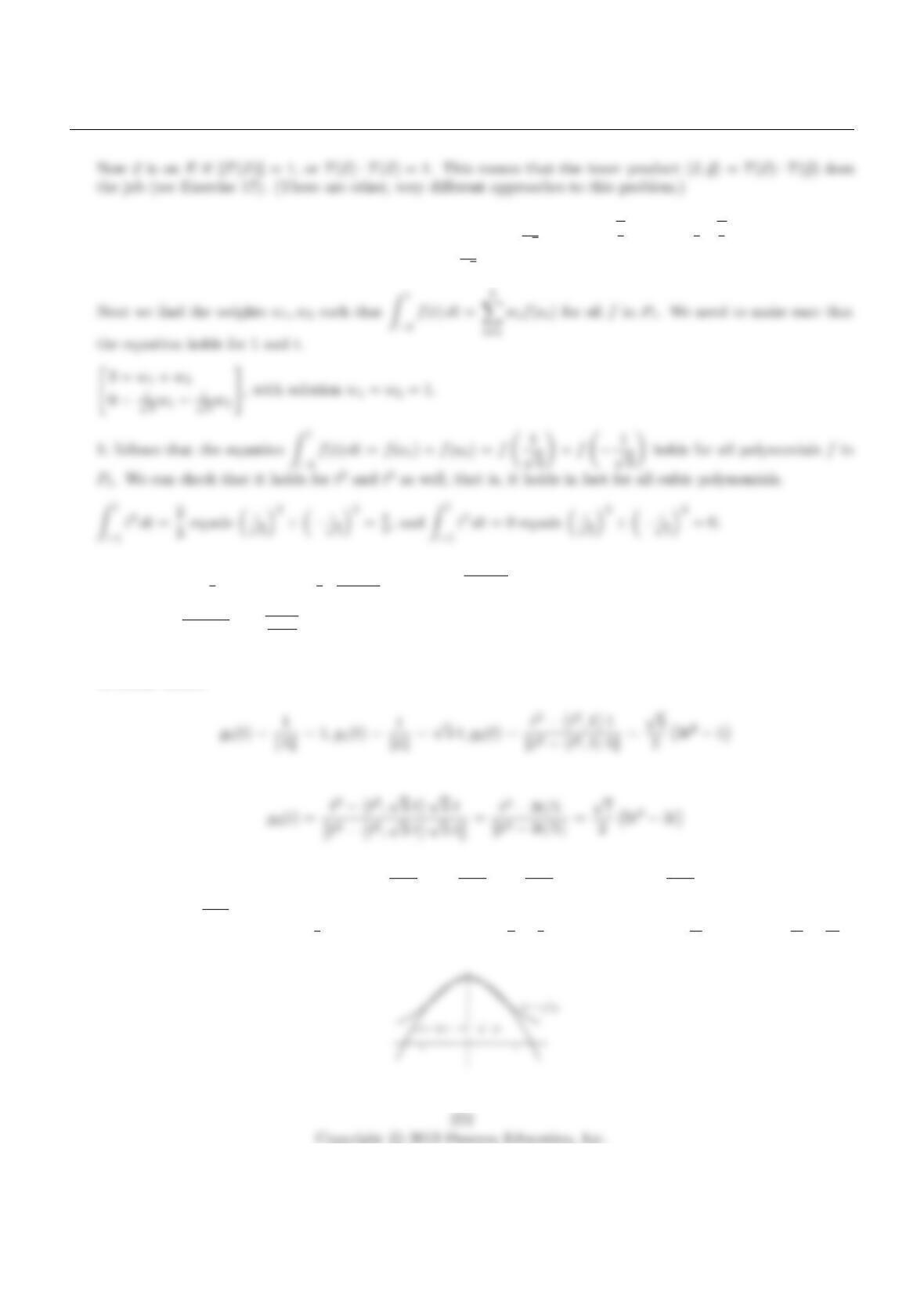
Summary:g1(t) = 1 and g2(t) = √3(2t−1) is an orthonormal basis.
Figure 5.21: for Problem 5.5.16b.
5.5.17 We leave it to the reader to check that the first three axioms are satisfied for any such T. As for axiom d: It
is required that hv, vi=T(v)·T(v) = kT(v)k2be positive for any nonzero v, that is, T(v)6=~
0. This means that
the kernel of T must be {0}.
5.5.18 Let the orthonormal basis be f1,…,fnand f=c1f1+···+cnfn; then [f]B=
c1
c2
.
.
.
. The Pythagorean
5.5.20 ax1
x2,1
0= [x1x2]1 2
2 8 1
0=x1+ 2x2= 0 when x1=−2x2. This is the line spanned by vector
−2
1.
Section 5.5
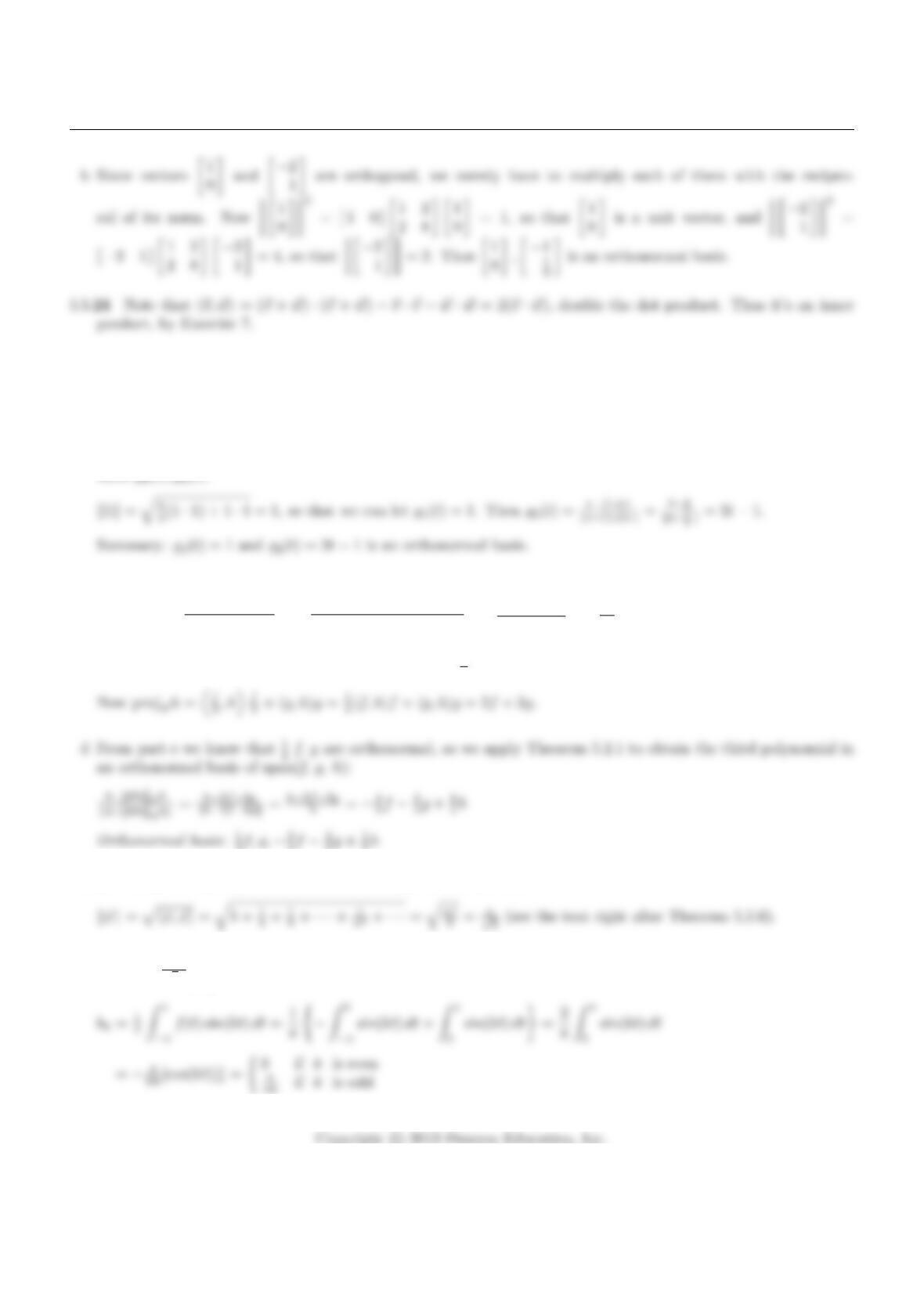
5.5.22 Apply the Cauchy-Schwarz inequality to f(t) and g(t) = 1; note that kgk= 1:
|hf, gi| ≤ kfkkgk=kfkor hf, gi2≤ kfk2or Z1
0
f(t)dt2
≤R1
0(f(t))2dt.
5.5.23 We start with the standard basis 1, tof P1and use the Gram-Schmidt process to construct and orthonormal
basis g1(t), g2(t).
5.5.24 ahf, g +hi=hf, gi+hf, hi= 0 + 8 = 8
bkg+hk=phg+h, g +hi=phg, gi+ 2hg, hi+hh, hi=√1 + 6 + 50 = √57
c Since hf, gi= 0,kgk= 1, and kfk= 2, we know that f
2, g is an orthonormal basis of span (f, g).
2f, g, −2
5f−3
5g+1
5h
5.5.25 Using the inner product defined in Example 2, we find that
5.5.26 a0=1
√2πZπ
−π
f(t)dt = 0
269
Chapter 5
ck=1
πZπ
−π
f(t) cos(kt)dt = 0,since the integrand is odd.
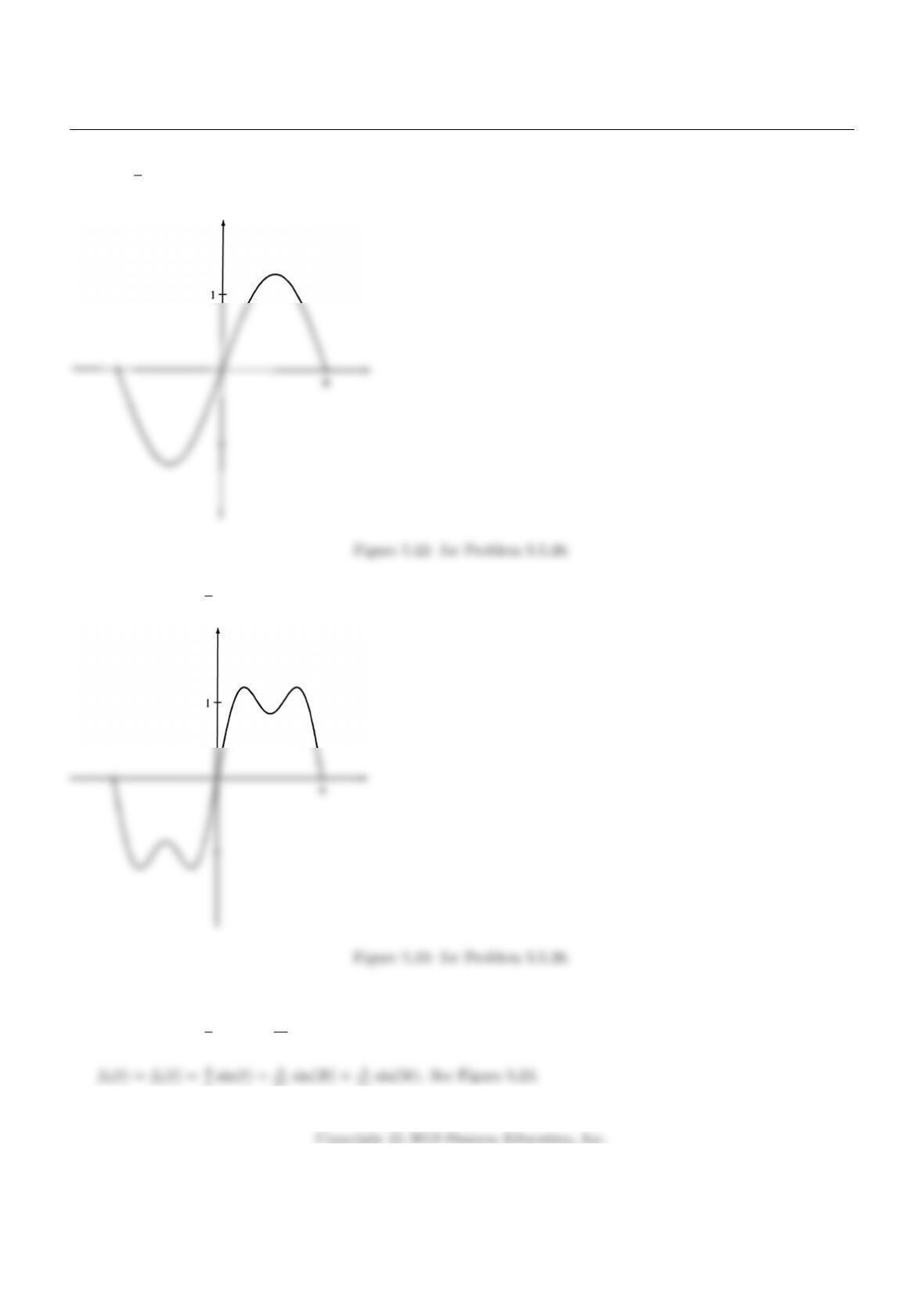
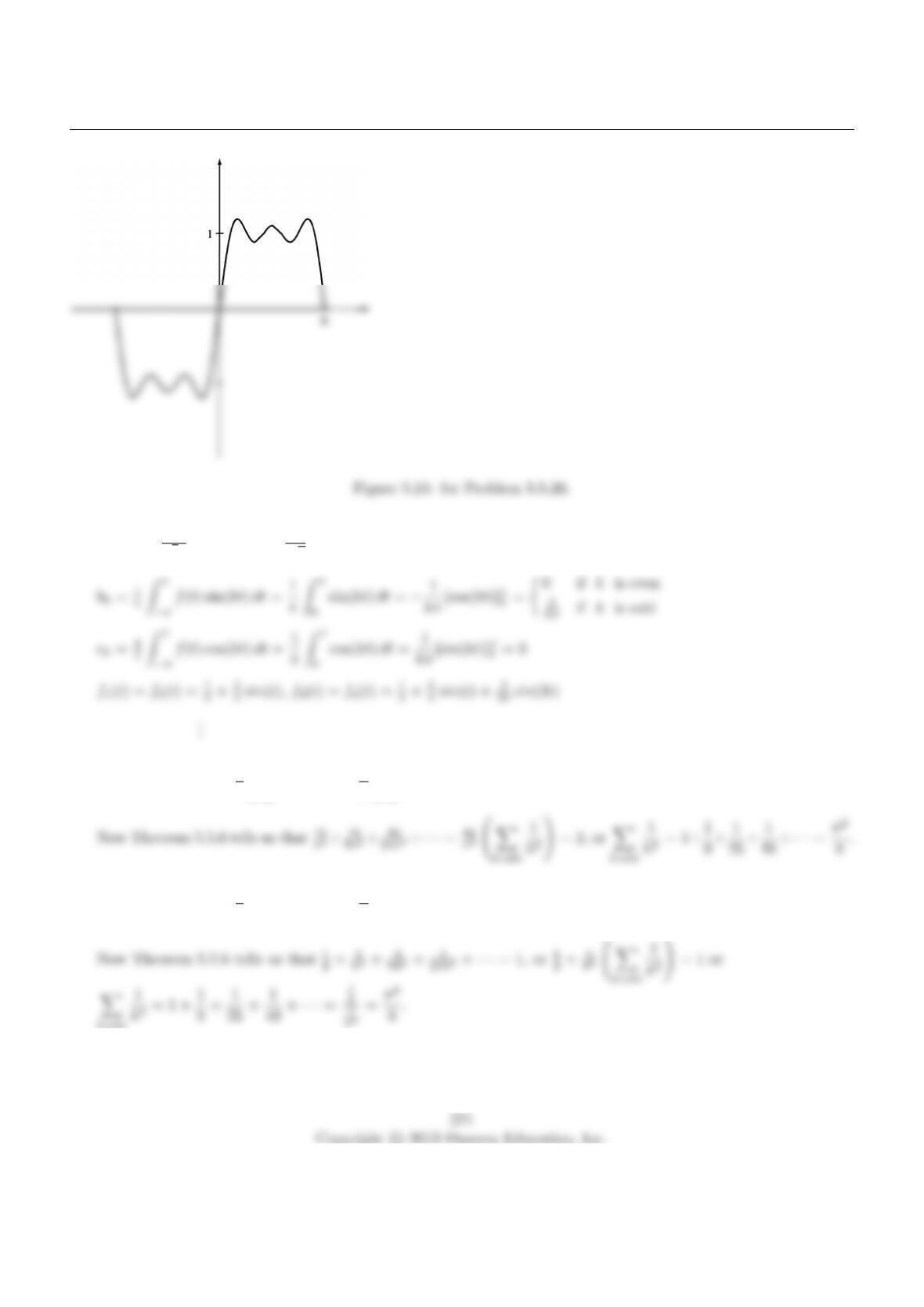
f1(t) = f2(t) = 4
πsin(t). See Figure 5.22.
f3(t) = f4(t) = 4
πsin(t) + 4
3πsin(3t). See Figure 5.23.
270
Section 5.5
5.5.27 a0=1
√2πZπ
−π
f(t)dt =1
√2.
5.5.28 kfk2=hf, f i=1
πZπ
−π
(f(t))2dt =1
πZπ
−π
1dt = 2
5.5.29 kfk2=hf, f i=1
πZπ
−π
(f(t))2dt =1
πZπ
0
1dt = 1
5.5.30 There is an invertible linear transformation T(~x) = A~x from R2to R2that transforms Einto the unit circle.
(If Eis parametrized by cos(t)~w1+ sin(t)~w2, let A= [ ~w1~w2]−1. Compare with Exercises 2.2.54 and 2.2.55.)
Chapter 5
5.5.31 An orthonormal basis of P2of the desired form is f0(t) = 1
√2, f1(t) = q3
2t, f2(t) = 1
2q5
2(3t2−1) (compare
with Exercise 10), and the zeros of f2(t) are a1,2=±1
√3.
5.5.32 a.htn, tmi=1
2R1
−1tn+mdt =1
2htn+m+1
n+m+1 i1
−1=1
n+m+1 if n+mis even
0 if n+mis odd
b. ktnk=phtn, tni=q1
2n+1 by part a.
c. It helps to observe that 1 and t2are orthogonal to tand t3. Accordingly, many terms in the Gram-Schmidt
formulas vanish.
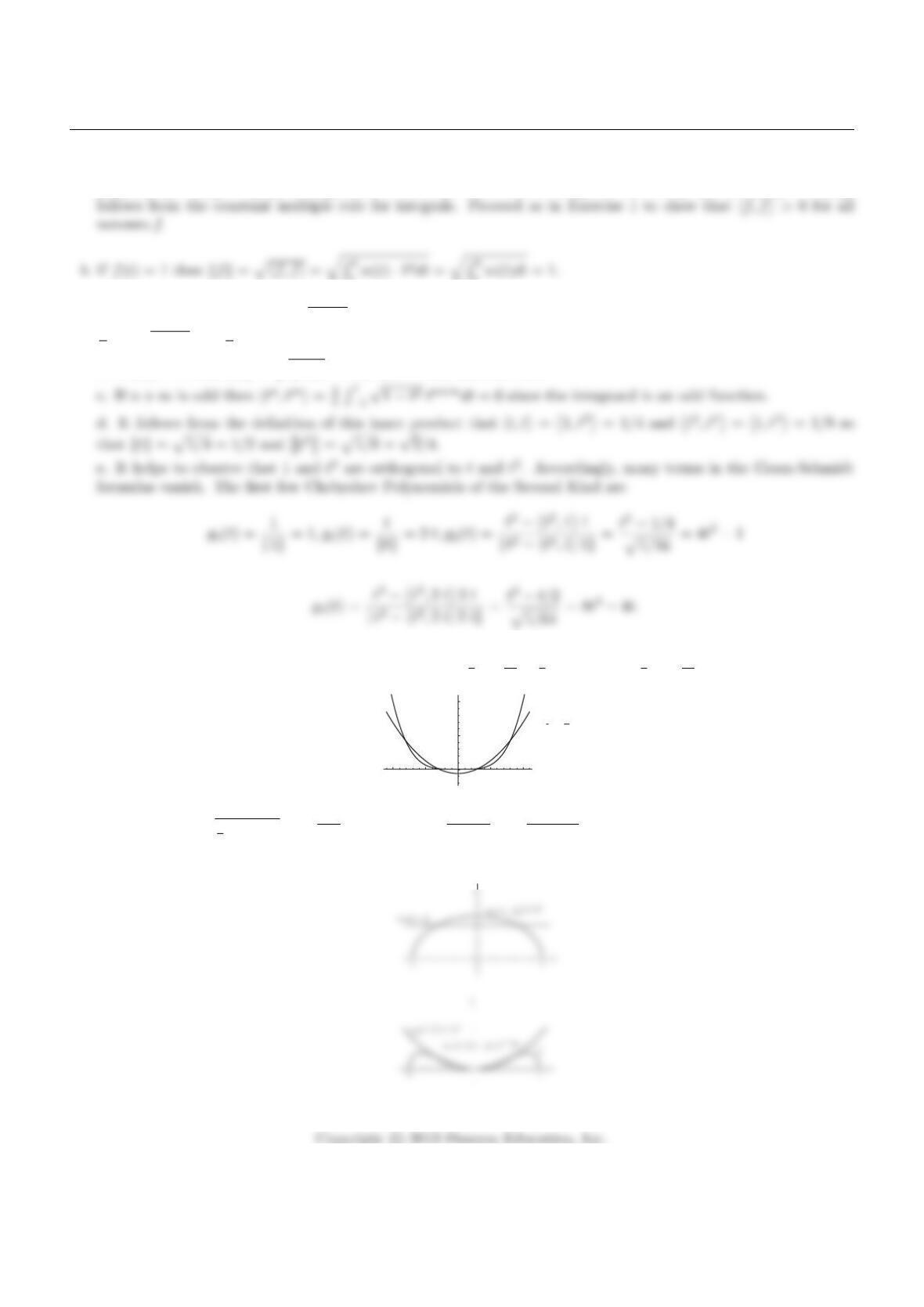
d. The first few Legendre Polynomials are g0(t)
g1(1) = 1,g1(t)
g1(1) =t,g2(t)
g2(1) =3t2−1/2, g3(t)
g3(1) =5t3−3t/2.
e. Since f(t) = 1
1+t2is an even function, we need to consider g0(t) and g2(t) only. The solution is hf(t), g0(t)ig0(t)+
hf(t), g2(t)ig2(t) = hf(t),1i1 + 5
4f(t),3t2−13t2−1=π
4+5
8(6 −2π)3t2−1=15
4(3 −π)t2−15
4+3π
2.
Section 5.5
5.5.33 a The first property of an inner product, hf, gi=hg, fi, follows from the fact that f(t)g(t) = g(t)f(t). The
property hf+h, gi=hf, gi+hh, gifollows from the sum rule for integrals, and the property hcf, gi=chf, gi
5.5.34 a. Note that the graph of √1−t2is the upper half of the unit circle centered at the origin. Thus R1
−1w(t)dt =
2
πR1
−1√1−t2dt =2
π(half the area of the unit circle) = 1
b. If f(t) = 1 then kfk=phf, f i= 1 by part a and Exercise 33b.
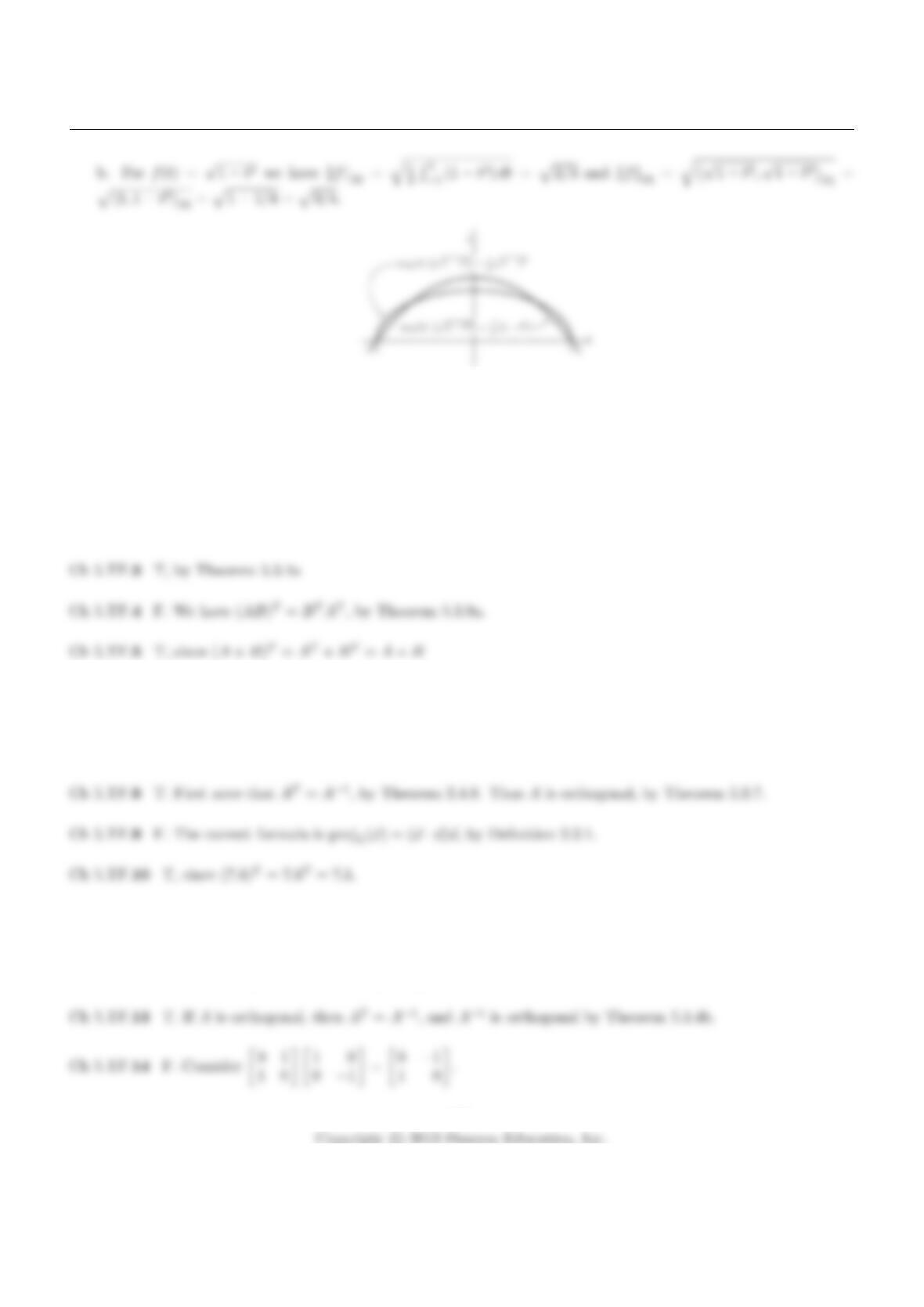
f. Since f(t) = t4is an even function, we need to consider g0(t) and g2(t) only. The solution is hf(t), g0(t)ig0(t) +
hf(t), g2(t)ig2(t) = t4,11 + t4,4t2−14t2−1=1
8+5
16 −1
84t2−1=3
4t2−1
16 .
1-1
1
t
g(t) = 3
4t2
−
1
16
f(t) = t4
5.5.35 a. ktk32 =q1
2R1
−1t2dt =p1/3 and ktk34 =pht, ti34 =ph1, t2i34 = 1/2, so that ktk32 >ktk34. Note that
1, t234 = 1/4 is given in Exercise 34.
273
Chapter 5
True or False
Ch 5.TF.1F. Consider T(~x) = 1 1
0 0 ~x.
Ch 5.TF.2T, by Theorem 5.3.9.b
Ch 5.TF.6T, by Theorem 5.3.4
Ch 5.TF.7F. Consider 1 1
1 1 .
Ch 5.TF.11 F. The Pythagorean Theorem holds for orthogonal vectors ~x, ~y only (Theorem 5.1.9)
Ch 5.TF.12 T. deta c
b d =ad −bc = det a b
c d .
274
True or False
Ch 5.TF.17 T, since (ABBA)T=ATBTBTAT=ABBA, by Theorem 5.3.9a
Ch 5.TF.18 T, since ATBT= (BA)T= (AB)T=BTAT, by Theorem 5.3.9a
Ch 5.TF.22 T. 1
2(A−AT)T=1
2(A−AT)T=1
2(AT−A) = −1
2(A−AT).
Ch 5.TF.23 T, since the columns are unit vectors.
Ch 5.TF.27 F. As a counterexample, consider 1 0
0−1and 0−1
1 0 .
Ch 5.TF.28 T, by Theorem 5.4.1.
Ch 5.TF.29 T, by Theorem 5.4.2a.
275
Chapter 5
Ch 5.TF.34 T. By Definition 5.1.12, quantity cos(θ) = ~v·~w
k~vkk~wkis positive, so that θis an acute angle.
Ch 5.TF.35 T. In Theorem 5.4.1, let A=BTto see that (im(BT))⊥= ker(B). Now take the orthogonal comple-
ments of both sides and use Theorem 5.1.8d.
5.4.2.
Ch 5.TF.39 T. We know that AT=Aand S−1=ST. Now (S−1AS)T=STAT(S−1)T=S−1AS, by Theo-
rem 5.3.9a.
Ch 5.TF.40 T. By Theorem 5.4.2, we have ker(A) = ker(ATA). Replacing Aby ATin this formula, we find that
ker(AT) = ker(AAT). Now ker(A) = ker(ATA) = ker(AAT) = ker(AT).
Ch 5.TF.43 T. Let A=x y
z t . We know that AAT=A2, or x2+y2xz +yt
xz +yt z2+t2=x2+yz xy +yt
zx +tz yz +t2. We
need to show that y=z. If y6= 0, this follows from the equation x2+y2=x2+yz; if z6= 0, it follows from
z2+t2=yz +t2; if both yand zare zero, we are all set.
276
True or False
Ch 5.TF.46 T. If A=a b
b c is a symmetric matrix, then A−xI2=a−x b
b c −x. This matrix fails to be
invertible if (and only if) det(A−xI2) = (a−x)(c−x)−b2= 0. We use the quadratic formula to find the (real)
solutions x=a+c±√(a+c)2−4ac+4b2
2=a+c±√(a−c)2+4b2
2. Note that the discriminant (a−c)2+ 4b2is positive
or zero.
Ch 5.TF.49 F; dim(R3×3)= 9, dim(R2×2)= 4, so dim(ker(L))≥5, but the space of all 3×3 skew-symmetric matrices
has dimension of 3.
A basis is
0−1 0
100
000
,
0 0 −1
0 0 0
1 0 0
,
0 0 0
0 0 −1
0 1 0
.
277