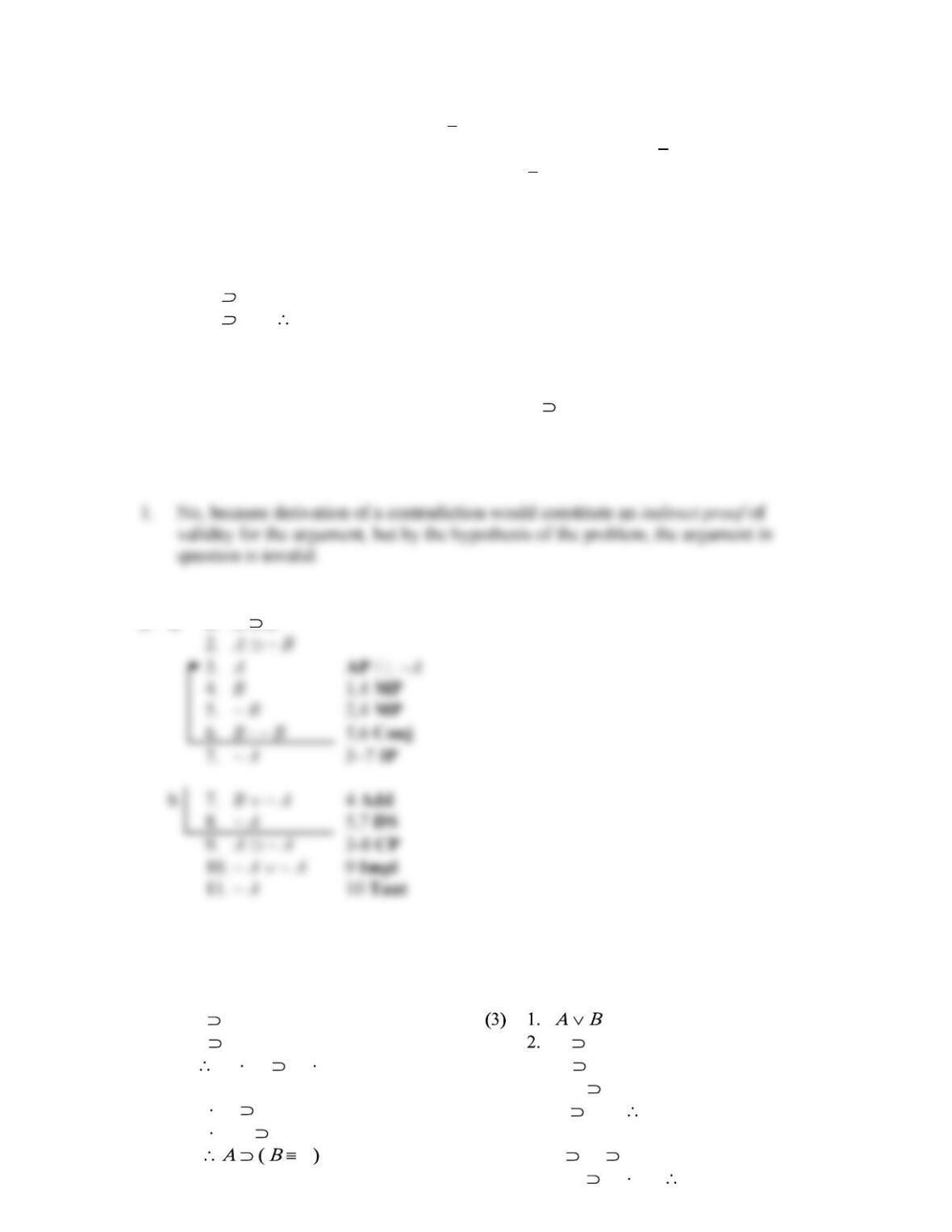
2. a. Use IP to prove that the following argument is valid.
A B
A ~ B / ~ A
b. To illustrate how indirect proofs are a kind of shortened conditional proof,
cross out the last line in the above proof and complete it as a conditional
proof. (Hint: as an intermediate step prove A ~ A.)
A. Answers
2. a. 1. A B
B. Proofs with CP or IP
Prove valid, using the eighteen valid argument forms and CP or IP:
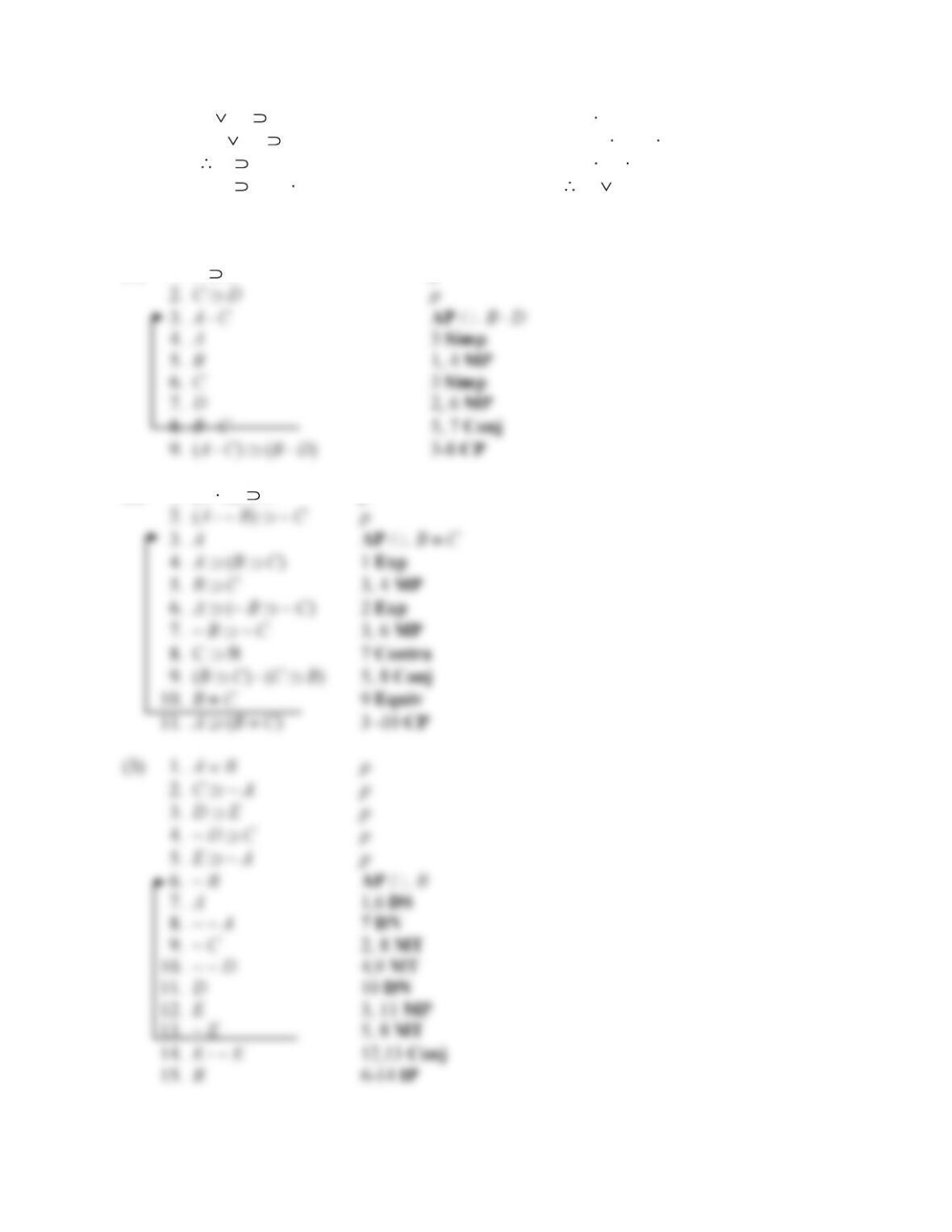
(1) 1. A B
2. C D
/ (A C) (B D)
(2) 1. (A B) C
2. (A ~ B) ~ C
/ C
C ~ A
3. D E
4. ~ D C
5. E ~ A / B
(4) 1. A (B C)
2. ~ C (A B) / C
V. CHAPTER FIVE: PROOFS WITH CP OR IP
A. General Theory
1. Suppose you know that a particular two premise argument is invalid. Now suppose
we add the negation of the conclusion of the two premises to form a three sentence set of
premises. Can a contradiction be derived from this three sentence set of premises?
(Defend your answer.)
16
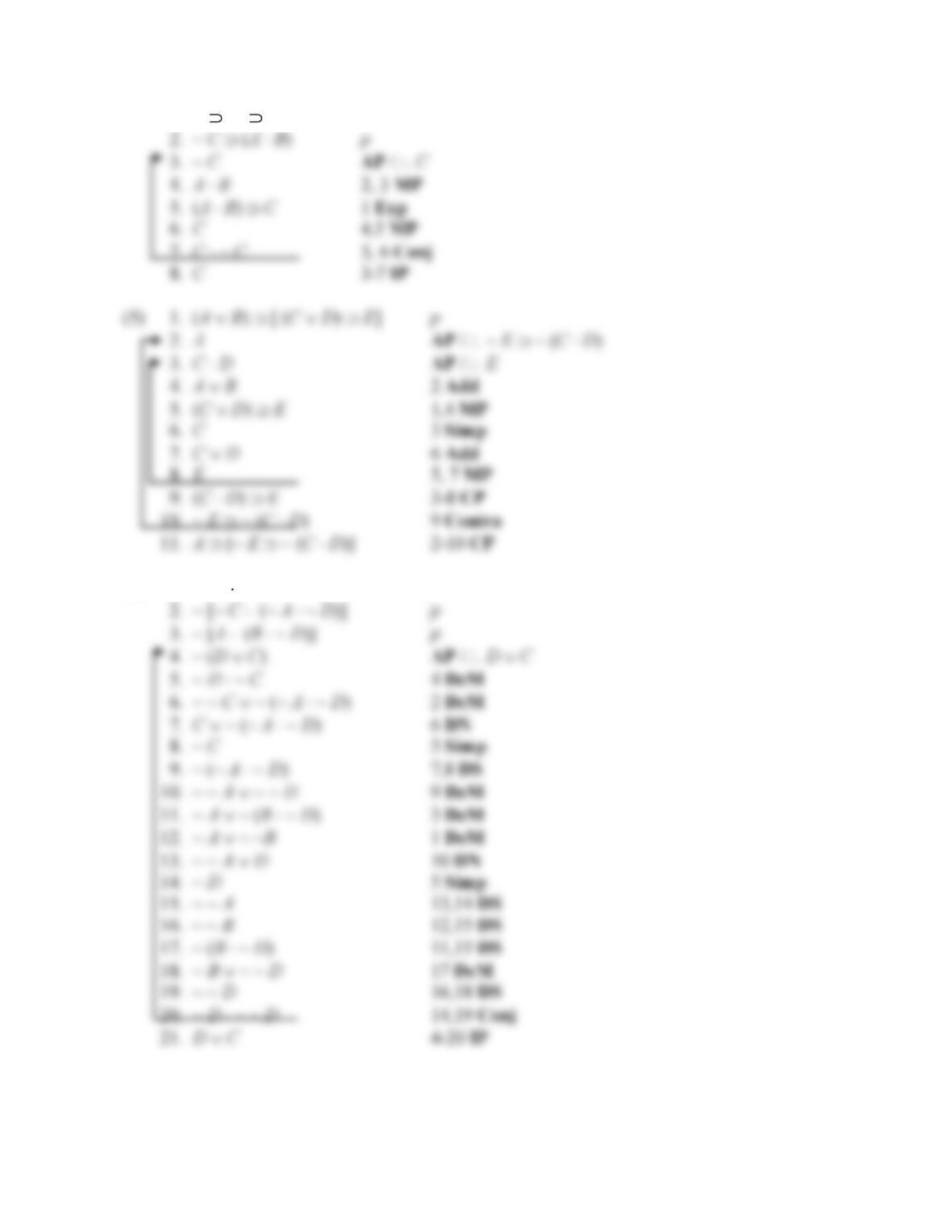
(5) 1. (A B)
[ (C D)E]
/A
[ ~ E~ (C D)]
(6) 1. ~ (A~B)
2. ~ [~ C(~ A~D)]
3. ~ [A(B~D)]
/D C
B. Suggested Answers
(1) 1. A B p
(2) 1. (A B)C p
17
(4) 1. A(B C)p
(6) 1. ~ (A~B)p
18
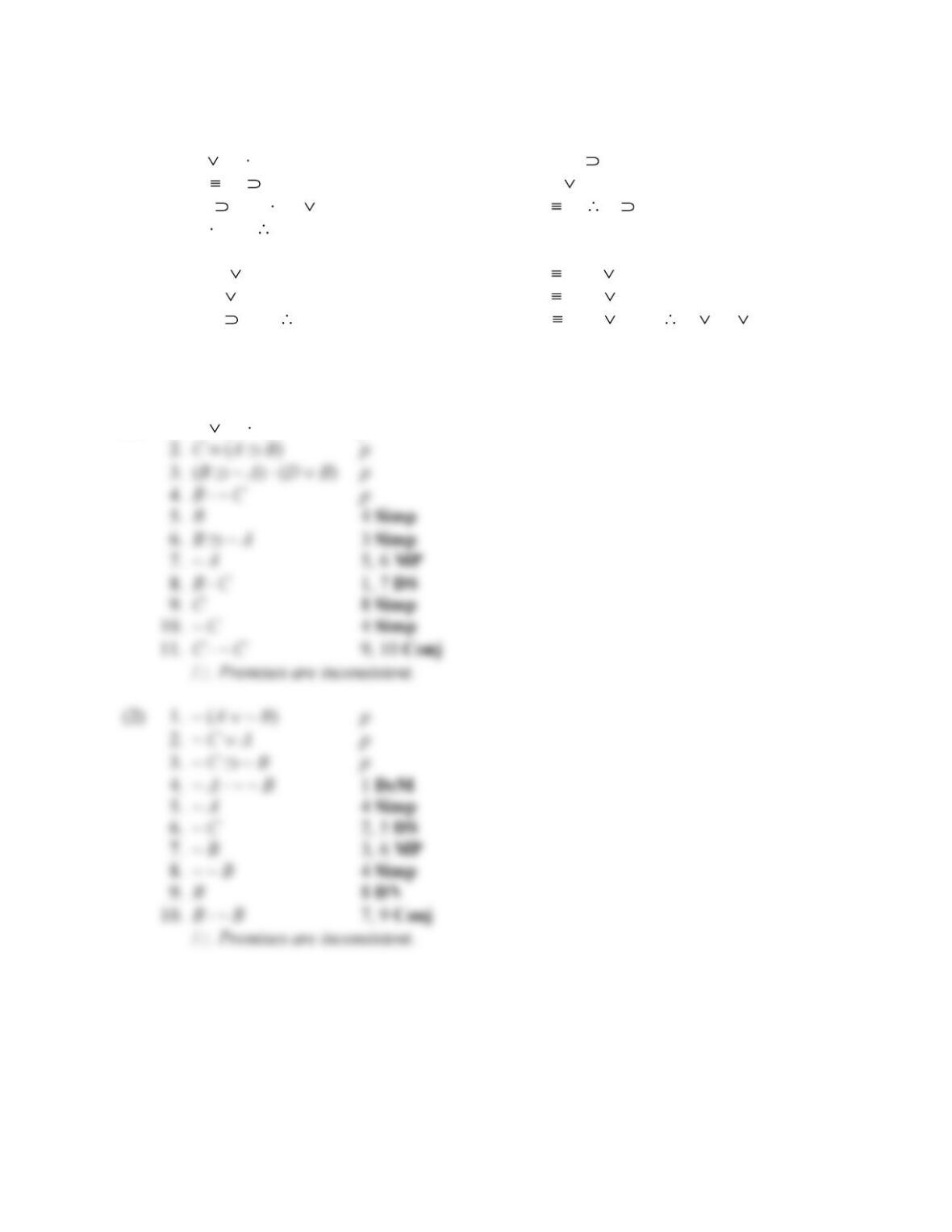
C. Show that premises in the following arguments are inconsistent:
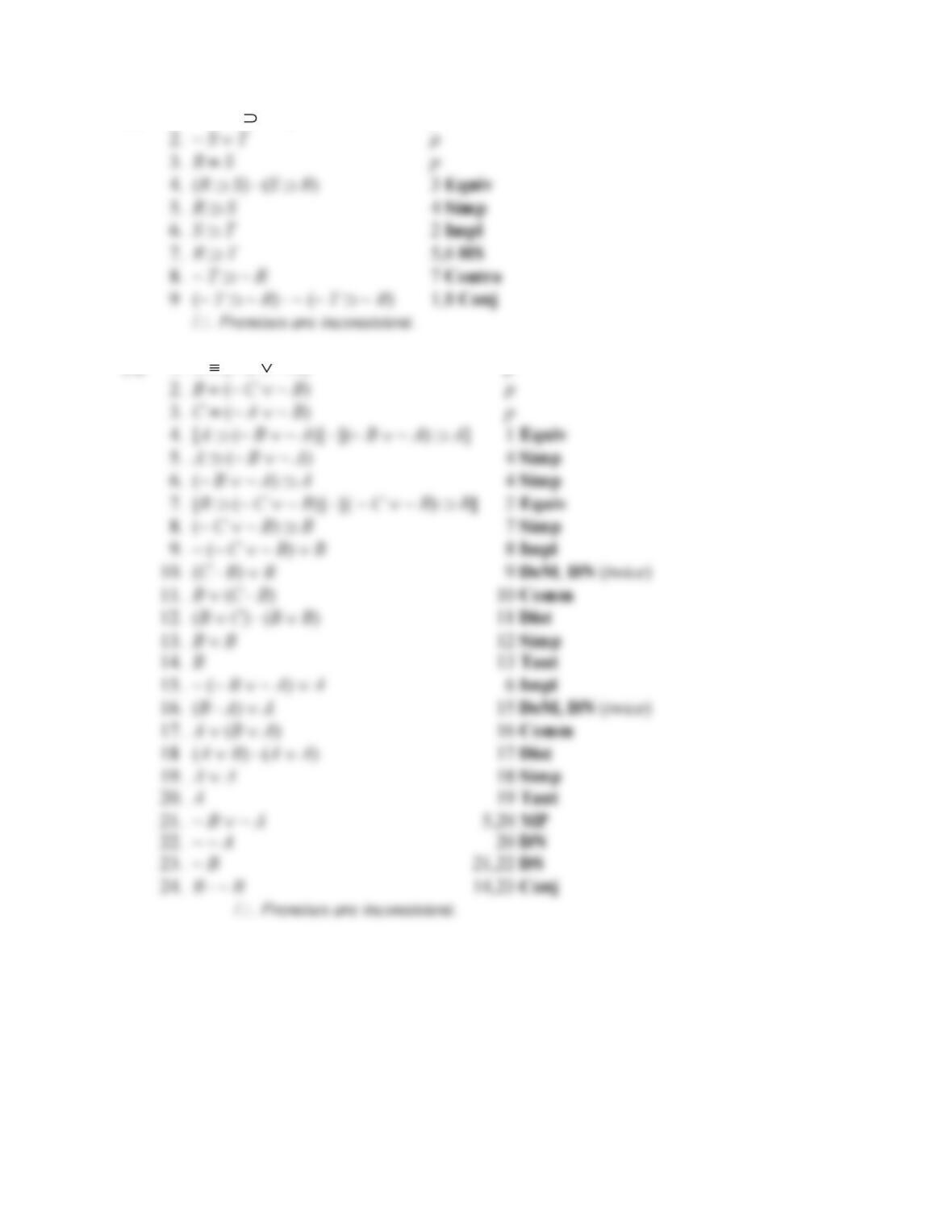
(1) 1. A(B C) (3) 1. ~ (~ T~R)
2. C(A B) 2. ~ S T
3. (B~A) (D B) 3. R S /T R
4. B~C/ ~ A
(2) 1. ~ (A~B) (4) 1. A(~ B~A)
2. ~ C A 2. B(~ C~B)
3. ~ C~B/C3. C(~ A~B) / A(B C)
C. Suggested Answers
(1) 1. A(B C)p
19
(3) 1. ~ (~ T~R)p
(4) 1. A(~ B~A)p