CHAPTER 5
ACCOUNTING FOR MERCHANDISING
OPERATIONS
LEARNING OBJECTIVES
1. DESCRIBE MERCHANDISING OPERATIONS AND
INVENTORY SYSTEMS.
2. RECORD PURCHASES UNDER A PERPETUAL
INVENTORY SYSTEM.
3. RECORD SALES UNDER A PERPETUAL INVENTORY
SYSTEM.
4. APPLY THE STEPS IN THE ACCOUNTING CYCLE TO A
MERCHANDISING COMPANY.
5. COMPARE A MULTIPLE-STEP WITH A SINGLE-STEP
INCOME STATEMENT.
*6. PREPARE A WORKSHEET FOR A MERCHANDISING
COMPANY.
*7. RECORD PURCHASES AND SALES UNDER A PERIODIC
INVENTORY SYSTEM.
*8 COMPARE THE ACCOUNTING FOR MERCHANDISING
UNDER GAAP AND IFRS.
CHAPTER REVIEW
Merchandising Operations
1. (L.O. 1) A merchandising company is an enterprise that buys and sells merchandise as their
primary source of revenue. Merchandising companies that purchase and sell directly to
consumers are retailers, and those that sell to retailers are known as wholesalers.
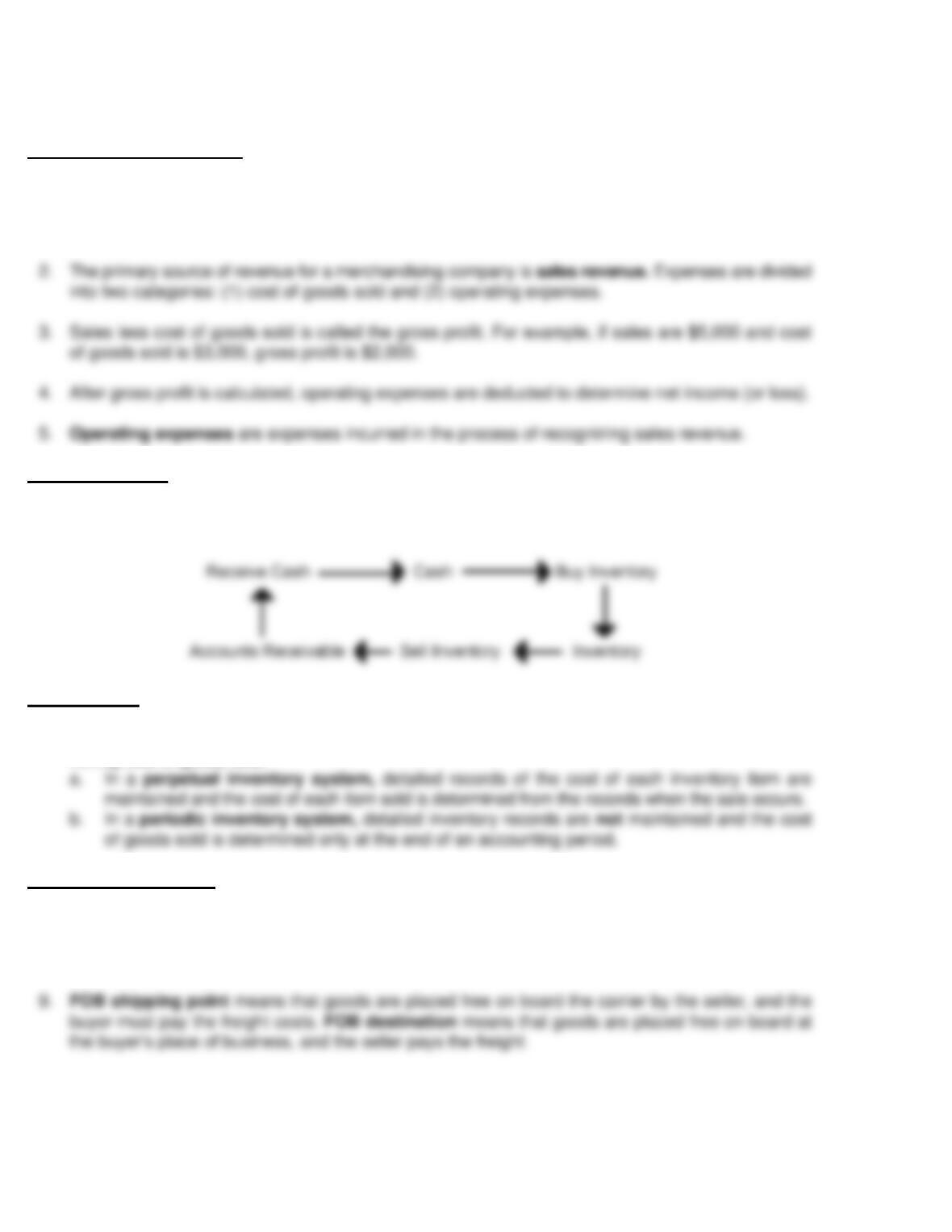
2. The primary source of revenue for a merchandising company is sales revenue. Expenses are divided
Operating Cycles
6. The operating cycle of a merchandising company is as follows:
Flow of Costs
7. A merchandising company may use either a perpetual or a periodic inventory system in deter-
mining cost of goods sold.
Purchase Transactions
8. (L.O. 2) Under the perpetual inventory system, purchases of merchandise for sale are recorded in
the Inventory account. For a cash purchase, Cash is credited; for a credit purchase, Accounts
Payable is credited.
9. FOB shipping point means that goods are placed free on board the carrier by the seller, and the
10. When the purchaser pays the freight, Inventory is debited and Cash is credited. When the seller
pays the freight, Freight-Out (Delivery Expense) is debited and Cash is credited. This account is
classified as an operating expense by the seller.
12. When the credit terms of a purchase on account permit the purchaser to claim a cash discount for
the prompt payment of a balance due, this is called a purchase discount. If a purchase discount
Sales Transactions
14. (L.O. 3) In accordance with the revenue recognition principle, companies record sales
revenue when the performance obligation is satisfied. Typically the performance obligation is
satisfied when goods transfer from the seller to the buyer.
16. A sale on credit is recorded as follows:
Sales Returns and Allowances
17. A sales return results when a customer is dissatisfied with merchandise and is allowed to return
the goods to the seller for credit or for a cash refund. A sales allowance results when a customer
is dissatisfied with merchandise and the seller is willing to grant an allowance (deduction) from the
selling price.
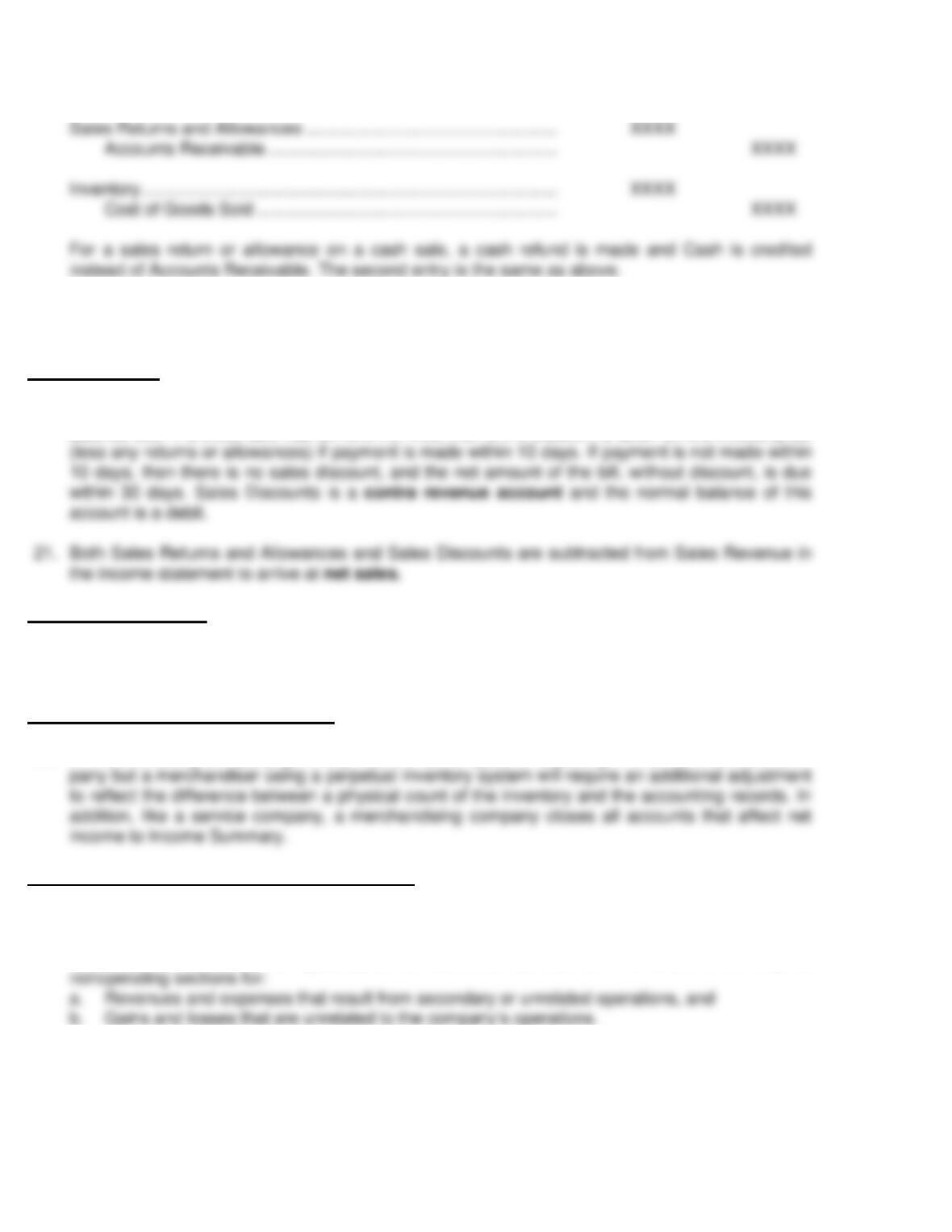
18. To give the customer a sales return or allowance, the seller normally makes the following entry if
the sale was a credit sale (the second entry is made only if the goods are returned):
19. Sales Returns and Allowances is a contra revenue account and the normal balance of the
account is a debit.
Sales Discounts
20. A sales discount is the offer of a cash discount to a customer for the prompt payment of a
balance due. If a credit sale has terms 2/10, n/30, then a 2% discount is taken on the invoice price
The Accounting Cycle
22. (L.O. 4) Each of the required steps in the accounting cycle for a service company applies to a
merchandising company.
Adjusting Entries and Closing Entries
23. A merchandising company generally has the same types of adjusting entries as a service com-
Multiple-Step vs. Single-Step Income Statement
24. (L.O. 5) A multiple-step income statement shows several steps in determining net income:
(1) cost of goods sold is subtracted from net sales to determine gross profit and (2) operating
expenses are deducted from gross profit to determine net income. In addition, there may be
Gross Profit and Operating Expenses
25. Gross profit is net sales less cost of goods sold. The gross profit rate is expressed as a
percentage by dividing the amount of gross profit by net sales. Operating expenses are the third
component in measuring net income for a merchandising company.
26. Nonoperating sections are reported in the income statement after income from operations and are
Classified Balance Sheet
28. A merchandising company generally has the same type of balance sheet as a service company
except inventory is reported as a current asset.
Using a Worksheet
Determining Cost of Goods Sold Under a Periodic System
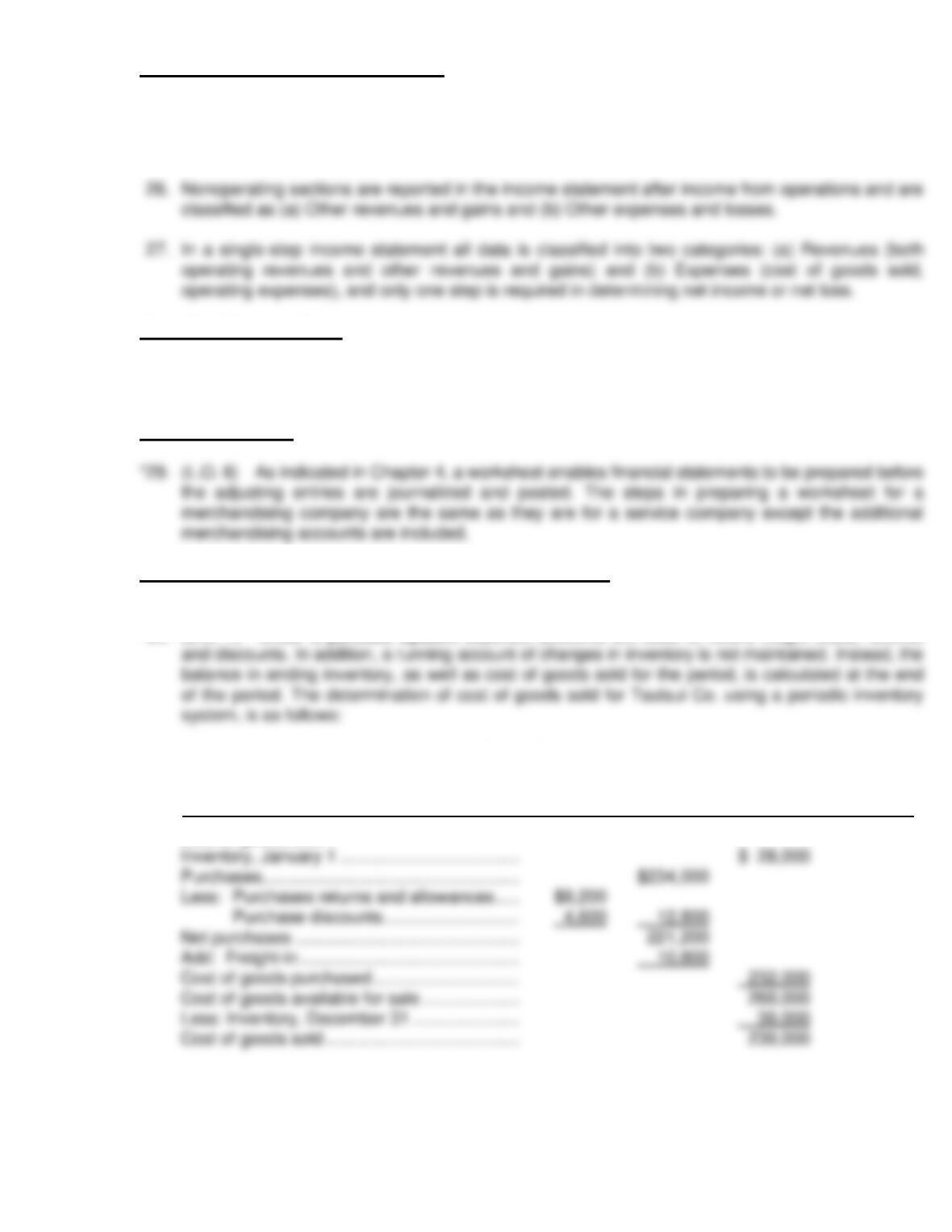
*30. (L.O. 7) Under a periodic system separate accounts are used to record freight costs, returns,
TSUTSUI COMPANY
Cost of Goods Sold
For the Year Ended December 31, 2017
Cost of goods sold
*31. To determine the cost of goods sold under a periodic inventory system, three steps are
required: (1) Record purchases of merchandise; (2) Determine the cost of goods purchased; and
(3) Determine the cost of goods on hand at the beginning and end of the accounting period.
Recording Purchases and Sales of Merchandise
*35. In a periodic inventory system revenues from the sale of merchandise are recorded when sales
are made in the same way as in a perpetual system. But, no attempt is made on the date of sale
to record the cost of the merchandise sold. Instead, a physical inventory count is taken at the end
of the period to determine (1) the cost of the merchandise then on hand and
(2) the cost of the goods sold during the period.
Compare the Accounting for Merchandising Under GAAP and IFRS
*39. (L.O. 8) The similarities and differences under IFRS and GAAP are:
a. Similarities
(1) Under both GAAP and IFRS, a company can choose to use either a perpetual or a
periodic system.

(3) Under IFRS, revaluation of land, buildings, and intangible assets is permitted. The initial
gains and losses resulting from this revaluation are reported as adjustments to equity,
LECTURE OUTLINE
A. Merchandising Operations.
1. The primary source of revenues for merchandising companies is the sale
of merchandise, referred to as sales revenue or sales.
2. A merchandising company has two categories of expenses:
INVESTOR INSIGHT
Morrow Snowboards implemented a perpetual inventory system to improve its
control over inventory. It also stated that it would perform a physical inventory
count every quarter until it felt that the perpetual inventory system was reliable.
If a perpetual system keeps track of inventory on a daily basis, why do companies
ever need to do a physical count?
B. Recording Purchases and Sales of Merchandise.
1. Under a perpetual inventory system:
a. Companies record purchases of merchandise for sale in the Inventory
account. Companies record purchases of assets acquired for use,
c. A purchaser may return goods to the seller for credit because the
goods are damaged or defective, or of inferior quality. The return of
goods to the seller is known as a purchase return.
d. The credit terms of a purchase on account may permit the buyer to
claim a cash discount for prompt payment. The buyer calls this cash
discount a purchase discount.
(5) Companies record the cost of goods returned by decreasing Cost of
Goods Sold and increasing the Inventory account.
(6) A sales discount occurs when the seller offers a cash discount for
prompt payment of the balance due.
ACCOUNTING ACROSS THE ORGANIZATION
Costco Wholesale Corp. has always had a generous return policy, but adopted a
new policy requiring that certain electronics be returned within 90 days of their
purchase. The reason for the change was that returned electronics cut an
estimated 8¢ per share off Costco’s earnings per share.
If a company expects significant returns, what are the implications for revenue
recognition?
C. Adjusting Entries.
1. A merchandiser using a perpetual system will require one additional adjusting
entry to make the records agree with the actual inventory on hand.
D. Closing Entries.
1. The temporary accounts with credit balances are closed to Income Summary.
E. Forms of Income Statements.
Merchandising companies use one of two forms for the income statement:
1. Multiple-step income statement.
2. The multiple-step income statement reports gross profit (net sales less
cost of goods sold).
a. A company’s gross profit can be expressed as a percentage, called
the gross profit rate.
3. Single-step income statement. All data are classified into two categories:
a. Revenues include both operating revenues and other revenues and
gains.
*F. Using a Worksheet.
1. The steps in preparing a worksheet for a merchandising company are
the same as they are for a service company.
*G. Determining Cost of Goods Sold Under a Periodic System.
1. Determining cost of goods sold is different under the periodic system
than under the perpetual system.
2. Under a periodic system, the company uses separate accounts to record
freight costs, returns, and discounts.
*H. Periodic Inventory System.
1. Companies record revenues from the sale of merchandise when sales
are made, just as in a perpetual system. But companies do not attempt
on the date of sale to record the cost of the merchandise sold.
A Look at IFRS
The basic accounting entries for merchandising are the same under both GAAP
and IFRS. The income statement is a required statement under both sets of
standards. The basic format is similar although some differences do exist.
KEY POINTS
SIMILARITIES
• Under both GAAP and IFRS, a company can choose to use either a
perpetual or a periodic system.
DIFFERENCES
• Under GAAP, companies generally classify income statement items by
function. Classification by function leads to descriptions like administration,
distribution, and manufacturing. Under IFRS, companies must classify
LOOKING TO THE FUTURE
The IASB and FASB are working on a project that would rework the structure of
financial statements. Specifically, this project will address the issue of how to
classify various items in the income statement. A main goal of this new approach
is to provide information that better represents how businesses are run. In
20 MINUTE QUIZ
Circle the correct answer.
True/False
1. Measuring net income for a merchandising company is conceptually the same as for
a service company.
True False
2. The cost of goods sold is determined only at the end of the accounting period under
a perpetual inventory system.
True False
3. Under the perpetual inventory system, the purchase of merchandise is recorded with a debit
to the Purchases account.
True False
4. Sales Discounts is a contra revenue account and has a debit balance.
True False
5. A customer may receive a sales discount for goods that are damaged or defective.
True False
6. In a single-step income statement, gross profit and operating income are shown on the
income statement.
True False
7. In the balance sheet, inventory is reported as a current asset immediately below
accounts receivable.
True False
8. Income from operations is determined by subtracting other expenses and losses from
gross profit.
True False
9. Merchandising companies report nonoperating activities in the income statement imme-
diately after the company’s primary operating activities.
True False
*10. In preparing a worksheet for a merchandising firm, all income statement column debits
represent expenses.
True False
Multiple Choice
1. Sales Discounts
a. is a contra revenue account.
b. has a normal debit balance.
c. appears on the income statement.
d. All of these answers are correct.
2. When a company uses the perpetual method of accounting for inventories the
a. Inventory account does not change until the end of the year.
b. Inventory account is debited when inventory is purchased
and Cost of Goods Sold is debited when inventory is sold.
c. sale of inventory requires a credit to Cost of Goods Sold.
d. acquisition of merchandise requires a debit to Purchases.
3. The recording of a sale requires a
a. credit to a sales account and a debit to an asset account.
b. debit to Cash and a credit to Owner’s Capital.
c. debit to a sales account and credit to an asset account.
d. credit to Sales Revenue and a debit to Sales Discounts.
4. Which of the following would not be considered an operating expense?
a. Cost of goods sold
b. Rent expense
c. Freight-out
d. Office expense
5. Which of the following is reported on both a multiple-step and a single-step income statement?
a. Gross profit
b. Income from operations
c. Other revenues and gains
d. Net sales

ANSWERS TO QUIZ
True/False
Multiple Choice