5.4 (a) TC303.15 K⋅:= TH623.15 K⋅:=
Chapter 5 – Section A – Mathcad Solutions
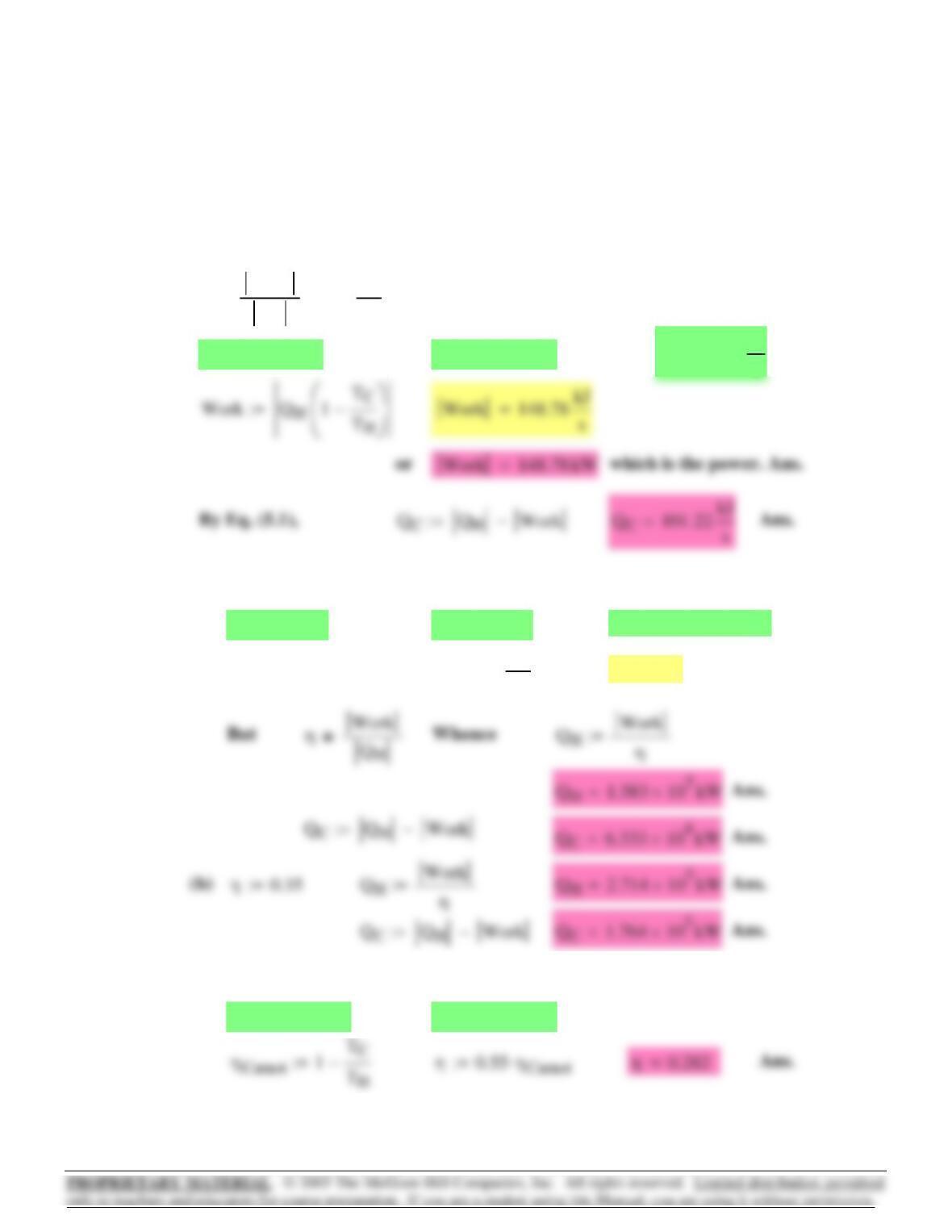
5.2 Let the symbols Q and Work represent rates in kJ/s. Then by Eq. (5.8)
ηWork
QH
=1TC
TH
−=
TC323.15 K⋅:= TH798.15 K⋅:= QH250 kJ
s
⋅:=
5.3 (a) Let symbols Q and Work represent rates in kJ/s
TH750 K⋅:= TC300 K⋅:= Work 95000−kW⋅:=
By Eq. (5.8): η1TC
TH
−:= η 0.6=
123
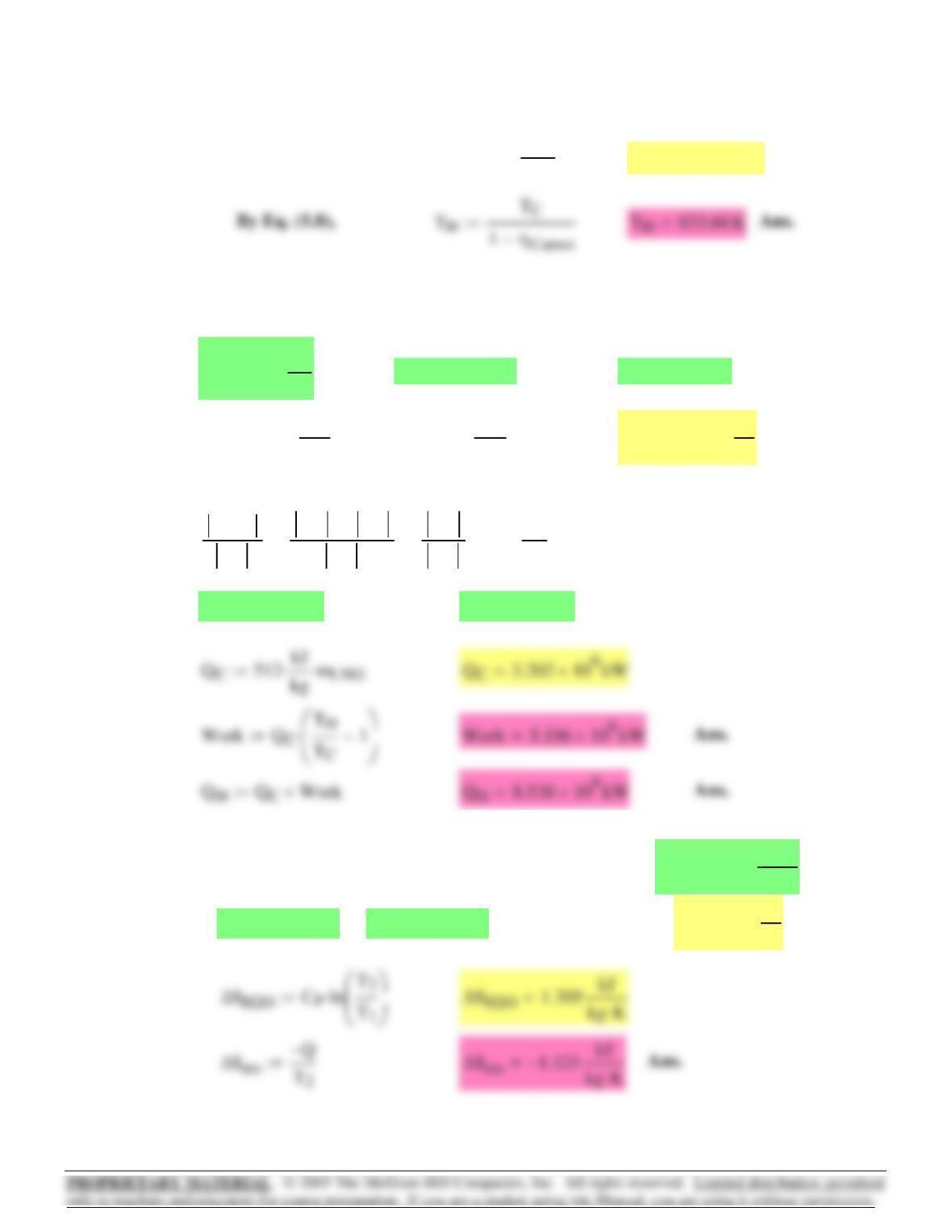
5.8 Take the heat capacity of water to be constant at the value
CP4.184 kJ
kg K⋅
⋅:=
(a) T1273.15 K⋅:= T2373.15 K⋅:= QC
PT2T1
−
()
⋅:= Q 418.4 kJ
kg
=
(b) η0.35:= ηCarnot
η
0.55
:= ηCarnot 0.636=
5.7 Let the symbols represent rates where appropriate. Calculate mass rate of
LNG evaporation:
V 9000 m3
s
⋅:= P 1.0133 bar⋅:= T 298.15 K⋅:=
molwt 17 gm
mol
:= mLNG
PV⋅
RT⋅molwt⋅:= mLNG 6254 kg
s
=
Maximum power is generated by a Carnot engine, for which
Work
QC
QHQC
−
QC
=
QH
QC
1−=
TH
TC
1−=
TH303.15 K⋅:= TC113.7 K⋅:=
124
Q 15000 J⋅:=
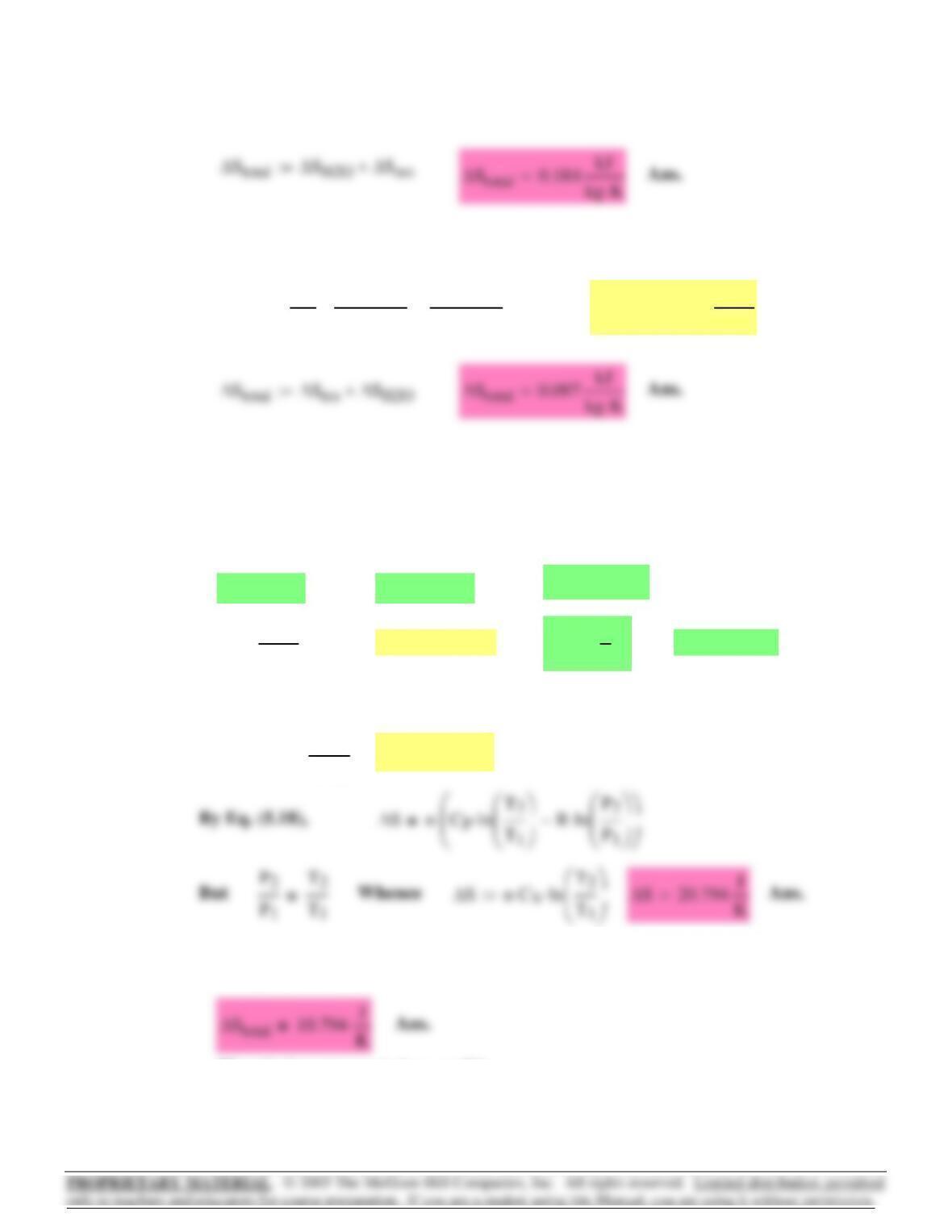
(a) Const.-V heating; ∆UQW+=Q=nC
V
⋅T2T1
−
()
⋅=
T2T1
Q
nC
V
⋅
+:= T2110
3
×K=
(b) The entropy change of the gas is the same as in (a). The entropy
change of the surroundings is zero. Whence
The stirring process is irreversible.
(b) The entropy change of the water is the same as in (a), and the total
heat transfer is the same, but divided into two halves.
∆Sres
Q−
2
1
323.15 K⋅
1
373.15 K⋅
+
⎛
⎜
⎝
⎞
⎠
⋅:= ∆Sres 1.208−kJ
kg K⋅
=
(c) The reversible heating of the water requires an infinite number of heat
reservoirs covering the range of temperatures from 273.15 to 373.15 K,
each one exchanging an infinitesimal quantity of heat with the water and
raising its temperature by a differential increment.
5.9 P11 bar⋅:= T1500 K⋅:= V 0.06 m3
⋅:=
nP1V⋅
RT
1
⋅
:= n 1.443 mol=CV
5
2R⋅:=
125
5.16 By Eq. (5.8), dW
dQ 1Tσ
T
−=dW dQ TσdQ
T
⋅−=
dW dQ TσdS⋅−=
Since dQ/T = dS,
Integration gives the required result.
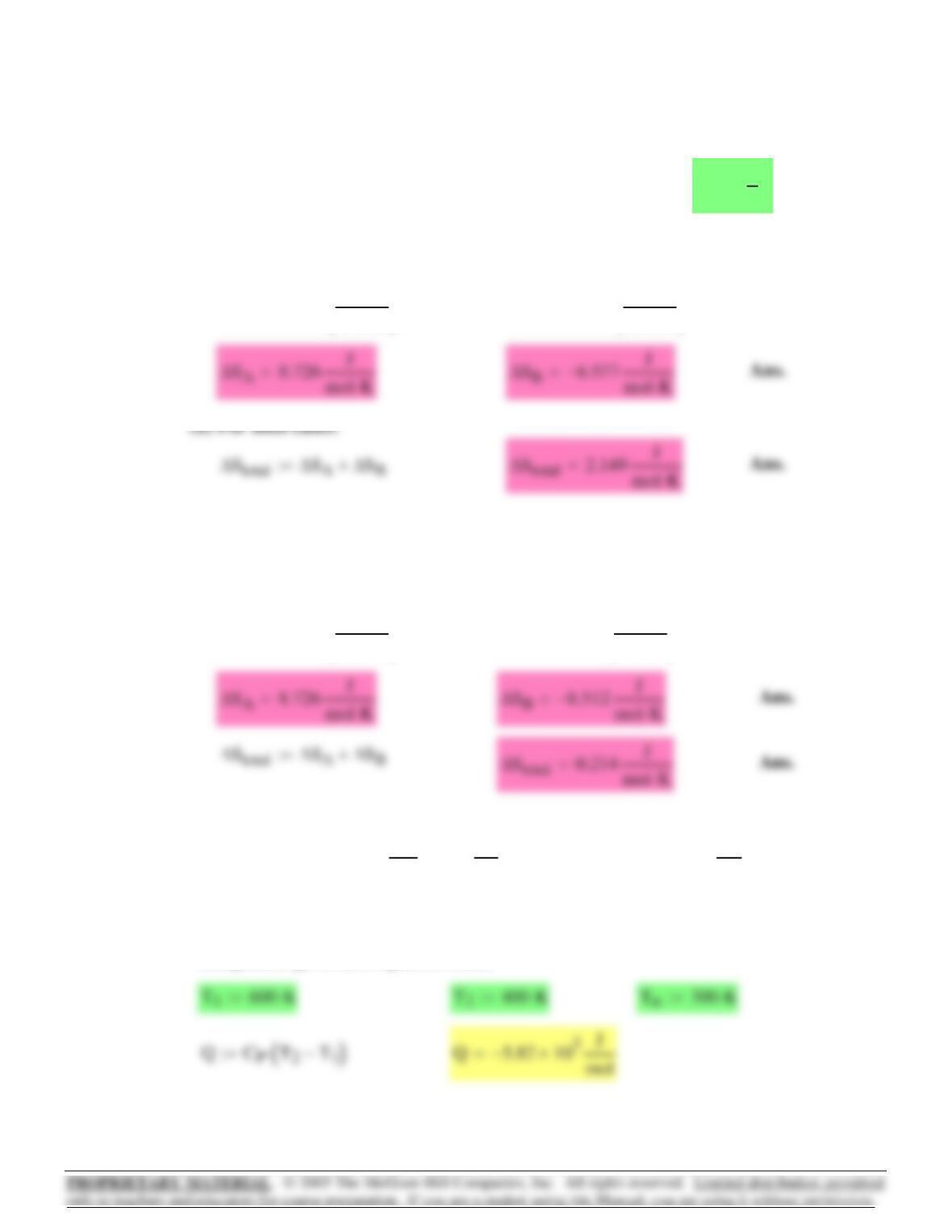
5.10 (a) The temperature drop of the second stream (B) in either
case is the same as the temperature rise of the first stream
(A), i.e., 120 degC. The exit temperature of the second
stream is therefore 200 degC. In both cases we therefore
have:
CP
7
2R:=
∆SACPln 463.15
343.15
⎛
⎜
⎝
⎞
⎠
⋅:= ∆SBCPln 473.15
593.15
⎛
⎜
⎝
⎞
⎠
⋅:=
(c) In this case the final temperature of steam B is 80 degC, i.e., there is
a 10-degC driving force for heat transfer throughout the exchanger.
Now
∆SACPln 463.15
343.15
⎛
⎜
⎝
⎞
⎠
⋅:= ∆SBCPln 353.15
473.15
⎛
⎜
⎝
⎞
⎠
⋅:=
126
W
QC2
TH2 TC2
−
TC2
=
Equate the two work quantities and solve for the required ratio of the heat
quantities:
5.18 (a) T1300K:= P11.2bar:= T2450K:= P26bar:= Cp
7
2R:=
⎜
⎜
∆SC
Pln T2
T1
⎛
⎜
⎝
⎞
⎠
⋅:= ∆S 11.799−J
mol K⋅
=
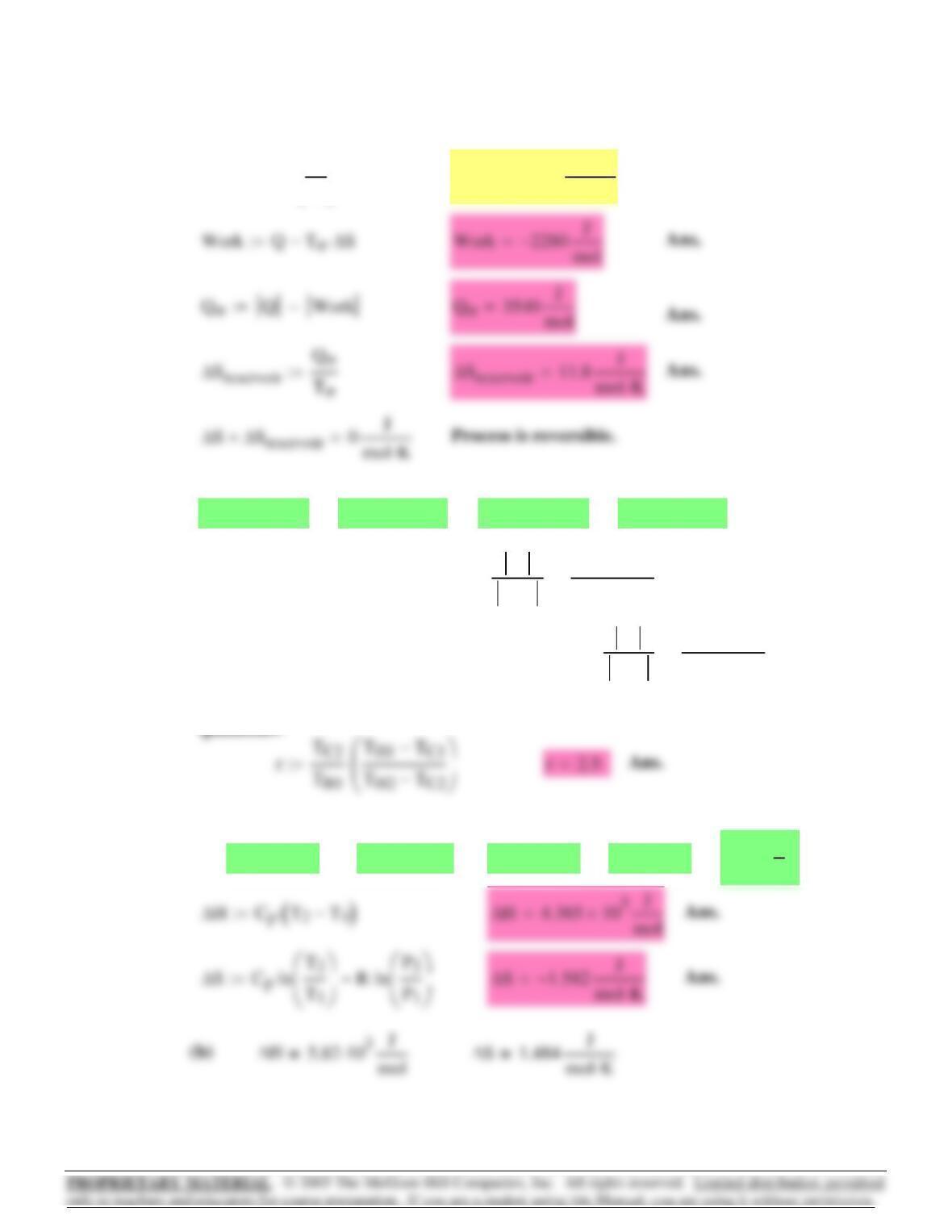
5.17 TH1 600 K⋅:= TC1 300 K⋅:= TH2 300 K⋅:= TC2 250 K⋅:=
For the Carnot engine, use Eq. (5.8): W
QH1
TH1 TC1
−
TH1
=
The Carnot refrigerator is a reverse Carnot engine.
Combine Eqs. (5.8) & (5.7) to get:
127
⎜

For isobaric step 2 to 3: P2
T2
P3
T3
=
Solving these 4 equations for T4 yields: T4T1
T2
T3
⎛
⎜
⎝
⎞
⎠
γ−
⋅=
Cp
7
2R:= Cv
5
2R:= γ Cp
Cv
:= γ 1.4=
T1200 273.15+()K:= T21000 273.15+()K:= T31700 273.15+()K:=
T4T1
T2
T3
⎛
⎜
⎞
γ−
⋅:= T4873.759 K=
5.19 This cycle is the same as is shown in Fig. 8.10 on p. 305. The equivalent states
are A=3, B=4, C=1, and D=2. The efficiency is given by Eq. (A) on p. 305.
Temperature T4 is not given and must be calaculated. The following equations
are used to derive and expression for T4.
For adiabatic steps 1 to 2 and 3 to 4:
T1V1γ1−
⋅T2V2γ1−
⋅=T3V3γ1−
⋅T4V4γ1−
⋅=
For constant-volume step 4 to 1: V1V4
=
128
⎜
5.25 P4:= T 800:=
Step 1-2: Volume decreases at constant P.
Heat flows out of the system. Work is done on the system.
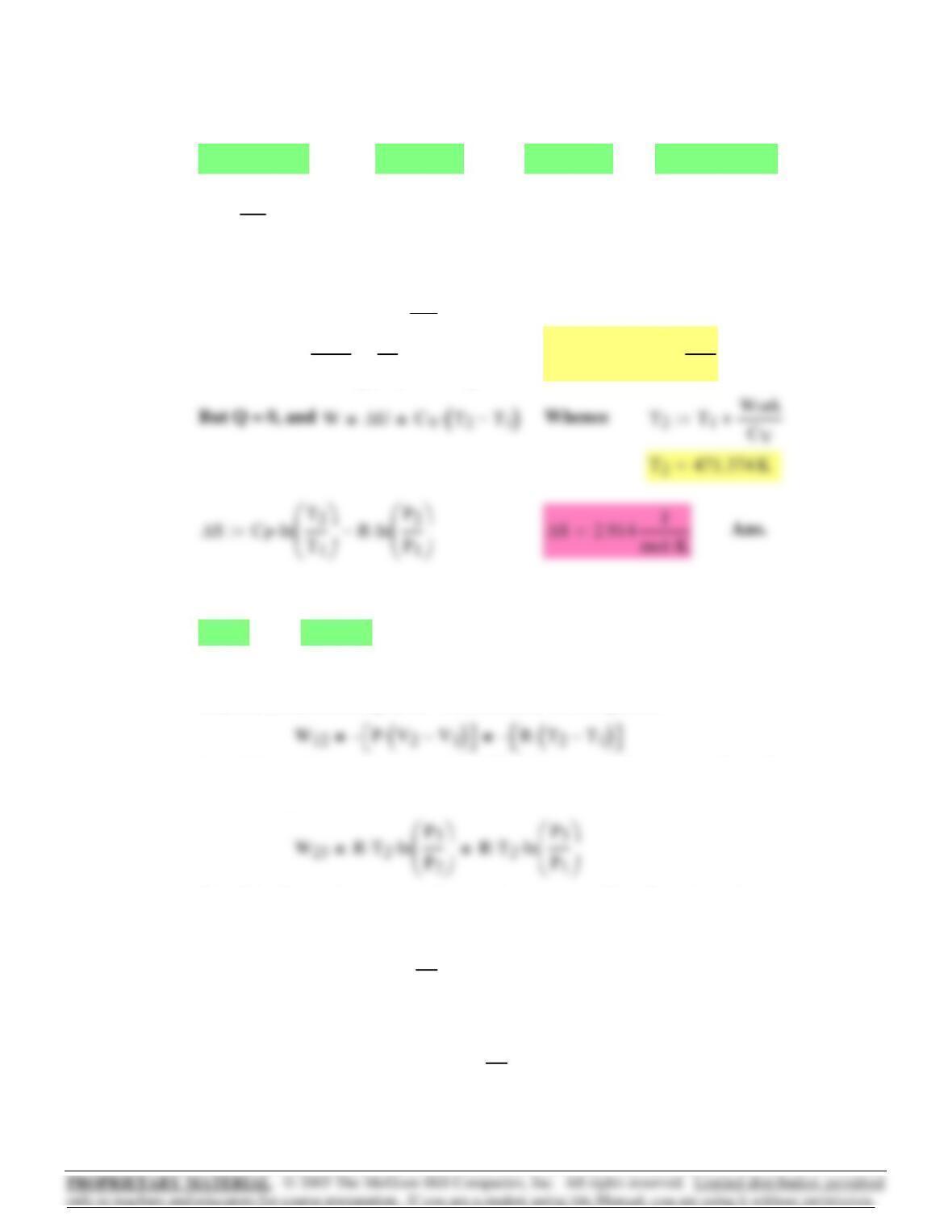
Step 2-3: Isothermal compression. Work is done on the system. Heat flows
out of the system.
⎜
⎜
Step 3-1: Expansion process that produces work. Heat flows into the
system. Since the PT product is constant,
PdT⋅TdP⋅+ 0=TdP
P
⋅dT−=(A)
PV⋅RT⋅=PdV⋅VdP⋅+ RdT⋅=
PdV⋅RdT⋅VdP⋅−=RdT⋅RT⋅dP
P
⋅−=
5.21 CVCPR−:= P12 bar⋅:= P27 bar⋅:= T1298.15 K⋅:=
γCP
CV
:= γ 1.4=
With the reversible work given by Eq. (3.34), we get for the actual W:
Work 1.35 RT
1
⋅
γ1−
⋅P2
P1
⎛
⎜
⎝
⎞
⎠
γ1−
γ
1−
⎡
⎢
⎢
⎢
⎣
⎤
⎥
⎥
⎥
⎦
⋅:= Work 3.6 103
×J
mol
=
129
⎜
⎜
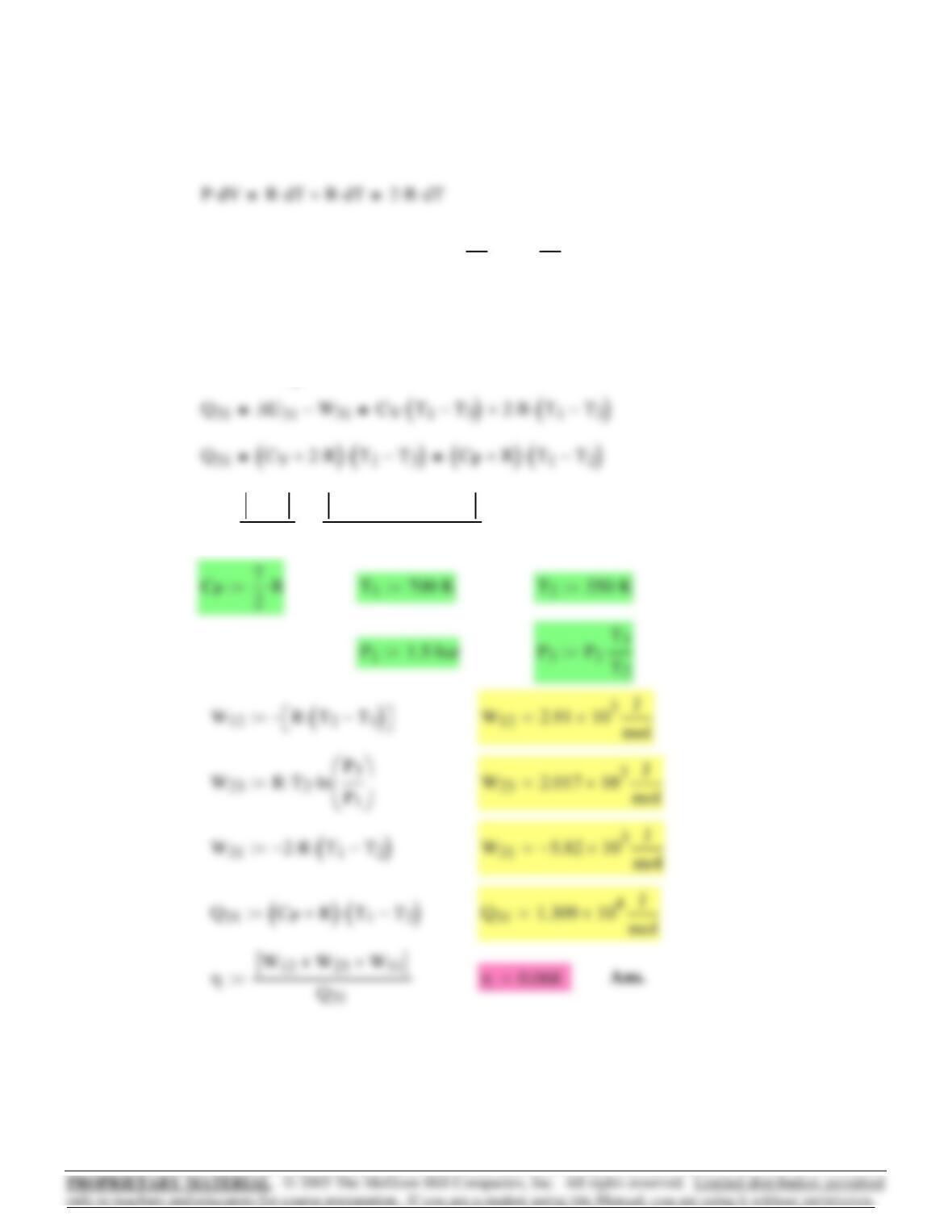
ηWnet
Qin
=
W12 W23
+W31
+
Q31
=
W31
V3
V1
VP
⌠
⎮
⌡d−=2−R⋅T1T3
−
()
⋅=2−R⋅T1T2
−
()
⋅=
P3P1
T1
T3
⋅=P1
T1
T2
⋅=
Moreover,
In combination with (A) this becomes
130
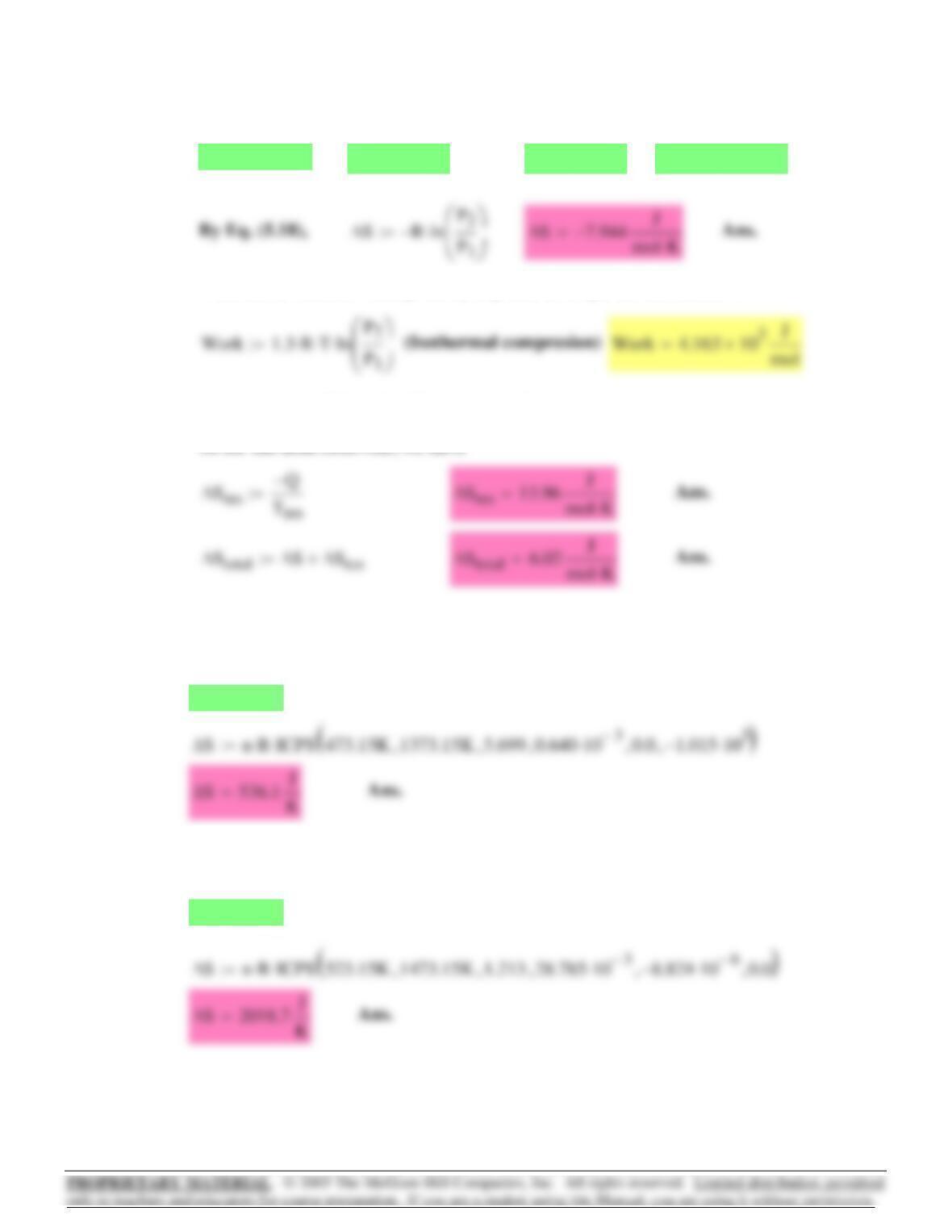
5.27 (a) By Eq. (5.14) with P = const. and Eq. (5.15), we get for the entropy change
of 10 moles
n 10 mol⋅:=
(b) By Eq. (5.14) with P = const. and Eq. (5.15), we get for the entropy
change of 12 moles
n 12 mol⋅:=
5.26 T 403.15 K⋅:= P12.5 bar⋅:= P26.5 bar⋅:= Tres 298.15 K⋅:=
With the reversible work given by Eq. (3.27), we get for the actual W:
Q Work−:= Q here is with respect to the system.
So for the heat reservoir, we have
131

(guess)
x 0.3:=
The relative amounts of the two streams are determined by an energy
balance. Since Q = W = 0, the enthalpy changes of the two streams must
cancel. Take a basis of 1 mole of air entering, and let x = moles of chilled air.
Then 1 – x = the moles of warm air.
5.29
n 18140 mol⋅:=
The final temperature for this process was found in Pb. 4.2c to be 1202.9 K.
The entropy change for 18.14 kg moles is then found as follows
(c)
n 15 mol⋅:=
The final temperature for this process was found in Pb. 4.2b to be 1413.8 K
.
The entropy change for 15 moles is then found as follows:
(b)
n 10 mol⋅:=
The final temperature for this process was found in Pb. 4.2a to be 1374.5 K.
The entropy change for 10 moles is then found as follows
(a)5.28
132
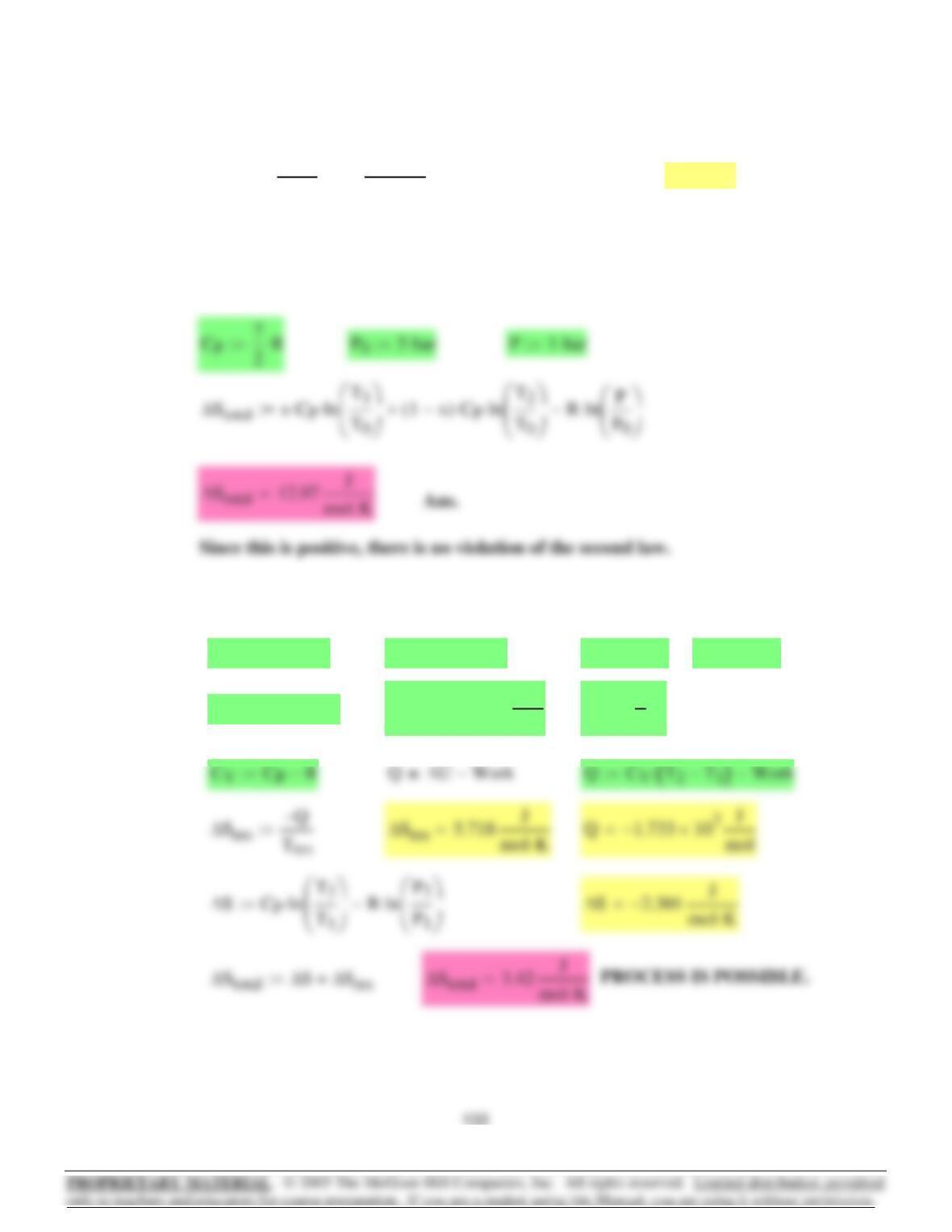
CP
7
2R⋅:=Work 1800−J
mol
⋅:=Tres 303.15 K⋅:=
P21 bar⋅:=
Given x
1x−
T2T0
−
T1T0
−
⎛
⎜
⎝
⎞
⎠
−=x Find x():= x 0.5=
Thus x = 0.5, and the process produces equal amounts of chilled and warmed
air. The only remaining question is whether the process violates the second
law. On the basis of 1 mole of entering air, the total entropy change is as
follows.
⎜
⎜
5.30 T1523.15 K⋅:= T2353.15 K⋅:= P13 bar⋅:=
⎜
⎜