5-1
CHAPTER 5
Balance Sheet and Statement of Cash Flows
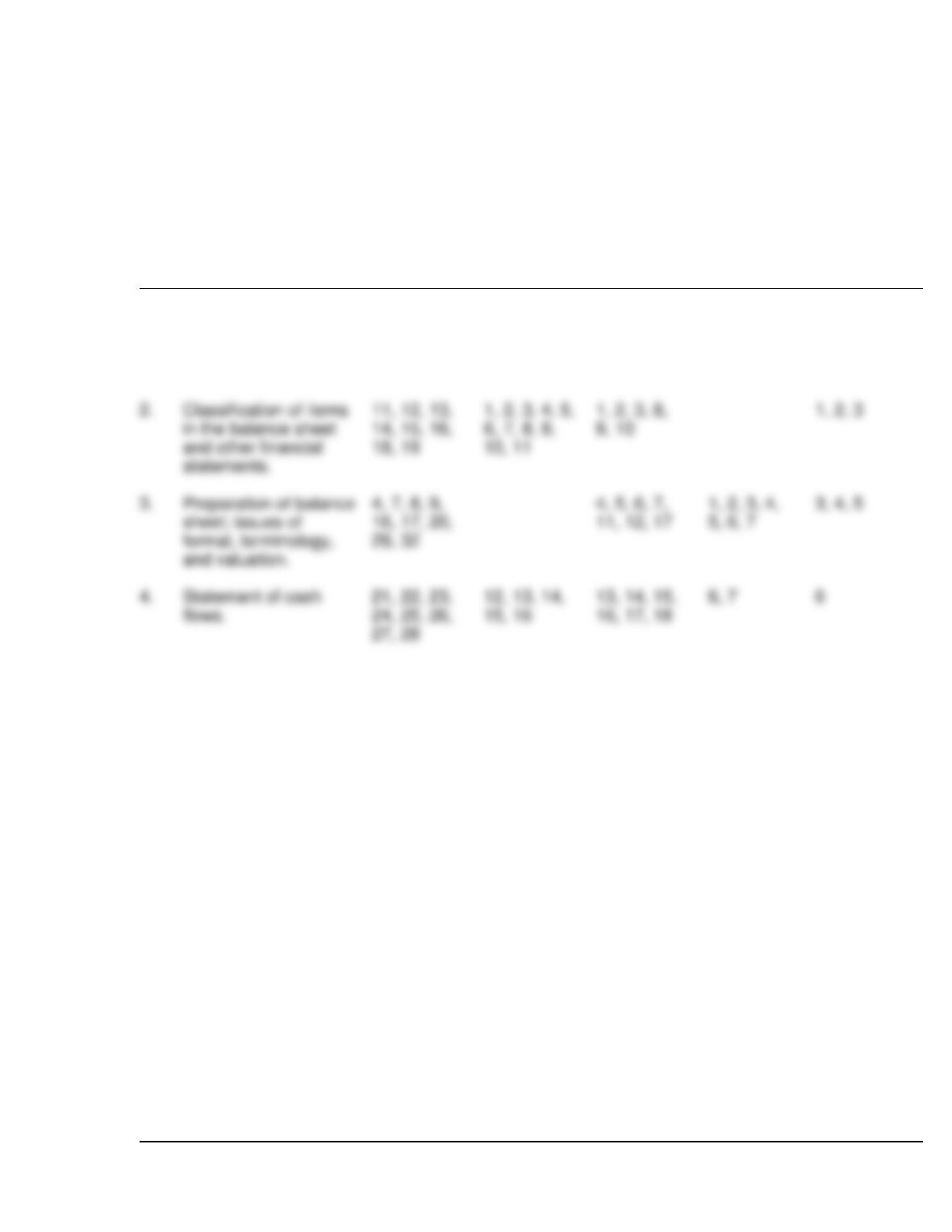
ASSIGNMENT CLASSIFICATION TABLE (BY TOPIC)
Topics
Questions
Brief
Exercises
Exercises
Problems
Concepts
for Analysis
1.
Disclosure principles,
uses of the balance
sheet, financial
flexibility.
1, 2, 3, 4, 5,
6, 7, 10, 18,
21, 30, 31
4, 5
2.
Classification of items
in the balance sheet
and other financial
statements.
11, 12, 13,
14, 15, 16,
18, 19
1, 2, 3, 4, 5,
6, 7, 8, 9,
10, 11
1, 2, 3, 8,
9, 10
1, 2, 3
3.
Preparation of balance
sheet; issues of
format, terminology,
and valuation.
4, 7, 8, 9,
16, 17, 20,
29, 32
4, 5, 6, 7,
11, 12, 17
1, 2, 3, 4,
5, 6, 7
3, 4, 5
Statement of cash
flows.
21, 22, 23,
24, 25, 26,
27, 28
12, 13, 14,
15, 16
13, 14, 15,
16, 17, 18
6, 7
6
5-2
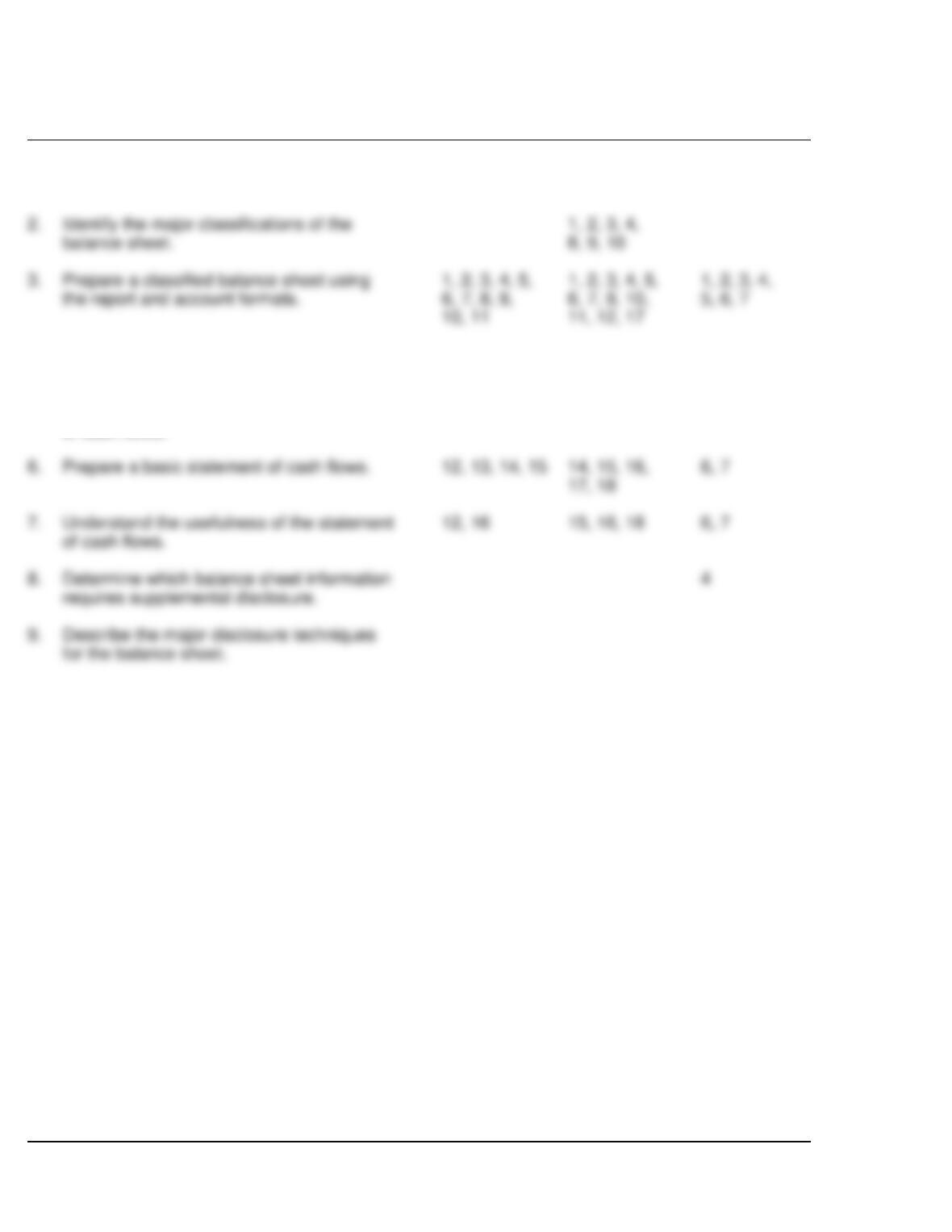
ASSIGNMENT CLASSIFICATION TABLE (BY LEARNING OBJECTIVE)
Learning Objectives
Brief
Exercises
Exercises
Problems
1. Explain the uses and limitations of a
balance sheet.
7
4. Indicate the purpose of the statement
of cash flows.
5. Identify the content of the statement
of cash flows.
13
6. Prepare a basic statement of cash flows.
12, 13, 14, 15
14, 15, 16,
6, 7
7. Understand the usefulness of the statement
of cash flows.
12, 16
15, 16, 18
6, 7
8. Determine which balance sheet information
requires supplemental disclosure.
4
2. Identify the major classifications of the
balance sheet.
1, 2, 3, 4,
6, 7, 8, 9,
6, 7, 9, 10,
5, 6, 7
5-3
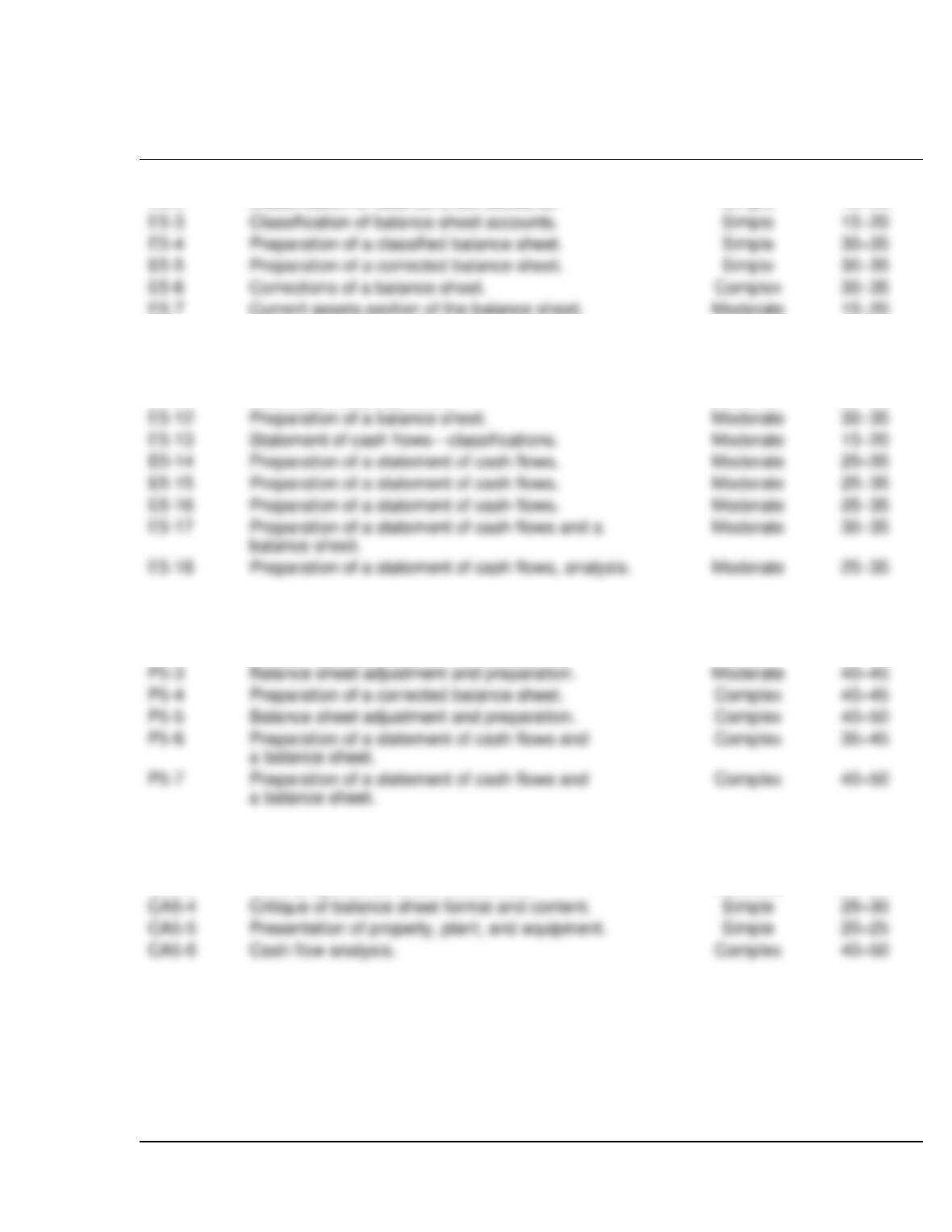
ASSIGNMENT CHARACTERISTICS TABLE
Item
Description
Level of
Difficulty
Time
(minutes)
E5-1
Balance sheet classifications.
Simple
15–20
E5-2
Classification of balance sheet accounts.
Simple
15–20
E5-7
Current assets section of the balance sheet.
Moderate
15–20
E5-8
Current vs. long-term liabilities.
Moderate
10–15
E5-9
Current assets and current liabilities.
Complex
30–35
E5–10
Current liabilities.
Moderate
15–20
E5–11
Balance sheet preparation.
Moderate
25–30
E5–12
Preparation of a balance sheet.
Moderate
30–35
E5–13
Statement of cash flows—classifications.
Moderate
15–20
E5–14
Preparation of a statement of cash flows.
Moderate
25–35
Preparation of a statement of cash flows.
Moderate
25–35
E5–16
Preparation of a statement of cash flows.
Moderate
25–35
E5–17
Preparation of a statement of cash flows and a
balance sheet.
Moderate
30–35
E5–18
Preparation of a statement of cash flows, analysis.
Moderate
25–35
P5-1
Preparation of a classified balance sheet, periodic
inventory.
Moderate
30–35
P5-2
Balance sheet preparation.
Moderate
35–40
P5-3
Balance sheet adjustment and preparation.
Moderate
40–45
P5-4
Preparation of a corrected balance sheet.
Complex
40–45
P5-5
Balance sheet adjustment and preparation.
Complex
40–50
a balance sheet.
P5-7
Preparation of a statement of cash flows and
a balance sheet.
40–50
CA5-1
Reporting for financial effects of varied transactions.
Moderate
25–30
CA5-2
Current asset and liability classification.
Moderate
30–35
CA5-3
Identifying balance sheet deficiencies.
Moderate
20–25
CA5-4
Critique of balance sheet format and content.
Simple
25–30
CA5-5
Presentation of property, plant, and equipment.
Simple
20–25
CA5-6
Cash flow analysis.
Complex
40–50
E5-3
Classification of balance sheet accounts.
Simple
15–20
E5-4
Preparation of a classified balance sheet.
Simple
30–35
E5-5
Preparation of a corrected balance sheet.
Simple
30–35
E5-6
Corrections of a balance sheet.
Complex
30–35
5-4
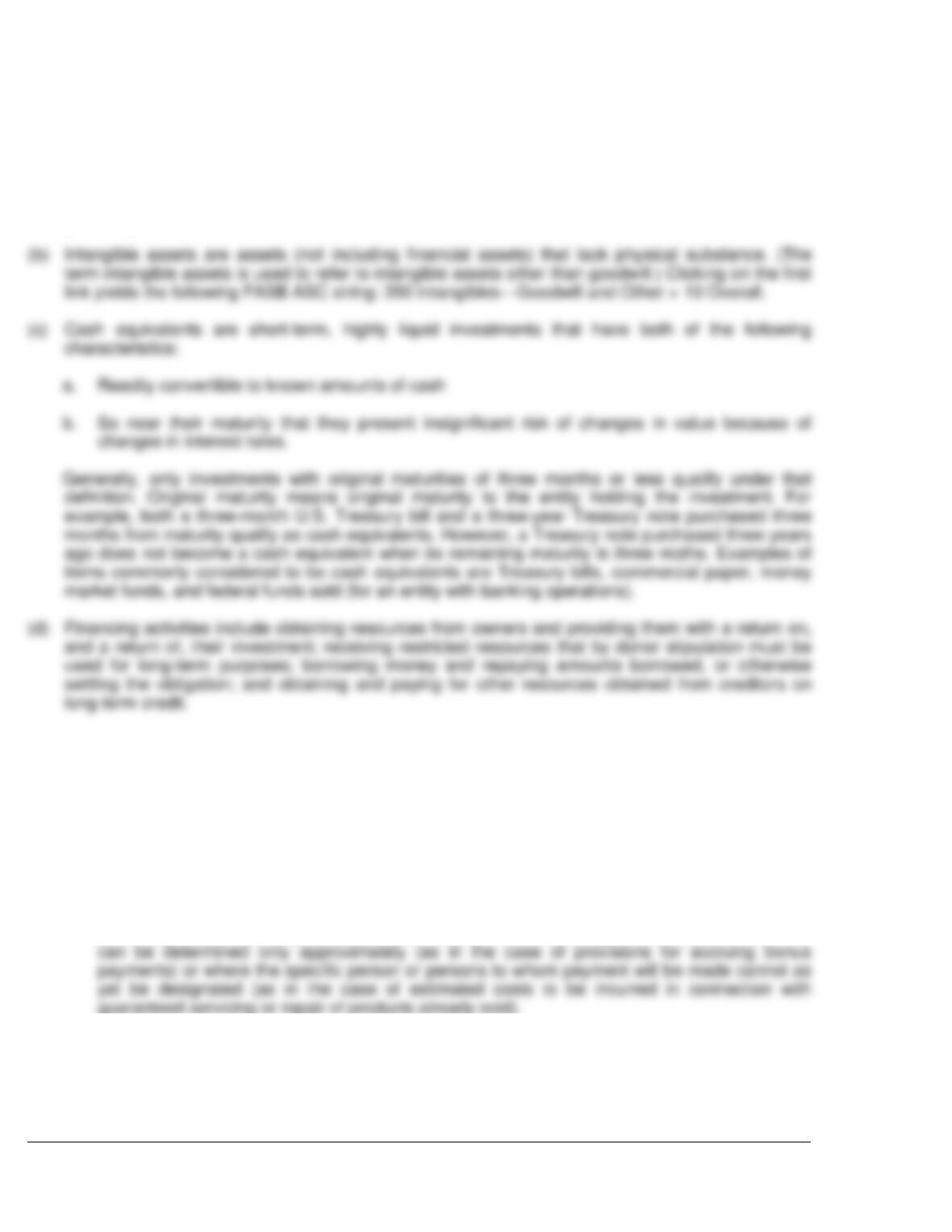
SOLUTIONS TO CODIFICATION EXERCISES
CE5-1
(a) Current assets is used to designate cash and other assets or resources commonly identified as
those that are reasonably expected to be realized in cash or sold or consumed during the normal
operating cycle of the business.
CE5-2
See FASC ASC 210-10-45 (Other Presentation Matters)
Classification of Current Liabilities
45–5A Total of current liabilities shall be presented in classified balance sheets.
45-6 The concept of current liabilities shall include estimated or accrued amounts that are expected
to be required to cover expenditures within the year for known obligations the amount of which
5-5
CE5-2 (Continued)
45-7 Section 470-10–45 includes guidance on various debt transactions that may result in current
liability classification. These transactions are the following:
CE5-3
The following discussion is provided at 235-10-50 Disclosure
> Accounting Policies Disclosure
50-1 Information about the accounting policies adopted by an entity is essential for financial
statement users. When financial statements are issued purporting to present fairly financial
position, cash flows, and results of operations in accordance with generally accepted
50-2 The provisions of the preceding paragraph are not intended to apply to unaudited financial
statements issued as of a date between annual reporting dates (for example, each quarter) if
the reporting entity has not changed its accounting policies since the end of its preceding
fiscal year.
> What to Disclose
50-3 Disclosure of accounting policies shall identify and describe the accounting principles followed
by the entity and the methods of applying those principles that materially affect the determina–
tion of financial position, cash flows, or results of operations. In general, the disclosure shall
50-4 Examples of disclosures by an entity commonly required with respect to accounting policies
CE5-3 (Continued)
c. Amortization of intangibles
50-5 Financial statement disclosure of accounting policies shall not duplicate details (for example,
composition of inventories or of plant assets) presented elsewhere as part of the financial
50-6 This Subtopic recognizes the need for flexibility in matters of format (including the location) of
disclosure of accounting policies provided that the entity identifies and describes its significant
CE5-4
The following section: 230-10-05 Overview and Background provides a discussion of the objectives for
the Statement of Cash Flows.
05-1 The Statement of Cash Flows Topic presents standards for reporting cash flows in general–
purpose financial statements.
05-2 Specific guidance is provided on all of the following:
5-7
CE5-4 (Continued)
10-2 The information provided in a statement of cash flows, if used with related disclosures and
information in the other financial statements, should help investors, creditors, and others (including
donors) to do all of the following:
ANSWERS TO QUESTIONS
1. The balance sheet provides information about the nature and amounts of investments in enterprise
resources, obligations to enterprise creditors, and the owners’ equity in net enterprise resources.
2. Solvency refers to the ability of an enterprise to pay its debts as they mature. For example, when a
company carries a high level of long-term debt relative to assets, it has lower solvency. Information
on long-term obligations, such as long-term debt and notes payable, in comparison to total assets
can be used to assess resources that will be needed to meet these fixed obligations (such as
interest and principal payments).
3. Financial flexibility is the ability of an enterprise to take effective actions to alter the amounts and
timing of cash flows so it can respond to unexpected needs and opportunities. An enterprise with a
4. Some situations in which estimates affect amounts reported in the balance sheet include:
(a) allowance for doubtful accounts.
5. An increase in inventories increases current assets, which is in the numerator of the current ratio.
Therefore, inventory increases will increase the current ratio. In general, an increase in the current
6. Liquidity describes the amount of time that is expected to elapse until an asset is converted into
cash or until a liability has to be paid. The ranking of the assets given in order of liquidity is:
(1) (d) Short-term investments.
(2) (e) Accounts receivable.
(3) (b) Inventory.
(4) (c) Buildings.
(5) (a) Goodwill.
7. The major limitations of the balance sheet are:
(a) The values stated are generally historical and not at fair value.
5-9
Questions Chapter 5 (Continued)
8. Some items of value to technology companies such as Intel or IBM are the value of research and
development (new products that are being developed but which are not yet marketable), the value
of the “intellectual capital” of its workforce (the ability of the companies’ employees to come up
9. Classification in financial statements helps users by grouping items with similar characteristics and
separating items with different characteristics. Current assets are expected to be converted to
cash within one year or one operating cycle, whichever is longer—property, plant and equipment
will provide cash inflows over a longer period of time. Thus, separating long-term assets from
current assets facilitates computation of useful ratios such as the current ratio.
10. Separate amounts should be reported for accounts receivable and notes receivable. The amounts
11. No. Available-for-sale securities should be reported as a current asset only if management expects
12. The relationship between current assets and current liabilities is that current liabilities are those
obligations that are reasonably expected to be liquidated either through the use of current assets
or the creation of other current liabilities.
13. The total selling price of the season tickets is $20,000,000 (10,000 X $2,000). Of this amount,
14. Working capital is the excess of total current assets over total current liabilities. This excess is
15. (a) Shareholders’ Equity. “Treasury stock (at cost).”
Note: This is a reduction of total shareholders’ equity (reported as contra-equity).
(b) Current Assets. Included in “Cash.”
Questions Chapter 5 (Continued)
16. (a) Allowance for doubtful accounts receivable should be deducted from accounts receivable in
current assets.
(b) Merchandise held on consignment should not appear on the consignee’s balance sheet
except possibly as a note to the financial statements.
17. (a) Trade accounts receivable should be stated at their estimated amount collectible, often
referred to as net realizable value. The method most generally followed is to deduct from the
18. Assets are defined as probable future economic benefits obtained or controlled by a particular
entity as a result of past transactions or events. If a building is leased under a capital lease, the
future economic benefits of using the building are controlled by the lessee (tenant) as the result of
a past event (the signing of a lease agreement).
19. Battle is incorrect. Retained earnings is a source of assets, but is not an asset itself. For example,
even though the funds obtained from issuing a note payable are invested in the business, the note
20. The notes should appear as long-term liabilities with full disclosure as to their terms. Each year, as
21. The purpose of a statement of cash flows is to provide relevant information about the cash receipts
and cash payments of an enterprise during a period. It differs from the balance sheet and the
22. The difference between these two amounts may be due to increases in current assets (e.g., an
increase in accounts receivable from a sale on account would result in an increase in revenue and
Questions Chapter 5 (Continued)
23. The difference between these two amounts could be due to noncash charges that appear in the
income statement. Examples of noncash charges are depreciation, depletion, and amortization of
24. Operating activities involve the cash effects of transactions that enter into the determination of
net income. Investing activities include making and collecting loans and acquiring and disposing
25. (a) Net income is adjusted downward by deducting $5,000 from $90,000 and reporting cash
provided by operating activities as $85,000.
(b) The issuance of the preferred stock is a financing activity. The issuance is reported as
follows:
Cash flows from financing activities
Issuance of preferred stock ……………………………………………………
$1,150,000
Investment in Land ……………………………………………………………….
26. The company appears to have good liquidity and reasonable financial flexibility. Its current cash
debt coverage ratio is 1.20
$1,200,000
$1,000,000
, which indicates that it can pay off its current liabilities in
a given year from its operations. In addition, its cash debt coverage ratio is also good at
5-12
Questions Chapter 5 (Continued)
29. Some of the techniques of disclosure for the balance sheet are:
(a) Parenthetical explanations.
30. A note entitled “Summary of Significant Accounting Policies” would indicate the basic accounting
principles used by that enterprise. This note should be very useful from a comparative standpoint,
since it should be easy to determine whether the company uses the same accounting policies as
other companies in the same industry.
31. General debt obligations, lease contracts, pension arrangements and stock option plans are four
32. The profession has recommended that the use of the word “surplus” be discontinued in balance
sheet presentations of owners’ equity. This term has a connotation outside accounting that is quite
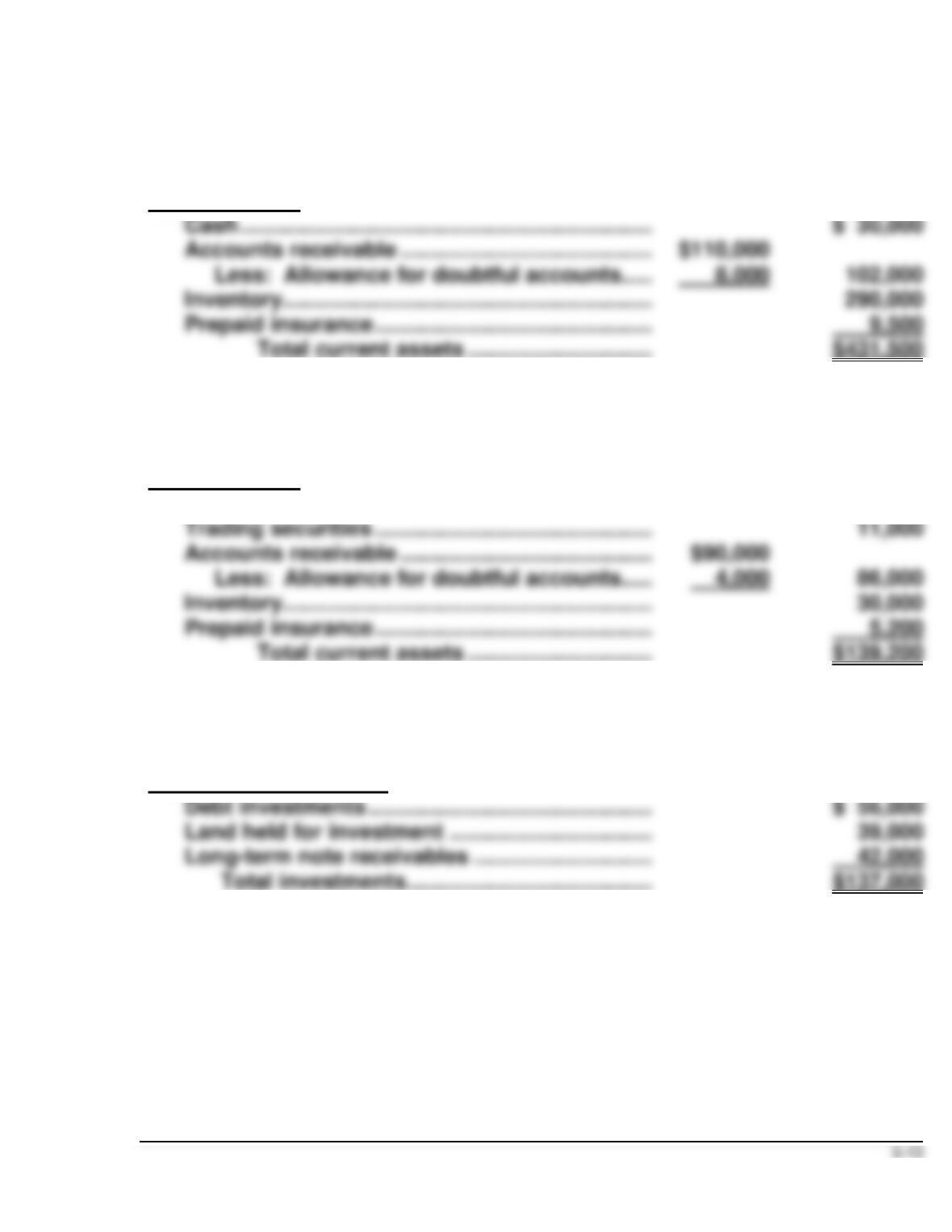
SOLUTIONS TO BRIEF EXERCISES
BRIEF EXERCISE 5-1
Current assets
Cash ……………………………………………………………
$ 30,000
Accounts receivable …………………………………….
Less: Allowance for doubtful accounts …….
Inventory ……………………………………………………..
Prepaid insurance ………………………………………..
BRIEF EXERCISE 5-2
Current assets
Cash ……………………………………………………………
$ 7,000
Trading securities …………………………..……………
Accounts receivable …………………………………….
Less: Allowance for doubtful accounts …….
Inventory ……………………………………………………..
Prepaid insurance ………………………………………..
BRIEF EXERCISE 5-3
Long-term investments
Debt investments …………………………………………..
Land held for investment ……………………………….
Long-term note receivables …………………………..
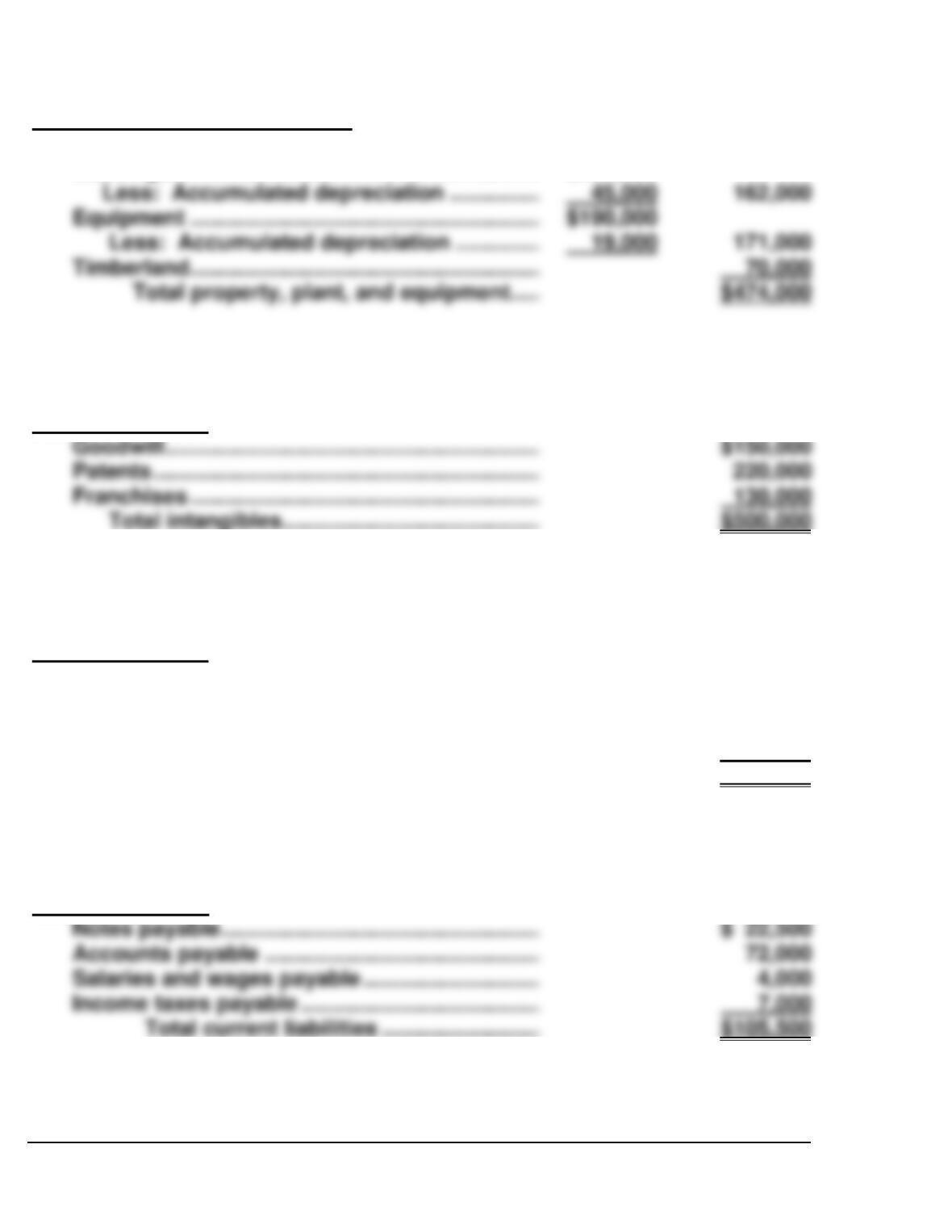
5-14
BRIEF EXERCISE 5-4
Property, plant, and equipment
Land ……………………………………………………………
$ 71,000
Buildings ……………………………………………………..
$207,000
BRIEF EXERCISE 5-5
Intangible assets
Goodwill ………………………………………………………
$150,000
Patents ……………………………………………………….
Franchises …………………………………………………..
BRIEF EXERCISE 5-6
Intangible assets
Goodwill ………………………………………………………
$ 50,000
Franchises …………………………………………………..
47,000
Patents ……………………………………………………….
33,000
Trademarks …………………………..……………………..
10,000
Total intangible assets …………………………..
$140,000
BRIEF EXERCISE 5-7
Current liabilities
Notes payable ………………………………………………
Accounts payable ………………………………………..
Salaries and wages payable ………………………….
Income taxes payable …………………………………..
Less: Accumulated depreciation ……………..
Equipment …………………………………………………..
Less: Accumulated depreciation …………….
19,000
Timberland …………………………………………………..
70,000
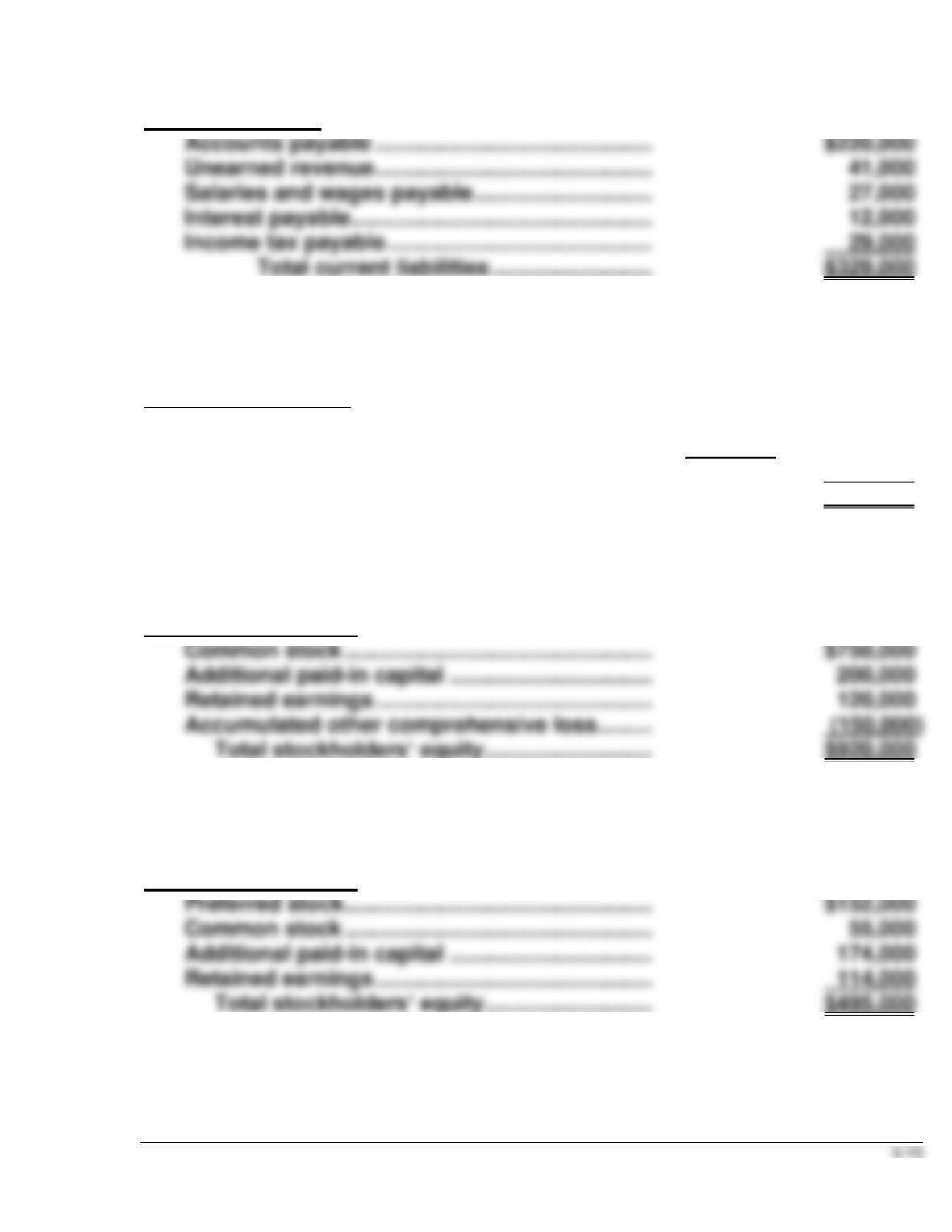
BRIEF EXERCISE 5-8
Current liabilities
Accounts payable ………………………………………..
$220,000
Unearned revenue ………………………………………..
Salaries and wages payable ………………………….
Interest payable …………………………..……………….
Income tax payable ………………………………………
Total current liabilities ……………………….
$329,000
BRIEF EXERCISE 5-9
Long-term liabilities
Bonds payable …………………………………………….
$400,000
Less: Discount on bonds payable ……………
29,000
$371,000
Pension liability …………………………..……………….
375,000
Total long-term liabilities ……………………
$746,000
BRIEF EXERCISE 5-10
Stockholders’ equity
Common stock …………………………………………….
Additional paid-in capital ……………………………..
Retained earnings ………………………………………..
Accumulated other comprehensive loss………..
Total stockholders’ equity ………………………..
BRIEF EXERCISE 5-11
Stockholders’ equity
Common stock …………………………………………….
Additional paid-in capital ……………………………..
Retained earnings ………………………………………..
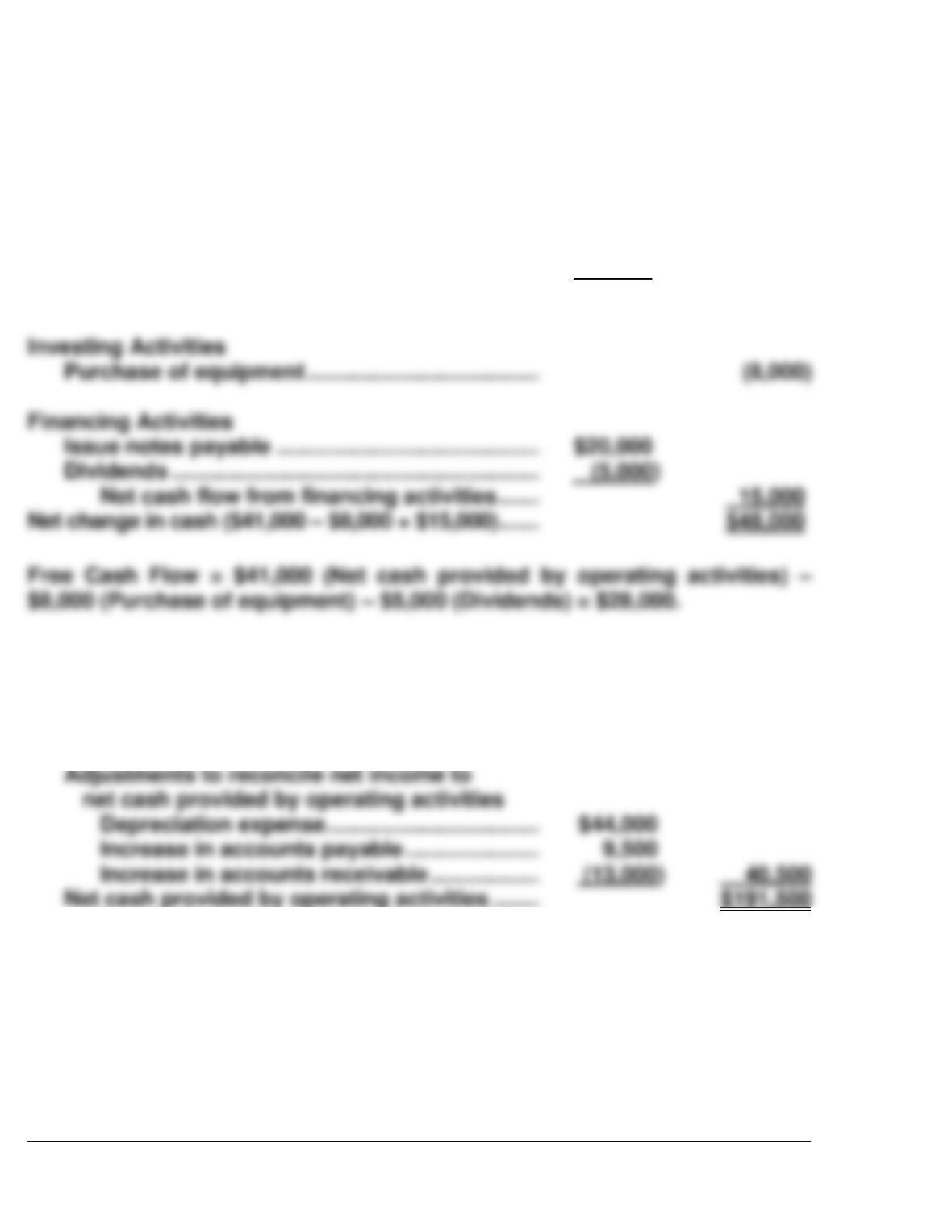
5-16
BRIEF EXERCISE 5-12
Cash Flow Statement
Operating Activities
Net income ………………………………………………….
$40,000
Depreciation expense…………………………………..
$ 4,000
Increase in accounts receivable ……………………
(10,000)
Increase in accounts payable ……………………….
7,000
Net cash provided by operating activities ……
41,000
BRIEF EXERCISE 5-13
Cash flows from operating activities
Net income ………………………………………………….
$151,000
Depreciation expense ……………………………..
Increase in accounts payable ………………….
Increase in accounts receivable ………………
40,500
Investing Activities
Purchase of equipment ………………………………..
Financing Activities
Issue notes payable …………………………………….
$20,000
Dividends ……………………………………………………
Net cash flow from financing activities …….
Net change in cash ($41,000 – $8,000 + $15,000) …….
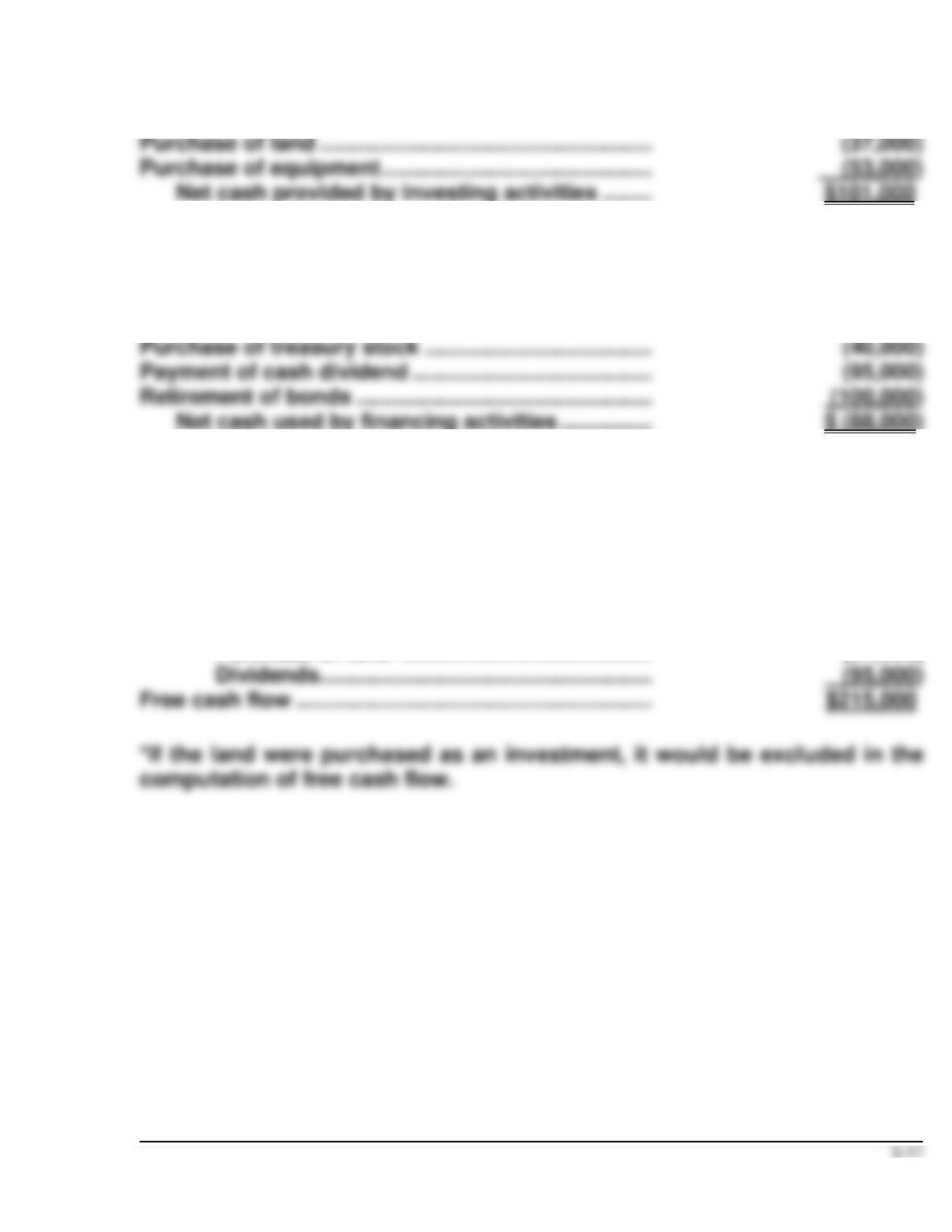
BRIEF EXERCISE 5-14
Sale of land and building …………………………………..
$191,000
Purchase of land ………………………………………………
Purchase of equipment ……………………………………..
BRIEF EXERCISE 5-15
Issuance of common stock ……………………………….
$147,000
Purchase of treasury stock ……………………………….
(40,000)
Payment of cash dividend …………………………………
(95,000)
Retirement of bonds …………………………………………
BRIEF EXERCISE 5-16
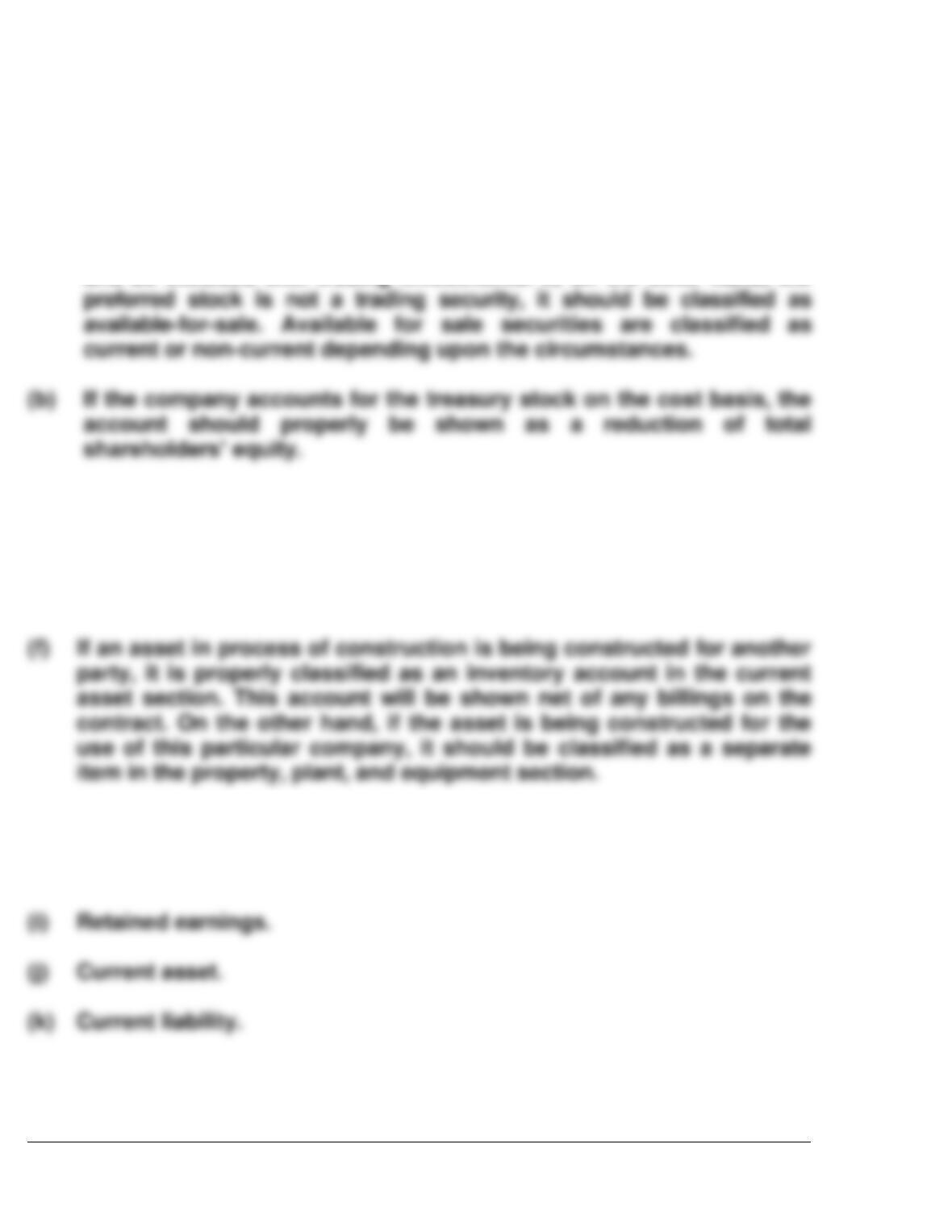
Free Cash Flow Analysis
Net cash provided by operating activities …………..
$400,000
Purchase of equipment ………………………….
(53,000)
Purchase of land* …………………………………..
(37,000)
Dividends ………………………………………………
5-18
SOLUTIONS TO EXERCISES
EXERCISE 5-1 (15–20 minutes)
(a) If the investment in preferred stock is readily marketable and held
primarily for sale in the near term to generate income on short-term
price differences, then the account should appear as a current asset
and be included with trading investments. If, on the other hand, the
(c) Shareholders’ equity.
(d) Current liability.
(e) Property, plant, and equipment (as a deduction).
(g) Current asset.
(h) Current liability.
5-19
EXERCISE 5-1 (Continued)
(l) Current liability.
EXERCISE 5-2 (15–20 minutes)
1.
h.
11.
b.
2.
d.
12.
f.
3.
f.
13.
a.
4.
f.
14.
h.
5.
c.
15.
c.
6.
a.
16.
b.
7.
f.
17.
a.
8.
g.
18.
a.
9.
a.
19.
g.
10.
a.
20.
f.
EXERCISE 5-3 (15–20 minutes)
1.
a.
10.
f.
2.
b.
11.
a.
3.
f.
12.
f.
4.
a.
13.
5.
14.
c. and N.
6.
h.
15.
f.
7.
16.
8.
d.
17.
9.
a.
18.
c.
EXERCISE 5-4 (30–35 minutes)
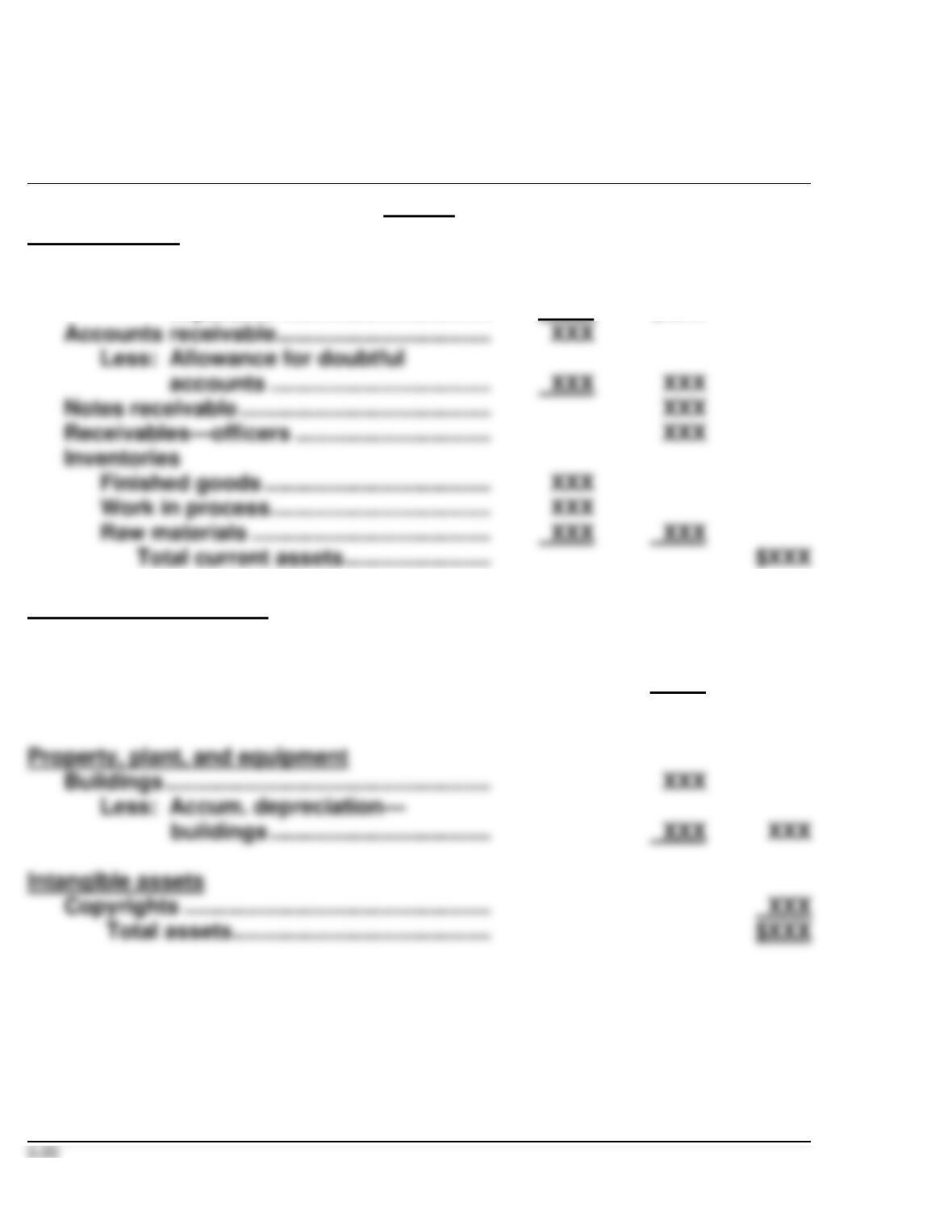
GULISTAN INC.
Balance Sheet
December 31, 20XX
Assets
Current assets
Cash …………………………..……………………….
$XXX
Less: Cash restricted for plant
expansion …………………………….
XXX
$XXX
Accounts receivable ……………………………..
XXX
Notes receivable …………………………………..
XXX
Receivables—officers …………………………..
XXX
Inventories
Finished goods ……………………………….
XXX
Work in process ………………………………
Raw materials …………………………………
XXX
Total current assets ……………………
$XXX
Long-term investments
Preferred stock investments………………….
XXX
Land held for future plant site ……………….
XXX
Cash restricted for plant expansion ……….
XXX
Total long-term investments ……….
XXX
Property, plant, and equipment
Buildings ……………………………………………..
XXX
Less: Accum. depreciation—
Intangible assets
Copyrights …………………………………………..