CHAPTER 5
DISCOUNTED CASH FLOW VALUATION
Answers to Concepts Review and Critical Thinking Questions
1. Assuming positive cash flows and a positive interest rate, both the present and the future value will
rise.
usually government sponsored!
4. The most important consideration is the interest rate the lottery uses to calculate the lump sum option.
If you can earn an interest rate that is higher than you are being offered, you can create larger annuity
payments. Of course, taxes are also a consideration, as well as how badly you really need $5 million
today.
easier to compute, but, with modern computing equipment, that advantage is not very important.
8. A freshman does. The reason is that the freshman gets to use the money for much longer before interest
starts to accrue.
9. The subsidy is the present value (on the day the loan is made) of the interest that would have accrued
up until the time it actually begins to accrue.
Solutions to Questions and Problems
NOTE: All end-of-chapter problems were solved using a spreadsheet. Many problems require multiple
steps. Due to space and readability constraints, when these intermediate steps are included in this solutions
manual, rounding may appear to have occurred. However, the final answer for each problem is found
without rounding during any step in the problem.
Basic
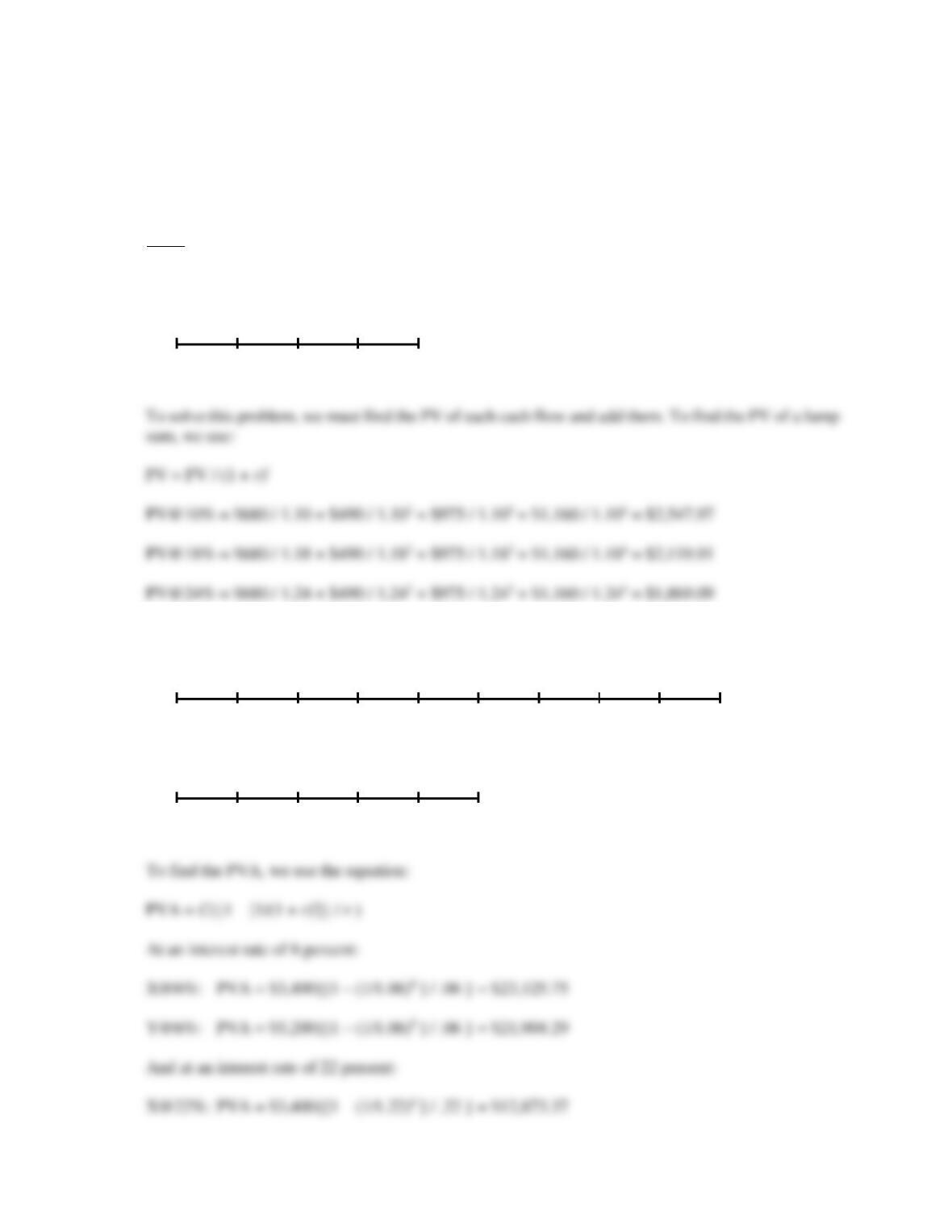
1. The time line is:
0
1
2
3
4
PV
$680
$490
$975
$1,160
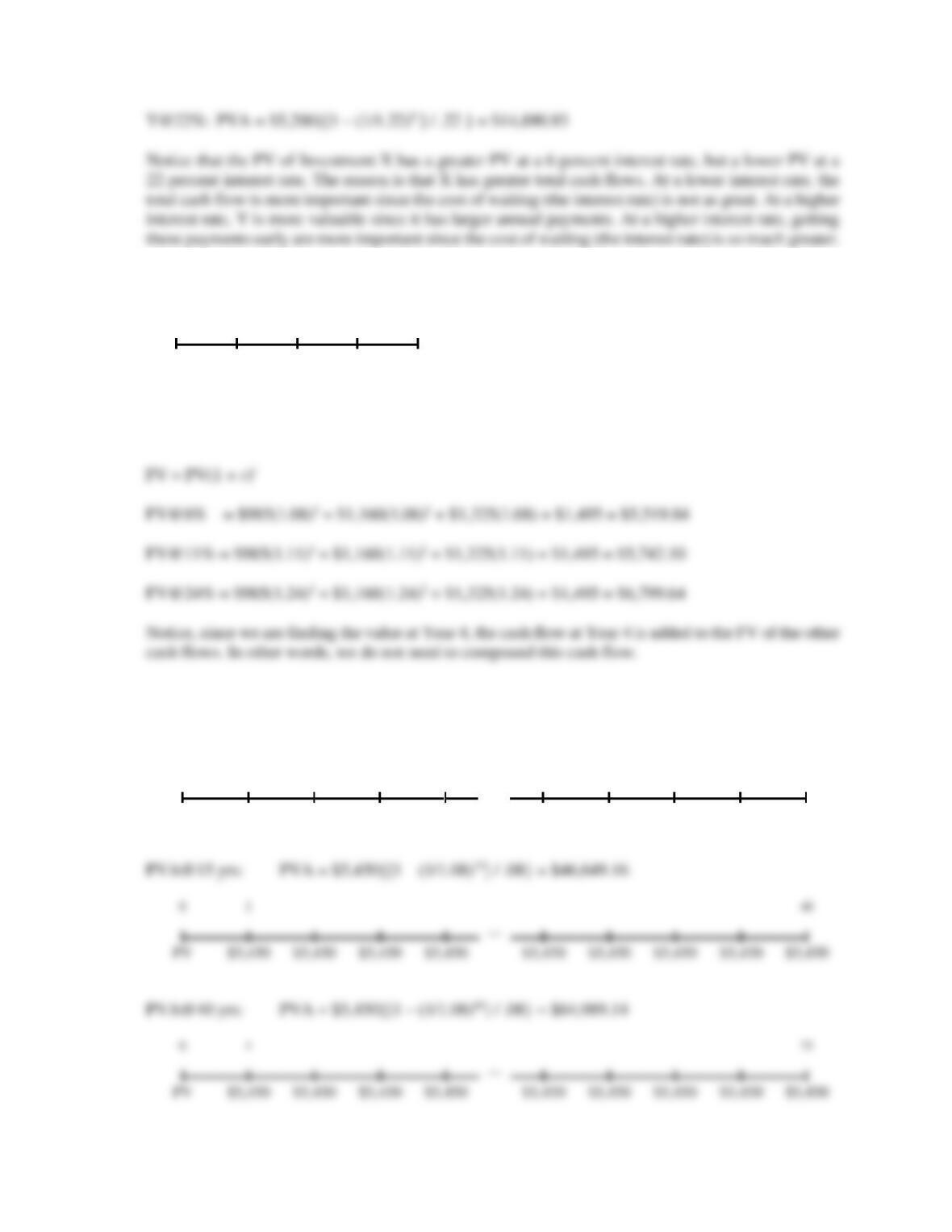
2. The times lines are:
0
1
2
3
4
5
6
7
8
9
PV
$3,400
$3,400
$3,400
$3,400
$3,400
$3,400
$3,400
$3,400
$3,400
0
1
2
3
4
5
PV
$5,200
$5,200
$5,200
$5,200
$5,200
3. The time line is:
0
1
2
3
4
$985
$1,160
$1,325
$1,495
To solve this problem, we must find the FV of each cash flow and sum. To find the FV of a lump sum,
we use:
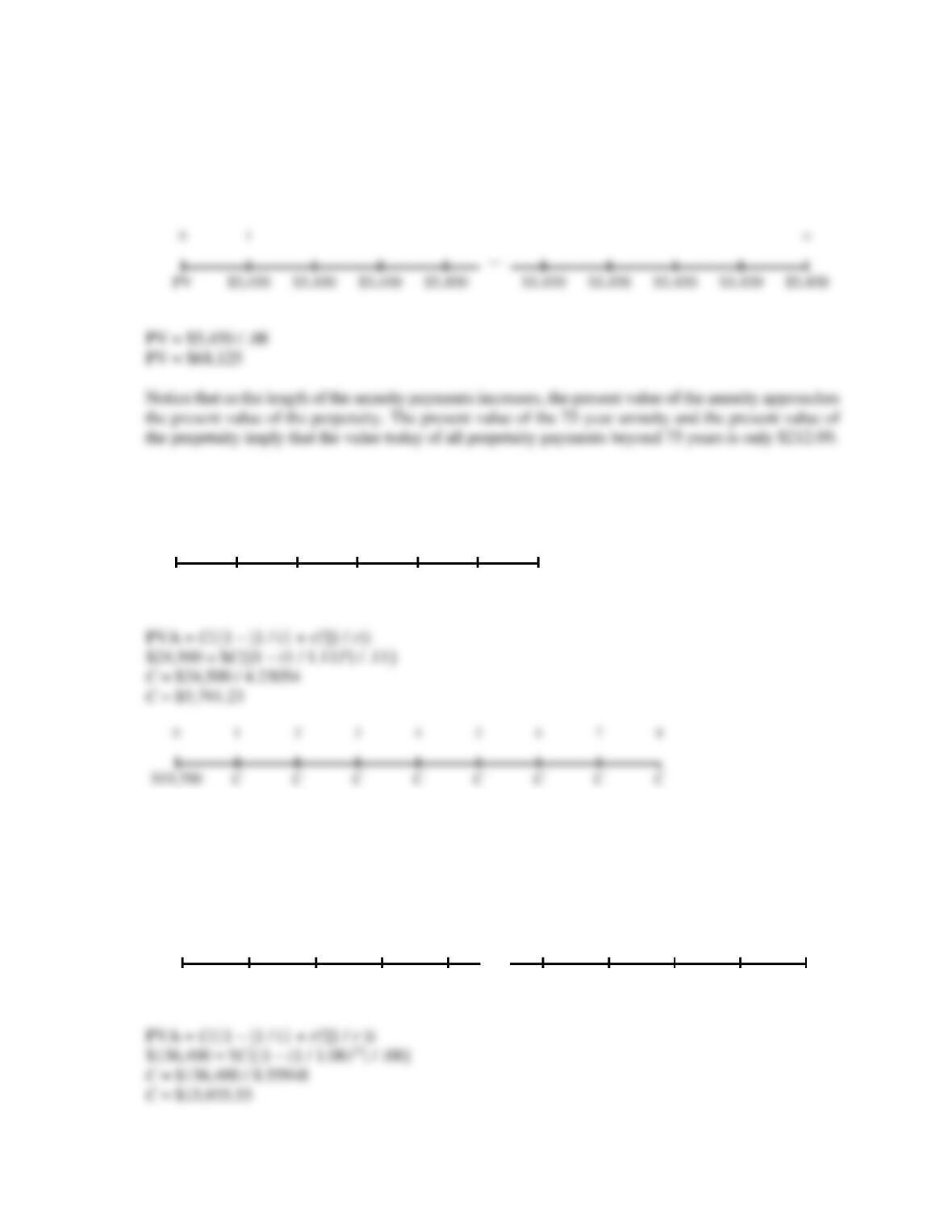
4. To find the PVA, we use the equation:
PVA = C({1 – [1/(1 + r)t]} / r)
0
1
…
15
PV
$5,450
$5,450
$5,450
$5,450
$5,450
$5,450
$5,450
$5,450
$5,450
…
PV
$5,450
$5,450
$5,450
$5,450
$5,450
$5,450
$5,450
$5,450
$5,450
PVA@75 yrs: PVA = $5,450{[1 – (1/1.08)75] / .08} = $67,912.91
To find the PV of a perpetuity, we use the equation:
PV = C / r
5. Here we have the PVA, the length of the annuity, and the interest rate. We want to calculate the annuity
payment. Using the PVA equation and solving for the payment in each case, we find:
0
1
2
3
4
5
6
$24,500
C
C
C
C
C
C
PVA = C({1 – [1 / (1 + r)t]} / r ))
$19,700 = $C{[1 – (1 / 1.07)8] / .07}
C = $19,700 / 5.97130
C = $3,299.11
0
1
…
15
$136,400
C
C
C
C
C
C
C
C
C
0
1
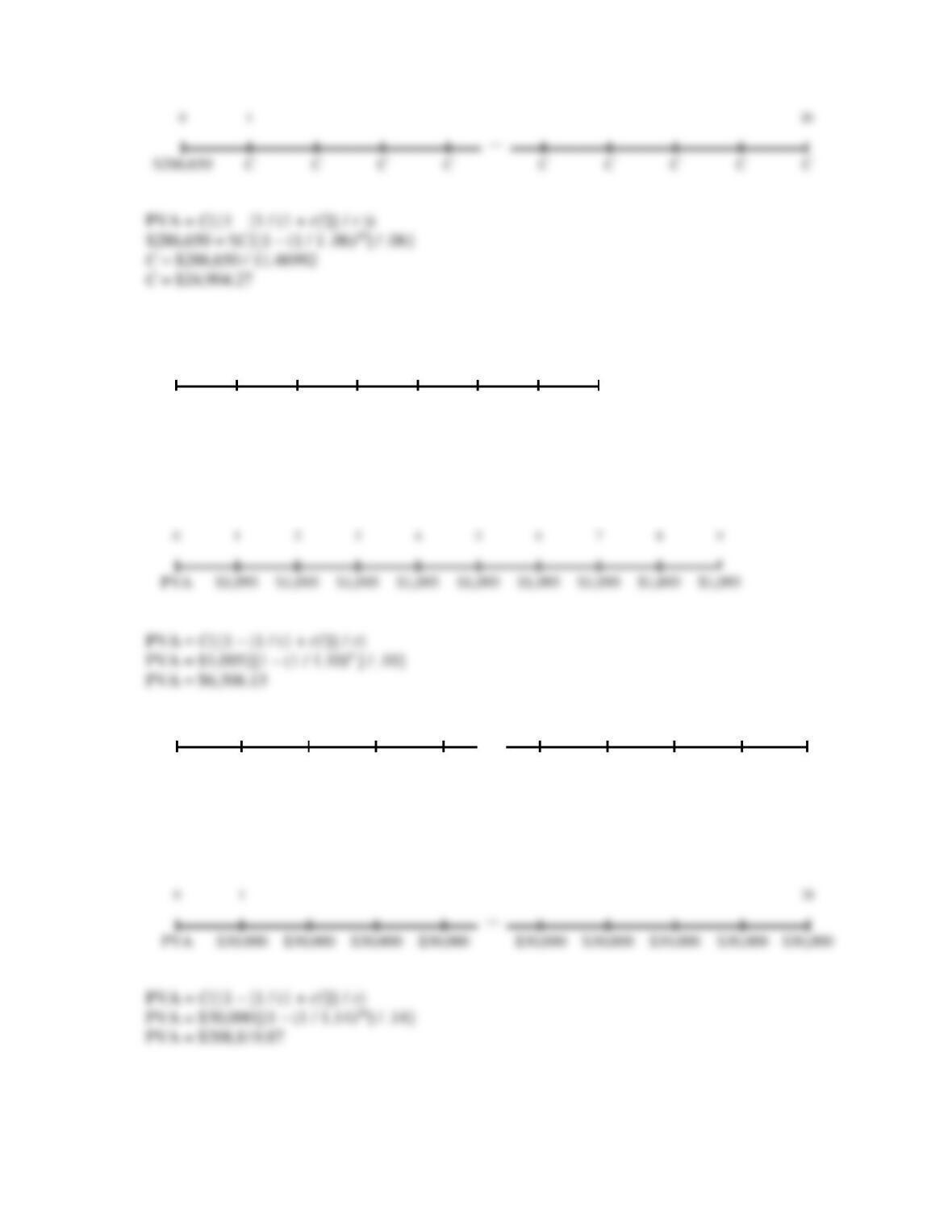
6. Here we need to find the present value of an annuity. Using the PVA equation, we find:
0
1
2
3
4
5
6
7
PVA
$2,100
$2,100
$2,100
$2,100
$2,100
$2,100
$2,100
PVA = C({1 – [1 / (1 + r)t]} / r)
PVA = $2,100{[1 – (1 / 1.05)7] / .05}
PVA = $12,151.38
0
1
2
3
4
5
6
7
8
9
PVA
$1,095
$1,095
$1,095
$1,095
$1,095
$1,095
$1,095
$1,095
$1,095
0
1
…
18
PVA
$11,000
$11,000
$11,000
$11,000
$11,000
$11,000
$11,000
$11,000
$11,000
…
PVA
$30,000
$30,000
$30,000
$30,000
$30,000
$30,000
$30,000
$30,000
$30,000
PVA = C({1 – [1 / (1 + r)t]} / r)
PVA = $11,000{[1 – (1 / 1.08)18 ] / .08}
PVA = $103,090.76
…
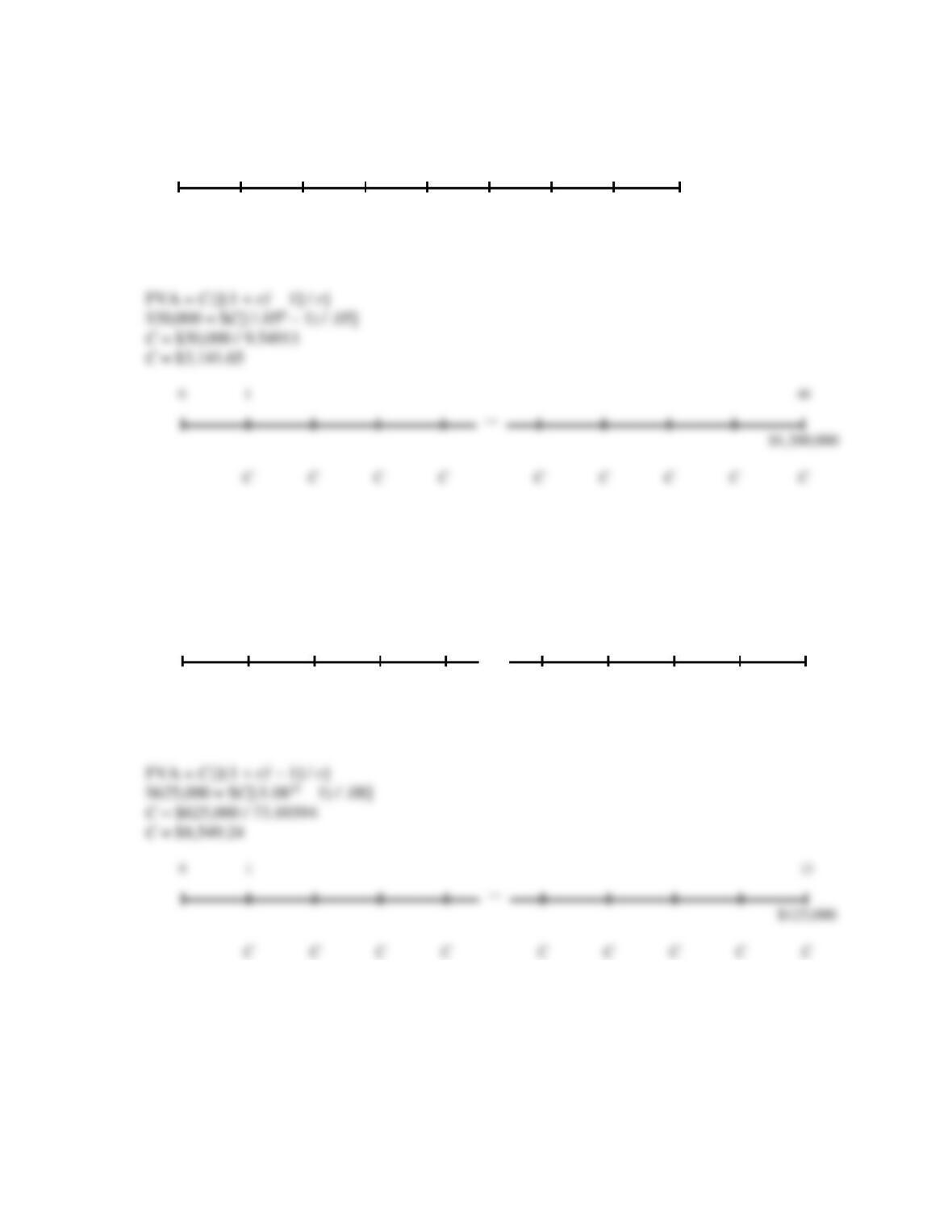
7. Here we have the FVA, the length of the annuity, and the interest rate. We want to calculate the annuity
payment. Using the FVA equation:
0
1
8
$30,000
C
C
C
C
C
C
C
C
FVA = C{[(1 + r)t – 1] / r}
$1,200,000 = $C[(1.0740 – 1) / .07]
C = $1,200,000 / 199.63511
C = $6,010.97
0
1
…
25
$625,000
C
C
C
C
C
C
C
C
C
0
1
$125,000
FVA = C{[(1 + r)t – 1] / r}
$125,000 = $C[(1.0413 – 1) / .04]
C = $125,000 / 16.62684
C = $7,517.97
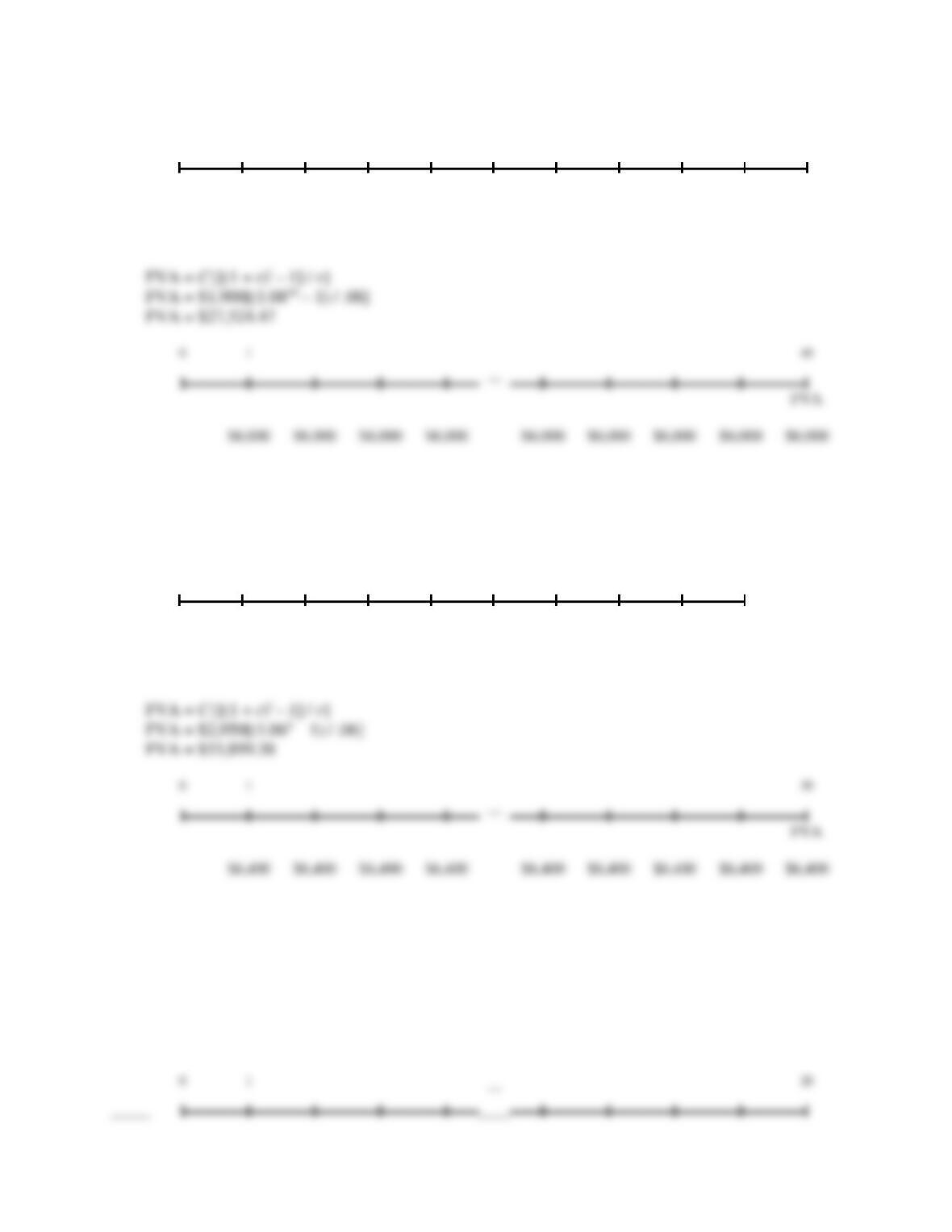
8. Here, we need to find the future value of an annuity. Using the FVA equation, we find:
0
1
10
FVA
$1,900
$1,900
$1,900
$1,900
$1,900
$1,900
$1,900
$1,900
$1,900
$1,900
FVA = C{[(1 + r)t – 1] / r}
FVA = $6,000[(1.0940 – 1) / .09]
FVA = $2,027,294.67
0
1
9
FVA
$2,950
$2,950
$2,950
$2,950
$2,950
$2,950
$2,950
$2,950
$2,950
FVA = C{[(1 + r)t – 1] / r}
FVA = $6,400[(1.1030 – 1) / .10]
FVA = $1,052,761.75
9. Here we need to find the FVA. The equation to find the FVA is:
FVA = C{[(1 + r)t – 1] / r}
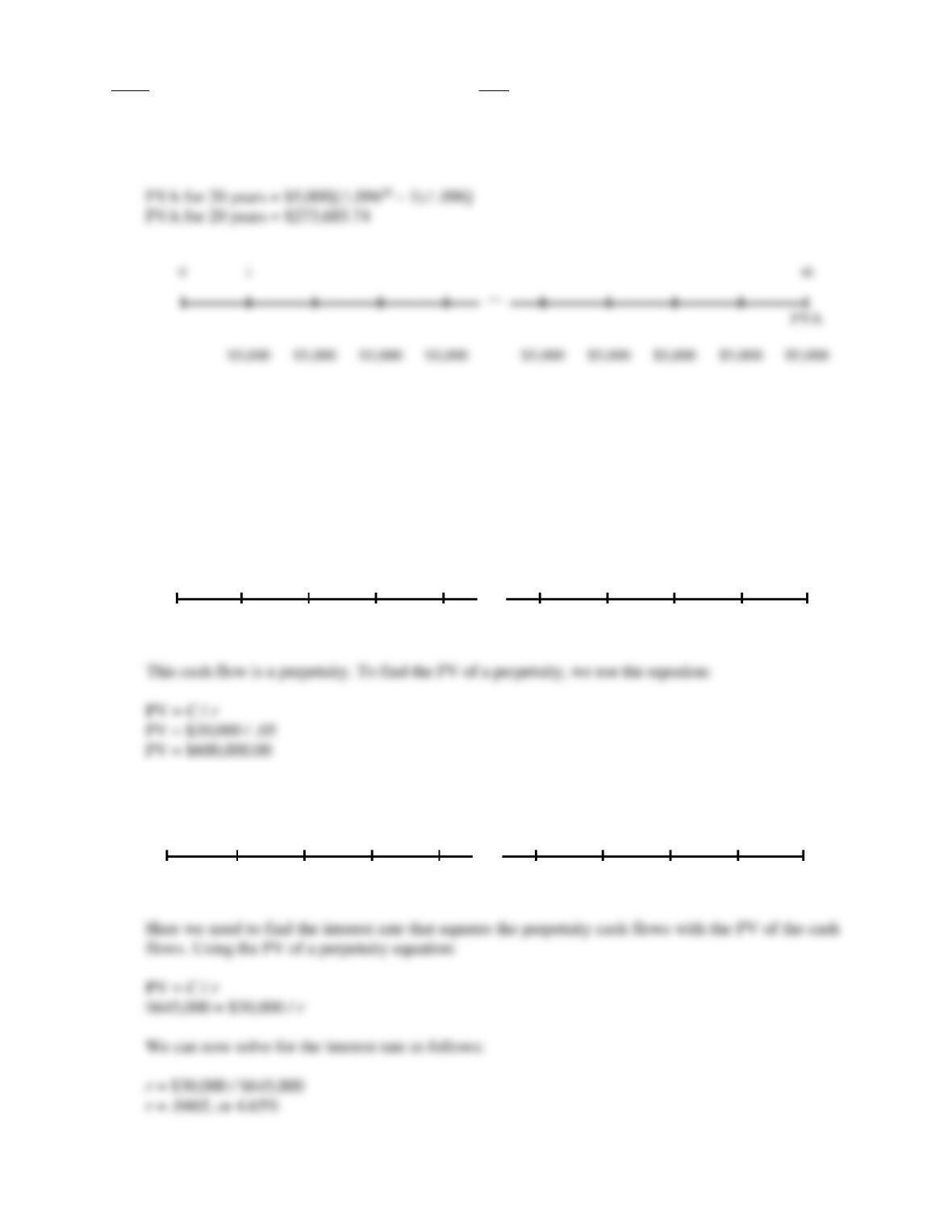
FVA
$5,000
$5,000
$5,000
$5,000
$5,000
$5,000
$5,000
$5,000
$5,000
FVA for 40 years = $5,000[(1.09640 – 1) / .096]
FVA for 40 years = $1,985,526.07
Notice that because of exponential growth, doubling the number of periods does not merely double
the FVA.
10. The time line is:
0
1
…
∞
PV
$30,000
$30,000
$30,000
$30,000
$30,000
$30,000
$30,000
$30,000
$30,000
11. The time line is:
0
1
…
∞
–$645,000
$30,000
$30,000
$30,000
$30,000
$30,000
$30,000
$30,000
$30,000
$30,000
0
1
FVA
$5,000
$5,000
$5,000
$5,000
$5,000
$5,000
$5,000
$5,000
$5,000
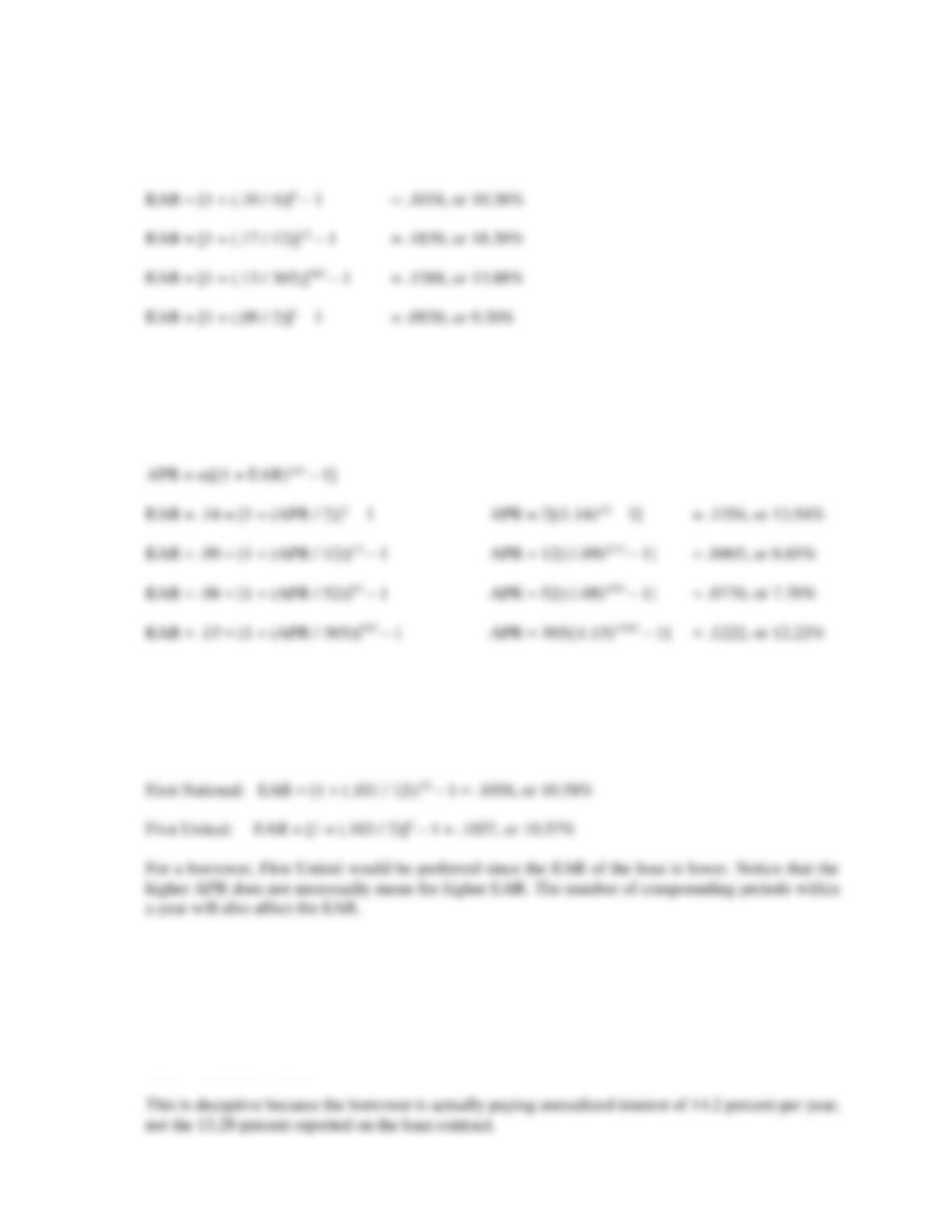
12. For discrete compounding, to find the EAR, we use the equation:
EAR = [1 + (APR / m)]m – 1
13. Here we are given the EAR and need to find the APR. Using the equation for discrete compounding:
EAR = [1 + (APR / m)]m – 1
We can now solve for the APR. Doing so, we get:
14. For discrete compounding, to find the EAR, we use the equation:
EAR = [1 + (APR / m)]m – 1
So, for each bank, the EAR is:
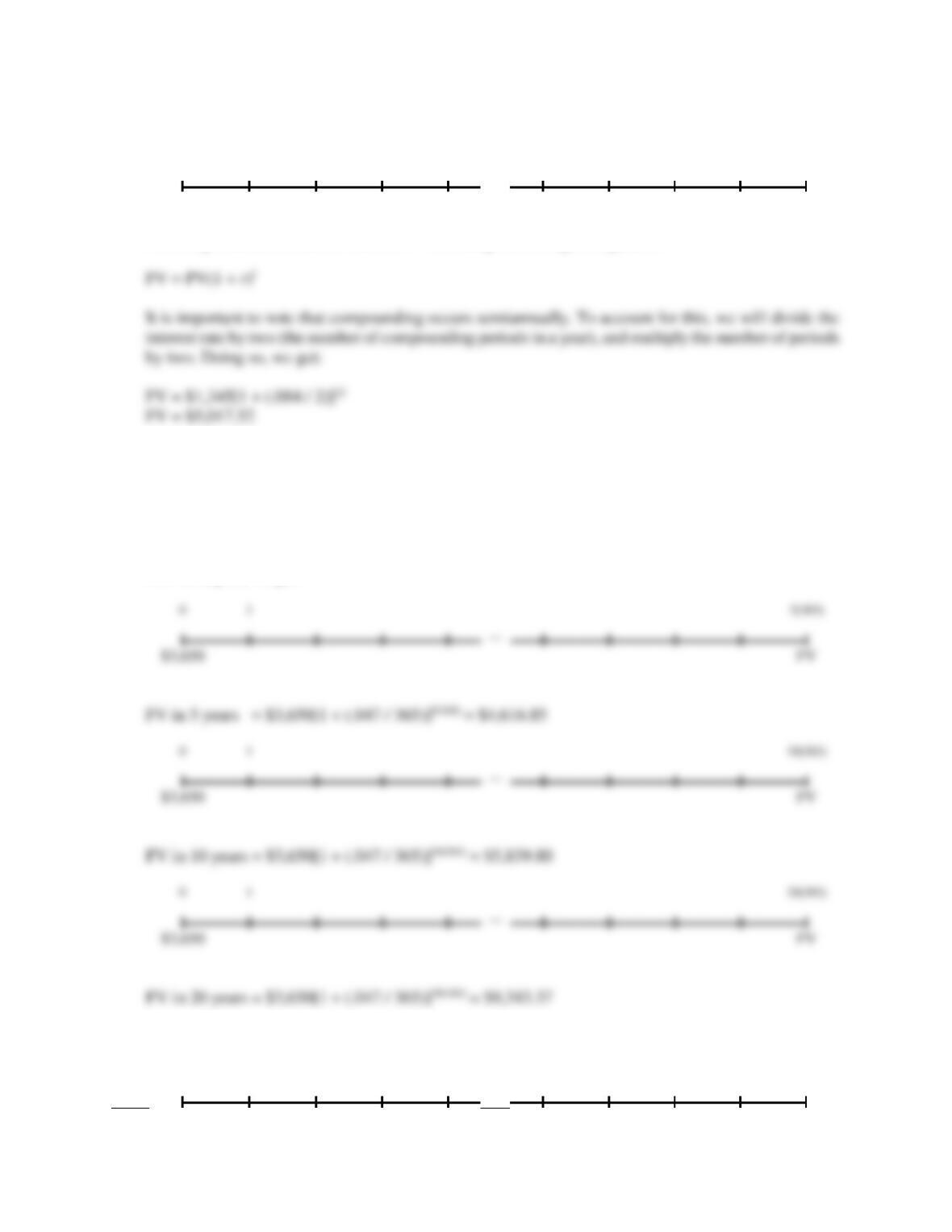
15. The reported rate is the APR, so we need to convert the EAR to an APR as follows:
EAR = [1 + (APR / m)]m – 1
APR = m[(1 + EAR)1/m – 1]
APR = 365[(1.142)1/365 – 1]
APR = .1328, or 13.28%
16. The time line is:
0
1
…
32
$1,345
FV
0
1
For this problem, we need to find the FV of a lump sum using the equation:
17. For this problem, we need to find the FV of a lump sum using the equation:
FV = PV(1 + r)t
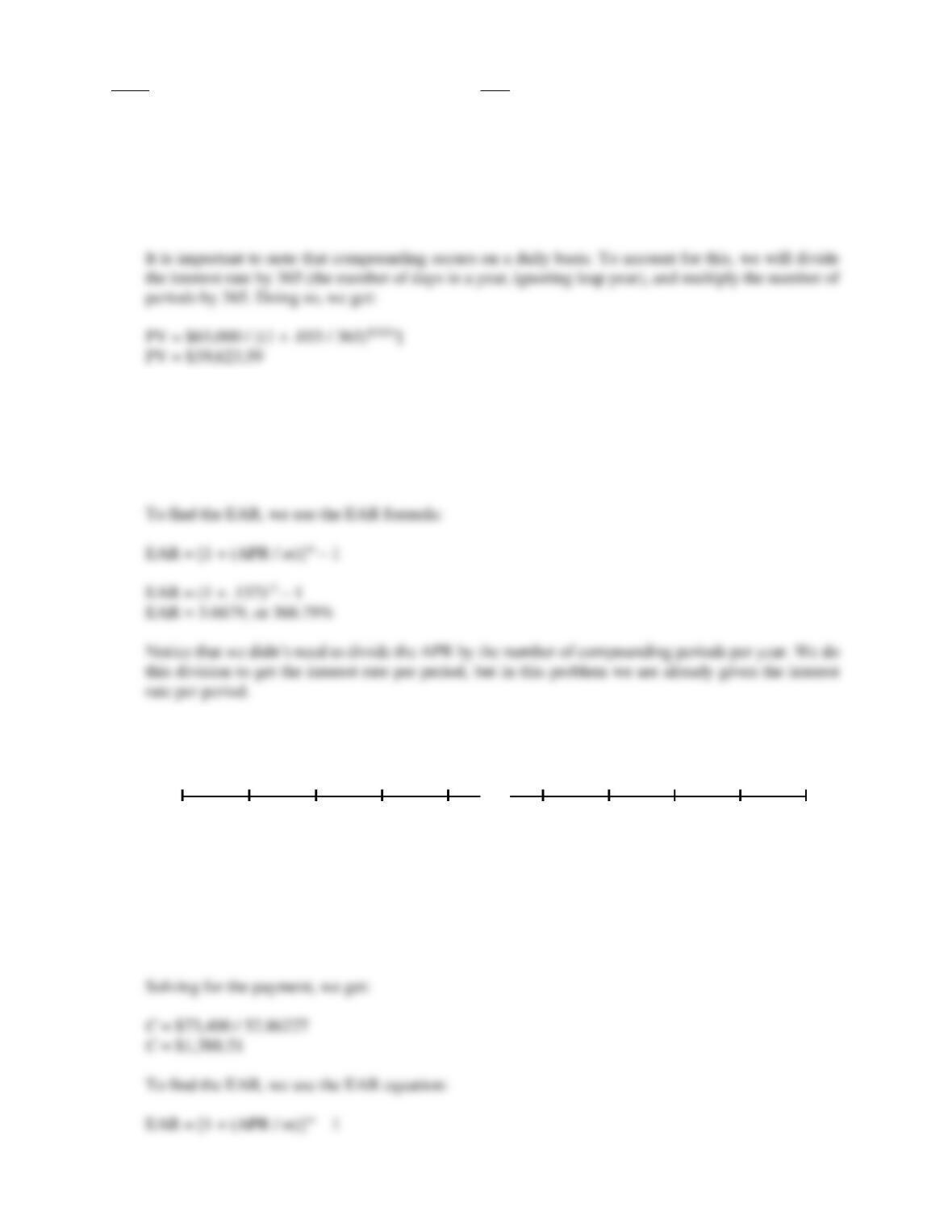
It is important to note that compounding occurs daily. To account for this, we will divide the interest
rate by 365 (the number of days in a year, ignoring leap year), and multiply the number of periods by
365. Doing so, we get:
18. The time line is:
0
1
…
9(365)
PV
$65,000
For this problem, we simply need to find the PV of a lump sum using the equation:
PV = FV / (1 + r)t
19. The APR is simply the interest rate per period times the number of periods in a year. In this case, the
interest rate is 13.7 percent per month, and there are 12 months in a year, so we get:
APR = 12(13.7%)
APR = 164.40%
20. The time line is:
0
1
…
60
$73,400
C
C
C
C
C
C
C
C
C
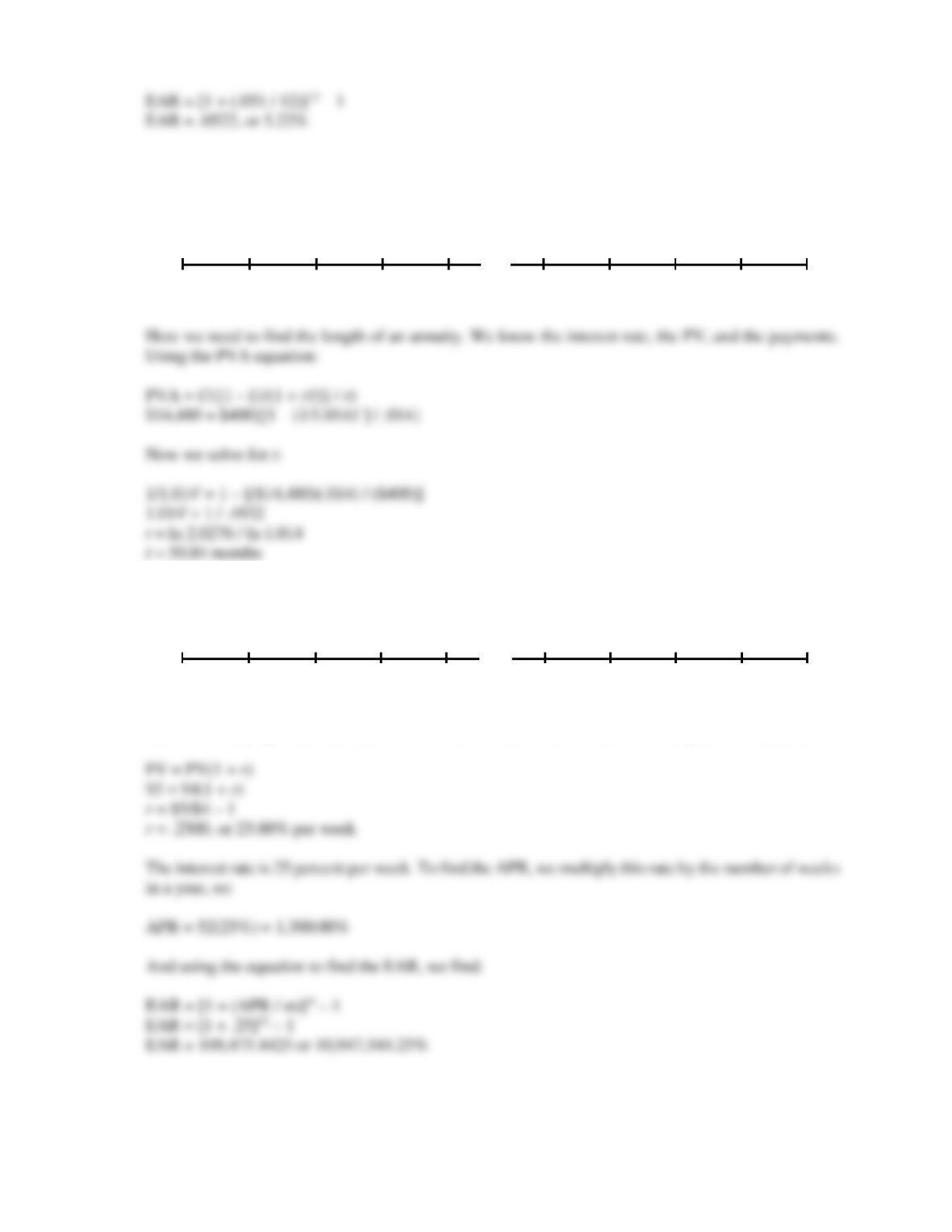
We first need to find the annuity payment. We have the PVA, the length of the annuity, and the interest
rate. Using the PVA equation:
PVA = C({1 – [1 / (1 + r)t]} / r )
$73,400 = $C[1 – {1 / [1 + (.051/12)]60} / (.051/12)]
21. The time line is:
0
1
…
t
–$14,480
$400
$400
$400
$400
$400
$400
$400
$400
$400
22. The time line is:
0
1
…
t
–$4
$5
Here we are trying to find the interest rate when we know the PV and FV. Using the FV equation:
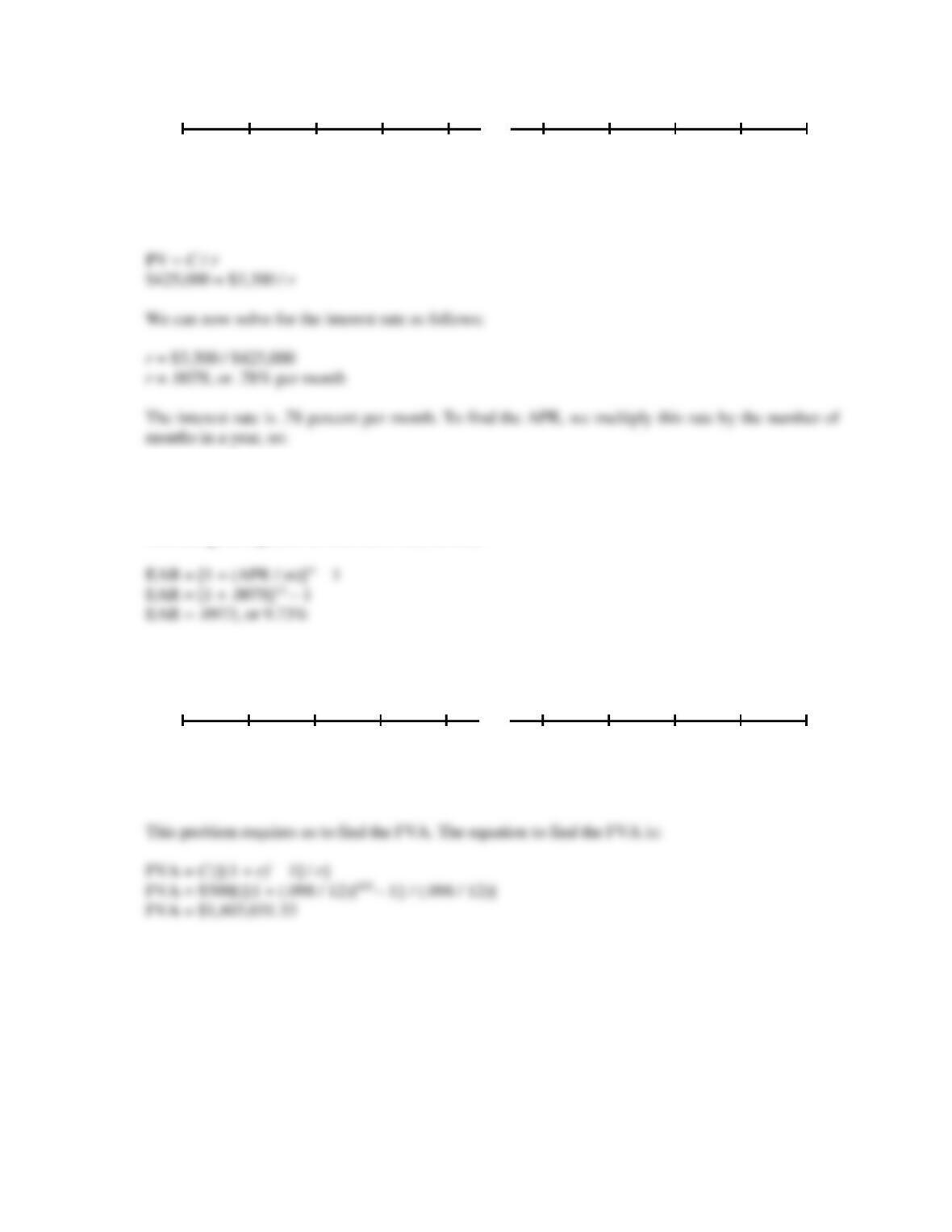
23. The time line is:
0
1
…
∞
–$425,000
$3,300
$3,300
$3,300
$3,300
$3,300
$3,300
$3,300
$3,300
$3,300
Here we need to find the interest rate that equates the perpetuity cash flows with the PV of the cash
flows. Using the PV of a perpetuity equation:
APR = 12(.78%)
APR = 9.32%
And using the equation to find the EAR, we find:
24. The time line is:
0
1
…
420
FVA
$500
$500
$500
$500
$500
$500
$500
$500
$500
25. In the previous problem, the compounding period is monthly. This assumption still holds. Since the
cash flows are annual, we need to use the EAR to calculate the future value of annual cash flows. It is
important to remember that you have to make sure the compounding periods of the interest rate
matches with the cash flows. In this case, we have annual cash flows, so we need the EAR since it is
the true annual interest rate you will earn. So, finding the EAR:
EAR = [1 + (APR / m)]m – 1
EAR = [1 + (.098 / 12)]12 – 1
EAR = .1025, or 10.25%
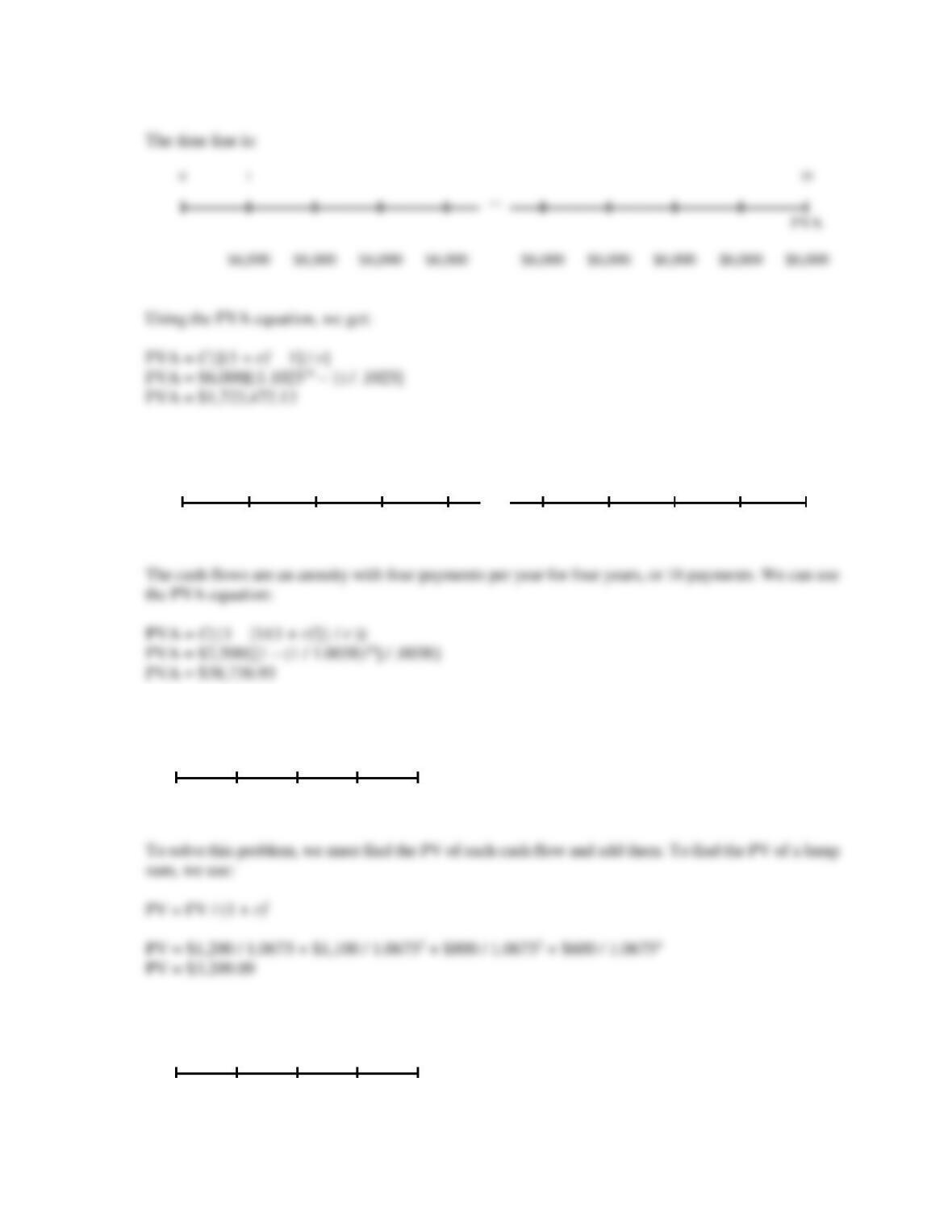
26. The time line is:
0
1
…
16
PVA
$2,500
$2,500
$2,500
$2,500
$2,500
$2,500
$2,500
$2,500
$2,500
27. The time line is:
0
1
2
3
4
PV
$1,200
$1,100
$800
$600
28. The time line is:
0
1
2
3
4
PV
$1,400
$1,900
$3,400
$4,300
0
1
Intermediate
29. The total interest paid by First Simple Bank is the interest rate per period times the number of periods.
In other words, the interest by First Simple Bank paid over 10 years will be:
.058(10) = .58
30. The time line is:
0
1
…
60
$58,600
C
C
C
C
C
C
C
C
C
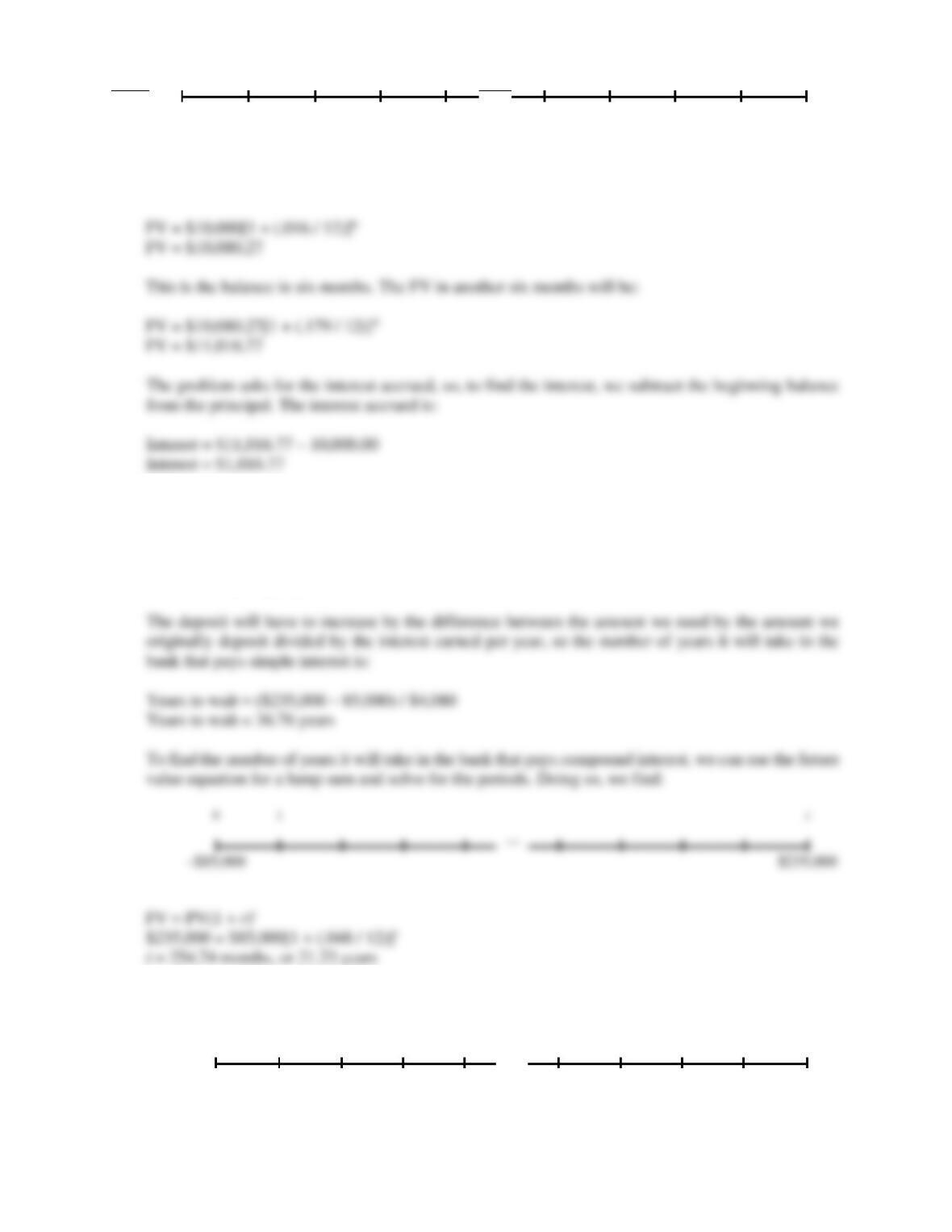
31. The time line is:
0
1
…
12
–$10,000
FV
0
1
Here we need to find the FV of a lump sum, with a changing interest rate. We must do this problem in
two parts. After the first six months, the balance will be:
32. We will calculate the time we must wait if we deposit in the bank that pays simple interest. The interest
amount we will receive each year in this bank will be:
Interest = $85,000(.048)
Interest = $4,080 per year
33. The time line is:
0
1
…
12
–$1
FV
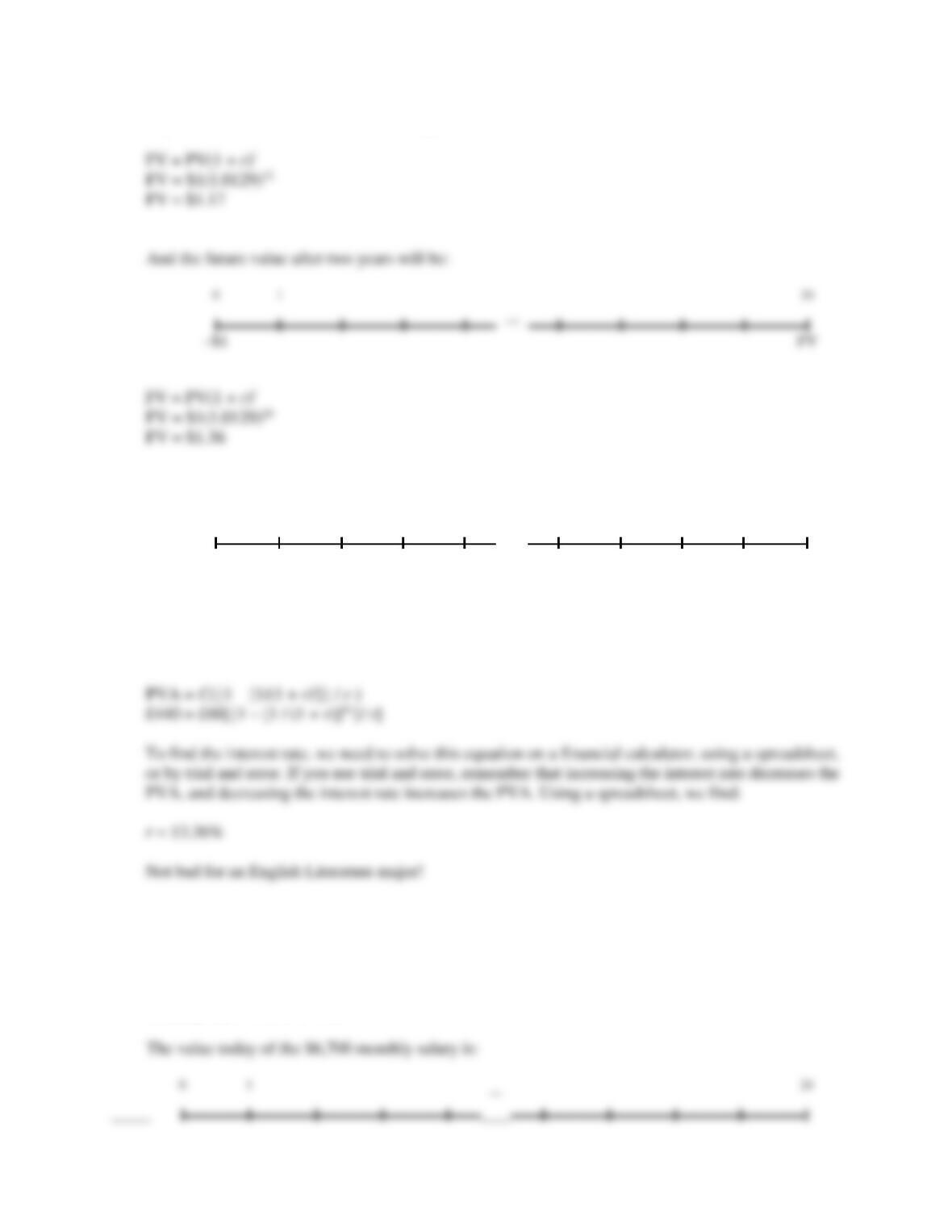
Here we need to find the future value of a lump sum. We need to make sure to use the correct number
of periods. So, the future value after one year will be:
34. The time line is:
0
1
…
31
–£440
£60
£60
£60
£60
£60
£60
£60
£60
£60
Here we are given the PVA, number of periods, and the amount of the annuity. We need to solve for
the interest rate. Even though the currency is pounds and not dollars, we can still use the same time
value equations. Using the PVA equation:
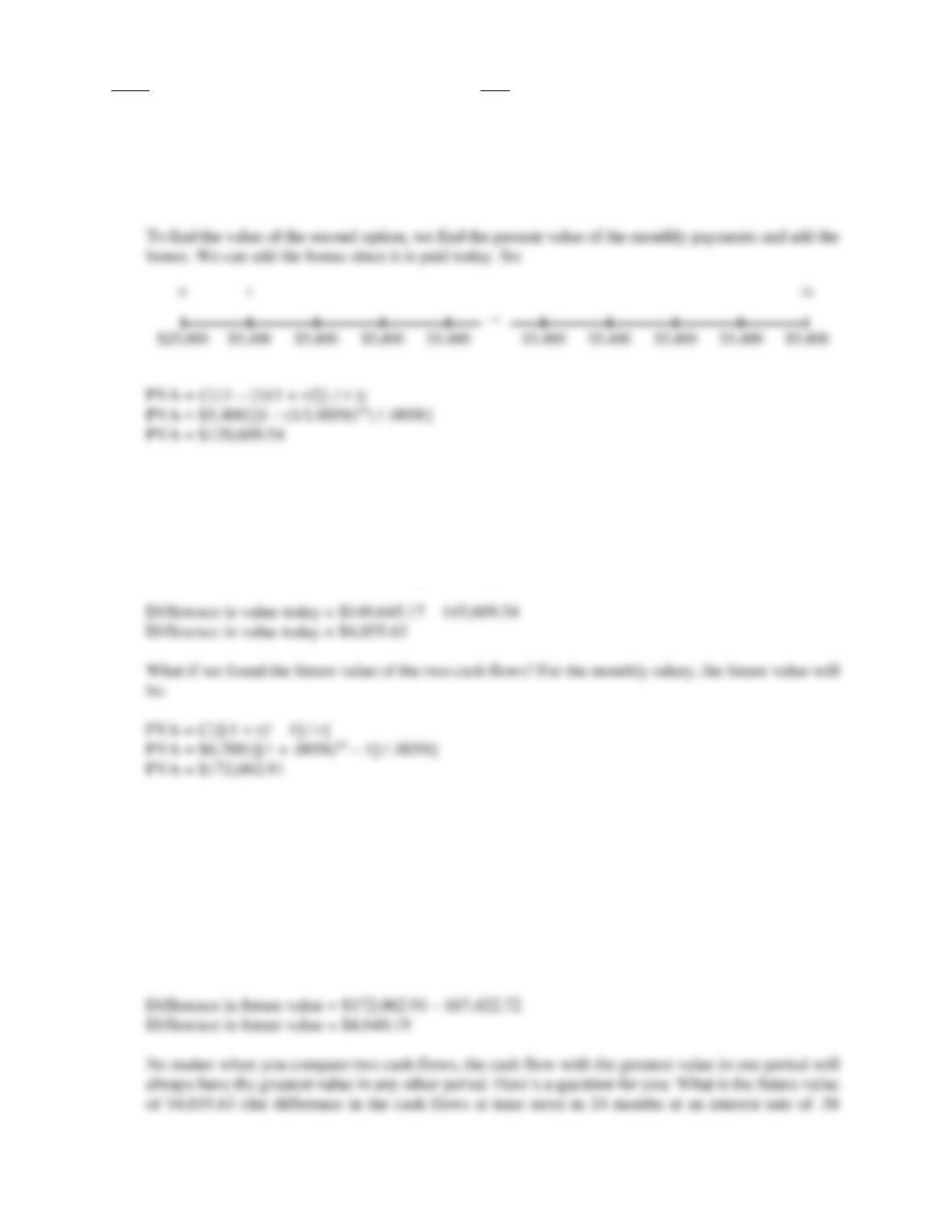
35. Here we need to compare two cash flows. The only way to compare cash flows is to find the value of
the cash flows at a common time, so we will find the present value of each cash flow stream. Since
the cash flows are monthly, we need to use the monthly interest rate, which is:
Monthly rate = .07 / 12
Monthly rate = .0058 or .58%
0
1
…
24
PVA
$6,700
$6,700
$6,700
$6,700
$6,700
$6,700
$6,700
$6,700
$6,700
PVA = C({1 – [1/(1 + r)t]} / r )
PVA = $6,700{[1 – (1 / 1.0058)24] / .0058}
PVA = $149,645.17
So, the total value of the second option is:
Value of second option = $120,609.54 + 25,000
Value of second option = $145,609.54
The difference in the value of the two options today is:
To find the future value of the second option we also need to find the future value of the bonus as well.
So, the future value of this option is:
FV = C{[(1 + r)t – 1] / r} + PV(1 + r)t
FV = $5,400{[(1 + .0058)24 – 1] / .0058} + $25,000(1 + .0058)24
FV = $167,422.72
So, the first option is still the better choice. The difference between the future values of the two options
is:
percent per month? With no calculations, you know the future value must be $4,640.19, the difference
in the cash flows at the same time!
36. The time line is:
0
1
…
20
PVA
$17,500
$17,500
$17,500
$17,500
$17,500
$17,500
$17,500
$17,500
$17,500
37. The investment we should choose is the investment with the higher rate of return. We will use the
future value equation to find the interest rate for each option. Doing so, we find the return for
Investment G is:
0
6
–$39,000
$75,000
–$39,000
So, we should choose Investment H.
38. The time line is:
0
1
2
3
4
5
6
7
8
9
10
PVA
$7,300
$7,300
$7,300
$7,300
$7,300
$7,300
$7,300
$7,300
$7,300
$7,300
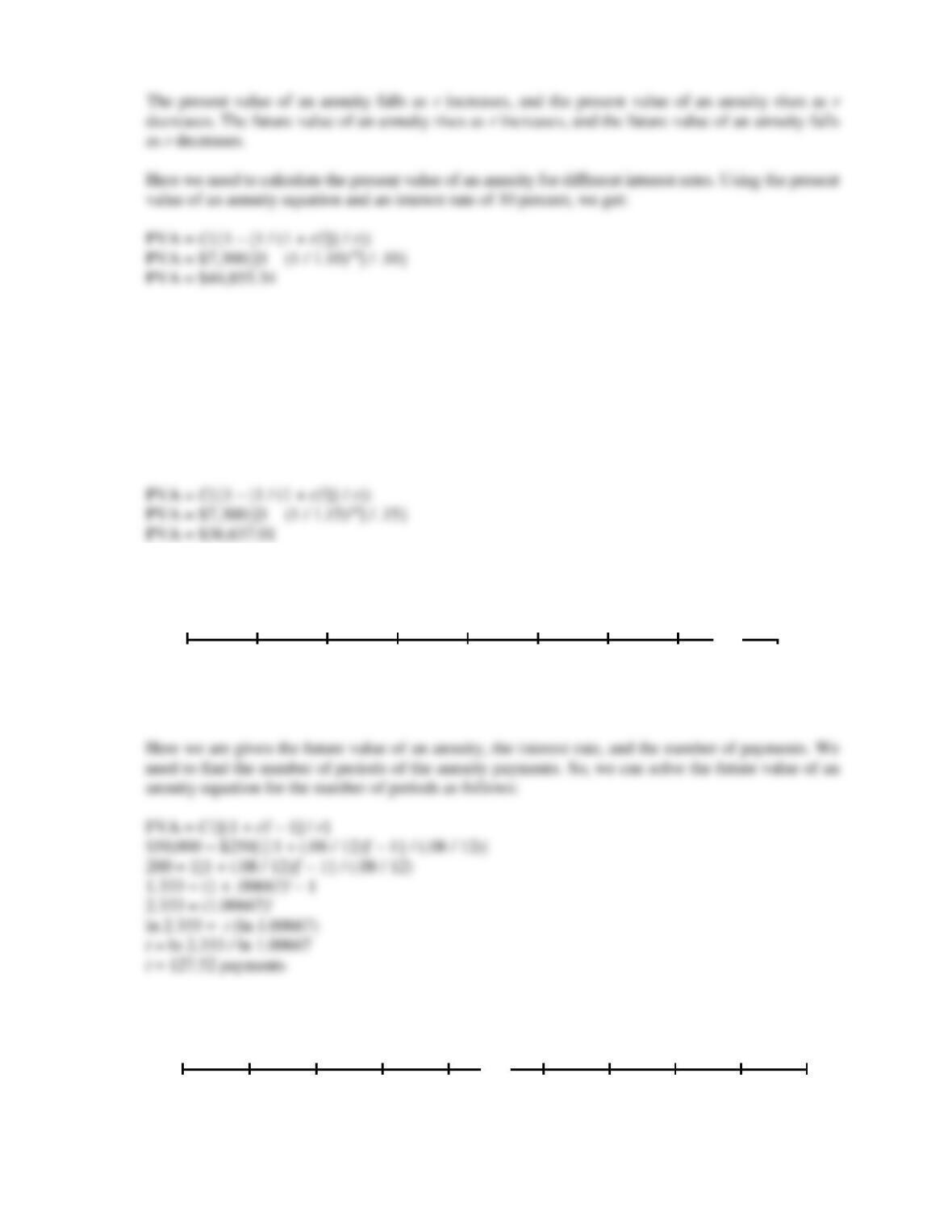
At an interest rate of 5 percent, the present value of the annuity is:
PVA = C({1 – [1 / (1 + r)t]} / r))
PVA = $7,300{[1 – (1 / 1.05)10] / .05}
PVA = $56,368.66
And, at an interest rate of 15 percent, the present value of the annuity is:
39. The time line is:
0
1
2
3
4
5
6
7
…
t
–$50,000
$250
$250
$250
$250
$250
$250
$250
$250
40. The time line is:
0
1
…
60
–$80,000
$1,650
$1,650
$1,650
$1,650
$1,650
$1,650
$1,650
$1,650
$1,650
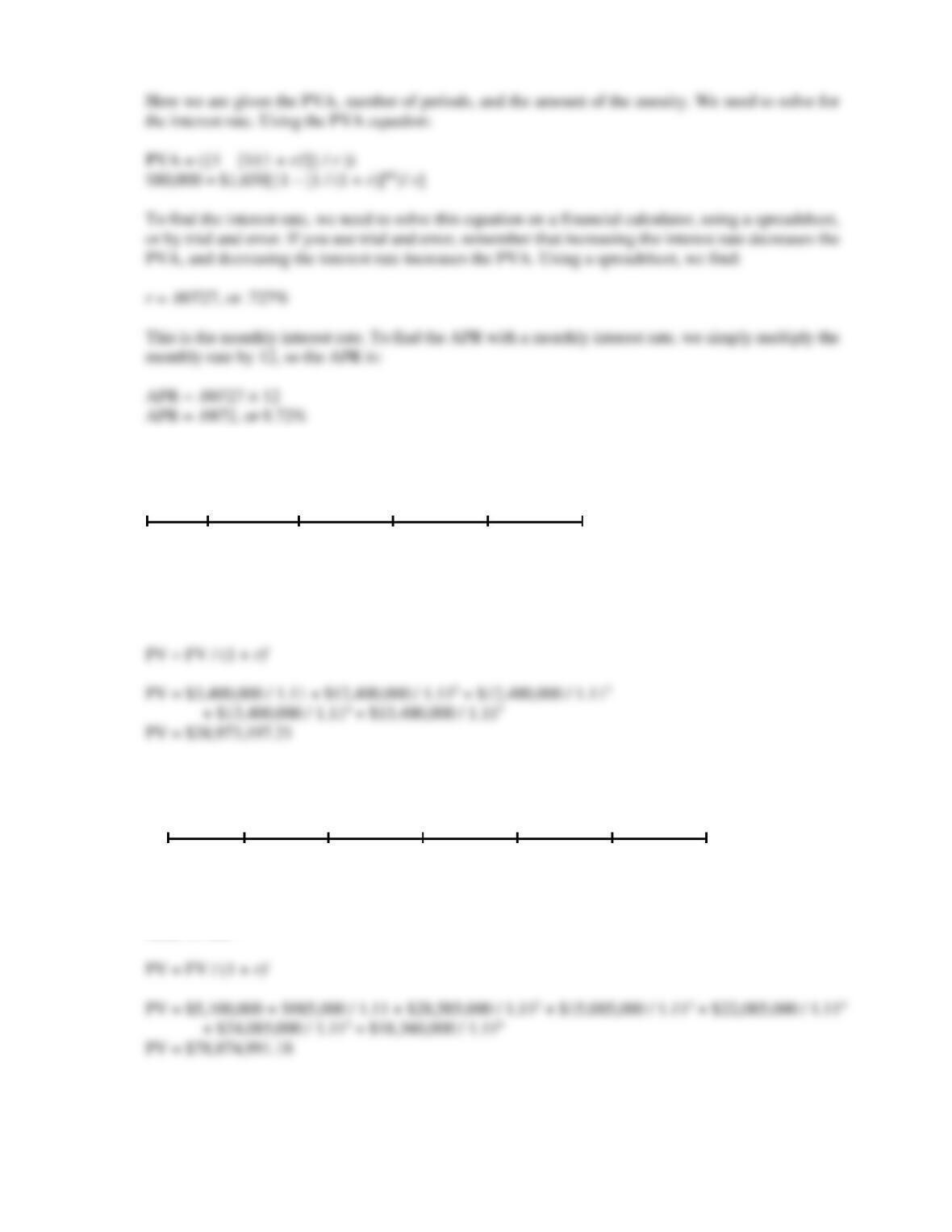
41. The time line is:
0
1
2
3
4
5
PV
$3,400,000
$12,400,000
$12,400,000
$13,400,000
$13,400,000
To solve this problem, we must find the PV of each cash flow and add them. To find the PV of a lump
sum, we use:
42. The time line is:
0
1
2
3
4
5
6
$5,100,000
$985,000
$28,585,000
$15,085,000
$22,085,000
$24,085,000
$18,360,000
To solve this problem, we must find the PV of each cash flow and add them. To find the PV of a lump
sum, we use:
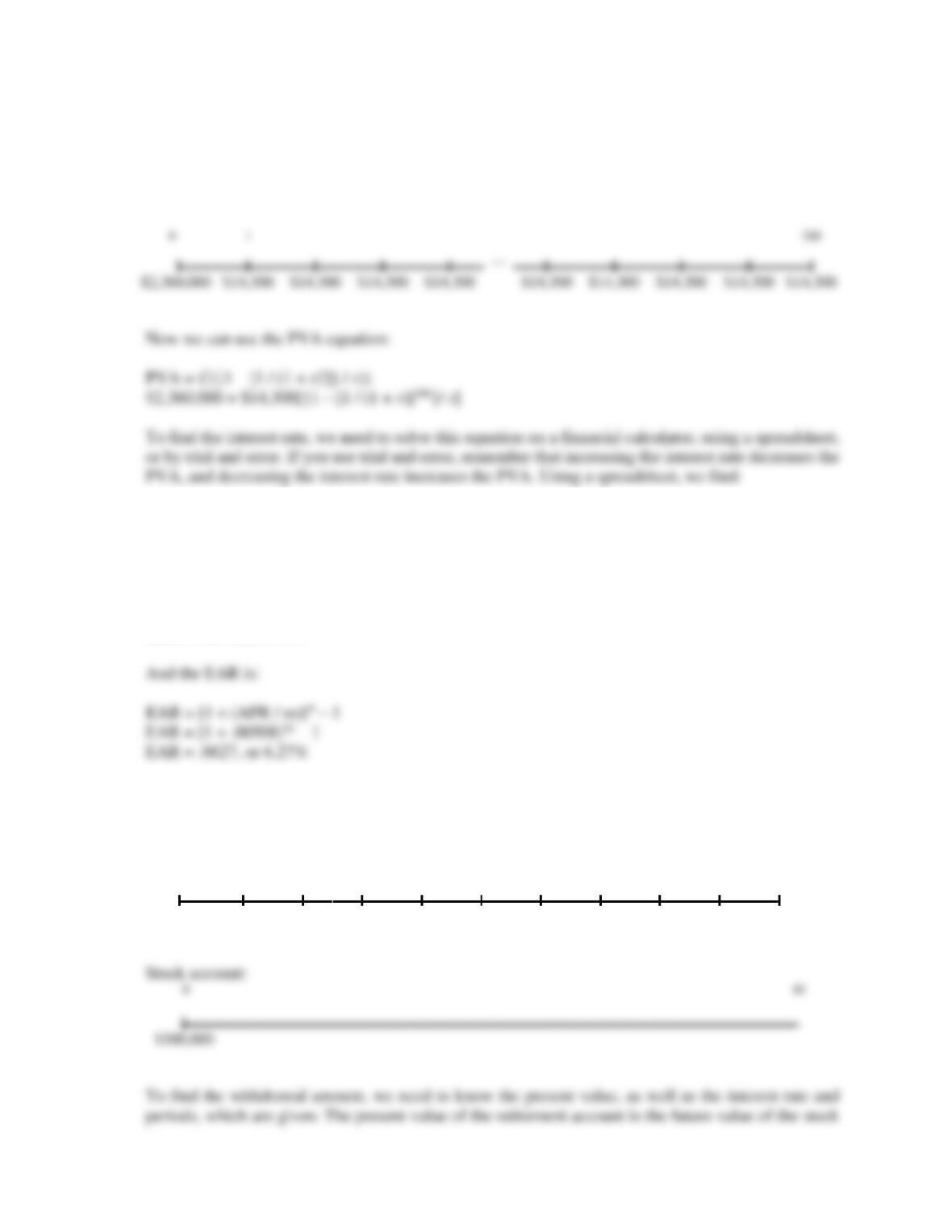
43. Here we are given the PVA, number of periods, and the amount of the annuity. We need to solve for
the interest rate. First, we need to find the amount borrowed since it is only 80 percent of the building
value. So, the amount borrowed is:
Amount borrowed = .80($2,950,000)
Amount borrowed = $2,360,000
r = .00508, or .508%
This is the monthly interest rate. To find the APR with a monthly interest rate, we simply multiply the
monthly rate by 12, so the APR is:
APR = .00508 × 12
APR = .0610, or 6.10%
44. Here, we have two cash flow streams that will be combined in the future. In essence, we have three
time lines. We will start with the time lines for the savings period, which are:
Bond account:
0
1
2
3
4
5
6
7
8
9
10
$75,000
$6,000
$6,000
$6,000
$6,000
$6,000
$6,000
$6,000
$6,000
$6,000
$6,000
$14,300
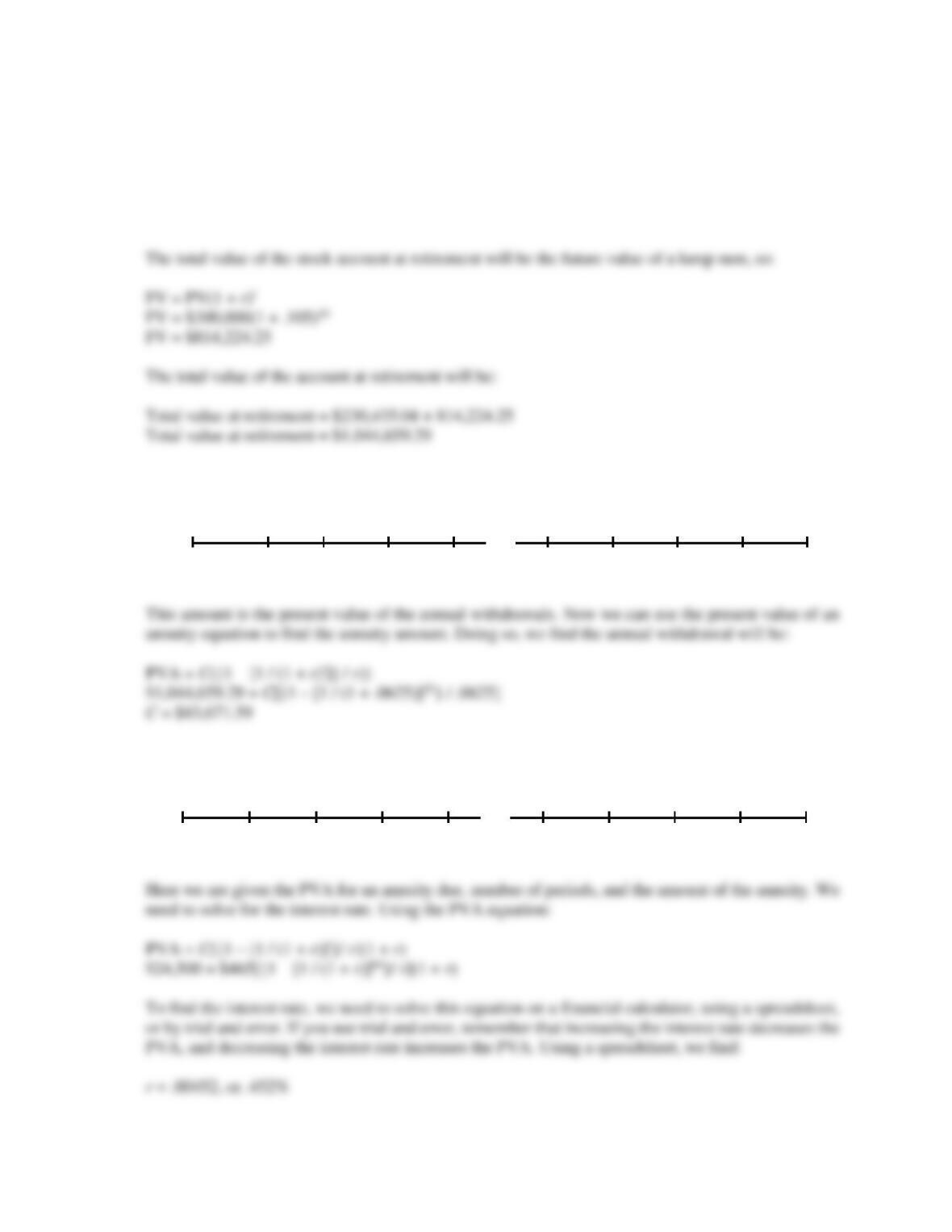
and bond account. We need to find the future value of each account and add the future values together.
For the bond account the future value is the value of the current savings plus the value of the annual
deposits. So, the future value of the bond account will be:
FV = C{[(1 + r)t – 1] / r} + PV(1 + r)t
FV = $6,000{[(1 + .07)10 – 1] / .07} + $75,000(1 + .07)10
FV = $230,435.04
So, at retirement, we have:
0
1
…
25
–$1,044,659.29
C
C
C
C
C
C
C
C
C
45. The time line is:
0
1
…
60
–$24,500
$465
$465
$465
$465
$465
$465
$465
$465
$465
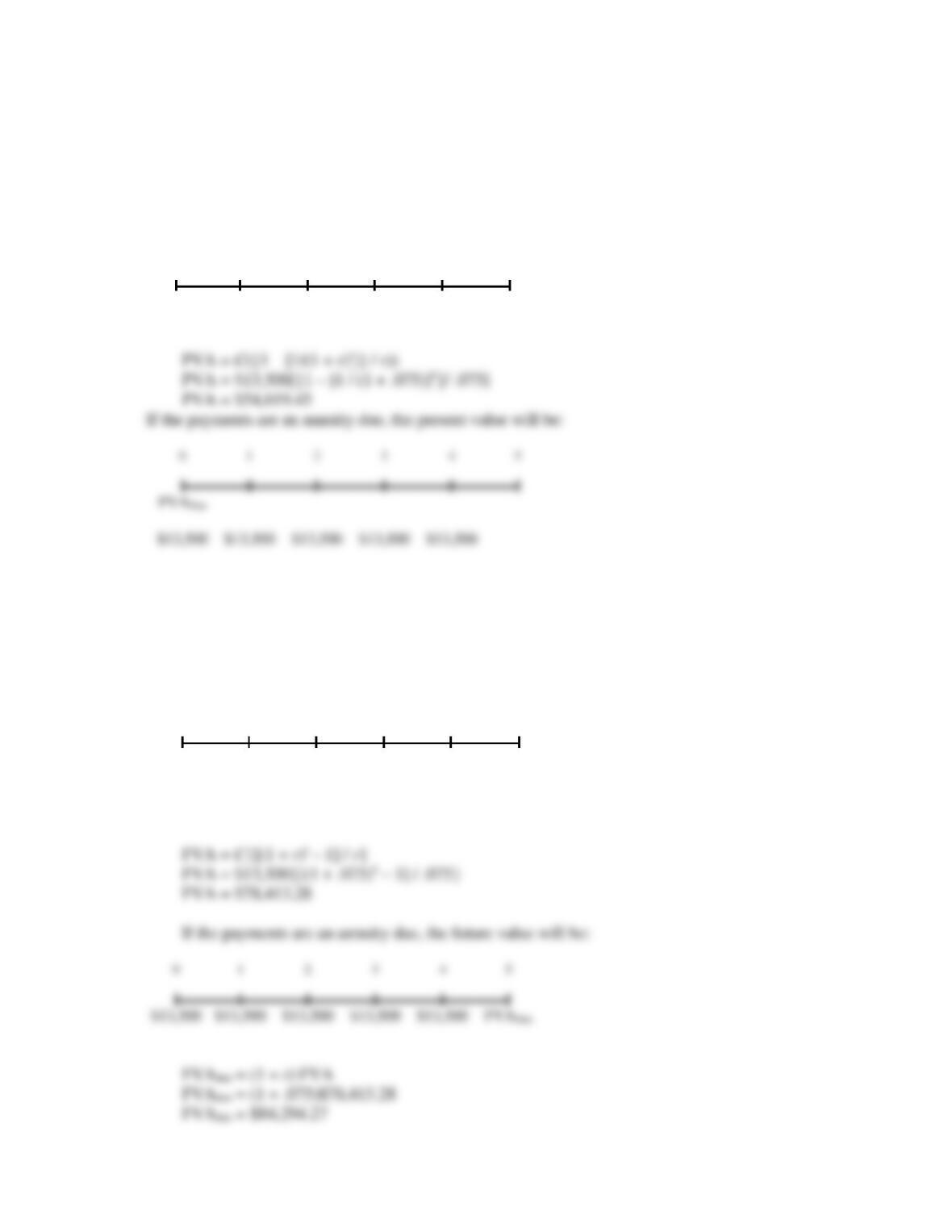
This is the monthly interest rate. To find the APR with a monthly interest rate, we simply multiply the
monthly rate by 12, so the APR is:
APR = .00452 × 12
APR = .0542, or 5.42%
46. a. If the payments are in the form of an ordinary annuity, the present value will be:
0
1
2
3
4
5
PVA
$13,500
$13,500
$13,500
$13,500
$13,500
PVAdue = (1 + r) PVA
PVAdue = (1 + .075)$54,619.45
PVAdue = $58,715.90
b. We can find the future value of the ordinary annuity as:
0
1
2
3
4
5
FVA
$13,500
$13,500
$13,500
$13,500
$13,500
0
1
2
3
4
5
$13,500
$13,500
$13,500
$13,500
0
1
2
3
4
5
$13,500
$13,500
$13,500
$13,500
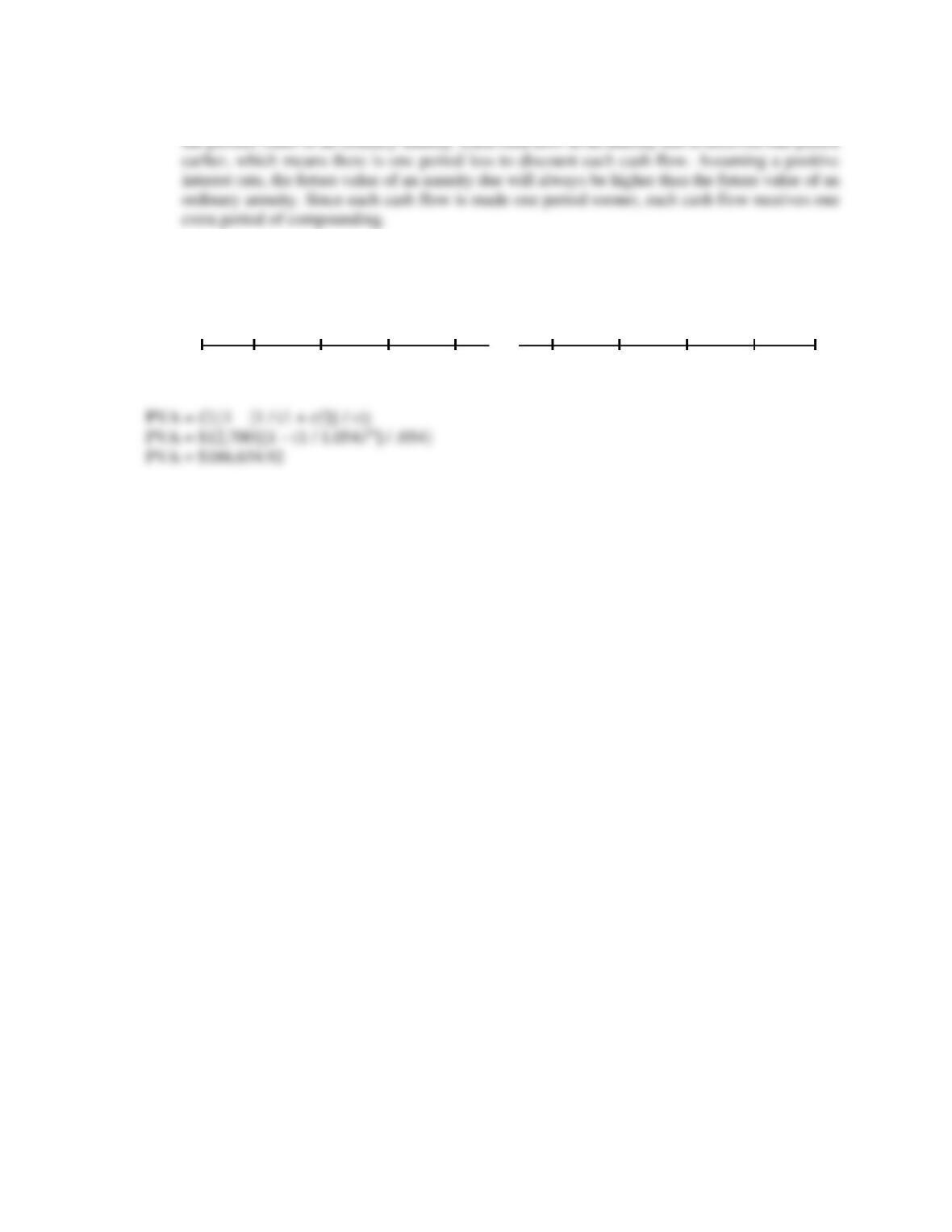
c. Assuming a positive interest rate, the present value of an annuity due will always be larger than
47. Here, we need to find the difference between the present value of an annuity and the present value of
a perpetuity. The annuity time line is:
0
1
…
30
PVA
$12,700
$12,700
$12,700
$12,700
$12,700
$12,700
$12,700
$12,700
$12,700
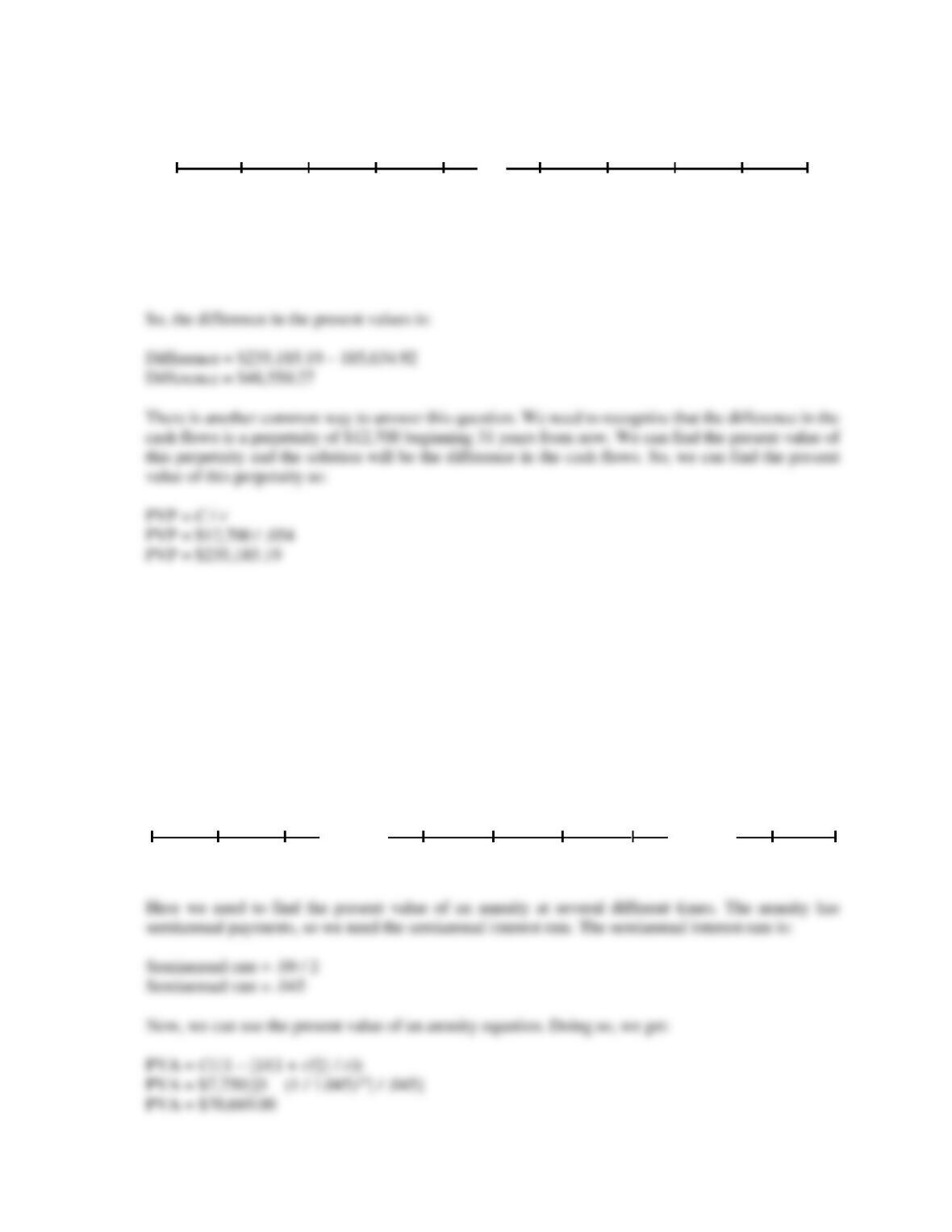
And the present value of the perpetuity is:
0
1
…
∞
PV
$12,700
$12,700
$12,700
$12,700
$12,700
$12,700
$12,700
$12,700
$12,700
PV = C / r
PV = $12,700 / .054
PV = $235,185.19
This is the present value 30 years from now, one period before the first cash flows. We can now find
the present value of this lump sum as:
PV = FV / (1 + r)t
PV = $235,185.19 / (1 + .054)30
PV = $48,550.27
This is the same answer we calculated before.
48. The time line is:
0
1
…
18
19
…
30
$7,750
$7,750
$7,750
$7,750
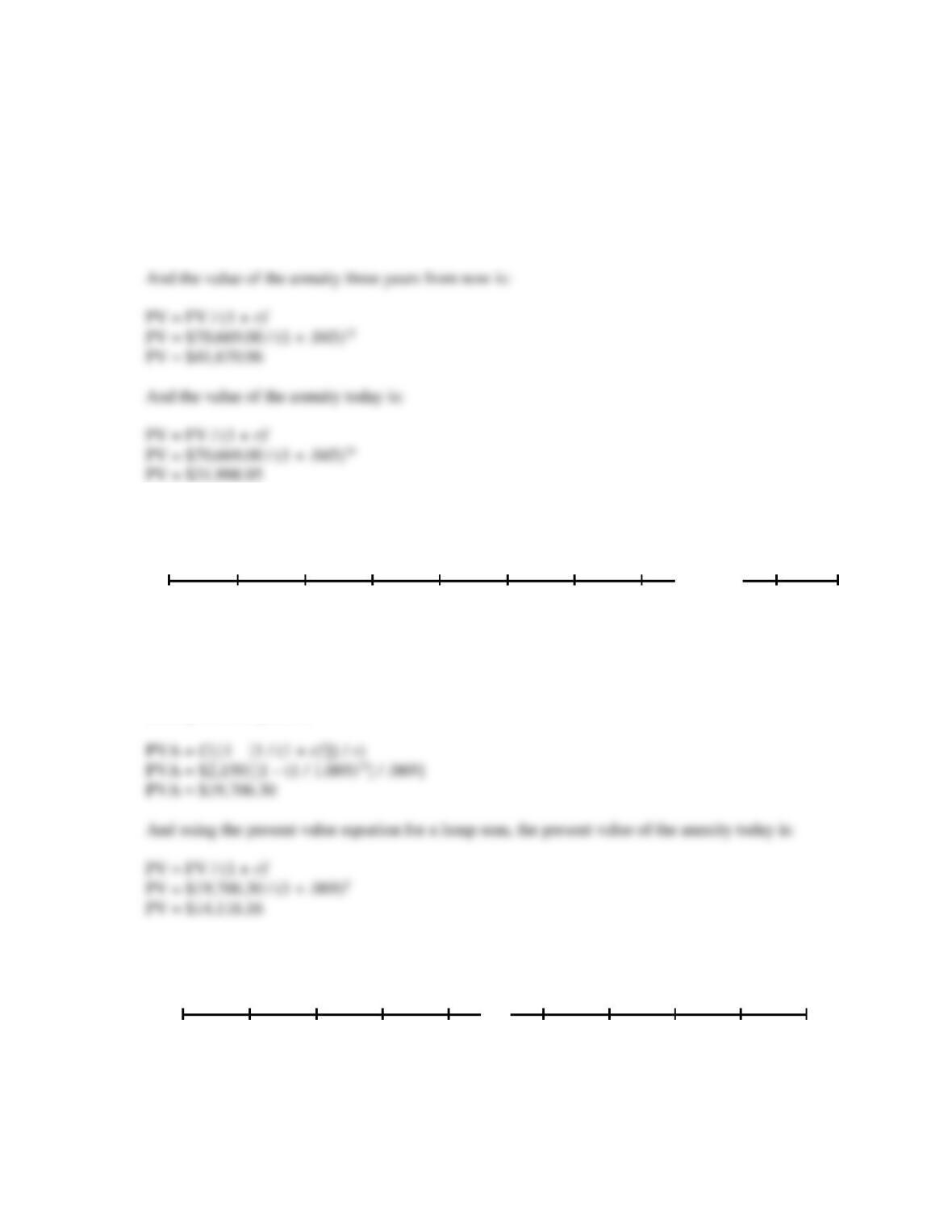
This is the present value one period before the first payment. The first payment occurs nine and one–
half years from now, so this is the value of the annuity nine years from now. Since the interest rate is
semiannual, we must also be careful to use the number of semiannual periods. The value of the annuity
five years from now is:
PV = FV / (1 + r)t
PV = $70,669.00 / (1 + .045)8
PV = $49,693.39
49. The time line is:
0
1
6
…
20
PV
$2,150
$2,150
$2,150
$2,150
Since the first payment is received six years from today and the last payment is received 20 years from
now, there are 15 payments. We can use the present value of an annuity formula, which will give us
the present value 5 years from now, one period before the first payment. So, the present value of the
annuity in 5five years is:
50. The time line is:
0
1
…
120
PVA
$1,450
$1,450
$1,450
$1,450
$1,450
$1,450
$1,450
$1,450
$1,450
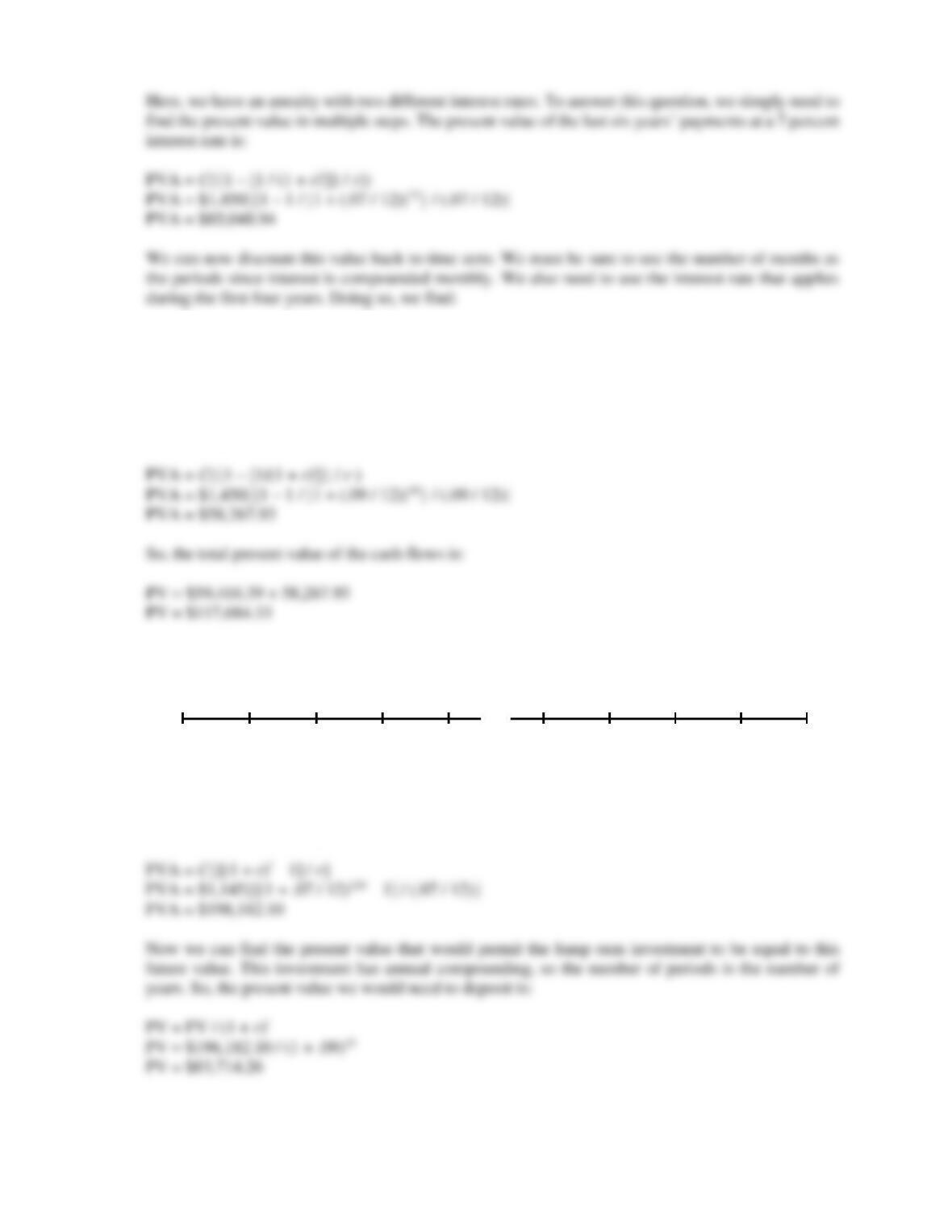
PV = FV / (1 + r)t
PV = $85,048.95 / (1 + .09 / 12)48
PV = $59,416.39
Now we can find the present value of the annuity payments for the first four years. The present value
of these payments is:
51. The time line is:
0
1
…
120
PVA
$1,145
$1,145
$1,145
$1,145
$1,145
$1,145
$1,145
$1,145
$1,145
To answer this question we need to find the future value of the annuity, and then find the present value
that makes the lump sum investment equivalent. We also need to make sure to use the number of
months as the number of periods. So, the future value of the annuity is:
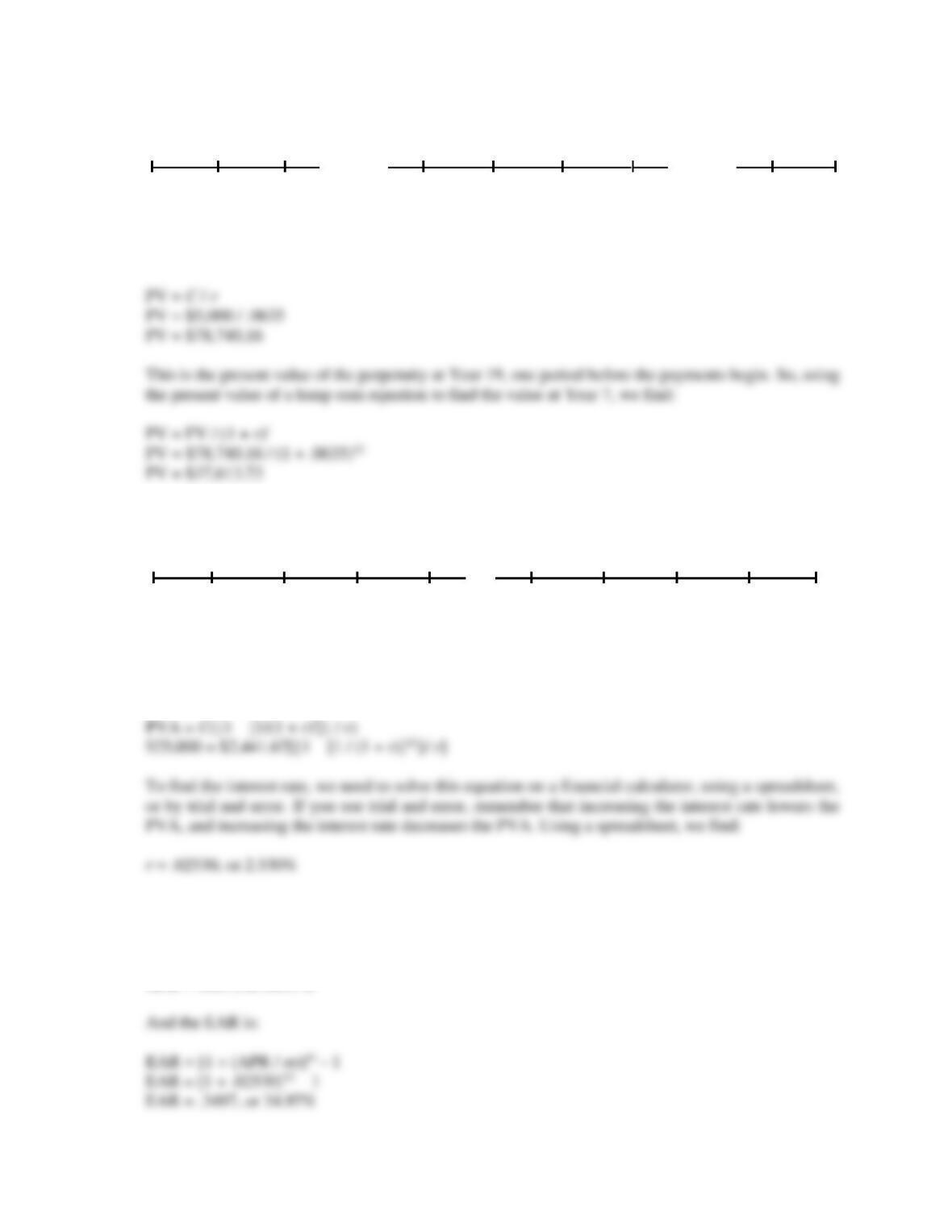
52. The time line is:
0
1
…
19
20
…
∞
$5,000
$5,000
$5,000
$5,000
Here we need to find the present value of a perpetuity at a date before the perpetuity begins. We will
begin by find the present value of the perpetuity. Doing so, we find:
53. The time line is:
0
1
…
12
–$25,000
$2,441.67
$2,441.67
$2,441.67
$2,441.67
$2,441.67
$2,441.67
$2,441.67
$2,441.67
$2,441.67
Here we are given the PVA, number of periods, and the amount of the annuity. We need to solve for
the interest rate. We must be careful to use the cash flows of the loan. Using the present value of an
annuity equation, we find:
This is the monthly interest rate. To find the APR with a monthly interest rate, we simply multiply the
monthly rate by 12, so the APR is:
APR = .02530 × 12
APR = .3037, or 30.37%
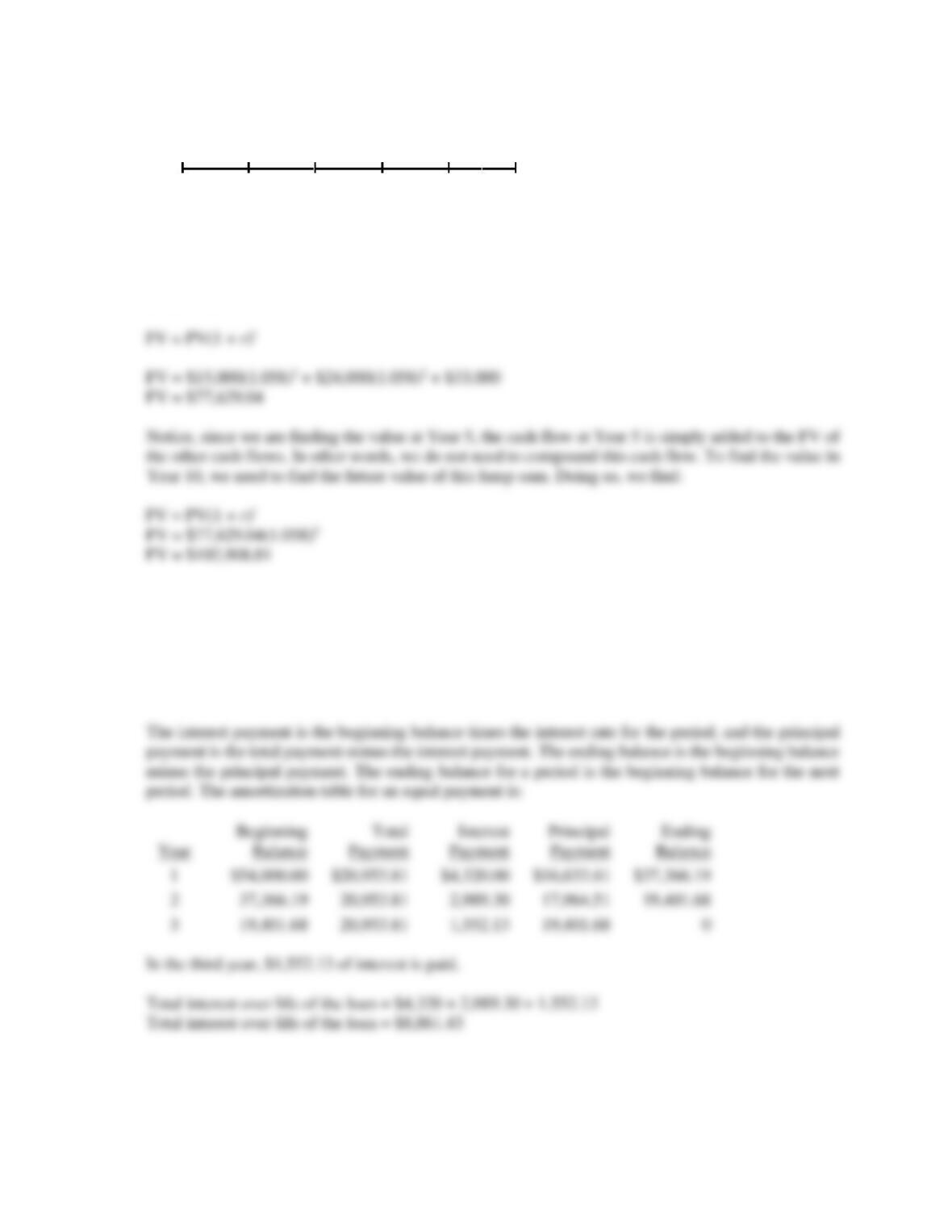
54. The time line is:
0
1
2
3
4
5
FV
$15,000
$24,000
$33,000
To solve this problem, we must find the FV of each cash flow and add them. To find the FV of a lump
sum, we use:
55. The payment for a loan repaid with equal payments is the annuity payment with the loan value as the
PV of the annuity. So, the loan payment will be:
PVA = C({1 – [1/(1 + r)t]} / r )
$54,000 = C{[1 – 1 / (1 + .08)3] / .08}
C = $20,953.81
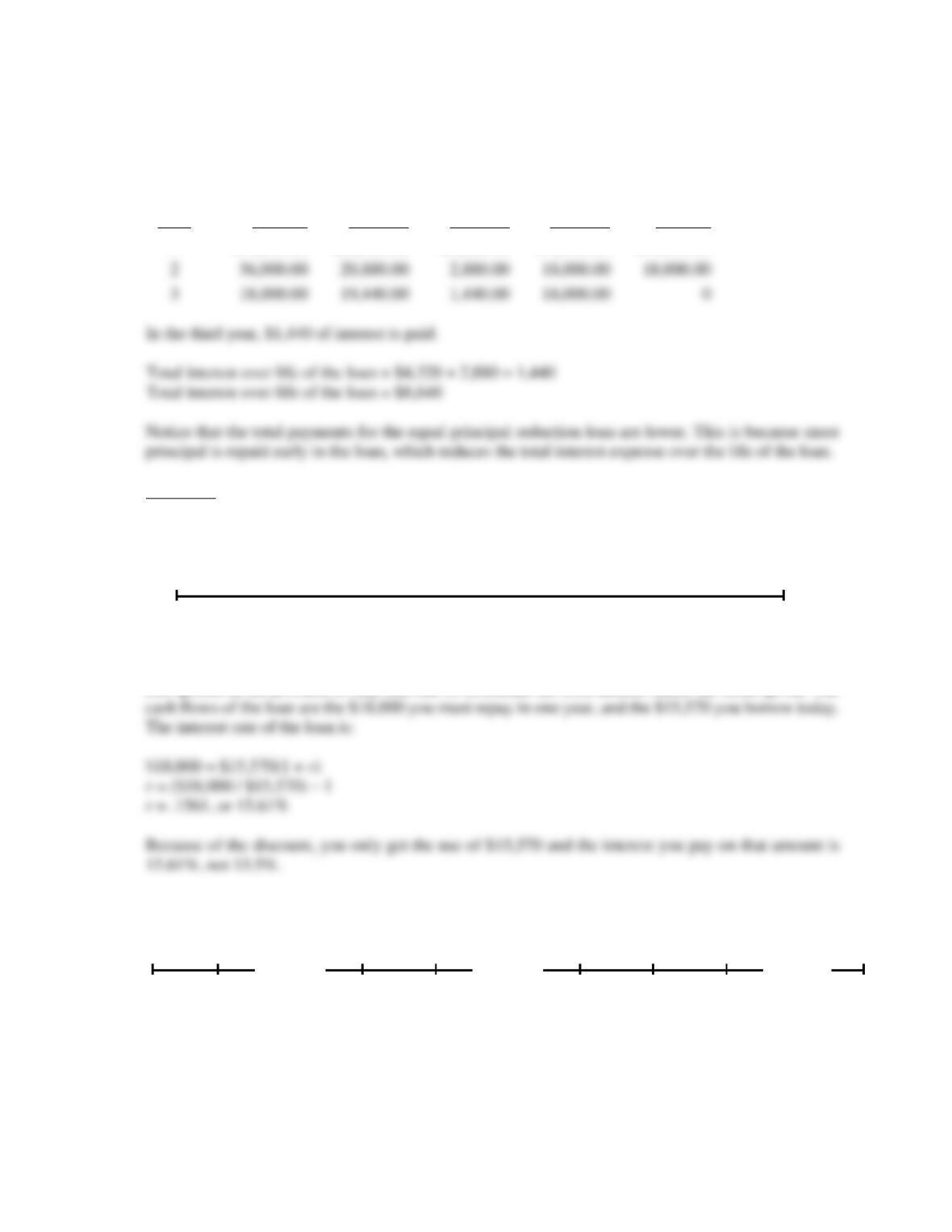
56. This amortization table calls for equal principal payments of $18,000 per year. The interest payment is
the beginning balance times the interest rate for the period, and the total payment is the principal
payment plus the interest payment. The ending balance for a period is the beginning balance for the
next period. The amortization table for an equal principal reduction is:
Year
Beginning
Balance
Total
Payment
Interest
Payment
Principal
Payment
Ending
Balance
1
$54,000.00
$22,320.00
$4,320.00
$18,000.00
$36,000.00
Challenge
57. The time line is:
0
1
–$15,570
$18,000
To find the APR and EAR, we need to use the actual cash flows of the loan. In other words, the interest
rate quoted in the problem is only relevant to determine the total interest under the terms given. The
58. The time line is:
–24
–23
…
–12
–11
…
0
1
…
60
$3,583.33
$3,583.33
$3,833.33
$3,833.33
$4,083.33
$4,083.33
$4,083.33
$200,000
$25,000
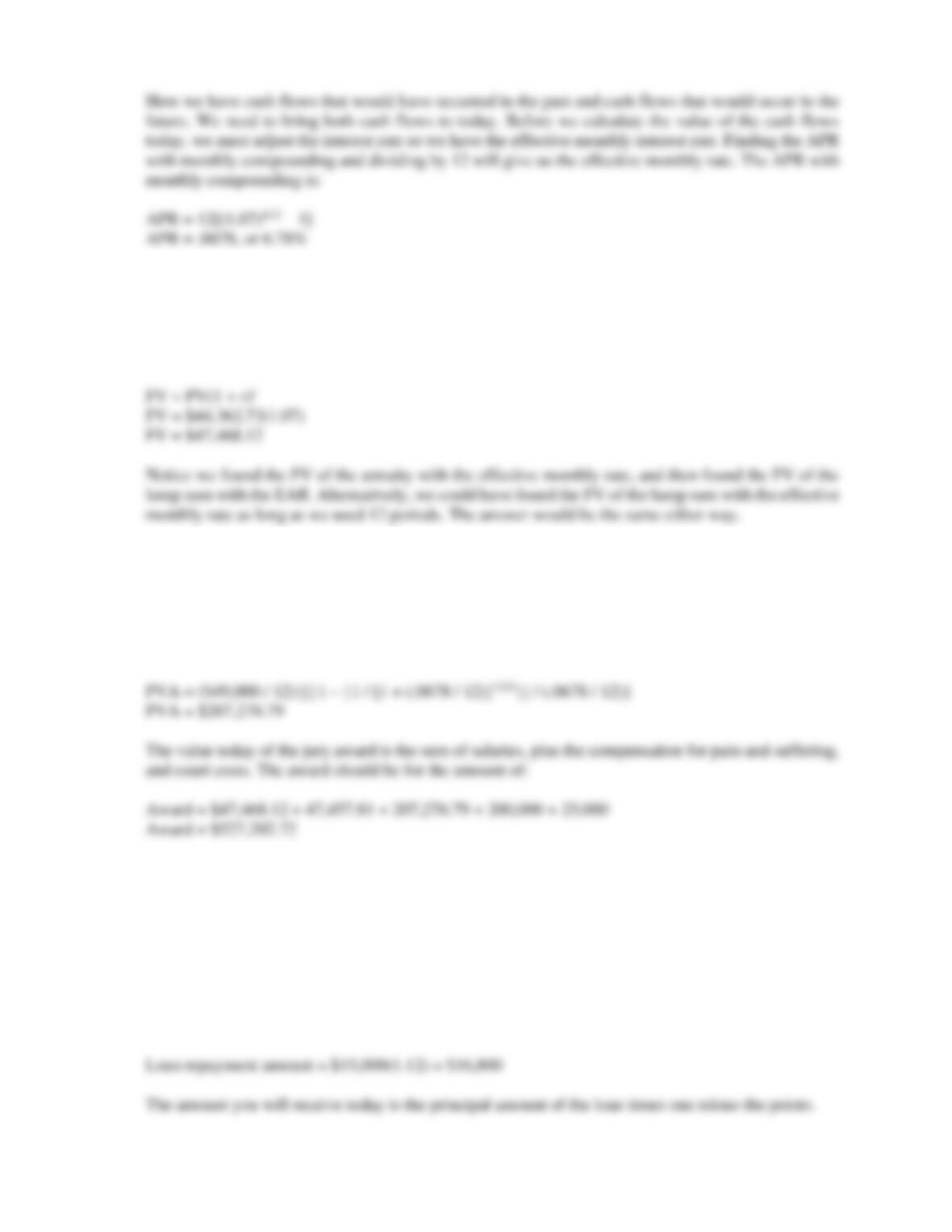
To find the value today of the back pay from two years ago, we will find the FV of the annuity, and
then find the FV of the lump sum. Doing so gives us:
FVA = ($43,000 / 12)[{[1 + (.0678 / 12)]12 – 1} / (.0678 / 12)]
FVA = $44,362.73
Now, we need to find the value today of last year’s back pay:
FVA = ($46,000 / 12)[{[1 + (.0678 / 12)]12 – 1} / (.0678 / 12)]
FVA = $47,457.81
Next, we find the value today of the five year’s future salary:
As the plaintiff, you would prefer a lower interest rate. In this problem, we are calculating both the PV
and FV of annuities. A lower interest rate will decrease the FVA, but increase the PVA. So, by a lower
interest rate, we are lowering the value of the back pay. But, we are also increasing the PV of the future
salary. Since the future salary is larger and has a longer time, this is the more important cash flow to
the plaintiff.
59. Again, to find the interest rate of a loan, we need to look at the cash flows of the loan. Since this loan
is in the form of a lump sum, the amount you will repay is the FV of the principal amount, which will
be:
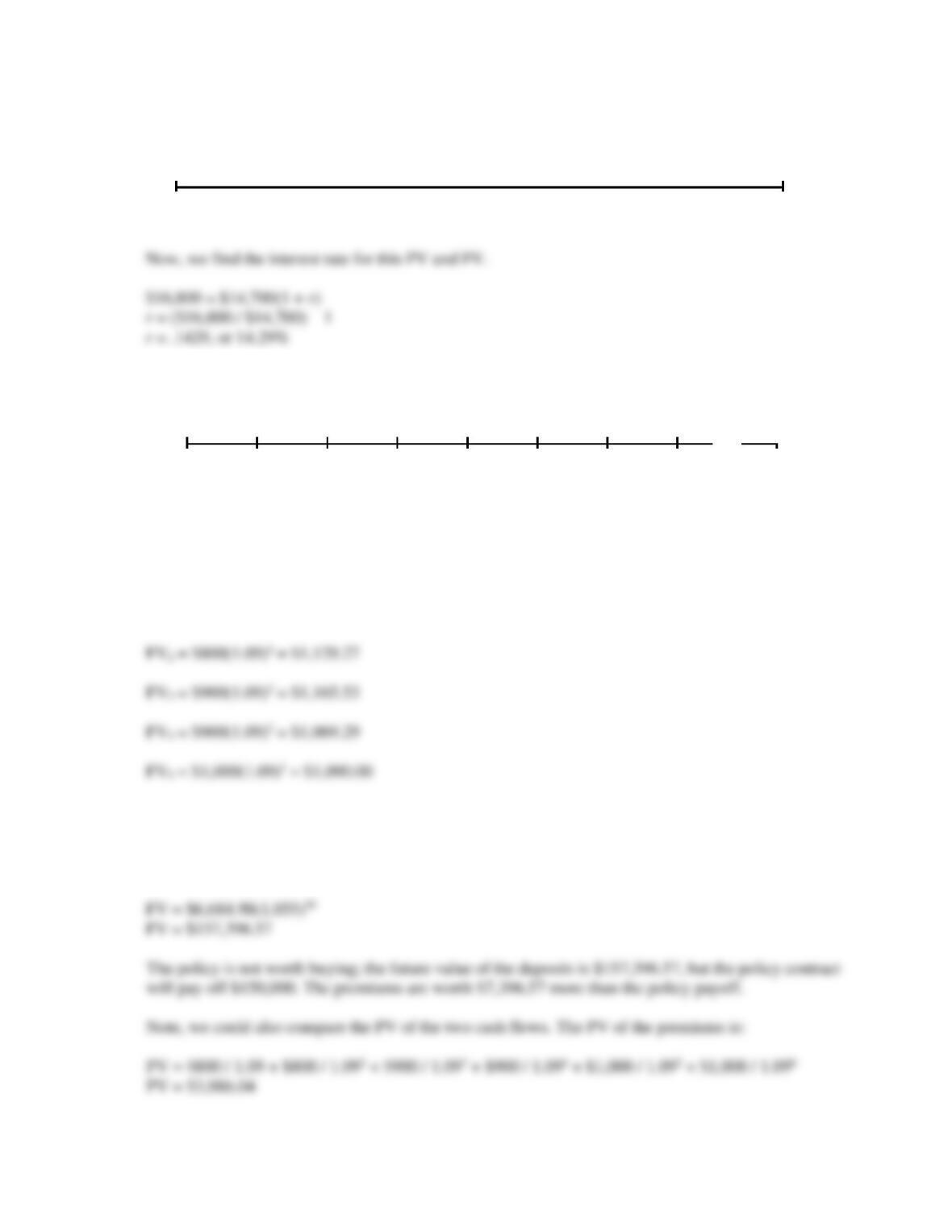
Amount received = $15,000(1 – .02) = $14,700
So, the time line is:
0
1
–$14,700
$16,800
60. The time line is:
0
1
2
3
4
5
6
…
65
$800
$800
$900
$900
$1,000
$1,000
FV
We need to find the FV of the premiums to compare with the cash payment promised at age 65. We
have to find the value of the premiums at Year 6 first since the interest rate changes at that time. So:
FV1 = $800(1.09)5 = $1,230.90
Value at Year 6 = $1,230.90 + 1,129.27 + 1,165.53 + 1,069.29 + 1,090 + 1,000
Value at Year 6 = $6,684.98
Finding the FV of this lump sum at the child’s 65th birthday:
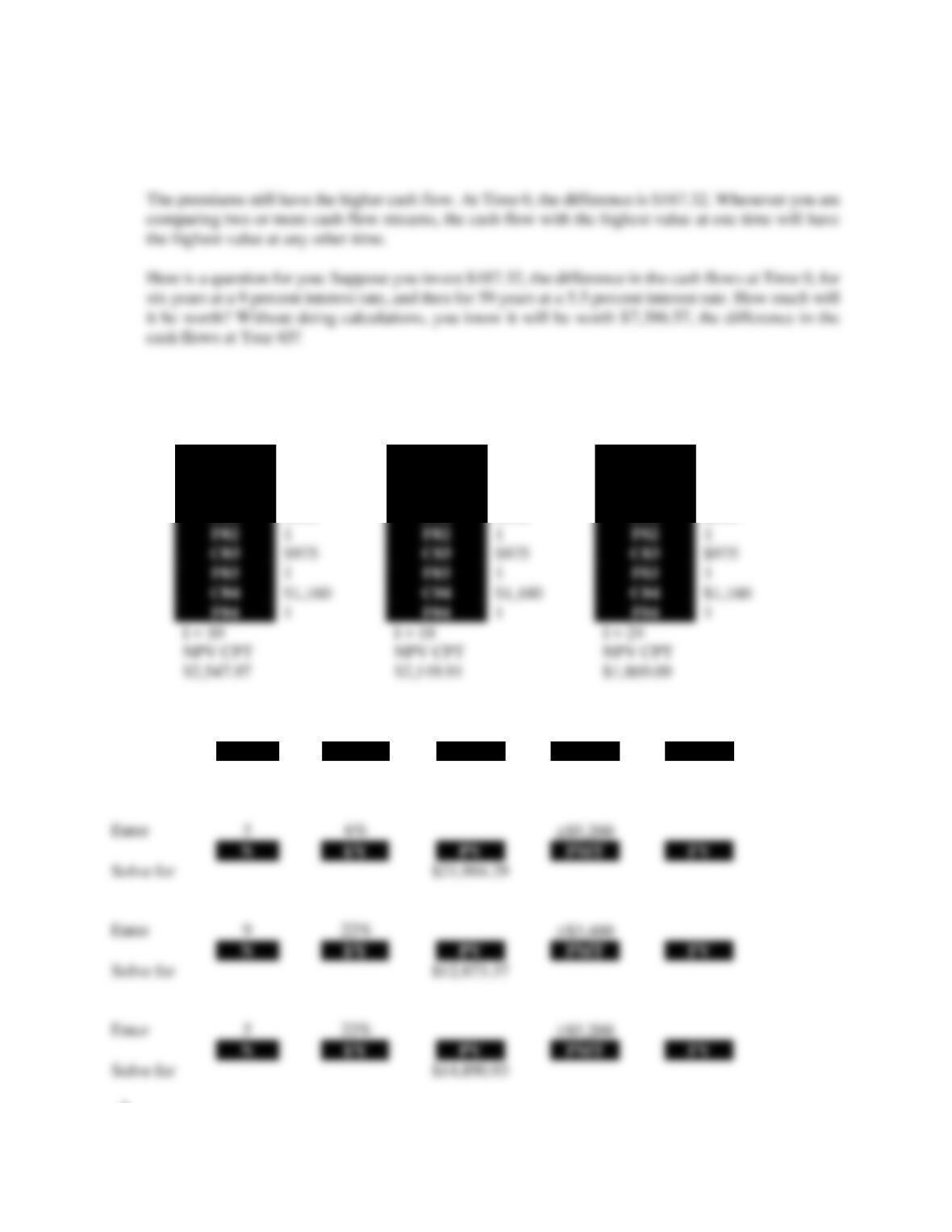
And the value today of the $150,000 at age 65 is:
PV = ($150,000 / 1.05559) / 1.096
PV = $3,798.72
Calculator Solutions
1.
CFo
$0
CFo
$0
CFo
$0
C01
$680
C01
$680
C01
$680
F01
1
F01
1
F01
1
C02
$490
C02
$490
C02
$490
1
1
1
C03
$975
C03
$975
C03
$975
1
1
1
C04
$1,160
C04
$1,160
C04
$1,160
1
1
1
I = 10
I = 18
I = 24
NPV CPT
NPV CPT
NPV CPT
$2,547.97
$2,119.91
$1,869.09
2.
Enter
9
6%
$3,400
N
I/Y
PV
PMT
FV
Solve for
$23,125.75
N
I/Y
PV
PMT
FV
Solve for
$21,904.29
N
I/Y
PV
PMT
FV
Solve for
$12,873.37
N
I/Y
PV
PMT
FV
3.
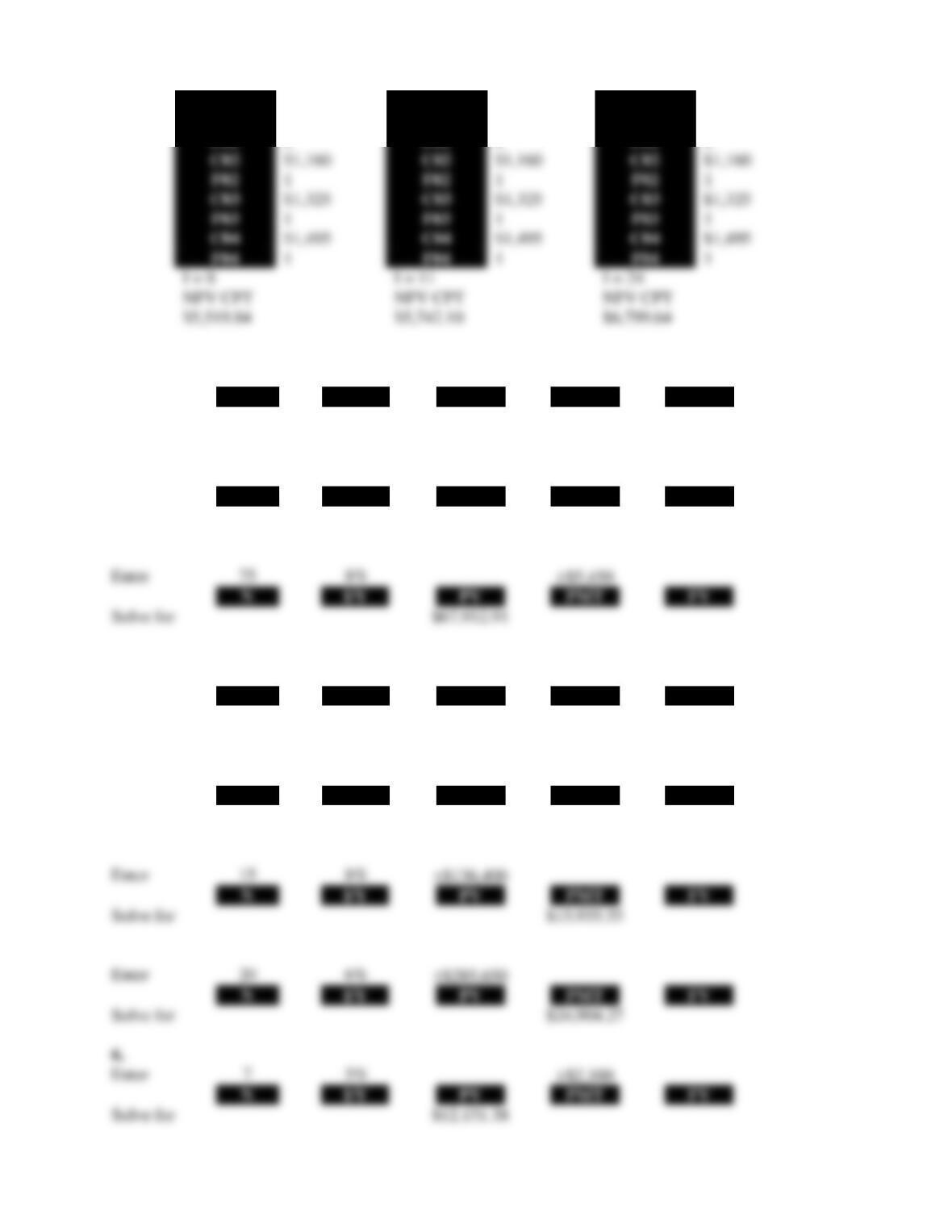
CFo
$0
CFo
$0
CFo
$0
C01
$985
C01
$985
C01
$985
F01
1
F01
1
F01
1
4.
Enter
15
8%
$5,450
N
I/Y
PV
PMT
FV
Solve for
$46,649.16
Enter
40
8%
$5,450
N
I/Y
PV
PMT
FV
Solve for
$64,989.14
Enter
75
8%
$5,450
N
I/Y
PV
PMT
FV
Solve for
$67,912.91
5.
Enter
6
11%
$24,500
N
I/Y
PV
PMT
FV
Solve for
$5,791.23
Enter
8
7%
$19,700
N
I/Y
PV
PMT
FV
Solve for
$3,299.11
Enter
15
8%
N
I/Y
PV
PMT
FV
Solve for
$15,935.55
Enter
20
6%
N
I/Y
PV
PMT
FV
Solve for
$24,904.27
Enter
7
5%
$2,100
N
I/Y
PV
PMT
FV
Solve for
C02
$1,160
C02
$1,160
C02
$1,160
F02
1
F02
1
F02
1
C03
$1,325
C03
$1,325
C03
$1,325
1
1
1
$1,495
$1,495
$1,495
1
1
1
I = 8
I = 11
I = 24
NFV CPT
NFV CPT
NFV CPT
$5,519.84
$5,742.10
$6,799.64
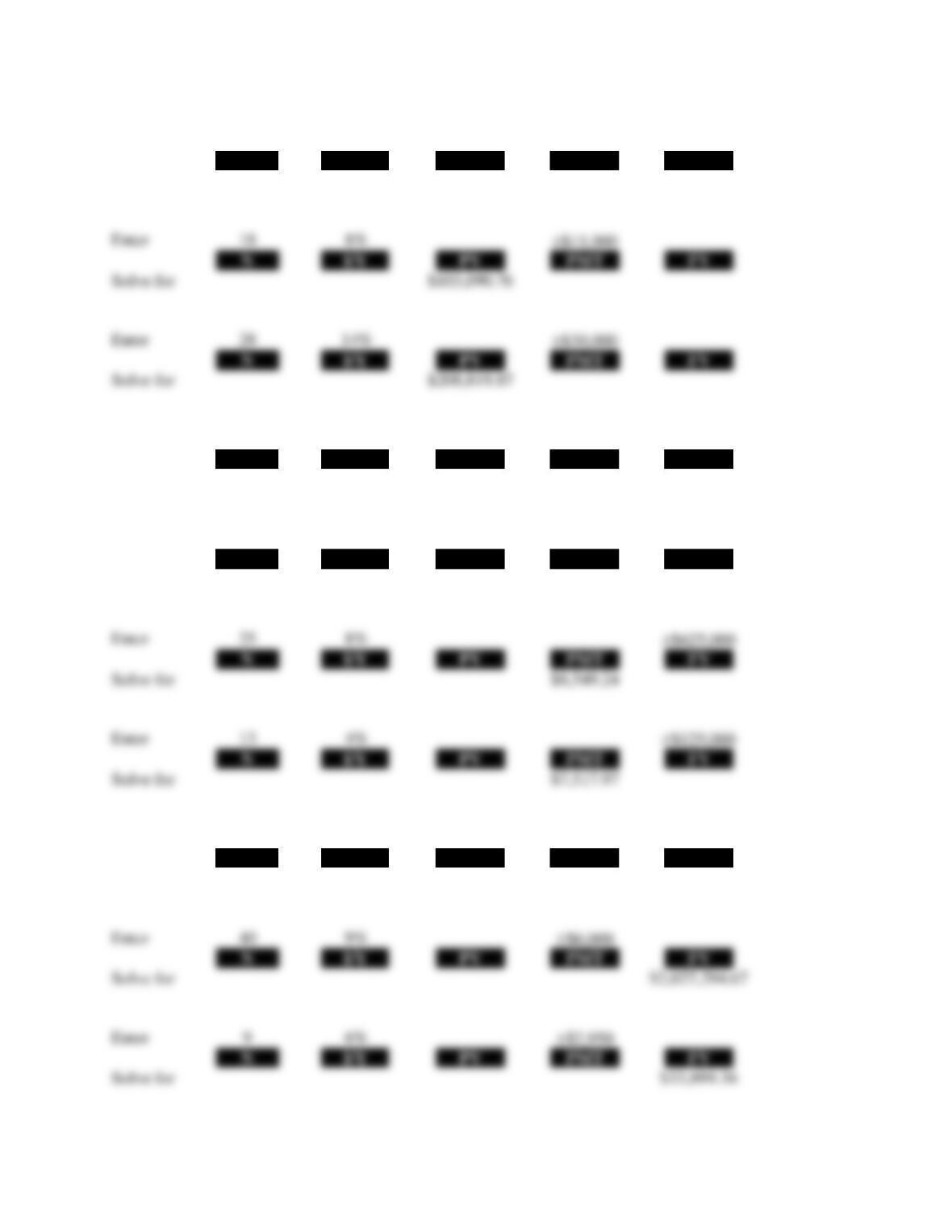
Enter
9
10%
$1,095
N
I/Y
PV
PMT
FV
Solve for
$6,306.13
7.
Enter
8
5%
$30,000
N
I/Y
PV
PMT
FV
Solve for
$3,141.65
Enter
40
7%
$1,200,000
N
I/Y
PV
PMT
FV
Solve for
$6,010.97
Enter
25
8%
N
I/Y
PV
PMT
FV
Solve for
$8,549.24
Enter
13
4%
N
I/Y
PV
PMT
FV
Solve for
$7,517.97
8.
Enter
10
8%
$1,900
N
I/Y
PV
PMT
FV
Solve for
$27,524.47
Enter
40
9%
$6,000
N
I/Y
PV
PMT
FV
Solve for
Enter
9
6%
$2,950
N
I/Y
PV
PMT
FV
Solve for
Enter
N
I/Y
PV
PMT
FV
Solve for
Enter
28
$30,000
N
I/Y
PV
PMT
FV
Solve for
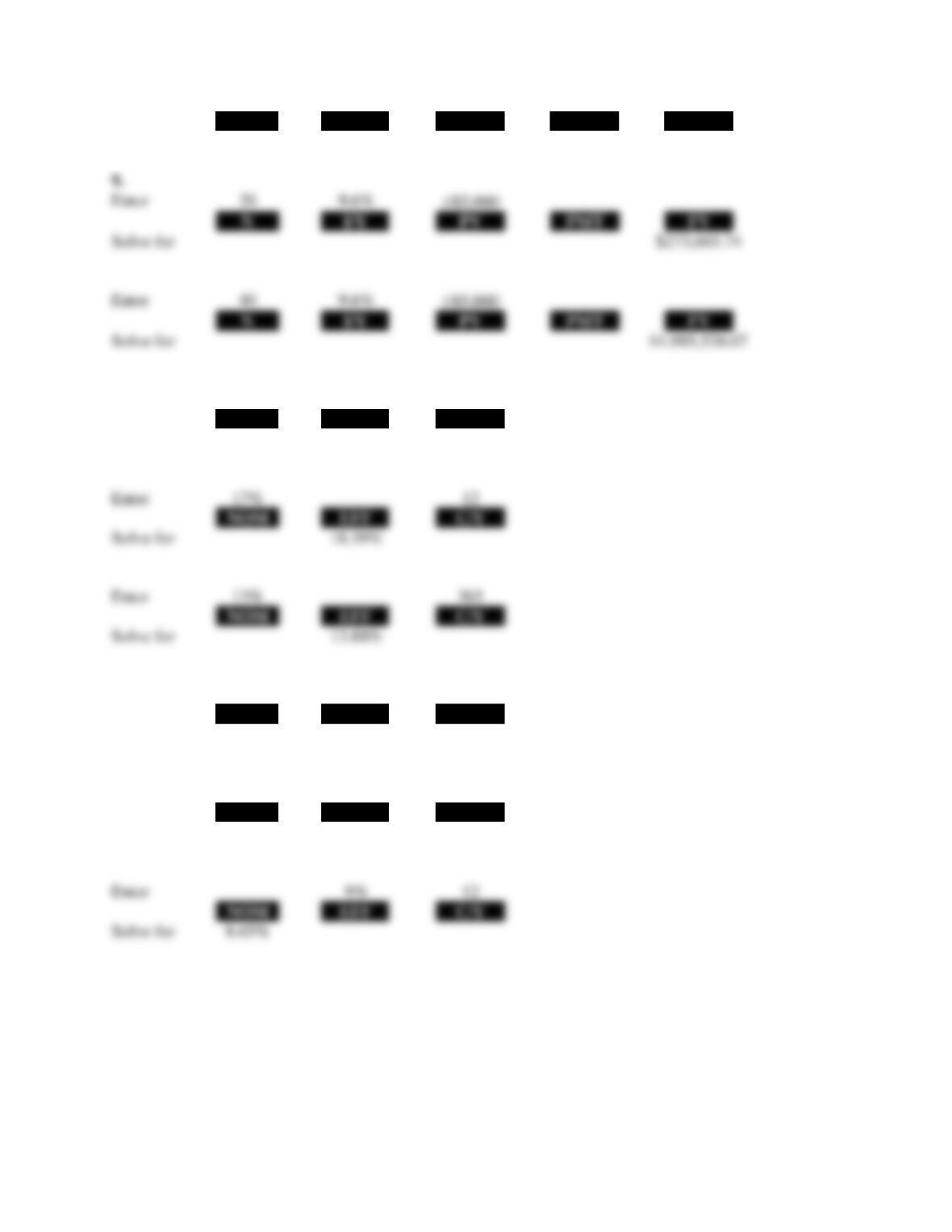
Enter
30
10%
$6,400
N
I/Y
PV
PMT
FV
Solve for
$1,052,761.75
12.
Enter
10%
4
NOM
EFF
C/Y
Solve for
10.38%
Enter
17%
NOM
EFF
C/Y
Solve for
18.39%
Enter
13%
NOM
EFF
C/Y
Solve for
13.88%
Enter
9%
2
NOM
EFF
C/Y
Solve for
9.20%
13.
Enter
14%
2
NOM
EFF
C/Y
Solve for
13.54%
Enter
NOM
EFF
C/Y
Solve for
8.65%
9.
Solve for
Solve for
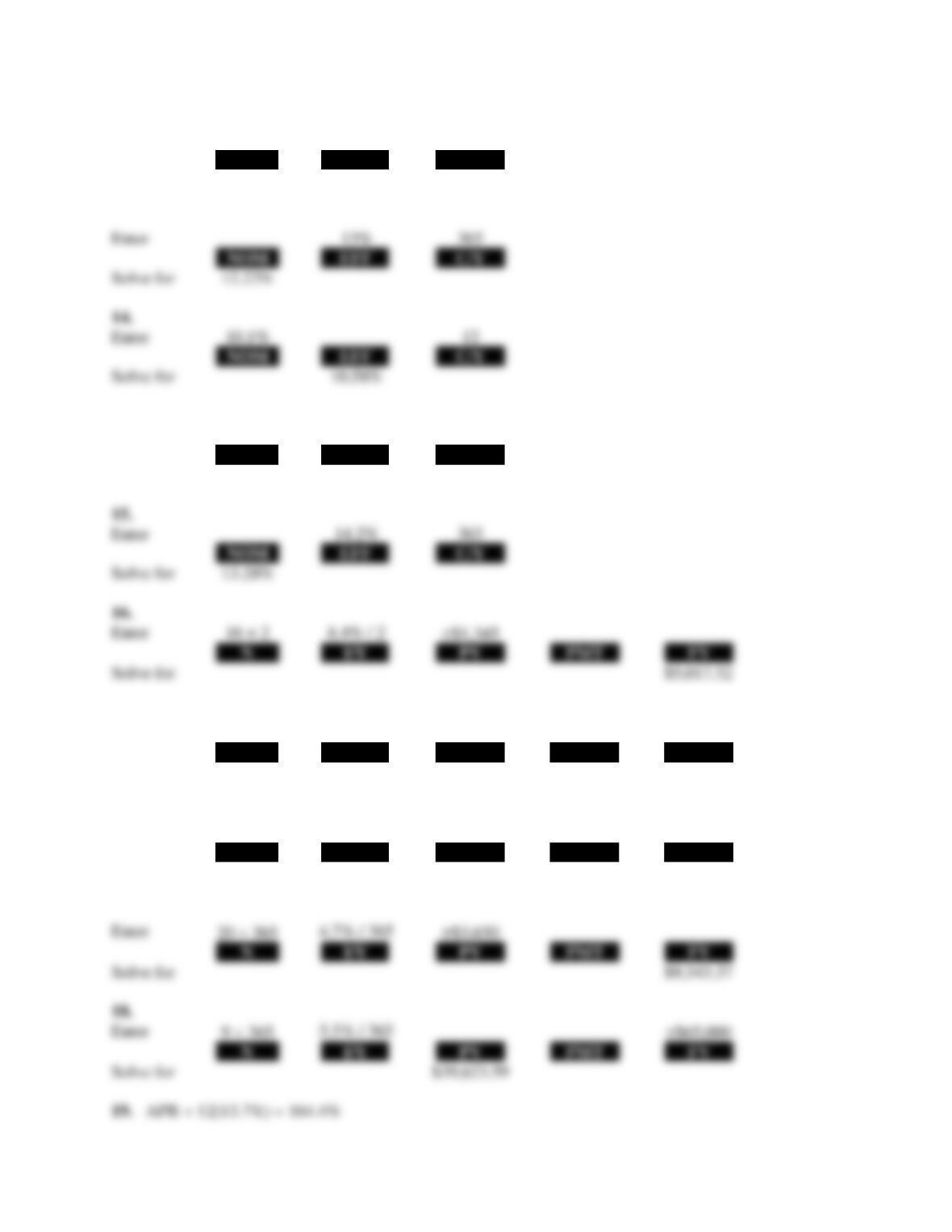
Enter
8%
52
NOM
EFF
C/Y
Solve for
7.70%
Enter
10.3%
2
NOM
EFF
C/Y
Solve for
10.57%
15.
Enter
365
NOM
EFF
C/Y
Solve for
13.28%
N
I/Y
PV
PMT
FV
Solve for
$5,017.52
17.
Enter
5 365
4.7% / 365
$3,650
N
I/Y
PV
PMT
FV
Solve for
$4,616.85
Enter
10 365
4.7% / 365
$3,650
N
I/Y
PV
PMT
FV
Solve for
$5,839.80
Enter
20 365
4.7% / 365
$3,650
N
I/Y
PV
PMT
FV
Solve for
$9,343.37
18.
Enter
9 365
5.5% / 365
N
I/Y
PV
PMT
FV
Solve for
Enter
365
NOM
EFF
C/Y
Solve for
12.22%
14.
Enter
10.1%
12
NOM
EFF
C/Y
Solve for
10.58%
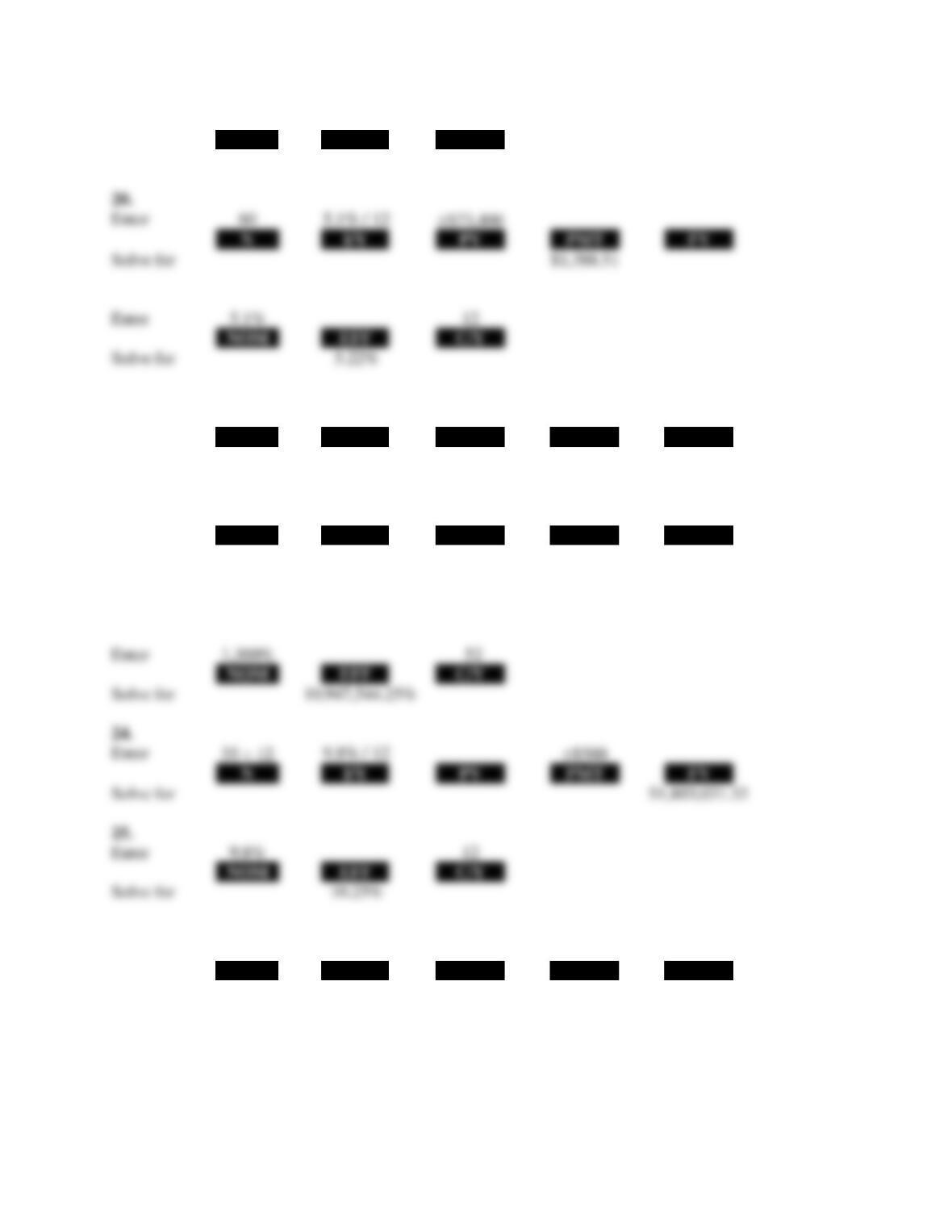
Enter
164.4%
12
NOM
EFF
C/Y
Solve for
366.79%
21.
Enter
1.4%
$14,480
$400
N
I/Y
PV
PMT
FV
Solve for
50.84
22.
Enter
1
±$4
$5
N
I/Y
PV
PMT
FV
Solve for
25%
APR = 52(25%) = 1,300%
Enter
1,300%
NOM
EFF
C/Y
Solve for
24.
Enter
35 12
$500
N
I/Y
PV
PMT
FV
Solve for
$1,803,031.33
25.
Enter
12
Solve for
Enter
35
10.25%
$6,000
N
I/Y
PV
PMT
FV
Solve for
$1,723,472.13
20.
Enter
60
N
I/Y
PV
PMT
FV
Solve for
Enter
12
NOM
EFF
C/Y
Solve for
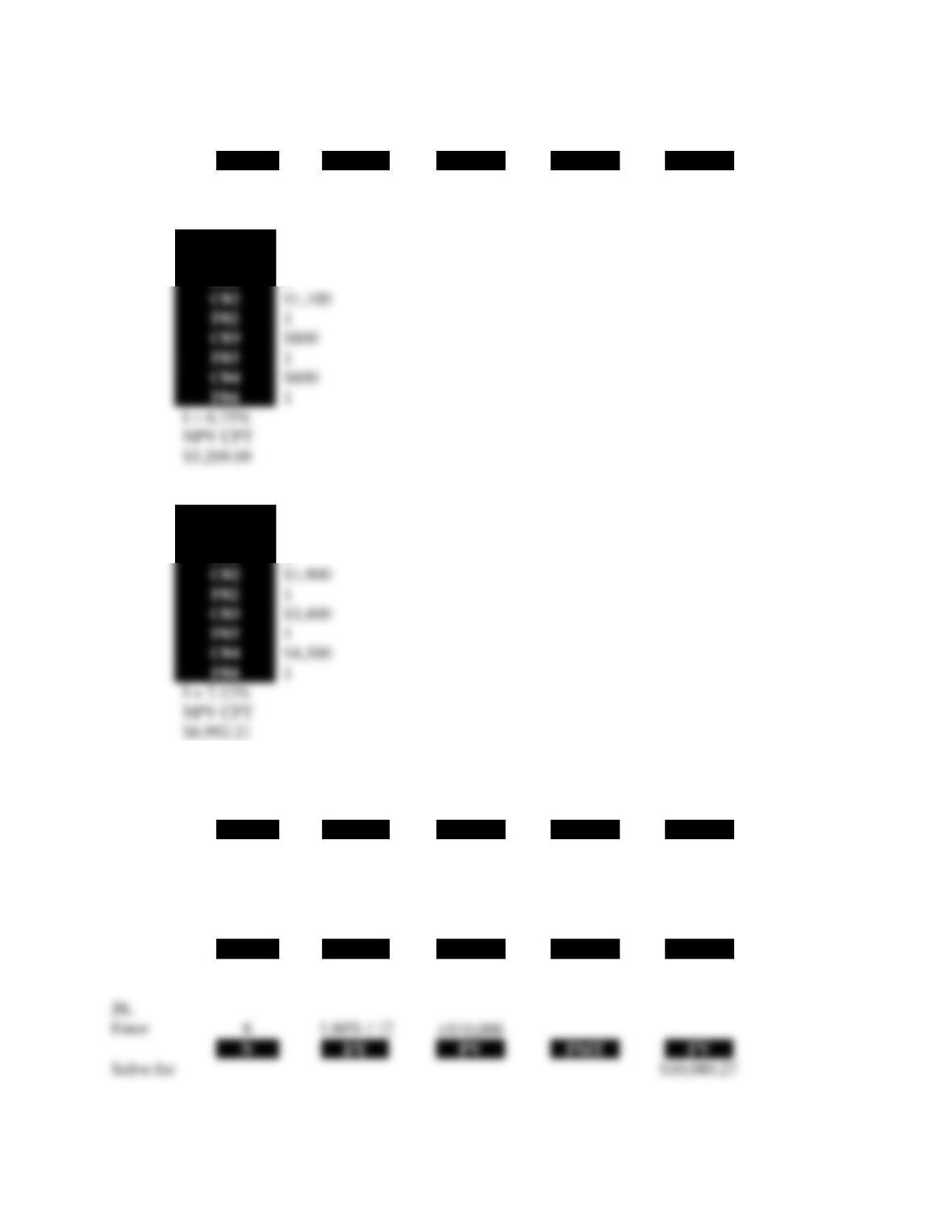
26.
Enter
4 4
.38%
$2,500
N
I/Y
PV
PMT
FV
Solve for
$38,736.93
27.
CFo
$0
C01
$1,200
F01
1
28.
CFo
$0
C01
$1,400
F01
1
C02
$1,900
F02
1
C03
$3,400
1
C04
$4,300
1
I = 7.13%
NPV CPT
$8,992.21
29. First Simple: $100(.058) = $5.80; 10 year investment = $100 + 10($5.80) = $158
Enter
10
±$100
$158
N
I/Y
PV
PMT
FV
Solve for
4.68%
30. 2nd BGN 2nd SET
Enter
60
5.20% / 12
$58,600
N
I/Y
PV
PMT
FV
Solve for
$1,106.44
31.
Enter
N
I/Y
PV
PMT
FV
C02
$1,100
F02
1
C03
$800
F03
1
C04
$600
F04
1
I = 6.75%
NPV CPT
$3,209.09
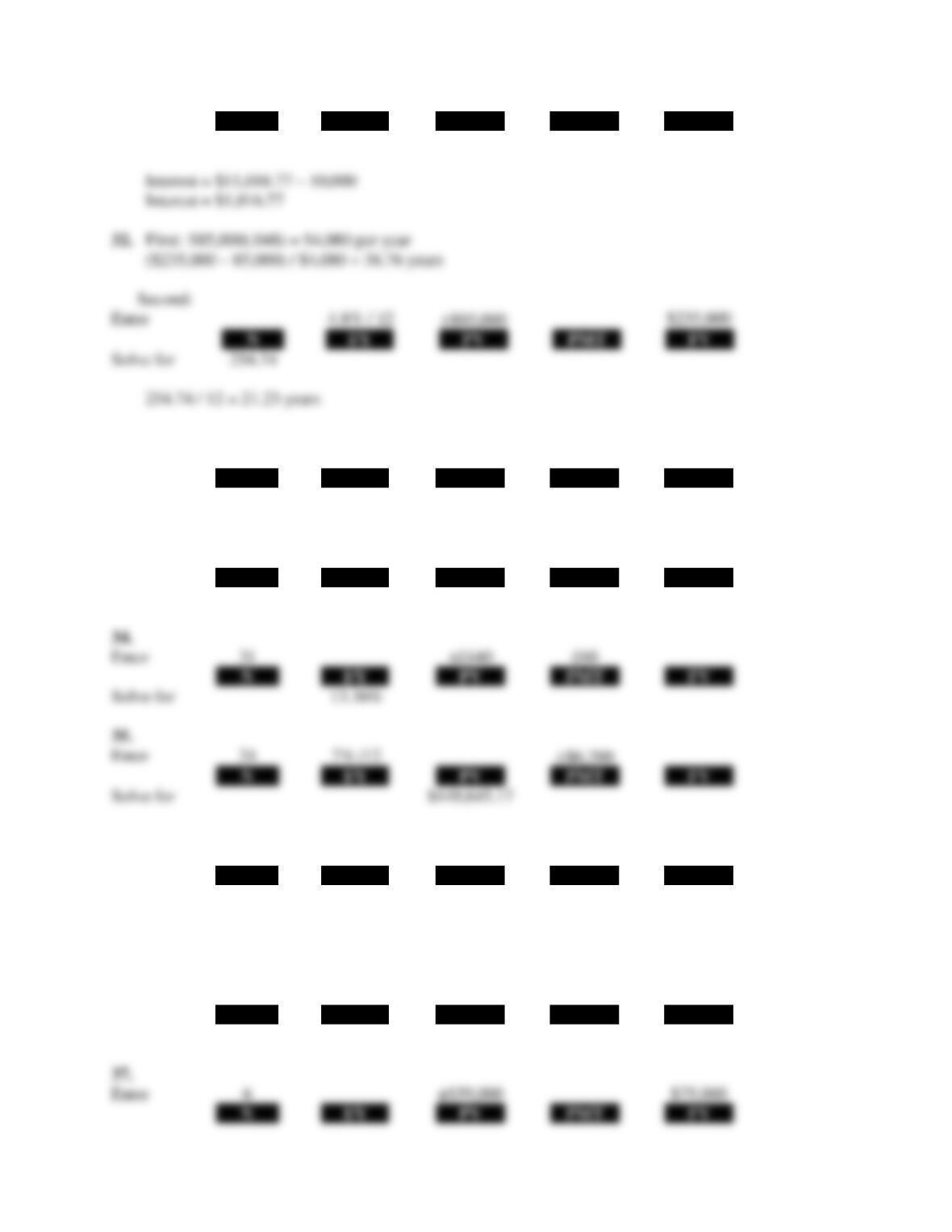
Enter
6
17.9% / 12
$10,080.27
N
I/Y
PV
PMT
FV
Solve for
$11,016.77
33.
Enter
12
1.29%
$1
N
I/Y
PV
PMT
FV
Solve for
$1.17
Enter
24
1.29%
$1
N
I/Y
PV
PMT
FV
Solve for
$1.36
34.
Enter
N
I/Y
PV
PMT
FV
Solve for
35.
Enter
24
N
I/Y
PV
PMT
FV
Solve for
$149,645.17
Enter
24
7% / 12
$5,400
N
I/Y
PV
PMT
FV
Solve for
$120,609.54
$120,609.54 + 25,000 = $145,609.54
36.
Enter
20
8%
$17,500
N
I/Y
PV
PMT
FV
Solve for
$171,817.58
37.
Enter
N
I/Y
PV
PMT
FV
Second:
Enter
Solve for
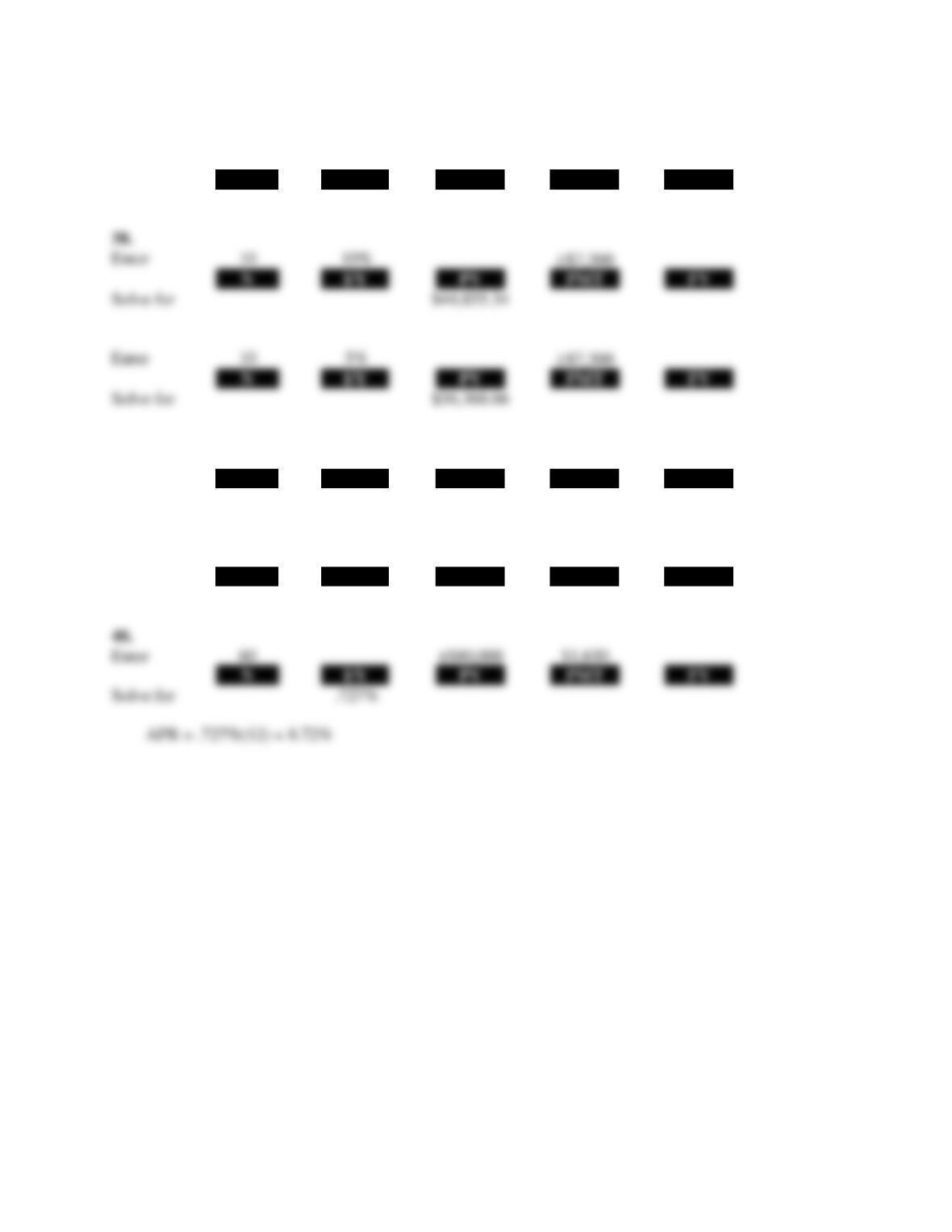
Solve for
11.51%
Enter
9
±$39,000
$105,000
N
I/Y
PV
PMT
FV
Solve for
11.63%
Enter
10
15%
$7,300
N
I/Y
PV
PMT
FV
Solve for
$36,637.01
39.
Enter
8% / 12
±$250
$50,000
N
I/Y
PV
PMT
FV
Solve for
127.52
40.
Enter
N
I/Y
PV
PMT
FV
Solve for
38.
Enter
10
10%
$7,300
N
I/Y
PV
PMT
FV
Solve for
$44,855.34
Enter
10
5%
$7,300
N
I/Y
PV
PMT
FV
Solve for
$56,368.66
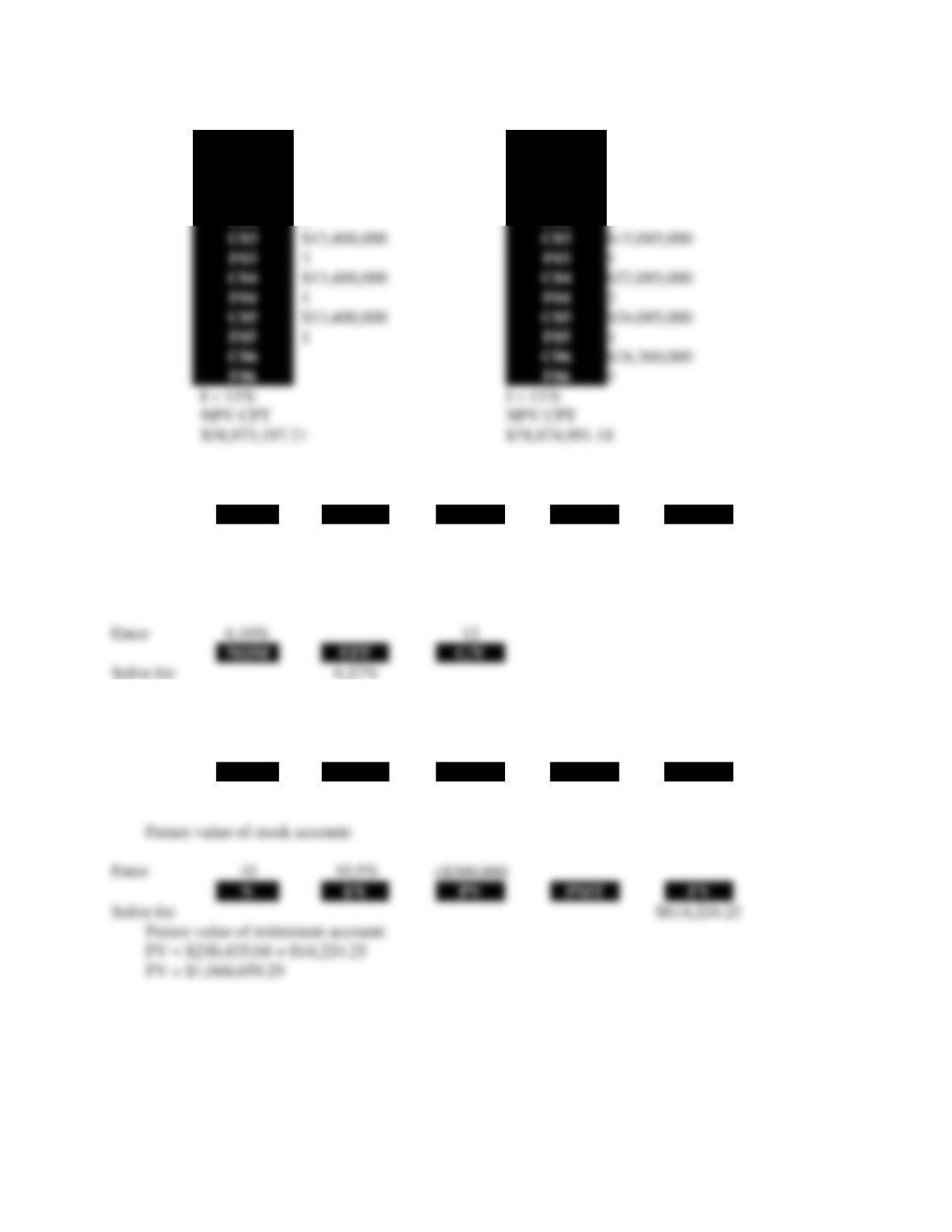
41.
42.
CFo
0
CFo
$5,100,000
C01
$3,400,000
C01
$985,000
F01
1
F01
1
C02
$12,400,000
C02
$28,585,000
F02
1
F02
1
43.
Enter
30 12
.80($2,950,000)
±$14,300
N
I/Y
PV
PMT
FV
Solve for
.508%
APR = .508%(12) = 6.10%
Enter
Solve for
6.27%
44. Future value of bond account:
Enter
10
7%
$75,000
$6,000
N
I/Y
PV
PMT
FV
Solve for
$230,435.04
Enter
10
N
I/Y
PV
PMT
FV
Solve for
$814,224.25
$12,400,000
$15,085,000
F03
3
F03
1
$13,400,000
$22,085,000
F04
1
F04
2
C05
$13,400,000
C05
$24,085,000
F05
1
F05
1
$18,360,000
1
I = 11%
I = 11%
NPV CPT
NPV CPT
$38,973,197.21
$78,874,991.18
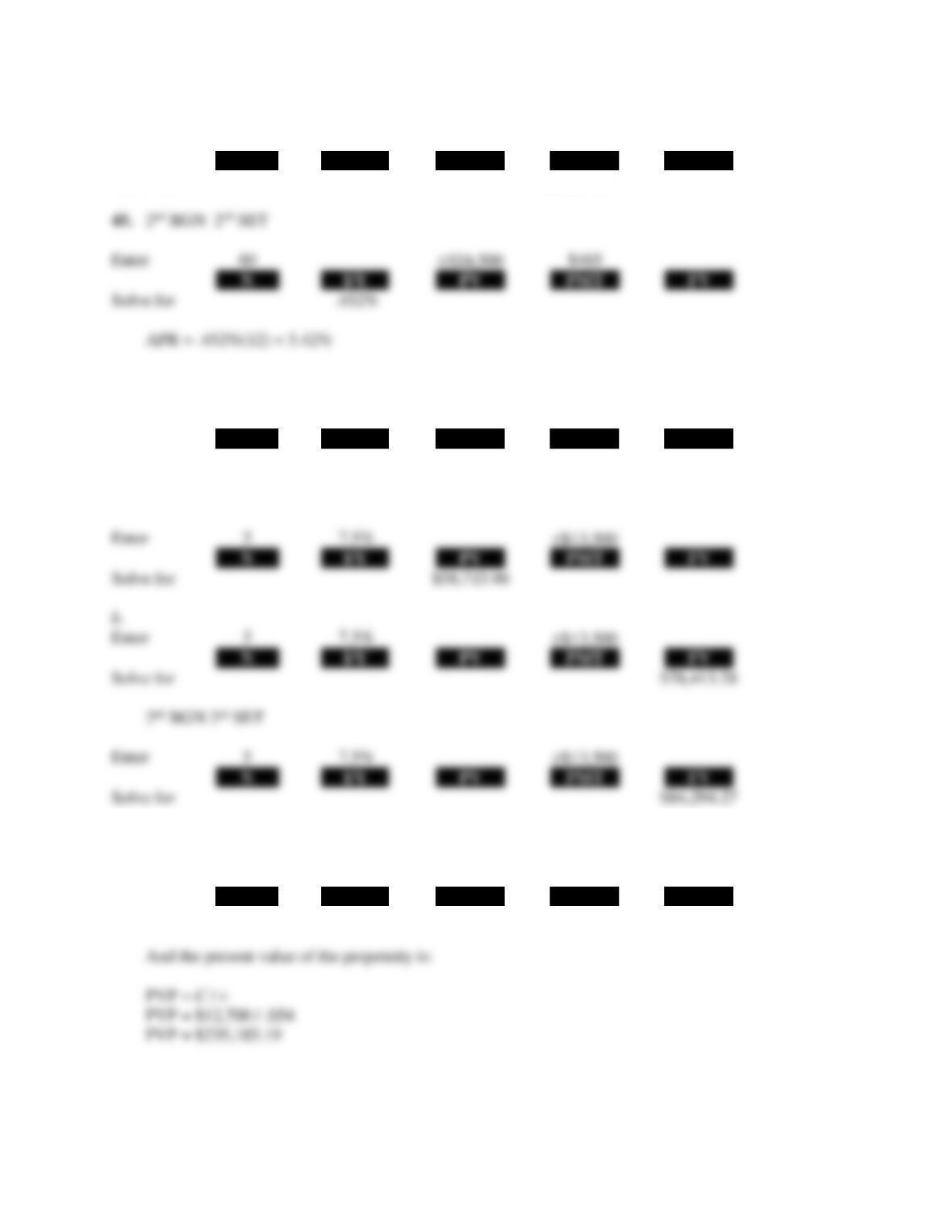
Annual withdrawal amount:
Enter
25
6.25%
$1,044,659.29
N
I/Y
PV
PMT
FV
Solve for
$83,671.59
46.
a.
Enter
5
7.5%
$13,500
N
I/Y
PV
PMT
FV
Solve for
$54,619.45
2nd BGN 2nd SET
Enter
5
7.5%
$13,500
N
I/Y
PV
PMT
FV
Solve for
$58,715.90
Enter
5
7.5%
$13,500
N
I/Y
PV
PMT
FV
Solve for
Enter
N
I/Y
PV
PMT
FV
Solve for
47. Present value of annuity:
Enter
30
5.4%
$12,700
N
I/Y
PV
PMT
FV
Solve for
$186,634.92
Enter
60
N
I/Y
PV
PMT
FV
Solve for
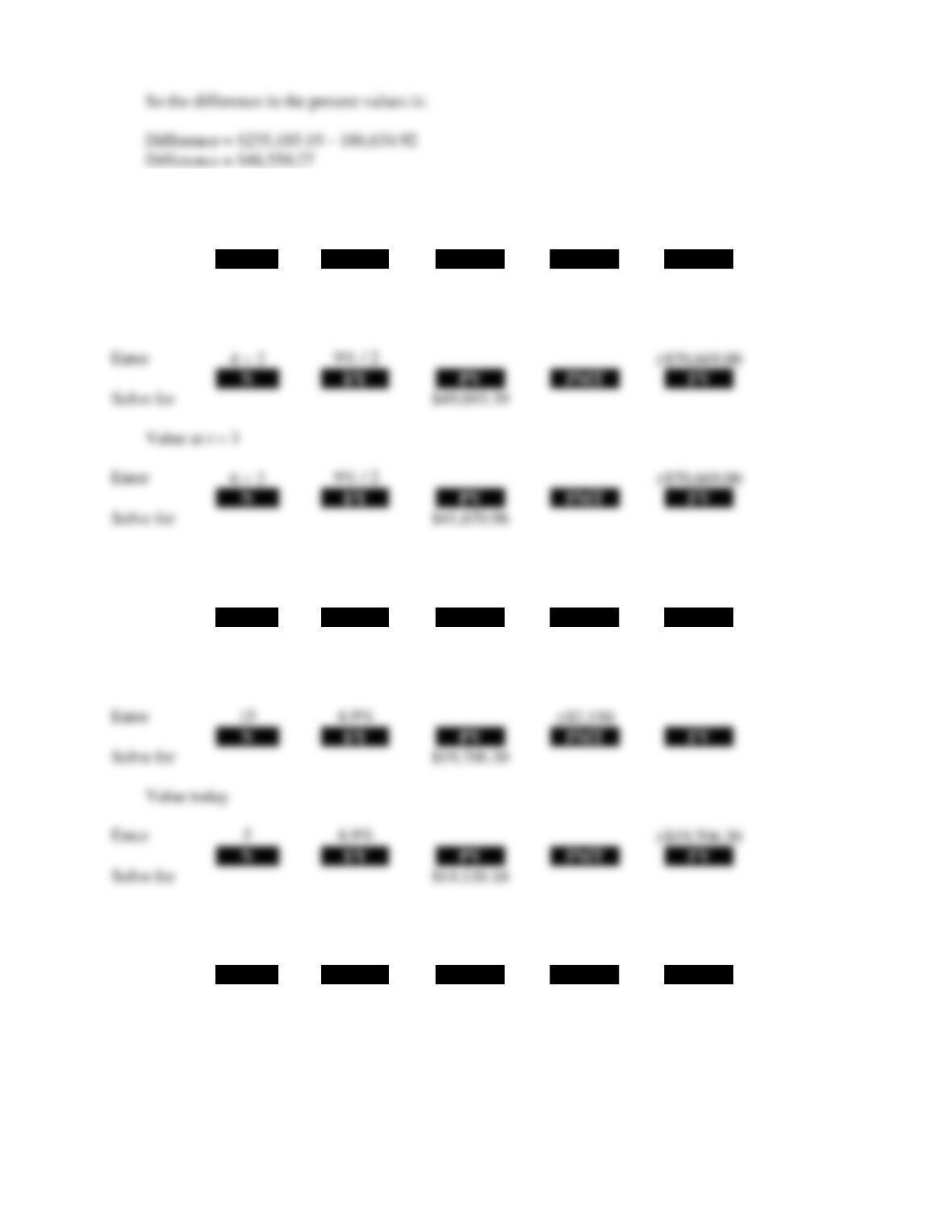
48. Value at t = 9
Enter
12
9% / 2
$7,750
N
I/Y
PV
PMT
FV
Solve for
$70,669.00
Value at t = 5
N
I/Y
PV
PMT
FV
Solve for
$49,693.39
Solve for
$41,670.96
Value today
Enter
9 2
9% / 2
$70,669.00
N
I/Y
PV
PMT
FV
Solve for
$31,998.95
49. Value at t = 5
N
I/Y
PV
PMT
FV
Solve for
$19,706.30
Solve for
$14,116.16
50. Value at t = 4
Enter
6 12
7% / 12
$1,450
N
I/Y
PV
PMT
FV
Solve for
$85,048.94
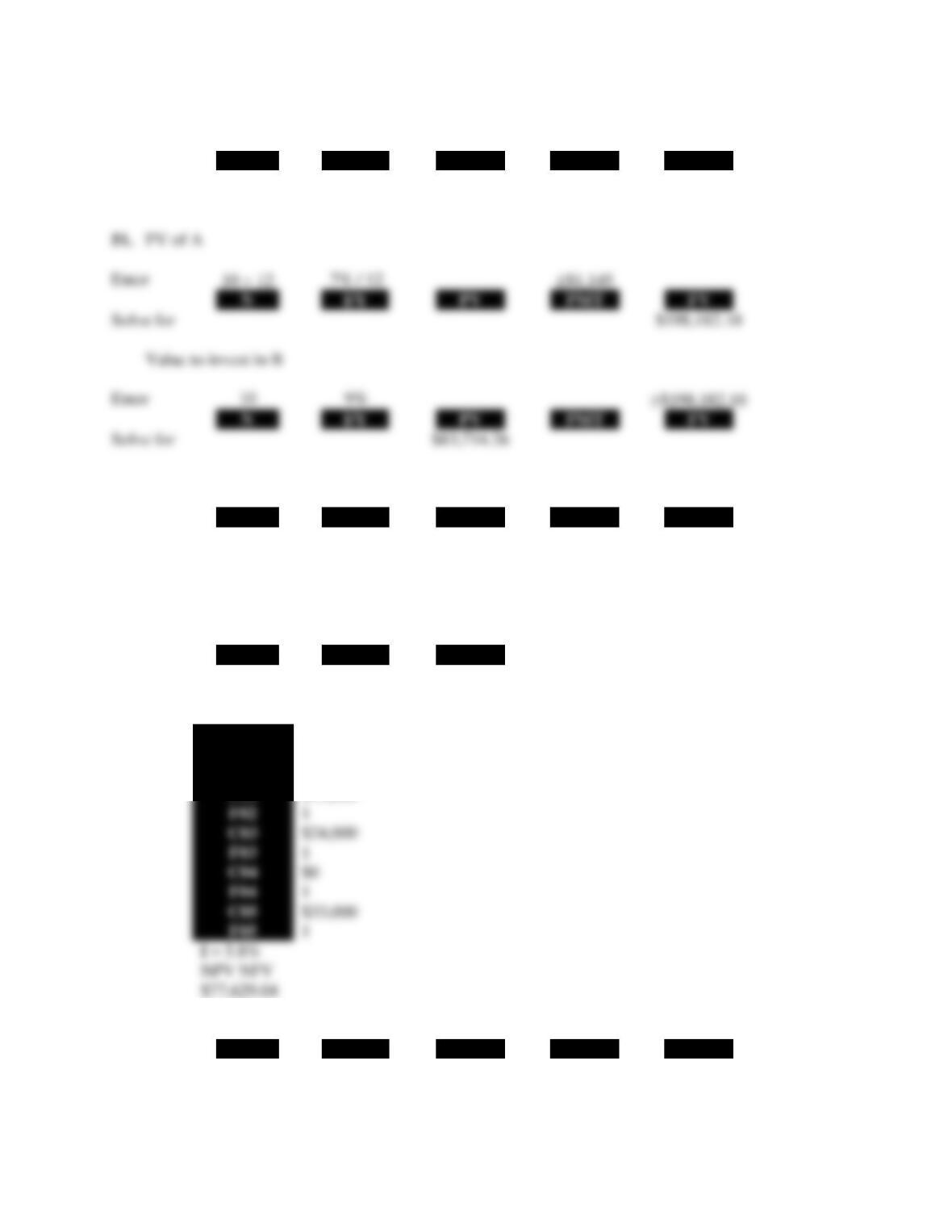
Value today
Enter
4 12
9% / 12
$1,450
$85,048.94
N
I/Y
PV
PMT
FV
Solve for
$117,684.33
53.
Enter
12
±$25,000
$2,441.67
N
I/Y
PV
PMT
FV
Solve for
2.530%
APR = 2.530%(12) = 30.37%
Enter
30.37%
12
NOM
EFF
C/Y
Solve for
34.97%
54.
CFo
$0
C01
$0
F01
1
C02
$15,000
F02
1
C03
$24,000
F03
1
C04
$0
1
C05
$33,000
1
I = 5.8%
NPV NFV
Enter
5
5.8%
±$77,629.04
N
I/Y
PV
PMT
FV
Solve for
$102,908.81
57.
Solve for
Enter
N
I/Y
PV
PMT
FV
Solve for
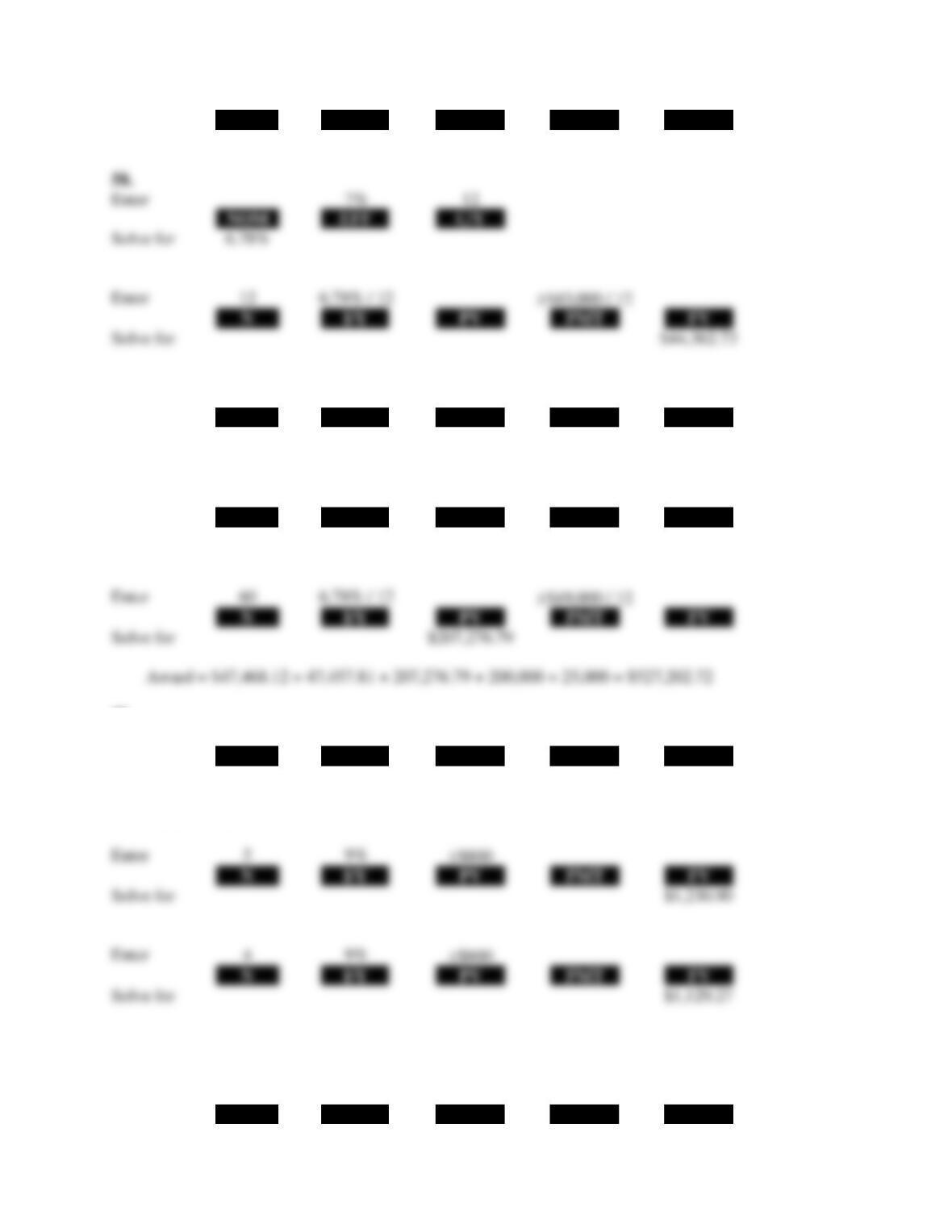
Enter
1
±$15,570
$18,000
N
I/Y
PV
PMT
FV
Solve for
15.61%
Enter
1
7%
$44,362.73
N
I/Y
PV
PMT
FV
Solve for
$47,468.12
Enter
12
6.78% / 12
$46,000 / 12
N
I/Y
PV
PMT
FV
Solve for
$47,457.81
Enter
60
6.78% / 12
N
I/Y
PV
PMT
FV
Solve for
59.
Enter
1
$14,700
$16,800
N
I/Y
PV
PMT
FV
Solve for
14.29%
60. Value at Year 6:
Enter
9%
N
I/Y
PV
PMT
FV
Solve for
Enter
9%
N
I/Y
PV
PMT
FV
Solve for
Enter
3
9%
$900
N
I/Y
PV
PMT
FV
58.
Enter
12
Solve for
6.78%
Enter
12
N
I/Y
PV
PMT
FV
Solve for
$44,362.73
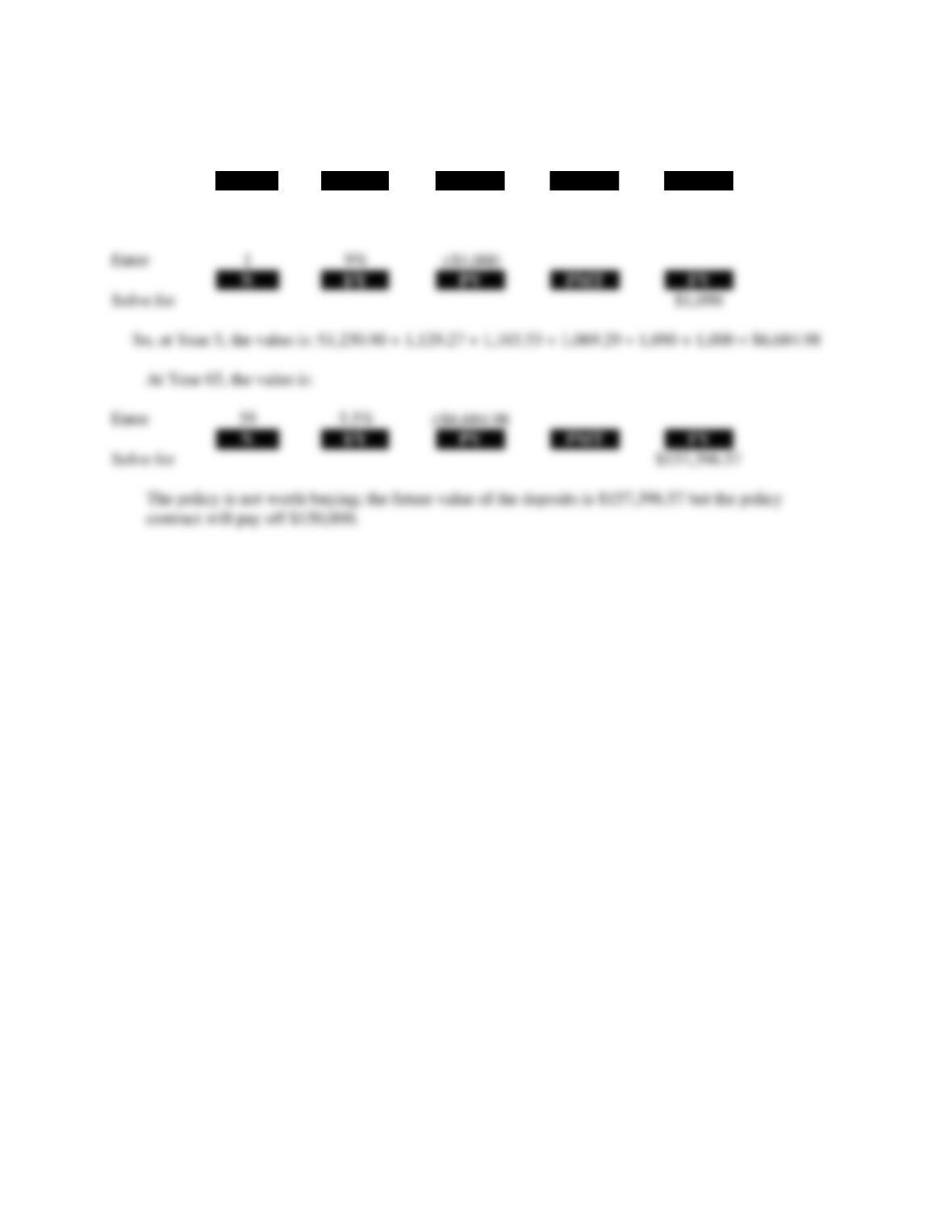
Solve for
$1,165.53
Enter
2
9%
$900
N
I/Y
PV
PMT
FV
Solve for
$1,069.29
Enter
1
9%
N
I/Y
PV
PMT
FV
Solve for
Enter
59
Solve for