14 Section 5.7
9. Repeat Exercise 8 using the Hermite interpolating polynomial.
(a) The coefficients of the Newton form of the Hermite interpolating polynomial
are, in order from left to right and from top to bottom,
(b) Let h(t)denote the height of the object at time tas determined by the Hermite
Hermite and Hermite Cubic Interpolation 15
(c) Based on the data, it appears that the object will be 0.20 meters above the
ground sometime between t= 0.10 seconds and t= 0.12 seconds. Rather
Next, it appears that the object will be 0.10 meters above the ground sometime
10. Repeat Exercise 8 using the clamped cubic spline.
16 Section 5.7
(a) The coefficients of the clamped cubic spline are
ajbjcjdj
0.290864 −0.164050 −11.510227 162.511348
0.274400 −0.587768 −6.156589 −6.375176
0.241472 −0.984704 −0.612014 −251.638805
0.189885 −1.508740 5.830886 −224.068096
(b) When t= 0.05 seconds, we estimate the height of the object is
When t= 0.15 seconds, we estimate the height of the object is
(c) Based on the data, it appears that the object will be 0.20 meters above the
for tyields t= 0.113396 seconds. Next, it appears that the object will be 0.10
11. Table 5-2 gives the charge on the capacitor and the current flowing through an
RLC circuit. Recall that current is the rate of change of charge.
(a) Construct the Hermite cubic interpolant for this data set.
(b) What is the charge on the capacitor when t= 0.05 seconds? when t= 0.15
seconds?
Hermite and Hermite Cubic Interpolation 17
(c) At what time is the charge on the capacitor a maximum?
(a) The Hermite cubic interpolant is
8.2325t2−1.98485t2(t−0.02),0.00 ≤t < 0.02
When t= 0.15 seconds, we estimate the charge on the capacitor is
(c) Based on the data, it appears that the charge on the capacitor is maximum
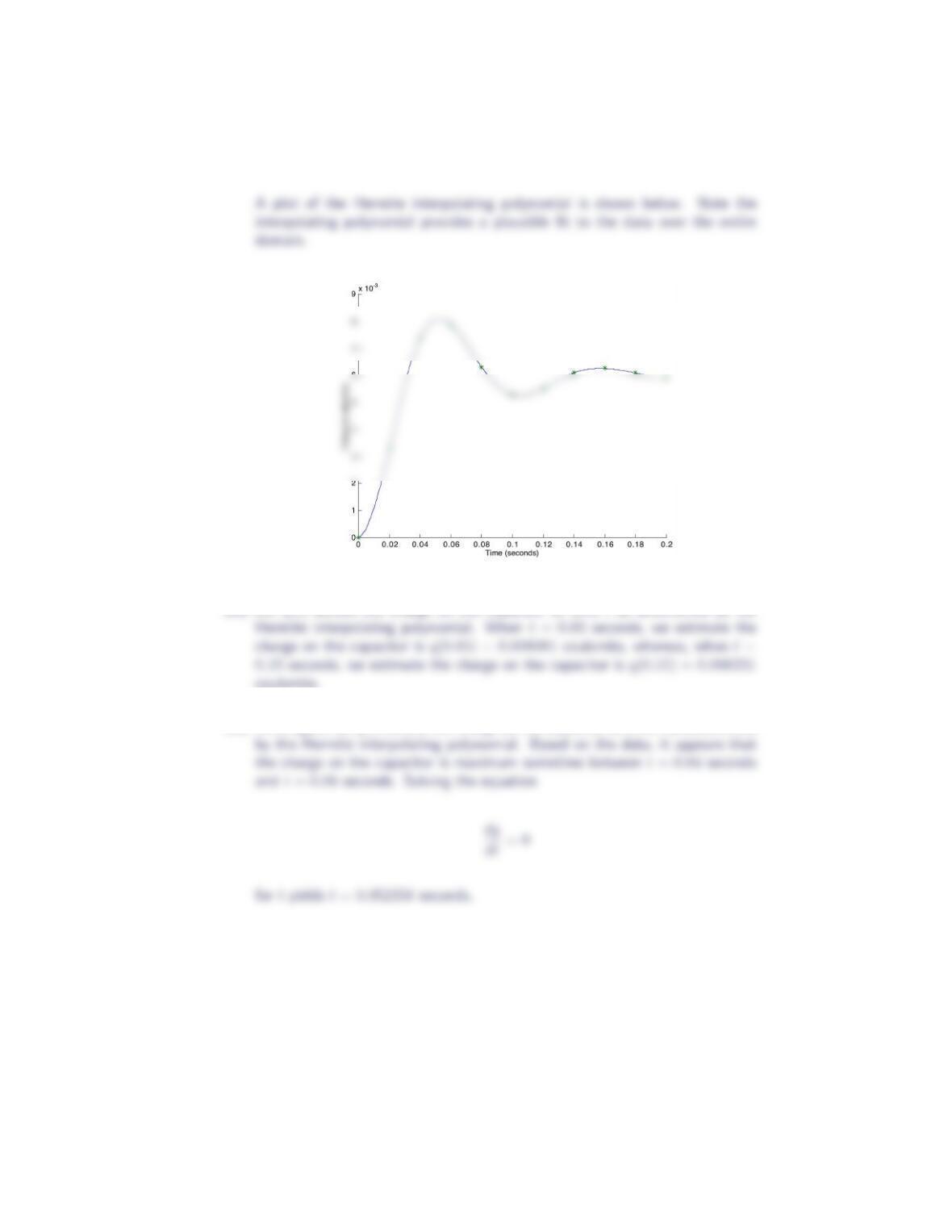
12. Repeat Exercise 11 using the Hermite interpolating polynomial.
(a) The coefficients of the Newton form of the Hermite interpolating polynomial
are, in order from left to right and from top to bottom,
0.000000 0.000000 8.2325
−198.485 875.8125 2.168125 ×10⁴
18 Section 5.7
(b) Let q(t)denote the charge on the capacitor at time tas determined by the
coulombs.
(c) Once again, let q(t)denote the charge on the capacitor at time tas determined
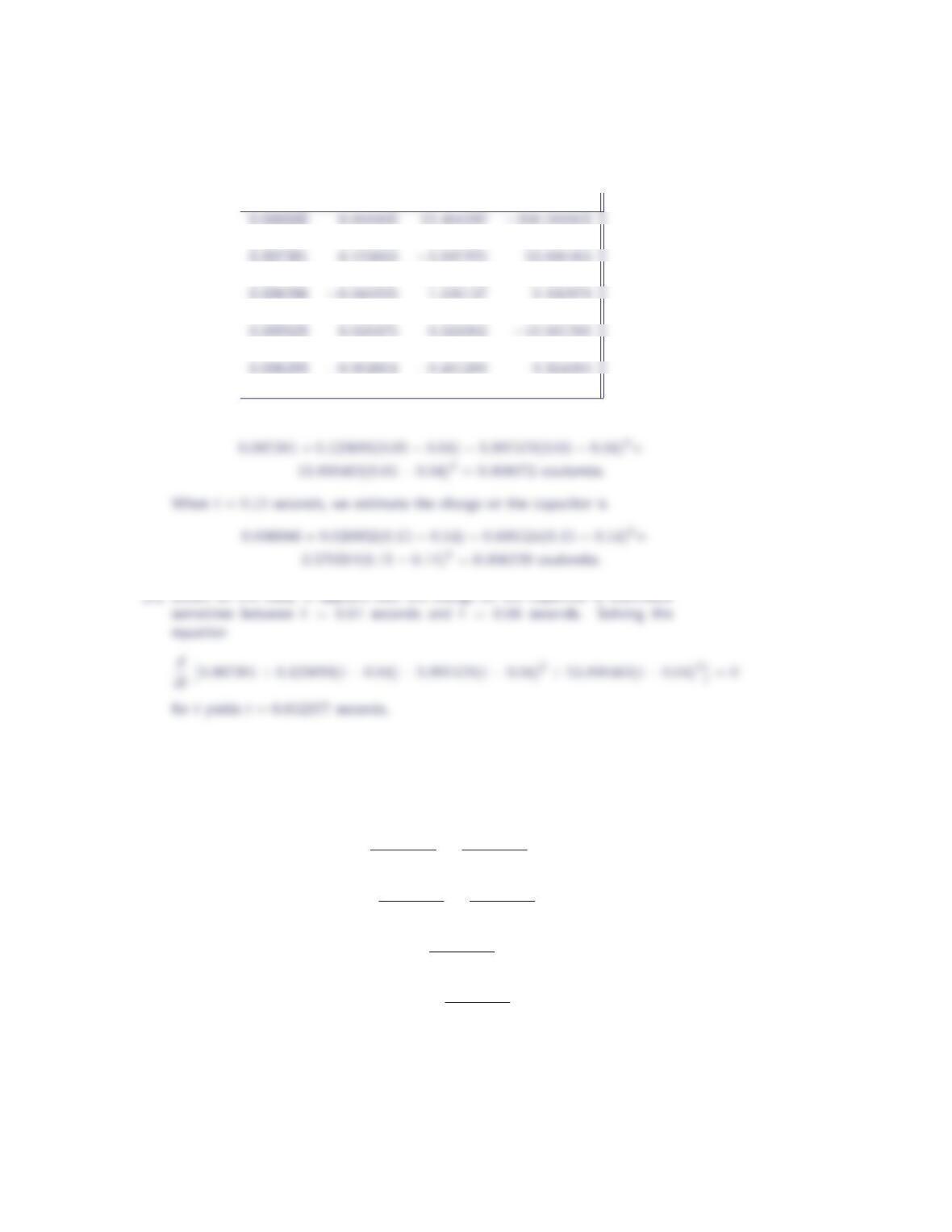
13. Repeat Exercise 11 using the clamped cubic spline.
(a) The coefficients of the clamped cubic spline are
Hermite and Hermite Cubic Interpolation 19
ajbjcjdj
0.003292 0.245864 −0.111080 −98.106490
0.007887 −0.051537 −2.764042 68.169640
0.005296 −0.015932 1.891995 −26.143555
0.006086 0.020932 −0.695524 3.570594
0.006085 −0.010666 0.078175 3.006872
(b) When t= 0.05 seconds, we estimate the charge on the capacitor is
14. Let ξ= (x−xj)/hj, where hj=xj+1 −xj. Show that
H1,j (x) = φ(ξ), H1,j+1(x) = 1−φ(ξ),ˆ
H1,j (x) = hjψ(ξ),and ˆ
H1,j+1(x) = −hjψ(1−ξ)
where
H1,j (x) = 1−2x−xj
xj−xj+1 x−xj+1
xj−xj+1 2
,
H1,j+1(x) = 1−2x−xj+1
xj+1 −xj x−xj
xj+1 −xj2
,
ˆ
H1,j (x) = (x−xj)x−xj+1
xj−xj+1 2
,
ˆ
H1,j+1(x) = (x−xj+1)x−xj
xj+1 −xj2
,
φ(ξ) = (1 + 2ξ)(1 −ξ)2

20 Section 5.7
and
ψ(ξ) = ξ(1 −ξ)2.
First note that
1−φ(ξ) = 1 −(1 + 2ξ)(1 −ξ)2
Now,
H1,j (x) = 1−2x−xj
xj−xj+1 x−xj+1
xj−xj+1 2
ˆ
H1,j (x) = (x−xj)x−xj+1
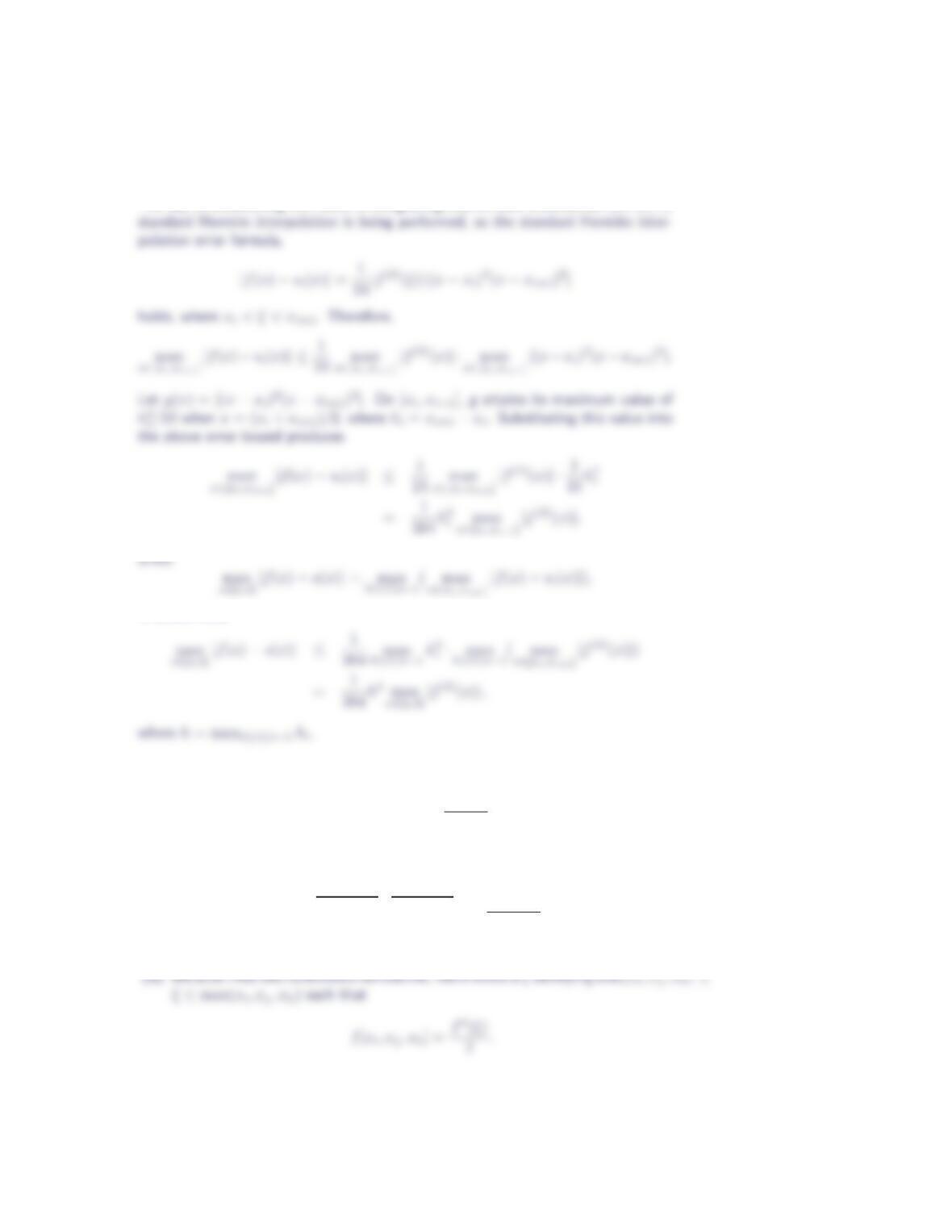
15. Prove the theorem which provides the error bound for the Hermite cubic inter-
polant. (Use the proof of the error bound for piecewise linear interpolation in
Section 5-5 as a model.)
Hermite and Hermite Cubic Interpolation 21
The key to establishing this result is recognizing that on each subinterval, [xi, xi+1],
it follows that
16. (a) Suppose that fhas two continuous derivatives. Show that
f[xi, xi, xi] = f′′(xi)
2.
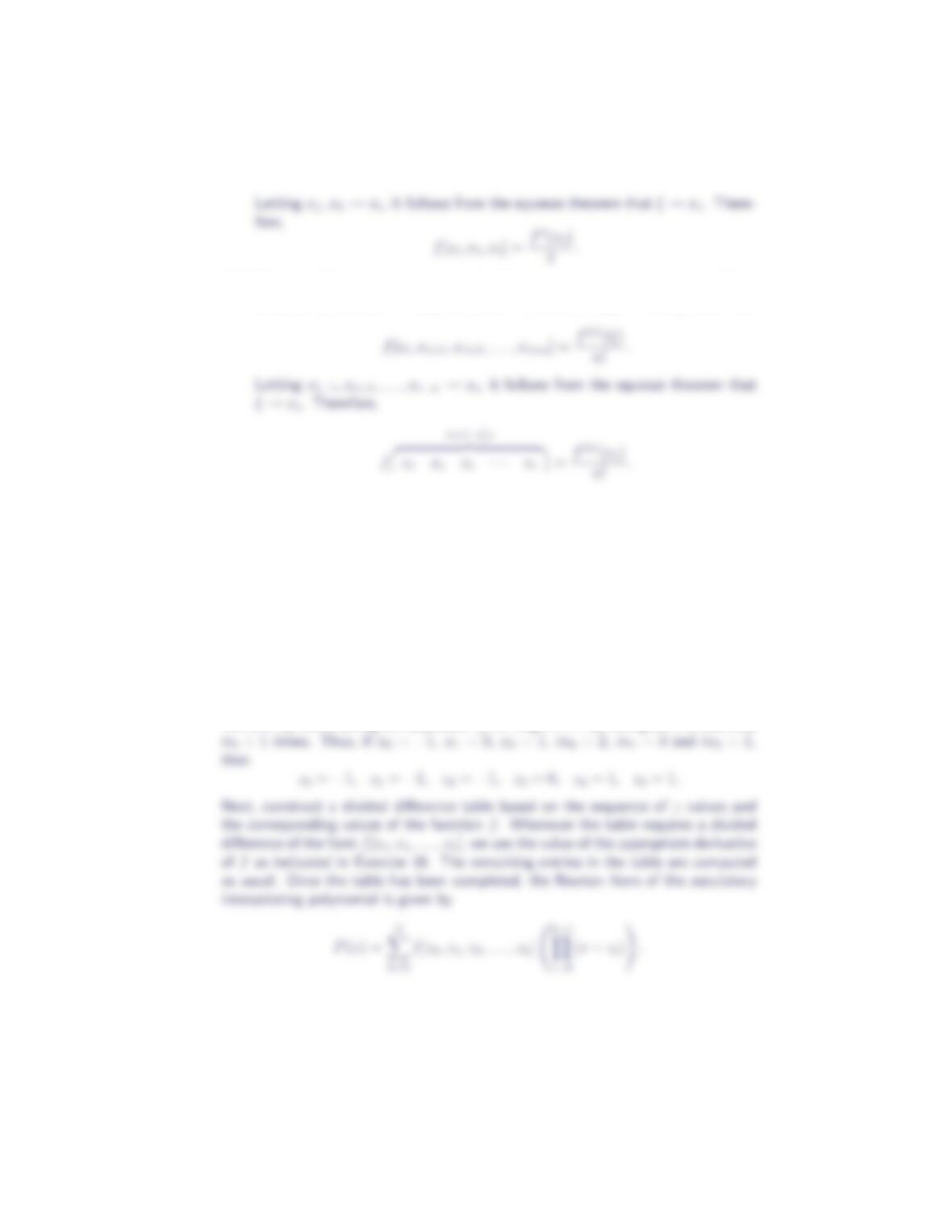
(b) Suppose that fis ntimes continuously differentiable. Show that
f[
n+1 x′
is
z}| {
xixixi··· xi] = f(n)(xi)
n!.
22 Section 5.7
(b) Because fis ntimes continuously derivatives, there exists a ξsatisfying
min(xi, xi+1, xi+2,…,xi+n)≤ξ≤max(xi, xi+1, xi+2, . . . , xi+n)such that
17. Let fbe a function defined on the interval [a, b], and let x0,x1,x2, …, xnbe n+1
distinct points from [a, b]. For each i= 0, 1, 2, …, n, let mibe a non-negative
integer. The polynomial, P, of degree at most d=n+Pn
i=0 mi, such that
P(k)(xi) = f(k)(xi)
for each i= 0, 1, 2, …, nand each k= 0, 1, 2, …, miis called the osculatory
interpolating polynomial. With the Newton form of the Hermite interpolating
polynomial as a guide and using the results of Exercise 16, construct the Newton
form of the osculatory interpolating polynomial.
We start by constructing the sequence, zj, of length d+1 by listing each xiprecisely
18. Determine the osculatory interpolating polynomial for each of the following
functions using the indicated amount of data at the specified points.
Hermite and Hermite Cubic Interpolation 23
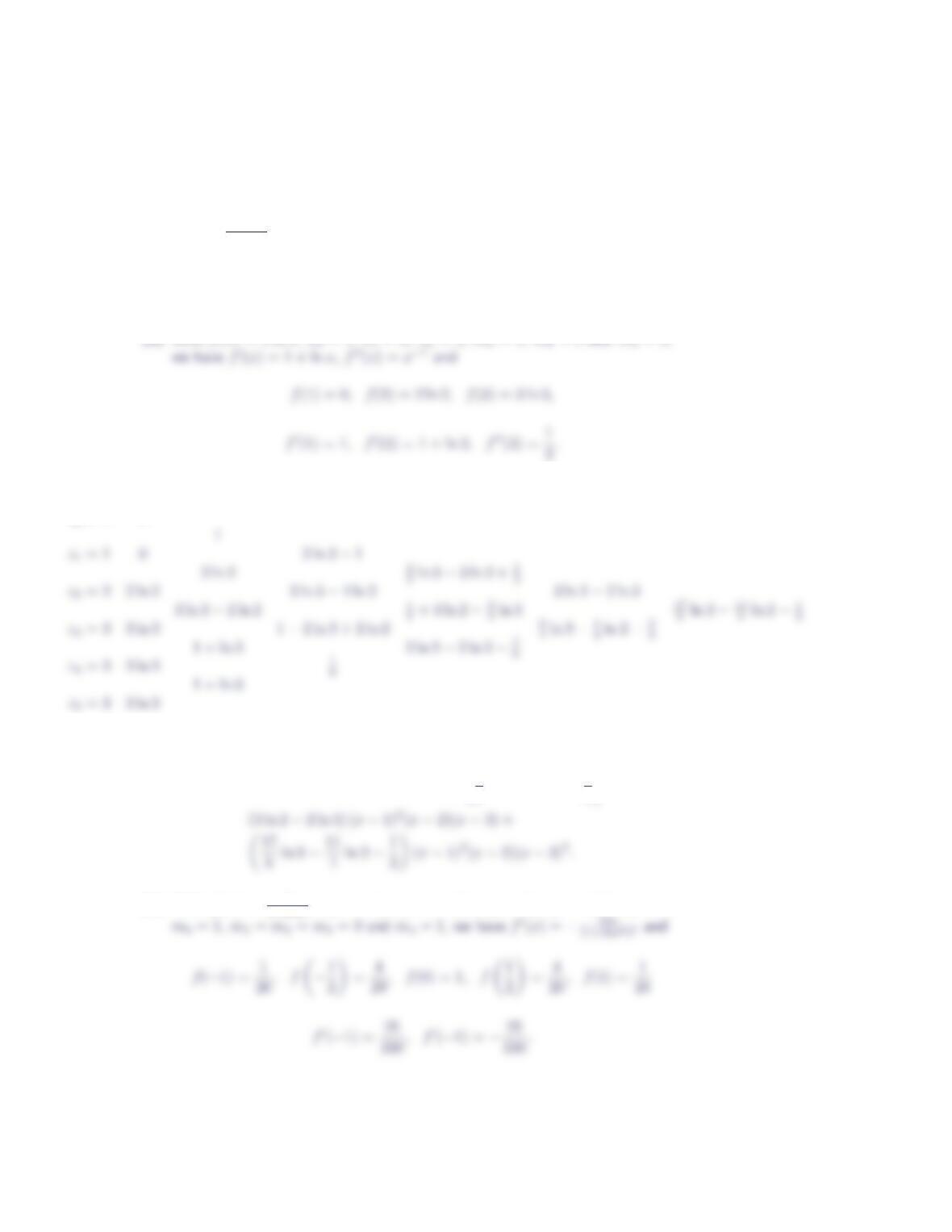
(a) f(x) = xln x,x0= 1, x1= 2, x2= 3, m0= 1, m1= 0, m2= 2
(b) f(x) = 1
1+25x2,x0=−1, x1=−1/2, x2= 0, x3= 1/2, x4= 1, m0= 1,
m1=m2=m3= 0, m4= 1
(c) f(x) = e−x,x0= 0, x1= 1, x2= 2, m0= 0, m1= 1, m2= 2
The corresponding divided difference table is
z0= 1 0
The Newton form of the osculating interpolating polynomial for fis then
P(x) = (x−1) + (2 ln 2 −1) (x−1)2+3
2ln 3 −3 ln 2 + 1
2(x−1)2(x−2) +
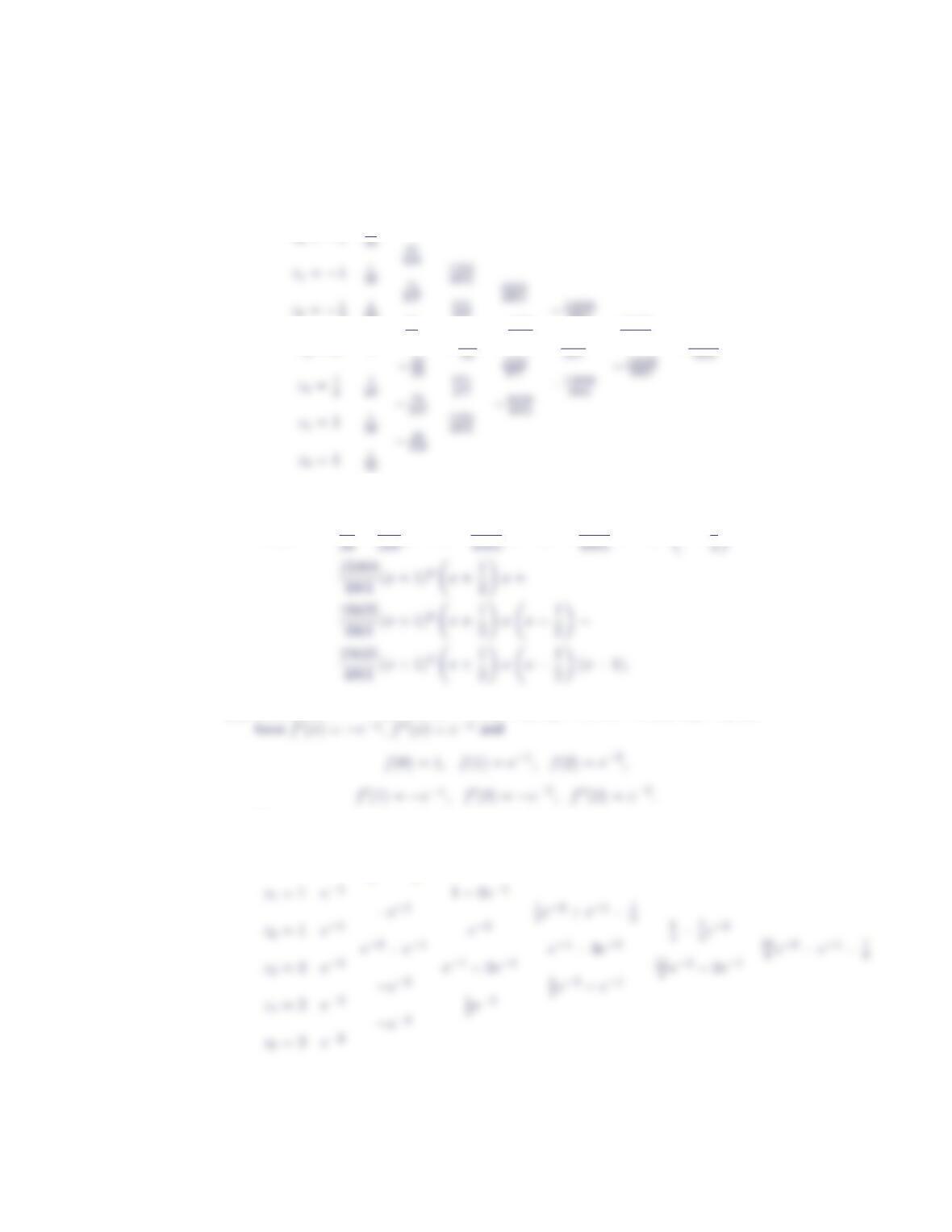
(b) With f(x) = 1
1+25x2,x0=−1,x1=−1/2,x2= 0,x3= 1/2,x4= 1,
24 Section 5.7
The corresponding divided difference table is
z0=−11
2
29
377 −15000
4901
50
29 −1250
377
15625
4901
z3= 0 1 −100
1250
The Newton form of the osculating interpolating polynomial for fis then
P(x) = 1
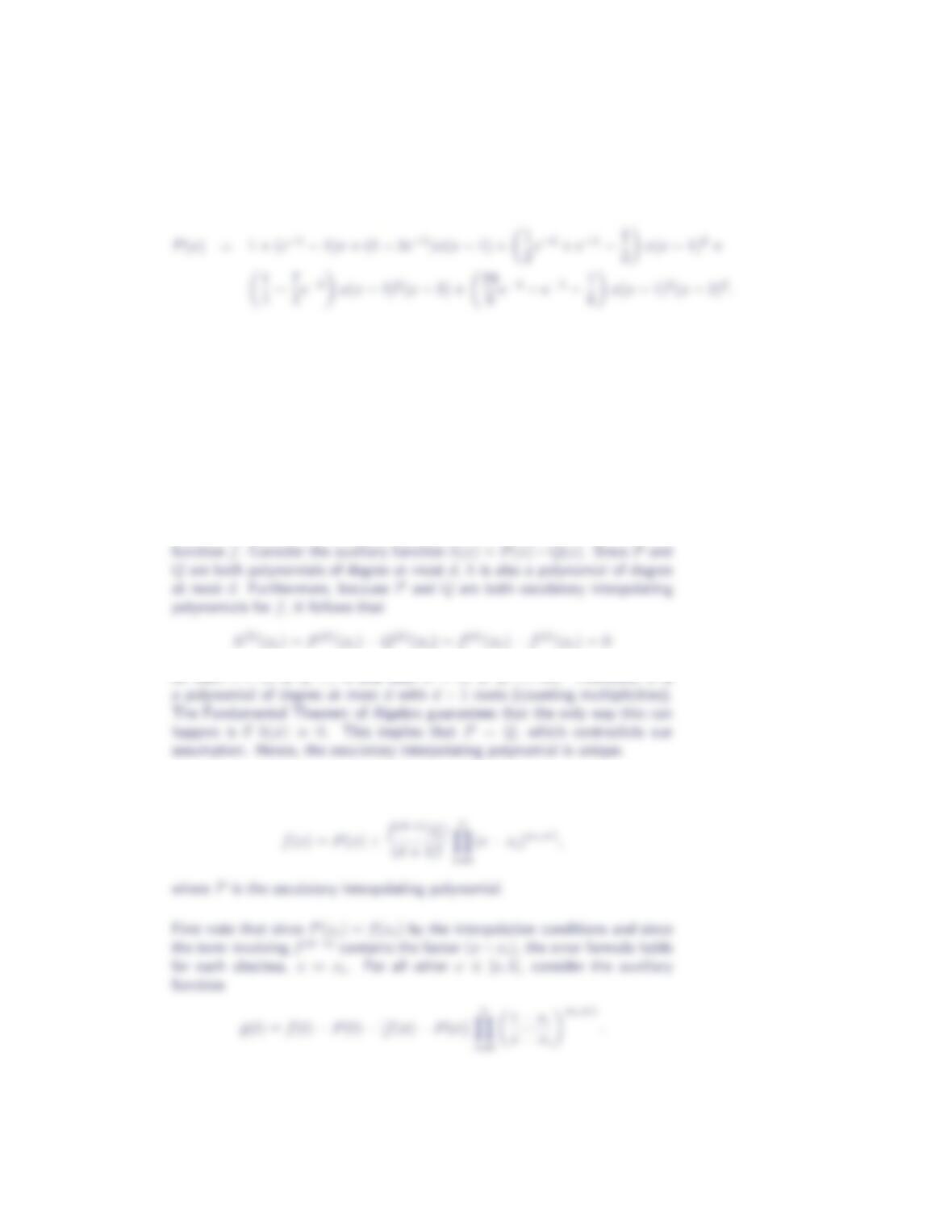
(c) With f(x) = e−x,x0= 0,x1= 1,x2= 2,m0= 0,m1= 1 and m2= 2, we
The corresponding divided difference table is
z0= 0 1
e−1−1
Hermite and Hermite Cubic Interpolation 25
The Newton form of the osculating interpolating polynomial for fis then
19. Let fbe a function defined on the interval [a, b], and let x0,x1,x2, …, xnbe n+1
distinct points from [a, b]. For each i= 0, 1, 2, …, n, let mibe a non-negative
integer.
(a) Prove that the osculatory interpolating polynomial is unqiue.
(b) If we suppose that fis sufficiently differentiable, what is the error associated
with the osculatory interpolating polynomial? Prove it.
(a) Let d=n+Pn
i=0 mi. For sake of contradiction, suppose that Pand Q
are different osculatory interpolating polynomials of degree at most dfor the
for each i= 0, 1, 2, …, nand each k= 0, 1, 2, …, mi. Therefore, his
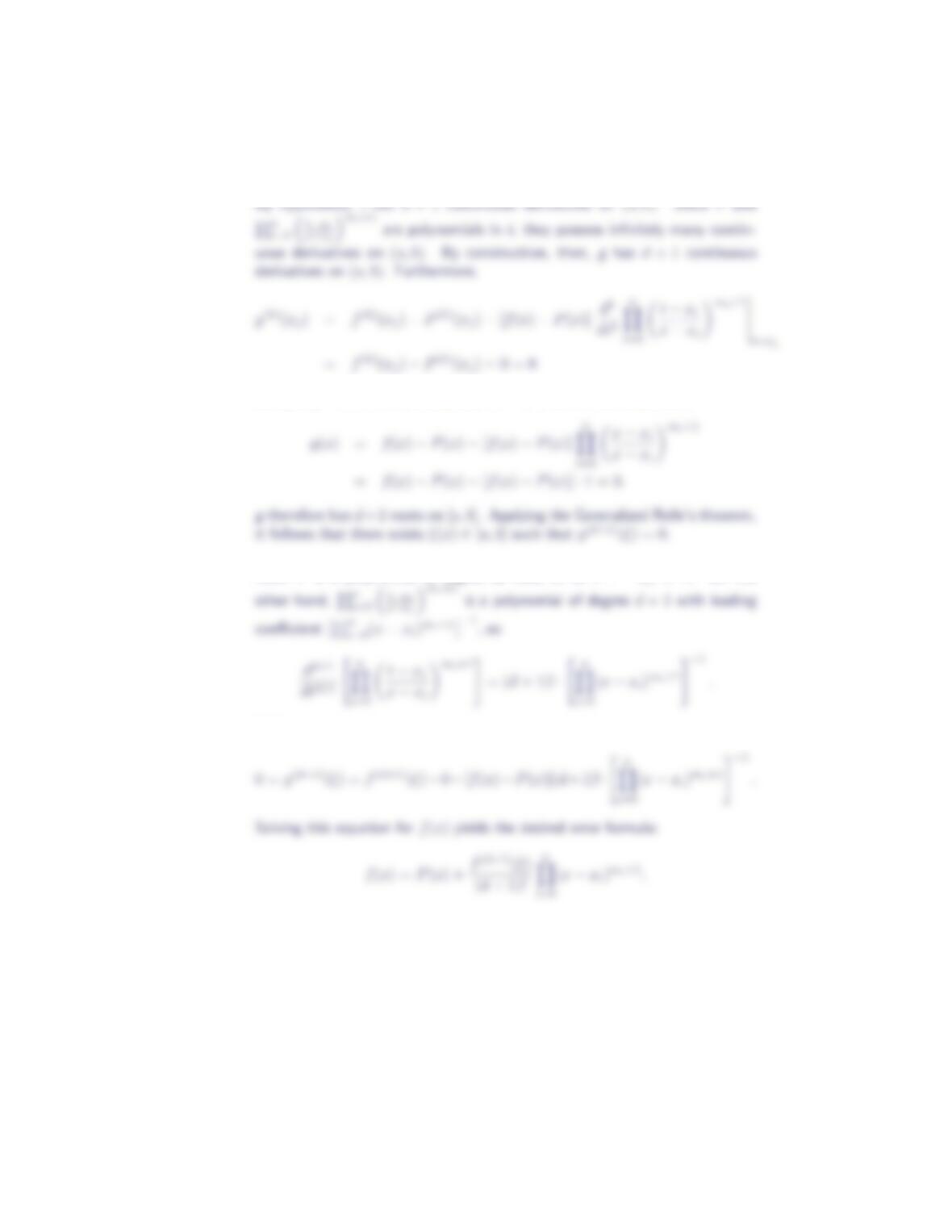
(b) Let d=n+Pn
i=0 mi. If fhas d+ 1 continuous derivatives on (a, b), then
for each x∈[a, b], there exists a ξ(x)∈[a, b]such that
26 Section 5.7
for each j= 0, 1, 2, …, nand each k= 0, 1, 2, …, mi. Moreover,
Now, Pis a polynomial of degree at most d, so P(d+1)(t)≡0. On the
Differentiating gd+ 1 times and evaluating at ξthen gives