5.4 Optimal Points for Interpolation
1. Prove each of the following properties of the Chebyshev polynomials:
(a) for each n,Tn(1) = 1.
(b) for each n,Tn(−1) = (−1)n.
(c) for all j > k ≥0, Tj(x)Tk(x) = 1
2[Tj+k(x) + Tj−k(x)].
(a) Tn(1) = cos(ncos−1(1)) = cos 0 = 1. Alternately, we proceed by induction
(b) We proceed by induction on n. For n= 0,T0(x) = 1 so that T0(−1) = 1 =
(c) Here, we make use of the trigonometric identity
2. Show that the Chebyshev polynomial Tn(x) is a solution to the differential
equation
(1 −x2)d2y
dx2−xdy
dx +n2y= 0.
Let y=Tn(x) = cos(ncos−1x). Then
3. Show that
Z1
−1
Tn(x)Tm(x)
√1−x2dx =0, m 6=n
cnπ
2, m =n,
where c0= 2 and cn= 1 (n≥1). This implies that the Chebyshev polynomials
form an orthogonal set on [−1,1] with respect to the weight function w(x) =
(1 −x2)−1/2. (Hint: Make the substitution θ= cos−1x.)
With the substitution θ= cos−1x, we have
If m6=n, then
Optimal Points for Interpolation 3
Thus, for n= 0,
4. Show that the Legendre polynomial Pn(x) is a solution to the differential equa-
tion
(1 −x2)d2y
dx2−2xdy
dx +n(n+ 1)y= 0.
We proceed by induction n. Observe that
Now suppose that Pn−1(x)and Pn−2(x)satisfy the appropriate differential equa-
tion. With
it follows that
(1 −x2)d2Pn
4Section 5.4
To complete the induction step, we need the identity
With this identity,
5. Consider interpolating f(x) = xe−xover [−1,3] with a polynomial of degree at
most four.
(a) Interpolate at uniformly spaced points and at the scaled and translated
Legendre points. Determine the l∞norm of the interpolation error for
both interpolating polynomials and compare with the l∞norm associated
with the scaled and translated Chebyshev points.
(b) Interpolate at uniformly spaced points and at the scaled and translated
Chebyshev points. Determine the l2norm of the interpolation error for
both interpolating polynomials and compare with the l2norm associated
with the scaled and translated Legendre points.
Let f(x) = xe−x. From Example 5.12, we know that the polynomial of degree at
most four that interpolates fat the Chebyshev points, scaled and translated to the
The polynomial of degree at most four that interpolates fat the uniformly spaced
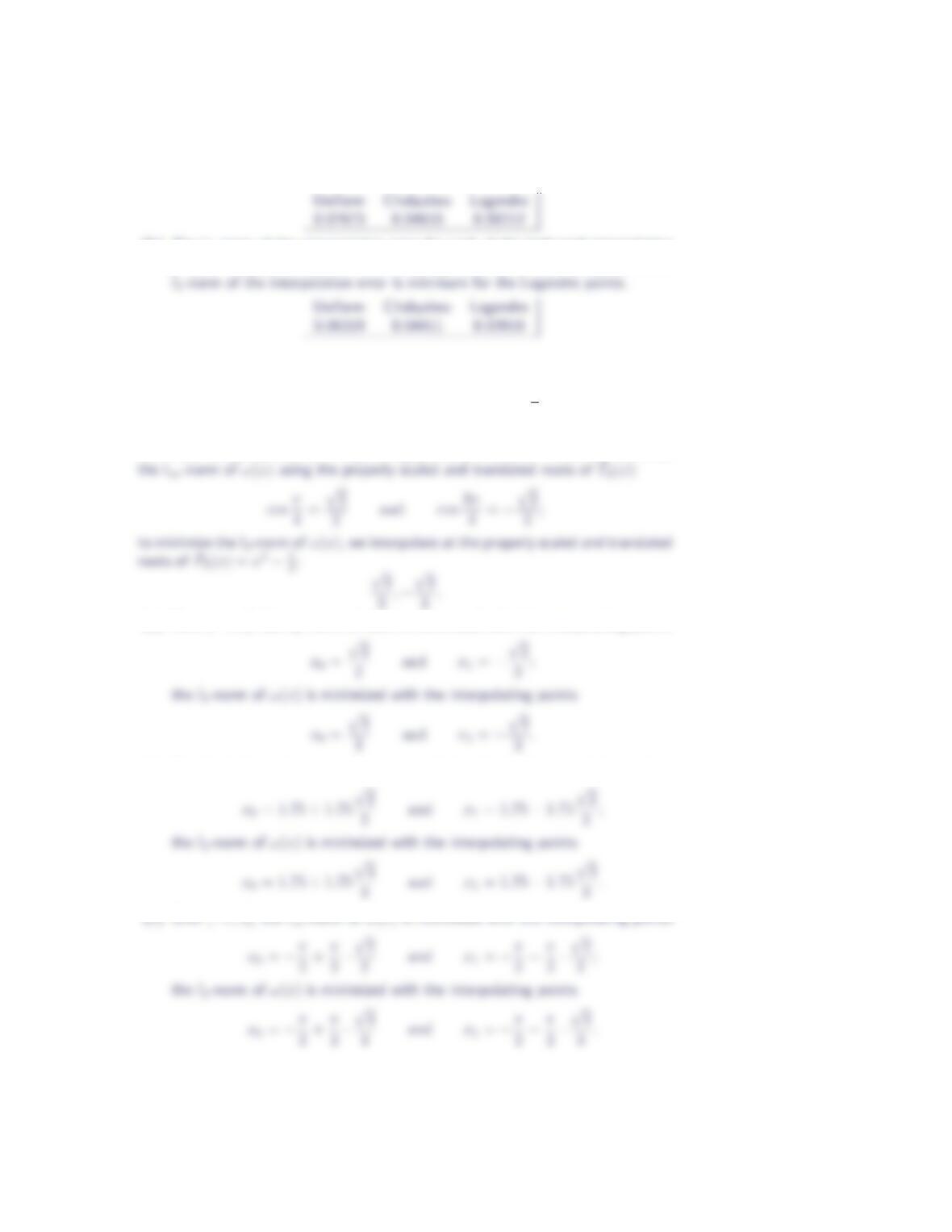
(a) The l∞-norm of the interpolation error for each of the indicated interpolating
Optimal Points for Interpolation 5
(b) The l2-norm of the interpolation error for each of the indicated interpolating
polynomials is summarized in the following table. Note that, as expected, the
6. For each of the following intervals, identify the interpolating points that mini-
mize the l∞and the l2norm of ωfor linear interpolation.
(a) [−1,1] (b) [0,3.5] (c) [−π, 0] (d) [−√2,3] (e) [−2.5,3.5]
For linear interpolation, two interpolating points are needed. Thus, we minimize
(a) Over [−1,1], the l∞-norm of ω(x)is minimized with the interpolating points
(b) Over [0,3.5], the l∞-norm of ω(x)is minimized with the interpolating points
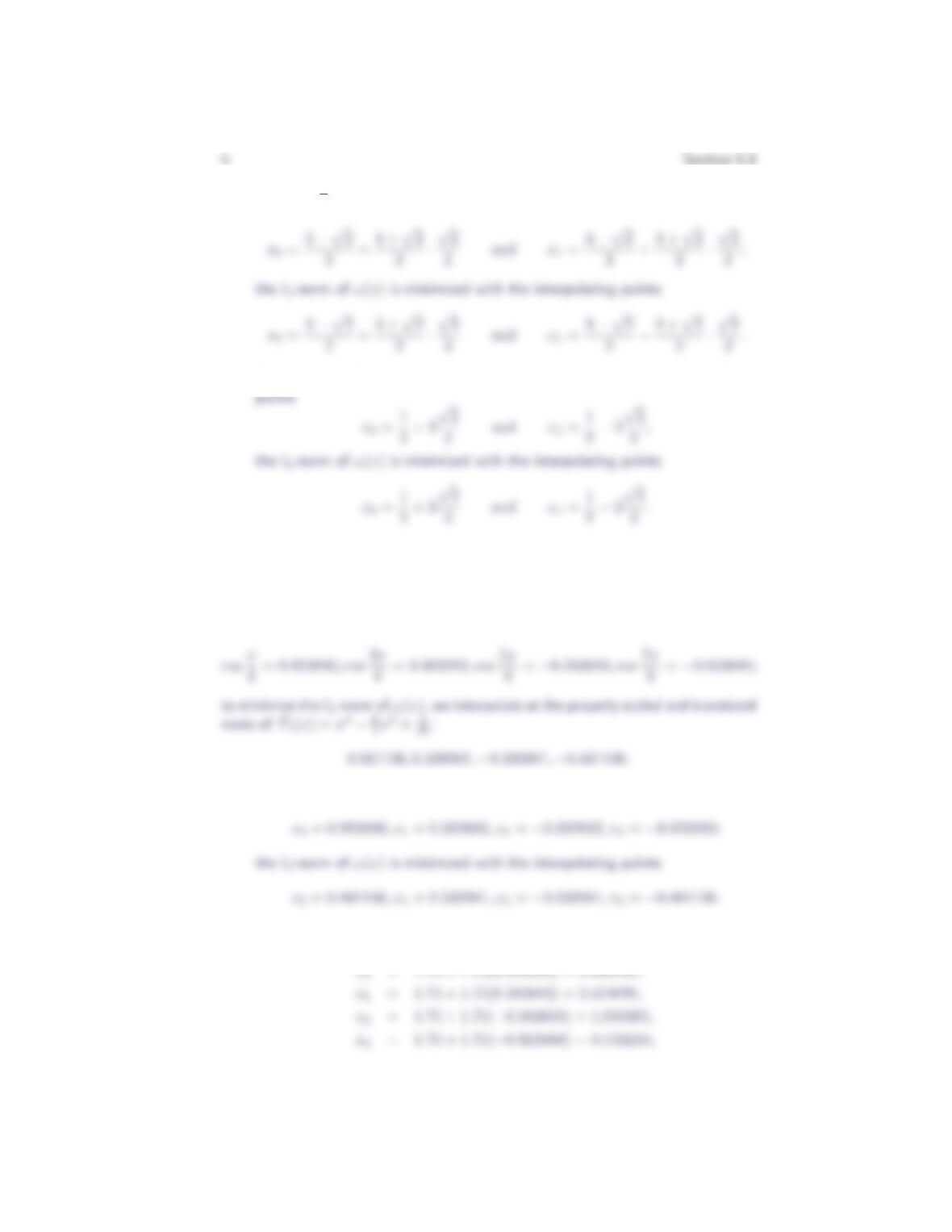
(d) Over [−√2,3], the l∞-norm of ω(x)is minimized with the interpolating points
(e) Over [−2.5,3.5], the l∞-norm of ω(x)is minimized with the interpolating
7. Repeat Exercise 6 for cubic interpolation.
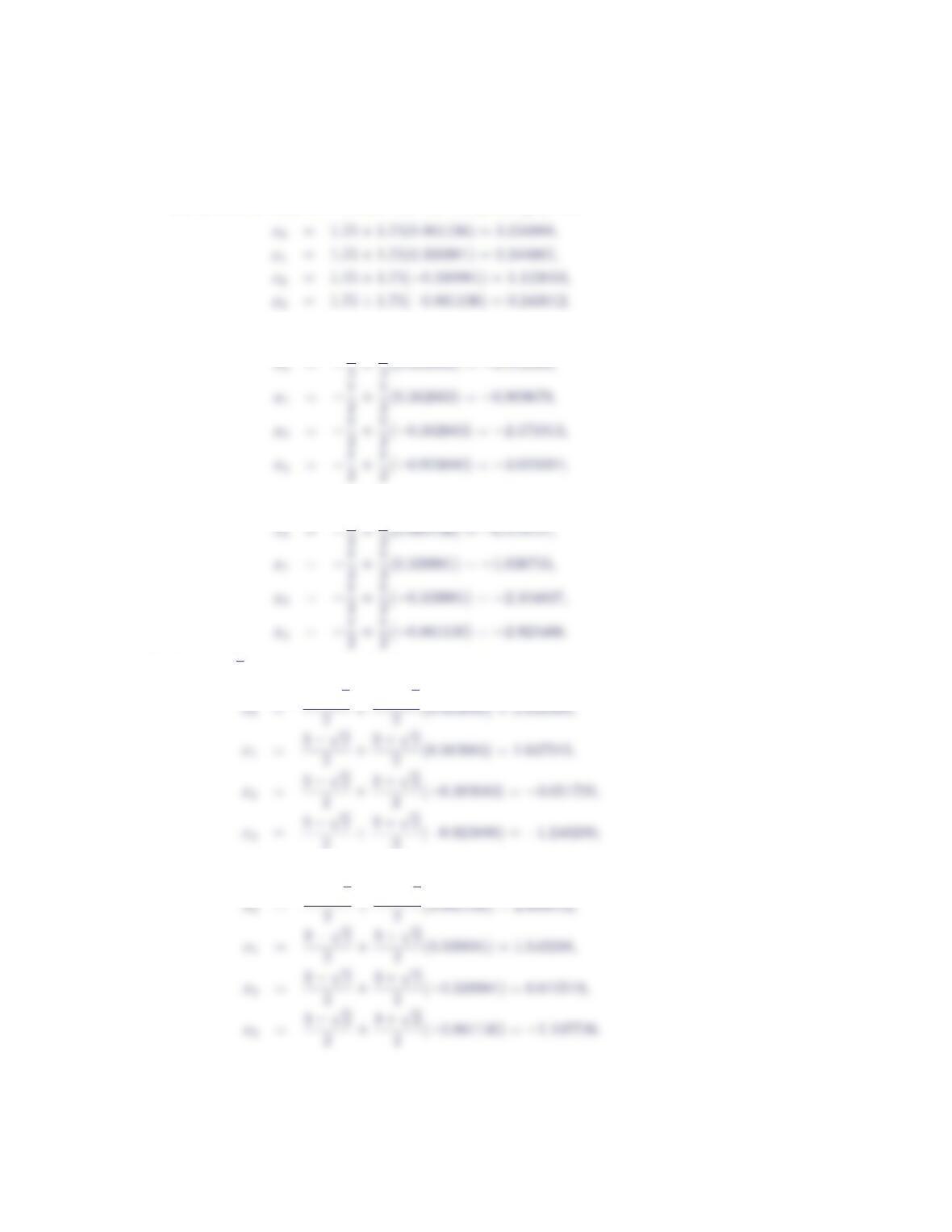
For cubic interpolation, four interpolating points are needed. Thus, we minimize
the l∞-norm of ω(x)using the properly scaled and translated roots of ˜
T4(x):
(a) Over [−1,1], the l∞-norm of ω(x)is minimized with the interpolating points
(b) Over [0,3.5], the l∞-norm of ω(x)is minimized with the interpolating points
Optimal Points for Interpolation 7
the l2-norm of ω(x)is minimized with the interpolating points
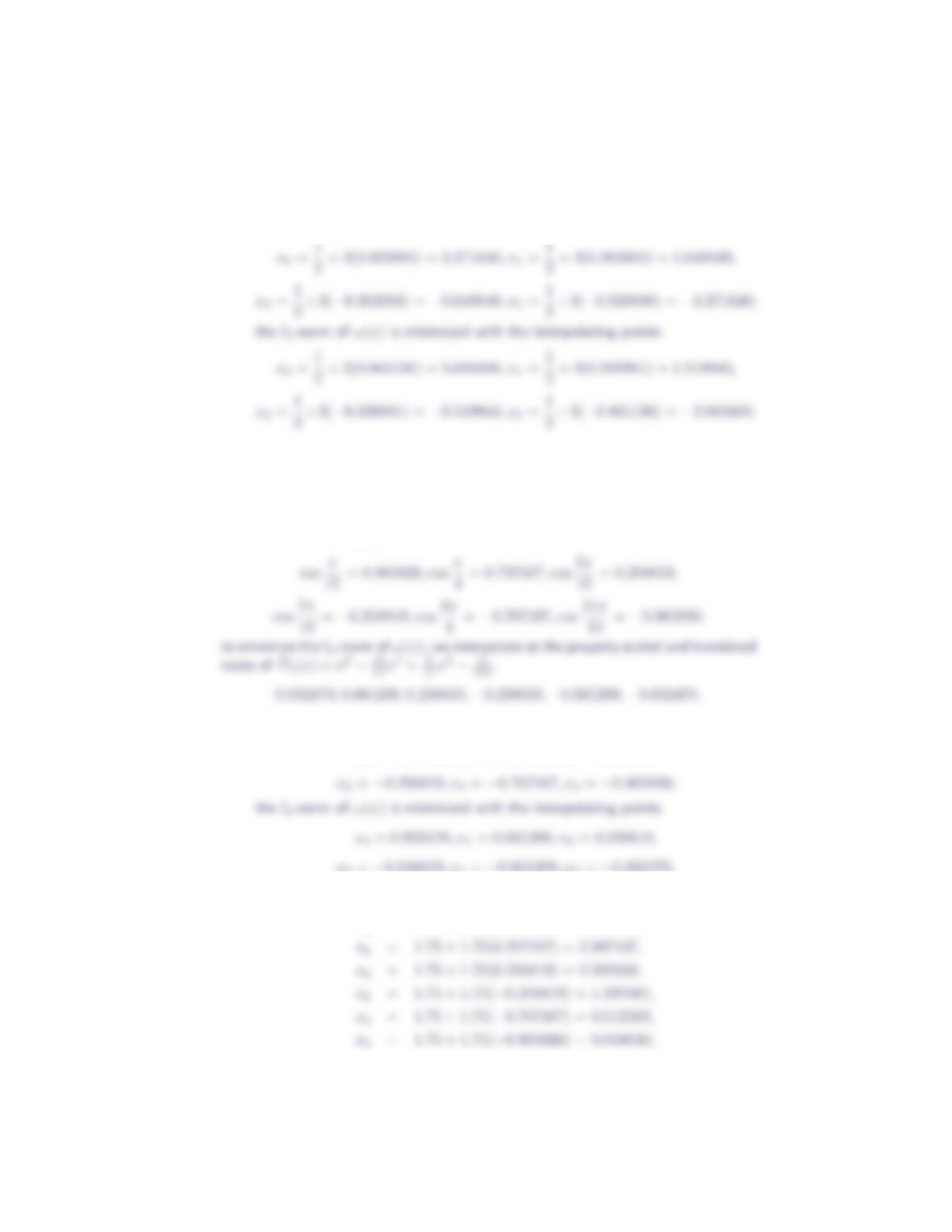
(c) Over [−π, 0], the l∞-norm of ω(x)is minimized with the interpolating points
the l2-norm of ω(x)is minimized with the interpolating points
(d) Over [−√2,3], the l∞-norm of ω(x)is minimized with the interpolating points
the l2-norm of ω(x)is minimized with the interpolating points
8Section 5.4
(e) Over [−2.5,3.5], the l∞-norm of ω(x)is minimized with the interpolating
points
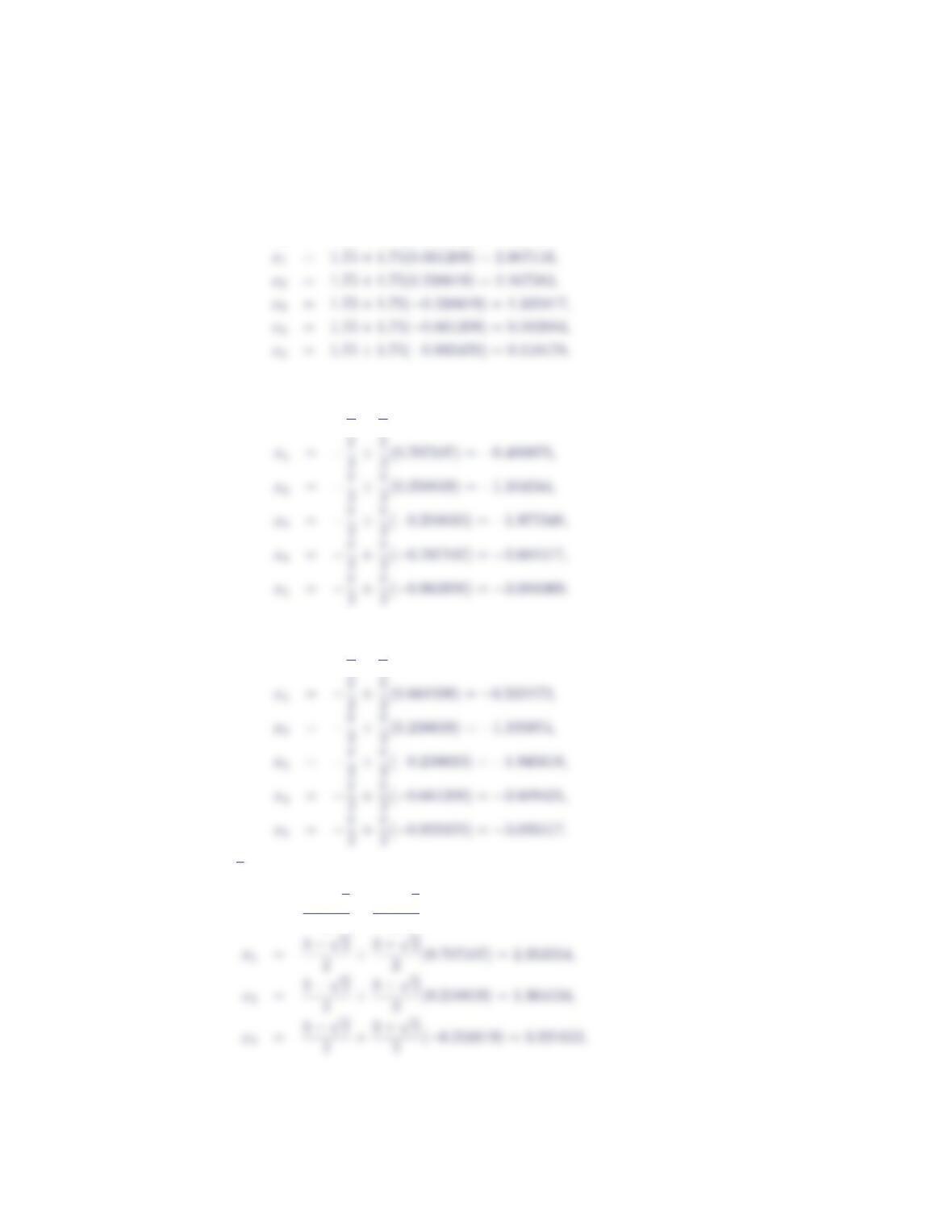
8. Repeat Exercise 6 for interpolation by polynomials of degree at most 5.
For interpolation by polynomials of degree at most 5, six interpolating points are
needed. Thus, we minimize the l∞-norm of ω(x)using the properly scaled and
translated roots of ˜
T6(x):
(a) Over [−1,1], the l∞-norm of ω(x)is minimized with the interpolating points
x0= 0.965926, x1= 0.707107, x2= 0.258819,
x3=−0.238619, x4=−0.661209, x5=−0.932470.
(b) Over [0,3.5], the l∞-norm of ω(x)is minimized with the interpolating points
x0= 1.75 + 1.75(0.965926) = 3.440371,
Optimal Points for Interpolation 9
the l2-norm of ω(x)is minimized with the interpolating points
x0= 1.75 + 1.75(0.932470) = 3.381823,
(c) Over [−π, 0], the l∞-norm of ω(x)is minimized with the interpolating points
x0=−π
2+π
2(0.965926) = −0.053523,
the l2-norm of ω(x)is minimized with the interpolating points
x0=−π
2+π
2(0.932470) = −0.106076,
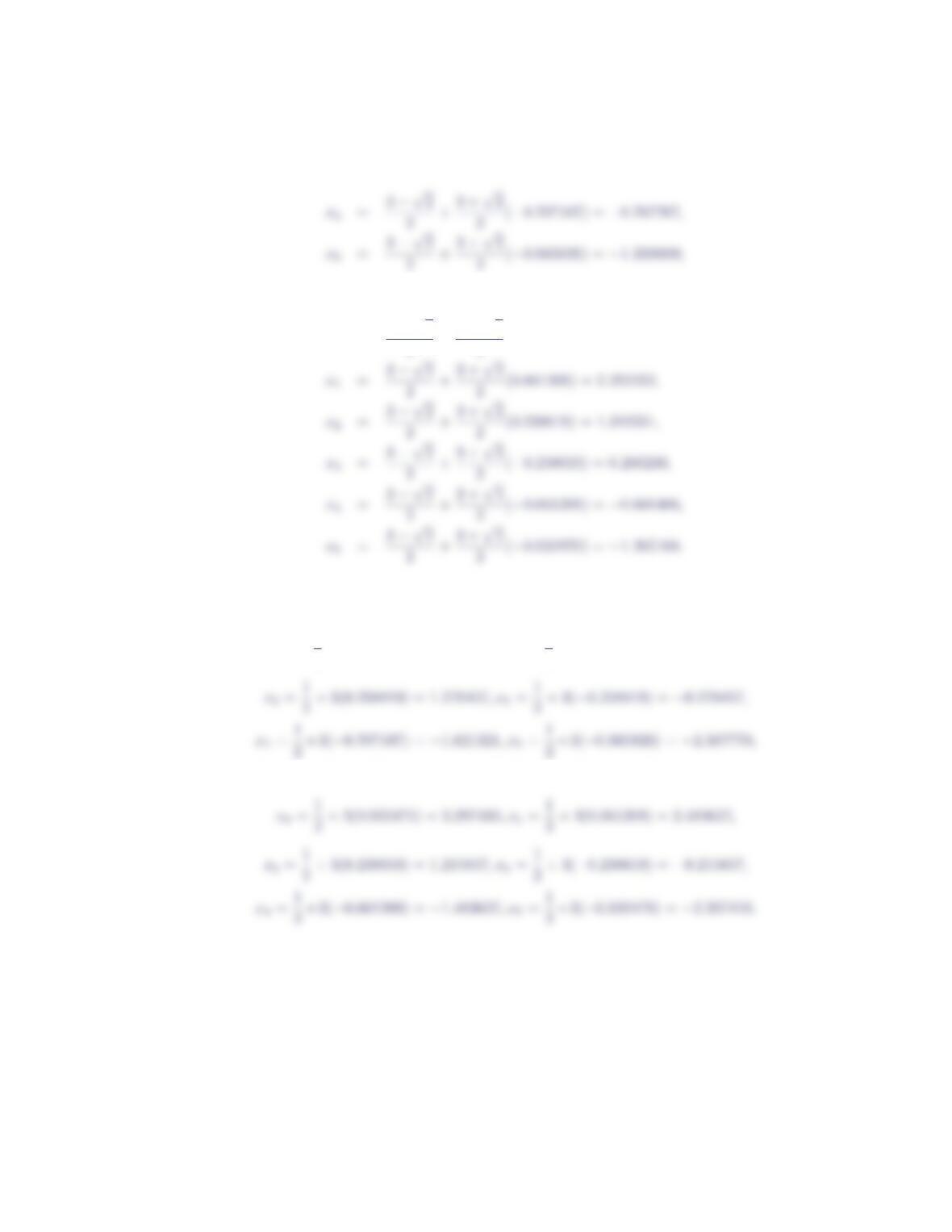
(d) Over [−√2,3], the l∞-norm of ω(x)is minimized with the interpolating points
x0=3−√2
2+3 + √2
2(0.965926) = 2.924795,
10 Section 5.4
the l2-norm of ω(x)is minimized with the interpolating points
x0=3−√2
2+3 + √2
2(0.932470) = 2.850954,
(e) Over [−2.5,3.5], the l∞-norm of ω(x)is minimized with the interpolating
points
x0=1
2+ 3(0.965926) = 3.397778, x1=1
2+ 3(0.707107) = 2.621321,
the l2-norm of ω(x)is minimized with the interpolating points
For Exercises 9 – 13, interpolate the given function over the specified interval by
a polynomial of the indicated degree. Interpolate at uniformly spaced points,
the Chebyshev points and the Legendre points, and compare the errors in the
resulting polynomials in both the l∞and the l2norm.
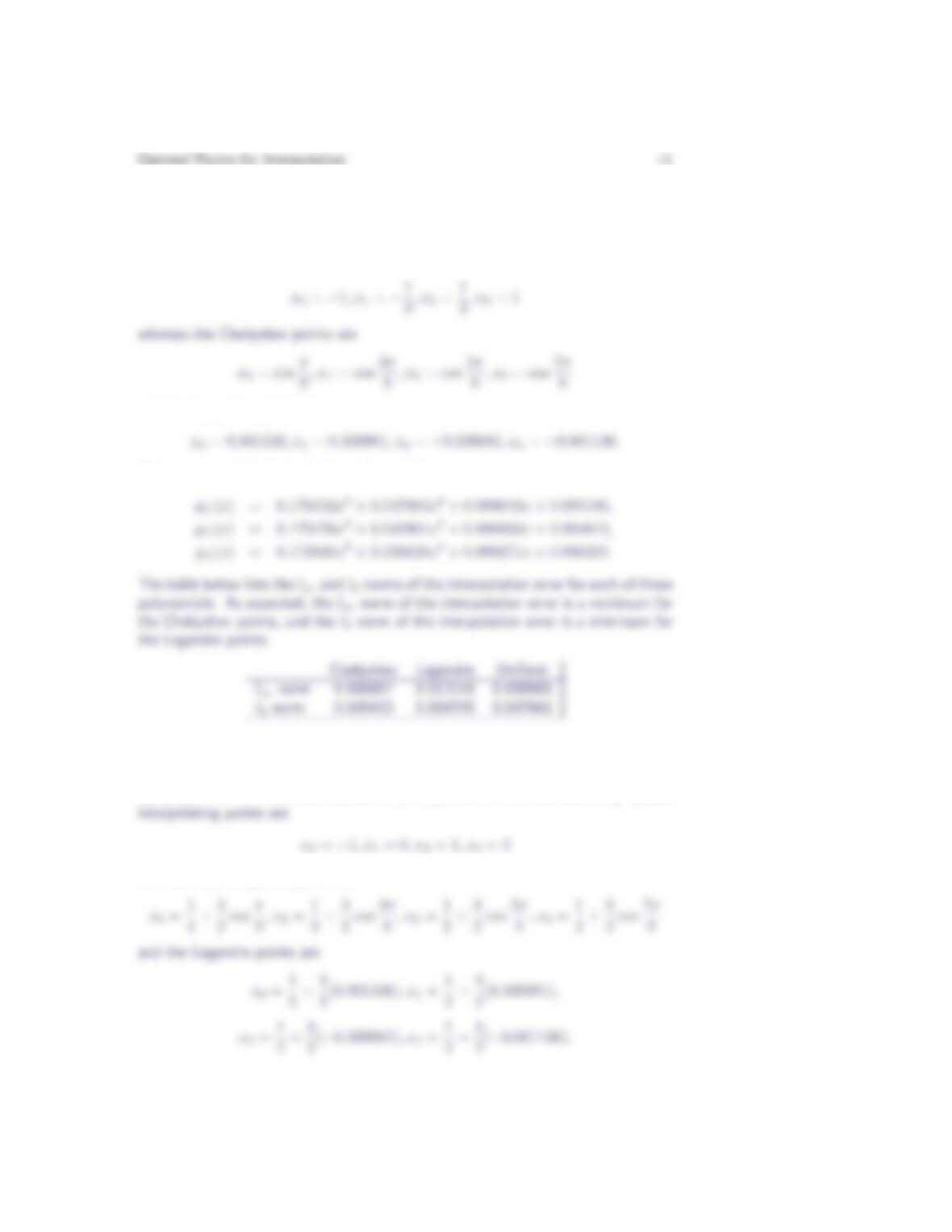
9. f(x) = ex, [−1,1], n= 3
Let f(x) = ex. With an interval of [−1,1] and n= 3, the uniformly spaced
interpolating points are
and the Legendre points are
The corresponding interpolating polynomials are
10. f(x) = e−x, [−1,2], n= 3
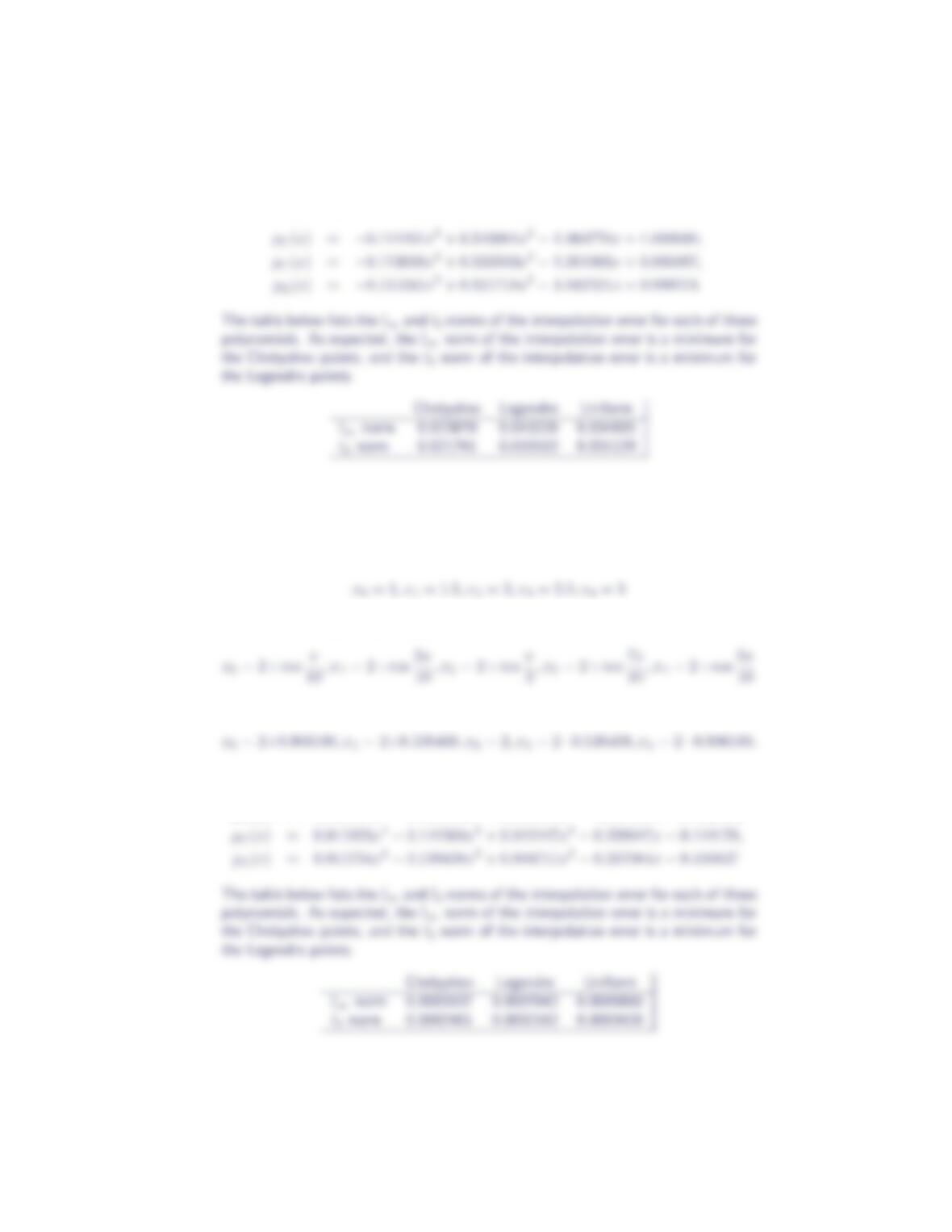
Let f(x) = e−x. With an interval of [−1,2] and n= 3, the uniformly spaced
whereas the Chebyshev points are
12 Section 5.4
The corresponding interpolating polynomials are
11. f(x) = xln x, [1,3], n= 4
Let f(x) = xln x. With an interval of [1,3] and n= 4, the uniformly spaced
interpolating points are
whereas the Chebyshev points are
and the Legendre points are
The corresponding interpolating polynomials are
pU(x) = 0.011937x4−0.141641x3+ 0.813054x2−0.240430x−0.442920,
Optimal Points for Interpolation 13
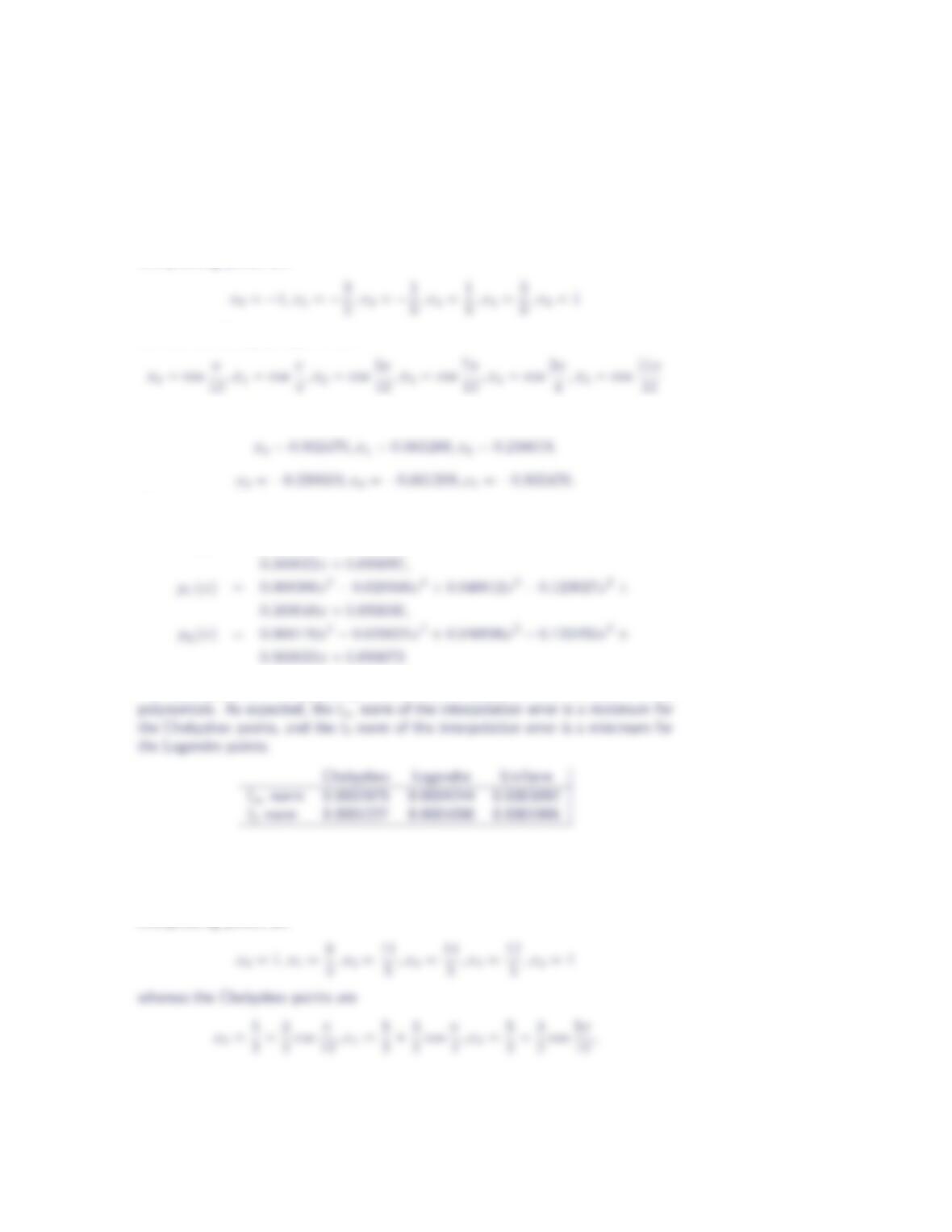
12. f(x) = ln(x+ 2), [−1,1], n= 5
Let f(x) = ln(x+ 2). With an interval of [−1,1] and n= 5, the uniformly spaced
interpolating points are
whereas the Chebyshev points are
and the Legendre points are
The corresponding interpolating polynomials are
pU(x) = 0.008238x5−0.020224x4+ 0.041046x3−0.123567x2+
The table below lists the l∞and l2norms of the interpolation error for each of these
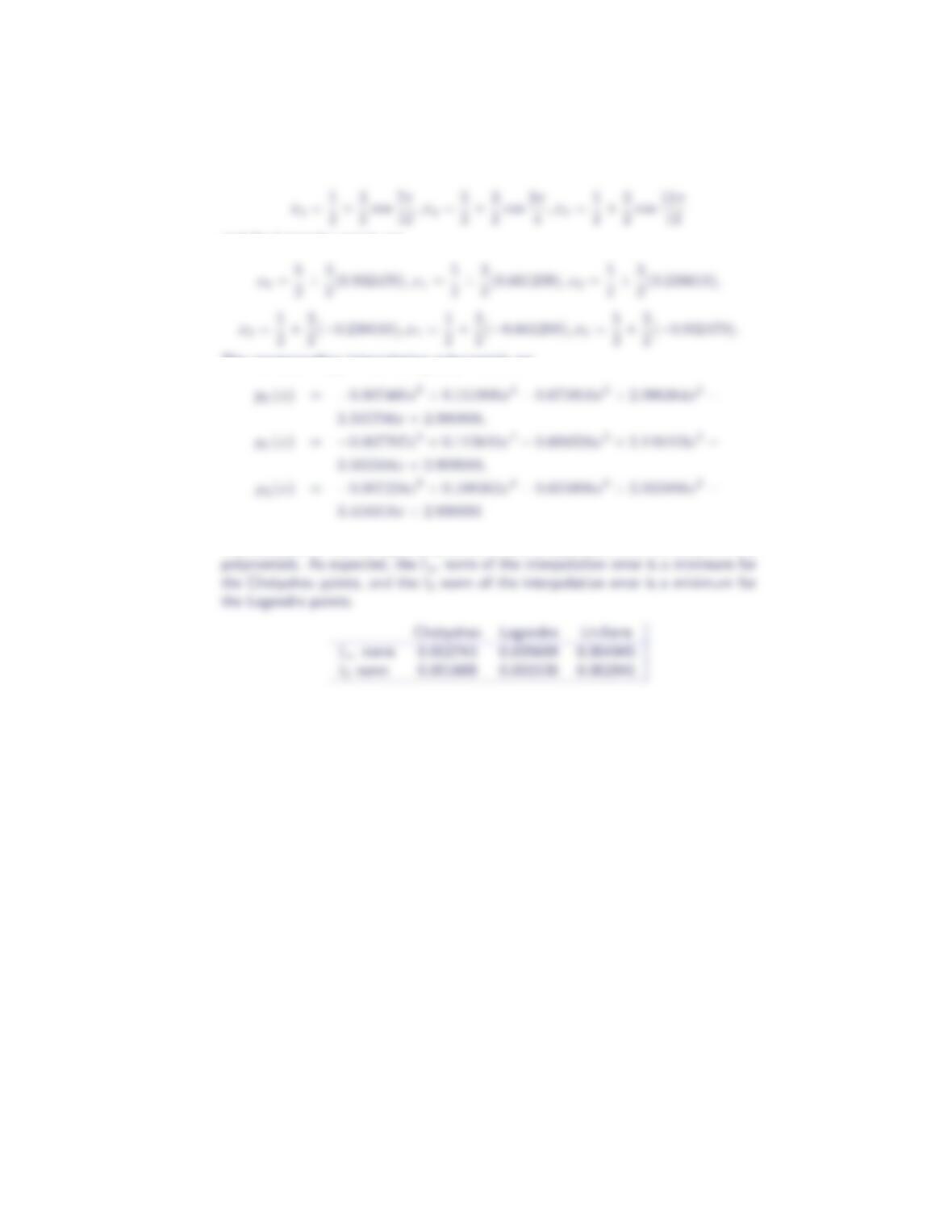
13. f(x) = 1/x, [1,4], n= 5
Let f(x) = x−1. With an interval of [1,4] and n= 5, the uniformly spaced
interpolating points are
14 Section 5.4
and the Legendre points are
The corresponding interpolating polynomials are
The table below lists the l∞and l2norms of the interpolation error for each of these