CHAPTER 5
S&S AIR’S MORTGAGE
1. The payment for a loan repaid with equal payments is the annuity payment with the loan value as the
PV of the annuity. So, the 30-year loan payment will be:
2. The interest payment is the beginning balance times the interest rate for the period, and the principal
payment is the total payment minus the interest payment. The ending balance is the beginning balance
minus the principal payment. The ending balance for a period is the beginning balance for the next
period. The amortization table for an equal payment mortgage is:
Year
Beginning
Balance
Total
Payment
Interest
Payment
Principal
Payment
Ending
Balance
1
$35,000,000.00
$212,098.17
$177,916.67
$34,181.51
$34,965,818.49
4
34,896,933.32
212,098.17
177,392.74
5
34,862,227.89
212,098.17
177,216.33
3. The bi-weekly payment is one-half of the 30-year traditional mortgage payment, or:
Bi-weekly payment = $212,098.17 / 2
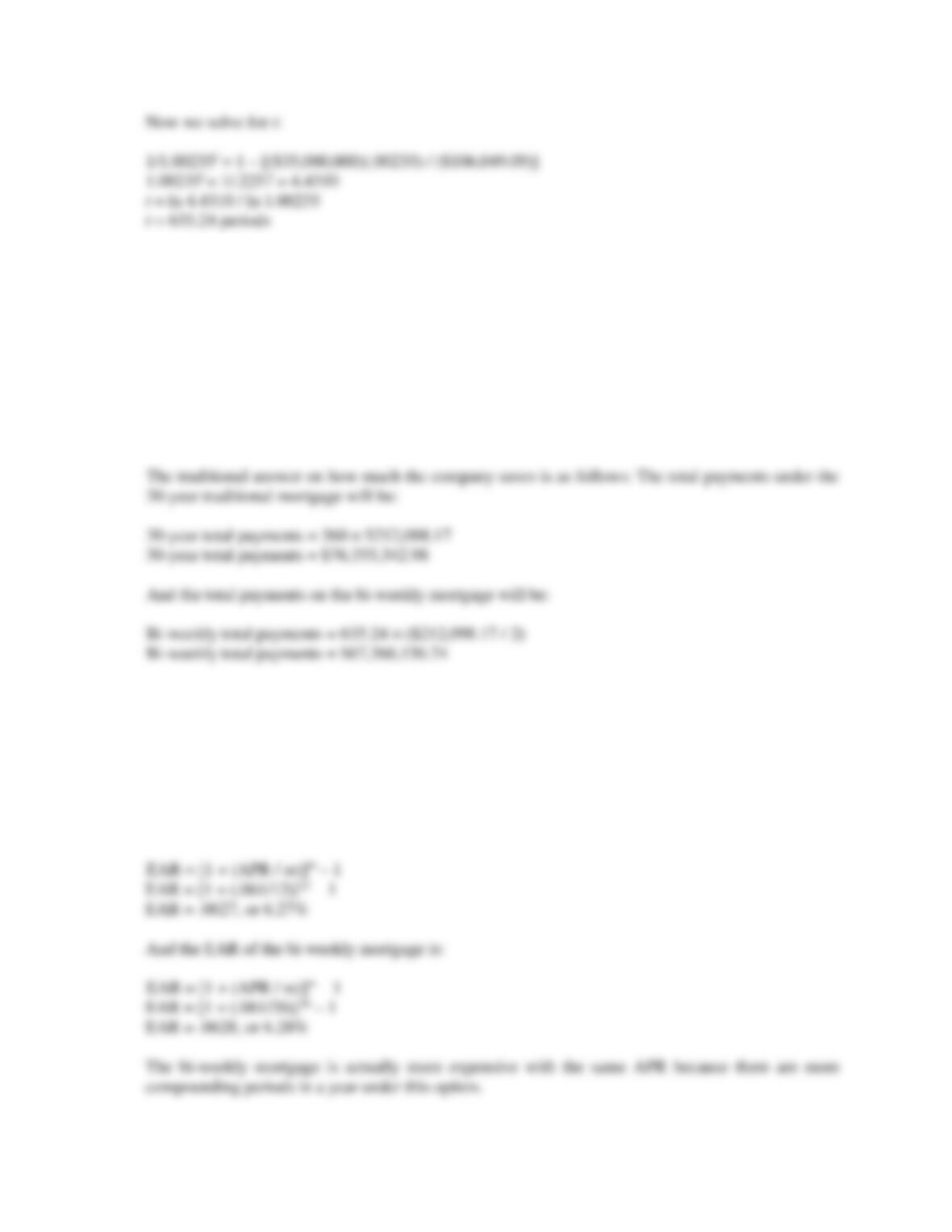
Since there are 26 bi-weekly periods in a year, the time necessary to pay of the bi-weekly mortgage
will be:
Bi-weekly payoff = 635.24 / 26
Bi-weekly payoff = 24.43 years
The bi-weekly payments pay off the loan quicker for two reasons. First, one-half of the payment gets
to the bank quicker each month, which reduces the interest that accrues each month. Second, the
company is actually making 13 full payments each year (26 bi-weekly periods amounts to 13 monthly
payments).
So, the traditional answer for how much the bi-weekly mortgage saves is the difference between these
two answers. Unfortunately, this calculation is very misleading. This is actually a “pseudo interest”
savings, which is caused by the different maturities of the loans. If the actual interest rate is 6.1 percent,
the present value of the two cash flows is still $35 million. More interest accrues in the 30-year
traditional mortgage because of the longer length, but the present value is still the same as the present
value of the bi-weekly mortgage, so the two mortgage cash flow streams are equivalent. In actual fact,
the bi-weekly mortgage is more expensive. We can see this by examining the EAR for the two loans.
The EAR of the monthly mortgage is:
4. The loan payments for the first 59 months are the same as the traditional 30-year mortgage, which is
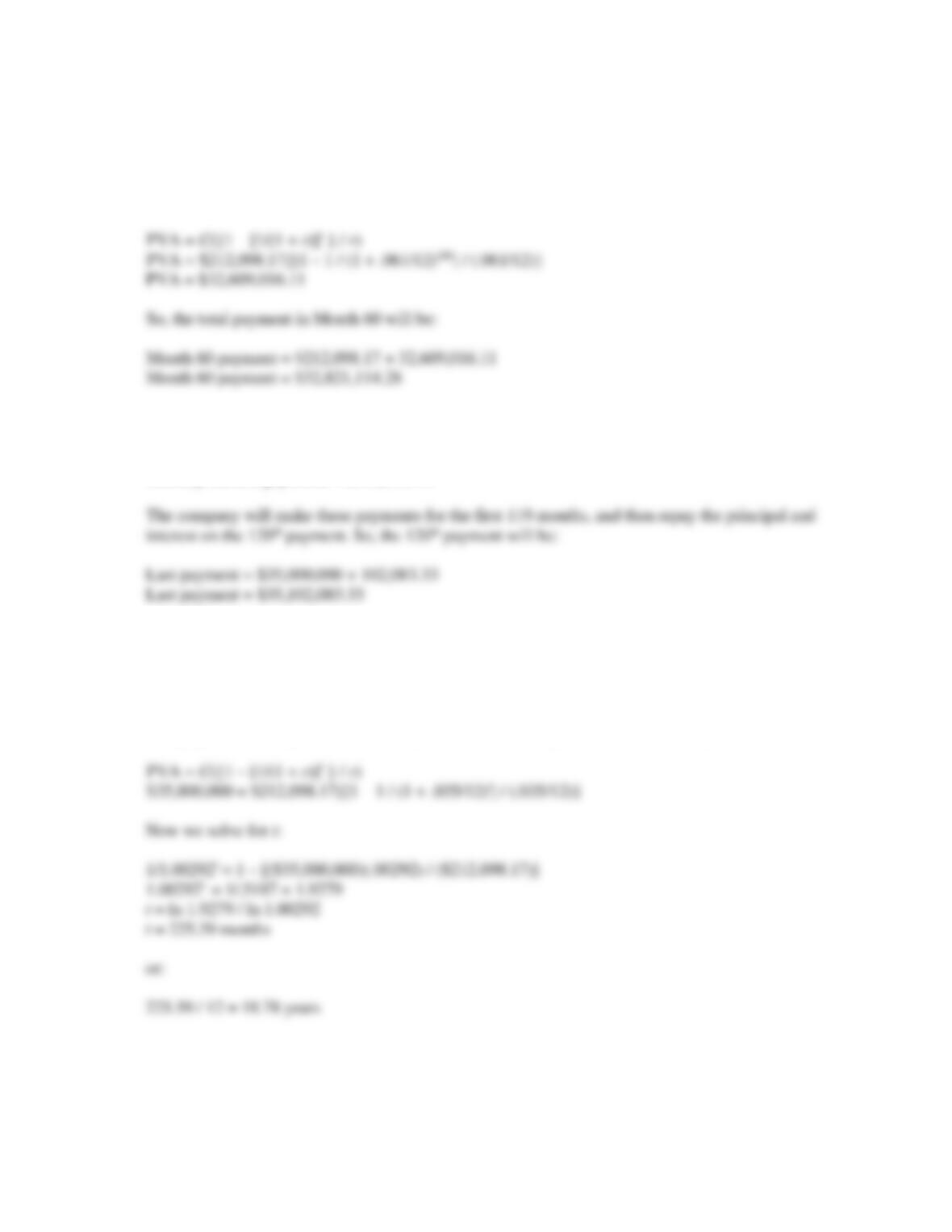
$212,098.17. This mortgage payment will be made in the 60th month as well, but the company will
also make the bullet payment. The bullet payment can be found by using an amortization table, but the
easier method is to find the present value of the remaining loan payments. The present value of the
remaining loan payments in Month 60 will be:
5. The interest-only loan requires only interest payments each month, which will be:
Monthly interest payments = $35,000,000(.035/12)
Monthly interest payments = $102,083.33
6. The best loan is the interest-only loan because it has the lowest interest rate. One risk of the loan is
that the company may not pay off the principal before maturity, which could mean it may refinance at
a higher rate in the future. Of course, the rate in the future could be the same, or even lower, but there
is still a refinancing risk. One way to show that the interest-only loan is the better option is to consider
what happens if the company makes the same payments as it would if took out the traditional 30-year
mortgage. If the company makes these payments, it would pay off the interest-only loan in: