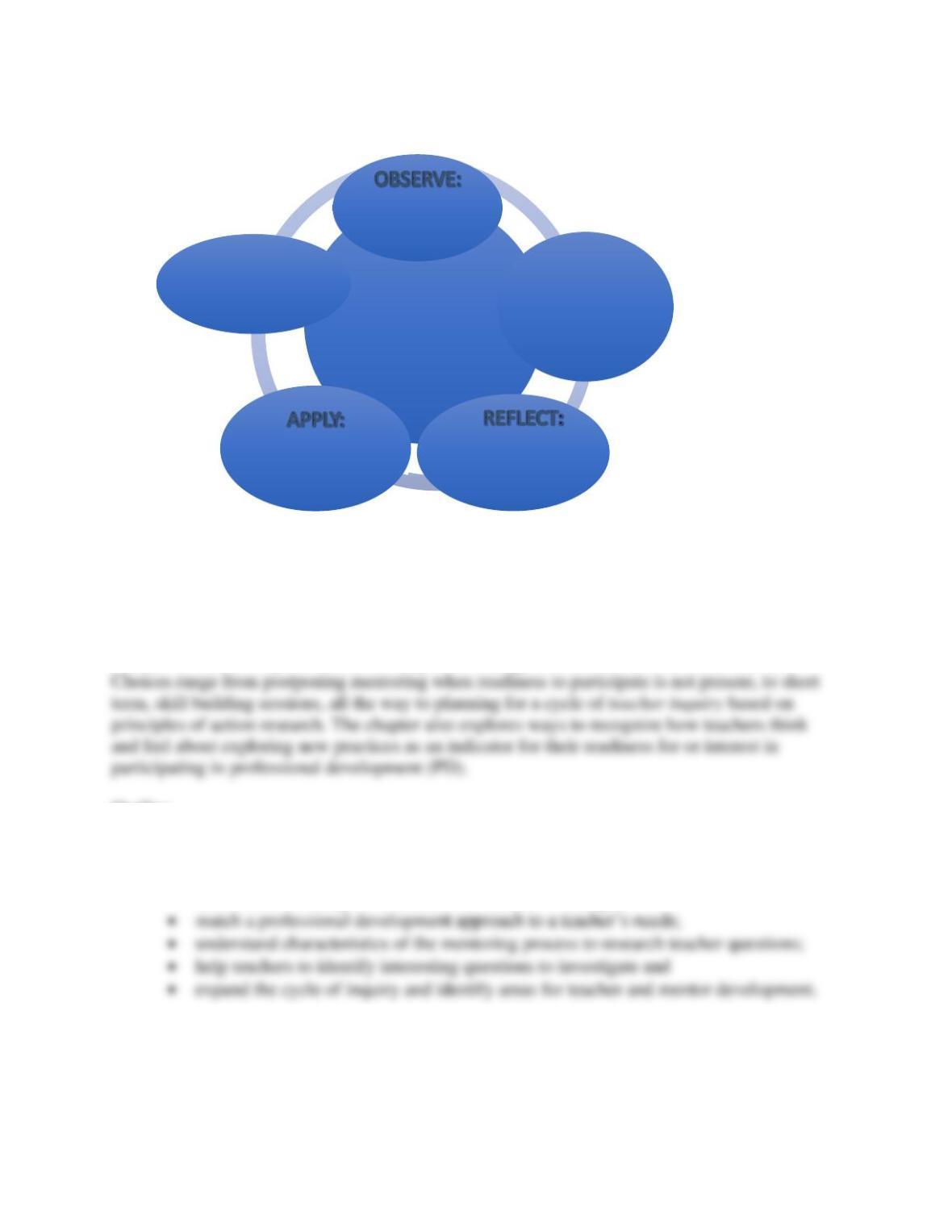
Chapter 5: Readiness for Change and Learning through Inquiry
Summary
Chapter 5 begins the second half of the book titled, Section II: Mentoring and Coaching for
Inquiry, Reflection and Leadership. Chapter 5 explores characteristics of the mentor-teacher
relationship required to identify a teacher’s readiness for change. Topics center on ways for
mentors to match the professional development strategy that best fits an individual teacher.
Outline
The chapter supports your growing capacity to
• understand and adapt to a teacher’s readiness for change;
Learner outcomes
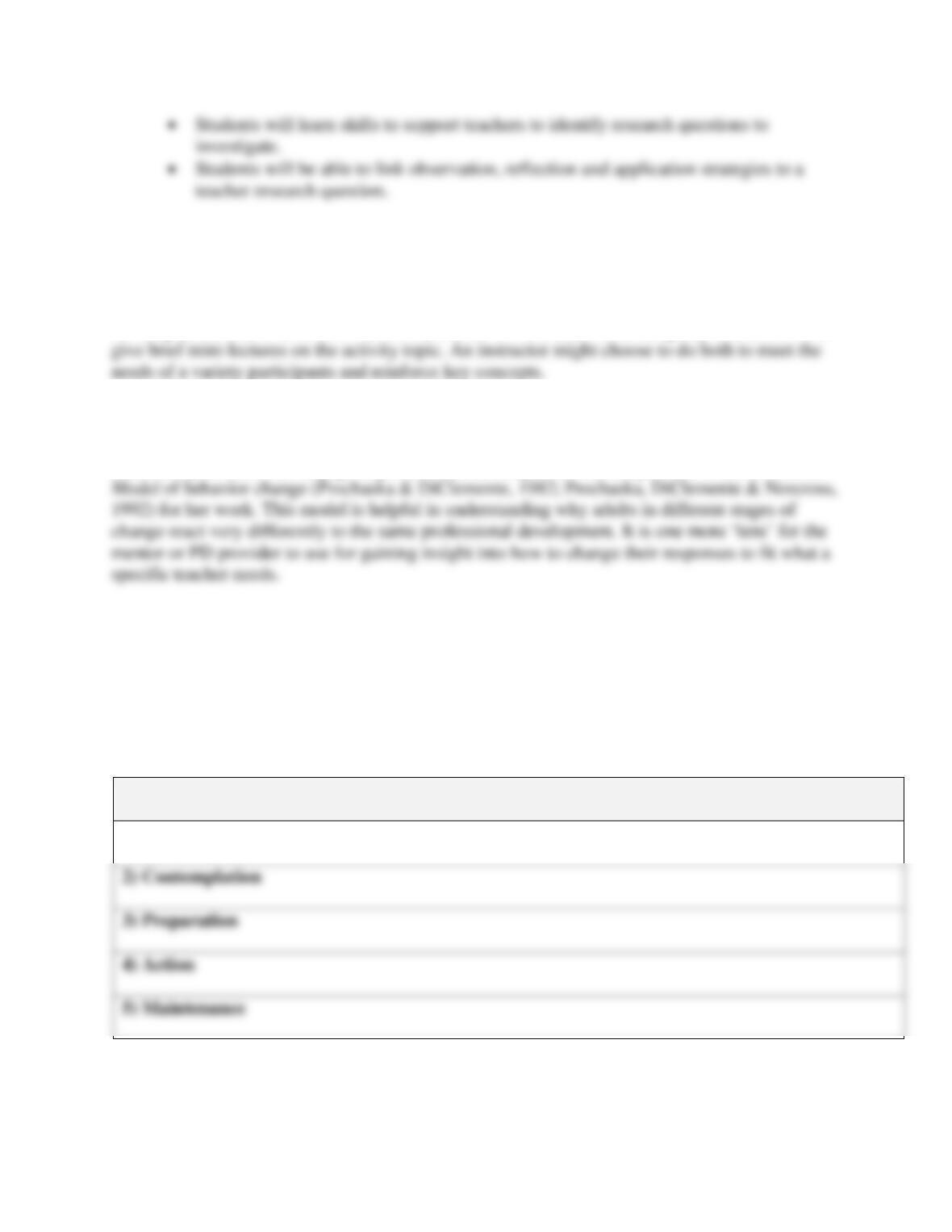
• Students will identify words and actions that may indicate readiness for change.
Readiness for
Change &
Learning through
Inquiry
understand
change
process
identify
change stage
& adapt
responses
action plan to
meet needs
make
meaning of
documentation
research
teacher Q’s
Suggested teaching activities
Note: All of the following activities assume the instructor has assigned this chapter to be read
before engaging in these activities.
An adaptation would be to have the texts available for reference for small group discussion or to
1. Readiness for Change
Mini-lecture: Peterson (2008) uses the ‘stages of change’ to help understand the behaviors of
child care providers who engage in professional development. She adapted the Transtheoretical
Activity-First Phase: Get participants into small groups. Give them a handout with the chart
below on it or project the image on a wall. Give the following directions:
Look at the chart provided and describe possible behaviors of an early childhood teacher who is
offered professional development in, for example, child guidance, and their possible responses
based on their ‘stage of change’ or readiness to consider new ideas. What might each of the five
different reactions be by a teacher in each stage?
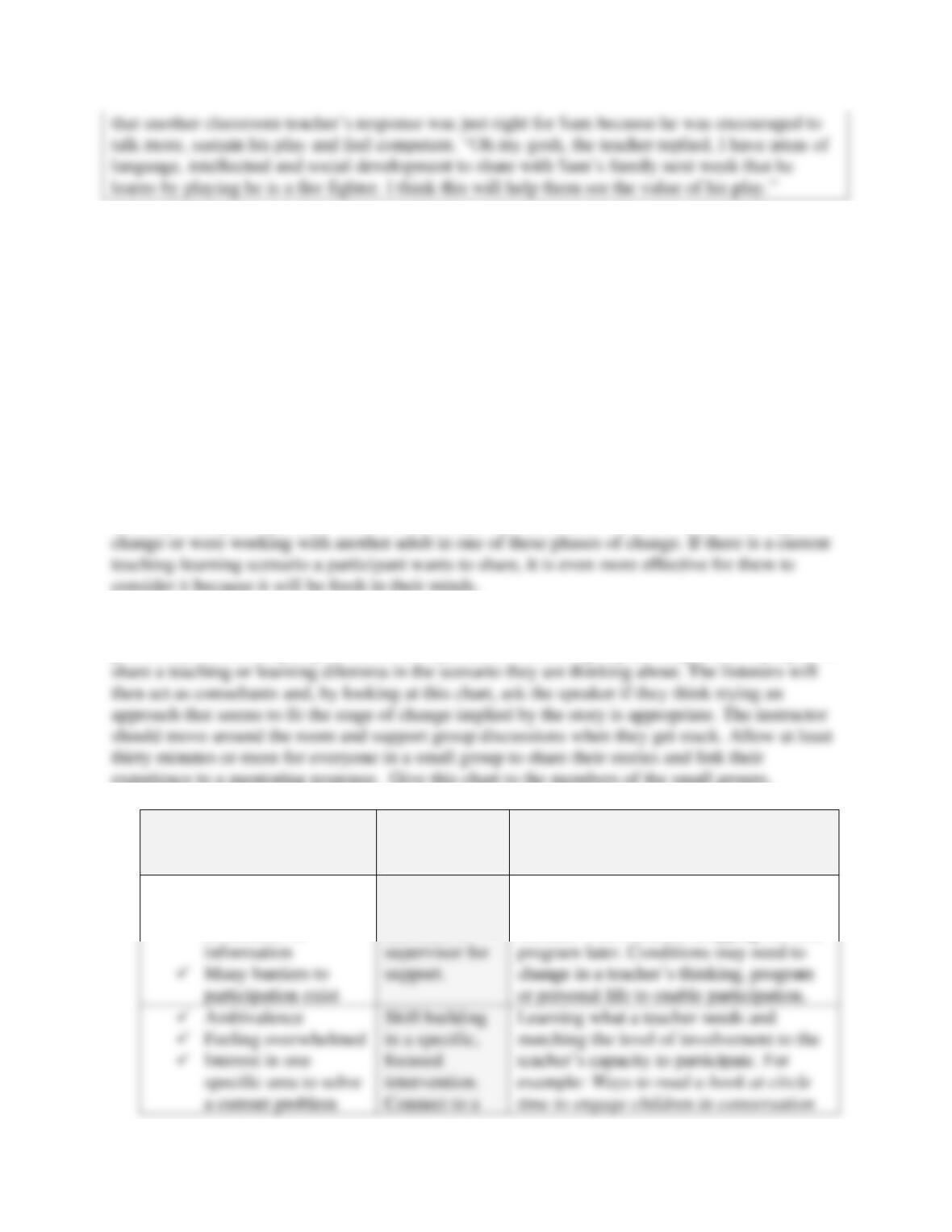
Stage of Change
1) Pre-contemplation
2) Contemplation
3) Preparation
5) Maintenance
Adaptation: Provide participants with the following dialogue and ask them to match it to the
stage of change.

Possible adult responses to an invitation to explore new ideas about child guidance practices
1) I really don’t have time for this. I didn’t ask to be part of this. Who sent you? What are you talking
about? ………Ok… I guess I am interested (Body language seems to says something else and
attention seems to be elsewhere. Leaves to do an important errand. Does not show up for next
session).
2) Sounds interesting but I have five other priorities that are more important than this.
I think it’s important but I just don’t see how I can really focus on it now.
3) Really!!! You are exactly what I need! I know this will be hard to find the time to do, but I can’t
think of a better use of my time. I have been asking the director for education on this topic.
4) I read a book on that topic and I want to ask you if what I am doing seems right for a child named
Tommy.
first.
Activity – Second Phase: Now ask participants to consider what their response would be if they
were the person providing the child guidance professional development. For experienced adult
Ways to support in the role of mentor or supportive peer
Choose the right strategy to support the stage of change of the teacher.
A) Listen and learn the person’s perspective. Ask how their current situation is working for them.
Wonder with them what a better situation might look like or simply let them know you or other
resources are available when they are ready to participate.
B) Ready for engaging in inquiry including observation, interpretation, feedback and problem solving
about a question of interest.
C) Acknowledge the change over time that has occurred and encourage modeling for others what has
been learned. Examine how to build in support through continuing involvement in professional
organizations or learning communities.
D) Learn the barriers, worries and concerns. Paraphrase back these concerns and encourage
participation through problem solving.
E) Learn the barriers, worries and concerns. Paraphrase back these concerns and encourage
participation through problem solving.
F) Work to develop a plan including providing information and skills needed to be successful.

Summarize: State the purpose of the activity again, to reinforce its importance and repeat a few
important insights participants noted while engaged in dialogue.
3. Learning Through Inquiry
Help Teachers Identify Interesting Questions to Investigate
Mini-lecture: The cycle of inquiry begins by turning a teacher concern, dilemma, or frustration
into a teacher question to investigate. If the teacher’s program is already using a curriculum or
Activity: Give the group a question to explore and practice what they might say and do with a
teacher they are mentoring (choose an age group, a program type, and paint a picture of this
teacher).
Research Question: How does Sam learn through play?
(Sam is a 20 month old in a morning Early Head Start program)
—————————————-—————————-——————————————
Activity Phase 1 – Direct a pair of participants to role play ‘mentor’ and ‘teacher of Sam’.
Direct them to assume they have already met and agreed to investigate how Sam learns through
OBSERVE: After taking anecdotal or narrative notes, highlight with the teacher areas of
interest. The teacher may do this or the mentor could model anecdotal or narrative note taking if
this is new to the teacher.
Example: “Sam (22 months) is wears a fire fighter hat. He picks up a toilet paper tube he finds
on the art table. He points the tube at a toy house and says “Whoooooo…..Out, fire!”
Large group debrief – After 5-10 minutes of paired discussion, get the group back together as a
large group and ask how the conversation went. Common challenges are mentors who want to

———————————————————————————————————-——–
Activity Phase II – Direct the mentor-teacher role playing pair to discuss the questions in the
REFLECT box here. This will require the ‘teacher’ to make up the facts of what she observed. If
this seems too abstract, provide the pairs with anecdotal notes from an actual teacher
observation.
REFLECT or make meaning of documentation: What does the observation tell about the
child’s strengths, interests, development, temperament, or learning strategies (or other area for
interpretation)? Help the teacher choose one area (inspired by their documentation of the child’s
Documentation interpretation example: “Sam uses one object to stand for another in his
pretend play.”
Mentor feedback example: The mentor suggested the teacher bring out the program’s Teaching
Strategies GOLD (2010) observation tool to begin the interpretation of the developmental
Large group debrief – After 5-10 minutes of paired discussion, get the group back together as a
large group and ask how the conversation went. Did ‘mentors’ help the teacher choose one area
of an observation to interpret? Did the ‘mentor’ break down the observation into bite size pieces
and help the teacher make meaning of their anecdotal notes? What was hard for each person to
share? Was natural or easy in the conversation?
—————————————-–———————————————————–—————–
Activity Phase III – Direct the mentor-teacher role playing pair to discuss the questions in the
APPLY: Action plan to meet needs of the child will be developed.
Example of documentation: “I see you have a hose to spray the fire with water.” Sam replies,
“Fire all wet. Gone!”
Mentor feedback example: The mentor should ask and listen for new or different insights from
Extension of activity: If participants are currently working in a teacher-mentor pair, encourage
the use of the Assessment of program conditions to support teacher inquiry (figure 5.2) form to
evaluate their progress.
Purpose: To better understand the role of the mentor in promoting teacher thinking. To use the
observe-reflect-apply process of inquiry to foster the beginnings of one way to encourage teacher
research.
4. Understand Change Process
This activity will go into more depth and reinforce the first activity in this chapter. By doing this
you will be modeling how central understanding the change process is to any adult learning
partnership. This activity takes considerable time to be effective.
Activity: Ask participants to think of a time they may have either been in one of these stages of
consider it because it will be fresh in their minds.
Get participants into new small groups, with different people in them than they worked with
previously. Direct the groups to allow each person in the small group (no larger than 4 people) to
experience to a mentoring response. Give this chart to the members of the small groups.
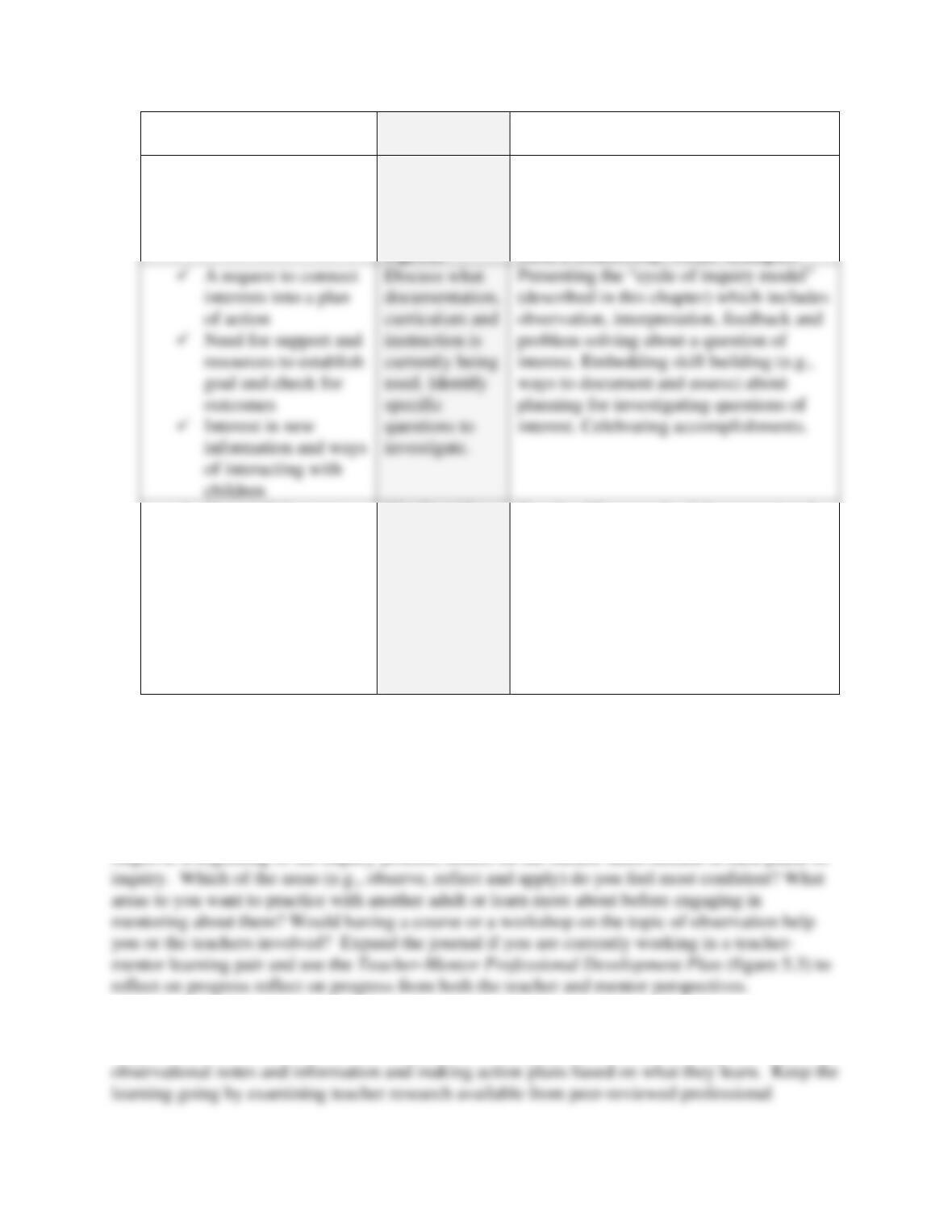
Teacher says or shows
behavior indicating:
Professional
Development
Options
Mentor responds by:
✓ Disinterest
✓ Defensiveness
✓ Avoidance of
Learn about
other resources
and refer to
Listening and learning the teacher’s
perspective. Forcing participation may
backfire with a teacher dropping out of a
role model on
site.
or five positive behavior management
strategies for the preschool teacher.
✓ A lack of confidence
✓ Is unsure about
participation but is
interested
Enroll “teacher
buddies” or a
cohort and
dialogue
together
build a relationship. Model strategies.
information and ways
of interacting with
specific
questions to
investigate.
planning for investigating questions of
interest. Celebrating accomplishments.
Noticing strengths, build on them and
dialogue about interests. Observing and
commenting on effective strategies used.
Taking time before teaching new skills to
✓ Unsure if they are
allowed to take time
out from teaching or
direct care to meet
with the mentor
Clarify with
both the
teacher and
supervisor the
roles,
responsibilities
& agreements
needed for
participation.
Develop Memoranda of Agreement and
involve administrators in the PD process.
Learn if the program has both the
willingness and the capacity to
participate. Consider how both the
teacher and program’s readiness for
change might be supported.
Purpose: To understand the value of listening to understand the stage of change a learner may be
in. To reinforce the ability, skill and knowledge to adapt mentoring responses to fit a learners
needs.
Journal – Refer to the mentor development self-reflection (figure 5.4)
After reading this chapter and participating in the activities, exploring teacher research, or the
Summary – Teacher Research
Support teachers to see themselves as capable of identifying a problem, collecting and analyzing

publications and other teacher websites. Examples of how teachers have reflected on their own
questions about their everyday practices can be inspirational to teachers being mentored. Online
resources include:
More suggested reading and resources
Forman, G. & Hall, E. (2005). Wondering with children: The importance of observation in early
education. Early Childhood Research & Practice, 7(2), 1-15. Retrieved from
http://ecrp.uiuc.edu/v7n2/forman.html.
Perry, G., Henderson, B. & Meier, D.R. (2012). Our inquiry, our practice: Undertaking,
supporting and learning from early childhood teacher research(ers). Washington, D.C.:
Peterson, S. M., Valk, C., Baker, A. C., Brugger, L., & Hightower, A. D. (2010). “We’re not
just interested in the work”: Social and emotional aspects of early educator mentoring
relationships. Mentoring & Tutoring: Partnership in Learning, 18(2), 155-175.
Prochaska, J. O., DiClemente, C.C., & Norcross, J.C. (1992). In search of how people change.
Applications to addictive behaviors. American Psychologist, 47: 1102-1114.
Prochaska, J. O., & DiClemente, C. C. (1982). Transtheoretical therapy: Toward a more
integrative model of change. Psychotherapy: theory, research and Practice, 19, 276–287.
Prochaska J.O.& Velicer, W.F. (1997). The Transtheoretical Model of health behavior change.