Accounting Information Systems, 10e 1
SOLUTIONS FOR CHAPTER 5
Discussion Questions
DQ 5-1 What are the basic components of a database management system (DBMS)?
Discuss the relationship between the above components of DBMS and the
functional model of information systems discussed in Chapter 1.
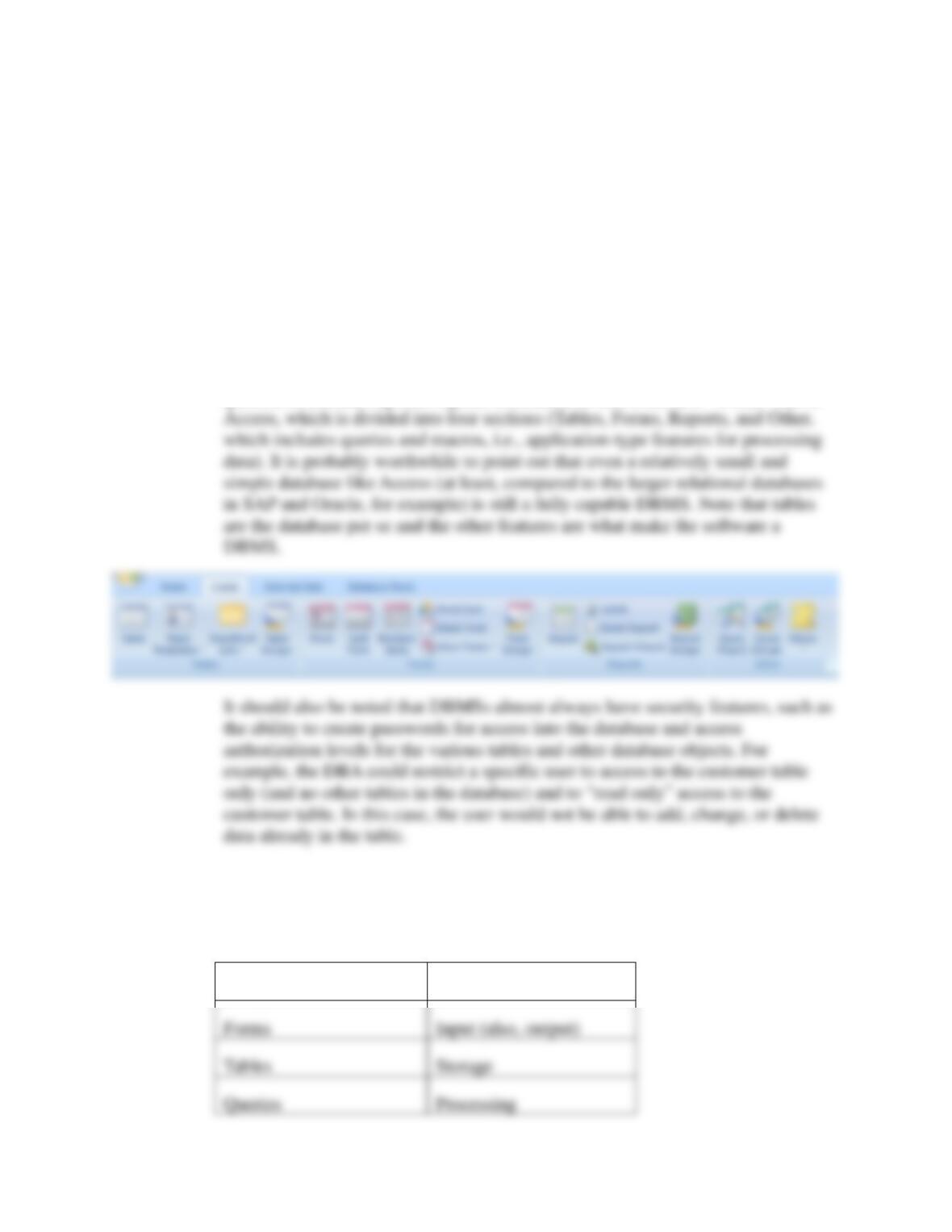
ANS. The four basic components (or features or functions) of a DBMS are tables,
queries, forms, and reports. A good illustration of this is the new “Create” tab in
The following table can be used for the discussion of the relationships between
(1) the above components of DBMS and (2) the functional model of information
systems discussed in Chapter 1:
Components of DBMS
Functional IS Model

2 Solutions for Chapter 5
DQ 5-2 How has the technological availability and implementation of DBMSs benefited
decision makers in organizations?
ANS. Database management systems have allowed access to cross-functional/cross-
application data providing insight to decision makers. For example, in an
DQ 5-3 What is data independence? Why is it important in a comparison of application
and database approaches to storing data?
ANS. Data independence means that the data is decoupled from the applications
(programs) that use the data. In a file management system, data is subordinate to,
DQ 5-4 How is a DBMS different from a database?
ANS.
“Database” refers only to the tables that store data, while DBMS also includes the
DQ 5-5 What are the differences between a logical view and a physical view of a
database? Which would be more important for accountants who are involved in
the design of a database that will store business event information?
ANS. Relational database tables are logical views of data that are physically stored in
Accounting Information Systems, 10e 3
DQ 5-6 What is three-tier architecture? What are some of its advantages over two-tier
architecture?
ANS. A three-tier architecture divides an IS into three parts—the user’s interface or
workstation, the applications (processing), and the database (input/storage). This
DQ 5-7 What problems are solved by transforming a set of relational tables from second
normal form (2NF) to third normal form (3NF)?
DQ 5-8 What are the different logical database models (or structures)?
ANS. The text discusses the following four:
• Hierarchical databases
– Child records may only have one parent record
4 Solutions for Chapter 5
DQ 5-9 “The database approach to data management is a good alternative to using
enterprise systems such as ERP and CRM.” Do you agree? Discuss fully.
ANS. Students should not agree with the statement. ERP and CRM systems are built on
DQ 5-10 Why have object-oriented databases not replaced relational databases in business
information system applications?
ANS. Although many researchers have argued that object-oriented DBMSs are superior
to relational DBMSs, most organizations still use relational DBMSs. These
DQ 5-11 Demonstrate your understanding of some of the coding schemes discussed in
Technology Summary 5.2 by indicating which type of code is represented by each
of the following. You should be prepared to explain and defend your answers.
ANS. The following coding schemes apply:
a. The student ID codes used at your college: This answer, of course, will vary
from institution to institution. For example, the student IDs at Bentley College
are assigned in straight sequential order.
Accounting Information Systems, 10e 5
b. MICR codes used by the banking industry: MICR codes that are imprinted on
bank checks and deposit slips evidence aspects of several different coding
schemes: significant digit, self-checking digit, and sequential.
For instance, bank checks typically have a nine-digit significant digit code,
located in the lower-left corner of the check, that is used for routing and
sorting the check. Assuming that these nine digits are 021302268, you could
analyze this code as follows:
The account number (let’s assume number 123407889 for our example) would
typically be another significant digit code, where the first two digits, 12, show
the account type and the next seven digits, 3407889, represent the specific
account.
Finally, the check number is an example of a sequential code.
c. The customer codes used in Figure 5.3: These codes, consisting entirely of
alphabetic characters, are examples of a mnemonic coding method. The code
DQ 5-12 What are the comparative advantages of the various data coding types discussed
in Technology Summary 5.2 when applied to each of the following? Discuss fully.
6 Solutions for Chapter 5
Note: In the following answer, we do not separate the discussion of employee,
vendor, and customer ID numbers because the factors that one would consider in
designing a coding scheme for each would be similar. Only when a particular
consideration would apply to one of the three and not to the others will we
mention it.
ANS. Some of the key points (in no order of importance) that students might have
included in their answers are the following:
• Computers manipulate numeric data more efficiently than they handle alpha
characters. On the other hand, humans usually find alphabetic codes easier to
Short Problems
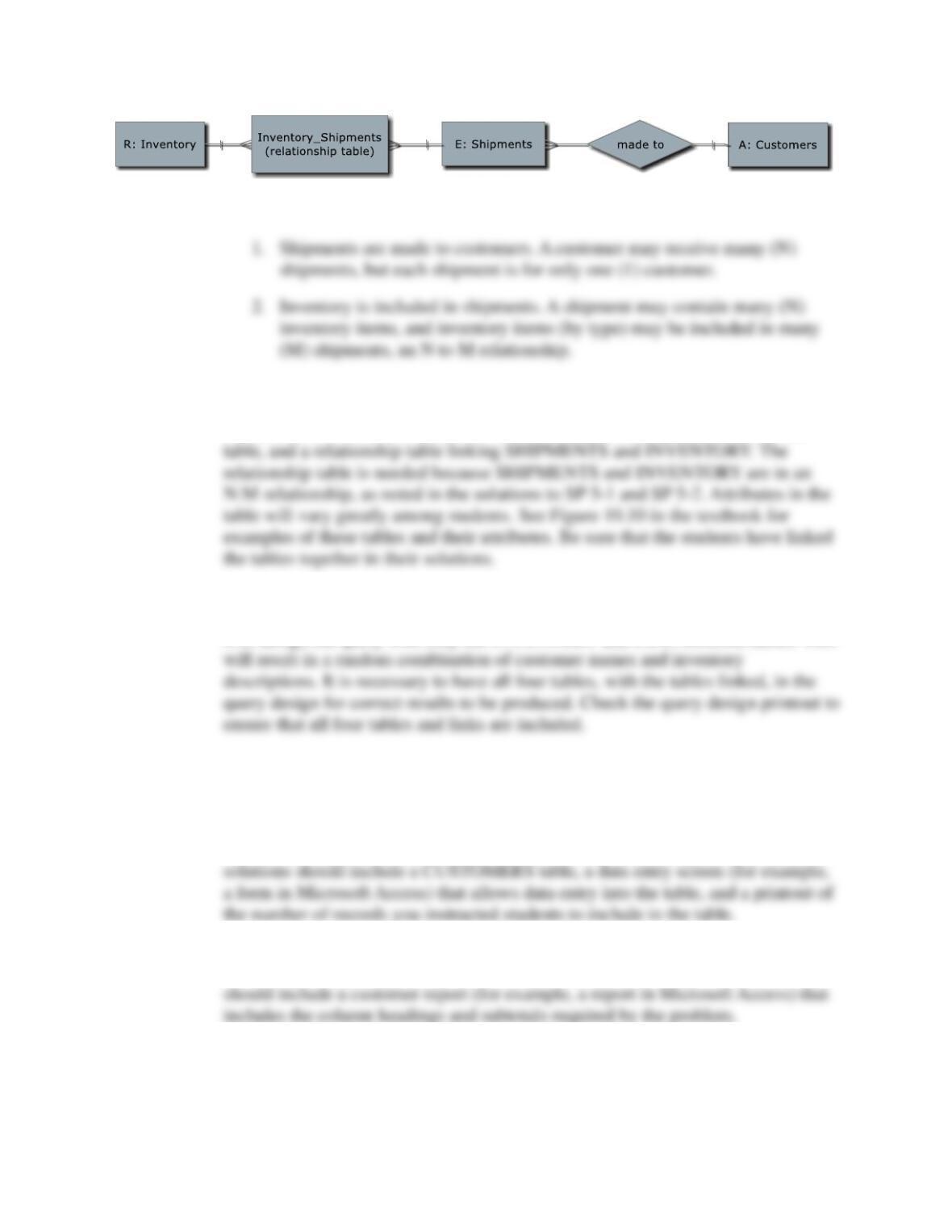
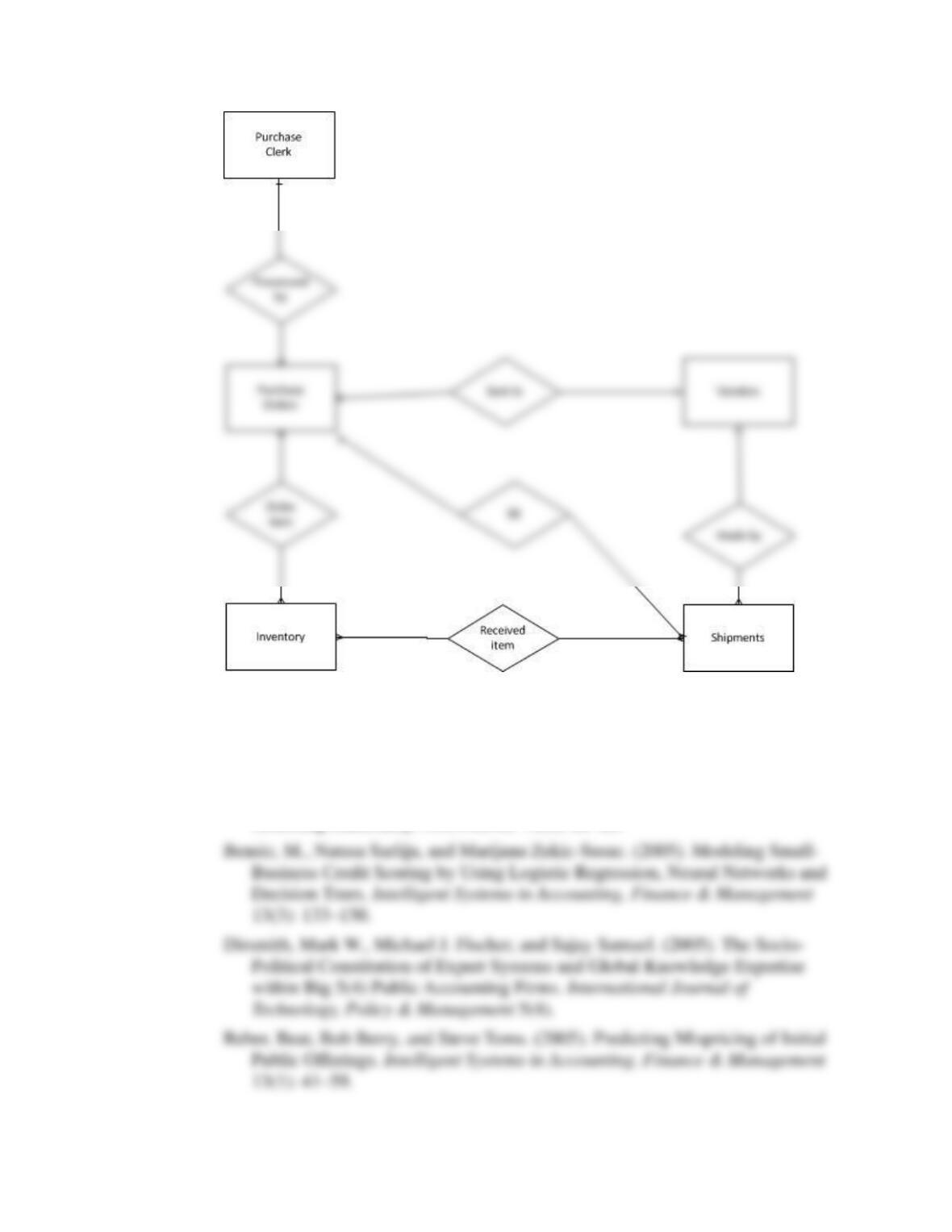
SP 5-1 ANS. Allowing for some variation among students, the solution should look like the
following E-R diagram in Visio:
Accounting Information Systems, 10e 7
SP 5-2 ANS. The two entity-relationship pairs might be described as follows:
SP 5-3 ANS. The solutions provided by your students will vary depending on which database
software package they use and their ability in using that package. The solutions
should include a CUSTOMERS table, a SHIPMENTS table, an INVENTORY
SP 5-4 ANS. The solutions provided by your students will vary depending on which database
software package they use and their ability in using that package. A common error
is to design the query with only the INVENTORY and CUSTOMERS tables. This
Problems
P 5-1 ANS. The solutions provided by your students will vary depending on which database
software package they use and their ability in using that package. In any case, the
P 5-2 ANS. The solutions provided by your students will vary depending on which database
software package they use and their ability in using that package. The solutions
8 Solutions for Chapter 5
P 5-3 ANS. The solutions provided by your students will vary depending on which database
software package they use and their ability in using that package. The solutions
P 5-4 ANS. The solutions provided by your students will vary depending on which database
software package they use and their ability in using that package. The solutions
P 5-5 ANS. The solutions provided by your students will vary depending on which database
software package they use and their ability in using that package. The solutions
should include four queries (called views in some database software). Some
students may document the queries by creating reports based on those queries, but
that is not required.
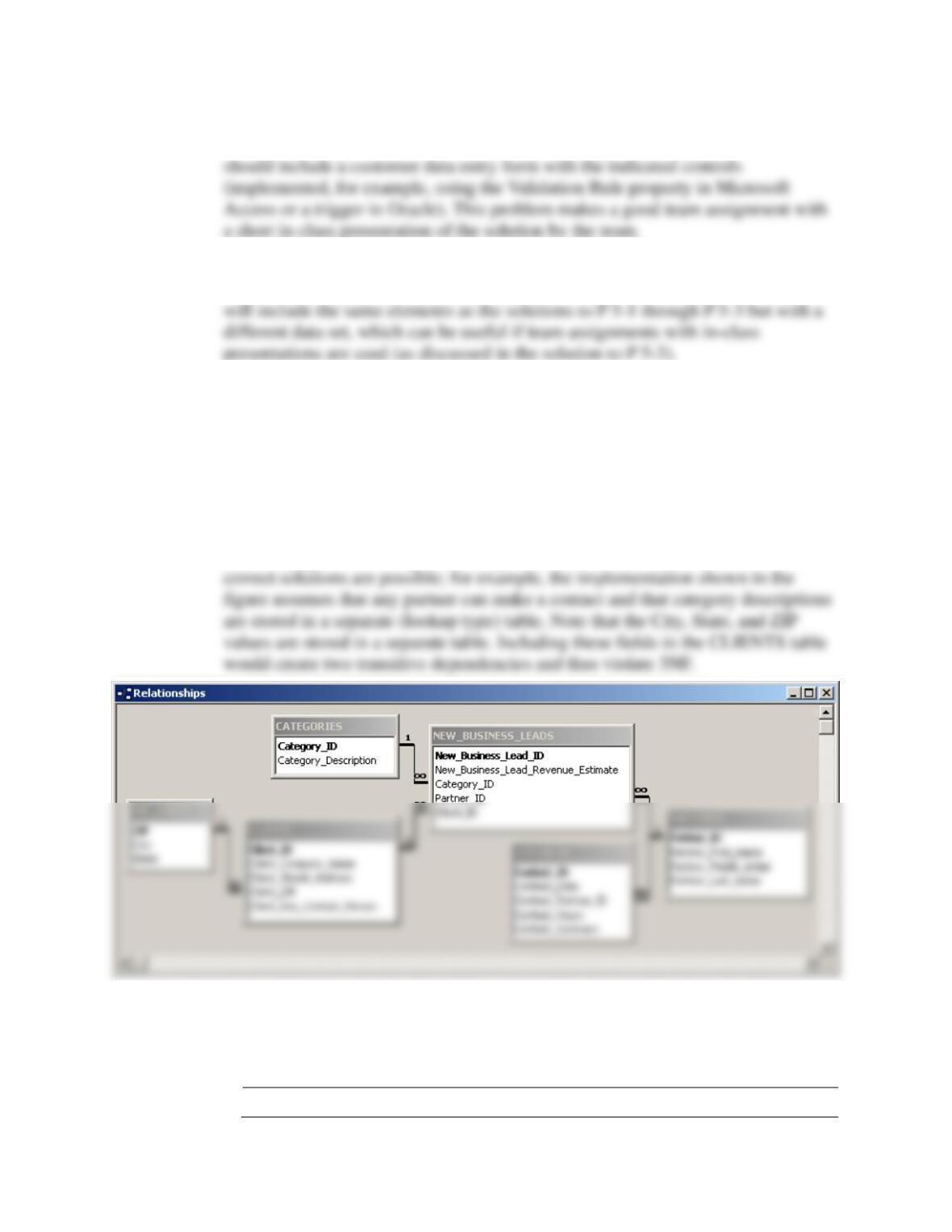
P 5-6 ANS. The solutions provided by your students will vary depending on which database
software package they use and their ability in using that package. The figure on
the next page shows one possible implementation in Microsoft Access. Other
P 5-7 ANS.
a. Students should classify the entities in this situation into the following
categories:
Resources
Events
Agents
Accounting Information Systems, 10e 9
INVENTORY
PURCHASE
ORDERS
VENDORS
SHIPMENTS
PURCHASE
CLERKS
b. The six entity-relationship pairs might be described as follows:
1. Purchase clerks process or generate purchase orders. Each purchase order
is processed by only one purchase clerk (1), but a purchase clerk can
process many purchase orders (N), a 1 to N relationship.
4. Purchase orders are filled by shipments. Each shipment is for one purchase
order (1), but many shipments (N) may be required to fill an order, a 1 to
N relationship.
5. Inventory items are received in shipments. Inventory items (M) may be
included in many shipments, and each shipment (N) may contain many
inventory items, an M to N relationship.
10 Solutions for Chapter 5
P 5-8 ANS. The papers developed by students in response to this problem will vary widely.
Some articles that might be useful to your students include the following:
Scott, Robert W. (2006, April). How Smart Is Business Intelligence? Accounting
Technology 22(3): 5.
Rosner, Rebecca L., Christie L. Comunale, and Thomas R. Sexton. (2006, June).
Assessing Materiality. CPA Journal 76(6): 26–28.
Accounting Information Systems, 10e 11
Koh, Hian Chye. (2004). Going concern prediction using data mining techniques.
Managerial Auditing Journal 19(3): 462–-476.
Hwang, S.-S., T. Shin, and I. Han (2004, February). CRAS-CBR: Internal control
risk assessment system using case-based reasoning. Expert Systems, 21(1):
22–33.
O’Leary, D. (2003, December). Auditor environmental assessments. International
Journal of Accounting Information Systems, 4(4): 275–294.
Mauldin, E. (2003, Spring). An experimental examination of information
technology and compensation structure complementarities in an expert system
context. Journal of Information Systems, 17(1): 19–41.
Herz, P., and J. Schultz (1999). The role of procedural and declarative knowledge
in performing accounting tasks. Behavioral Research in Accounting 11: 1–25.
Qureshi, A., J. Shim, and J. Siegel (1998, September). Artificial intelligence in
accounting and business, National Public Accountant 43(7): 13–18.
Davis, J., A. Massey, and R. Lovell (1997, December). Supporting a complex
audit judgment task: An expert network approach. European Journal of
Operational Research 103(2): 350–372.
12 Solutions for Chapter 5
Depending on the experience of your students in creating research papers, you
might want to provide them with some of this list or the entire list of articles to
get them started.
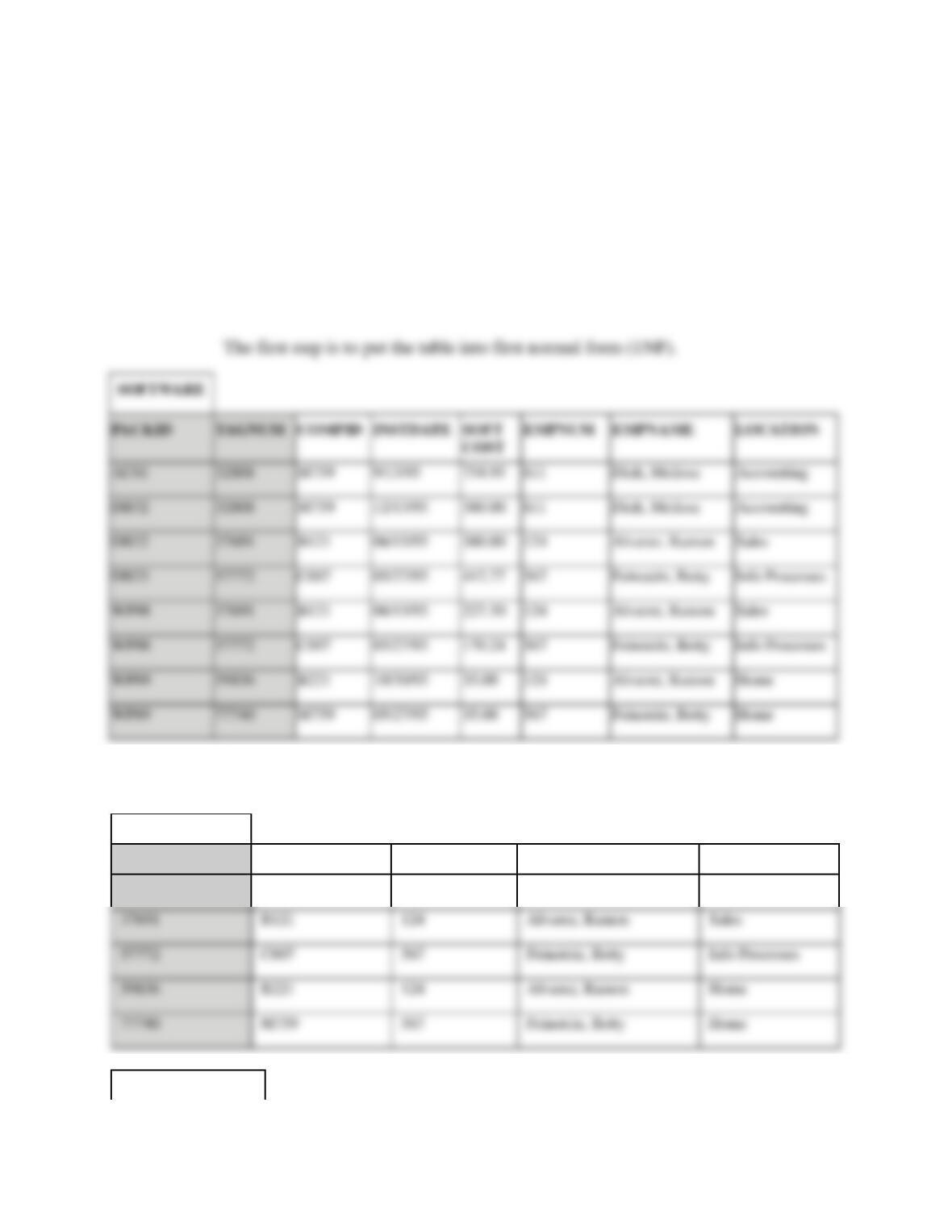
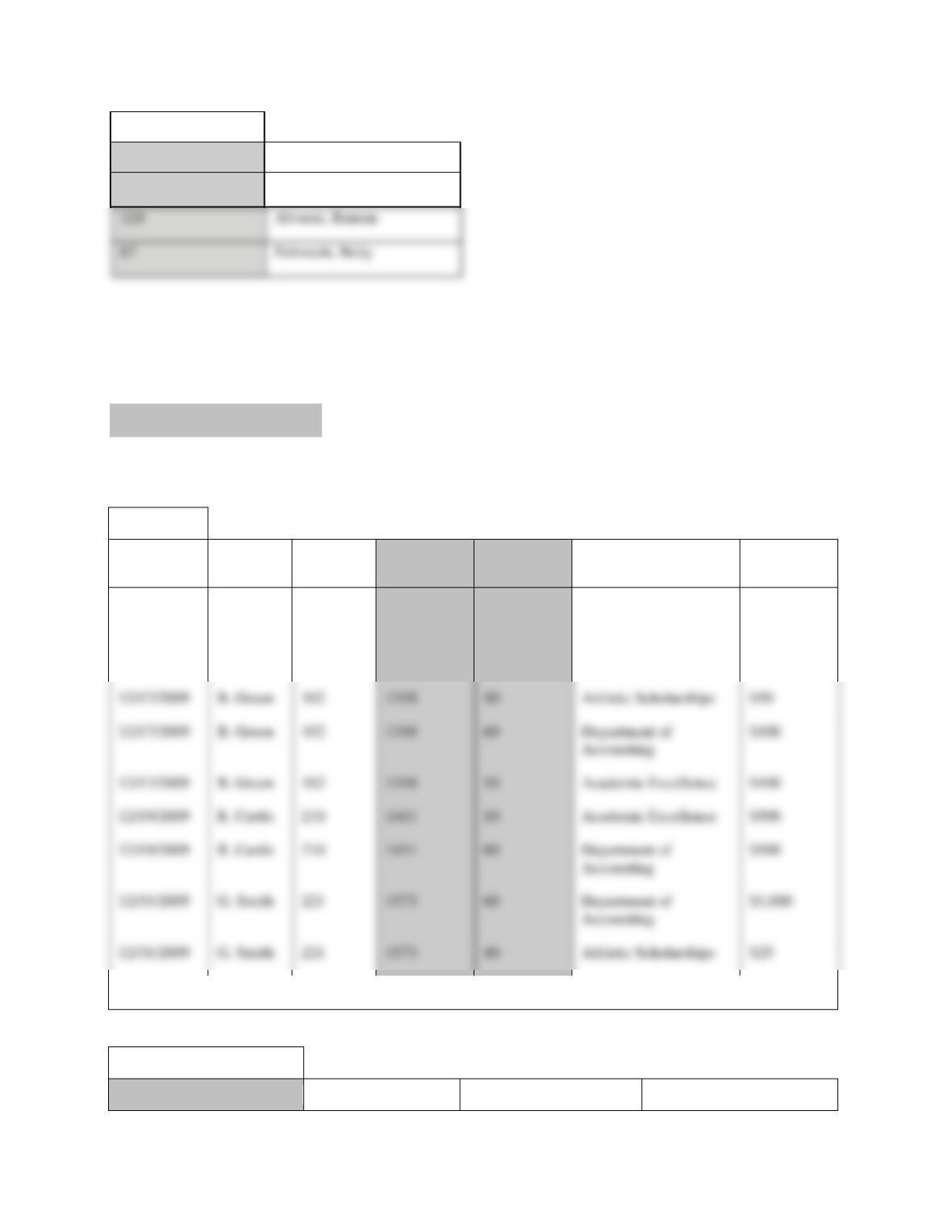
P 5-9 ANS. The table includes two transitive dependencies: COMPID is transitively
dependent on TAGNUMB, and EMPNAME is transitively dependent on
EMPNUM. Transforming this table into a set of relational tables that are in 3NF
requires the creation of three separate tables. A good way to accomplish this is to
move through first, second, and then third normal form transformations as
follows:
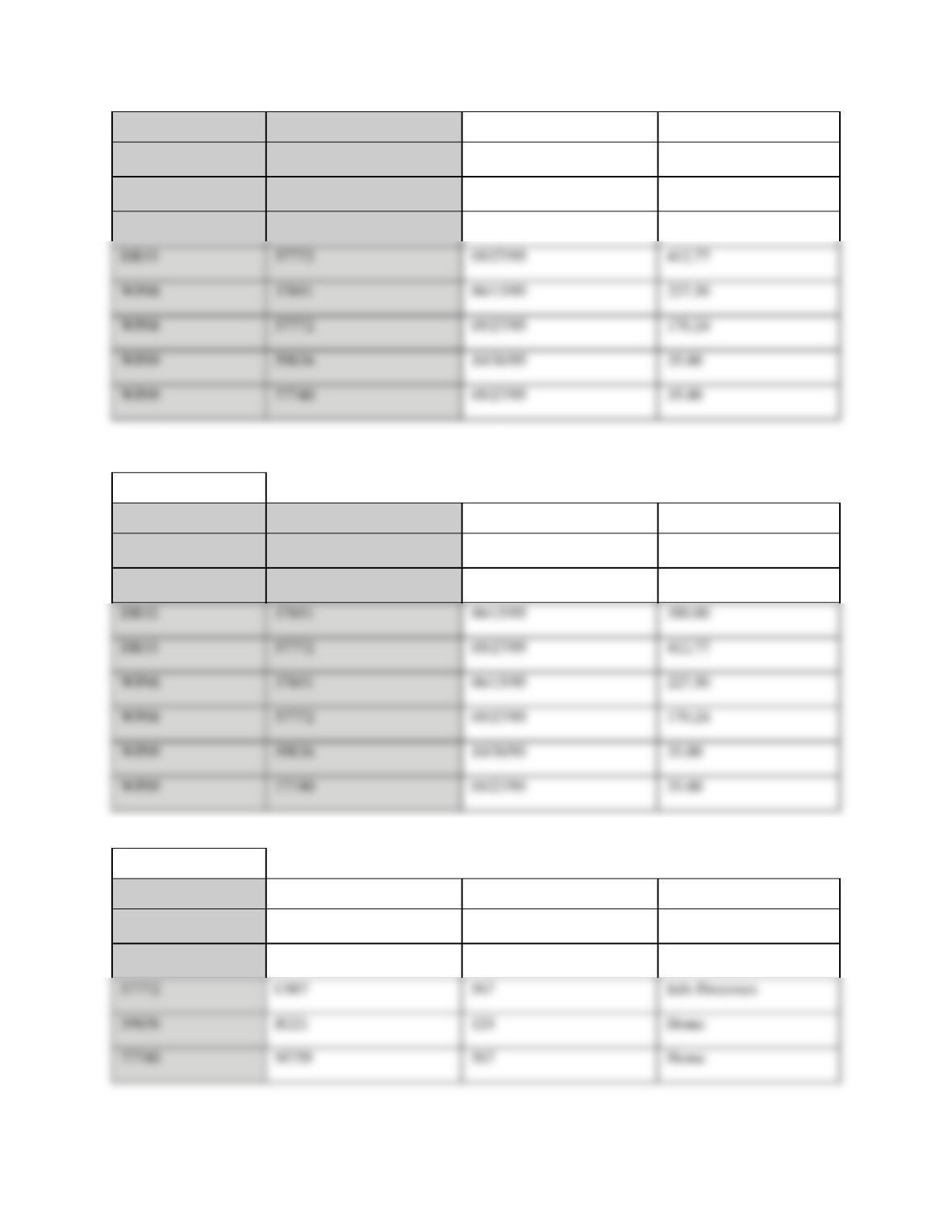
The following tables are in second normal form (2NF). Without any attributes
such as package name, there is no need for a relation with the key PACKID.
COMPUTER
TAGNUM
COMPID
EMPNUM
EMPNAME
LOCATION
32808
M759
611
Dinh, Melissa
Accounting
37691
B121
Alvarez, Ramon
Sales
59836
B221
Alvarez, Ramon
Home
77740
Feinstein, Betty
Home
SOFTWARE
Accounting Information Systems, 10e 13
PACKID
TAGNUM
INSTDATE
SOFTCOST
AC01
32808
9/13/95
754.95
DB32
32808
12/13/95
380.00
DB32
37691
06/15/95
380.00
The following tables are in third normal form (3NF).
SOFTWARE
PACKID
TAGNUM
INSTDATE
SOFTCOST
AC01
32808
9/13/95
754.95
DB32
32808
12/13/95
380.00
37691
06/15/95
227.50
WP08
57772
05/27/95
170.24
WP09
59836
10/30/95
35.00
WP09
77740
05/27/95
35.00
COMPUTER
TAGNUM
COMPID
EMPNUM
LOCATION
32808
M759
611
Accounting
37691
B121
124
Sales
59836
B221
124
Home
DB33
57772
05/27/95
412.77
WP08
37691
06/15/95
227.50
WP09
59836
10/30/95
35.00
WP09
77740
05/27/95
35.00
14 Solutions for Chapter 5
EMPLOYEE
EMPNUM
EMPNAME
611
Dinh, Melissa
P 5-10 ANS.
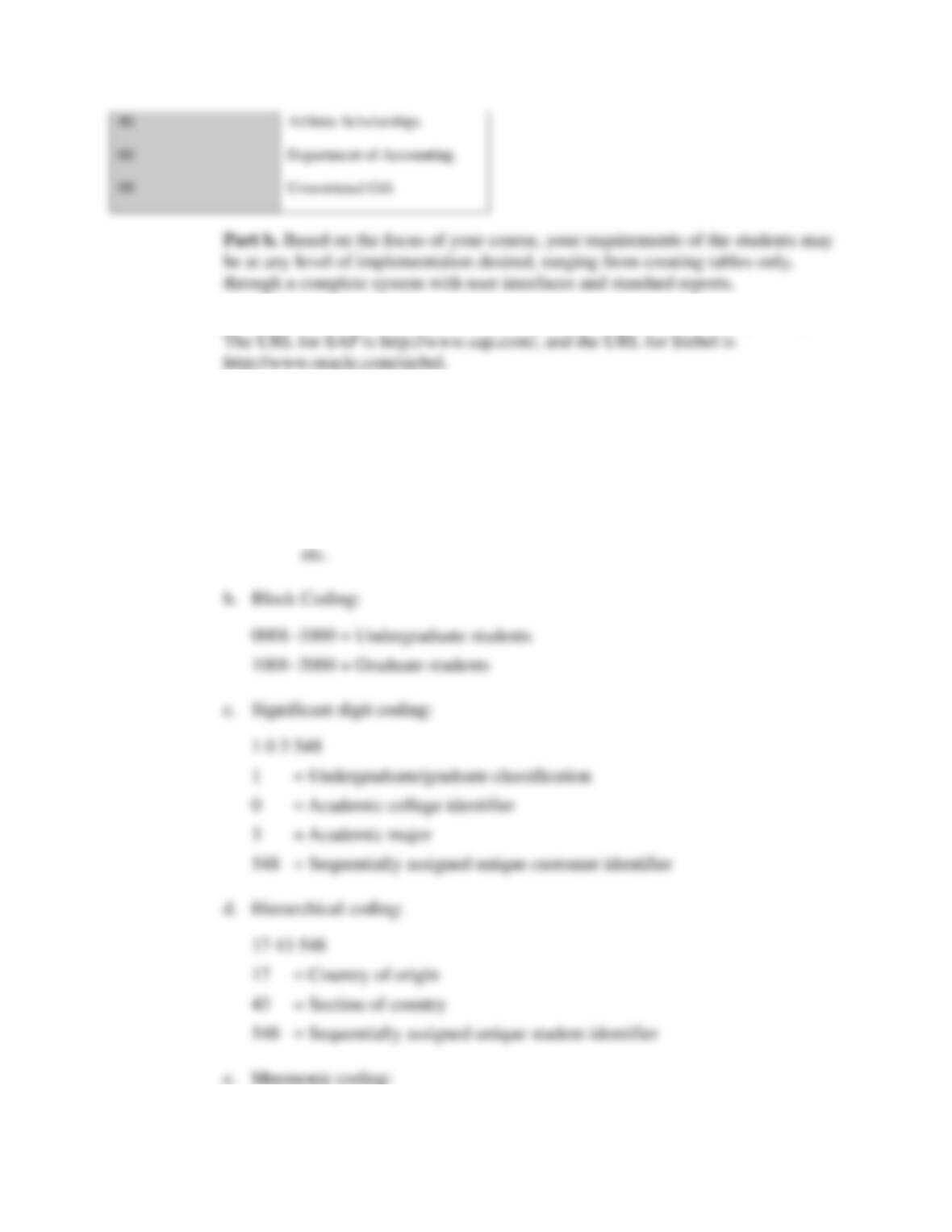
Part a.
Shaded Attribute(s)
= Primary Key
First Normal Form (1NF)
Gift
Date
Donor
Name
Donor
Number
Receipt
Number
Fund ID
Fund Name
Amount
12/5/2009
A. Eddy
109
1201
10
Academic Excellence
$100
12/5/2009
A. Eddy
109
1201
40
Athletic Scholarships
$100
12/17/2009
B. Lester
116
1317
99
Unrestricted Gift
$500
12/17/2009
B. Green
Athletic Scholarships
Accounting
12/17/2009
B. Green
102
1318
10
Academic Excellence
$100
12/19/2009
R. Curtis
210
1411
10
Academic Excellence
$500
Accounting
Accounting
12/31/2009
G. Smith
221
1573
40
Athletic Scholarships
$25
Second Normal Form (2NF)
Receipt
Receipt Number
Date
Donor Name
Donor Number
124
Alvarez, Ramon
67
Feinstein, Betty

Accounting Information Systems, 10e 15
Fund
Fund ID
Fund Name
10
Academic Excellence
40
Athletic Scholarships
60
Department of Accounting
99
Unrestricted Gift
Gift
Receipt Number
Fund ID
Amount
1201
10
$100
1317
99
$500
1318
40
$50
1318
60
$100
1318
10
$100
1411
10
$500
1411
60
$500
1573
60
$1,000
1573
40
$25
Third Normal Form (3NF)
Receipt
Receipt Number
Date
Donor Number
1201
12/5/2009
109
1317
12/17/2009
B. Lester
116
1318
12/17/2009
B. Green
102
1411
12/19/2009
R. Curtis
210
1573
12/31/2009
G. Smith
221

16 Solutions for Chapter 5
Gift
Receipt Number
Fund ID
Amount
1201
10
$100
1201
40
$100
1317
99
$500
1318
40
$50
1318
60
$100
1318
10
$100
1411
10
$500
1573
60
$1,000
1573
40
$25
Donor
Donor Number
Donor Name
109
A. Eddy
116
B. Lester
102
B. Green
221
G. Smith
Fund
Fund ID
Fund Name
10
Academic Excellence
Receipt
Receipt Number
Date
Donor Number
1317
12/17/2009
116
1318
102
1411
12/19/2009
210
1573
12/31/2009
221
Accounting Information Systems, 10e 17
P 5-11 ANS. The papers developed by students in response to this problem will vary widely.
P 5-12 ANS. The following student coding schemes illustrate the coding types described in
Technology Summary 5.2.
a. Sequential (serial) coding:
001 = First student
002 = Second student.
18 Solutions for Chapter 5
SSMITH = Stan Smith
MHAMMER = Mike Hammer
P 5-13 ANS. The solutions developed by students in response to this problem will vary
1. Promotes sharing and collaboration of organizational knowledge and
intellectual assets
2. Easy access to new content
3. Automatic notifications and alerts of new and edited documents
P 5-14 ANS. The simplest decision model would be to assign all twelve factors equal
decision weights, either 1 if the factor is positive (e.g., apartments come with
washers and dryers) or 0 if negative (e.g., apartments do not have washers and
dryers). If this model is used, then all of the apartments have the same resulting
decision value (= 6), since each apartment has 6 positive and 6 negative factors.