Problem 5-28 (continued)
4.
Incremental contribution margin:
$20,000 increased sales × 60% CM ratio ………..
$12,000
Less incremental fixed salary cost ……………………
8,000
Increased net operating income ………………………
$ 4,000
Yes, the position should be converted to a full-time basis.
Problem 5-29 (75 minutes)
1.
a.
Selling price …………………
$37.50
100%
Variable expenses …………
22.50
60%
Contribution margin ……….
$15.00
40%
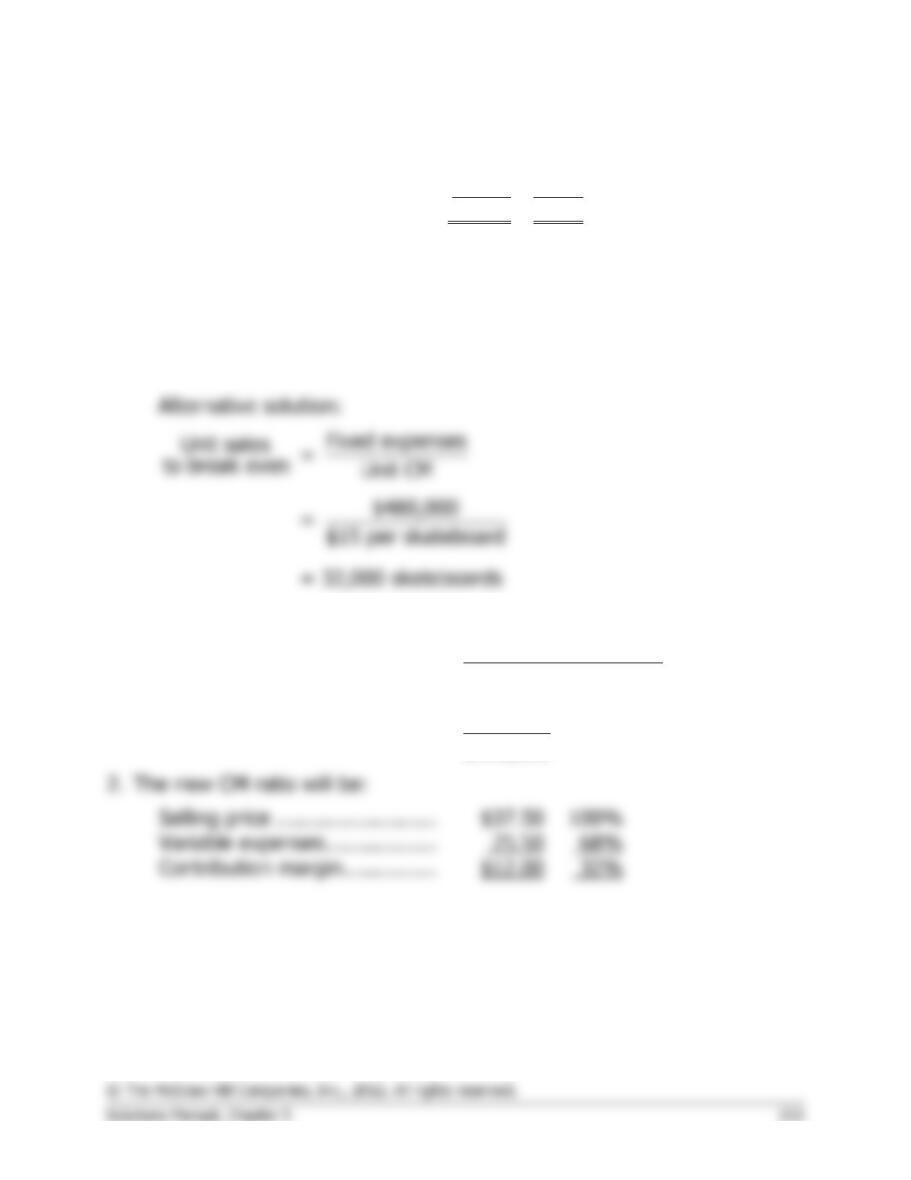
Profit
= Unit CM × Q − Fixed expenses
$0
= $15 × Q − $480,000
$15Q
= $480,000
Q
= $480,000 ÷ $15 per skateboard
Q
= 32,000 skateboards
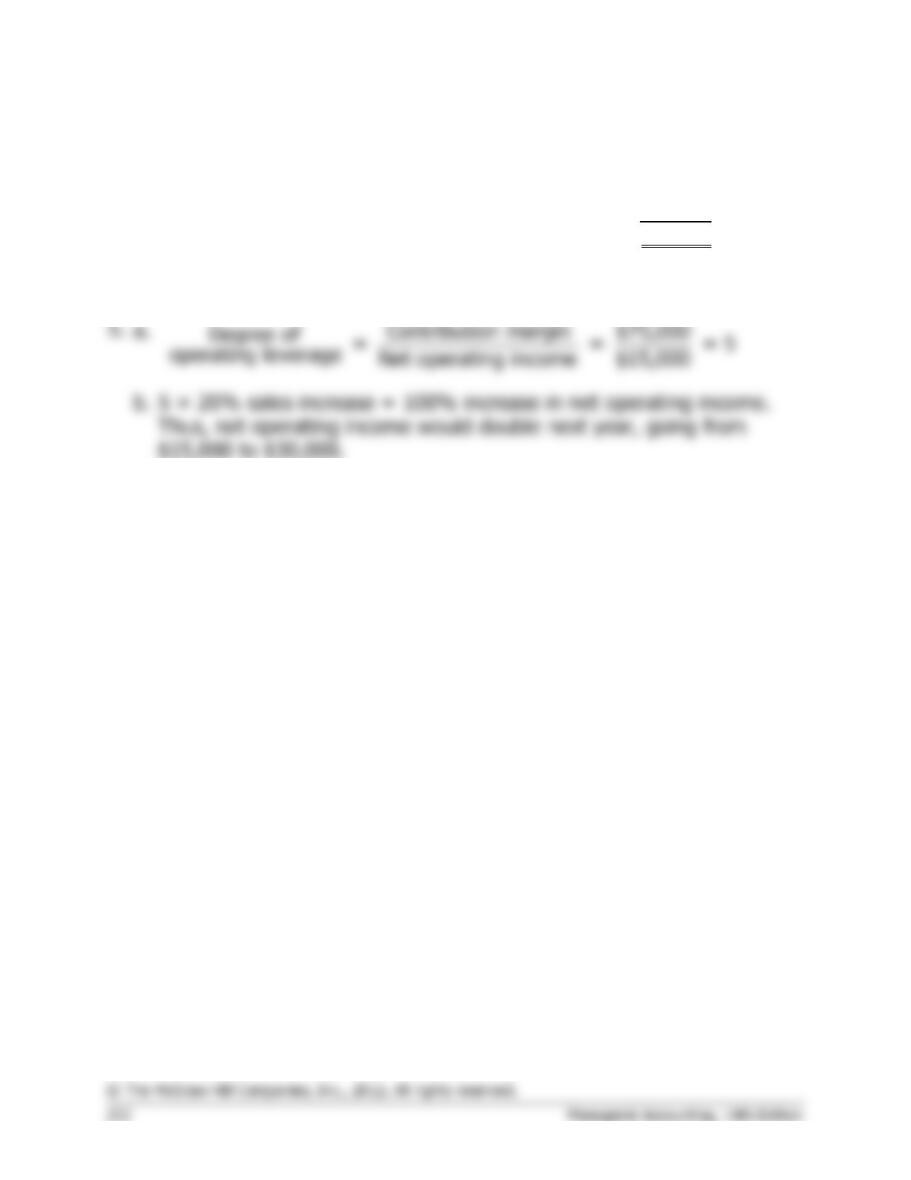
b. The degree of operating leverage would be:
Contribution margin
Degree of operating leverage = Net operating income
$600,000
= = 5.0
$120,000
Selling price ……………………..
$37.50
Variable expenses ………………
25.50
Contribution margin ……………
$12.00
Problem 5-29 (continued)
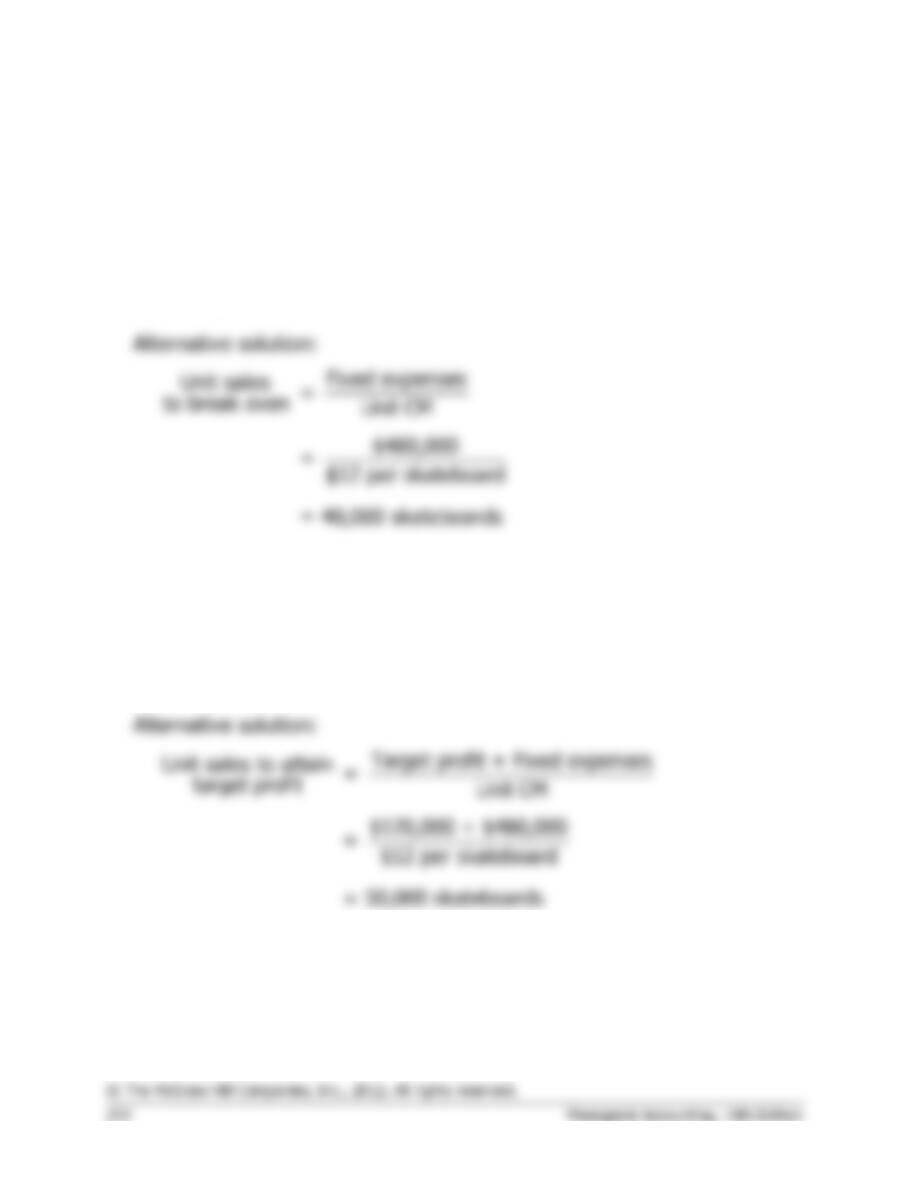
The new break-even point will be:
Profit
= Unit CM × Q − Fixed expenses
$0
= $12 × Q − $480,000
$12Q
= $480,000
Q
= $480,000 ÷ $12 per skateboard
Q
= 40,000 skateboards
3.
Profit
= Unit CM × Q − Fixed expenses
$120,000
= $12 × Q − $480,000
$12Q
= $120,000 + $480,000
Q
= $600,000 ÷ $12 per skateboard
Q
= 50,000 skateboards
Problem 5-29 (continued)
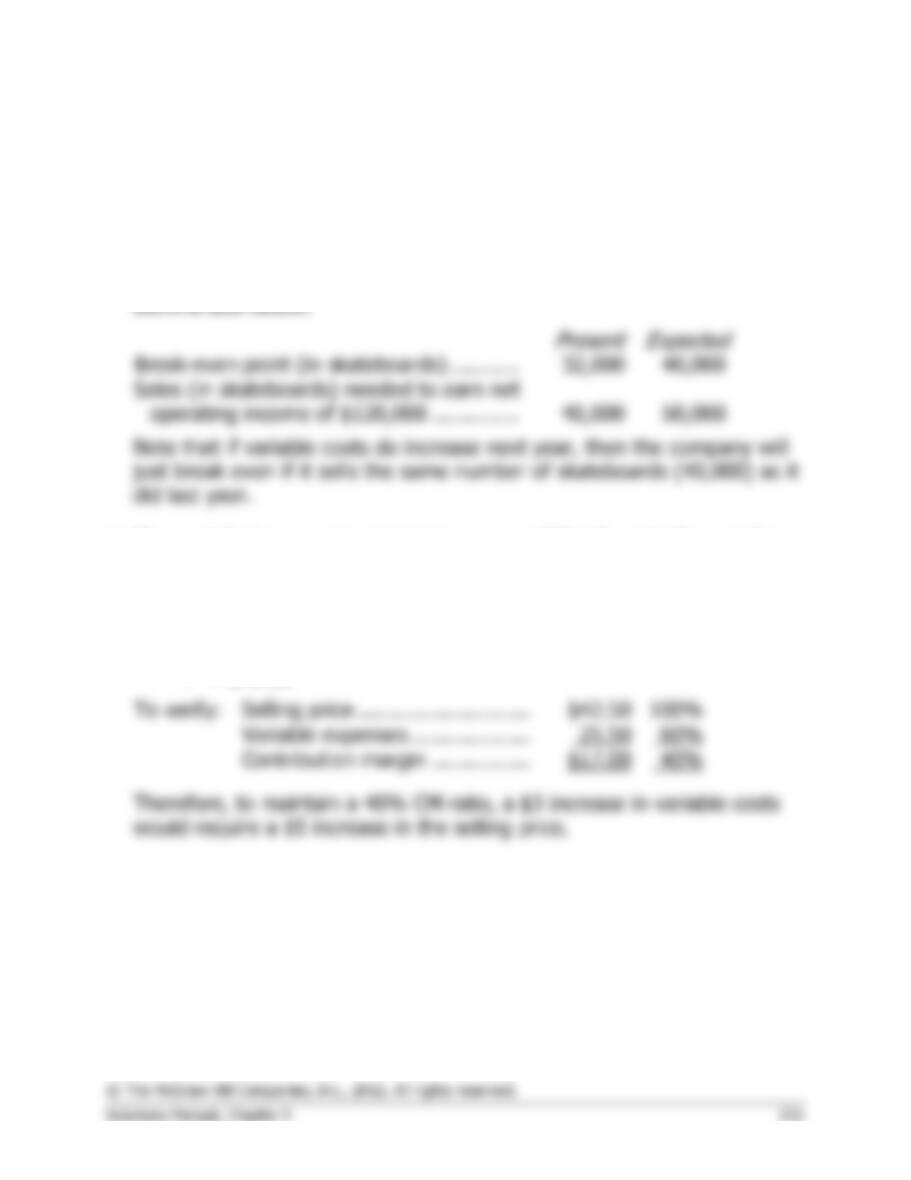
Thus, sales will have to increase by 10,000 skateboards (50,000
skateboards, less 40,000 skateboards currently being sold) to earn the
same amount of net operating income as earned last year. The
computations above and in part (2) show the dramatic effect that
increases in variable costs can have on an organization. These effects
from a $3 per unit increase in labor costs for Tyrene Company are
4. The contribution margin ratio last year was 40%. If we let P equal the
new selling price, then:
P
=
$25.50 + 0.40P
0.60P
=
$25.50
P
=
$25.50 ÷ 0.60
P
=
$42.50
To verify:
Selling price ……………………….
Variable expenses ……………….
Contribution margin …………….
Problem 5-29 (continued)
5. The new CM ratio would be:
Selling price ……………………
$37.50
100%
Variable expenses …………….
13.50
*
36%
Contribution margin ………….
$24.00
64%
*$22.50 – ($22.50 × 40%) = $13.50
The new break-even point would be:
Profit
= Unit CM × Q − Fixed expenses
$0
= $24 × Q − $912,000*
= $912,000 ÷ $24 per skateboard
Problem 5-29 (continued)
6.
a.
Profit
= Unit CM × Q − Fixed expenses
$120,000
= $24 × Q − $912,000*
$24Q
= $120,000 + $912,000
Q
= $1,032,000 ÷ $24.00 per skateboard
Q
= 43,000 skateboards
Problem 5-29 (continued)
b. The contribution income statement would be:
Sales
(40,000 skateboards × $37.50 per skateboard) ..
$1,500,000
Variable expenses
(40,000 skateboards × $13.50 per skateboard) .
540,000
912,000
c. This problem shows the difficulty faced by some companies. When
variable labor costs increase, it is often difficult to pass these cost
increases along to customers in the form of higher prices. Thus,
Problem 5-30 (30 minutes)
1. The contribution margin per stein would be:
Selling price ………………………………………………..
$30
Variable expenses:
Purchase cost of the steins …………………………..
$15
Commissions to the student salespersons ………..
6
21
Contribution margin ………………………………………
$ 9
2. Since an order has been placed, there is now a “fixed” cost associated
with the purchase price of the steins (i.e., the steins can’t be returned).
For example, an order of 200 steins requires a “fixed” cost (investment)
of $3,000 (= 200 steins × $15 per stein). The variable costs drop to
only $6 per stein, and the new contribution margin per stein becomes:
Selling price …………………………………………
$30
Variable expenses (commissions only) ……….
6
Contribution margin ……………………………….
$24
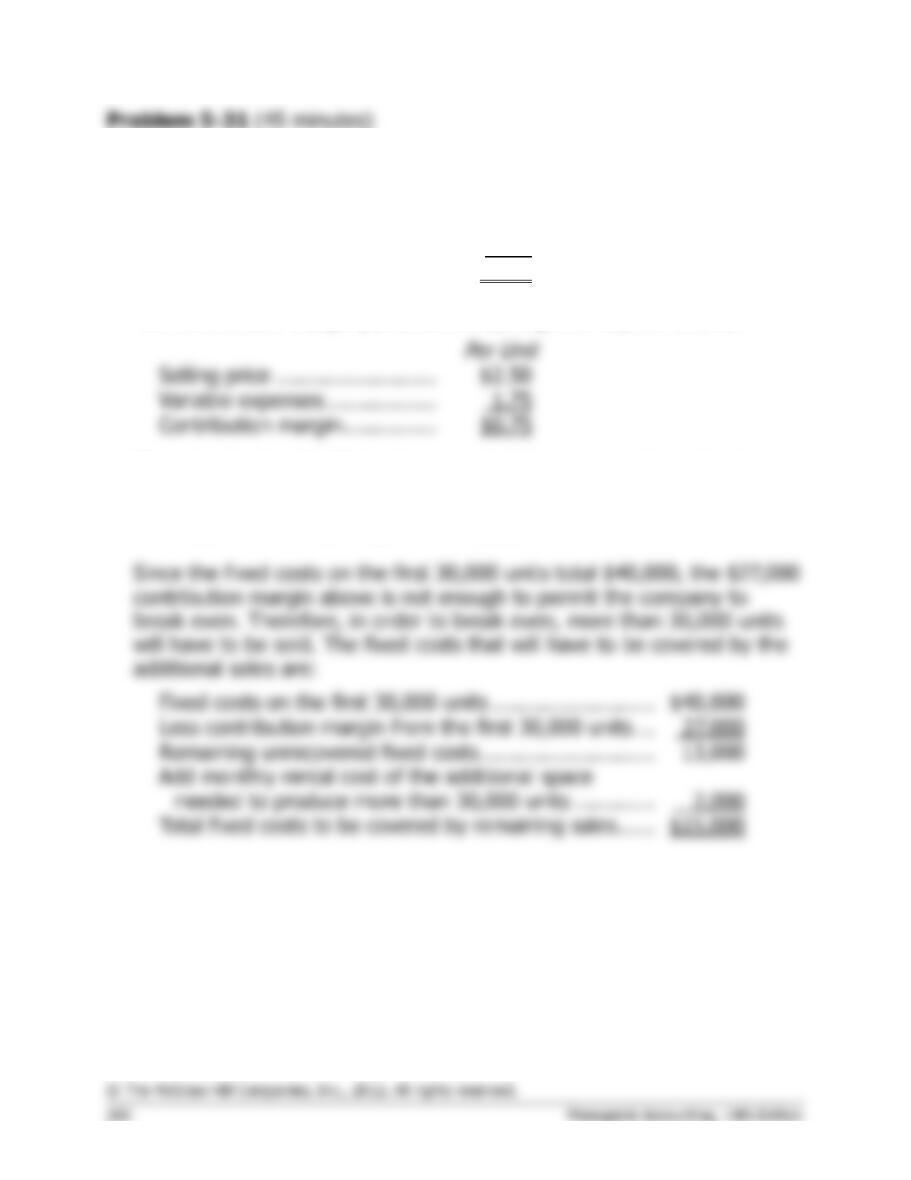
1. The contribution margin per unit on the first 30,000 units is:
Per Unit
Selling price ……………………..
$2.50
Variable expenses ………………
1.60
Contribution margin ……………
$0.90
The contribution margin per unit on anything over 30,000 units is:
Per Unit
Selling price ……………………..
$2.50
Variable expenses ………………
1.75
Contribution margin ……………
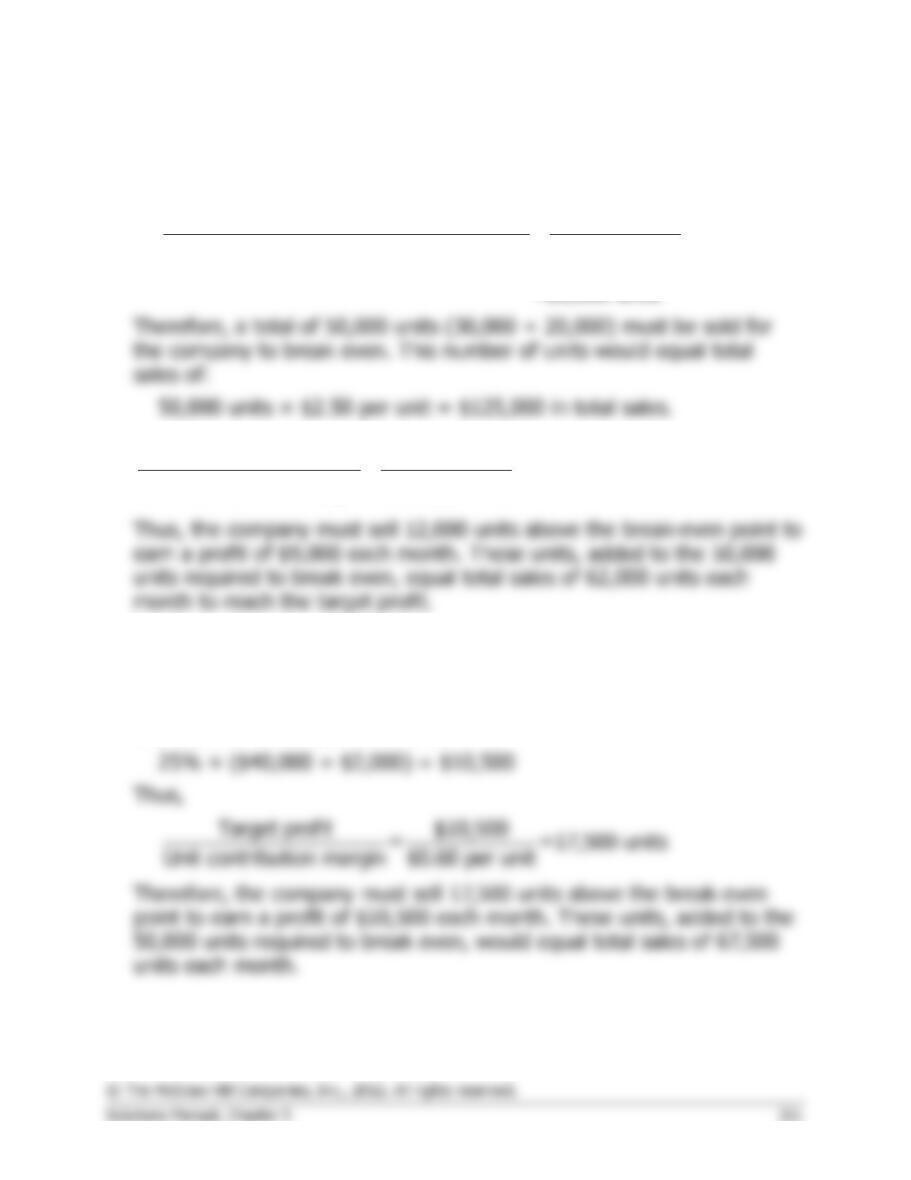
Thus, for the first 30,000 units sold, the total amount of contribution
margin generated would be:
30,000 units × $0.90 per unit = $27,000.
Fixed costs on the first 30,000 units ……………………..
Less contribution margin from the first 30,000 units …
Remaining unrecovered fixed costs ……………………….
Total fixed costs to be covered by remaining sales ……
Problem 5-31 (continued)
The additional sales of units required to cover these fixed costs would
be:
Total remaining fixed costs $15,000
=
Unit contribution margin on added units $0.75 per unit
=20,000 units
2.
Target profit $9,000
= =12,000 units
Unit contribution margin $0.75 per unit
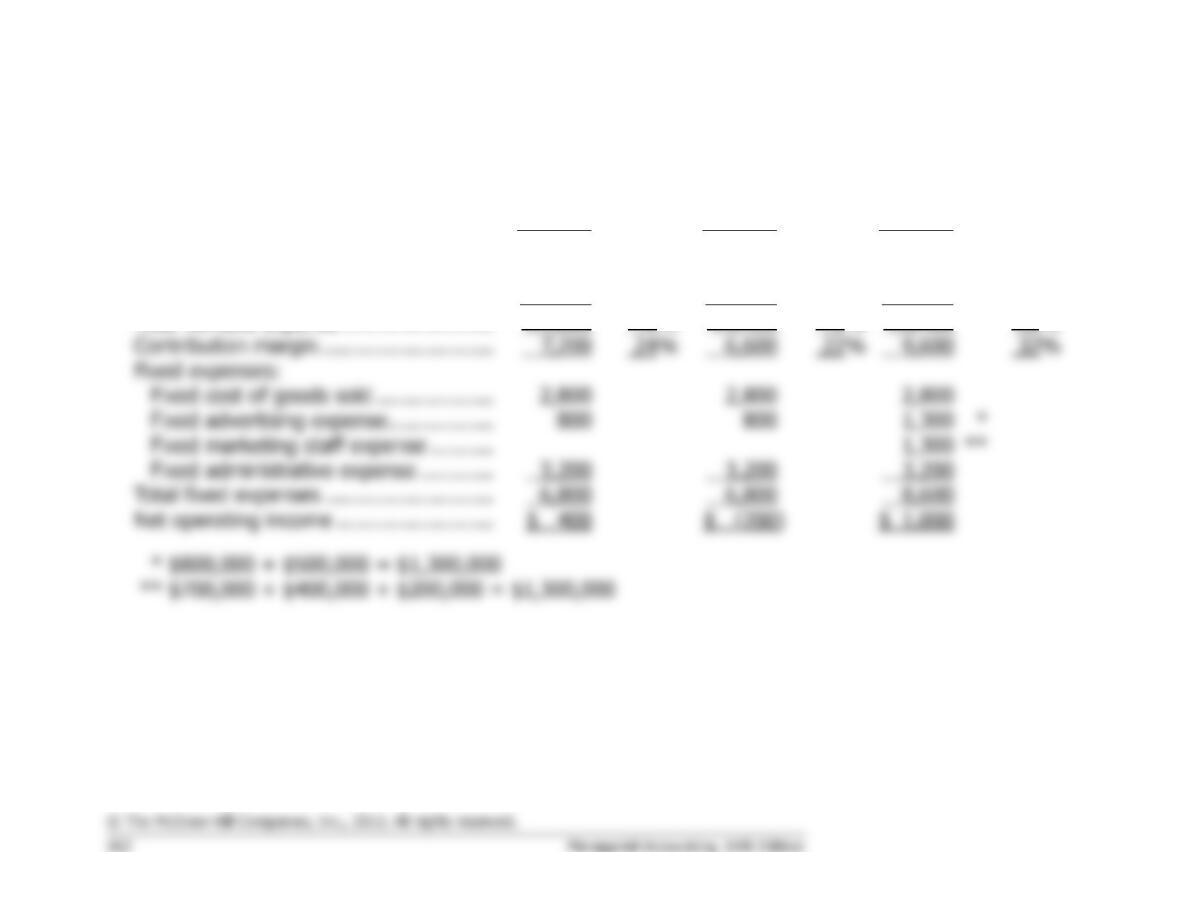
3. If a bonus of $0.15 per unit is paid for each unit sold in excess of the
break-even point, then the contribution margin on these units would
drop from $0.75 to only $0.60 per unit.
The desired monthly profit would be:
Target profit $10,500
= =17,500 units
Unit contribution margin $0.60 per unit
Case 5-32 (75 minutes)
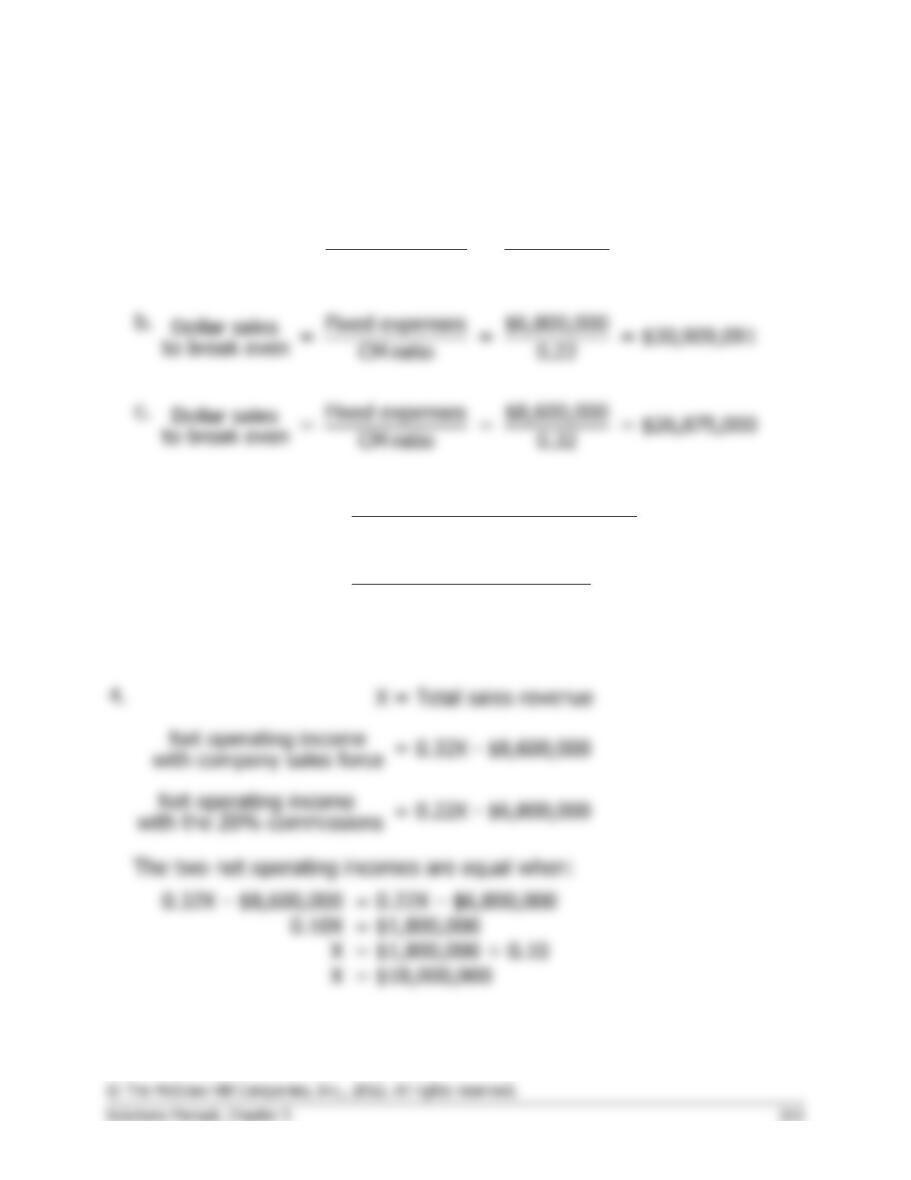
1. The contribution format income statements (in thousands of dollars) for the three alternatives are:
18% Commission
20% Commission
Own Sales Force
Sales ………………………………………….
$30,000
100
%
$30,000
100
%
$30,000
100
%
Variable expenses:
Variable cost of goods sold ……………
17,400
17,400
17,400
Commissions ……………………………..
5,400
6,000
3,000
Total variable expense ……………………
22,800
76
%
23,400
78
%
20,400
68
%
Contribution margin ……………………….
7,200
24
%
22
%
32
%
Fixed expenses:
Fixed cost of goods sold ……………….
Fixed advertising expense ……………..
Fixed marketing staff expense ……….
Total fixed expenses ………………………
Net operating income …………………….
$ 400
$ (200)
$ 1,000
$800,000 + $500,000 = $1,300,000
$700,000 + $400,000 + $200,000 = $1,300,000
Case 5-32 (continued)
2. Given the data above, the break-even points can be determined using
total fixed expenses and the CM ratios as follows:
a.
Fixed expenses $6,800,000
Dollar sales = = = $28,333,333
to break even CM ratio 0.24
3.
Target profit + Fixed expenses
Dollar sales to attain=
target profit CM ratio
-$200,000 + $8,600,000
= 0.32
= $26,250,000
Case 5-32 (continued)
Thus, at a sales level of $18,000,000 either plan will yield the same net
operating income. This is verified below (in thousands of dollars):
20% Commission
Own Sales Force
Sales ……………………….
%
%
Total fixed expenses …..
Net operating income ….
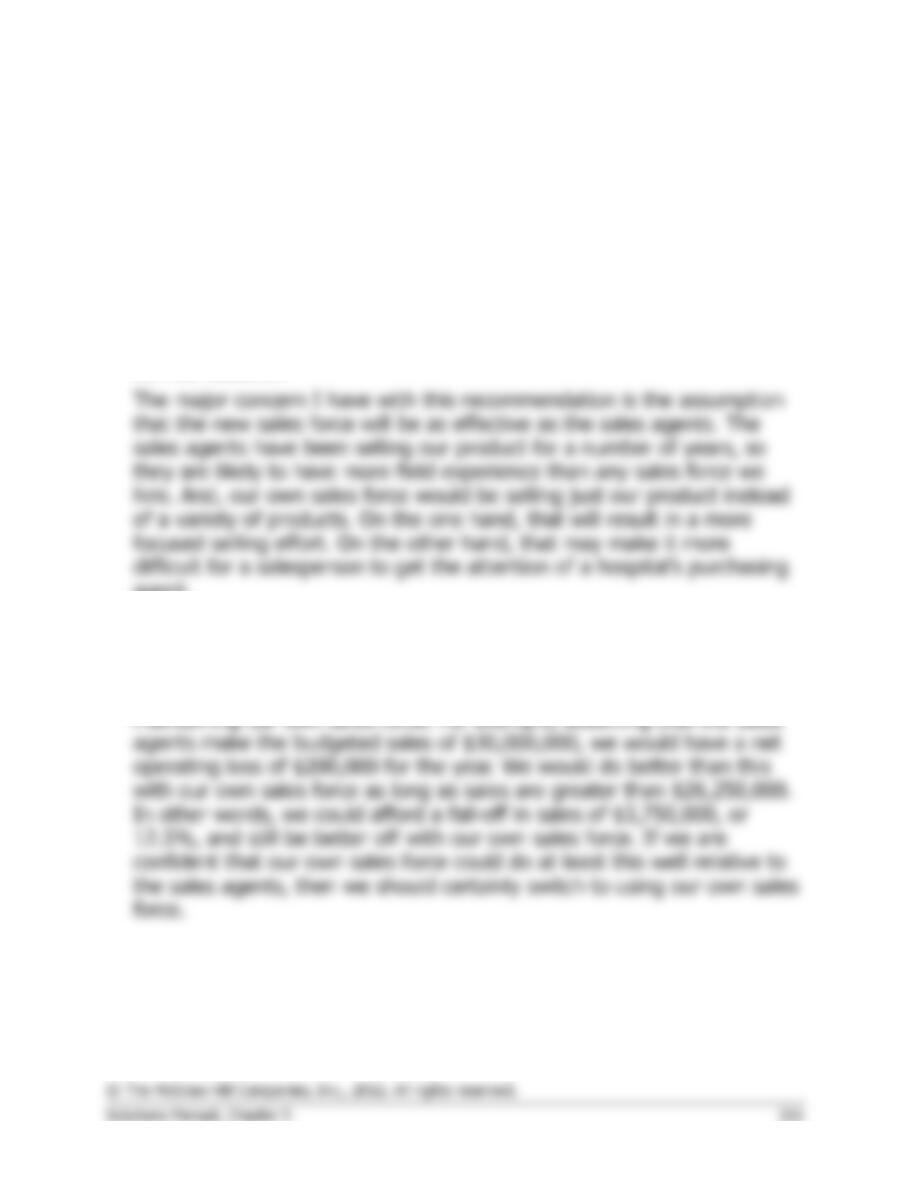
5. A graph showing both alternatives appears below:
$2,000
$4,000
$6,000
Case 5-32 (continued)
6.
To: President of Marston Corporation
Fm: Student’s name
Assuming that a competent sales force can be quickly hired and trained
and the new sales force is as effective as the sales agents, this is the
better alternative. Using the data provided by the controller, unless sales
fall below $18,000,000 net operating income is higher when the
company has its own sales force. At that level of sales and below, the
company would be losing money, so it is unlikely that this would be the
normal situation.
agent.
The purchasing agents may prefer to deal through a small number of
salespersons, each of whom sells many products, rather than a large
number of salespersons each of whom sells only a single product. Even
so, we can afford some decrease in sales because of the lower cost of
CASE 5-33 (60 minutes)
Note: This is a problem that will challenge the very best students’ conceptual
and analytical skills. However, working through this case will yield substantial
dividends in terms of a much deeper understanding of critical management
accounting concepts.
1. The overall break-even sales can be determined using the CM ratio.
Frog
Minnow
Worm
Total
Sales …………………….
$200,000
$280,000
$240,000
$720,000
Variable expenses …….
120,000
160,000
150,000
430,000
Contribution margin ….
Fixed expenses ……….
Net operating income .
2. The issue is what to do with the common fixed costs when computing
the break-evens for the individual products. The correct approach is to
ignore the common fixed costs. If the common fixed costs are included
in the computations, the break-even points will be overstated for
individual products and managers may drop products that in fact are
profitable.
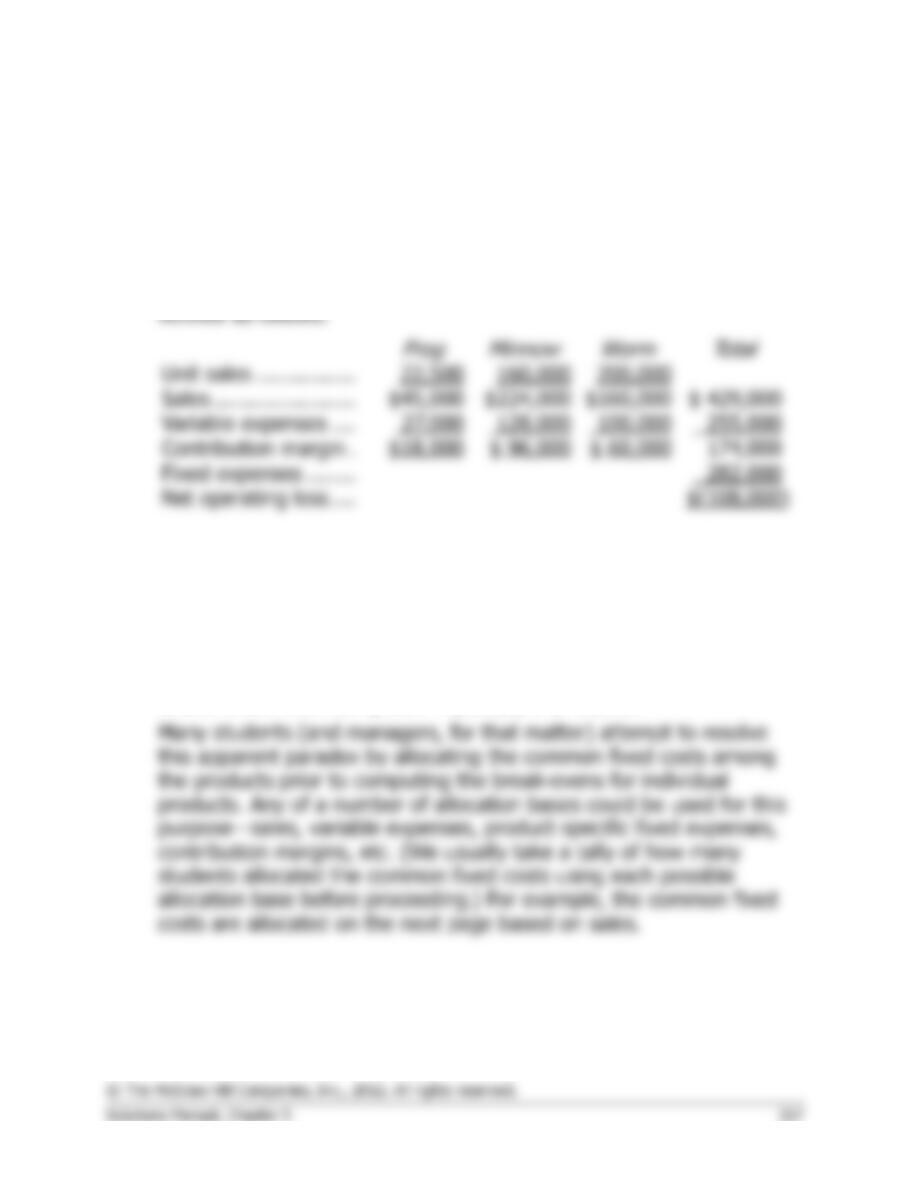
Frog
Unit selling price …………….
Variable cost per unit ………
Unit contribution margin (a)
Product fixed expenses (b) .
Case 5-33 (continued)
b. If the company were to sell exactly the break-even quantities
computed above, the company would lose $108,000—the amount of
the common fixed cost. This occurs because the common fixed costs
have been ignored in the calculations of the break–evens.
The fact that the company loses $108,000 if it operates at the level of
sales indicated by the break-evens for the individual products can be
At this point, many students conclude that something is wrong with
their answer to part (a) because the company loses money operating
at the break-evens for the individual products. They also worry that
managers may be lulled into a false sense of security if they are given
the break-evens computed in part (a). Total sales at the individual
product break-evens is only $429,000 whereas the total sales at the
overall break–even computed in part (1) is $700,100.
Case 5-33 (continued)
Allocation of common fixed expenses on the basis of sales revenue:
Frog
Minnow
Worm
Total
Sales ……………………….
$200,000
$280,000
$240,000
$720,000
Percentage of total
sales ……………………..
27.8%
38.9%
33.3%
100.0%
$108,000
Product fixed expenses ..
$138,000
$282,000
Unit contribution
$0.60
Allocated common
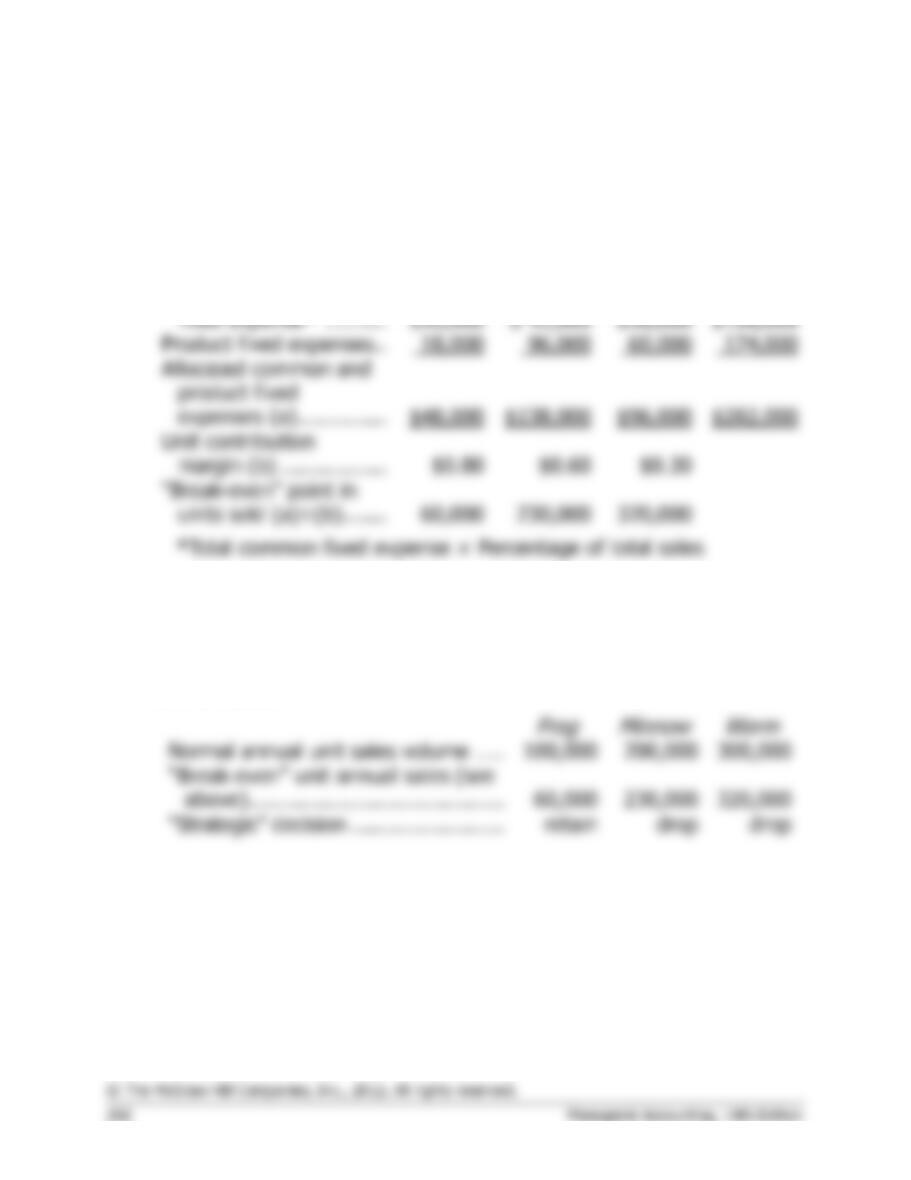
If the company sells 60,000 units of the Frog lure product, 230,000
units of the Minnow lure product, and 320,000 units of the Worm lure
product, the company will indeed break even overall. However, the
apparent break-evens for two of the products are above their normal
annual sales.
Normal annual unit sales volume …..
above) …………………………………..
Case 5-33 (continued)
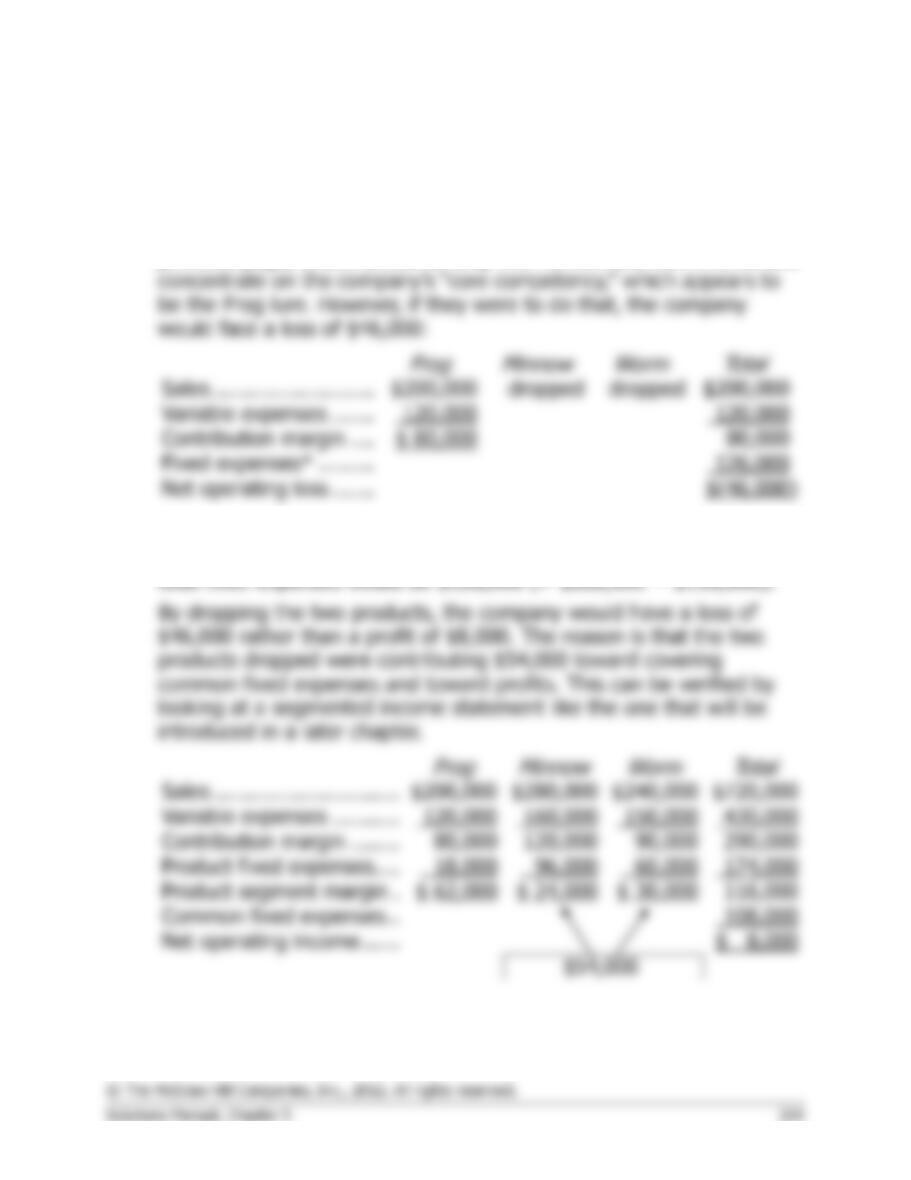
It would be natural to interpret a break-even for a product as the
level of sales below which the company would be financially better off
dropping the product. Therefore, we should not be surprised if
managers, based on the erroneous break-even calculation on the
previous page, would decide to drop the Minnow and Worm lures and
*By dropping the two products, the company reduces its fixed
expenses by only $156,000 (= $96,000 + $60,000). Therefore, the