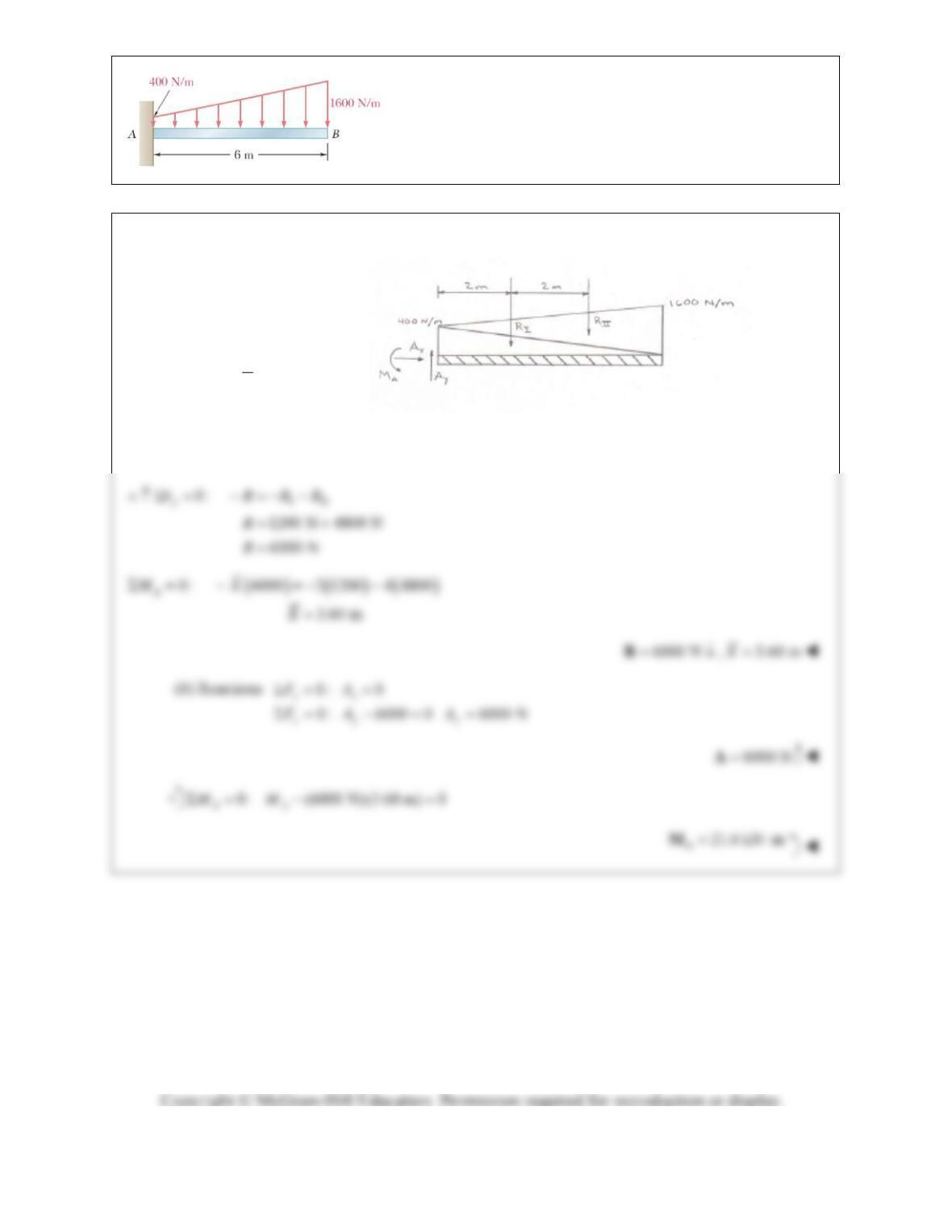
PROBLEM 5.66
For the beam and loading shown, determine (a) the magnitude
and location of the resultant of the distributed load, (b) the
reactions at the beam supports.
SOLUTION
I
II
1
( ) (400 N/m) (6 m)
2
1200 N
(1600 N/m) (6 m)
4800 N
aR
R
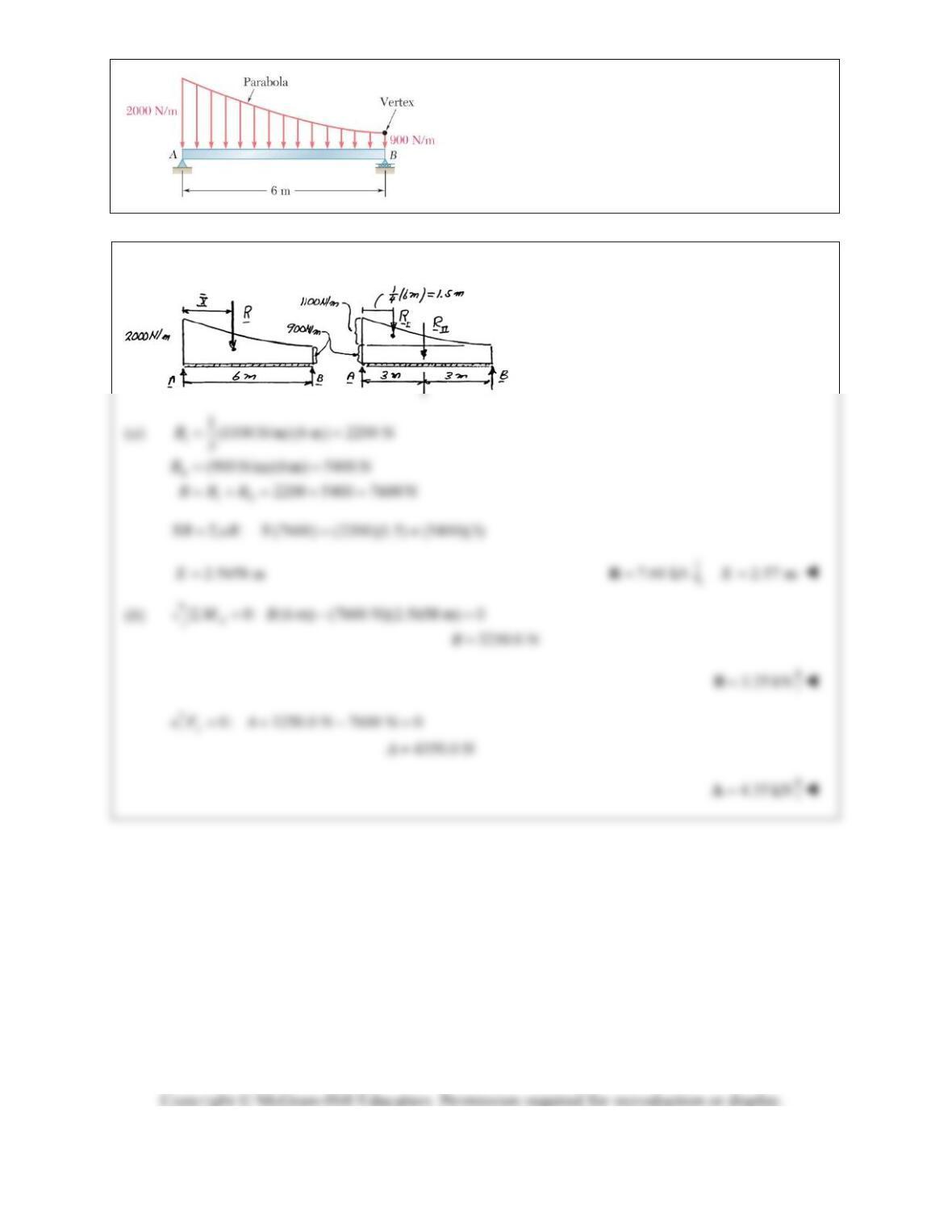
PROBLEM 5.67
For the beam and loading shown, determine (a) the
magnitude and location of the resultant of the
distributed load, (b) the reactions at the beam supports.
SOLUTION
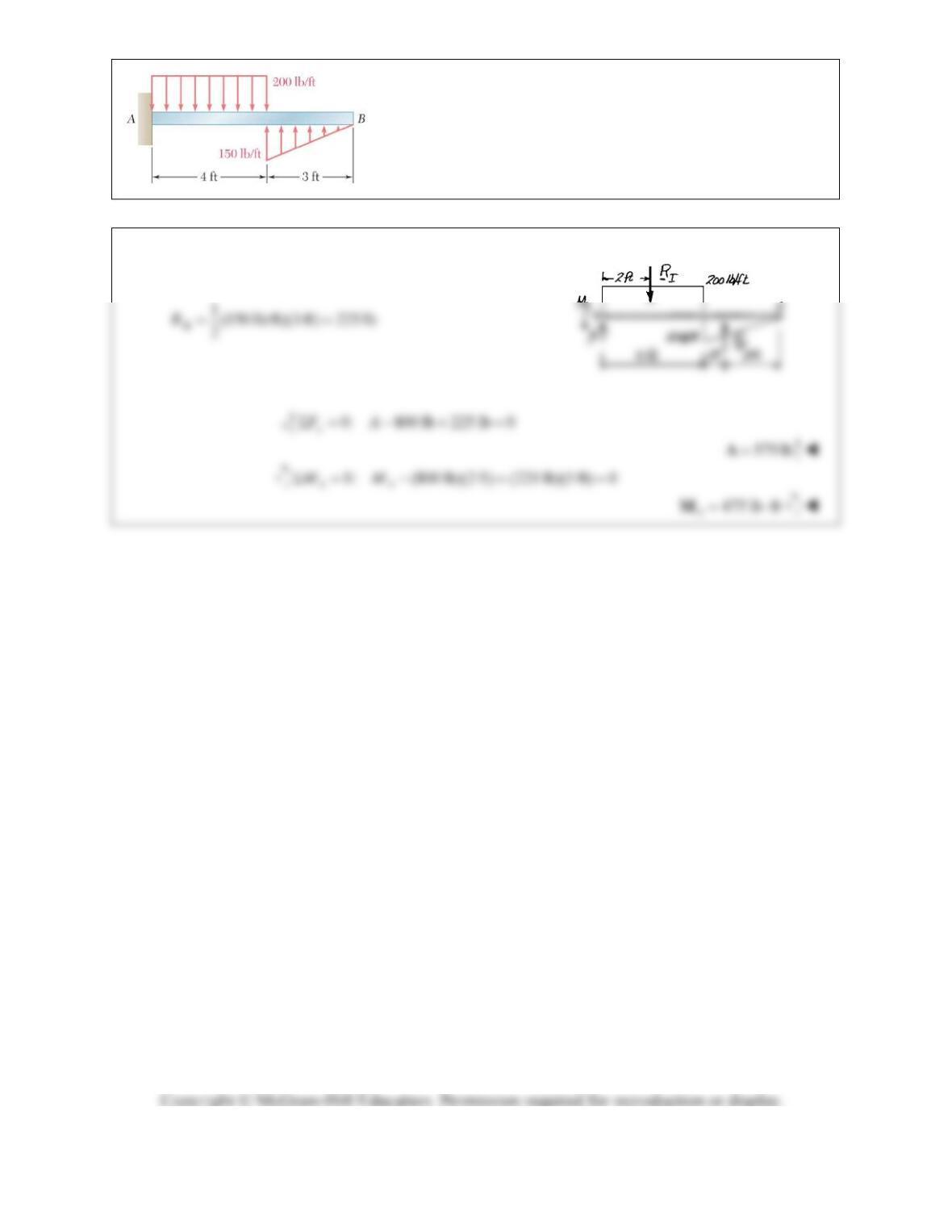
PROBLEM 5.68
Determine the reactions at the beam supports for the given
loading.
SOLUTION
I
(200 lb/ft)(4 ft) 800 lb
R
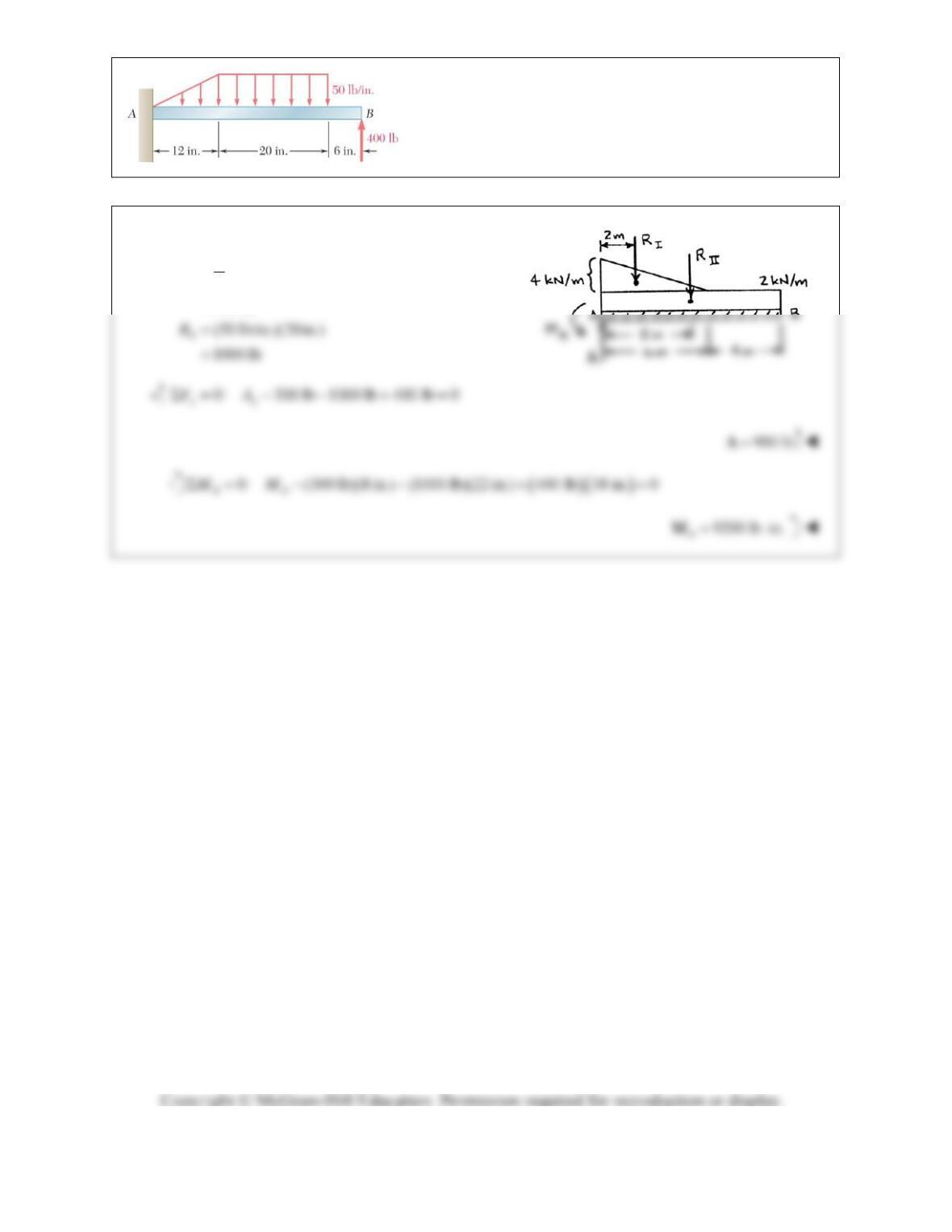
PROBLEM 5.69
Determine the reactions at the beam supports for the given
loading.
SOLUTION
I
1(50 lb/in.)(12 in.)
2
300 lb
R
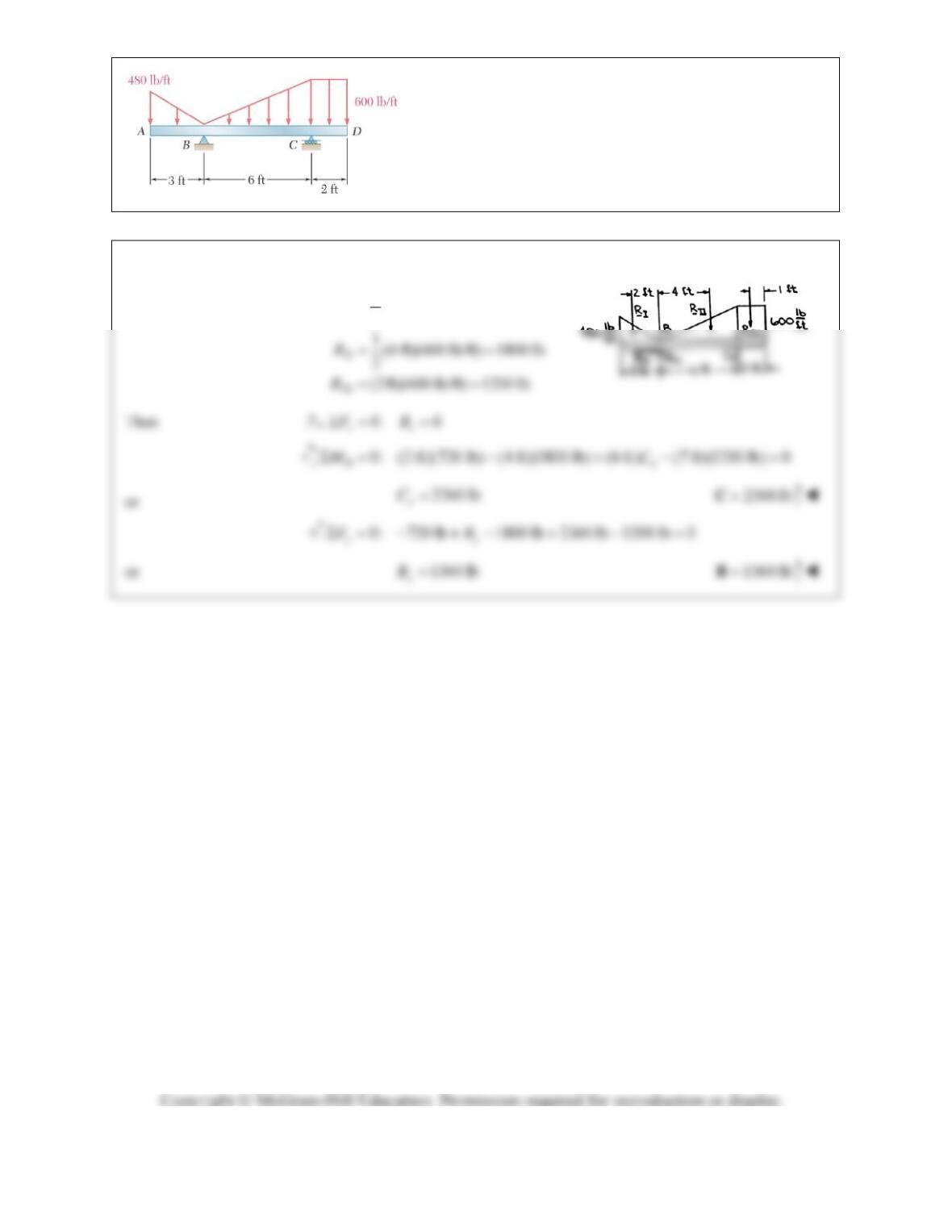
PROBLEM 5.70
Determine the reactions at the beam supports for the given
loading.
SOLUTION
We have
I
1(3ft)(480 lb/ft) 720 lb
2
R
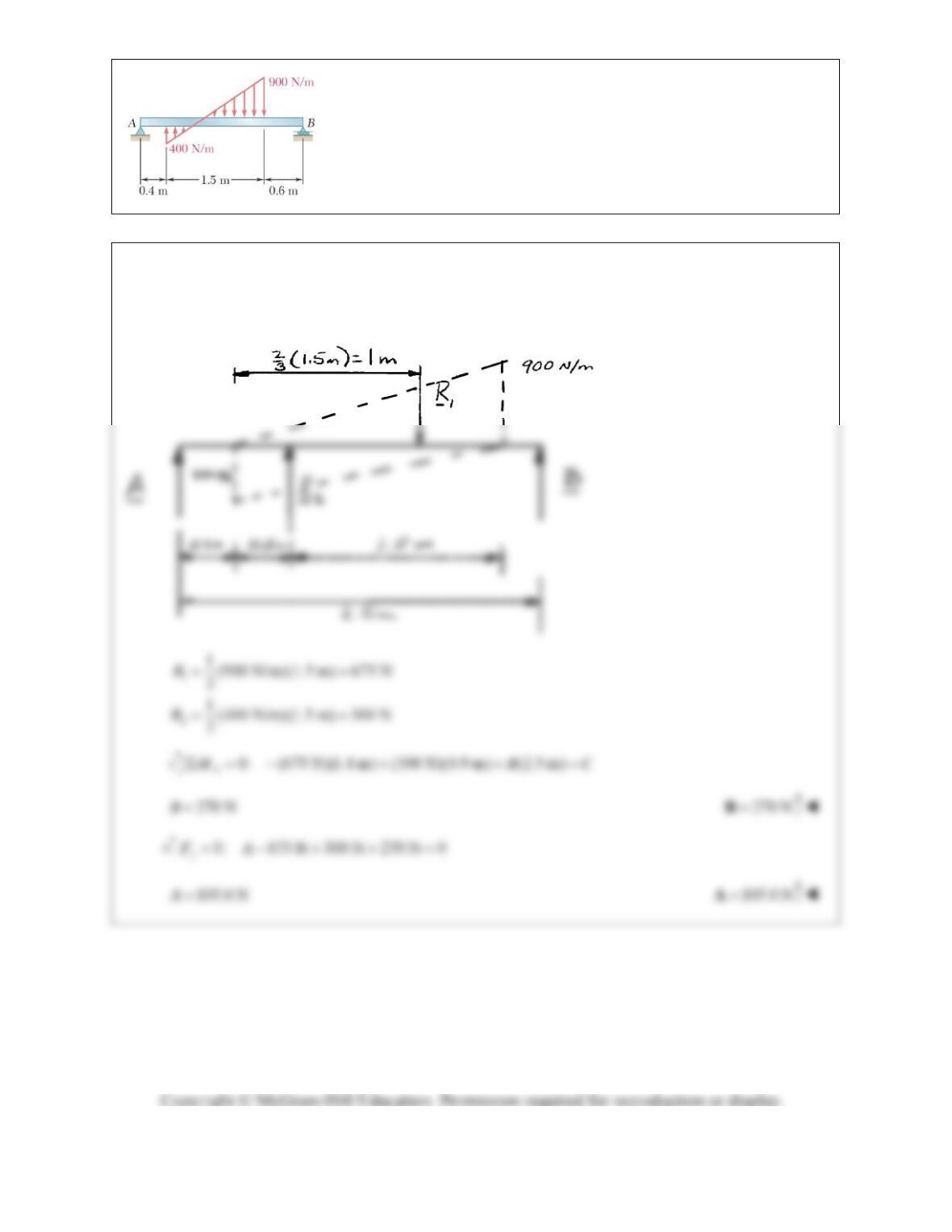
PROBLEM 5.71
Determine the reactions at the beam supports for the given loading.
SOLUTION
First replace the given loading by the loadings shown below. Both loadings are equivalent since they are
both defined by a linear relation between load and distance and have the same values at the end points.
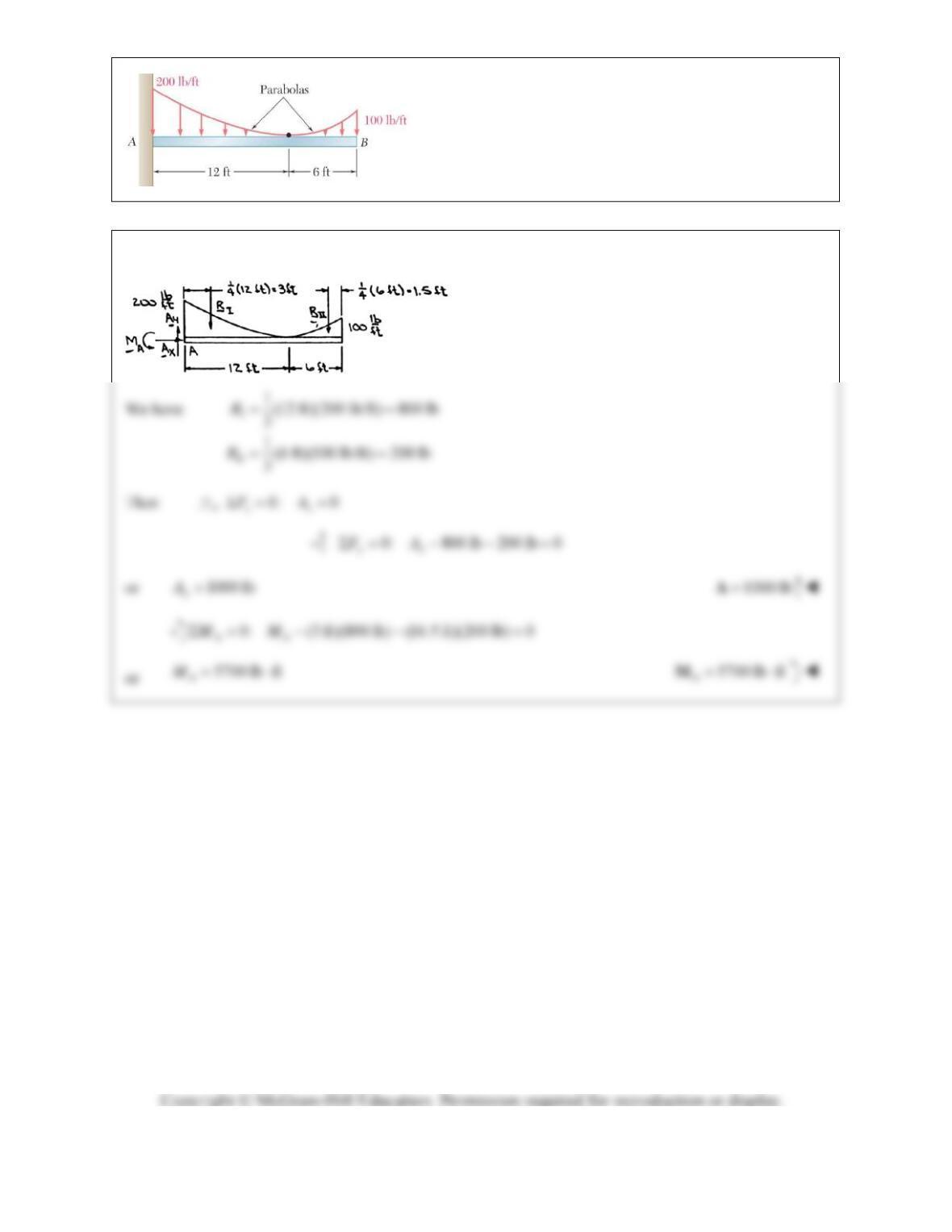
PROBLEM 5.72
Determine the reactions at the beam supports for the given
loading.
SOLUTION
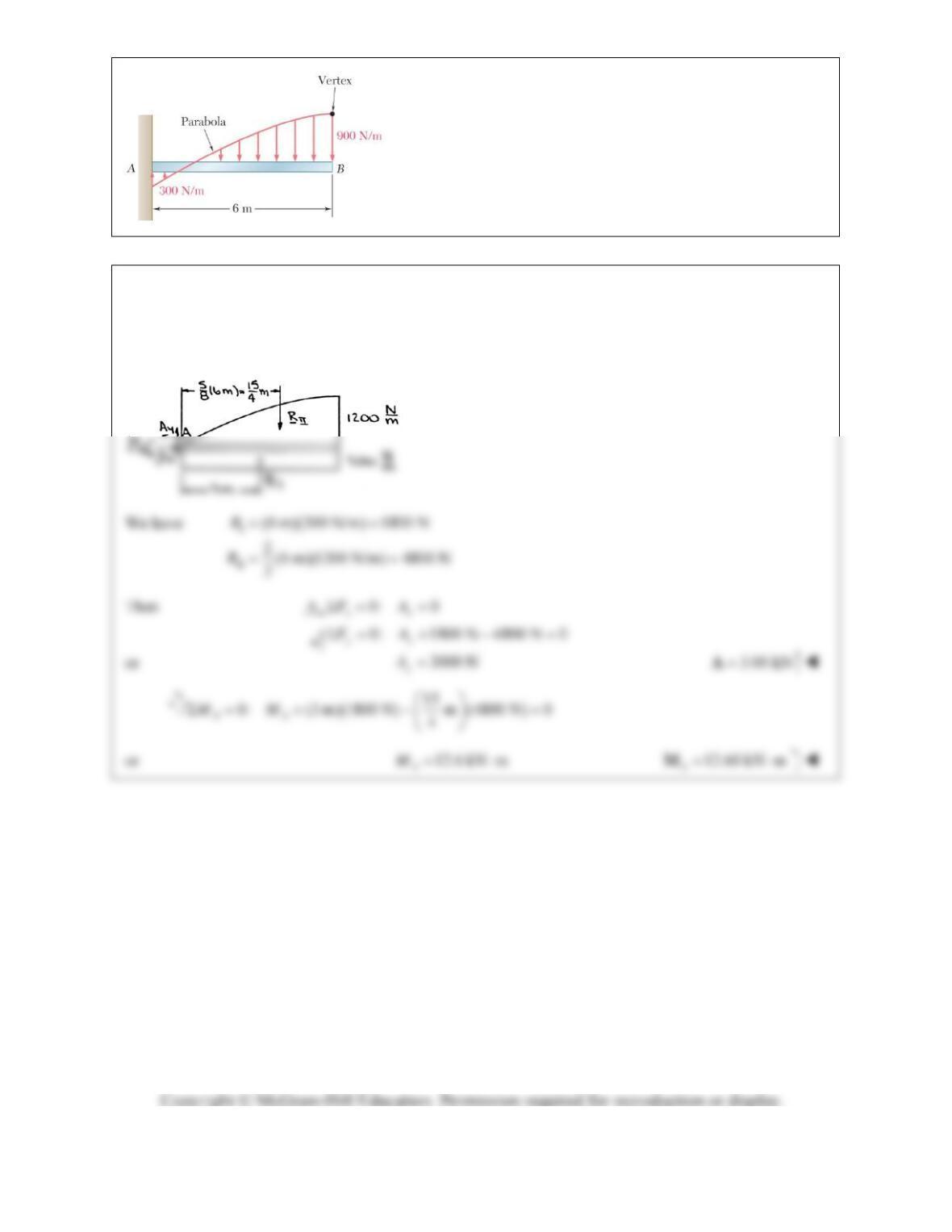
PROBLEM 5.73
Determine the reactions at the beam supports for the given
loading.
SOLUTION
First replace the given loading with the loading shown below. The two loadings are equivalent because
both are defined by a parabolic relation between load and distance and the values at the end points are the
same.
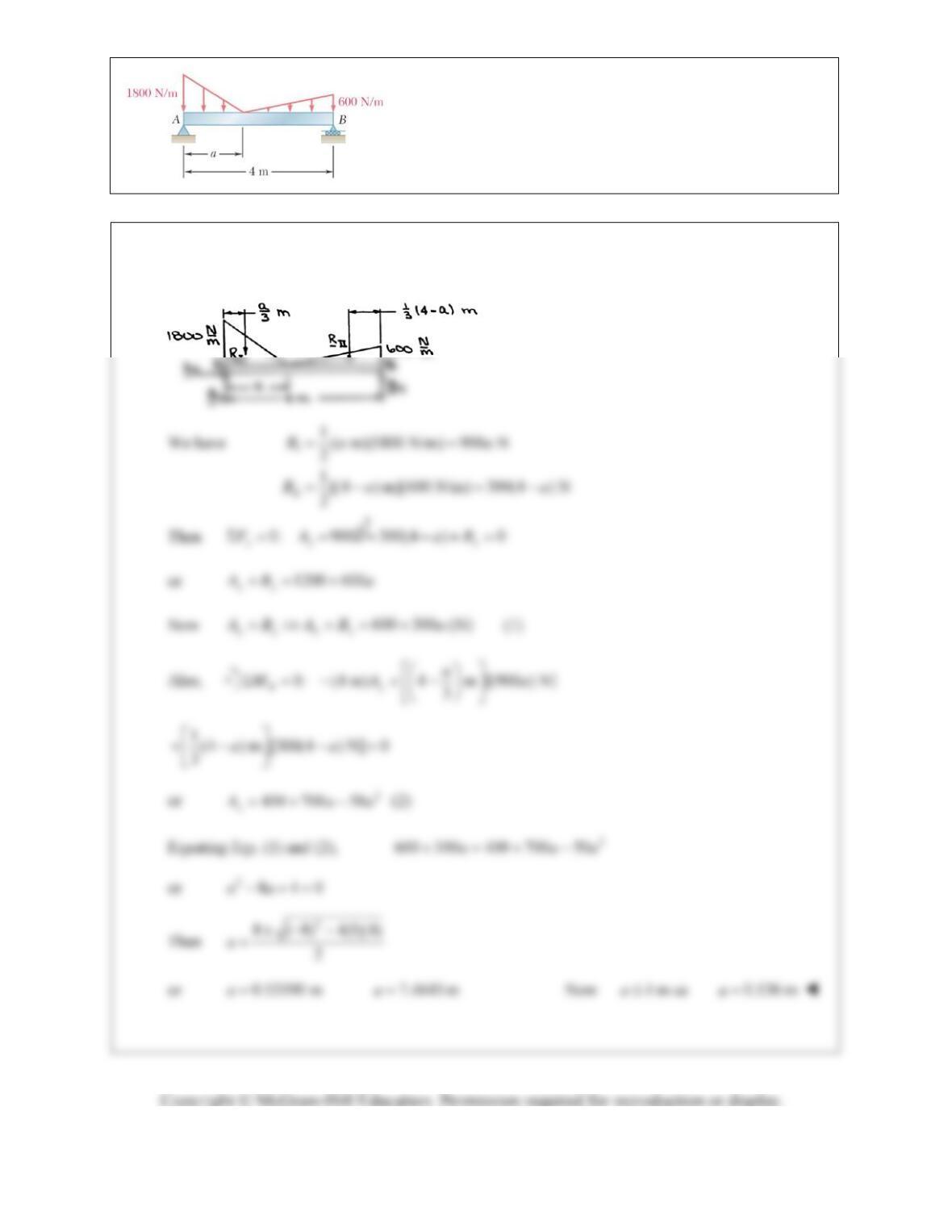
PROBLEM 5.74
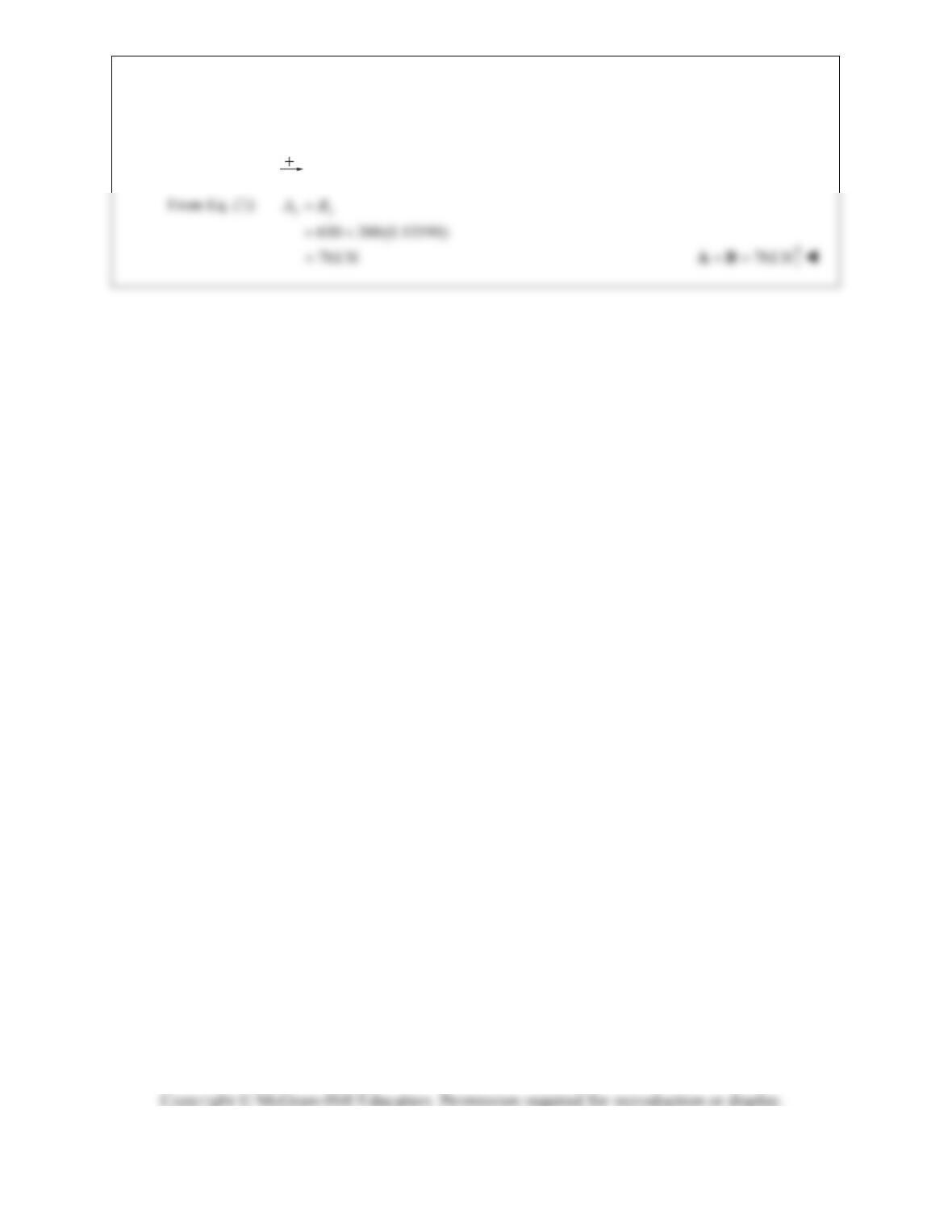
Determine (a) the distance a so that the vertical reactions at
supports A and B are equal, (b) the corresponding reactions at
the supports.
SOLUTION
(a)
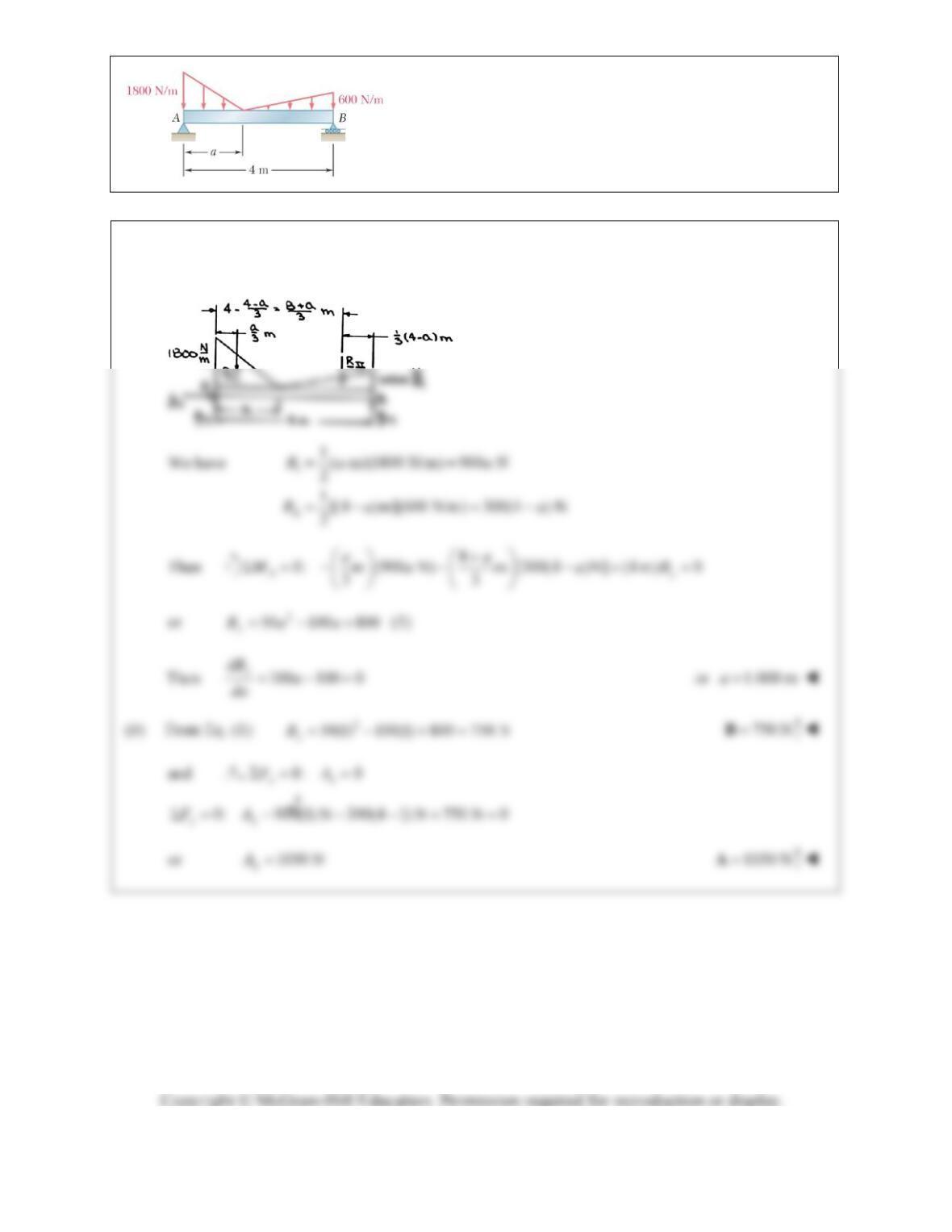
PROBLEM 5.74 (Continued)
(b) We have
0: 0
xx
FA
PROBLEM 5.75
Determine (a) the distance a so that the reaction at support B is
minimum, (b) the corresponding reactions at the supports.
SOLUTION
(a)
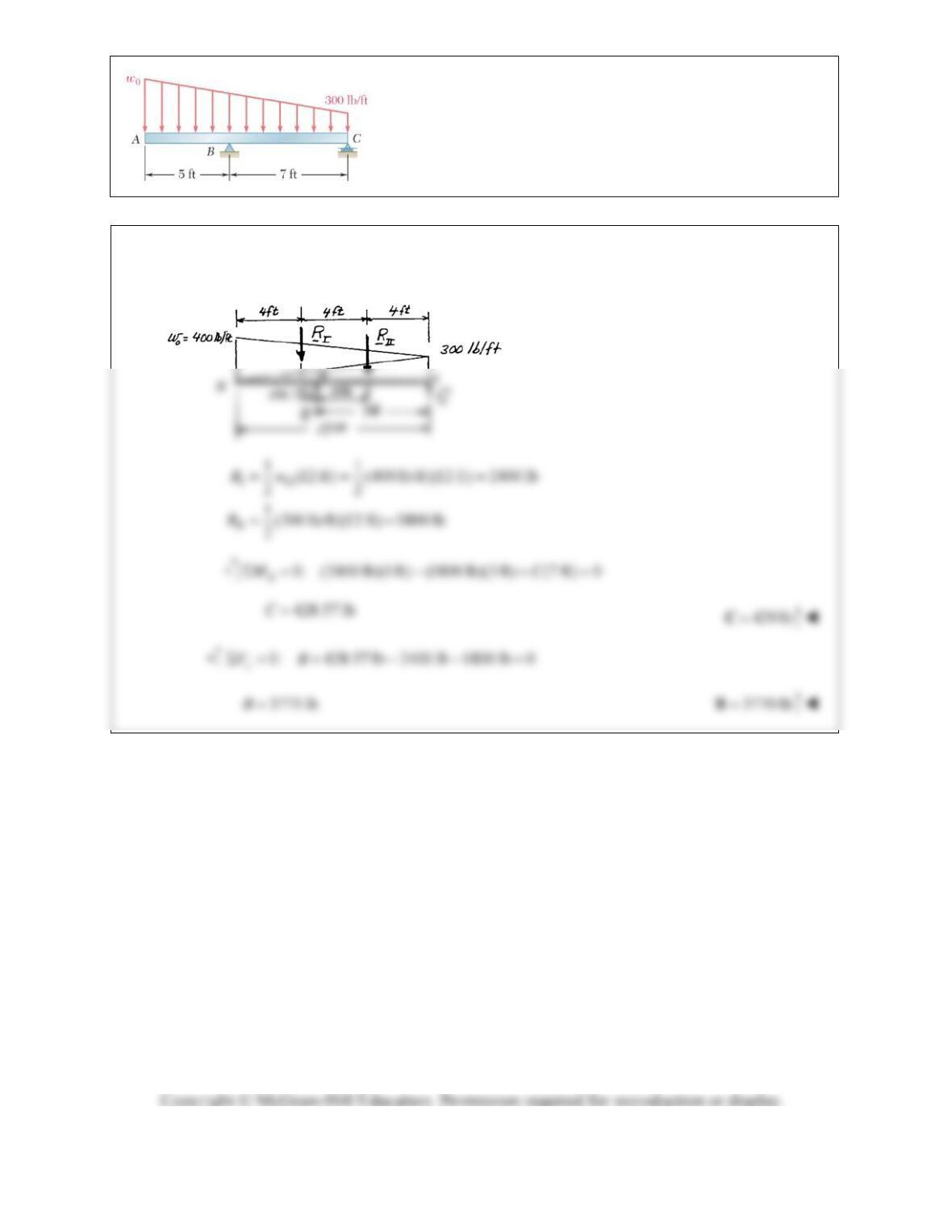
PROBLEM 5.76
Determine the reactions at the beam supports for the given
loading when w
O
400 lb/ft.
SOLUTION
PROBLEM 5.77
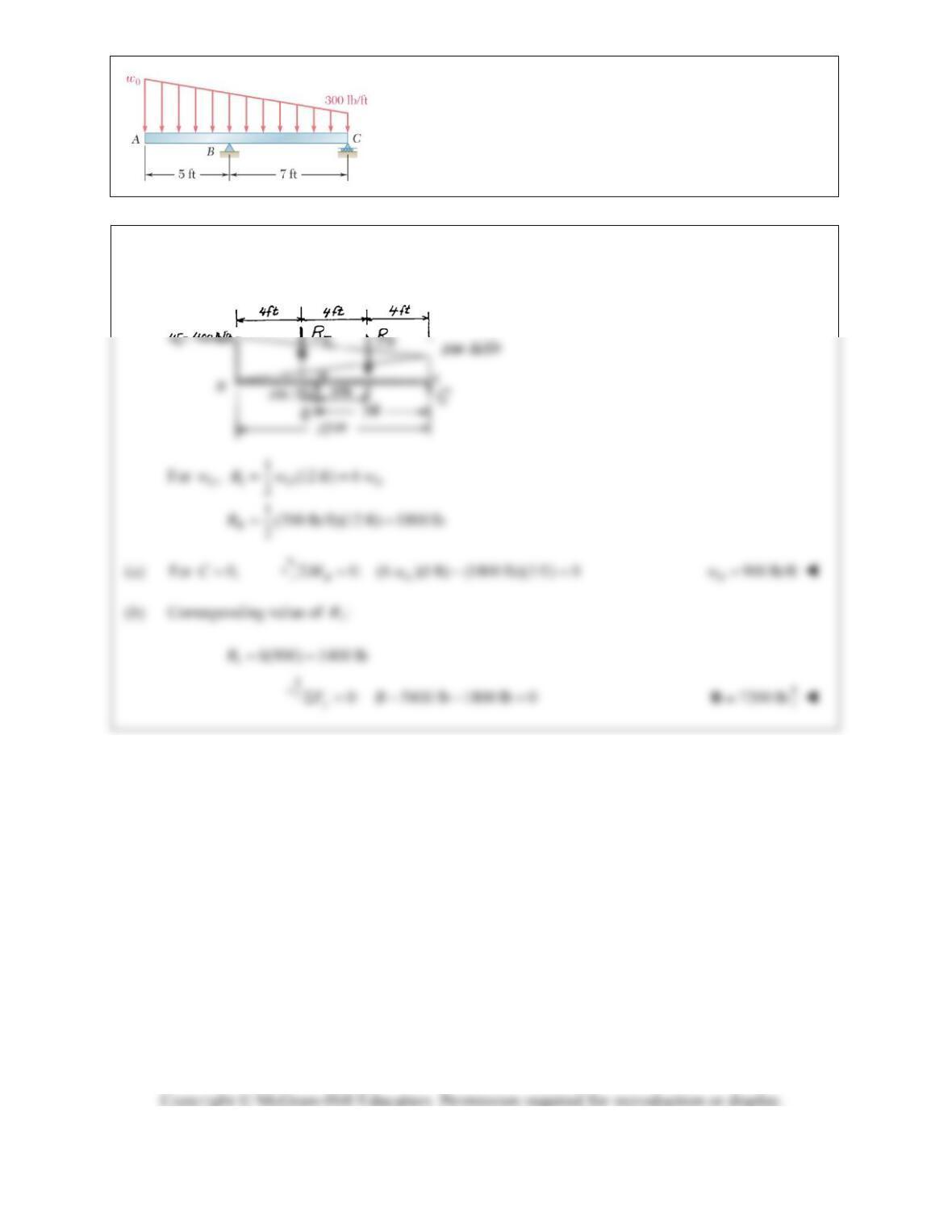
Determine (a) the distributed load w
O
at the end A of the beam
ABC for which the reaction at C is zero, (b) the corresponding
reaction at B.
SOLUTION
PROBLEM 5.78
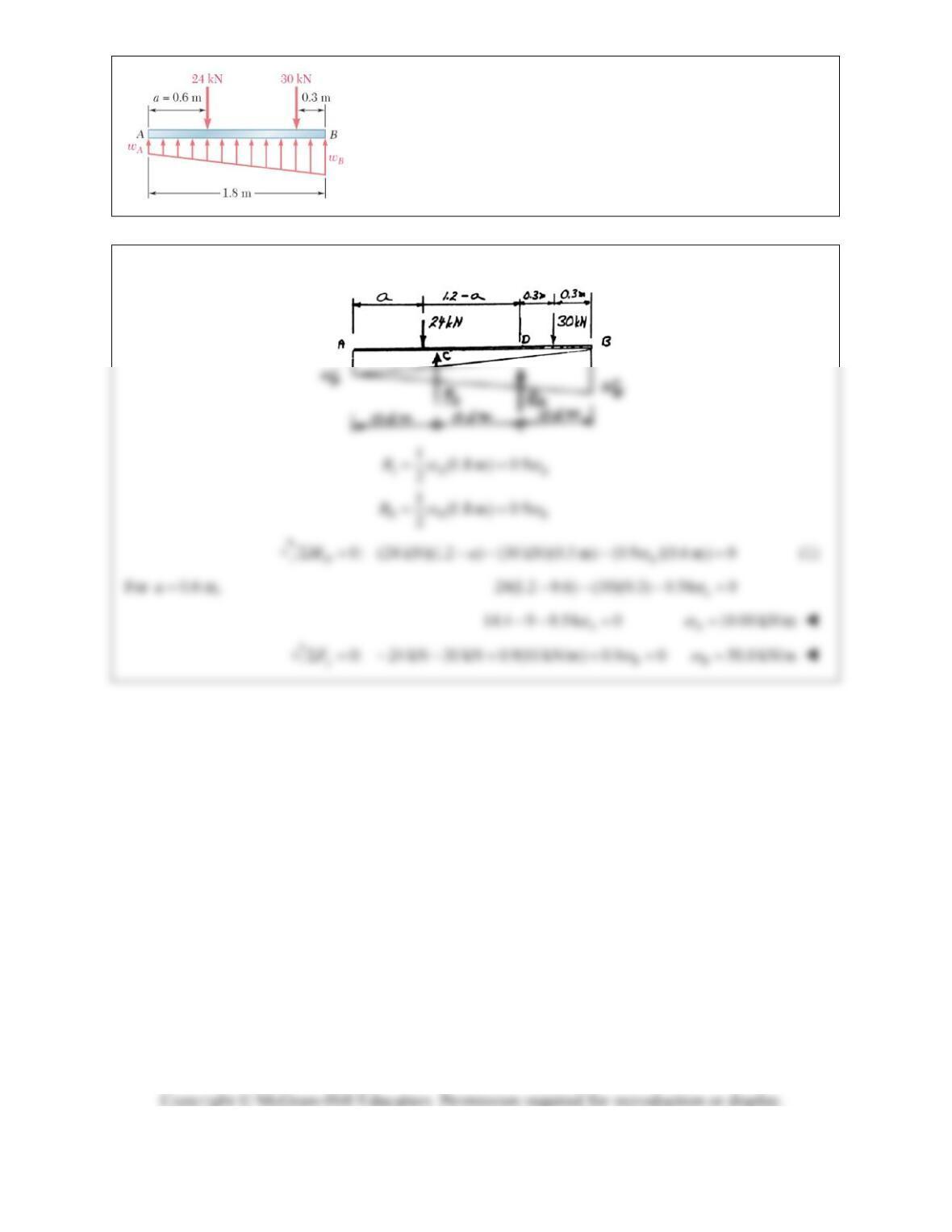
The beam AB supports two concentrated loads and rests on soil that
exerts a linearly distributed upward load as shown. Determine the
values of
A
and
B
corresponding to equilibrium.
SOLUTION
PROBLEM 5.79
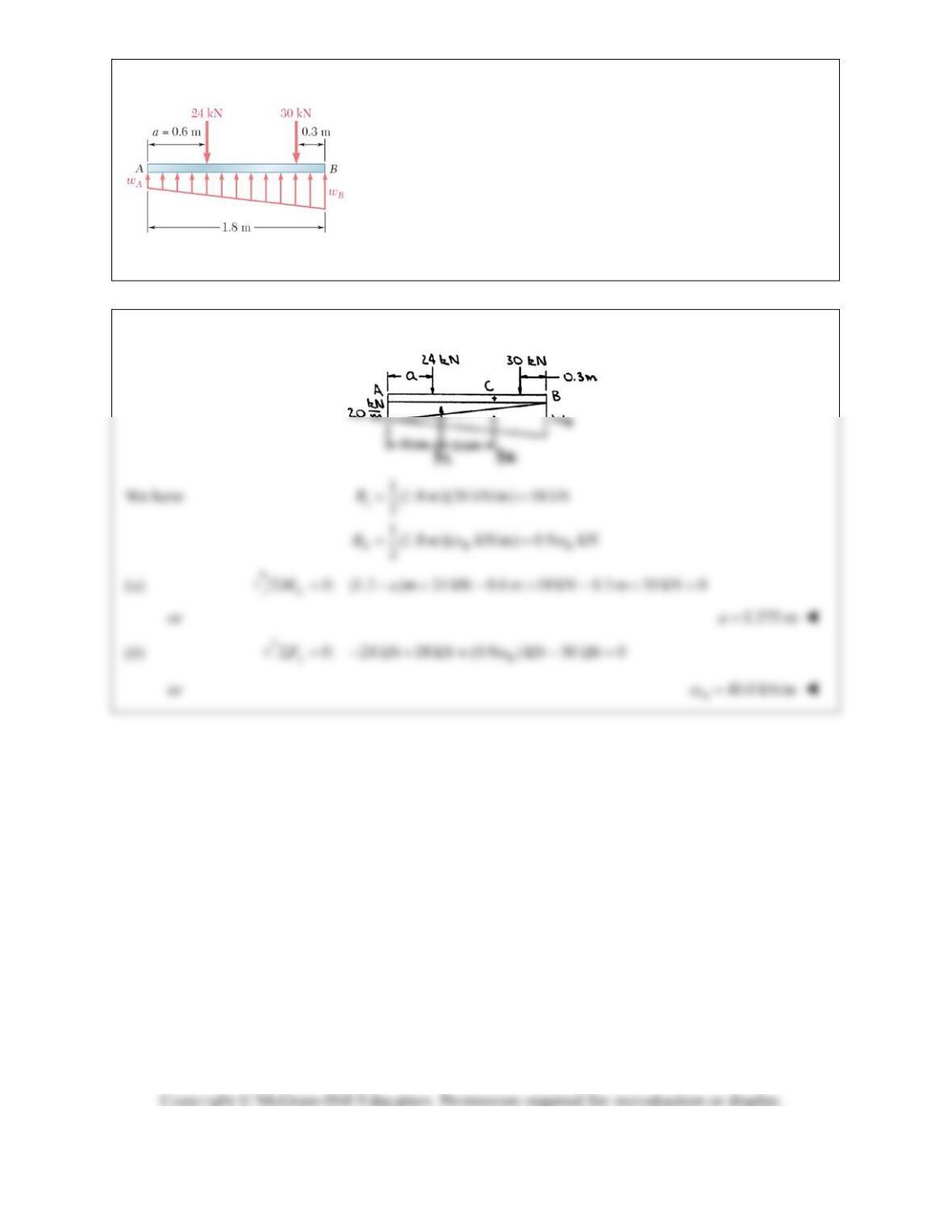
For the beam and loading of Problem 5.78, determine (a) the
distance a for which
A
20 kN/m, (b) the corresponding value of
B
.
PROBLEM 5.78
The beam AB supports two concentrated loads
and rests on soil that exerts a linearly distributed upward load as
shown. Determine the values of
A
and
B
corresponding to
equilibrium.
SOLUTION
PROBLEM 5.80
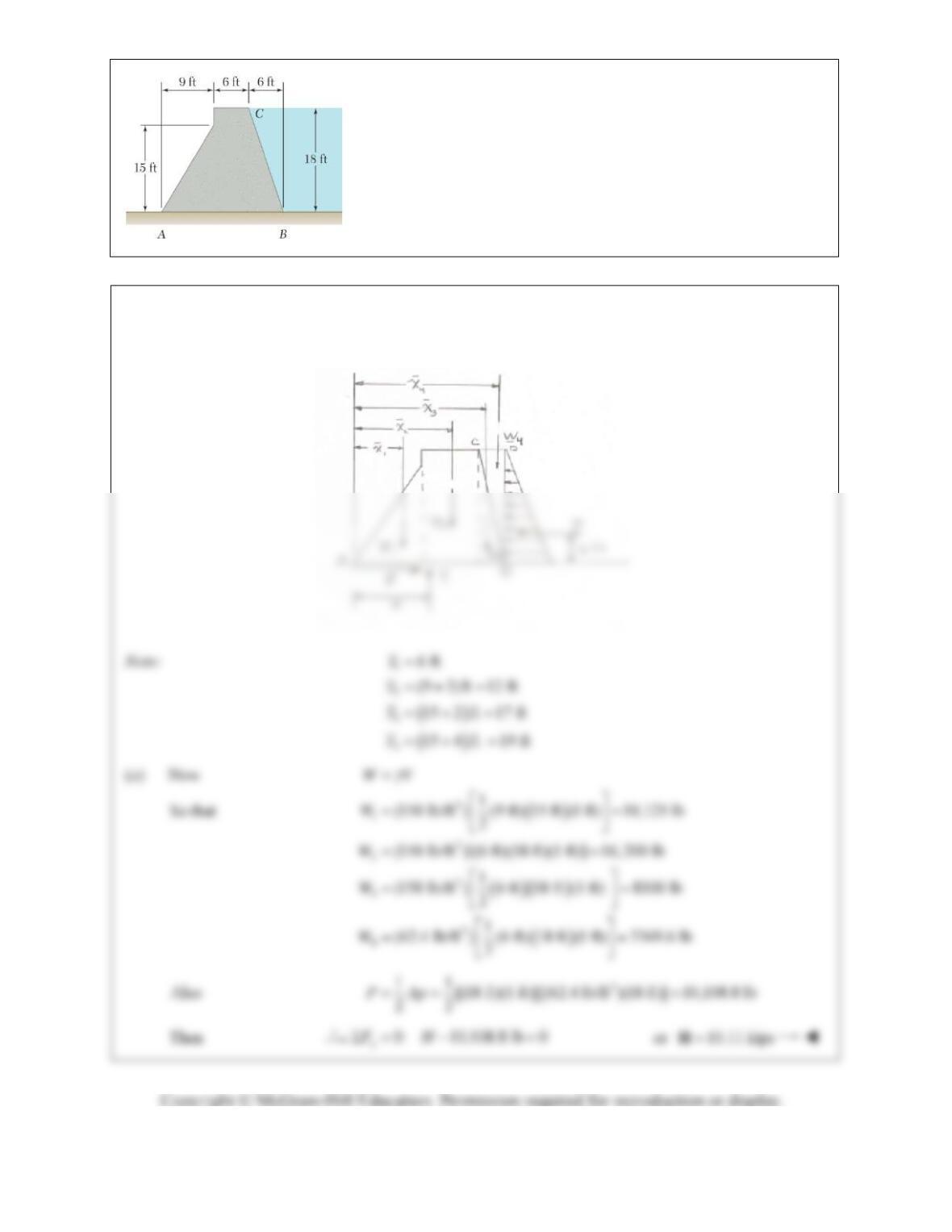
The cross section of a concrete dam is as shown. For a 1-ft-wide
dam section determine (a) the resultant of the reaction forces exerted
by the ground on the base AB of the dam, (b) the point of application
of the resultant of part a, (c) the resultant of the pressure forces
exerted by the water on the face BC of the dam.
SOLUTION
The free body shown consists of a 1-ft thick section of the dam and the triangular section of water above
the dam.
PROBLEM 5.80 (Continued)
0: 10,125 lb 16,200 lb 8100 lb 3369.6 lb 0
y
FV
or
37,795 lbV
37.8 kips
V
(b) We have
0: (37,794.6 lb) (6 ft)(10,125 lb) (12 ft)(16,200 lb)
(17 ft)(8100 lb) (19 ft)(3369.6 lb)
+(6 ft)(10,108.8 lb) 0
A
Mx
or
37,794.6 60,750 194, 400 137,700 64,022.4 60,652.8 0x
PROBLEM 5.81
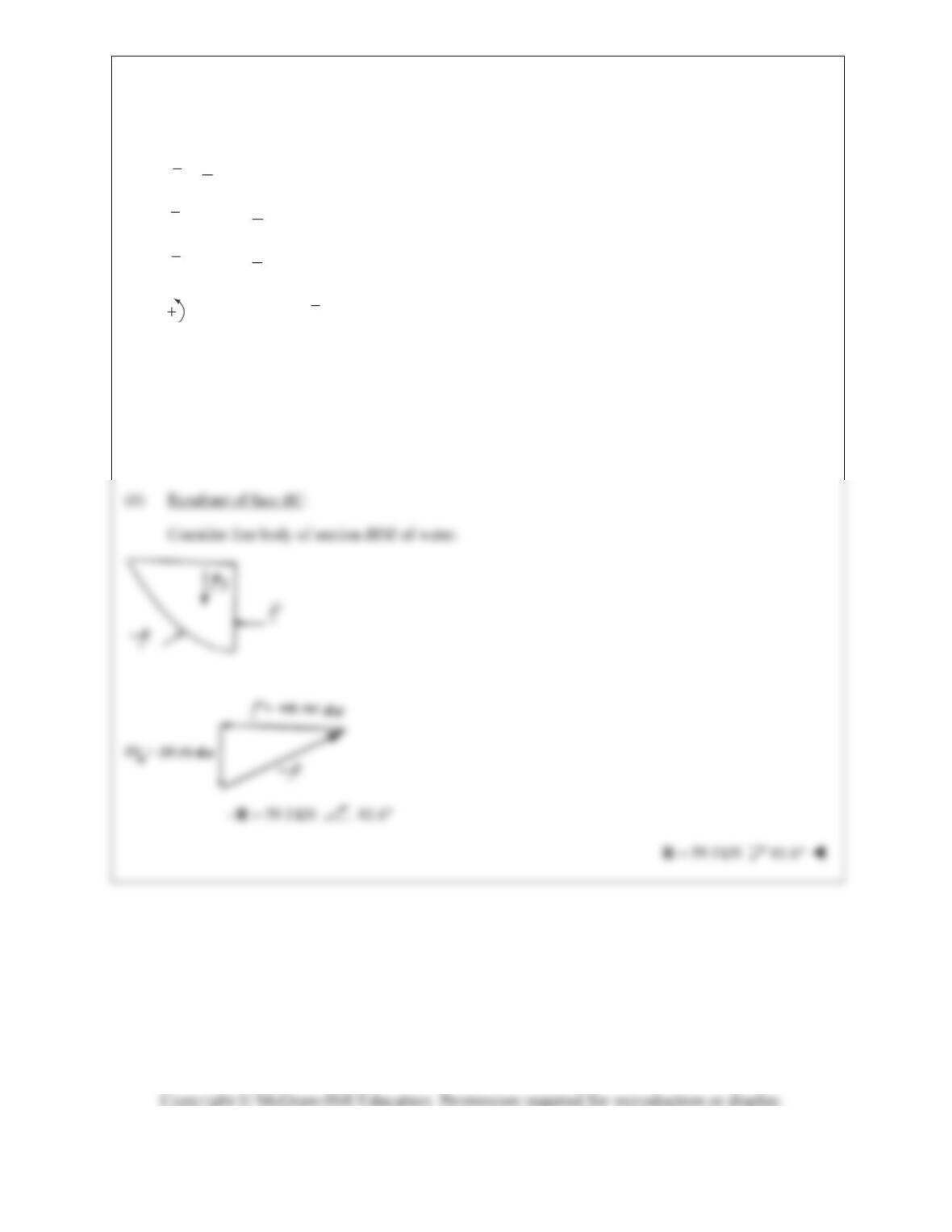
The cross section of a concrete dam is as shown. For a 1-m-wide
dam section, determine (a) the resultant of the reaction forces
exerted by the ground on the base AB of the dam, (b) the point of
application of the resultant of part a, (c) the resultant of the pressure
forces exerted by the water on the face BC of the dam.
SOLUTION
(a) Consider free body made of dam and section BDE of water. (Thickness 1 m)
PROBLEM 5.81 (Continued)
1
2
3
1(1.5 m) 0.75 m
2
1
1.5 m (2 m) 2 m
4
5
1.5 m (2 m) 2.75 m
8
x
x
x
0: (1 m) 0
A
MxVxWP
(227.6 kN) (141.26 kN)(0.75 m) (47.09 kN)(2 m)
(39.24 kN)(2.75 m) (44.145 kN)(1 m) 0
(227.6 kN) 105.9 94.2 107.9 44.145 0
(227.6) 263.9 0
x
x
x
1.159 mx
(to right of A)
PROBLEM 5.82
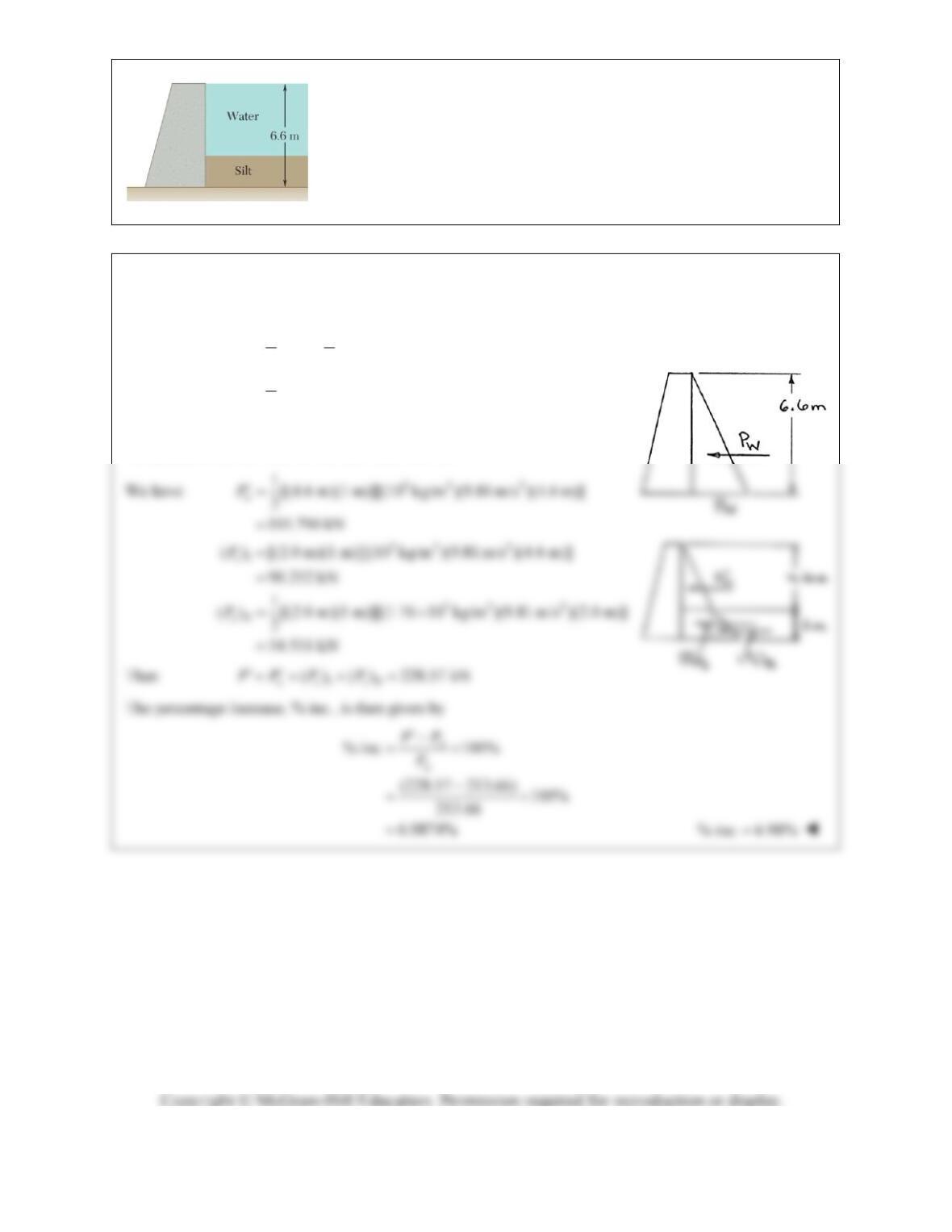
The dam for a lake is designed to withstand the additional force caused by
silt that has settled on the lake bottom. Assuming that silt is equivalent to
a liquid of density
33
1.76 10 kg/m
s
and considering a 1-m-wide
section of dam, determine the percentage increase in the force acting on
the dam face for a silt accumulation of depth 2 m.
SOLUTION
First, determine the force on the dam face without the silt.
We have
33 2
11
()
22
1[(6.6 m)(1 m)][(10 kg/m )(9.81 m/s )(6.6 m)]
2
213.66 kN
ww
PAp Agh
Next, determine the force on the dam face with silt