CHAPTER 5
Organization of the Firm
CHAPTER SUMMARY AND TEACHING OBJECTIVES
The material in this and following chapters relies on the fundamentals of economics developed in the
previous chapters and applies these fundamentals to topics often left to courses in organizational
behavior or human relations. Why does it matter how a firm is organized? What is the role of hierarchy
or other organizational forms? Can organization provide a competitive advantage?
The purpose of this chapter is for students to learn that the internal aspects of the firm are as important
to a firm’s success or failure as external aspects. Students should understand why some firms are
strongly hierarchical while others are less hierarchical; that is, to understand the costs and benefits of
alternative organizational forms.
IMPORTANT TERMS
vertical integration joining of two or more steps in the supply chain in a single firm
using the market typically related to the “buy or make” decision; does the firm carry out the activity
or does the firm purchase it in the market
upstream those steps in the supply chain that come before others or what are called downstream firms
downstream firms that are customers of upstream firms
make or buy the decision as to whether to produce the item in-house or to purchase it from other firms
through the market
transaction costs costs of carrying out transactions
18 Chapter 5: Organization of the Firm
TOPICS AND TEACHING SUGGESTIONS
1. Organizational Structure
Why have firms altered the way they are organized? Because of efficiency. This defines whether
firms make or buy, i.e., their vertical and their horizontal boundaries.
ANSWERS TO EXERCISES
1. Explain how singing a company song at the beginning of the workday could create a corporate
culture. What would the culture be?
2. Is there a relationship between corporate culture and performance? Explain.
3. Is it possible for a firm to have several different cultures? If so, what does this imply about the
relationship between culture and performance?
It would seem so; cultures could change or different divisions could have different cultures.
4. Explain why a firm might select the u-form rather than m-form organizational structure.
5. What is the advantage of the network over the m-form?
6. If it is necessary for each employee to interact with all other employees, what organizational form
makes most sense? If the employees work independently, not having to interact with each other,
which organizational form makes most sense?
7. Process innovations and a firm’s reputation can benefit many employees without reducing the
benefits to others. What is the problem created by this type of internal product? How can it be
8. A recent Wall Street Journal article noted that Intel was considering following the lead of other
Silicon Valley firms and do away with cubicles. Instead of a cubicle, Intel might turn to desks
upon which employees share space and simply plop their computer down.
a. What could explain this change? Could it be to minimize a “hold up” problem?
b. Might it be directed toward rent seeking?
9. Suppose that an employee has two tasks to perform—assembling machinery and evaluating
quality. Suppose that the supervisor can only observe how many machines have been assembled
by the worker. Is a hierarchical firm structure necessary under this situation? Under what
conditions should the principal closely tie pay to performance on the first task?
10. A shareholder in a limited liability company is not personally liable for any of the debts of the
company, other than for the value of his investment in that company. Explain why limited liability
came about. Explain why it was enacted in the late 19th Century.
11. Describe the efficiencies and the inefficiencies that occur with a top-down (hierarchical)
management structure.
12. What might be a problem with democracy as a structure to run a publicly held company?
13. Would it be more efficient to enable employees to vote on decisions with majority rule or to
assign the CEO full responsibility for decisions? Explain.
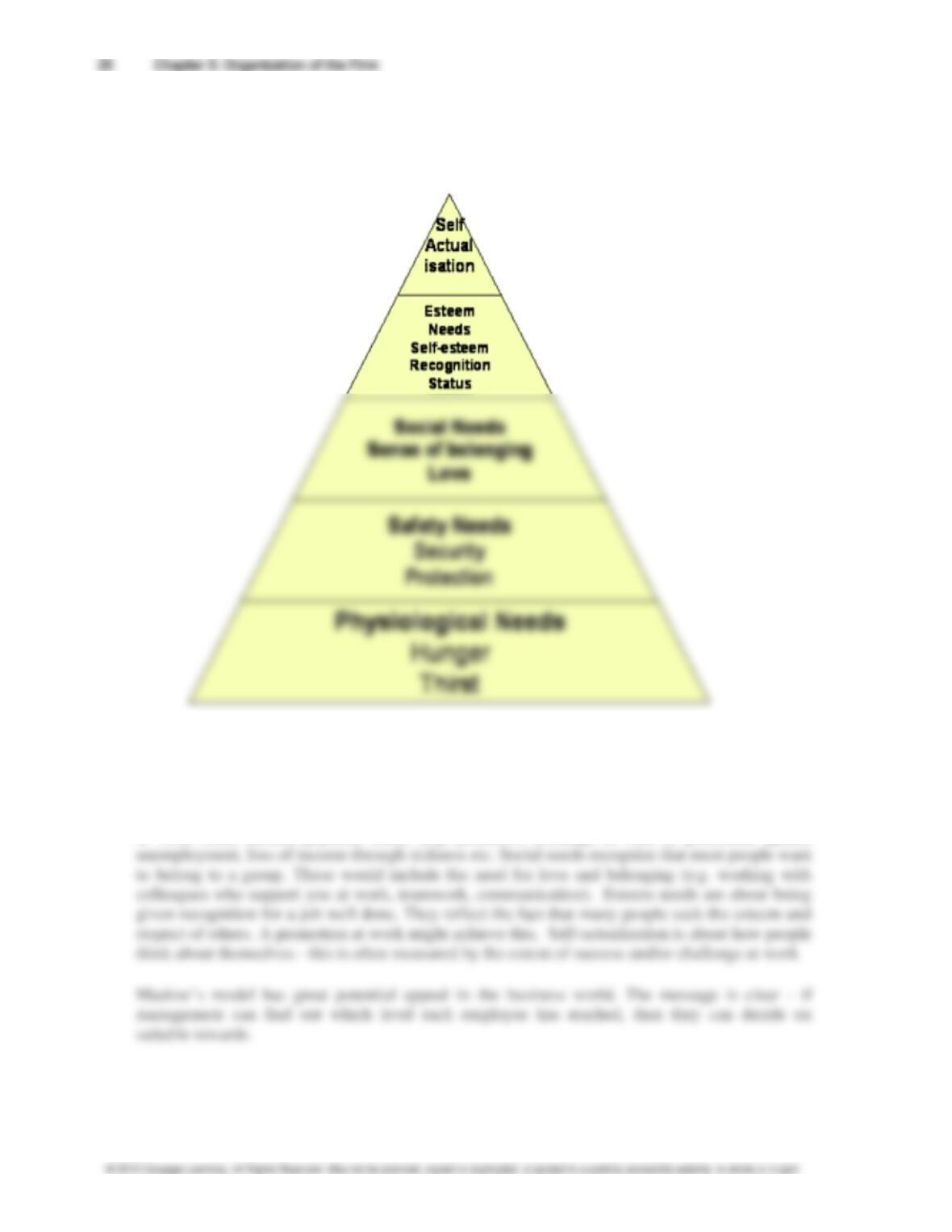
14. A commonly referred to management theory is Maslow’s Hierarchy of Needs. It is a theory of
motivation and is structured as an hierarchy.
The way the hierarchy works is that a person starts at the bottom of the hierarchy and initially
seeks to satisfy basic needs (e.g. food, shelter). Once these physiological needs have been
satisfied, they are no longer a motivator. The individual moves up to the next level. Safety needs
at work could include physical safety (e.g. protective clothing) as well as protection against
Chapter 5: Organization of the Firm 21
What problems with the Maslow Model come from its hierarchy?
15. When leading business thinker Gary Hamel analyzes the central problems with the modern
hierarchical organization, he sees 5 debilitating deficits. One is that too few voices are heard. His
suggested fix: Too few voices: Encourage people to write critical in-house blogs (and allow them
to do it anonymously if they so wish)? Track the number of responses each blog posting generates
and then require senior executives to respond to those that garnered the most feedback.
Evaluate the problem and the fix.
16. One of the best examples of the impact structure has on operations is the transformation that
began in the 1970’s and is still going on today: flattening. In the early part of this century,
companies had many levels between the worker in the shop or office and the President. Decisions
had to pass through many levels of approval before anything got done. Why are the old, but still
operational steel mills such as U.S. Steel and Bethlehem Steel structured using vertical
hierarchies? Why are newer steel mini-mills such as Chaparral Steel structured more horizontally,
capitalizing on the innovativeness of their employees?
17. Here is a view on organizational changes.
It was not long after the computer business got going that titles proliferated. Soon you could give
22 Chapter 5: Organization of the Firm
19. The fashion for flattening hierarchies has had the paradoxical effect of multiplying meaningless
job titles. Workers crave important-sounding titles to give them the illusion of ascending the
ranks. Everybody, from the executive suite downward, wants to fluff up their résumé as a hedge
against being sacked. Is this a good strategy to “avoid being sacked”? Explain
20. It has been suggested that large, tall hierarchies will predominate in physical capital intensive
industries, and these will typically have seniority-based promotion policies. By contrast, flat
hierarchies will be seen in human capital intensive industries. These will have up-or-out
promotion systems, where experienced managers either become owners or are fired. Can you
provide a basis for this suggestion or against the suggestion? Explain