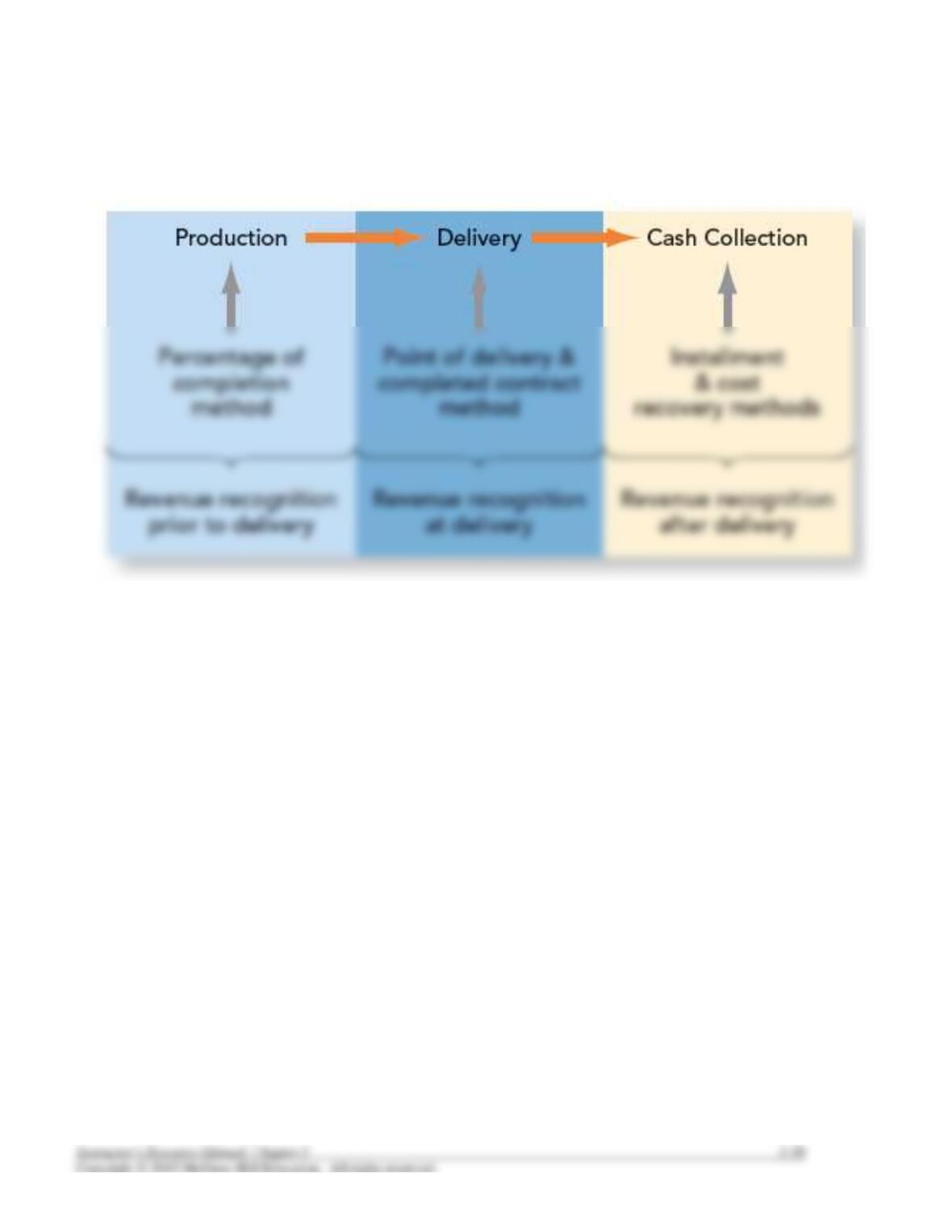
RELATION BETWEEN EARNINGS PROCESS
AND REVENUE RECOGNITION METHODS
➢ In most situations, the revenue recognition criteria are satisfied at
the point of product delivery.
T5-46

REVENUE RECOGNITION
Usually Recognize Revenue for:
Nature of the Revenue
Sale of a Product
Sale of a Service
Revenue Recognition Prior
to Delivery, Because:
proportion to its percentage of completion
Dependable estimates of
progress are not available.
At the completion of the project (completed
Not applicable
Dependable estimates of
Each period during the earnings process
Not applicable
Revenue Recognition
at Delivery
When product is delivered and title transfers
As the service is provided or the key
activity is performed
Revenue Recognition After
Delivery, Because:
significantly uncertain
When cash is collected (installment sales or
When cash is collected
unavailable
product return uncertainty
on consignment
ultimate consumer
T5-47
INTERNATIONAL FINANCIAL REPORTING STANDARDS
Long-Term Construction Contracts. IAS No. 11 governs revenue recognition
for long-term construction contracts. Like U.S. GAAP, IAS No. 11 requires use of
percentage-of-completion accounting when estimates can be made precisely. Unlike
U.S. GAAP, IAS No. 11 requires use of the cost recovery method rather than the
completed contract method when estimates cannot be made precisely enough to allow
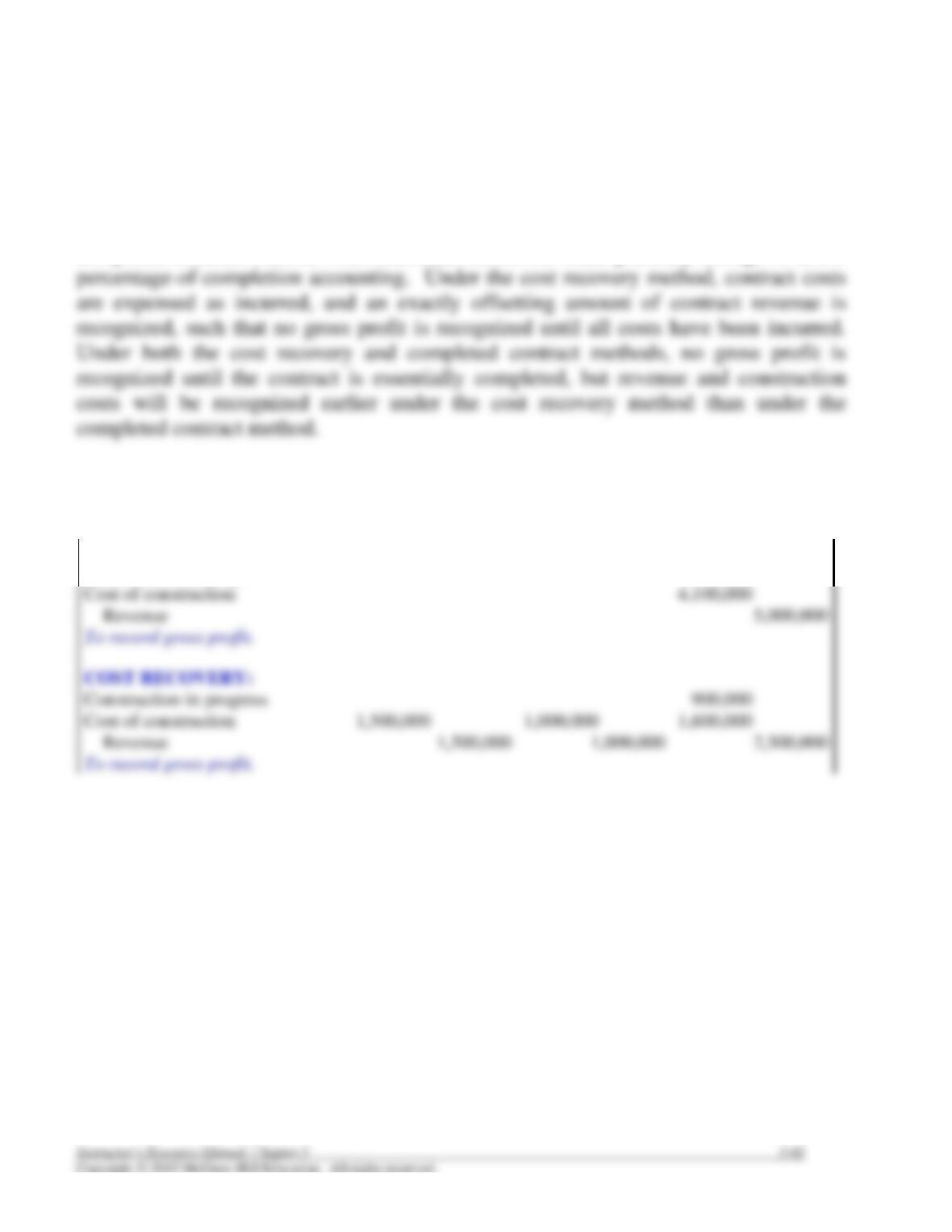
To see the difference, here is a version of Illustration 5-12B that compares cost and
gross profit recognition under the two methods:
COMPLETED CONTRACT:
Construction in progress
900,000
Cost of construction
Revenue
COST RECOVERY:
Construction in progress
900,000
Cost of construction
1,500,000
1,000,000
1,600,000
Revenue
T5–48
INSTALLMENT SALES METHOD
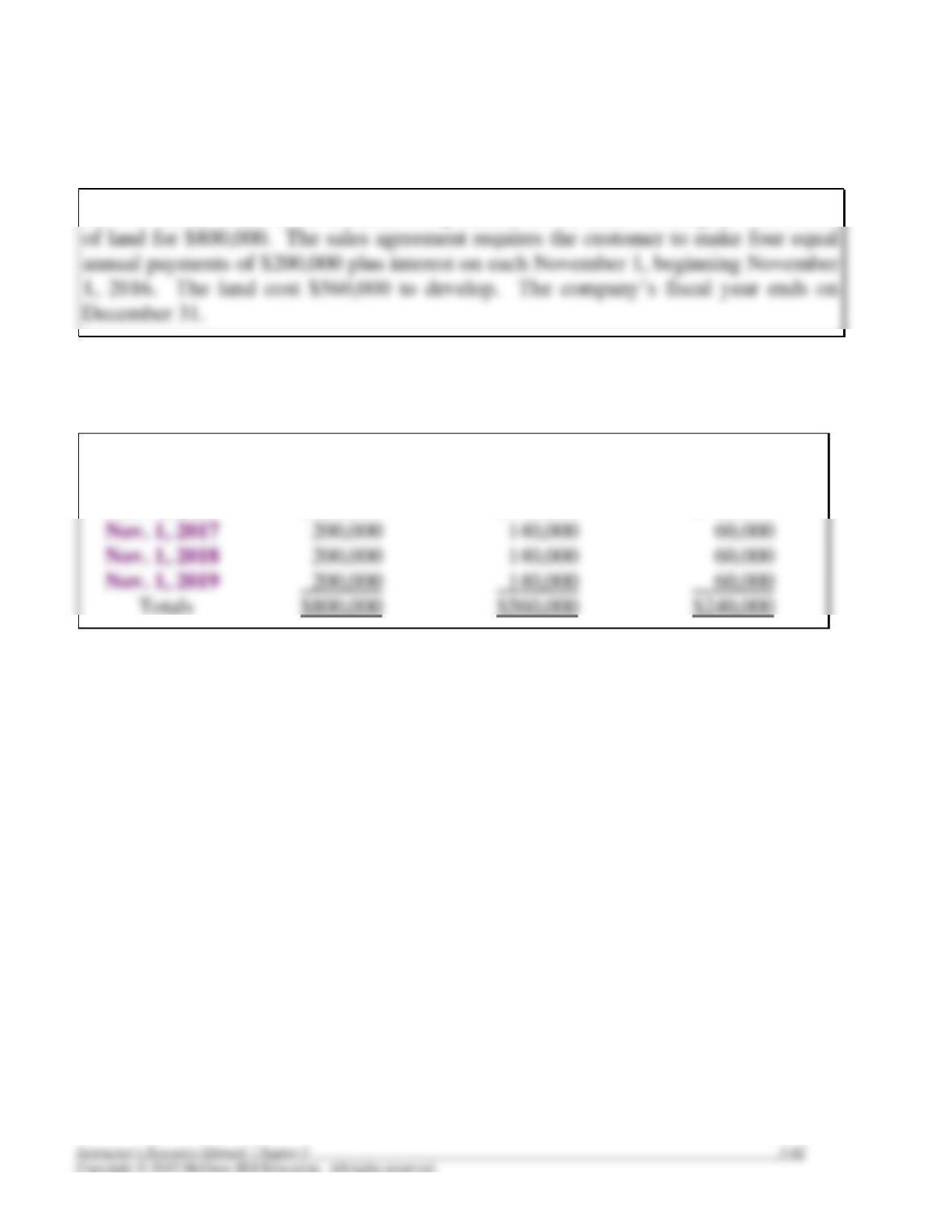
➢ The installment sales method recognizes gross profit by applying the gross profit
percentage on the sale to the amount of cash actually received.
On November 1, 2016, the Belmont Corporation, a real estate developer, sold a tract
Illustration 5-A3
Gross Profit Recognition
Date
Cash Collected
Cost Recovery
($560/$800=70%)
Gross Profit
($240/$800=30%)
Nov. 1, 2016
$200,000
$140,000
$ 60,000
Nov. 1, 2017
Nov. 1, 2019
$800,000
$560,000
$240,000
T5-49

INSTALLMENT SALES METHOD
(continued)
Journal Entries
Nov. 1, 2016 To record installment sale
Installment receivables …………………………………………… 800,000
T5–49 (continued)
COST RECOVERY METHOD
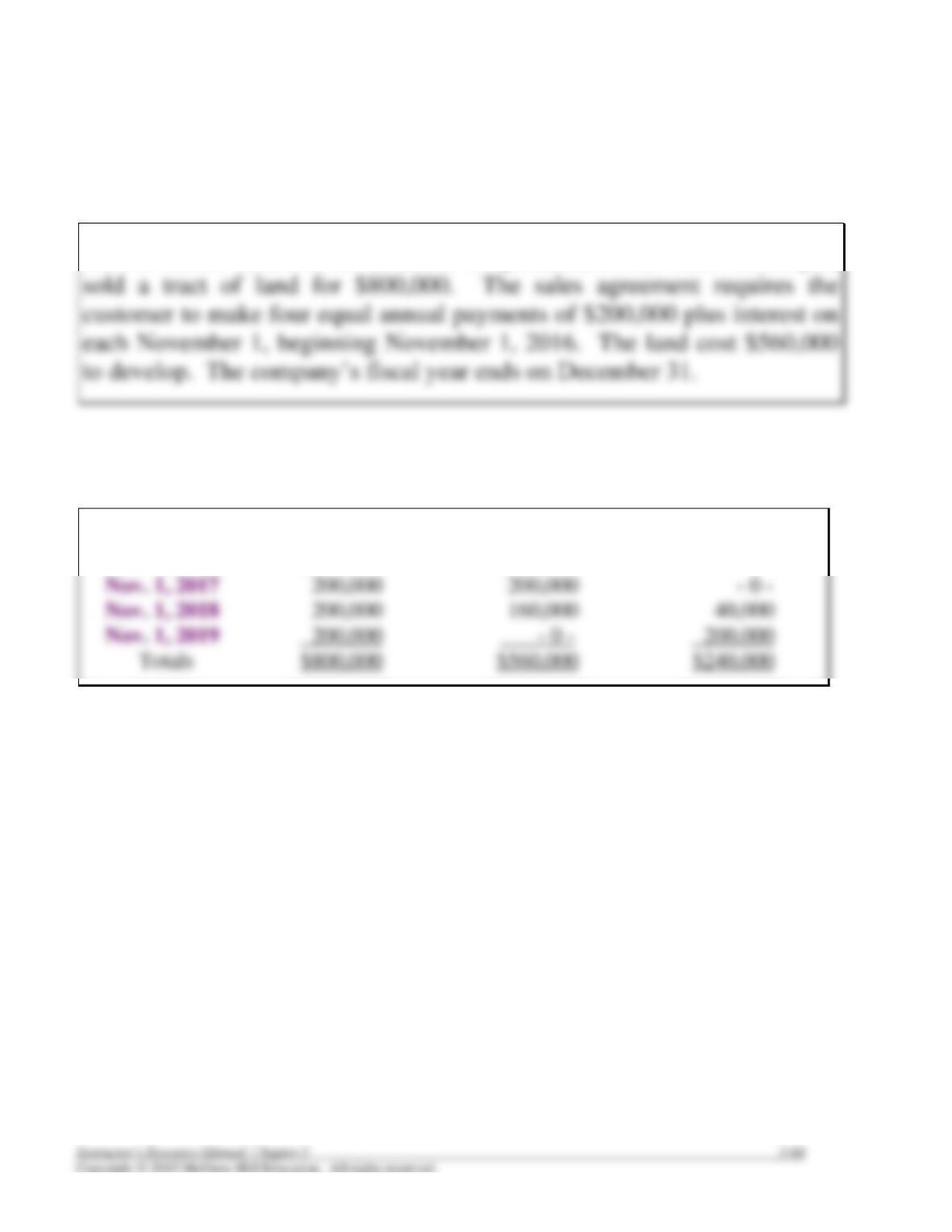
➢ The cost recovery method defers all gross profit recognition until cash equal to the
cost of the item sold has been recovered.
On November 1, 2016, the Belmont Corporation, a real estate developer,
Illustration 5-A3
Gross Profit Recognition
Date
Cash Collected
Cost Recovery
Gross Profit
Nov. 1, 2016
$200,000
$200,000
$ – 0 –
Nov. 1, 2017
Nov. 1, 2018
$800,000
$560,000
$240,000
T5–50

COST RECOVERY METHOD
(continued)
Journal Entries
Nov. 1, 2016 To record installment sale
Installment receivables …………………………………. 800,000
To record cash collection from installment sale
To recognize gross profit from installment sale
Nov. 1, 2016 and 2017
No entry
Nov. 1, 2018
T5–50 (continued)

SOFTWARE AND OTHER
MULTIPLE-ELEMENT ARRANGEMENTS
➢ If a software arrangement (sale) includes multiple elements, the revenue from the
arrangement should be allocated to the various elements based on “VSOE” (vendor–
T5–51

FRANCHISE SALES
On March 31, 2016, the Red Hot Chicken Wing Corporation entered into a franchise
agreement with Thomas Keller. In exchange for an initial franchise fee of $50,000,
Initial Franchise Fee
March 31, 2016 To record franchise agreement and down payment
Cash …………………………………………………………………….. 10,000
Franchise fee revenue …………………………………………. 50,000
Continuing Franchise Fees
To recognize continuing franchise fee revenue
Cash (or accounts receivable) …………………………..…….. 1,000
Illustration 5-A4
Suggestions for Class Activities
1. Real World Scenario
The following is an excerpt from an article that appeared in the August 25, 2002 edition of The Seattle
Times:
When Cutter & Buck revealed two weeks ago that it padded sales figures in
2000 by recording $5.8 million in shipments that were mostly returned, the
news came as a surprise to many investors. But it wasn’t the first time the
Suggestions:
This article provides a good way to introduce the topic of channel stuffing. When a company stuffs
the channel, it ships inventory ahead of schedule filling its distribution channels with more product
Points to note:
Channel stuffing is not an uncommon practice. There are many examples you can find for your
students. A text case references the Sunbeam incident that occurred in the late 90s. More recent
2. Research Activity
Probably most of your students have purchased merchandise via the Internet. You can buy the
products of many companies on line. Some of these companies, such as Amazon.com, often act
merely as intermediaries between the manufacturer and the consumer. Revenue recognition for this
type of transaction has been controversial. If Amazon sells something to a customer for $100 that
Suggestions:
Discuss with your class the implications of one reporting method versus the other. Why should it
make a difference? What factors might dictate whether or not Amazon should recognize the
transaction gross versus net? Have them access Amazon’s most recent financial statements using
3. PetSmart Analysis
Have students, individually or in groups, go to the most recent PetSmart annual report using Edgar
1. Compute the receivables turnover ratio, the profit margin on sales, the return on assets ratio, and
the return on shareholders’ equity ratio for the most three years. Are there any discernible
trends? How might they be interpreted?
4. Professional Skills Development Activities
The following are suggested assignments from the end-of-chapter material that will help your
students develop their communication, research, analysis and judgment skills.
Communication Skills. In addition to Communication Cases 5-7 and 5-13, Judgment Case 5-12
Research Skills. In their careers, our graduates will be required to locate and extract relevant
Analysis Skills. The “Broaden Your Perspective” section includes Analysis Cases that direct
Judgment Skills. The “Broaden Your Perspective” section includes Judgment Cases that require
5. Ethical Dilemma
The chapter contains the following ethical dilemma:
ETHICAL DILEMMA
The Precision Parts Corporation manufactures automobile parts. The company has reported a profit
every year since the company’s inception in 1977. Management prides itself on this accomplishment
and believes one important contributing factor is the company’s incentive plan that rewards top
You may wish to discuss this in class. If so, discussion should include these elements.
Step 1—The Facts:
Precision Parts Corporation has reported profits since its inception and given top management
bonuses when the operating income goal is achieved. In 2016, however, the company does not expect
Step 2—The Ethical Issue and the Stakeholders:
The ethical issue or dilemma is whether Tony Smith’s obligation to top management to show a
Step 3—Values:
Values include competence, honesty, integrity, objectivity, loyalty to the company, and
Step 4—Alternatives:
1. Record the parts sales revenue in 2016.
Step 5—Evaluation of Alternatives in Terms of Values:
1. Alternative 1 illustrates loyalty to the company and other top managers.
Step 6—Consequences:
Alternative 1
Positive consequences: Tony would enable other top managers to receive bonuses and permit the
Alternative 2
Positive consequences: Users of financial statements would receive more relevant and reliable
Step 7—Decision:

Assignment Chart
Brief
Exercises
Learning
Objective
Topic
Est.
Time
BE5-1
05–02
Revenue recognition at a point in time
5
BE5-2
05–03
Timing of revenue recognition
5
BE5-3
05–03
Timing of revenue recognition
5
BE5-4
05–04
Allocating the transaction price
5
BE5-5
05–05
Separate performance obligations; prepayments
5
BE5-6
05–05
Separate performance obligations; warranties
5
BE5-7
05–05
Separate performance obligations; warranties
5
BE5-8
05–05
Separate performance obligations; options
5
BE5-9
05–05
Separate performance obligations; construction
5
BE5–10
05–05
Separate performance obligations; construction
5
BE5–11
05-05, 05-06
Separate performance obligations; right of return
5
BE5–12
05–06
Variable consideration
5
BE5–13
05–06
Variable consideration
5
BE5–15
05–06
Principal or agent
5
BE5–16
05–06
Payments by the seller to the customer
5
Estimating stand-alone selling prices; adjusted market assessment
BE5–17
05–06
approach
10
BE5–18
05–06
Estimating stand-alone selling prices; expected cost plus margin
approach
10
BE5–19
05–06
Estimating stand-alone selling prices; residual approach
10
BE5–20
05–07
Timing of revenue recognition; licenses
10
BE5–21
05–07
Timing of revenue recognition; franchises
10
BE5–22
05–07
Timing of revenue recognition; bill–and-hold
10
BE5–23
05–07
Timing of revenue recognition; consignment
10
BE5–24
05–07
Timing of revenue recognition; gift card
10
BE5–25
05–08
Contract assets and contract liabilities
10
BE5–26
05-08, 05-09
Contract assets and contract liabilities
5
BE5–27
05–09
5
BE5–28
05–09
5
BE5–29
05–09
Long-term contract; revenue recognition upon completion
5
BE5–30
05-09
Long-term contract; revenue recognition; loss
on entire project
5
BE5–31
05–10
Receivables and inventory turnover ratios
10
BE5–32
05–10
Profitability ratios
10
BE5–33
05–10
Profitability ratios
15
BE5–34
05–10
Inventory turnover ratio
5
BE5–35
Appendix 5
Installment sales method
10
BE5–36
Appendix 5
Installment sales method
10
BE5–37
Appendix 5
Cost recovery method
10
BE5–38
Appendix 5
IFRS cost recovery method
10
BE5–39
Appendix 5
Revenue recognition; software contracts
5
BE5–40
Appendix 5
5
BE5–41
Appendix 5
Revenue recognition; franchise sales
5
Exercises
Learning
Objective
Topic
Est.
Time
E5-1
05-01, 05-02,
05–03
FASB codification research
15
E5-2
05–03
Service revenue
15
E5-3
05–04
Allocating transaction price
15
E5-4
05-04, 05-05
FASB codification research
15
E5-5
05-02, 05-04,
05–05
Performance obligations
20
E5-6
05-02, 05-04,
Performance obligations; customer option for additional goods or services
15
E5-7
15
E5-8
05-04, 05-05
Performance obligations; customer option for additional goods or services
20
E5-9
05–06
Variable consideration; estimation and constraint
15
E5–10
05-03, 05-06
Variable consideration – most likely amount; change in estimate
15
E5–11
05-03, 05-06
Variable consideration – expected value; change in estimate
20
E5–12
05-02, 05-05,
Consideration payable to customer; collectability of transaction price
10
E5–13
05–06
Approaches for estimating stand-alone selling prices
10
E5–14
05-06, 05-07
FASB codification research
15
E5–15
05-06, 05-07
Franchises; residual method
20
E5–16
05–08
FASB codification research
15
E5–17
05–09
Long-term contract; revenue recognition over time and at a
point in time
25
E5–18
05–09
Long-term contract; revenue recognition over time vs. upon project
completion
30
E5–19
05–09
Long-term contract; revenue recognition over time; loss projected on entire
project
30
E5–20
05-08, 05-09
projected on entire project
20
E5–21
05–09
50
E5–22
05–09
Long-term contract; revenue recognition over time; solve for unknowns
25
E5–23
05–10
Inventory turnover; calculation and evaluation
10
E5–24
05–10
Evaluating efficiency of asset management
10
E5–25
05-10
Profitability ratios
10
E5–26
05–10
DuPoint analysis
10
E5–27
Appendix 5
Installment sales method
20
E5–28
Appendix 5
Installment sales method; journal entries
15
E5–29
Appendix 5
Installment sales; alternative recognition methods
15
E5–30
Appendix 5
Journal entries; point of delivery, installment sales, and cost recovery
methods
25
E5–31
Appendix 5
Installment sales and cost recovery methods; solve for unknowns
10
E5–32
Appendix 5
Installment sales method; default and repossession.
20
E5–33
Appendix 5
Real estate sales; gain recognition
15
E5–34
Appendix 5
FASB codification research
15
E5–35
Appendix 5
Long-term contract; percentage of completion, completed contract and
30
E5–36
Appendix 5
Revenue recognition; software
10
E5–37
Appendix 5
Multiple-deliverable arrangements
15
E5–38
Appendix 5
Multiple-deliverable arrangements under IFRS
10
E5–39
Appendix 5
Revenue recognition; franchise sales
15
CPA/CMA
Questions
Learning
Objective
Topic
Est.
Time
CPA5-1
05–02
Recognizing Revenue at a Single Point in Time
15
CPA5-2
05–04
Recognizing Revenue for Contracts that Contain Multiple Performance
Obligations
5
CPA5-3
05–04
Recognizing Revenue for Contracts that Contain Multiple Performance
Obligations
5
CPA5-4
05–05
Special Issues for Step 1: Identify the Contract
5
CPA5-5
05–07
Special Issues for Step 5: Recognize Revenue As Each Performance
5
CPA5-6
05–08
Disclosures
5
CPA5-7
05–08
Disclosures
5
CPA5-8
05–08
Disclosures
5
CPA5-9
Appendix
Revenue Recognition GAAP In Effect Prior to ASU No. 2014-09
5
Appendix
Revenue Recognition GAAP In Effect Prior to ASU No. 2014-09
5
Appendix
Revenue Recognition GAAP In Effect Prior to ASU No. 2014-09
5
Appendix
Revenue Recognition GAAP In Effect Prior to ASU No. 2014-09
5
Appendix
Revenue Recognition GAAP In Effect Prior to ASU No. 2014-09
5
CMA5-1
05–08
Disclosures
10
CMA5-2
Appendix
Revenue Recognition GAAP In Effect Prior to ASU No. 2014-09
10
Problems
Learning
Objective
Topic
Est.
Time
P5-1
05-04, 05-05
Upfront fees; separate performance obligations
25
P5-2
Performance obligations; warranties; option
30
P5-3
05-02, 05-04,
Performance obligations; warranties; option
35
P5-4
05-02, 05-04,
Performance obligations; customer options for additional goods and
30
P5-5
05-03, 05-06
Variable consideration
25
P5-6
05-03, 05-06
Variable consideration; change in estimate
25
P5-7
05-03, 05-06
Variable consideration; constraint and change of estimate
20
P5-8
05-03, 05-06
Variable transaction price
40
P5-9
05-03, 05-06,
Variable transaction price
45
P5–10
05-08, 05-09
Long-term contract; revenue recognition over time
55
P5–11
05–09
40
Long-term contract; revenue recognized over time; loss projected on
05-02, 05-04,
P5–12
05–09
entire project
25
P5–13
05–09
Long-term contract; revenue recognition over time vs. upon project
completion
45
P5–14
05–10
Calculating activity and profitability ratios
20
P5–15
05–10
Use of ratios to compare two companies in the same industry
40
P5–16
05–10
Creating a balance sheet from ratios; chapters 3 and 5
50
P5–17
05–10
Compare two companies in the same industry; chapters 3 and 5
40
P5–18
Appendix 5
Income statement presentation; installment sales method
25
P5–19
Appendix 5
Installment sales and cost recovery methods
30
P5–20
Appendix 5
Installment sales; alternative recognition methods
30
P5–21
Appendix 5
Installment sales and cost recovery methods, multiple years
30
P5–22
Appendix 5
Construction accounting under IFRS
40
P5–23
Appendix 5
Franchise sales, installment sales method
25