CHAPTER 5
Revenue Recognition and Profitability Analysis
Overview
In Chapter 4 we discussed net income and its presentation in the income statement. In Chapter
5 we focus on revenue recognition, which determines when and how much revenue appears in
the income statement. In Part A of this chapter we discuss the general approach for recognizing
Note to Instructors: Using Chapter 5 to Teach Revenue Recognition
Given the FASB’s new approach to revenue recognition, Chapter 5 was completely revised
and carefully structured to facilitate instruction, starting off by making clear to students how the
five-step revenue recognition process works and then discussing how various business
arrangements affect the five-step process.
• Part A is designed to provide a simple introduction to the five-step revenue-recognition
process. Part A can be covered on its own by instructors who desire to provide single-
arrangements, and gift cards. A key feature of Part B is that each of these special issues is
presented according to which step in the revenue recognition process is being affected.
Organizing topics this way allows students to build a stronger framework for understanding
each step in the FASB’s new revenue recognition process.
• Part C likewise maximizes instructor flexibility as it covers accounting for long-term
contracts under ASU 2014-09. Given the importance of long-term contracts, we continue to
include this topic in the body of the chapter, but instructors who don’t wish to cover long-
Learning Objectives
● LO5-1 State the core revenue recognition principle and the five key steps in applying it.
● LO5-2 Explain when it is appropriate to recognize revenue at a single point in time.
● LO5-3 Explain when it is appropriate to recognize revenue over a period of time.
● LO5-4 Allocate a contract’s transaction price to multiple performance obligations.
● LO5-5 Determine whether a contract exists, and whether some frequently encountered
Lecture Outline
Part A: Introduction to Revenue Recognition
I. Revenue Recognition in General
A. FASB definition: “Revenues are inflows or other enhancements of assets of an entity
or settlements of its liabilities (or a combination of both) from delivering or producing
B. To determine how much revenue to recognize and when to recognize it, we apply the
core revenue recognition principal: Companies recognize revenue when goods or
services are transferred to customers for the amount the company expects to be entitled
C. Five steps are used to apply the principle: (T5-2)
1. Identify the contract with a customer.
D. Key considerations for each of the five steps that we will learn about: (T5-3)
1. A contract establishes the legal rights and obligations of the seller and the
customer.
II. Revenue Recognition at a Point in Time
A. We recognize revenue at a point in time when we don’t qualify for recognizing revenue
over time.
B. The performance obligation is satisfied when control of the goods or services is
III. Revenue Recognition over a Period of Time
A. Revenue should be recognized over time if goods and services are transferred over time
to the customer.
B. Revenue can be recognized over time if one of the following conditions hold: (T5-6,
T5-7)
1. The customer consumes the benefit of the seller’s work as it is performed, or
IV. Revenue Recognition for Contracts with Multiple Performance Obligations
A. The objective is to separate complex contracts into parts that can be viewed on a stand–
alone basis. Steps 2 and 4 are critical to this process. (T5-8 – T5-12)
B. Step 2: Identify the performance obligation(s) in the contract.
1. A promise to provide a good or service is a performance obligation if the good or
V. Illustration 5-11 Sumarizes the Revenue Recognition Concepts Covered in Part A (T5–
13)
Part B: Special Topics in Revenue Recognition
I. Special Issues for Step 1: Identify the Contract (T5-14, T5-15)
A. A contract is an agreement that creates legally enforceable rights and obligations.
1. Can be explicit or implicit.
2. Can be oral or written.
B. A contract exists for purposes of revenue recognition only if it
1. has commercial substance, affecting the risk, timing or amount of the seller’s
C. A contract does not exist if both of the following are true.
1. neither the seller nor the customer has performed any obligations under the
II. Special Issues for Step 2: Identify the Performance Obligation(s) (T5-16, T5-17)
A. Examples of common parts of contracts that are not performance obligations:
1. Prepayments (it’s part of the transaction price).
2. Quality-assurance warranties (it’s part of the performance obligation to deliver
a. the customer has the option to purchase the warranty separately, or
III. Special Issues for Step 3: Determine the Transaction Price
A. Variable Consideration: (T5-18 – T5-22)
1. Occurs when some of the contract price depends on the outcome of a future
event. Examples:
2. Estimate variable consideration using either
a. Expected value, calculated as the sum of each possible amount multiplied
3. Sellers only include an estimate of variable consideration in the transaction price
to the extent it is probable that a significant revenue reversal will not occur when
the uncertainty associated with the variable consideration is resolved.
4. The seller should update estimates of variable consideration (and of whether the
constraint is required) prospectively, adjusting revenue and other accounts as
necessary in the period in which the estimate is revised.
5. Regarding sales with a right of return,
a. If sales are for cash, companies record estimated returns by debiting a
contra-revenue account called “sales returns” and crediting a refund
B. Principal or Agent (T5-23, T5-24)
1. If the company is a principal, it records revenue equal to the total sales price paid
3. We view the seller as a principal if it obtains control of the goods or services
before they are transferred to the customer. Control is evident if the principal
C. Time Value of Money (T5-23)
1. If payment happens before or after delivery, the transaction has a financing
component. If the financing component is significant, the seller has to account
for it.
D. Payments by the Seller to the Customer (T5-23)
1. If the seller is purchasing distinct goods or services from the customer at the fair
value of those goods or services, we account for that purchase as a separate
IV. Special Issues for Step 4: Allocate the Transaction Price to the Performance
Obligations
A. Three methods are recommended for estimating stand-alone selling prices that are not
observable: (T5-25, T5-26)
1. Adjusted market assessment approach: The seller considers what it could sell the
product or services for in the market in which it normally conducts business,
3. Residual approach: The seller estimates an unknown (or highly uncertain) stand-
alone selling price by subtracting the sum of the known or estimated stand-alone
selling prices from the total transaction price. The residual approach is allowed
V. Special Issues for Step 5: Recognize Revenue When (Or As) Each Performance
Obligation Is Satisfied (T5-27, T5-28)
A. Licenses
1. Right of use: Some licenses transfer a right to use the seller’s intellectual
property as it exists when the license is granted. Revenue for those licenses is
B. Franchises
1. The franchisor grants to the franchisee the right to sell the franchisor’s products
and use its name for a specified period of time.
C. Bill-and-hold sales
1. Exist when a customer purchases goods but requests that the seller not ship the
product until a later date.
D. Consignment arrangements
1. Exist when a “consignor” physically transfers the goods to the other company
E. Gift Cards
1. Seller records a deferred revenue liability when the card is sold.
VI. Disclosures (T5-29)
A. Income Statement reports revenue, bad debt expense, and interest revenue and interest
expense associated with significant finance components.
B. Balance Sheet
1. Accounts Receivable: Unconditional right to receive payment, depending only
C. Disclosure:
1. The objective is to help investors understand the nature, amount, timing and
uncertainty of revenues and cash flows.
2. Required disclosures include:
a. Separation of revenue into meaningful categories (product lines, geographic
VII. Illustration 5-22 Sumarizes the Revenue Recognition Special Topics Covered in Part
B (T5-30)
Part C: Accounting for Long-Term Contracts (T5-31)
I. Two of the five revenue recognition steps are especially critical for long-term contracts:
(T5-32)
A. Step 2, “Identify the performance obligation(s) in the contract,” is important because
B. Step 5, “Recognize revenue when (or as) each performance obligation is satisfied,” is
important because there can be a considerable difference for long-term contracts
between recognizing revenue over time and recognizing revenue only when the
contract has been completed. Most long-term contracts qualify for revenue recognition
over time, either because
1. the seller is creating an asset that the customer controls as it is completed, or
II. Much of the accounting is the same, regardless of whether revenue is recognized over
time or upon contract completion. (T5-33 – T5-37)
A. All costs of construction are recorded in an asset (inventory) account called
construction in progress.
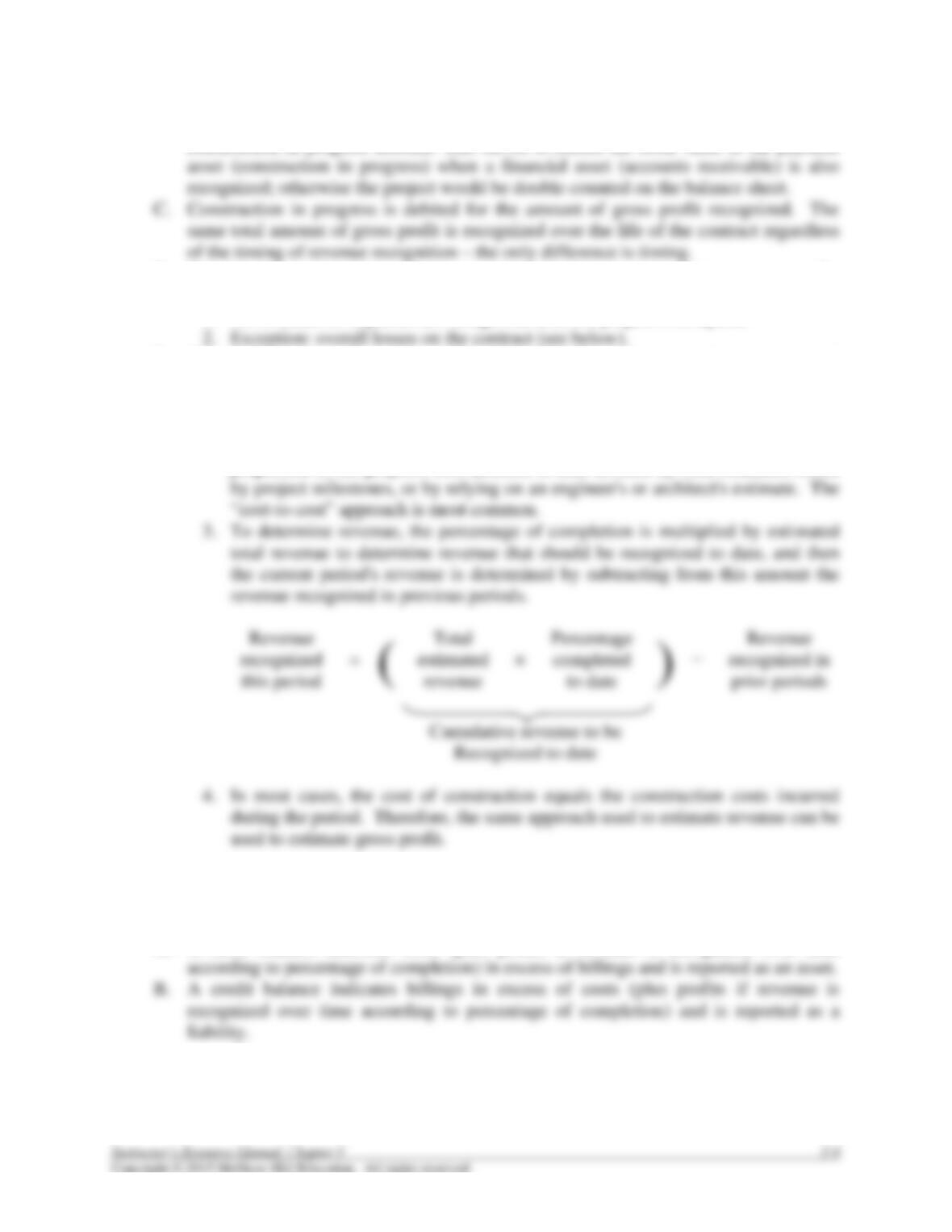
B. Period billings are credited to billings on construction contract, a contra account to the
construction in progress account. This serves to reduce the book value of the physical
D. Recognizing revenue at a point in time is equivalent to recognizing revenue at the
point of delivery, that is, when the project is complete.
1. No revenues or expenses are recognized until the project is complete.
E. Recognizing revenue over time allocates a fair share of a project’s revenues and
expenses to each reporting period during construction. How is that fair share
determined? (T5-13)
1. The allocation of project profit is accomplished by estimating progress to date.
2. Progress to date (the percentage of completion) can be estimated as the
proportion of the project’s cost incurred to date divided by total estimated costs,
III. Balance sheet effects: Construction in progress is compared to billings on construction
contract. (T5-38)
A. A debit balance indicates costs (plus profits if revenue is recognized over time
IV. Long-term contract losses (T5-39)
A. A loss could occur on a profitable project if the estimated costs to complete were
Part D: Profitability Analysis
I. Activity Ratios (T5-40)
A. Activity ratios measure a company’s efficiency in managing its assets.
B. The asset turnover ratio measures a company’s efficiency in using assets to generate
D. The inventory turnover ratio measures a company’s efficiency in managing its
investment in inventory.
1. The ratio is calculated by dividing the period’s cost of goods sold by the average
II. Profitability Ratios (T5-41)
A. Profitability ratios assist in evaluating various aspects of a company’s profit-making
activities.
B. The profit margin on sales measures the amount of net income achieved per sales
III. DuPont Framework (T5-42)
A. The DuPont Framework helps identify how profitability, activity, and financial
Appendix (Covering Key Areas of GAAP Superceded by ASU 2014-09) (T5-43)
I. Revenue Recognition in General
A. The realization principle requires that two criteria be satisfied before revenue can be
recognized: (T5-44)
B. Staff Accounting Bulletin No.’s 101 and 104 summarized the SEC’s views on revenue
recognition. The bulletins provide additional criteria for judging whether or not the
realization principle is satisfied:
1. Persuasive evidence of an arrangement exists.
C. IFRS revenue recognition concepts focus on transfer of economic benefits. IFRS
allows revenue to be recognized when the following conditions have been satisfied:
1. The amount of revenue and costs associated with the transaction can be
measured reliably.
D. Under prior GAAP, it was useful to characterize revenue from the perspective of
the point of delivery. (T5-46, 47)
E. Revenue recognition prior to delivery is covered in the main chapter (that is,
II. Revenue Recognition after Delivery
A. Significant uncertainties about cash collection could cause a delay in recognizing
revenue from the sale of a product or a service.
B. Installment sales
1. Revenue recognition for most installment sales takes place at the point of
delivery, because reliable estimates of potential uncollectible amounts can be
C. Under IFRS, IAS No. 11 governs revenue recognition for long-term construction
contracts.
(T5-17)
1. Like U.S. GAAP, the international standard requires the use of percentage-of-
III. Industry-Specific Revenue Issues
A. Multiple-element arrangements (T5-51)
1. If a software arrangement (sale) includes multiple elements, the revenue from the
arrangement should be allocated to the various elements based on the relative fair
values of the individual elements (Vendor-specific objective evidence”).
B. In a franchise sale, the fees to be paid by the franchisee to the franchisor usually
comprise (1) the initial franchise fee, and (2) continuing franchise fees. (T5-52)
1. GAAP requires that the franchisor has substantially performed the services
PowerPoint Slides
A PowerPoint presentation of the chapter is available in the Connect library.

Teaching Transparency Masters
The following can be reproduced on transparency film as they appear here, or you
DEFINITION OF REVENUE
➢ According to the FASB, “Revenues are inflows or other enhancements of assets
T5-1
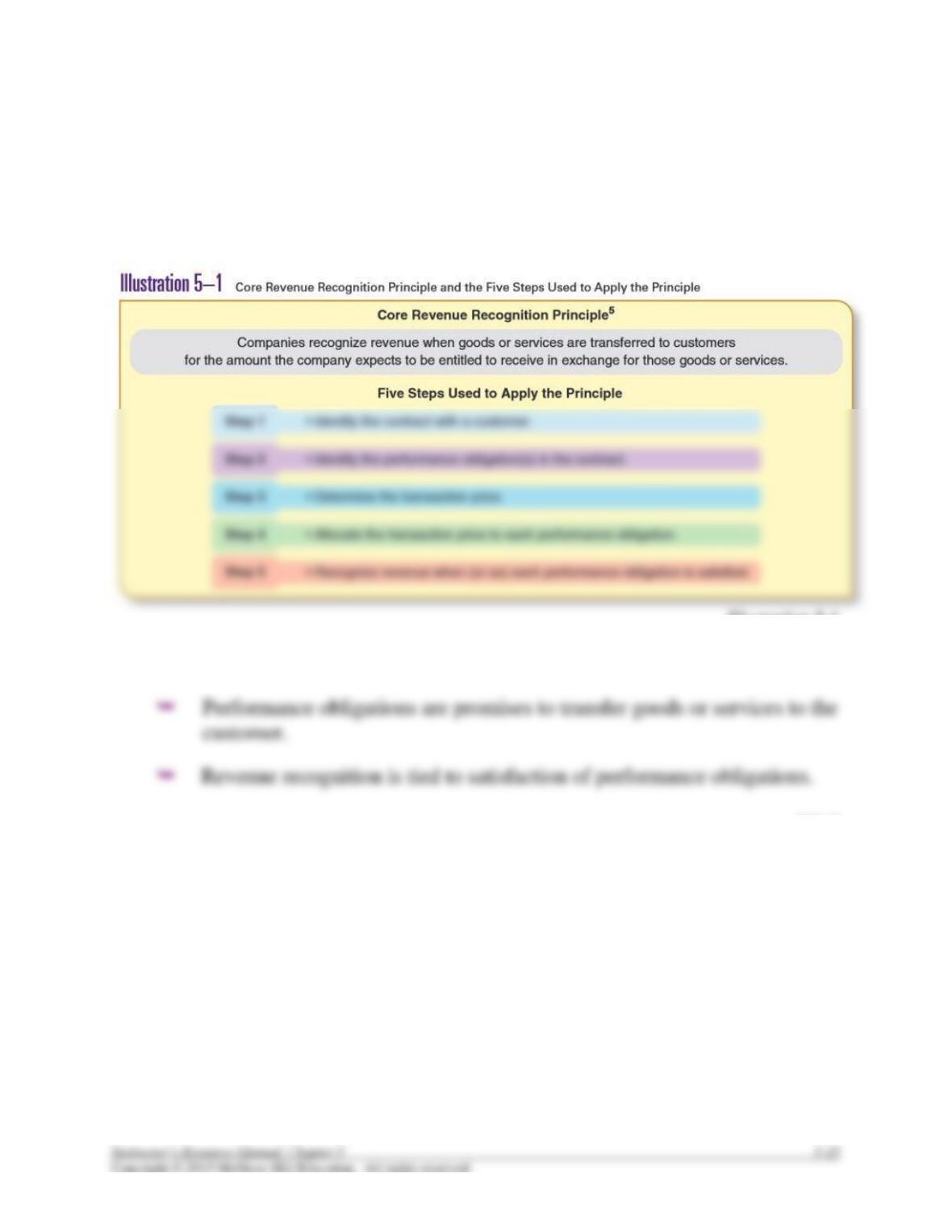
CORE REVENUE RECOGNITION PRINCIPLE
AND THE 5 STEPS TO IMPLEMENTING IT
Illustration 5-1
➢ Key concept: The seller has one or more performance obligations
T5-2
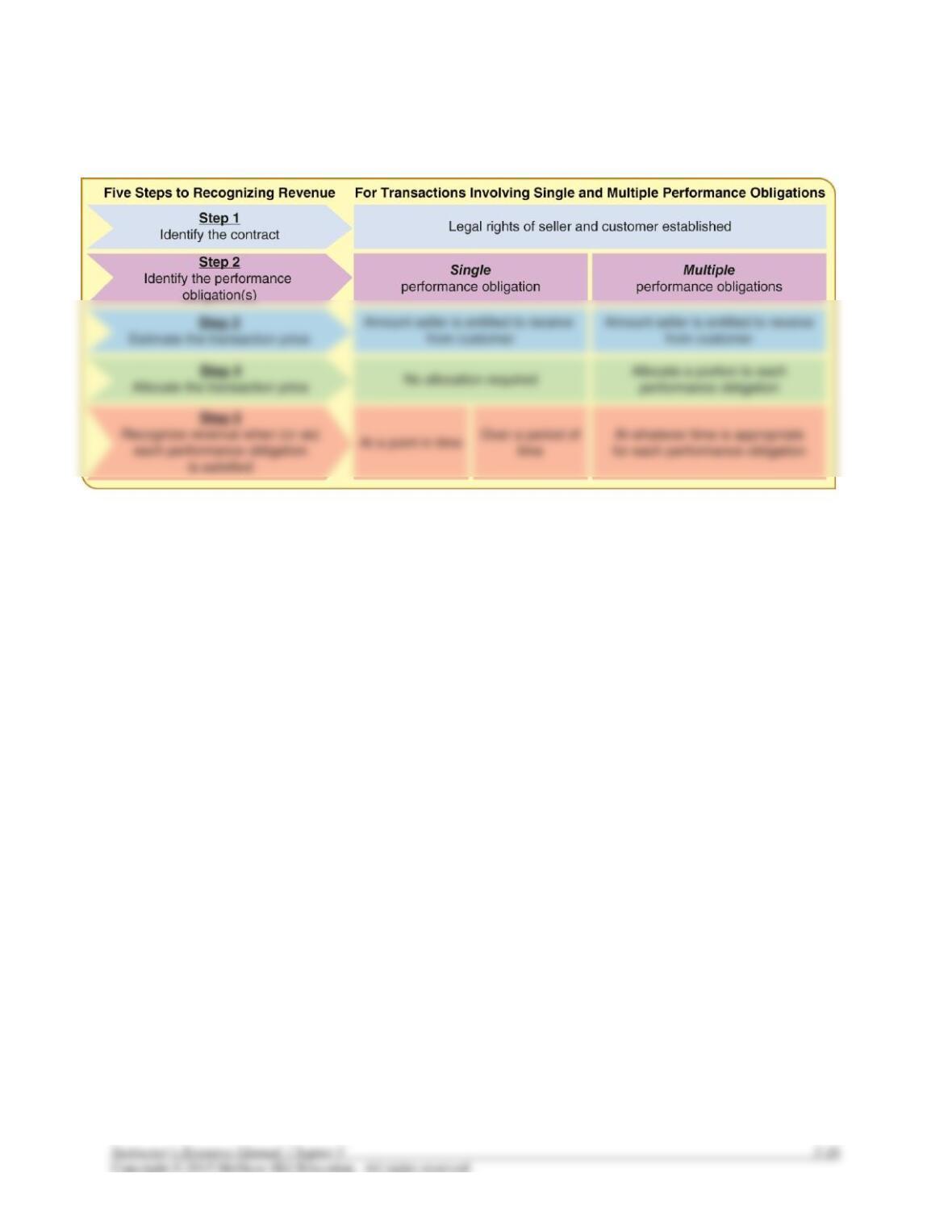
OVERVIEW OF THE 5 STEPS
Illustration 5-2
T5-3
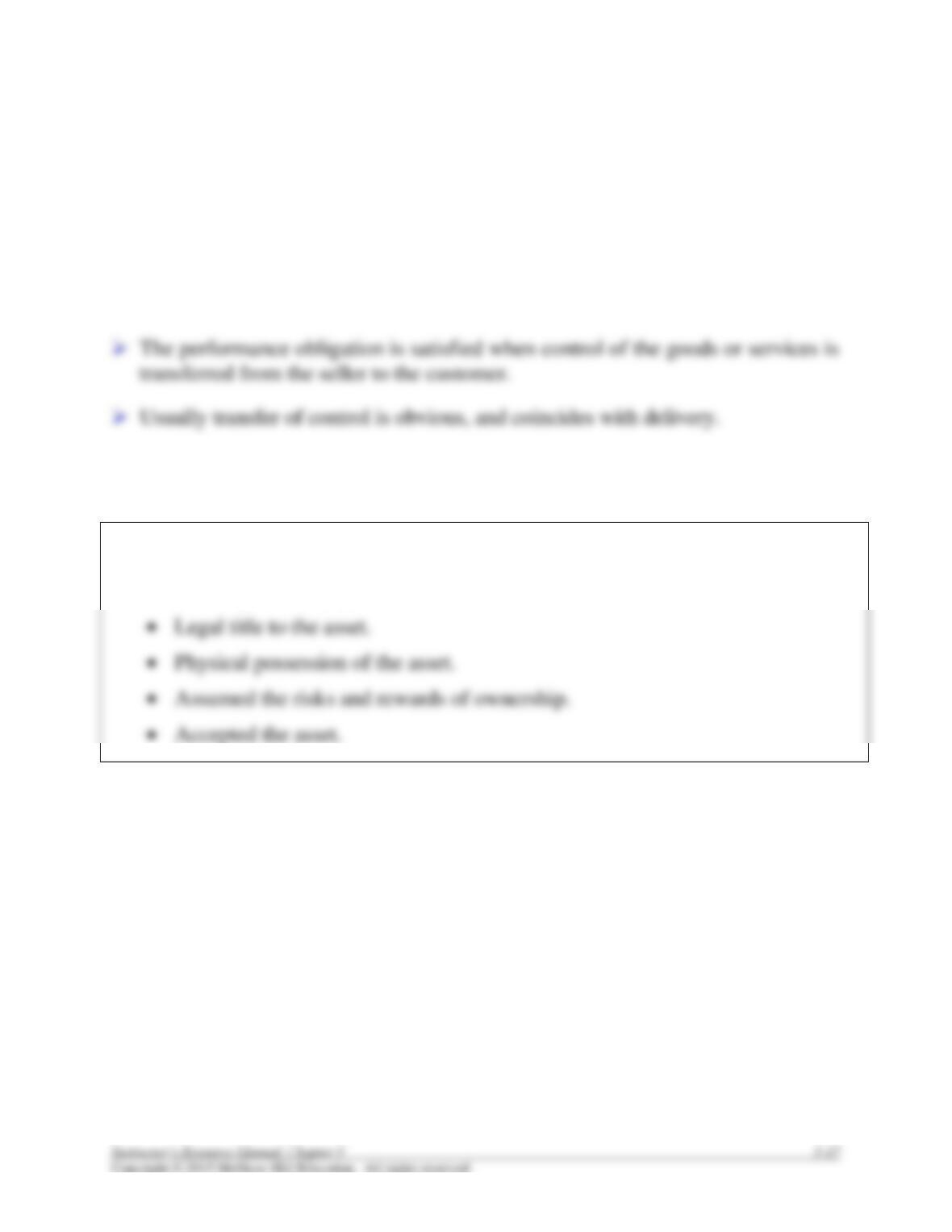
RECOGNIZING REVENUE AT A SINGLE POINT IN
TIME
➢ We recognize revenue at a point in time when we don’t qualify for recognizing
revenue over time.
Criteria for Recognizing Revenue at a Point in Time
The customer is more likely to control a good or service if the customer has:
• An obligation to pay the seller.
Illustration 5-3
T5-4
RECOGNIZING REVENUE AT A SINGLE POINT IN
TIME
(continued)
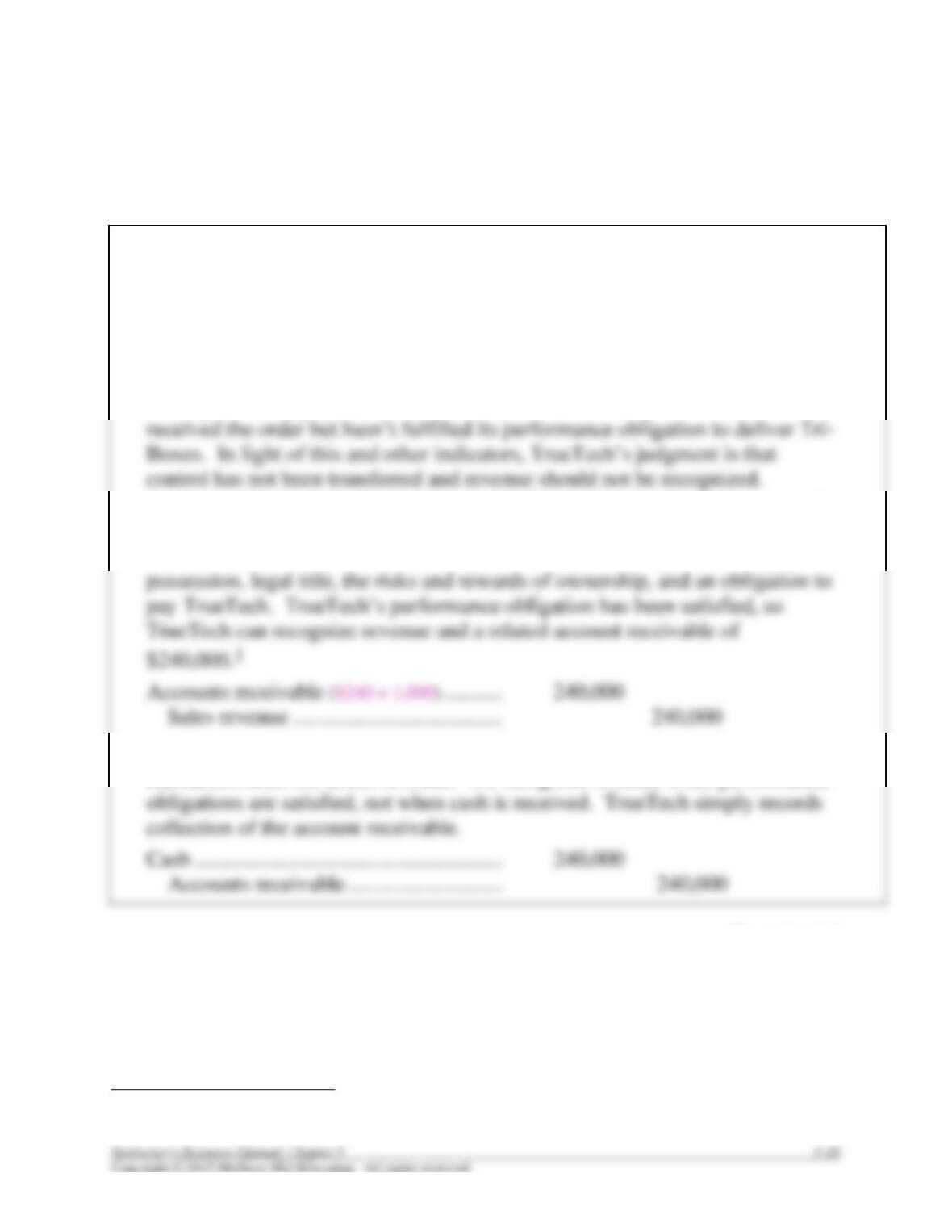
TrueTech Industries sells the Tri-Box, a gaming console that allows users to play
video games individually or in multi-player environments over the Internet. A
Tri-Box is only a gaming module and includes no other goods or services. When
should TrueTech recognize revenue for the following sale of 1,000 Tri-Boxes to
CompStores?
• December 20, 2015: CompStores orders 1,000 Tri-Boxes at a price of $240
each, promising payment within 30 days after delivery. True Tech has
• January 1, 2016: TrueTech delivers 1,000 Tri-Boxes to CompStores, and
title to the Tri-Boxes transfers to CompStores. TrueTech has delivered the
Tri-Boxes, and CompStores has accepted delivery, so CompStores has physical
• January 25, 2016: TrueTech receives $240,000 from CompStores. This
transaction does not affect revenue. We recognize revenue when performance
Illustration 5-4
T5-5
1 TrueTech also would debit cost of goods sold and credit inventory to recognize the cost of inventory sold.
RECOGNIZING REVENUE OVER TIME
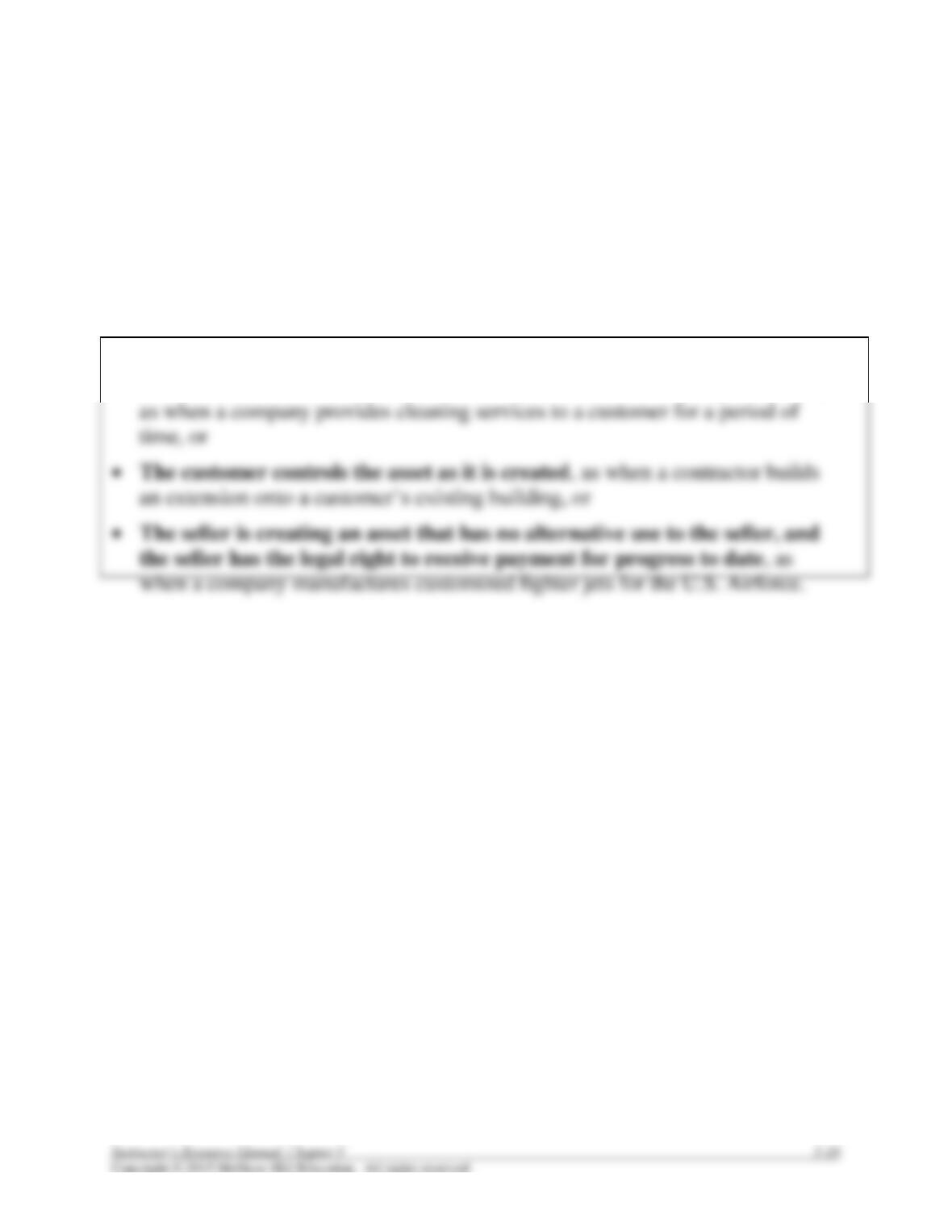
➢ We recognize revenue over time when performance obligations are satisfied
over time. That is the case if we transfer goods and services over time.
Criteria for Recognizing Revenue over Time
Revenue is recognized over time if either:
• The customer consumes the benefit of the seller’s work as it is performed,
Illustration 5-5
T5-6
RECOGNIZING REVENUE
OVER A PERIOD OF TIME
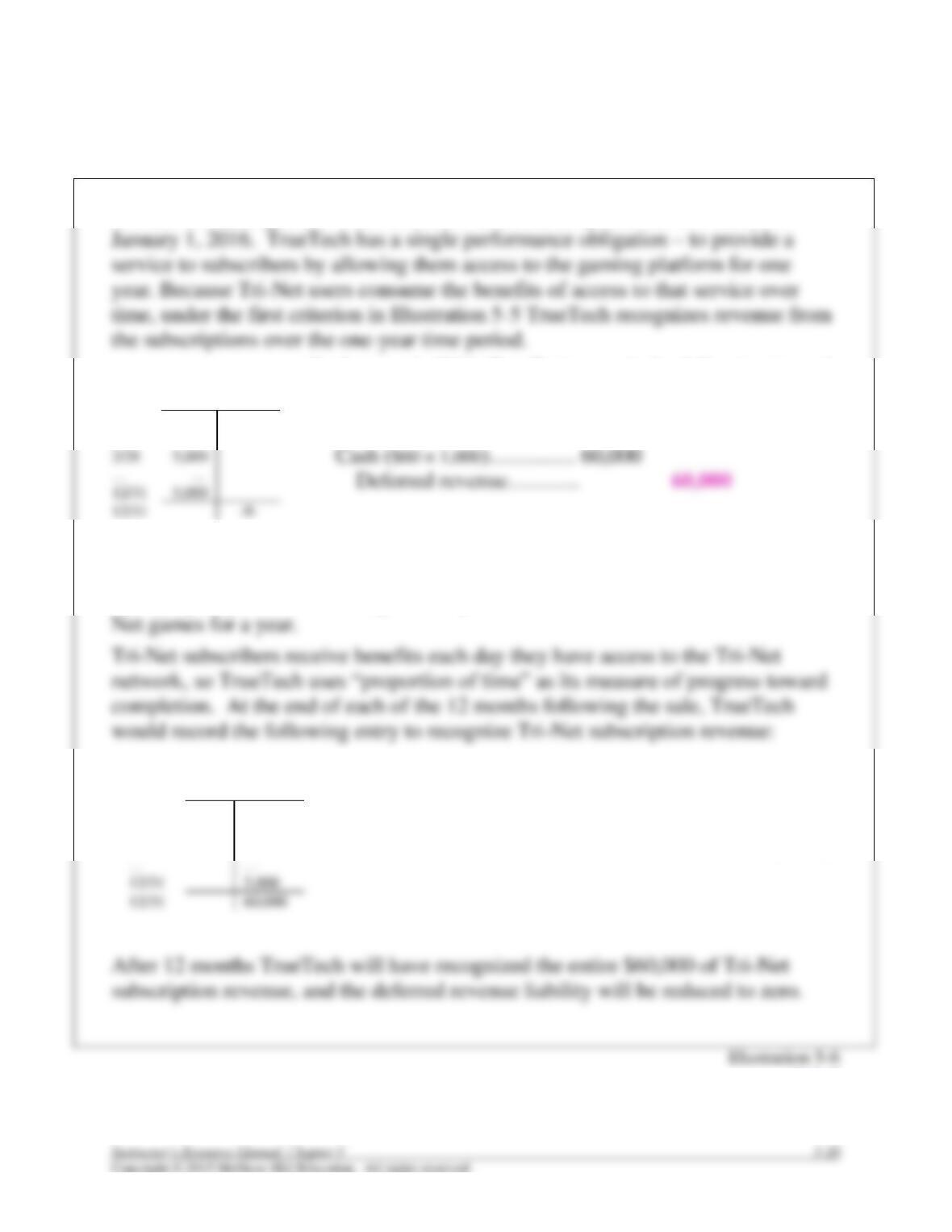
TrueTech Industries sells one-year subscriptions to the Tri-Net multiuser platform
of Internet-based games. TrueTech sells 1,000 subscriptions for $60 each on
On January 1, 2016, TrueTech records the following journal
entry:
2/28
12/31
12/31
TrueTech recognizes no revenue on January 1. Rather, TrueTech recognizes a
deferred revenue liability for $60,000 associated with receiving cash prior to
satisfying its performance obligation to provide customers with access to the Tri–
Deferred revenue ($60,000 ÷ 12) ……………..
5,000
Service revenue………………………. 5,000
12/31
5,000
12/31
60,000
T 5-7
Deferred
Revenue
1/1
60,000
1/31
5,000
Service
Revenue
1/1
-0-
1/31
5,000
2/28
5,000