5.59: PROBLEM DEFINITION
Situation:
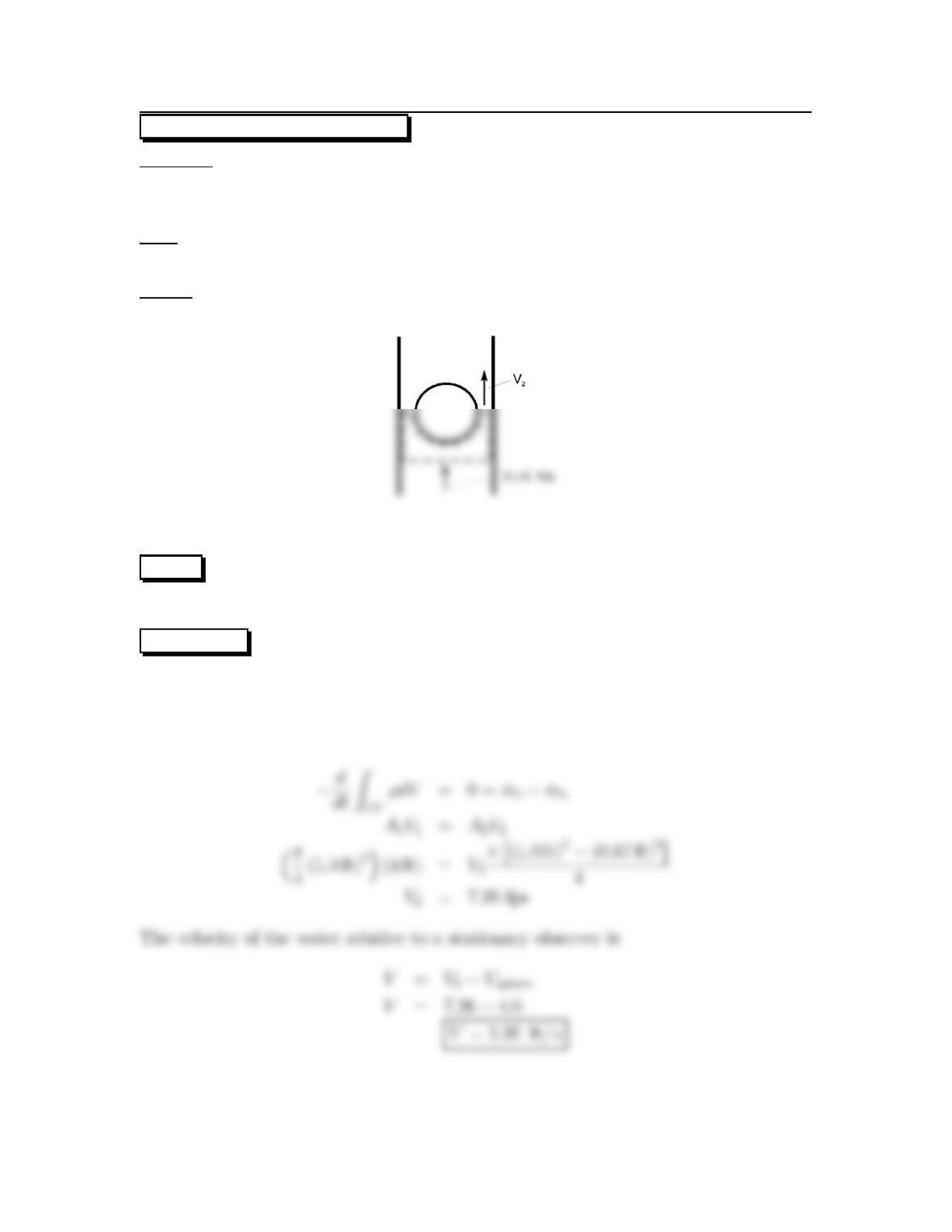
A sphere is falling in a cylinder filled with water.
D1=8in,D2=1ft,V1=4ft/s.
Find:
Velocity of water at the midsection of the sphere.
Sketch:
PLAN
Apply the continuity equation.
SOLUTION
As shown in the above sketch, select a control volume that is attached to the falling
sphere. Relative to the sphere, the velocity entering the control volume is V1and the
velocity exiting is V2
Continuity equation
61
5.60: PROBLEM DEFINITION
Situation:
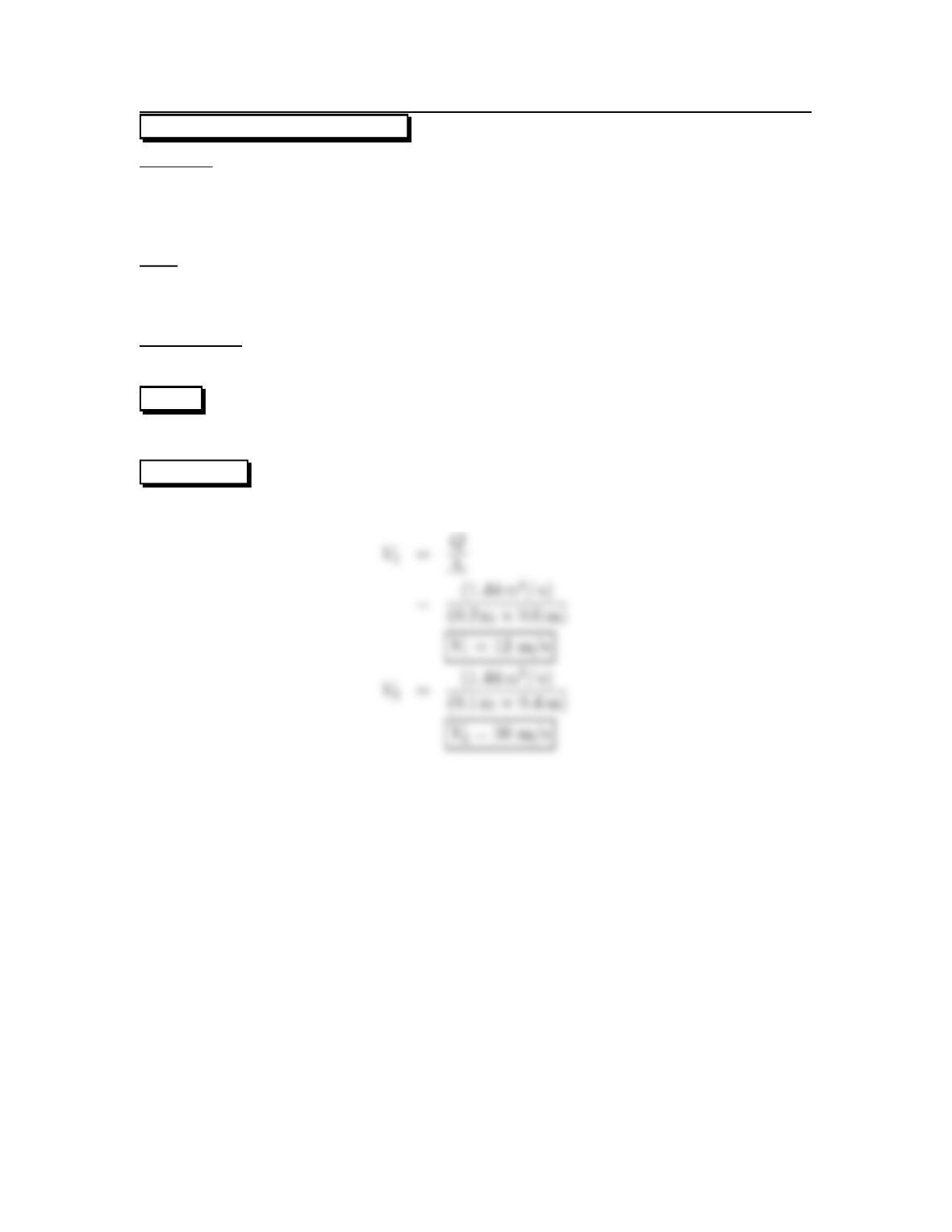
Air flows in a rectangular duct.
Q=1.44 m3/s, A1=20cm×60 cm.
A2=10cm×40 cm.
Find:
Airspeedforinitialductarea,V1.
Airspeedforlatterductarea,V2.
Assumptions:
Constant air density.
PLAN
Apply the flow rate equation.
SOLUTION
Flow rate equation
62
5.61: PROBLEM DEFINITION
Situation:
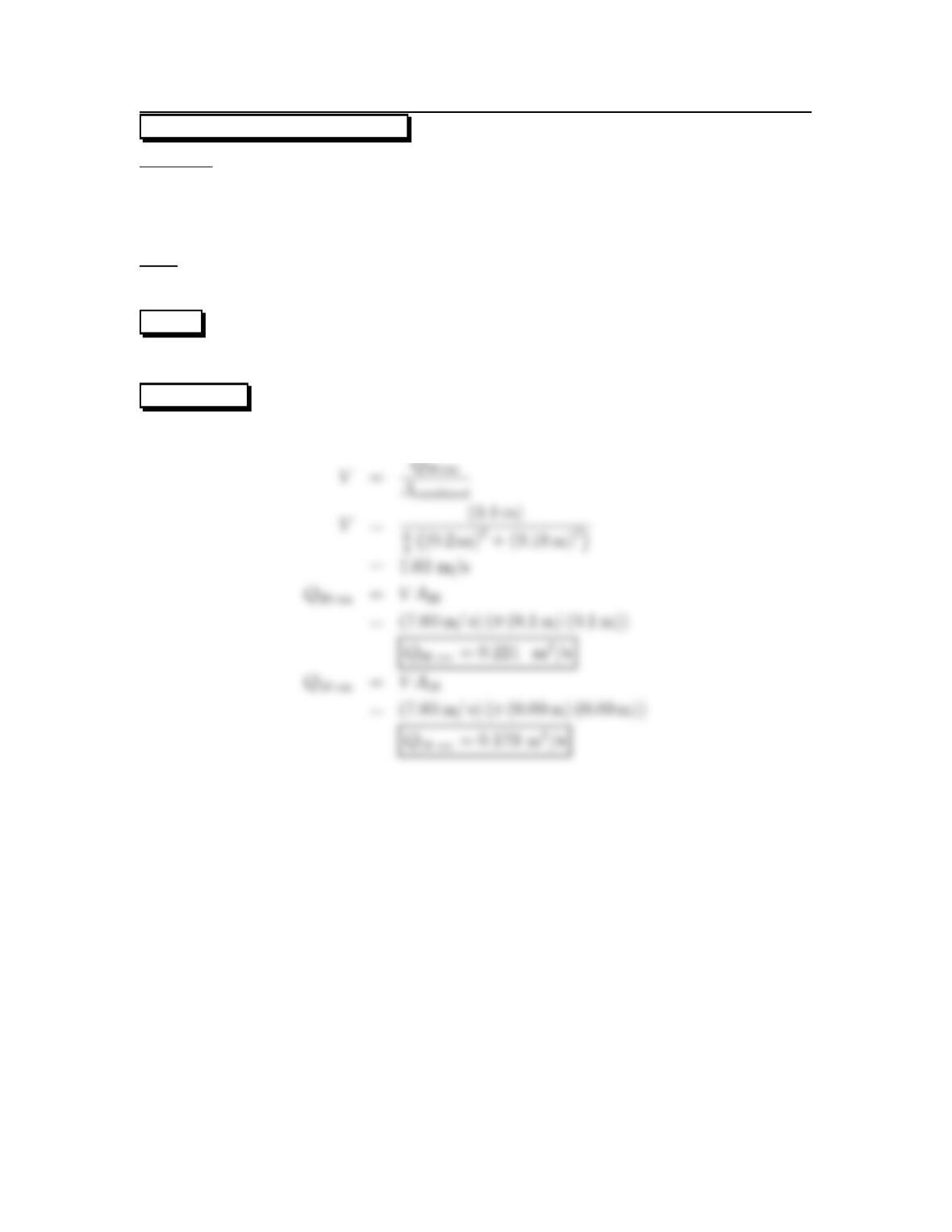
A pipe divides into two outlets.
D30cm =30cm,D20cm =20cm,D18cm =18cm.
V20cm =V18cm,Q=0.4m
3/s.
Find:
Dischargeineachbranch.
PLAN
Apply the flow rate equation.
SOLUTION
Flow rate equation
63
5.62: PROBLEM DEFINITION
Situation:
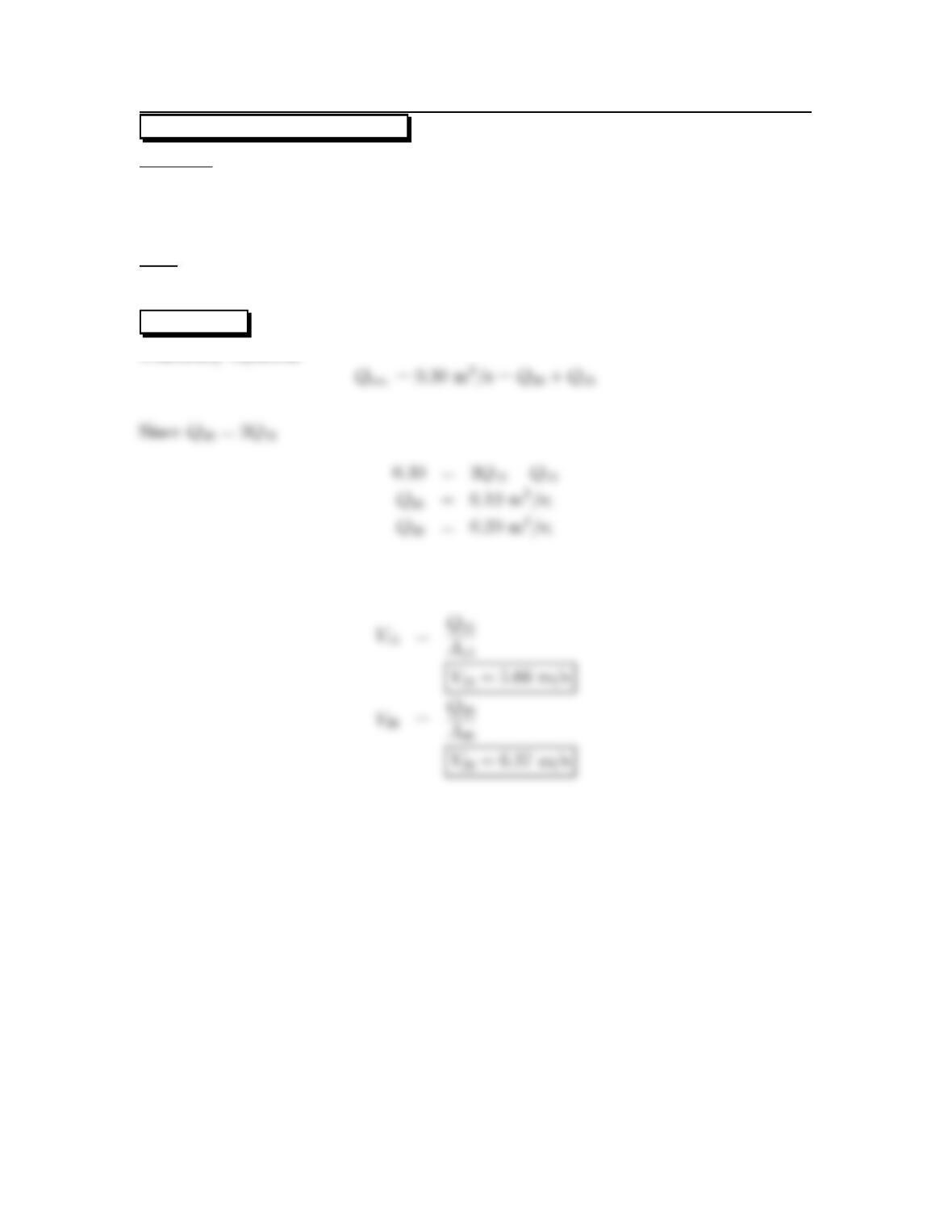
A pipe divides into two outlets.
D30cm =30cm,D20cm =20cm,D15cm =15cm.
Q20cm =2Q15cm,Q=0.3m
3/s.
Find:
Mean velocity in each outlet branch.
SOLUTION
Continuity equation
Flow rate equation
64
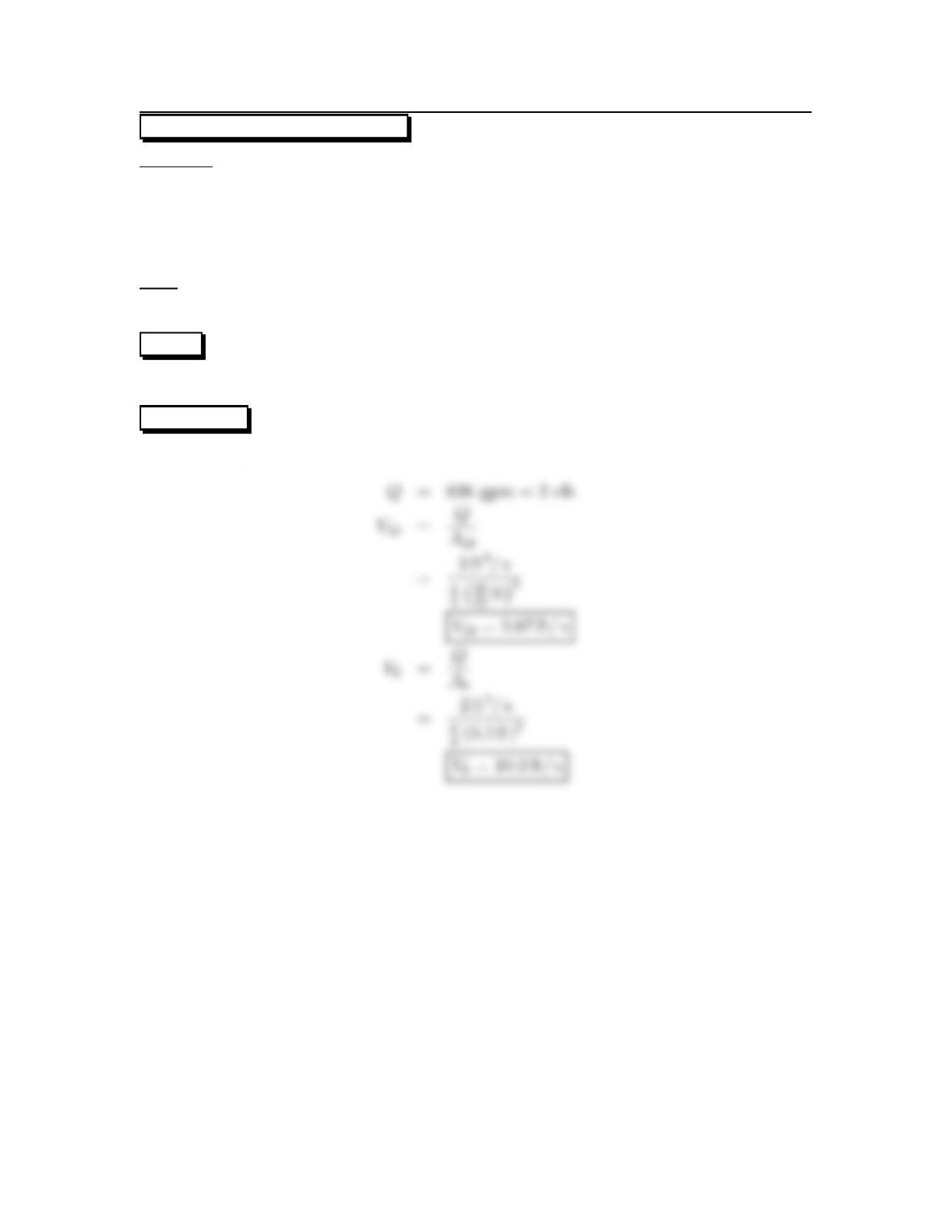
5.63: PROBLEM DEFINITION
Situation:
Water flows through pipe that is in series with a narrower pipe.
A pipe divides into two outlets.
D10 =10in,D6=6in.
V20cm =V15cm,Q=898 gal/min.
Find:
Mean velocity in each pipe.
PLAN
Apply the flow rate equation.
SOLUTION
Flow rate equation
65
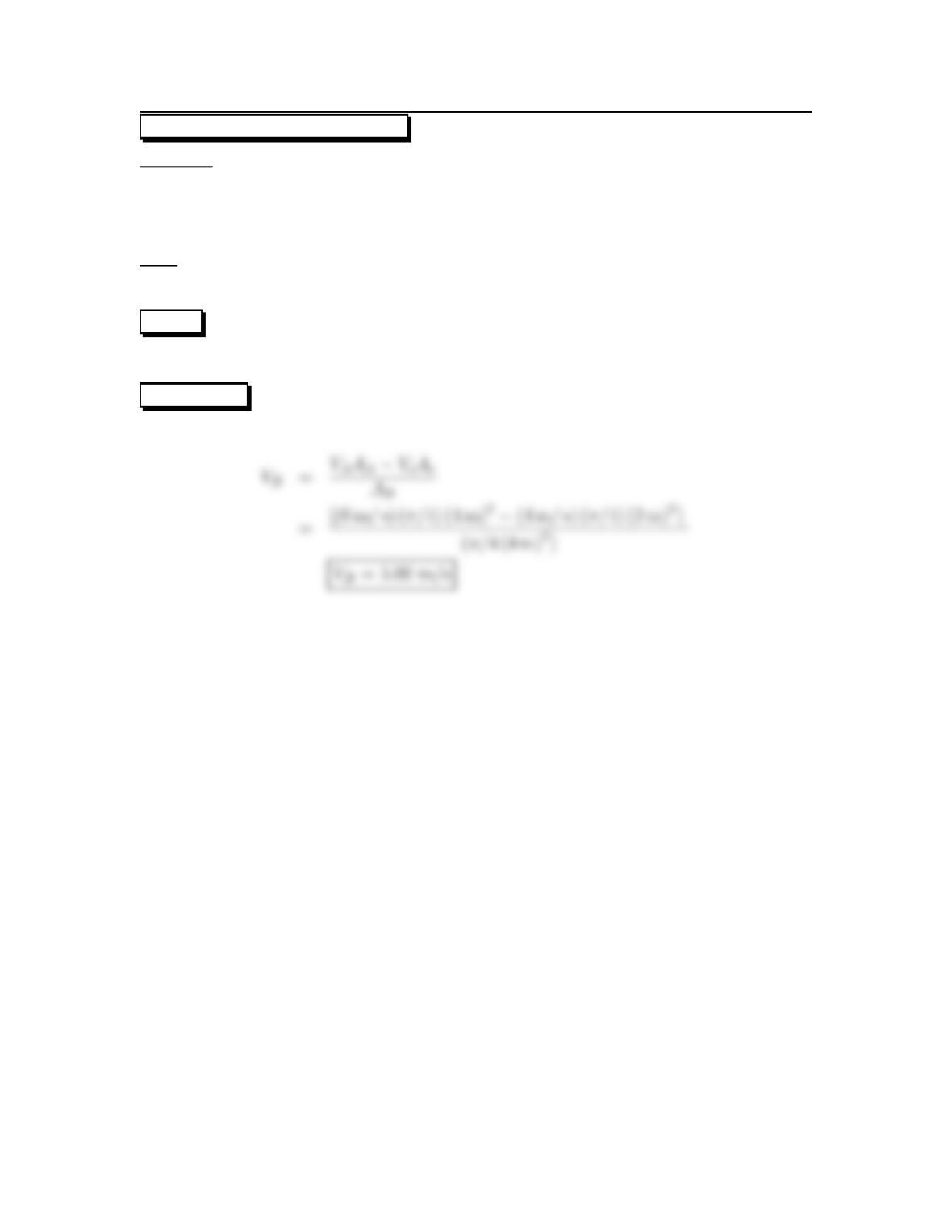
5.64: PROBLEM DEFINITION
Situation:
Water flows through a tee.
DA=DB=4m,DC=2m.
VA=6m/s,VC=4m/s.
Find:
Mean velocity in outlet B.
PLAN
Apply the continuity equation.
SOLUTION
Continuity equation
66
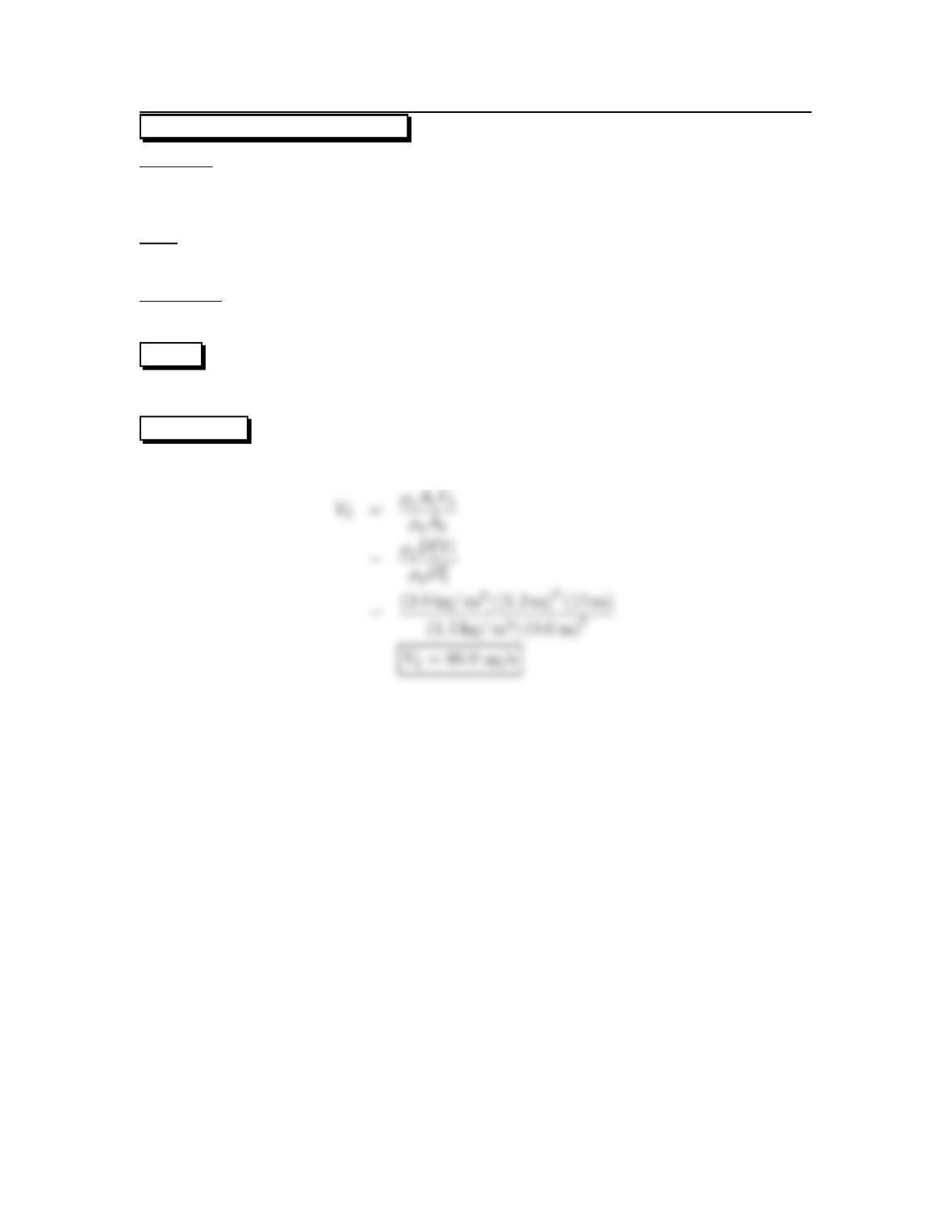
5.65: PROBLEM DEFINITION
Situation:
Gas flows in a round conduit that tapers to a smaller diameter.
D1=1.2m,D2=0.6m,V1=15m/s.
Find:
Mean velocity at section 2.
Properties:
ρ1=2.0kg/m3,ρ2=1.5kg/m3.
PLAN
Apply the continuity equation.
SOLUTION
Continuity equation
67
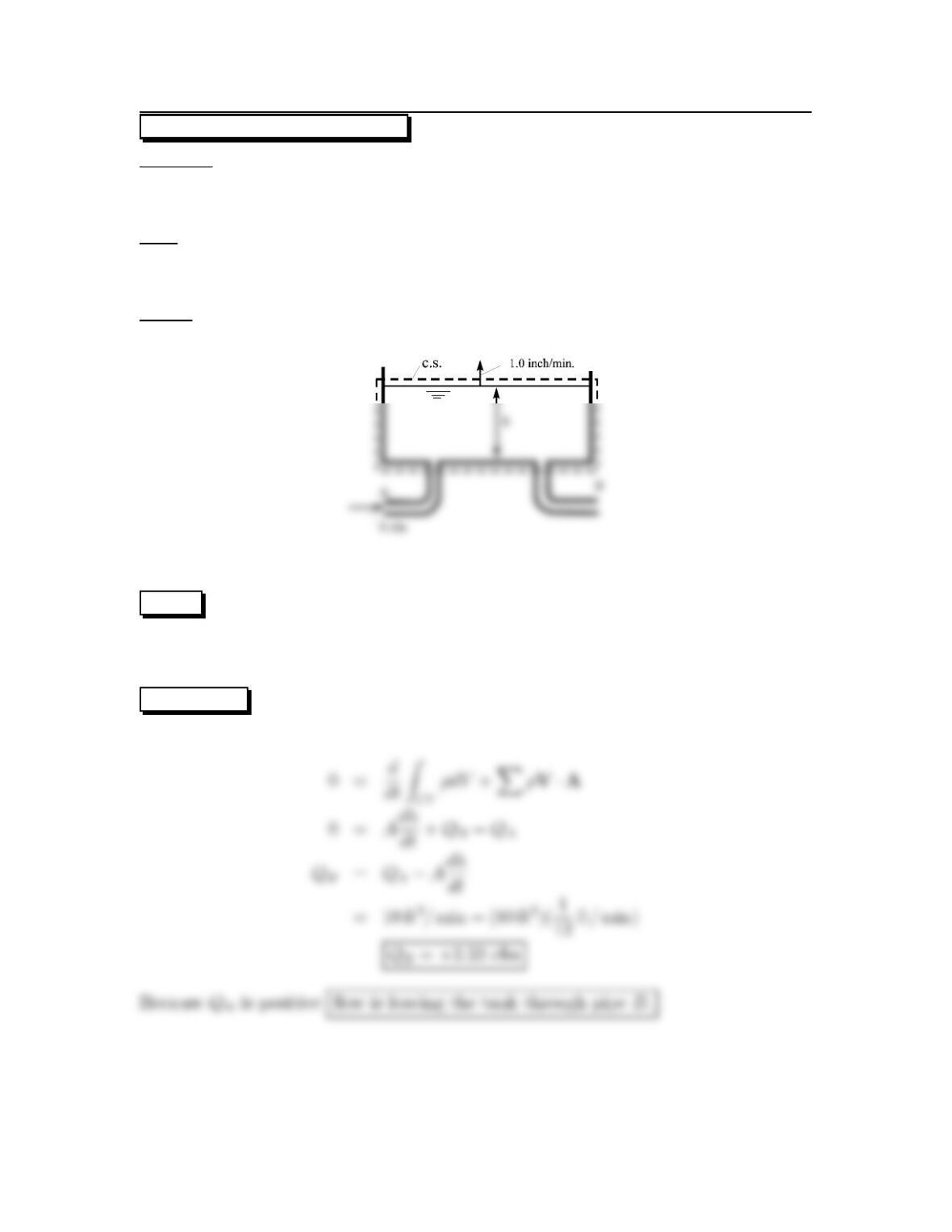
5.66: PROBLEM DEFINITION
Situation:
Pipes A and B are connected to an open tank.
QA=10ft
3/min,A=80ft
2,dh/dt =1in/min.
Find:
DischargeinpipeB.
If flow in pipe B is entering or leaving the tank.
Sketch:
PLAN
Apply the continuity equation. Define a control volume as shown in the above sketch.
Let the c.s. move upward or downward with the water surface.
SOLUTION
Continuity equation
68
5.67: PROBLEM DEFINITION
Situation:
A tank has one inflow and two outflows.
D4in =4in=0.333 ft,V4in =10ft/s.
D6in =6in=0.5ft,V6in =7ft/s.
D3in =3in=0.25 ft,V3in =4ft/s.
Dtank =3ft.
Find:
Is the tank filling or emptying.
Rate at which the tank level is changing: dh
dt
SOLUTION
Inflow =(10ft/s) ³π
4´µ4
12 ft¶2
=0.8727 cfs
69
5.68: PROBLEM DEFINITION
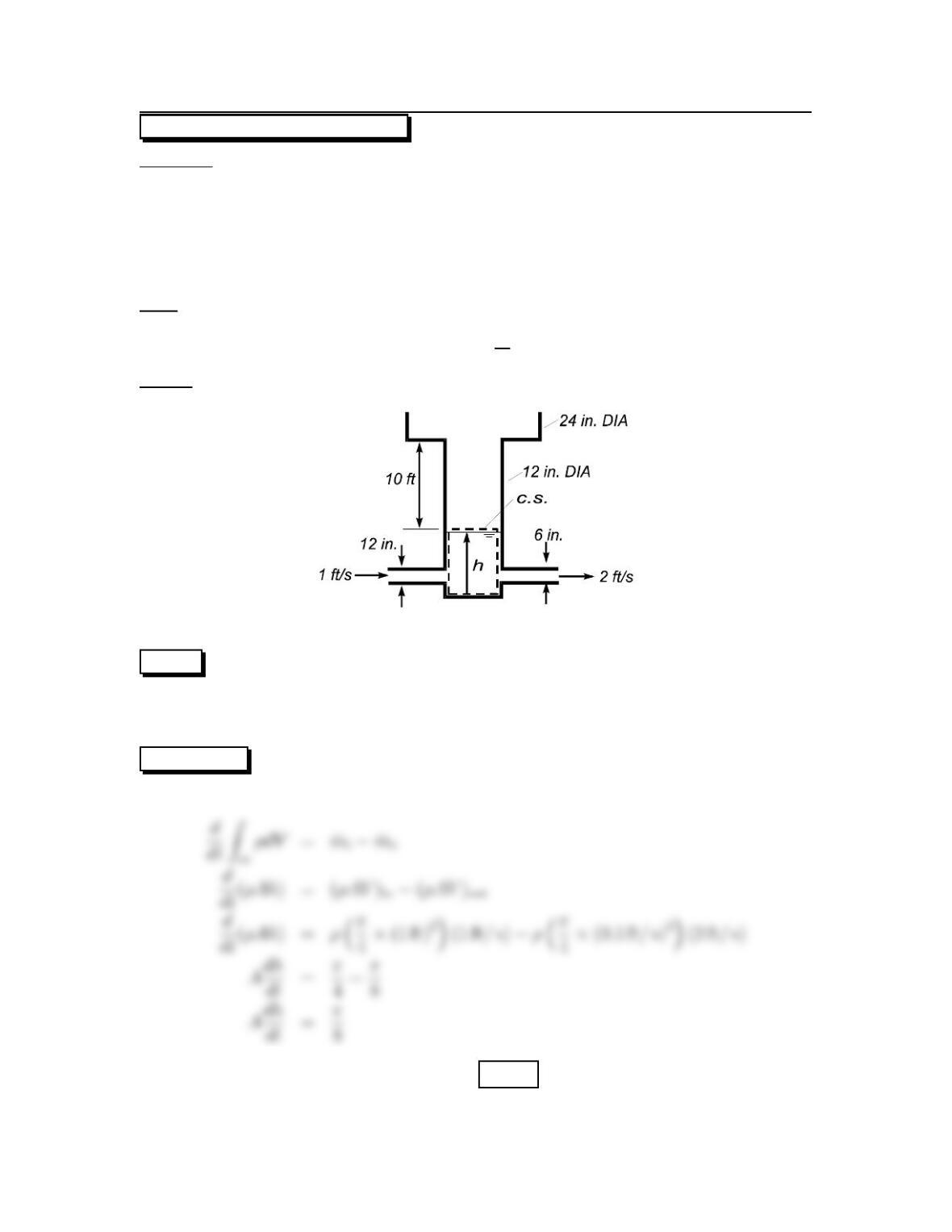
Situation:
Atankisfilled with water over time.
Di=12in =1ft,Vi=1ft/s.
Do=6in=0.5ft,Vo=2ft/s.
h1=0ft,D
tank1 =1ft.
Dtank2 =2ft,h2=10ft.
Find:
At t=22s, if the the water surface will be rising or falling.
Rate at which the tank level is changing: dh
dt
Sketch:
PLAN
Apply the continuity equation. Define a control volume in which the control surface
(c.s.) is coincident with the water surface and moving with it.
SOLUTION
Continuity equation
Since Adh/dt > 0, the water level must be rising. While the water column occupies
70
the 12 in. section, the rate of rise is
Therefore, at the end of 20 sec. the water surface will be in the 2 ft. section. Then
the rise velocity will be:
71
5.69: PROBLEM DEFINITION
Situation:
A lake is fed by an inlet and has no outlet. cfs. Lake surface area is , where his
depth in feet.
Qin =1200ft
3/s,A(h)=4.5+5.5hmi2.
QEvap =13ft
3/smi
2.
Find:
Equilibrium depth of lake.
The minimum discharge to prevent the lake from drying up.
PLAN
Apply the continuity equation.
SOLUTION
Continuity equation
72
5.70: PROBLEM DEFINITION
Situation:
A nozzle discharges water onto a plate moving towards the nozzle. Plate speed
equals half the jet speed.
Qin =5ft
3/s,Vin =2Vp.
Find:
Rate at which the plate deflects water.
PLAN
Apply the continuity equation. Select a control volume surrounding the plate and
moving with the plate.
SOLUTION
Continuity equation
Qin =Qp
Reference velocities to the moving plate. Let Vobe the speed of the water jet relative
73
5.71: PROBLEM DEFINITION
Situation:
Atankwithadepthhhas one inflow ( ft3/s) and one outflow through a 1 ft
diameter pipe. The outflow velocity is .
Q=20ft
3/s,Vout =√2gh,Dout =1ft.
Find:
Equilibrium depth of liquid.
PLAN
Apply the continuity equation and the flow rate equation.
SOLUTION
Continuity equation
74
5.72: PROBLEM DEFINITION
Situation:
Flows with different specific weights enter a closed tank through ports A and B and
exit the tank through port C. Assume steady flow. Details are provided on figure
with problem statement.
DA=6in,QA=3ft
3/s.
SA=0.95,DC=6in.
QB=1ft
3/s,SB=0.85,DB=4in.
Find:
Mass flow rate at C.
Average velocity at C.
Specificgravityofthemixture.
Assumptions:
Steady state.
PLAN
Apply the continuity equation and the flow rate equation.
SOLUTION
Continuity equation
Continuity equation, assuming incompressible flow
75
5.73: PROBLEM DEFINITION
Situation:
O2and CH4are mixed in a mixer before exiting.
VO2=VCH4=5m/s.
ACH4=1cm
2,AO2=3cm
2.
Find:
Exit velocity of the gas mixture, Ve.
Properties:
From Table A.2: RO2= 260 J/kg K,RCH4=518J/kg K.
T=100◦C,ρ=1.9kg/m3,p=200kPa.
PLAN
Apply the ideal gas law to find inlet density. Then apply the continuity equation.
SOLUTION
Ideal gas law
Continuity equation
76
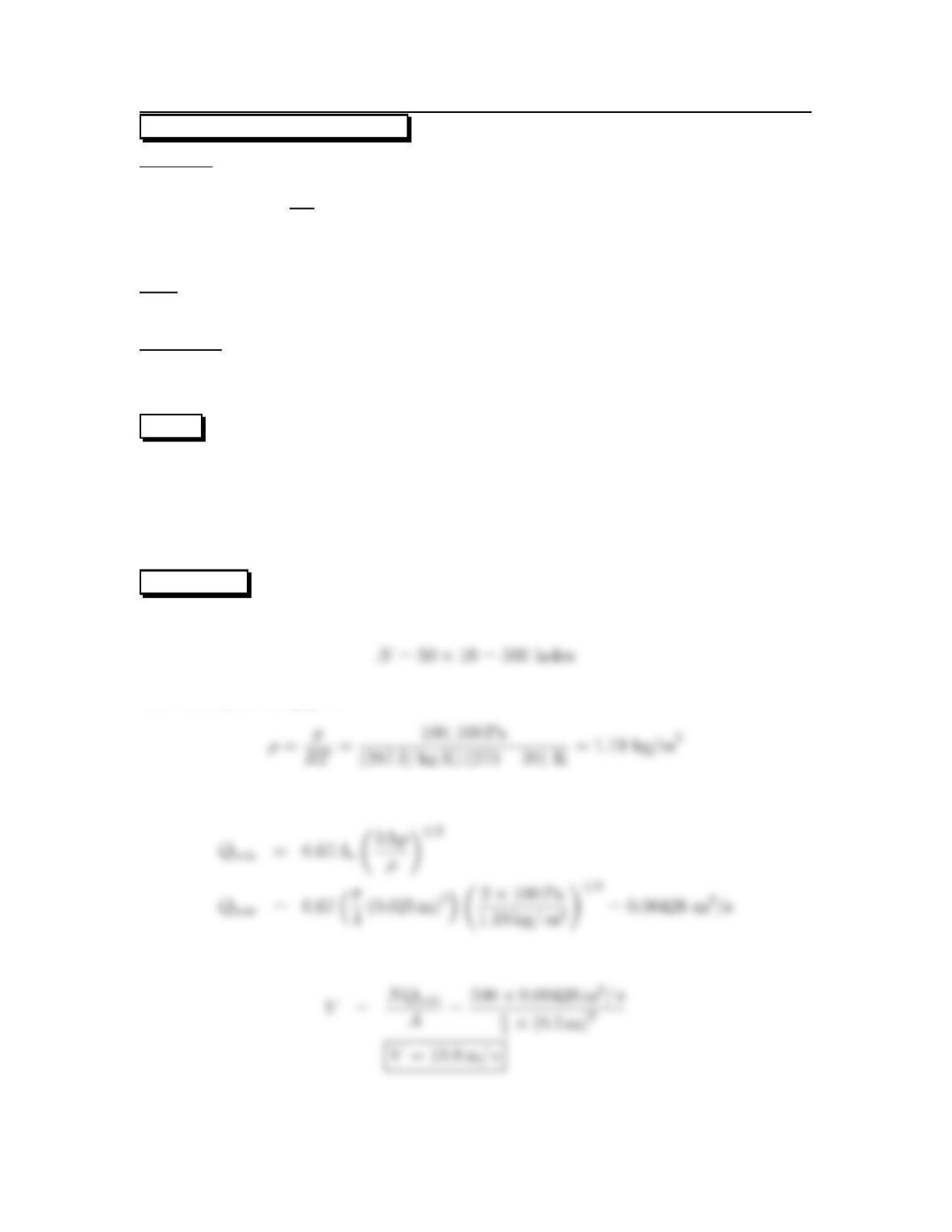
5.74: PROBLEM DEFINITION
Situation:
A pipe with a series of holes is used to distribute air.
Qhole =0.67A0¡2∆p
r¢1/2.
nhole =50/m,L=10m.
Dpipe =0.5m,Dhole =2.5cm.
Find:
Velocity of air entering the pipe.
Properties:
From Table A.2: R=287J/kg K.
T=20◦C,p
pipe =100Pagage
PLAN
The total discharge out of the holes is equal to the inlet discharge.
Qin =AVin =NQhole
where Nis the number of holes and Qholeis the discharge for each hole.
SOLUTION
The total number of holes
The density in the pipe is
The flow rate through the holes is
The velocity at the pipe entrance is
77
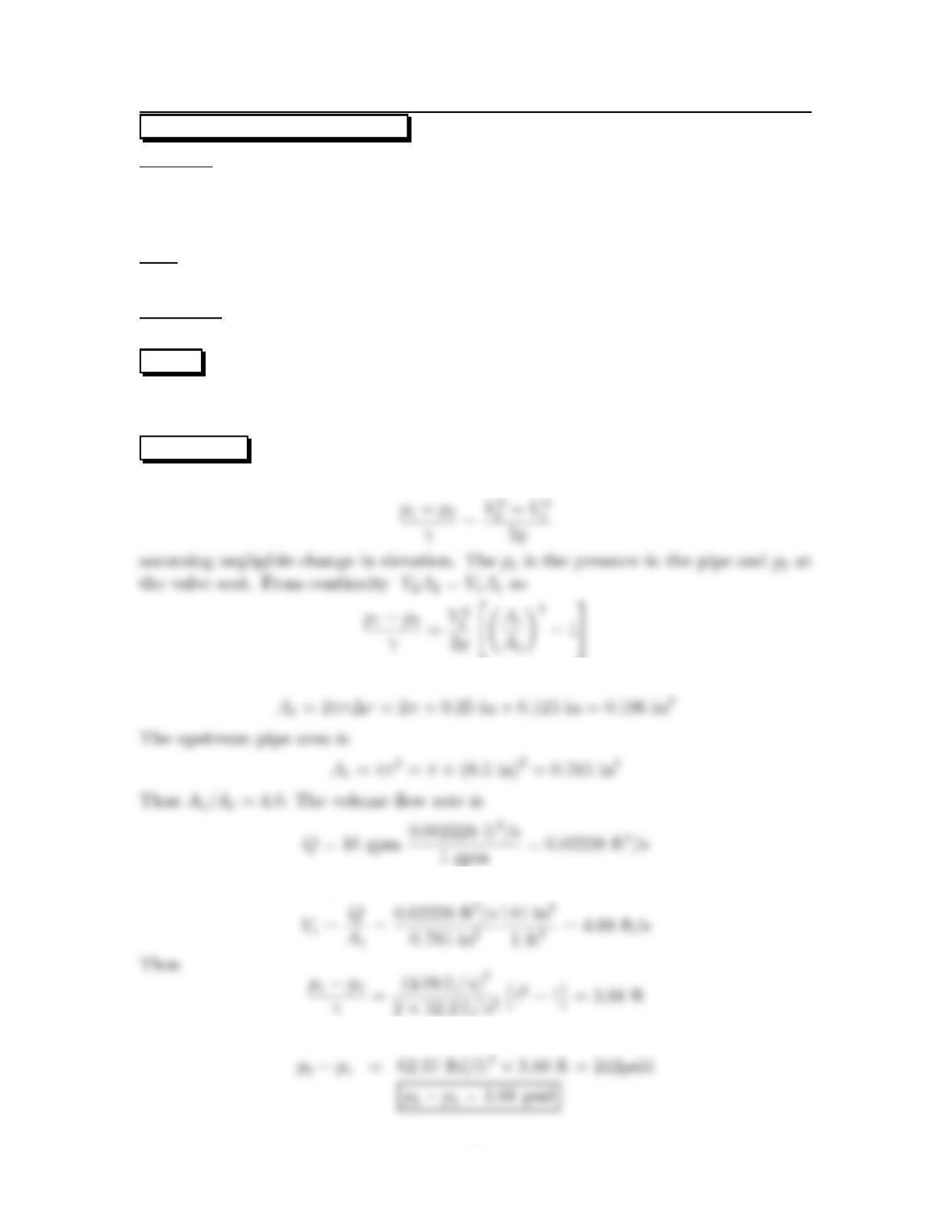
5.75: PROBLEM DEFINITION
Situation:
Water through a globe valve.
Q=10gal/min,∆r2=0.125 in.
D1=1in,D2=0.5in
Find:
Pressure drop across the valve.
Properties:
T=60◦F.
PLAN
Apply the Bernoulli equation between the 1 inch upstream pipe and the opening at
the seat of the valve
SOLUTION
The pressure drop across the globe valve is
Theareabetweenthediscandtheseatis
and the velocity in the pipe is
The specific weight of water at 60oF is 62.37 lbf/ft3.The pressure drop is
78
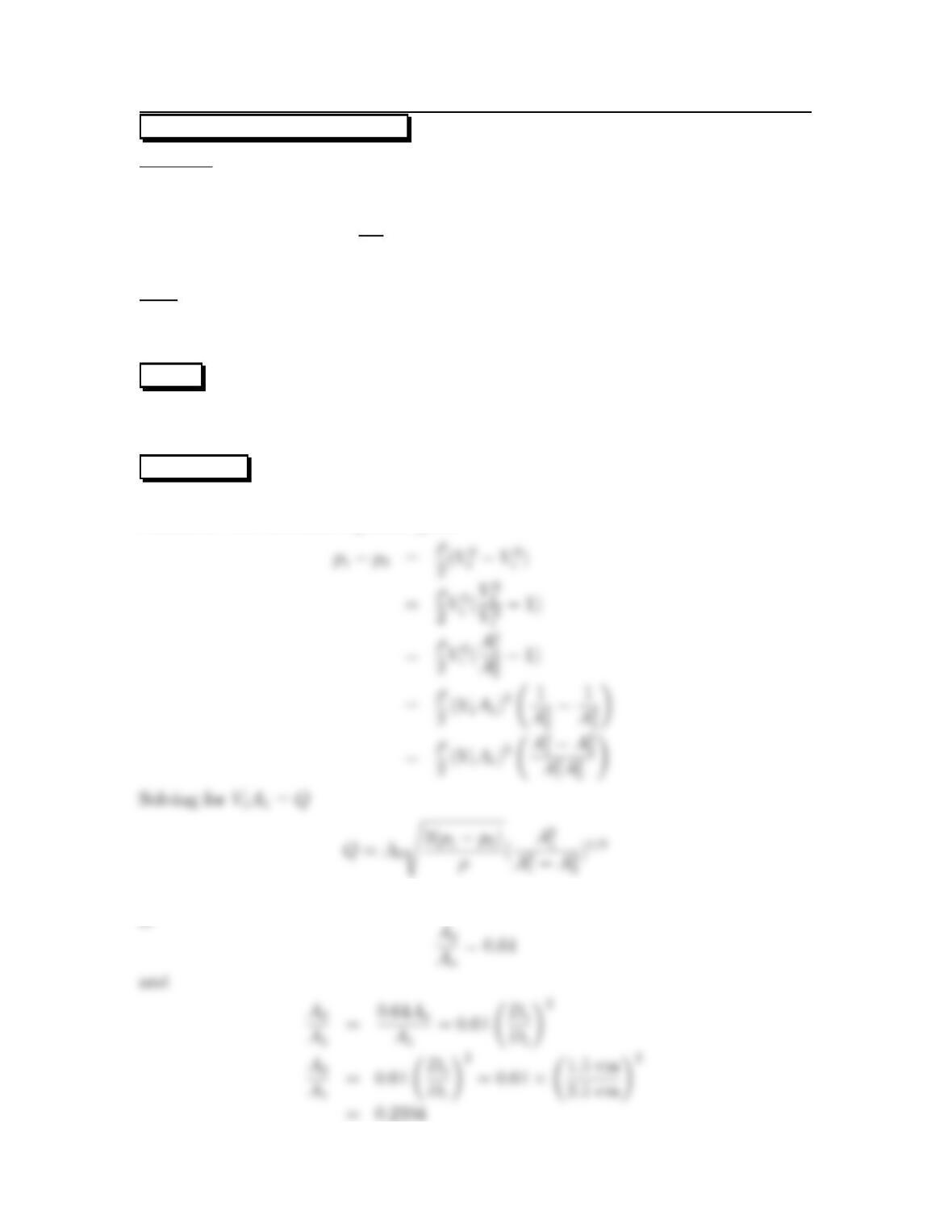
5.76: PROBLEM DEFINITION
Situation:
Water flowthroughanorifice in a pipe.
D1=2.5cm,Do=1.5cm.
0.64Ao=A2,Q=CAo³2∆p
ρ´1/2
.
∆p=10kPa,Q=1000kg/m3.
Find:
a) Derive equation for discharge.
b) Evaluate discharge across orifice.
PLAN
Apply the continuity equation and the Bernoulli equation between pipe and vena
contracta. Neglect elevation change.
SOLUTION
Let point 1) be at the centerline of the upstream pipe and point 2) at the vena
contracta. The Bernoulli equation gives
The ratio of the cross-sectional area at the vena contracta to the area of the orifice
is A2
79
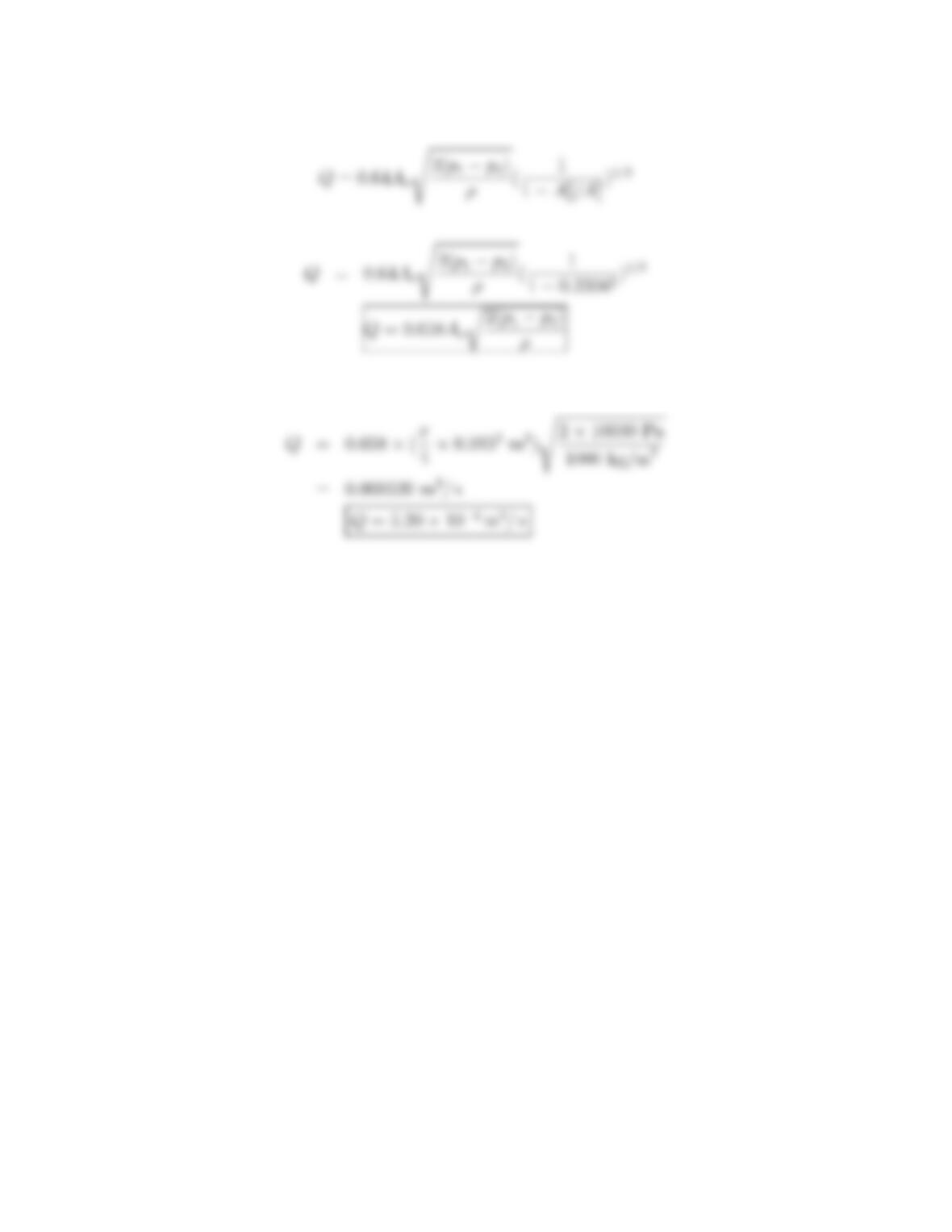
Substitute into discharge equation
For a ∆p=10kPa the discharge is
80