PROBLEM 5.14 (Cont.)
The heat transfer coefficient at
T
= 110°C is
h
= 1010 W/m2⋅K3×(10 K)2 = 101,000 W/m2∙K. Hence,
for the case where the heat transfer coefficient is constant Equation 5.6 becomes
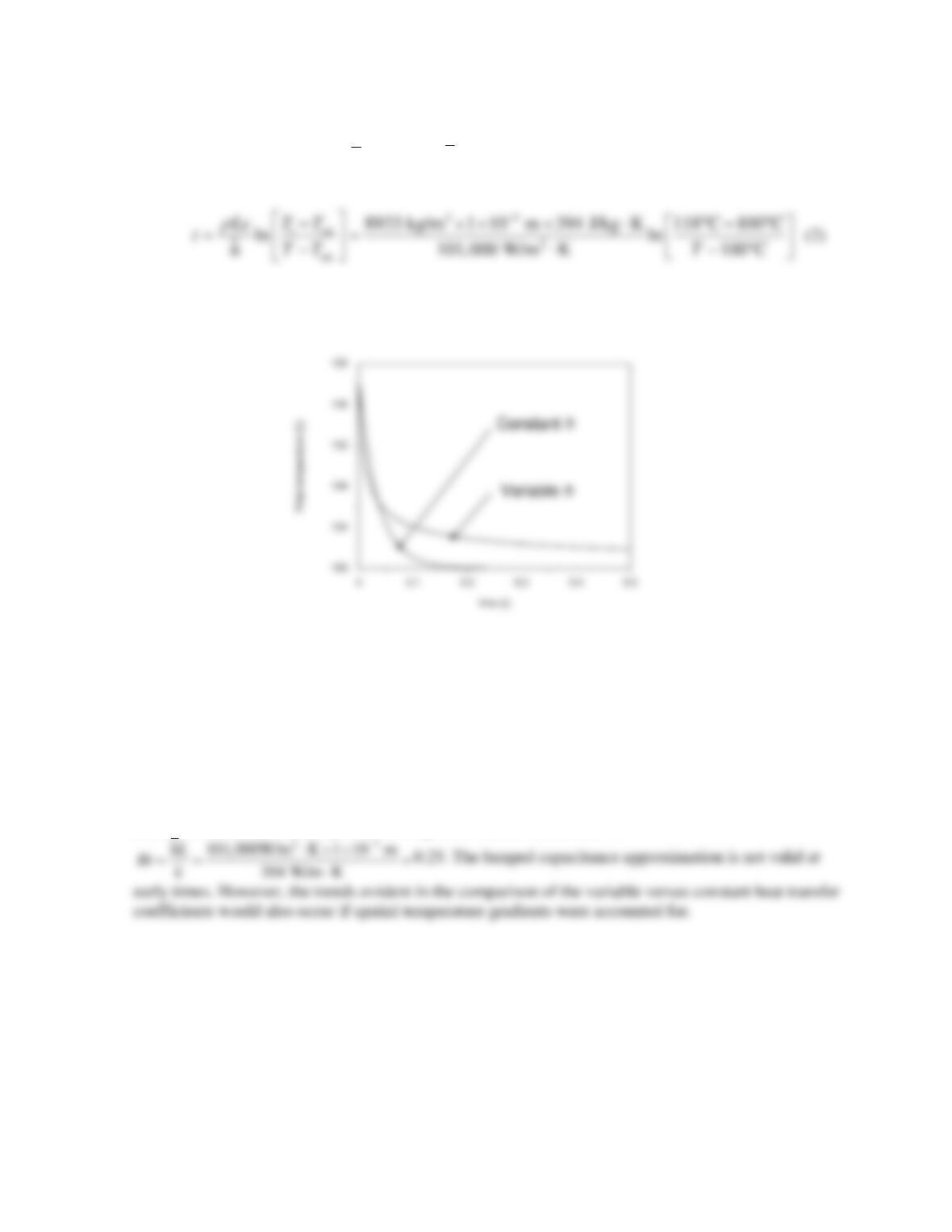
Equations (1) and (2) may be solved for time-dependence of the plate temperature to yield
The convection heat transfer coefficient is initially relatively high and decays as the temperature
difference between the plate and the water decreases. If the convection heat transfer coefficient is
evaluated at the average plate temperature, the heat transfer coefficient is initially under–predicted,
leading to a slower plate cooling rate at early times. However, the convection coefficient is over–
predicted at later times, leading to an unrealistic high cooling rate as evident in the graph.
COMMENTS: (1) The time could also be calculated by solving Equation 5.28.
(2) The Biot number based upon the average heat transfer coefficient is
PROBLEM 5.15
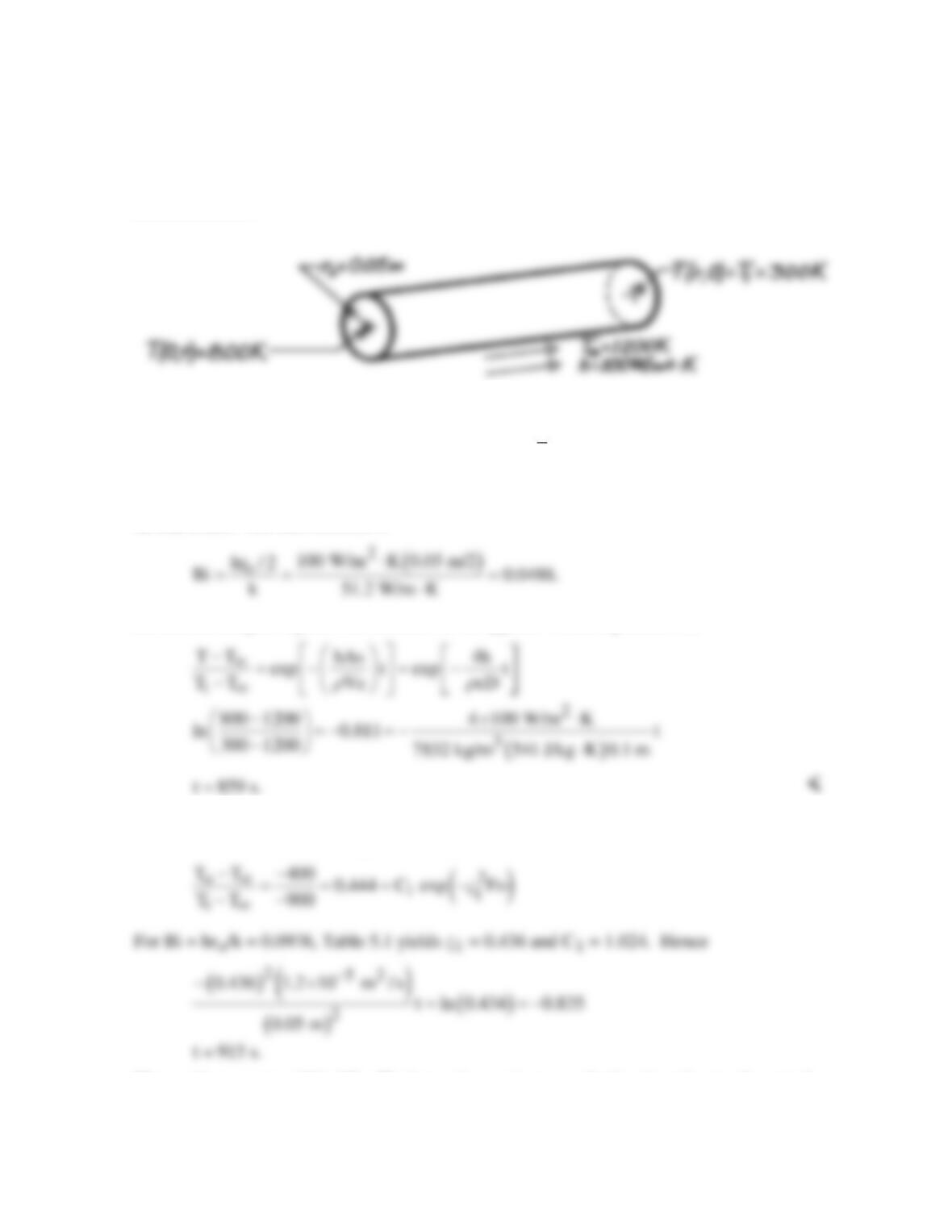
KNOWN: Diameter and radial temperature of AISI 1010 carbon steel shaft. Convection
coefficient and temperature of furnace gases.
FIND: Time required for shaft centerline to reach a prescribed temperature.
SCHEMATIC:
ASSUMPTIONS: (1) One-dimensional, radial conduction, (2) Constant properties.
PROPERTIES: AISI 1010 carbon steel, Table A.1
( )
T 550 K :=
ρ
=7832 kg / m3,
k =
51.2 W/m⋅K, c = 541 J/kg⋅K, α = 1.21×10⁻⁵ m2/s.
ANALYSIS: The Biot number is
Hence, the lumped capacitance method can be applied. From Equation 5.6,
COMMENTS: To check the validity of the foregoing result, use the one–term approximation
to the series solution. From Equation 5.52c,
The results agree to within 6%. The lumped capacitance method underestimates the actual
time, since the response at the centerline lags that at any other location in the shaft.
PROBLEM 5.16
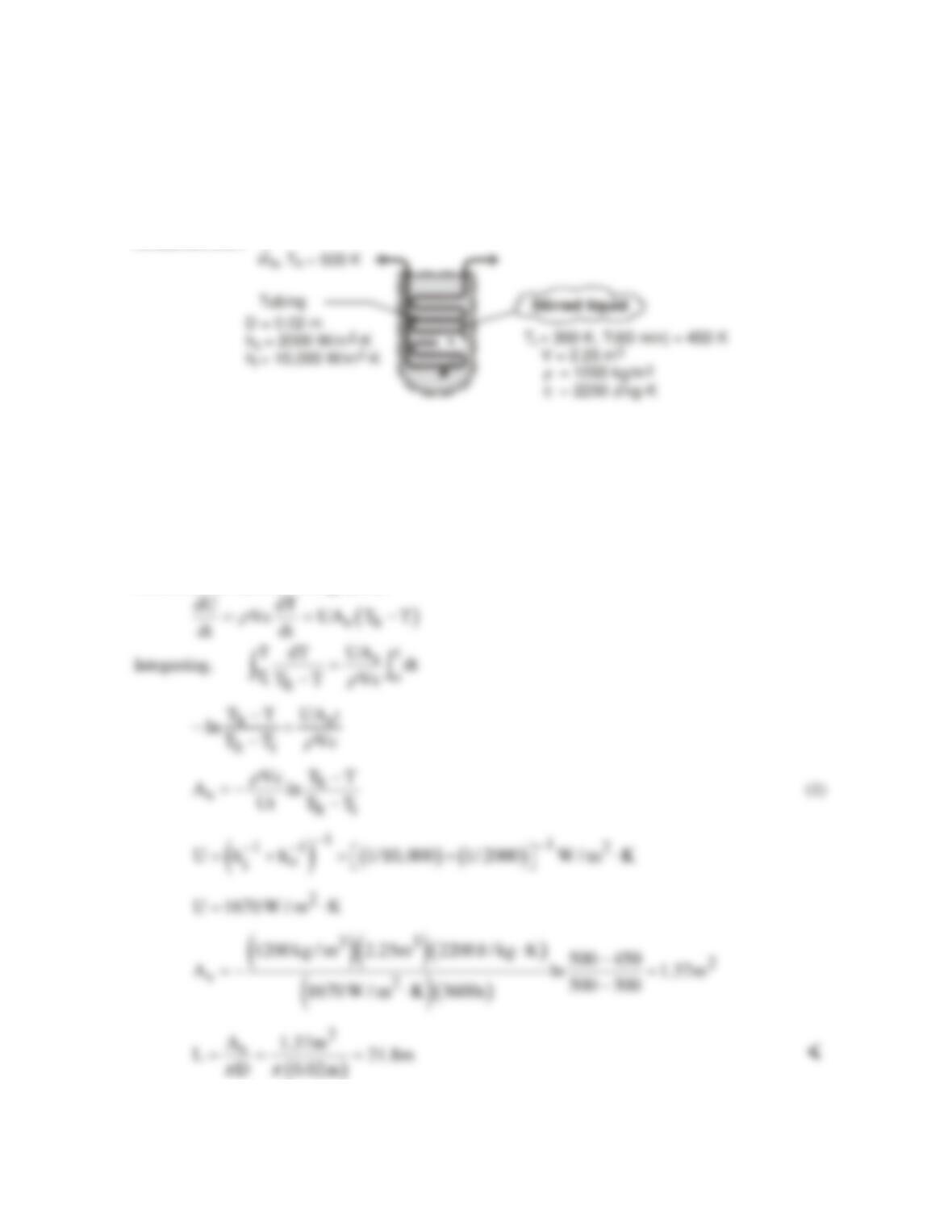
KNOWN: Volume, density and specific heat of chemical in a stirred reactor. Temperature and
convection coefficient associated with saturated steam flowing through submerged coil. Tube
diameter and outer convection coefficient of coil. Initial and final temperatures of chemical and time
span of heating process.
FIND: Required length of submerged tubing. Minimum allowable steam flowrate.
SCHEMATIC:
ASSUMPTIONS: (1) Constant properties, (2) Negligible heat loss from vessel to surroundings, (3)
Chemical is isothermal, (4) Negligible work due to stirring, (5) Negligible thermal energy generation
(or absorption) due to chemical reactions associated with the batch process, (6) Negligible tube wall
conduction resistance, (7) Negligible kinetic energy, potential energy, and flow work changes for
steam.
ANALYSIS: Heating of the chemical can be treated as a transient, lumped capacitance problem,
wherein heat transfer from the coil is balanced by the increase in thermal energy of the chemical.
Hence, conservation of energy yields
COMMENTS: Eq. (1) could also have been obtained by adapting Eq. (5.5) to the conditions of this
problem, with T∞ and h replaced by Th and U, respectively.
PROBLEM 5.17
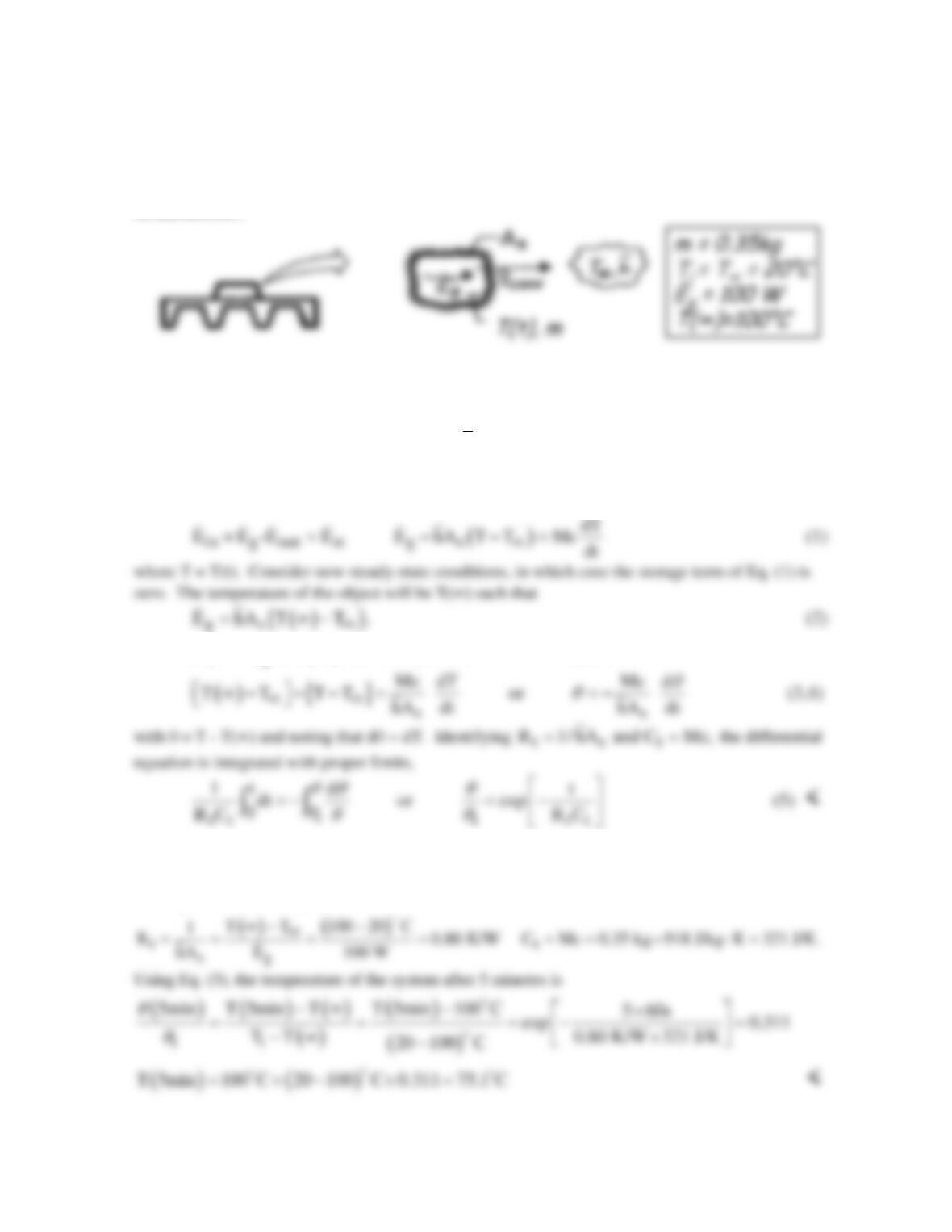
KNOWN: Electronic device on aluminum, finned heat sink modeled as spatially isothermal object
with internal generation and convection from its surface.
FIND: (a) Temperature response after device is energized, (b) Temperature rise for prescribed
conditions after 5 min.
SCHEMATIC:
ASSUMPTIONS: (1) Spatially isothermal object, (2) Object is primarily aluminum, (3) Initially,
object is in equilibrium with surroundings at T∞.
PROPERTIES: Table A-1, Aluminum, pure
( )
( )
T 20 100 C/2 333K :=+≈
c = 918 J/kg⋅K.
ANALYSIS: (a) Following the general analysis of Section 5.3, apply the conservation of energy
requirement to the object,
Substituting for
Eg
using Eq. (2) into Eq. (1), the differential equation is
where θi = θ(0) = Ti – T(∞) and Ti is the initial temperature of the object.
(b) Using the information about steady-state conditions and Eq. (2), find first the thermal resistance
and capacitance of the system,
COMMENTS: Eq. 5.24 may be used directly for Part (b) with a = hAs/Mc and
g
b E / Mc.=
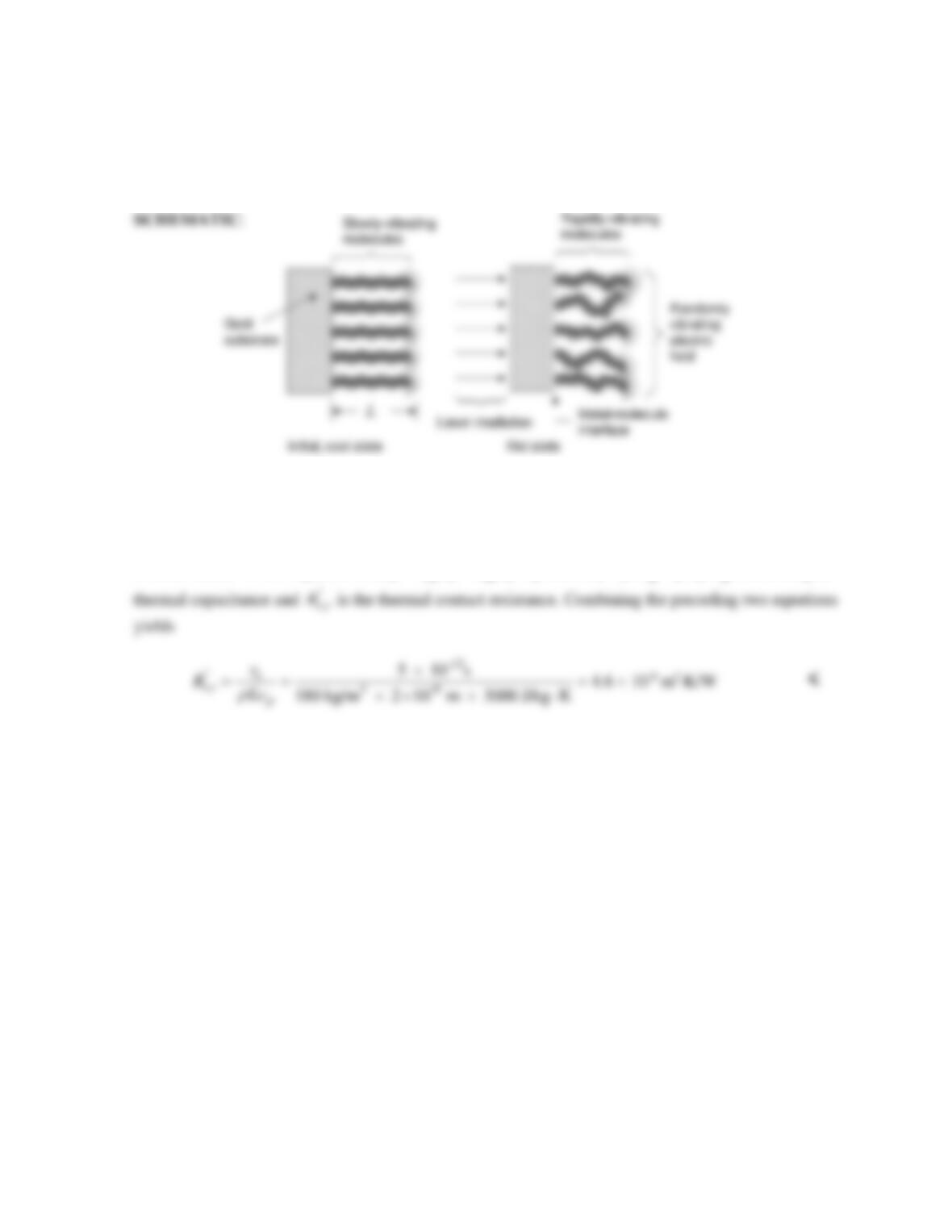
PROBLEM 5.18
KNOWN: Initial length, density and specific heat of self-assembled molecular chains. Time constant
of the molecules’ vibrational response.
FIND: Value of the contact resistance at the metal-molecule interface.
ASSUMPTIONS: (1) Molecules lose no thermal energy to surroundings. (2) Lumped capacitance
behavior, (3) Constant properties, (4) Vibrational intensity represents temperature at the molecular
scale, (5) Cylindrical molecule geometry.
ANALYSIS: From Equation 5.7,
“
,,
/
t t c t t c t c
R C R C A
where
t p c p
C Vc A Lc
is the lumped
COMMENTS: (1) The contact resistance is very small, compared to values typical of larger
systems. Nonetheless, the contact resistance may be larger than the conduction resistance within the
moledule or thin gold film. (2) The time response is very fast, as expected at these length scales. This
suggests that computational speed using such devices will be correspondingly fast. (3) See Z. Wang,
J.A. Carter, A. Lagutchev, Y.K. Koh, N.-H. Seong, D.G. Cahill, and D.D. Dlott, “Ultrafast Flash
Thermal Conductance of Molecular Chains,” Science, Vol. 317, pp. 787-790, 2007, for details.
PROBLEM 5.19
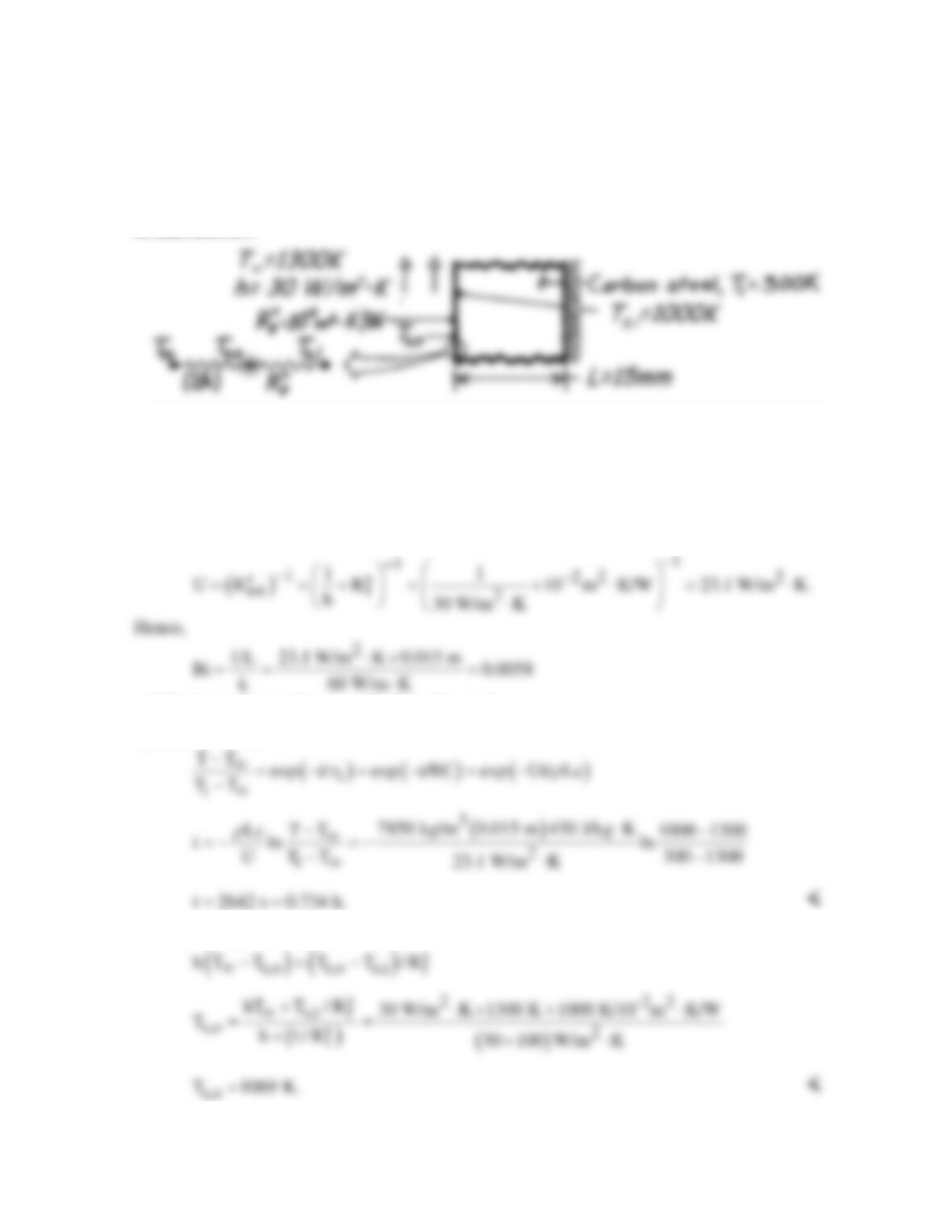
KNOWN: Thickness and properties of furnace wall. Thermal resistance of film on surface
of wall exposed to furnace gases. Initial wall temperature.
FIND: (a) Time required for surface of wall to reach a prescribed temperature, (b)
Corresponding value of film surface temperature.
SCHEMATIC:
ASSUMPTIONS: (1) Constant properties, (2) Negligible film thermal capacitance, (3)
Negligible radiation.
PROPERTIES: Carbon steel (given): ρ = 7850 kg/m3, c = 430 J/kg⋅K, k = 60 W/m⋅K.
ANALYSIS: The overall coefficient for heat transfer from the surface of the steel to the gas
is
and the lumped capacitance method can be used.
(a) It follows that
(b) Performing an energy balance at the outer surface (s,o),
COMMENTS: The film increases
t
t
by increasing Rt but not Ct.
PROBLEM 5.20
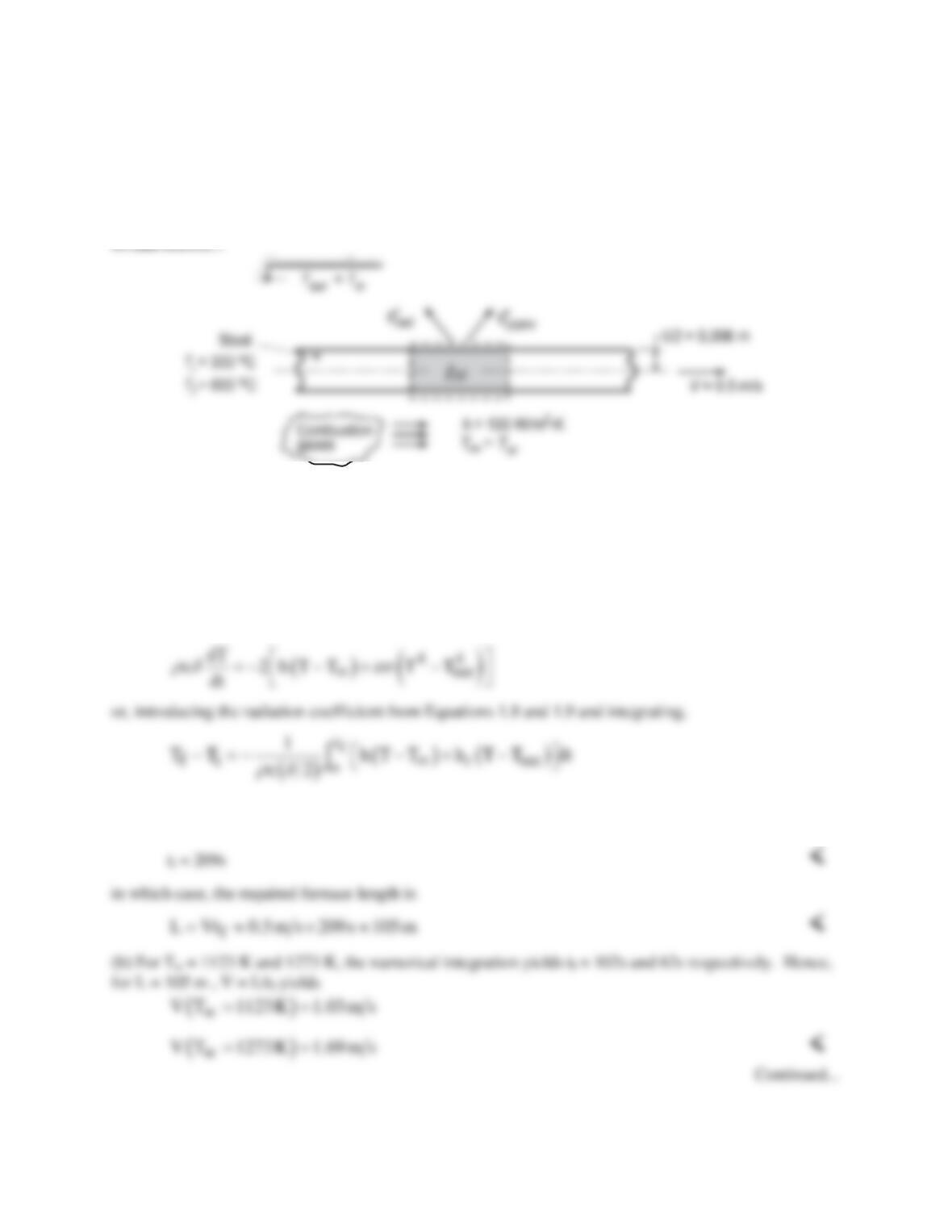
KNOWN: Thickness and properties of strip steel heated in an annealing process. Furnace operating
conditions.
FIND: (a) Time required to heat the strip from 300 to 600°C. Required furnace length for prescribed
strip velocity (V = 0.5 m/s), (b) Effect of wall temperature on strip speed, temperature history, and
radiation coefficient.
SCHEMATIC:
ASSUMPTIONS: (1) Constant properties, (2) Negligible temperature gradients in transverse direction
across strip, (c) Negligible effect of strip conduction in longitudinal direction.
PROPERTIES: Steel: ρ = 7900 kg/m3, cp = 640 J/kg⋅K, k = 30 W/m⋅K, ε= 0.7.
ANALYSIS: (a) Considering a fixed (control) mass of the moving strip, its temperature variation with
time may be obtained from an energy balance which equates the change in energy storage to heat transfer
by convection and radiation. If the surface area associated with one side of the control mass is
designated as As, As,c = As,r = 2As and V = dAs in Equation 5.15, which reduces to
Using the IHT Lumped Capacitance Model to integrate numerically with Ti = 573 K, we find that Tf =
873 K corresponds to
PROBLEM 5.20 (Cont.)
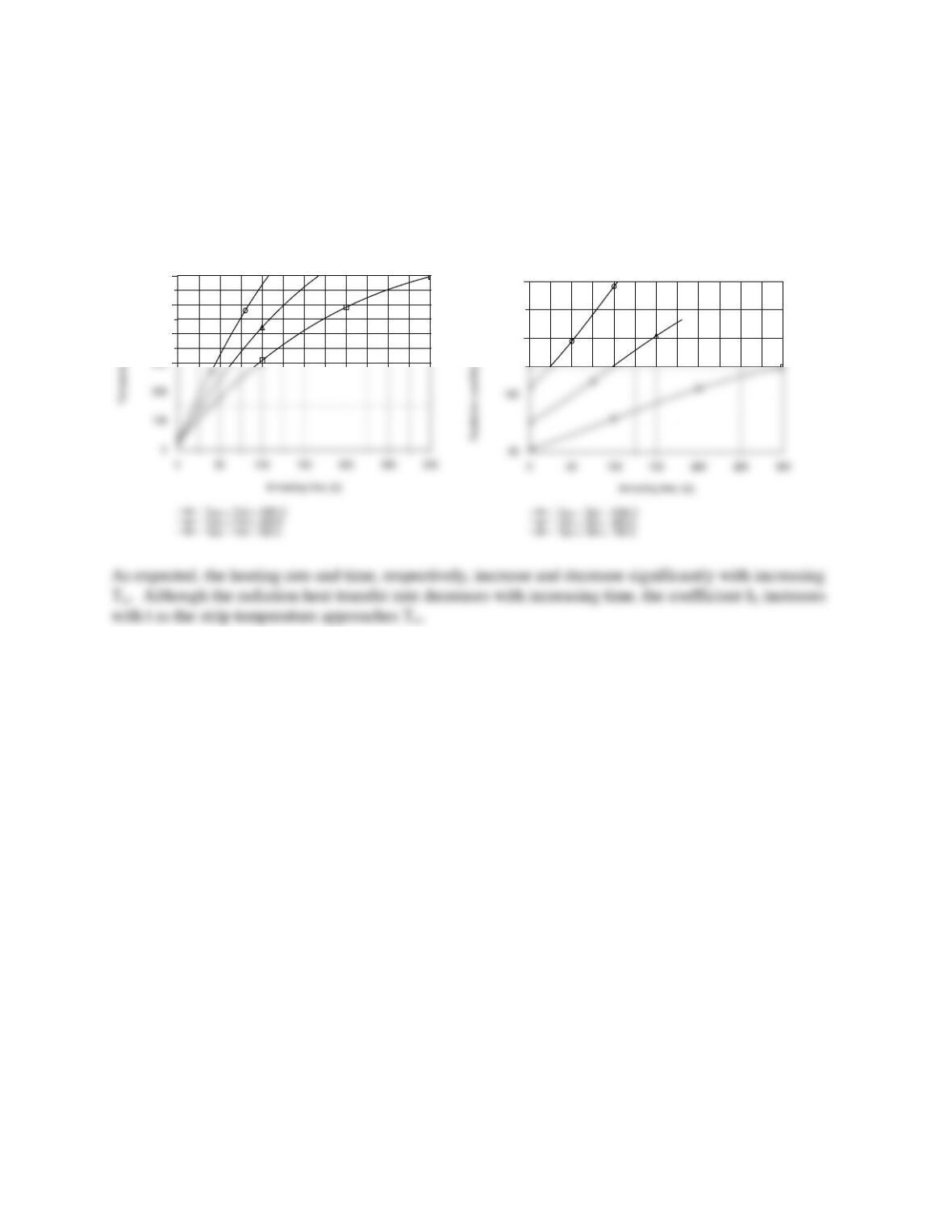
which correspond to increased process rates of 106% and 238%, respectively. Clearly, productivity can
be enhanced by increasing the furnace environmental temperature, albeit at the expense of increasing
energy utilization and operating costs.
If the annealing process extends from 25°C (298 K) to 600°C (873 K), numerical integration
yields the following results for the prescribed furnace temperatures.
300
400
500
600
150
200
COMMENTS: To check the validity of the lumped capacitance approach, we calculate the Biot number
based on a maximum cumulative coefficient of (h + hr) ≈ 300 W/m2⋅K. It follows that Bi = (h + hr)(d/2)/k
= 0.06 and the assumption is valid.
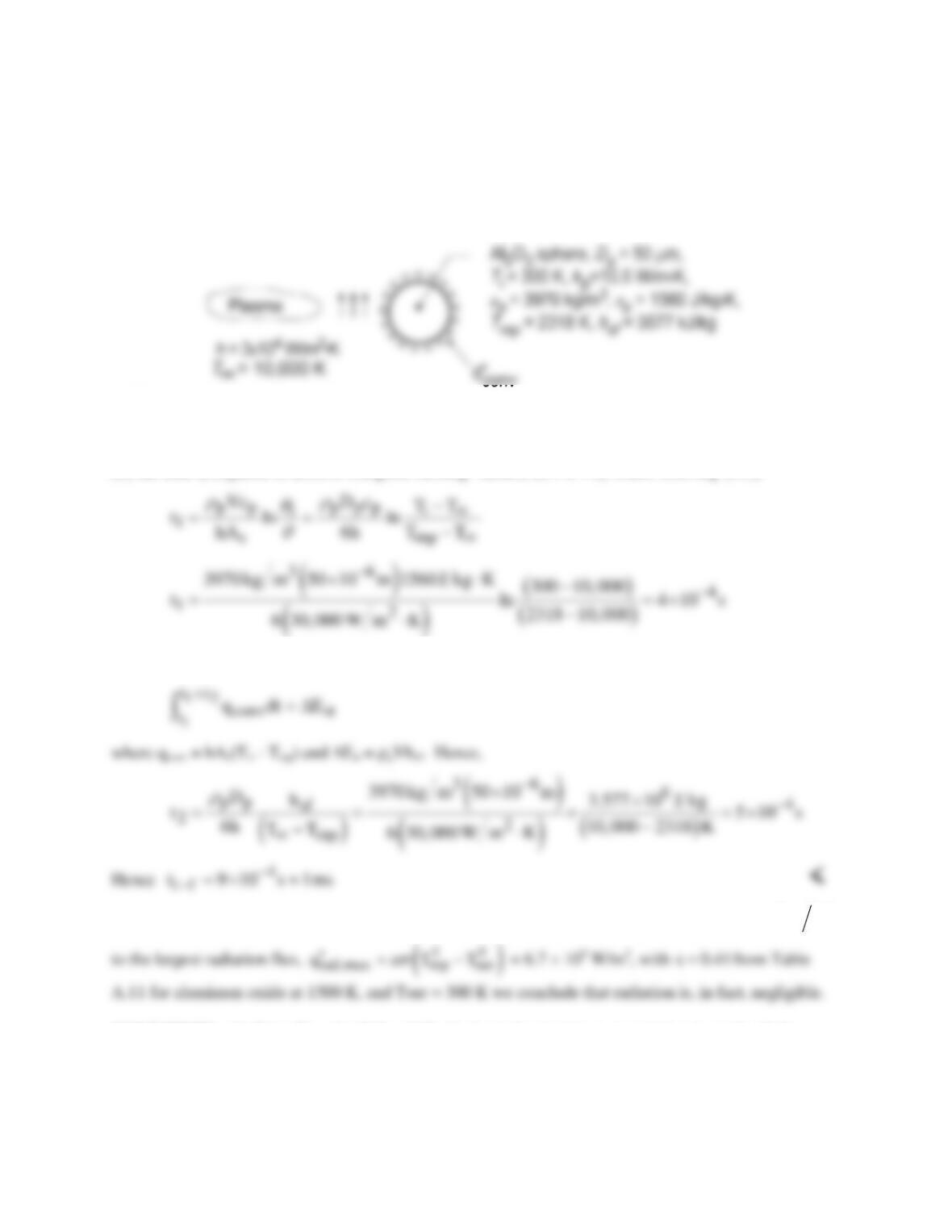
PROBLEM 5.21
KNOWN: Diameter and thermophysical properties of alumina particles. Convection conditions
associated with a two–step heating process.
FIND: (a) Time–in–flight (ti-f) required for complete melting, (b) Validity of assuming negligible
radiation.
SCHEMATIC:
ASSUMPTIONS: (1) Particle behaves as a lumped capacitance, (2) Negligible radiation, (3) Constant
properties.
ANALYSIS: (a) The two–step process involves (i) the time t1 to heat the particle to its melting point and
(ii) the time t2 required to achieve complete melting. Hence, ti-f = t1 + t2, where from Eq. (5.5),
Performing an energy balance for the second step, we obtain
(b) Contrasting the smallest value of the convection heat flux,
( )
82
conv,min mp
q h T T 2.3 10 W m
∞
′′ = −=×
COMMENTS: (1) Since Bi = (hrp/3)/k ≈ 0.02, the lumped capacitance assumption is good. (2) In an
actual application, the droplet should impact the substrate in a superheated condition (T > Tmp), which
would require a slightly larger ti-f.
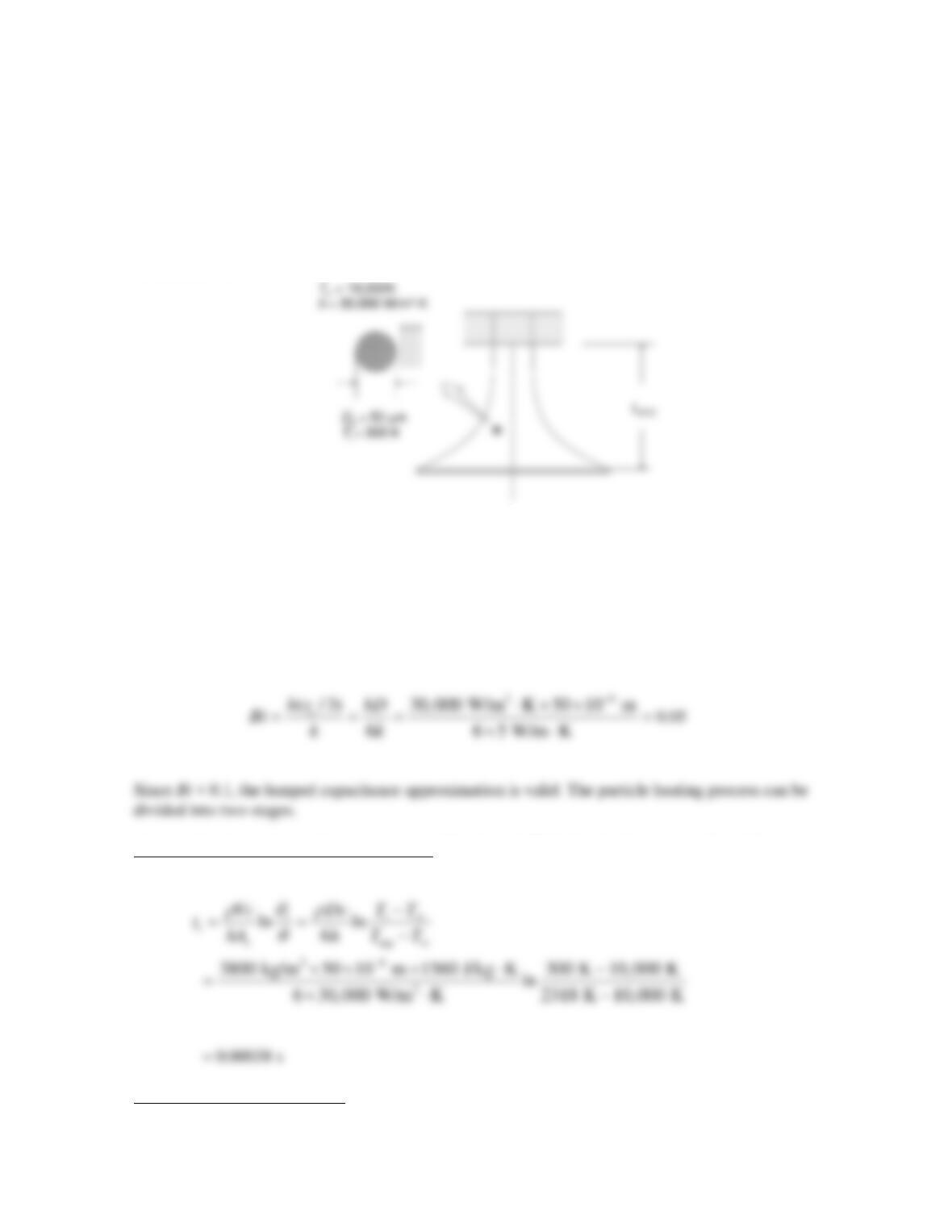
PROBLEM 5.22
KNOWN: Diameter and initial temperature of nanostructured ceramic particle. Plasma temperature
and convection heat transfer coefficient. Properties and velocity of particles.
FIND: (a) Time–in-flight corresponding to 30% of the particle mass being melted. (b) Time–in–flight
corresponding to the particle being 70% melted. (c) Standoff distances between the nozzle and the
substrate associated with parts (a) and (b).
SCHEMATIC:
ASSUMPTIONS: (1) Constant properties. (2) Negligible radiation.
PROPERTIES: Given; k = 5 W/m⋅K,
ρ
= 3800 kg/m3, cp = 1560 J/kg⋅K, hsf = 3577 kJ/kg, Tmp = 2318
K.
ANALYSIS: (a) To determine whether the lumped capacitance assumption is appropriate, the Biot
number is calculated as
Stage 1: Heating to the melting temperature. The time-of-flight for the first stage is found from
Equation 5.5.
Stage 2: Melting to 30% liquid. The second stage involves heat transfer to the particle which is
isothermal at its melting point temperature. Hence
Continued…
PROBLEM 5.22 (Cont.)
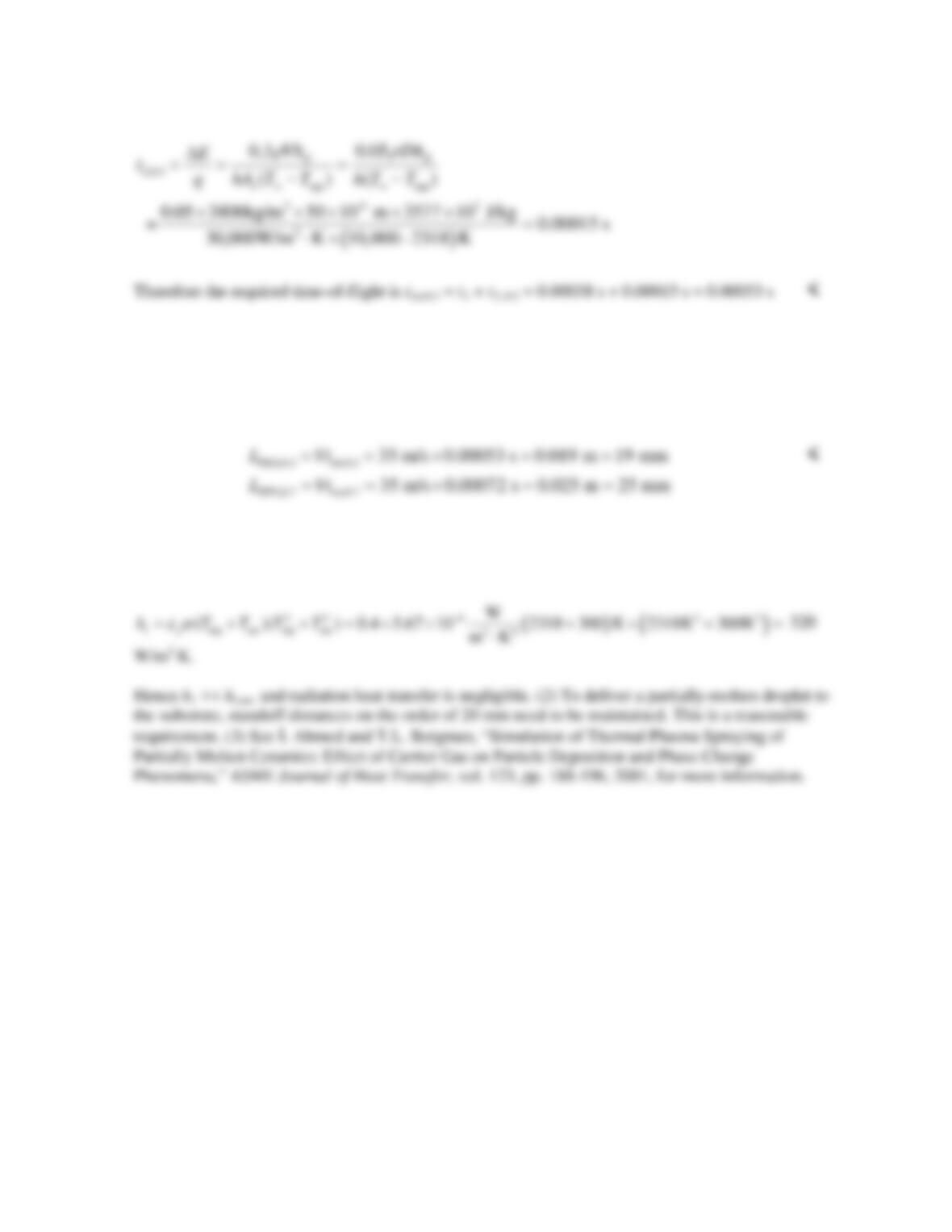
(b) The calculation for the second stage may be repeated for 70% liquid, yielding t2, 0.7 = 0.00034 s.
Therefore the required time-of–flight is ttot, 0.7 = t1 + t2, 0.7 = 0.00038 s + 0.000341 s = 0.00072 s <
(c) The required standoff distances are
COMMENTS: (1) Assuming the particles to have an emissivity of
ε
p = 0.4 and radiation is
exchanged with surroundings at an assumed temperature of Tsur = 300 K, the radiation heat transfer
coefficient may be found from Equation 1.9 as
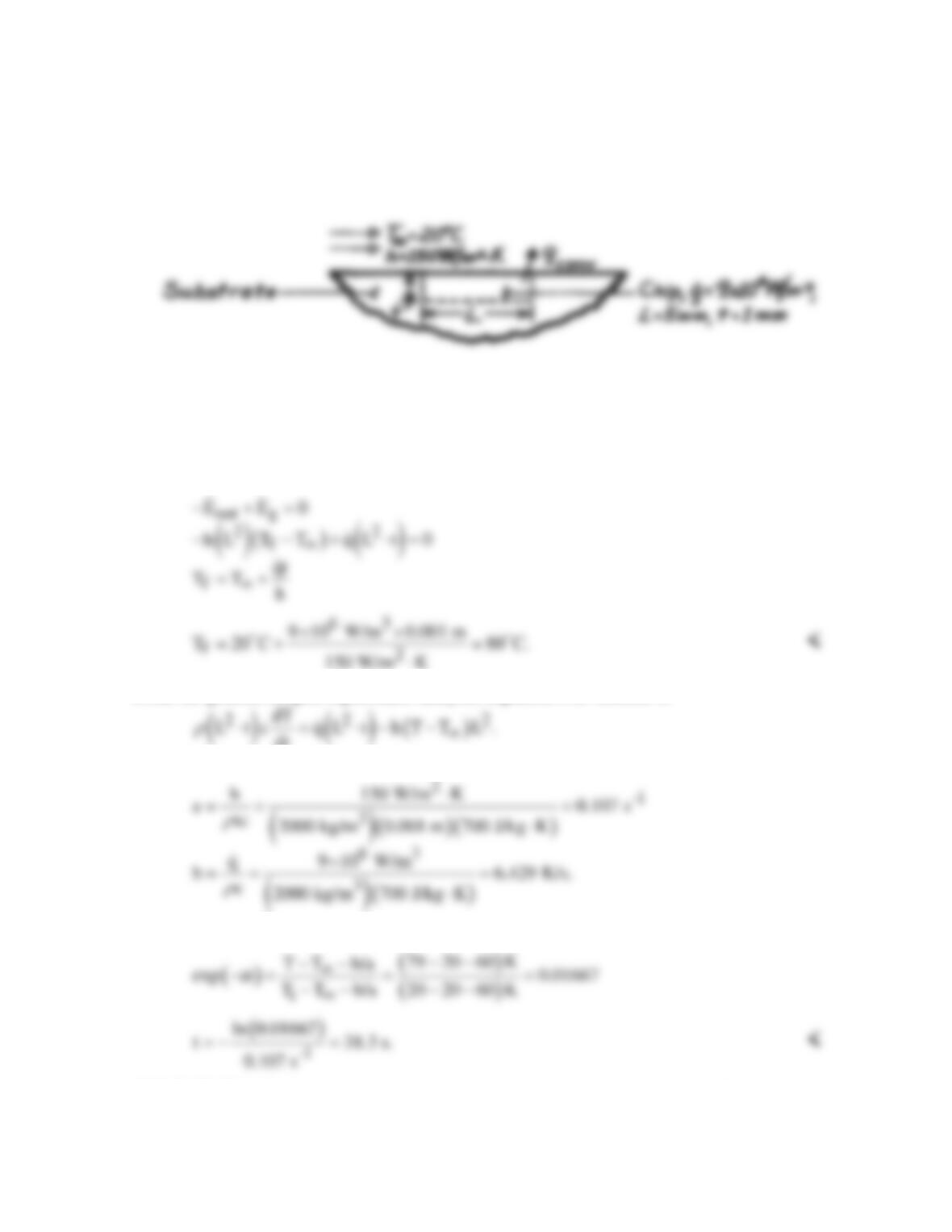
PROBLEM 5.23
KNOWN: Dimensions and operating conditions of an integrated circuit.
FIND: Steady–state temperature and time to come within 1°C of steady–state.
SCHEMATIC:
ASSUMPTIONS: (1) Constant properties, (2) Negligible heat transfer from chip to
substrate.
PROPERTIES: Chip material (given): ρ = 2000 kg/m3, c = 700 J/kg⋅K.
ANALYSIS: At steady-state, conservation of energy yields
From the general lumped capacitance analysis, Equation 5.15 reduces to
dt
With
From Equation 5.24,
COMMENTS: Due to additional heat transfer from the chip to the substrate, the actual
values of Tf and t are less than those which have been computed.
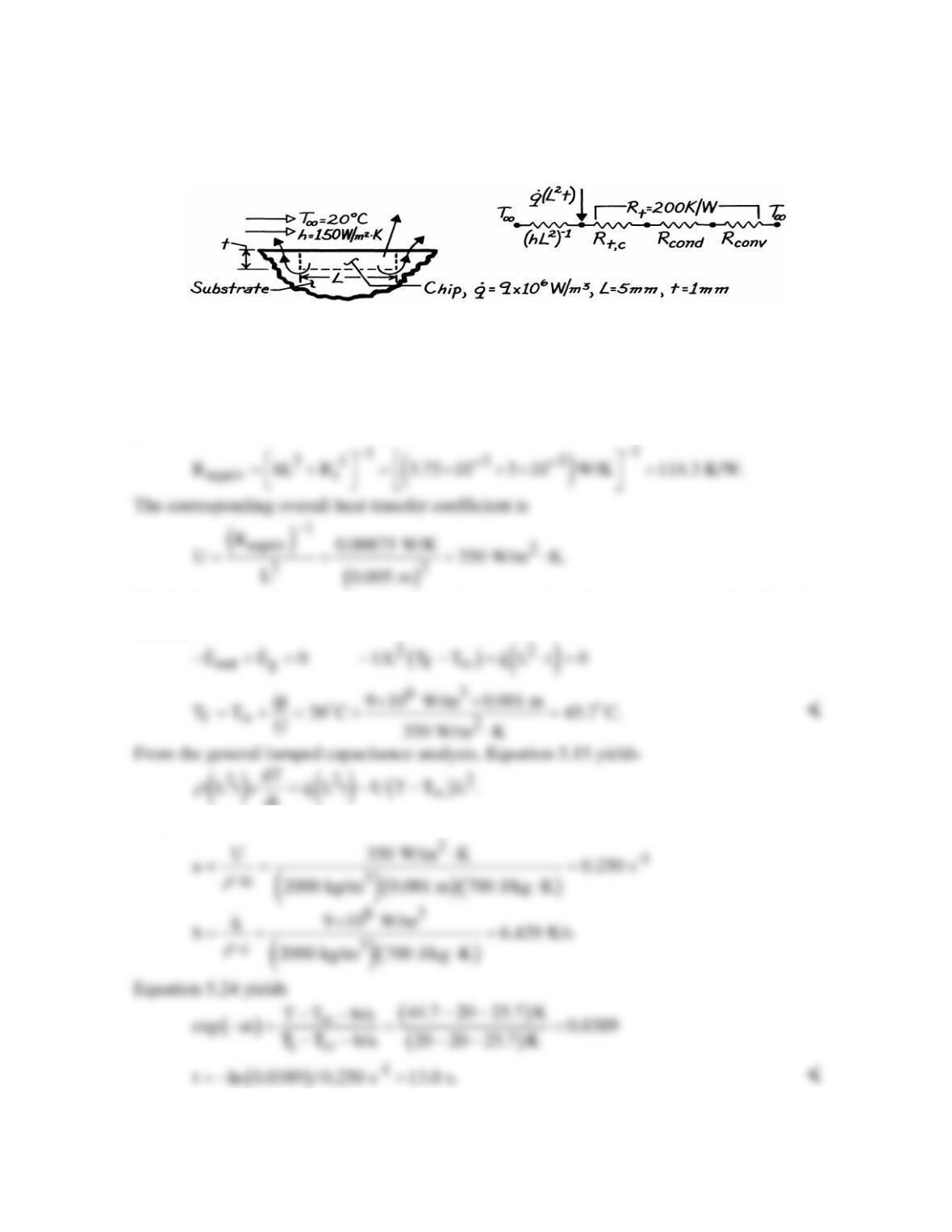
PROBLEM 5.24
KNOWN: Dimensions and operating conditions of an integrated circuit.
FIND: Steady–state temperature and time to come within 1°C of steady–state.
SCHEMATIC:
ASSUMPTIONS: (1) Constant properties.
PROPERTIES: Chip material (given): ρ = 2000 kg/m3, cp = 700 J/kg⋅K.
ANALYSIS: The direct and indirect paths for heat transfer from the chip to the coolant are in
parallel, and the equivalent resistance is
To obtain the steady-state temperature, apply conservation of energy to a control surface about
the chip.
dt
With
COMMENTS: Heat transfer through the substrate is comparable to that associated with
direct convection to the coolant.
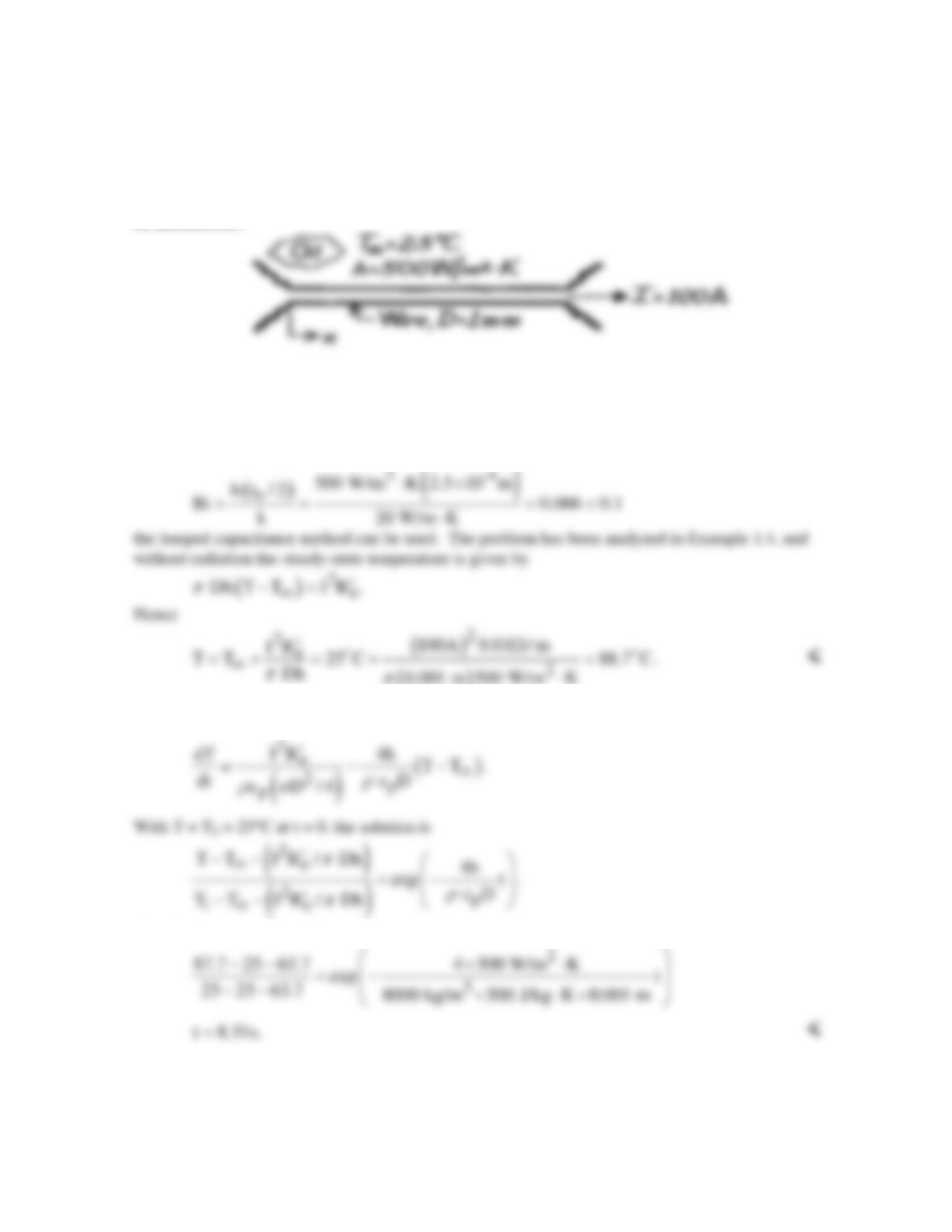
PROBLEM 5.25
KNOWN: Diameter, resistance and current flow for a wire. Convection coefficient and temperature
of surrounding oil.
FIND: Steady–state temperature of the wire. Time for the wire temperature to come within 1°C of its
steady–state value.
SCHEMATIC:
ASSUMPTIONS: (1) Constant properties, (2) Wire temperature is independent of x.
PROPERTIES: Wire (given): ρ = 8000 kg/m3, cp = 500 J/kg⋅K, k = 20 W/m⋅K,
e
R 0.01 /m.
′= Ω
ANALYSIS: Since
( )
With no radiation, the transient thermal response of the wire is governed by the expression (Example
1.4)
Substituting numerical values, find
COMMENTS: The time to reach steady state increases with increasing ρ, cp and D and with
decreasing h.
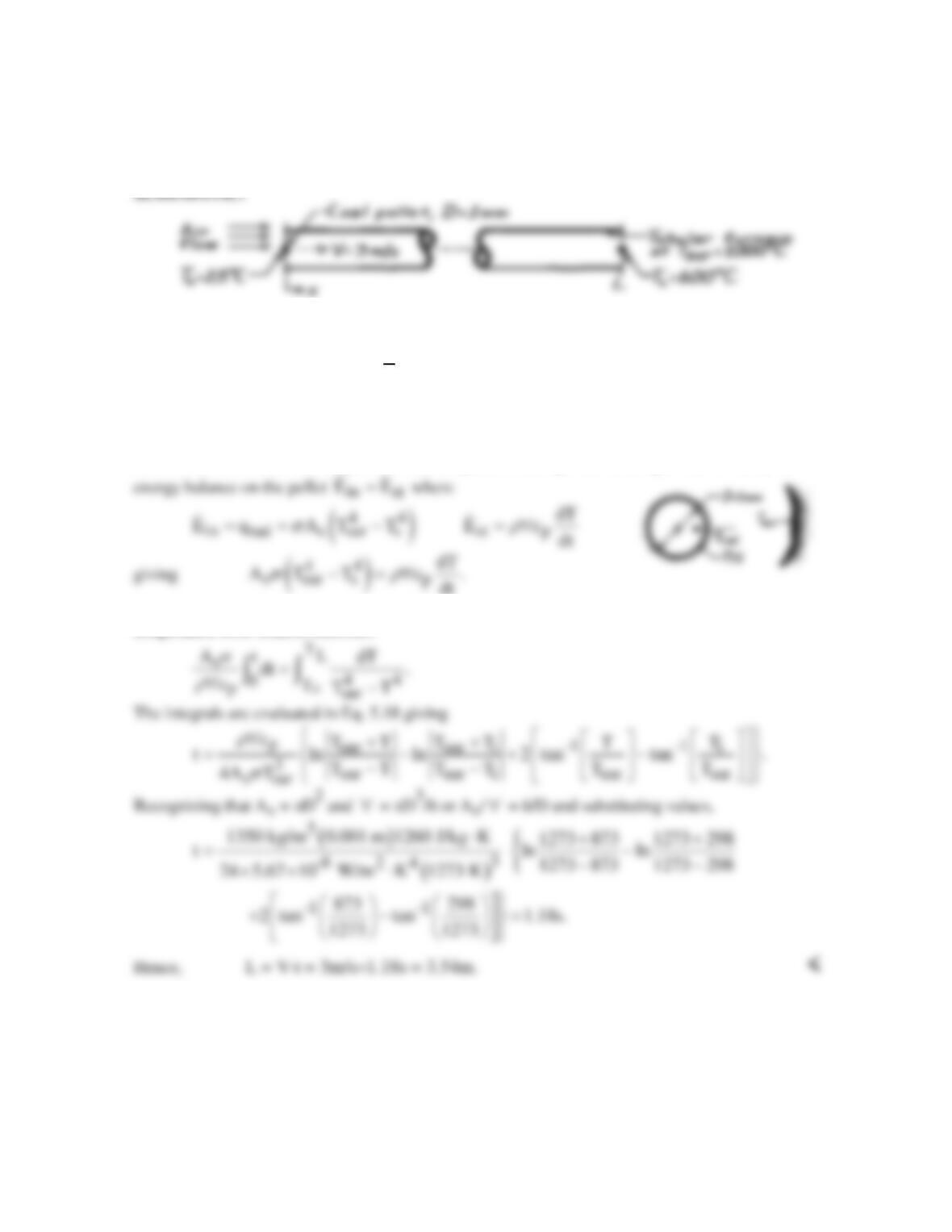
PROBLEM 5.26
KNOWN: Spherical coal pellet at 25°C is heated by radiation while flowing through a furnace
maintained at 1000°C.
FIND: Length of tube required to heat pellet to 600°C.
ASSUMPTIONS: (1) Pellet is suspended in air flow and subjected to only radiative exchange with
furnace, (2) Pellet is small compared to furnace surface area, (3) Coal pellet has emissivity, ε = 1.
PROPERTIES: Table A-3, Coal
( )( )
T 600 25 C/2 585K, however, only 300K data available
:
= + °=
ρ =
1350 kg/m3,cp = 1260 J/kg⋅K, k = 0.26 W/m⋅K.
ANALYSIS: Considering the pellet as spatially isothermal, use the lumped capacitance method of
Section 5.3 to find the time required to heat the pellet from To = 25°C to TL = 600°C. From an
Separating variables and integrating with limits shown, the
temperature–time relation becomes
The validity of the lumped capacitance method requires Bi = h(
∀
/As)/k < 0.1. Using Eq. (1.9) for h
= hr and
∀
/As = D/6, find that when T = 600°C, Bi = 0.19; but when T = 25°C, Bi = 0.10. At early
times, when the pellet is cooler, the assumption is reasonable but becomes less appropriate as the
pellet heats.
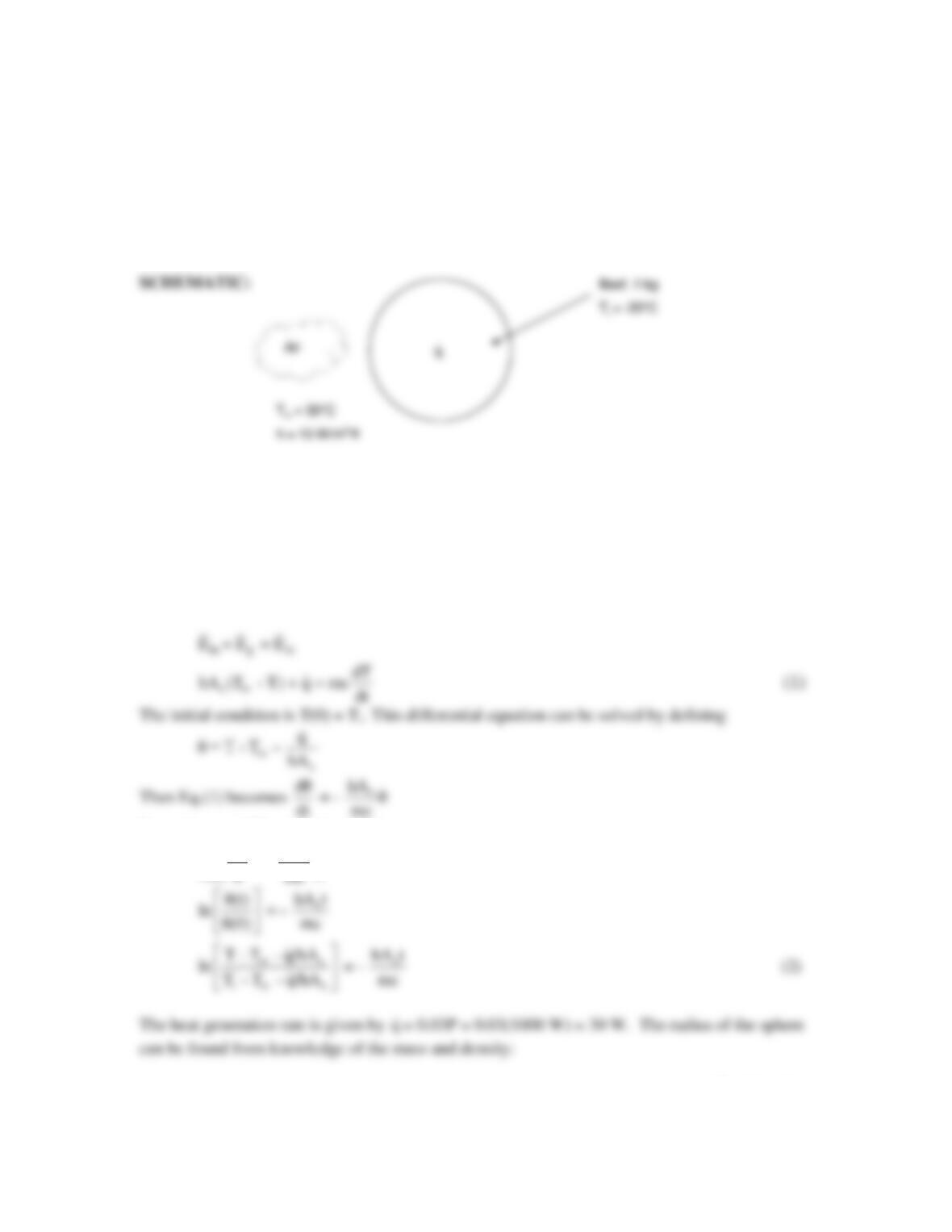
PROBLEM 5.27
KNOWN: Mass and initial temperature of frozen ground beef. Temperature and convection
coefficient of air. Rate of microwave power absorbed in beef.
FIND: (a) Time for beef to reach 0°C, (b) Time for beef to be heated from liquid at 0°C to 80°C,
and (c) Explain nonuniform heating in microwave and reason for low power setting for thawing.
ASSUMPTIONS: (1) Beef is nearly isothermal, (2) Beef has properties of water (ice or liquid),
(3) Radiation is negligible, (4) Constant properties (different for ice and liquid water).
PROPERTIES: Table A.3, Ice (≈ 273 K): ρ = 920 kg/m3, c = 2040 J/kg∙K, Table A.6, Water (≈
315 K): c = 4179 J/kg∙K.
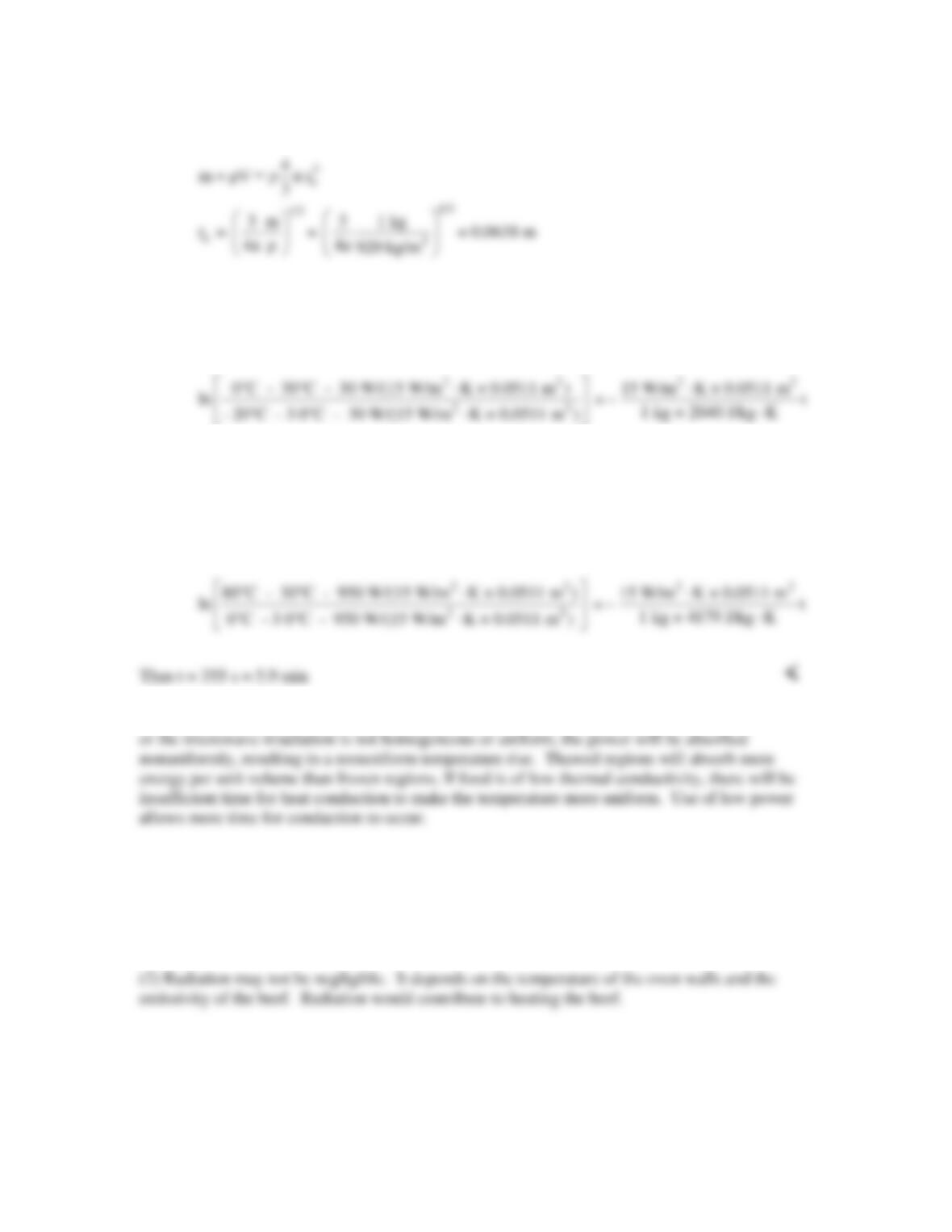
ANALYSIS: (a) We apply conservation of energy to the beef
Separating variables and integrating,
θ(t) t
s
θ(0) 0
hA
dθ = – dt
∫∫
Continued…
PROBLEM 5.27 (Cont.)
Thus
2 22
so
A = 4πr = 4π(0.0638 m) = 0.0511 m
Substituting numerical values into Eq.(2), we can find the time at which the temperature reaches
0°C:
Thus t = 676 s = 11.3 min <
(b) After all the ice is converted to liquid, the absorbed power is
q
= 0.95P = 950 W. The time
for the beef to reach 80°C can again be found from Eq.(2):
(c) Microwave power is more efficiently absorbed in regions of liquid water. Therefore, if food
COMMENTS: (1) The time needed to turn the ice at 0°C into liquid water at 0°C was not
calculated. The required energy is Q = mhfg = 1 kg × 2502 kJ/kg = 2502 kJ. The required time
depends on how the fraction of microwave power absorbed changes during the thawing process.
The minimum possible time would be tmin = 2502 kJ/950 W = 2600 s = 44 min. Therefore, the
time to thaw is significant.
PROBLEM 5.28
KNOWN: Thickness and initial temperatures of two layers of copper and aluminum. Contact
resistance at the interface between the layers, applied heat flux, and convective conditions on the upper
surface of the top layer.
FIND: (a) Times at which the copper (bottom) and aluminum (top) reach a temperature of Tf = 90C.
(b) Times at which the copper (top) and aluminum (bottom) reach a temperature of Tf = 90C.
ASSUMPTIONS: (1) Lumped capacitance behavior, (2) Constant properties, (3) Negligible
radiation.
PROPERTIES: Table A.1; copper (T = 300 K):
A = 8933 kg/m3, cA = 385 J/kgK, kA = 401 W/mK;
aluminum (T = 300 K):
B = 2702 kg/m3, cB = 903 J/kgK, kB = 237 W/mK.
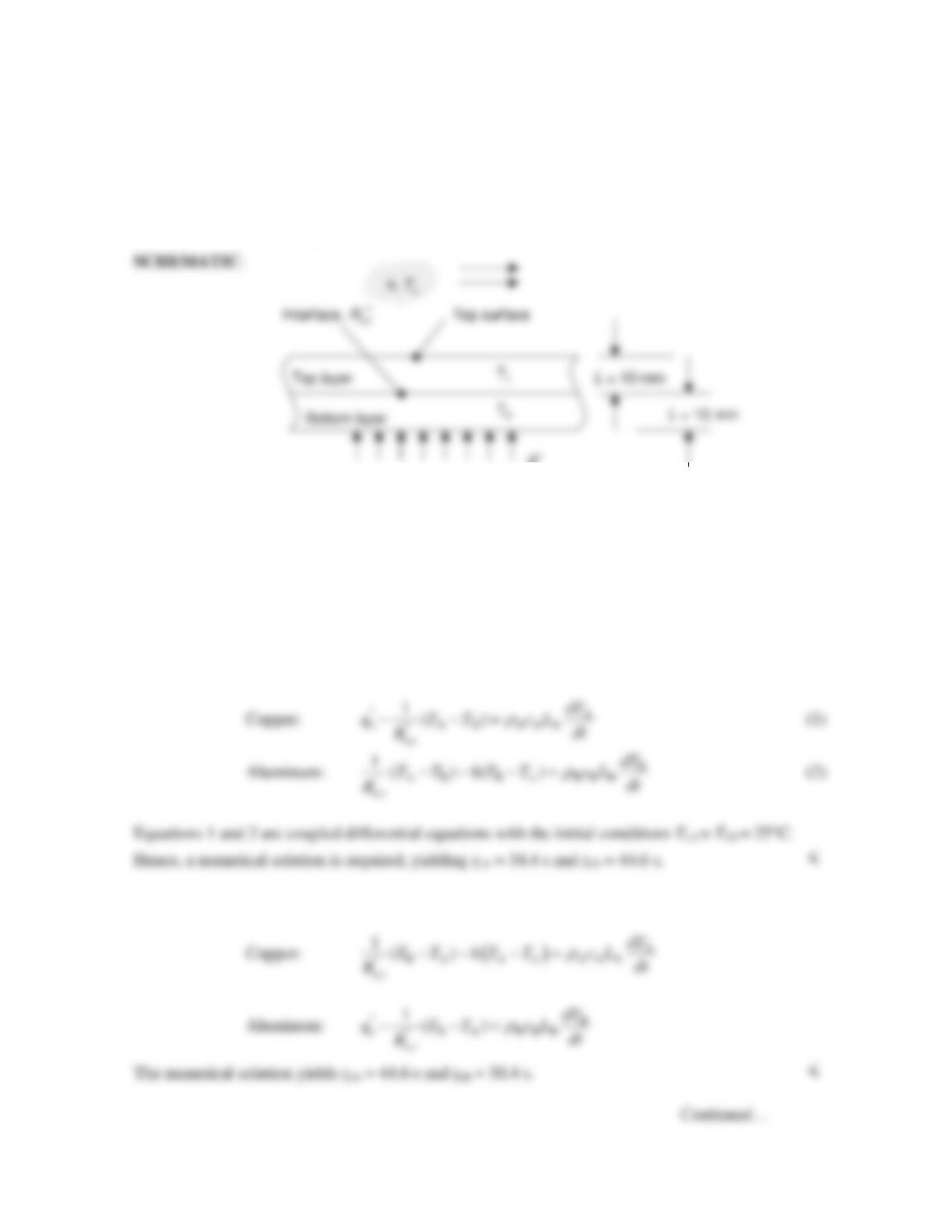
ANALYSIS: (a) For copper on the bottom, a modified form of Eq. 5.15 may be applied to both
materials, resulting in
(b) For copper on the top, modified Eq. 5.15 is written as
q
PROBLEM 5.28 (Cont.)
COMMENTS: (1) For the aluminum on the top, the Biot number associated with the aluminum is BiB
= hLB/kB = (40 W/m2K 10 10–3 m)/237 W/mK = 0.0017. The lumped capacitance approach is
valid for the aluminum. For the copper, the contact resistance and the conduction resistance through
the top aluminum layer pose thermal resistances in series with the convective resistance. In addition,
the thermal conductivity of copper is greater than that of the aluminum, so lumped capacitance
behavior is also expected for the copper. For the copper on top, the Biot number for the copper is BiA =
0.0010. Lumped capacitance behavior will also exist for this configuration. (2) The thermal responses
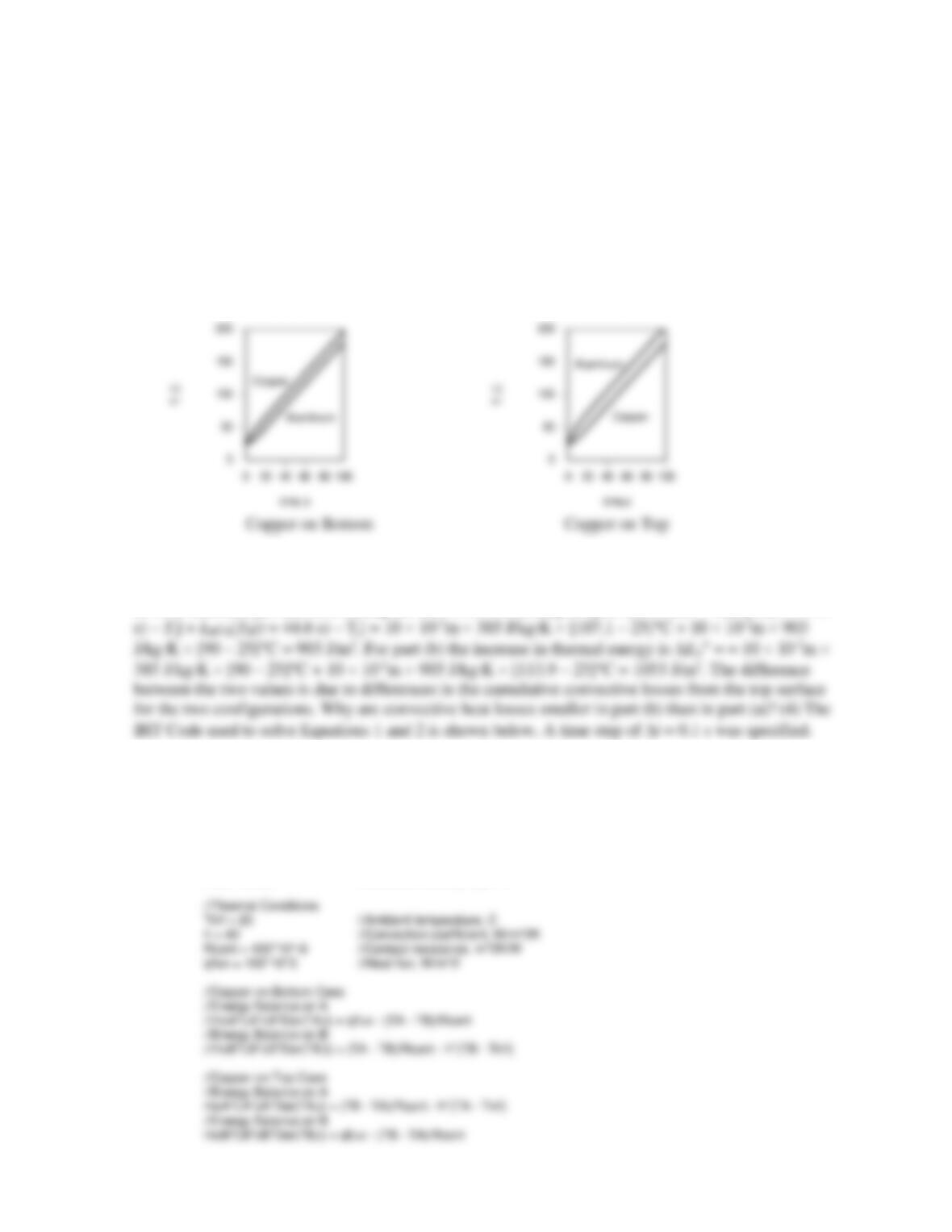
for the two cases are shown below. Can you explain the differences?
(3) At t = 44.6 s, the temperature of the copper in part (a) is TA(t = 44.6s) = 107.1C. At t = 44.6 s, the
temperature of the bottom aluminum in part (b) is TB = 113.9C. Hence, the increase in thermal energy
of both materials per unit area during the first 44.6 s of heating for part (a) is Est = LAcA[TA(t = 44.6
//Dimensions
LA = 10/1000 //m
LB = 10/1000 //m
//Properties
cA = 385 //Copper specific heat, J/kgK
rhoA = 8933 //Copper density, kg/m^3
cB = 903 //Aluminum specific heat, J/kgK
rhoB = 2702 //Aluminum density, kg/m^3
Material Temperature versus Time
Material Temperature versus Time
PROBLEM 5.29
KNOWN: Droplet properties, diameter, velocity and initial and final temperatures.
FIND: Travel distance and rejected thermal energy.
ASSUMPTIONS: (1) Constant properties, (2) Negligible radiation from space.
PROPERTIES: Droplet (given): ρ = 885 kg/m3, c = 1900 J/kg⋅K, k = 0.145 W/m⋅K, ε =
0.95.
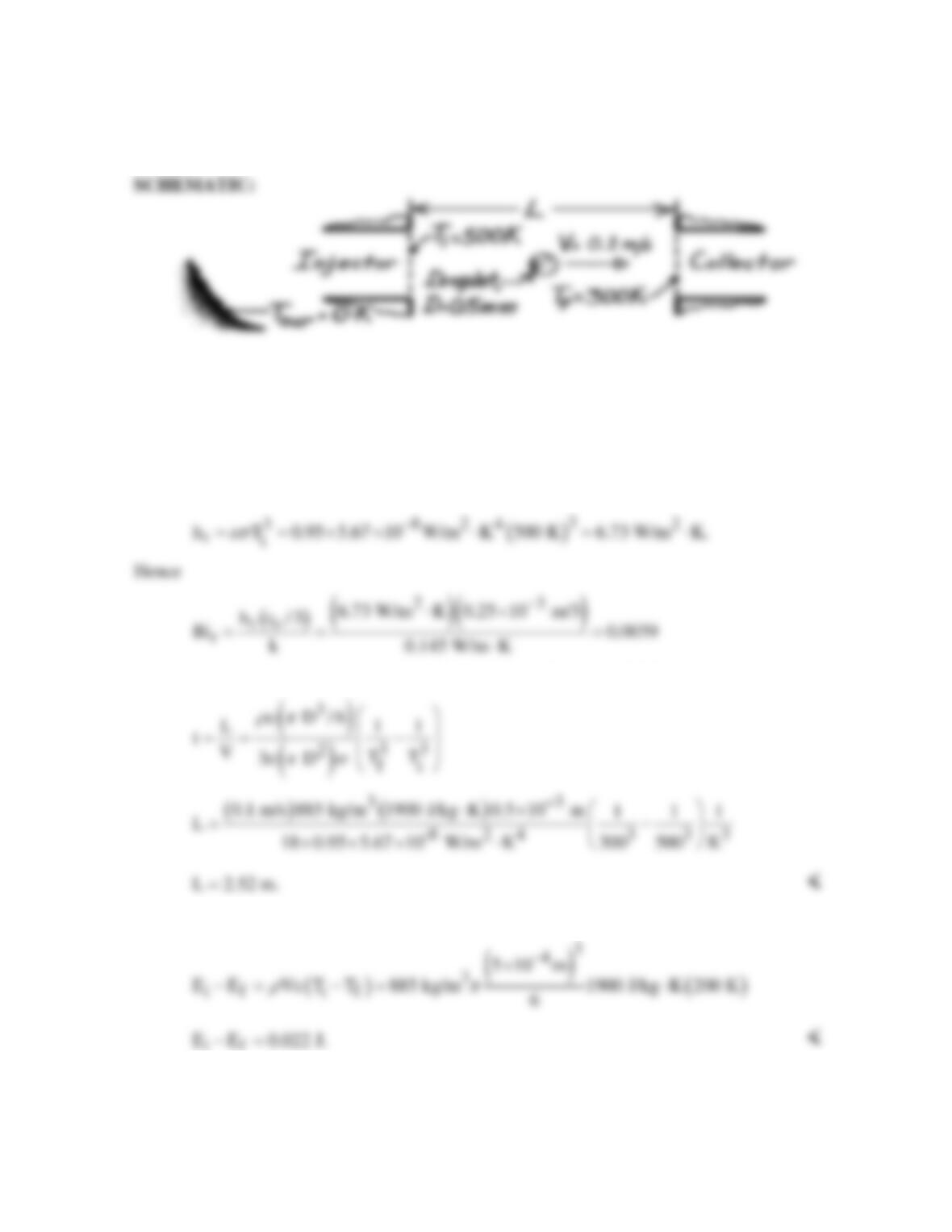
ANALYSIS: To assess the suitability of applying the lumped capacitance method, use
Equation 1.9 to obtain the maximum radiation coefficient, which corresponds to T = Ti.
and the lumped capacitance method can be used. From Equation 5.19,
The amount of energy rejected by each droplet is equal to the change in its internal energy.
if
COMMENTS: Because some of the radiation emitted by a droplet will be intercepted by
other droplets in the stream, the foregoing analysis overestimates the amount of heat
dissipated by radiation to space.