Introduction to Medical-Surgical Nursing, 6th ed.
41
Lesson Plans for
Liver, Gallbladder, and Pancreatic Disorders
CHAPTER LESSON PLANS & OBJECTIVES
Lesson 41.1:
2. Identify the nurse’s role in tests and procedures performed to diagnose disorders of the liver,
gallbladder, and pancreas.
4. Describe the care of the patient who has an esophageal balloon tube in place.
5. Assist in developing a nursing care plan for the patient with liver, gallbladder, or pancreatic
dysfunction.
CHAPTER TEACHING FOCUS
• In this chapter, students are introduced to disorders associated with the liver, gallbladder, and
pancreas.

2 Chapter 41Liver, Gallbladder, and Pancreatic Disorders
Introduction to Medical-Surgical Nursing, 6th ed.
CHAPTER PRETEST
Have the students answer these questions prior to covering this chapter to understand where they stand
in relation to the content.
1) Venous blood from the spleen, stomach, pancreas, and intestines passes through the liver through
the __________.
a) superior vena cava
b) portal vein
c) subclavian vein
d) femoral vein
2) In discussing gluconeogenesis, it would be correct to state that it __________.
a) occurs in the pancreas after a large meal
b) is a process that uses fat and protein molecules to make glucose
c) is the production of antibodies to help resist infections
d) is the method by which glycogen is produced in the liver
3) Unless contraindicated, a patient with hepatitis should maintain a fluid intake of __________.
a) 500 mL/day
b) 1000 mL/day
c) 2000 mL/day
d) 2000 mL/day
4) Which of the following is a potentially life-threatening complication of cirrhosis of the liver?
a) Bleeding esophageal varices
b) Varicose veins
c) Cholelithiasis
d) Hemorrhoids
5) A risk factor for gallbladder disease is __________.
a) diabetes mellitus type 2
b) prolonged bleeding time
c) diabetes insipidus
d) multiple pregnancies
6) An anxious patient asks the nurse to tell him about his diagnosis of cholelithiasis. The nurse could
begin by telling him that __________.
a) it might affect his body’s ability to produce antibodies
b) this is the medical terminology for gallstones
c) it is not a very common condition in the United States
d) the most frequent complication is the inability to urinate
7) Pancreatitis is an inflammation of the pancreas that __________.
a) is characterized by jaundice and itching
b) occurs more often in women than in men
c) is often caused by excessive alcohol consumption
d) has no indications for surgical intervention
8) Abdominal pain is a prominent symptom of pancreatitis. This pain is typically __________.
a) moderate to severe with a gradual onset
b) severe with a sudden onset
c) mild to moderate with a gradual onset
d) mild with a sudden onset
9) A Whipple procedure is a surgical intervention for __________.
a) gallstones
b) liver cancer
c) diabetes mellitus
d) pancreatic cancer
10) People with gallbladder disease are advised to follow a diet that is __________.
a) low-carbohydrate
b) high-protein
c) low-fat
d) high-carbohydrate
__________________________________________ Chapter 41Liver, Gallbladder, and Pancreatic Disorders 3
Introduction to Medical-Surgical Nursing, 6th ed.
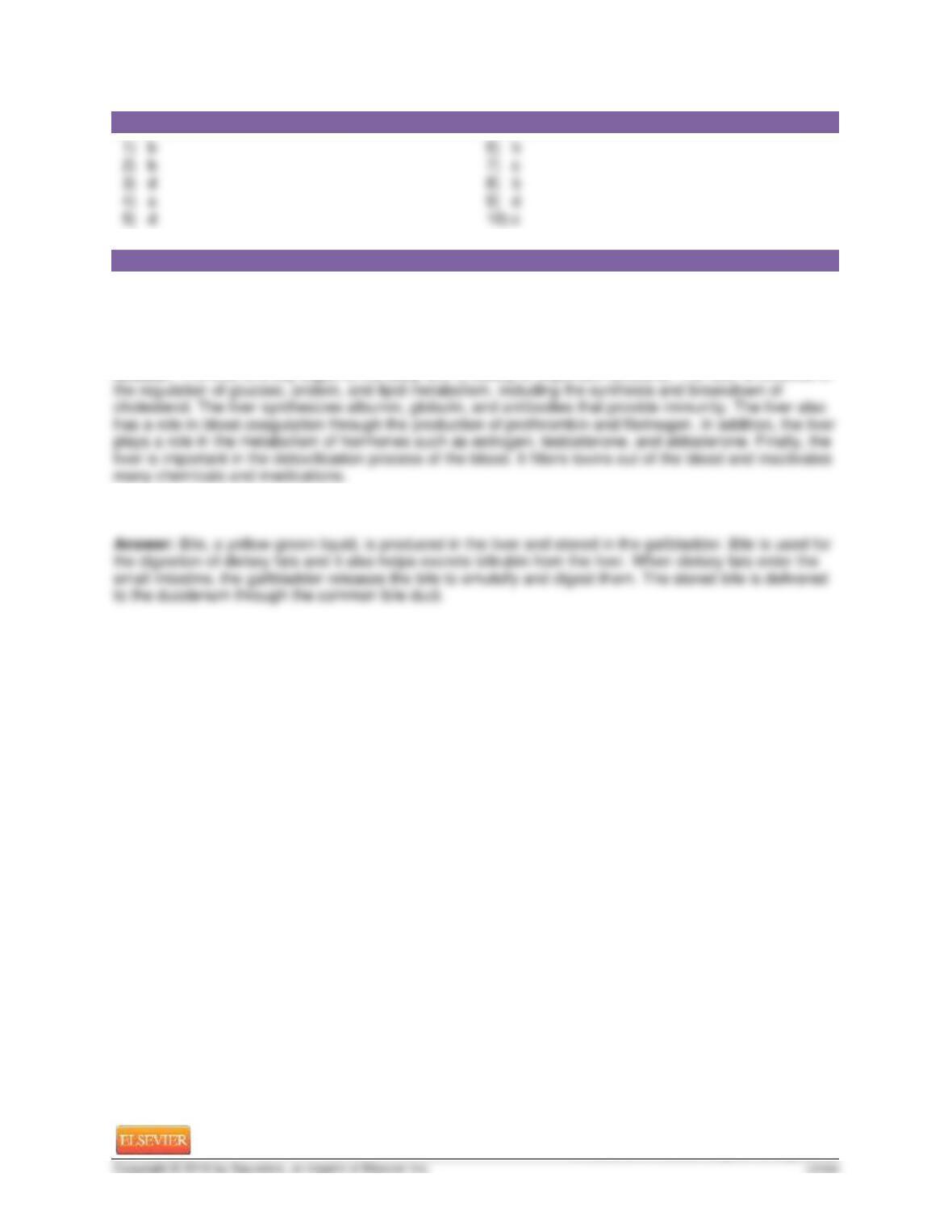
Chapter Pretest Answers
CHAPTER BACKGROUND ASSESSMENT
Discuss these questions with your students prior to covering this chapter to understand where they stand
in relation to the content.
Question: What are the essential functions of the liver?
Answer: The liver is a key organ of the body with a variety of important functions. The liver is involved in
Question: What is the role of the gallbladder in digestion?
4 Chapter 41Liver, Gallbladder, and Pancreatic Disorders
Introduction to Medical-Surgical Nursing, 6th ed.
LESSON 41.1
Instructor Preparation
Textbook Objectives Covered
2. Identify the nurse’s role in tests and procedures performed to diagnose disorders of the liver,
gallbladder, and pancreas.
4. Describe the care of the patient who has an esophageal balloon tube in place.
5. Assist in developing a nursing care plan for the patient with liver, gallbladder, or pancreatic
dysfunction.
Lesson Preparation Checklist
• Prepare lecture from TEACH lecture slides available on Evolve.
• Student performance evaluation of all entry-level skills required for student comprehension of
principles underlying disorders of the liver, gallbladder, and pancreas, including:
Materials and Supplies
• computer and PowerPoint
projector
Key Terms
• ascites (p. 851)
• cholecystectomy (p. 872)
• endocrine gland (p. 876)
• eructation (p. 872)
• hepatic (p. 848)
• hepatitis (p. 850)
__________________________________________ Chapter 41Liver, Gallbladder, and Pancreatic Disorders 5
Introduction to Medical-Surgical Nursing, 6th ed.
LESSON 41.1
Assignments 2 hours
1
READ – Textbook (pp. 848-851; 870-871; 876-877)
REVIEW
• Figure 41-1: Location of the liver (p. 849)
• Figure 41-2: Lobes of the liver(p. 849)
ANSWER – Text
• Review Questions for the NCLEX Examination: 1, 5, 6, 8 (pp. 888–889)
ANSWER – Study Guide
• Part IA: 2, 4, 9, 10 (p. 259)
2
READ – Textbook (pp. 851-856)
REVIEW
• Table 41-1: Diagnostic Tests and Procedures: Liver and Gallbladder (pp. 852-855)
• Table 41-5: Diagnostic Tests and Procedures: The Pancreas (p. 877)
ANSWER – Study Guide
6 Chapter 41Liver, Gallbladder, and Pancreatic Disorders
Introduction to Medical-Surgical Nursing, 6th ed.
LESSON 41.1
3
READ – Textbook (pp. 856-870; 871-876; 879-887)
REVIEW
• Table 41-2: Key Features of Each Type of Viral Hepatitis (p. 857)
• Table 41-3: Medications for Cirrhosis (pp. 863-864)
• Figure 41-6: Peritoneal-venous shunt (p. 865)
• Figure 41-7: Injection sclerotherapy (p. 865)
• Table 41-7: Potential complications of the Whipple Procedure (p. 886)
ANSWER – Text
• Review Questions for the NCLEX Examination: 2, 3, 4, 7, 9 (pp. 888-889)
ANSWER – Study Guide
• Part IA: 1, 5-8 (p. 259)
• Part ID: 1-3 (p. 260)
• Part IE: A-E and 1-8 (pp. 261-262)
4
READ – Textbook (p. 866)
REVIEW
• Figure 41-8: Sengstaken-Blakemore tube (p. 866)
ANSWER – Study Guide
5
READ – Textbook (pp. 856-870, 871-876, 879-887)
REVIEW
• Nursing Care Plan (p. 883)
ANSWER – Text
• Review Questions for the NCLEX Examination: 10 (p. 889)
ANSWER – Study Guide
__________________________________________ Chapter 41Liver, Gallbladder, and Pancreatic Disorders 7
Introduction to Medical-Surgical Nursing, 6th ed.
LESSON 41.1
50-Minute Lesson Plan
Lecture Outline 20 minutes
Slide 1
Chapter 41
Liver, Gallbladder, and Pancreas Disorders
1
The Liver
Anatomy and Physiology of the Liver
• Divided into four lobes made up of many lobules
• Blood from aorta delivered to liver via the hepatic artery
TALKING POINTS:
• What is the function of Kupffer cells?
• Parenchymal cells carry out various metabolic functions, including metabolism of
carbohydrates, fats, proteins, and steroids and detoxification of potentially harmful
substances.
Bile Production and Excretion
• Bilirubin
Bile Production and Excretion (cont.)
• Bile produced in the liver passes through the cystic duct into the gallbladder for storage
TALKING POINTS:
• Bile travels through the intestines with the chyme.
• In the large intestine, what is bile converted into?
8 Chapter 41Liver, Gallbladder, and Pancreatic Disorders
Introduction to Medical-Surgical Nursing, 6th ed.
LESSON 41.1
Slide 6
Metabolism
• Glucose metabolism
• Glycogenesis
• After a meal, excess glucose molecules are taken up by the liver, combined, and
then stored as glycogen
• Glycogenolysis
Slide 7
Metabolism (cont.)
• Protein metabolism
• Some nonessential amino acids, plasma proteins, and clotting factors are synthesized
in the liver
Slide 8
Metabolism (cont.)
• Lipid metabolism
• Synthesizes lipids from glucose, pyruvic acid, acetic acid, and amino acids
Slide 9
Metabolism (cont.)
• Detoxification
• Liver filters the blood and inactivates many chemicals, including most medications
• Immunity
• Development of antibodies to resist pathogens
• Antibodies produced in the liver
• Hormone metabolism
TALKING POINTS:
• Medications are prescribed very cautiously for patients with poor liver function.
• How does age affect liver function?
Slide 10
Health History
• Patient’s chief complaint
• Change in the color of skin, urine, or stools; abdominal pain, nausea, and vomiting; and
fatigue
__________________________________________ Chapter 41Liver, Gallbladder, and Pancreatic Disorders 9
Introduction to Medical-Surgical Nursing, 6th ed.
LESSON 41.1
Slide 11
Health History (cont.)
• Medical history
• Document any previous or chronic liver disorders
• Recent surgical procedures, injuries, or blood transfusions sometimes expose the
patient to the hepatitis virus
• Compile a complete list of medications
Slide 12
Health History (cont.)
• Family history
• Document whether any of the patient’s family members have had cancer of the liver
or colon, hepatitis, or alcoholism
Slide 13
Health History (cont.)
• Review of systems
• Patient’s general health status; systematically assess for signs and symptoms related
to liver dysfunction
TALKING POINTS:
• General fatigue is a common complaint among people who have impaired liver function.
• What changes may have occurred that the patient may not be aware of?
Health History (cont.)
• Functional assessment
• Dietary intake and patterns of activity and rest
Slide 15
Physical Examination
• Vital signs, height, weight: observe general appearance
• Skin color; assess for jaundice
• Inspect the sclera of the eyes
• Enlargement of breast tissue in men(gynecomastia)
TALKING POINTS:
• Jaundice is a golden yellow skin color associated with liver dysfunction or bile obstruction.
• What is a yellow discoloration of the eyes called?
10 Chapter 41Liver, Gallbladder, and Pancreatic Disorders
Introduction to Medical-Surgical Nursing, 6th ed.
LESSON 41.1
2
Slide 16
Diagnostic Tests and Procedures
• Laboratory studies
• Serum and urine bilirubin, urinary and fecal urobilinogen, serum proteins, ammonia,
prothrombin time, vitamin K production, International Normalized Ratio (INR), and
Diagnostic Tests and Procedures (cont.)
• Imaging studies
• Hepatobiliary scintigraphy (HIDA)
Slide 18
Radiologic Studies
• Hepatobiliary scintigraphy: Nuclear imaging scan
• IV injection of radioactive substance; substance accumulates in liver
• Reveals tumors, cirrhosis, abscesses
Slide 19
Liver Biopsy
• Specimen obtained for biopsy
• Open biopsy under general anesthesia
Slide 20
Liver Biopsy (cont.)
• Preprocedural care:
• Baseline VS, blood coagulation studies
• Signed consent, procedure explained
Slide 21
Liver Biopsy: Postprocedure
• Pressure dressing over puncture
• Assess site for bleeding; assess VS per agency protocol
• Patient to stay on right side for 2 hours to maintain pressure
TALKING POINTS:
• What are the signs of bleeding?
• What are possible complications
__________________________________________ Chapter 41Liver, Gallbladder, and Pancreatic Disorders 11
Introduction to Medical-Surgical Nursing, 6th ed.
LESSON 41.1
3
Slide 22
Hepatitis
• Pathophysiology
• Locally, inflammatory process causes the liver to swell
• Bile channels compressed; damage the cells that produce bile
• Then blood flow through the liver is impaired, causing pressure to rise in the
portal circulation
TALKING POINTS:
• It is estimated that more than 250,000 cases of viral hepatitis are reported in the United
States each year.
• What complications may occur due to hepatitis?
Slide 23
• Why do health care workers receive hepatitis B vaccine?
Hepatitis (cont.)
• Hepatitis A: transmitted via water, food, or equipment contaminated with infected fecal
matter
• Rarely fatal; people do not become asymptomatic carriers
• Hepatitis B: transmitted via intimate contact, contaminated blood or medical equipment, or
from infected mother to baby
Slide 24
Hepatitis (cont.)
• Hepatitis C: transmitted by contact with contaminated blood, medical equipment or body
fluids, from infected mother to baby
• Chronic carriers may develop cirrhosis or liver cancer
• Hepatitis D: survives in presence of hepatitis B, transmitted percutaneously or following
HBV infection
• Increased risk of chronic hepatitis, liver failure
Hepatitis (cont.)
• Hepatitis E: similar to hepatitis A; transmitted via water or food contaminated with infected
Hepatitis (cont.)
• Noninfectious hepatitis: cause not always identifiable
12 Chapter 41Liver, Gallbladder, and Pancreatic Disorders
Introduction to Medical-Surgical Nursing, 6th ed.
LESSON 41.1
Slide 27
Hepatitis (cont.)
• Signs and symptoms
• Preicteric phase
• Malaise, severe headache, right upper quadrant abdominal pain, anorexia,
nausea, vomiting, fever, arthralgia (joint pain), rash, enlarged lymph nodes,
TALKING POINTS:
• The preicteric phase lasts 1 to 21 days and is the period when the patient is most
infectious.
• Pruritus may be present and is caused by the accumulation of bile salts under the skin.
• How long does the icteric phase last?
Slide 28
Hepatitis (cont.)
• Complications
• Chronic hepatitis, fulminant hepatitis, cirrhosis of the liver, liver cancer, severe liver failure
TALKING POINTS:
3
&
Hepatitis (cont.)
• Medical diagnosis
• Detection of the virus or its antibodies in the blood
Slide 30
Hepatitis (cont.)
• Medical treatment
• No cure: treat to promote healing and manage symptoms
• Interferon and antiviral drugs for some types of hepatitis
TALKING POINTS:
• Chronic hepatitis B now is treated with a 4– to 12-month course of interferon, lamivudine
__________________________________________ Chapter 41Liver, Gallbladder, and Pancreatic Disorders 13
Introduction to Medical-Surgical Nursing, 6th ed.
LESSON 41.1
Slide 31
Hepatitis (cont.)
• Prevention
• Vaccines; immune globulin (IG); hepatitis B immune globulin (HBIG)
TALKING POINTS:
• Which patients should receive hepatitis A and hepatitis B vaccines?
• When should immune globulin be given?
Slide 32
Hepatitis (cont.)
• Assessment
• General health state, drug and alcohol use, chemical exposure, dietary habits, blood
transfusions, recent travel, gastrointestinal disturbances, and changes in skin, urine,
or stools
• Vital signs, skin, weight changes, and mental status
Slide 33
Hepatitis (cont.)
• Interventions
• Activity intolerance
• Impaired physical mobility
Hepatitis (cont.)
• Patient teaching
• Infected persons should see provider immediately
TALKING POINTS:
• Can a person with hepatitis B donate blood to others?
Slide 35
Hepatitis (cont.)
• Staff protection
• Standard Precautions
• Hepatitis B vaccinations; 3 injections, titer level
• If antibody titer is inadequate, up to 3 booster doses may be given
Alcohol-Induced Liver Disease
14 Chapter 41Liver, Gallbladder, and Pancreatic Disorders
Introduction to Medical-Surgical Nursing, 6th ed.
LESSON 41.1
Slide 37
Cirrhosis
• Pathophysiology
• Chronic, progressive disease
• Degeneration and destruction of liver cells
• Fibrotic bands of connective tissue impair the flow of blood and lymph and distort the
normal liver structure
• Incidence
• Related to alcoholic liver disease or chronic viral infection
TALKING POINTS:
• What are the effects of liver disease?
Slide 38
Cirrhosis (cont.)
• Types
• Alcoholic
• Postnecrotic
• Biliary
• Cardiac
TALKING POINTS:
• With alcoholic liver disease, the liver enlarges, becomes “knobby,” then shrinks; not
Slide 39
Cirrhosis (cont.)
• Signs and symptoms
• Early: slight weight loss, unexplained fever, fatigue, and dull heaviness in the right
upper abdomen
• Progresses: anorexia, nausea, vomiting, diarrhea or constipation, flatulence,
dyspepsia, esophageal varices, infections, and epistaxis
Slide 40
Cirrhosis (cont.)
• Complications
• Portal hypertension, esophageal varices, ascites, hepatic encephalopathy,
hepatorenal syndrome, and spontaneous bacterial peritonitis
• Medical diagnosis
• History and physical examination
• Liver function tests, CBC, prothrombin time, protein, electrolytes, albumin, bilirubin,
__________________________________________ Chapter 41Liver, Gallbladder, and Pancreatic Disorders 15
LESSON 41.1
Slide 41
Cirrhosis: Medical Treatment
• Bedrest
• Diet high in carbohydrates and vitamins with moderate to high protein unless blood
ammonia level is elevated
• Intravenous fluids
• Anemia may require blood transfusions
TALKING POINTS:
• What are the goals of medical treatment for cirrhosis?
• Malnutrition is common, and the specific diet depends on individual patient factors.
Slide 42
Cirrhosis: Medical Treatment (cont.)
• Ascites
• Various types of diuretics
• Salt-poor albumin may be given intravenously
• Paracentesis
TALKING POINTS:
• What is the aim of medical management for ascites?
• Paracentesis is the removal of ascitic fluid from the peritoneal cavity.
• Shunts provide a mechanism to collect ascitic fluid and return it to the circulation.
• Acute bleeding episodes may be treated with intravenous vasopressin, which constricts
blood vessels and lowers pressure in the hepatic circulation.
Cirrhosis: Medical Treatment (cont.)
• Paracentesis
• Removal of ascitic fluid from peritoneal cavity
Slide 44
Cirrhosis, Medical Treatment (cont.)
• Paracentesis (cont.)
• Support and encourage patient during the procedure
• Usually 2-3 L of fluid removed slowly
• Sterile dressing applied to puncture site
• Monitor VS, dressing check per agency protocol
• Measure fluid obtained, send for analysis
• Monitor for blood in the urine
TALKING POINTS:
• Why does the nurse monitor for blood in the urine?
16 Chapter 41Liver, Gallbladder, and Pancreatic Disorders
Introduction to Medical-Surgical Nursing, 6th ed.
Copyright © 2016 by Saunders, an imprint of Elsevier Inc. Linton
LESSON 41.1
Slide 45
Cirrhosis, Medical Treatment (cont.)
Shunts
• LeVeen shunt: placed in the abdominal peritoneum, drains fluid into jugular vein or
superior vena cava
• One-way valve permits fluid to drain
• Denver peritoneal-venous shunt: involves a manual pump placed under skin
• Can be compressed to cause fluid to flow from peritoneum to venous system
TALKING POINTS:
• What are some of the complications from these devices?
Cirrhosis, Medical Treatment (cont.)
• TIPS
TALKING POINTS:
• What are some of the complications from this device?
4
• Beta blockers to reduce blood pressure
Bleeding Esophageal Varices: Treatment
• Acute bleeding episode treated with IV octreotide, which constricts blood vessels
Slide 48
Surgical Treatments
• Sclerotherapy: solution injected into varices to harden and close varices
• Persistent pain indicates perforation of esophagus
• Tube left inflated for 24-48 hours
Esophageal-Gastric Balloon Tube
• Sengstaken-Blakemore esophageal-gastric balloon tube
3
Cirrhosis: Medical Treatment
• Hepatic encephalopathy
TALKING POINTS:
• Many factors can precipitate hepatic encephalopathy including constipation, GI bleeding,
hypokalemia, infection, opioids, dehydration, and renal failure.
• What is the goal of therapy in hepatic encephalopathy?
• Hepatorenal syndrome (HRS) is renal failure accompanying cirrhosis.
__________________________________________ Chapter 41Liver, Gallbladder, and Pancreatic Disorders 17
Introduction to Medical-Surgical Nursing, 6th ed.
LESSON 41.1
5
Slide 51
Cirrhosis
• Assessment
• Daily measurement of weight, intake and output, and abdominal girth
• Monitor for signs and symptoms of complications—bleeding, ascites, encephalopathy,
and renal failure
Slide 52
Cirrhosis (cont.)
• Interventions
• Imbalanced nutrition: Less than body requirements
• Activity intolerance
• Risk for impaired skin integrity
3
Slide 53
End-Stage Liver Disease
• From injury or chronic disease
• Injury from acute hepatitis, drug toxicity, or obstruction of the hepatic vein
• Liver failure associated with injury: fulminant liver failure
Cancer of the Liver
• Rarely begins in the liver, but is frequent site of metastasis
• Cirrhosis is a predisposing factor
Cancer of the Liver (cont.)
• Because early signs and symptoms of liver cancer are vague, the condition often not
diagnosed until advanced
Liver Transplantation
• Only cure for end-stage liver disease