4.61: PROBLEM DEFINITION
Situation:
A Pitot tube measures the flow direction and velocity in water.
Find:
Explain how to design the Pitot tube.
SOLUTION
Three pressure taps could be located on a sphere at an equal distance from the
61
4.62: PROBLEM DEFINITION
Situation:
Two Pitot tubes are connected to air-water manometers to measure air and water
velocities.
Find:
The relationship between VAand VW.
V=p2g∆h=s2∆pz
ρ
SOLUTION
The ∆pzisthesameforboth;however,
62
4.63: PROBLEM DEFINITION
Situation:
A Pitot tube measures the velocity of kerosene at center of a pipe.
D=12in,∆h=4in,
Find:
Velo city (ft/s).
Properties:
From Table A.4: ρker =1.58 slugs/ft3.
T=68◦F,γker =51lbf/ft3,γHG =847lbf/ft3.
PLAN
Apply the Pitot tube equation and the hydrostatic equation.
SOLUTION
Hydrostatic equation
Pitot tube equation
63
4.64: PROBLEM DEFINITION
Situation:
A Pitot tube for measuring velocity of air.
Find:
Air velocity (m/s).
Properties:
Air (20oC), Table A.3: ρ=1.2kg/m3.
∆pz=2kPa.
PLAN
Apply the Pitot tube equation.
SOLUTION
Pitot tube equation
64
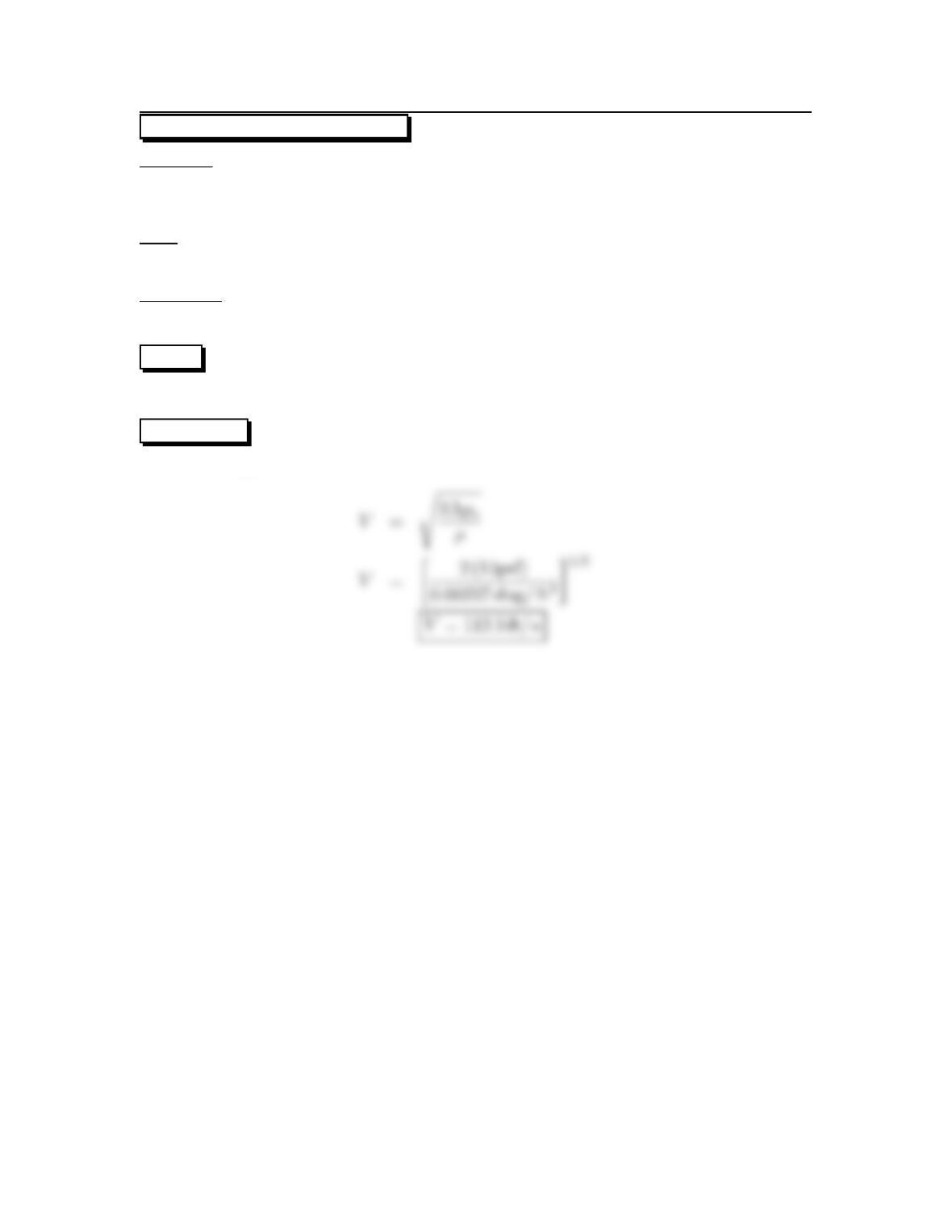
4.65: PROBLEM DEFINITION
Situation:
A Pitot tube is used to measure the velocity of air.
∆pz=15psf, T=60◦F.
Find:
Air velocity (ft/s).
Properties:
Air (60oF), Table A.3: ρ=0.00237 slug/ft3.
PLAN
Apply the Pitot tube equation.
SOLUTION
Pitot tube equation
65
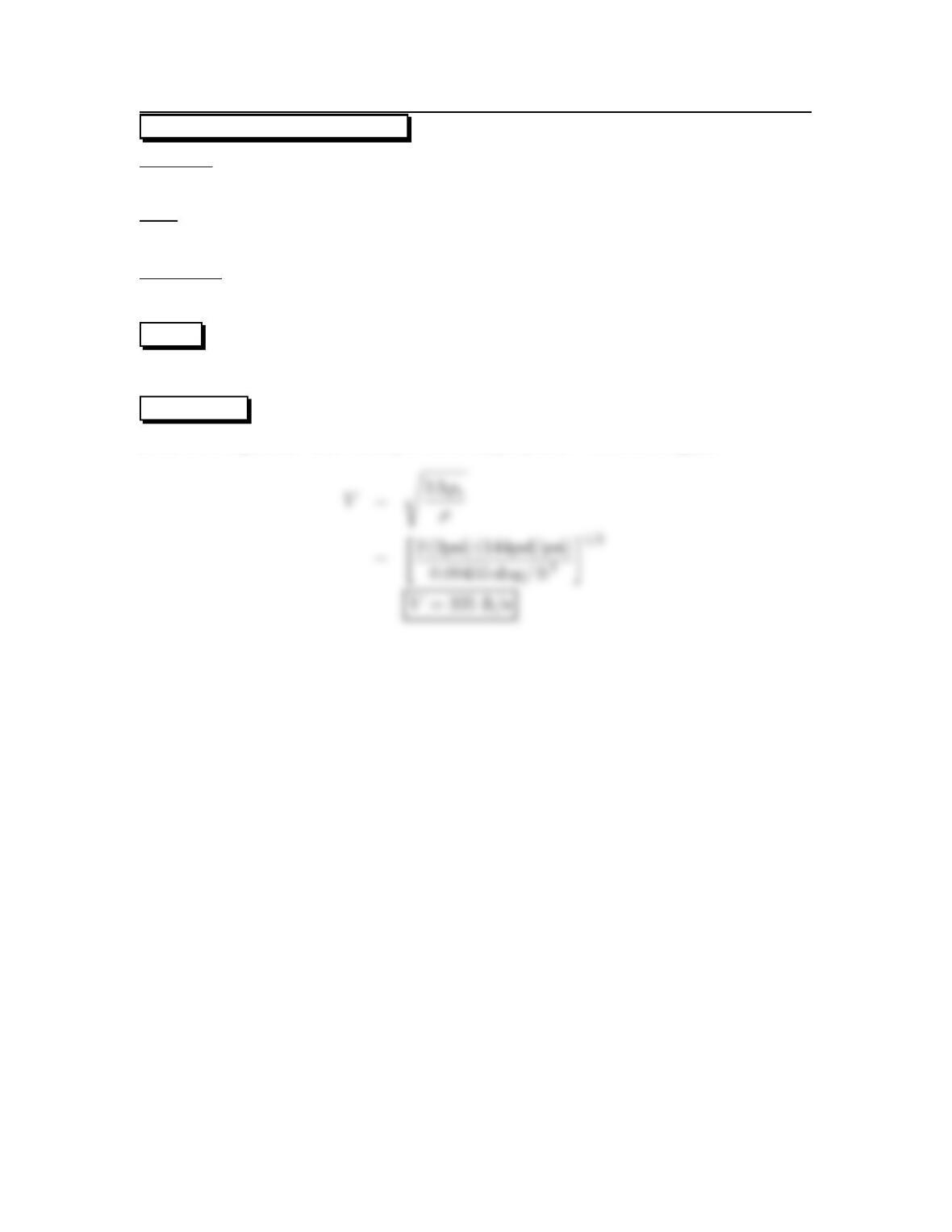
4.66: PROBLEM DEFINITION
Situation:
A Pitot tube measures gas velocity in a duct.
Find:
Gas velocity in duct (ft/s).
Properties:
∆pz=2psi, ρ=0.14 lb/ft3.
PLAN
Apply the Pitot tube equation.
SOLUTION
Pitot tube equation The density is 0.14 lbm/ft3/32.2=0.00435 slugs/ft3
66
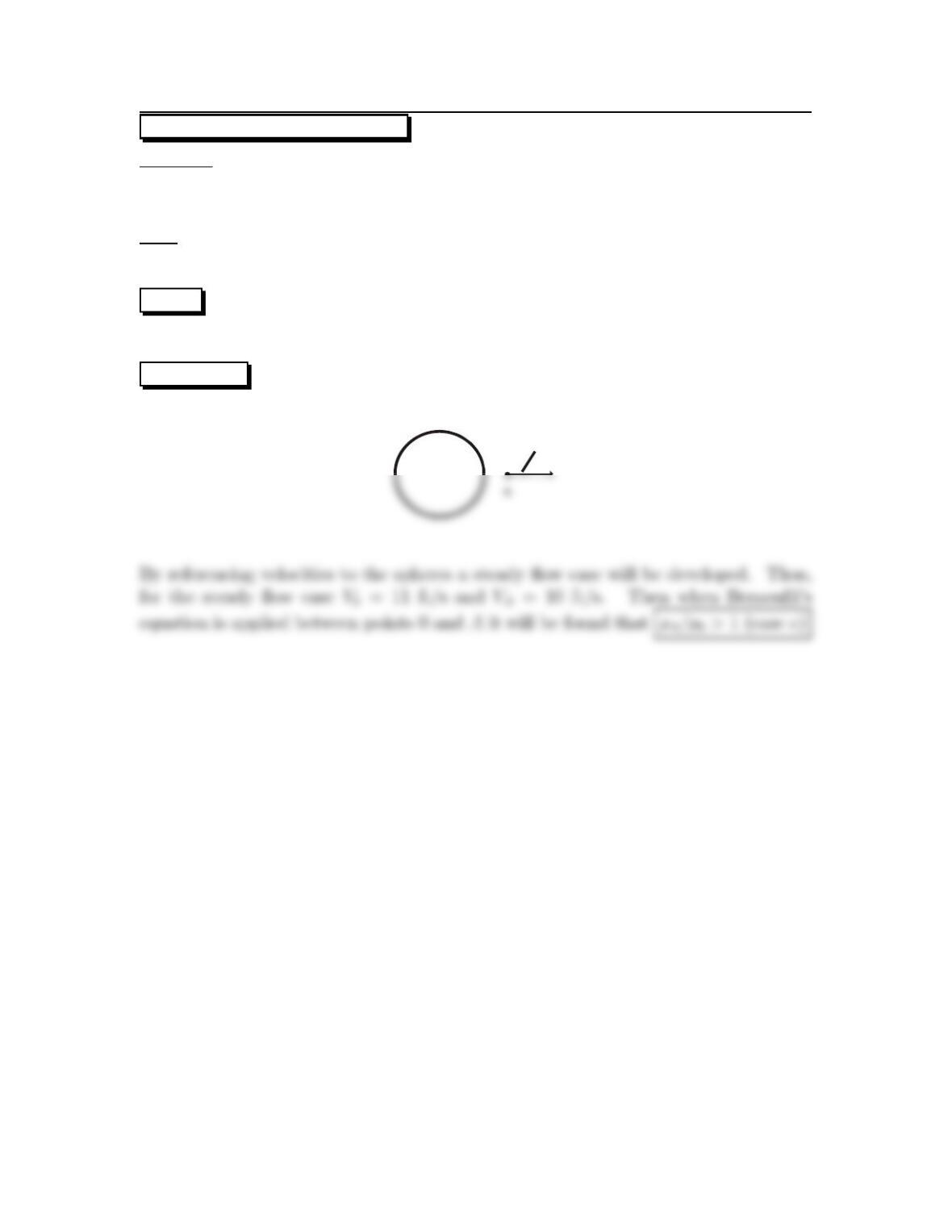
4.67: PROBLEM DEFINITION
Situation:
A sphere moving horizontally through still water.
V0=11ft/s,VA=1ft/s.
Find:
Pressure ratio: pA/p0
PLAN
Apply the Bernoulli equation.
SOLUTION
1 ft/s
67
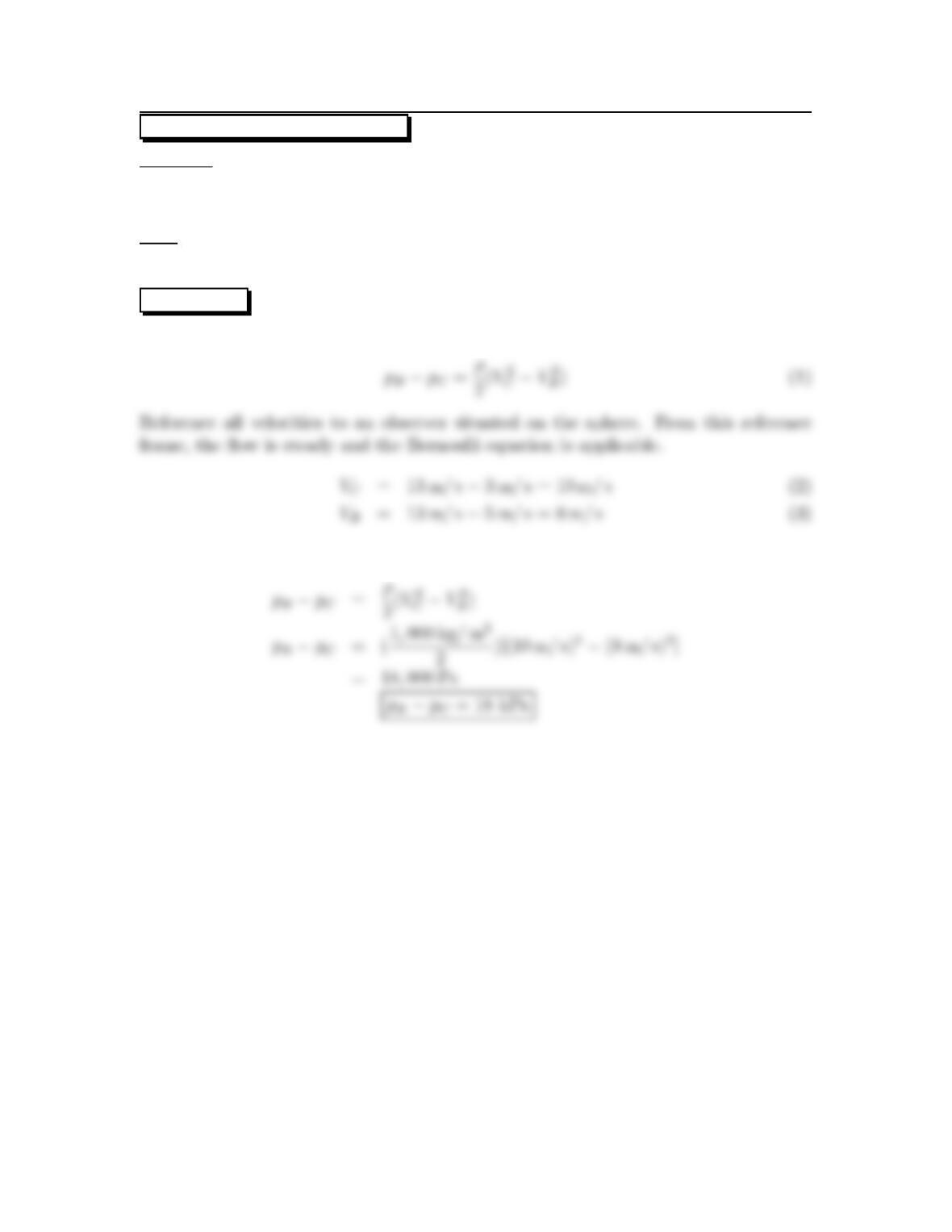
4.68: PROBLEM DEFINITION
Situation:
A body moving horizontally through still water.
VA=13m/s,VB=5m/s,V
C=3m/s.
Find:
pB−pC(kPa).
SOLUTION
Apply the Bernoulli equation.
Combine Eqs. (1) to (3)
68
4.69: PROBLEM DEFINITION
Situation:
Water is in a flume with a pressure gage along the bottom.
Da=Db,Va=0m/s,Vb=3m/s.
Find:
If gage A will read greater or less than gage B.
SOLUTION
69
4.70: PROBLEM DEFINITION
Situation:
An apparatus is used to measure the air velocity in a duct. It is connected to a
slant tube manometer with a 30oleg with the indicated deflection.
D=10cm,Dstagn =2mm
1=6.7cm,2=2.3cm.
Find:
Air velocity (m/s).
Properties:
Table A.2: R=287J/kg K.
T=20◦C,pstagn =150kPa,S=0.7
PLAN
Apply the Bernoulli equation.
SOLUTION
The side tube samples the static pressure for the undisturbed flow and the central
But
Then
70
4.71: PROBLEM DEFINITION
Situation:
An instrument used to find gas velocity in smoke stacks.
CpA =1,CpB =−0.3,∆h=5mm.
Find:
Velocity of stack gases (m/s).
Properties:
T=20◦C,R=200J/kg K.
Tgas =250◦C,pgas =101kPa.
SOLUTION
Ideal gas law
Manometer equation
∆pz=(γw−γa)∆h
71
4.72: PROBLEM DEFINITION
Situation:
The wake of a sphere which separates at 120o.
V0=100m/s.
V=1.5V0,θ=120◦.
Find:
(a) Gage pressure (kPa).
(b) Pressure coefficient.
Properties:
ρ=1.2kg/m3.
PLAN
Apply the Bernoulli equation from the free stream to the point of separation and the
pressure coefficient equation.
SOLUTION
Pressure coefficient
Bernoulli equation
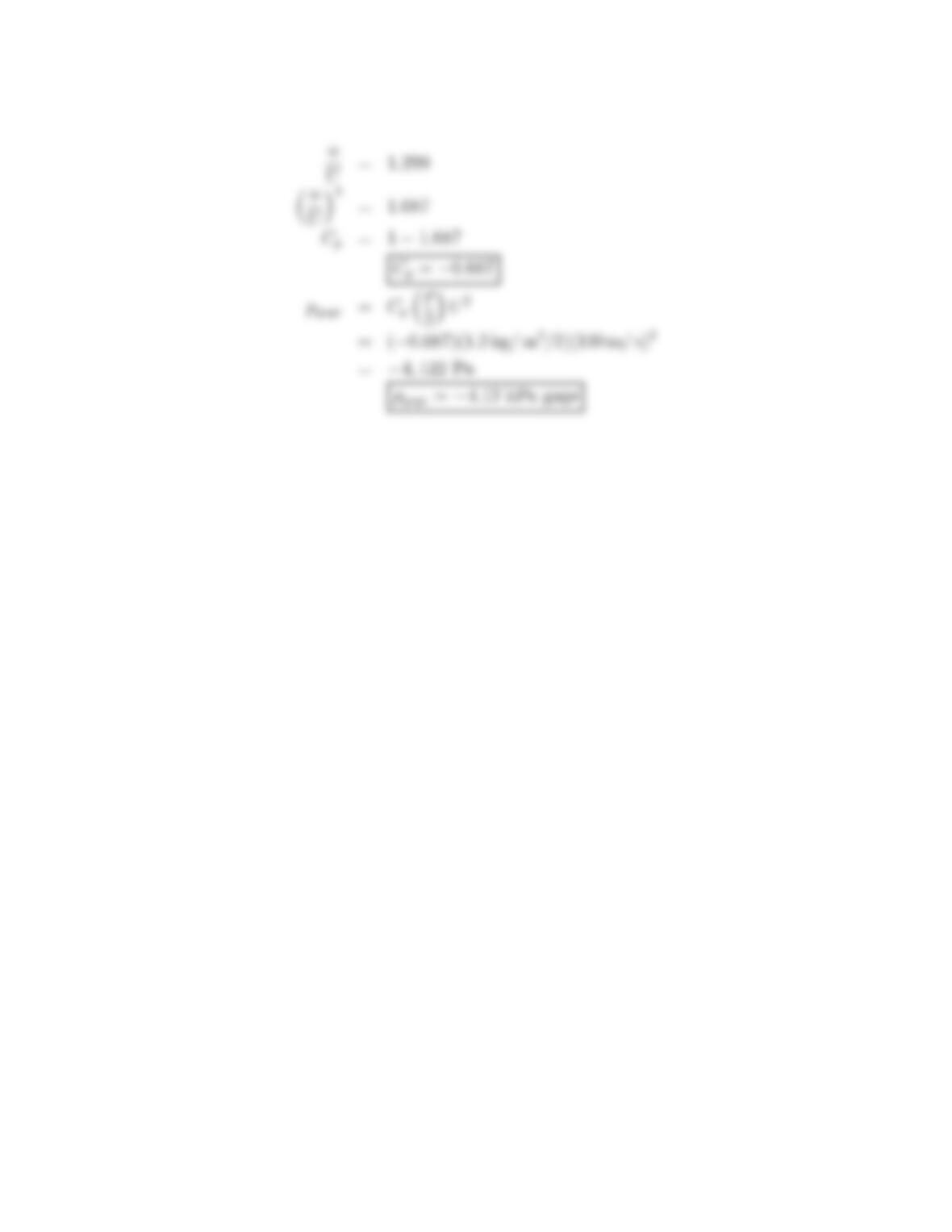
At the separation point
73
4.73: PROBLEM DEFINITION
Situation:
An airplane uses a Pitot-static tube to measure airspeed.
z2=3000m,Vind =70m/s.
Find:
True air-speed (m/s).
Properties:
TSL =17◦C,T=−6.3◦C.
pSL =101kPa,p=70kPa.
PLAN
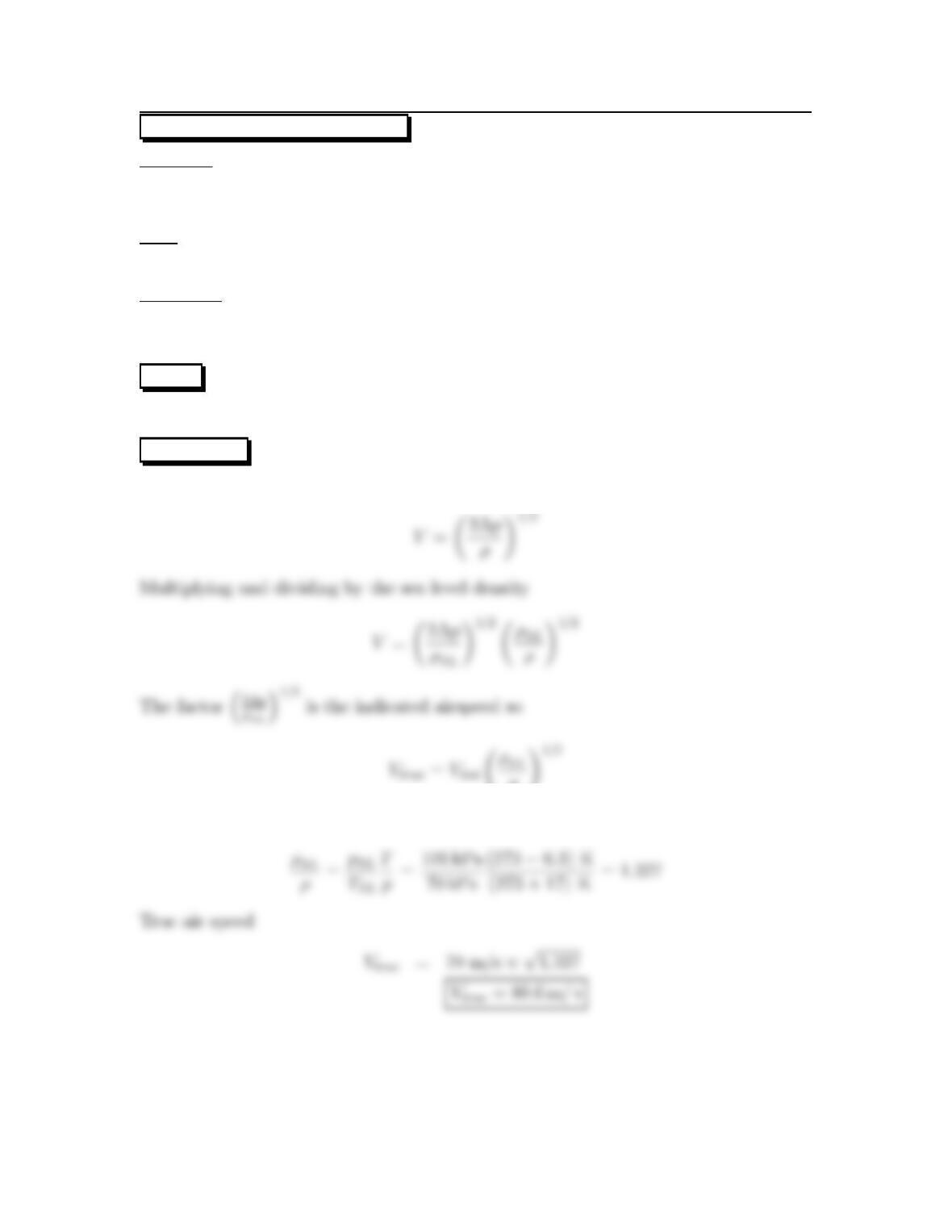
Apply the Pitot-tube equation and correct for density change.
SOLUTION
ThePitot–statictubeequationis
ρ¶1/2
From the ideal gas law
74
4.74: PROBLEM DEFINITION
Situation:
An airplane uses a Pitot-static tube to measure airspeed.
z= 10000 ft.
Find:
Speed of aircraft (mph).
Properties:
T2=25◦F,p=9.8psig,∆p=0.5psid.
SOLUTION
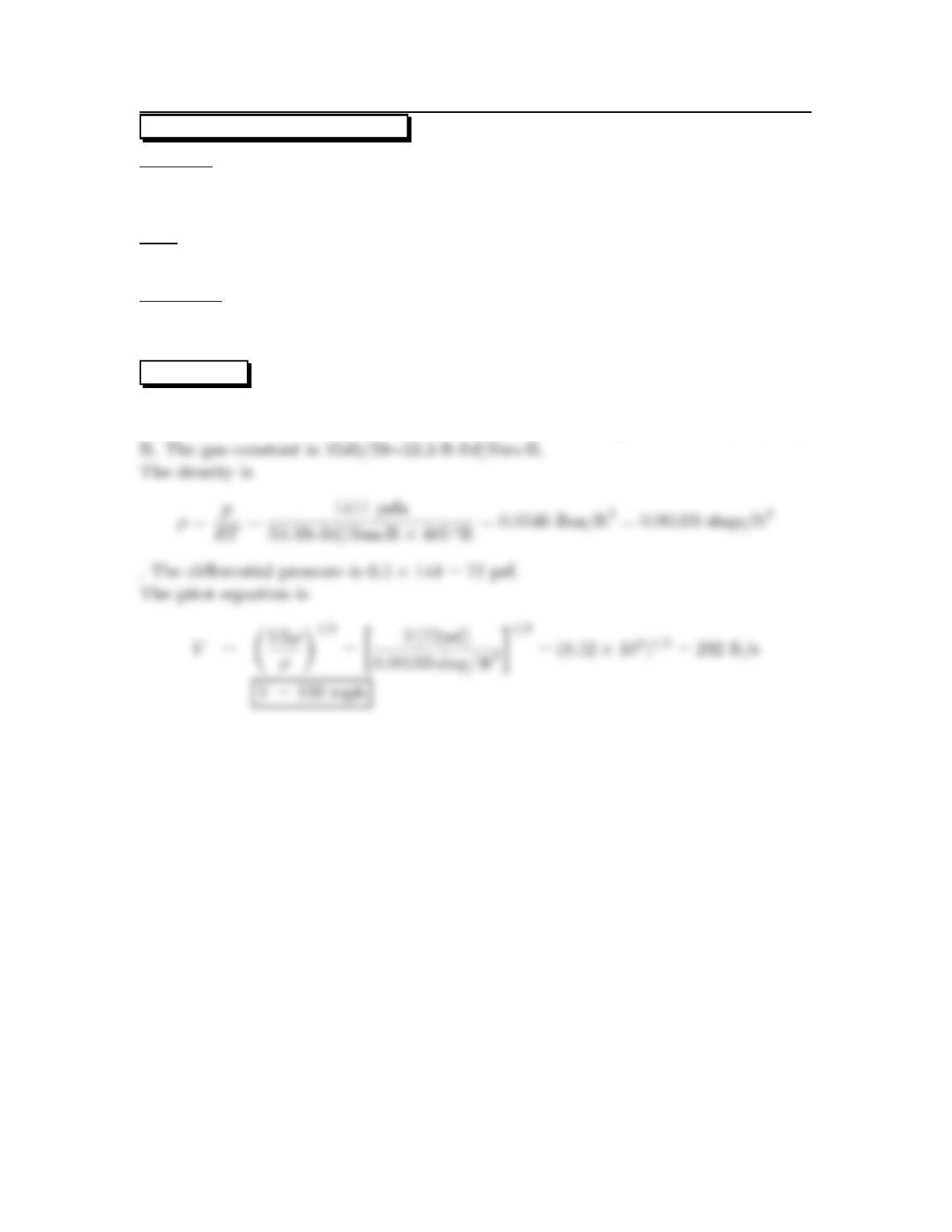
The temperature is 25 degrees F and the pressure is 9.8 psia. The pressure difference
is 0.5 psid. The pressure is 144×9.8 = 1411 psfa. The temperature is 460+25=485
75
4.75: PROBLEM DEFINITION
Situation:
Check equations for pitot tube velocity measurement provided by instrument com-
pany.
V=1096.7phv/d,d=1.325Pa/T .
Find:
Validity of Pitot tube equations provided.
PLAN
Apply the Bernoulli equation
SOLUTION
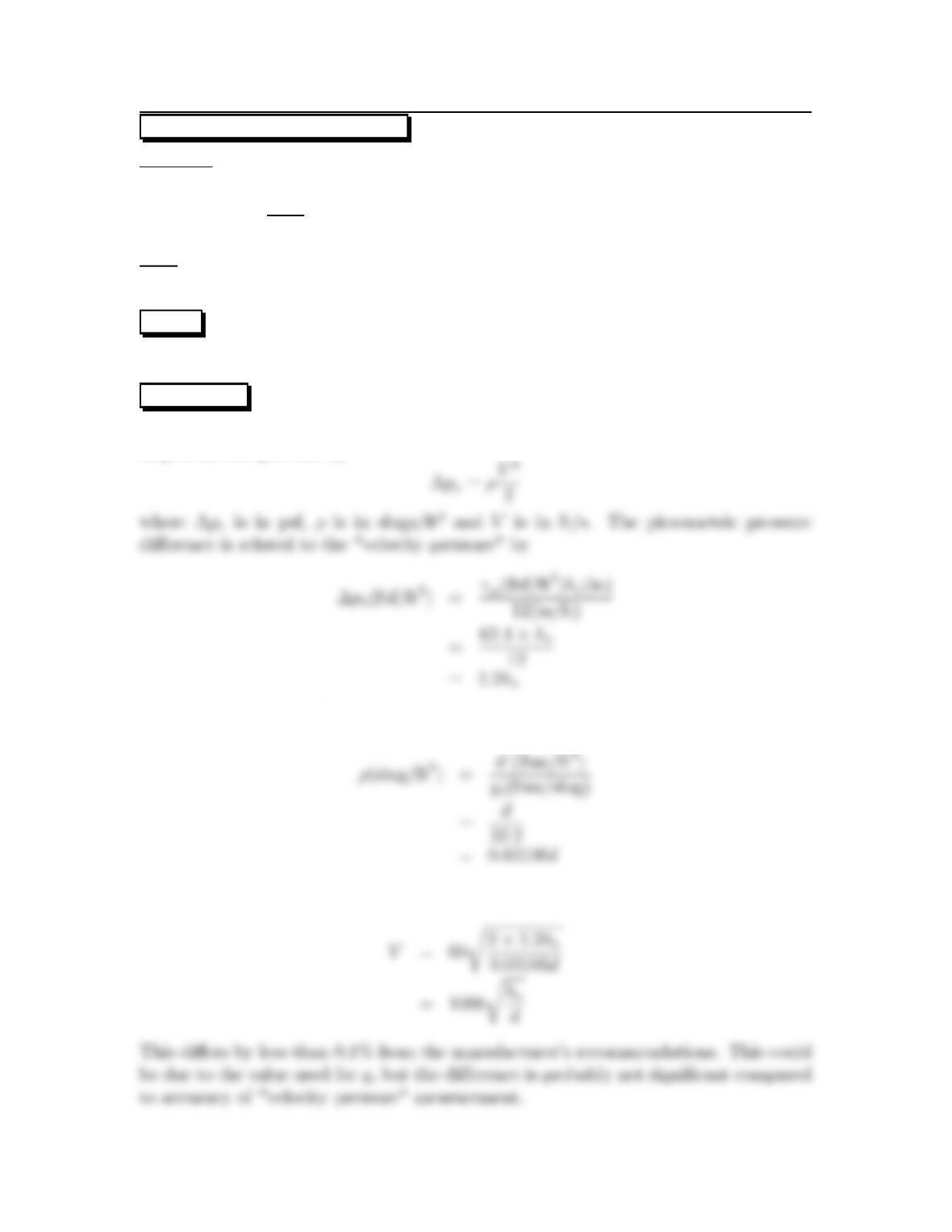
Applying the Bernoulli equation to the Pitot tube, the velocity is related to the change
in piezometric pressure by
The density in slugs/ft3is given by
The velocity in ft/min is obtained by multiplying the velocity in ft/s by 60. Thus
76
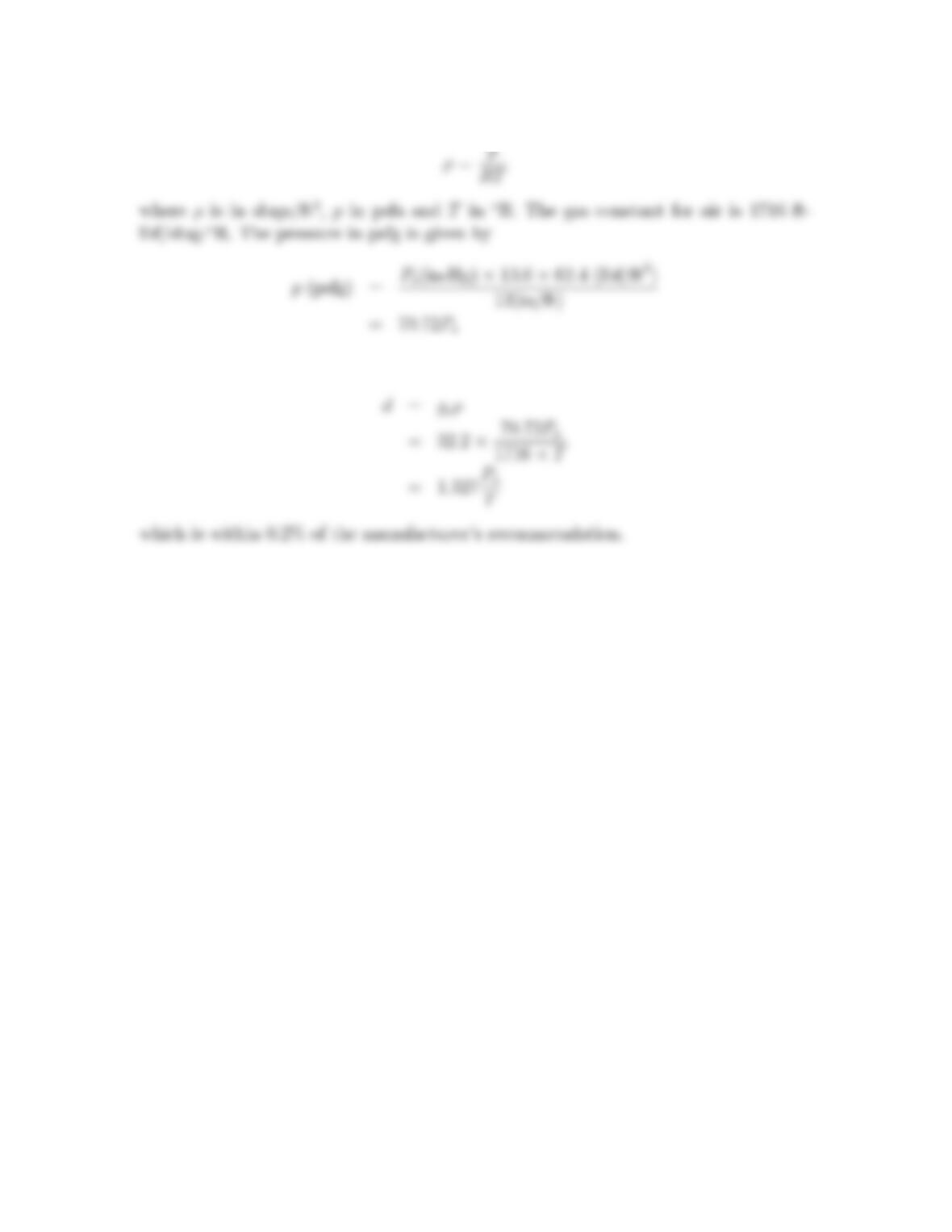
Fromtheidealgaslaw,thedensityisgivenby
where 13.6 is the specific gravity of mercury. The density in lbm/ft3is
77
4.76: PROBLEM DEFINITION
Situation:
The flowofwateroverdifferent surfaces.
Find:
Relationship of pressures.
(a) pC>p
B>p
A.
(b) pB>p
C>p
A.
(c) pC=pB=pA.
(d) pB<p
C<p
A.
(e) pA<p
B<p
C.
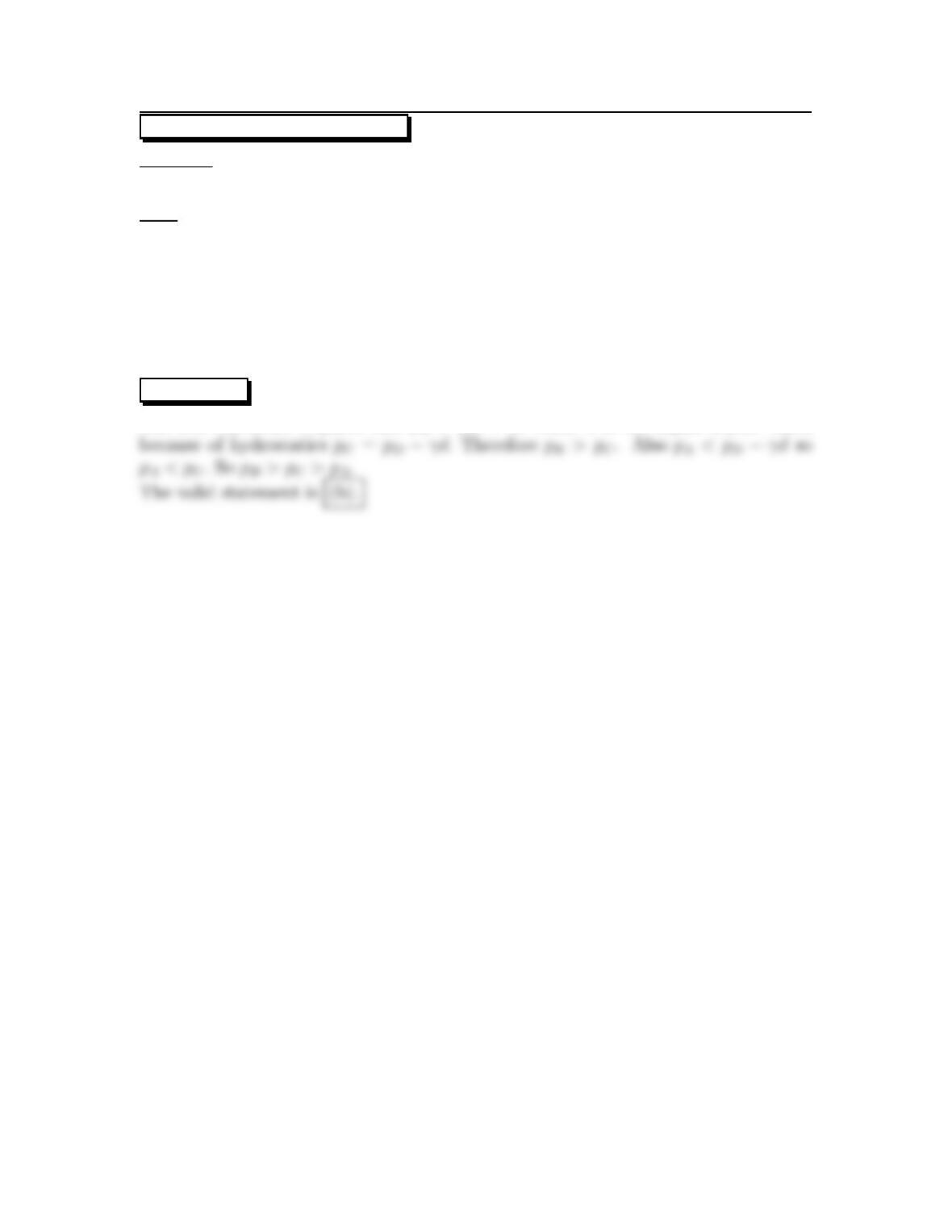
SOLUTION
The flow curvature requires that pB>p
D+γd where dis the liquid depth. Also,
78
4.77: PROBLEM DEFINITION
Situation:
Fluid element rotation.
Find:
What is meant by rotation of a fluid element?
SOLUTION
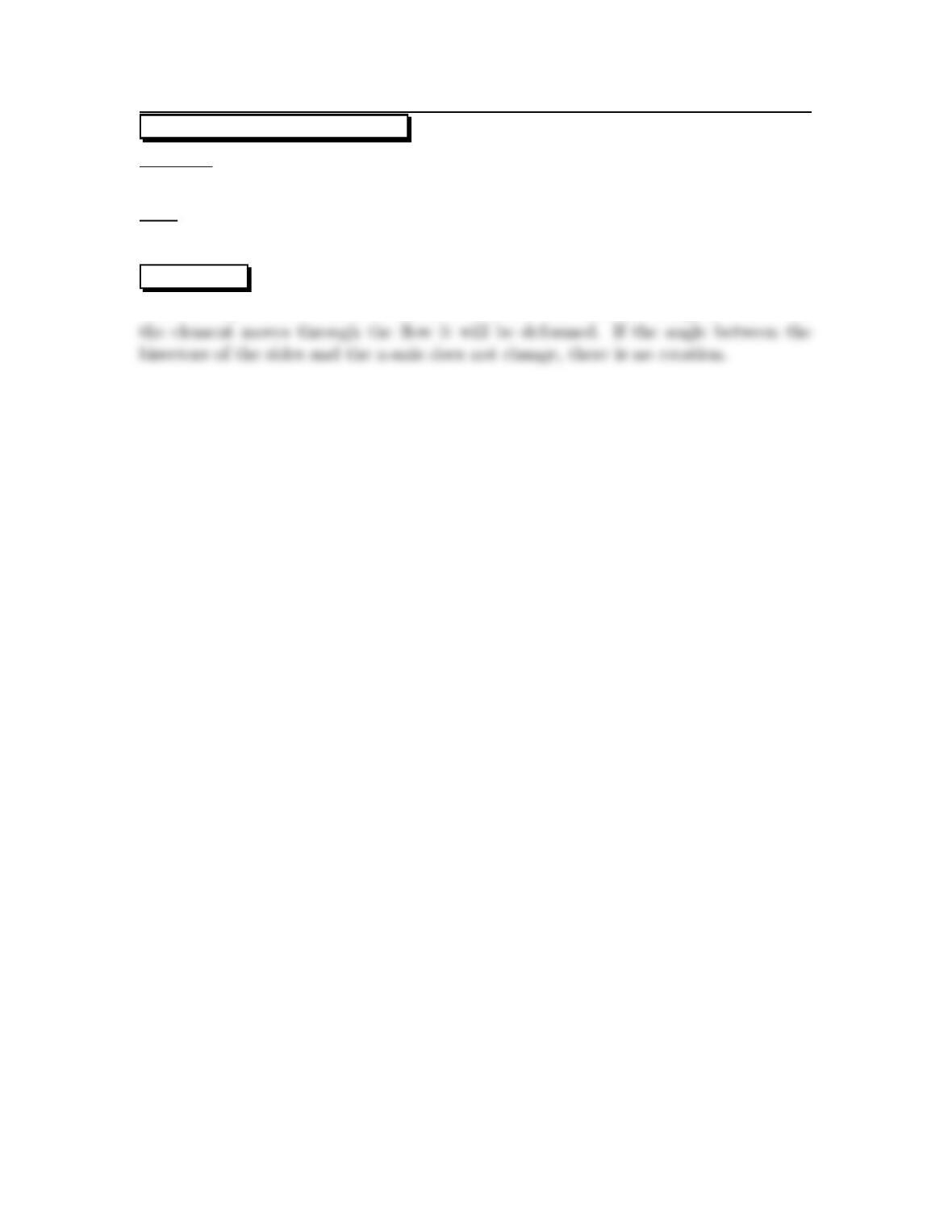
An arbitrary cubical element is selected in a flow. One side lies along the x-axis. As
79
4.78: PROBLEM DEFINITION
Situation:
Asphericalfluid element in an inviscid fluid.
Find:
If pressure and gravitational forces are the only forces acting on the element, can
they cause the element to rotate?
SOLUTION
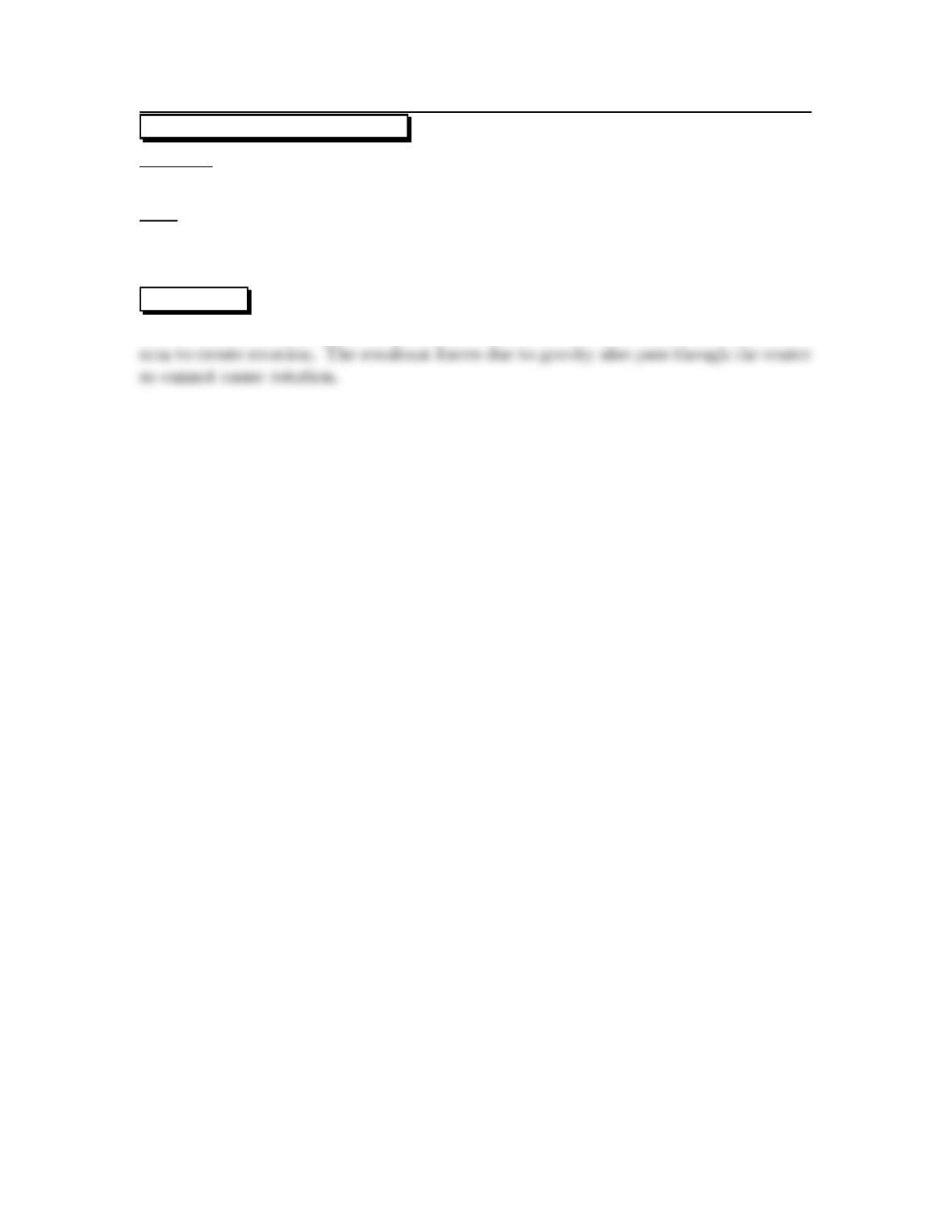
The result force due to pressure passes through the center of the sphere so no moment
80