
4-18 Intermediate Accounting, 8/e
CHANGE IN ACCOUNTING ESTIMATE
► A change in accounting estimate is reflected in the financial
EARNINGS PER SHARE
➢ Earnings per share (EPS) is the amount of income reported
expressed on a per share basis.
➢ In its simplest form, EPS is computed by dividing income
T4–13
4-20 Intermediate Accounting, 8/e
EARNINGS PER SHARE
(continued)
BIG LOTS, INC.
Consolidated Statements of Operations (in part)
Thirteen Weeks Ended
(In thousands, except per share amounts) May 3, 2014 May 4, 2013
Income from continuing operations $28,581 $37,065
Earnings per common share – basic:
Continuing operations $0.50 $0.65
Illustration 4-10
T4–13 (continued)
COMPREHENSIVE INCOME
► Comprehensive income is the total nonowner change in equity
for a period.
($ in millions)
Net income $xxx
Other comprehensive income:
Net unrealized holding gains (losses) from investments (net of tax)* $xx
Gains (losses) from and amendments to postretirement
* Changes in the market value of certain investments (described in Chapter 12).
† Gains and losses due to revising assumptions or market returns differing from
expectations and prior service cost from amending the plan (described in
Chapter 17).
Illustration 4-11
➢ The information in the income statement and other
comprehensive income items can be presented either (1) in a
T4–14
4-22 Intermediate Accounting, 8/e
INTERNATIONAL FINANCIAL REPORTING STANDARDS
Comprehensive Income. Both U.S. GAAP and IFRS allow companies to
report comprehensive income in either a single statement of comprehensive
income or in two separate statements.
Other comprehensive income items are similar under the two sets of
STATEMENT OF CASH FLOWS
► OPERATING ACTIVITIES
➢ Inflows and outflows of cash that result from activities
► INVESTING ACTIVITIES
➢ Inflows and outflows of cash related to the acquisition
and disposition of long-term assets (such as property,
► FINANCING ACTIVITIES
➢ Cash inflows and outflows from transactions with
creditors (excluding trade creditors) and owners.
T4–16
4-24 Intermediate Accounting, 8/e
CASH FLOWS FROM OPERATIONS ACTIVITIES
➢ Under the direct method, the cash effect of each operating
T 4-17
CASH FLOWS FROM OPERATIONS ACTIVITIES
(continued)
Arlington Lawn Care (ALC) began operations at the beginning of 2016. ALC’s 2016 income
statement and its year-end balance sheet are shown below ($ in thousands).
ARLINGTON LAWN CARE
Income Statement
For the Year Ended December 31, 2016
Service revenue $90
Operating expenses:
* Includes $6 in insurance expense.
ARLINGTON LAWN CARE
Balance Sheet
At December 31, 2016
Assets Liabilities and shareholders’ equity
Current assets: Current liabilities:
Illustration 4-14
T4–17 (continued)
4-26 Intermediate Accounting, 8/e
CASH FLOWS FROM OPERATIONS ACTIVITIES
(continued)
ARLINGTON LAWN CARE
Statement of Cash Flows
For the Year Ended December 31, 2016
($ in thousands)
Cash Flows from Operating Activities
* Service revenue of $90 thousand, less increase of $12 thousand in accounts
receivable.
Illustration 4-14A
ARLINGTON LAWN CARE
Statement of Cash Flows
For the Year Ended December 31, 2016
($ in thousands)
Cash Flows from Operating Activities
Net income $35
Adjustments for noncash effects:
Illustration 4-14B
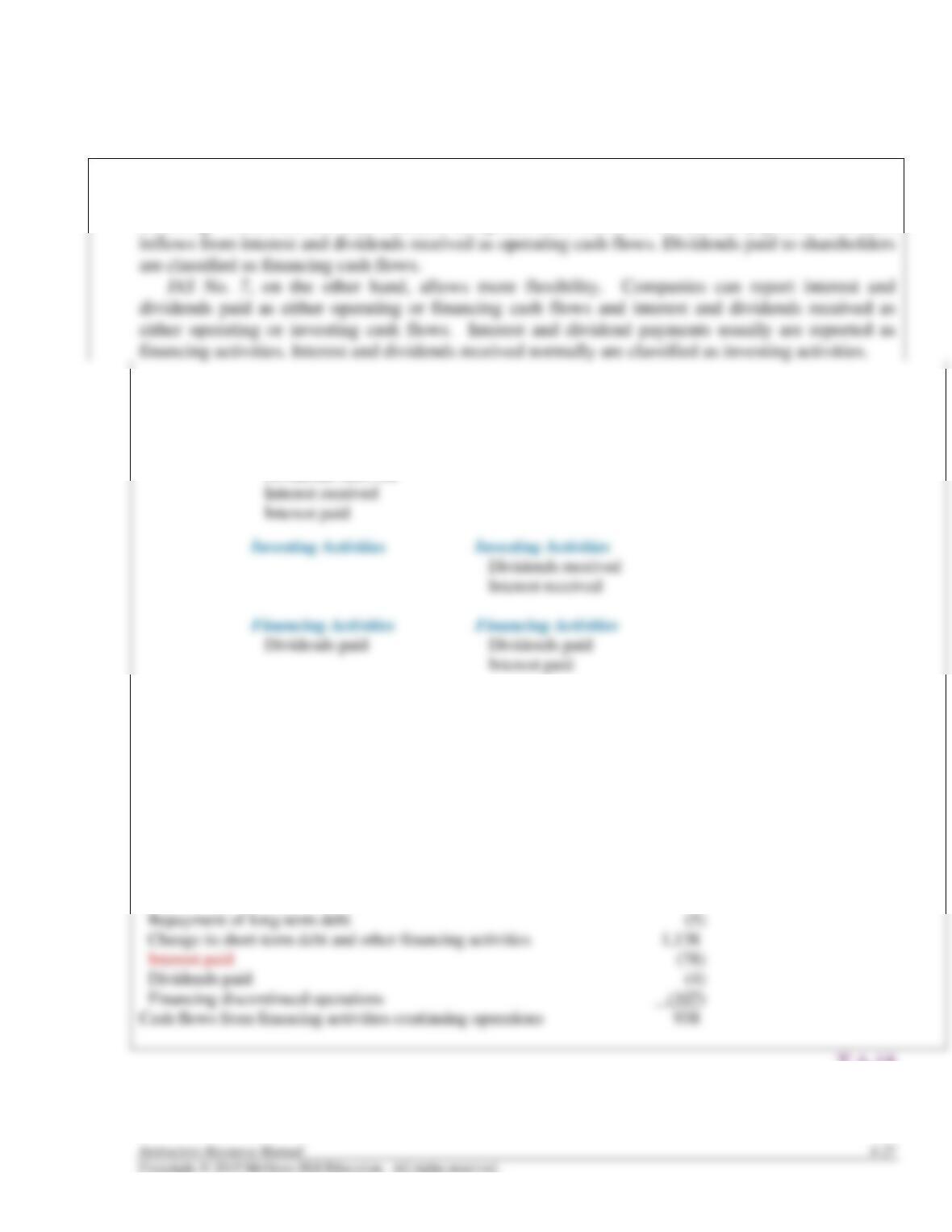
INTERNATIONAL FINANCIAL REPORTING STANDARDS
Classification of Cash Flows. Like U.S. GAAP, international standards also require a statement of
cash flows. Consistent with U.S. GAAP, cash flows are classified as operating, investing, or
financing. However, the U.S. standard designates cash outflows for interest payments and cash
Typical Classification of Cash Flows from Interest and Dividends
U.S. GAAP IFRS
Operating Activities Operating Activities
Dividends received
Siemens AG, a German company, prepares its financial statements according to IFRS. In its statement
of cash flows for the first three months of the 2014 fiscal year, the company reported interest and
dividends received as operating cash flows, as would a U.S. company. However, Siemens classified
interest paid as a financing cash flow.
Siemens AG
Statement of Cash Flows (partial)
For the First Three Months of Fiscal 2014
(€ in millions)
Cash flows from financing activities:
Transactions with owners (6)
T 4-18
4-28 Intermediate Accounting, 8/e
Suggestions for Class Activities
1. Research Activity
Layne Christensen Company, a leading construction and exploration company, reported
discontinued operations in its income statements for its 2014, 2013, and 2012 fiscal years.
Suggestions:
Have the class access the company’s financial statements for the fiscal year ended January 31,
Points to note:
Layne Christensen completed the sale of its Solmete X operation on July 31, 2013. A gain on sale
2. PetSmart Analysis
Have students, individually or in groups, go to the most recent PetSmart annual report using
EDGAR which can be located at: www.sec.gov. Ask them to:
1. Compare revenues, operating expenses, net income, and net income as a percentage of revenue
dollars with those in the 2014 annual report in Appendix B of the text. Are there any
The following are suggested assignments from the end–of-chapter material that will help your
students develop their communication, research, analysis and judgment skills.
Communication Skills. Integrating Case 4-12 can be adapted to ask students to answer the
Research Skills. In their careers, our graduates will be required to locate and extract relevant
information from available resource material to determine the correct accounting practice,
Analysis Skills. The “Broaden Your Perspective” section includes Analysis Cases that direct
Judgment Skills. The “Broaden Your Perspective” section includes Judgment Cases that require
4-30 Intermediate Accounting, 8/e
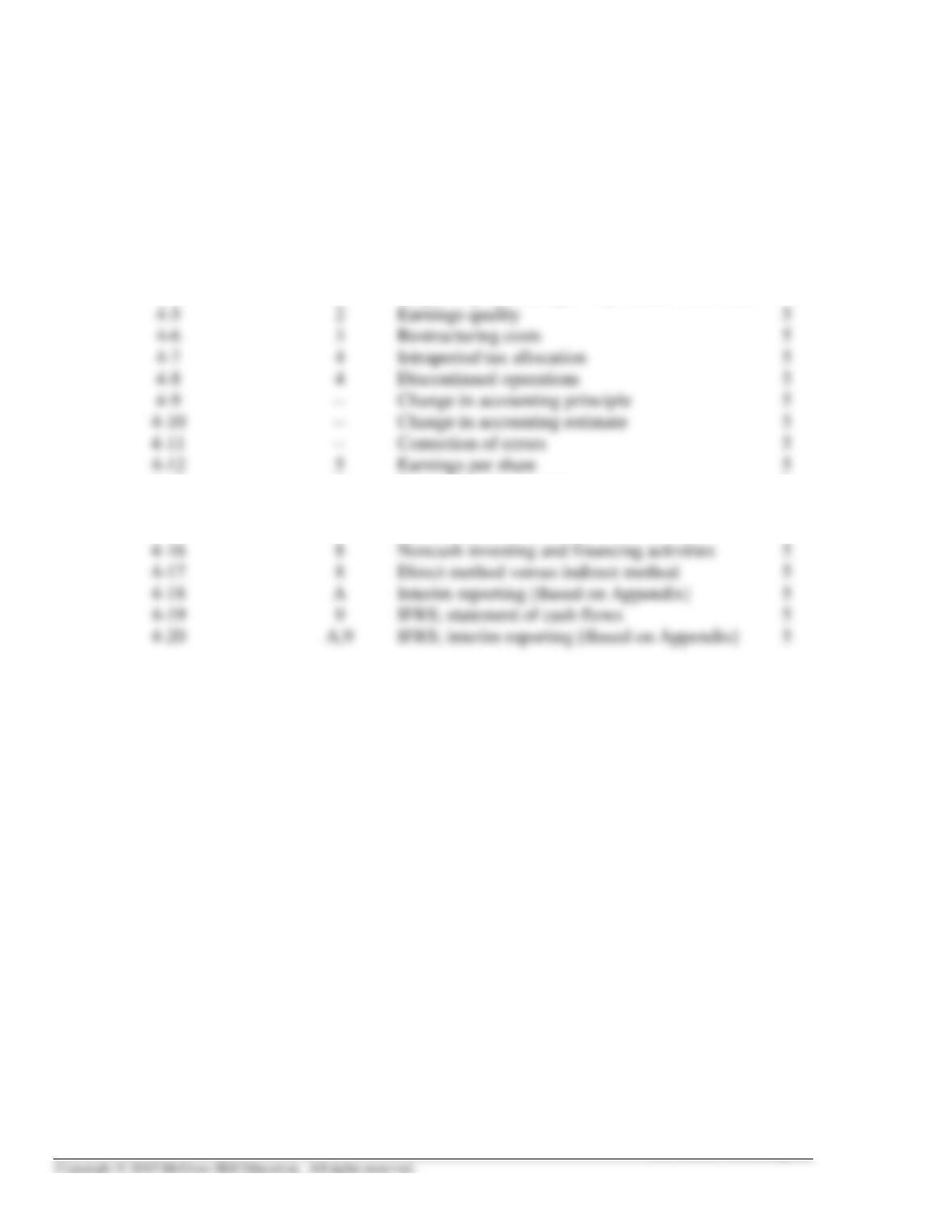
Assignment Chart
Learning Est. time
Questions Objective(s) Topic (min.)
4-1
1
Purpose of the income statement
5
4-2
1
Income from continuing operations
5
4-3
1
Operating and nonoperating income
5
4-4
1
Single-step and multiple-step income statements
5
4-5
2
Earnings quality
5
4-6
3
Restructuring costs
5
4-7
4
Intraperiod tax allocation
5
4-8
4
Discontinued operations
5
4-9
Change in accounting principle
5
4-10
Change in accounting estimate
5
4-11
Correction of errors
5
4-12
5
Earnings per share
5
4-13
6
Comprehensive income
5
4-14
7
Purpose of the statement of cash flows
5
4-15
8
Classification of cash flows
5
4-16
8
Noncash investing and financing activities
5
4-17
8
Direct method versus indirect method
5
4-18
Interim reporting [Based on Appendix]
5
4-19
9
IFRS; statement of cash flows
5
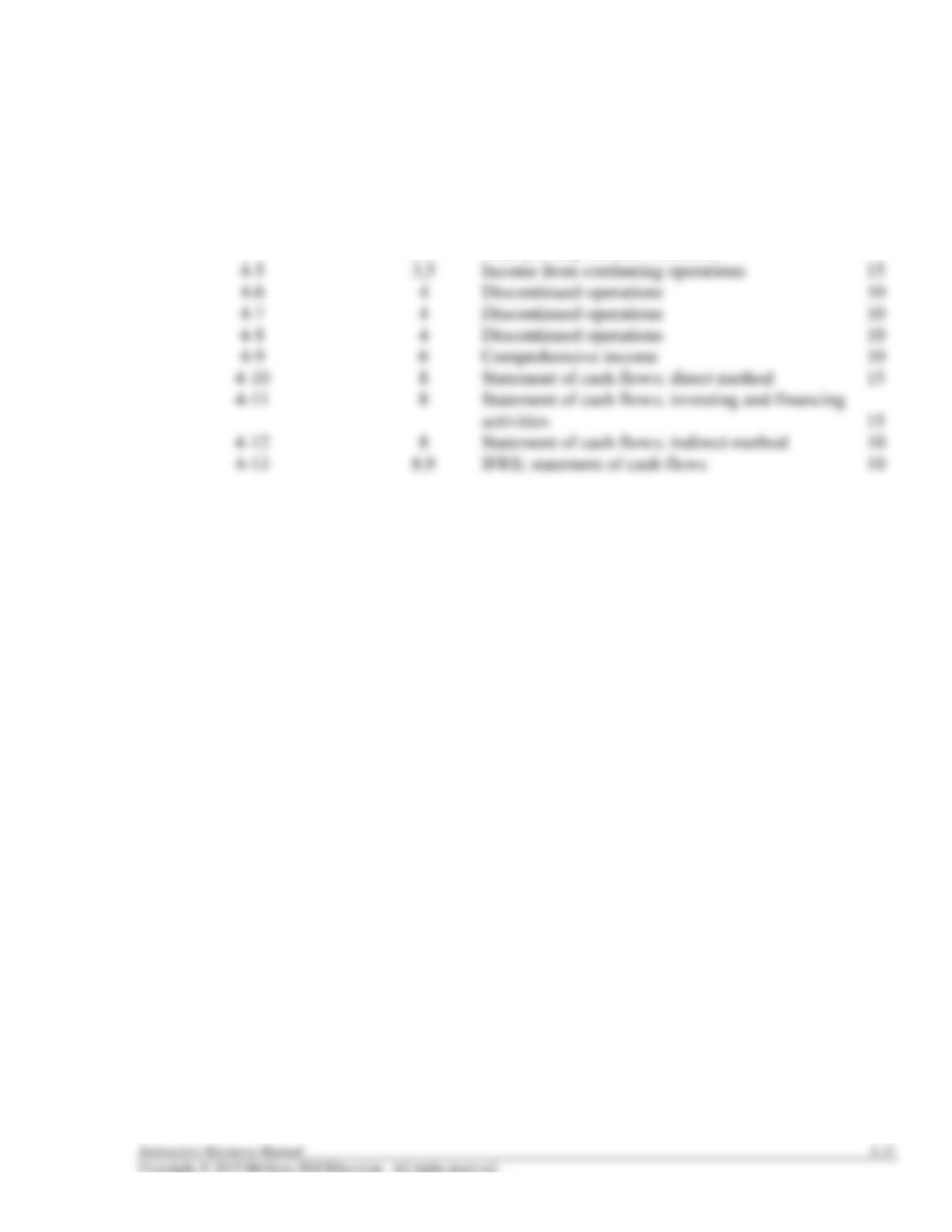
Brief Learning Est. time
Exercises Objective(s) Topic (min.)
4-1
1
Single-step income statement
10
4-2
1,3
Multiple-step income statement
10
4-3
1,3
Multiple-step income statement
15
4-4
1,3
Multiple-step income statement
15
3,5
Income from continuing operations
15
4
Discontinued operations
10
4
Discontinued operations
10
4-8
4
Discontinued operations
10
4-9
6
Comprehensive income
10
8
Statement of cash flows; direct method
15
8
Statement of cash flows; indirect method
10
8,9
IFRS; statement of cash flows
10
4-32 Intermediate Accounting, 8/e
Learning Est. time
Exercises Objective(s) Topic (min.)
4-1
1
Operating versus nonoperating income
10
4-2
1,5
Income statement format; single-step and
multiple-step
20
4-3
1,3,5
Income statement format; single-step and
multiple-step
20
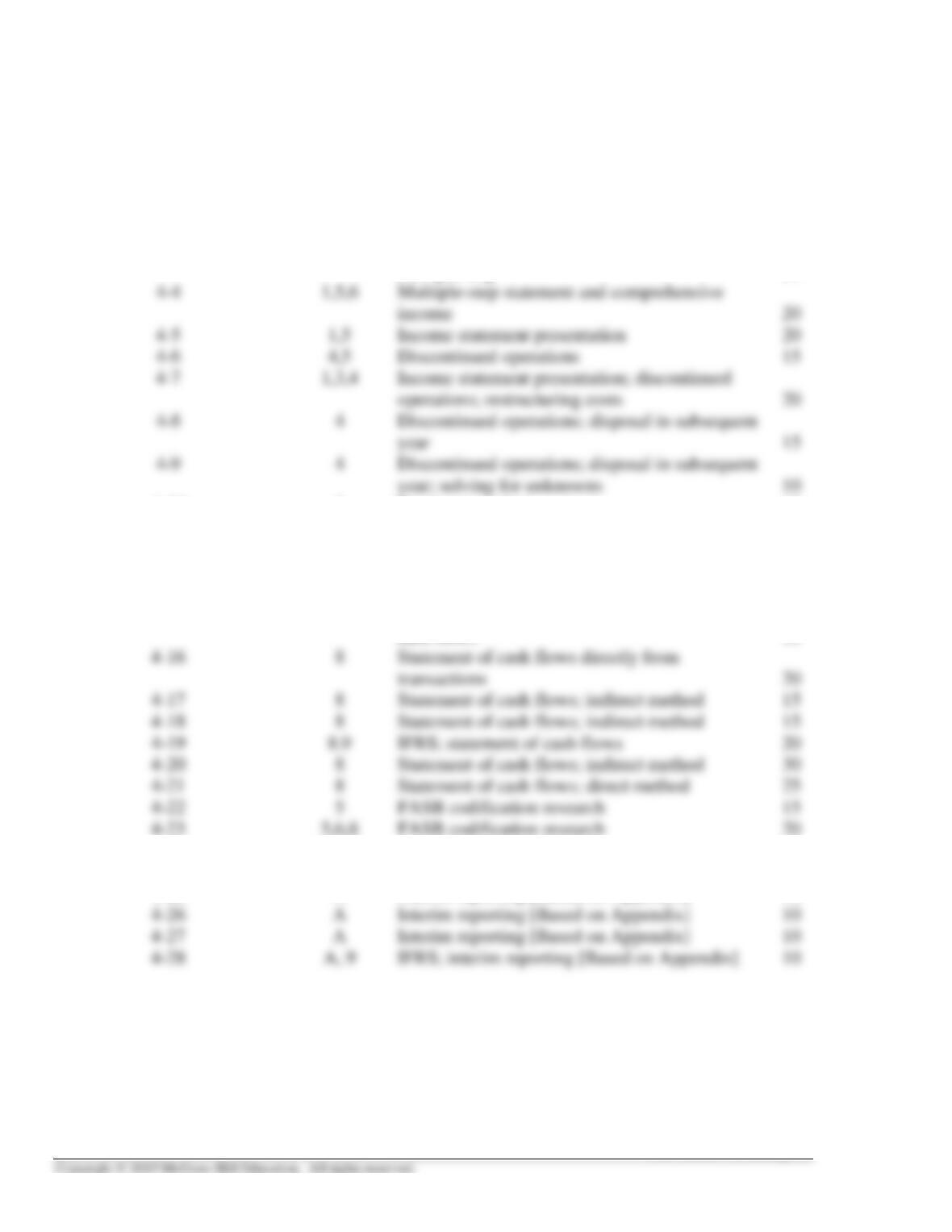
4-4
1,5,6
Multiple-step statement and comprehensive
income
20
4-5
1,5
Income statement presentation
20
4,5
Discontinued operations
15
1,3,4
Income statement presentation; discontinued
operations; restructuring costs
20
Discontinued operations; disposal in subsequent
4-9
Discontinued operations; disposal in subsequent
year; solving for unknowns
10
4-10
5
Earnings per share
10
4-11
6
Comprehensive income
20
4-12
8
Statement of cash flows; classifications
10
4-13
8
Statement of cash flows preparation
15
4-14
8,9
IFRS; statement of cash flows
5
4-15
8
Indirect method; reconciliation of net income to
cash flows
15
Statement of cash flows directly from
transactions
20
4-17
8
Statement of cash flows; indirect method
15
4-18
8
Statement of cash flows; indirect method
15
4-19
8.9
IFRS; statement of cash flows
20
4-20
8
Statement of cash flows; indirect method
30
4-21
8
Statement of cash flows; direct method
25
4-22
5
FASB codification research
15
4-23
FASB codification research
20
4-24
1 through 4,
5 through 8
Concepts; terminology
15
4-25
A
Interim reporting [Based on Appendix]
10
4-26
Interim reporting [Based on Appendix]
10
4-27
Interim reporting [Based on Appendix]
10
4-28
IFRS; interim reporting [Based on Appendix]
10
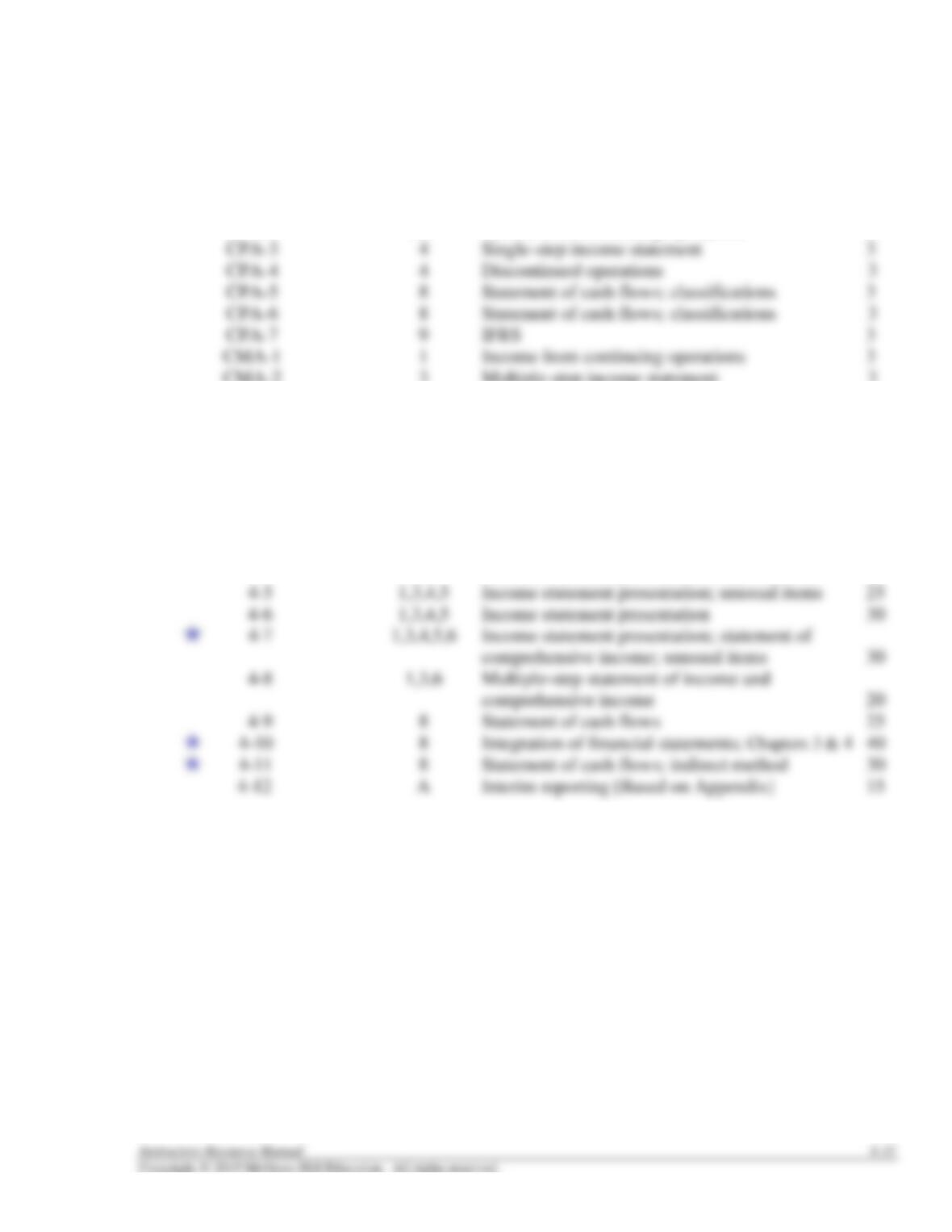
CPA/CMA Learning Est. time
Exam Questions Objective(s) Topic (min.)
CPA-1
4
Discontinued operations
3
CPA-2
3,4
Income from continuing operations
3
CPA-3
4
Single-step income statement
3
4
Discontinued operations
3
CPA-5
8
Statement of cash flows; classifications
3
CPA-6
8
Statement of cash flows; classifications
3
CPA-7
9
IFRS
3
1
Income from continuing operations
3
CMA-2
3
Multiple-step income statement
3
Learning Est. time
Problems Objective(s) Topic (min.)
4-1
1,3,4,5
Comparative income statements; multiple-step
format
25
4-2
4
Discontinued operations
25
4-3
4
Income statement presentation
20
4-4
3,4
Income statement presentation; unusual items
10
4-5
Income statement presentation; unusual items
25
4-6
Income statement presentation
30
4-8
Multiple-step statement of income and
comprehensive income
20
4-9
8
Statement of cash flows
25
Interim reporting [Based on Appendix]
15
Star Problems
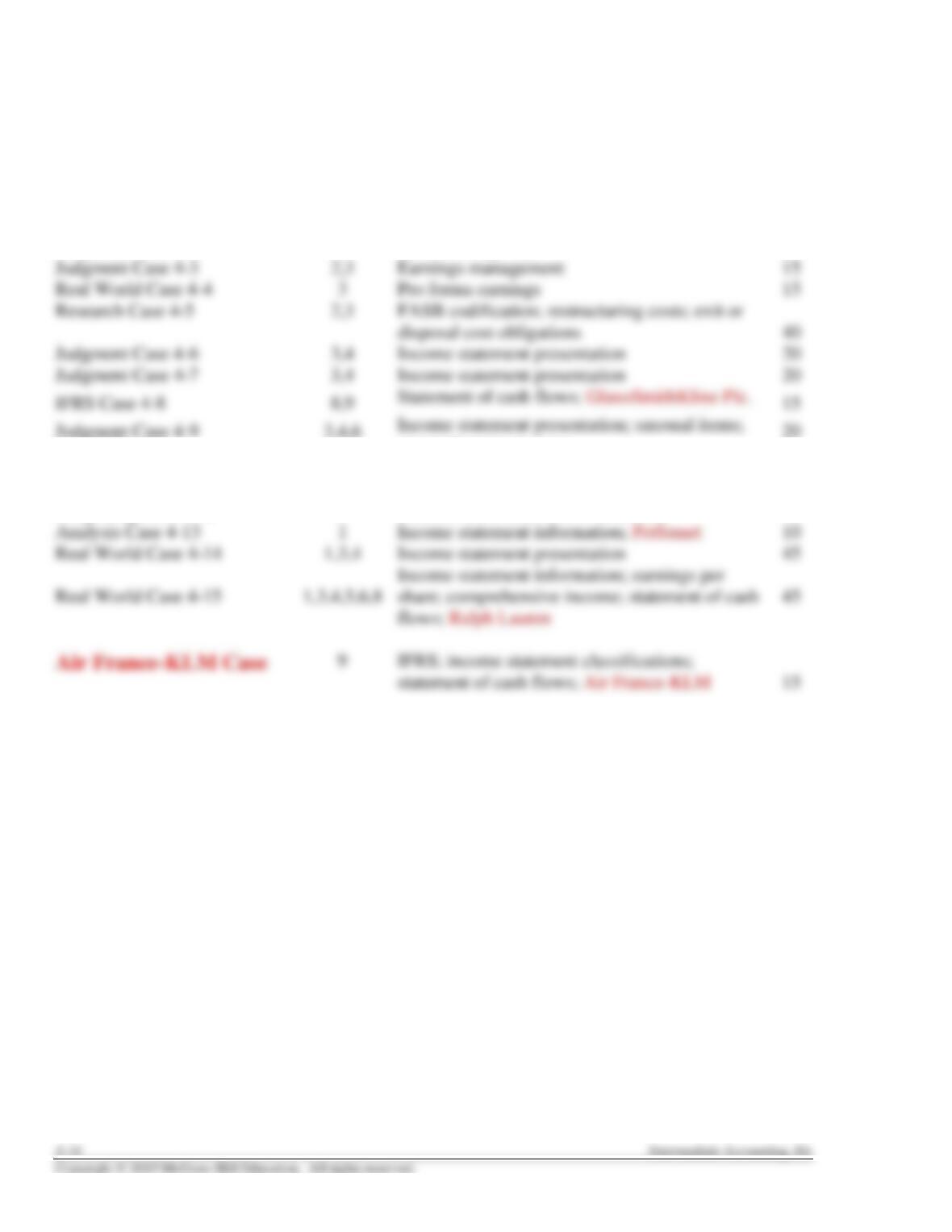
Learning Est. time
Cases Objective(s) Topic (min.)
Judgment Case 4-1
2,3
Earnings quality
15
Judgment Case 4-2
3
Restructuring costs
15
Judgment Case 4-3
2,3
Earnings management
15
Real World Case 4-4
3
Pro forma earnings
15
disposal cost obligations
40
Judgment Case 4-6
3,4
Income statement presentation
20
IFRS Case 4-8
8,9
15
comprehensive income
Judgment Case 4-10
2
Management incentives for change
15
Research Case 4-11
3
Pro forma earnings
60
Integrating Case 4-12
3
Balance sheet and income statement
35
Analysis Case 4-13
1
Income statement information; PetSmart
10
Real World Case 4-14
Income statement presentation
45
statement of cash flows; Air France-KLM
15