4-41
P4-8 (continued)
Stockholders’ Equity
Contributed Capital
Preferred stock, $100 par $12,000
Common stock, $5 par 25,000
P4-9 BRANDT COMPANY
Balance Sheet
December 31, 2010
Assets
Current Assets
Cash $ 3,800
Temporary investments in
available-for-sale securities 4,600
Accounts receivable $18,500
P4-9 (continued)
Intangible Assets
Patents (net) $ 5,900
Trademarks 3,700
Total intangible assets 9,600
Total Assets $166,200
Liabilities
Current Liabilities
Stockholders’ Equity
Contributed Capital
Preferred stock, $100 par $ 6,000
Common stock, $5 par 11,000
4-43
P4-10
Note to Instructor: The solution is shown in a balance sheet format. The answers are
lettered (a) through (p). The more difficult explanations are explained in footnotes
(1) through (6).
JOHN COMPANY
Balance Sheet
December 31
2010 2011
Current assets $ 35,200(d)2 $ 39,800
Long-term investments 40,100 42,300(o)
1Total liabilities = Current liabilities(x) + Long-term liabilities(2x)
$51,900 = x + 2x; $51,900 = 3x; x = $17,300, 2x = $34,600.
P4-11
1. (1) “Balance Report” should be “Balance Sheet.”
(2) Balance sheet is reported on a certain date. Therefore, “For year ended
December 31, 2010″ should be altered to “December 31, 2010.”
and Equipment.
(8) Patents are usually reported at book value.
(9) Cash surrender value of life insurance should be classified under Long-
Term Investments.
(10) Discount on bonds payable is a contra-liability account and should be
section.
(16) Accumulated depreciation: equipment should be listed as a contra
account to the Equipment account in Property, Plant, and Equipment.
(17) Current taxes payable should be listed as a current liability.
(18) “Stockholders’ equity” is a better term than “Owners’ equity” for a
corporation.
P4-11 (continued)
2. CUTLER CORPORATION
Balance Sheet
December 31, 2010
Assets
Current Assets
Cash $ 6,300
Marketable securities, short-term 10,000
Total long-term investments 18,300
Property, Plant, and Equipment
Land $11,300
Liabilities
Current Liabilities
Accounts payable $13,000
P4-11 (continued)
2. (continued)
Stockholders’ Equity
Contributed Capital
Preferred stock, $50 par $15,000
P4-12 (AICPA adapted solution)
Note to Instructor: This problem includes many topics that are covered in depth in
later chapters. Students should be able to develop most of the correct answers
from reading Chapter 4, and the content of this problem provides for a good
introduction to the more advanced topics.
ZUES MANUFACTURING CORPORATION
Balance Sheet
December 31, 2010
Assets
Current Assets
Cash $ 109,000a
Accounts receivable (net) 317,700b
Liabilities
Current Liabilities
Accounts payable $ 119,800e
Current installments of long-term debt 200,000f,g
P4-12 (continued)
Stockholders’ Equity
Contributed Capital
Common stock, authorized 100,000 shares
of $50 par value; issued 40,000 shares;
1Alternatively, this could be reported under Long-Term Investments
Explanations of Amounts
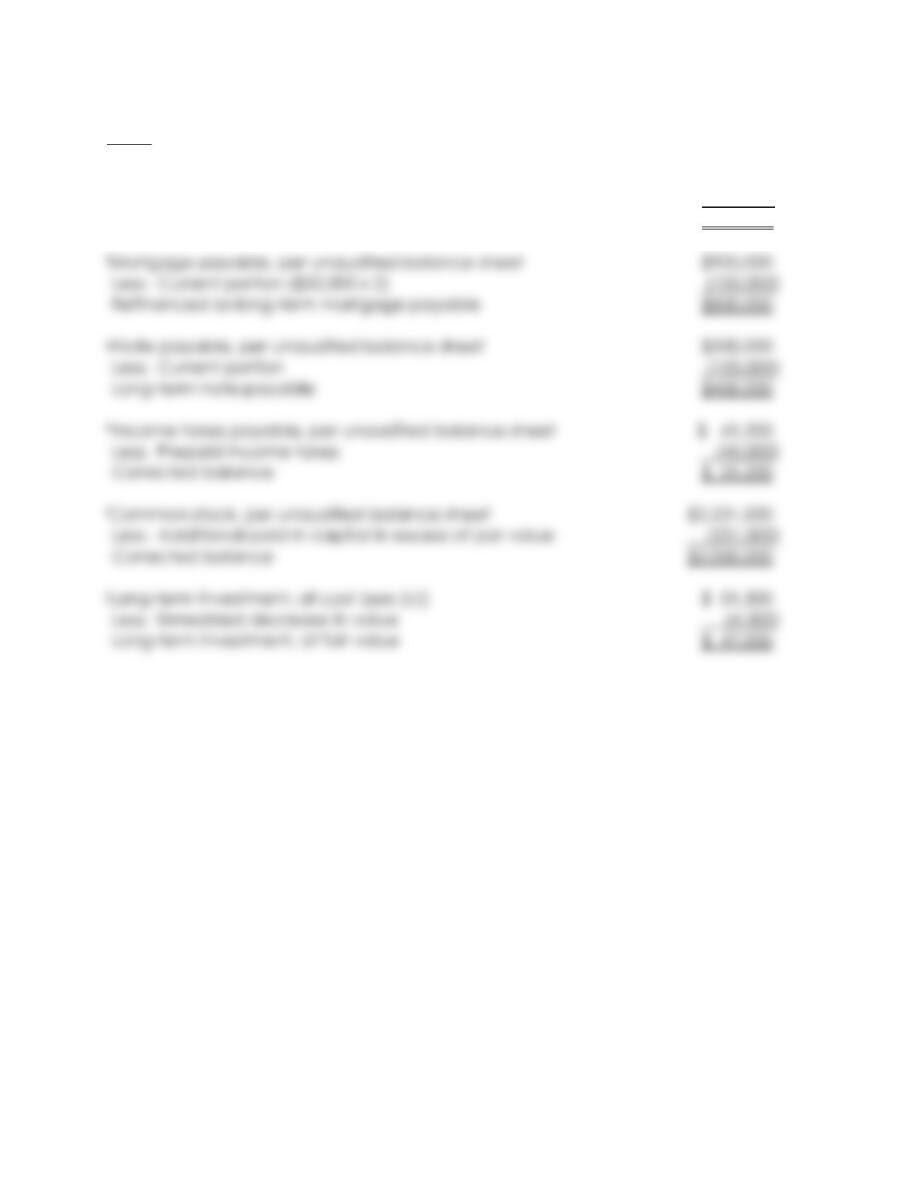
aCash, per unaudited balance sheet $225,000
Less: Unrecorded checks in payment of accounts payable (14,000)
4-49
P4-12 (continued)
eAccounts payable, per unaudited balance sheet $133,800
Less: Unrecorded payments [see (a)] (14,000)
Corrected balance $119,800
3-50
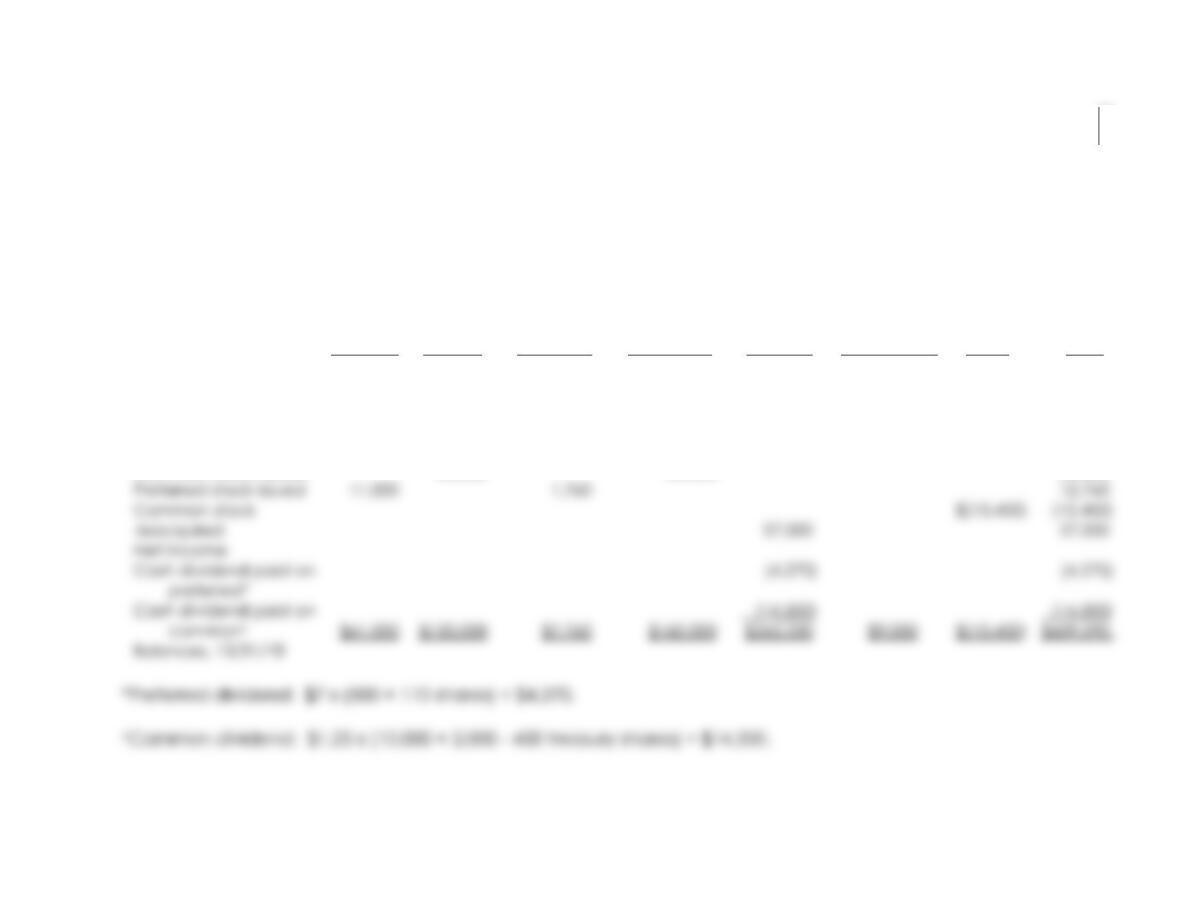
KNOX COMPANY
Statement of Changes in Stockholders’ Equity
For Year Ended December 31, 2010
Preferred
Stock
$100 par
Common
Stock
$10 par
Additional
Paid-in
Capital
on Preferred
Stock
Additional
Paid-in
Capital
on Common
Stock
Retained
Earnings
Accumulated
Other
Comprehen-
Sive Income
Treasury
Stock
Total
Balances, 1/1/10
Unrealized increase
in value of
available-for-sale
securities
Common stock issued
$50,000
$100,000
20,000
$6,000
$130,000
30,000
$224,000
$9,000
$510,000
9,000
50,000
4-50
P4-13
P4-14
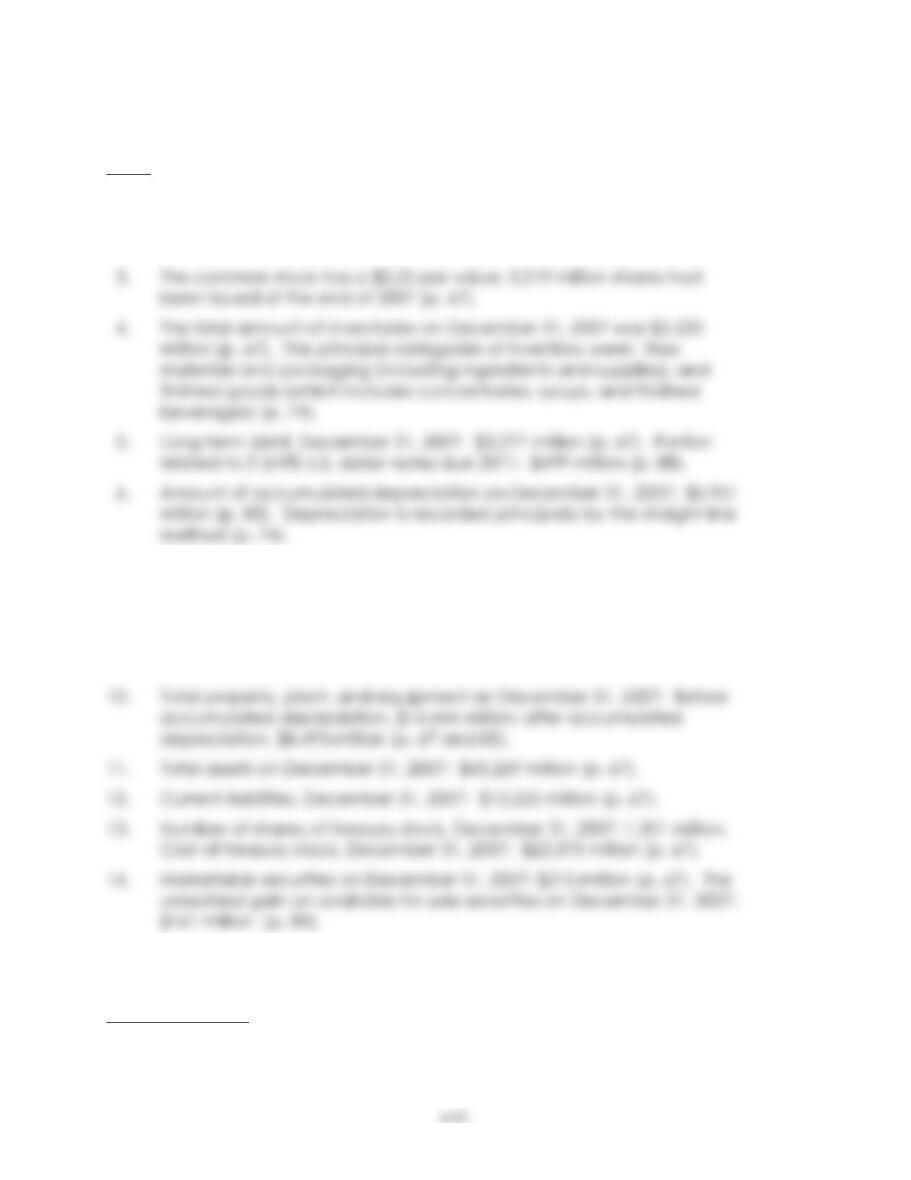
1. Current assets, December 31, 2007: $12,105 million (p. 67).
2. Allowance for doubtful accounts, December 31, 2007: $56 million
(p. 67).
7. Accounts payable and accrued expenses, December 31, 2007: $6,915
million (p. 67). Accrued marketing expenses were $1,749 million (p. 87).
8. Inventory costing method for inventories: Average cost or first-in, first-
out (p. 74).
9. Reinvested earnings, December 31, 2007: $36,235 million (p. 67).
15. The company was contingently liable for guarantees of indebtedness
of $267 million owed by third parties on December 31, 2007 (p. 95).
Note to Instructor: Some of the preceding answers may be located on other
pages within the financial statements and related notes.
3-52
ANSWERS TO CASES
C4-1
Historical cost is the valuation method primarily used on a company’s balance sheet to
report its assets. It has been criticized, however, because some users of financial
Fair value is the price that a company would receive to sell an asset in an orderly
transaction between market participants on the date of measurement. Thus, fair value is
based on market prices and is a measure of exit value. A fair value measurement is the
“selling price” for a particular asset held by a company. The measurement assumes that
the asset is sold in a “hypothetical transaction” on the measurement date. The transaction
is hypothetical because the company is not actually planning to sell the asset. In other
words, for that particular asset, the company is asking the question, “What price could the
company get for the asset if we sold it now in our usual market?”
C4-2
Loss contingencies are situations that exist on a company’s balance sheet date involving
uncertainty as to possible losses that the company may incur if some future event occurs.
Two types of disclosures are generally made relating to loss contingencies:
C4-2 (continued)
2. If either of the above conditions is not met, the company discloses the loss
contingency in the notes to its financial statements.
1. Those that provide additional evidence concerning conditions that existed on the
made to the financial statements.
2. Those that provide evidence concerning conditions that did not exist on the
company’s balance sheet date, but instead occurred after that date. For these,
C4-3 (CMA adapted solution)
1. The major classes of information that must be included in both the annual report to
shareholders and Form 10-K filed with the SEC are:
2. a. Incorporation by reference permits the corporation to cross-reference schedules from
other documents. Information from the proxy or corporate annual report may be
substituted by reference for various sections of the 10-K to avoid repetition of already
4-54
3-54
C4-3 (continued)
2. (continued)
c. The SEC’s principal reasons for making the changes in the annual reporting process
are to improve disclosure to investors and other users of financial information and to
C4-4
To: President
From: Accountant
I am writing in response to your question concerning the recording of property, plant, and
equipment at its appraised value. Although this method would increase our reported 2010
earnings, it is not appropriate.
Furthermore, because we are using a method which is not in compliance with GAAP, our
auditor would be required to disclose this in the auditor’s report. If the difference between
using historical cost and appraised value were material enough, it may prevent the
auditor from giving us an unqualified opinion. Such a result would greatly harm our
reputation to external users.
C4-5
Historical cost is used on a company’s balance sheet to report the “value” of its non-
financial assets (and liabilities). In general, each asset is recorded at the exchange price
of the transaction in which the asset is obtained. Usually this exchange price is then
Long-term investments can be reported in several ways. They may be listed at their fair
value, historical cost, or book value, depending on the type of investment. Property,
plant, and equipment, on the other hand, are measured and reported at their historical
cost adjusted for depreciation, with the exception of land which is listed at its historical
cost. Property, plant, and equipment that has been impaired is reported at its lower fair
value. In addition, a capital lease is initially recorded as an asset at the present value of
the future lease payments and is amortized in a manner similar to other legally owned
assets of the company. Intangible assets with a finite useful life are reported on the
balance sheet at their book values. Intangible assets that have been impaired are
reported at their lower fair value.
C4-6
1. A description of all significant accounting policies of a company must be included as an
integral part of its financial statements. Generally, the disclosures should encompass a
discussion of the principles relating to revenue recognition and asset allocation,
2. a. The company recognizes revenue when persuasive evidence of an arrangement
exists, delivery of products has occurred, the sales price charged is fixed or
determinable, and collectibility is reasonably assured (p. 71).
C4-7
Note to Instructor: This case does not have a definitive answer. From a financial reporting
perspective, GAAP is identified and summarized. From an ethical perspective, various
issues are raised for discussion purposes.
4-57
C4-7 (continued)
From an ethical perspective there are several primary stakeholders, including the creditors
and stockholders of Davenport Corporation, the creditors and stockholders of Travis
Corporation, Jim Davenport, and Ted Travis. If the loss and writedown are recognized, this
will decrease Davenport Corporation’s income and working capital which may have an
The questions that are important from financial reporting and ethical perspectives in this
situation are how reliable is the newspaper report, what is meant by financial difficulty,
and when did the financial difficulty of Travis occur. Additional information must be
gathered concerning each of these questions. For instance, there are times when
newspaper reports misstate the facts. What is the source of the newspaper report; can it
be corroborated? In regard to financial difficulty, how is this defined and how serious is it?
C4-8
Note to Instructor: This case does not have a definitive answer. From a financial reporting
perspective, GAAP is identified and summarized. From an ethical perspective, various
issues are raised for discussion purposes.
From a financial reporting perspective, the note receivable from the president is the result

C4-8 (continued)
From an ethical perspective, where this note is classified and how it is reported may have
an impact on the rights of, and fairness to, the various stakeholders. These stakeholders
include the creditors, stockholders, and president of Spaedy Company. If the note is
ANSWER TO RESEARCH SIMULATION
R4-1
Note to Instructor: Students are expected to cite references to GAAP in their research of
this issue. They might use the FARS electronic database, pronouncements listed on the
FASB web site, the FASB Original Pronouncements, the FASB Current Text, or other primary
sources of GAAP to obtain these references. They may also use the FASB Accounting
Standards Codification which is cited in parentheses.
To: Head Accountant
From: Assistant Accountant
I have researched the issue of how to report the $100,000 note payable (that is due on
4-59
R4-1 (continued)
(FASB Cod. #470-10-50-4) indicates that the company must include a general description
of the equity securities issued in the refinancing.
The Tyler Corporation intends to refinance the $100,000 note payable on a long-