4.21: PROBLEM DEFINITION
Situation:
In a flowing fluid, acceleration means that a fluid particle is
a. changing direction
b. changing speed
c. changing both speed and direction
d. any of the above
SOLUTION
21
4.22: PROBLEM DEFINITION
Situation:
Flow through a nozzle is steady.
Vincreases between the entrance and the exit of the nozzle.
The acceleration halfway between the entrance and the nozzle is:
a. convective
b. local
c. both
SOLUTION
22
4.23: PROBLEM DEFINITION
Situation:
Local acceleration
a. is close to the origin
b. is quasi-nonuniform
c. occurs in unsteady flow
SOLUTION
23
4.24: PROBLEM DEFINITION
Situation:
Flow past a circular cylinder with constant approach velocity.
Find:
Describe the flow as:
(a) Steady or unsteady.
(b) One dimensional, two dimensional, or three dimensional.
(c) Locally accelerating or not, and is so, where.
(d) Convectively accelerating or not, and if so, where.
SOLUTION
(a) Steady.
24
4.25: PROBLEM DEFINITION
Situation:
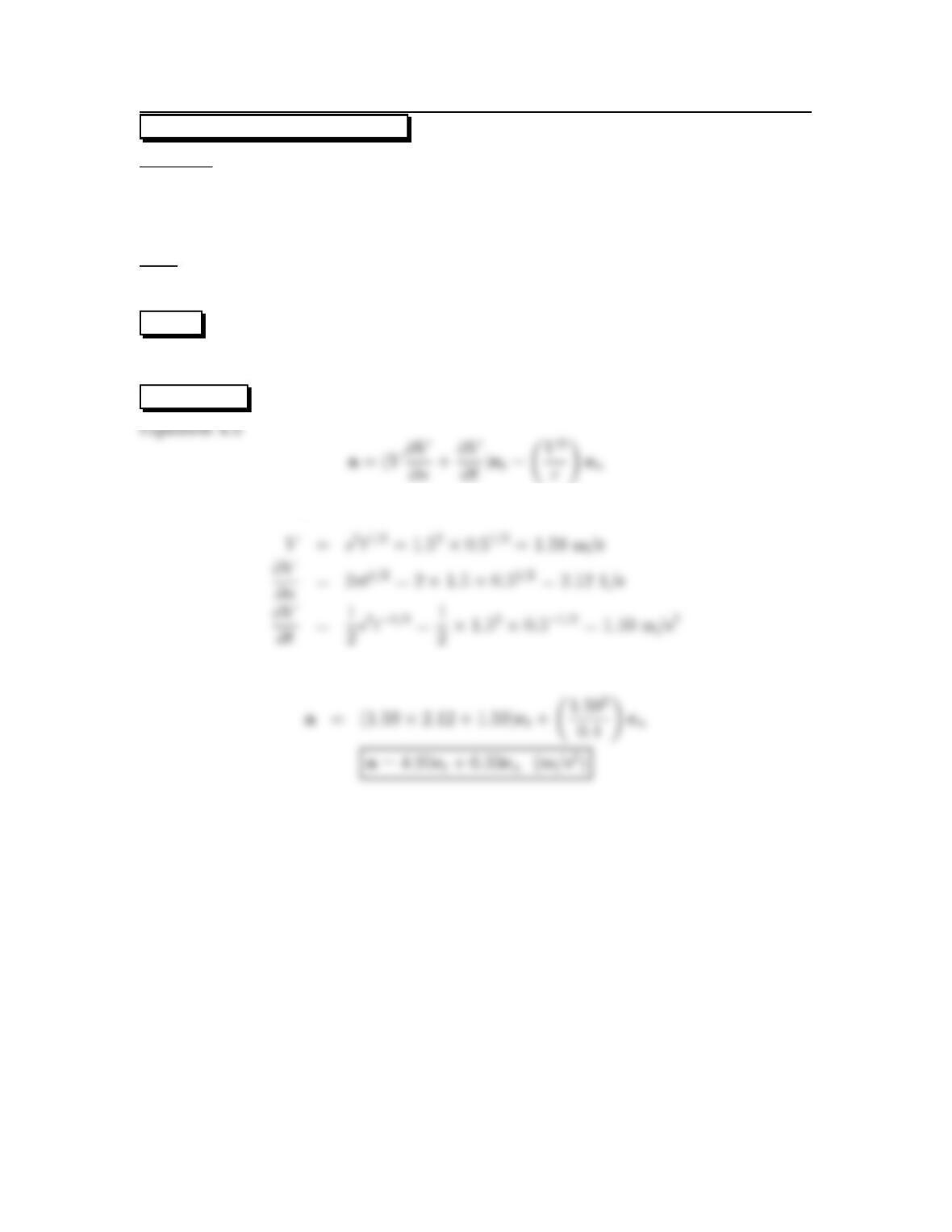
A path line is given with velocity as a function of distance and time.
V=s2t1/2,r=0.4m.
s=1.5m,t=0.5.
Find:
Acceleration along and normal to pathline (m/s2).
PLAN
Apply Eq. 4.5 for acceleration along pathline.
SOLUTION
Evaluation of velocity and derivatives at s=2mandt=0.5sec.
Evaluation of the acceleration
25
4.26: PROBLEM DEFINITION
Situation:
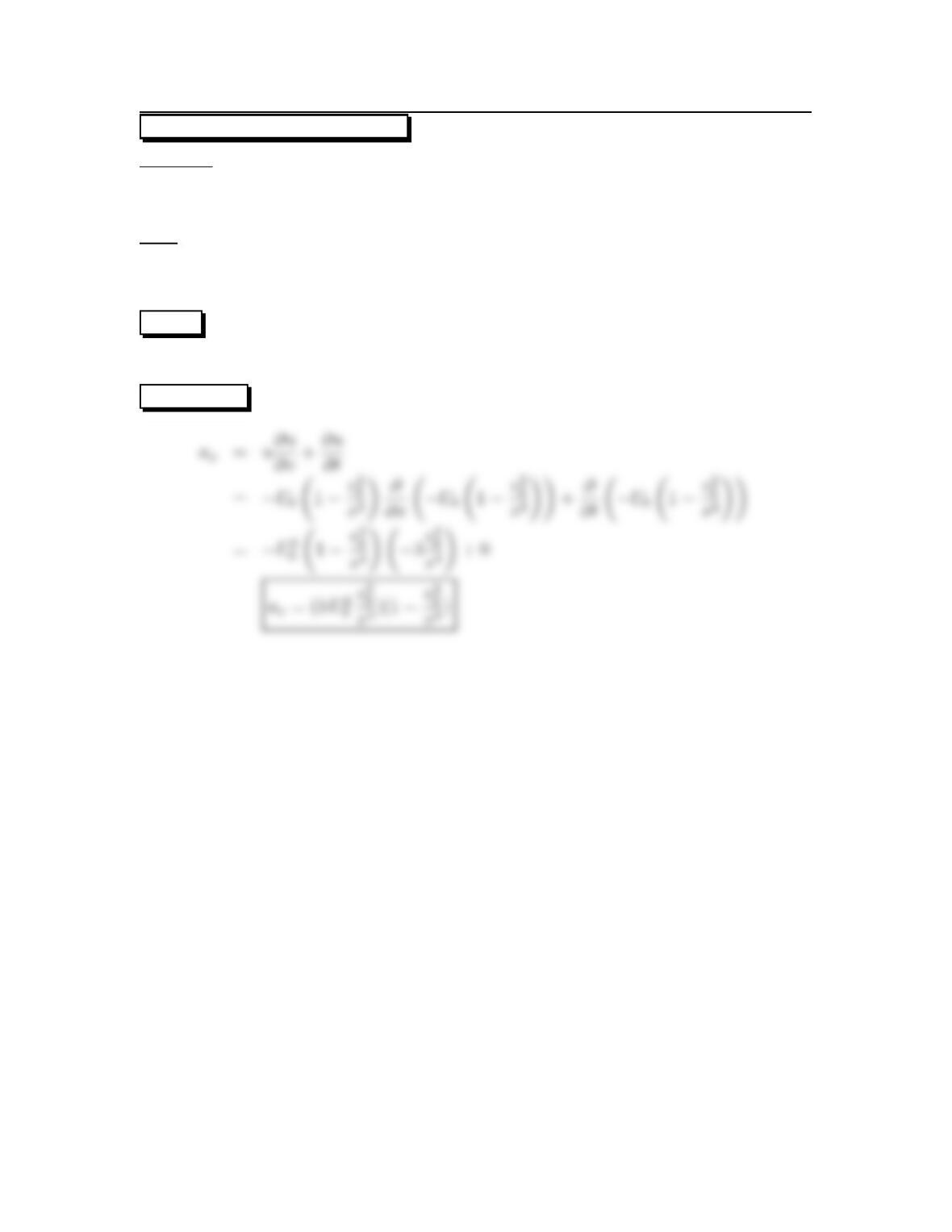
Air is flowing around a sphere in a wind tunnel.
u=−Uo(1 −r3
o/x3).
Find:
An expression for the acceleration of a fluid particle on the x-axis. The form of the
answer should be ax=ax(x, ro,U
o).
PLAN
Use Eq. 4.5 along x-axis which is a pathline. Replace Vwith uand swith x.
SOLUTION
26
4.27: PROBLEM DEFINITION
Situation:
Flow occurs in a tapered passage.
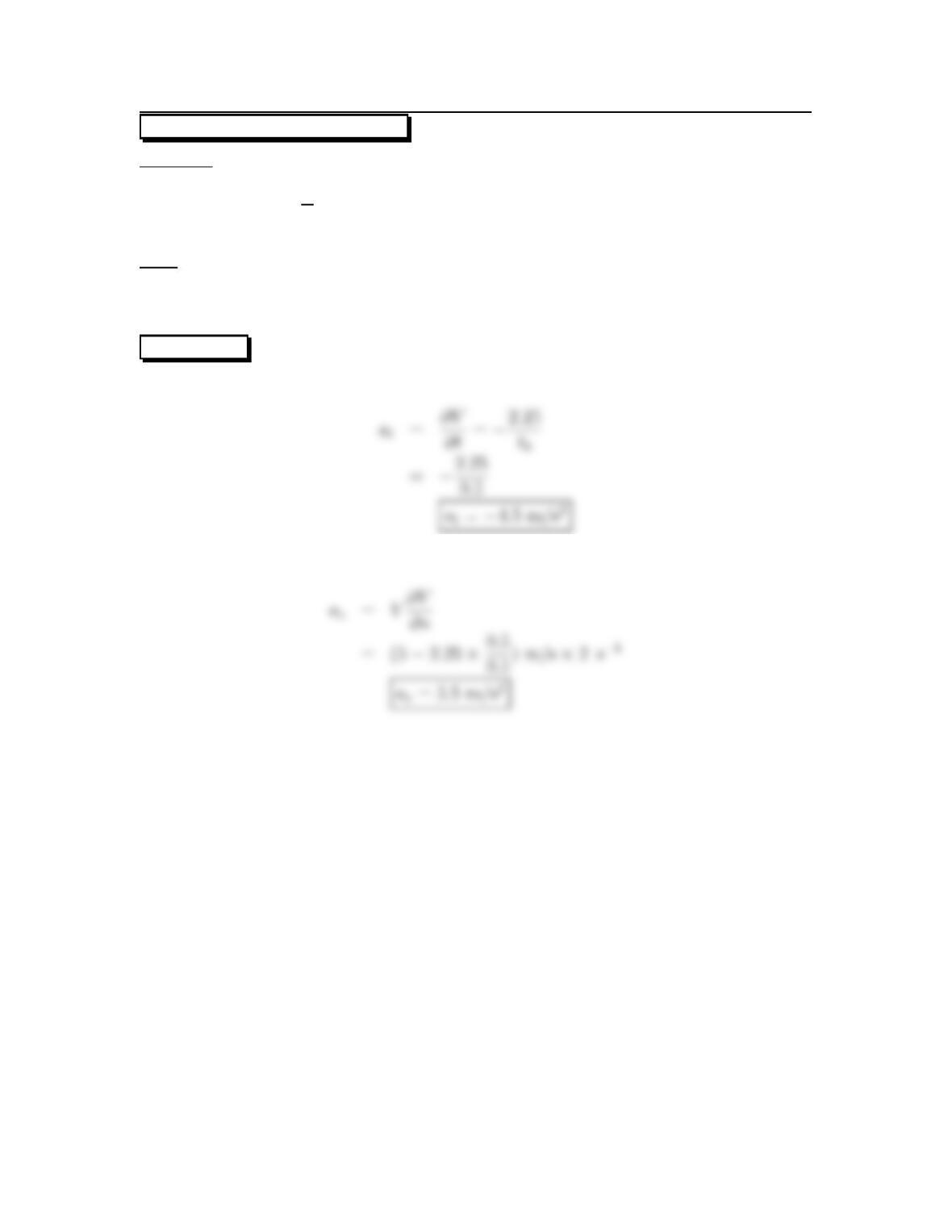
V=5m/s−2.25 t
tom/s,
∂V/∂s =+2s
−1at t0=0.5s.
Find:
(a) local acceleration at section AA (m/s2).
(b) Convective acceleration at section AA (m/s2).
SOLUTION
a) Local acceleration
b) Convective acceleration
27
4.28: PROBLEM DEFINITION
Situation:
One-dimensional flow occurs in a nozzle.
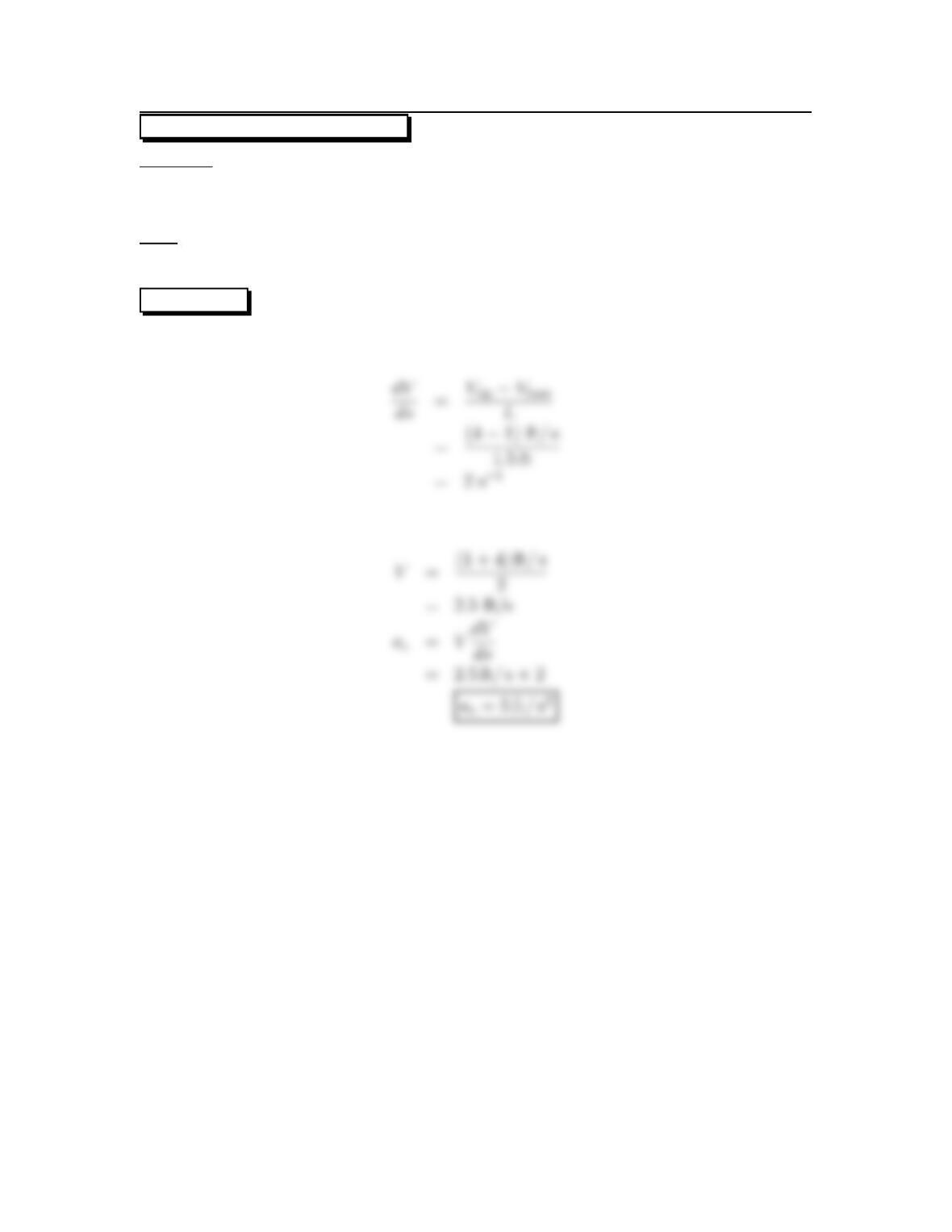
Vtip =4ft/s,Vbase =1ft/s,L=1.5ft.
Find:
Convective acceleration (ft/s2).
SOLUTION
Velocity gradient.
Acceleration at mid-point
28
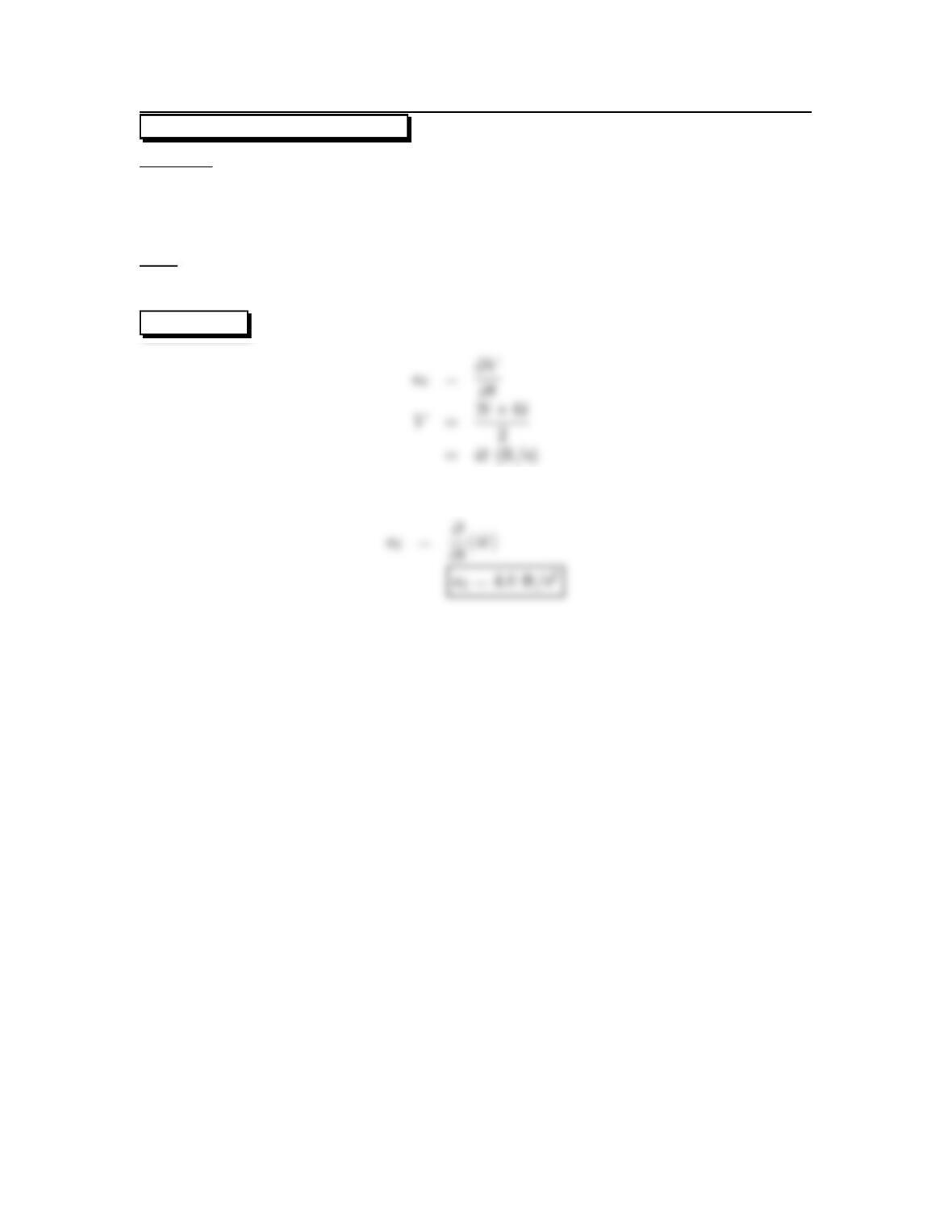
4.29: PROBLEM DEFINITION
Situation:
One-dimensional flow occurs in a nozzle and the velocity varies linearly with dis-
tance along the nozzle.
Vtip =6tft/s,Vbase =2tft/s,t=2s.
Find:
Local acceleration midway in the nozzle (ft/s2).
SOLUTION
Then
29
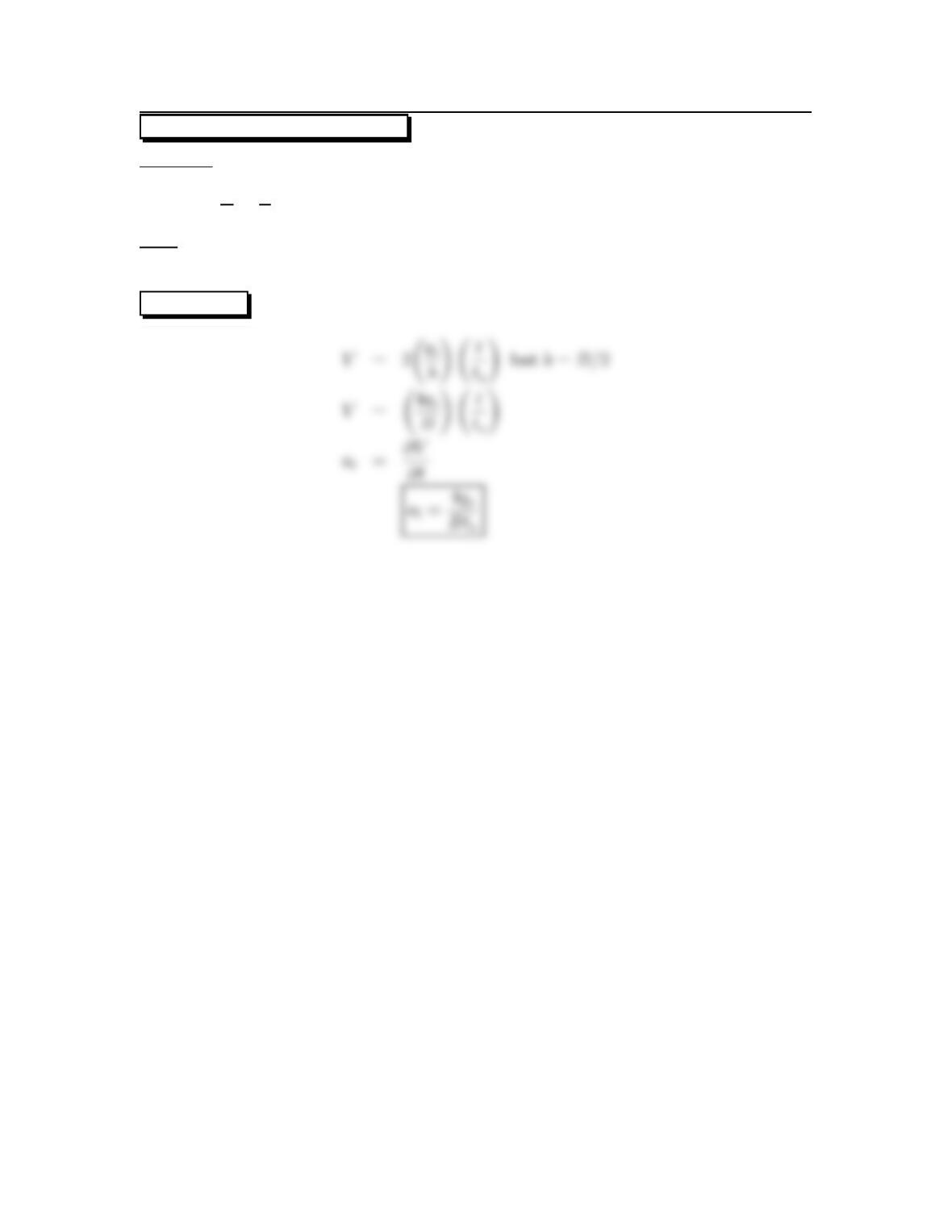
4.30: PROBLEM DEFINITION
Situation:
Flow in a two-dimensional slot.
V=2¡qo
b¢³t
to´,x=2B,y=0in.
Find:
An expression for local acceleration midway in nozzle.
SOLUTION
30
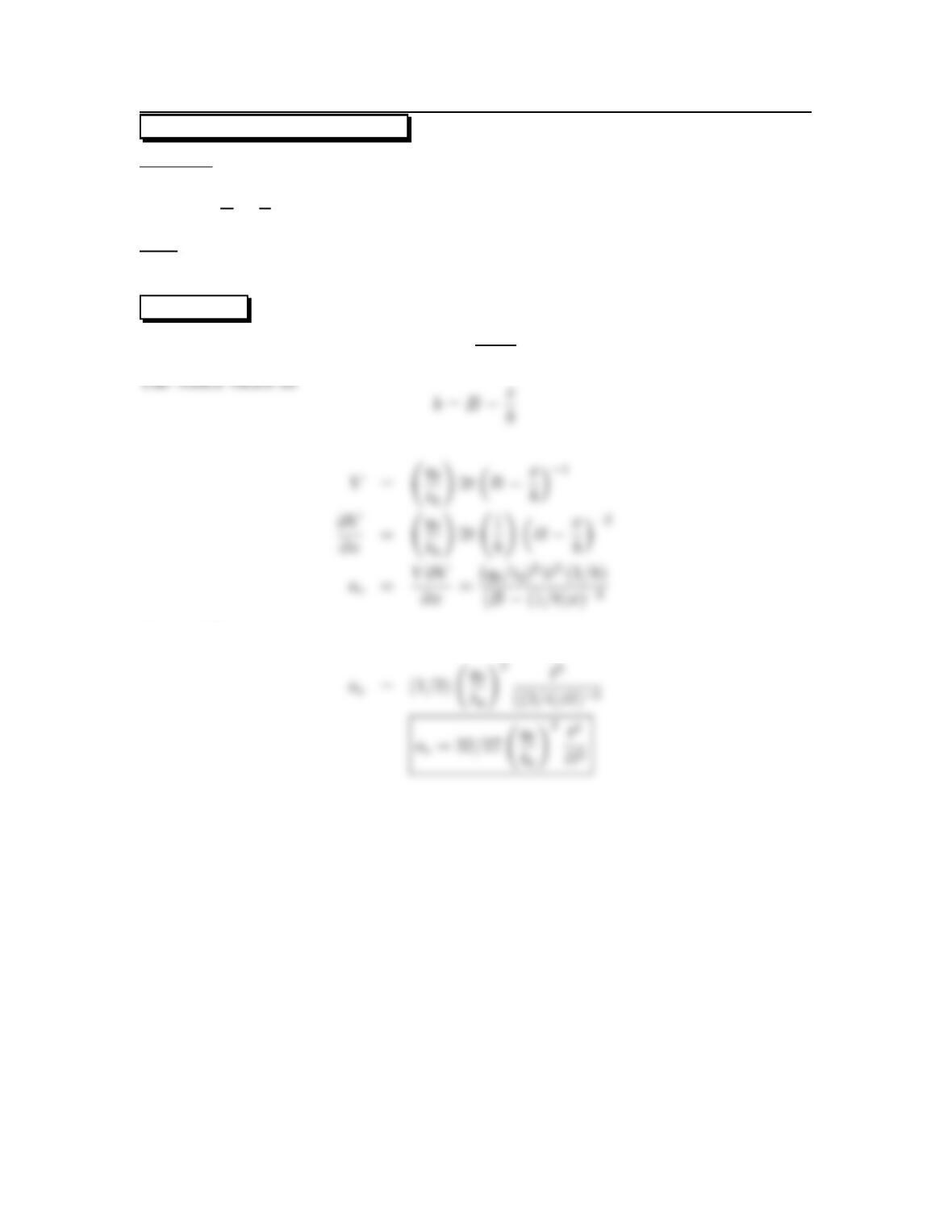
4.31: PROBLEM DEFINITION
Situation:
Flow in a two-dimensional slot and velocity varies as
V=2¡qo
b¢³t
to´,x=2B,y=0in.
Find:
An expression for convective acceleration midway in nozzle.
SOLUTION
ac=V∂V
∂x
At x=2B
31
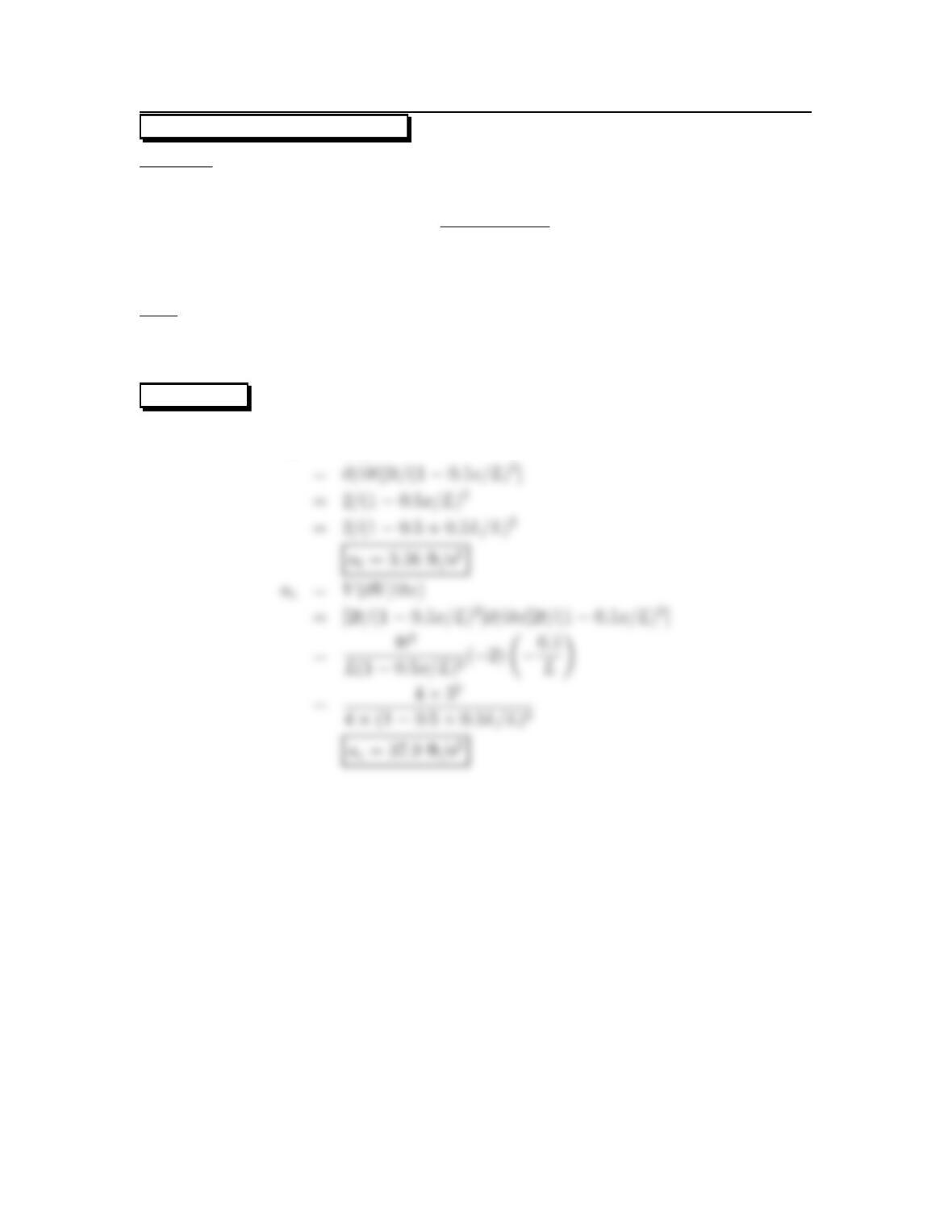
4.32: PROBLEM DEFINITION
Situation:
Water flow in a nozzle with
V=2t
(1 −0.5x/L)2
L=4ft,x=0.5L, t =3s.
Find:
Local acceleration (ft/s2).
Convective acceleration (ft/s2).
SOLUTION
a=∂V/∂t
32
4.33: PROBLEM DEFINITION
Situation:
StateNewton’ssecondlawofmotion.
Find:
Are there any limitations on the use of Newton’s second law?
SOLUTION
Newtons second law states
33
4.34: PROBLEM DEFINITION
Situation:
Force weight and force pressure.
Find:
What is the difference between a force due to weight and a force due to pressure?
SOLUTION
The force due to weight is the gravitational attraction on the mass and the magnitude
34
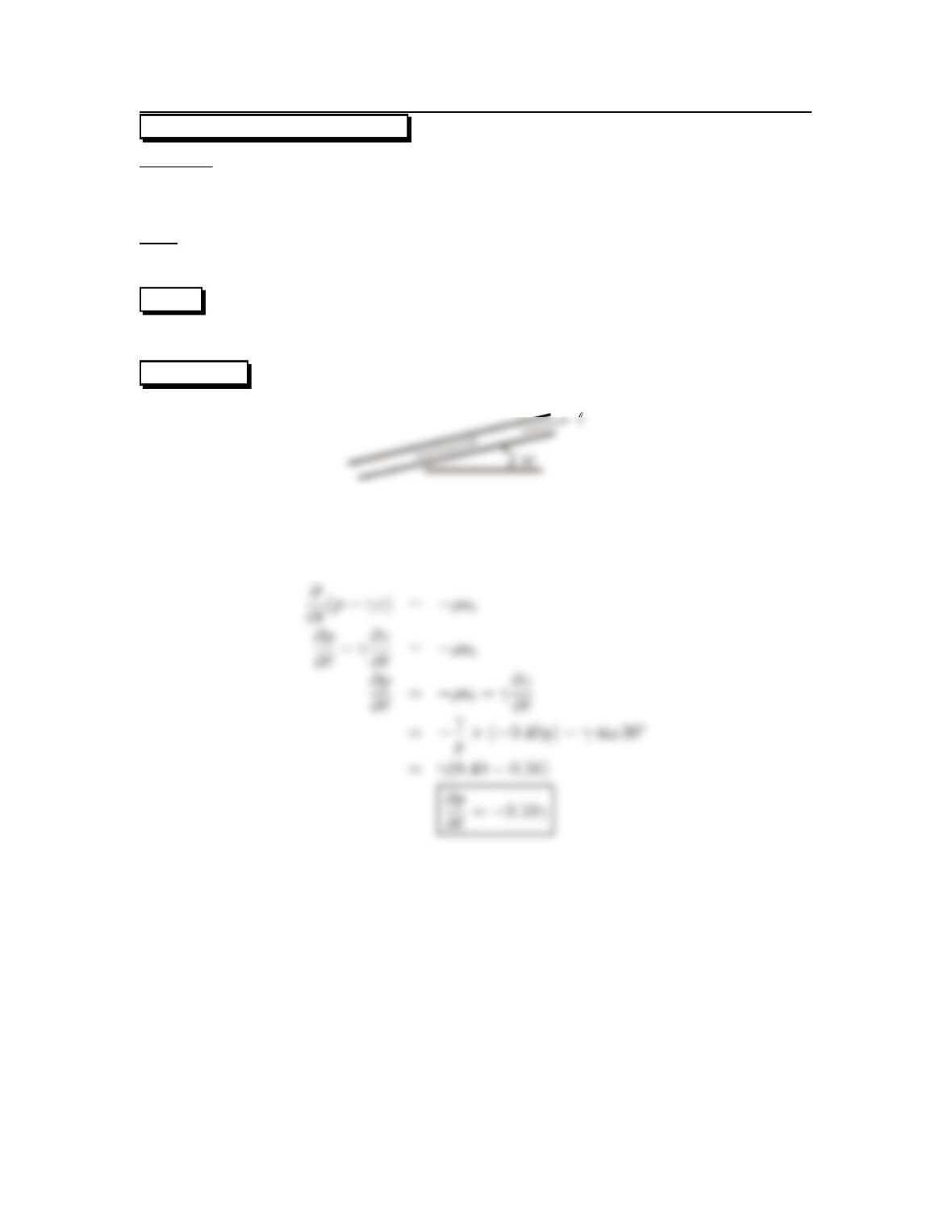
4.35: PROBLEM DEFINITION
Situation:
Flowthroughaninclinedpipeat30
ofrom horizontal.
a=−0.4g.
Find:
Pressure gradient in flow direction.
PLAN
Apply Euler’s equation.
SOLUTION
Euler’s equation
35
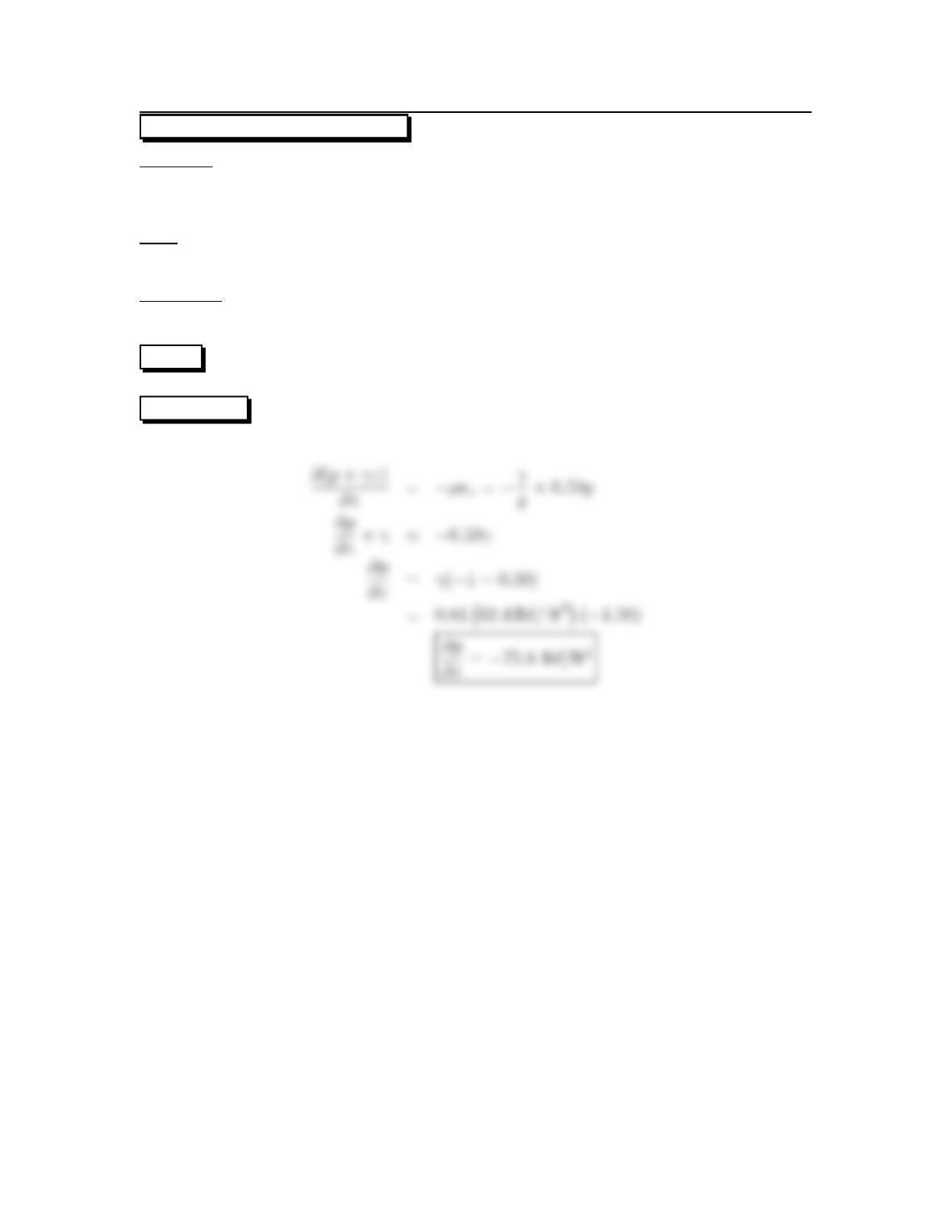
4.36: PROBLEM DEFINITION
Situation:
Kerosene is accelerated upward in vertical pipe.
S=0.81,az=0.5g.
Find:
Pressure gradient required to accelerate flow (lbf/ft3).
Properties:
γ=62.4lbf/ft3.
PLAN Apply Euler’s equation.
SOLUTION Applying Euler’s equation in the zdirection.
36
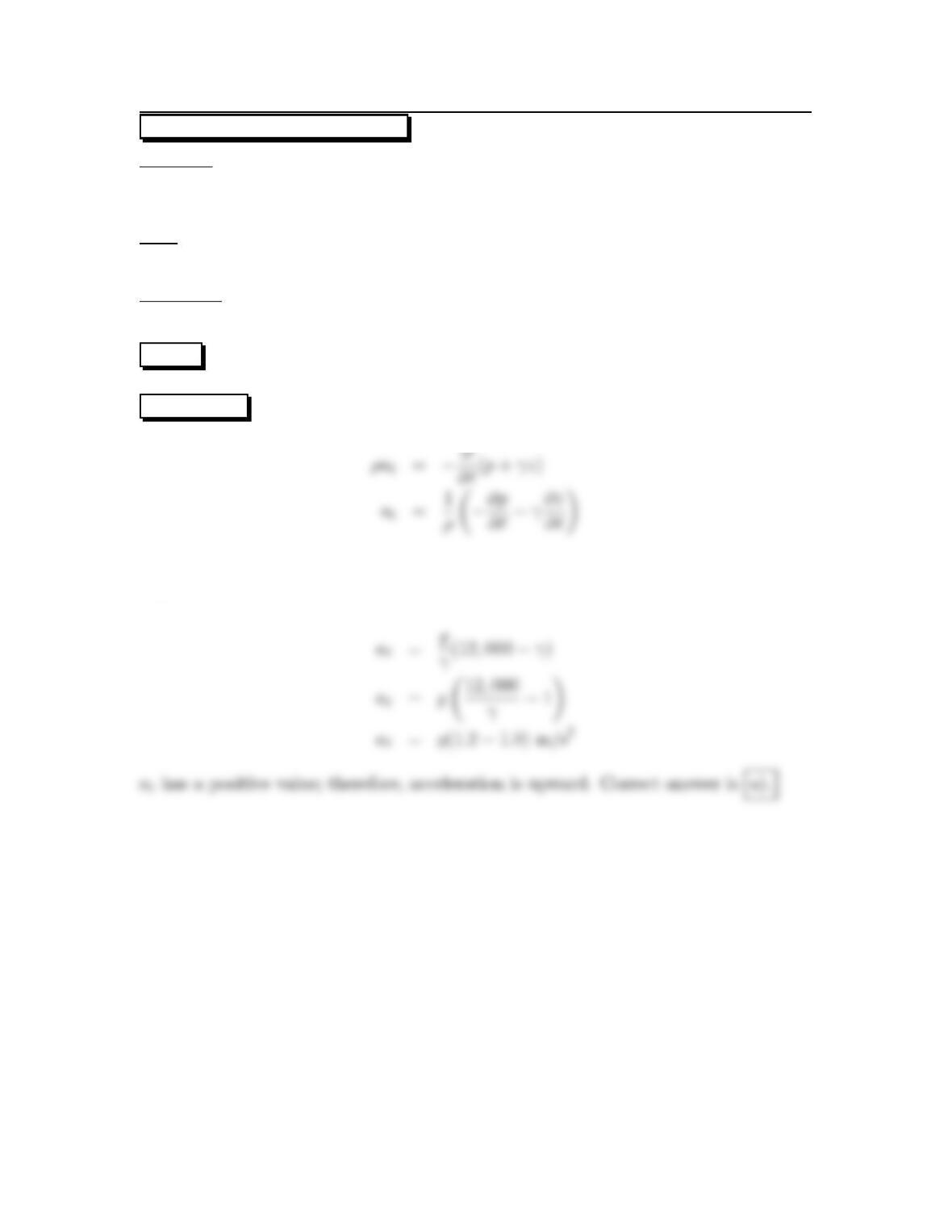
4.37: PROBLEM DEFINITION
Situation:
A hypothetical liquid flows through a vertical tube.
v=0.
Find:
Direction of acceleration.
Properties:
γ=10kN/m3,pB−pA=12kPa.
PLAN Apply Euler’s equation.
SOLUTION Euler’s equation
Let be positive upward. Then ∂z/∂ =+1and ∂p/∂ =(pA−pB)/1=−12,000
Pa/m. Thus
37
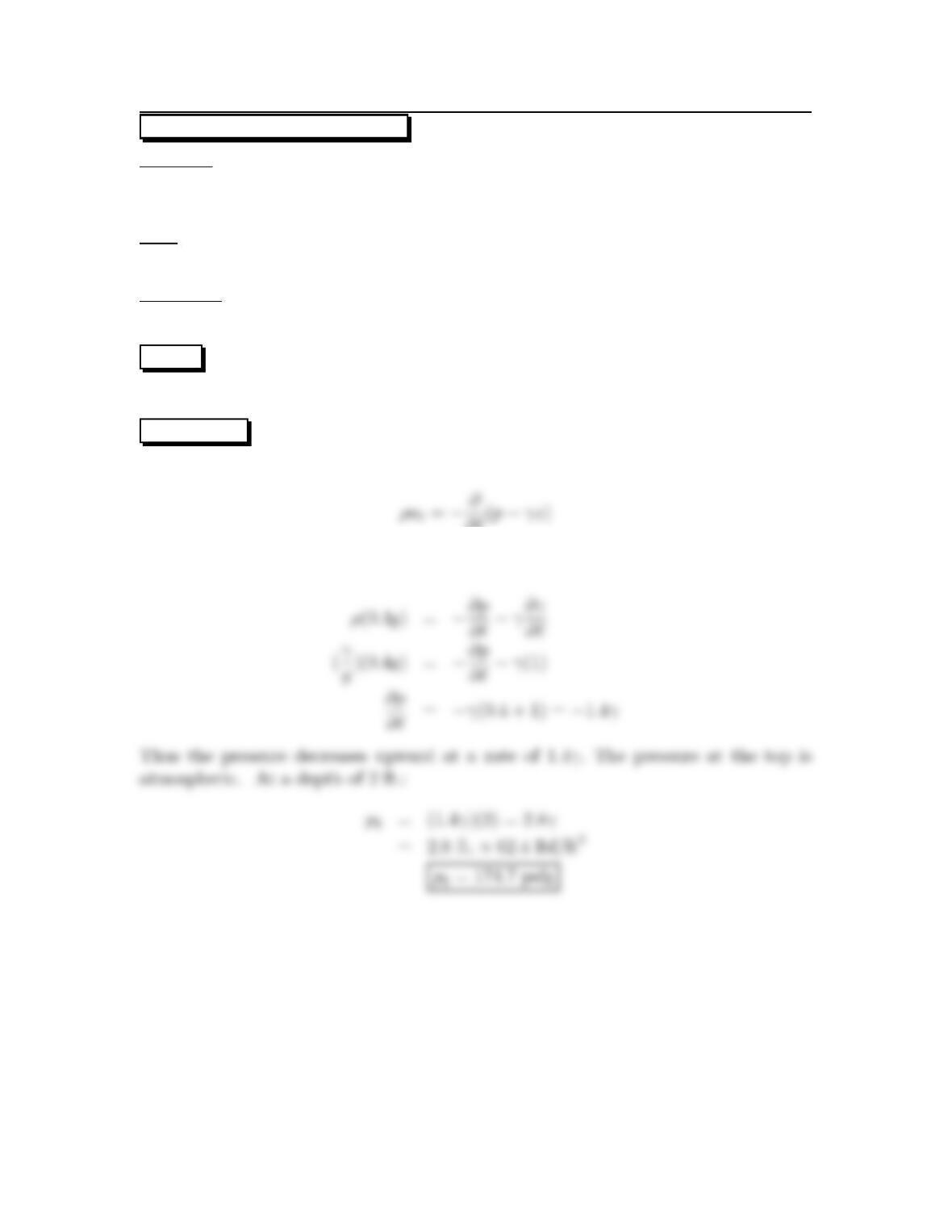
4.38: PROBLEM DEFINITION
Situation:
A piston and water accelerating upward at 0.4g.
a=0.4g, z=2ft.
Find:
Pressure in water column (psfg).
Properties:
ρ=62.4lbm/ft3,γ=62.4lbf/ft3
PLAN
Apply Euler’s equation.
SOLUTION
Euler’s equation
∂(p+γz)
Let be positive upward.
38
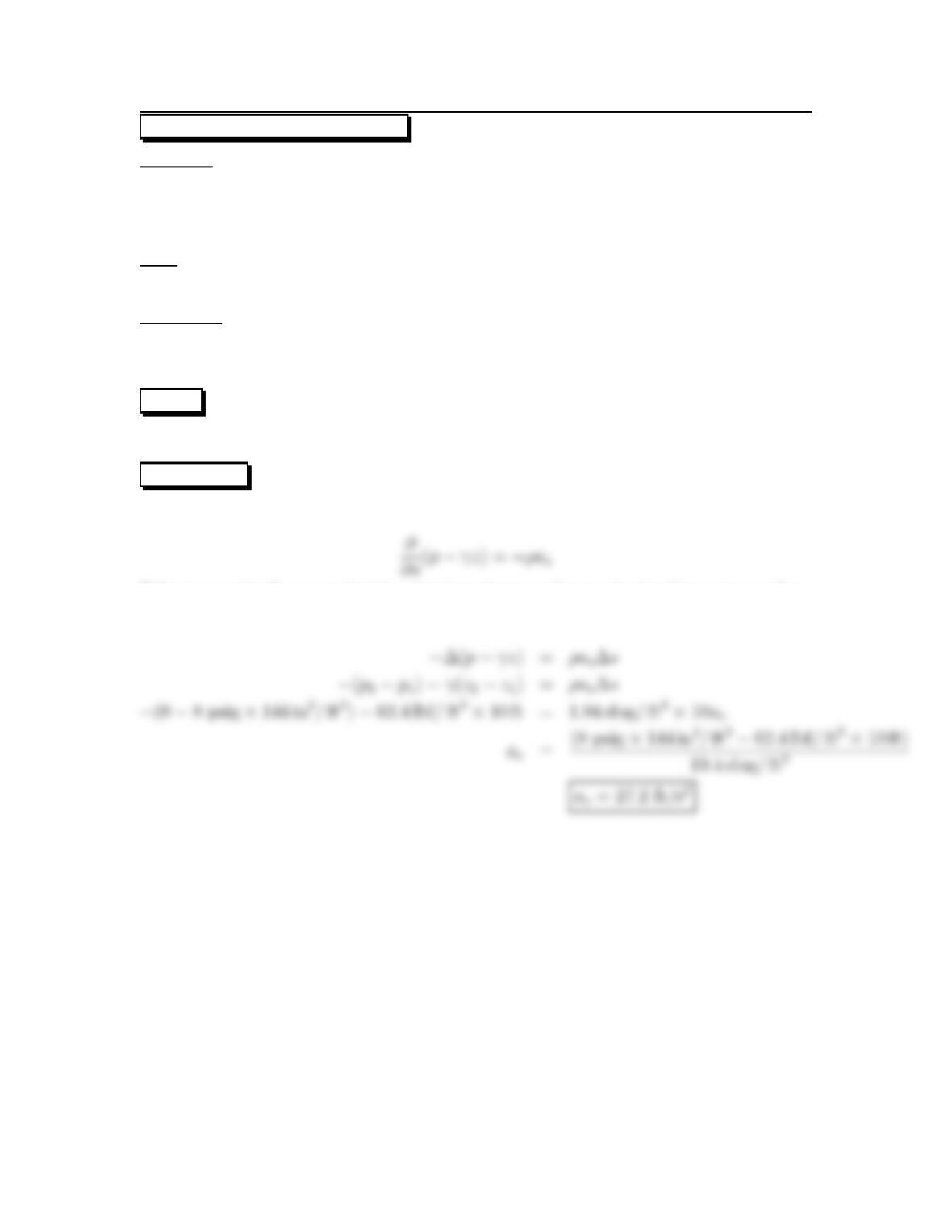
4.39: PROBLEM DEFINITION
Situation:
Water stands with depth of 10 ft in a vertical pipe open at top and supported by
piston at the bottom.
z=0ft,z2=10ft.
Find:
Acceleration of piston (ft/s2).
Properties:
γ=62.4lbf/ft3,ρ=1.94 slug/ft3.
p1=8psig,p
2=0psig.
PLAN
Apply Euler’s equation.
SOLUTION
Euler’s equation
Take sas vertically upward with point 1 at piston surface and point 2 at water surface.
39
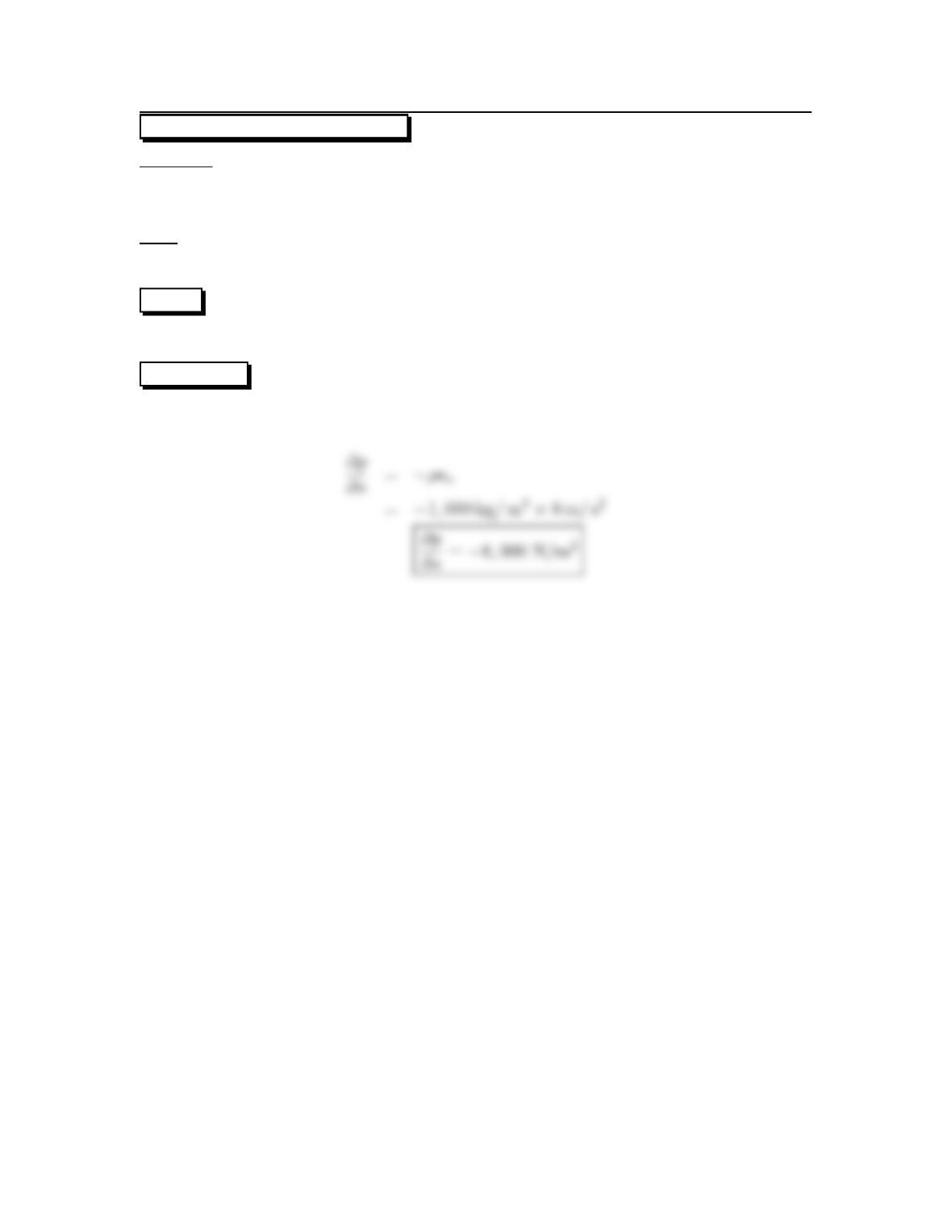
4.40: PROBLEM DEFINITION
Situation:
Water accelerates in a horizontal pipe.
as=8m/s2,ρ=1000kg/m3.
Find:
Pressure gradient (N/m3).
PLAN
Apply Euler’s equation.
SOLUTION
Euler’s equation with no change in elevation
40