4-1
CHAPTER 4
THE BALANCE SHEET AND STATEMENT OF CHANGES IN STOCKHOLDERS’ EQUITY
CONTENT ANALYSIS OF EXERCISES AND PROBLEMS
Number
Content
Time Range
(minutes)
E4-1
Current Assets. (Easy) Partial balance sheet preparation from
listed accounts.
5-10
E4-5
Balance Sheet. (Moderate) Matching various accounts with
major sections.
5-10
E4-6
Balance Sheet. (Moderate) Preparation from accounts listed in
random order. Calculation of debt ratio.
15-20
E4-10
Corrections. (Moderate) Preparation of a properly classified
balance sheet from one prepared erroneously.
10-15
4-2
Number
Content
Time Range
(minutes)
P4-1
Balance Sheet. (Moderate) Matching various accounts with
major sections.
15-30
P4-4
Balance Sheet. (Moderate) Preparation from accounts listed in
random order under U.S. GAAP and under IFRS.
30-45
P4-5
Balance Sheet. (Moderate) Preparation from alphabetical
adjusted trial balance. Calculation of debt ratio.
20-30
and discussion.
P4-8
Corrections. (Moderate) Preparation of a properly classified
balance sheet from one prepared incorrectly, using account
breakdowns.
30-45
P4-11
Errors. (Moderate) Identification of balance sheet errors.
Preparation of a properly classified balance sheet from one
prepared erroneously.
30-45
ANSWERS TO QUESTIONS
Q4-1 The major financial statements of a company are:
1. A balance sheet, which shows the company’s financial position at the end of
the accounting period.
Q4-2 The financial position of a company includes its economic resources (i.e., assets),
Q4-3 One purpose of a company’s balance sheet is to provide information about its
Q4-4 Liquidity refers to how quickly a company can convert an asset into cash to pay its
Q4-5 Financial capital is the monetary value of the net assets invested by stockholders, as
well as from earnings retained by the corporation. Capital maintenance refers to
Q4-6 Recognition is the process of formally recording and reporting an element in the
Q4-7 An asset is a probable future economic benefit obtained or controlled by a
company as a result of a past transaction or event. To be considered an asset, an
4-4
Q4-8 A liability is a probable future sacrifice of economic benefits arising from a present
obligation of a company to transfer assets or provide services in the future as a result
of a past transaction or event. An obligation of a company must have three
Q4-9 Stockholders’ equity is the residual interest in the assets of a corporation that remains
after deducting its liabilities.
Q4-10 The two alternatives for measuring (valuing) assets are historical cost and fair value.
Q4-11 A company’s balance sheet is divided into three major sections each with the
components as follows:
1. Assets
a. Current assets
Q4-12 Current assets are cash and other assets that a company expects to convert into
cash, sell, or consume within one year or the normal operating cycle, whichever is
4-5
Q4-12 (continued)
Current liabilities are obligations of a company that it expects to liquidate by using
existing current assets, or creating other current liabilities within one year or the
normal operating cycle, whichever is longer.
Q4-13 A company’s operating cycle is the average time taken by the company to spend
cash for inventory, process and sell the inventory, and collect the receivables,
converting them back into cash.
Q4-14 a. If a company expects to hold investments for more than one year or the
operating cycle, whichever is longer, these investments are classified as long-
term. Long-term investments include:
1. Noncurrent investments in available-for-sale debt and equity securities.
b. All tangible assets used in the operations of a company are classified as property,
plant, and equipment. They include:
1. Land
4-6
Q4-14 (continued)
c. Economic resources that are used in the operations of the business but that have
no physical existence are classified as intangible assets. They include:
Q4-15 a. Obligations that a company does not expect to liquidate using current assets or
creating current liabilities within one year or the normal operating cycle
(whichever is longer) are classified as long-term liabilities. They include:
1. Bonds payable
6. Obligations under noncurrent financial instruments
b. Other liabilities are miscellaneous liabilities not meeting the definition of either a
current or long-term liability. They include:
Q4-16 A bond is a written promise to pay a specified interest rate and to repay a specific
amount (its face value) at some future maturity date.
Q4-17 a. Capital stock are the shares of stock that a corporation is authorized to issue as
evidence of ownership in that corporation. There are two types of capital
stock, preferred stock and common stock. Preferred stock has a preference
4-7
Q4-17 (continued)
d. Retained earnings is the total amount of corporate net income that has not
Q4-18 Investments by owners are increases in the equity of a company resulting from
transfers of something valuable to the company from other entities to obtain or
Q4-19 Examples of accounting policies that are disclosed in the notes accompanying a
company’s financial statements include:
1. Basis for consolidation
The disclosure of accounting policies is important because it enables the external
users of financial statements to see:
Q4-20 Financial instruments include items such as notes payable and receivable, contracts
for loan commitments, collateralized mortgages, interest rate swaps, and put and
call options on stocks. A company is also required to disclose the fair value of all its
Q4-21 A loss contingency is a situation that exists for a company on its balance sheet date
involving uncertainty as to possible losses that it may incur if some future event
occurs.
Q4-22 Usually a time lag of several weeks or months exists between the end of a company’s
accounting period and the date when it issues its annual report. During this time, it is
possible for significant business events and transactions to occur, which, if not
Q4-23 For related-party transactions, a company must disclose (1) the nature of the
Q4-24 Comparative financial statements provide current as well as past financial
Q4-25 In an audit the certified public accountant is responsible for making an examination
of the accounting system, records, and reports of a company in accordance with
generally accepted auditing standards and, based on this examination, expressing
Q4-26 The SEC “integrated” disclosures that most regulated companies include in their
annual reports are:
(1) Comparative financial statements. These include comparative balance sheets
Q4-26 (continued)
(2) Selected financial data. These include (for a five-year period) net sales or
(3) Management’s discussion and analysis. This involves a discussion and analysis of
the company’s financial condition, changes in financial condition, and results of
(4) Common stock market prices and dividends. Information included here
consists of the principal trading markets for the company’s common stock, the
Q4-27 On a balance sheet prepared using IFRS, a company will normally report noncurrent
assets (property, plant, and equipment, investments, long-term receivables, and
Q4-28 The report form of the balance sheet takes a vertical format in which the asset
accounts are listed first and the liability and stockholders’ equity accounts are listed in
Q4-29 Additional information not included in the accounts reported on a company’s
financial statements can be disclosed by the following alternative methods.
1. Notes are used to describe narrative information and to provide additional
2. Supporting schedules are used to complement an entire financial statement or
explain a summary amount on a specific financial statement. Examples include:
Q4-29 (continued)
3. (continued)
a. Lower of cost or market method of valuing inventories
ANSWERS TO MULTIPLE CHOICE
4-11
SOLUTIONS TO REVIEW EXERCISES
RE4-1
RE4-2
Current Assets*
Cash $ 1,500
RE4-3
Current Liabilities*
Accounts payable $ 7,200
RE4-4
RE4-5
Long-Term Investments*
RE4-5 (continued)
RE4-6
Property, Plant, and Equipment*
Land $ 50,000
RE4-7
Intangible Assets*
Trademarks $ 37,000
RE4-8
Long-Term Liabilities*
Bonds payable $ 4,500
RE4-9
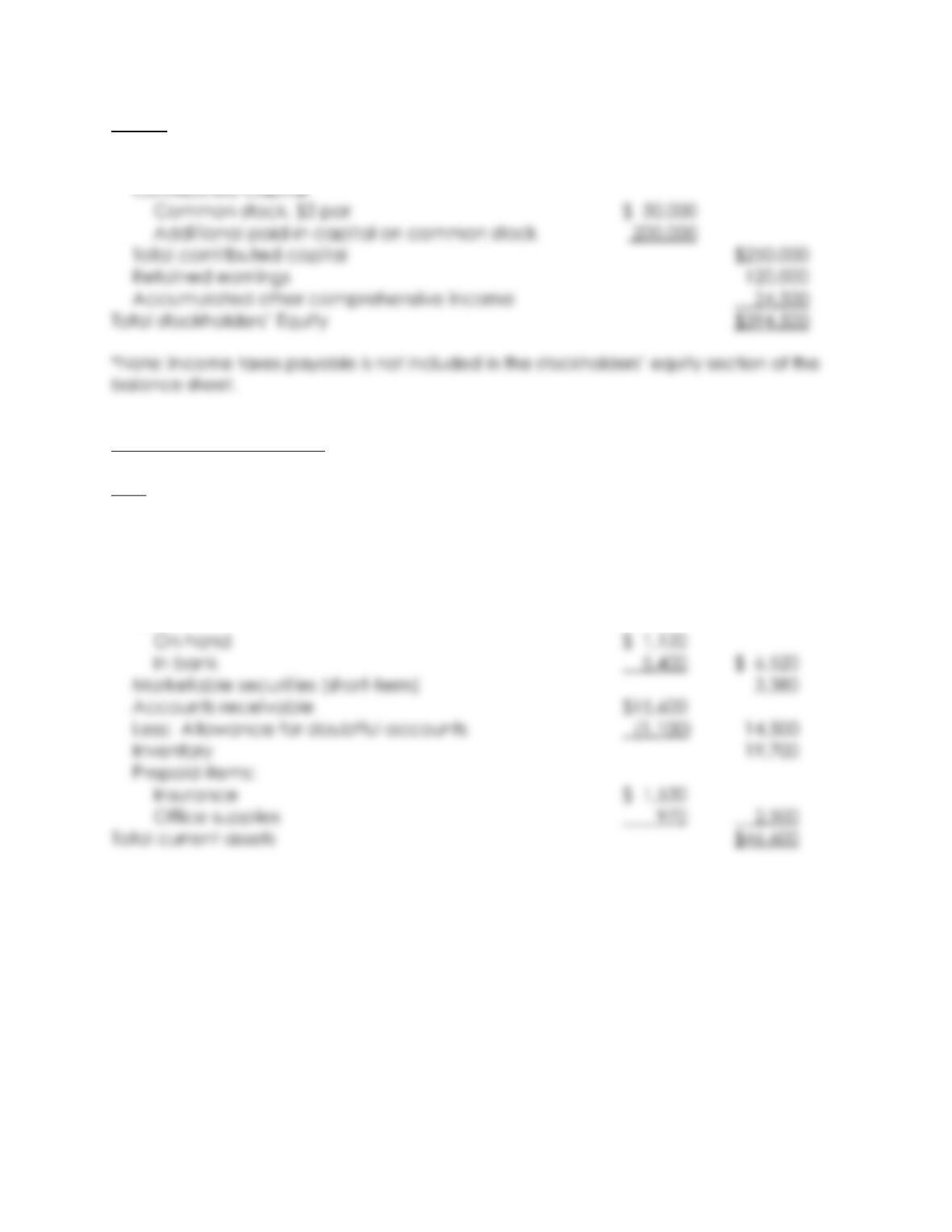
4-13
RE4-10
Stockholders’ Equity*
SOLUTIONS TO EXERCISES
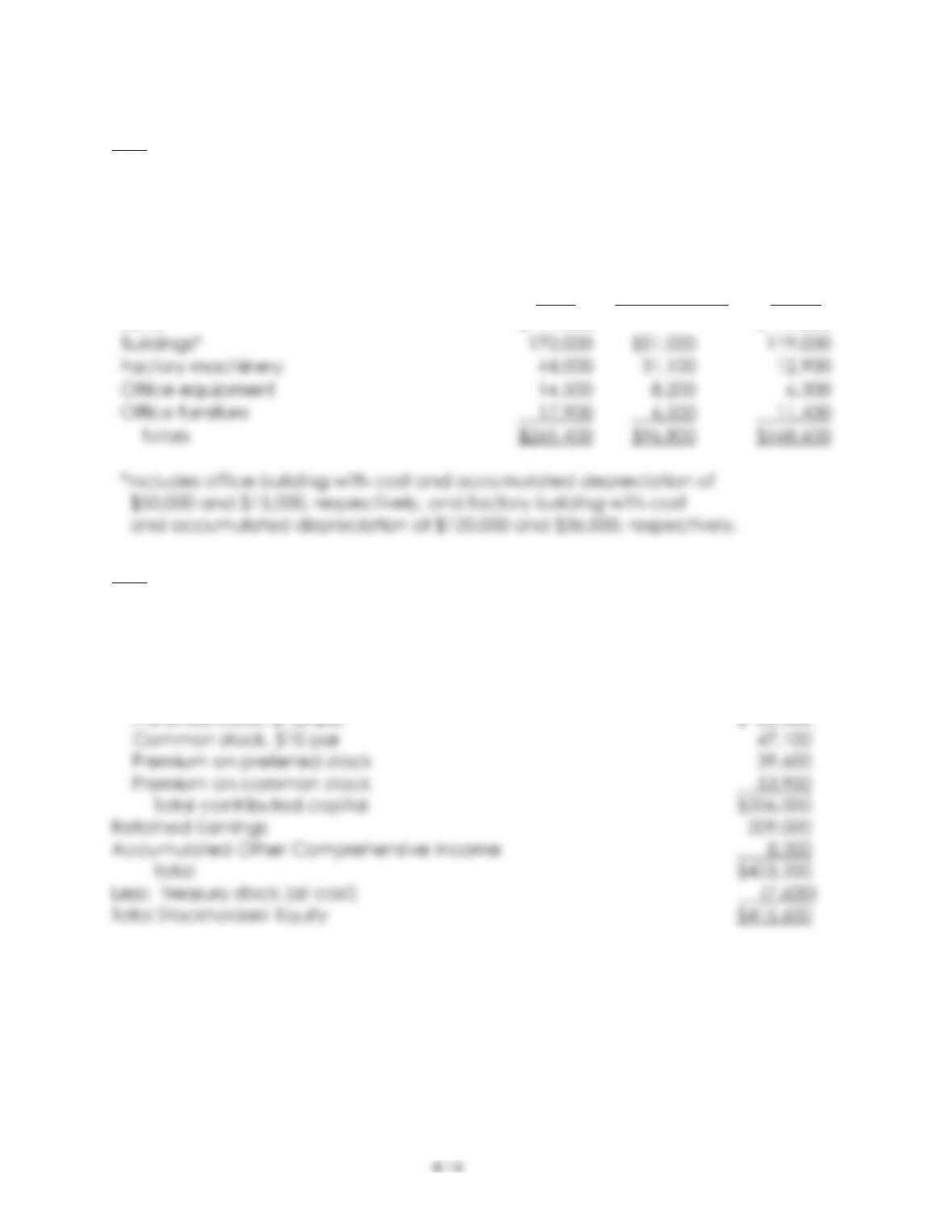
E4-1
JENKINS COMPANY
Current Asset Section of Balance Sheet
December 31, 2010
Current Assets
Cash:
E4-2
MOEN CORPORATION
Property, Plant, and Equipment Section of
Balance Sheet
December 31, 2010
Cost
Accumulated
Depreciation
Book
Value
Land $ 19,000
– $ 19,000
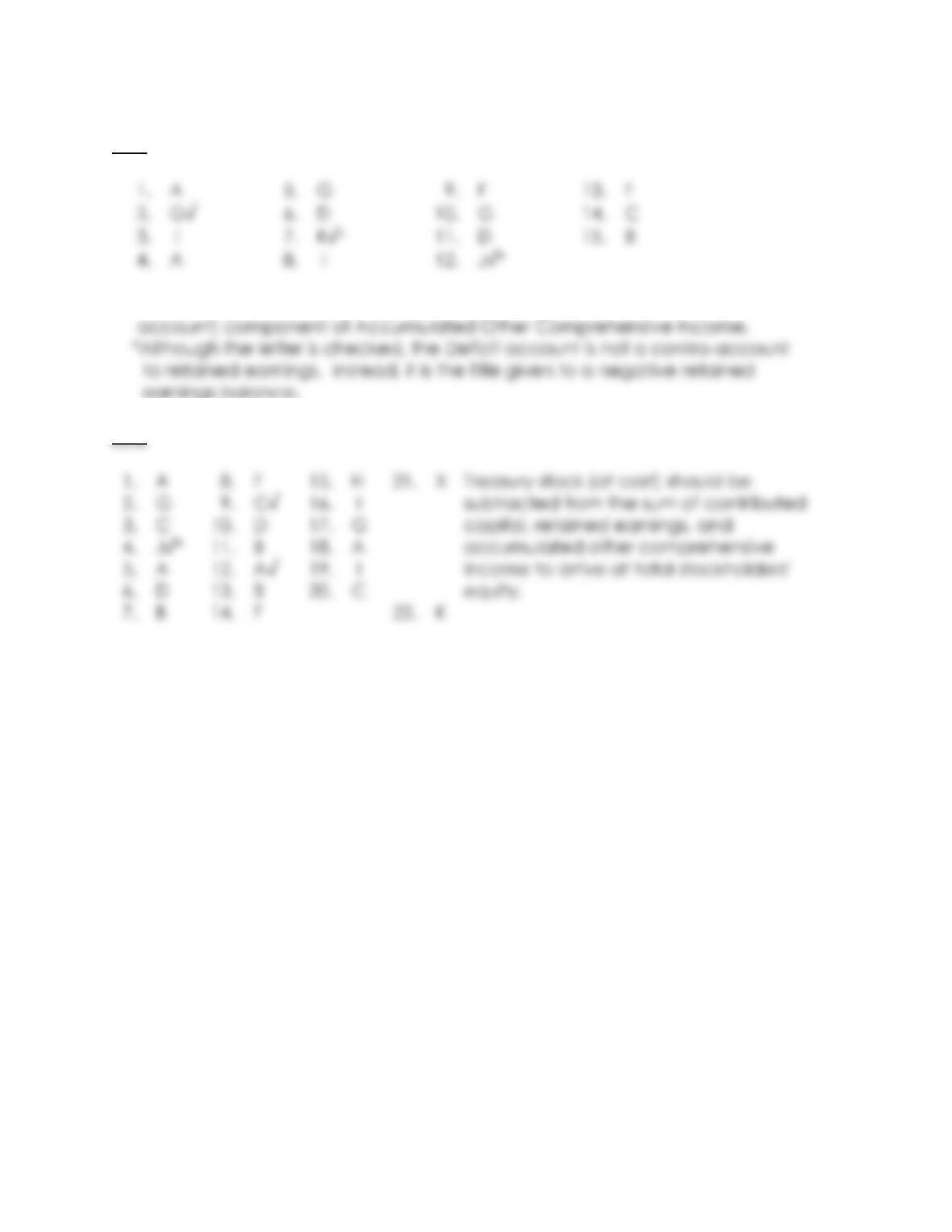
E4-3
GRAF CORPORATION
Stockholders’ Equity Section of
Balance Sheet
December 31, 2010
Contributed Capital
4-15
E4-4
+The unrealized decrease is a negative (although not strictly a contra-
E4-5
*Although the letter is checked, the Deficit account is not a contra-account to
retained earnings. Instead, it is the title given to a negative retained earnings
balance.
4-16
E4-6
1. BAGGETT COMPANY
Balance Sheet
December 31, 2010
Assets
Current Assets
Cash $ 4,300
Accounts receivable $ 12,600
Less: Allowance for doubtful accounts (1,600) 11,000
Land $12,200
Buildings $ 57,400
Less: Accumulated depreciation (21,000) 36,400
Liabilities
Current Liabilities
Accounts payable $13,100
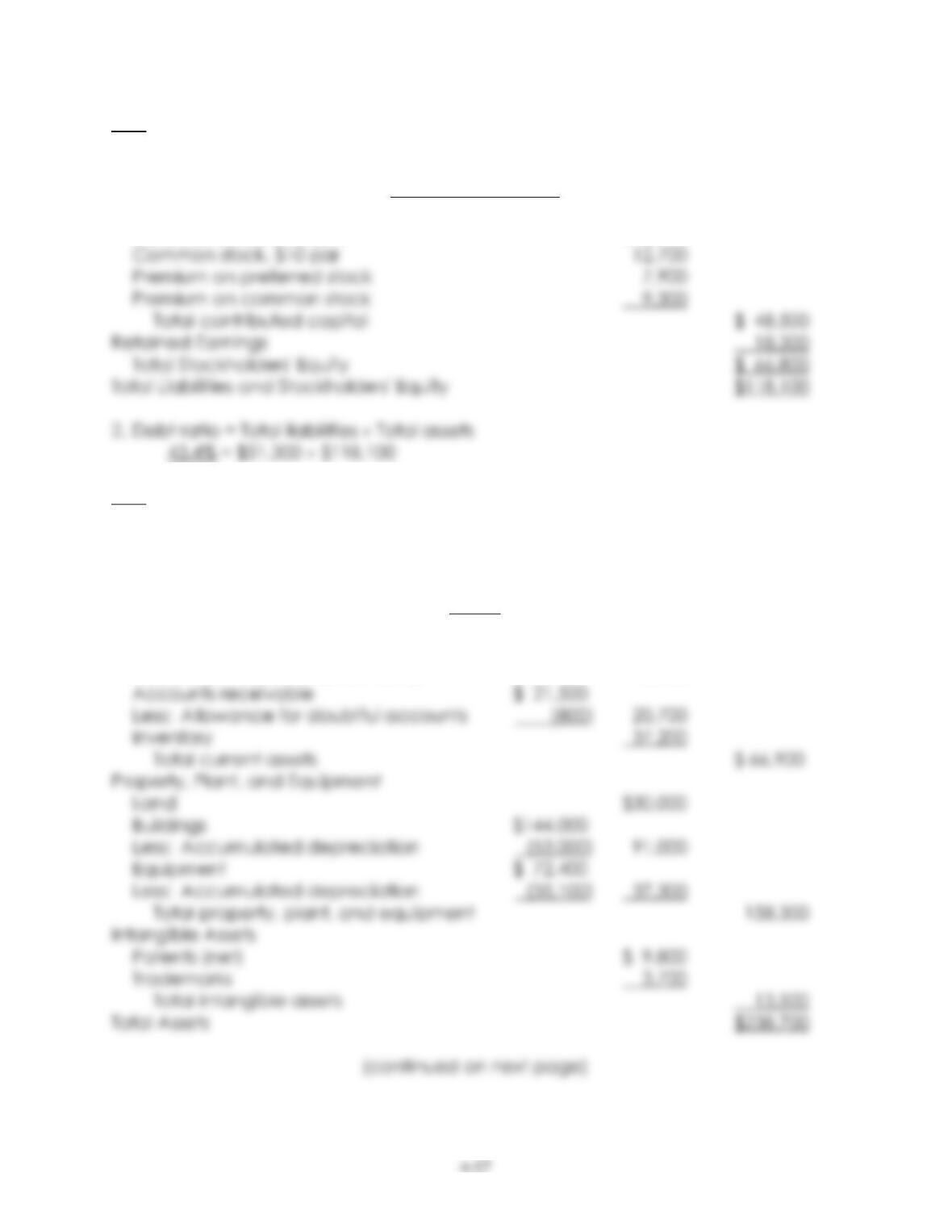
E4-6 (continued)
1. (continued)
Stockholders’ Equity
Contributed Capital
Preferred stock, $100 par $18,600
E4-7
1. HITT COMPANY
Balance Sheet
December 31, 2010
Assets
Current Assets
Cash $ 2,900
Marketable securities (short-term) 6,100
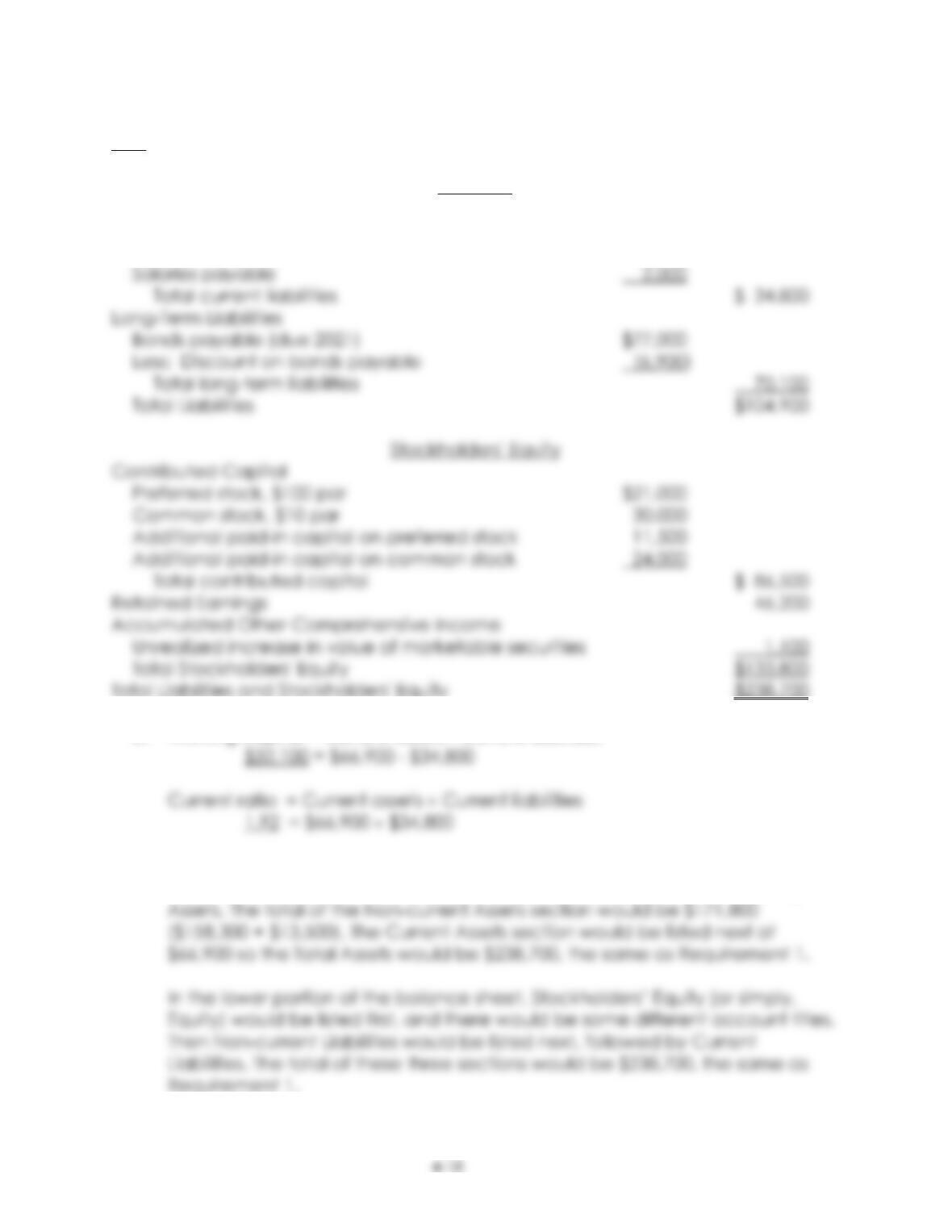
E4-7 (continued)
1. (continued)
Liabilities
Current Liabilities
Accounts payable $22,400
Current taxes payable 10,400
2. Working capital = Current assets – Current liabilities
3, If the Hitt Company used IFRS, it would list the non-current assets first and
would not separate them into Property, Plant, and Equipment and Intangible
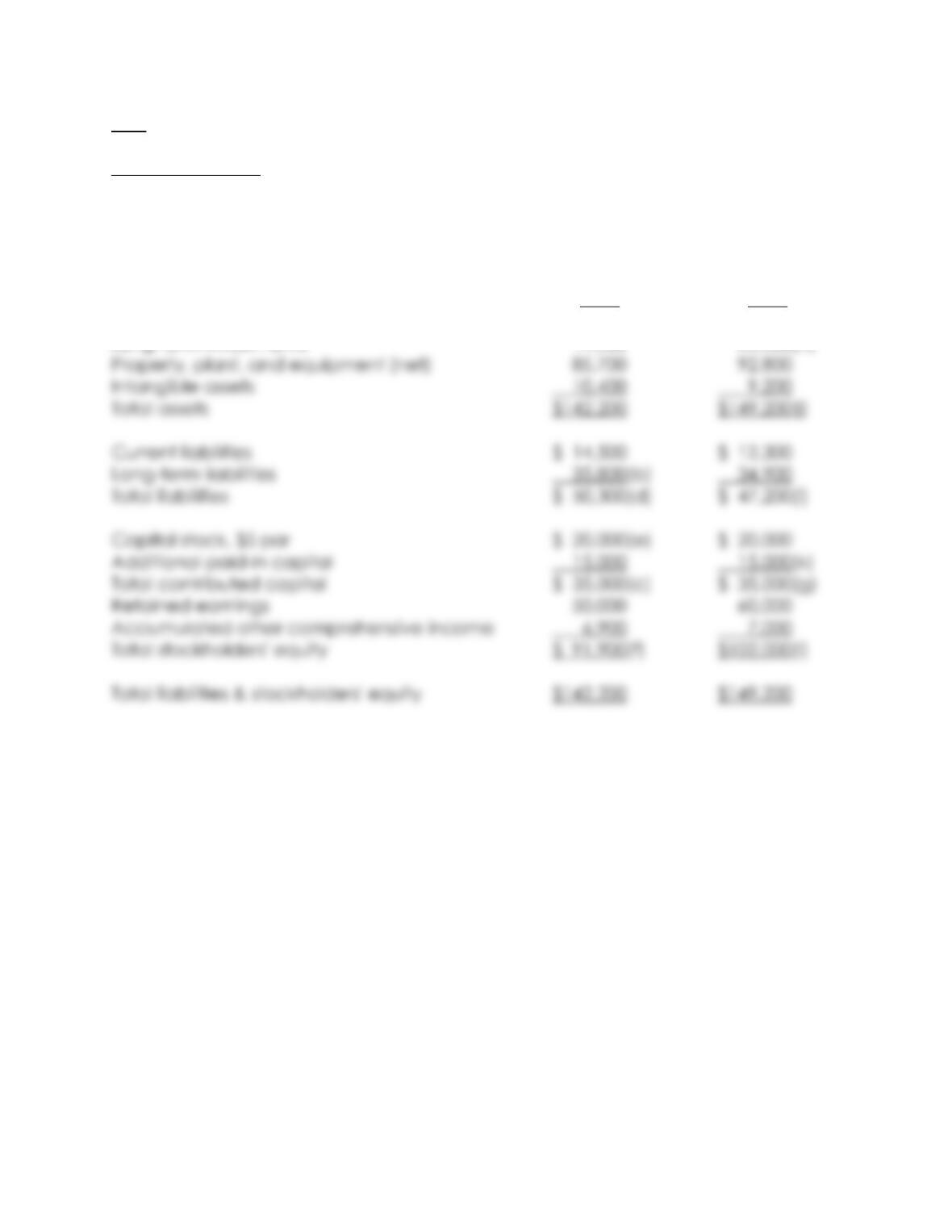
4-19
E4-8
Note to Instructor: The solution is shown in a balance sheet format. The answers are
lettered (a) through (l).
DAWSON COMPANY
Balance Sheet
December 31
2010 2011
Current assets $ 26,900(a) $ 25,000
Long-term investments 19,200 22,200(h)
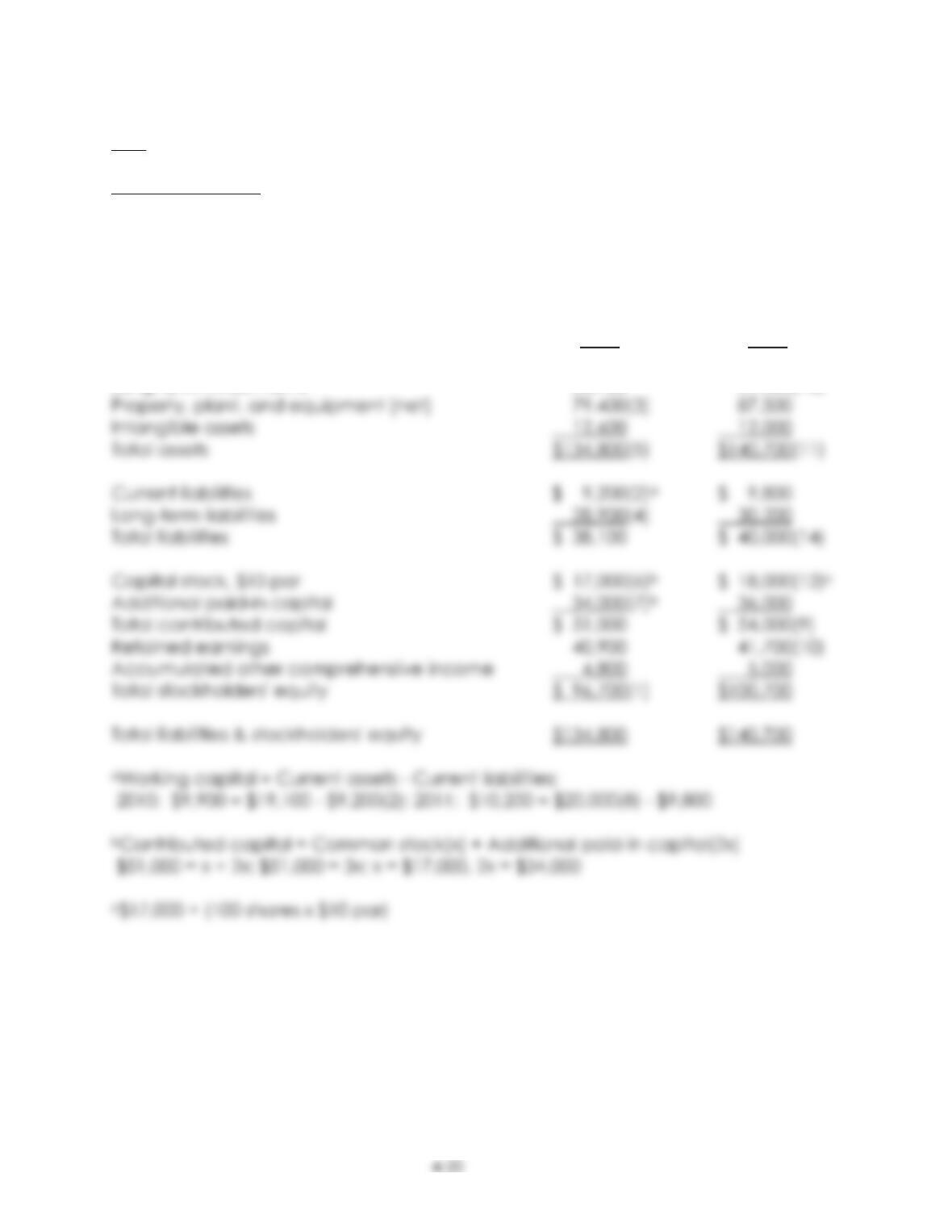
E4-9
Note to Instructor: The solution is shown in a balance sheet format. The answers are
numbered (1) through (14).
FERMER COMPANY
Balance Sheet
December 31
2010 2011
Current assets $ 19,100 $ 20,000(8)a
Long-term investments 23,700 21,200(13)