Section 4.2
4.2.73 Yes. Tis an isomorphism; the inverse transformation is D(f(t)) = f′(t) = df
dt , the derivative. We will check
that the composite of Twith Dis the identity, in either order. Indeed
4.2.74 Let T(f(t)) = f′(t).This is an isomorphism, since the spaces have the same dimension, and the kernel
consists only of the zero polynomial.
4.2.77 If Tand Lare linear, then
(L◦T)(f+g) = L(T(f+g)) = L(T(f) + T(g)) = L(T(f)) + L(T(g))
4.2.78 a Check all the conditions in Definition 4.1.1. A basis is 2.
bT(x⊕y) = T(xy) = ln(xy) = ln(x) + ln(y) = T(x) + T(y) and
Chapter 4
4.2.79 Yes; let Tbe an invertible function from R2to R. On R2we can define the “exotic” operations ~v ⊕~w =
T−1(T(~v) + T(~w)) and k⊙~v =T−1(kT (~v)) (check that the conditions of Definition 4.1.1 hold). Then Tis
4.2.80 If a real linear space Vhas more than one element, then it is infinite; to see this, note that the scalar multiples
4.2.81 a ker(T) is a subspace of V, so by Exercise 4.1.54, ker(T) must also be finite-dimensional. Also, im(T) is
finite-dimensional, because it is finitely-generated by some elements T(f1), T (f2),···, T (fk), where f1, f2,···, fk
is a basis of V.
b Following the hint: T(c1u1+···+crur+d1v1+···+dnvn) = T(0), so c1T(u1) + ···+crT(ur) + d1T(v1) + ···+
dnT(vn) = c1w1+···+crwr+ 0 + ···+ 0 = 0. So, since w1,···, wris a basis and must be linearly independent,
4.2.82 Consider a basis v1, …, vnof ker Tand a basis w1, …, wrof imT. Consider elements u1, …, urin Vsuch that
T(ui) = wifor i= 1, …, r. In Exercise 81, parts b and c, we prove that the elements v1, …, vn, u1, …, urform a
basis of V, proving our claim.
4.2.83 The transformation Tinduces a transformation ˜
Tfrom ker (L◦T) to ker L, with ker ˜
T= ker T. Since ker Lis
4.2.84 Using the terminology and the results introduced in Exercise 83, we observe that im ˜
T= ker L. Indeed,
Section 4.3
4.3.1Let Bbe the standard basis of P2: 1, t, t2. Then the coordinates of the given polynomials with respect to B
200
Section 4.3
4.3.2Let Bbe the basis 1 0
0 0 ,0 1
0 0 ,0 0
1 0 ,0 0
0 1 of R2×2. Then the coordinates of the given matrices
with respect to Bare 1 1
1 1 B
=
1
1
1
,1 2
3 4 B
=
1
2
3
,2 3
5 7 B
=
2
3
5
,1 4
6 8 B
=
1
4
6
. Finding
4.3.4Consider the coordinate vectors of the 3 given polynomials with respect to the standard basis of P2: 1, t, t2.
1
1
0
,
0
1
1
,
2k
2 + k
1
4.3.5Use a diagram:
a b
0c−−→
T1 2
0 3 a b
0c=a b + 2c
0 3c
4.3.6Use Theorem 4.3.2. to construct matrix Bcolumn by column:
B=T1 0
0 0 BT0 1
0 0 BT0 1
0 1 B
Chapter 4
4.3.7Use Theorem 4.3.2 to construct Bcolumn by column:
B=T1 0
0 1 BT0 1
0 0 BT1 0
0−1B=0 0
0 0 B0 0
0 0 B0 4
0 0 B
4.3.8Use a diagram:
a b
0c−−→
T0 2a−2c
0 0
y
y
4.3.9Use a diagram:
a b
0c−−→
Ta2b
0c
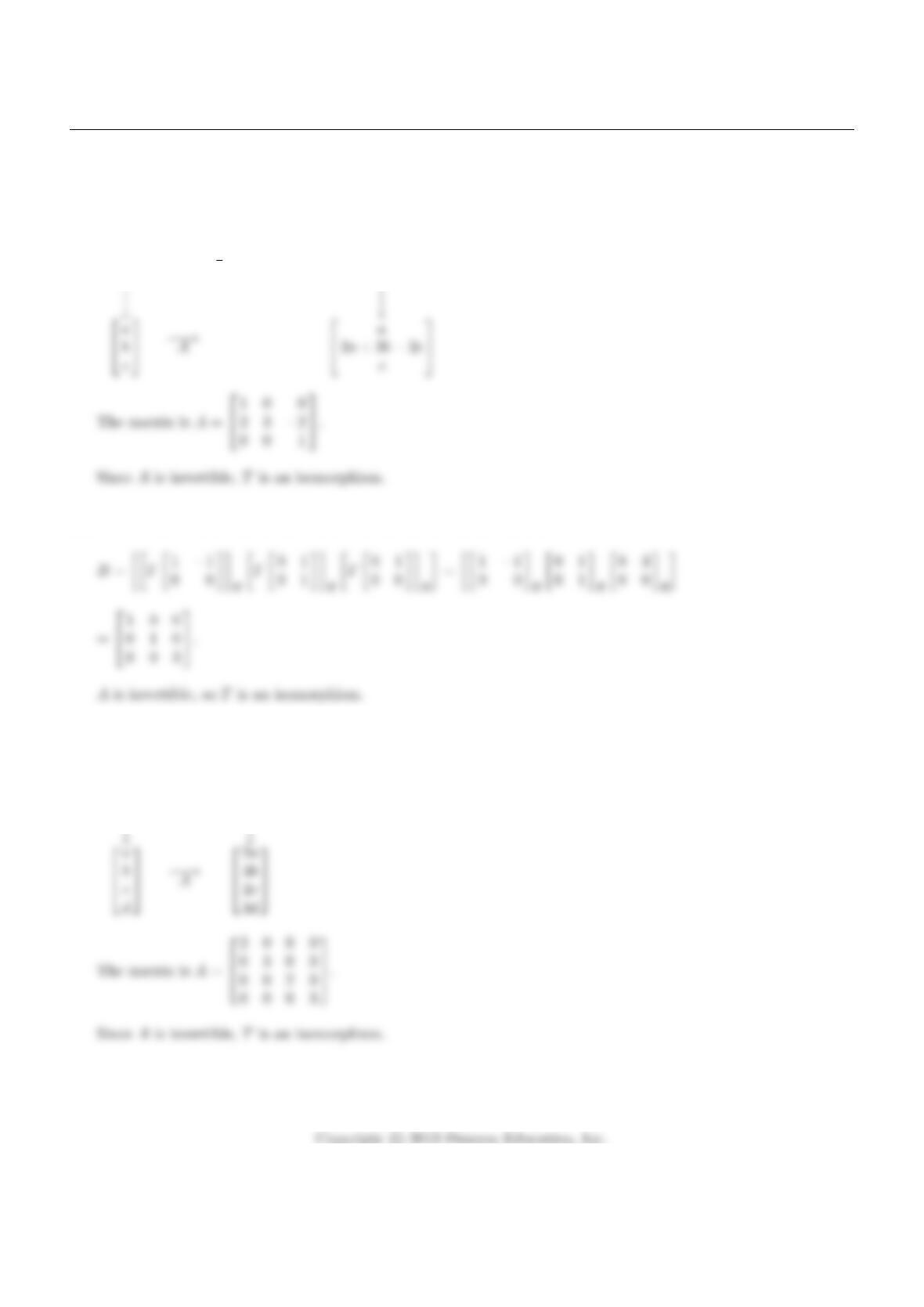
Section 4.3
Ais invertible, so Tis an isomorphism.
4.3.10 Use a diagram:
a b
0c−−→
T1
33−2
0 1 a b
0c1 2
0 3 =a2a+ 3b−2c
0c
4.3.11 Use Theorem 4.3.2. to construct matrix Bcolumn by column:
4.3.12 Use a diagram as in Definition 4.3.1:
a b
c d −−→
T2a3b
2c3d
4.3.13 Use a diagram:
203
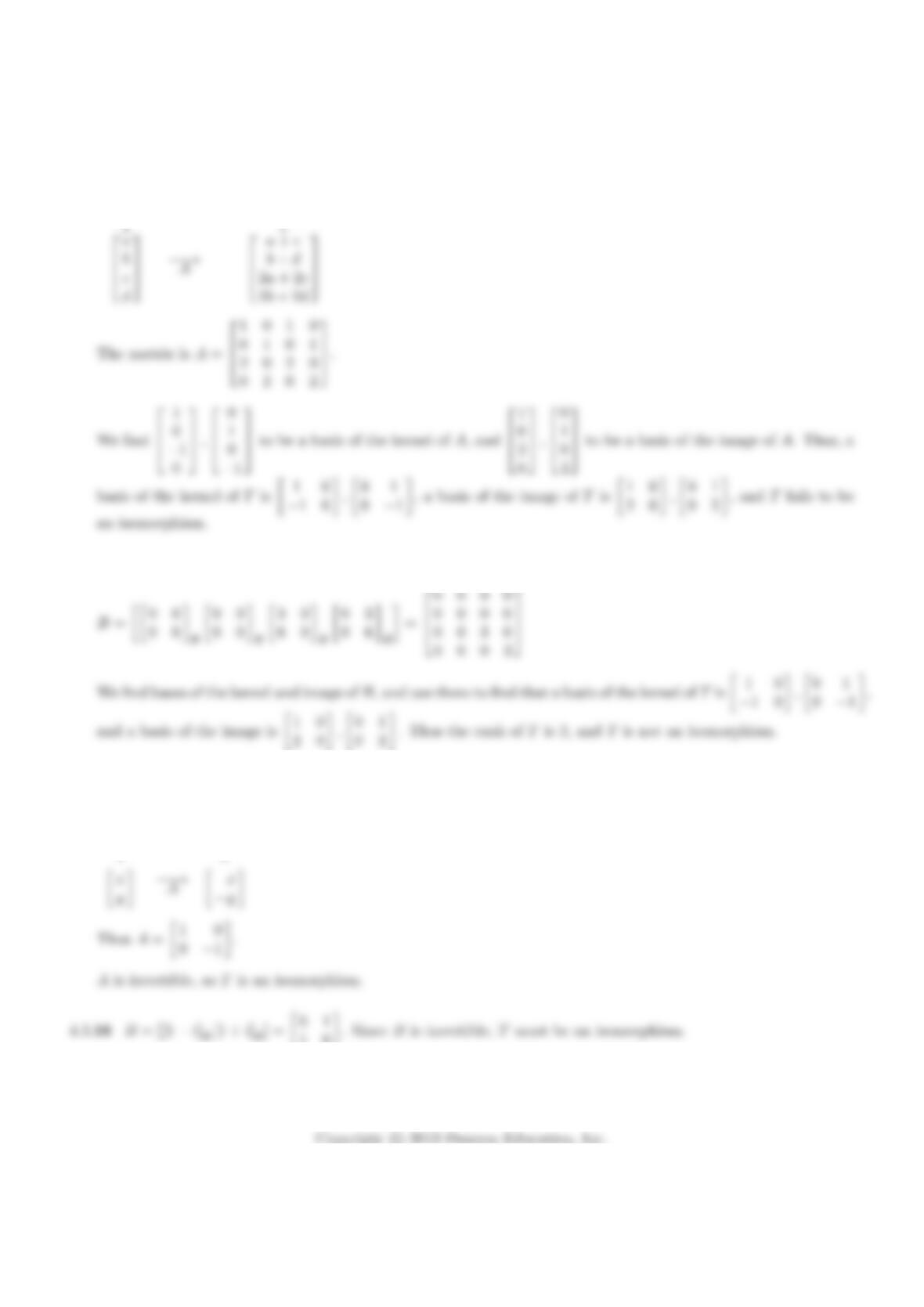
Chapter 4
a b
c d −−→
Ta+c b +d
2a+ 2c2b+ 2d
y
y
4.3.14 Use Theorem 4.3.2 to construct matrix Bcolumn by column:
4.3.15 We use a diagram again:
x+iy −−→
Tx−iy
y
y
1 0 . Since Bis invertible, Tmust be an isomorphism.
4.3.17 Another diagram:
204
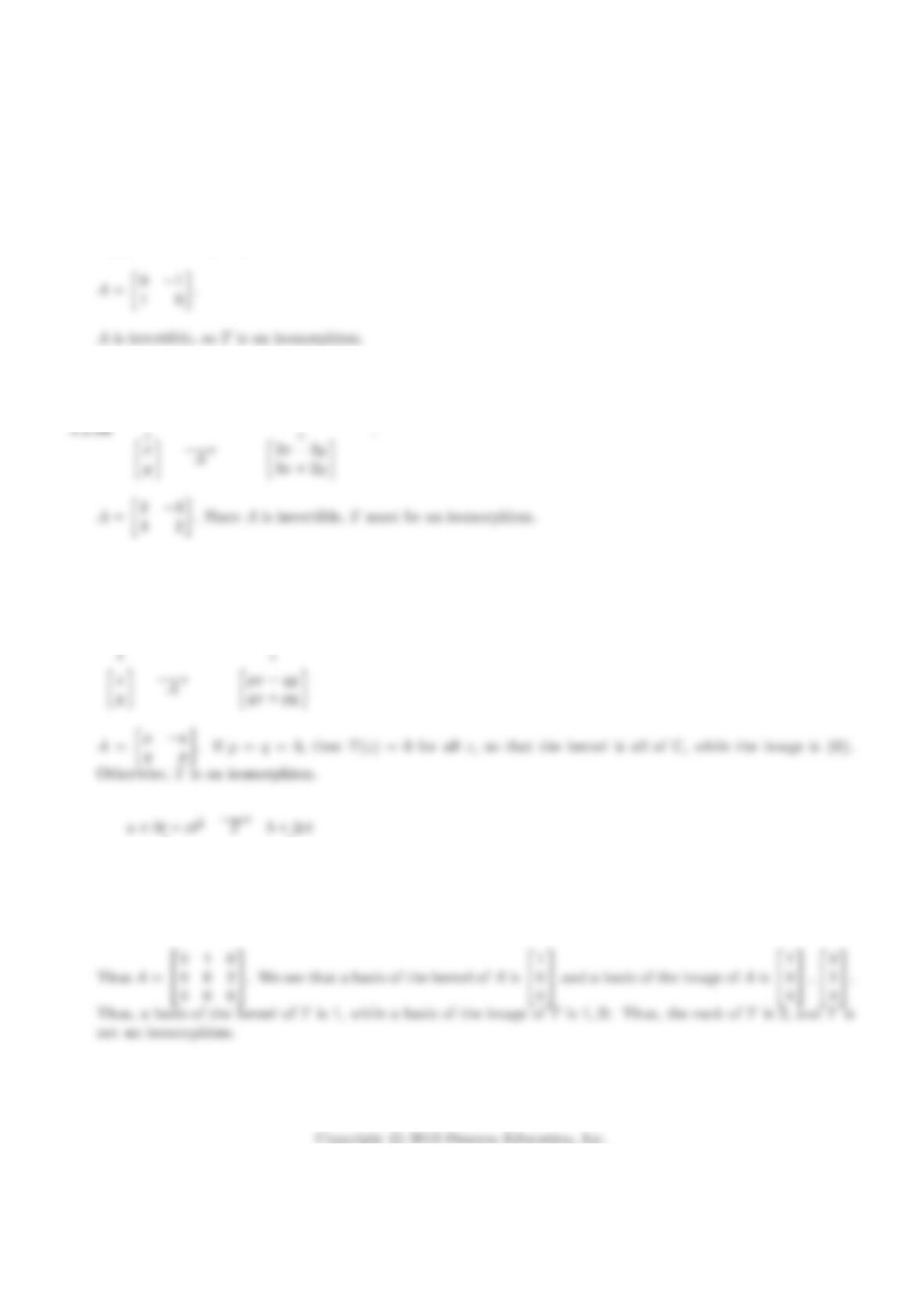
Section 4.3
x+iy −−→
T−y+ix
y
y
x
y−−→
A−y
x
x+iy −−→
T2x−3y+i(3x+ 2y)
y
y
4.3.19 We use a diagram to show our work:
x+iy −−→
T px −qy +i(qx +py)
y
y
4.3.20
y
y
a
b
c
−−→
A
b
2c
0
4.3.21 We use a diagram to show our work:
205
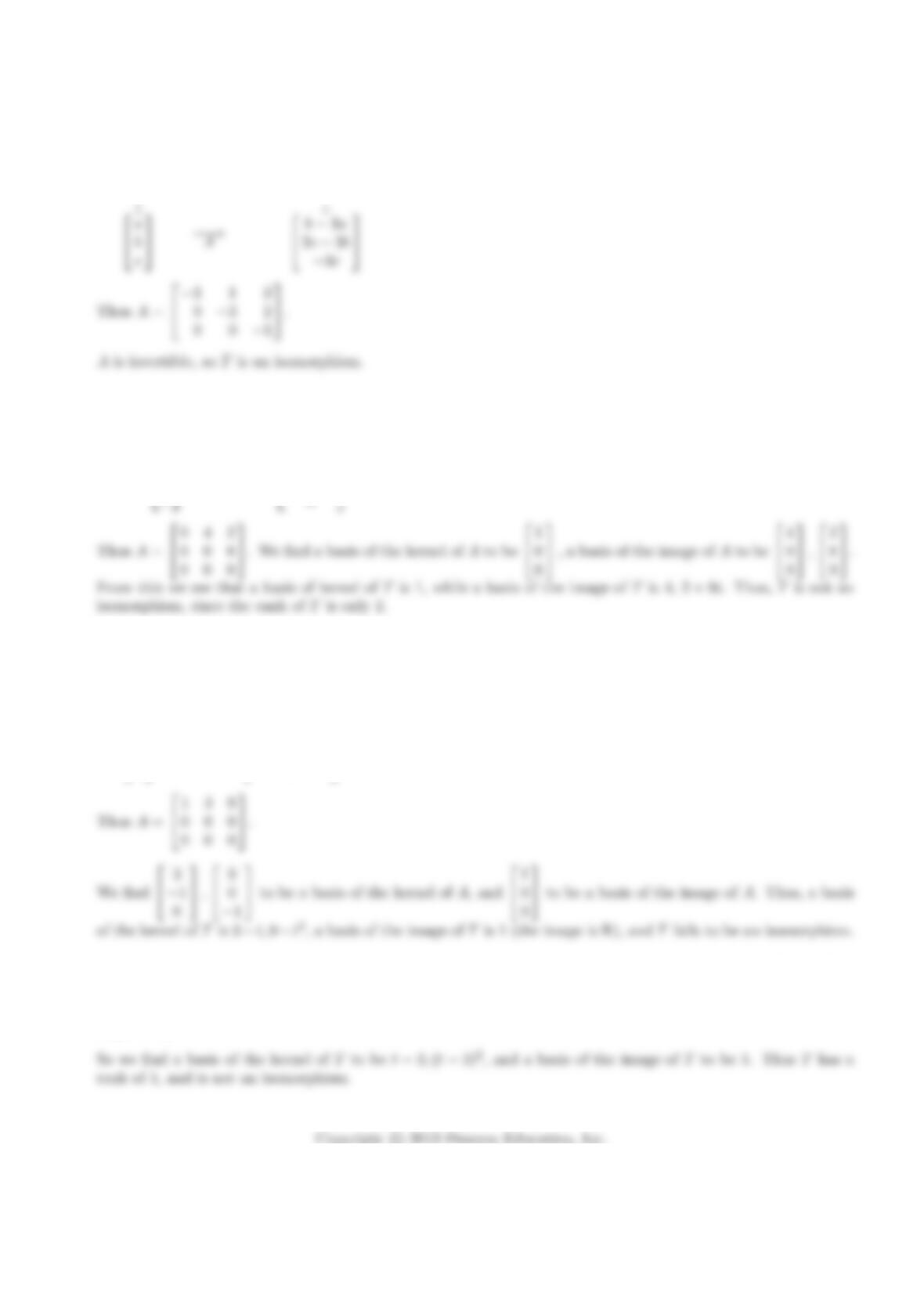
Chapter 4
a+bt +ct2−−→
Tb−3a+ (2c−3b)t−3ct2
4.3.22
a+bt +ct2−−→
T4b+ 2c+ 8ct
y
y
a
b
c
−−→
A
4b+ 2c
8c
0
4.3.23 A diagram shows our work:
a+bt +ct2−−→
T a + 3b+ 9c
y
y
a
b
c
−−→
A
a+ 3b+ 9c
0
0
4.3.24 B= [[1]B[0]B[0]B] =
1 0 0
0 0 0
0 0 0
. A basis of the kernel and image of Bare obvious,
0
1
0
,
0
0
1
and
1
0
0
respectively.
206
Section 4.3
4.3.25 We use the following diagram:
a+bt +ct2−−→
T a −bt +ct2
y
y
4.3.26
a+bt +ct2−−→
T a + 2bt + 4ct2
y
y
a
b
c
−−→
A
a
2b
4c
Thus A=
1 0 0
0 2 0
0 0 4
. Since Ais invertible, Tmust be an isomorphism.
4.3.27 We use a diagram:
4.3.28 B=[1]B[2t−2]B4(t−1)2B=
100
020
004
. Since Bis invertible, Twill be an isomorphism.
4.3.29 This diagram shows our work:
207
Chapter 4
a+bt +ct2−−→
T2a+ 2b+ 8c/3
y
y
4.3.30
a+bt +ct2−−→
T
a+b(t+h)+c(t+h)2−a−bt−ct2
h
=b+ch + 2ct
y
y
a
b
c
−−→
A
b+ch
2c
0
4.3.31
y
y
a
b
c
−−→
A
b
2c
0
Thus A=
0 1 0
0 0 2
0 0 0
.
208
Section 4.3
4.3.32
=a−c+ (b+ 2c)t
y
y
a
b
c
−−→
A
a−c
b+ 2c
0
Thus A=
1 0 −1
0 1 2
. We find a basis of the kernel of Ato be
−1
2
,while a basis of the image of Ais
4.3.33 B= [[1]B[t−1]B[0]B] =
1 0 0
0 1 0
0 0 0
.
4.3.34 A=T1 0
0 0 AT0 1
0 0 AT0 0
1 0 AT0 0
0 1 A
209
Chapter 4
4.3.35 Again, we use a diagram to show our work:
M=a b
c d −−→
T T (M) = c d −a
0−c=c1 0
0 0 + (d−a)0 1
0 0 −c0 0
0 1
y
y
By inspection, a basis of the kernel and image of this matrix are
0
1
0
0
,
1
0
0
1
and
0
−1
0
0
,
1
0
0
−1
,respectively. Thus, we see that a basis of ker(T) is 0 1
0 0 ,1 0
0 1 ,
and a basis of im(T) is 0−1
0 0 ,1 0
0−1. Thus, Tfails to be an isomorphism.
4.3.36 We will build Acolumn-by-column:
A=T1 0
0 0 AT0 1
0 0 AT0 0
1 0 AT0 0
0 1 A
4.3.37 We will construct our matrix Bcolumn-by-column:
210
Section 4.3
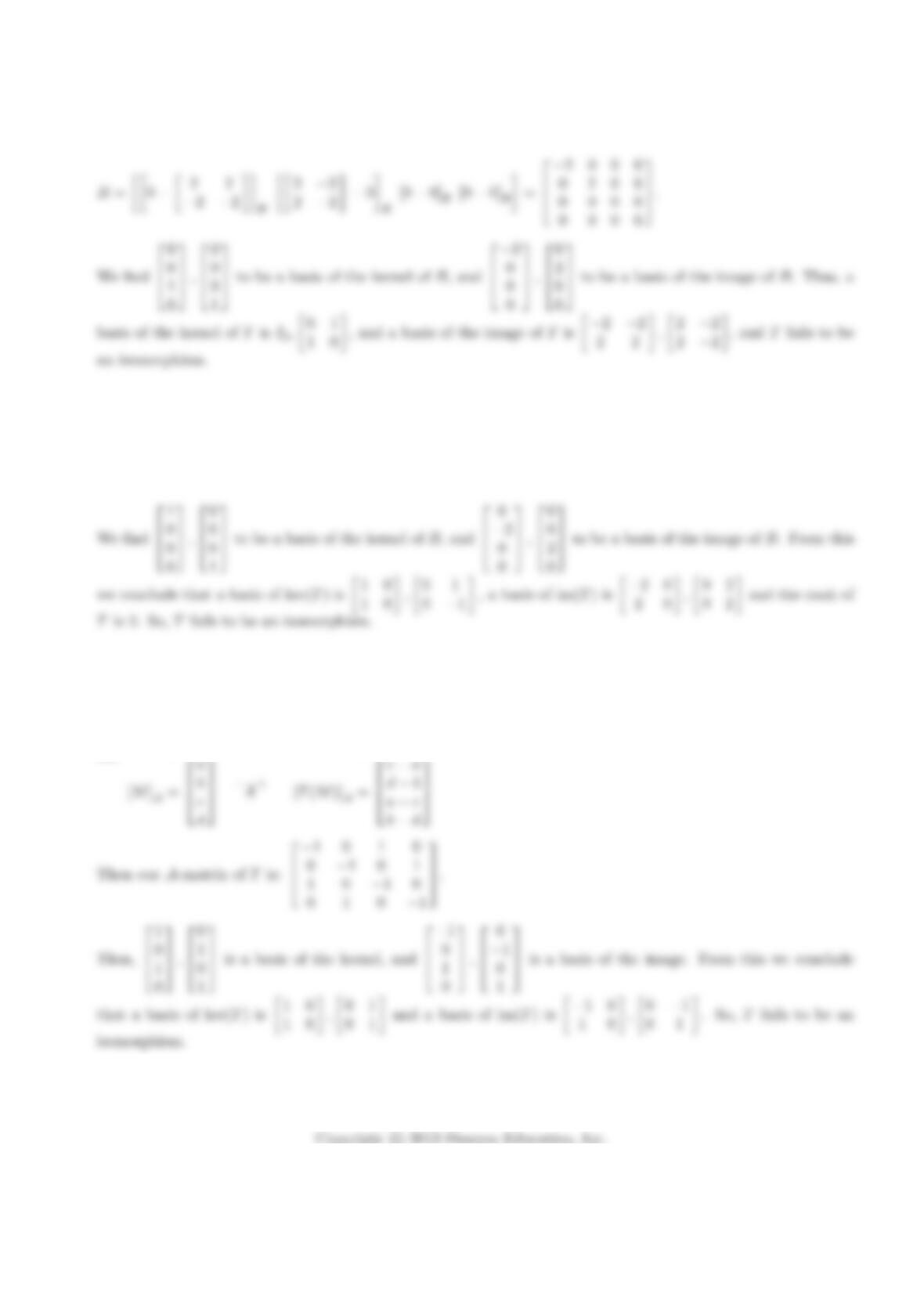
4.3.38 We will construct our matrix Bcolumn-by-column:
B=[0]B−2 0
2 0 B0 2
0 2 B
[0]B=
0 0 0 0
0−2 0 0
0 0 2 0
0 0 0 0
.
4.3.39 We use a diagram to show our work:
Let
M=a b
c d −−→
T T (M) = c−a d −b
a−c b −d
y
y
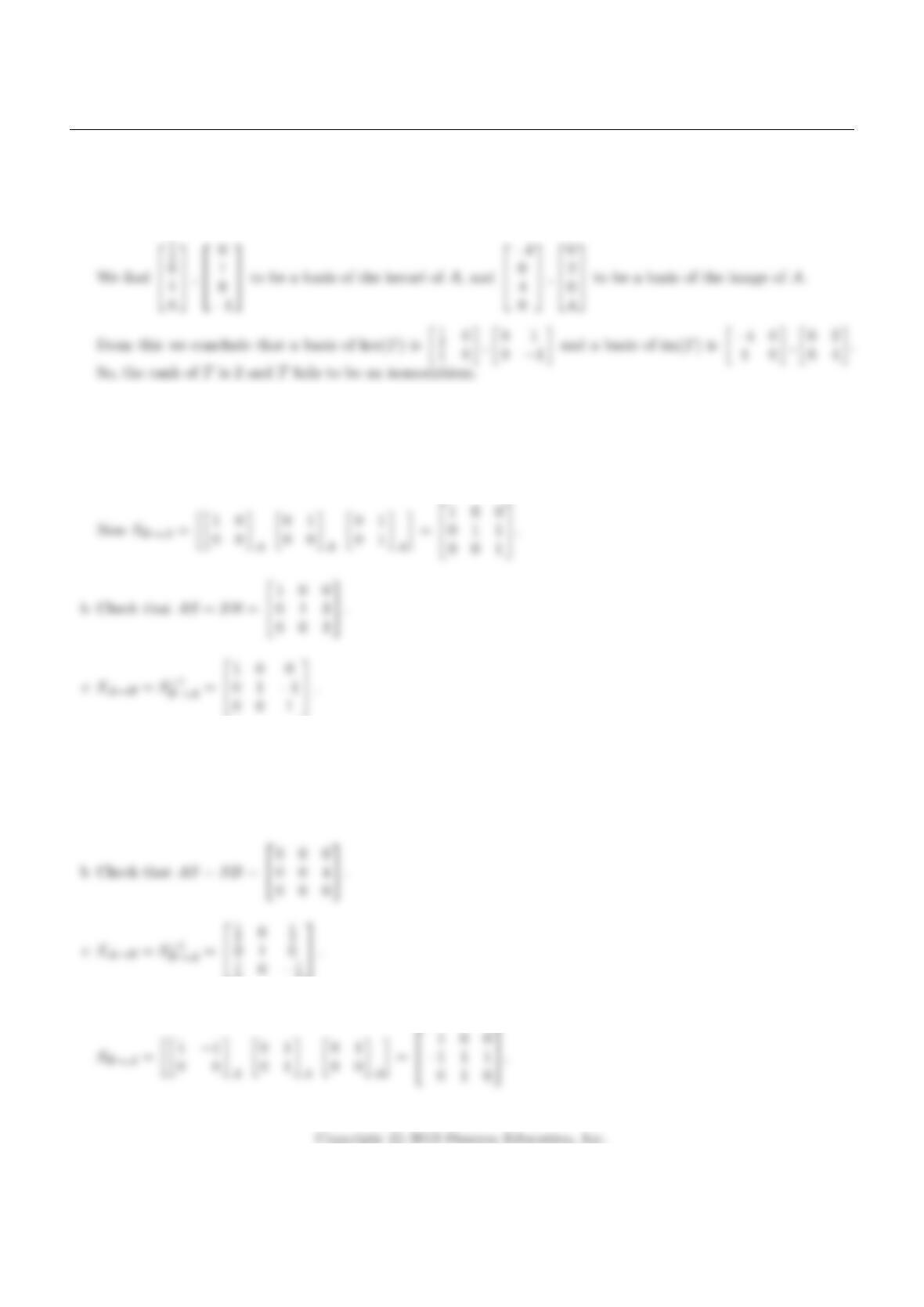
4.3.40 We will construct our matrix Acolumn-by-column:
211
Chapter 4
A= −4 0
4 0 A0 2
0 4 A 2 0
−2 0 A0 2
0 4 A=
−4 0 2 0
0 2 0 2
4 0 −2 0
0 4 0 4
.
4.3.41 a In Exercise 5 we consider the standard basis Aof U2×2, and in Exercise 6 we work with the alternative
basis Bconsisting of
1 0
0 0 ,0 1
0 0 ,0 1
0 1 .
4.3.42 a If Ais the standard basis considered in Exercise 8 and Bis the basis in Exercise 7, then
S=1 0
0 1 A0 1
0 0 A1 0
0−1A=
1 0 1
0 1 0
1 0 −1
.
20−1
2
4.3.43 a If Ais the standard basis considered in Exercise 10 and Bis the basis in Exercise 11, then
212