4.79: PROBLEM DEFINITION
Situation:
A two-dimensional velocity field is represented by the vector V=10xi−10yj.
Find:
Is the flow irrotational?
SOLUTION
In a two dimensional flow in the x−yplane, the flow is irrotational if (Eq. 4.34a)
81
4.80: PROBLEM DEFINITION
Situation:
Aflow field has velocity components described by u=−ωy and v=ωx.
Find:
Vorticity.
Rate of rotation.
SOLUTION
Rate of rotation
82
4.81: PROBLEM DEFINITION
Situation:
A two-dimensional velocity field is given by:
u=Cx
(x2+y2)2,v=Cy
(x2+y2)2.
Find:
Check if flow is irrotational.
SOLUTION
Apply equations for flow rotation in x−yplane.
83
4.82: PROBLEM DEFINITION
Situation:
A two=dimensional flow field is defined by:
u=x2−y2,v=−2xy.
Find:
If the flow is rotational or irrotational.
SOLUTION
Rate of flow rotation about the z-axis,
84
4.83: PROBLEM DEFINITION
Situation:
Fluid flows between two stationary plates.
u=2(1−4y2),V
max =2cm/s.
Find:
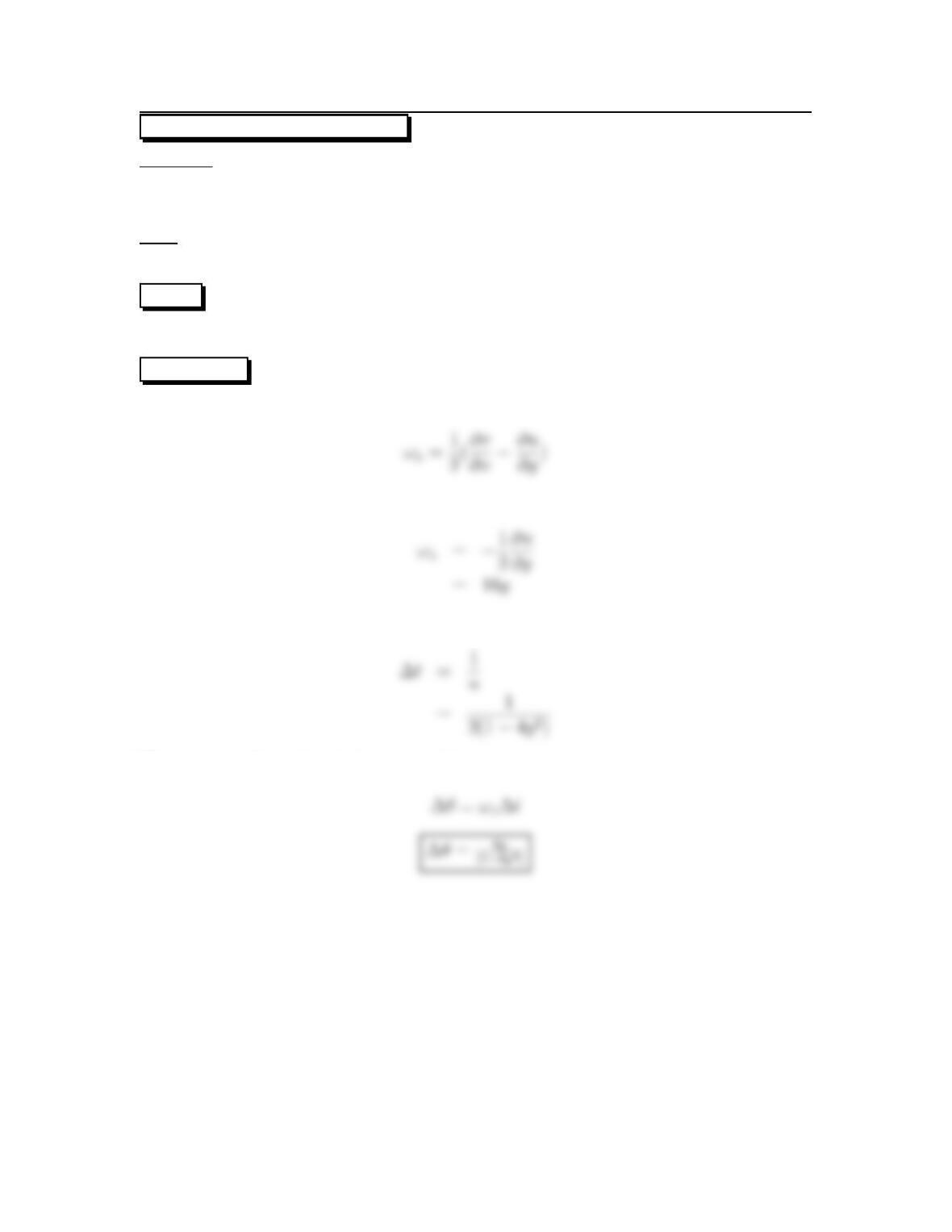
Find rotation of fluid element when it moves 1 cm downstream
PLAN
Apply equations for rotation rate of fluid element..
SOLUTION
The rate of rotation for this planar (two-dimensional) flow is
In this problem, v=0so
The time to travel 1 cm is
The amount of rotation in 1 cm travel is
85
4.84: PROBLEM DEFINITION
Situation:
A velocity distribution is provided for a combination of free and forced vortex.
vθ=1
r[1 −exp(−r2)],r=0.5,1.0,1.5.
2˙
θz=dvθ
dr +vθ
r=1
r
d
dr (vθr).
Find:
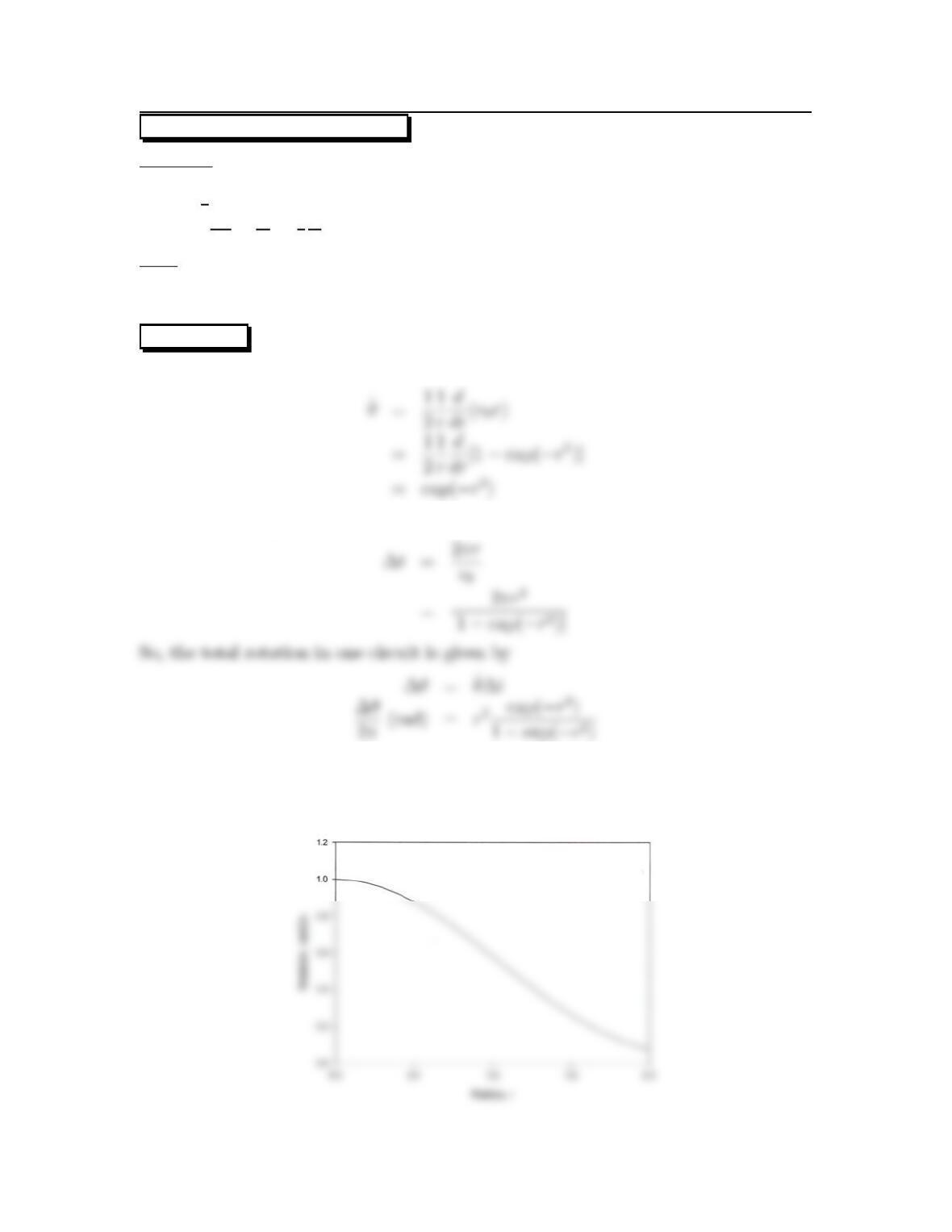
Find how much a fluid element rotates in one circuit around the vortex as a function
of radius.
SOLUTION
Therateofrotationisgivenby
Thetimetocompleteonecircuitis
A plot of the rotation in one circuit is shown. Note that the rotation is 2πfor r→0
(rigid body rotation) and approaches zero (irrotational) as rbecomes larger.
86

4.85: PROBLEM DEFINITION
Situation:
Incompressible and inviscid liquid flows around a bend.
V=1
r,ri=1m,ro=3m.
Find:
Depth of liquid from inside to outside radius (m).
PLAN
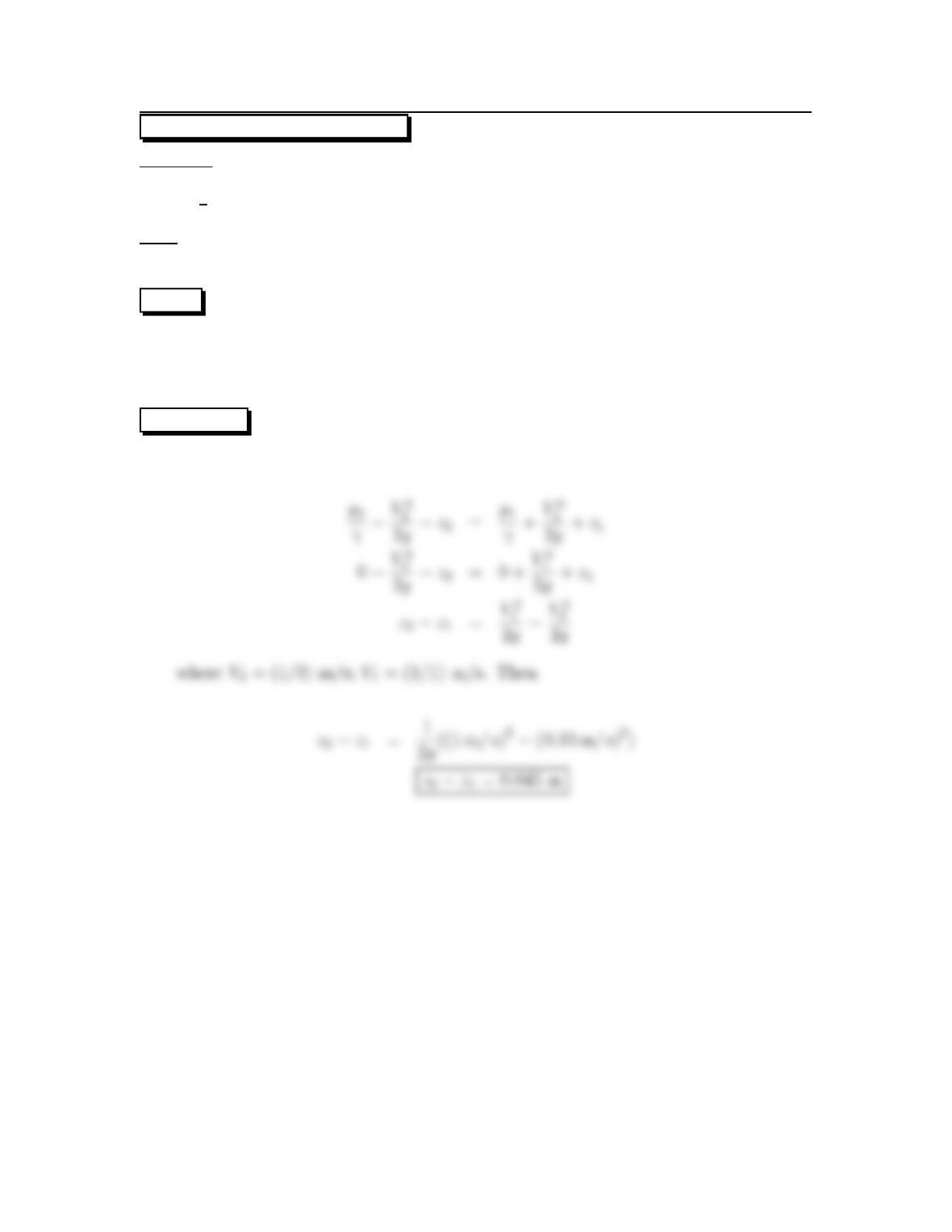
Flow field is irotational so apply the Bernoulli equation across streamlines between
theoutsideofthebendatthesurface(point2)andtheinsideofthebendatthe
surface (point 1).
SOLUTION
Bernoulli equation
88
4.86: PROBLEM DEFINITION
Situation:
An outlet pipe from a reservoir.
V=30ft/s,h=18ft.
Find:
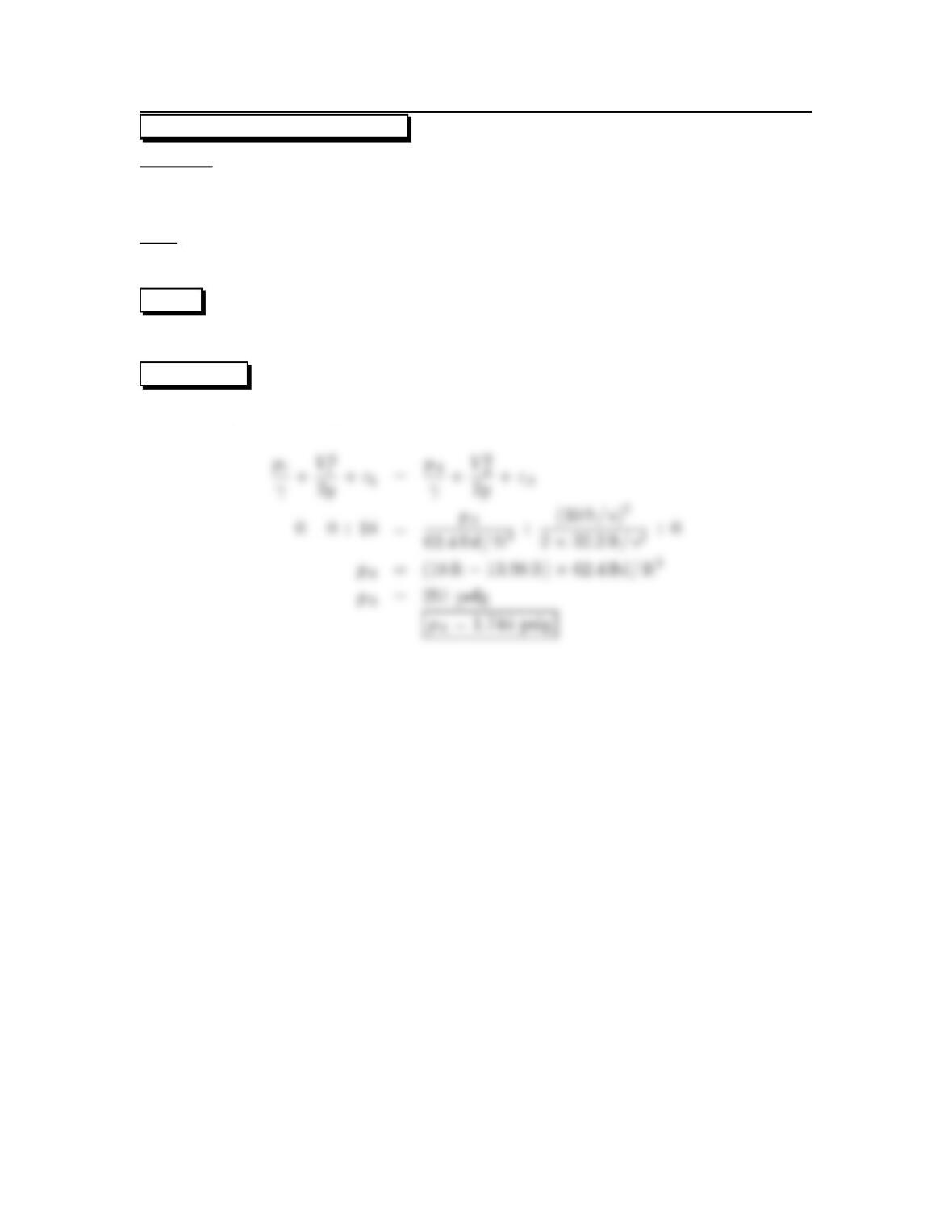
Pressure at point A(psig).
PLAN
Apply the Bernoulli equation.
SOLUTION
Bernoulli equation. Let point 1 be at surface in reservoir.
89
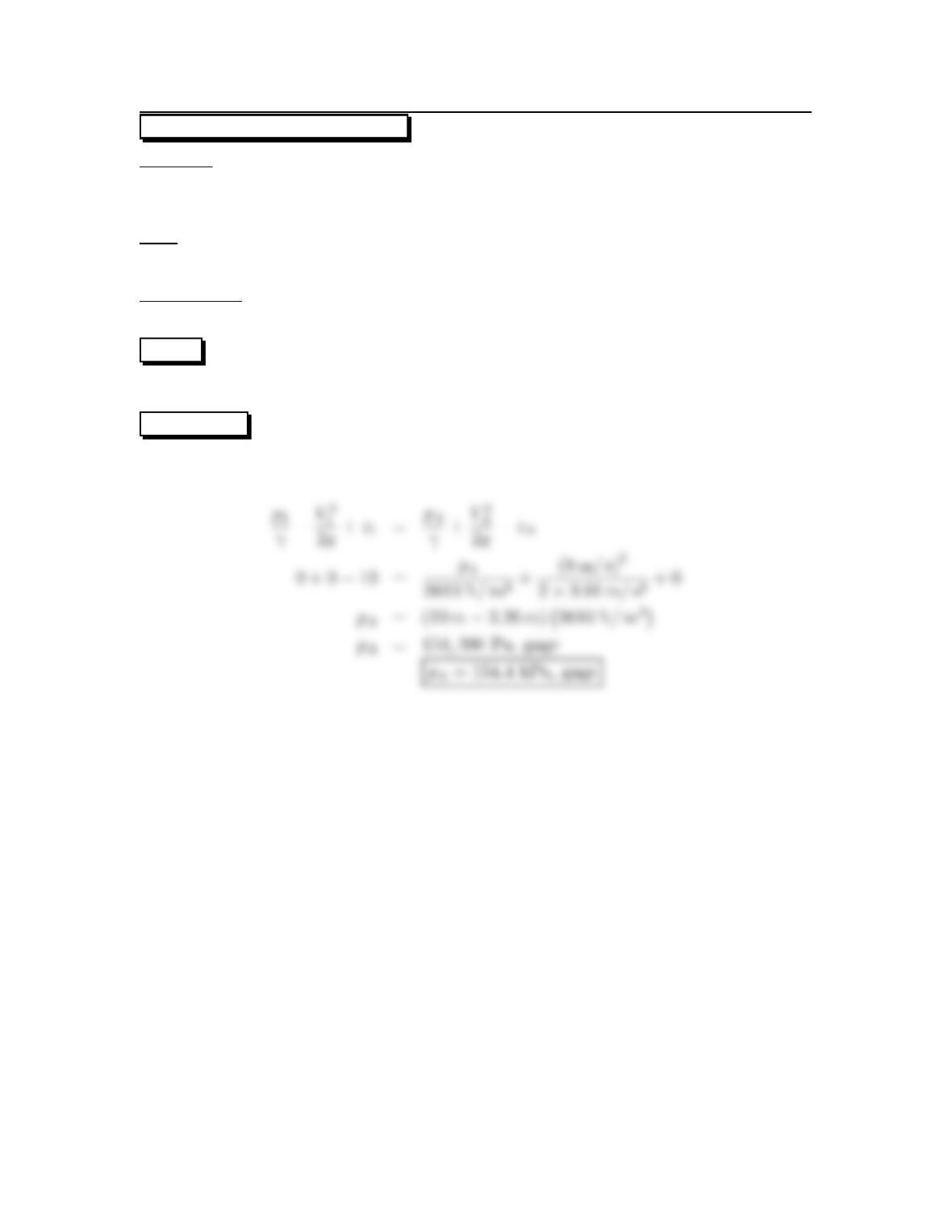
4.87: PROBLEM DEFINITION
Situation:
An outlet pipe from a reservoir.
V=8m/s,h=19m.
Find:
Pressure at point A(kPa).
Assumptions:
Flow is irrotational.
PLAN
Apply the Bernoulli equation.
SOLUTION
Bernoulli equation. Let point 1 be at reservoir surface.
90
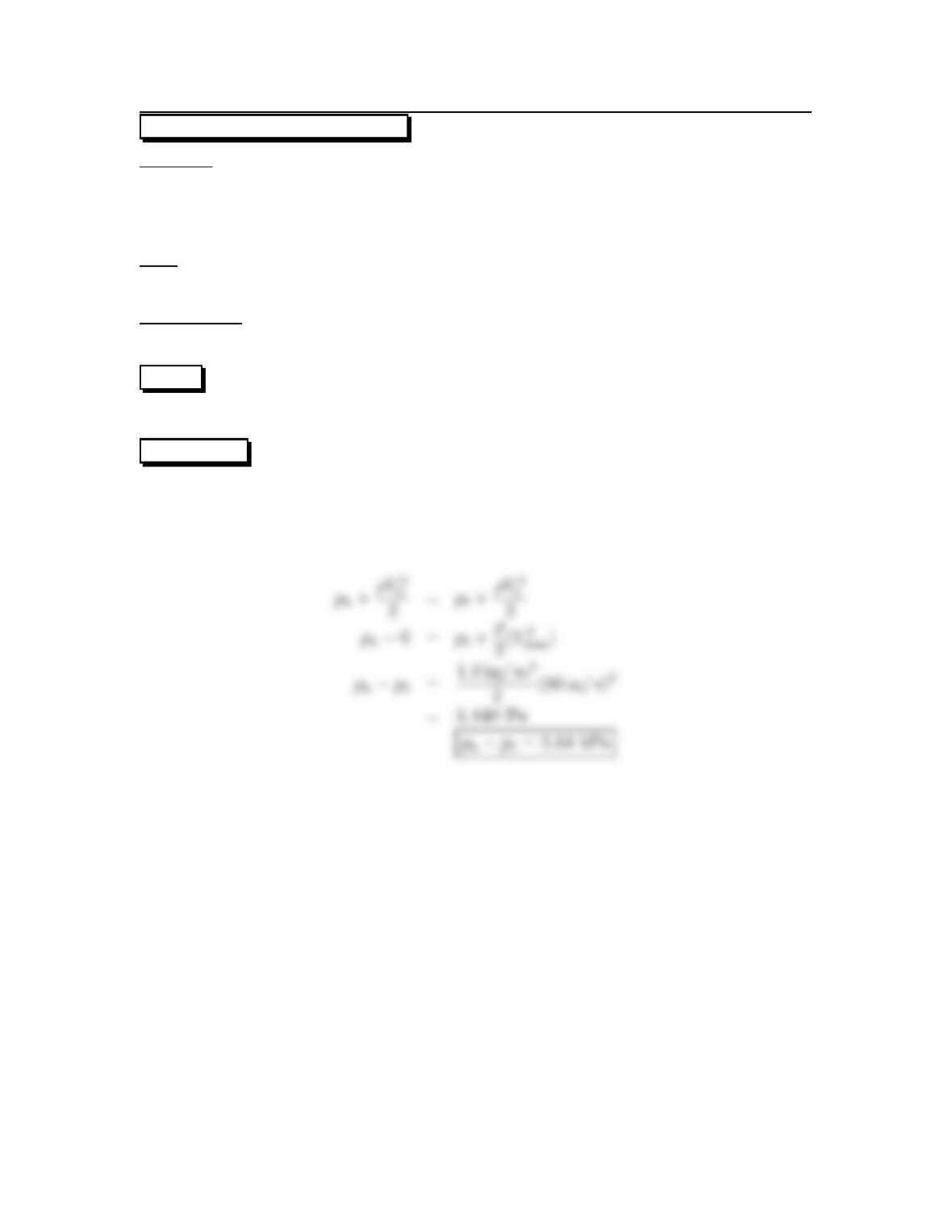
4.88: PROBLEM DEFINITION
Situation:
Air flows past a cylinder.Highest velocity at the maximum width of sphere is twice
thefreestreamvelocity.
V0=40m/s,Vmax =2V0.
Find:
Pressure difference between highest and lowest pressure (kPa).
Assumptions:
Hydrostatic effects are negligible and the wind has density of 1.2 kg/m3.
PLAN
Apply the Bernoulli equation between points of highest and lowest pressure.
SOLUTION
The maximum pressure will occur at the stagnation point where V=0and the point
of lowest pressure will be where the velocity is highest (Vmax =80m/s).
Bernoulli equation
91
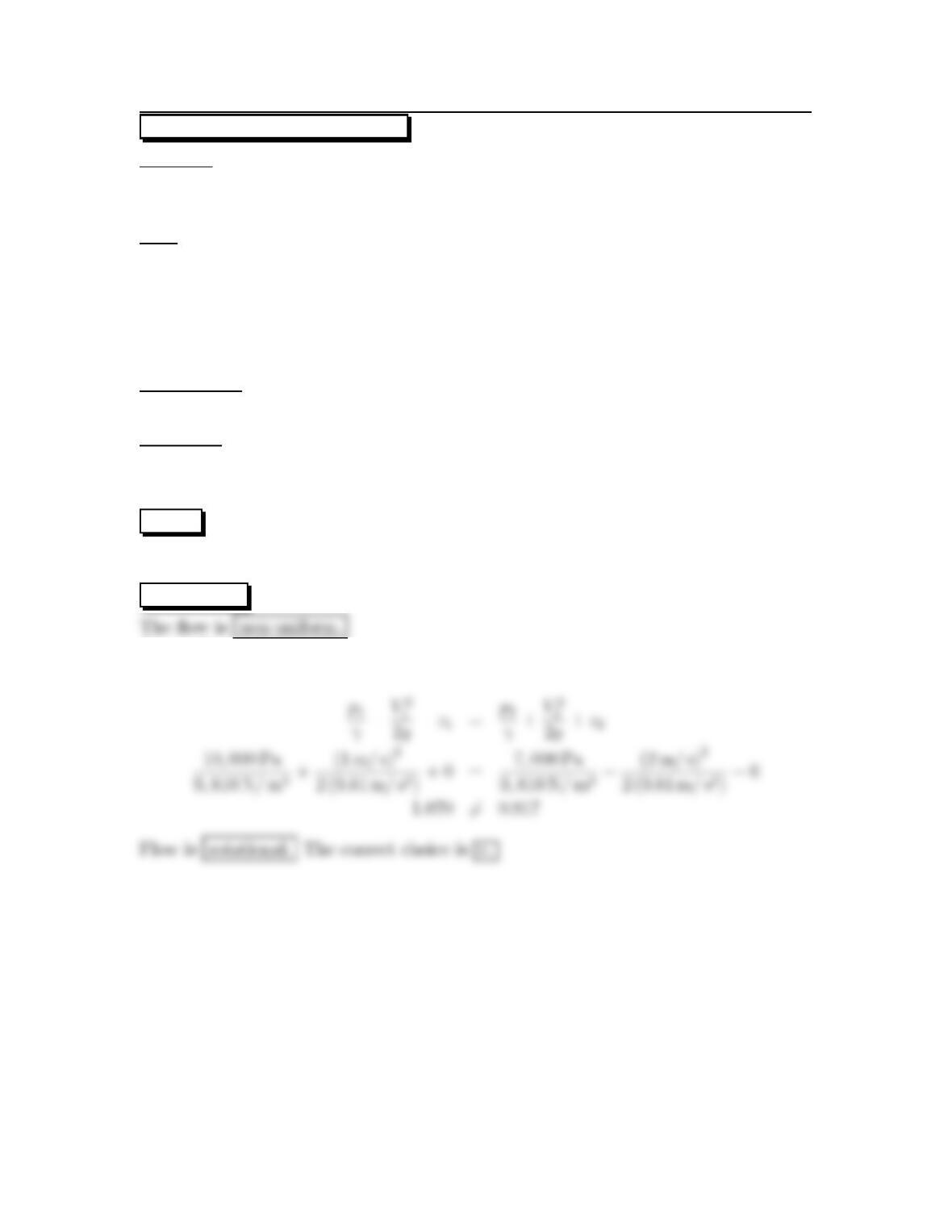
4.89: PROBLEM DEFINITION
Situation:
Velocity and pressure given at two points in a duct.
V1=1m/s,V2=2m/s.
Find:
Determine which is true:
(a) Flow in contration in nonuniform and irrotational.
(b) Flow in contration is uniform and irrotational.
(c) Flow in contration is nonuniform and rotational.
(d) Flow in contration is uniform and rotational.
Assumptions:
Elevations are equal.
Properties:
p1=10kPa,p2=7kPa.
ρ=1000kg/m3.
PLAN
Check to see if it is irrotational by seeing if it satisfies Bernoulli’s equation.
SOLUTION
Bernoulli equation
92
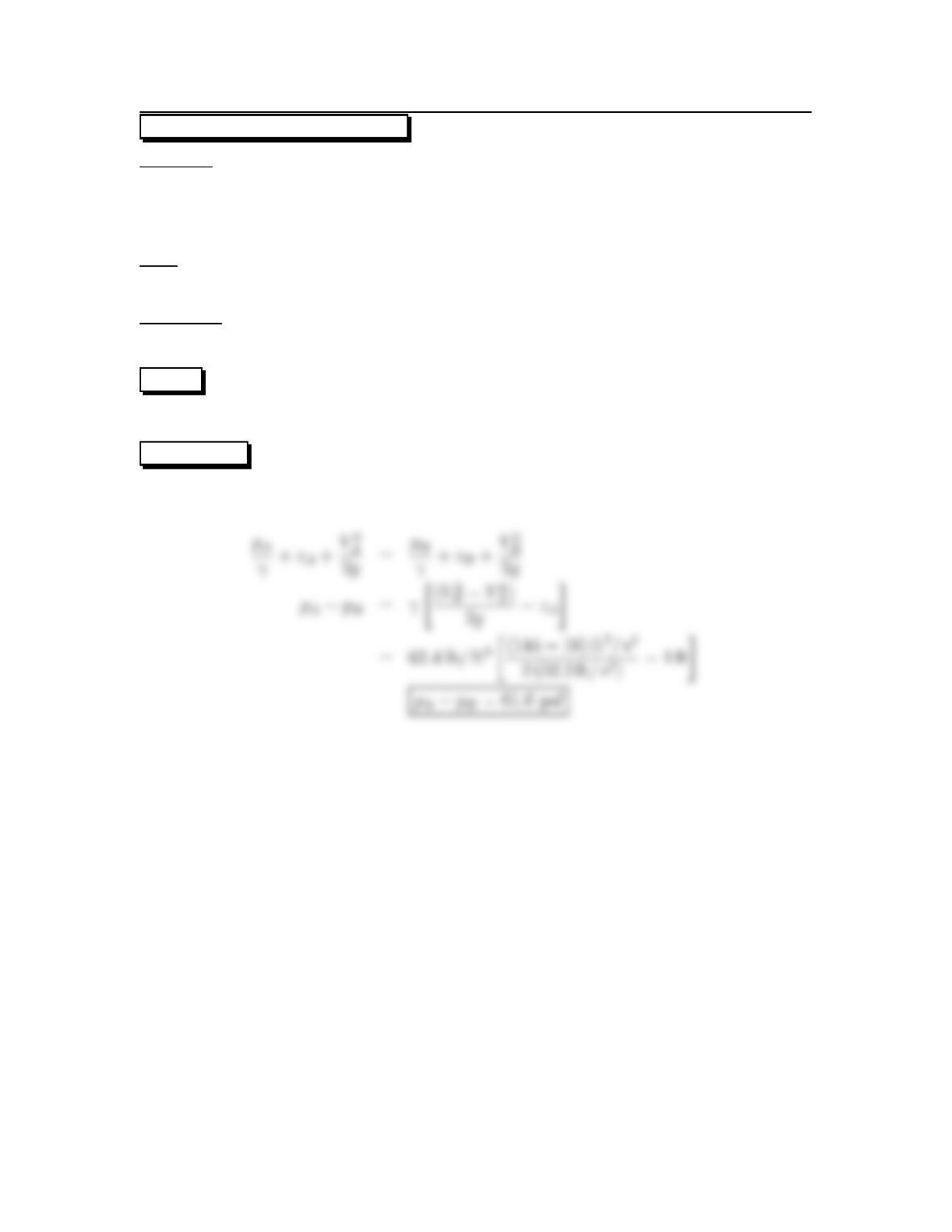
4.90: PROBLEM DEFINITION
Situation:
Water flowing from a large orifice in bottom of tank.
VA=4ft/s,VB=12ft/s.
zA=1ft,zB=0ft.
Find:
pA−pB(psf).
Properties:
ρ=62.4lb/ft3.
PLAN
Apply the Bernoulli equation.
SOLUTION
Bernoulli equation
93
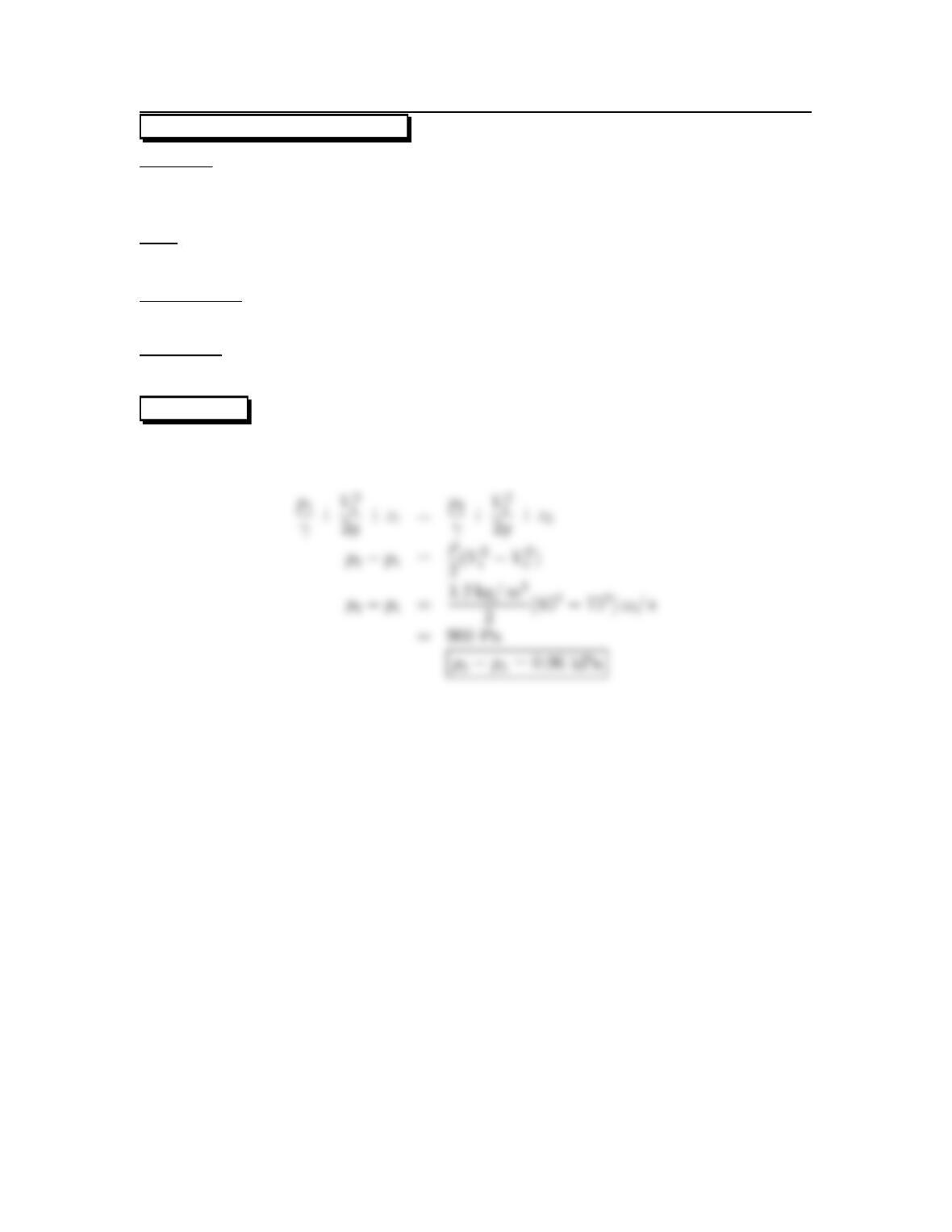
4.91: PROBLEM DEFINITION
Situation:
Aflow pattern past an airfoil.
V0=80m/s,V1=85m/s,V2=75m/s.
Find:
Pressure difference between bottom and top (kPa).
Assumptions:
The pressure due to elevation difference between points is negligible.
Properties:
ρ=1.2kg/m3.
SOLUTION
The flow is ideal and irrotational so the Bernoulli equation applies between any two
points in the flow field
94
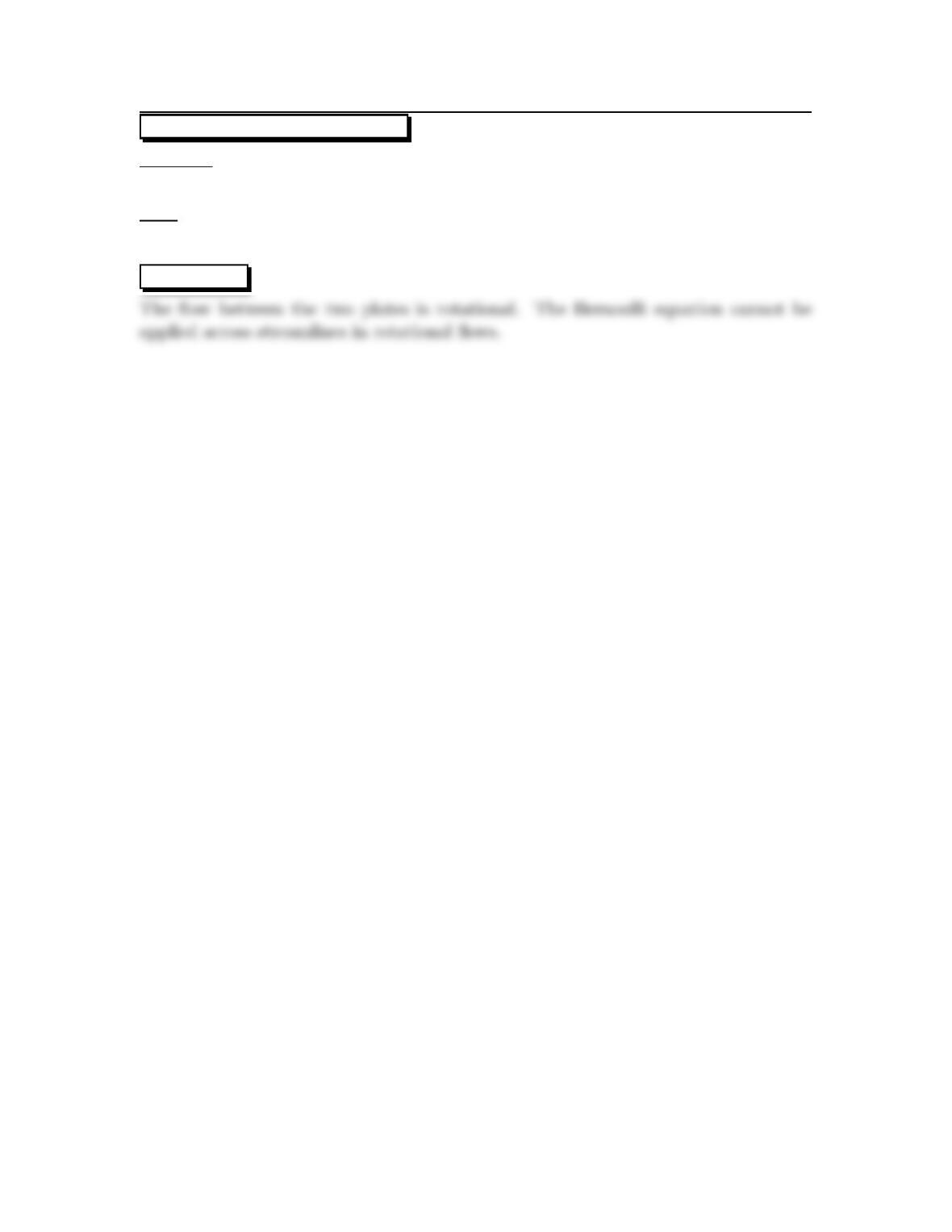
4.92: PROBLEM DEFINITION
Situation:
Flow of water between parallel plates.
Find:
Is the Bernoulli equation valid between plates?
SOLUTION
95
4.93: PROBLEM DEFINITION
Situation:
A two dimensional flow in the xy plane is described in the problem statement.
Find:
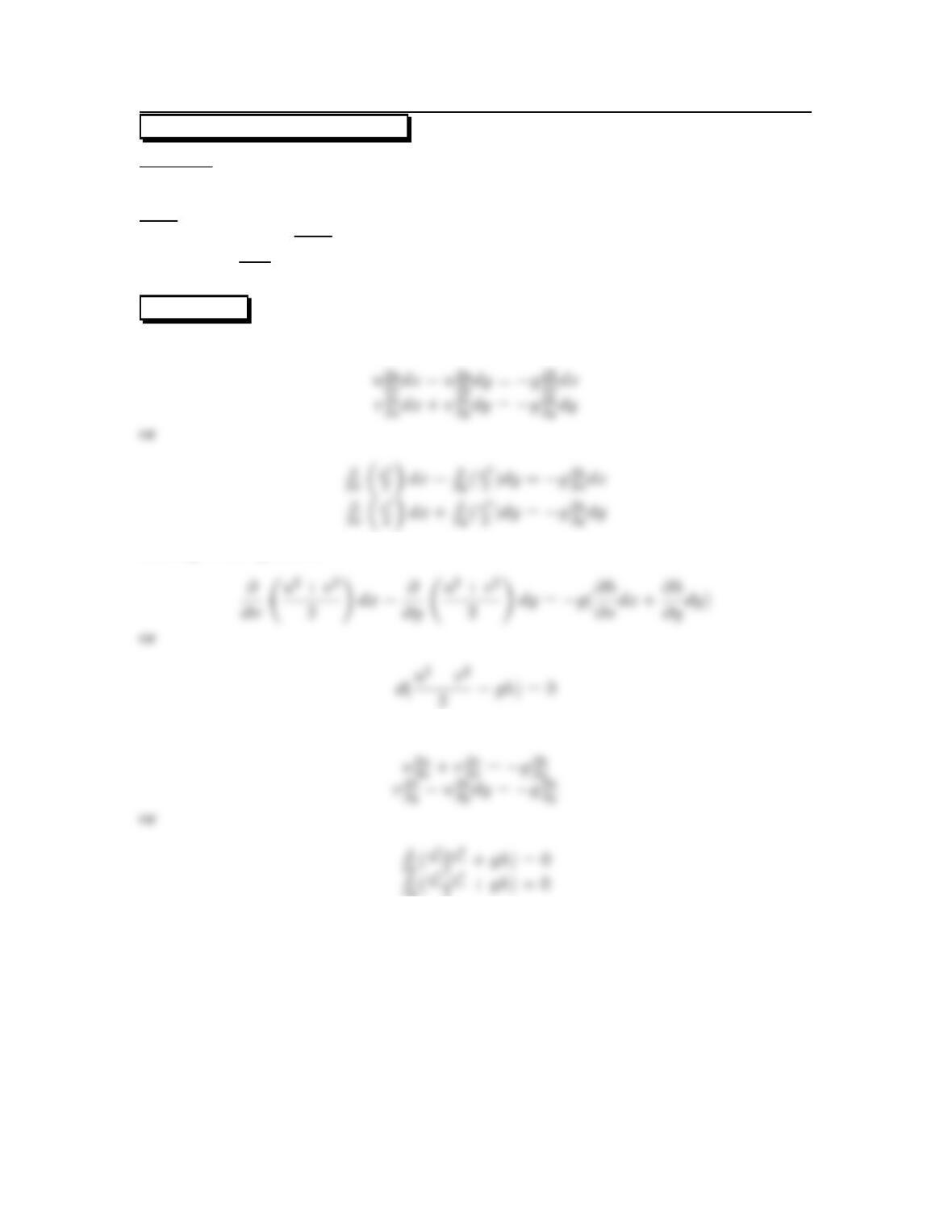
(a) Show that d(u2+v2
2+gh)=0.
(b) Show V2
2g+his constant in all directions.
SOLUTION
a) Substituting the equation for the streamline into the Euler equation gives
Adding both equations
b) Substituting the irrotationality condition into Euler’s equation gives
96
4.94: PROBLEM DEFINITION
Situation:
Afluid is flowing around a cylinder as shown in Fig 4.37 in §4.10. A favorable pressure
gradient can be found:
a. upstream of the stagnation point
b. at the stagnation point
c. between the stagnation point and separation point
SOLUTION
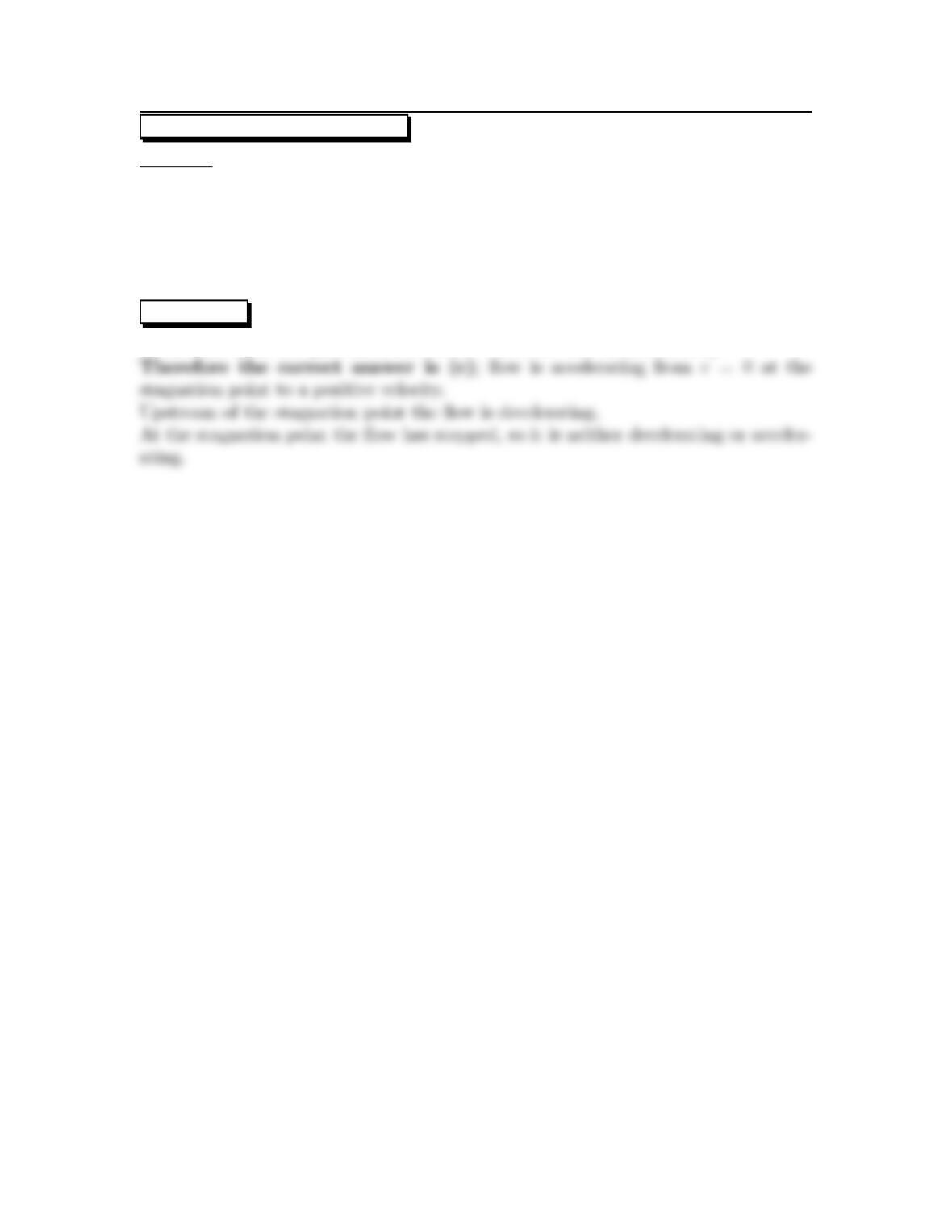
A favorable pressure gradient is defined as where the flow is accelerating.
97
4.95: PROBLEM DEFINITION
Situation:
Flow over a sphere.
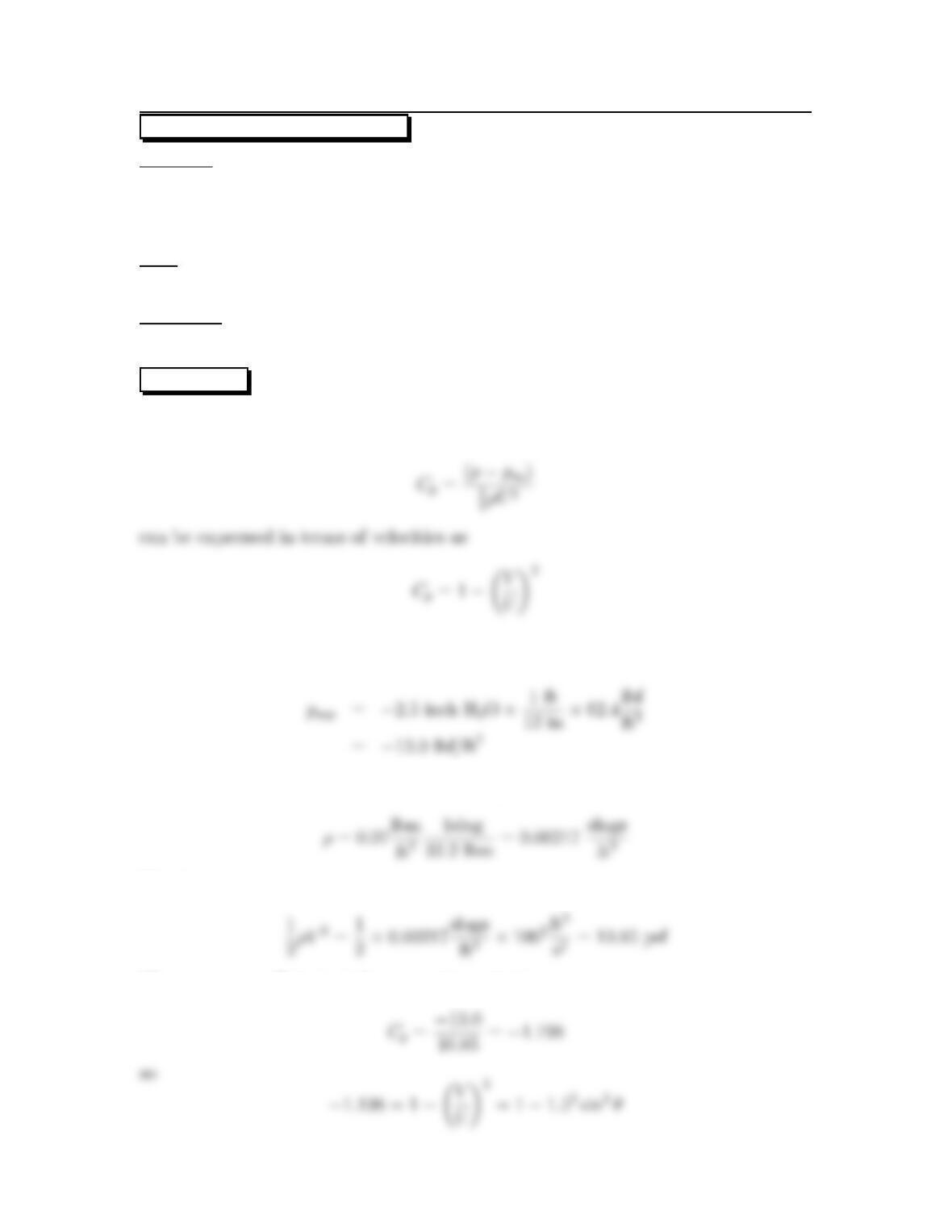
uθ=1.5Usin θ,p=−2.5in H2O.
V=100ft/s.
Find:
Angle of separation point.
Properties:
ρ=0.07 lb/ft3.
SOLUTION
Since the fluid is air, neglect the contribution of hydrostatic in the Bernoulli equation
The pressure coefficient defined by
by application of the Bernoulli equation. The pressure in psfg at the stagnation point
is
In order to have the correct units, the density has to be in slugs/ft3.
The dynamic pressure is
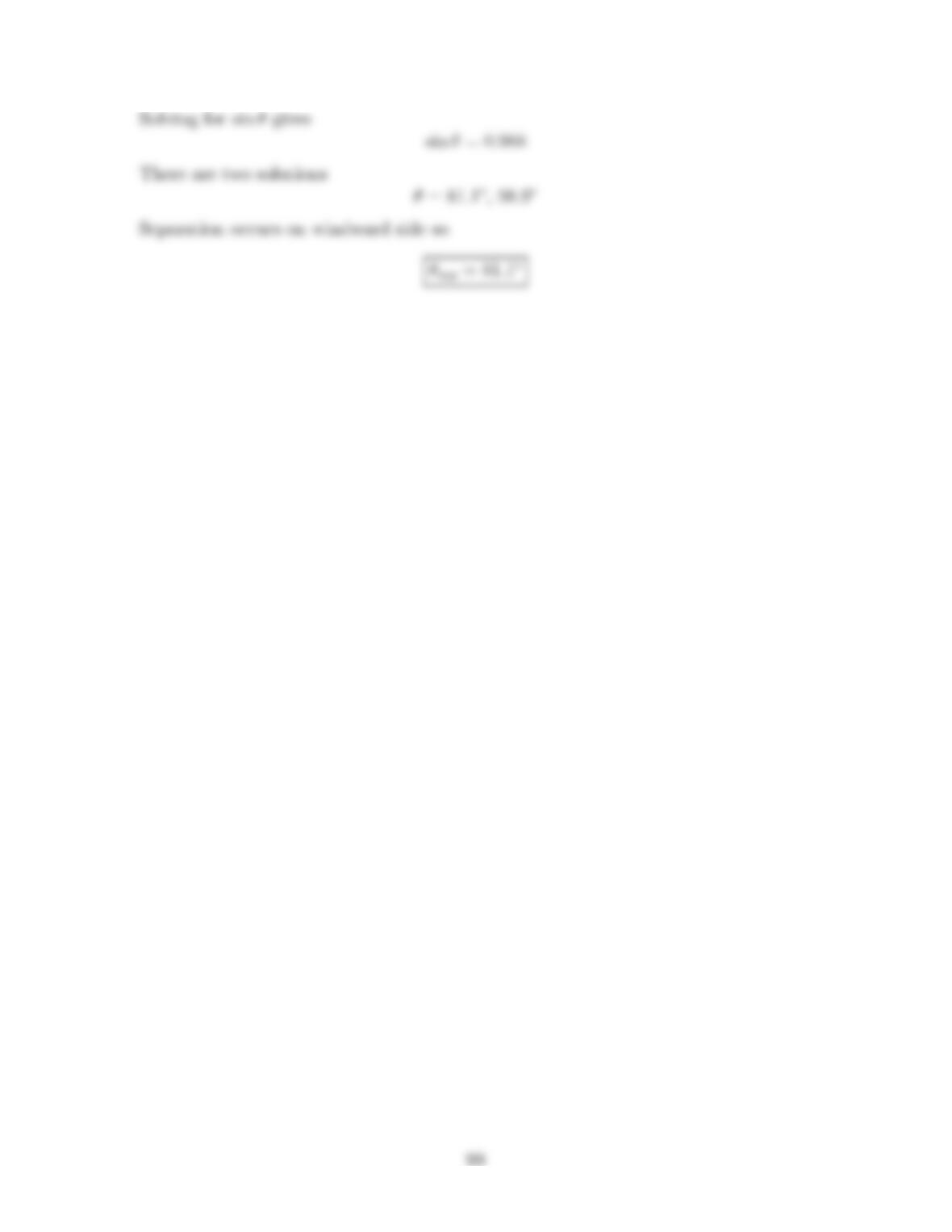
The pressure coefficient at the separation point is
98
4.96: PROBLEM DEFINITION
Situation:
ApplicationoftheBernoulliequationbetweenapointupstreamandinthewake
of a sphere.
Find:
Is the Bernoulli equation valid between these two points?
SOLUTION
100