4.1: PROBLEM DEFINITION
Situation:
Path of a fluid particle.
Find:
If a light was attached to a fluid particle and take a time exposure, would the image
you photographed be a pathline or streakline?
SOLUTION
1
4.2: PROBLEM DEFINITION
Situation:
Smoke rising from a chimney.
Find:
The pattern produced by smoke rising from a chimney on a windy day is analogous
to a pathline or streakline?
SOLUTION
The streakline is defined as a line generated by a tracer injected into flow at starting
2
4.3: PROBLEM DEFINITION
Situation:
A windsock is a sock-shaped device attached to a swivel on top of a pole. Windsocks
at airports are used by pilots to see instantaneous shifts in the direction of the wind.
If one drew a line co-linear with a windsock’s orientation at any instant, the line
would be best approximate a (a) pathline (b) streakline (c) streamline.
SOLUTION
Answer is (c) streamline. A windsock shows you the wind direction (flow field) at
the streamline.
3
4.4: PROBLEM DEFINITION
Situation:
For pathlines, streaklines, and streamlines to all be co-linear, the flow must be
a) dividing
b) stagnant
c) steady
d) a tracer
SOLUTION
4
4.5: PROBLEM DEFINITION
Situation:
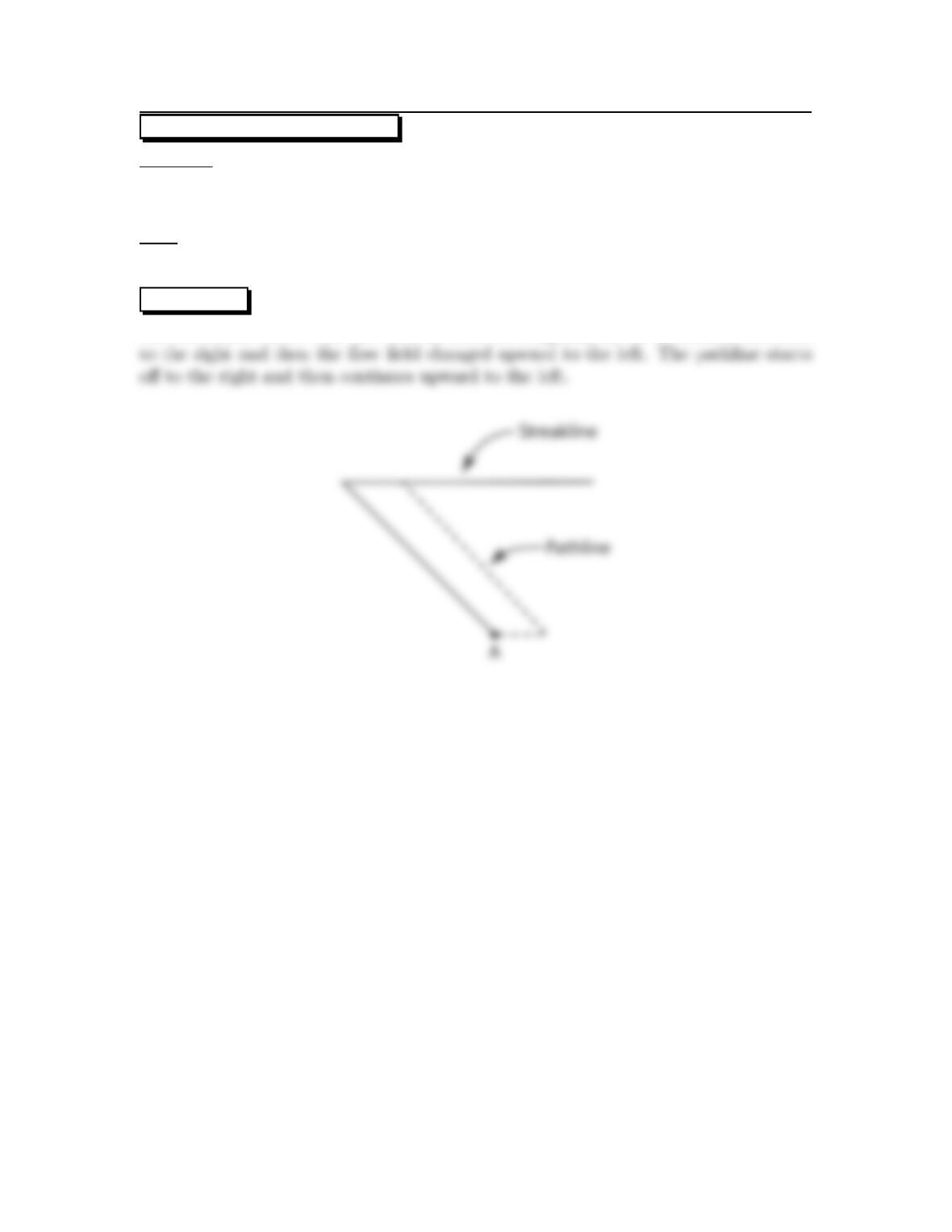
Dye is injected into a flow field and produces a streakline.
Pathline starts at t=4s,endsatt=10s.Flow speed is constant.
Find:
Draw a pathline of the particle.
SOLUTION
The streakline shows that the velocity field was originally in the horizontal direction
5
4.6: PROBLEM DEFINITION
Situation:
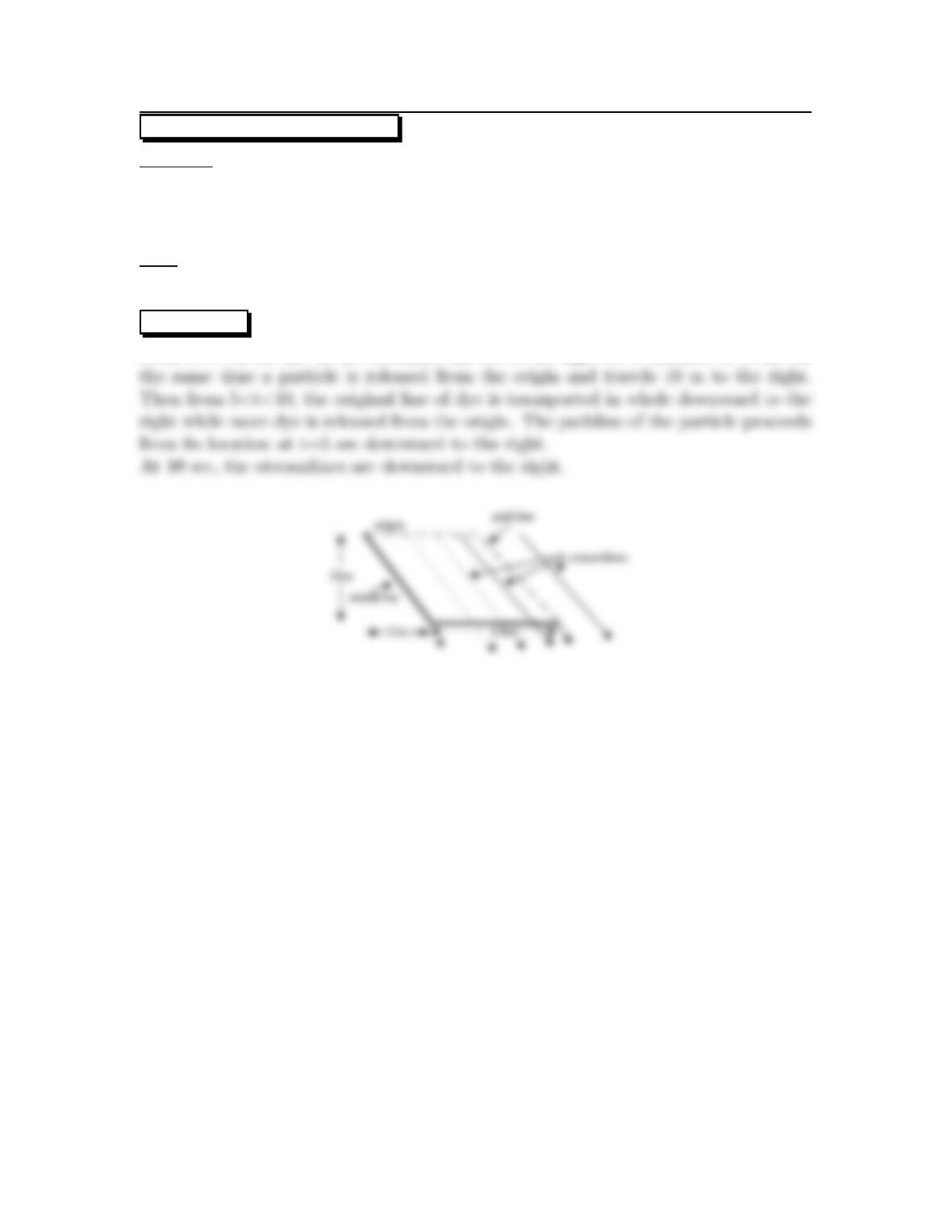
A dye streak was started, and a particle was released.
For 0≤t≤5s,u=2 m/s,v=0.
For 5<t≤10 s,u=3 m/s,v=−4m/s.
Find:
For t=10s, draw to scale the streakline, pathline of the particle, and streamlines.
SOLUTION
From 0<t<5, the dye in the streakline moved to the right for a distance of 10 m. At
6
4.7: PROBLEM DEFINITION
Situation:
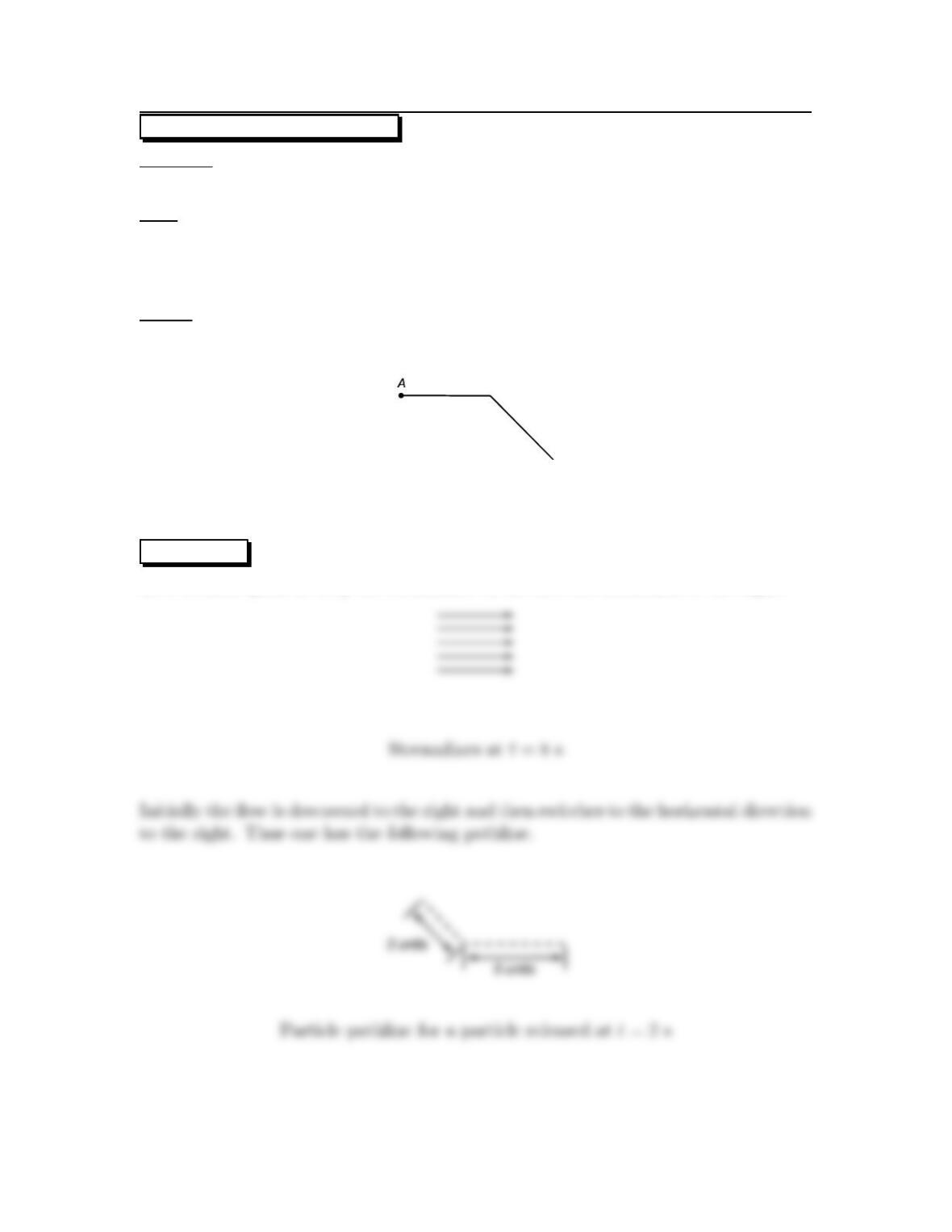
A dye streak is produced in a flow that has a constant speed.
Find:
Sketch a streamline at t=8 s.
Sketch a particle pathline at t=10 sfor a particle that was released from point A
at time t=2 s.
Sketch:
SOLUTION
At 8 seconds (near 10 sec) the streamlines of the flow are horizontal to the right.
7
4.8: PROBLEM DEFINITION
Situation:
Avelocityfield is given mathematically as V=2i+4yj.Thevelocityfield is:
a. 1D in x
b. 1D in y
c. 2D in x and y
SOLUTION
8
4.9: PROBLEM DEFINITION
Situation:
Gasoline spill in a major river.
The mayor of a large downstream city demands an estimate of hours for the spill
to get to reach supply plant intake.
Emergency responders measure the speed of the leading edge of the spill, effectively
focusing on one particle of fluid.
Environmental engineers employ a computer model which simulates the velocity
field for any stage of the river, and for all locations (including steep narrow canyon
sections with fast velocities, and an extremely wide reach with slow velocities).
To compare these two mathematical approaches, which statement is most correct?
a. The responders have an Eulerian approach, and the engineers have a Lagrangian
one
b. The responders have a Lagrangian approach, and the engineers have an Eulerian
one.
SOLUTION
9
4.10: PROBLEM DEFINITION
Situation:
Unsteady flow.
Find:
Identify five examples of an unsteady flow explain what features classify them as
unsteady?
SOLUTION
1. Gust of wind blowing past a pole.
10
4.11: PROBLEM DEFINITION
Situation:
Pouring a heavy syrup on pancakes.
Find:
Would the thin film of syrup be a laminar or turbulent flow?
SOLUTION
11
4.12: PROBLEM DEFINITION
Situation:
Avelocityfield is given by V=10xyi.Itis
a. 1D and steady
b. 1D and unsteady
c. 2D and steady
d. 2D and unsteady
SOLUTION
12
4.13: PROBLEM DEFINITION
Situation:
Which is the most correct way to characterize turbulent flow?
a. 1D
b. 2D
c. 3D
SOLUTION
There are 2 possible answers.
13
4.14: PROBLEM DEFINITION
Situation:
The valve in a system is gradually opened to have a constant rate of increase in
discharge.
Find:
Describe the flow at points A and B.
SOLUTION
14
4.15: PROBLEM DEFINITION
Situation:
Water flows in a widening passage with flow rate decreasing with time.
Find:
Describe the flow.
PLAN
Steady or unsteady has to do with a time rate of change. Uniform or non-uniform
has to do with whether the streamlines are parallel or not.
SOLUTION
15

4.16: PROBLEM DEFINITION
Situation:
Aflow pattern has converging streamlines.
Find:
Classify the flow.
SOLUTION
16
4.17: PROBLEM DEFINITION
Situation:
Afluid flows in a straight conduit. The conduit has a section with constant
diameter, followed by a section with changing diameter.
Find:
Match the given flow labels with the mathematical descriptions.
SOLUTION
Steady flow corresponds to ∂Vs/∂t =0.
17
4.18: PROBLEM DEFINITION
Situation:
A series of flows are either one, two or three dimensional.
Find:
Classify the flowsasone,twoorthreedimensional.
(a) Water flow over the crest of a long spillway of a dam.
(b) Flow in a straight horizontal pipe.
(c) Flow in a constant-diameter pipeline that follows the contour of the ground in
hilly country.
(d) Airflow from a slit in a plate at the end of a large rectangular duct.
(e) Airflow past an automobile.
(f) Air flow past a house.
(g) Water flow past a pipe that is laid normal to the flow across the bottom of a
wide rectangular channel.
SOLUTION
a. Two dimensional e. Three dimensional
18
4.19: PROBLEM DEFINITION
Situation:
Acceleration.
Find:
Is the acceleration vector always aligned with the velocity vector?
SOLUTION
19
4.20: PROBLEM DEFINITION
Situation:
Rotating bodies.
Find:
Is the acceleration toward the center of rotation a centripetal or centrifugal accel-
eration?
SOLUTION
The acceleration toward the center of rotation is centripetal acceleration. “Petal”
20