
Chap. 4 Subsurface Investigation and Characterization
4.1 Describe a scenario that would require a very extensive site investigation and laboratory testing
program (i.e., one in which a large number of borings and many laboratory and/or in–situ tests
would be necessary).
Solution
One such scenario would be a large development project that includes large and tall buildings to
Chap. 4 Subsurface Investigation and Characterization
4.2 How would you go about determining the location of the groundwater table in the design soil
profile. Recall that this is not necessarily the same as the groundwater table that was present
when the borings were made.
Solution
First install an observation well in a completed boring to monitor the groundwater conditions.
4.3 A five–story office building is to be built on a site underlain by moderately uniform soils.
Bedrock is at a depth of over 200 m. This building will be 50 m wide and 85 m long, and the
foundations will be founded at a depth of 1 m below the ground surface. Determine the required
number and depth of the exploratory borings.
Solution
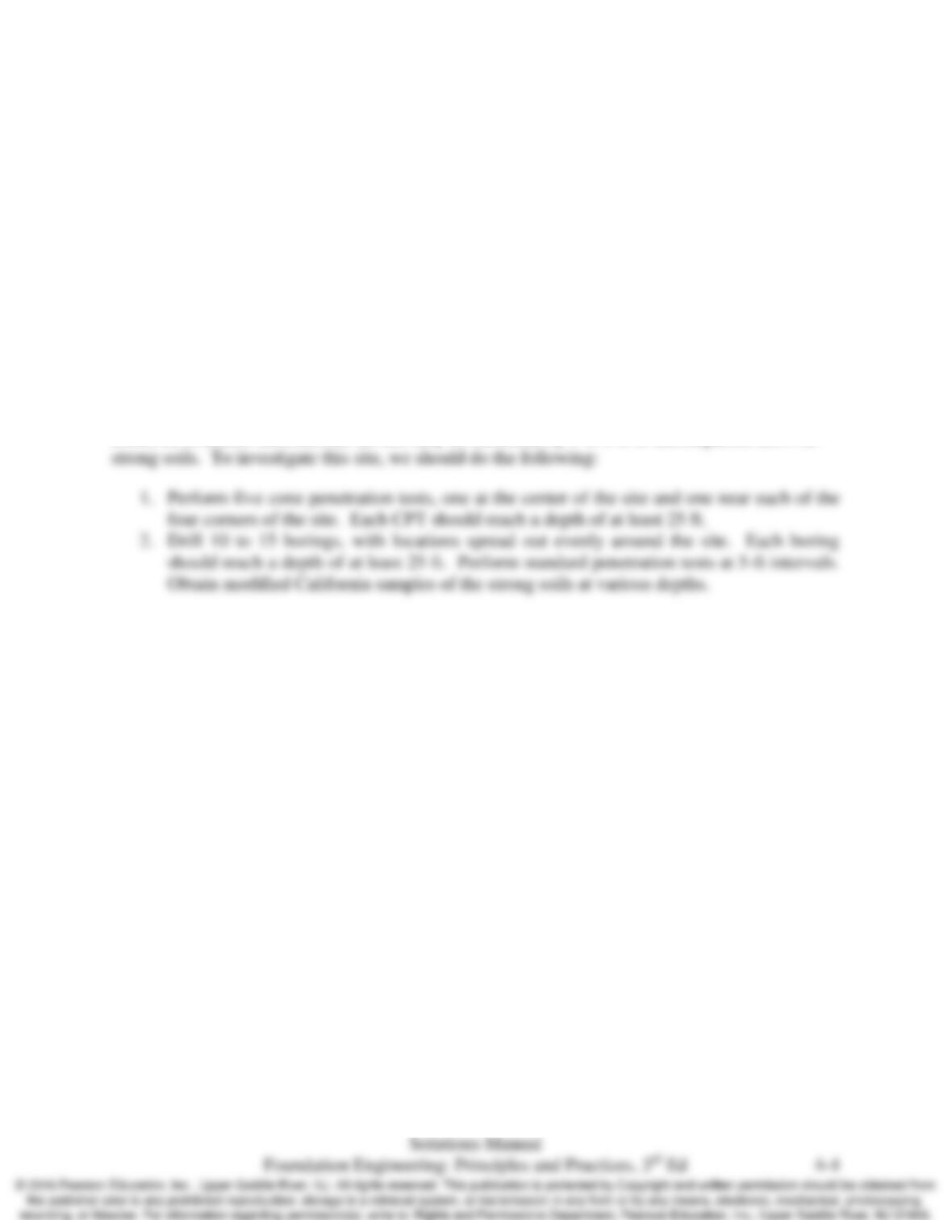
Using Table 4.1, we determine that there should be a boring for each 600 m2.
Chap. 4 Subsurface Investigation and Characterization
4.4 A two–story reinforced concrete building is to be built on a vacant parcel of land. This building
will be 100 ft wide and 200 ft long. Based on information from other borings on adjacent
properties, you are reasonably certain that the soils below a depth of 5 to 8 feet (1.5 to 2.5 m) are
strong and relatively incompressible. However, the upper soils are questionable because several
uncompacted fills have been found in the neighborhood. Not only are these uncompacted fills
loose, they have often contained various debris such as wood, rocks, and miscellaneous trash.
However, none of these deleterious materials is present at the ground surface at this site.
Plan a site investigation program for this project and present your plan in the form of written
instructions to your field crew. This plan should include specific instructions regarding what to
do, where to do it, and any special instructions. You should presume that the field crew is
experienced in soil investigation work, but is completely unfamiliar with this site.
Solution
Based on available information, the site may be underlain by 5 to 8 ft of uncompacted fill over

Chap. 4 Subsurface Investigation and Characterization
4.5 Discuss the advantages of the cone penetration test over the standard penetration test:
Solution
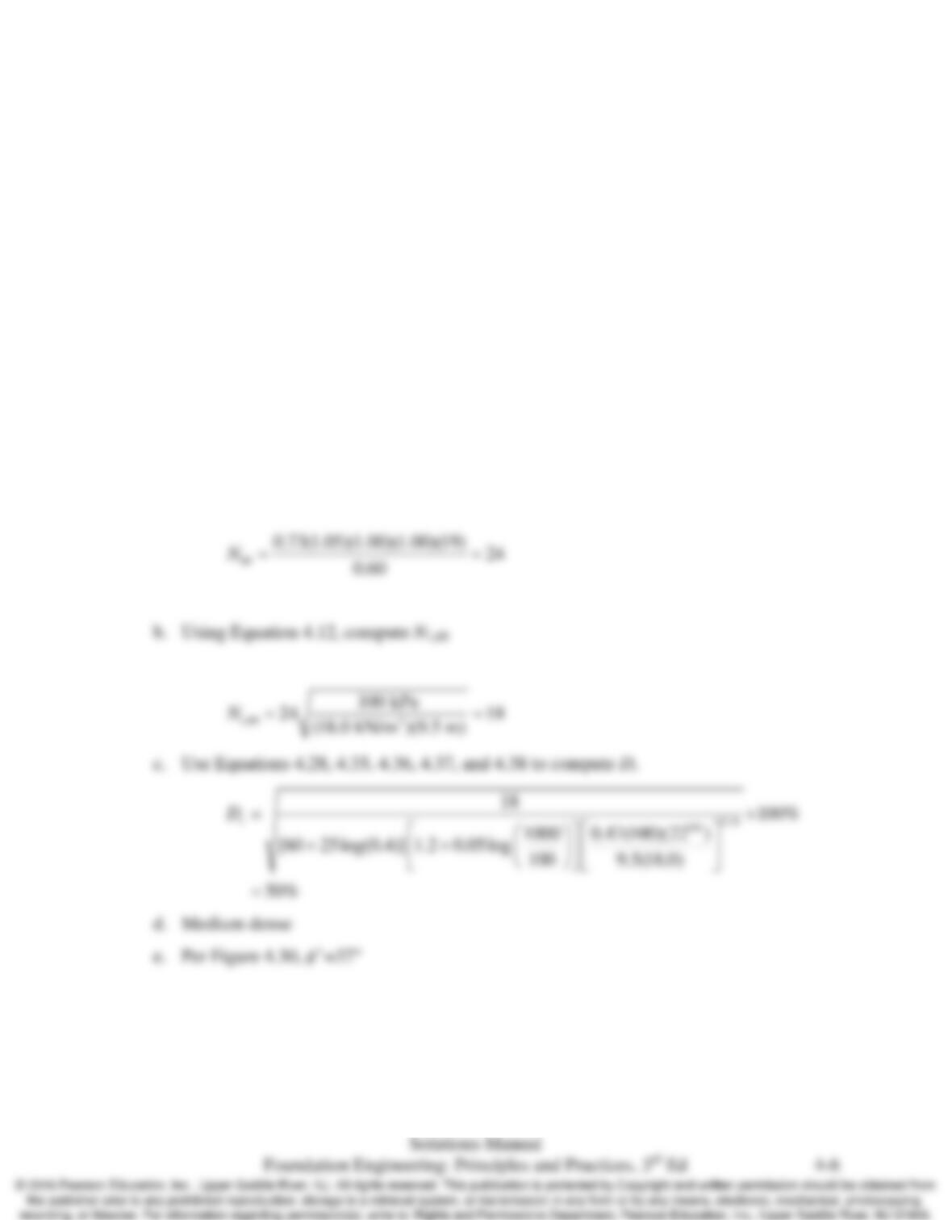
First and foremost, the CPT produces much better quality data than the SPT. The CPT allows
Chap. 4 Subsurface Investigation and Characterization
4.6 Standard penetration test was performed in a 150–mm diameter boring at a depth of 9.5 m below
the ground surface. The driller used a UK–style automatic trip hammer and a standard SPT
sampler. The actual blow count, N, was 19. The soil is a normally consolidated fine sand with a
unit weight of 18.0 kN/m3 and D50 = 0.4 mm. The groundwater table is at a depth of 15 m.
Compute the following:
a. N60
b. N1,60
c. Dr
d. Consistency (based on Table 3.3)
e. ϕʹ
Solution
a. Using Equation 4.11, compute N60
Chap. 4 Subsurface Investigation and Characterization
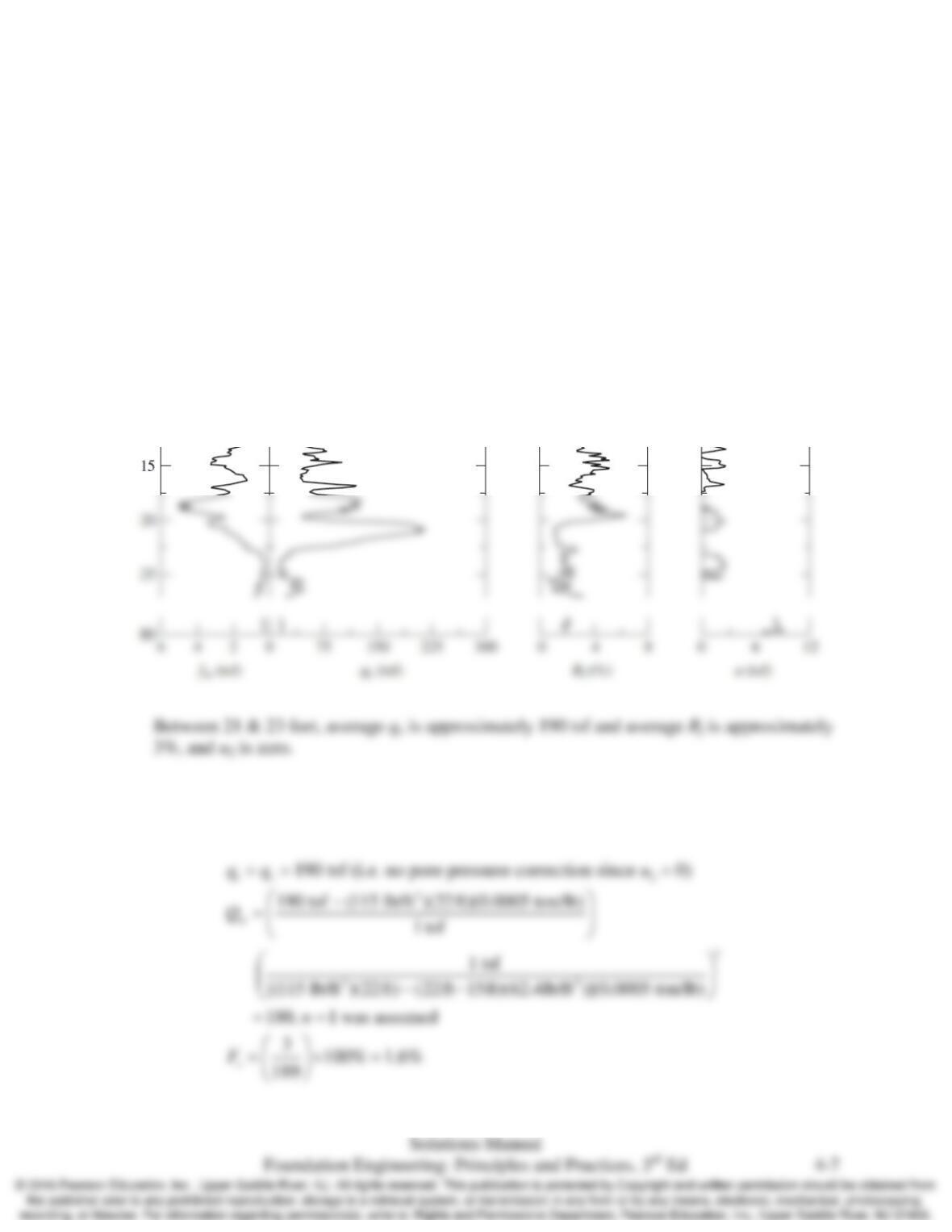
4.7 Using the cone penetration test data in Figure 4.22, a unit weight of 115 lb/ft3, and an
overconsolidation ratio of 3, compute the following for the soil between depths of 21 and 23ft.
Use a groundwater depth of 15 ft below the ground surface.
a. Soil behavior type.
b. Dr (assume the soil has some fines, but no mica)
c. Consistency (based on Table 3.3)
d.
ϕ
ʹ
e. N60 (use an estimated D50 of 0.60 mm)
Solution
Portion of CPT test of interest
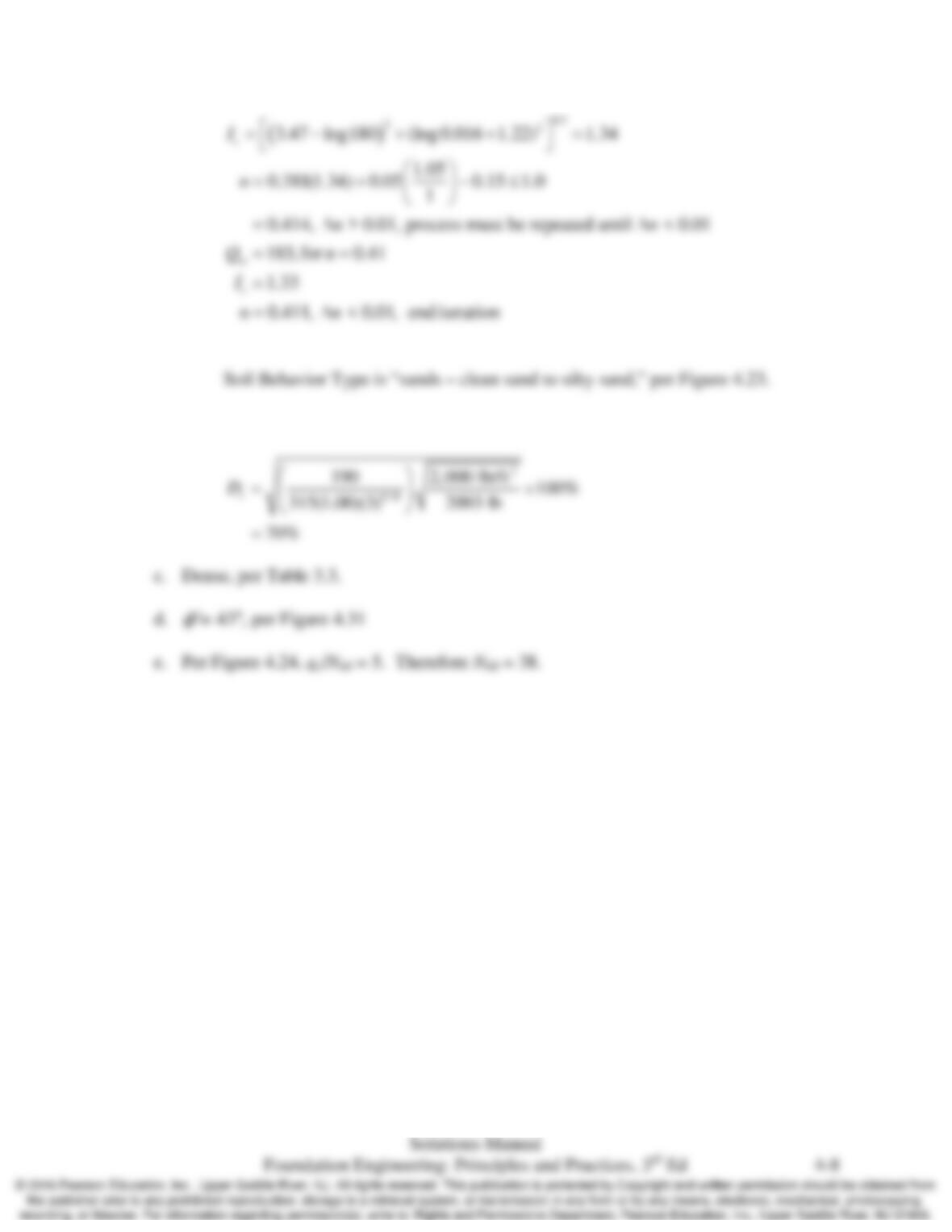
a. Using Equations 4.15 and 4.16, compute
tn
Q
and
r
F
. Then, using Equations 4.18 and
4.19, compute
c
I
and n.
Chap. 4 Subsurface Investigation and Characterization
b. Using Equation 4.39 English, compute the relative density

Chap. 4 Subsurface Investigation and Characterization
4.8 Classify the soil stratum between depths of 66 and 80 ft in Figure 4.22. What is the significance
of the spike in the plots at a depth of 77 ft?
Solution
Using the method used for problem 4.7 part a, the soil behavior type is “sand mixture – silty sand
4.9 The following standard penetration test results were obtained in a uniform silty sand:
Depth (m) 1 2 3 5
N60 12 13 18 15
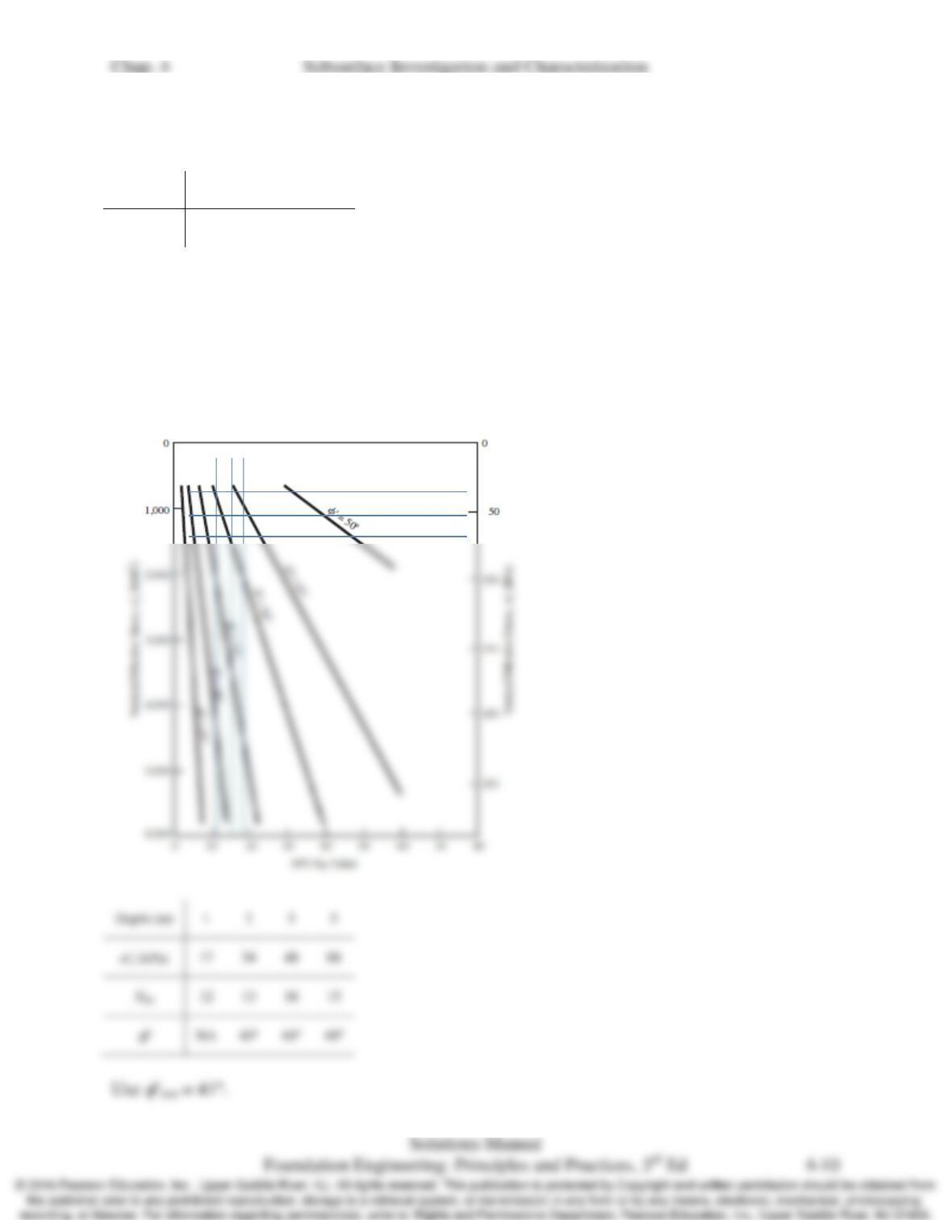
The groundwater table is at a depth of 2.5 m. Assume a reasonable value for γ, then determine
ϕ
ʹ
for each test. Finally, determine a single design
ϕ
ʹ value for this stratum.
Solution
Per Table 3.2, assume γ values of 17
3
kN/m
above the groundwater table and 20
3
kN/m
below
the groundwater table. Note that any reasonable assumptions for γ would be acceptable.
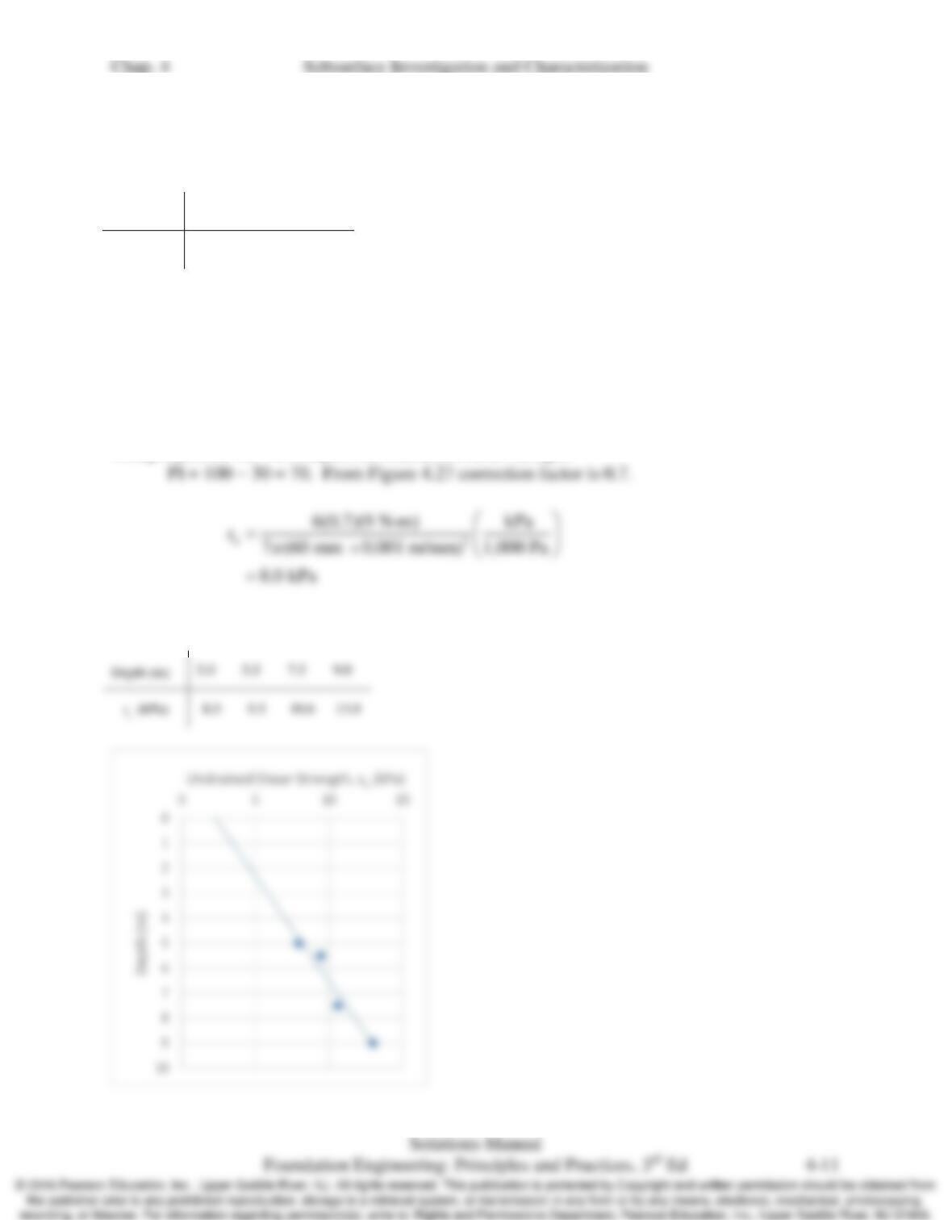
4.10 A series of vane shear tests have been performed on a soft clay stratum. The results of these tests
are as follows::
Depth (m) 5.0 5.5 7.5 9.0
Tf (N-m) 9.0 10.7 12.0 14.7
The vane was 60 mm in diameter and 120 mm long. The soil has a liquid limit of 100 and a
plastic limit of 30. Compute the undrained shear strength for each test, then develop a plot of
undrained shear strength vs. depth. This plot should have depth on the vertical axis, with zero at
the top of the plot.
Solution
Using Equation 4.27 to compute the undrained shear strength
The following table shows the computational results for all given depths

Chap. 4 Subsurface Investigation and Characterization
4.11 A dilatometer test was performed in a normally consolidated clay at a depth of 10 m, giving a KD
of 2.1. The clay has a unit weight of 118 lb/ft3, and the groundwater table is at the ground
surface. Estimate the undrained shear strength of the clay at a depth of 10 m.
Solution
Using Equation 4.42, compute the undrained shear strength