Section 4.1
Chapter 4
Section 4.1
4.1.1Not a subspace since it does not contain the neutral element, that is, the function f(t) = 0, for all t.
4.1.2This subset Vis a subspace of P2:
•The neutral element f(t) = 0 (for all t) is in V.
4.1.3This subset Vis a subspace of P2:
•The neutral element f(t) = 0 (for all t) is in Vsince f′(1) = f(2) = 0.
•If fand gare in V(so that f′(1) = f(2) and g′(1) = g(2)), then
4.1.4This subset Vis a subspace of P2:
•The neutral element f(t) = 0 (for all t) is in Vsince Z1
0
0dt = 0.
179
Chapter 4
4.1.5If p(t) = a+bt +ct2then p(−t) = a−bt +ct2and −p(−t) = −a+bt −ct2.
4.1.6Not a subspace, since I3and −I3are invertible, but their sum is not.
4.1.7a The set Vof diagonal 3 ×3 matrices is a subspace of R3×3:
b The zero matrix
000
000
000
is in V,
4.1.8This is a subspace; the justification is analogous to Exercise 7.
4.1.9Not a subspace; consider multiplication with a negative scalar. I3belongs to the set, but −I3doesn’t.
4.1.11 Not a subspace: I3is in rref, but the scalar multiple 2I3isn’t.
4.1.12 Yes, the set Wof all arithmetic sequences is a subspace of V. Use the fact that a sequence (x0, x1, x2,…) is
arithmetic if xn=x0+kn for some constant k.
180
Section 4.1
4.1.13 Not a subspace: (1,2,4,8,…) and (1,1,1,1,…) are both geometric sequences, but their sum (2,3,5,9,…)
is not, since the ratios of consecutive terms fail to be equal, for example, 3
26=5
3.
4.1.14 Yes
4.1.15 The set Wof all square-summable sequences is a subspace of V:
•The sequence (0,0,0,…) is in W.
will converge.
4.1.16
a b
c d
e f
=a
1 0
0 0
0 0
+b
0 1
0 0
0 0
+c
0 0
1 0
0 0
+d
0 0
0 1
0 0
+e
0 0
0 0
1 0
+f
0 0
0 0
0 1
4.1.17 Let Eij be the n×mmatrix with a 1 as its ijth entry, and zeros everywhere else. Any Ain Rn×mcan be
written as the sum of all aij Eij , and the Eij are linearly independent, so that they form a basis of Rn×m. Thus
dim(Rn×m) = nm.
Chapter 4
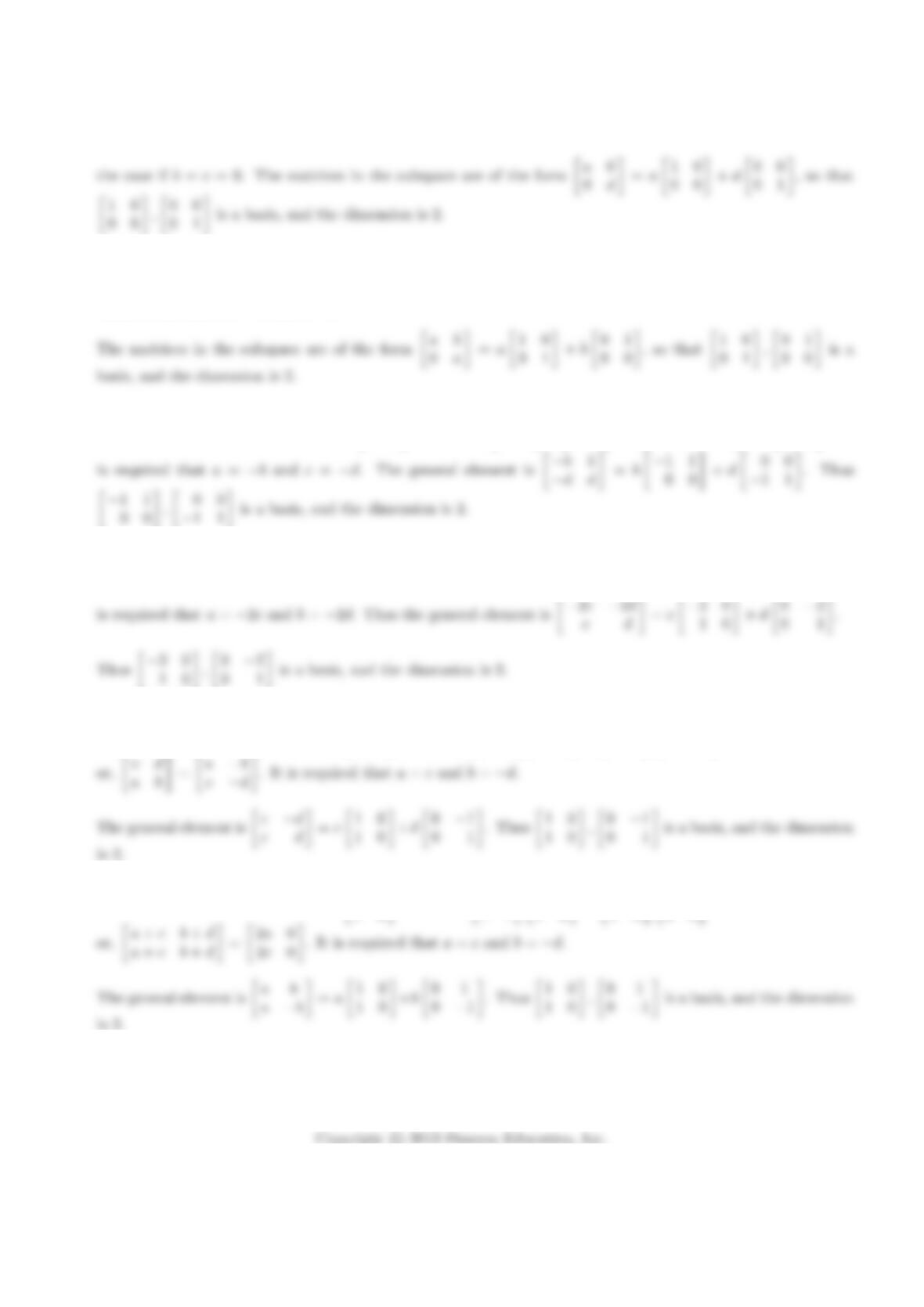
4.1.20 We use Summary 4.1.6. We have a=−d, so that the general element of the subspace is −d b
c d =
4.1.21 Use Summary 4.1.6. The general element of the subspace is
4.1.22 Using Exercise 21 as a guide, we find the basis E11, E22,…,Enn, where Eii is the n×nmatrix with all 0
entries, except for a 1 at the ith place on the diagonal. The dimension of this space is n.
4.1.24 Proceeding as in Exercise 21, we find the basis E11, E12, E13, E22, E23, E33. Here Eij is the 3 ×3 matrix with
all 0 entries, except for a 1 in the ith component of the jth column; the dimension is 6.
4.1.25 A polynomial f(t) = a+bt +ct2is in this subspace if f(1) = a+b+c= 0, or a=−b−c.
The polynomials in the subspace are of the form f(t) = (−b−c) + bt +ct2=b(t−1) + c(t2−1), so that t−1,
t2−1 is a basis of the subspace, whose dimension is 2.
4.1.26 Denote the subspace by W. A polynomial f(t) = a+bt +ct2+dt3is in Wif f(1) = a+b+c+d= 0 and
d
The polynomials in Ware of the form f(t) = −1
3c−2
3c+dt+ct2+dt3=ct2−2
3t−1
3+d(t3−t), so that
t2−2
3t−1
3, t3−tis a basis of W, and dim(W) = 2.
182
Section 4.1
4.1.28 a b
c d is in the subspace if a b
c d 1 1
0 1 =a a +b
c c +dequals 1 1
0 1 a b
c d =a+c b +d
c d
which is the case if c= 0 and a=d.
4.1.29 We are looking for the matrices a b
c d such that a b
c d 1 1
1 1 =a+b a +b
c+d c +d=0 0
0 0 . It
4.1.30 We are looking for the matrices a b
c d such that 1 2
3 6 a b
c d =a+ 2c b + 2d
3a+ 6c3b+ 6d=0 0
0 0 . It
4.1.31 We are looking for the matrices a b
c d such that 0 1
1 0 a b
c d =a b
c d 1 0
0−1,
4.1.32 We are looking for the matrices a b
c d such that 1 1
1 1 a b
c d =a b
c d 2 0
0 0 ,
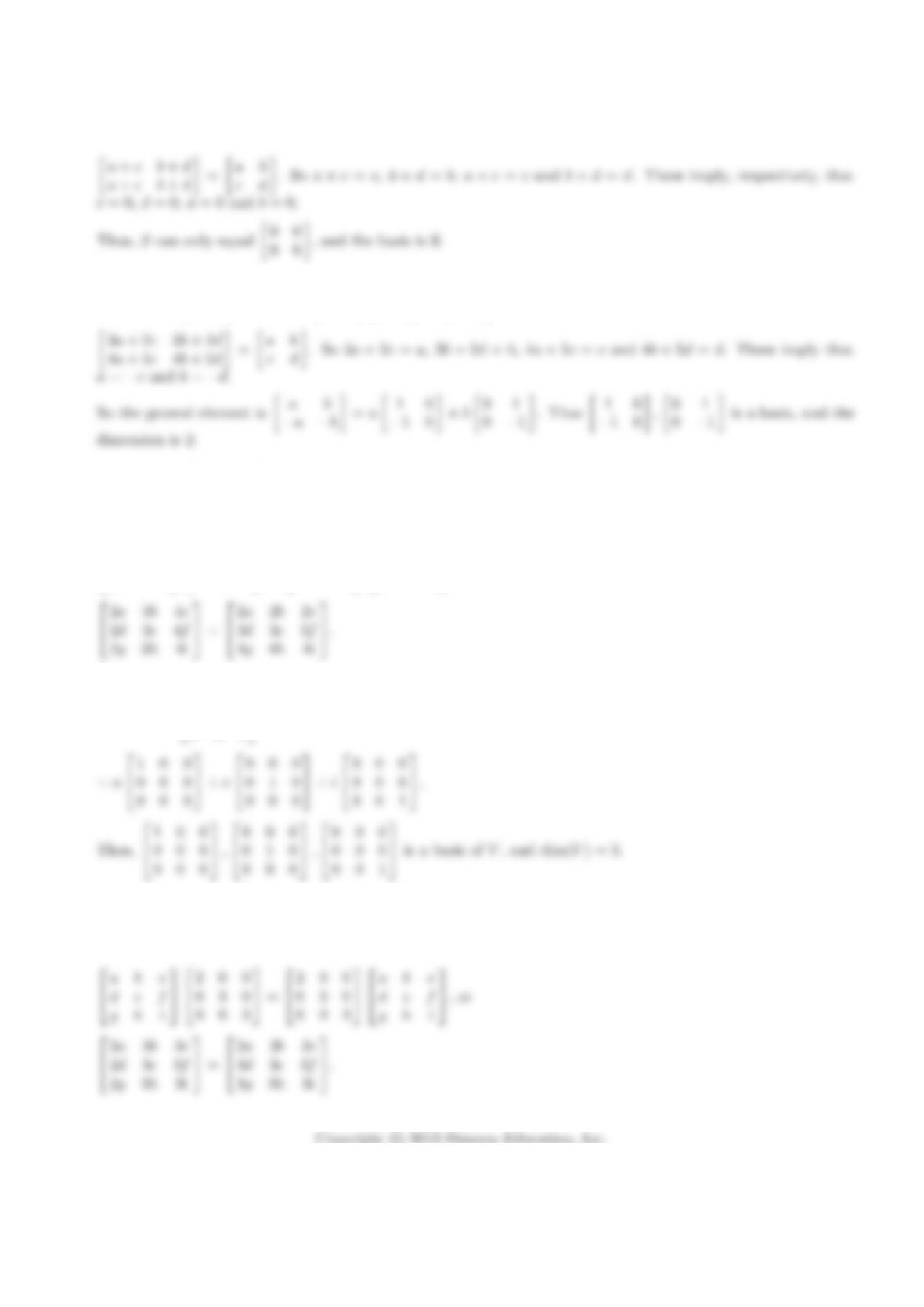
4.1.33 Let S=a b
c d . Then 1 1
1 1 a b
c d =a b
c d , meaning
183
Chapter 4
4.1.34 Let S=a b
c d . We want 3 2
4 5 a b
c d =a b
c d , meaning
4.1.35 Let A=
a b c
d e f
g h i
. We want AB =BA, or
a b c
d e f
g h i
2 0 0
0 3 0
0 0 4
=
2 0 0
0 3 0
0 0 4
a b c
d e f
g h i
, or
We note that b, c, d, f, g, h must be zero, but a, e, and iare chosen freely. So, our space, V, consists of all matrices
of the form
a0 0
0e0
0 0 i
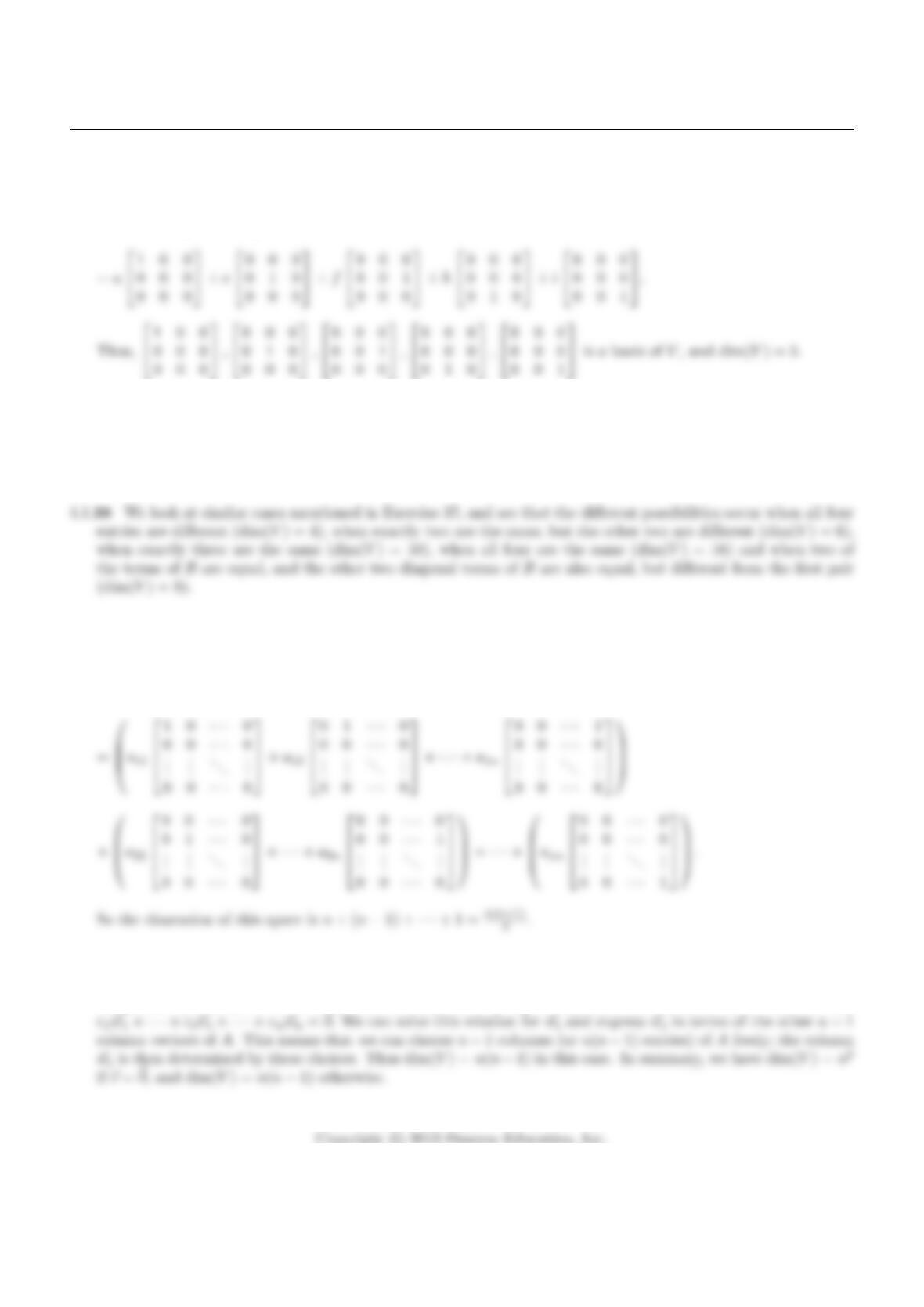
4.1.36 Let A=
a b c
d e f
g h i
. We want AB =BA, or
184
Section 4.1
We note that b, c, d, g must be zero, but a, e, f, h and iare chosen freely. So, our space, V, consists of all matrices
of the form
a0 0
0e f
0h i
4.1.37 If all diagonal entries of Bare different, then dim(V) = 3, as in Exercise 35. If two of the diagonal entries
are equal, then dim(V) = 5, as in Example 36. If all three entries are equal, then Bis a scalar multiple of I3,
and will commute with all 3×3 matrices, so that dim(V) = dim(R3×3) = 9. So, in summary, dim(V) could be 3,
5 or 9.
4.1.39 An upper-triangular matrix has the form:
a11 a12 ··· a1n
0a22 ··· a2n
.
.
..
.
.....
.
.
0 0 ··· ann
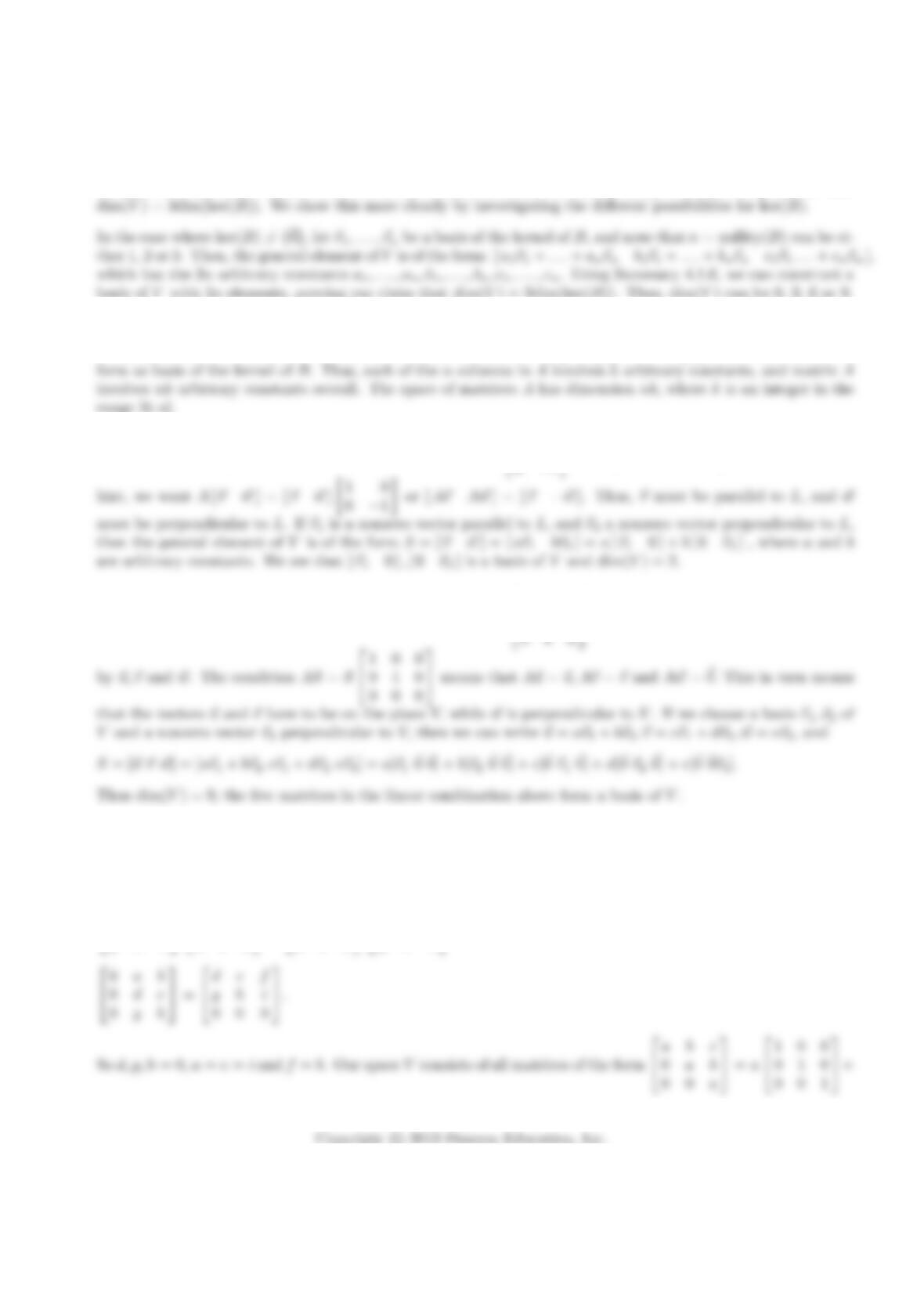
4.1.40 Let Vbe the space of all n×nmatrices Asuch that A~c =~
0.We look at some possibilities for ~c. If
~c =~
0,then any matrix Awill work, and dim(V) = n2.Now assume that ~c 6= 0,and suppose that the ith
component ciis nonzero. If we denote the columns of Aby ~w1, . . . , ~wn,then the condition A~c =~
0 means that
185
Chapter 4
4.1.41 Let Vbe the space of all matrices Asuch that BA = 0. Note that Ais in Vif (and only if) all the
columns of Aare in the kernel of B. Since the columns of Acan be chosen independently, it is plausible that
4.1.42 Let Bbe a matrix such that dim(ker(B))= k. Then, it is required that the columns of Acontain only vectors
in the kernel of B. Thus, each column of Acan be written as: c1~v1+c2~v2+···+ck~vk,where the vectors ~vi
4.1.43 Let Vbe the space of all matrices Ssuch that AS =S1 0
0−1. Using the terminology introduced in the
4.1.44 Let Vbe the space of all matrices Ssuch that AS =S
1 0 0
0 1 0
.Let’s denote the column vectors of S
4.1.45 Let A=
a b c
d e f
g h i
. We want AB =BA, or
a b c
d e f
g h i
0 1 0
0 0 1
0 0 0
=
0 1 0
0 0 1
0 0 0
a b c
d e f
g h i
, or
186
Section 4.1
b
0 1 0
0 0 1
0 0 0
+c
0 0 1
0 0 0
0 0 0
.
4.1.47 We show that the set of all even functions is a subspace of F(R,R):
•If f(t) = 0 for all t, then f(−t) = f(t) = 0 for all t.
4.1.48 afis even if f(−t) = f(t) for all t. Comparing coefficients we find that b=d= 0, so that f(t) is of the form
f(t) = a+ct2+et4, with basis 1, t2, t4. The dimension is 3.
4.1.49 We show that L(Rm,Rn) is a subspace of F(Rm,Rn):
•The zero transformation T(~x) = ~
0 (for all ~x) is linear, represented by the zero matrix.
4.1.50 Using Example 18 as a guide, we first look for solutions of the form f(x) = ekx. It is required that f′′(x) +
8f′(x)−20f(x) = k2ekx + 8kekx −20ekx = 0 for all x, or k2+ 8k−20 = (k−2)(k+ 10) = 0. Thus k= 2 or
k=−10. By Theorem 4.1.5, the solutions of the differential equation are of the form f(x) = c1e2x+c2e−10x,
where c1and c2are arbitrary constants.
187
Chapter 4
4.1.52 We have to find constants aand bsuch that the functions e−xand e−5xare solutions of the differential
4.1.53 Let B= (f1,…,fn) be a basis of Vand suppose that the elements g1,…,gmin Vare linearly independent.
In the proof of Theorem 4.1.5, we show that the coordinate vectors [g1]B,…,[gm]Bin Rnare linearly independent,
so that m≤nby Theorem 3.2.8.
4.1.54 We can adapt the answer to Exercise 3.2.38a. Let mbe the largest number of linearly independent elements
4.1.55 We will argue indirectly, assuming that F(R,R) is n-dimensional for some n. Now, the n+ 1 polynomials
1, x, x2,…,xnin F(R,R) are linearly independent, contradicting the fact that we can find at most nlinearly inde-
pendent elements in an n-dimensional space (see Exercise 53). We conclude that F(R,R) is infinite dimensional,
as claimed.
4.1.56 Argue indirectly and assume that the space Vof infinite sequences is finite-dimensional, with dim(V) = n.
According to the solution to Exercise 57, there can be at most nlinearly independent elements in V. But here
4.1.57 We can construct a basis of Vby omitting the redundant elements from the list g1,…,gm. It follows that
Vis finite-dimensional, and, in fact, dim(V)≤m, since our basis is a “sub-list” of the original list g1,…,gm.
4.1.58 a Let g(x) be a function in V. Thus, g′′(x) = −g(x). Now, if f(x) = g(x)2+g′(x)2,then f′(x) = 2(g(x))g′(x)+
2(g′(x))g′′(x) = 2(g(x))g′(x)−2(g(x))g′(x) = 0.So, f(x) = g(x)2+g′(x)2is a constant function.
4.1.59 0 = k0−k0 = k(0 + 0) −k0 = k0 + k0−k0 = k0
4.1.60 a.
188
Section 4.2
b. A sequence in Wcan be written in the form (x, y, x+y, x+2y, 2x+3y, …) = x(1,0,1,1,2, …)+y(0,1,1,2,3, …).
We see that Wis spanned by the sequences (1,0,1,1,2, …) and (0,1,1,2,3, …), which implies that Wis a subspace
Since dim W= 2, the geometric sequences (1, a, a2, a3, …) and (1, b, b2, b3, …) form a basis of W.
d. We need to find the scalars xand ysuch that (0,1,1,2, …) = x(1, a, a2, a3, …) + y(1, b, b2, b3, …). Consider the
first component to see that y=−x. Now the seconds component gives x=1
a−b=1
√5. It follows that the nth
term of the Fibonacci sequence is fn=xan+ybn=an−bn
√5=1
√51+√5
2n−1
√51−√5
2n,
Section 4.2
4.2.1Fails to be linear, since T(A+B) = A+B+I2doesn’t equal
T(A) + T(B) = A+I2+B+I2=A+B+ 2I2.
4.2.3Linear, since Ta b
c d +p q
r s =Ta+p b +q
c+r d +s=a+p+d+s
4.2.4Fails to be linear, since T(2I2) = det(2I2) = 4 does not equal
2T(I2) = 2 det(I2) = 2.
Chapter 4
4.2.6Let P=1 2
3 6 . Transformation Tis linear, since
4.2.7Linear, since T(M+N) = 1 2
3 4 (M+N) = 1 2
3 4 M+1 2
3 4 N=T(M) + T(N). Also, T(kM ) =
1 2
3 4 (kM) = k1 2
3 4 M=kT (M).
4.2.8Not linear, since T(kM ) = (kM)1 2
3 4 (kM) = k2M1 2
3 4 M=k2T(M)6=kT (M),in general.
4.2.9Linear, since T(A+B) = S−1(A+B)S=S−1AS +S−1BS equals
4.2.10 Linear, since T(A+B) = P(A+B)P−1=P AP −1+P BP −1equals
4.2.11 Linear, since T(M+N) = P(M+N)Q= (P M +P N )Q=P MQ +P NQ =T(M) + T(N).
Also, T(kM) = P(kM )Q=kP M Q =kT (M).
This is also an isomorphism. Solve the equation N=P M Q for Mto find the inverse M=P−1NQ−1.
190
Section 4.2
No, Tisn’t an isomorphism, since domain and codomain have different dimensions.
4.2.13 Let Q=1 2
0 1 . Transformation Tis linear, since
4.2.14 Let Q=2 3
5 7 . Transformation Tis linear, since
T(M+N) = Q(M+N)−(M+N)Q=QM +QN −MQ −N Q equals
4.2.15 Linear, since T(M+N) = 2 0
0 3 (M+N)−(M+N)4 0
0 5 =2 0
0 3 M+2 0
0 3 N−M4 0
0 5 −
N4 0
0 5 =2 0
0 3 M−M4 0
0 5 +2 0
0 3 N−N4 0
0 5 =T(M) + T(N).
4.2.16 Linear, since T(M+N) = (M+N)2 0
0 3 −3 0
0 4 (M+N) = M2 0
0 3 +N2 0
0 3 −3 0
0 4 M−
3 0
0 4 N=M2 0
0 3 −3 0
0 4 M+N2 0
0 3 −3 0
0 4 N=T(M) + T(N).
191
Chapter 4
4.2.18 This transformation fails to be linear, since 2T(3) = 2(9) = 18 6=T(6) = 36.
4.2.19 Tis linear: if wand zare complex numbers, then T(w+z) = i(w+z) = iw +iz =T(w) + T(z) and
T(kz) = i(kz) = k(iz) = kT (z).
4.2.21 Linear, since T((x+iy) + (z+it)) = T(x+z+i(y+t)) = y+t+i(x+z) equals
T(x+iy) + T(z+it) = y+ix +t+iz =y+t+i(x+z), and
T(k(x+iy)) = T(kx +iky) = ky +ikx equals kT (x+iy) = k(y+ix) = ky +ikx.
Yes, Tis an isomorphism; it’s its own inverse, since T(T(x+iy)) = T(y+ix) = x+iy.
4.2.23 Tis linear, because T(f(t) + g(t)) = f(7) + g(7) = T(f(t)) + T(g(t)), and T(kf (t)) = kf (7) = kT (f(t)).
However, Tcannot be an isomorphism, because the dimensions of the domain and codomain fail to be equal.
4.2.24 Tis not linear. 2T(t2) = 2(2(t2)) = 4t26=T(2t2) = 4(2t2) = 8t2.
192
Section 4.2
4.2.27 Linear, since T(f(t) + g(t)) = f(2t) + g(2t) equals
T(f(t)) + T(g(t)) = f(2t) + g(2t), and T(kf (t)) = kf(2t) equals kT (f(t)) = kf (2t).
Yes, Tis an isomorphism; the inverse is T−1(g(t)) = gt
2.
4.2.30 Linear, since T(f(t) + g(t)) = t(f′(t) + g′(t)) = t(f′(t)) + t(g′(t)) equals
T(f(t)) + T(g(t)) = t(f′(t)) + t(g′(t)), and T(kf (t)) = t(kf ′(t)) = kt(f′(t))
equals kT (f(t)) = kt(f′(t)).
No, Tisn’t an isomorphism, since the constant function f(t) = 1 is in ker(T).
4.2.32 Tis not linear: T(2) = 0 + t26= 2T(1) = 2(0 + t2).
4.2.34 Linear, since T((x0, x1, x2,…) + (y0, y1, y2,…)) = T(x0+y0, x1+y1, x2+y2,…) =
(0, x0+y0, x1+y1, x2+y2,…) equals
193
Chapter 4
4.2.35 Linear, since T(f(t) + g(t)) = (f(0) + g(0), f ′(0) + g′(0),···)
= (f(0), f′(0),···) + (g(0), g′(0),···) = T(f(t)) + T(g(t)) and T(kf (t))
= (kf(0), kf ′(0),···) = k(f(0), f ′(0),···) = kT (f(t)).
Tfails to be an isomorphism. Note that the sequences in the image of Thave only finitely many nonzero entries,
so that a sequence like (1,1,1,1, . . .), with all 1’s, fails to be in the image of T. Now use Theorem 4.2.4a.
However, T(e−x) = e−x−e−x= 0, so Tfails to be an isomorphism.
4.2.38 Linear, just as in Exercise 37.
Tis not an isomorphism, since T(sin(x)) = sin(x)−sin(x) = 0.
4.2.40 Same answer as in Exercise 39.
4.2.41 Not linear, because T(f(t) + g(t)) = f(t) + g(t) + f′′(t) + g′′(t) + sin(t) does not equal T(f(t)) + T(g(t)) =
f(t) + f′′(t) + sin(t) + g(t) + g′′(t) + sin(t).
4.2.43 Linear, since T(f(t) + g(t)) =
f(5) + g(5)
f(7) + g(7)
f(11) + g(11)
=
f(5)
f(7)
f(11)
+
g(5)
g(7)
g(11)
=T(f(t)) + T(g(t)), and T(kf (t)) =
194
Section 4.2
Tis an isomorphism; the proof is analogous to Example 6b.
4.2.45 Linear, since T(f(t) + g(t)) = t(f(t) + g(t)) = tf (t) + tg(t) = T(f(t)) + T(g(t)) and T(kf (t)) = t(kf(t)) =
ktf(t) = kT (f(t)).
This is not an isomorphism, since the constant function f(t) = 1 isn’t in the image.
4.2.48 Linear, since T(f(t)+g(t)) = (f+g)′(t) = f′(t)+g′(t) = T(f(t))+T(g(t)) and T(kf (t)) = kf′(t) = kT (f(t)).
This is not an isomorphism, however, since T(5) = 0.
4.2.51 We need to find the matrices M=x y
z t that commute with 1 2
0 1 , that is,
x y
z t 1 2
0 1 =1 2
0 1 x y
z t , or, x2x+y
z2z+t=x+ 2z y + 2t
z t .
195
Chapter 4
4.2.52 We need to find the matrices A=x y
z t such that
4.2.53 Note that T(a+bt +ct2) = 2c+ 4b+ 8ct. Thus the kernel consists of all constant polynomials f(t) =
a(when b=c= 0), and the nullity is 1. The image consists of all linear polynomials f(t) = p+qt, and the rank
is 2.
4.2.55 The kernel consists of all infinite sequences (x0, x1, x2, x3,…) such that
T(x0, x1, x2, x3, x4,…) = (x0, x2, x4,…) = (0,0,0,…), that is, all terms xkwith even kmust be 0.
4.2.56 Note that T(a+bt +ct2) = bt + 2ct2. Thus the kernel consists of all constant polynomials f(t) = a(when
b=c= 0), and the nullity is 1. The image consists of all polynomials of the form f(t) = pt +qt2, and the rank
is 2.
4.2.58 The kernel consists of all infinite sequences such that
T(x0, x1, x2,…) = (0, x0, x1, x2, . . .) = (0,0,0,0,…), that is, all terms xkmust be 0.
Thus the kernel consists of the zero sequence (0,0,0,…) alone. The image
consists of all infinite sequences of the form (0, x0, x1, x2,…).
Section 4.2
4.2.61 The kernel consists of all polynomials f(t) such that t(f(t)) = 0 for all t, that is, the zero polynomial f(t) = 0
alone. The image consists of all polynomials g(t) that can be written as g(t) = t(f(t)), meaning that we can
factor out a t. These are the polynomials with constant term 0, of the form g(t) = a1t+a2t2+···+antn.
4.2.63 This is impossible, since dim(P3) = 4 and dim(R3) = 3. See Theorem 4.2.4b.
4.2.64 Consider T(a+bt +ct2+dt3) = a b
c d , for example.
4.2.65 a First, we need to show that T(A+B) = T(A) + T(B) for all n×mmatrices A
b The kernel of Tconsists of all n×mmatrices Asuch that T(A) = 0, that is (T(A))(~v) = A~v =~
0 for all ~v in Rm.
This holds for the zero matrix only. Thus ker(T) = {0}.
c This is true by definition of a linear transformation (Definition 2.1.1).
4.2.67 To show that Tis linear, proceed as in Exercise 15. Now let M=a b
c d .
197
Chapter 4
Then T(M) = 2 3
0 4 a b
c d −a b
c d 3 0
0k
If kis 2, then bis arbitrary (while a=c=d= 0), and Tfails to be an isomorphism. A nonzero matrix in the
kernel is 0 1
0 0 in this case.
4.2.68 We find the constants kwhich make the kernel of Tnonzero. Let M=a b
4.2.69 No, since Ais similar to B, there exists an invertible Ssuch that AS =SB. Now T(S) = AS −SB = 0, so
that the nonzero matrix Sis in the kernel of T.
4.2.70 Since the dimensions of the domain and codomain are equal, it suffices to examine when the kernel is zero.
Now f(t) is in the kernel of Tif f(c0) = f(c1) = ···=f(cn) = 0.
4.2.71 Exercise 70 tells us that Tis an isomorphism so long as c0, c1,···, cnare all different. This condition is met
198