Problem 4.59
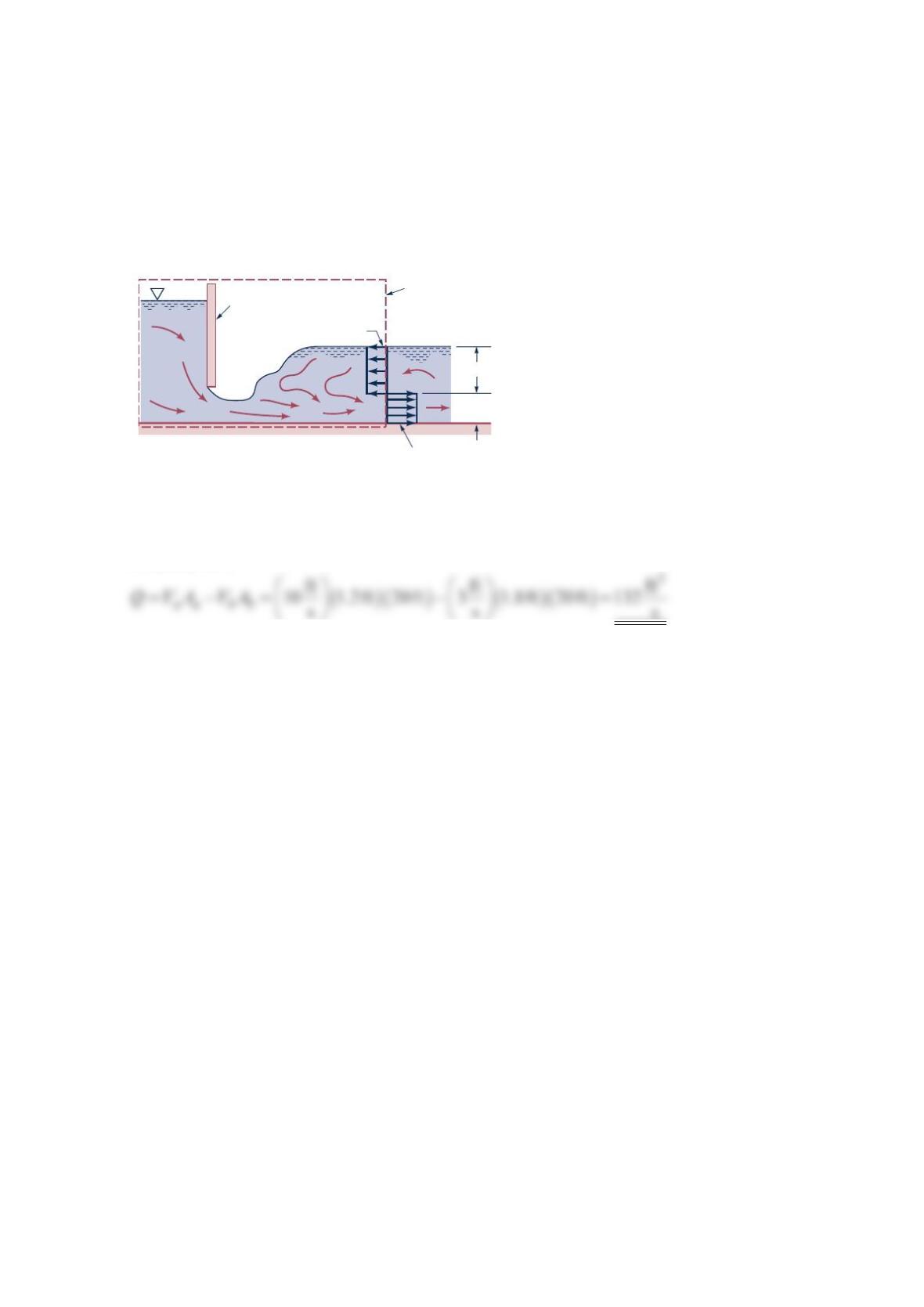
In the region just downstream of a sluice gate, the water may develop a reverse flow region
as is indicated in the figure below. The velocity profile is assumed to consist of two uniform
regions, one with velocity =10 fps
a
V and the other with =3 fps
b
V
. Determine the net
flowrate of water across the portion of the control surface at section (2) if the channel is
2
0f
t
wide.
Solution 4.59
Sluice gate
Control surface
V
b = 3 ft/s
V
a = 10 ft/s
1.8 ft
1.2 ft
(1) (2)
Problem 4.60
At time =
0
t, the valve on an initially empty (perfect vacuum,
ρ
=0) tank is opened and air
rushes in. If the tank has a volume of 0
V and the density of air within the tank increases as
bt
e(1 )
ρρ
−
∞
=−, where
b
is a constant, determine the time rate of change of mass within the
tank.
Solution 4.60
0
Problem 4.62
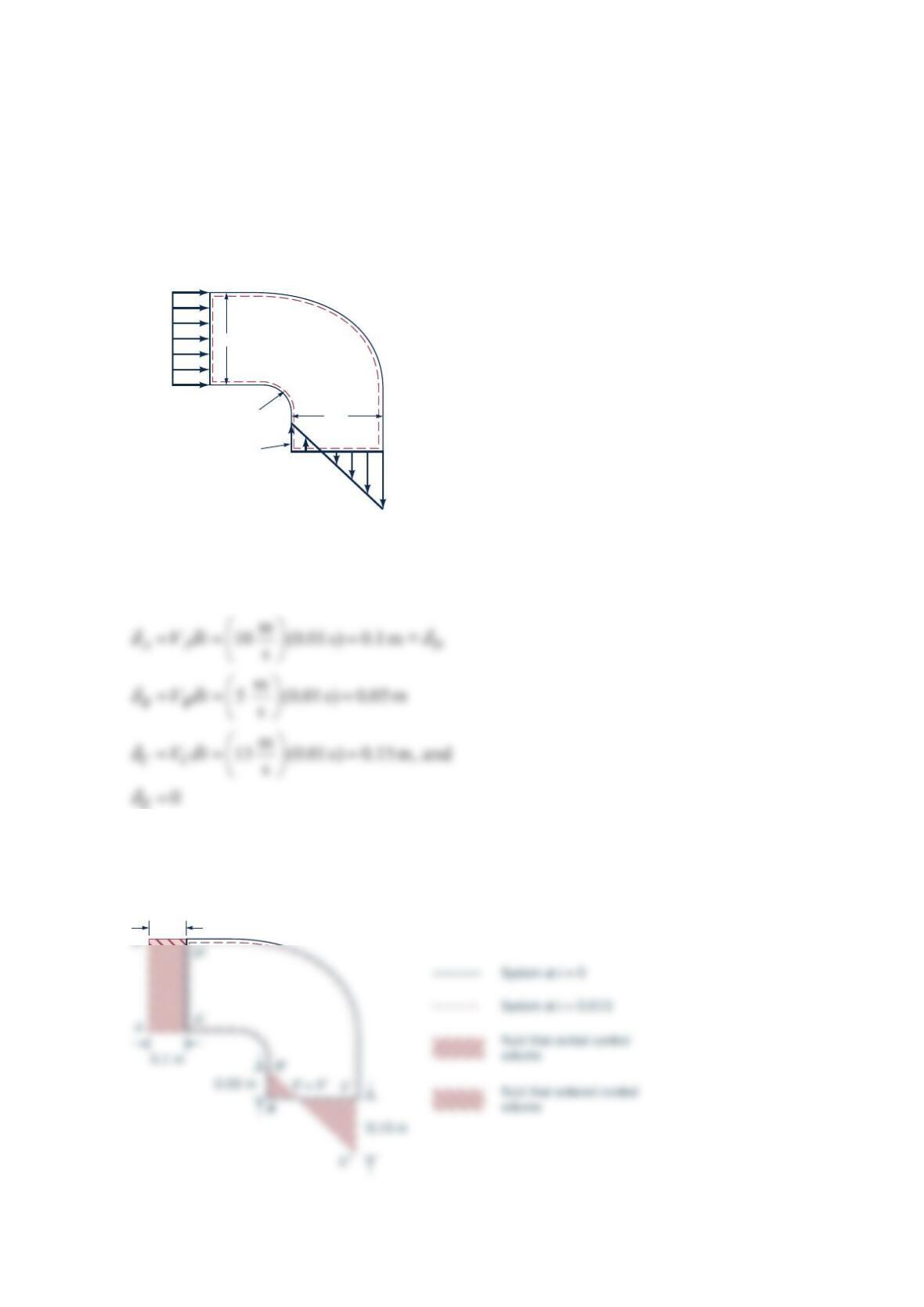
Air enters an elbow with a uniform speed of
1
0m/s
as shown in the figure below. At the exit
of the elbow, the velocity profile is not uniform. In fact, there is a region of separation or
reverse flow. The fixed control volume
A
BC
D
coincides with the system at time =
0
t. Make
a sketch to indicate (a) the system at time =0.01st and (b) the fluid that has entered and
exited the control volume in that time period.
Solution 4.62
From 0t= to =0.01st particles
A
, B,
C
,
D
, and
E
move the following distances:
Thus, fluid along lines
A
D and BE
C
originally moves to lines
′′
A
D and
′′′
BEC shown
below.
1 m
1 m
Control volume
Reverse
flow
V
= 10 m/s
5 m/s
15 m/s
B
A
D
C
0.1 m
Problem 4.63
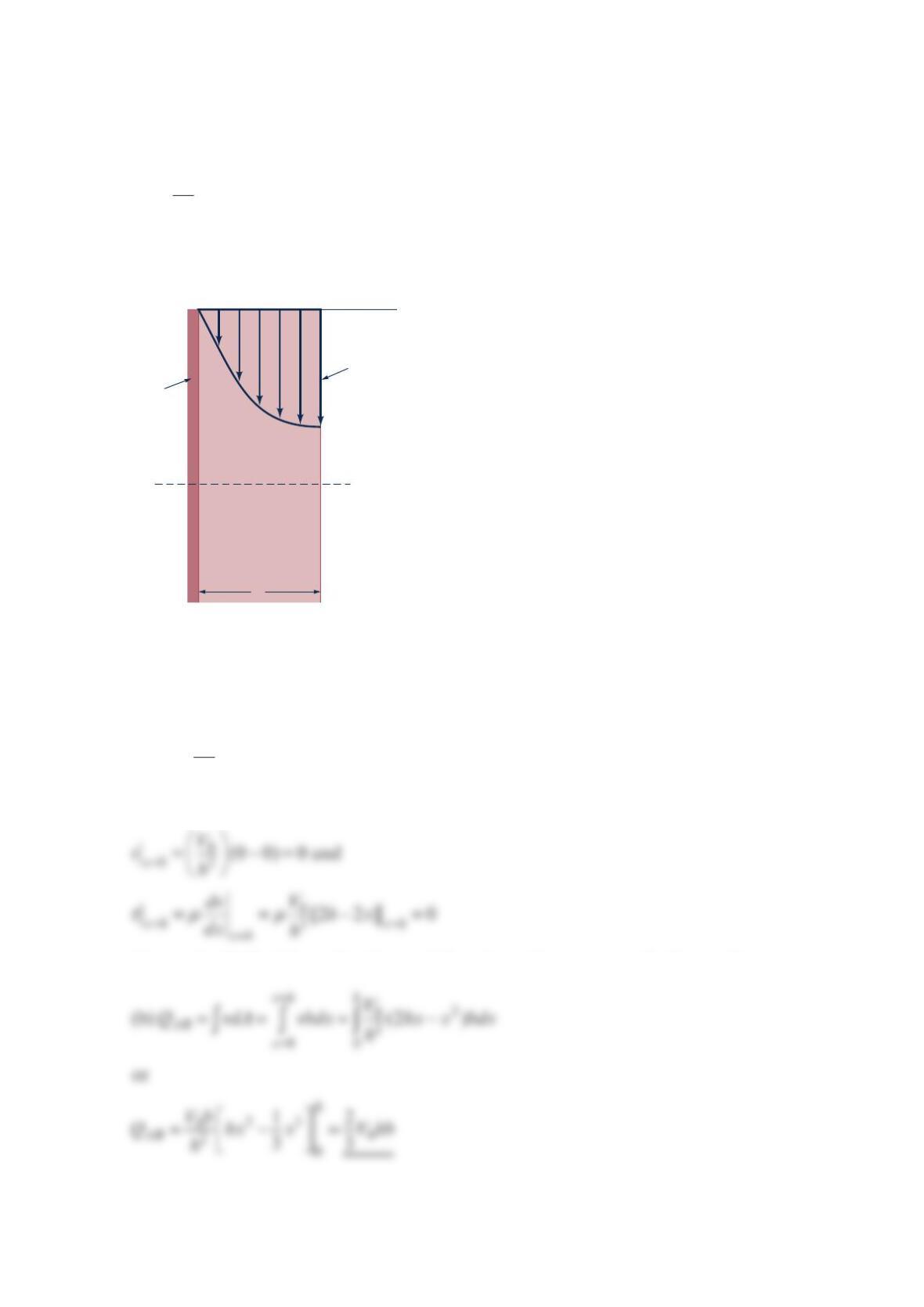
A layer of oil flows down a vertical plate as shown in the figure below with a velocity of
=−
2
0
2(2 )
Vhx x
h
Vj
where 0
V
and h are constants. (a) Show that the fluid sticks to the plate
and that the shear stress at the edge of the layer ( =xh
) is zero. (b) Determine the flowrate
across surface
A
B. Assume the width of the plate is
b
. (Note: The velocity profile for
laminar flow in a pipe has a similar shape.)
Solution 4.63
(a)
=−
2
0
2(2 )
V
v
hx x
h
Thus,
Hence, the fluid sticks to the plate and there is no shear stress at the free surface.
x
y
A
h
B
v(x)
Plate
Oil
v
Problem 4.64
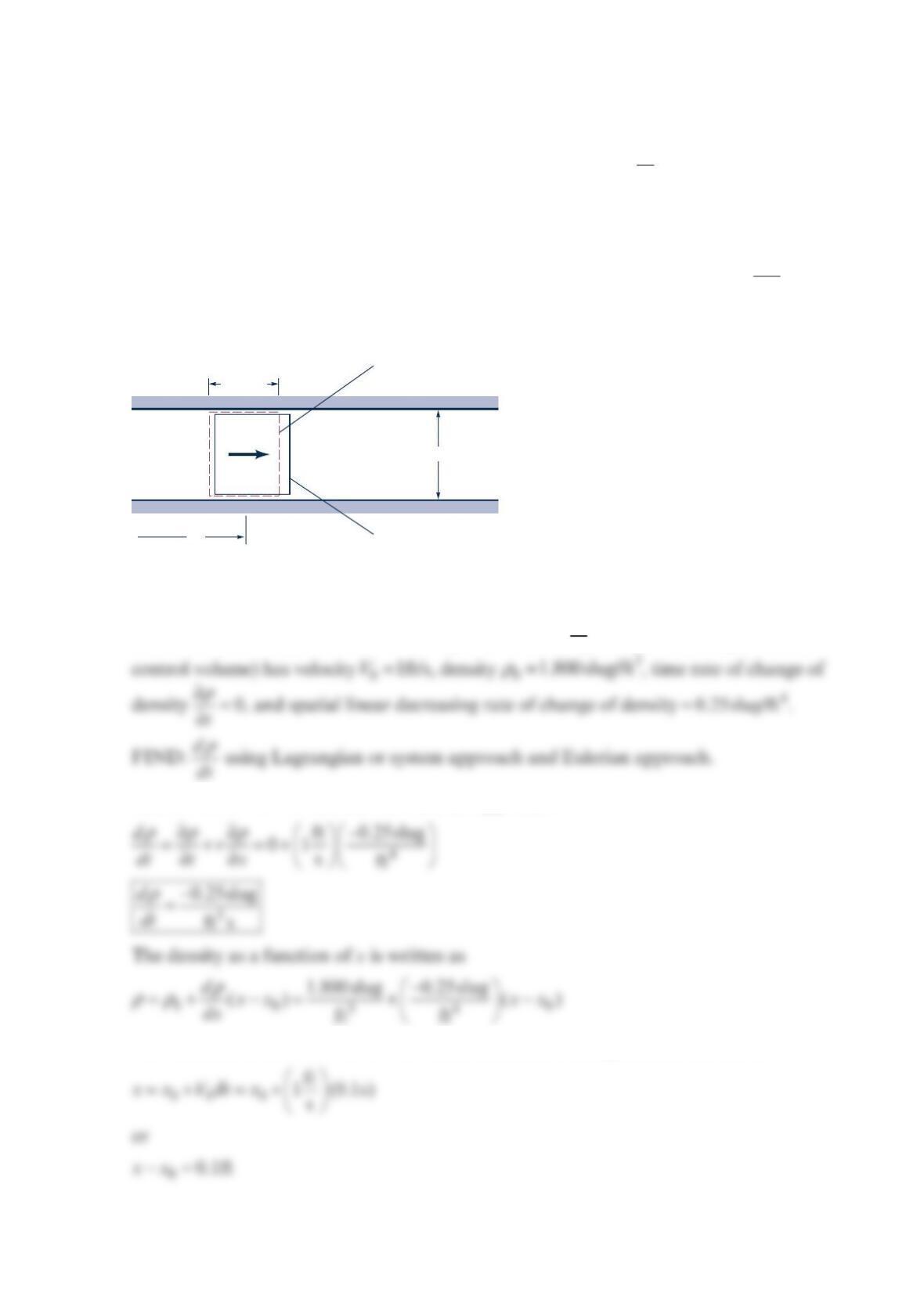
The figure below shows a fixed control volume. It has a volume =
3
01.0 ftV, a flow area
=2
1.0 ft
A
, and a length =
01.0 ft
. Position x represents the center of the control volume
where the fluid velocity =
01.0ft/sV and the density
ρ
=3
01.800slug/ft . Also, at position x,
the fluid density does not change locally with time but decreases in the axial direction at the
linear rate of 4
0.25slug/ft . Use the system or Lagrangian approach to evaluate
ρ
d
dt .
Compare this result with that of the material derivative and flux terms.
Solution 4.64
GIVEN: Fixed control volume in the Figure of volume =
3
01ftV. Position 0
x (center of
SOLUTION: We will first use the Eulerian approach.
Now consider a time interval of 0.1s where the center if the system has moved to
System and control
volume at time
t
System at time
t
+
st
A
= 1 ft
2
x
0
ℓ0 = 1 ft
V
0, 0
+
ρ
ρ
At this position, the average fluid density
Problem 4.65
The figure below shows a fixed control volume. It has a volume =
3
01.0 ftV, a flow area
=2
1.0 ft
A
, and a length =
01.0 ft
. Position x represents the center of the control volume
where the fluid velocity =
01.0ft/sV and the density
ρ
=3
01.800slug/ft . Also, at position x,
the fluid density does not change locally with time but decreases in the axial direction at the
linear rate of 4
0.25slug/ft . Find DV
Dt for the system.
Solution 4.65
GIVEN: Fixed control volume in the figure of volume =
3
01ftV. Position 0
x (center of
control volume) has velocity =
01ft/sV, density
ρ
=3
01.800slug/ft , time rate of change of
density
ρ
∂=
∂0
t, and linear spatial rate of change of density
=
−4
0.25slug/ft .
System and control
volume at time
t
System at time
t
+
st
A
= 1 ft
2
x
0
ℓ
0
= 1 ft
V
0,
0
+
ρ
Now consider a small time period
δ
t
where
δ
−=
00
()xx Vt
. Then*
Problem 4.66
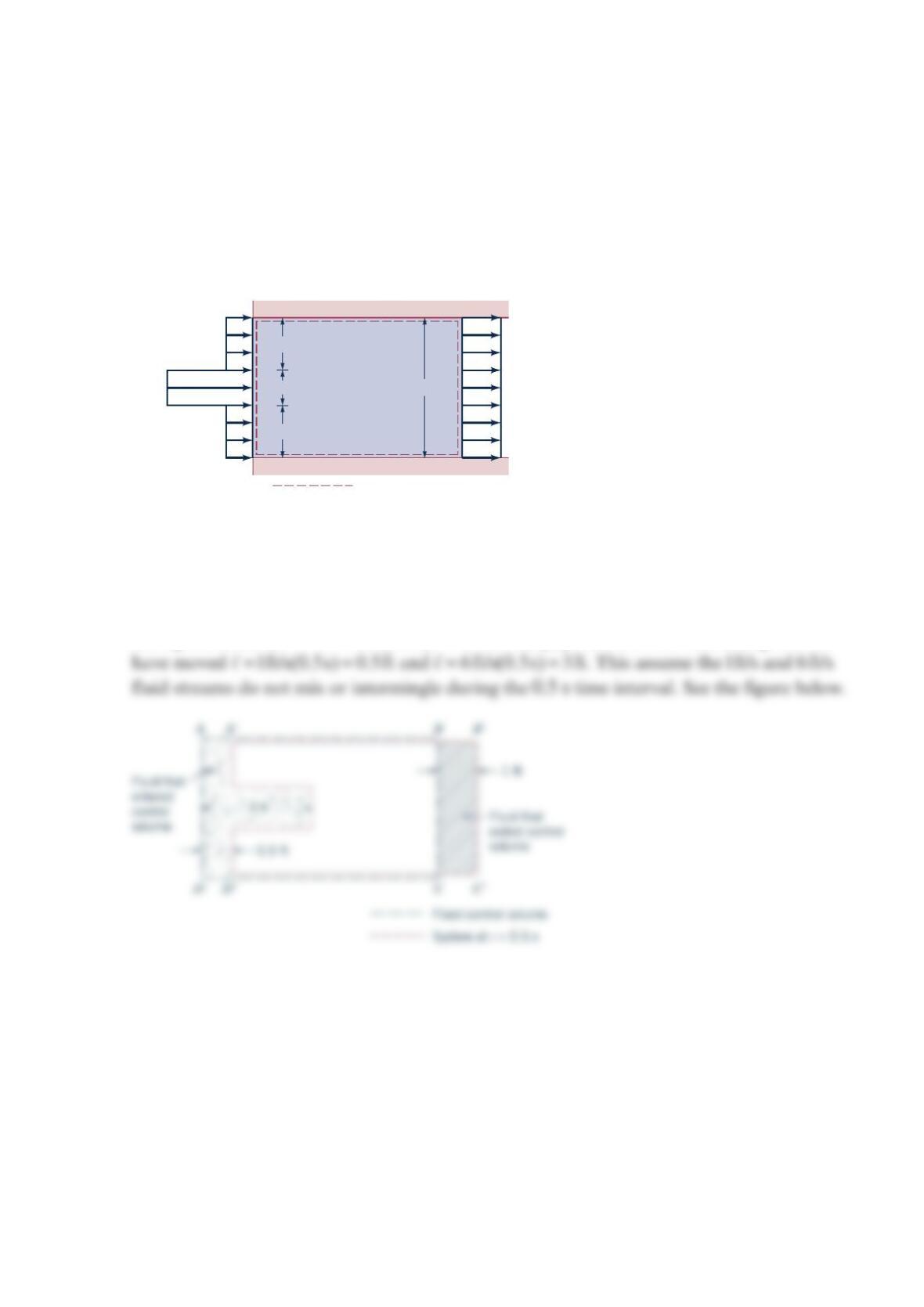
Water enters a 5-ft-wide, 1-ft-deep channel as shown in the figure below. Across the inlet,
the water velocity is
6
ft/s in the center portion of the channel and
1
ft/s in the remainder of
it. Farther downstream, the water flows at a uniform
2
ft/s velocity across the entire
channel. The fixed control volume
A
BC
D
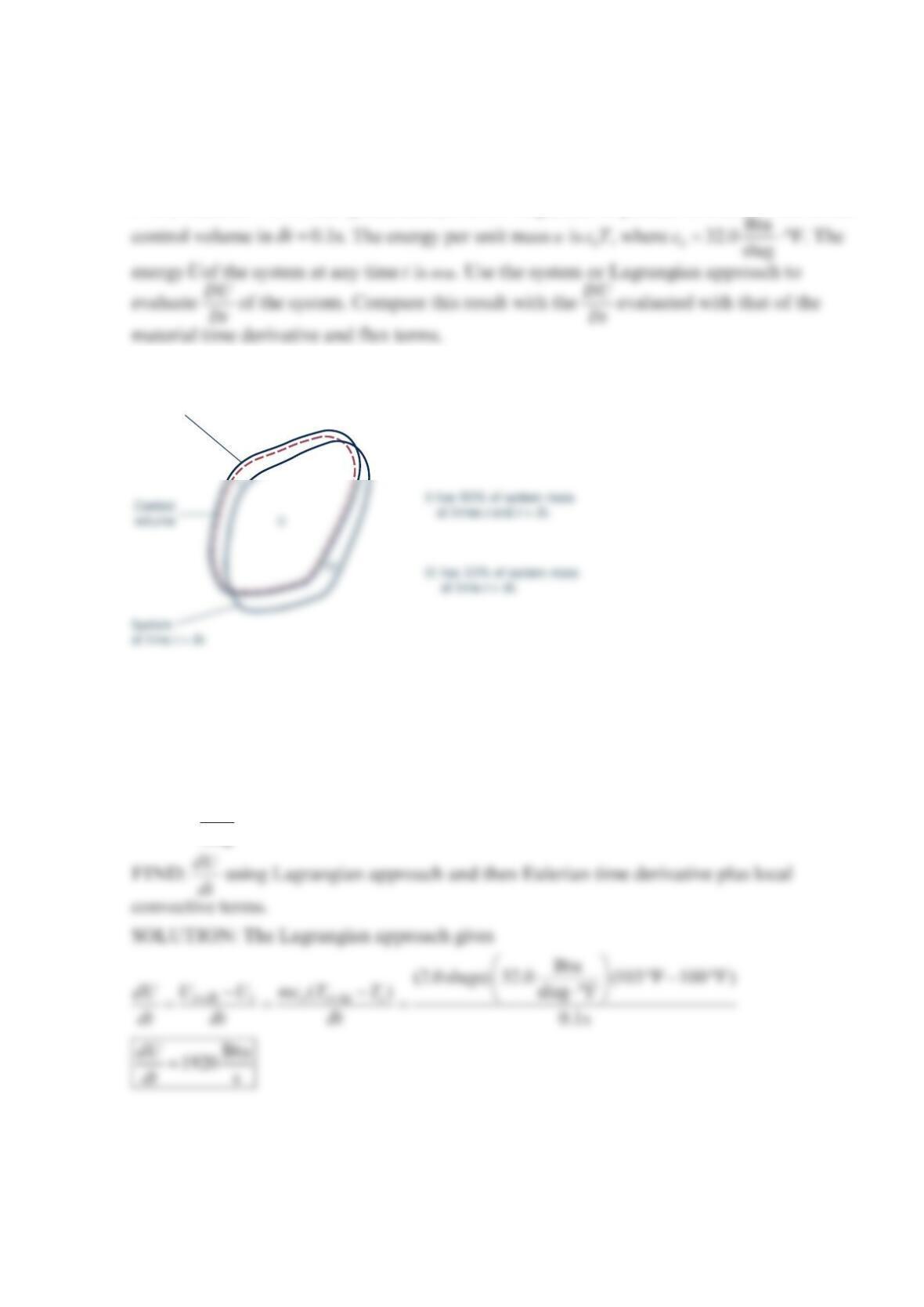
coincides with the system at time 0t=. Make a
sketch to indicate (a) the system at time =0.5st and (b) the fluid that has entered and exited
the control volume in that time period.
Solution 4.66
During the =0.5st time interval, the fluid that was along line BC at time =
0
t has moved to
the right a distance == =2 ft/s(0.5 s) 1ftVt
. Similarly, portions of the fluid along line
A
D
1 ft/s
2 ft/s
1 ft/s
6 ft/s
Control surface
A
D
B
C
2 ft
2 ft
1 ft 5 ft
Problem 4.67
The figure below illustrates a system and fixed control volume at time t and the system at a
short time
δ
t
later. The system temperature is =100°FT at time
t
and =103°FT at time
δ
+tt
, where
δ
=0.1
s
t. The system mass, m is
2
.0 slugs, and 10 percent of it moves out of the
Solution 4.67
GIVEN: System temperature is =100°FT at time
t
and =103°FT at time
δ
+tt
, with
δ
=0.1
s
t. System mass is
2
.0slugs. System energy per unit mass =v
ucT
with
=⋅
Btu
32.0 °F
slug
v
c.=Umu
.
I has 10% of system mass
at time t.
System
at time t
δ
s
t
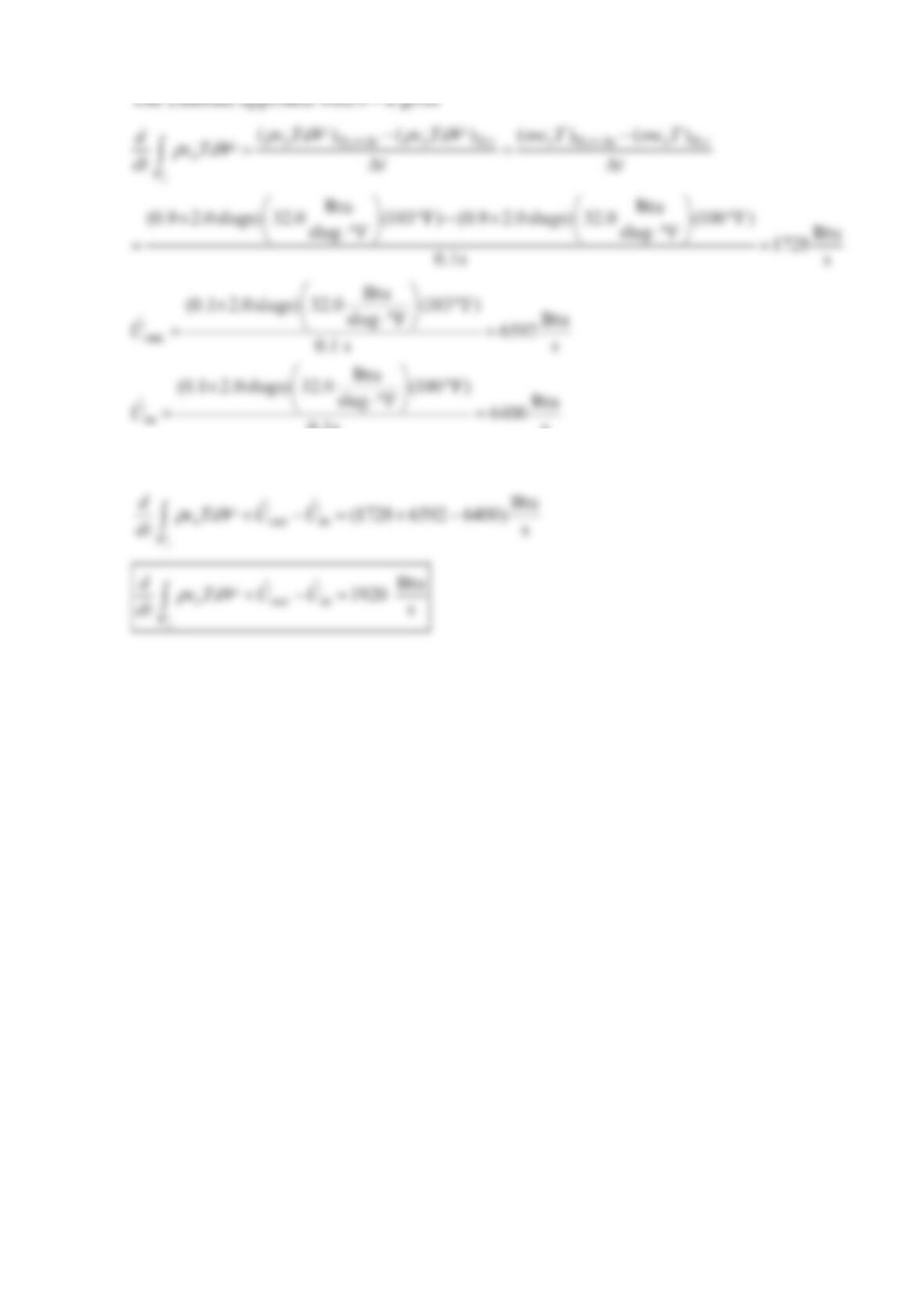
0.1s s
and
Problem 4.68
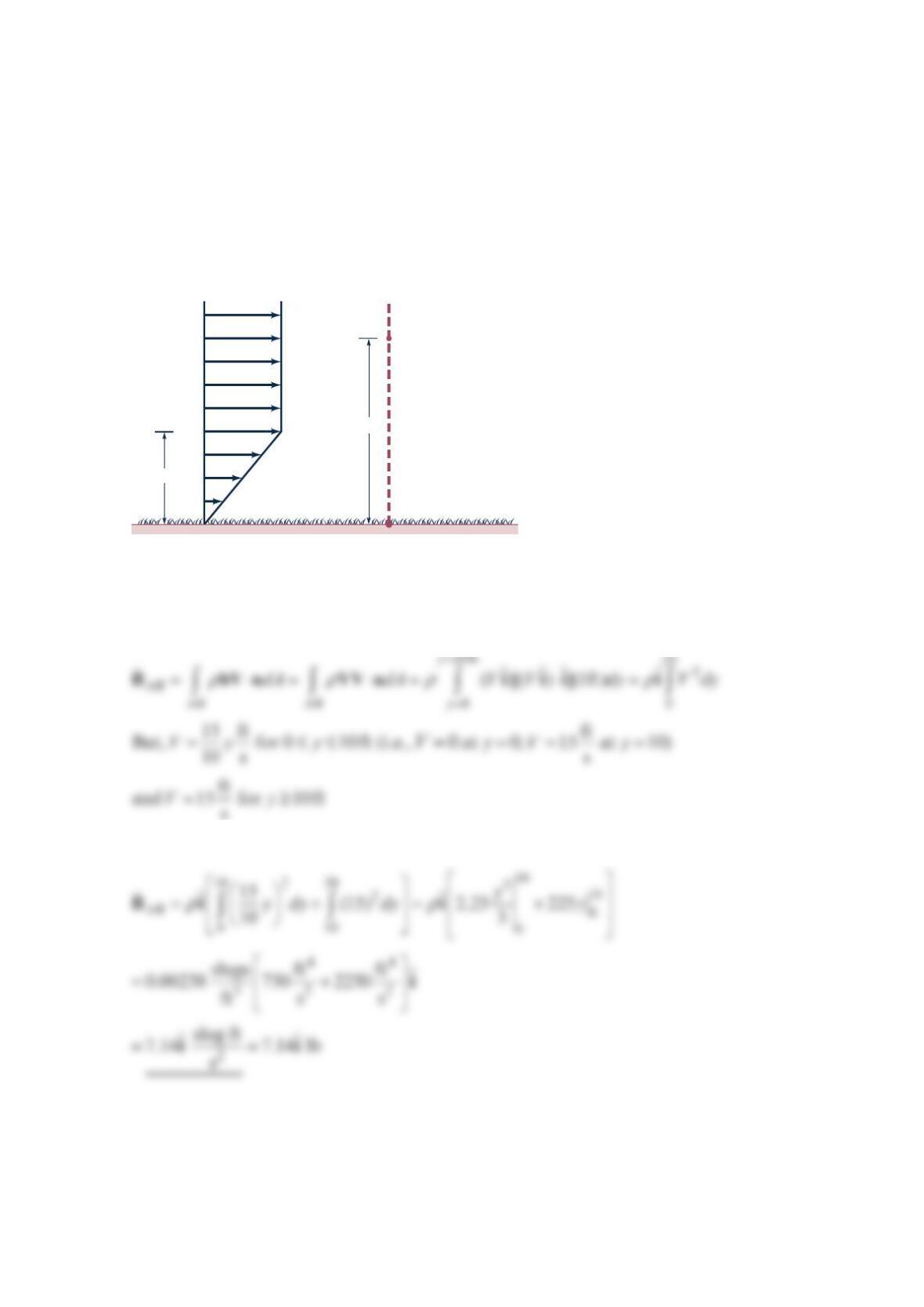
The wind blows across a field with an approximate velocity profile as shown in the figure
below. Use Equation
ρ
=⋅
out
out
cs
Bbd
A
Vn
with the parameter
b
equal to the velocity to
determine the momentum flowrate across the vertical surface −
A
B, which is of unit depth
into the paper.
Solution 4.68
Thus,
20 ft
B
15 ft/s
10 ft
A
Problem 4.69
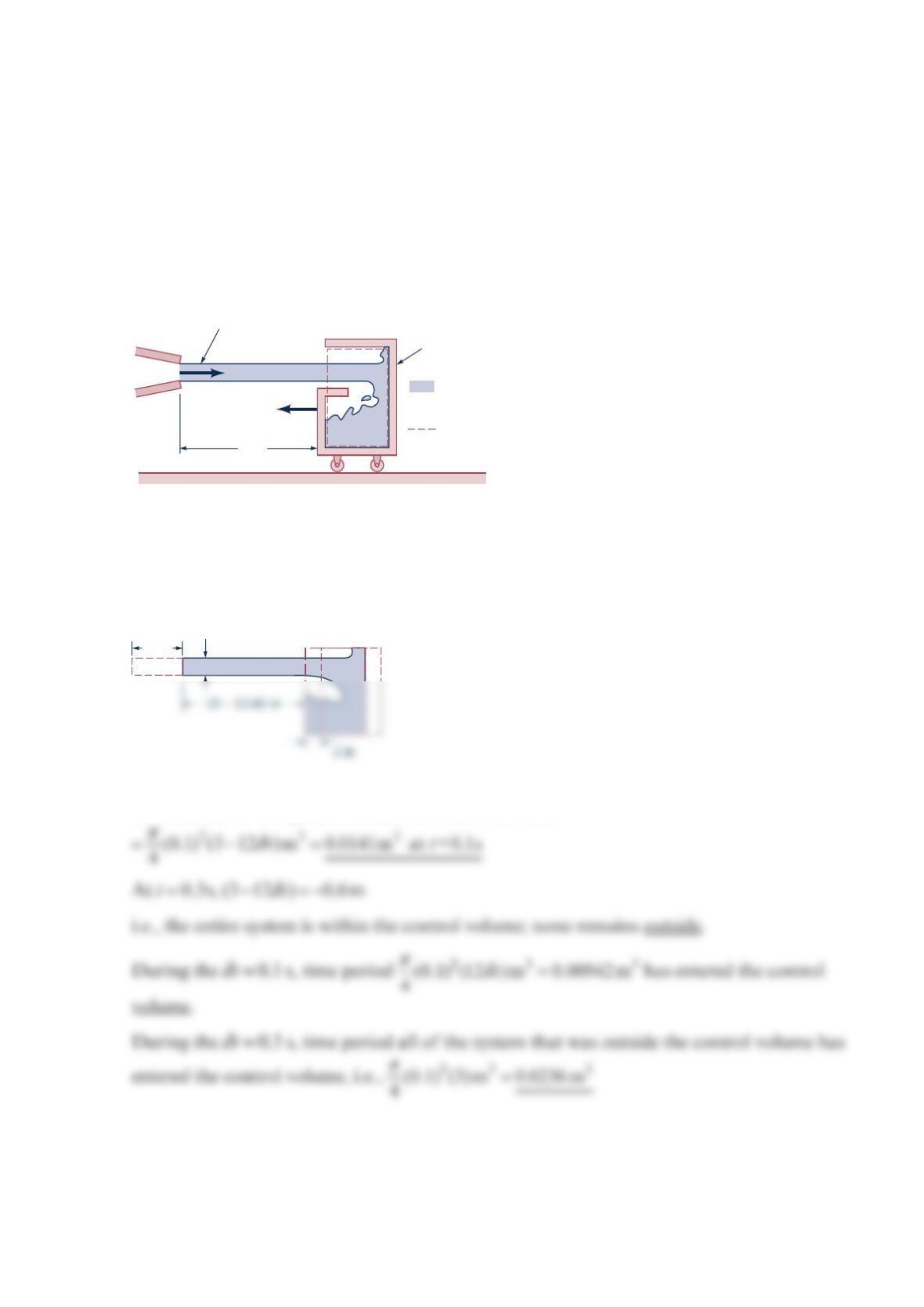
Water flows from a nozzle with a speed of =10 m/s
V
and is collected in a container that
moves toward the nozzle with a speed of =2m/s
cv
V
as shown in the figure below. The
moving control surface consists of the inner surface of the container. The system consists of
the water in the container at time =
0
t and the water between the nozzle and the tank in the
constant diameter stream at =
0
t. At time =0.1st, what volume of the system remains
outside of the control volume? How much water has entered the control volume during this
time period? Repeat the problem for =0.3st.
Solution 4.69
During the time interval
δ
t
, the control volume moves to the left a distance of
δδ
=2m
cv
V
tt
and the water that was at the nozzle exit moves a distance
δδ
=10
m
Vt t to the right, as
shown below.
The amount of the system outside the control volume
V
cv
= 2 m/s
V
= 10 m/s
3 m
Stream diameter = 0.1 m
Nozzle Container
at
t
= 0
Stream
at
t
= 0
Moving
control
volume
0.1 m
10 t
δ