Section 4.3
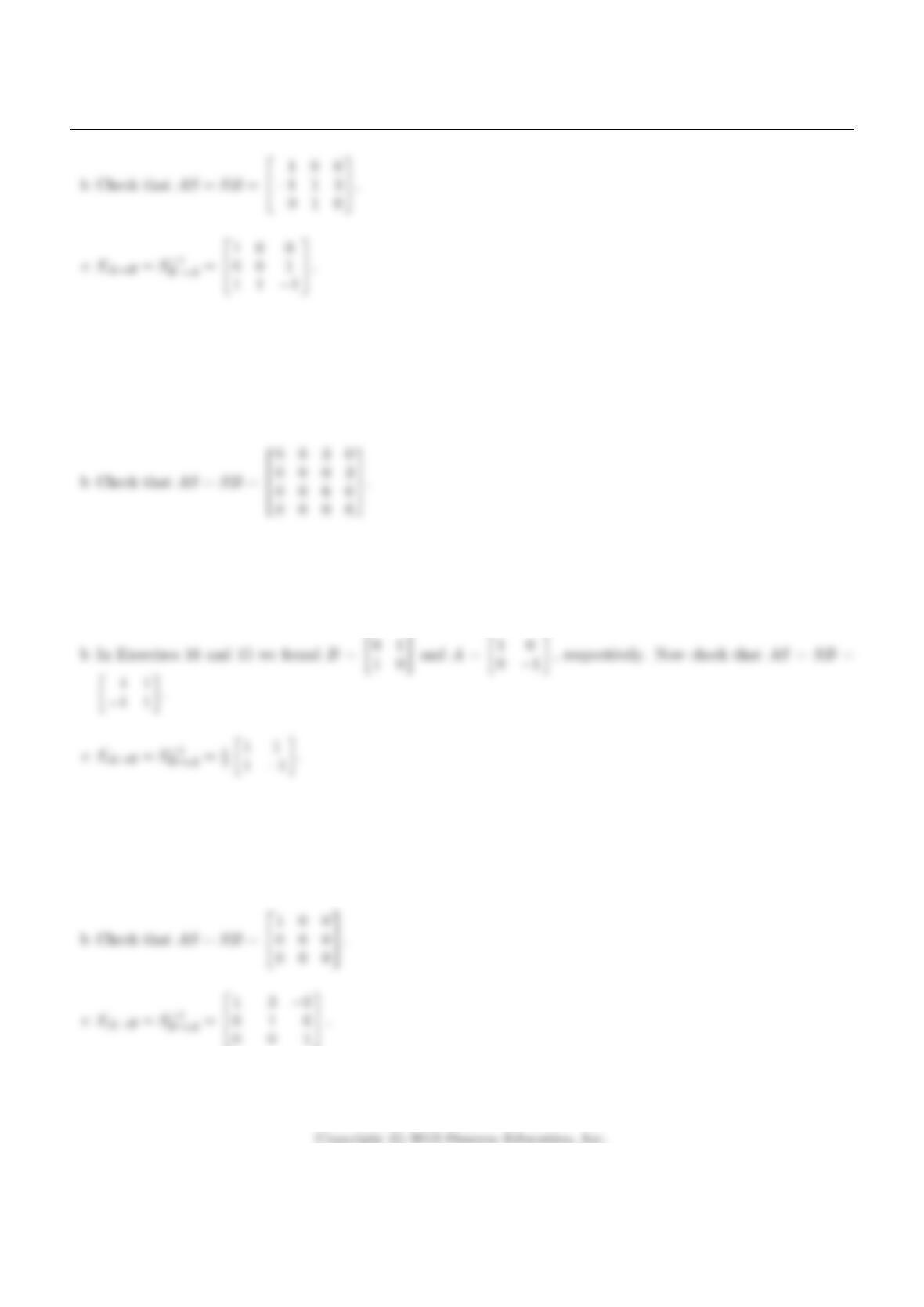
4.3.44 a If Ais the standard basis considered in Exercise 13 and Bis the basis in Exercise 14, then
S= 1 0
−1 0 A0 1
0−1A1 0
2 0 A0 1
0 2 A=
1 0 1 0
0 1 0 1
−1 0 2 0
0−1 0 2
.
4.3.45 a If Ais the standard basis considered in Exercise 15 and Bis the basis in Exercise 16, then
SB→A = [[1 + i]A[1 −i]A] = 1 1
1−1.
4.3.46 a If Ais the standard basis considered in Exercise 23 and Bis the basis in Exercise 24, then
S=[1]A[−3 + t]A9−6t+t2A=
1−3 9
0 1 −6
0 0 1
.
4.3.47 a If Ais the standard basis considered in Exercise 27 and Bis the basis in Exercise 28, then
213
Chapter 4
SB→A =[1]A[−1 + t]A1−2t+t2A=
1−1 1
0 1 −2
0 0 1
.
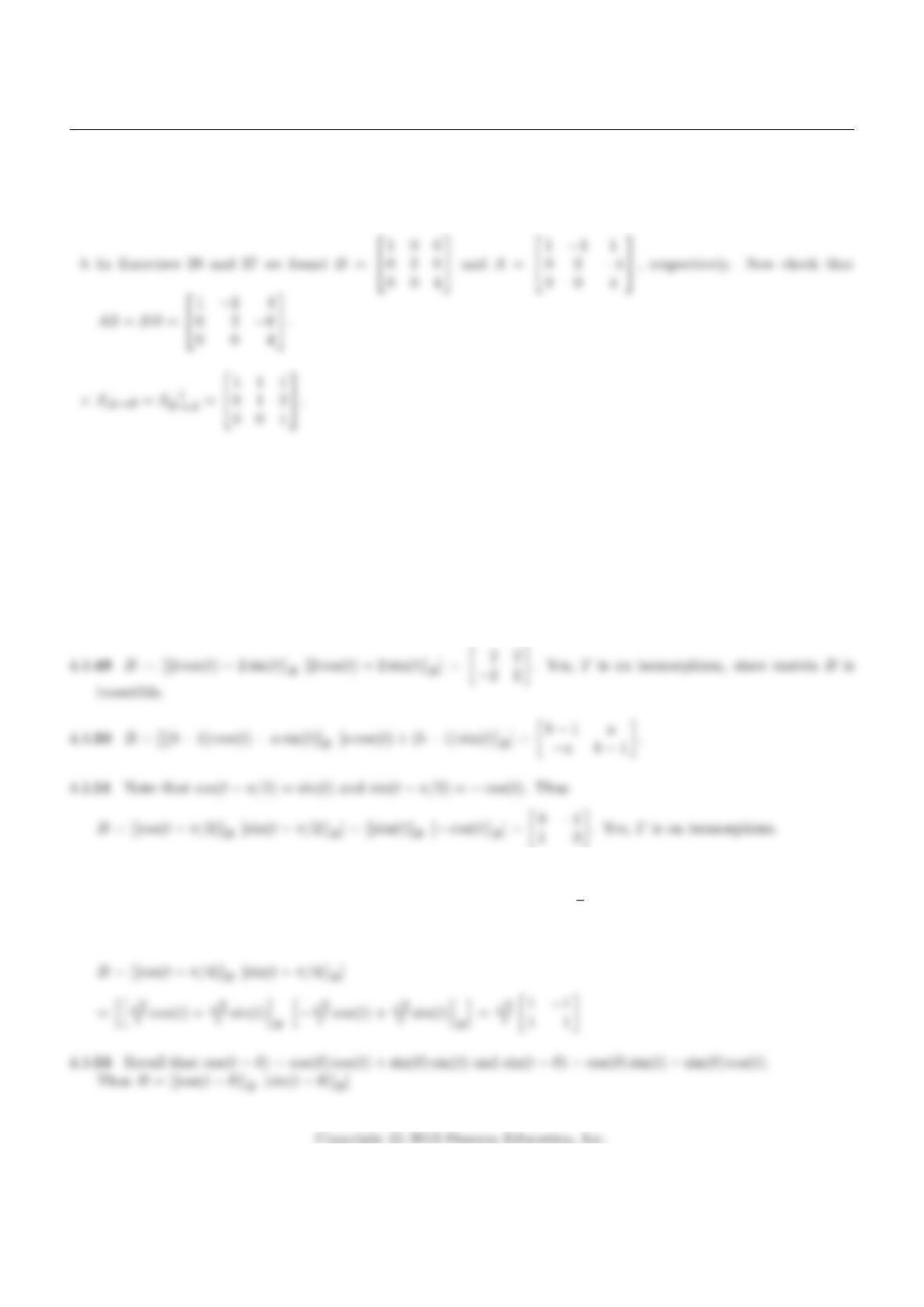
4.3.48 Use a diagram:
acos(t) + bsin(t)−−→
T b cos(t)−asin(t)
y
y
a
b−−−→
Bb
−a
Thus B=0 1
−1 0 .
4.3.52 Recall that cos(t−δ) = cos(δ) cos(t) + sin(δ) sin(t) and
sin(t−δ) = cos(δ) sin(t)−sin(δ) cos(t). Also, cos(π/4) = sin(π/4) = √2/2.
Thus
214
Section 4.3
= [[cos(θ) cos(t) + sin(θ) sin(t)]B[−sin(θ) cos(t) + cos(θ) sin(t)]B] = cos(θ)−sin(θ)
sin(θ) cos(θ). Yes, Tis an isomor-
phism.
Note that Bis a rotation matrix.
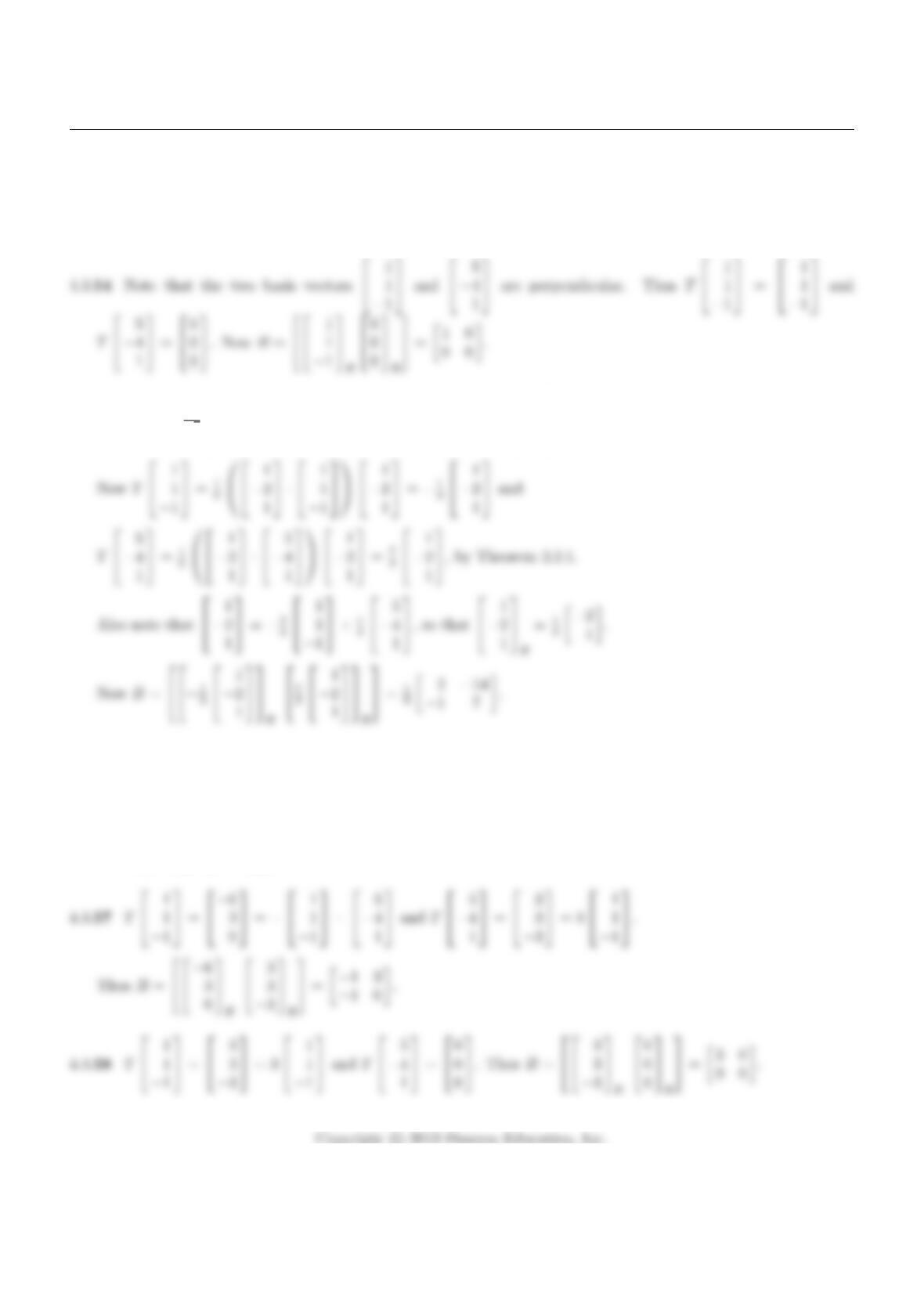
4.3.55 Let ~u =1
√6
1
−2
1
be the unit vector in the direction of
1
−2
1
.
4.3.56 T
1
1
−1
=
1
2
3
×
1
1
−1
=
−5
4
−1
and T
5
−4
1
=
1
2
3
×
5
−4
1
=
14
14
−14
. Thus
B=
−5
4
−1
B
14
14
−14
B
=0 14
−1 0 .
215
Chapter 4
4.3.59 T(f) = t·fis linear and ker(T) = {0}, but Tis not an isomorphism since the constant function 1 is not in
the image of T.
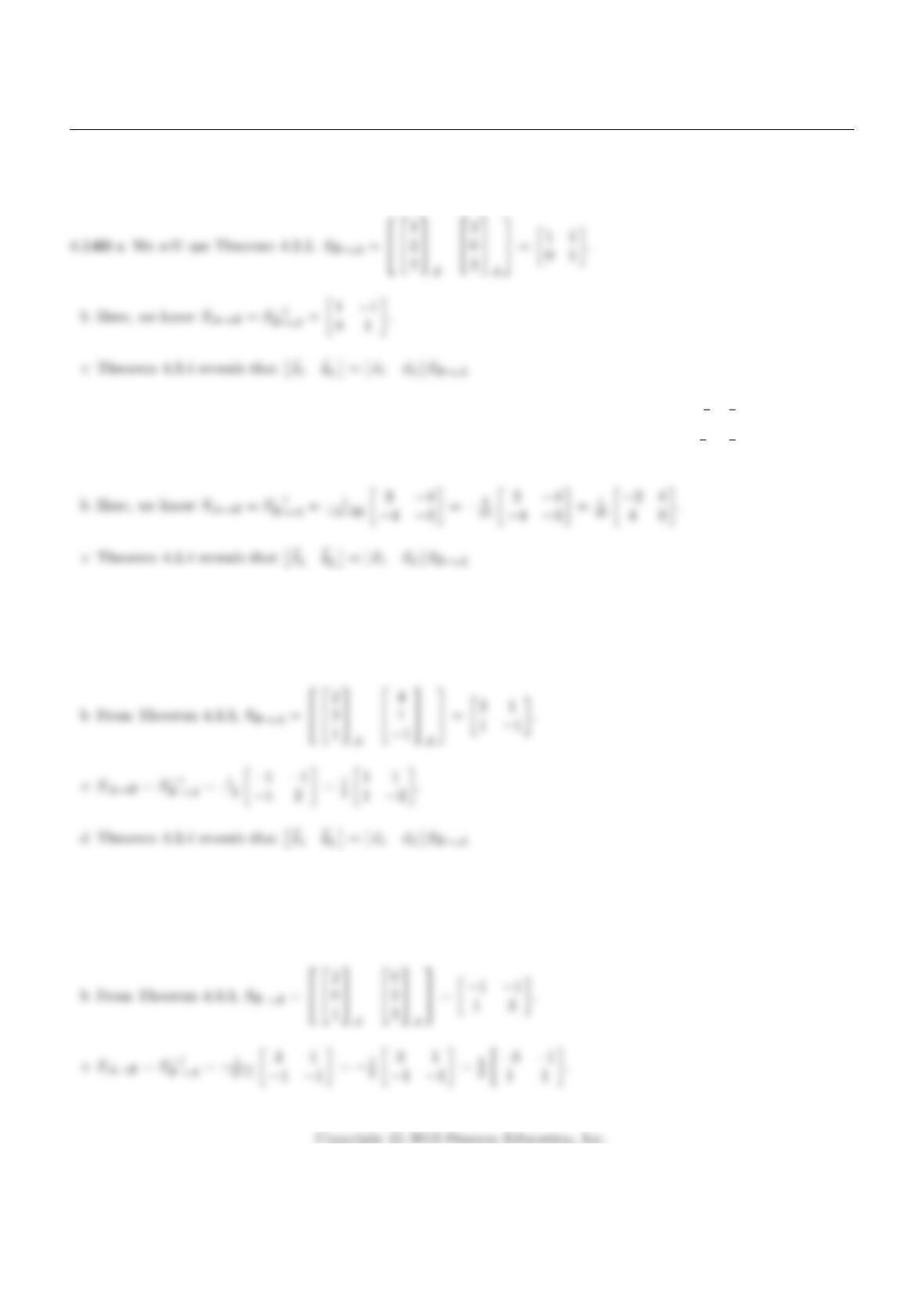
4.3.61 a We will use Theorem 4.3.3. SB→A =5
−10 A10
5A=−3 4
4 3 = 5 “−3
5
4
5
4
5
3
5#, and is thus a
reflection combined with a scaling.
4.3.62 a Finding this basis is equivalent to finding a basis of the kernel of [ 1 −2 2 ] that does not contain any
zeroes. We can quickly spot the vectors
2
2
1
and
4
1
−1
, so B=
2
2
1
,
4
1
−1
, for example.
4.3.63 a Finding this basis is equivalent to finding a basis of the kernel of [ 1 3 −2 ]. We can quickly spot the
vectors
2
0
1
and
0
2
3
, so B=
2
0
1
,
0
2
3
, for example.
216
Section 4.3
d Theorem 4.3.4 reveals that ~
b1~
b2= [~a1~a2]SB→A
4.3.65 aP2=a b
c d 2
=a2+bc ab +bd
ac +cd bc +d2=a2+bc (a+d)b
(a+d)c bc +d2= (a+d)a b
c d + (bc −ad)1 0
0 1 . So
[P2]B=bc −ad
a+d.
b We will do this column-by-column: B= [[T(I2)]B[T(P)]B] = [P]BP2B
4.3.66 aB=T(x2
1)B[T(x1x2)]BT(x2
2)B=
0−1 0
2 0 −2
0 1 0
.
4.3.67 a[T(cos t)]B= [0]B=~
0
[T(sin t)]B= [0]B=~
0
217
Chapter 4
b The equation T(f) = cos(t) corresponds to M~x =
1
0
0
0
, with solutions ~x =
p
q
0
1
2
, where pand qare arbitrary.
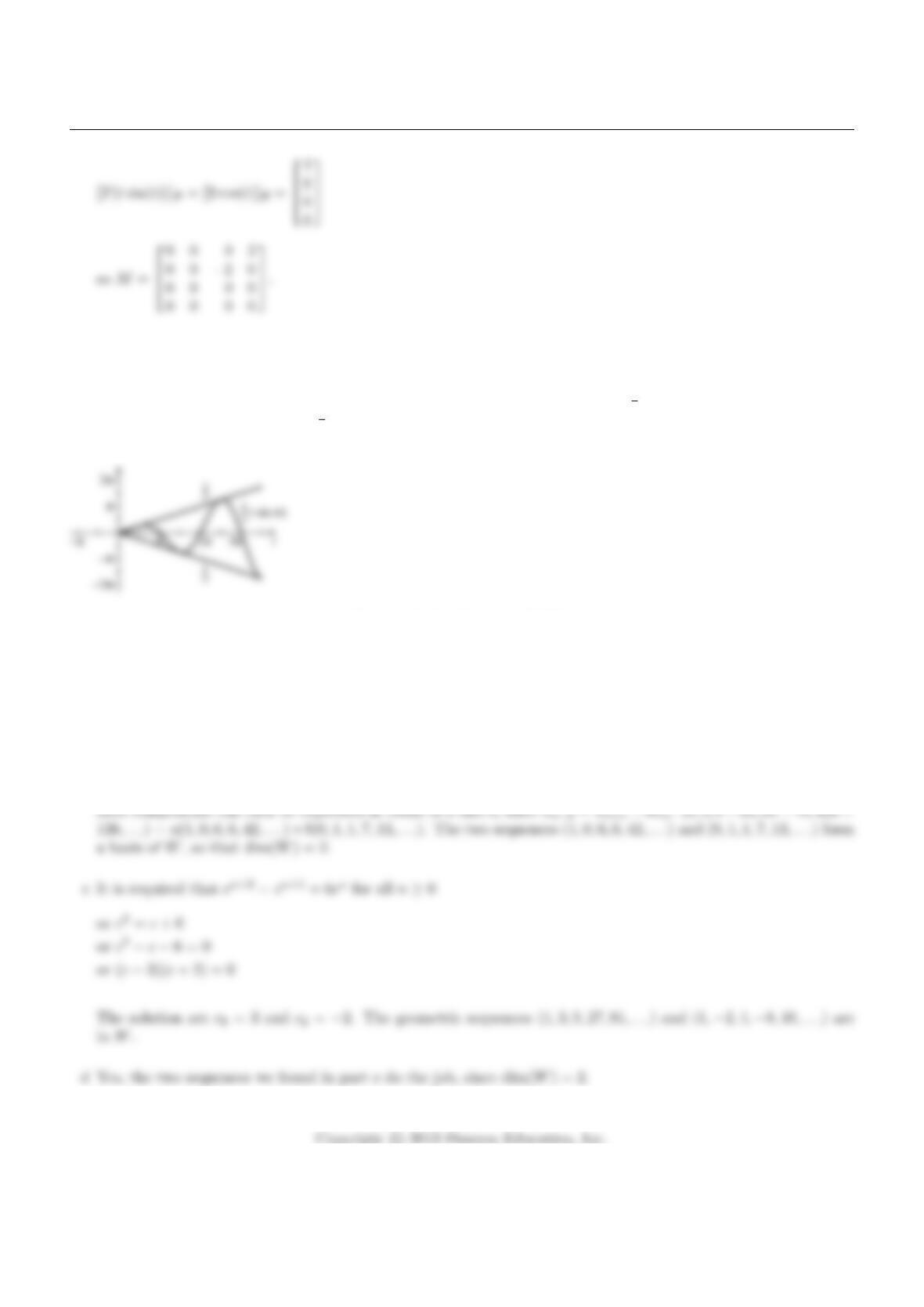
Thus f(t) = pcos(t) + qsin(t) + 1
2tsin(t). In Figure 4.2 we graph f(t) for p=q= 0; note that pcos(t) + qsin(t)
is just a sinusoidal function
Figure 4.2: for Problem 4.3.67b.
4.3.68 a The sequence (0,0,0,…) is in W.
•If the sequences (xn) and (yn) are in W(that is, xn+2 =xn+1 + 6xnand yn+2 =yn+1 + 6ynfor all n), then
xn+2 +yn+2 =xn+1 +yn+1 + 6(xn+yn) so that the sequence (xn+yn) is in Was well.
•If the sequence (xn) is in Wand kis any constant, then kxn+2 =kxn+1 + 6kxn, so that the sequence (kxn) is
in Was well.
b A sequence in Wis determined by its first two components (aand b, say), which we can choose freely. All the
218
Section 4.3
e (x0, x1, x2, x3, x4,…) = (0,1,1,7,13,…).
We are looking for constants pand qsuch that
4.3.69 As the hint suggests, we find the kernel of M=
f1(a1)f2(a1)··· fn(a1)
f1(a2)f2(a2)··· fn(a2)
.
.
..
.
..
.
.
f1(an)f2(an)··· fn(an)
.
4.3.70 We need to show that there are constants w1,…,wnsuch that
w1f1(a1) + w2f1(a2) + ···+wnf1(an) = Z1
−1
f1
w1f2(a1) + w2f2(a2) + ···+wnf2(an) = Z1
−1
f2
.
.
..
.
.
219
Chapter 4
4.3.71 If we work with the basis f1(t) = 1, f2(t) = t, and f3(t) = t2of P2, then we have to solve the system
w1+w2+w3= 2
4.3.72 a. Since Vis given by the equations x1+x2−x3= 0 and x2+x3−x4= 0, we have
V= ker 1 1 −1 0
0 1 1 −1. We can let M=1 1 −1 0
0 1 1 −1.
Now dim V= 4 −rankM= 2.
c. To check that T(~x) =
y1
y2
y3
y4
=
x2
x3
x4
x3+x4
is in Vif ~x is in V, we need to verify that y3=y1+y2and
y4=y2+y3. The first equation follows from the definition of V, and the second one is trivial.
1
21 + √5 0
0 1 −√5
f. To write the change of basis matrix SB→A, we need to express the vectors of basis Bin terms of the vectors of
220
True or False
4.3.73 a. To check orthogonality, verify that ~x ·T(~x) = 0.To check that T(~x) =
y1
y2
y3
y4
=
x4
−x3
x2
−x1
is in Vif ~x is
in V, we need to verify that y3=y1+y2and y4=y2+y3, meaning that x2=x4−x3and −x1=−x3+x2. But
the two last equations follow from the definition of V.
d. To write the change of basis matrix SB→A, we need to express the vectors of basis Bin terms of the vectors of
basis A. Now
0
1
1
2
= 0
1
0
1
1
+ 1
0
1
1
2
and
2
−1
1
0
= 2
1
0
1
1
−1
0
1
1
2
, so that S=SB→A =0 2
1−1
True or False
Ch 4.TF.1T; We are looking at P6, with a basis 1, t, t2, t3, t4, t5, t6, which has seven elements.
Ch 4.TF.2T; We can check both requirements of Definition 4.2.1.
Chapter 4
Ch 4.TF.5F; A basis of R2×3is 1 0 0
0 0 0 ,0 1 0
0 0 0 ,0 0 1
0 0 0 ,0 0 0
1 0 0 ,0 0 0
0 1 0 ,
0 0 0
0 0 1 , so it has a dimension of 6.
Ch 4.TF.9T; This fits all properties of Definition 4.1.2.
Ch 4.TF.14 F; T(f) = 0 0
0 0 is not an isomorphism.
Ch 4.TF.15 F; Let V=R2,A=1−1
1−1. Now im(A) = ker(A) = span1
1.
Ch 4.TF.16 T; the dimensions of both spaces are the same: 10.
Ch 4.TF.17 F; dim(P3)= 4, so the three given polynomials cannot span P3.
222
True or False
= (a+ 2c)1 0
3 0 + (b+ 2d)0 1
0 3 . So the image is the span of 1 0
3 0 and 0 1
0 3 , and rank(T)= 2.
Ch 4.TF.22 T; If the basis Bwe consider is f1, f2,then the given matrix tells us that T(f1) = 3f1and T(f2) =
5f1+ 4f2. Thus f=f1does the job.
Ch 4.TF.26 T; Let our basis be 1 0
0 1 ,1 0
0−1,0 1
1 0 ,0 1
−1 0 .Each matrix here is invertible, and also
clearly none are redundant.
Ch 4.TF.27 F; T(f(t)) = f′(t) is not an isomorphism.
Ch 4.TF.30 T; Make the substitution 4t−3 = sto see that the inverse is T−1(g(s)) = g(s+3
4).
Ch 4.TF.31 F; P2is a subspace of P, and Pis infinite dimensional.
Ch 4.TF.33 F; The space spanned by 1 0
0 0 and 0 1
0 0 contains no invertible matrices.
223
Chapter 4
Ch 4.TF.35 F; Let B= (f, g) and C= (g, f ). The fact that 1 2
3 4 is the B– matrix of Timplies that [T(f)]B=1
3,
or T(f) = f+ 3g. But then [T(f)]C=3
1, meaning that the second column of the C-matrix of Tis 3
1. This
shows that the matrix 2 1
4 3 fails to be the C-matrix of T.
Ch 4.TF.39 T; let W1be {~
0}. Then any other subspace W2unioned with W1will simply be W2again, which we
know is a subspace.
Ch 4.TF.40 T; Let T(a0+a1t+a2t2+···+a5t5+···) = a0+a1t+a2t2+···+a5t5.The image of this transformation
is clearly all of P5, and Tsatisfies the requirements of Definition 4.2.1.
Ch 4.TF.45 T; 0 is in our set, and if fand gare in our set, then T(f+g) = T(f) + T(g) = f+gso that f+gis
in our set as well. Also, if fis in our set and kis an arbitrary scalar, then T(kf) = kT (f) = kf, so kf is in our
set as well.
Ch 4.TF.46 T; The kernel of T is {0}. Indeed, if f(t) is a nonzero polynomial, with f(t) = a0+a1t+… +aktk
where ak6= 0, then T(f(t)) = a0T(1) + a1T(t) + … +akT(tk)is of degree k≥0, so that T(f(t))fails to be the
zero polynomial.
224
True or False
Ch 4.TF.51 T; note that dim(P11) = 12 = dim(R3×4). The linear spaces P11 and R3×4are both isomorphic to R12,
via the coordinate transformation, and thus they are isomorphic to each other.
Ch 4.TF.52 F; Consider the linear transformation T(f(t)) = f(t) from P2to P, for example.
Ch 4.TF.55 T; Using a coordinate transformation, it suffices to show this for R4. For every real number k, we define
the three dimensional subspace Vkof R4consisting of all vectors ~x such that x4=kx3. If cis different from k,
Ch 4.TF.56 T; If the basis Bwe consider is f1, f2,then the given matrix tells us that T(f1) = 3f1and T(f2) =
Ch 4.TF.57 T; This is logically equivalent to the following statement: If the domain of Tis finite dimensional, then
so is the image of T. Compare with Exercises 4.2.81a and 4.1.57.
Ch 4.TF.58 F; If Ais a scalar multiple of I2,then all 2 ×2 matrices commute with A, so that the space of
commuting matrices is 4 – dimensional. If A=a b
Ch 4.TF.59 T; If A= 0, then we are done. If rank(A) = 1, then the image of the linear transformation T(M) = AM
Ch 4.TF.61 T; Pick the first redundant element fkin the list. Since the elements f1,…,fk−1are linearly indepen-
dent, the representation of fkas a linear combination of the preceding elements will be unique.
225
Chapter 4
Ch 4.TF.62 F; T(I3) = P−P= 0,and Tcan never be an isomorphism.
Ch 4.TF.63 T; Let W= span(f1, f2, f3, f4, f5) = span(f2, f4, f5, f1, f3).If we omit the two redundant elements from
Ch 4.TF.64 F; The dimensions of the kernel and image would have to be equal, and both add up to the dimension
of P6, which is the odd number 7.
Ch 4.TF.65 T; Consider the proof of the rank nullity theorem outlined in Exercise 4.2.81. In the proof, we use bases
of ker(T) and im(T) to construct a basis of the domain.
Ch 4.TF.66 F; If the basis Bwe consider is f1, f2,then the given matrix tells us that T(f1) = 3f1and T(f2) =
Ch 4.TF.67 T; Consider a 3-dimensional subspace Wof R2×2. The matrices x y
z t in Wcan be described by a
single linear equation ax +by +cz +dt = 0 , where at least one of the coefficients is nonzero. Suppose xis the