CASE STUDY 4
The Crowne Inn: A Classic Case of a Family
Business in Turmoil
This case and teaching note were written by Todd A. Finkle, The University of Akron, as a basis
for class discussion rather than to illustrate either effective or ineffective handling of a business
situation. Reprinted by permission.
SUMMARY AND AUTHOR’S NOTE
The primary subject matter of this case concerns the succession of a family-owned business.
Secondary issues examined include contracts, personality conflicts, valuations, and ethics. The
case has a difficulty level that is appropriate for senior-level undergraduate students. The case is
designed to be taught in a one-hour-and-twenty-minute period and is expected to require at least
four hours of outside preparation by students.
WHERE TO USE THIS CASE
• Chapter 7: Use to show how to learn from the experiences of the family in this case. It
offers many lessons for students considering founding family ventures in the future.
91 Case 4: The Crowne Inn
CASE ANALYSIS
In early 2001, Barbara Johnston and her four sons were negotiating with Barbara’s son Bruce for
the rights to own the family-owned business, The Crowne Inn. After Bruce’s father retired from
the business in 1995, Bruce made an oral agreement with his parents to pay off the mortgage of
their house ($23,500), pay their medical costs, and pay $500 cash per month for the rest of their
lives in exchange for the future profits from the business. The company was structured as an S-
corporation with Bruce’s father owning 100 percent of the stock. The stock of the company was
to remain with the parents until their deaths, upon which the stock would pass to Bruce without
remuneration.
DISCUSSION QUESTIONS
1. Describe the historical evolution of The Crowne Inn. What has made the business
successful?
Harvey Johnston and Leo Smith founded The Crowne Inn in 1952 with a $10,000 loan in
downtown Kansas City. The bar was structured as an S-corporation where both Johnston
Case 4: The Crowne Inn 92
2. What mistakes did Harvey make during the succession process? As a result of his having
no written succession plan, what happened?
Harvey’s major mistake was not having a formal written succession plan. Harvey made an
oral agreement with his son Bruce on the day of his retirement. The oral agreement stated
3. Why were the brothers so mad? Were they justified?
The brothers’ anger was justifiable. One of the major complaints was Bruce’s inability to
pay his mother’s health care costs. Bruce paid his parents’ health care premiums with the
93 Case 4: The Crowne Inn
EXHIBIT 3: Barbara Johnston’s Sources of Income and Tax Summary for the Tax Year
1999
Sources of Income
Amount ($)
Taxable interest
2,294
Dividends
2,752
Cashed-in stock (capital gain)
Taxable pension
5,778
Taxable S-corporation income (bar)
2,299
Total income
Adjusted gross income
Standard deduction
5,350
Personal exemptions
2,750
Taxable income
Total federal tax
2,576
Total state tax
Total tax
3,518
According to the exhibit, Barbara owed only $3,518 in taxes. This excluded her real estate
taxes, which were paid separately. Bruce and Sharon had Barbara take out a $10,000 loan
to pay for her supposed $10,000 tax bill; however, there was no $10,000 tax bill.
The brothers were right in their suspicions. Once Danny retrieved a copy of their mother’s
financial statements, their accountant quickly called Barbara to inform her that she would
be receiving a refund of $6,482 from her taxes. Would this refund have appeared so
suddenly if the sons had not retrieved the financials?
4. Bruce attempted to get his mother to sign a contract. Do you think this was a fair contract?
If not, what was wrong with the contract?
The contract was very ambiguous. The first problem was the means by which Bruce and
Case 4: The Crowne Inn 94
5. Bruce gave the brothers a detailed analysis of all of the money that he had given to their
mother since 1995. What role should this play in determining your final recommendation to
the family?
The amount of money that Bruce gave to his parents in the past should have no bearing on
the final recommendation. The important thing to note is that we are talking about future
6. Based on the financial information in the case, place a value on the business using the
following methodologies: (a) balance sheet method, (b) income statement method, and (c)
discounted cash flow method.
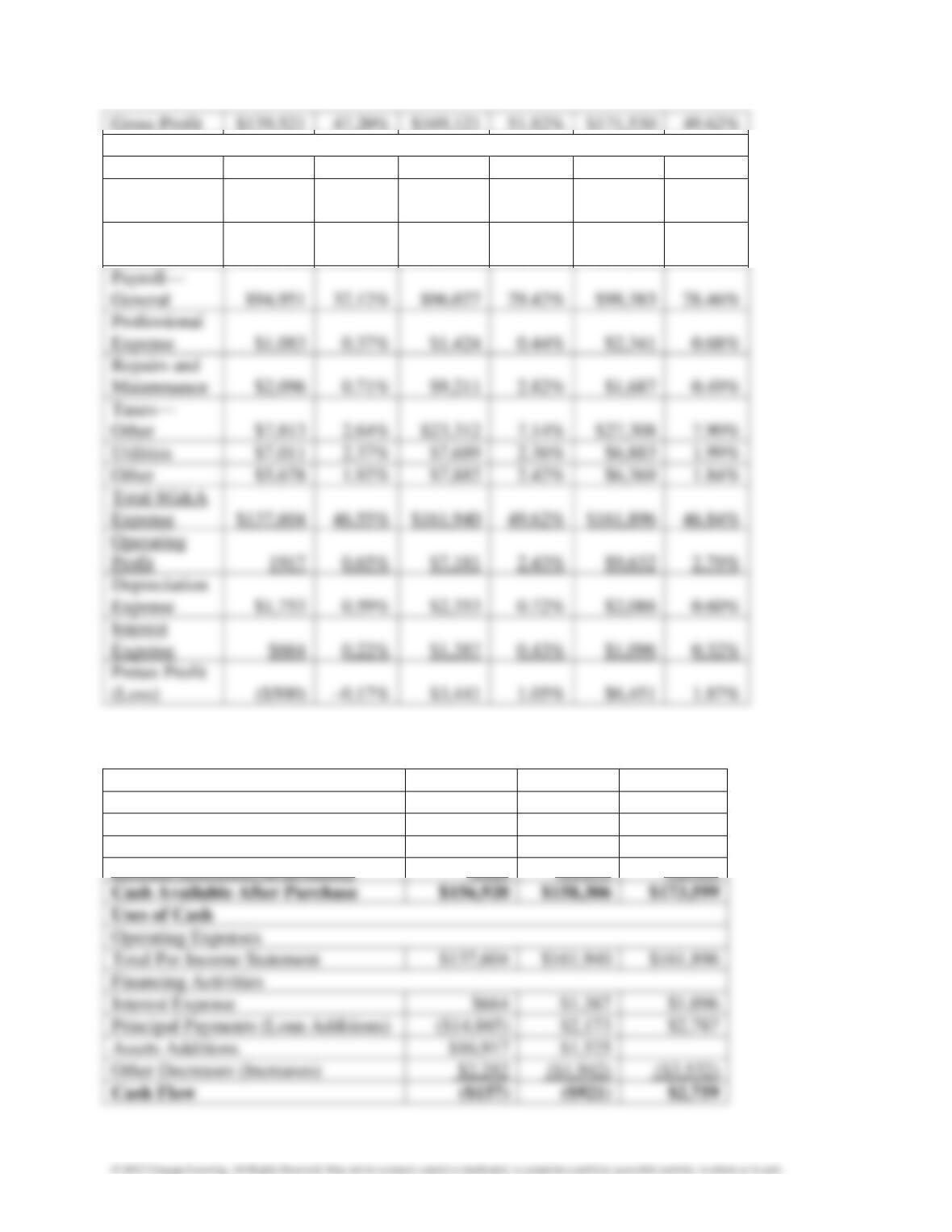
EXHIBIT 4: Income Statement for The Crowne Inn, 1997–1999
1997
1998
1999
$
%Sales
$
%Sales
$
%Sales
Sales
100.00%
100.00%
100.00%
Goods Sold
95 Case 4: The Crowne Inn
Gross Profit
Operational Expenses
Advertising
$8,318
2.81%
$8,277
2.54%
$5,777
1.67%
Bank
Charges
$892
0.30%
$1,094
0.34%
$1,592
0.46%
Insurance—
General
$9,762
3.30%
$7,024
2.15%
$11,555
3.34%
Payroll—
General
$94,951
$96,027
$98,383
Professional
Expense
$1,083
0.37%
$1,424
0.44%
$2,341
0.68%
Maintenance
$2,096
0.71%
$9,211
2.82%
$1,687
0.49%
Taxes—
Other
$7,813
2.64%
$23,312
7.14%
$27,308
7.90%
Utilities
$7,011
2.37%
$7,689
2.36%
$6,883
1.99%
Other
$5,678
1.92%
$7,882
2.42%
$6,369
1.84%
Total SG&A
Expense
Operating
Profit
1917
0.65%
$7,181
2.43%
$9,632
2.79%
Depreciation
Expense
$1,753
0.59%
$2,353
0.72%
$2,086
0.60%
Expense
$664
0.22%
$1,387
0.43%
$1,096
0.32%
Pretax Profit
(Loss)
$3,441
1.05%
$6,451
1.87%
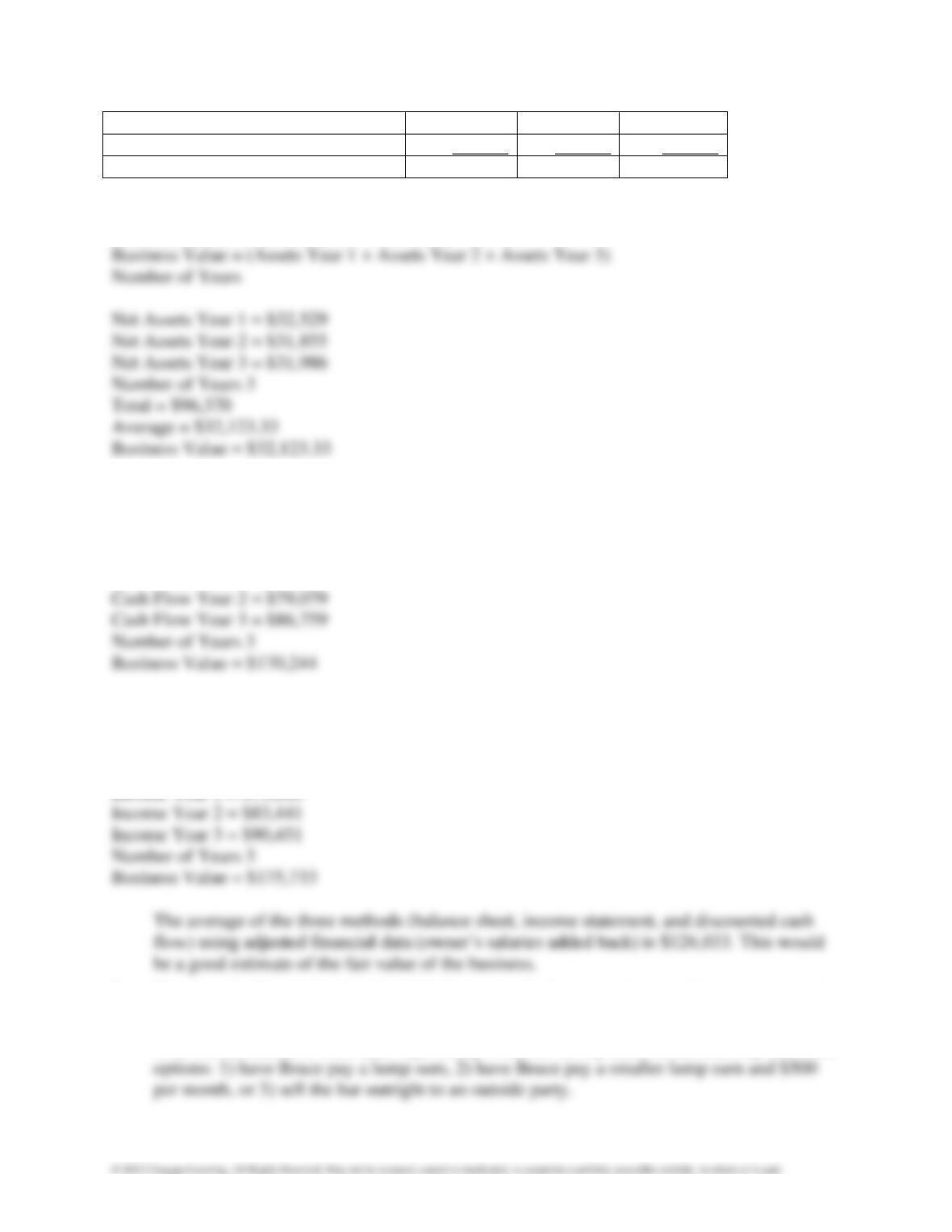
EXHIBIT 6: The Crown Inn Cash Flow Summary, 1997–1999
1997
1998
1999
Total Sales
$295,621
$326,352
$345,669
Total Cash Available
$295,621
$326,352
$345,669
Total Purchases
$156,100
$157,231
$174,131
Increase (Decrease) in Inventory
$820
$1,075
($540)
Cash Available After Purchase
$156,920
$158,306
$173,599
Uses of Cash
Operating Expenses
Total Per Income Statement
$137,604
$161,940
$161,896
Financing Activities
Interest Expense
$664
$1,387
Principal Payments (Loan Additions)
$2,173
Assets Additions
$1,525
Other Decreases (Increases)
($1,942)
($3,532)
Cash Flow
Case 4: The Crowne Inn 96
Beginning Cash
$6,437
$6,280
$5,359
Ending Cash
$6,280
$5,359
$8,118
Cash Flow Increase (Decrease)
($157)
($921)
$2,759
Business Valuation
The balance sheet method can be calculated as follows:
The discounted cash flow method (using a required rate of return of 12%) can be calculated as
follows:
Business Value = (Cash Flow Year 1 + Cash Flow Year 2 + Cash Flow Year 3)
(1 + Required Rate of Return) ^ Number of Years
Cash Flow Year 1 = $73,343
Finally, the income statement method (using a required rate of return of 12%) can be calculated
as follows:
Business Value = (Income Year 1 + Income Year 2 + Income Year 3)
(1 + Required Rate of Return) ^ Number of Years
Income Year 1 = $73,000
7. Based on the financial and statistical information in the case, what would you recommend
to the Johnston family? Why?
With the assistance of their attorney, Bobby Free, the family determined that they had three
97 Case 4: The Crowne Inn
If the family decided to sell the bar to an outside party, based on the previous calculations,
they could place a price tag on the bar of approximately $130,000. However, we can
Actuary Valuation
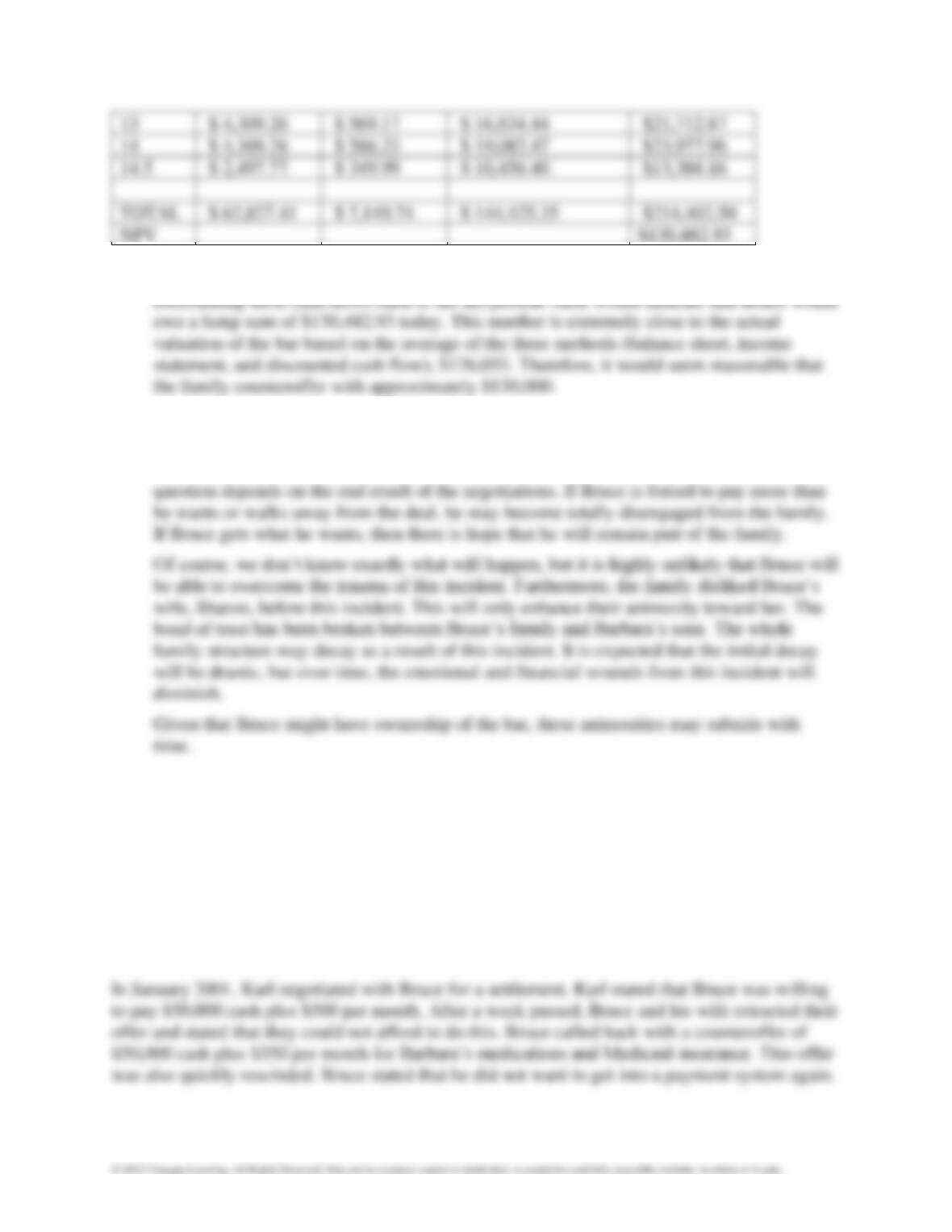
The table below breaks down the monies Bruce will owe his mother into three separate
categories: cash, Medicare, and prescriptions. Since the oral agreement requires $500 cash every
month and complete health care coverage, the health care costs had to be broken down into two
NPV of Monthly Cash Flows over Projected 14.5-Year Life Span (Compounded Monthly)
YEAR
CASH
MEDICARE
PRESCRIPTIONS
TOTALS
1
$ 4,309.26
$ 396.45
$ 3,740.84
$8,446.55
2
$ 4,309.26
$ 408.35
$ 4,240.38
$8,957.99
3
$ 4,309.26
$ 420.58
$ 4,806.63
$9,536.47
4
$ 4,309.26
$ 433.17
$ 5,448.49
$10,190.92
5
$ 4,309.26
$ 446.18
$ 6,176.07
$10,931.51
6
$ 4,309.26
$ 459.54
$ 7,000.81
$11,769.61
7
$ 4,309.26
$ 473.33
$ 7,935.68
$12,718.27
8
$ 4,309.26
$ 491.00
$ 8,995.38
$13,795.64
9
$ 4,309.26
$ 505.73
$ 10,196.60
$15,011.59
10
$ 4,309.26
$ 520.90
$ 11,558.23
$16,388.39
11
$ 4,309.26
$ 536.50
$ 13,101.68
$17,947.44
12
$ 4,309.26
$ 552.62
$ 14,851.25
$19,713.13
Case 4: The Crowne Inn 98
The figures indicate that Bruce would owe $214,402.50 over the next 14.5 years.
8. How do you think the culture of the family will change in the future?
The major issue is how Bruce’s family will deal with the situation in the future. Will they
cut themselves off from the family, remain distant, or continue as they were before? This
EPILOGUE
Bruce’s personal financial problems probably led him to do many of the unethical things
described in the case. Bruce was having financial problems that had nothing to do with the bar.
He had been investing in the stock market on margin when the NASDAQ posted the worst loss
in its history in 2000, a 39 percent downfall. As a result, Bruce had several margin calls, which
left him strapped for cash. His statement that he would pay nothing more than $60,000 for the
bar was probably based on his limited cash reserves.
99 Case 4: The Crowne Inn
The weekend after he made this offer, Bruce called his mother to have her come out to the
YMCA to see his kids play in a basketball game. The following week, three of the four brothers
accepted the proposal. Danny was the lone holdout, stating that Bruce should pay $150,000.
All of the brothers were in shock! They could not believe what they were hearing. Cal, Danny,
and Tyler all agreed that Karl was irrational and that $65,000 was a bargain for the bar. Caren
and Karl fought hard to get the bar for nothing but left Kansas City empty-handed. By the end of
their stay, Karl stated that he was never coming back to Kansas City.
REFERENCES