PROBLEM 4.113 (Continued)
0.90 0.88182(19.6203 N) 0; 19.2240 N
xx
AA j:
0.90 44.145 0.180(19.6203 N) 0; 45.123 N
yy
AA i:
19.62 N
CD
F
(19.22N) (45.1 N)
Aij
PROBLEM 4.114
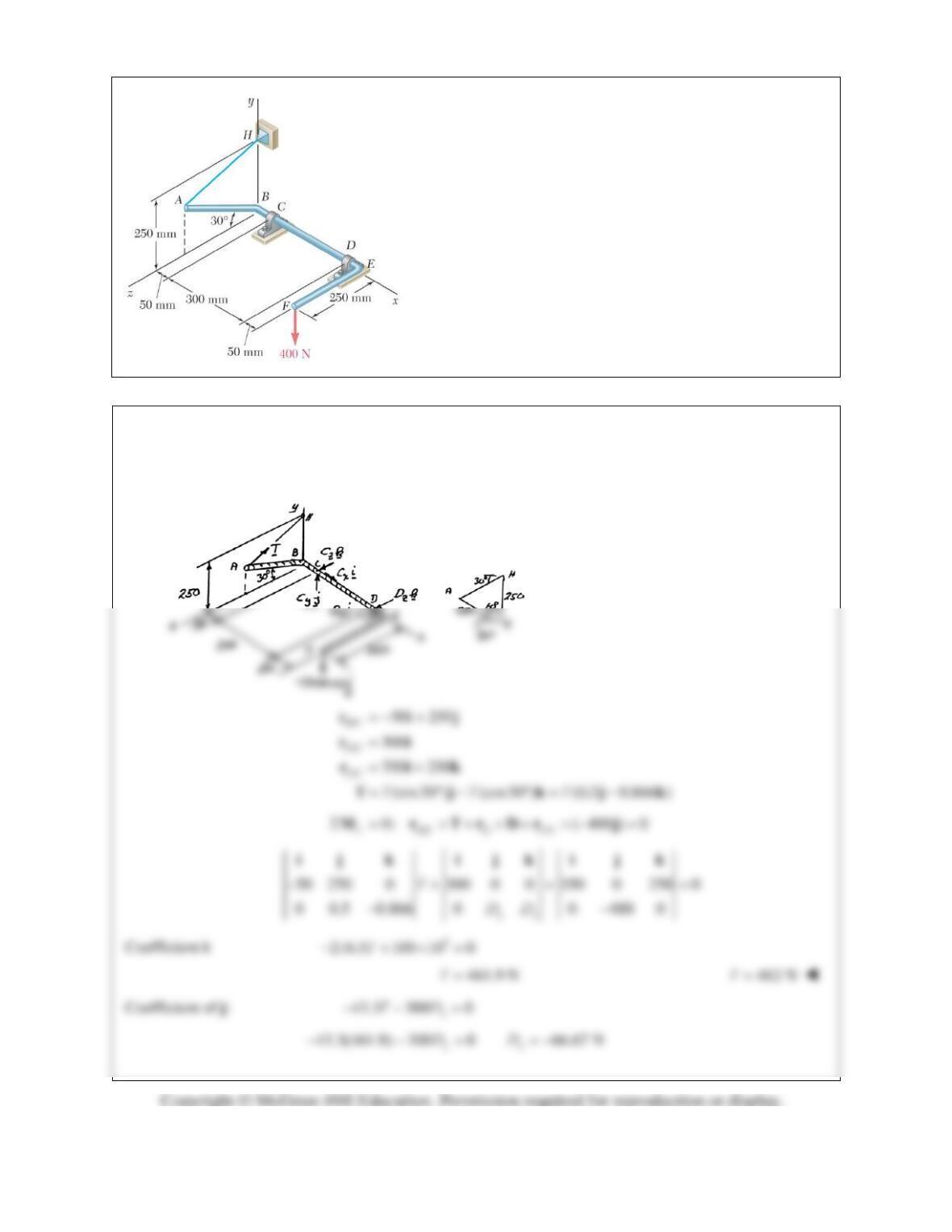
The bent rod ABEF is supported by bearings at C and D and
by wire AH. Knowing that portion AB of the rod is 250 mm
long, determine (a) the tension in wire AH, (b) the reactions
at C and D. Assume that the bearing at D does not exert any
axial thrust.
SOLUTION
Free-Body Diagram:
ABH is equilateral.
Dimensions in mm
PROBLEM 4.114 (Continued)
Coefficient of k: 3
25 300 140 10 0
y
TD
3
25(461.9) 300 140 10 0 505.1 N
yy
DD
(505 N) (66.7 N)
Dj k
PROBLEM 4.115
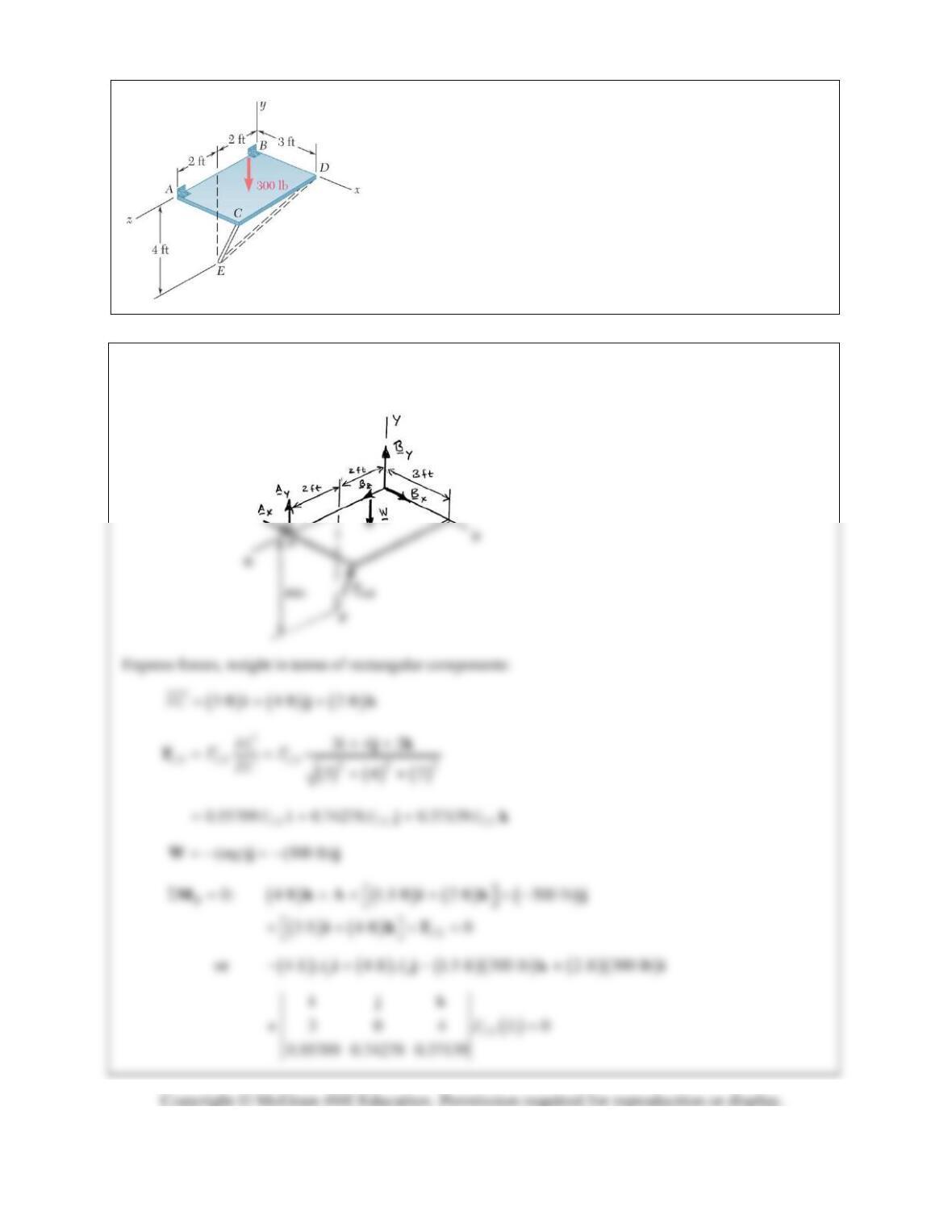
The horizontal platform ABCD weighs 60 lb and supports a 240-lb
load at its center. The platform is normally held in position by
hinges at A and B and by braces CE and DE. If brace DE is
removed, determine the reactions at the hinges and the force
exerted by the remaining brace CE. The hinge at A does not exert
any axial thrust.
SOLUTION
Free-Body Diagram:
PROBLEM 4.115 (Continued)
Setting the coefficients of the unit vectors equal to zero:
: 0.74278 3 ft 300 lb 1.5 ft 0
CE
Fk
201.94 lb
CE
F
0: 0.371391 201.94 lb 0
zz
FB
74.999 lb
z
B
Therefore:
56.3 lbAi
56.2 lb 150.0 lb 75.0 lb Bijk
PROBLEM 4.116
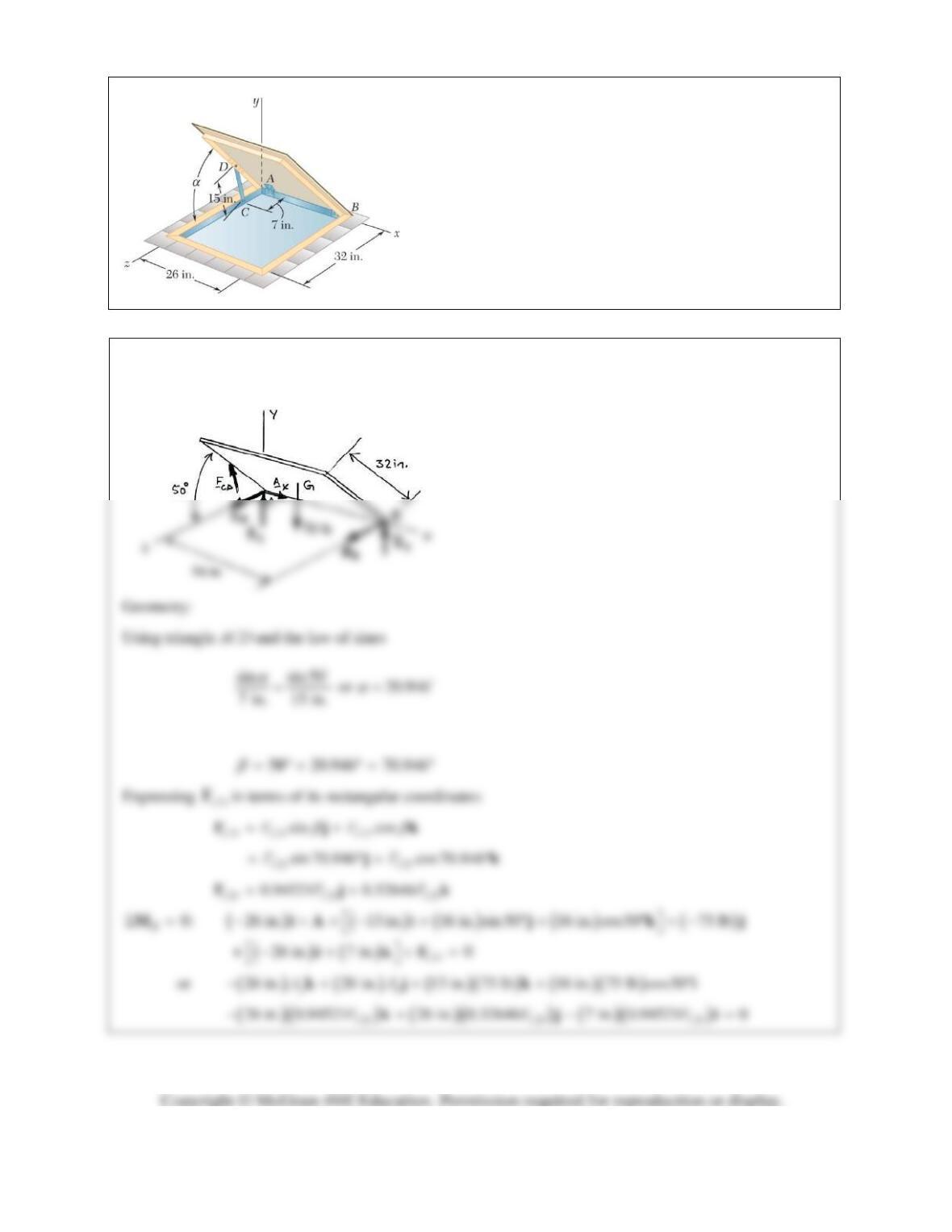
The lid of a roof scuttle weighs 75 lb. It is hinged at corners
A and B and maintained in the desired position by a rod CD
pivoted at C; a pin at end D of the rod fits into one of several
holes drilled in the edge of the lid. For the position shown,
determine (a) the magnitude of the force exerted by rod CD,
(b) the reactions at the hinges. Assume that the hinge at B
does not exert any axial thrust.
SOLUTION
Free-Body Diagram:
PROBLEM 4.116 (Continued)
(a) Setting the coefficients of the unit vectors to zero:
: 75lb 16in. cos50 0.94521 7in. 0
CD
F
i
116.6 lb
CD
F
(b) 0: 0
xx
FA
: 0.94521 116.580 lb 26 in. 75 lb 13 in. 26 in. 0
y
A
k
72.693 lb
A
PROBLEM 4.117
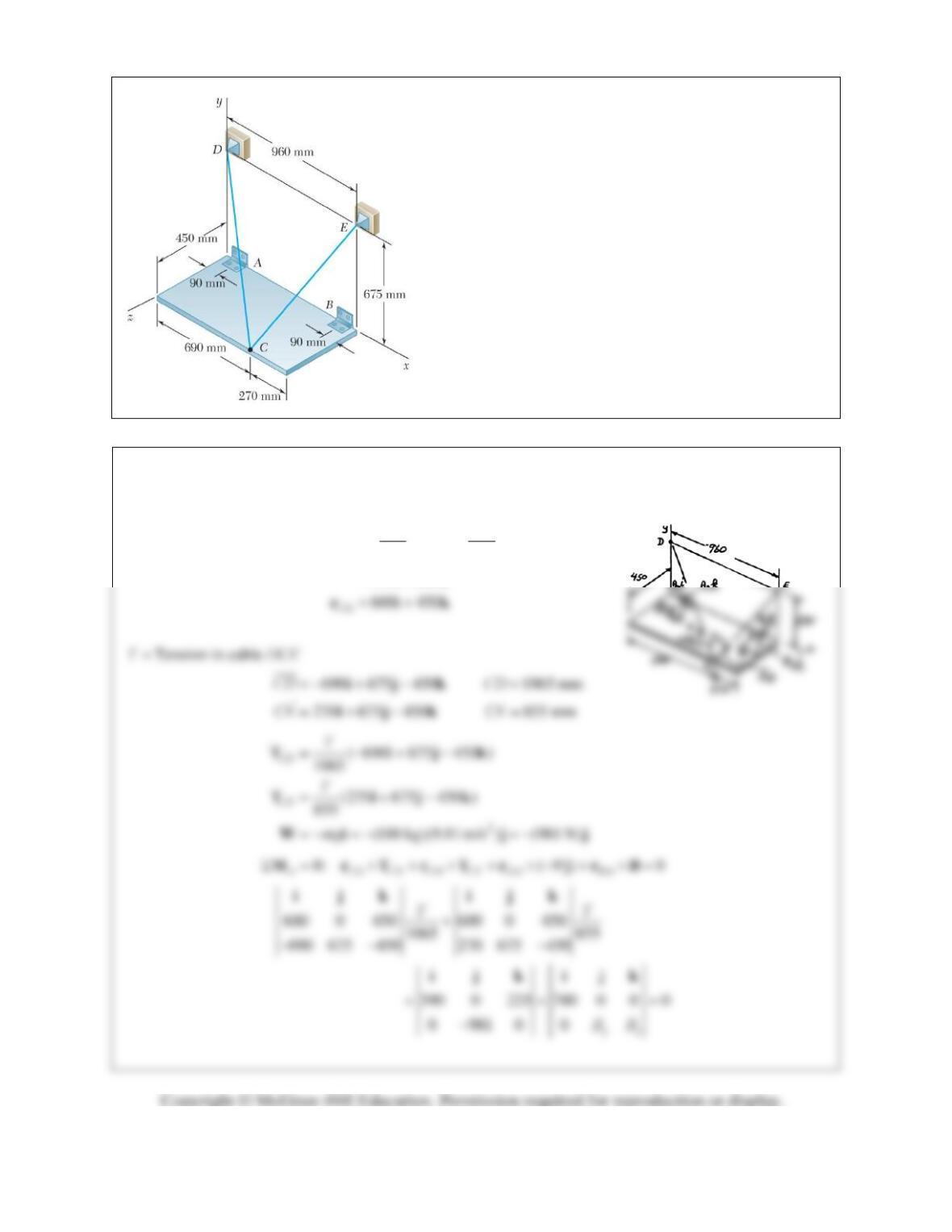
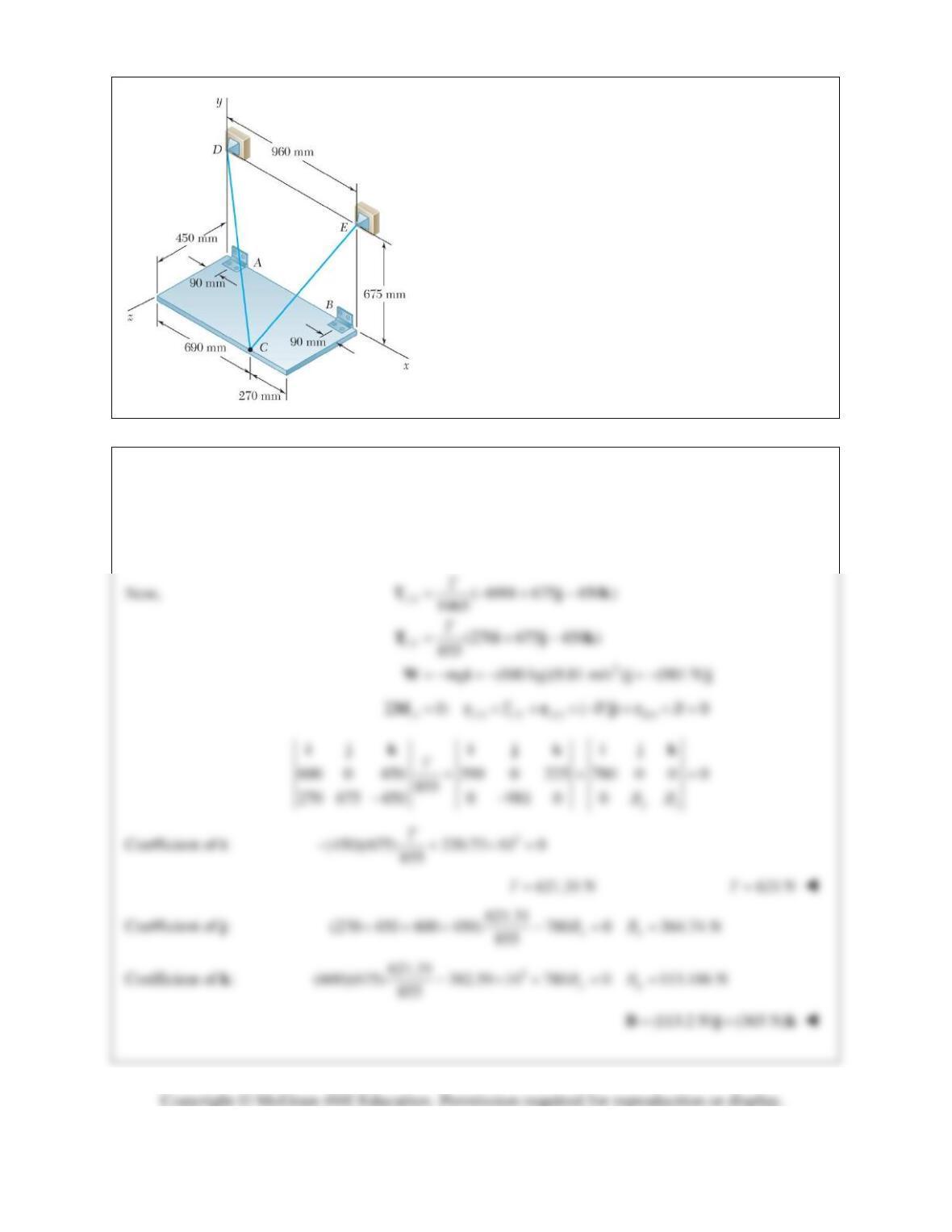
A 100-kg uniform rectangular plate is supported in the
position shown by hinges A and B and by cable DCE that
passes over a frictionless hook at C. Assuming that the
tension is the same in both parts of the cable, determine (a)
the tension in the cable, (b) the reactions at A and B.
Assume that the hinge at B does not exert any axial thrust.
SOLUTION
/
/
(960 180) 780
960 450
90
22
390 225
BA
GA
rii
rik
ik
Dimensions in mm
PROBLEM 4.117 (Continued)
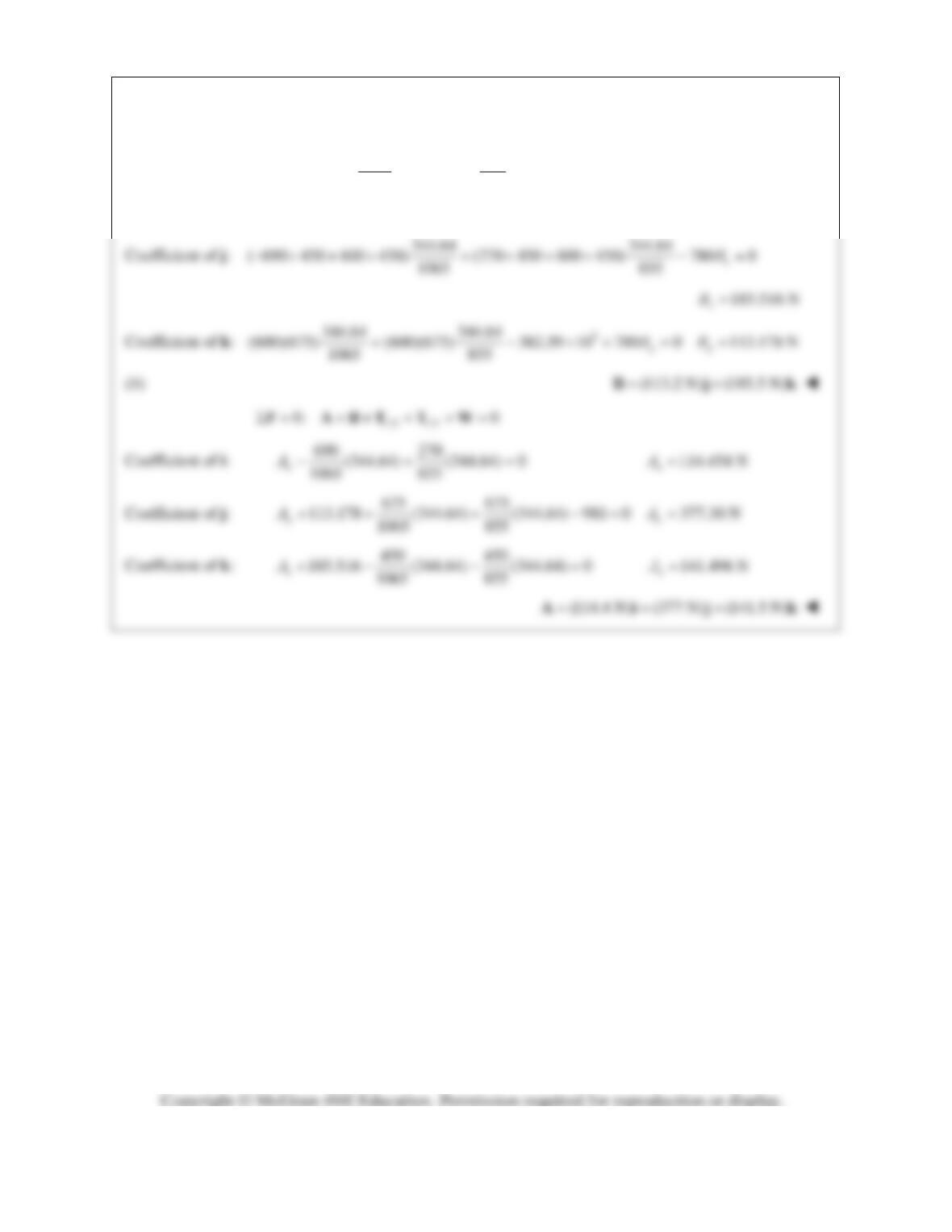
Coefficient of i: 3
(450)(675) (450)(675) 220.73 10 0
1065 855
TT
(a) 344.64 NT
345 NT
PROBLEM 4.118
Solve Problem 4.117, assuming that cable DCE is replaced
by a cable attached to Point E and hook C.
PROBLEM 4.117 A 100-kg uniform rectangular plate is
supported in the position shown by hinges A and B and by
cable DCE that passes over a frictionless hook at C.
Assuming that the tension is the same in both parts of the
cable, determine (a) the tension in the cable, (b) the
reactions at A and B. Assume that the hinge at B does not
exert any axial thrust.
SOLUTION
See solution to Problem 4.113 for free-body diagram and analysis leading to the following:
1065 mm
855 mm
CD
CE
PROBLEM 4.118 (Continued)
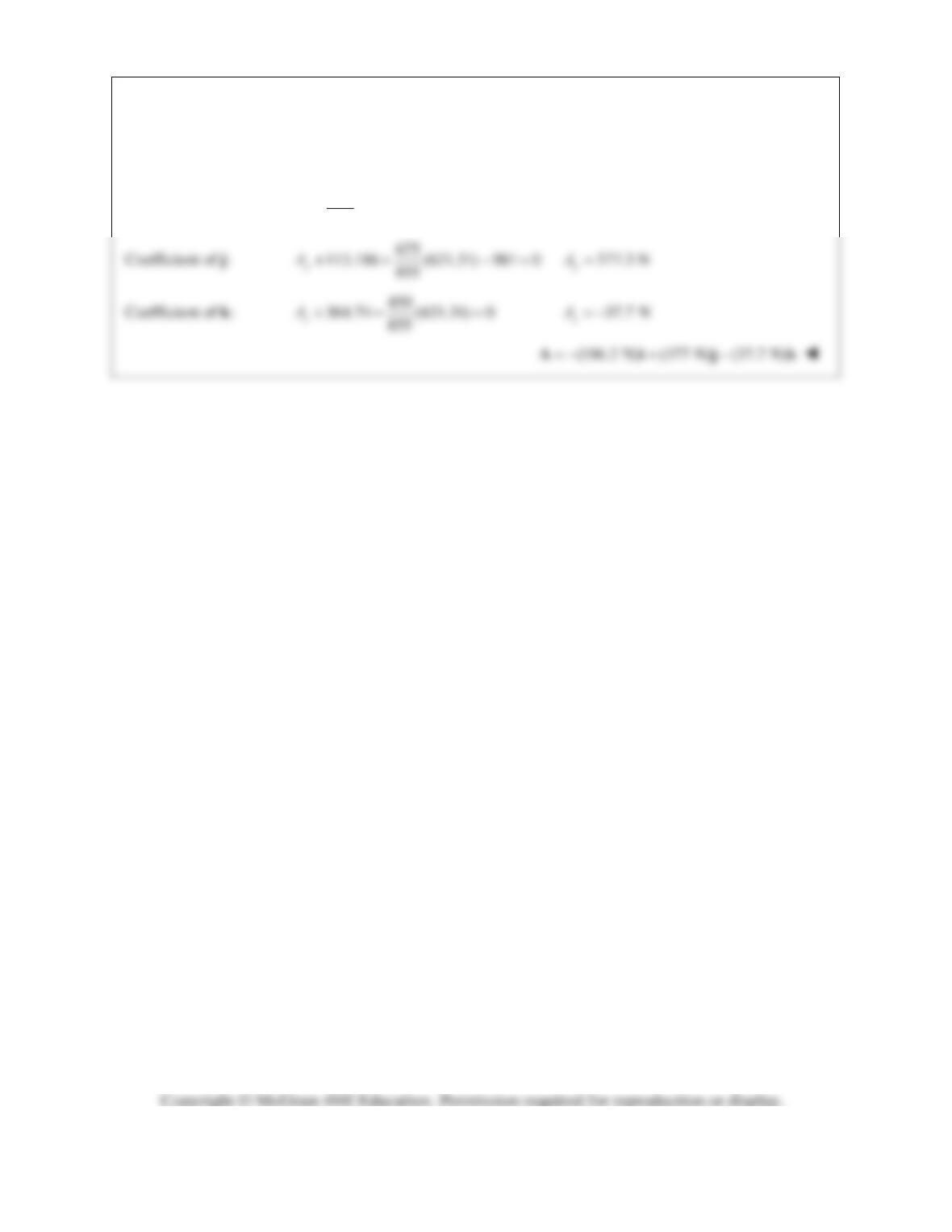
0: 0
CE
FABTW
Coefficient of i: 270 (621.31) 0
855
x
A
196.2 N
x
A
PROBLEM 4.119
Solve Prob. 4.113, assuming that the hinge at A has been removed and
that the hinge at B can exert couples about axes parallel to the x and y
axes.
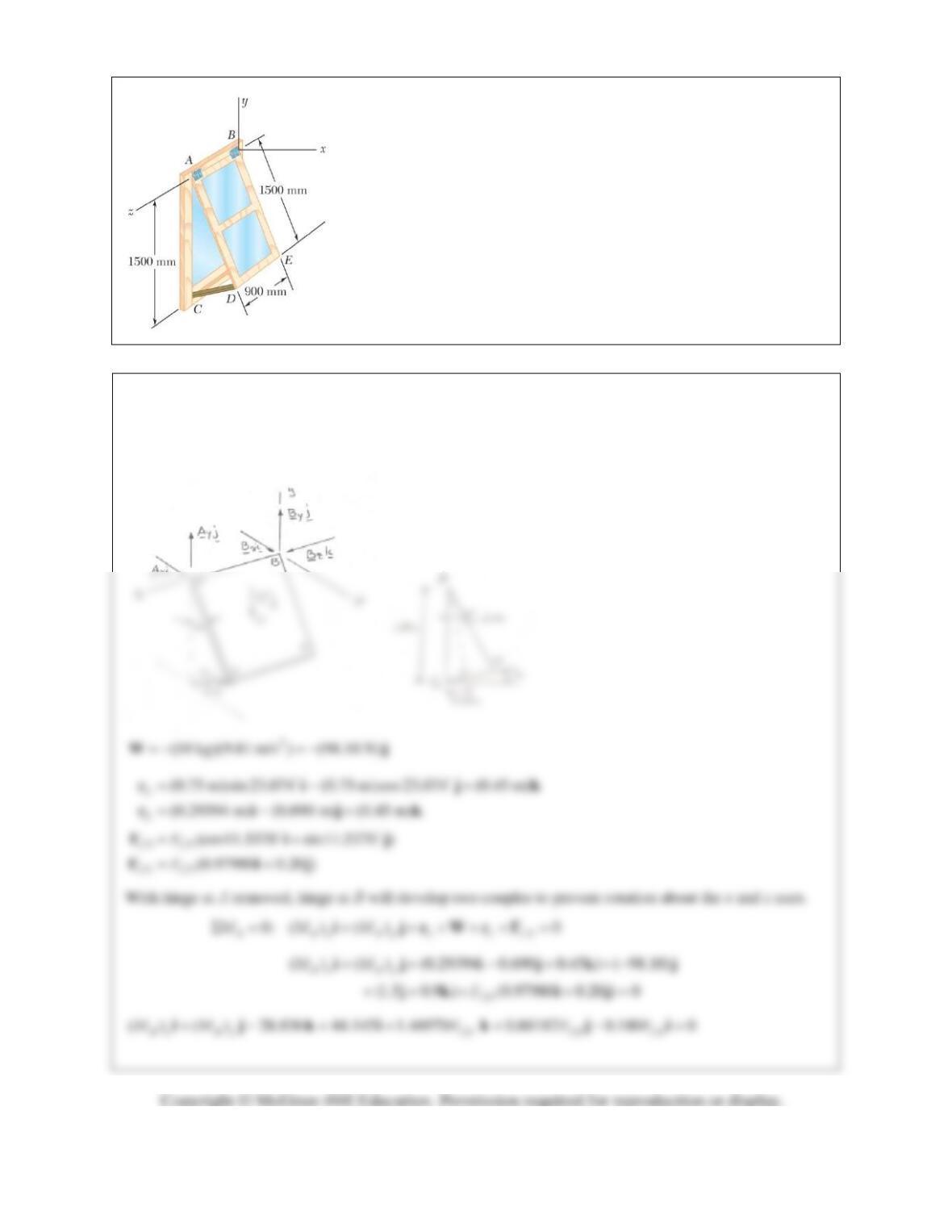
PROBLEM 4.113
A 10-kg storm window measuring 900 × 1500 mm is
held by hinges at A and B. In the position shown, it is held away from
the side of the house by a 600-mm stick CD. Assuming that the hinge at
A does not exert any axial thrust, determine the magnitude of the force
exerted by the stick and the components of the reactions at A and B.
SOLUTION
Free-Body Diagram:
Since CD is a two-force member,
CD
F
is directed along CD and triangle ACD is isosceles. We have
PROBLEM 4.119 (Continued)
Equating the coefficients of the unit vectors to zero,
28.836 1.46970 0; 19.6203 N
CD CD
FF k:
( ) 0.88182(19.6203) 0; ( ) 17.3016 N m
By By
MM
j:
PROBLEM 4.120
Solve Prob. 4.115, assuming that the hinge at B has been removed
and that the hinge at A can exert an axial thrust, as well as couples
about axes parallel to the x and y axes.
PROBLEM 4.115 The horizontal platform ABCD weighs 60 lb
and supports a 240-lb load at its center. The platform is normally
held in position by hinges at A and B and by braces CE and DE. If
brace DE is removed, determine the reactions at the hinges and
the force exerted by the remaining brace CE. The hinge at A does
not exert any axial thrust.
SOLUTION
Free-Body Diagram:
0
xyz
BBB
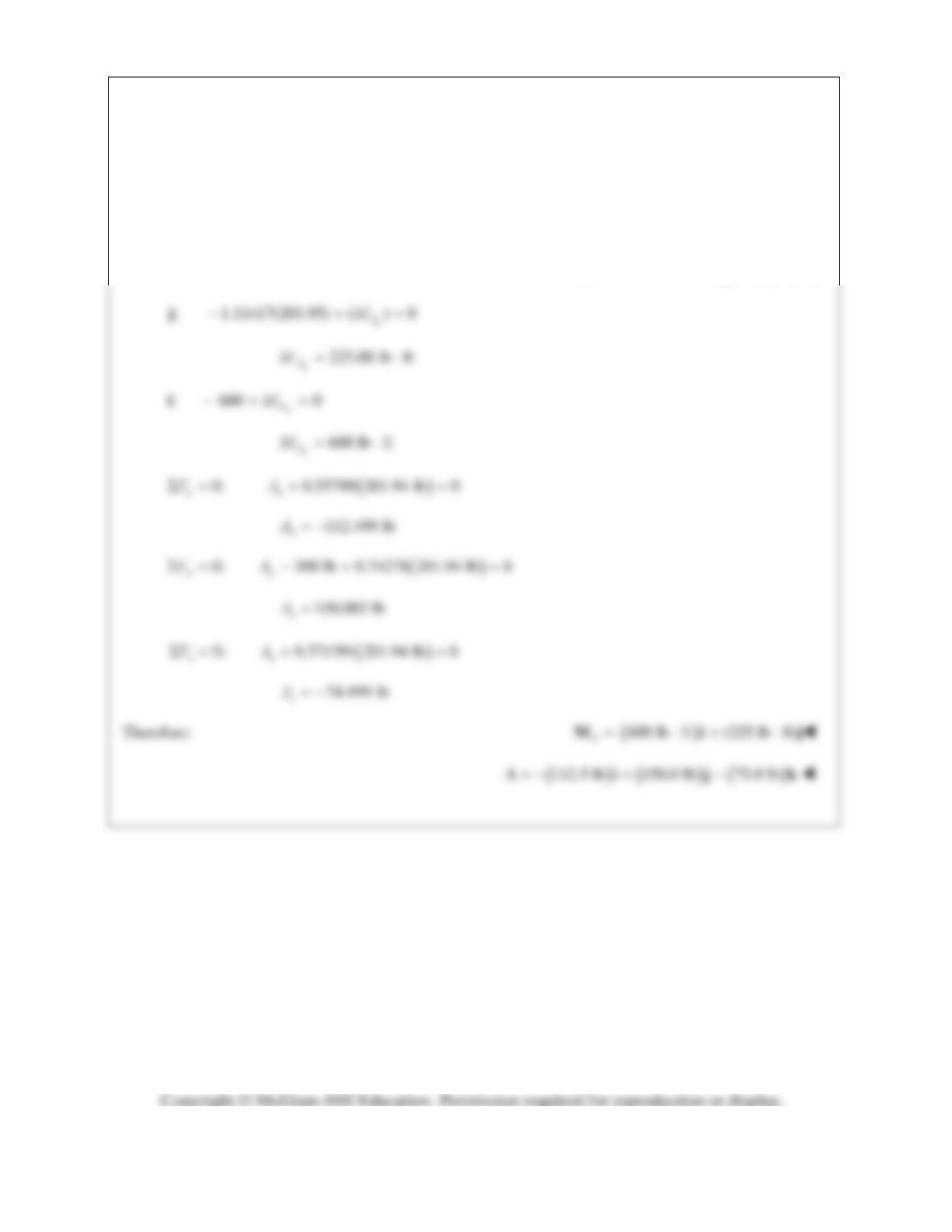
PROBLEM 4.120 (Continued)
Setting the coefficients of the unit vectors equal to zero:
: 450 2.2283 0
CE
F k
201.95 lb
CE
F
or 202 lb
CE
F
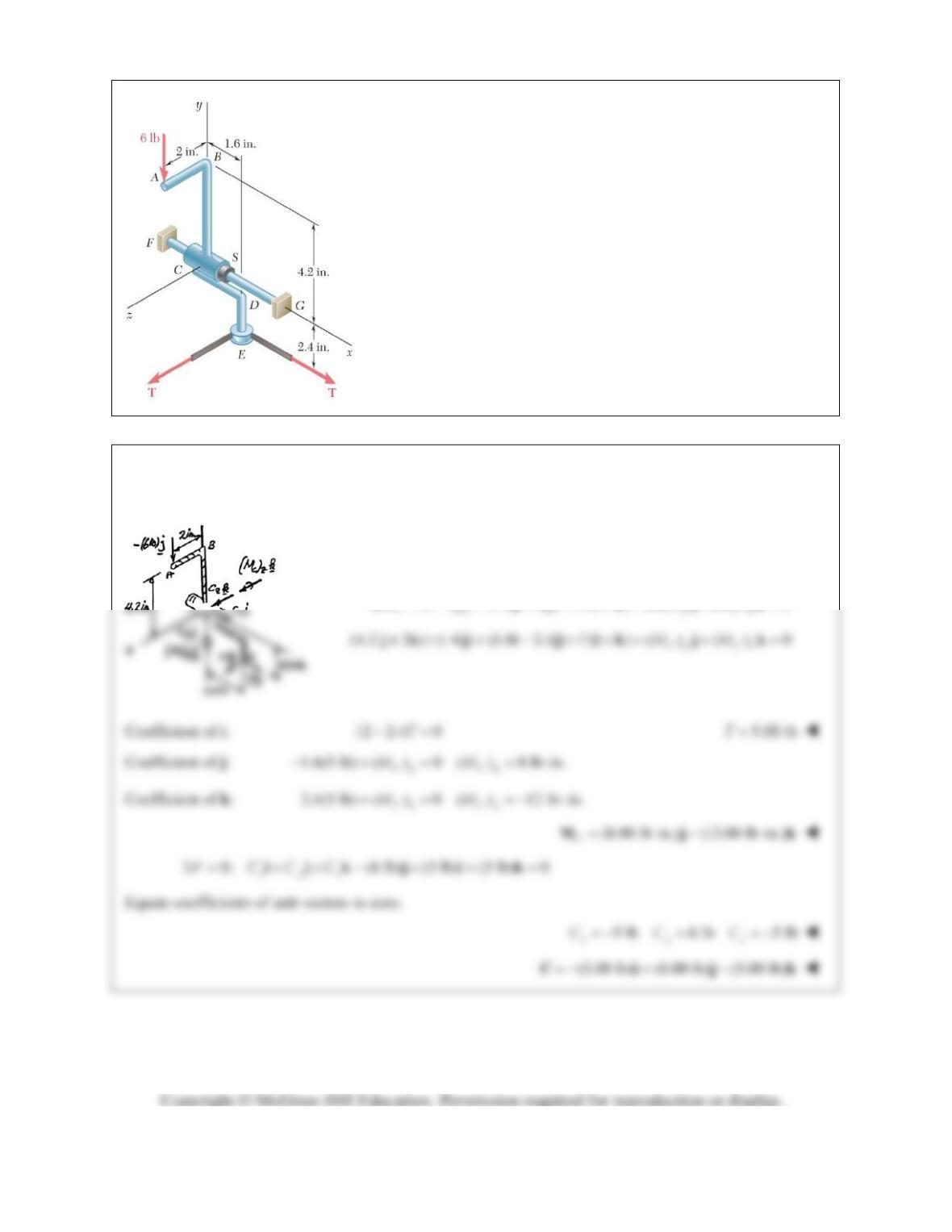
PROBLEM 4.121
The assembly shown is used to control the tension T in a tape that
passes around a frictionless spool at E. Collar C is welded to rods
ABC and CDE. It can rotate about shaft FG but its motion along the
shaft is prevented by a washer S. For the loading shown, determine
(a) the tension T in the tape, (b) the reaction at C.
SOLUTION
Free-Body Diagram:
/
/
4.2 2
1.6 2.4
AC
EC
rjk
rij
0: ( 6 ) ( ) ( ) ( ) 0
MTMM
rjrik j k
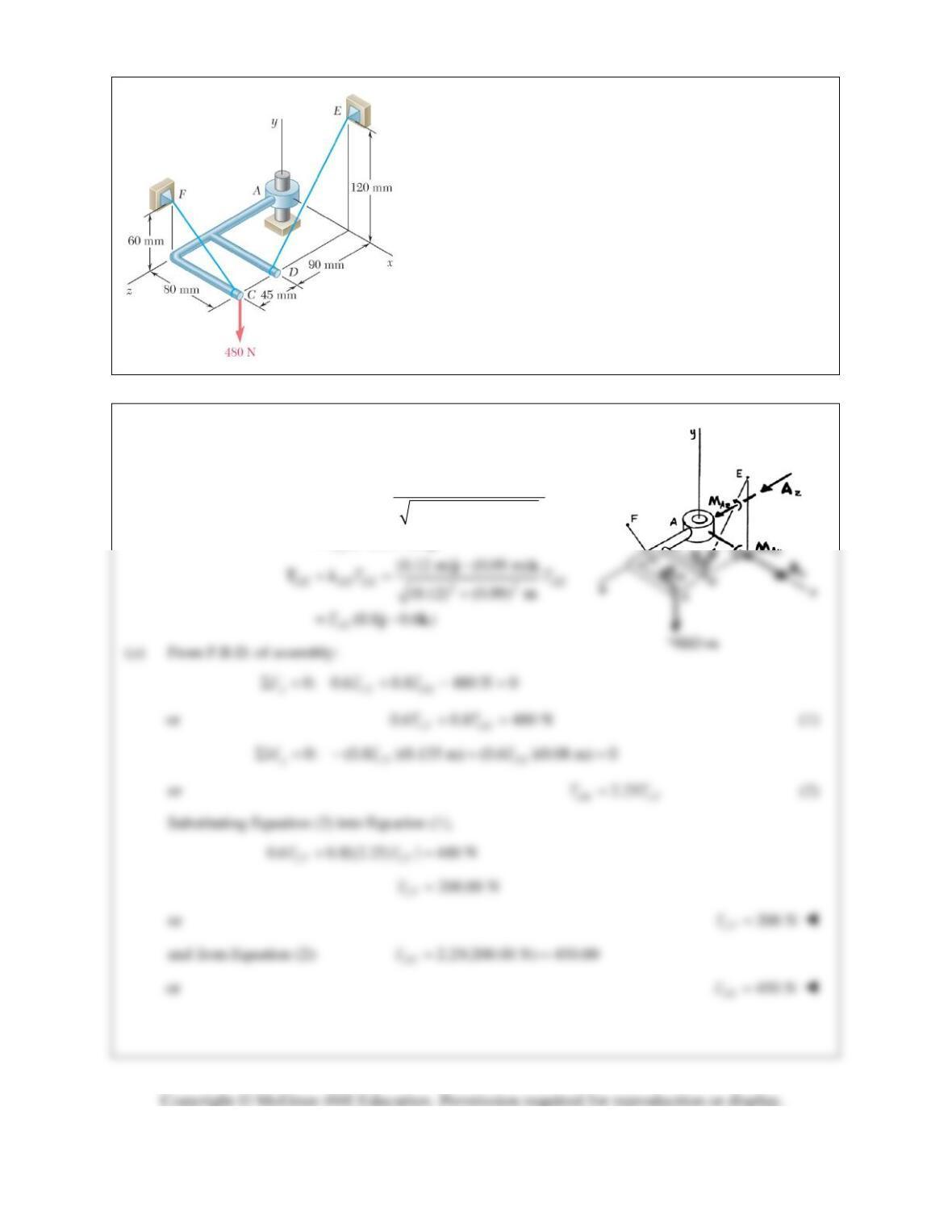
PROBLEM 4.122
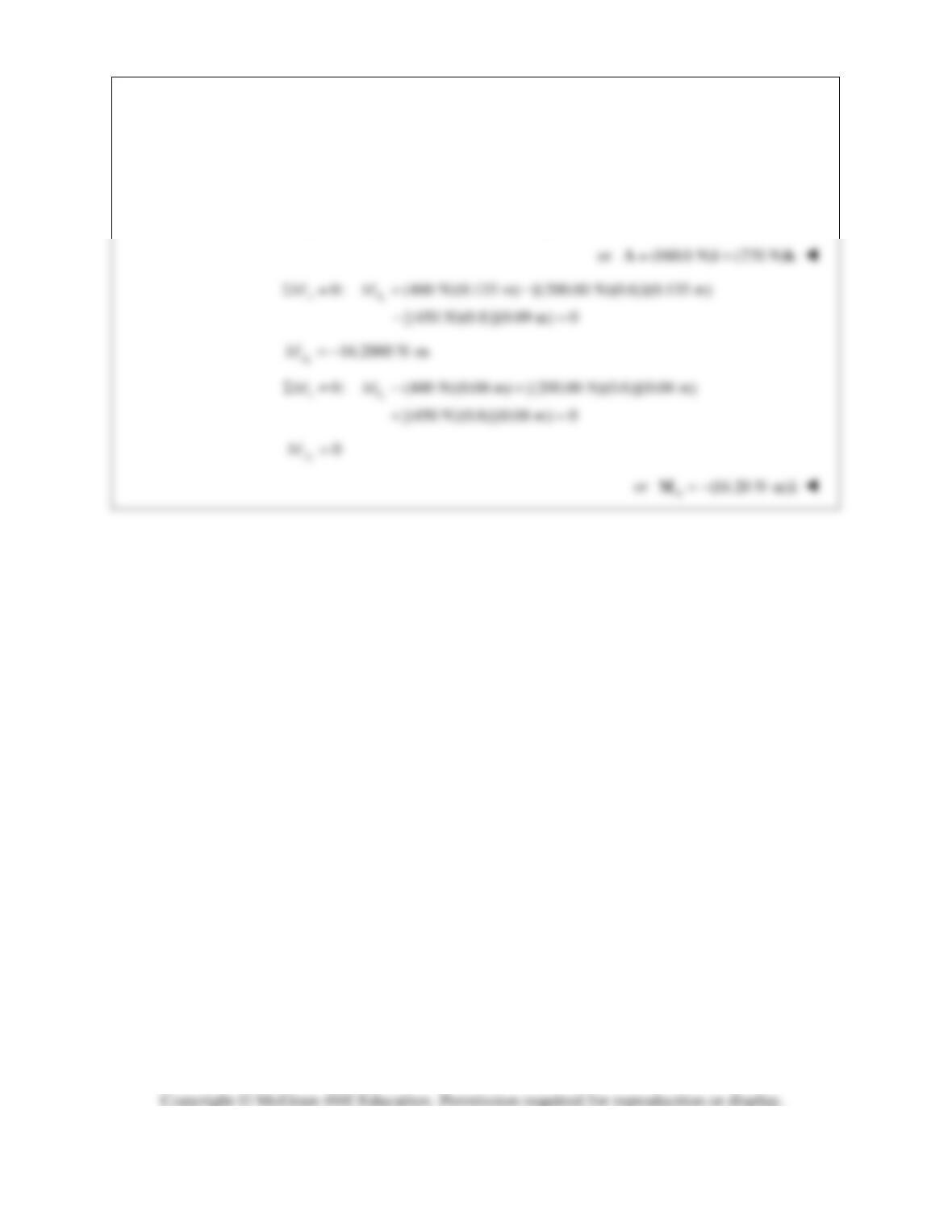
The assembly shown is welded to collar A that fits on the
vertical pin shown. The pin can exert couples about the x
and z axes but does not prevent motion about or along the y–
axis. For the loading shown, determine the tension in each
cable and the reaction at A.
SOLUTION
Free-Body Diagram:
First note:
22
(0.08 m) (0.06 m)
(0.08) (0.06) m
(0.8 0.6)
CF CF CF CF
TT
T
ij
Tλ
ij
PROBLEM 4.122 (Continued)
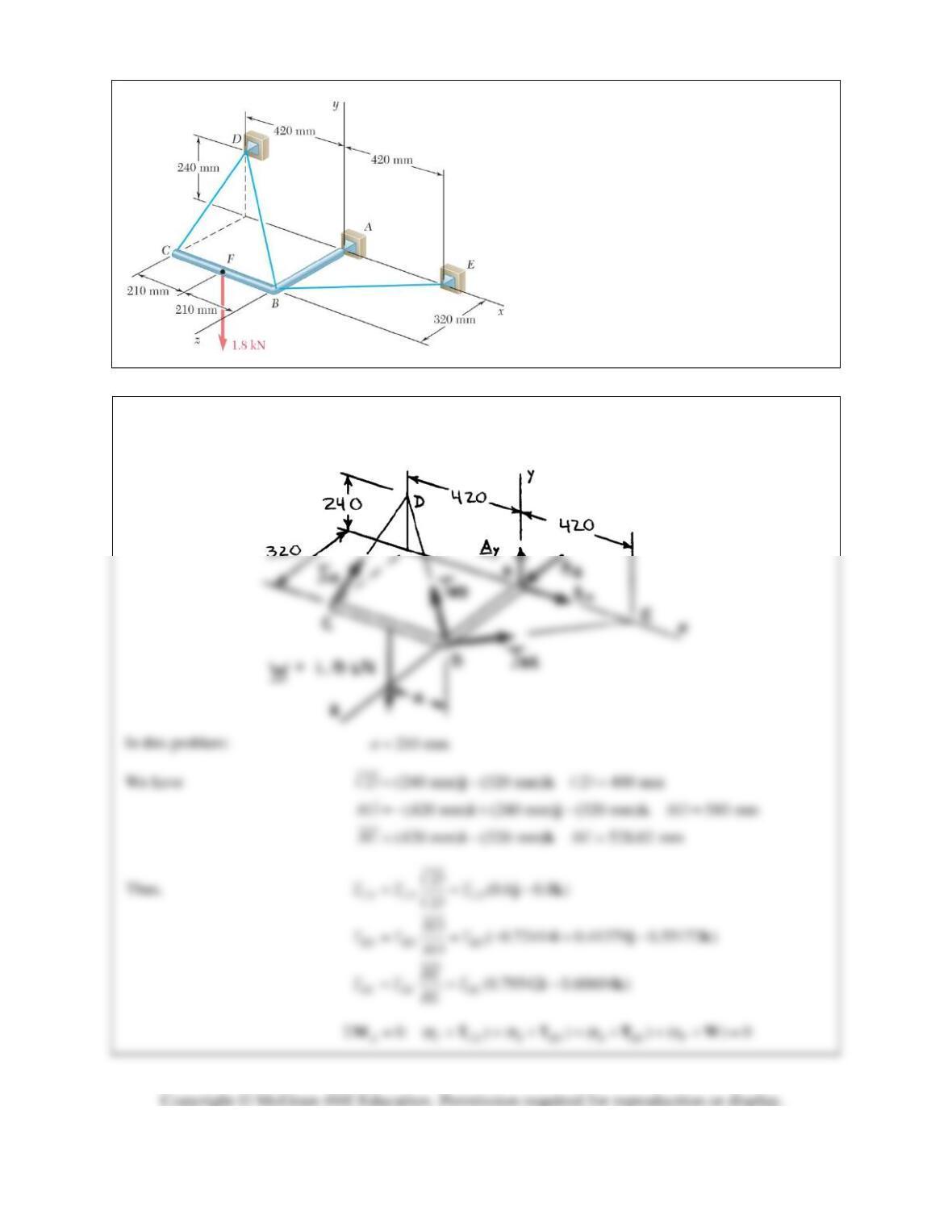
(b) From F.B.D. of assembly:
0: (0.6)(450.00 N) 0 270.00 N
zz z
FA A
0: (0.8)(200.00 N) 0 160.000 N
xx x
FA A
PROBLEM 4.123
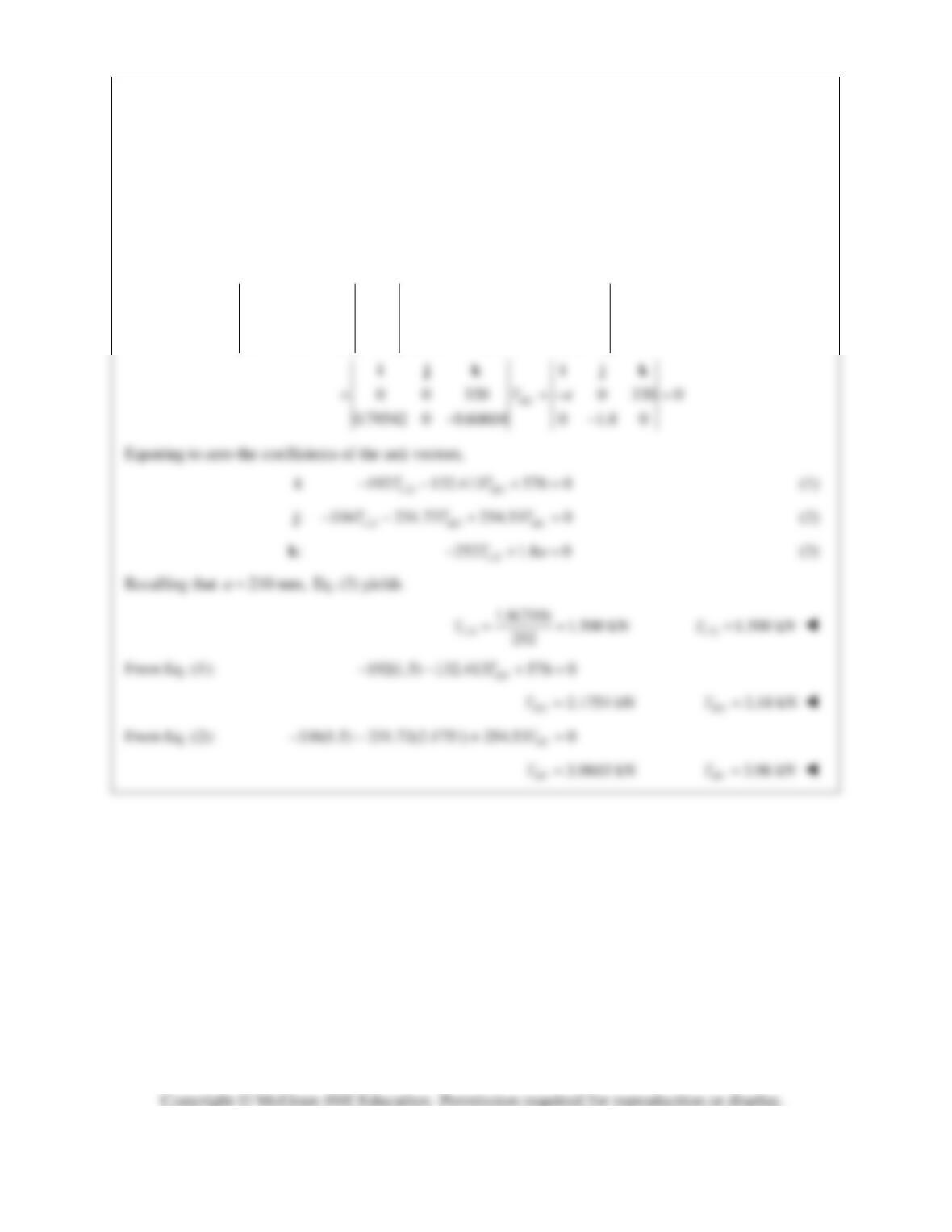
The rigid L-shaped member ABC is
supported by a ball-and-socket joint at A and
by three cables. If a 1.8-kN load is applied at
F, determine the tension in each cable.
SOLUTION
Free-Body Diagram: Dimensions in mm
PROBLEM 4.123 (Continued)
Noting that (420 mm) (320 mm)
(320 mm)
(320 mm)
C
B
Wa
rik
rk
ri k
and using determinants, we write
420 0 320 0 0 320
0 0.6 0.8 0.72414 0.41379 0.55172
CD BD
TT
ijk i j k