4-1
CHAPTER 4
Income Statement and Related Information
ASSIGNMENT CLASSIFICATION TABLE (BY TOPIC)
Topics
Questions
Brief
Exercises
Exercises
Problems
Concepts
for Analysis
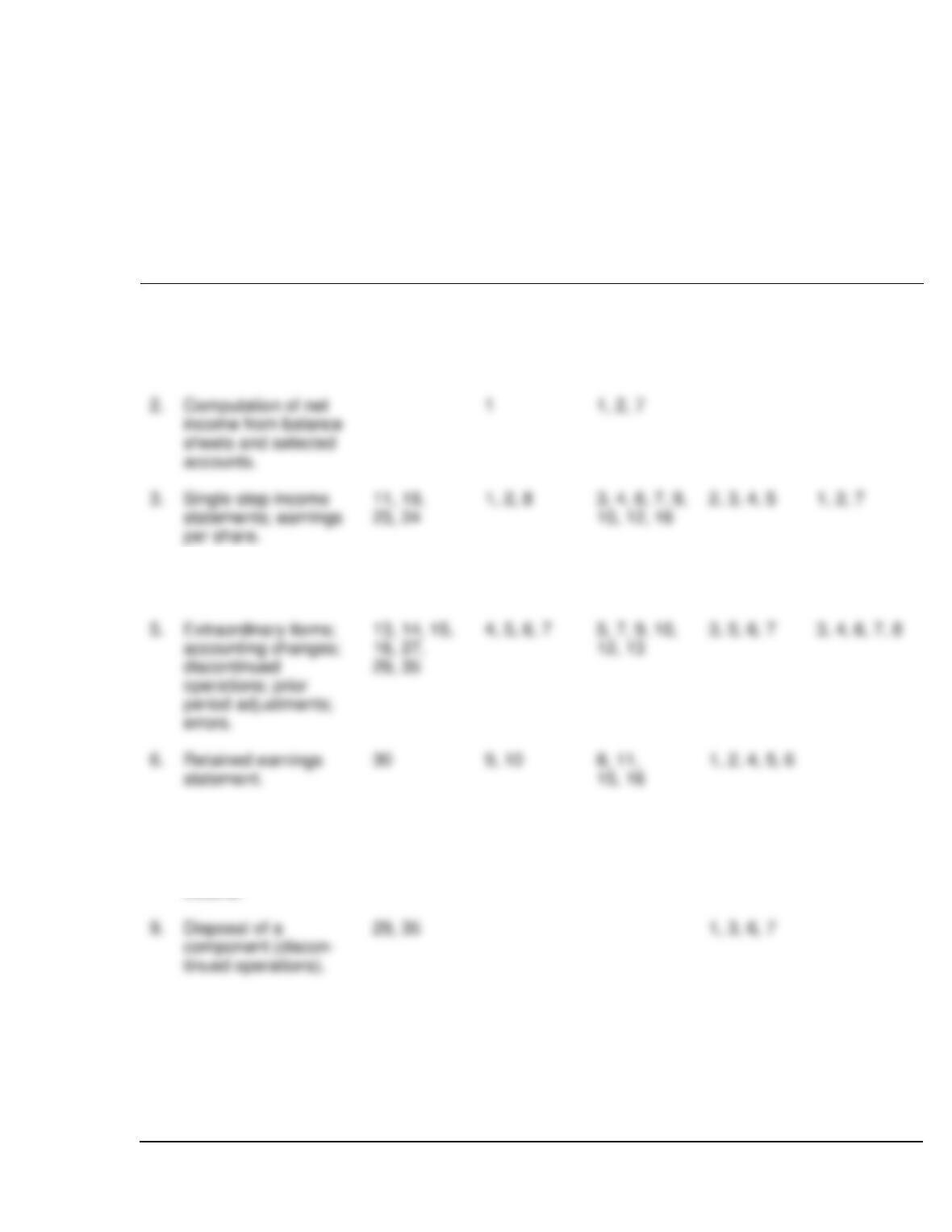
1.
Income measurement
concepts.
1, 2, 3, 4, 5,
6, 7, 8, 9, 10,
18, 28, 31,
32, 33
4, 5, 6, 8
4.
Multiple-step income
statements.
12, 17,
19, 20
3
4, 5, 6, 8
1, 4
6.
Retained earnings
statement.
30
9, 10
8, 11,
15, 16
1, 2, 4, 5, 6
7.
Intraperiod tax
allocation.
21, 22, 25,
26, 27
8, 10, 12,
13, 16
3, 5, 7
8.
Comprehensive
income.
34
4, 11
14, 15, 16
9
Disposal of a
component (discon-
tinued operations).
29, 35
1, 3, 6, 7
2.
Computation of net
income from balance
sheets and selected
accounts.
1
1, 2, 7
Single-step income
statements; earnings
per share.
11, 19,
23, 24
1, 2, 8
3, 4, 6, 7, 9,
10, 12, 16
2, 3, 4, 5
1, 2, 7
4-2
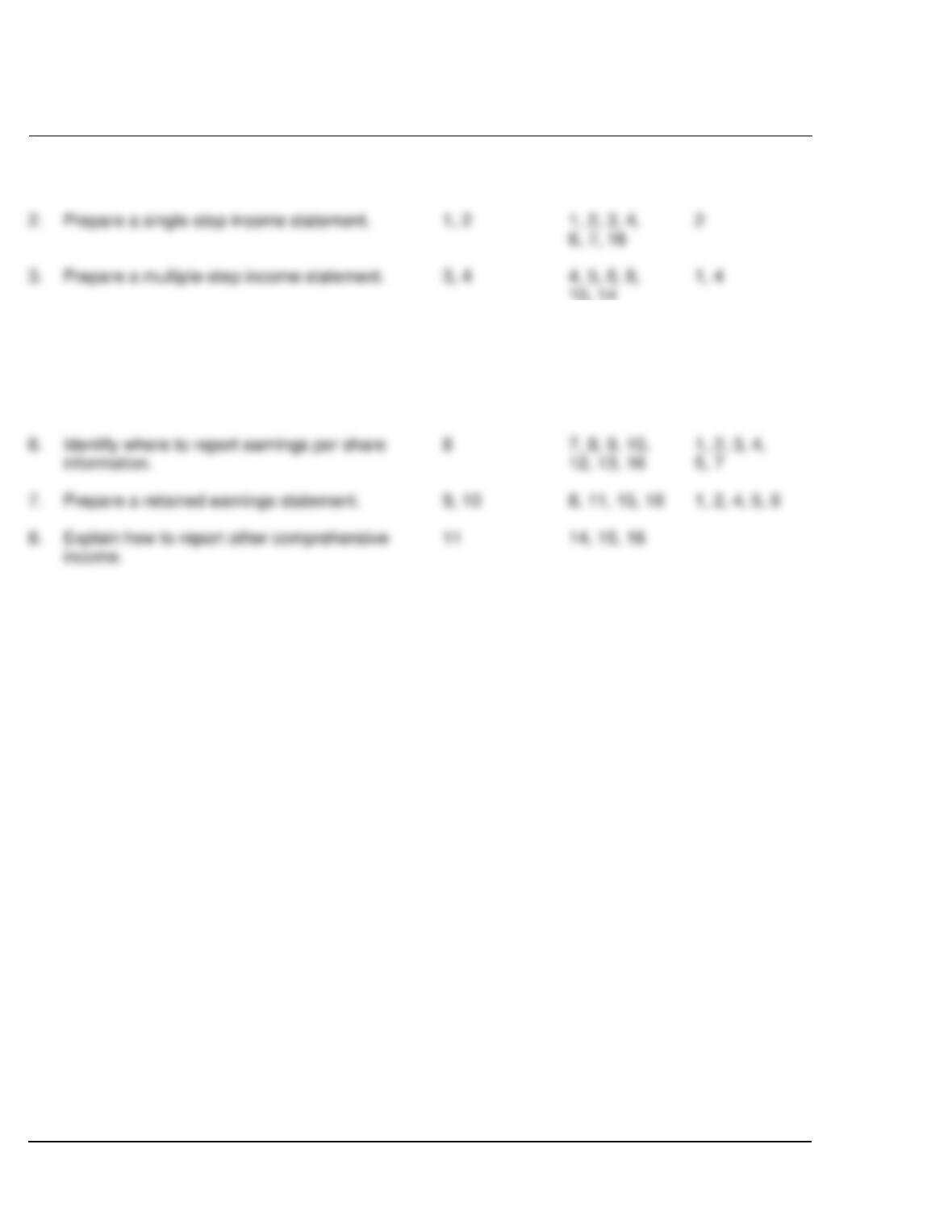
ASSIGNMENT CLASSIFICATION TABLE (BY LEARNING OBJECTIVE)
Learning Objectives
Brief
Exercises
Exercises
Problems
1. Understand the uses and limitations
of an income statement.
10, 14
4. Explain how to report irregular items.
4, 5, 6, 7, 10
5, 7, 8, 10,
12, 13, 16
1, 3, 4,
5, 6, 7
5. Explain intraperiod tax allocation.
5
8, 10, 12,
13, 16
1, 3, 5, 6, 7
6. Identify where to report earnings per share
information.
8
7, 8, 9, 10,
12, 13, 16
1, 2, 3, 4,
5, 7
9, 10
8, 11, 15, 16
1, 2, 4, 5, 6
8. Explain how to report other comprehensive
income.
14, 15, 16
2. Prepare a single-step income statement.
1, 2
6, 7, 16
2
3. Prepare a multiple-step income statement.
3, 4
4, 5, 6, 8,
1, 4
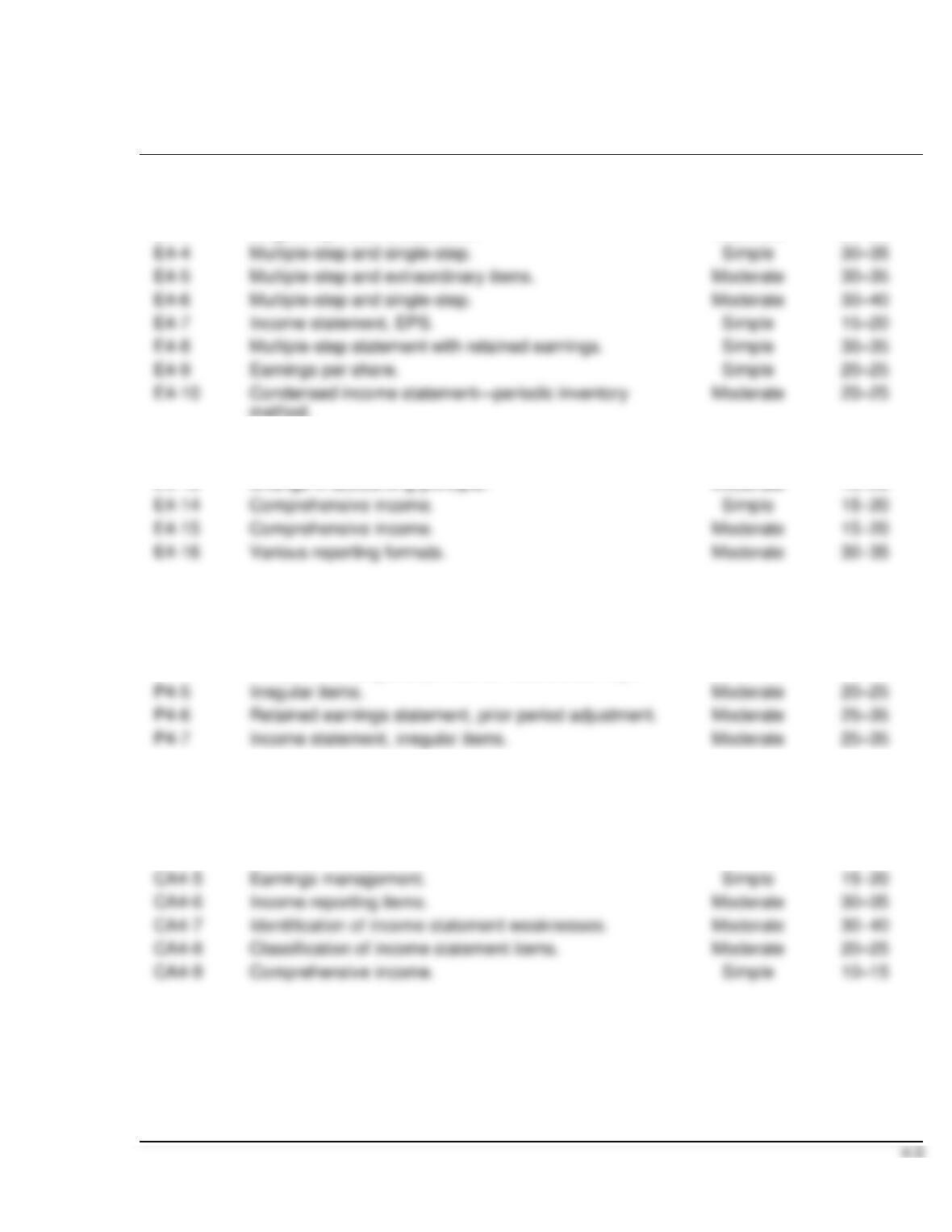
ASSIGNMENT CHARACTERISTICS TABLE
Item
Description
Level of
Difficulty
Time
(minutes)
E4-1
Computation of net income.
Simple
18–20
E4-2
Income statement items.
Simple
25–35
E4-3
Single-step income statement.
Moderate
20–25
E4-4
Multiple-step and single-step.
Simple
30–35
E4-5
Multiple-step and extraordinary items.
Moderate
30–35
E4-6
Multiple-step and single-step.
Moderate
30–40
E4-7
Income statement, EPS.
Simple
15–20
E4-8
Multiple-step statement with retained earnings.
Simple
30–35
E4-9
Earnings per share.
Simple
20–25
method.
E4–11
Retained earnings statement.
Simple
20–25
E4–12
Earnings per share.
Moderate
15–20
E4–13
Change in accounting principle.
Moderate
15–20
E4–14
Comprehensive income.
Simple
15–20
E4–15
Comprehensive income.
Moderate
15–20
E4–16
Various reporting formats.
Moderate
30–35
P4-1
Multiple-step income, retained earnings.
Moderate
30–35
P4-2
Single-step income, retained earnings, periodic inventory.
Simple
25–30
P4-3
Irregular items.
Moderate
30–40
P4-4
Multiple- and single-step income, retained earnings.
Moderate
45–55
P4-5
Irregular items.
Moderate
20–25
P4-6
Retained earnings statement, prior period adjustment.
Moderate
25–35
P4-7
Income statement, irregular items.
Moderate
25–35
CA4-1
Identification of income statement deficiencies.
Simple
20–25
CA4-2
Income reporting deficiencies.
Simple
10–15
CA4-3
Extraordinary items.
Moderate
20–25
CA4-4
Earnings management.
Moderate
20–25
CA4-5
Earnings management.
Simple
15–20
CA4-7
Identification of income statement weaknesses.
Moderate
30–40
CA4-8
Classification of income statement items.
Moderate
20–25
CA4-9
Comprehensive income.
Simple
10–15
4-4
SOLUTIONS TO CODIFICATION EXERCISES
CE4-1
According to the Glossary:
(a) A change in accounting estimate is a change that has the effect of adjusting the carrying amount
of an existing asset or liability or altering the subsequent accounting for existing or future assets or
liabilities. Changes in accounting estimates result from new information. Examples of items for
which estimates are necessary are uncollectible receivables, inventory obsolescence, service lives
and salvage value of depreciable assets, and warranty obligations. A change in accounting estimate
is a necessary consequence of the assessment, in conjunction with the periodic presentation of
financial statements, of the present status and expected future benefits and obligations associated
with assets and liabilities.
CE4-2
The master glossary provides the term “Unusual Nature”, a link from which yields the following:
Glossary Term Usage
The glossary term is used in the following locations.
Following this link yields the following paragraph:
45-2 Extraordinary items are events and transactions that are distinguished by their unusual nature
and by the infrequency of their occurrence. Thus, both of the following criteria shall be met to
classify an event or transaction as an extraordinary item:
4-5
CE4-2 (Continued)
b. Infrequency of occurrence. The underlying event or transaction should be of a type that
CE4-3
Entering “extraordinary item” and “interim” into the search window, yields the following guidance (FASB
ASC 225-20–50-4):
Interim Reporting
50-4 As indicated in paragraph FASB ASC 270-10–50-5, extraordinary items shall be disclosed
separately and included in the determination of net income for the interim period in which they
occur. In determining materiality, extraordinary items shall be related to the estimated income for
CE4-4
Entering “effect of preferred stock” in the search window yields the following link (FASB ASC 260–10–
S55): 260 Earnings per Share > 10 Overall > S55 Implementation Guidance and Illustrations.
General
S99-5 The following is the text of SAB Topic 6.B, Accounting Series Release 280—General Revision Of
Regulation S-X: Income Or Loss Applicable To Common Stock.
Facts: A registrant has various classes of preferred stock. Dividends on those preferred stocks
and accretions of their carrying amounts cause income applicable to common stock to be less
than reported net income.
4-6
CE4-4 (Continued)
Interpretive Response: Income or loss applicable to common stock should be reported on the
face of the income statement (FN1) when it is materially different in quantitative terms from
reported net income or loss (FN2) or when it is indicative of significant trends or other qualitative
ANSWERS TO QUESTIONS
1. The income statement is important because it provides investors and creditors with information
that helps them predict the amount, timing, and uncertainty of future cash flows. It helps investors
and creditors predict future cash flows in a number of different ways. First, investors and creditors can
2. Information on past transactions can be used to identify important trends that, if continued, provide
information about future performance. If a reasonable correlation exists between past and future
3. Some situations in which changes in value are not recorded in income are:
(a) Unrealized gains or losses on available-for-sale investments,
(b) Changes in the market values of long-term liabilities, such as bonds payable,
4. Some situations in which application of different accounting methods or estimates lead to comparison
problems include:
5. The transaction approach focuses on the activities that have occurred during a given period and
instead of presenting only a net change, a description of the components that comprise the change
4-8
Questions Chapter 4 (Continued)
6. Earnings management is often defined as the planned timing of revenues, expenses, gains and
losses to smooth out bumps in earnings. In most cases, earnings management is used to increase
7. Earnings management has a negative effect on the quality of earnings if it distorts the information
in a way that is less useful for predicting future cash flows. Within the Conceptual Framework,
8. Caution should be exercised because many assumptions and estimates are made in accounting
and the net income figure is a reflection of these assumptions. If for any reason the assumptions are
9. The term “quality of earnings” refers to the credibility of the earnings number reported. Companies
that use aggressive accounting policies report higher income numbers in the short-run. In such
cases, we say that the quality of earnings is low. Similarly, if higher expenses are recorded in the
current period, in order to report higher income in the future, then the quality of earnings is also
considered low.
10. The major distinction between revenues and gains (or expenses and losses) depends on the
typical activities of the enterprise. Revenues can occur from a variety of different sources, but
11. The advantages of the single–step income statement are: (1) simplicity and conciseness, (2) probably
better understood by the layperson, (3) emphasis on total costs and expenses, and net income,
and (4) does not imply priority of one revenue or expense over another. The disadvantages are that
it does not show the relationship between sales and cost of goods sold and it does not show other
important relationships and information, such as income from operations, income before taxes, etc.
12. Operating items are the expenses and revenues which relate directly to the principal activity of the
concern; they are revenues realized from, or expenses which contribute to, the sale of goods or
13. The current operating performance income statement contains only the revenues and usual
expenses of the current year, with all unusual gains or losses or material corrections of prior periods’
4-9
Questions Chapter 4 (Continued)
14. Items considered corrections of errors should be charged or credited to the opening balance of
retained earnings.
15. (a) This might be shown in the income statement as an extraordinary item if it is a material,
unusual, and infrequent gain realized during the year. However, in general and in accordance
with FASB ASC 225–20 this transaction would normally not be considered extraordinary, but
would be shown in the nonoperating section of a multiple-step income statement. If unusual or
infrequent but not both, it should be separately disclosed in the income statement.
16. (a) The remaining book value of the equipment should be depreciated over the remainder of the
five-year period. The additional depreciation ($425,000) is not a correction of an error and is not
shown as an adjustment to retained earnings. The change is considered a change in estimate.
(b) The loss should be shown as an extraordinary item, assuming that it is unusual and infrequent.
17. (a) Other expenses or losses section or in a separate section, appropriately labeled as an unusual
item, if unusual or infrequent but not both.
(b) Operating expense section or other expenses and losses section or in a separate section,
4-10
Questions Chapter 4 (Continued)
(e) Other revenues and gains section or in a separate section, appropriately labeled as an
18. Perlman and Sheehan should not report the sales in a similar manner. This type of transaction
appears to be typical of Perlman’s central operations. Therefore, Perlman should report revenues of
19. You should tell Greg that a company’s reported net income is the same whether the single–step or
multiple-step format is used. Either way, the company has the same revenues, gains, expenses,
and losses; they are simply organized in a different format.
20. Both formats are acceptable. The amount of detail reported in the income statement is left to the
judgment of the company, whose goal in making this decision should be to present financial
21. Intraperiod tax allocation should not affect the reporting of an unusual gain. The FASB specifically
prohibits a “net–of–tax” treatment for such items to insure that users of financial statements can
22. Intraperiod tax allocation has no effect on reported net income, although it does affect the amounts
reported for various components of income. The effects on these components offset each other so
net income remains the same. Intraperiod tax allocation merely takes the total tax expense and
allocates it to the various items which affect the tax amount.
23. If Neumann has preferred stock outstanding, the numerator in its computation may be incorrect.
A better description of “earnings per share” is “earnings per common share.” The numerator should
24. The earnings per share trend is not favorable. Extraordinary items are one-time occurrences which
Questions Chapter 4 (Continued)
25. Tax allocation within a period is the practice of allocating the income tax for a period to such items
as income before extraordinary items, extraordinary items, and prior period adjustments.
26. Tax allocation within a period (intraperiod) becomes necessary when a firm encounters such items
as discontinued operations, extraordinary items, or corrections of errors. Such allocation is neces-
sary to bring about an appropriate relationship between income tax expense and income from
27.
LISELOTTE COMPANY
Partial Income Statement
28. The damages would probably be reported in Frazier Corporation’s financial statements in the other
29. The assets, cash flows, results of operations, and activities of the plants closed would not appear to
be clearly distinguishable, operationally or for financial reporting purposes, from the assets, results of
operations, or activities of the Linus Paper Company. Therefore, disposal of these assets is not
considered to be a disposal of a component of a business that would receive special reporting.
30. The major items reported in the retained earnings statement are: (1) adjustments of the beginning
balance for corrections of errors or changes in accounting principle, (2) the net income or loss for
4-12
Questions Chapter 4 (Continued)
31. Generally accepted accounting principles are ordinarily concerned only with a “fair presentation” of
business income. In contrast, taxable income is a statutory concept which defines the base for
raising tax revenues by the government, and any method of accounting which meets the statutory
definition will “clearly reflect” taxable income as defined by the Internal Revenue Code. It should
be noted that the Code prohibits use of the cash receipts and disbursements method as a method
which will clearly reflect income in accounting for purchases and sales if inventories are involved.
32. Problems arise both from the revenue side and from the expense side. There sometimes may be
doubt as to the amount of revenue under our common rules of revenue recognition. However, the
more difficult problem is the determination of costs expired in the production of revenue. During
a single fiscal period it often is difficult to determine the expiration of certain costs which may
33. Elements are the basic ingredients which comprise the income statement; that is, revenues, gains,
expenses, and losses. Items are descriptions of the elements such as rent revenue, rent expense, etc.
In order to predict the future, the amounts of individual items may have to be reported. For example,
Questions Chapter 4 (Continued)
34. Other comprehensive income must be displayed (reported) in one of three ways: (1) a second
separate income statement, (2) a combined income statement of comprehensive income, or (3) as
part (separate columns) of the statement of stockholders’ equity.
35. The results of continuing operations should be reported separately from discontinued operations,
and any gain or loss from disposal of a component of a business should be reported with the
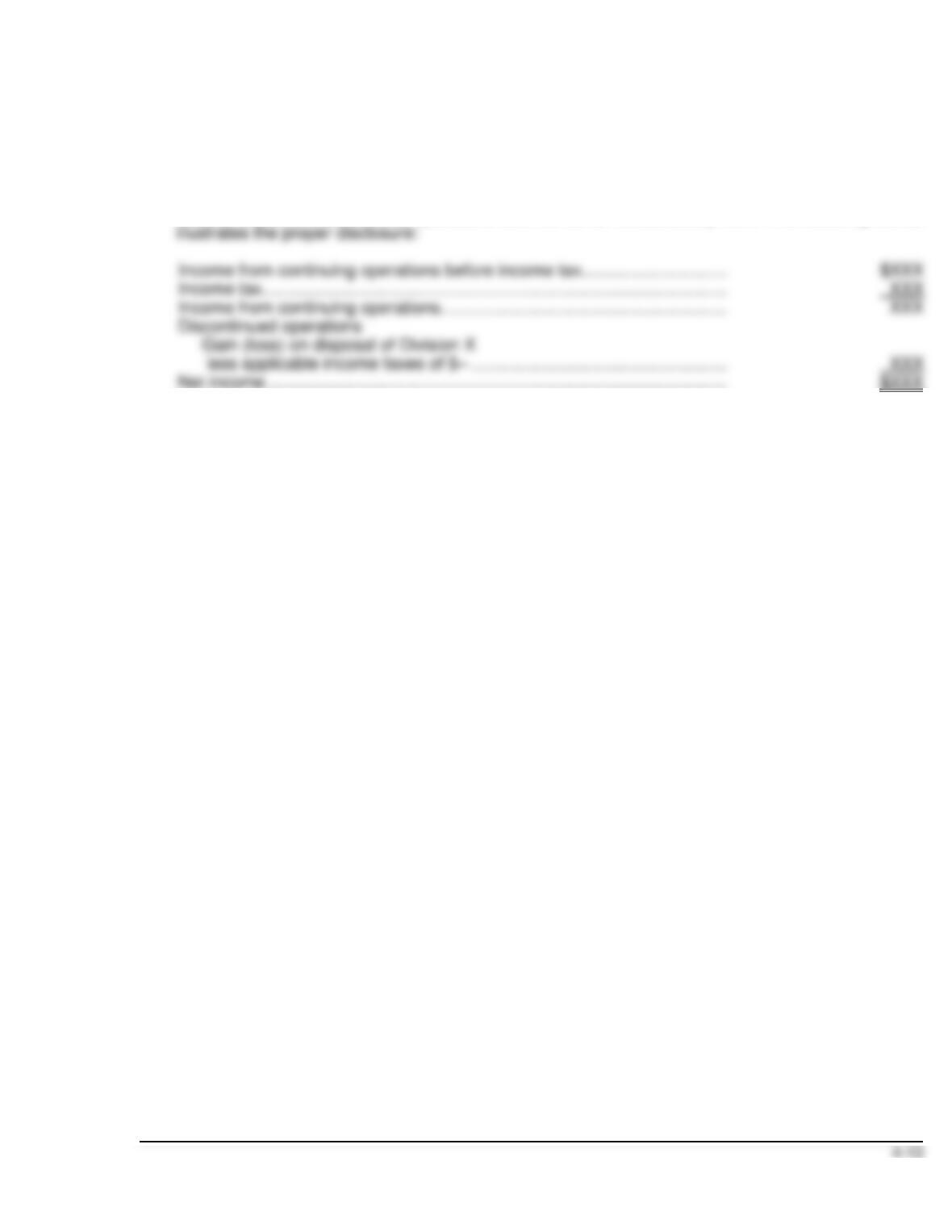
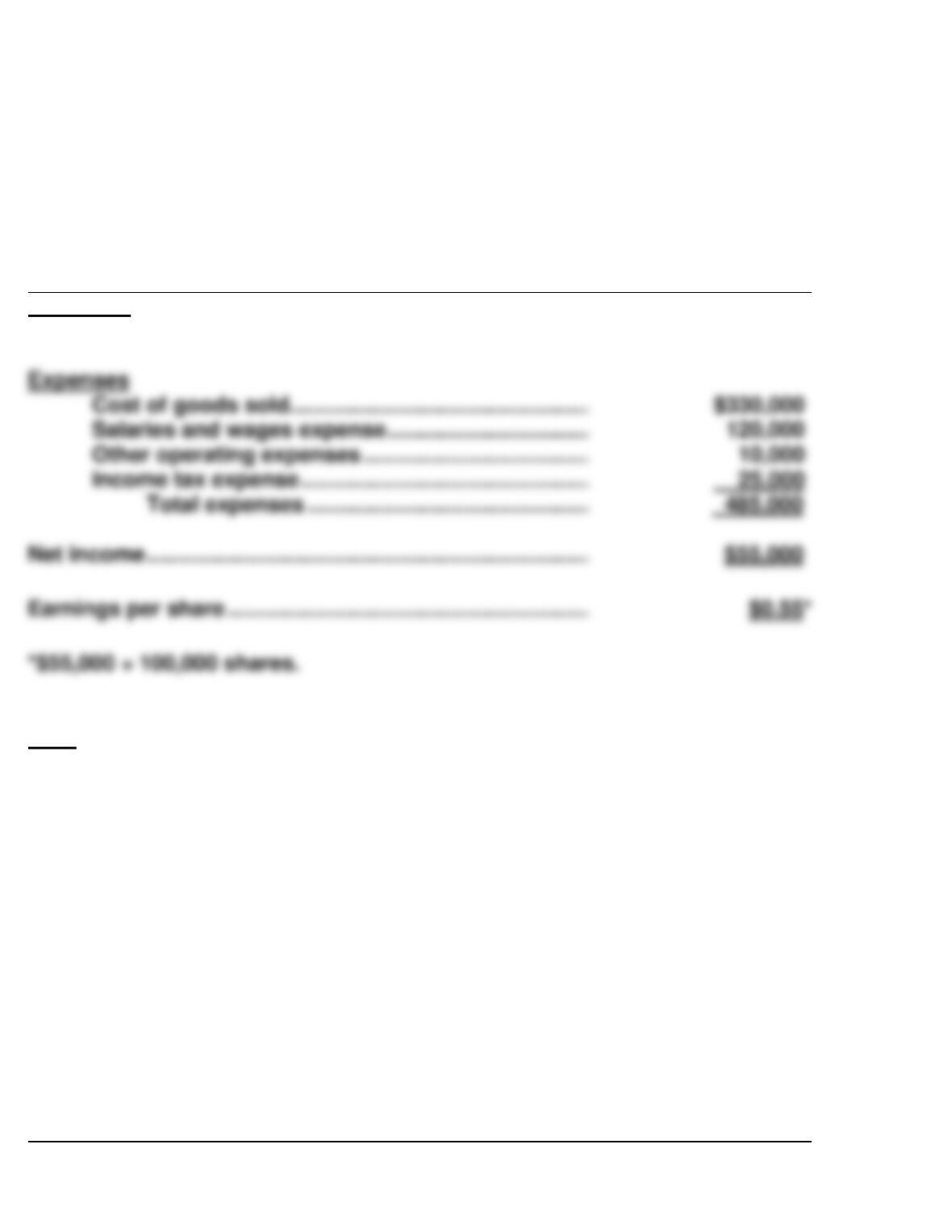
related results of discontinued operations and not as an extraordinary item. The following format
4-14
SOLUTIONS TO BRIEF EXERCISES
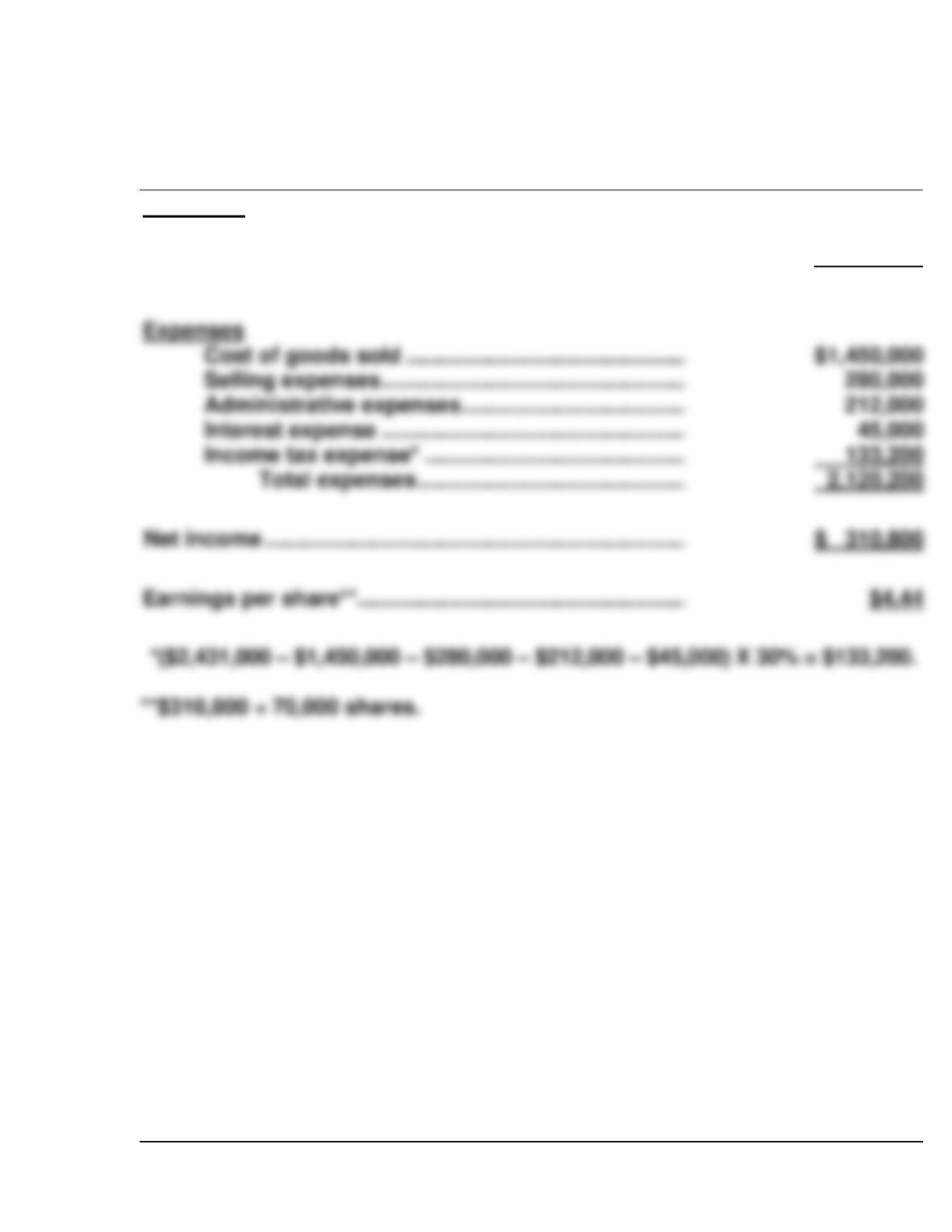
BRIEF EXERCISE 4-1
STARR CO.
Income Statement
For the Year 2012
Revenues
Sales revenue ………………………………………………….
$540,000
Note: The increase in value of the company reputation and the unrealized
gain on the value of patents are not reported.
Cost of goods sold…………………………………………..
Salaries and wages expense …………………………….
Other operating expenses ………………………………..
Income tax expense …………………………………………
Total expenses ………………………………………..
4-15
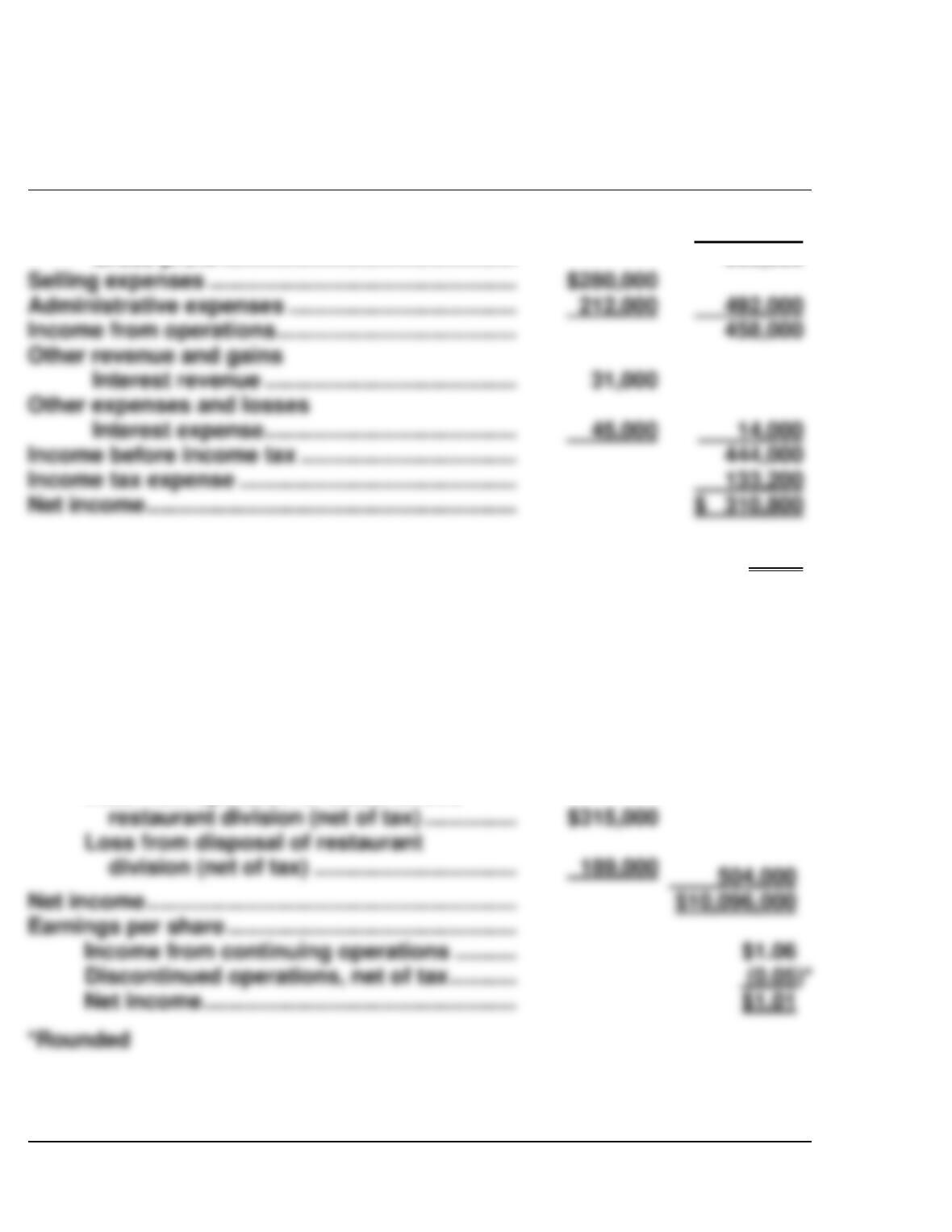
BRIEF EXERCISE 4-2
BRISKY CORPORATION
Income Statement
For the Year Ended December 31, 2012
Revenues
Net sales ……………………………………………………….
$2,400,000
Interest revenue ……………………………………………..
31,000
Total revenues…………………………………………
2,431,000
Expenses
Cost of goods sold …………………………………………
$1,450,000
Administrative expenses …………………………………
Interest expense …………………………………………….
Income tax expense* ………………………………………
133,200
Total expenses ……………………………………….
4-16
BRIEF EXERCISE 4-3
BRISKY CORPORATION
Income Statement
For the Year Ended December 31, 2012
Net sales ……………………………………………………….
$2,400,000
Cost of goods sold ………………………………………….
1,450,000
Gross profit …………………………………………..
950,000
Earnings per share ………………………………………….
$4.44*
*$310,800 ÷ 70,000 shares.
BRIEF EXERCISE 4-4
Income from continuing operations ……………………..
$10,600,000
Discontinued operations
Earnings per share ……………………………………………..
Discontinued operations, net of tax ……………..
Loss from operation of discontinued
Selling expenses …………………………………………….
Administrative expenses …………………………………
Income from operations …………………………..………
458,000
Other revenue and gains
Other expenses and losses
Interest expense …………………………………….
Income before income tax ……………………………….
Income tax expense ………………………………………..
133,200
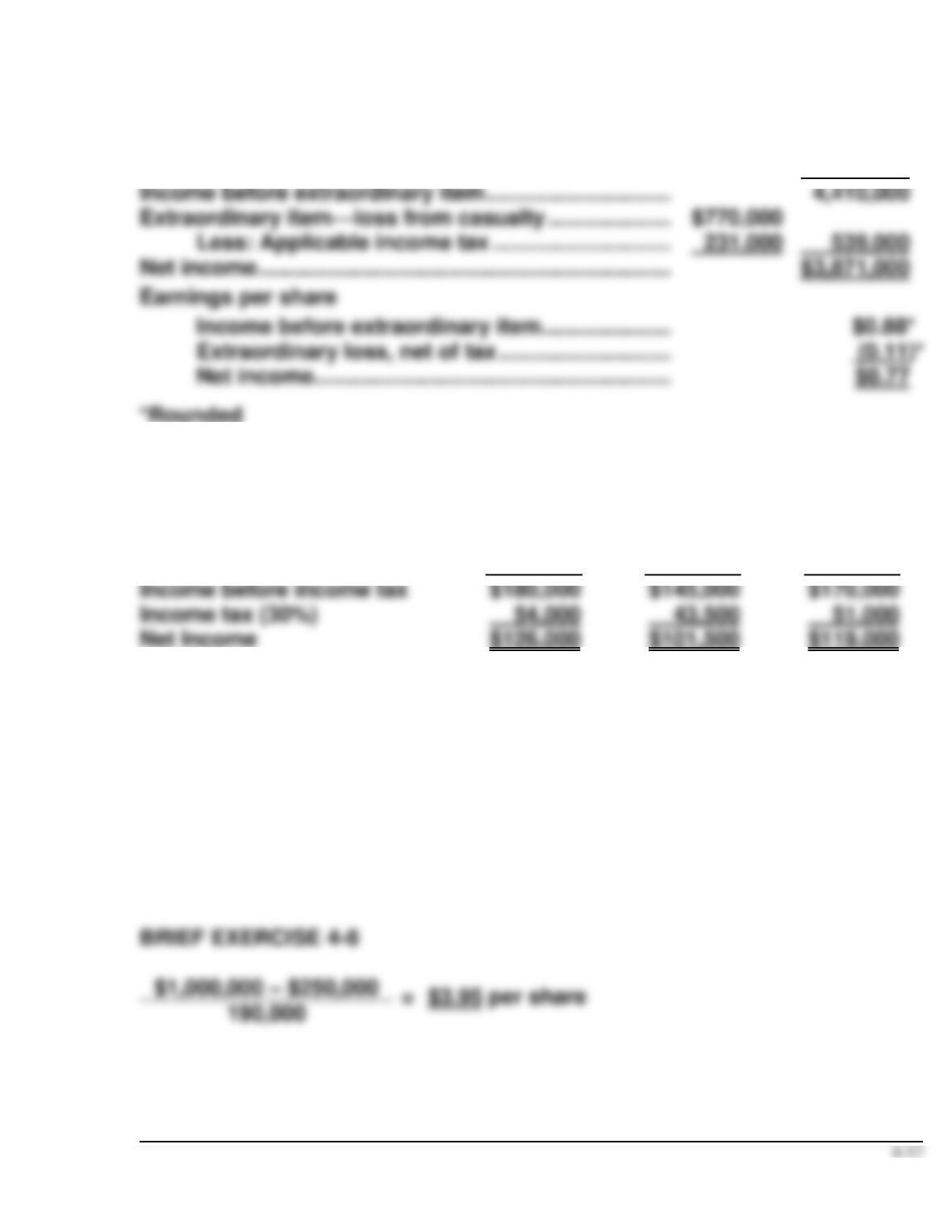
BRIEF EXERCISE 4-5
Income before income tax and extraordinary
item …………………………………………………………………
$6,300,000
Income tax expense …………………………..………………..
1,890,000
Less: Applicable income tax ………………………..
Income before extraordinary item …………………
BRIEF EXERCISE 4-6
2012
2011
2010
BRIEF EXERCISE 4-7
Vandross would not report any cumulative effect because a change in estimate
is not handled retrospectively. Vandross would report bad debt expense of
$120,000 in 2012.
4-18
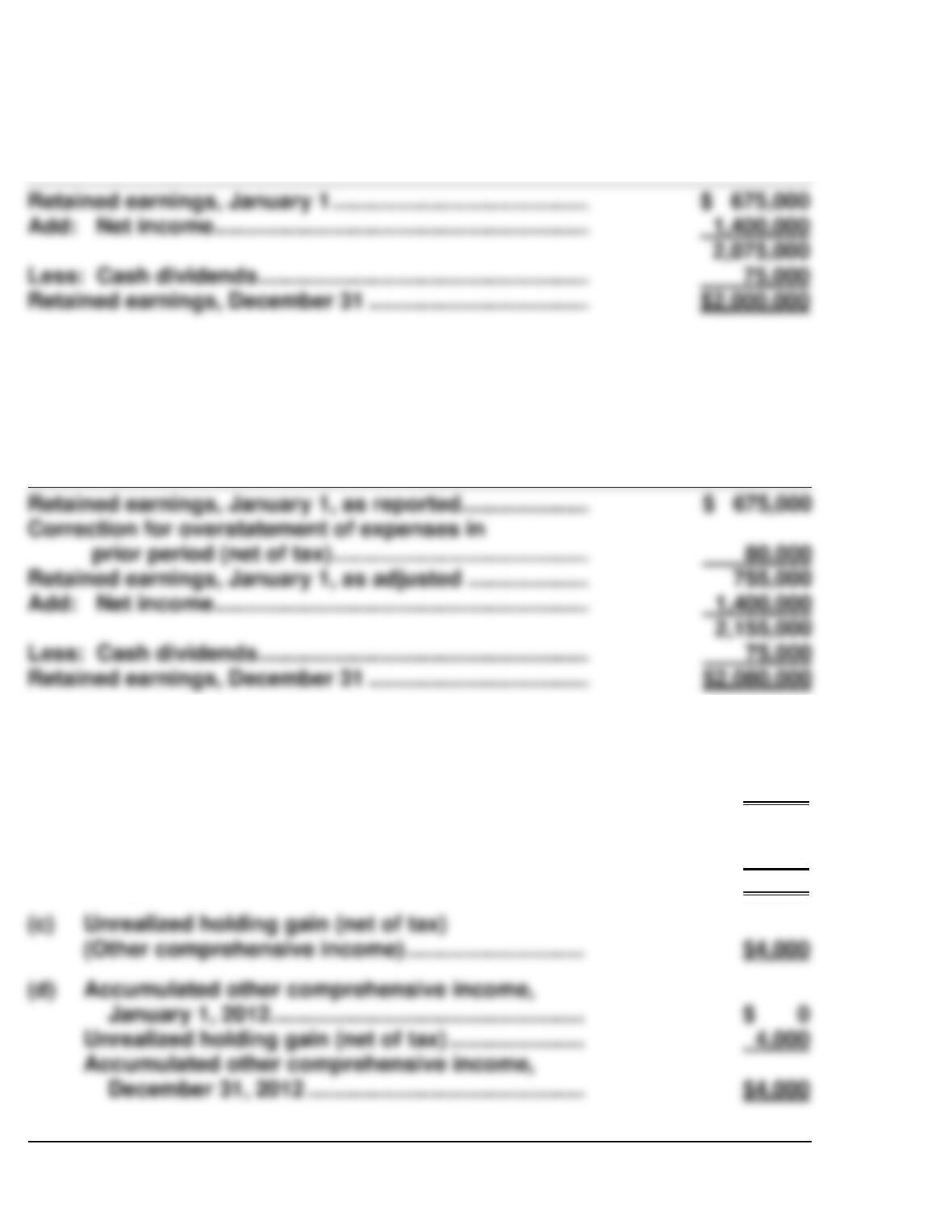
BRIEF EXERCISE 4-9
PORTMAN CORPORATION
Retained Earnings Statement
For the Year Ended December 31, 2012
BRIEF EXERCISE 4-10
PORTMAN CORPORATION
Retained Earnings Statement
For the Year Ended December 31, 2012
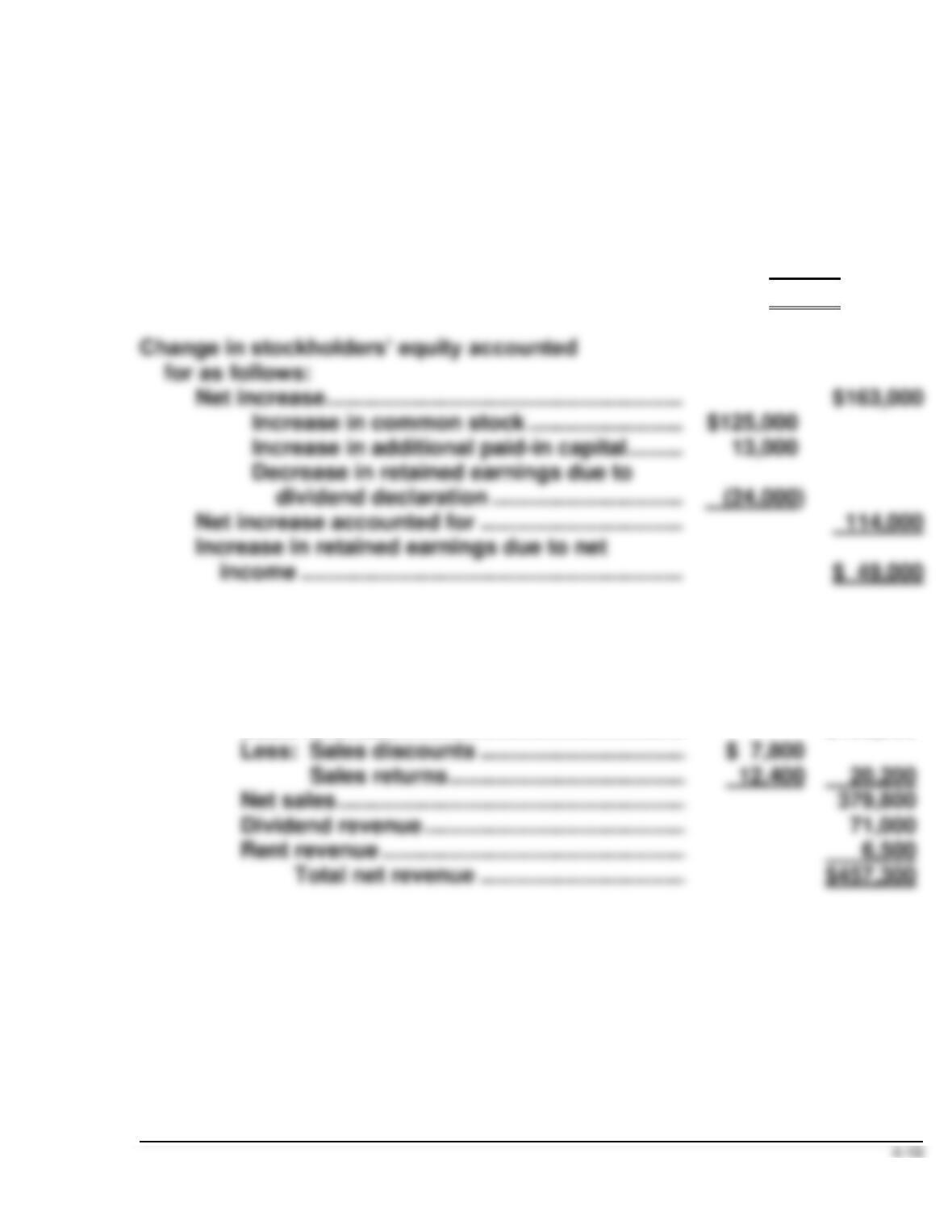
BRIEF EXERCISE 4-11
(a) Net income (Dividend revenue) ………………………..
$3,000
(b) Net income ……………………………………………………..
$3,000
Unrealized holding gain (net of tax) ………………….
4,000
Comprehensive income …………………………………..
$7,000
Unrealized holding gain (net of tax) ………………….
SOLUTIONS TO EXERCISES
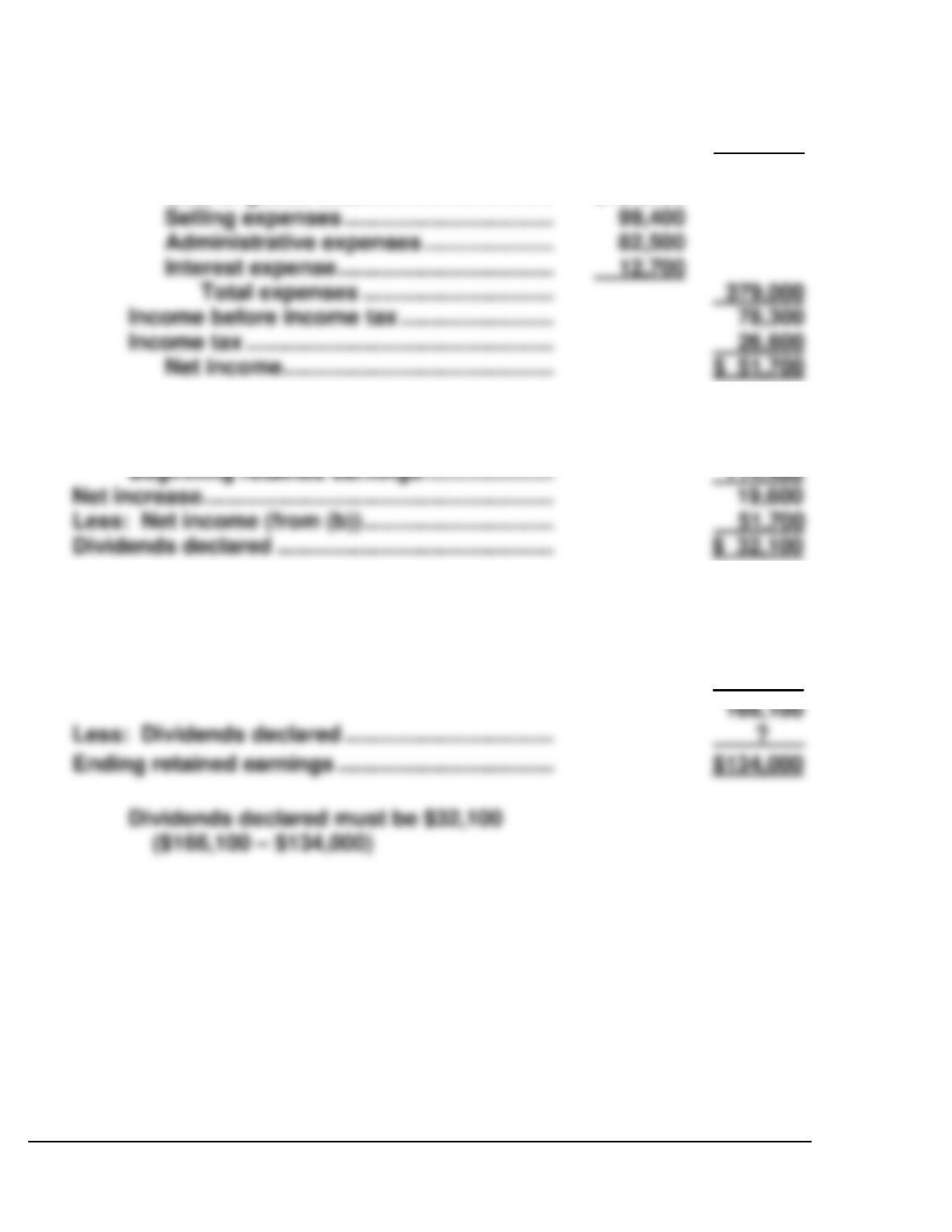
EXERCISE 4-1 (15–20 minutes)
Computation of net income
Change in assets:
$69,000 + $45,000 + $127,000 – $47,000 = $194,000 Increase
Change in liabilities:
$ 82,000 – $51,000 = 31,000 Increase
Change in stockholders’ equity:
$163,000 Increase
Net increase ………………………………………………….
Increase in common stock …………………….
Increase in additional paid-in capital ………
Net increase accounted for …………………………...
EXERCISE 4-2 (25–35 minutes)
(a)
Total net revenue:
Sales revenue ……………………………………………….
$400,000
Less: Sales discounts ………………………………….
Sales returns ………………………………………
Net sales ………………………………………………………
Dividend revenue ………………………………………….
Rent revenue ………………………………………………..
Total net revenue ………………………………….
4-20
EXERCISE 4-2 (Continued)
(b)
Net income:
Total net revenue (from (a)) …………………..
$457,300
Expenses:
Cost of goods sold ………………………….
$184,400
(c)
Dividends declared:
Ending retained earnings ……………………..
$134,000
Beginning retained earnings …………………
Net increase …………………………………………………
Less: Net income (from (b)) ………………………….
ALTERNATE SOLUTION (for (c))
Beginning retained earnings …………………………
$114,400
Add: Net income …………………………………………
51,700
Less: Dividends declared …………………………….
?
Ending retained earnings ……………………………..
$134,000
Dividends declared must be $32,100
($166,100 – $134,000)
Selling expenses …………………………….
Administrative expenses …………………
Interest expense ……………………………..
12,700
Total expenses ………………………….
Income before income tax …………………….
Income tax …………………………………………..
26,600
Net income ……………………………………..