CHAPTER 4 │ DISCRETE PROBABILITY DISTRIBUTIONS 155
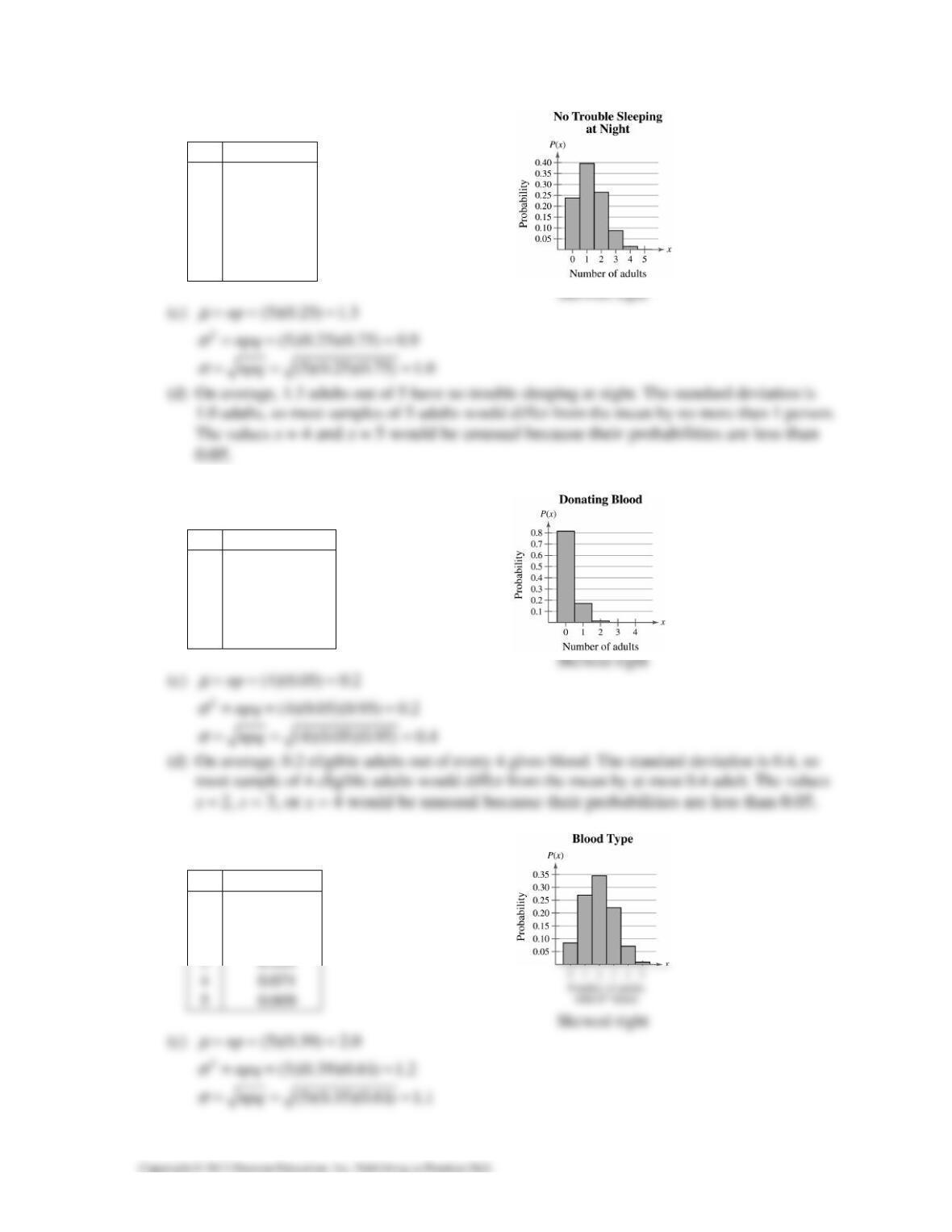
28. (a) n = 5, p = 0.25 (b)
x P(x)
0 0.237
1 0.396
2 0.264
3 0.088
4 0.015
5 0.001
29. (a) n = 4, p = 0.05 (b)
x P(x)
0 0.814506
1 0.171475
2 0.013538
3 0.000475
4 0.000006
30. (a) n = 5, p = 0.39 (b)
x P(x)
0 0.084
1 0.270
2 0.345
156 CHAPTER 4 │ DISCRETE PROBABILITY DISTRIBUTIONS
(d) On average, 2.0 adults out of 5 have O+ blood. The standard deviation is 1.1, so most
samples of 5 adults would differ from the mean by at most 1.1 adults. The value x = 5 would
be unusual because the probability is less than 0.05.
31. (a) n = 6, p = 0.37
x P(x)
0 0.063
1 0.220
2 0.323
32. (a) n = 5, p = 0.48
x P(x)
0 0.038
1 0.175
2 0.324
33. n = 6, p = 0.37, q = 0.63
(6)(0.37) 2.2np
µ
== ≈
(6)(0.37)(0.63) 1.2npq
σ
== ≈
34. n = 5, p = 0.48, q = 0.52
(5)(0.48) 2.4np
µ
== ≈
(5)(0.48)(0.52) 1.1npq
σ
== ≈
On average, 2.4 out of 5 owners would name financial management as the skill they want to
35. (a) P(x = 9) ≈ 0.081
CHAPTER 4 │ DISCRETE PROBABILITY DISTRIBUTIONS 157
36. (a) P(x = 4) ≈ 0.270
(b) P(x ≥ 5) ≈ 0.431
(c) P(x < 2) ≈ 0.024; This event is unusual because its probability is less than 0.05.
4.3 MORE DISCRETE PROBABILITY DISTRIBUTIONS
4.3 Try It Yourself Solutions
1a. P(1) = 0
(0.74)(0.26) 0.74≈
P(2) = 0
(0.74)(0.26) 0.192≈
b. P(shot made before third attempt) = P(1) + P(2) ≈ 0.932
c. The probability that LeBron makes his first free throw shot before his third attempt is 0.932.
3a. 2000 0.10
20, 000
µ
==
b. 0.10, 3x
µ
==
c. P(3) = 0.0002
d. The probability of finding three brown trout in any given cubic meter of the lake is 0.0002.
e. Because 0.0002 is less than 0.05, this can be considered an unusual event.
4.3 EXERCISE SOLUTIONS
158 CHAPTER 4 │ DISCRETE PROBABILITY DISTRIBUTIONS
2. 0
(1) (0.45)(0.55) 0.45P==
6.
36
(6) (2.71828)
(3) 0.089
3!
P
−
≈=
7.
21.5
(1.5) (2.71828)
(2) 0.251
2!
P
−
≈=
8.
59.8
(9.8) (2.71828)
(5) 0.042
5!
P
−
≈=
12. Poisson. You are interested in counting the number of occurrences that takes place within a given
unit of time.
13. Binomial. You are interested in counting the number of successes out of n trials.
14. Geometric. You are interested in counting the number of trials until the first success.
CHAPTER 4 │ DISCRETE PROBABILITY DISTRIBUTIONS 159
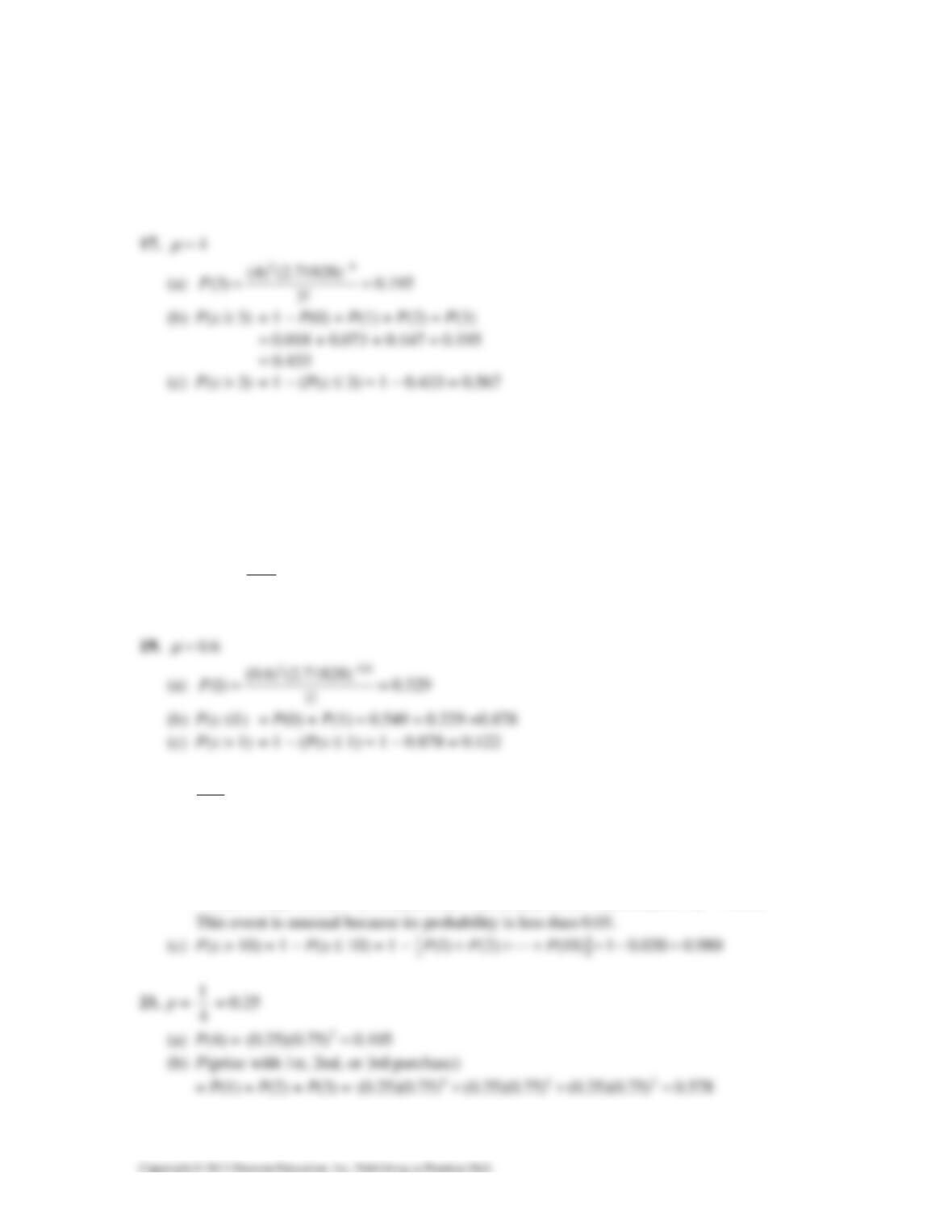
(c) P(x > 5) = 1 − (P(0) + P(1) + P(2) + P(3) + P(4) + P(5))
≈ 1 − (0.135 + 0.271 + 0.271 + 0.180 + 0.090 + 0.036)
= 0.017
This event is unusual because its probability is less than 0.05.
18. p = 0.648
(a) P(2) = 1
(0.648)(0.352) 0.228≈
(b) P(completes 1st or 2nd pass) = P(1) + P(2) = 01
(0.648)(0.352) (0.648)(0.352) 0.876+≈
(c) P(does not complete first 2 passes) = 1 − P(completes 1st or 2nd pass)
≈ 1 − 0.876
= 0.124
P(0) = 02
2! (0.648) (0.352) 0.124
0!2! =
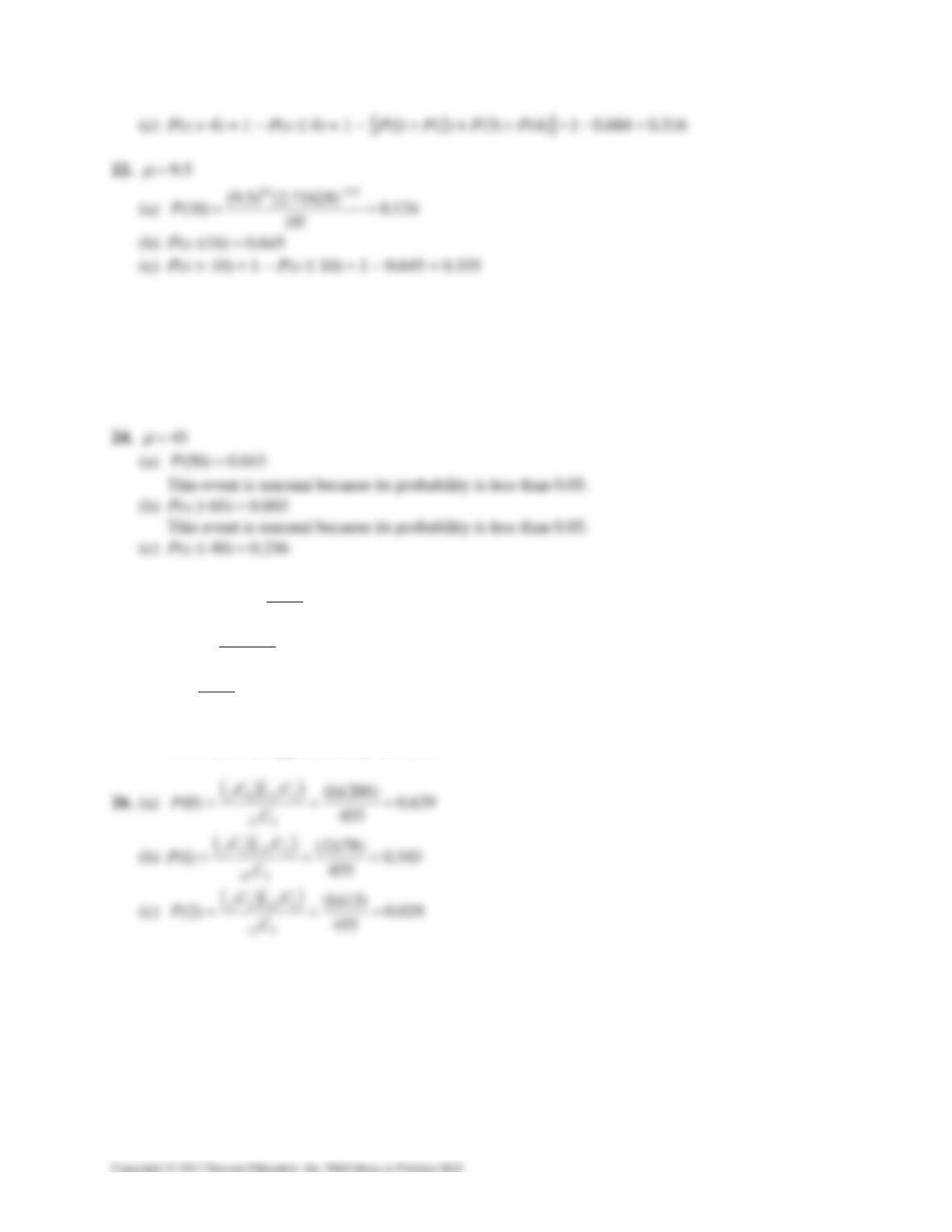
20. p = 1
500 = 0.002
(a) 9
(10) (0.002)(0.998) 0.002P==
This event is unusual because its probability is less than 0.05.
(b) P(1st, 2nd, or 3rd part is defective)
= P(1) + P(2) + P(3) = 012
(0.002)(0.998) (0.002)(0.998) (0.002)(0.998) 0.006++ =
160 CHAPTER 4 │ DISCRETE PROBABILITY DISTRIBUTIONS
µ
23. 8
µ
=
(a) (8) 0.140P≈
(b) P(x ≤ 3) ≈ 0.042
This event is unusual because its probability is less than 0.005.
(c) P(x > 12) ≈ 0.064
µ
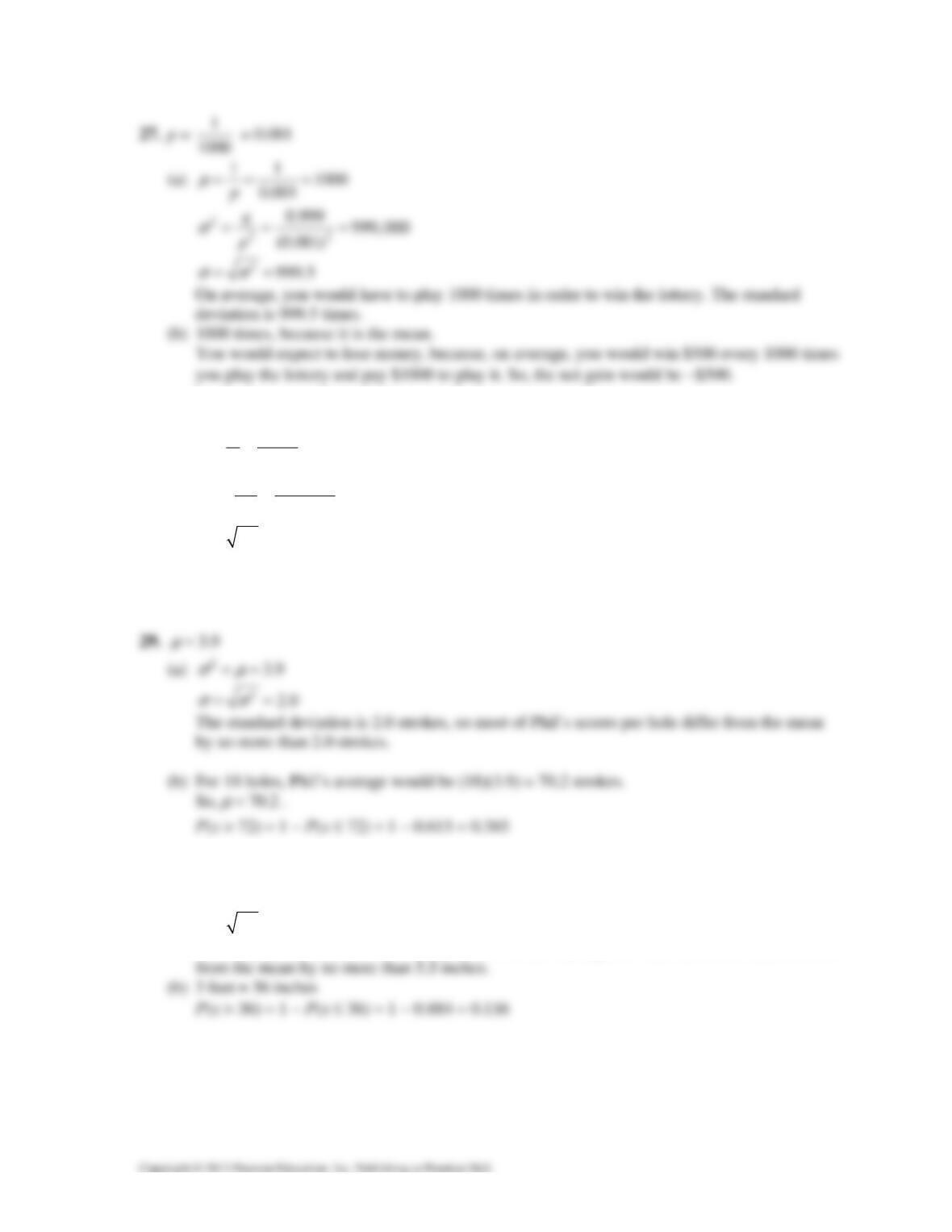
25. (a) n = 6000, p = 1
2500 = 0.0004
P(4) = 4 5996
6000! (0.0004) (0.9996) 0.1254235482
5996!4! ≈
(b) 6000
2500
µ
= = 2.4 cars with defects per 6000.
P(4) ≈ 0.1254084986
The results are approximately the same.
CHAPTER 4 │ DISCRETE PROBABILITY DISTRIBUTIONS 161
28. p = 0.005
(a) 11
200
0.005
p
µ
== =
2
22
0.995 39,800
(0.005)
q
p
σ
== =
2199.5
σσ
=≈
On average 200 records will be examined before finding one that has been miscalculated. The
standard deviation is 199.5 records.
(b) 200, because it is the mean.
µ
µ
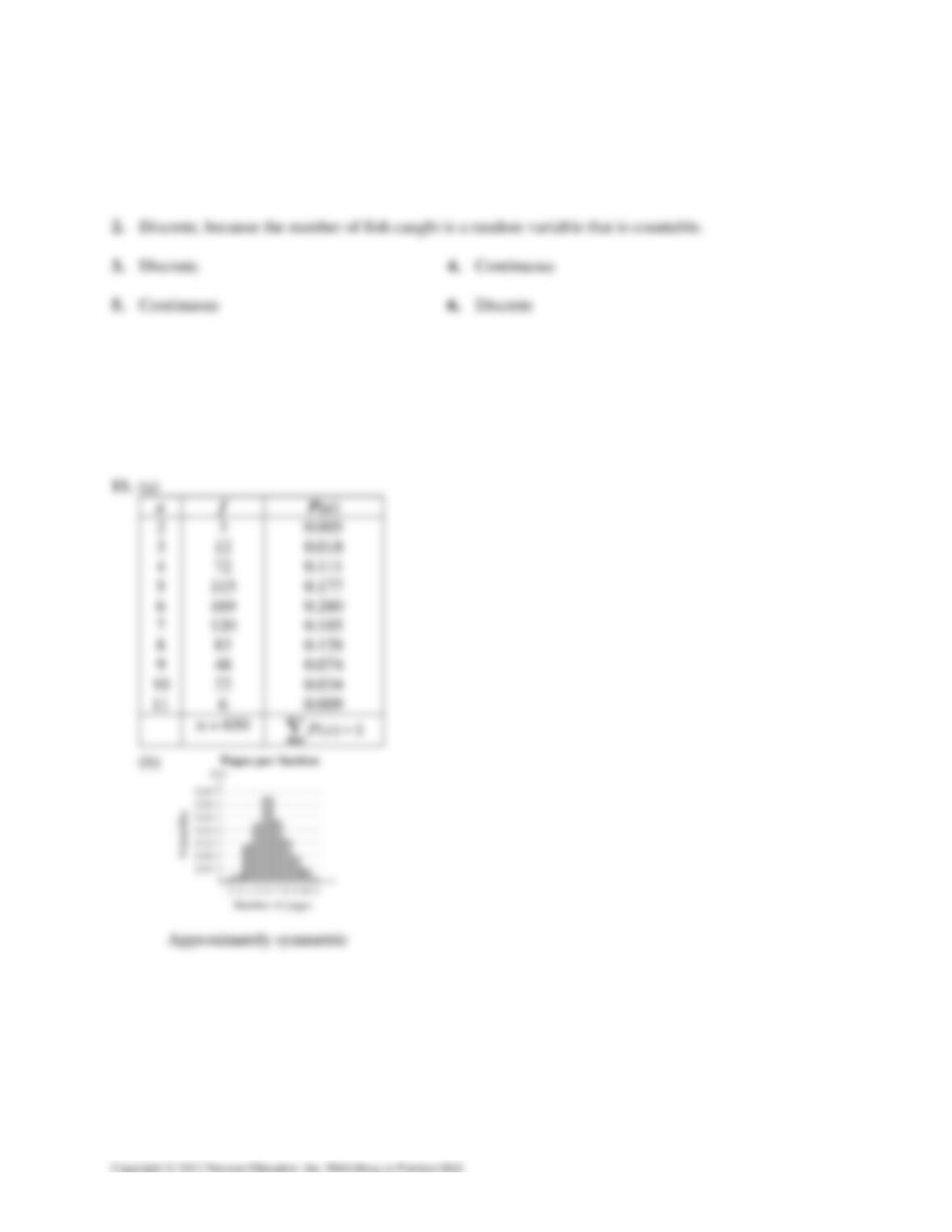
30. 29.9
µ
=
(a) 229.9
σµ
==
25.5
σσ
=≈
The standard deviation to 5.5 inches, so most of the January snowfalls in Mount Shasta differ
162 CHAPTER 4 │ DISCRETE PROBABILITY DISTRIBUTIONS
CHAPTER 4 REVIEW EXERCISE SOLUTIONS
1. Continuous, because the length of time spent sleeping is a random variable that cannot be
counted.
7. No, () 1.Px ≠
∑ 8. Yes.
9. Yes
10. No, P(5) > 1 and () 1.Px ≠
∑
CHAPTER 4 │ DISCRETE PROBABILITY DISTRIBUTIONS 163
(c)
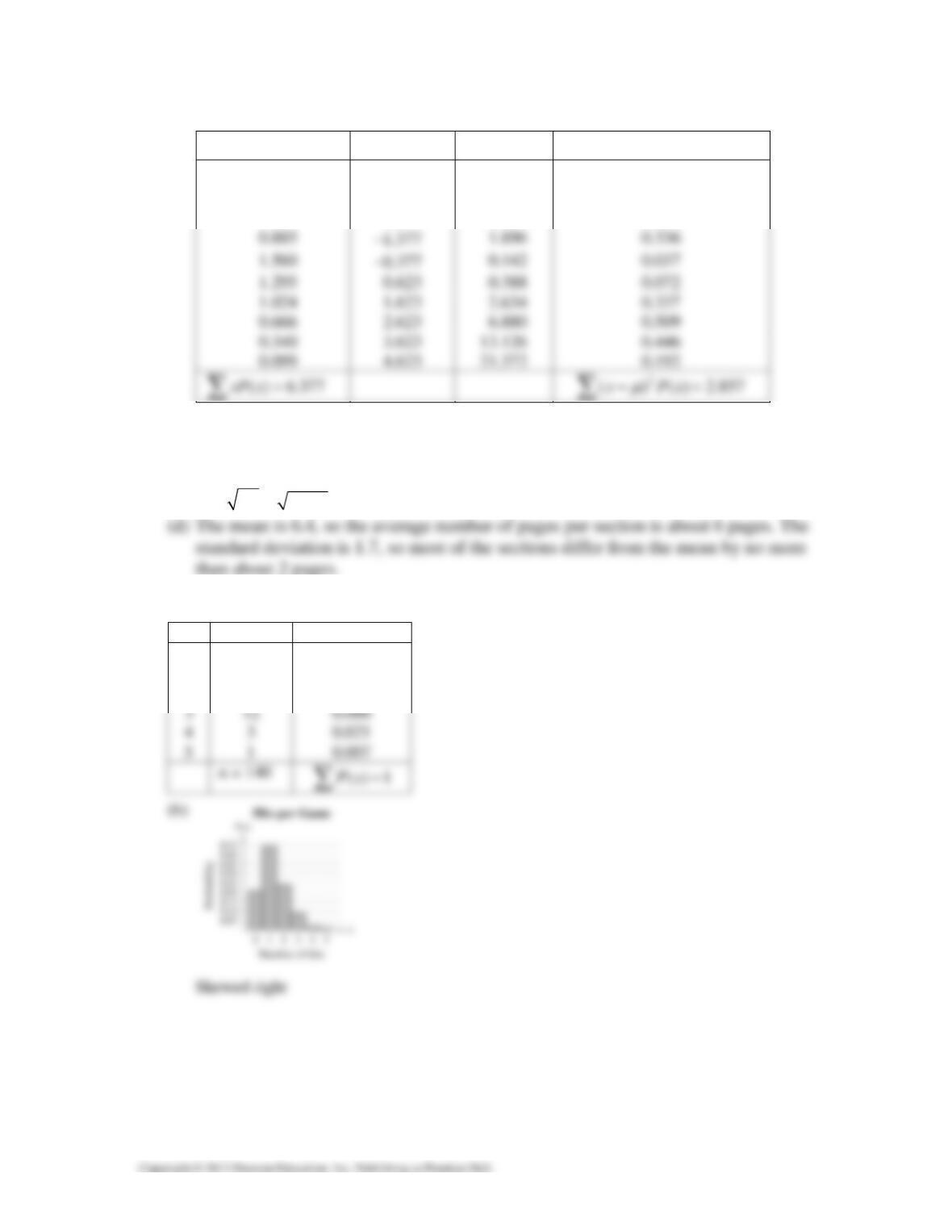
xP(x) (x −
µ
) (x −
µ
)2 (x −
µ
)2P(x)
0.010 −4.377 19.158 0.096
0.054 −3.377 11.404 0.205
0.444 −2.377 5.650 0.627
( ) 6.377 6.4xP x
µ
==≈
∑
22
( ) ( ) 2.857 2.9xPx
σµ
=− =≈
∑
22.857 1.7
σσ
== ≈
12. (a)
x f P(x)
0 29 0.207
1 62 0.443
2 33 0.236
164 CHAPTER 4 │ DISCRETE PROBABILITY DISTRIBUTIONS
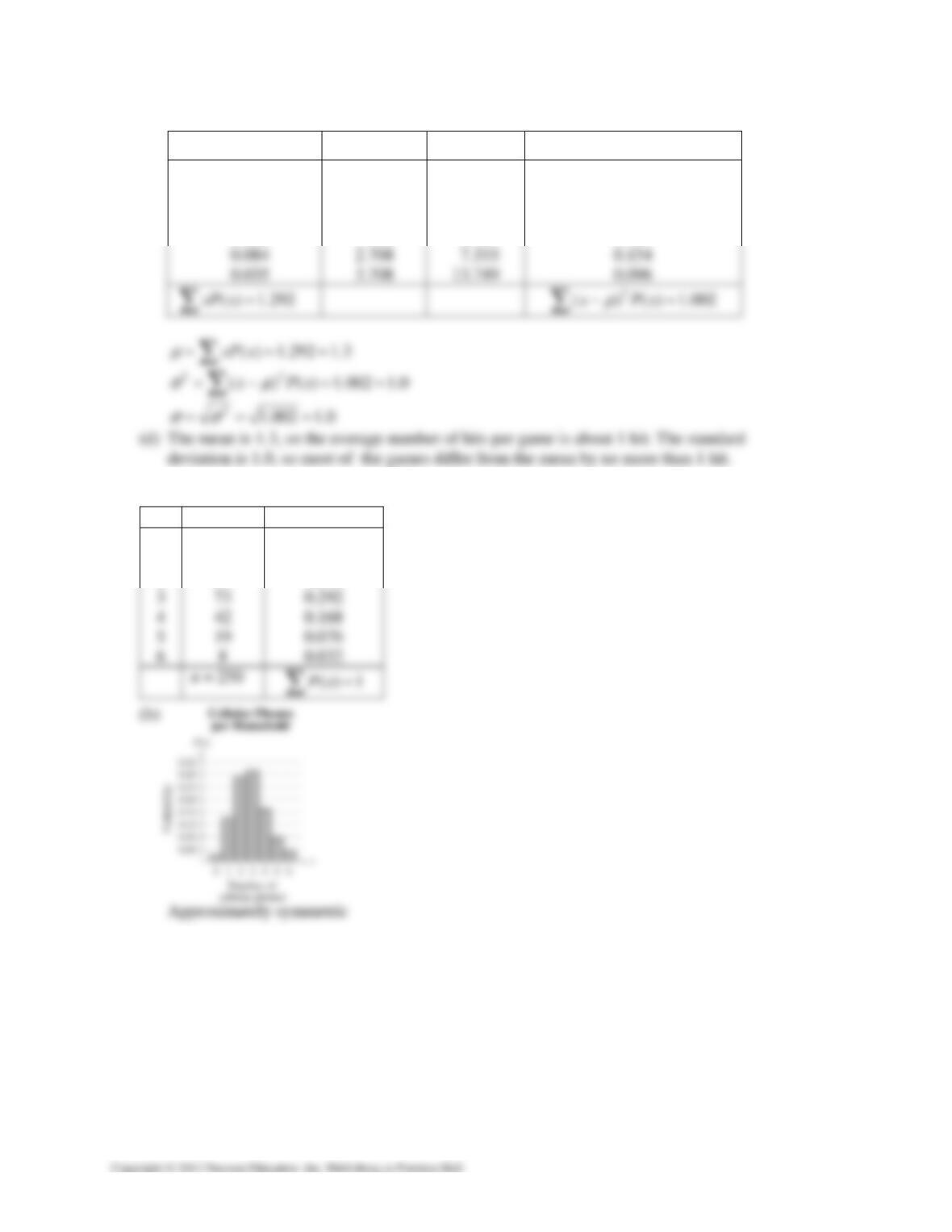
(c)
xP(x) (x −
µ
) (x −
µ
)2 (x −
µ
)2P(x)
0 −1.292 1.669 0.345
0.443 −0.292 0.085 0.038
0.472 0.708 0.501 0.118
0.258 1.708 2.917 0.251
13. (a)
x f P(x)
0 5 0.020
1 35 0.140
2 68 0.272
CHAPTER 4 │ DISCRETE PROBABILITY DISTRIBUTIONS 165
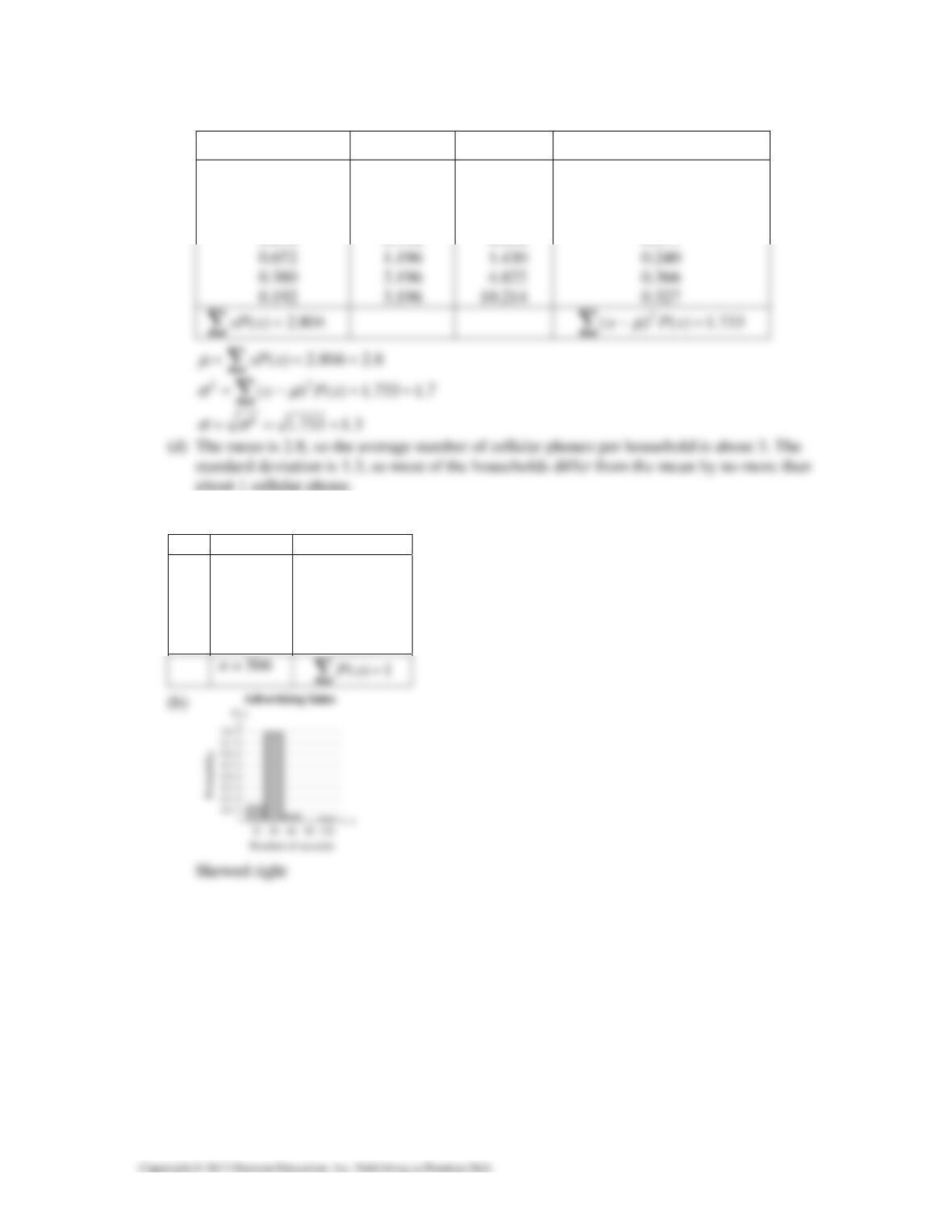
(c)
xP(x) (x −
µ
) (x −
µ
)2 (x −
µ
)2P(x)
0 −2.804 7.862 0.157
0.140 −1.804 3.254 0.456
0.544 −0.804 0.646 0.176
0.876 0.196 0.038 0.011
about 1 cellular phone.
14. (a)
x f P(x)
15 76 0.1342
30 445 0.7862
60 30 0.0530
90 3 0.0053
120 12 0.0212
166 CHAPTER 4 │ DISCRETE PROBABILITY DISTRIBUTIONS
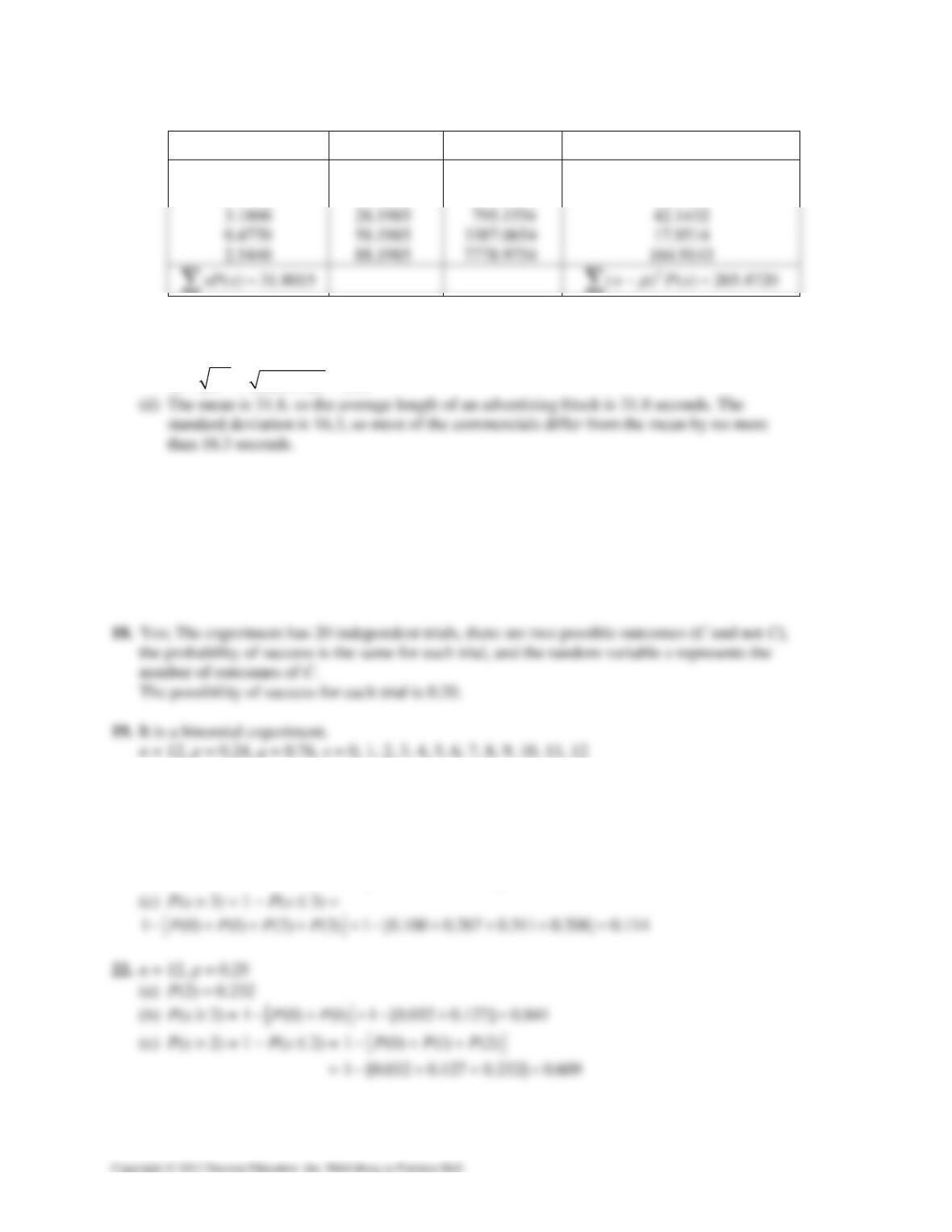
(c)
xP(x) (x −
µ
) (x −
µ
)2 (x −
µ
)2P(x)
2.0145 −16.8015 282.2904 37.9116
23.5860 −1.8015 3.2454 2.5515
( ) 31.8015 31.8xP x
µ
==≈
∑
22
( ) ( ) 265.4720 265.5xPx
σµ
=− = ≈
∑
2265.4720 16.3
σσ
== ≈
15. () () 3.4Ex xPx
µ
== ≈
∑
16. () () 2.5Ex xPx
µ
== ≈
∑
17. No; In a binomial experiment, there are only two possible outcomes: success or failure.
20. Not a binomial experiment because the experiment is not repeated for a fixed number of trials.
21. n = 8, p = 0.25
(a) P(3) ≈ 0.208
(b) P(x ≥ 3) = 1 − P(x < 3) =
[]
1 (0) (1) (2) 1 [0.100 0.267 0.311] 0.322PPP−++=− ++ =
CHAPTER 4 │ DISCRETE PROBABILITY DISTRIBUTIONS 167
24. n = 5, p = 0.31
(a) P(2) ≈ 0.316
(b) P(x ≥ 2) = P(2) + P(3) + P(4) + P(5) ≈ 0.316 + 0.142 + 0.032 + 0.003 = 0.493
(c) P(x > 2) = P(3) + P(4) + P(5) ≈ 0.142 + 0.032 + 0.003 = 0.177
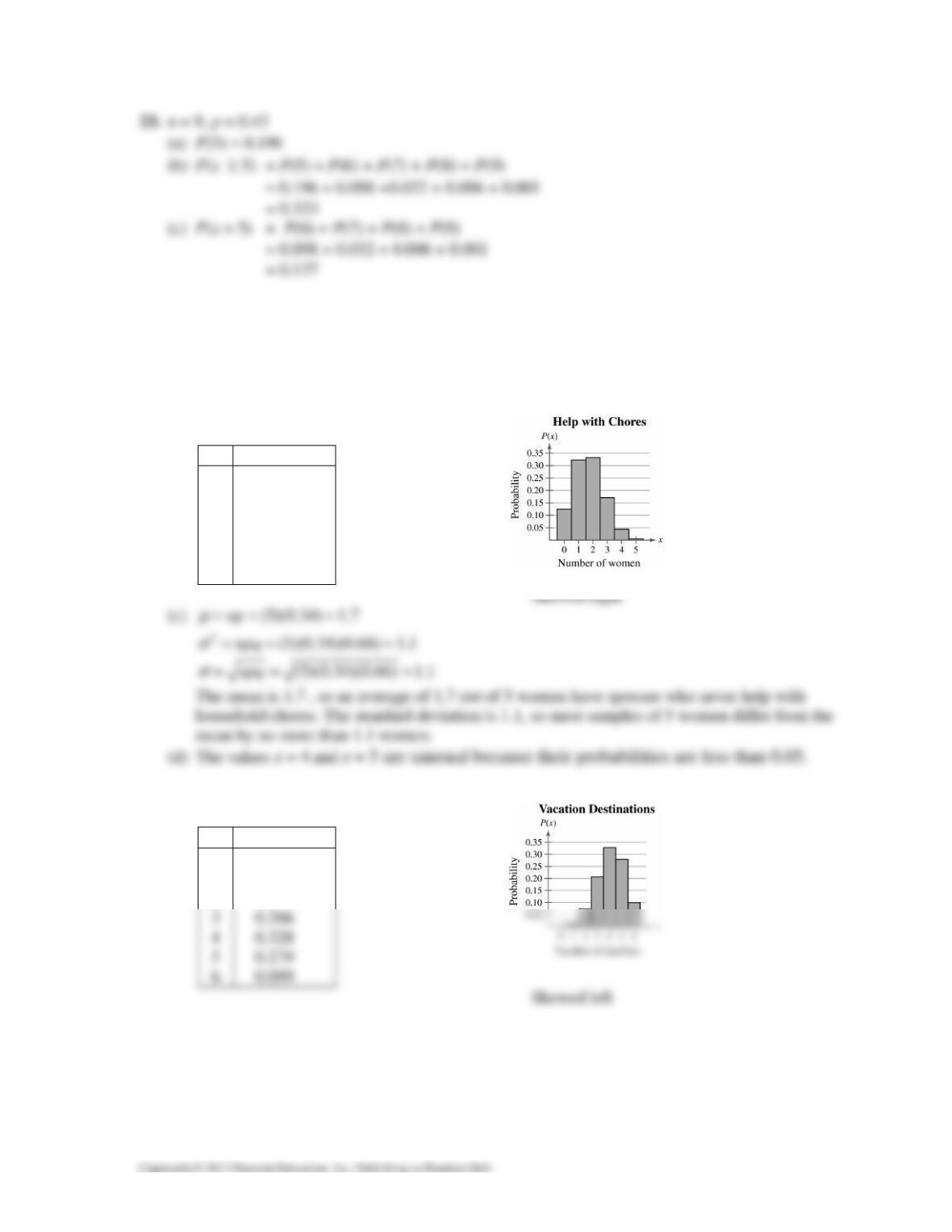
25. (a) n = 5, p = 0.34 (b)
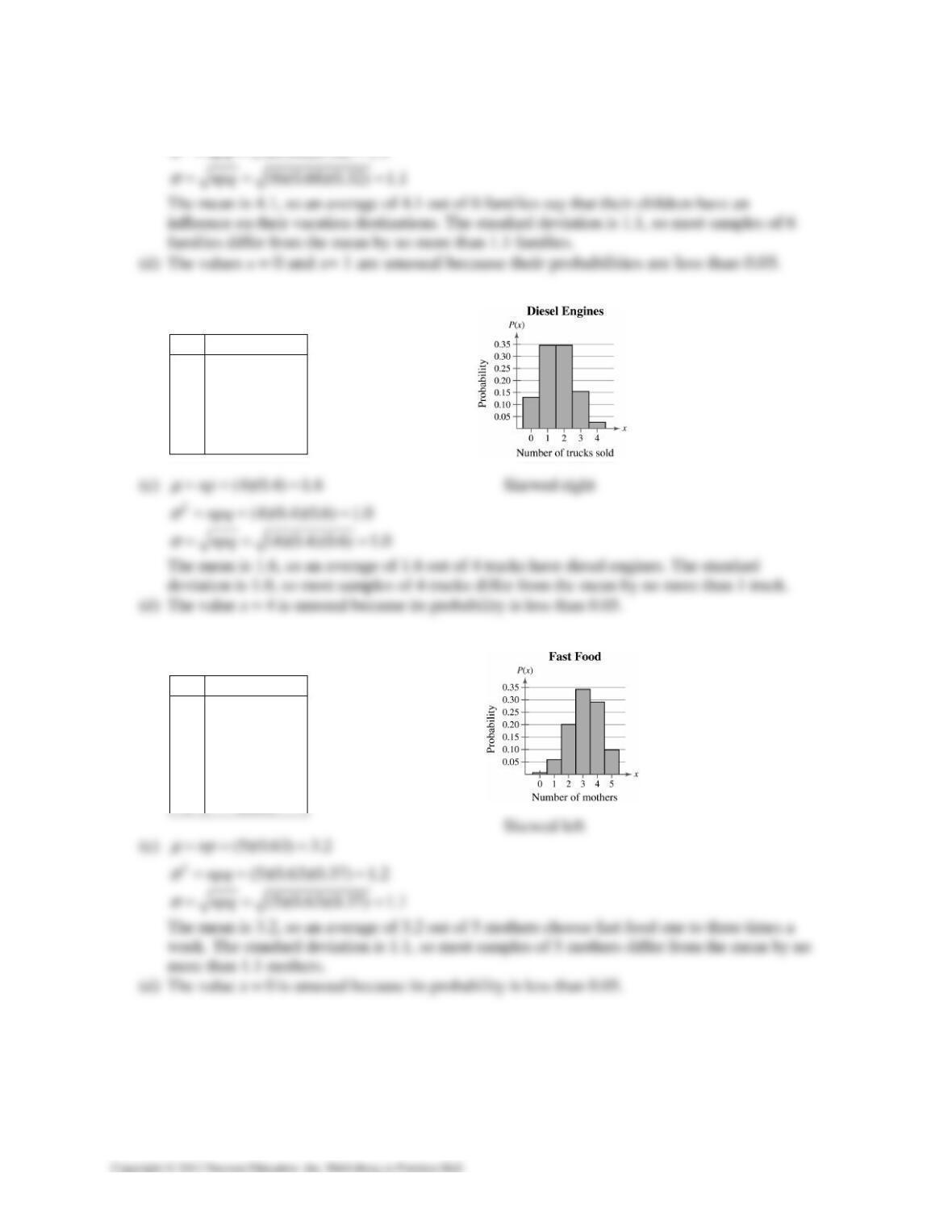
26. (a) n = 6, p = 0.68 (b)
x P(x)
0 0.125
1 0.323
2 0.332
3 0.171
4 0.044
5 0.005
x P(x)
0 0.001
1 0.014
2 0.073
168 CHAPTER 4 │ DISCRETE PROBABILITY DISTRIBUTIONS
(c) (6)(0.68) 4.1np
µ
== ≈
2(5)(0.68)(0.32) 1.3npq
σ
== ≈
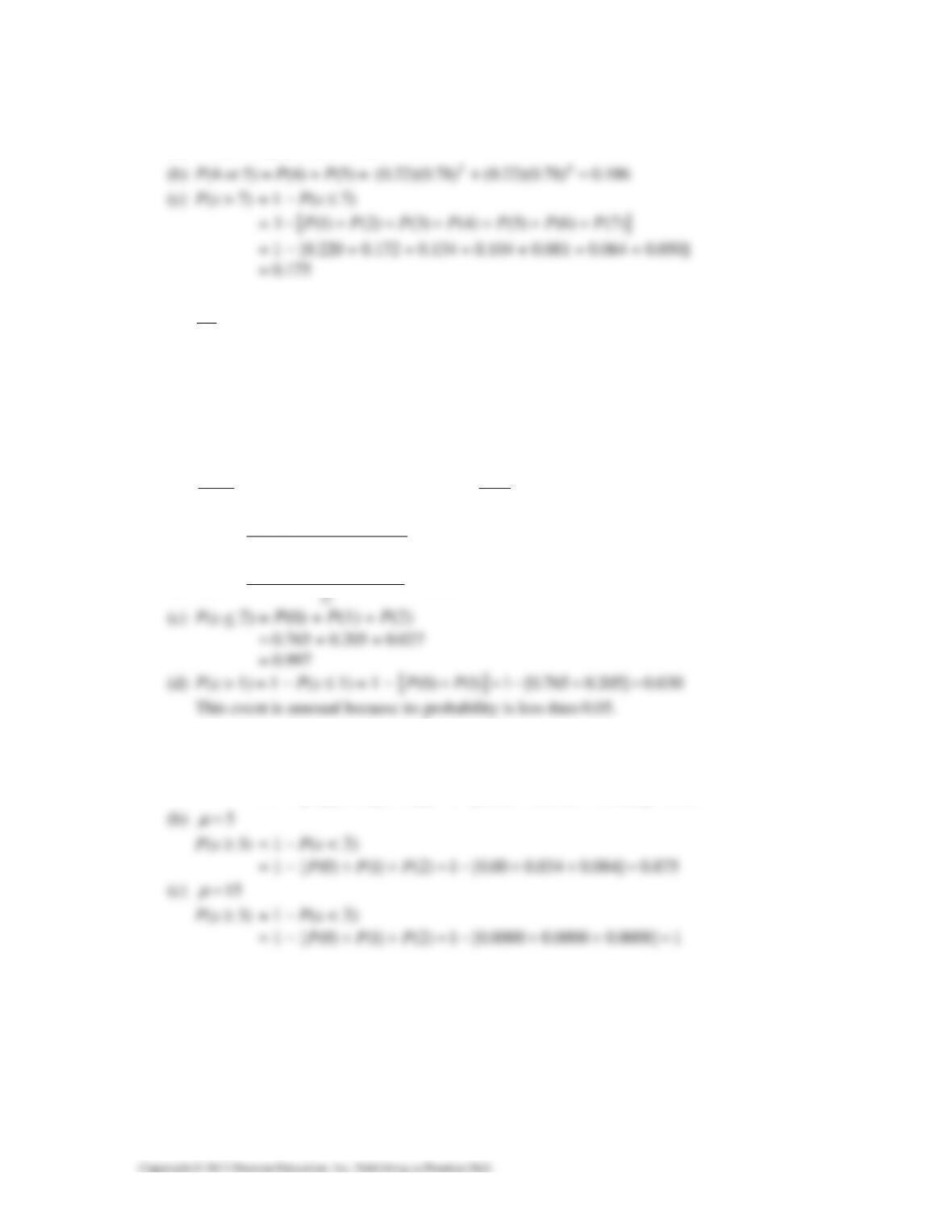
27. (a) n = 4, p = 0.4 (b)
28. (a) n = 5, p = 0.63 (b)
x P(x)
0 0.130
1 0.346
2 0.346
3 0.154
4 0.025
x P(x)
0 0.007
1 0.059
2 0.201
3 0.342
4 0.291
5 0.099
CHAPTER 4 │ DISCRETE PROBABILITY DISTRIBUTIONS 169
29. p = 0.22
(a) P(3) = 2
(0.22)(0.78) 0.134≈
30. p = 33
77 = 0.429
(a) P(1) = 0
(0.429)(0.571) 0.429≈
(b) P(2) = 1
(0.429)(0.571) 0.245≈
(c) P(1 or 2) = P(1) + P(2) ≈ 0.429 + 0.245 = 0.674
(d) P(within first 3 games) = P(1) P(2) + P(3) ≈ 0.429 + 0.245 + 0.140 = 0.814
31. 6755 97.9
69
µ
=≈ tornado deaths/year → 97.9 0.268
365
µ
=≈ deaths/day
(a) P(0) ≈
00.268
(0.268) (2.71828) 0.765
0!
−≈
(b) P(1) ≈
10.268
(0.268) (2.71828) 0.205
−≈
32. (a) 10
µ
=
P(x ≥ 3) = 1 − P(x < 3)
= 1 − [ (0) (1) (2) 1 [0.000 0.0005 0.0023] 0.997PPP++ ≈− + + ≈
µ
µ
33. The probability increases as the rate increases, and decreases as the rate decreases.
170 CHAPTER 4 │ DISCRETE PROBABILITY DISTRIBUTIONS
CHAPTER 4 QUIZ SOLUTIONS
1. (a) Discrete because the number of lightning strikes that occur in Wyoming during the month of
June is a random variable that is countable.
(b) Continuous because the fuel (in gallons) used by the Space Shuttle during takeoff is a random
variable that has an infinite number of possible outcomes and cannot be counted.
(b)
Skewed right
CHAPTER 4 │ DISCRETE PROBABILITY DISTRIBUTIONS 171
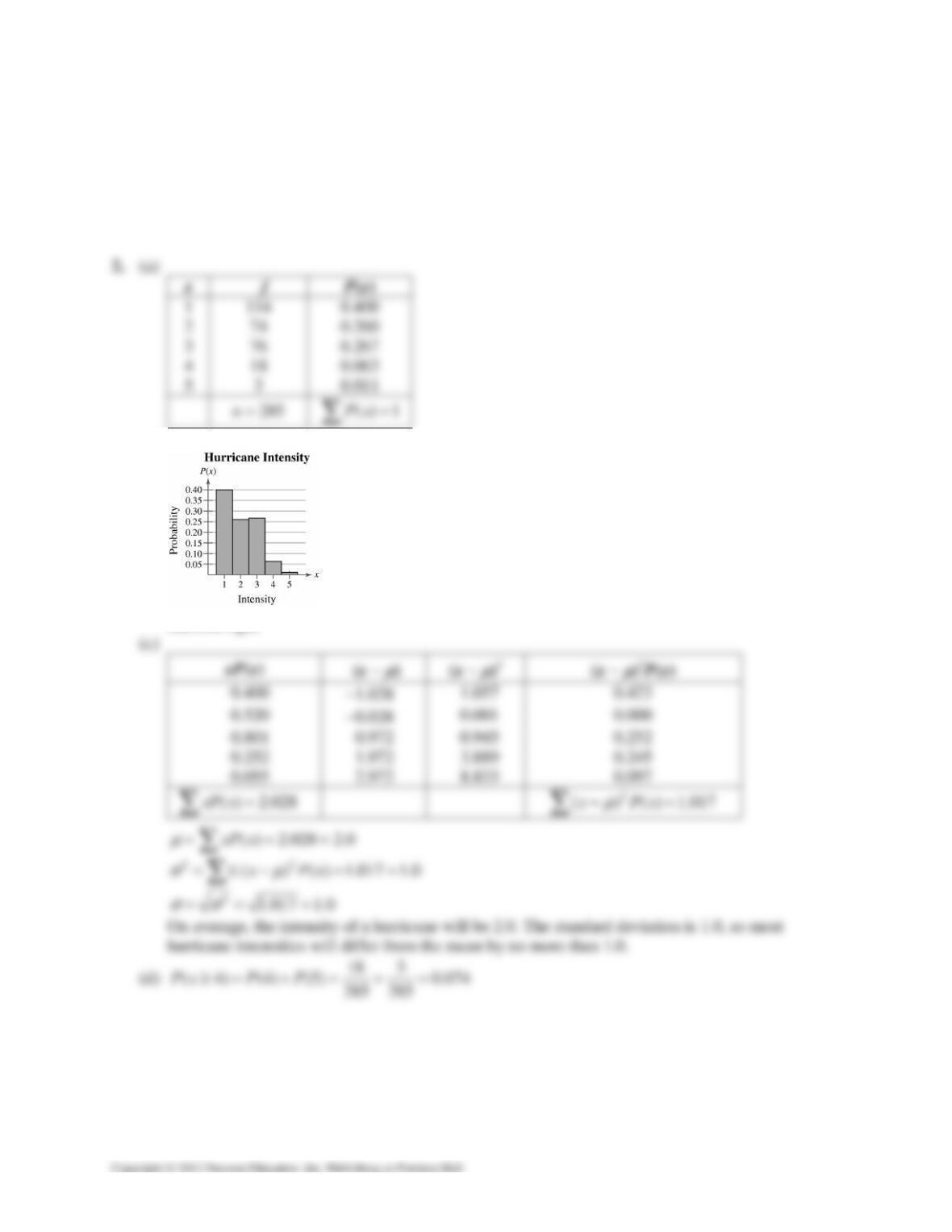
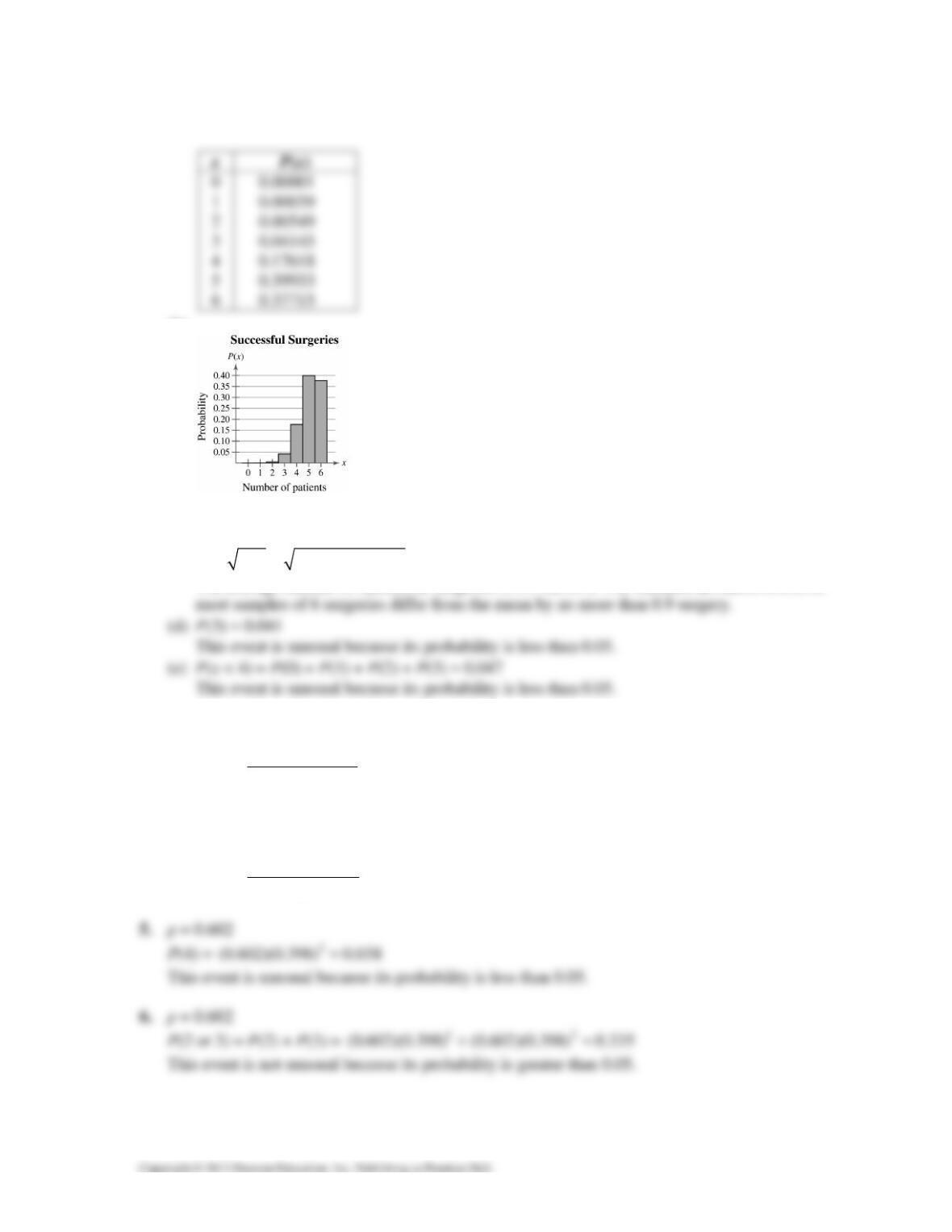
3. (a) n = 6, p = 0.85
(b)
(c) (6)(0.85) 5.1np
µ
== =
2(6)(0.85)(0.15) 0.8npq== =
σ
(16)(0.85)(0.15) 0.9npq== =
σ
The average number of successful surgeries is 5.1 out of 6. The standard deviation is 0.9, so
4. 5
µ
=
(a) P(5) ≈
55
(5) (2.71828) 0.175
5!
−≈
(b) P(x < 5) = P(0) + P(1) + P(2) + P(3) + P(4)
≈ 0.007 + 0.034 + 0.084 + 0.140 + 0.175
= 0.440
(c) P(0) ≈
05
(5) (2.71828)
0!
−
≈ 0.007