n39.781=n32.6 79
21
⋅:=
n22.6=n22 1.3⋅:=
n11:=
Moles methane
Moles oxygen
Moles nitrogen
Entering:
FURNACE: Basis is 1 mole of methane burned with 30% excess air.
CH4 + 2O2 = CO2 + 2H2O(g)
4.29
This value is for the constant-V reaction, whereas the STANDARD
reaction is at const. P.However, for ideal gases H = f(T), and for liquids H
is a very weak function of P. We therefore take the above value as the
standard value, and for the specified reaction:
∆H 7.145−106
×J=∆HQRT⋅∆ngas
⋅+:=
∆ngas 10 14.5−( ) mol⋅:=T 298.15 K⋅:=
Q∆U=∆H∆PV()−=∆HRT⋅∆ngas
⋅−=
This value is for the constant-volume reaction:
C10H18(l) + 14.5O2(g) = 10CO2(g) + 9H2O(l)
Assuming ideal gases and with symbols representing total properties,
Q 7.133−106
×J=Q 43960−162.27⋅J⋅:=
On the basis of 1 mole of C10H18
(molar mass = 162.27)
4.28
96
R 8.314 J
mol K⋅
=
A
i
niAi
⋅
()
∑
:= B
i
niBi
⋅
()
∑
:= D
i
niDi
⋅
()
∑
:=
A 48.692=B 10.896983 10 3−
=C0:= D 5.892−104
×=
The TOTAL value for MCPH of the product stream:
∆HPR MCPH 303.15K 1773.15K,A,B,C,D,()⋅1773.15 303.15−()K⋅:=
Total moles of dry gases entering nn
1n2
+n3
+:= n 13.381=
At 30 degC the vapor pressure of water is
4.241 kPa. Moles of water vapor entering:
n4
4.241
101.325 4.241−13.381⋅:= n40.585=
Leaving: CO2 — 1 mol
(1)
By an energy balance on the furnace:
Q∆H=∆H298 ∆HP
+=
For evaluation of ∆HP we number species as above.
1
⎛
⎞
5.457
⎛
⎞
1.045
⎛
⎞
1.157−
⎛
⎞
i14..:=
97
Moles water formed = (6)(0.8) = 4.8
Moles O2 reacting = (5)(0.8) = 4.0
Moles NH3 reacting = moles NO formed = (4)(0.8) = 3.2
Moles N2 entering = (6.5)(79/21) = 24.45
Moles O2 entering = (5)(1.3) = 6.5
4NH3(g) + 5O2(g) = 4NO(g) + 6H2O(g)
BASIS: 4 moles ammonia entering reactor
4.30
Latent heat of water at 50 degC in J/mol:
Moles of water vapor leaving the heat exchanger:
The vapor pressure of water at 50 degC (exit of heat exchanger) is 12.34
kPa, and water must condense to lower its partial pressure to this value.
HEAT EXCHANGER: Flue gases cool from 1500 degC to
50 degC. The partial pressure of the water in the flue gases leaving the
furnace (in kPa) is
98
PRODUCTS:1=NH3; 2=O2; 3=NO; 4=H2O; 5=N2
0.8
2.5
24.45
⎛
⎜
⎜
⎜
⎝
⎞
⎟
⎠
3.578
3.639
3.280
⎛
⎜
⎜
⎜
⎝
⎞
⎟
⎠
3.020
0.506
0.593
⎛
⎜
⎜
⎜
⎝
⎞
⎟
⎠
K
0.186−
0.227−
0.040
⎛
⎜
⎜
⎜
⎝
⎞
⎟
⎠
i
()
∑
i
()
∑
i
()
∑
A 119.65=B 0.027 1
K
=D 8.873 104
×K2
=
By the energy balance and Eq. (4.7), we can write:
ENERGY BALANCE:
∆H∆HR∆H298
+∆HP
+=0=
REACTANTS: 1=NH3; 2=O2; 3=N2
⎜
⎜
⎜
⎜
4
3.578
3.020
0.186−
TOTAL mean heat capacity of reactant stream:
∆HRR MCPH 348.15K 298.15K,A,B,C,D,()⋅298.15K 348.15K−()⋅:=
99

B14.394
1.450
⎛
⎜
⎝
⎞
⎠10 3−
⋅:= C4.392−
0.0
⎛
⎜
⎝
⎞
⎠10 6−
⋅:= D0.0
0.121
⎛
⎜
⎝
⎞
⎠105
⋅:=
A
i
niAi
⋅
()
∑
:= B
i
niBi
⋅
()
∑
:= C
i
niCi
⋅
()
∑
:= D
i
niDi
⋅
()
∑
:=
A 4.894=B 0.01584=C 4.392−10 6−
×= D 1.21 104
×=
Given ∆H298
−∆HR
−RAT
0
⋅τ1−
()
⋅B
2T02
⋅τ
21−
()
⋅+
…
⎡
⎢
⎤
⎥
⋅=
4.31 C2H4(g) + H2O(g) = C2H5OH(l)
BASIS: 1 mole ethanol produced
Energy balance:
n 1mol:=
∆HQ=∆HR∆H298
+=
∆H298 277690−52510 241818−()−[]
J
mol
⋅:= ∆H298 8.838−104
×J
mol
=
Reactant stream consists of 1 mole each of C2H4 and H2O.
i12..:= n1
1
⎛
⎜
⎝
⎞
⎠
:=
A1.424
3.470
⎛
⎜
⎝
⎞
⎠
:=
100
n
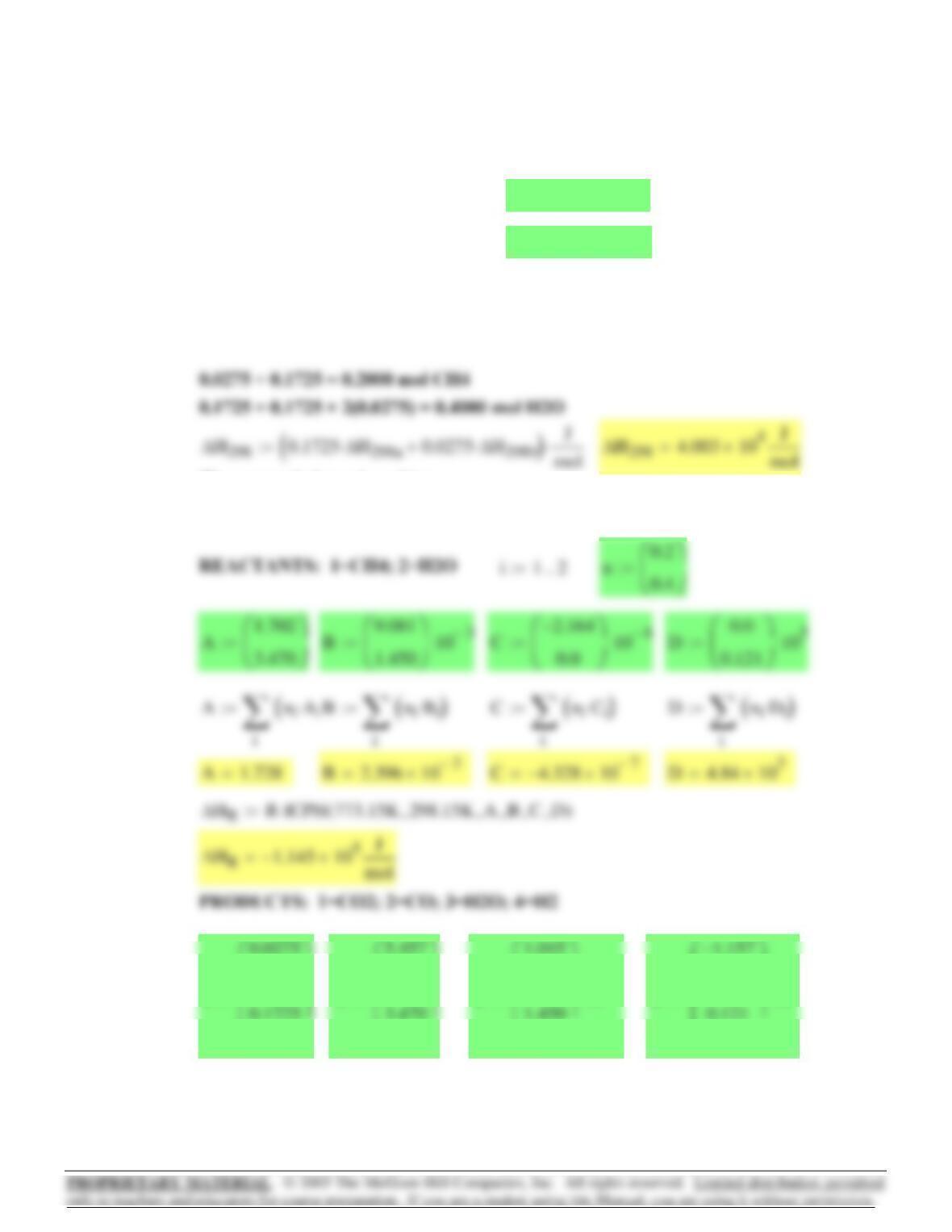
0.1725
0.6275
⎛
⎜
⎜
⎜
⎝
⎞
⎟
⎠
:= A
3.376
3.249
⎛
⎜
⎜
⎜
⎝
⎞
⎟
⎠
:= B
0.557
0.422
⎛
⎜
⎜
⎜
⎝
⎞
⎟
⎠
10 3−
⋅:= D
0.031−
0.083
⎛
⎜
⎜
⎜
⎝
⎞
⎟
⎠
105
⋅:=
4.32 One wa
y
to proceed is as in Example 4.8 with the alternative pair of reactions
:
CH4 + H2O = CO + 3H2 ∆H298a 205813:=
CH4 + 2H2O = CO2 + 4H2 ∆H298b 164647:=
BASIS: 1 mole of product gases containing 0.0275 mol CO2; 0.1725 mol CO;
& H2O 0.6275 mol H2
Entering gas, by carbon & oxygen balances:
The energy balance is written
Q∆HR∆H298
+∆HP
+=
101
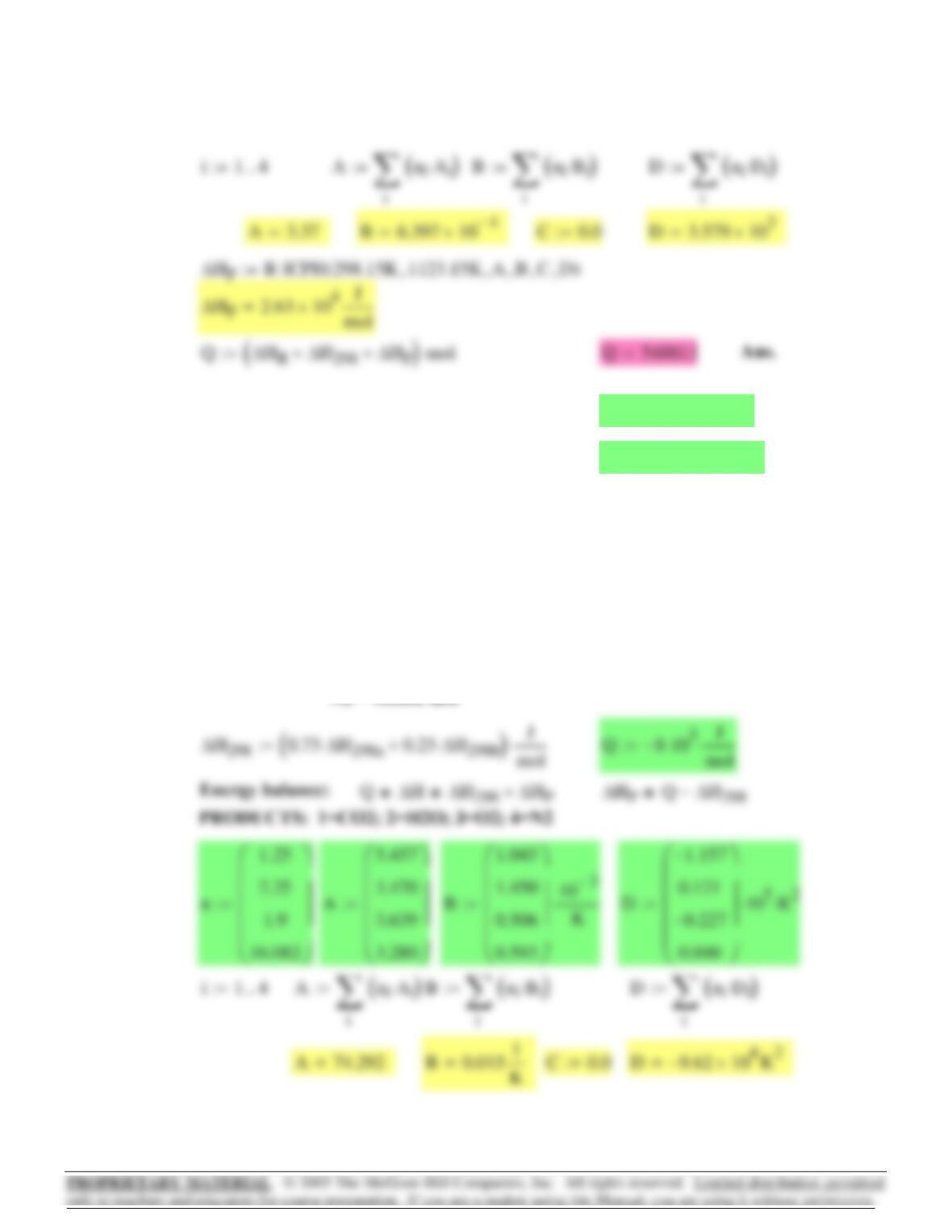
H2O = 2(0.75) + 3(0.25) = 2.25 mol
O2 = (0.8/1.8)(4.275) = 1.9 mol
N2 = 16.082 mol
4.33 CH4 + 2O2 = CO2 + 2H2O(g)
C2H6 + 3.5O2 = 2CO2 + 3H2O(g)
∆H298a 802625−:=
∆H298b 1428652−:=
BASIS: 1 mole fuel (0.75 mol CH4; 0.25 mol C2H6) burned completely with
80% xs. air.
O2 in = 1.8[(0.75)(2) + (0.25)(3.5)] = 4.275 mol
N2 in = 4.275(79/21) = 16.082 mol
Product gases: CO2 = 0.75 + 2(0.25) = 1.25 mol
102
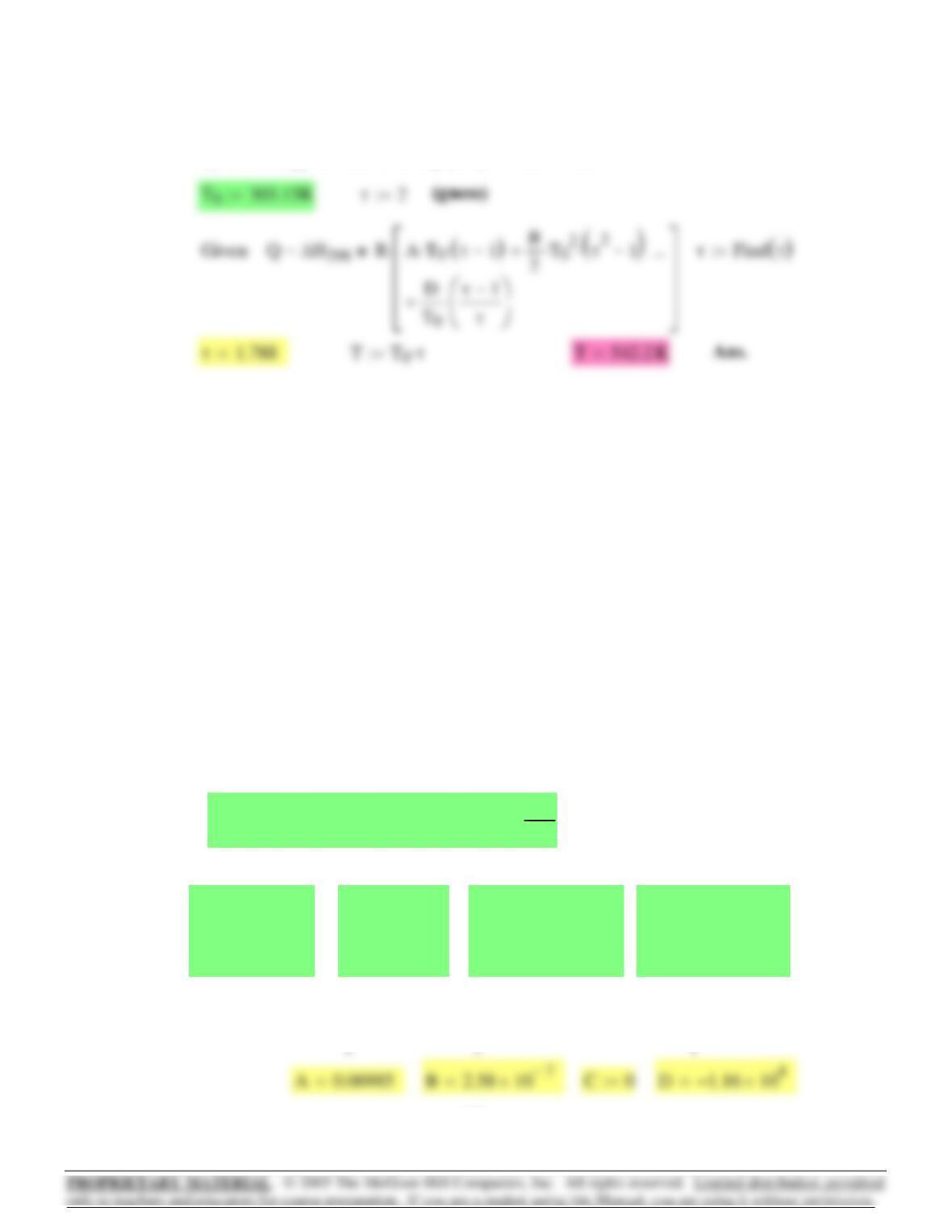
D
niDi
⋅
()
∑
:=
B
niBi
⋅
()
∑
:=
A
niAi
⋅
()
∑
:=
i13..:=
D
1.015−
0.227−
2.028−
⎛
⎜
⎜
⎜
⎝
⎞
⎟
⎠
105
⋅:=
B
0.801
0.506
1.056
⎛
⎜
⎜
⎜
⎝
⎞
⎟
⎠
10 3−
⋅:=
A
5.699
3.639
8.060
⎛
⎜
⎜
⎜
⎝
⎞
⎟
⎠
:=
n
0.129−
0.0645−
0.129
⎛
⎜
⎜
⎜
⎝
⎞
⎟
⎠
:=
1: SO2; 2: O2; 3: SO3
∆H298 395720−296830−()−[ ] 0.129⋅J
mol
⋅:=
Since ∆HR and ∆HP cancel for the gas that passes through the converter
unreacted, we need consider only those species that react or are formed.
Moreover, the reactants and products experience the same temperature
change, and can therefore be considered together. We simply take the
number of moles of reactants as being negative. The energy balance is
then written: ∆H773 ∆H298 ∆Hnet
+=
BASIS: 1 mole of entering gases containing 0.15 mol SO2; 0.20 mol
O2; 0.65 mol N2
SO2 + 0.5O2 = SO3 Conversion = 86%
SO2 reacted = SO3 formed = (0.15)(0.86) = 0.129 mol
O2 reacted = (0.5)(0.129) = 0.0645 mol
Energy balance: ∆H773 ∆HR∆H298
+∆HP
+=
4.34
⎢
⎥
By the energy balance and Eq. (4.7), we can write:
103
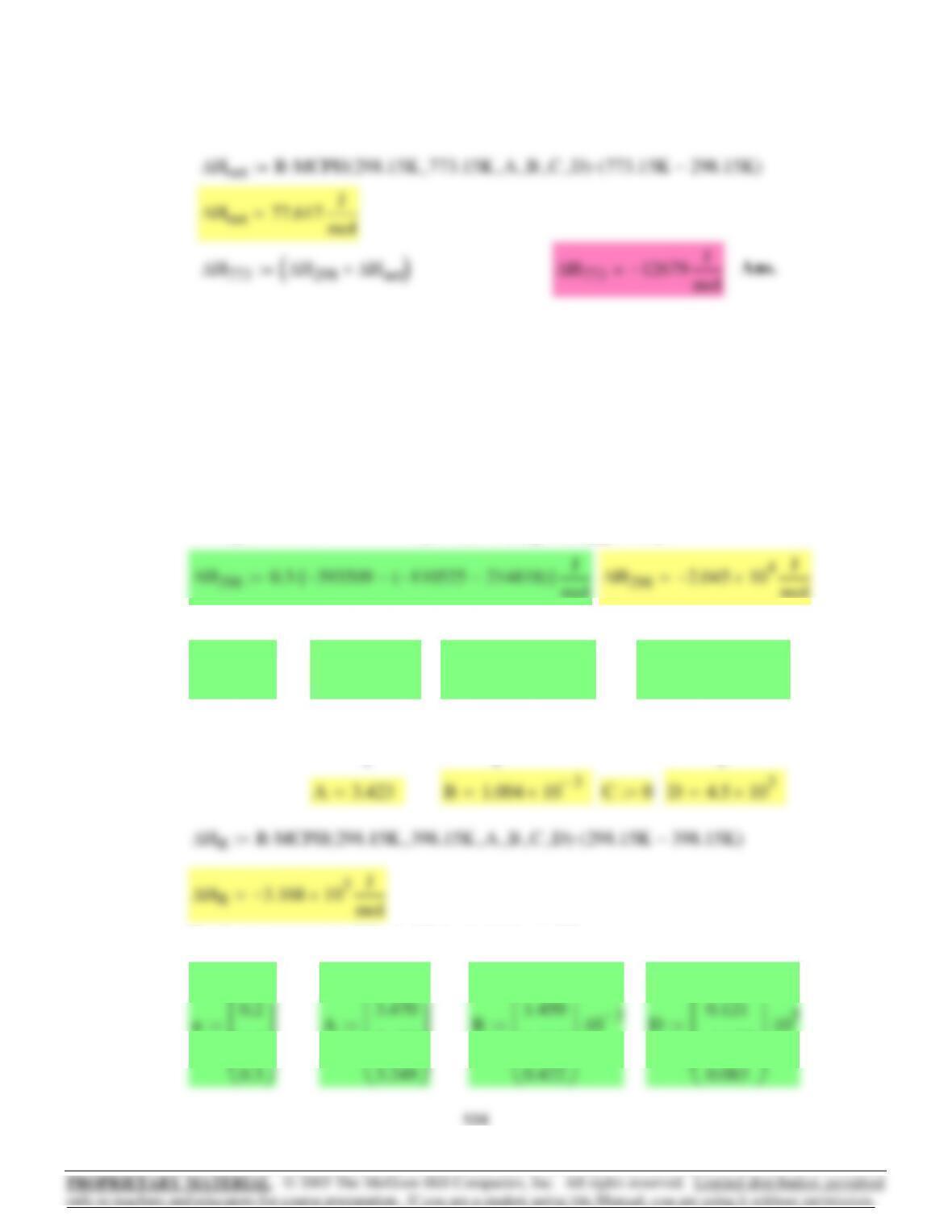
D0.031−
0.121
⎛
⎜
⎝
⎞
⎠105
⋅:=
i12..:= A
i
niAi
⋅
()
∑
:= B
i
niBi
⋅
()
∑
:= D
i
niDi
⋅
()
∑
:=
Products: 1: CO 2: H2O 3: CO2 4: H2
0.2
0.3
⎛
⎜
⎜
⎞
⎟
3.376
5.457
⎛
⎜
⎜
⎞
⎟
0.557
1.045
⎛
⎜
⎜
⎞
⎟
0.031−
1.157−
⎛
⎜
⎜
⎞
⎟
4.35 CO(g) + H2O(g) = CO2(g) + H2(g)
BASIS: 1 mole of feed consisting of 0.5 mol CO and 0.5 mol H2O.
Moles CO reacted = moles H2O reacted = moles CO2 formed = moles H2
formed = (0.6)(0.5) = 0.3
Product stream: moles CO = moles H2O = 0.2
moles CO2 = moles H2 = 0.3
Energy balance: Q∆H=∆HR∆H298
+∆HP
+=
mol
mol
Reactants: 1: CO 2: H2O
n0.5
0.5
⎛
⎜
⎝
⎞
⎠
:= A3.376
3.470
⎛
⎜
⎝
⎞
⎠
:= B0.557
1.450
⎛
⎜
⎝
⎞
⎠10 3−
⋅:=
N2 entering in oil:
Find amount of air entering by N2 & O2 balances.
Also H2O is formed by combustion of H2 in the oil in the amount
The oil also contains H2O:
BASIS: 100 lbmol DRY flue gases containing 3.00 lbmol CO2 and 11.80
lbmol CO x lbmol O2 and 100-(14.8-x)= 85.2-x lbmol N2. The oil therefore
contains 14.80 lbmol carbon;a carbon balance gives the mass of oil burned:
4.36
D
i
niDi
⋅
()
∑
:=
B
i
niBi
⋅
()
∑
:=
A
i
niAi
⋅
()
∑
:=
i14..:=
105
Reaction upon which net heating value is based:
where Q = 30% of net heating value of the oil:
3.00 lbmol CO2
Entering the process are oil, moist air, and the wet material to be dried, all at
77 degF. The “products” at 400 degF consist of:
If y = lbmol H2O evaporated in the drier, then
lbmol H2O entering in air:
Humidity of entering air, sat. at 77 degF in lbmol H2O/lbmol dry air,
P(sat)=0.4594(psia)
Since air is 21 mol % O2,
106
For the product stream we need MCPH:
∆H298 y() ∆H298a ∆H298b
+∆H298c y()+:=
Addition of these three reactions gives the “reaction” in the drier, except for
some O2, N2, and H2O that pass through unchanged. Addition of the
corresponding delta H values gives the standard heat of reaction at 298 K:
y50:=
(y)H2O(l) = (y)H2O(g) Guess:
To get the “reaction” in the drier, we add to this the following:
107
4.38 BASIS: 1 mole gas entering reactor, containing 0.6 mol HCl, 0.36 mol O2,
and 0.04 mol N2.
HCl reacted = (0.6)(0.75) = 0.45 mol
4HCl(g) + O2(g) = 2H2O(g) + 2Cl2(g)
4.37 BASIS: One mole of product gas containing 0.242 mol HCN, and
(1-0.242)/2 = 0.379 mol each of N2 and C2H2. The energy balance is
Q∆H=∆H298 ∆HP
+=
∆H298 2 135100⋅227480−()
0.242
2
⋅J⋅:= ∆H298 5.169 103
×J=
Products:
108
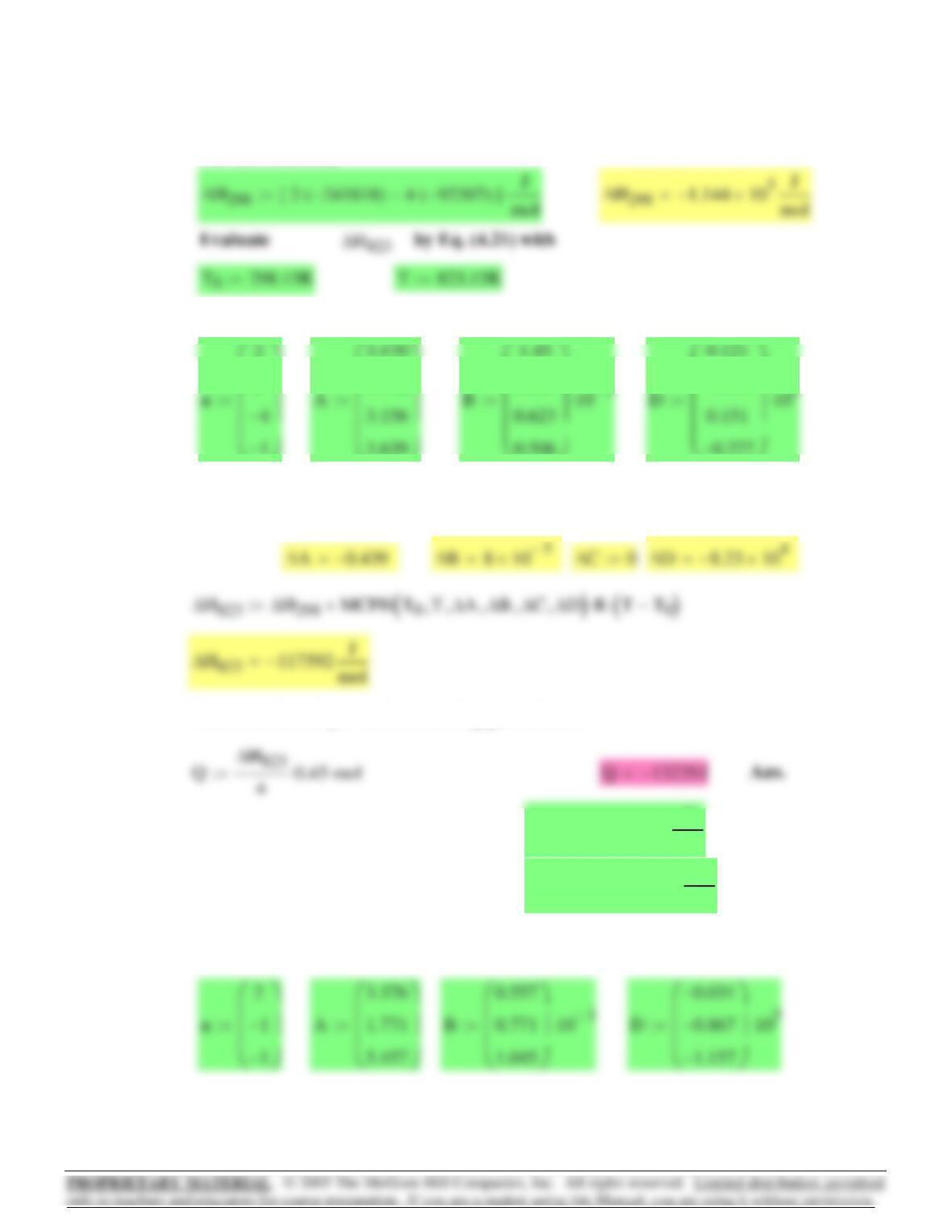
Heat transferred per mol of entering gas mixture:
4.39 CO2 + C = 2CO
2C + O2 = 2CO
Eq. (4.21) applies to each reaction:
∆H298a 172459 J
mol
:= (a)
∆H298b 221050−J
mol
:= (b)
For (a):
⎜
⎜
⎜
⎜
For this reaction,
1: H2O 2: Cl2 3: HCl 4=O2
2
⎛
⎜
⎝
⎞
⎠
4.442
⎛
⎜
⎝
⎞
⎠
0.089
⎛
⎜
⎝
⎞
⎠
0.344−
⎛
⎜
⎝
⎞
⎠
i14..:= ∆A
i
niAi
⋅
()
∑
:= ∆B
i
niBi
⋅
()
∑
:= ∆D
i
niDi
⋅
()
∑
:=
109