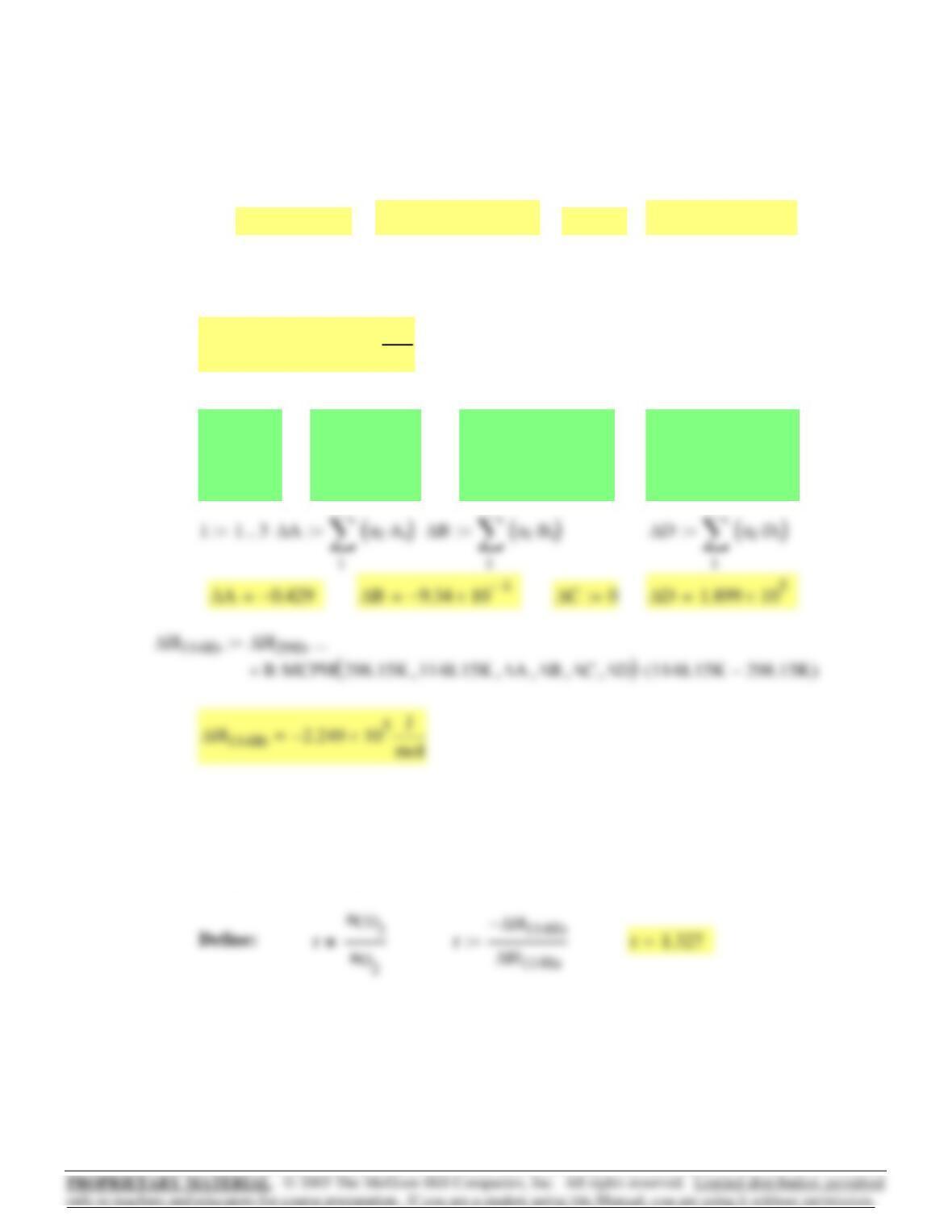
nCO2∆H1148a
⋅nO2∆H1148b
⋅+ 0=
The combined heats of reaction must be zero:
i13..:= ∆A
i
niAi
⋅
()
∑
:= ∆B
i
niBi
⋅
()
∑
:= ∆D
i
niDi
⋅
()
∑
:=
∆A 0.476−= ∆B 7.02−10 4−
×= ∆C0:= ∆D 1.962 105
×=
∆H1148a ∆H298a
R MCPH 298.15K 1148.15K,∆A,∆B,∆C,∆D,
()
⋅1148.15K 298.15K−()⋅+
…:=
∆H1148a 1.696 105
×J
mol
=
For (b):
n
2
1−
2−
⎛
⎜
⎜
⎜
⎝
⎞
⎟
⎠
:= A
3.376
3.639
1.771
⎛
⎜
⎜
⎜
⎝
⎞
⎟
⎠
:= B
0.557
0.506
0.771
⎛
⎜
⎜
⎜
⎝
⎞
⎟
⎠
10 3−
⋅:= D
0.031−
0.227−
0.867−
⎛
⎜
⎜
⎜
⎝
⎞
⎟
⎠
105
⋅:=
110
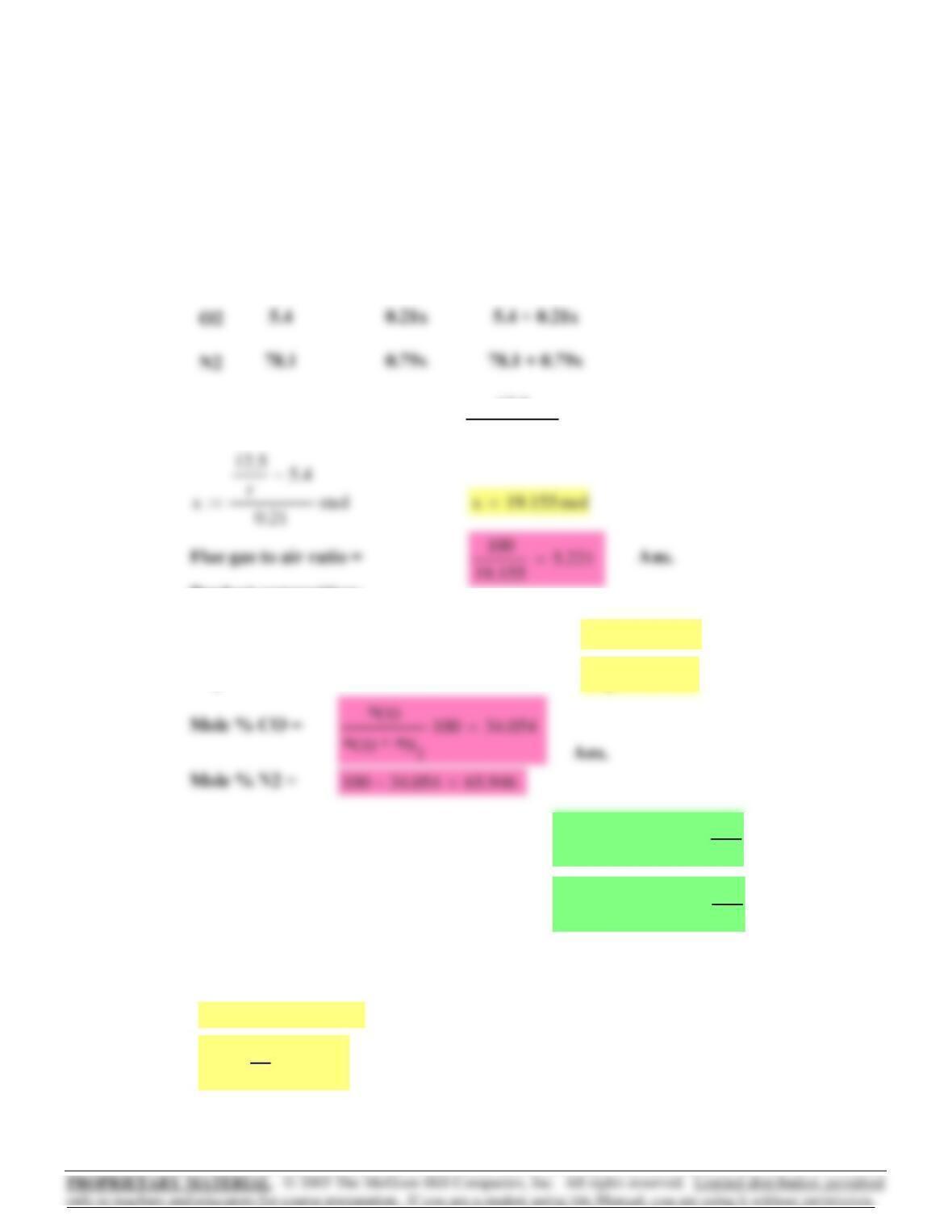
nN293.232=
4.40 CH4 + 2O2 = CO2 + 2H2O(g)
CH4 + (3/2)O2 = CO + 2H2O(g)
∆H298a 802625−J
mol
:=
∆H298b 519641−J
mol
:=
BASIS: 1 mole of fuel gas consisting of 0.94 mol CH4 and 0.06 mol N2
Air entering contains:
1.35 2⋅0.94⋅2.538=mol O2
2.538 79
21
⋅9.548=mol N2
For 100 mol flue gas and x mol air, moles are:
Flue gas
12.8
3.7
Air
0
0
Feed mix
12.8
3.7
CO2
CO
Whence in the feed mix: r12.8
5.4 0.21 x⋅+
=
Product composition:
nCO 3.7 2 12.8 5.4+0.21 19.155⋅+()⋅+:= nCO 48.145=
nN278.1 0.79 19.155⋅+:=
111
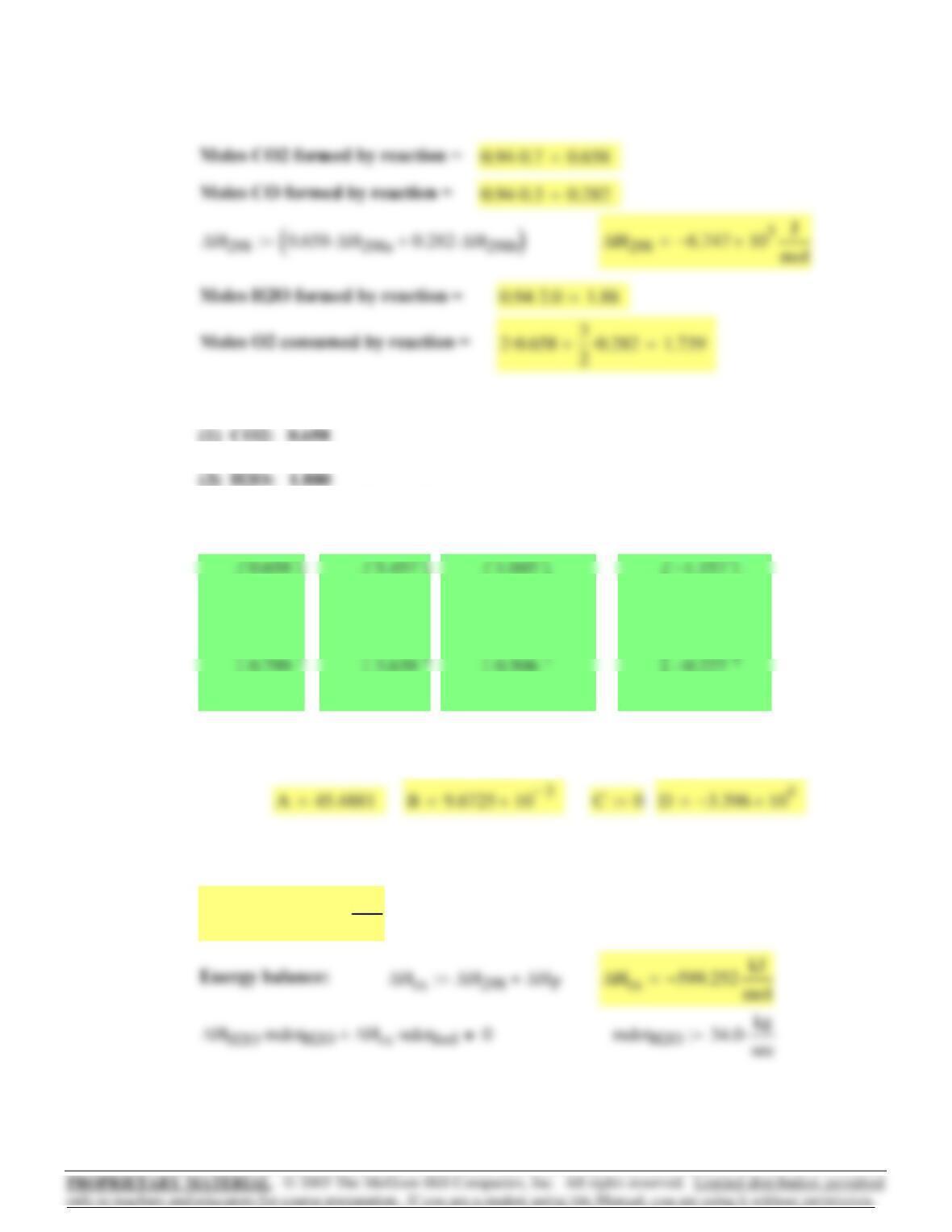
∆HP7.541 104
×J
mol
=
∆HPR MCPH 298.15K 483.15K,A,B,C,D,()⋅483.15K 298.15K−()⋅:=
D
i
niDi
⋅
()
∑
:=
B
i
niBi
⋅
()
∑
:=
A
i
niAi
⋅
()
∑
:=
i15..:=
Product gases contain the following numbers of moles:
(2) CO: 0.282
(4) O2: 2.538 – 1.739 = 0.799
(5) N2: 9.548 + 0.060 = 9.608
n
0.282
1.880
9.608
⎛
⎜
⎜
⎜
⎜
⎝
⎞
⎟
⎟
⎠
:= A
3.376
3.470
3.280
⎛
⎜
⎜
⎜
⎜
⎝
⎞
⎟
⎟
⎠
:= B
0.557
1.450
0.593
⎛
⎜
⎜
⎜
⎜
⎝
⎞
⎟
⎟
⎠
10 3−
⋅:= D
0.031−
0.121
0.040
⎛
⎜
⎜
⎜
⎜
⎝
⎞
⎟
⎟
⎠
105
⋅:=
112
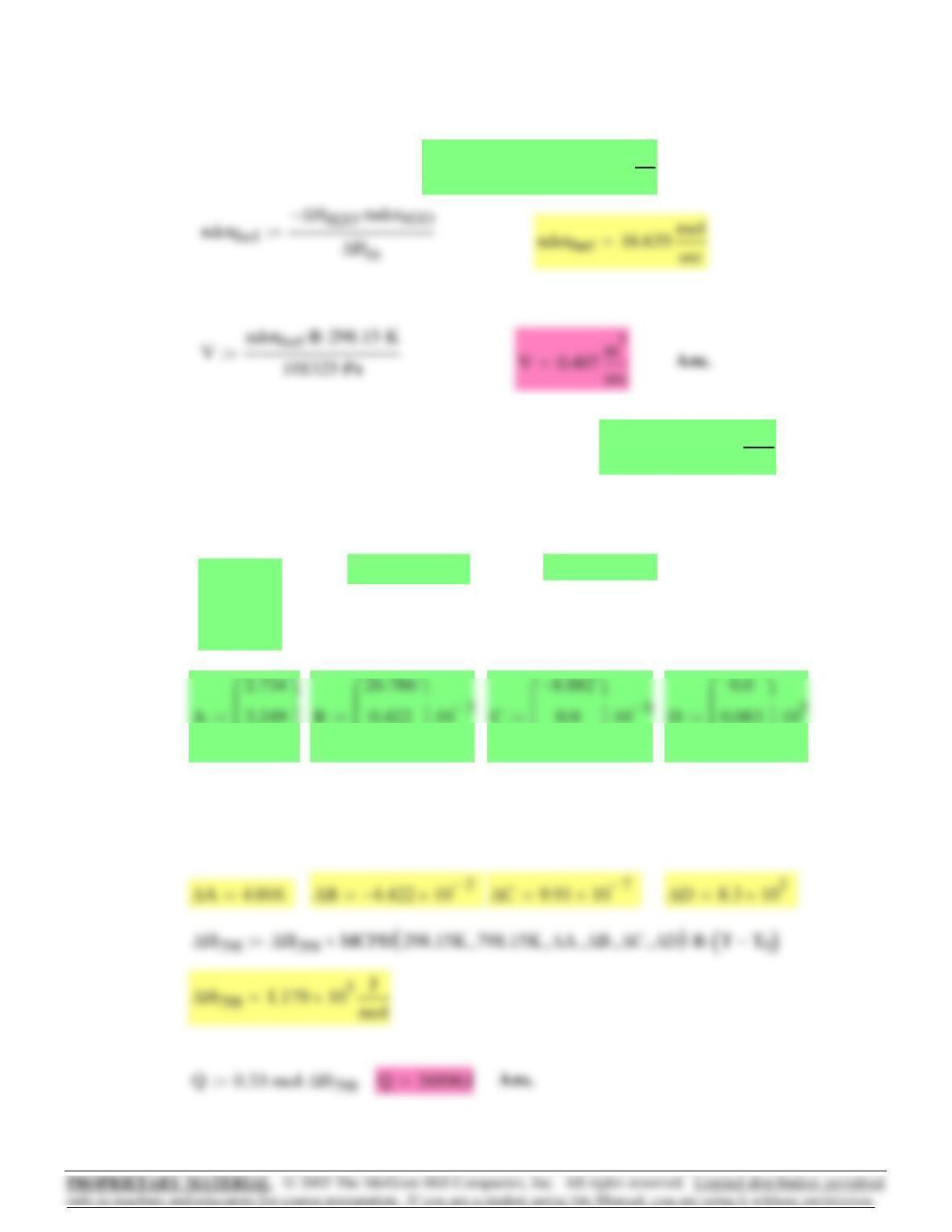
1: C4H6 2: H2 3: C4H8
1.967
⎜
⎜
⎝
⎟
⎠
31.630
⎜
⎜
⎝
⎟
⎠
9.873−
⎜
⎜
⎝
⎟
⎠
0.0
⎜
⎜
⎝
⎟
⎠
i13..:=
∆A
i
niAi
⋅
()
∑
:= ∆B
i
niBi
⋅
()
∑
:= ∆C
i
niCi
⋅
()
∑
:= ∆D
i
niDi
⋅
()
∑
:=
From Table C.1: ∆HH2O 398.0 104.8−()
kJ
kg
⋅:=
Volumetric flow rate of fuel, assuming ideal gas:
4.41 C4H8(g) = C4H6(g) + H2(g) ∆H298 109780 J
mol
⋅:=
BASIS: 1 mole C4H8 entering, of which 33% reacts.
The unreacted C4H8 and the diluent H2O pass throught the reactor
unchanged, and need not be included in the energy balance. Thus
T0298.15 K⋅:= T 798.15 K⋅:=
n
1
1
1−
⎛
⎜
⎜
⎜
⎝
⎞
⎟
⎠
:= Evaluate ∆H798 by Eq. (4.21):
113
⎜
⎜
⎜
⎜
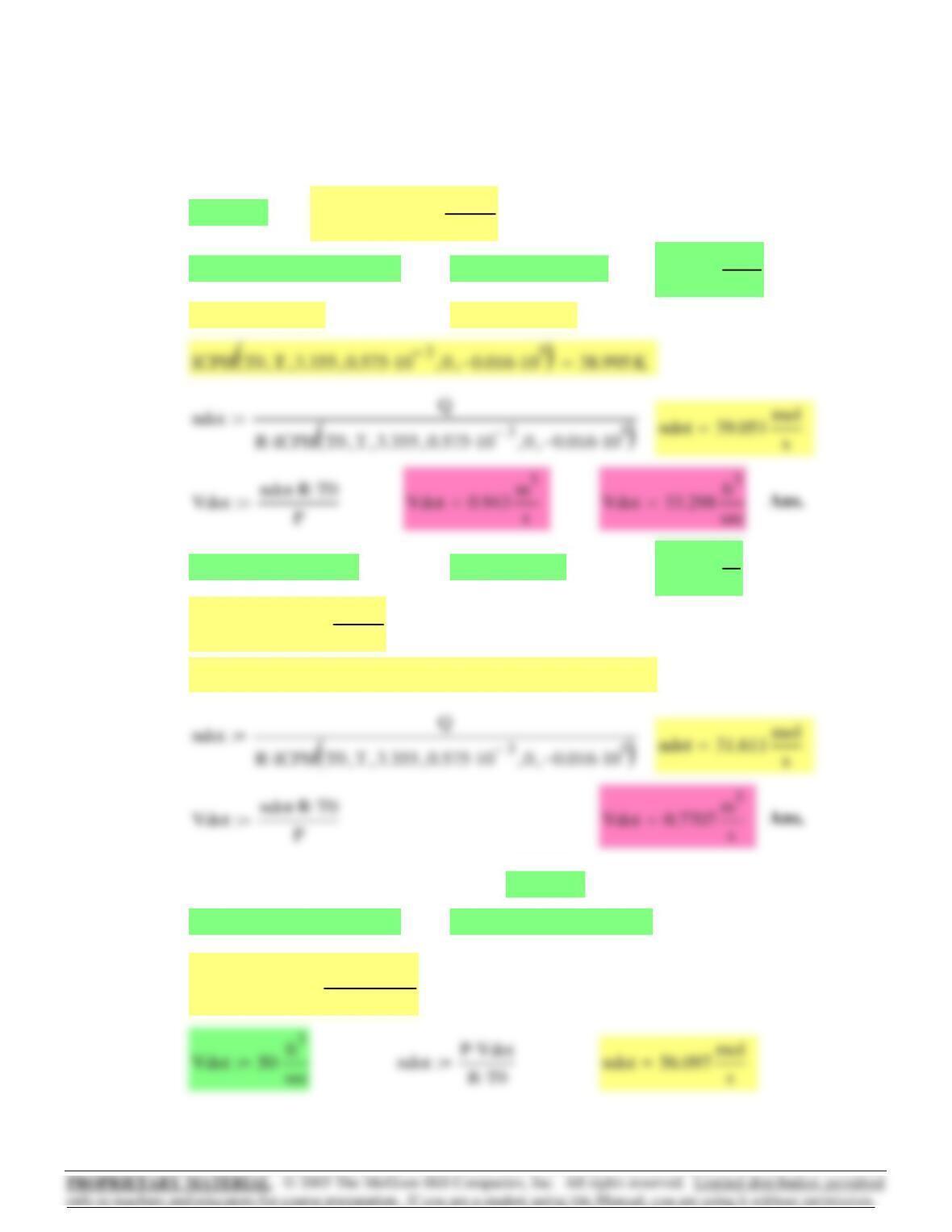
TT013K+:= Q12
kJ
s
:=
R 8.314 10 3−
×kJ
mol K⋅
=
ICPH T0 T,3.355,0.575 10 3−
⋅, 0,0.016−105
⋅,
()
45.659 K=
4.43 Assume Ideal Gas and P = 1 atm P 1atm:=
a) T0 94 459.67+( )rankine:= T 68 459.67+( )rankine:=
R 1.61 10 3−
×atm ft3
⋅
mol rankine⋅
=
4.42 Assume Ideal Gas and P = 1 atm
P 1atm:= R 7.88 10 3−
×BTU
mol K⋅
=
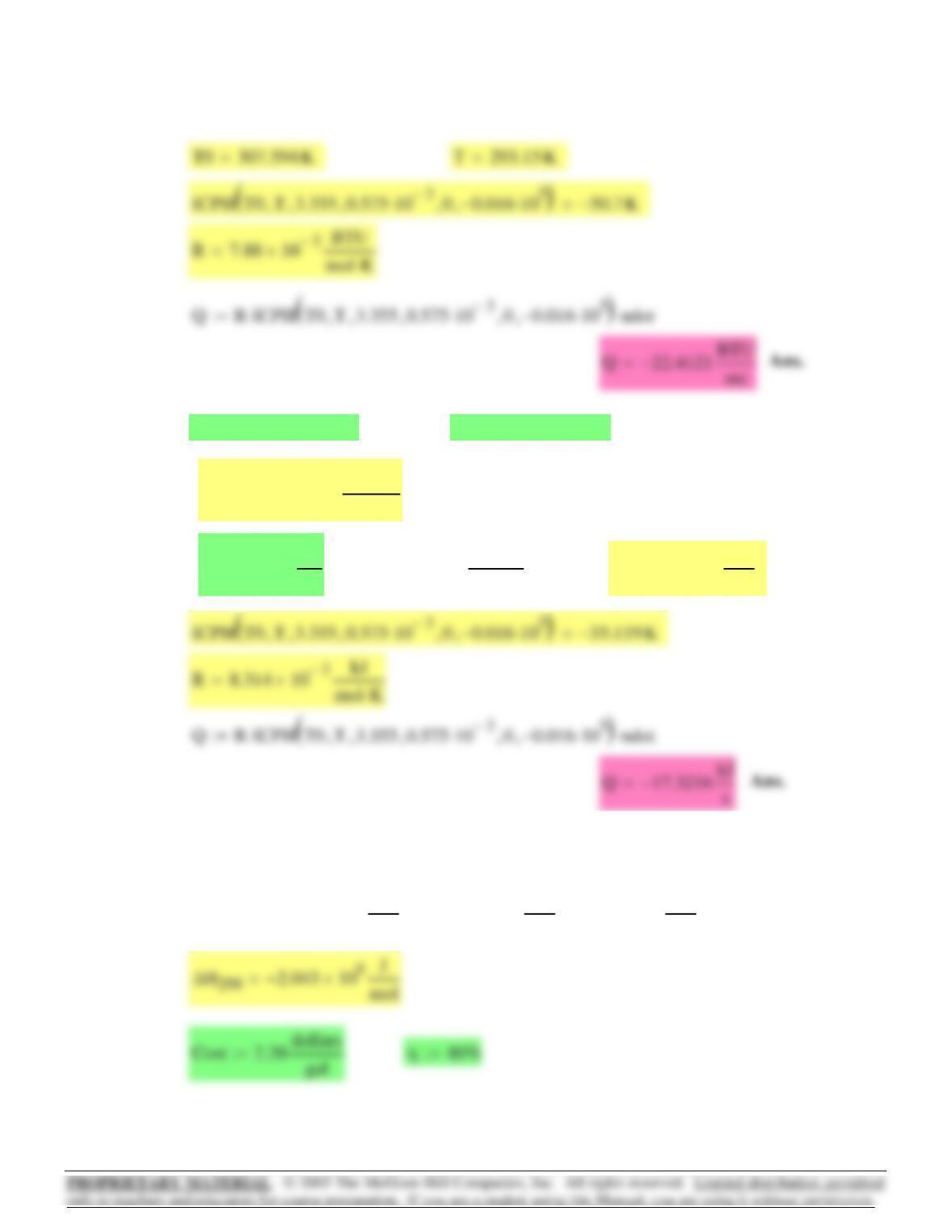
a) T0 70 459.67+( )rankine:= T T0 20rankine+:= Q12
BTU
sec
:=
T0 294.261 K=T 305.372 K=
b) T0 24 273.15+()K:=
114
∆H298 3 393509−J
mol
⋅
⎛
⎜
⎝
⎞
⎠
⋅4 241818−J
mol
⎛
⎜
⎝
⎞
⎠
⋅+ 104680−J
mol
⎛
⎜
⎝
⎞
⎠
−:=
C3H8 + 5O2 = 3CO2(g) + 4H2O (g)
First calculate the standard heat of combustion of propane4.44
ndot 59.325 mol
s
=ndot P Vdot⋅
RT0⋅
:=Vdot 1.5 m3
sec
⋅:=
R 8.205 10 5−
×atm m3
⋅
mol K⋅
=
T 25 273.15+()K:=T0 35 273.15+()K:=
b)
115
J/mol
a) Acetylene 26,120
b) Ammonia 20,200
h) Hydrogen chloride 14,040
i) Methane 23,318
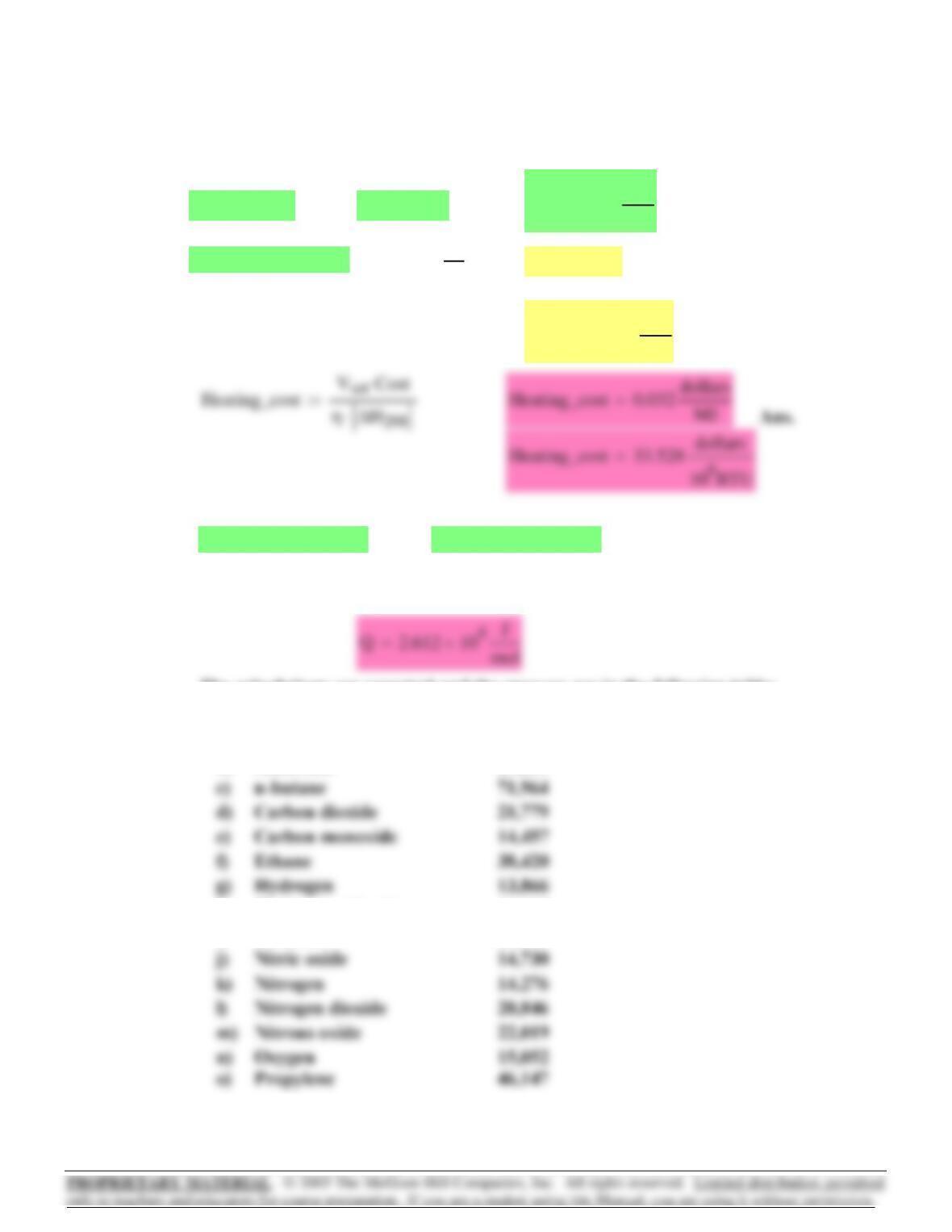
The calculations are repeated and the answers are in the following table:
Q R ICPH T0 T,6.132,1.952 10 3−
⋅, 0,1.299−105
⋅,
()
⋅:=
a) Acetylene
T 500 273.15+()K:=T0 25 273.15+()K:=
4.45
Vsat 89.373 cm3
mol
=Vsat VcZc
1T
r
−
()
0.2857
⋅:=
Tr0.806=Tr
T
Tc
:=T 25 273.15+()K:=
Vc200.0 cm3
mol
:=Zc0.276:=Tc369.8K:=
Estimate the density of propane using the Rackett equation
116
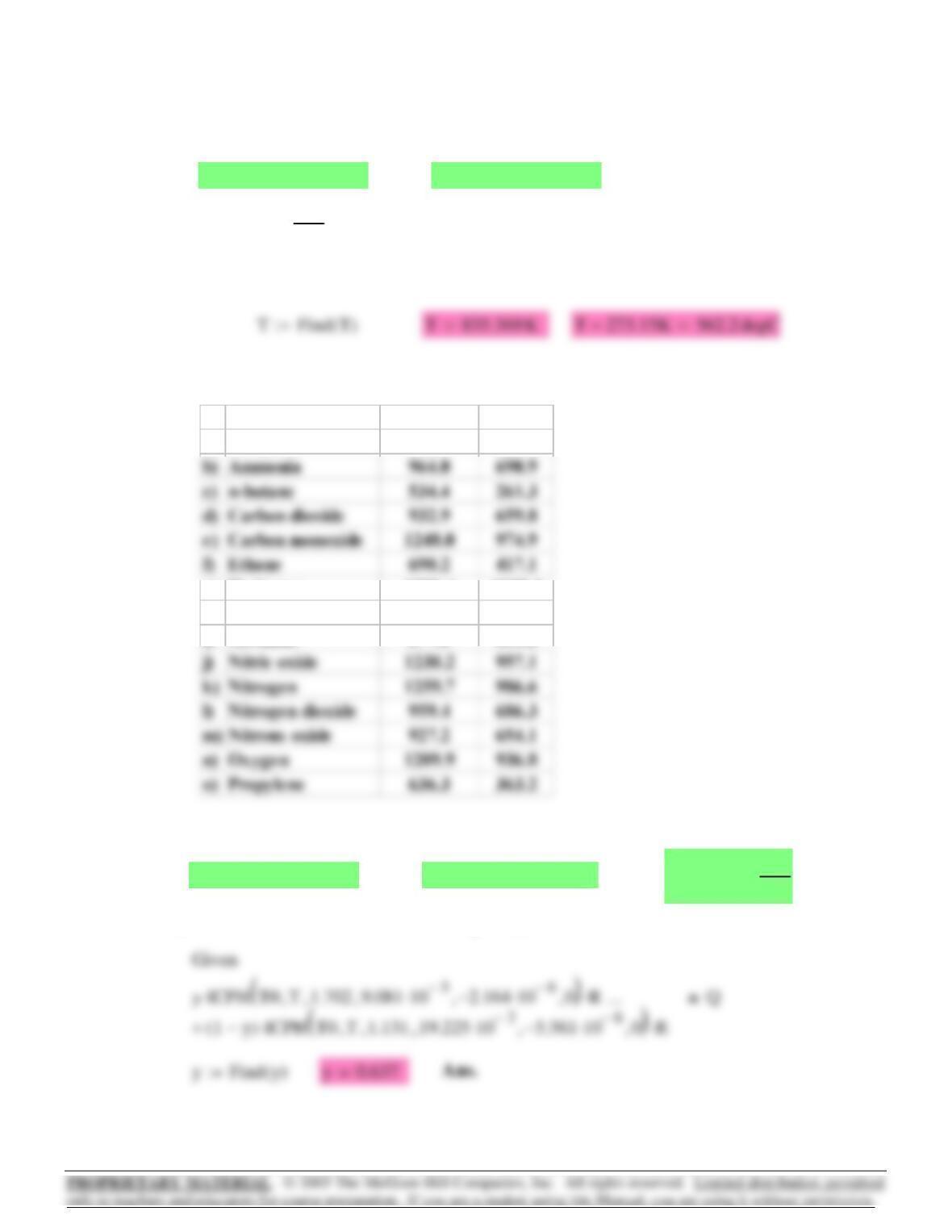
y 0.5:=
Guess mole fraction of methane:a)
Q 11500 J
mol
:=T 250 273.15+()K⋅:=T0 25 273.15+()K:=
4.47
T (K) T ( C)
a) Acetylene 835.4 562.3
g) Hydrogen 1298.4 1025.3
h) Hydrogen chloride 1277.0 1003.9
i) Methane 877.3 604.2
The calculations are repeated and the answers are in the following table:
Q R ICPH T0 T,6.132,1.952 10 3−
⋅, 0,1.299−105
⋅,
()
⋅=Given
a) Acetylene
Q 30000 J
mol
:=
T 500 273.15+()K:=T0 25 273.15+()K:=
4.46
117

TH1
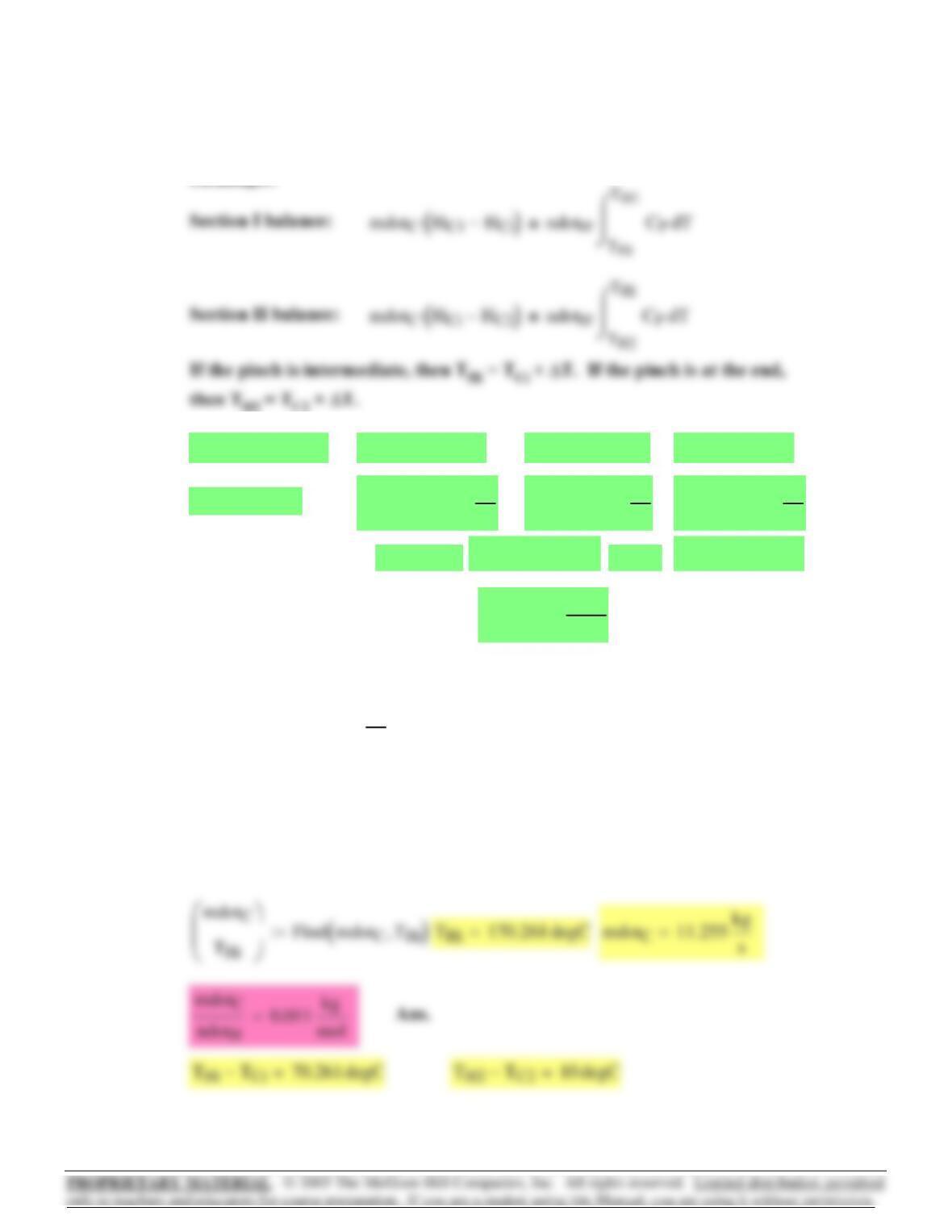
Section I
Section II
Intermediate Pinch Pinch at End
Temperature profiles for the air and water are shown in the figures below.
There are two possible situations. In the first case the minimum
temperature difference, or “pinch” point occurs at an intermediate location
in the exchanger. In the second case, the pinch occurs at one end of the
exchanger. There is no way to know a priori which case applies.
4.48
y 0.5:=
Guess mole fraction of toluene
Q 17500 J
mol
:=T 250 273.15+()K⋅:=T0 150 273.15+()K:=
c)
y 0.5:=
Guess mole fraction of benzene
Q 54000 J
mol
:=T 400 273.15+()K⋅:=T0 100 273.15+()K:=
b)
118
D 0.016−105
⋅:=
Assume as a basis ndot = 1 mol/s. ndotH1kmol
s
:=
Assume pinch at end: TH2 TC2 ∆T+:=
Guess: mdotC1kg
s
:= THi 110degC:=
Given
mdotCHC1 HCi
−
()
⋅ndotHR⋅ICPH THi TH1
,A,B,C,D,
()
⋅=Energy balances
on Section I and
II
mdotCHCi HC2
−
()
⋅ndotHR⋅ICPH TH2 THi
,A,B,C,D,
()
⋅=
To solve the problem, apply an energy balance around each section of the
exchanger.
a) TH1 1000degC:= TC1 100degC:= TCi 100degC:= TC2 25degC:=
∆T 10degC:= HC1 2676.0 kJ
kg
:= HCi 419.1 kJ
kg
:= HC2 104.8 kJ
kg
:=
For air from Table C.1:A 3.355:= B 0.575 10 3−
⋅:= C0:=
119
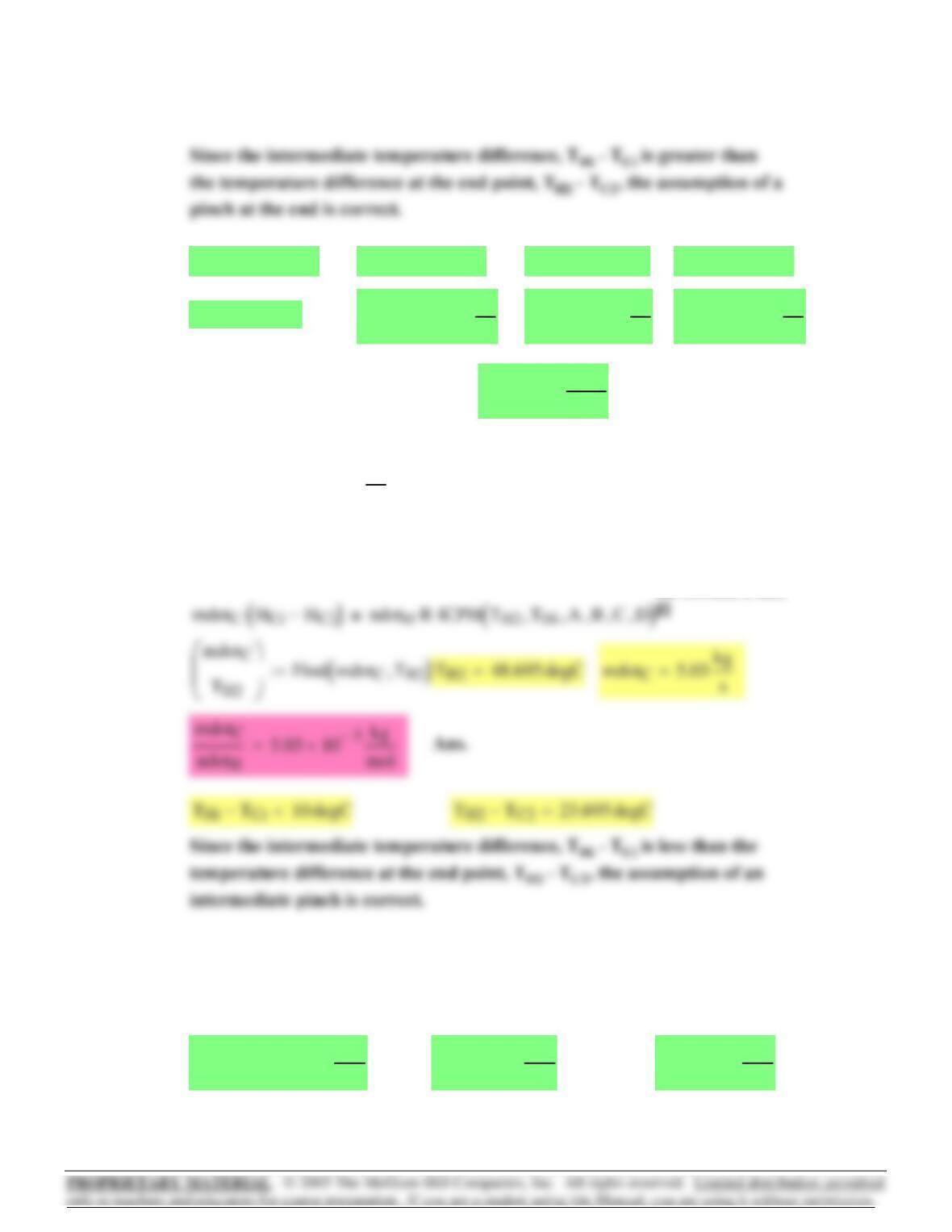
mdotCHC1 HCi
−
()
⋅ndotHR⋅ICPH THi TH1
,A,B,C,D,
()
⋅=Energy balances
on Section I and
4.50 a) C6H12O6(s) + 6 O2(g)= 6 CO2(g) + 6 H2O(l)
1 = C6H12O6 , 2 = O2 , 3 = CO2 , 4 = H2O
∆H0f1 1274.4−kJ
mol
:= ∆H0f2 0kJ
mol
:= M1180 gm
mol
:=
b) TH1 500degC:= TC1 100degC:= TCi 100degC:= TC2 25degC:=
∆T 10degC:= HC1 2676.0 kJ
kg
:= HCi 419.1 kJ
kg
:= HC2 104.8 kJ
kg
:=
Assume as a basis ndot = 1 mol/s. ndotH1kmol
s
:=
Assume pinch is intermediate: THi TCi ∆T+:=
Guess: mdotC1kg
s
:= TH2 110degC:=
Given
120
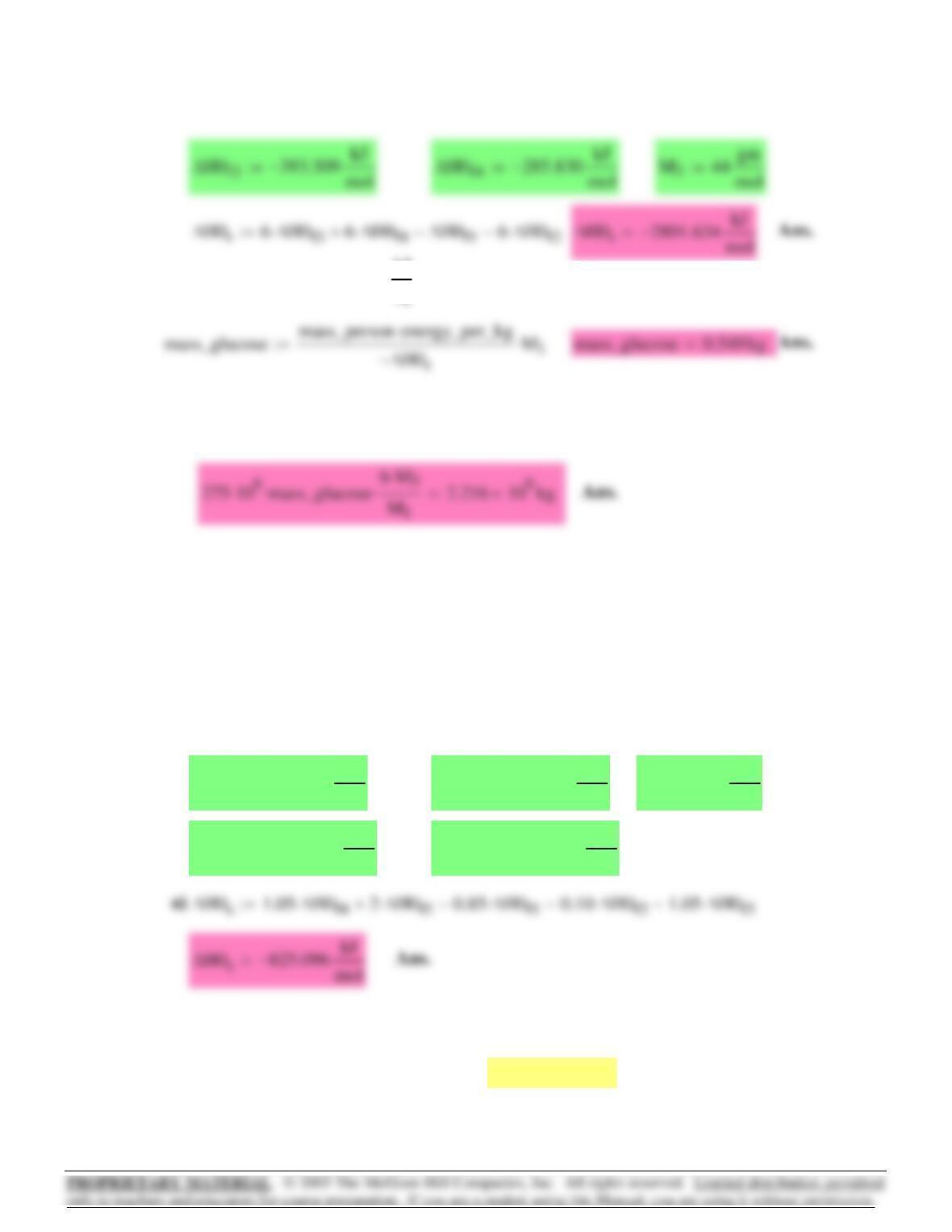
Assume as a basis, 1 mole of fuel.
0.85 (CH4(g) + 2 O2(g) = CO2(g) + 2 H2O(g))
0.10(C2H6 (g) + 3.5 O2(g) = 2 CO2(g) + 3 H2O(g))
——————————————————————
0.85 CH4(g) + 0.10 C2H6(g) + 2.05 O2(g) = 1.05 CO2(g) + 2 H2O(g)
1 = CH4, 2 = C2H6, 3 = O2, 4 = CO2, 5 = H2O 6 = N2
∆H0f1 74.520−kJ
mol
:= ∆H0f2 83.820−kJ
mol
:= ∆H0f3 0kJ
mol
:=
∆H0f4 393.509−kJ
mol
:= ∆H0f5 241.818−kJ
mol
:=
b)For complete combustion of 1 mole of fuel and 50% excess air, the exit
gas will contain the following numbers of moles:
n30.5 2.05⋅mol:= n31.025 mol=Excess O2
b) energy_per_kg 150 kJ
kg
:= mass_person 57kg:=
c) 6 moles of CO2 are produced for every mole of glucose consumed. Use
molecular mass to get ratio of mass CO2 produced per mass of glucose.
4.51
121
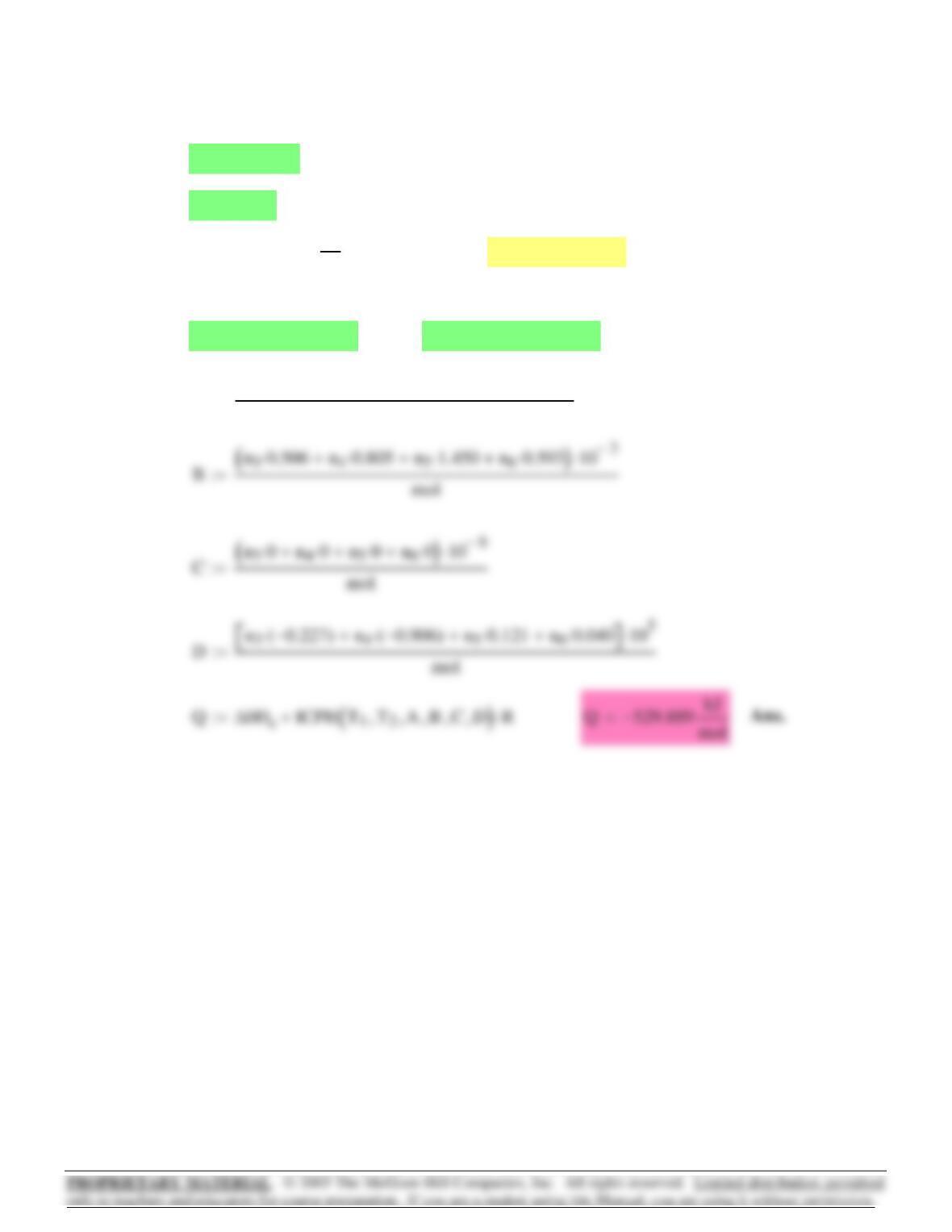
n41.05mol:=
n52mol:=
n60.05mol 79
21 1.5⋅2.05⋅mol+:= n611.618 mol=Total N2
Air and fuel enter at 25 C and combustion products leave at 600 C.
T125 273.15+()K:= T2600 273.15+()K:=
An33.639⋅n46.311⋅+ n53.470⋅+ n63.280⋅+
()
mol
:=
122