
Chapter 4: Adult Learning and Planning for Teacher Development
Summary
This chapter examines effective ways to support adult development and learning. Stages of
teacher development and how they relate to the practice of mentoring are explored.
Outline
The chapter supports your growing capacity to
Adult Learning
& Planning for
Teacher
Development
reflect on
your image
of adult as
learner understand
adult
development
understand
learning
theories
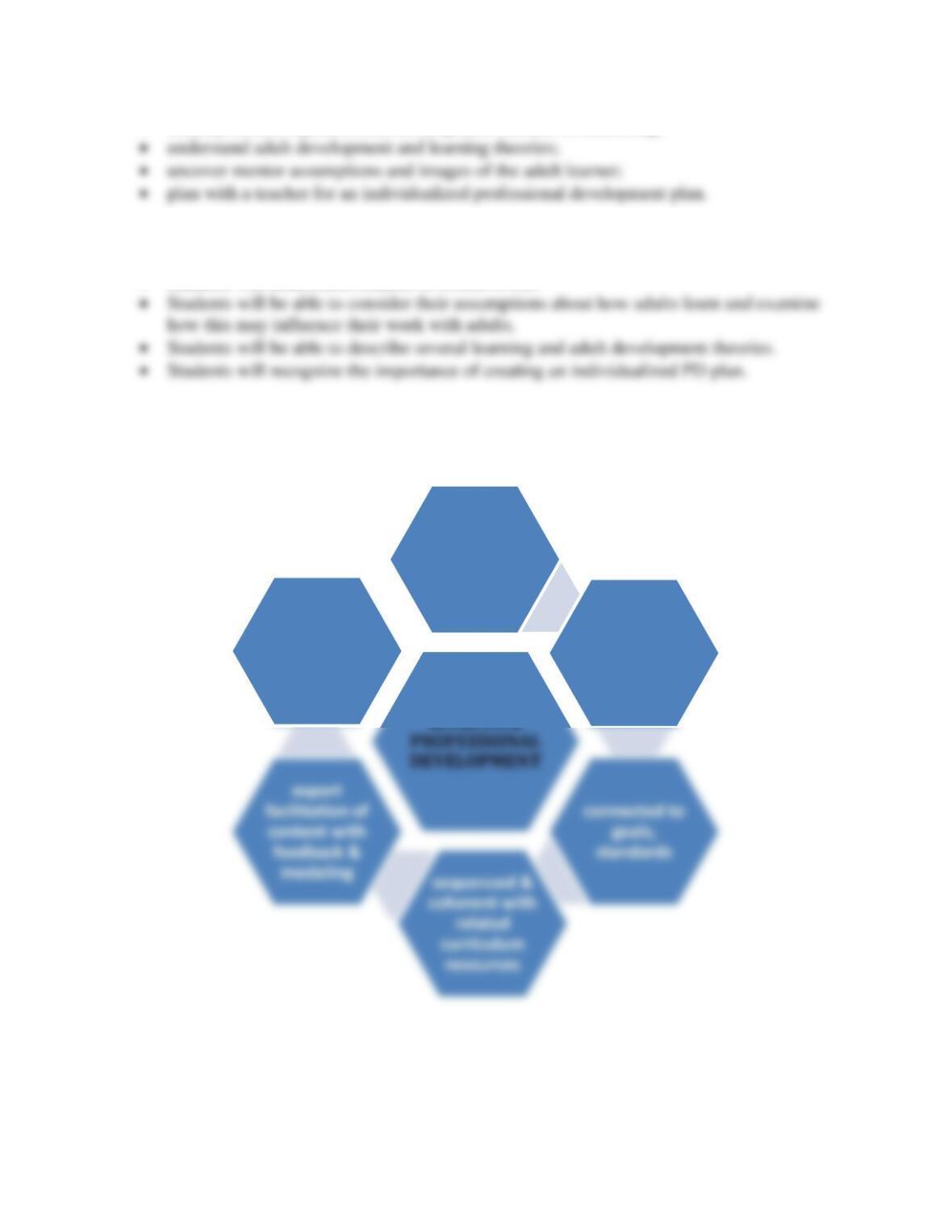
identify PD
features
engage in a
cycle of
planning
create a PD
plan with a
teacher
• identify effective professional development features of mentoring;
Learner outcomes
Suggested teaching activities
1. Features of effective professional development (PD)
Purpose: Contrasting the frequent experience of the ‘one shot workshop’ with the features of
effective PD that is more likely to result in positive changes in teacher practices.
intensive
(30-100 hrs),
ongoing
(6-12 mos.) active
learning
connected to
practice in a
community
relevant &
rigorous
content

After assigning chapter 4 reading, and showing this graphic, (adapted from: Darling-Hammond,
Wei, Andree, Richardson, & Orphanos, 2009), ask participants the following question:
The research implies it takes time for teachers to embrace new learning and become comfortable
applying it in their setting. When have you had the time to learn something new and practice
applying it? When have you learned a new practice in a classroom setting without applying it
soon afterward? Compare and contrast the two experiences.
Debrief the participants responses by connecting them to the features of effective PD. Conclude
Journal
(A) Suggest they continue to write in their journal about this topic after the session. Give the
following directions:
Brainstorm both suggestions and questions you have about how to best support teachers in each
of the stages discussed. What do you need to learn about a teacher to mentor appropriately in
each stage? What is your experience working or mentoring teachers in each stage?
2. Stages of teacher development
Share some foundational ideas on adult learning with the participants to introduce this topic.
Malcolm Knowles (1973), focused on the art and science of teaching adults or andragogy, and
characterized adult learners as:
• Extremely self-directed and not ready to comply with only program goals or standards,
Next review Erikson’s psychosocial stages (1959) and then ask participants to get into small
groups and do as follows:
Survival and Emerging Teacher Stage: Feelings may swing from enthusiastic and energetic to
being overwhelmed and lacking in confidence. Mentors need to put feelings in perspective
Consolidation Stage: This teacher usually knows what they know and is interested in increasing
their satisfaction with their work and their effectiveness. This teacher makes mentors feel the
Renewal and Maturity Stages: Facilitating, not directing, learning is needed for mature
teachers. Spending time learning what this teacher knows, values, and is interested in, is essential
for any mentoring to be successful. This teacher has little interest in being treated like an empty
(B) Think about specific mentoring situations when skill building is the best choice or when long-
term investigation and reflection is the best choice. Did the age, teacher stage other learning
conditions indicate one choice would be better than another? Discuss the factors in the learning
context that suggest one strategy was more appropriate than another strategy?
3. What is your image of the adult learner?
Cut out the following bulleted, brief summaries of key ideas associated with different learning
theories and educational approaches. Ask participants to get into small groups and give each
group one bulleted item to read and discuss. An expansion of this activity would be to have
seven tables with the one sentence description plus evocative objects (e.g., a blank slate) to help
them remember the concept.
• Capable, competent, interested, rich in ideas, wanting to grow. Learners’ needs, interests
and experiences must be valued (Reggio Emilia inspired in part by Freire, 1970).
Direct the groups to discuss their following question:
Do you agree or disagree with the statement? Why? Relate to your experiences as a learner or
as a teacher of adults.
Next ask each small group to pass their statement to another group to the right of them. Ask them
Are there situations when assumptions about how adults learn could damage your learning
relationship? An example of an assumption that might interfere with the mentoring process is if a
mature teacher was paired with a mentor who viewed her as a “blank slate”.
Debrief and facilitate the conversation by continually linking comments to the characteristics of
Summarize: Suggest that theories are one way to explain, describe and predict why adults
behave as they do when the theory is backed up by empirical research. However, theories reflect
the times they were developed in and, as with the ‘blank slate’ theory, fall out favor when later
4. Question – Observe – Apply to create a PD plan
(A) Question: How will I plan to challenge the assumptions or reignite a passion for learning in
a teacher by reframing their concerns or dilemmas into questions to research and learn about?
(B) Observe: What are a few ways I will plan with a teacher to consistently and intentionally
notice what they are interested in learning and note their progress toward their goals?
(C) Apply: How will I encourage experimentation, and practicing of newly identified strategies?
• Interview a teacher about the ways she learns best (reading, talking, noticing, being
observed with feedback, seeing something modeled or trying an idea out). Now practice
Adaptation for experienced participant who is working as a mentor: Find an early childhood
teacher to volunteer for the planning activity described below. Next, sit down with this teacher
who is requesting mentoring in a specific area. Begin with a conversation to construct a
Teacher-Mentor: Professional Development Plan using the form from the end of chapter 4,
labeled figure 4.3). Portions of this plan could be included in a required individual PD plan that a
teacher may be required to have in many federal, state or local program or school district
educational systems.

5. Empowerment is more than simple affirmations
Conclude with Freire’s ideas about empowerment as a sort of affirmation that the participants
have the ability to make a difference in the life of another adult if they remember these three
ideas:
Freire (1970, 2000) felt the empowerment of those who may have felt powerless to change their
situations occurs only if the educator sees themself as:
• Equal to the learner.
Journal
Keep the learning going by asking participants to write about Freire’s comments and what they
mean to them in their experiences working with adults.
Conclude by stating in your own words: Mentoring as effective professional development
requires the adult educator to understand that development continues throughout the human
More suggested reading
Bandura, A. (1977). Social learning theory. Englewood Cliffs, NJ: Prentice-Hall.
Bandura, A. (2001). Social-cognitive theory: An agentic perspective. Annual Review of
Psychology, 52, 1-26.
Dewey, J. (1943). The school and society. New York: Macmillan.
Erikson, E. (1950). Childhood and society. New York: Norton.
Freire, P. (1970). Pedagogy of the oppressed. New York: Herder and Herder.
Gardner, H. (1999) Intelligence Reframed. Multiple intelligences for the 21st century, New
York: Basic Books.
Hall, G. E. & Hord, S.M. (2006). Implementing change: Patterns, principles and potholes.

John Simkins School (2003). Making teaching visible: Documenting individual and
group learning as professional development. Cambridge, MA: Harvard University
Graduate School
Raikes, H. H., Torquati, J.C., Hegland, S., Raikes, H.A., Scott, J., Messner, L., Peterson, C.,
Thornburg, K., Houf, B., &Scott, S. (2006). Studying the culture of quality early education
and care: A cumulative approach to measuring characteristics of the workforce and relations
to quality in four midwestern states. In Critical Issues in Early Childhood Professional
Development, edited by M. Zaslow and I. Martinez–Beck. Baltimore, Md.: Brookes.
Rinaldi, C. (2006). In dialogue with Reggio Emilia: Listening, researching, and learning.