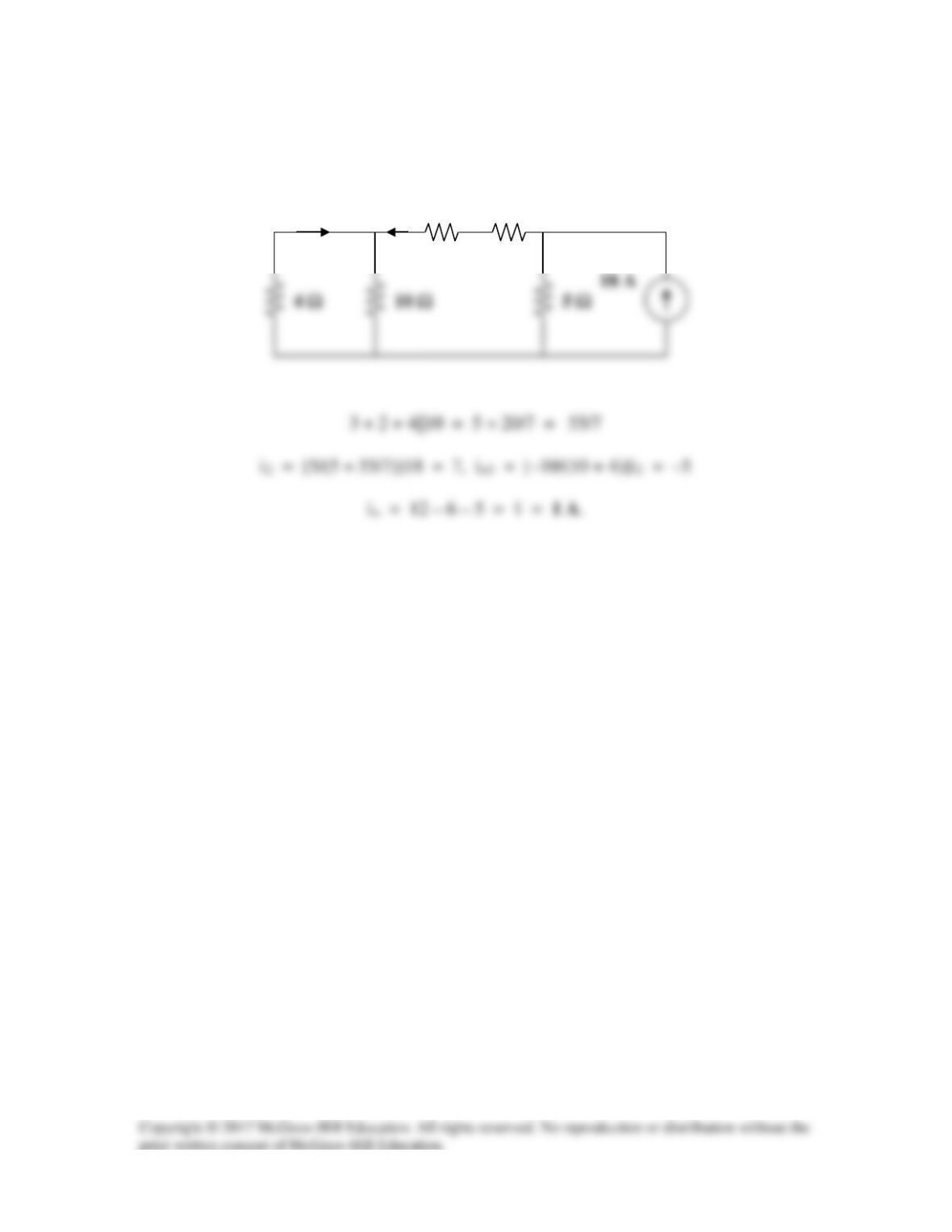
For io3, consider the circuit below.
3 Ω
i
o3
i2
2 Ω
Solution 4.17
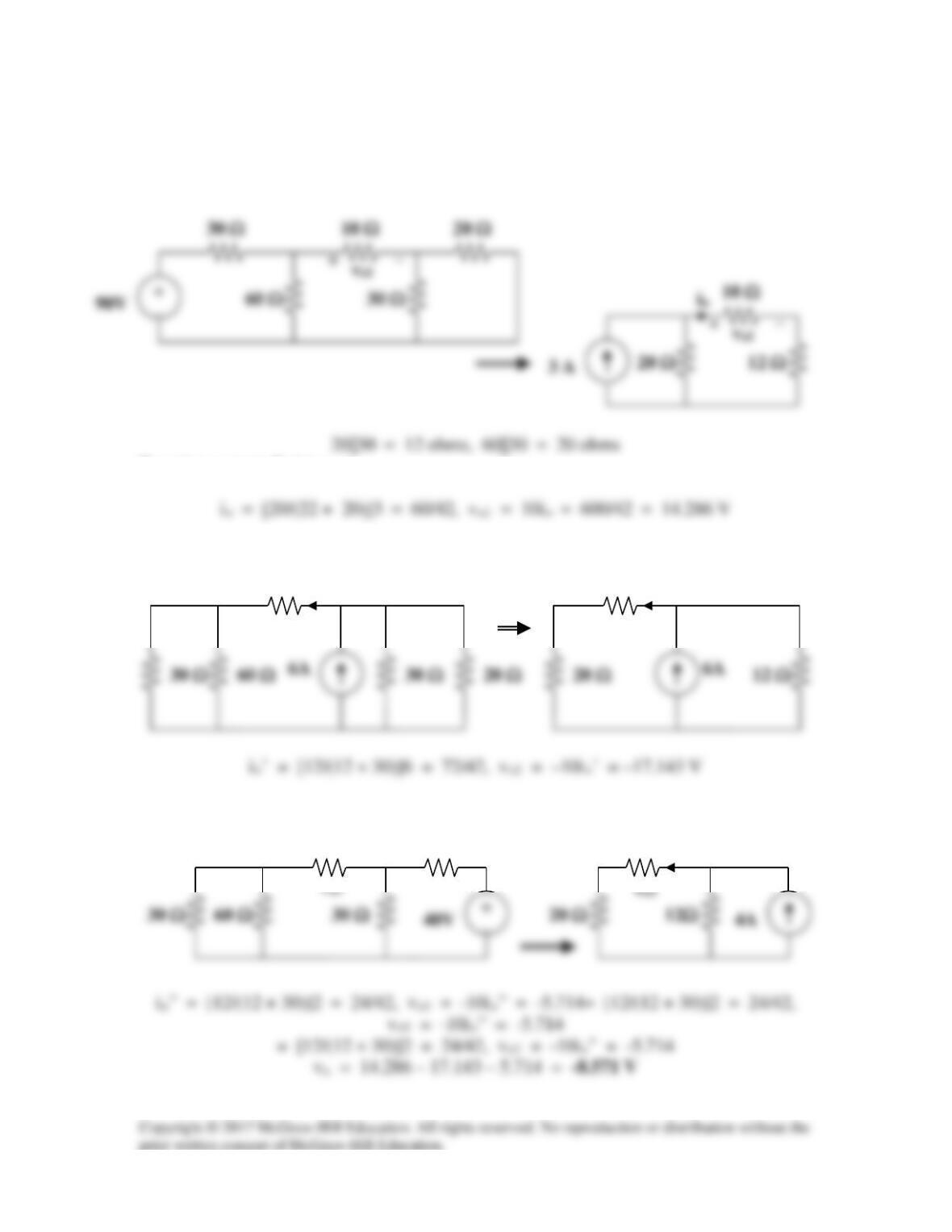
Let vx = vx1 + vx2 + vx3, where vx1,vx2, and vx3 are due to the 90-V, 6–A, and 40-V
sources. For vx1, consider the circuit below.
30 Ω
20 Ω
10 Ω
+ −
io
10 Ω
+ −
By using current division,
For vx2, consider the circuit below.
For vx3, consider the circuit below.
io’
10 Ω
+ v
x2
−
+ −
10 Ω
io’
vx2
10 Ω
20 Ω
+ −
io”
+ −
10 Ω
Solution 4.18
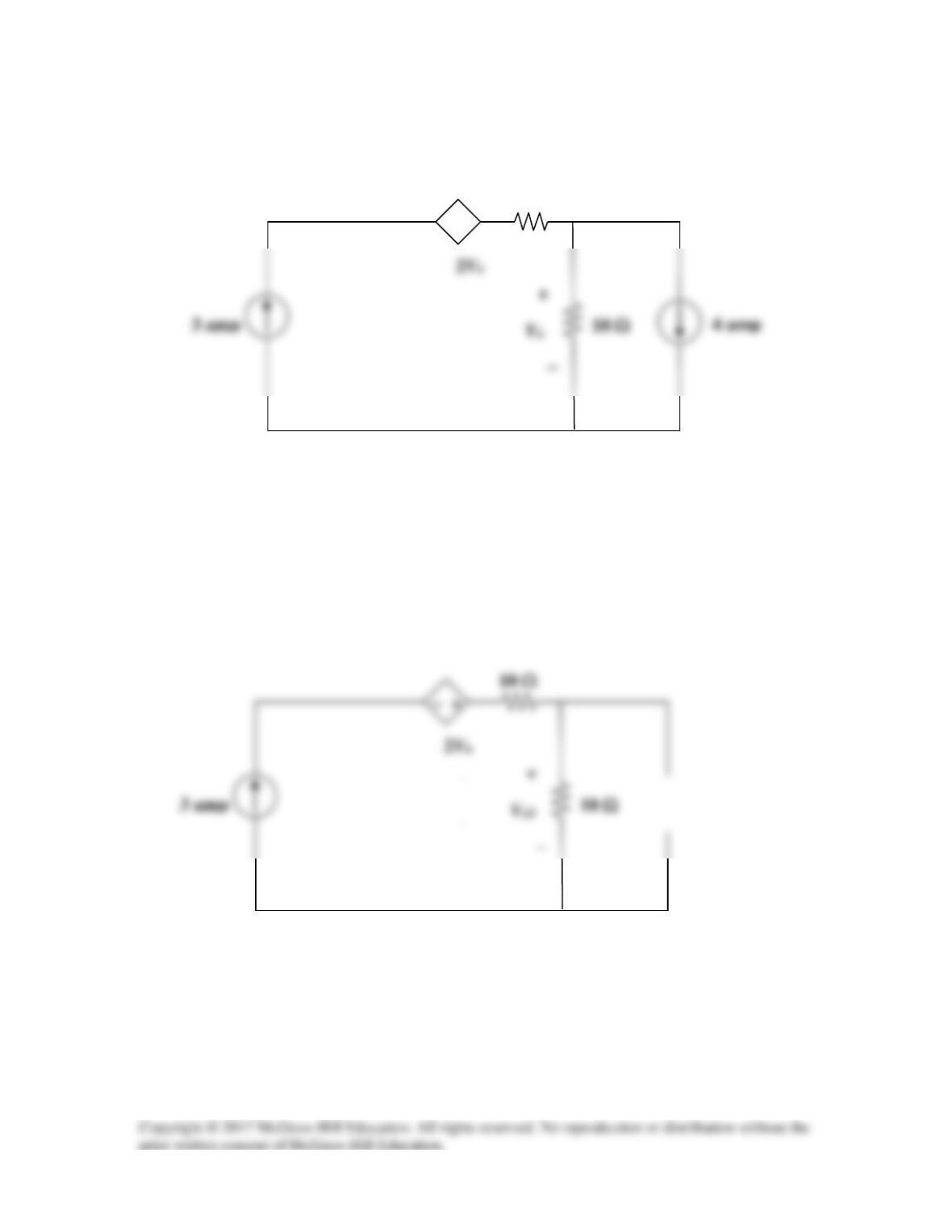
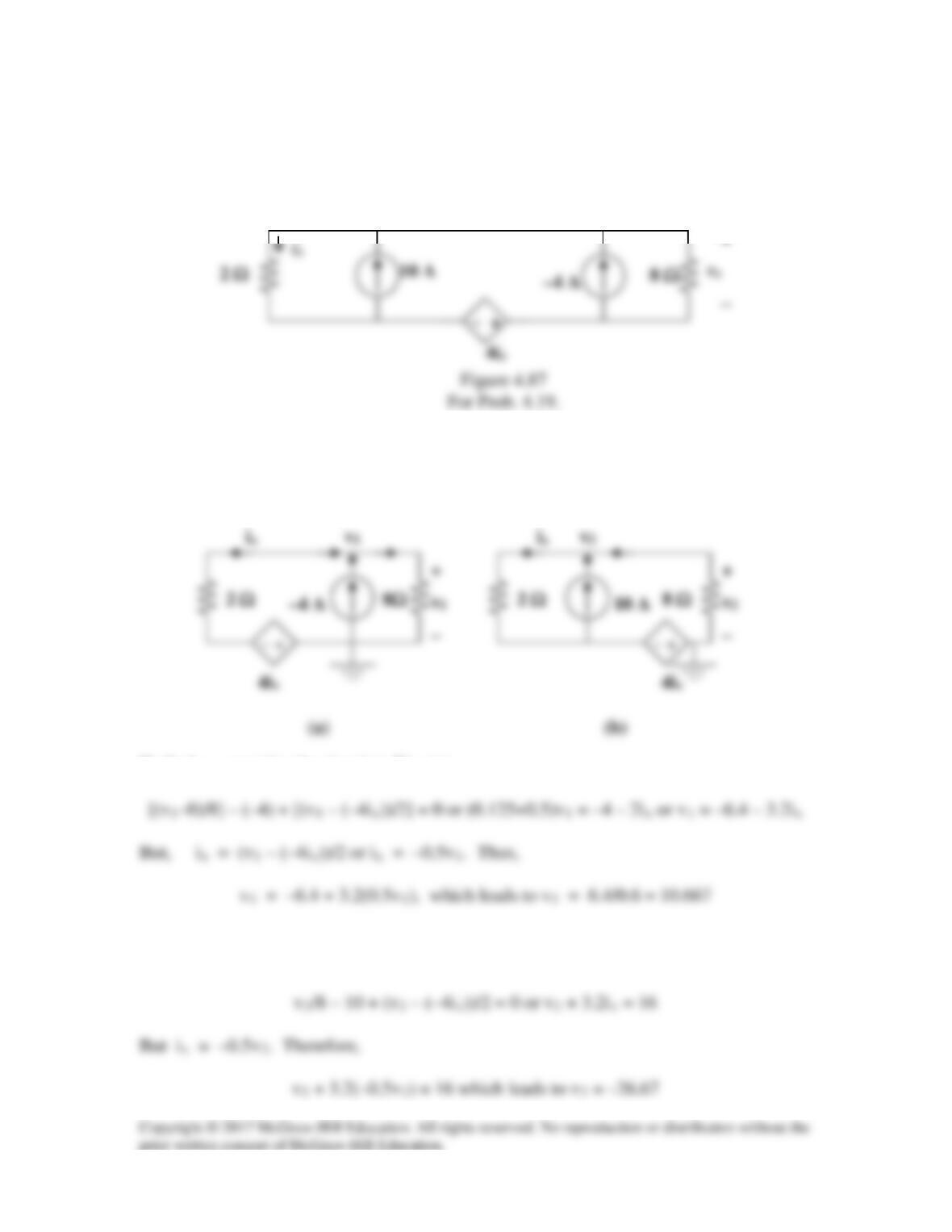
Use superposition to find Vo in the circuit of Fig. 4.86.
Figure 4.86
For Prob. 4.18.
Solution
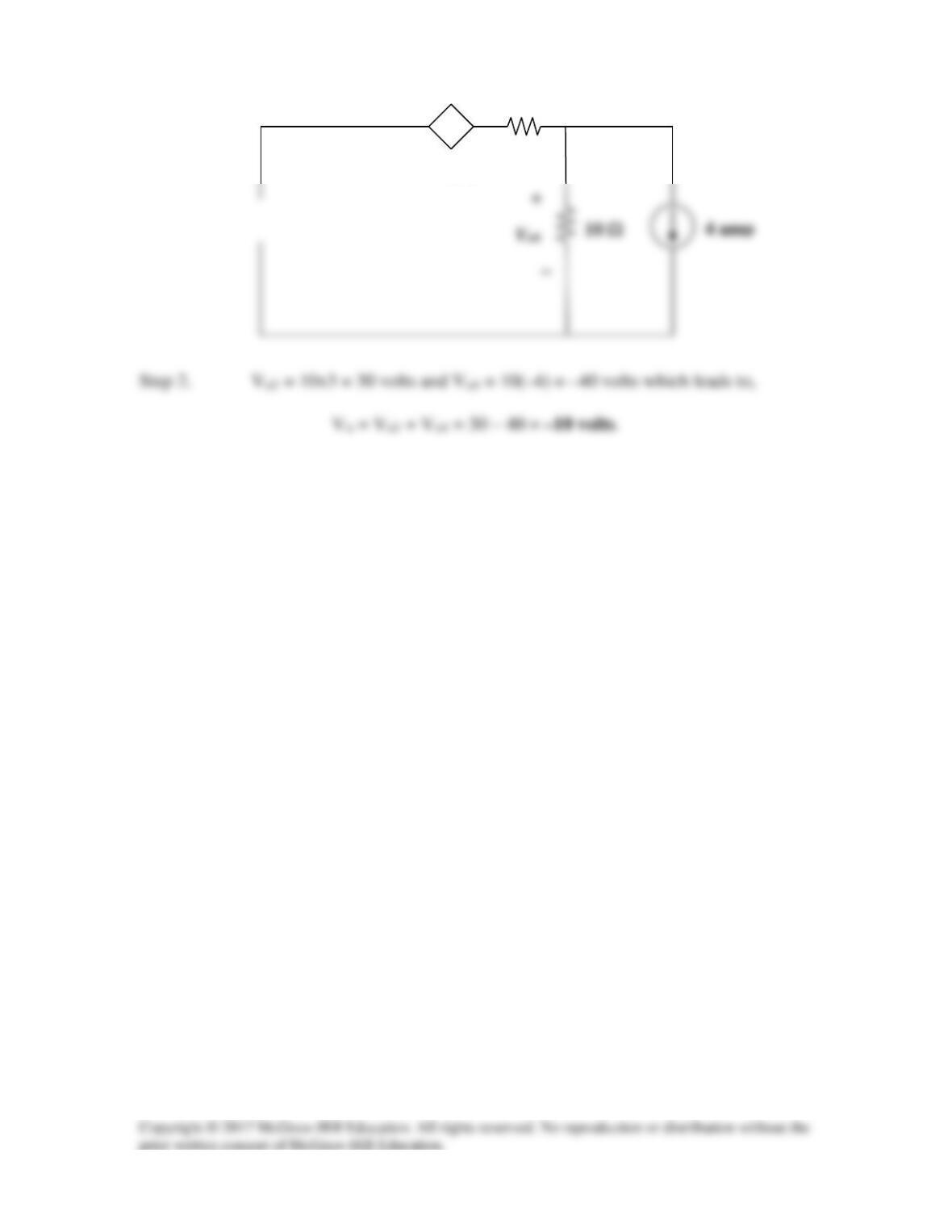
Step 1. Since we only have two independent sources, we need to look at the
contributions from each of these sources. Next we create two circuits.
10 Ω
− +
10 Ω
2Vo
− +
Solution 4.19
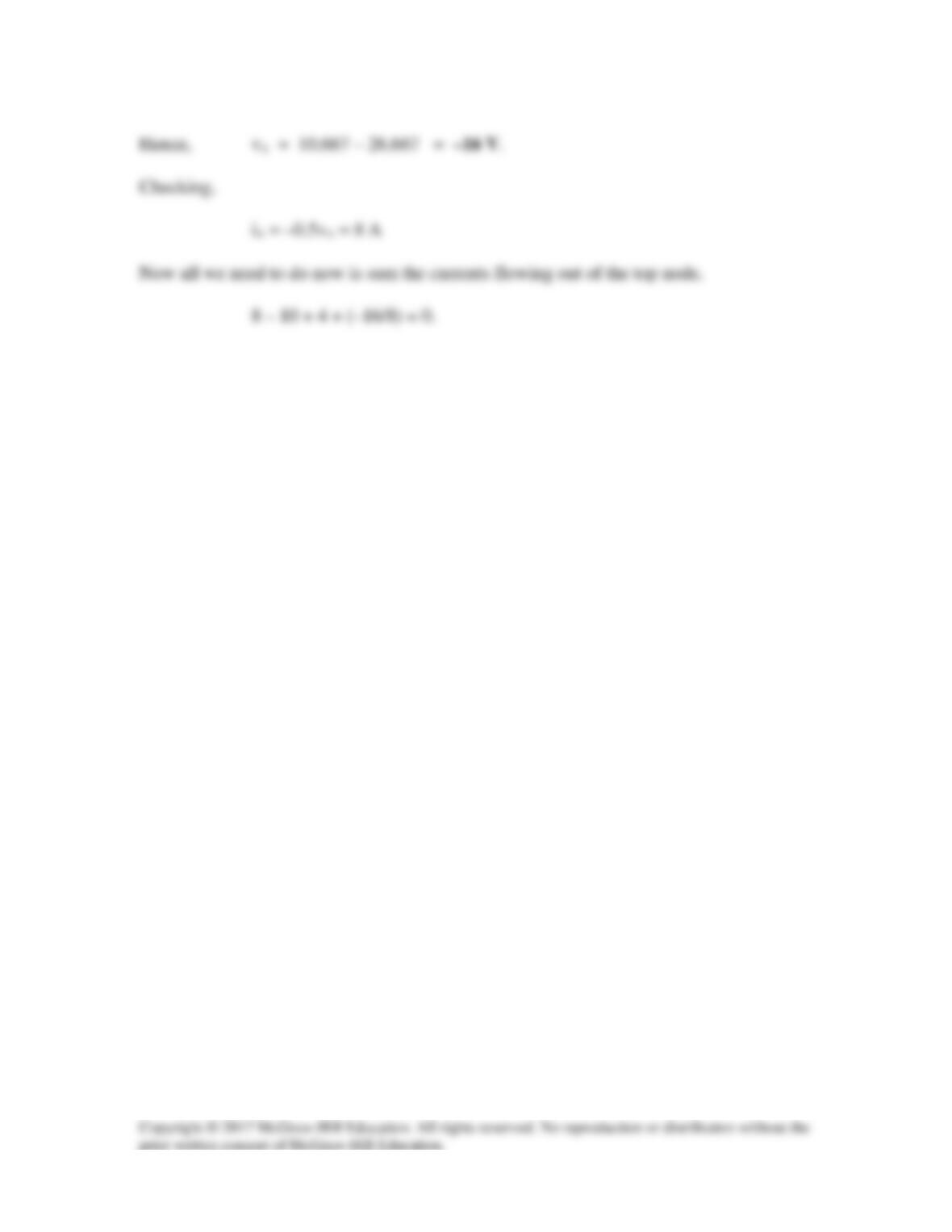
Use superposition to solve for vx in the circuit of Fig. 4.87.
Solution
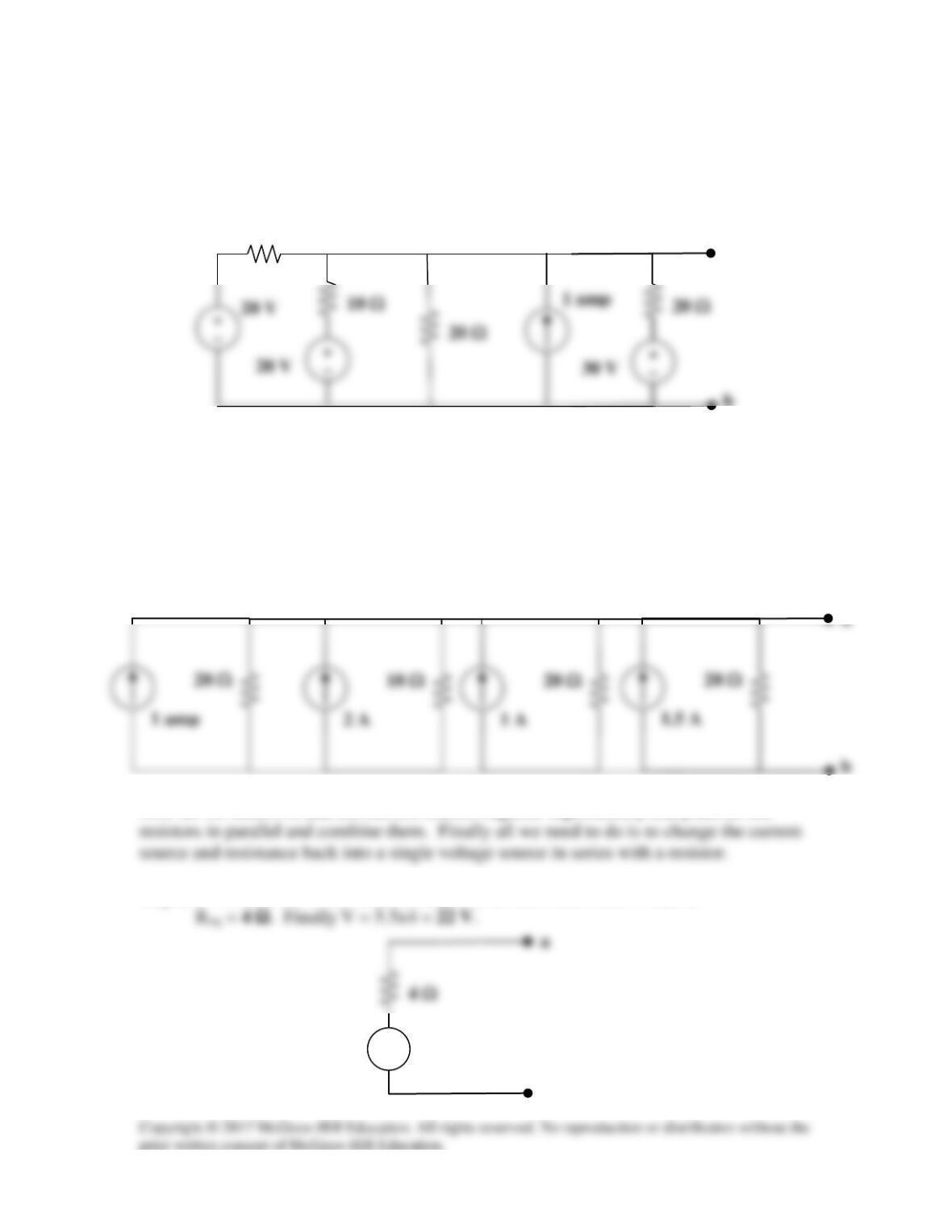
Let vx = v1 + v2, where v1 and v2 are due to the 4-A and 6-A sources respectively.
To find v1, consider the circuit in Fig. (a).
To find v2, consider the circuit shown in Fig. (b).
Solution 4.20
Use source transformations to reduce the circuit between terminals a and b shown in Fig.
4.88 to a single voltage source in series with a single resistor.
20 V
1 amp
10 Ω
−
20 Ω
30 V
−
Figure 4.88
For Prob. 4.20.
Solution
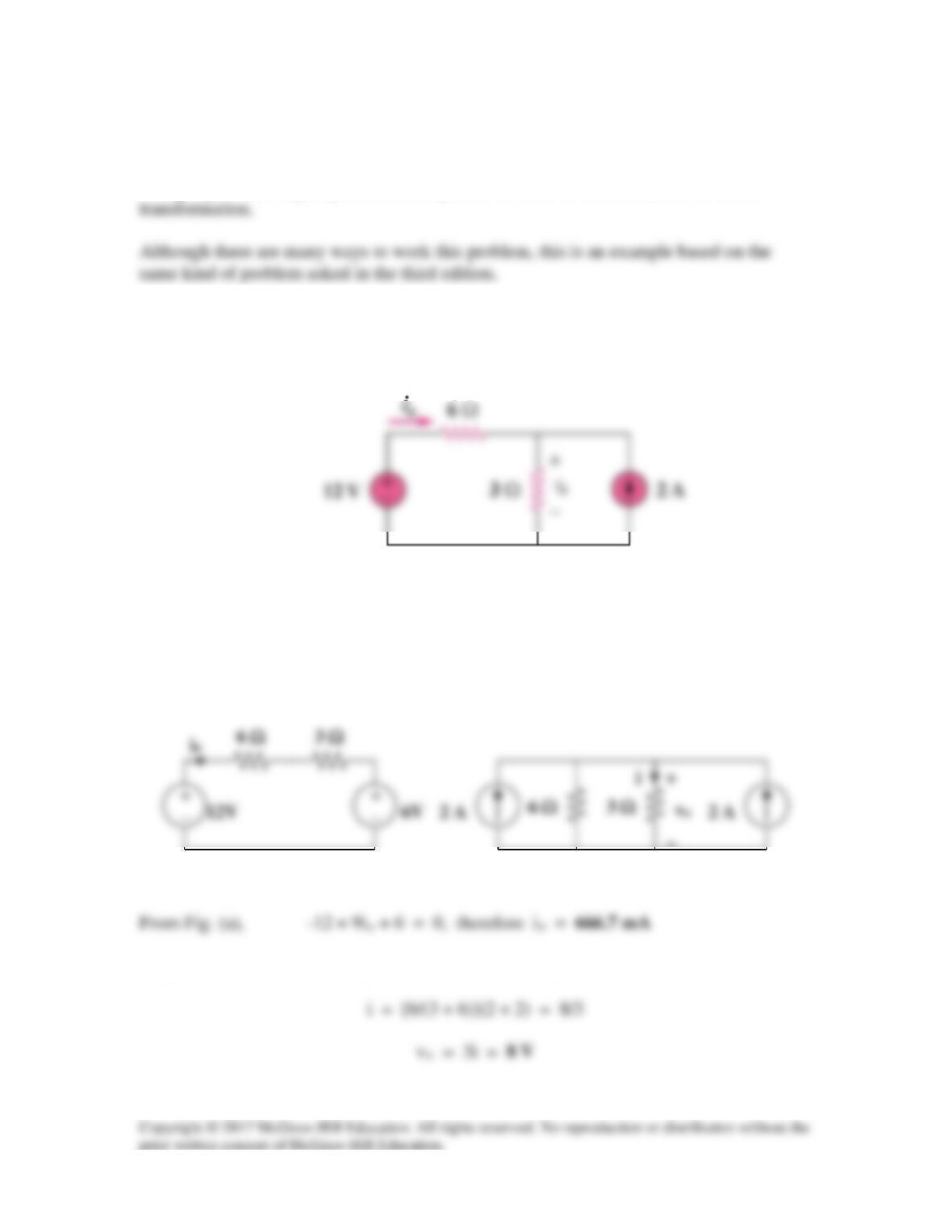
Step 1. This problem is most easily solved by converting all the voltage sources in series
with resistors to current sources in parallel with resistors.
a
b
20 Ω
1 amp
10 Ω
2 A
20 Ω
1 A
20 Ω
1.5 A
Now all we need is to add the current sources together algebraically and place all the
Step 2. I = 1+2+1+1.5 = 5.5 A and (1/Req) = 0.05+0.1+0.05+0.05 = 0.25 or
4 Ω
a
22 V
+
−
b
a
b
20 Ω
Solution 4.21
Using Fig. 4.89, design a problem to help other students to better understand source
Problem
Apply source transformation to determine vo and io in the circuit in Fig. 4.89.
Figure 4.89
Solution
To get io, transform the current sources as shown in Fig. (a).
To get vo, transform the voltage sources as shown in Fig. (b).
(a)
(b)
−
Solution 4.22
We transform the two sources to get the circuit shown in Fig. (a).
We now transform only the voltage source to obtain the circuit in Fig. (b).
(a)
(b)
Solution 4.23
If we transform the voltage source, we obtain the circuit below.
8
Ω
Ω
Ω
Ω
3//6 = 2-ohm. Convert the current sources to voltages sources as shown below.
Ω
Ω
Ω
–
Applying KVL to the loop gives
Solution 4.24
Transform the two current sources in parallel with the resistors into their voltage source
equivalents yield,
We now have the following circuit,
10 Ω
We now write the following mesh equation and constraint equation which will lead to a
solution for Vx,
8 Ω
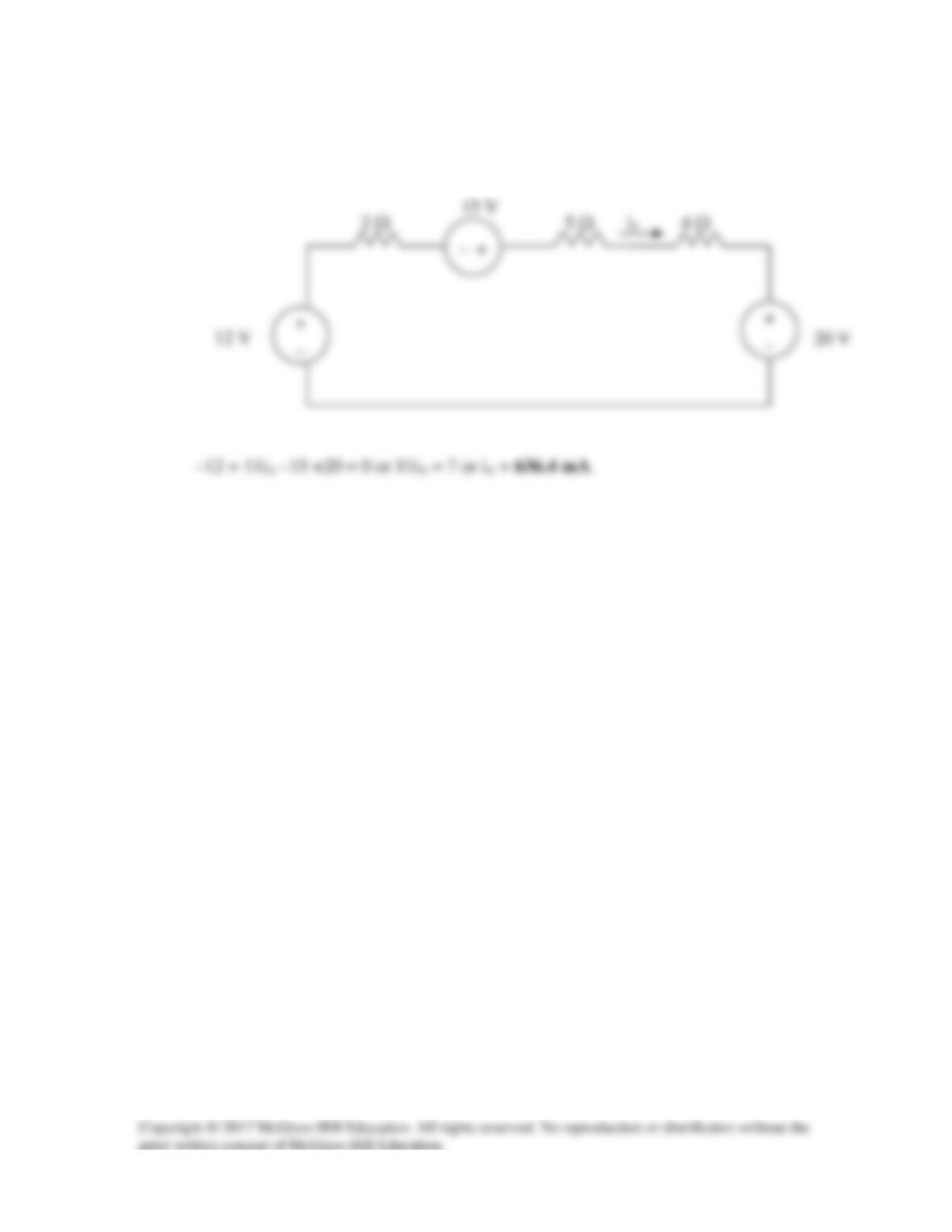
10 Ω
Solution 4.25
Transforming only the current source gives the circuit below.
Applying KVL to the loop gives,
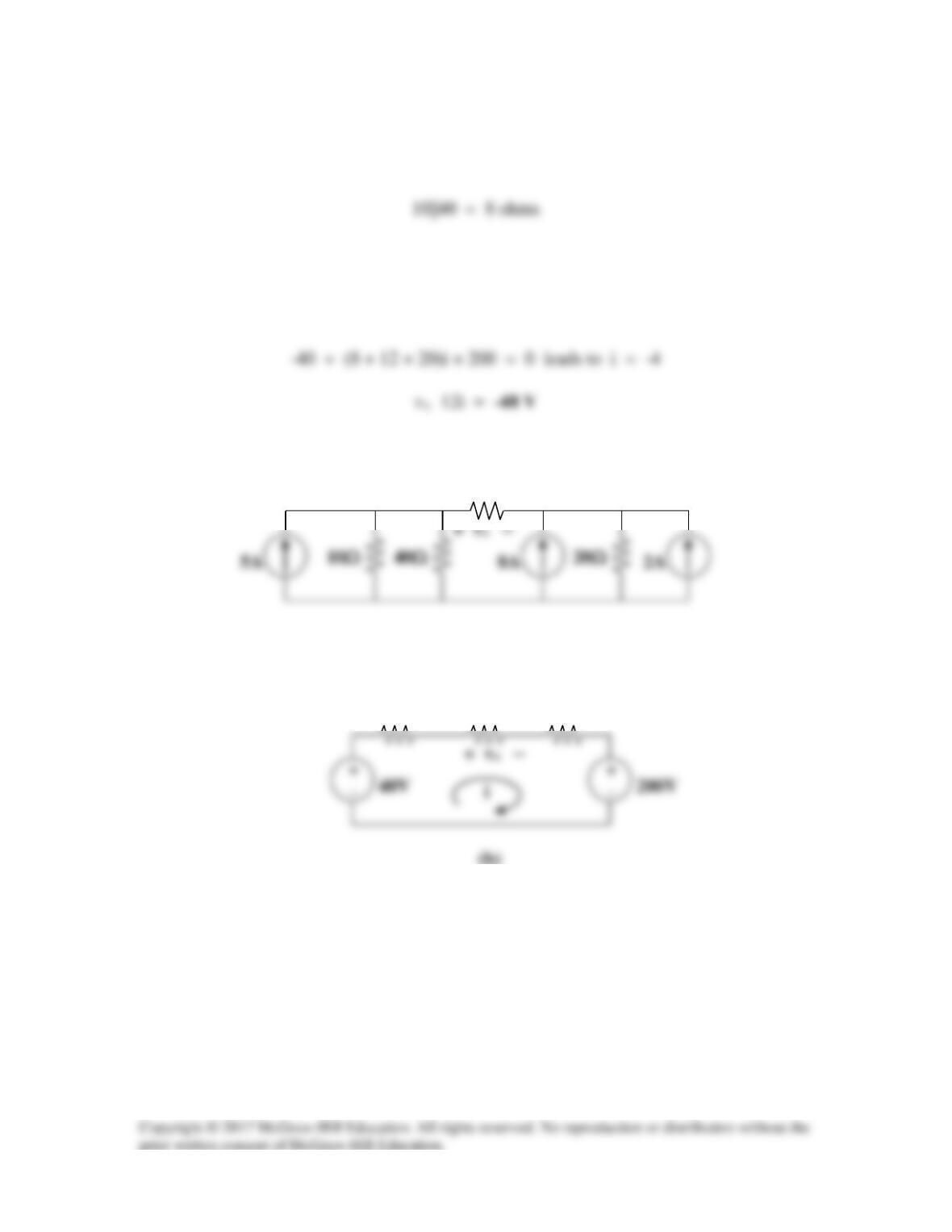
Solution 4.26
Transforming the current sources gives the circuit below.
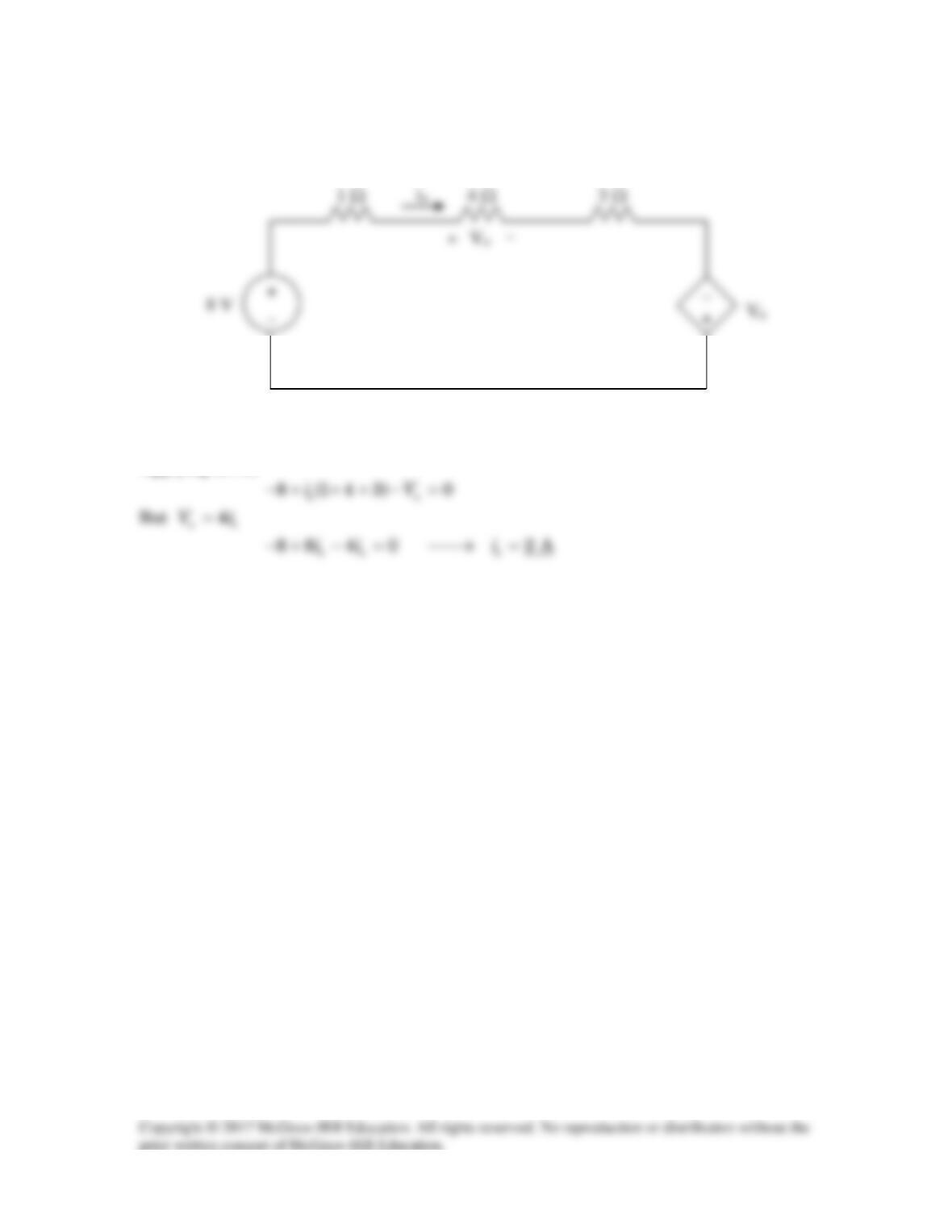
Solution 4.27
Transforming the voltage sources to current sources gives the circuit in Fig. (a).
Transforming the current sources to voltage sources yields the circuit in Fig. (b).
Applying KVL to the loop,
12 Ω
(a)
(b)
8 Ω
12 Ω
20 Ω
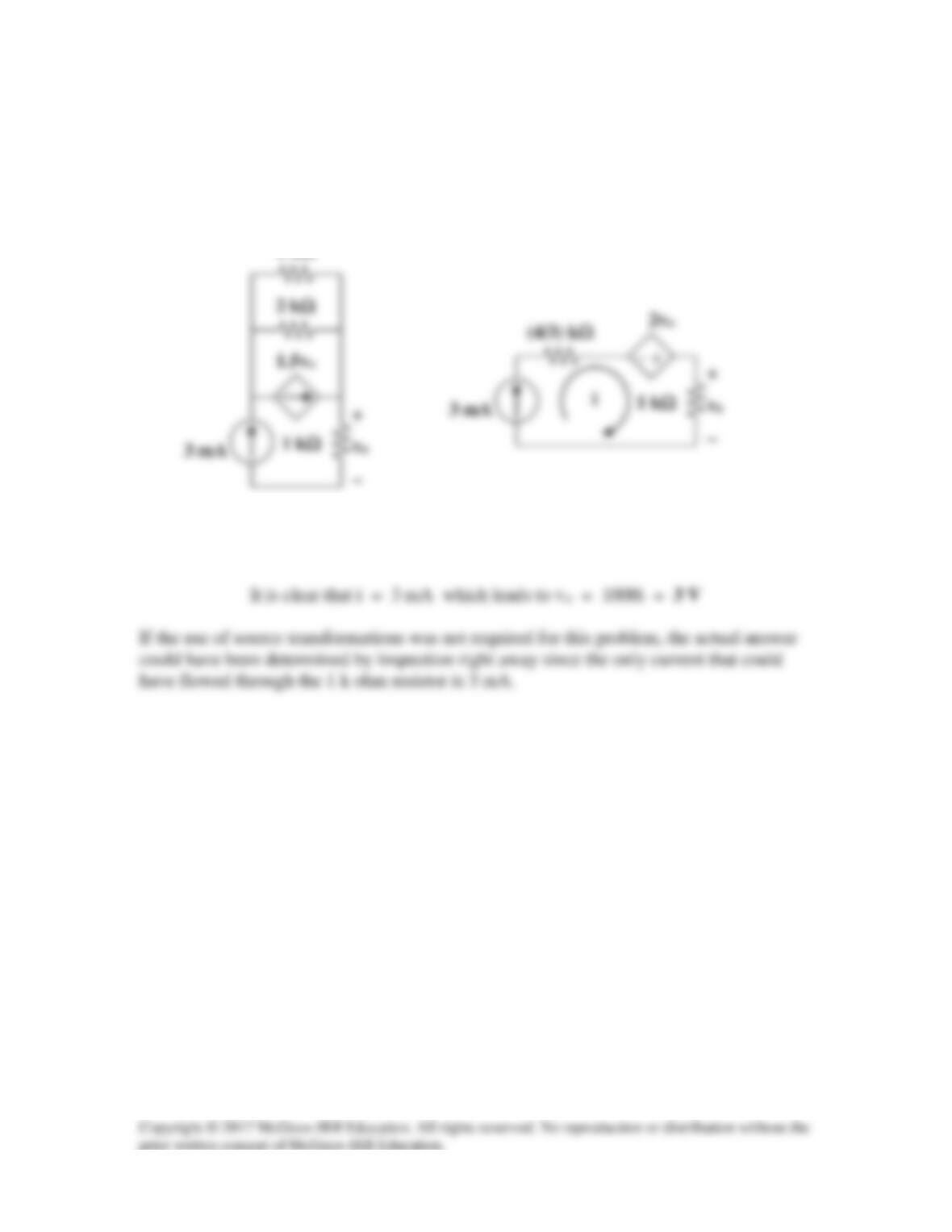
Solution 4.28
Convert the dependent current source to a dependent voltage source as shown below.
Applying KVL,
Solution 4.29
Transform the dependent voltage source to a current source as shown in Fig. (a). 2||4 =
(4/3) k ohms
2 kΩ
(a)
4 kΩ
(b)
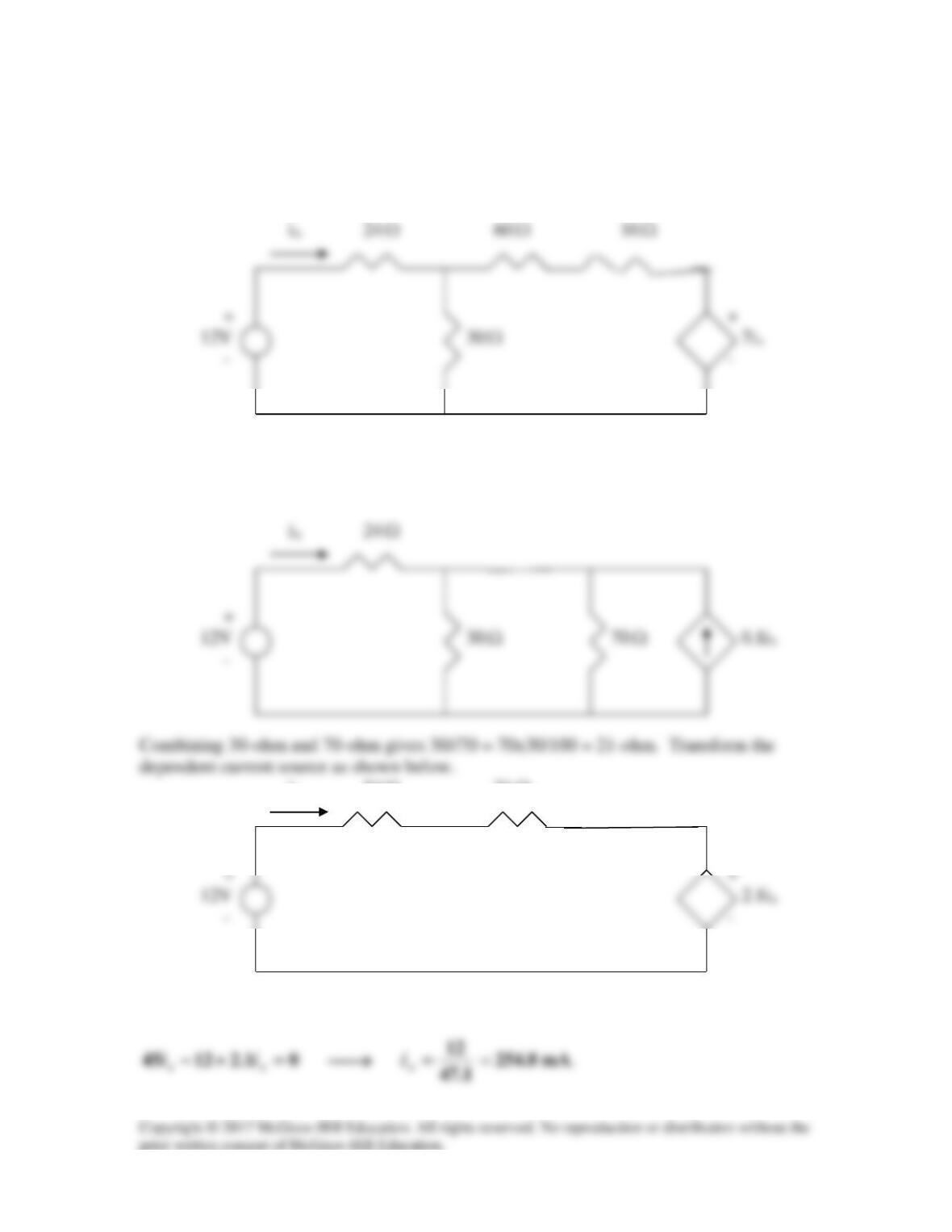
Solution 4.30
Transform the dependent current source as shown below.
Combine the 60-ohm with the 10-ohm and transform the dependent source as shown
below.
ix 24
Ω
21
Ω
Applying KVL to the loop gives
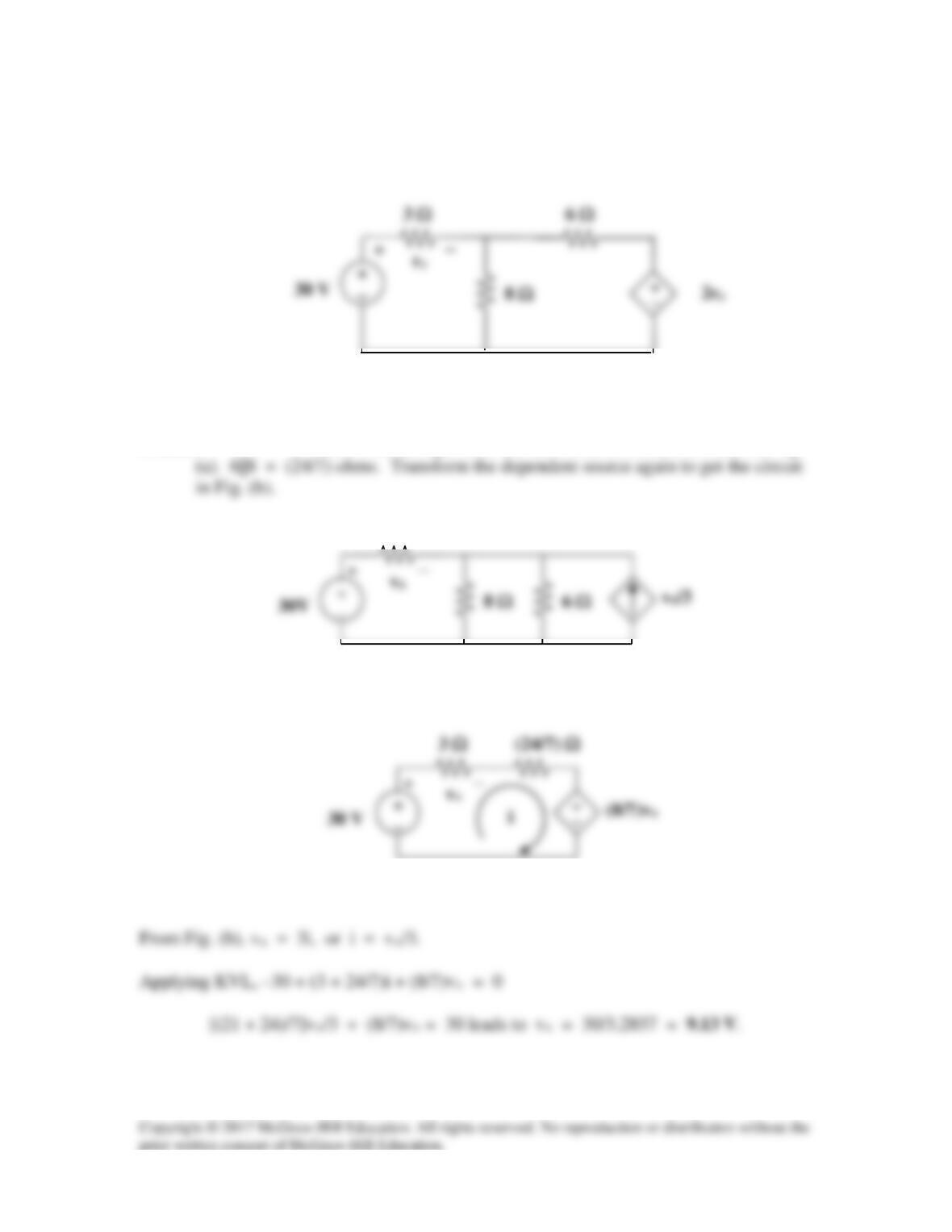
Solution 4.31
Determine vx in the circuit of Fig. 4.99 using source transformation.
3 Ω
6 Ω
Figure 4.99
For Prob. 4.31.
Solution Transform the dependent source so that we have the circuit in Fig.
3 Ω
(a)
3 Ω
(b)
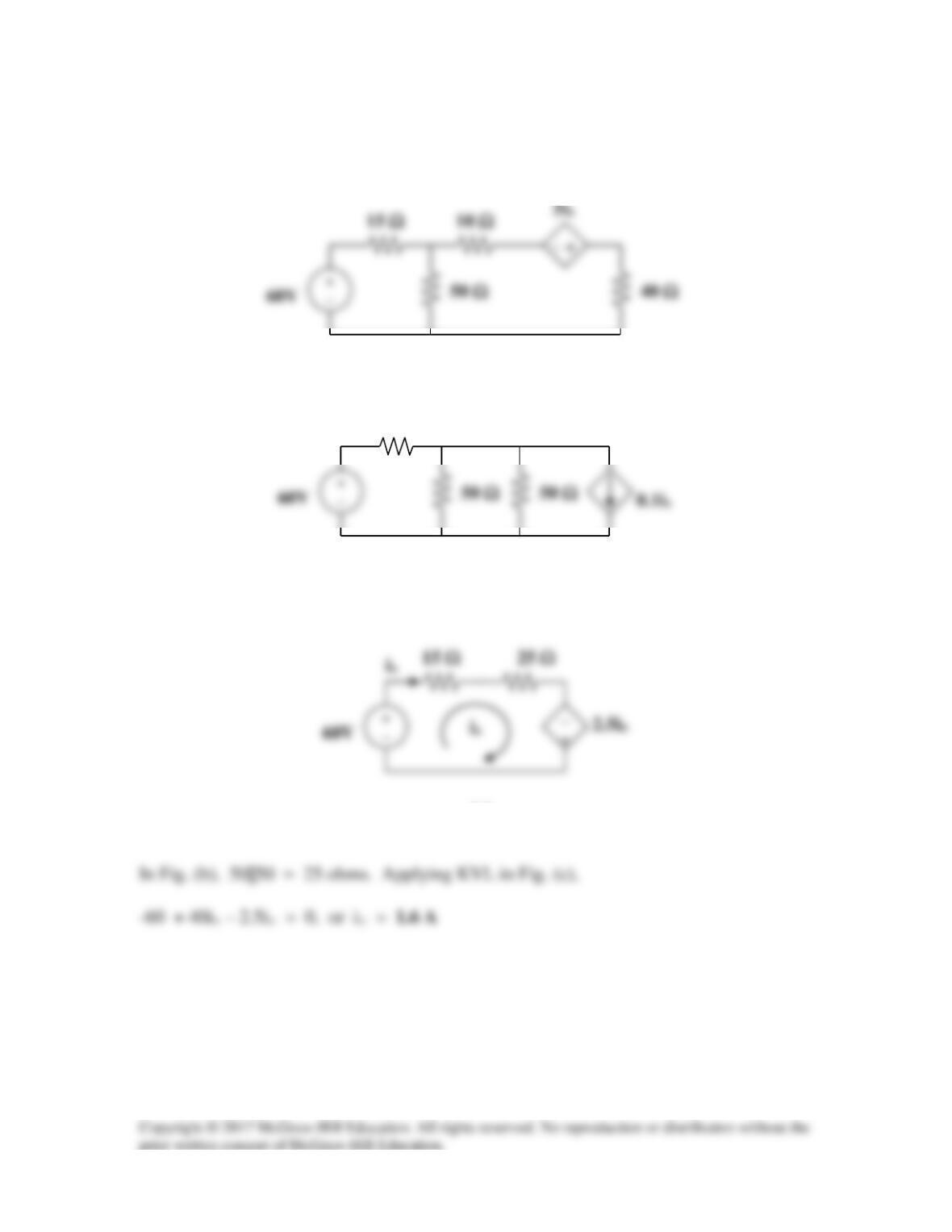
Solution 4.32
As shown in Fig. (a), we transform the dependent current source to a voltage source,
15 Ω
10 Ω
15 Ω
(a)
(c)
(b)
15 Ω
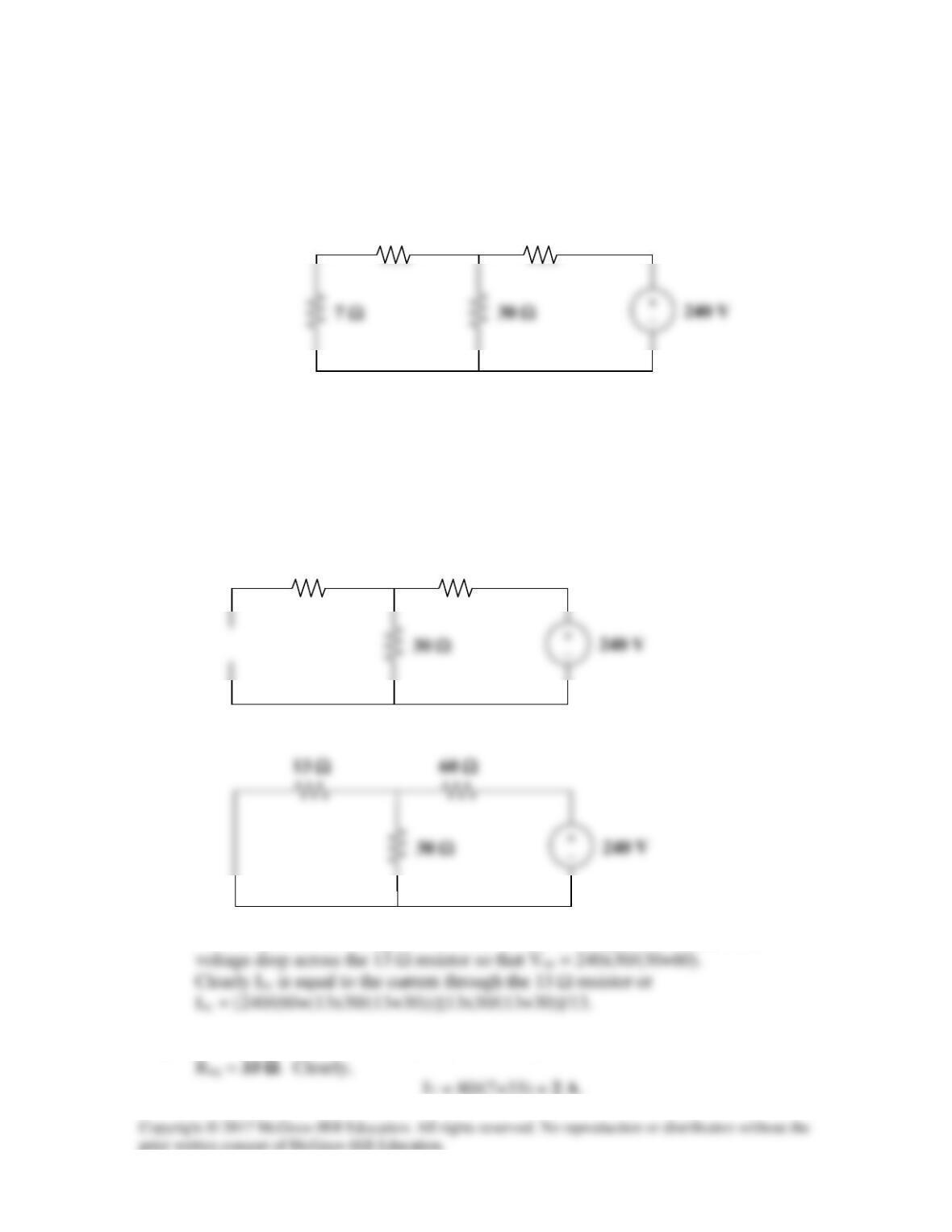
Solution 4.33
Determine the Thevenin equivalent circuit, shown in Fig. 4.101, as seen by the 7-ohm
resistor. Then calculate the current flowing through the 7-ohm resistor.
Figure 4.101
For Prob. 4.33.
Solution
Step 1. We need to find Voc and Isc. To do this, we will need two circuits, label
the appropriate unknowns and solve for Voc, Isc, and then Req which is equal to Voc/Isc.
60 Ω
13 Ω
For the open circuit voltage all we need to do is to recognize that there is no
Step 2. Voc = VThev = 80 V. Isc = [240/69.07]9.07/13 = 2.4242 which leads to
60 Ω
13 Ω
60 Ω
13 Ω