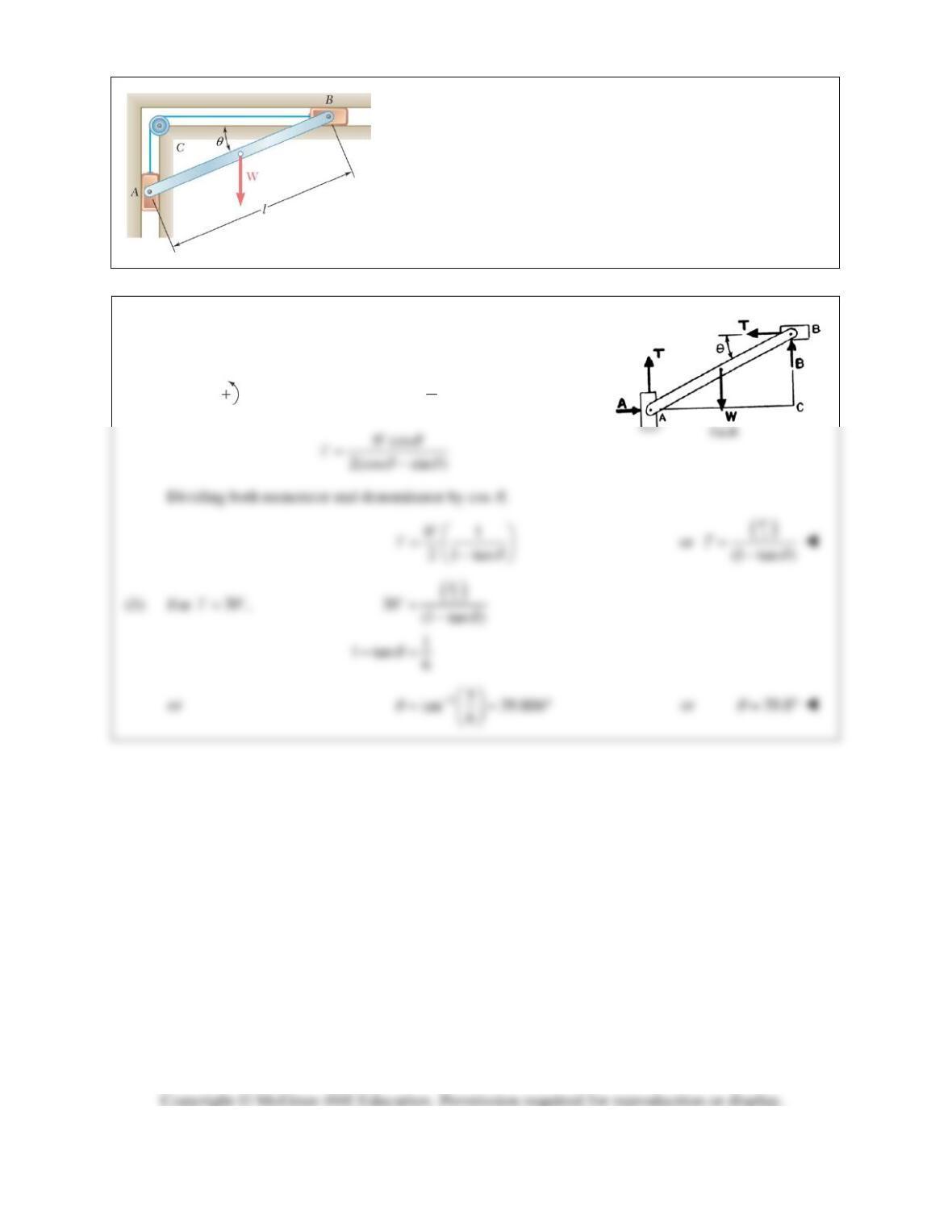
PROBLEM 4.53
A slender rod AB, of weight W, is attached to blocks A and B,
which move freely in the guides shown. The blocks are
connected by an elastic cord that passes over a pulley at C.
(a) Express the tension in the cord in terms of W and
.
(b) Determine the value of
for which the tension in the cord is
equal to 3W.
SOLUTION
(a) From F.B.D. of rod AB:
1
0: ( sin ) cos ( cos ) 0
2
C
MTlW Tl
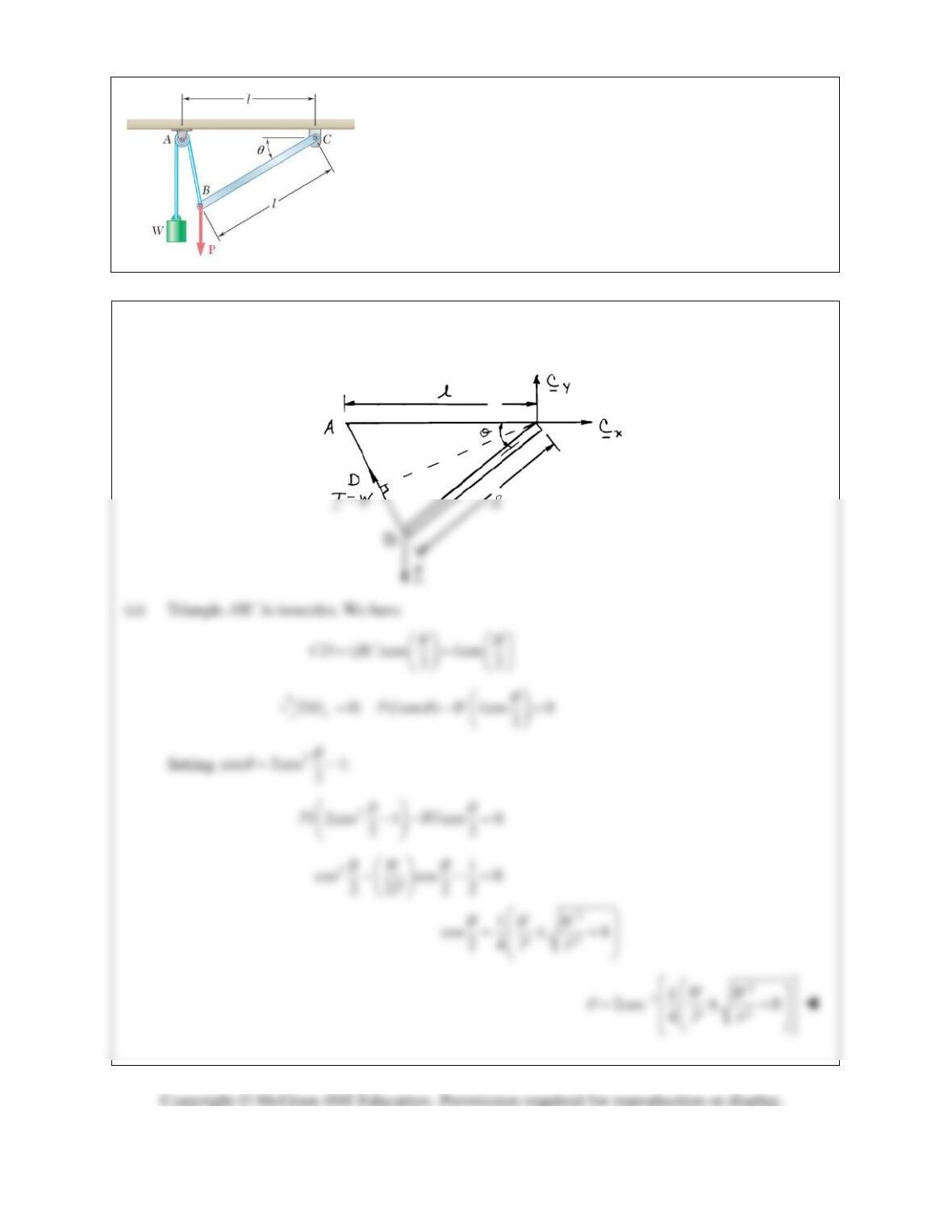
PROBLEM 4.54
A vertical load P is applied at end B of rod BC. (a) Neglecting the
weight of the rod, express the angle
corresponding to the
equilibrium position in terms of P, l, and the counterweight W. (b)
Determine the value of
corresponding to equilibrium if
P 2W.
SOLUTION
Free-Body Diagram:
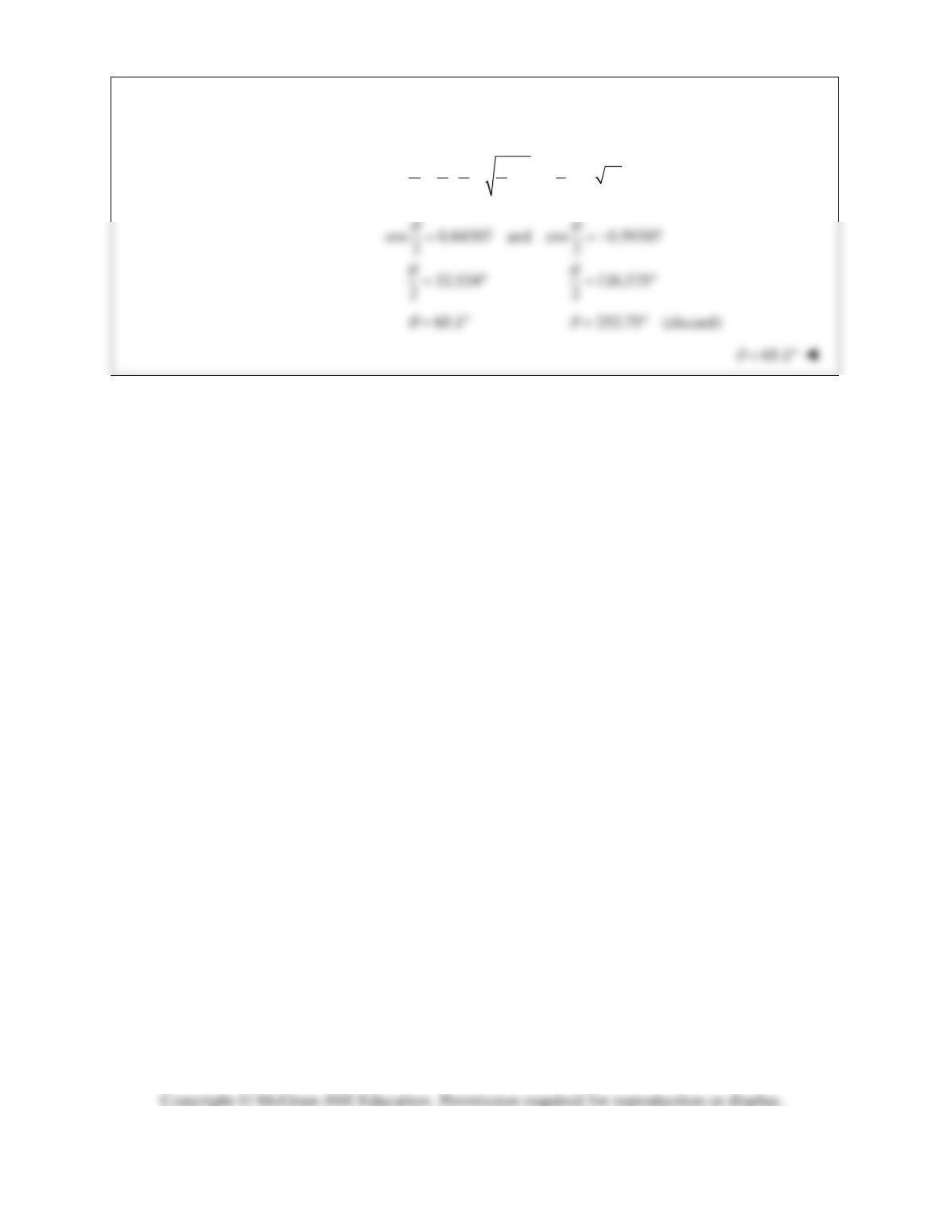
PROBLEM 4.54 (Continued)
(b) For 2,
P
W
11 1 1
cos 8 1 33
242 4 8
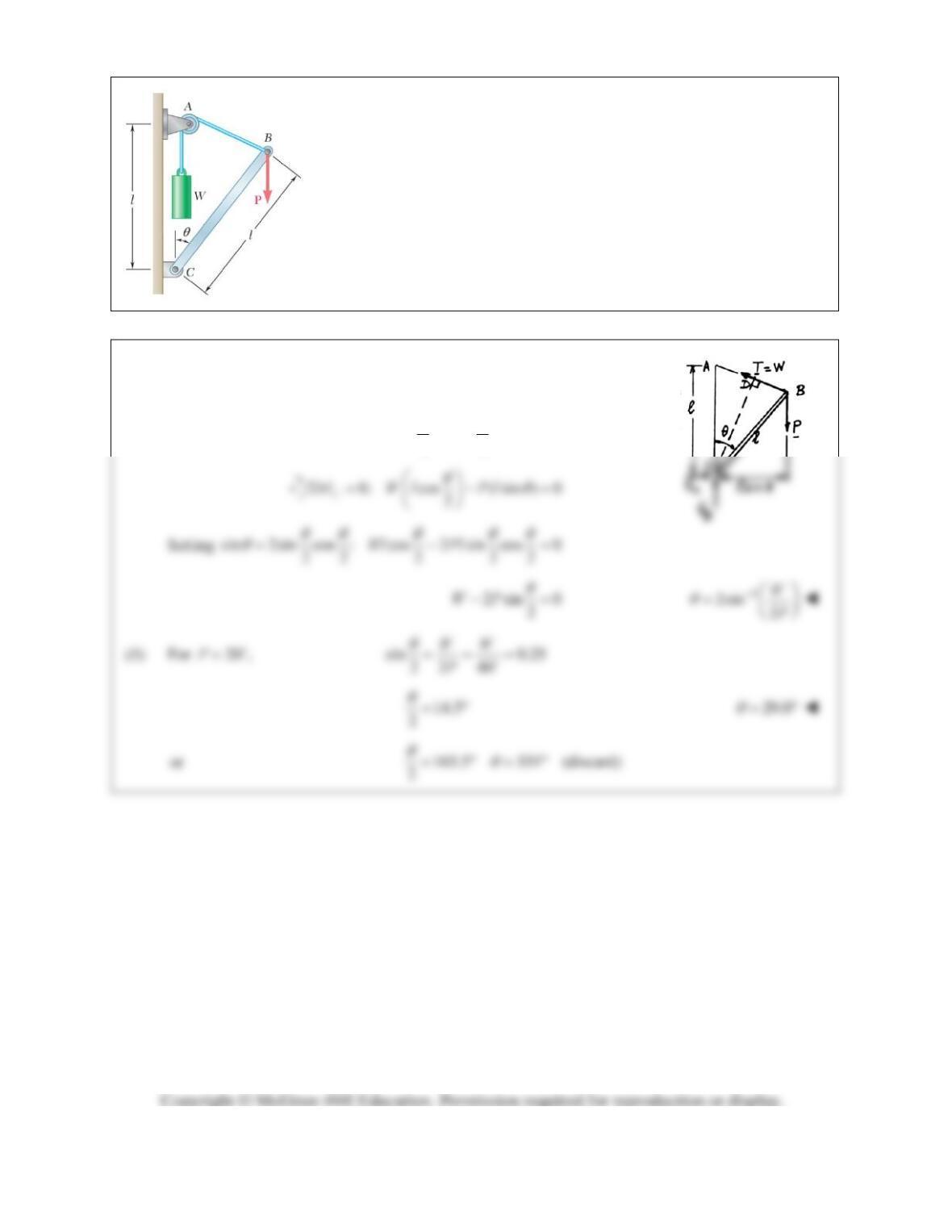
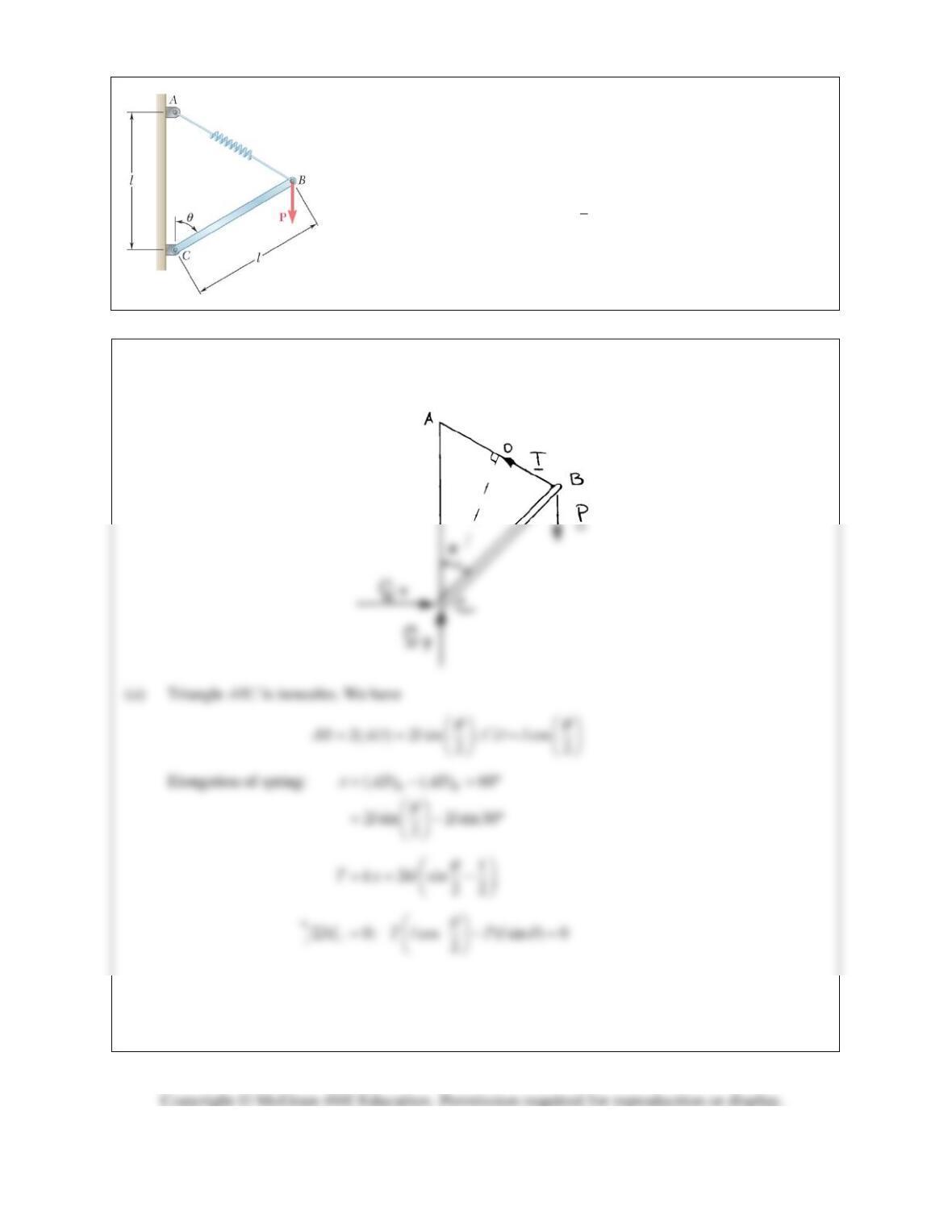
PROBLEM 4.55
A vertical load
P
is applied at end B of rod BC. (a) Neglecting the weight
of the rod, express the angle
corresponding to the equilibrium position in
terms of P, l, and the counterweight W. (b) Determine the value of
corresponding to equilibrium if P 2W.
SOLUTION
(a) Triangle ABC is isosceles. We have
()cos cos
22
CD BC l
PROBLEM 4.56
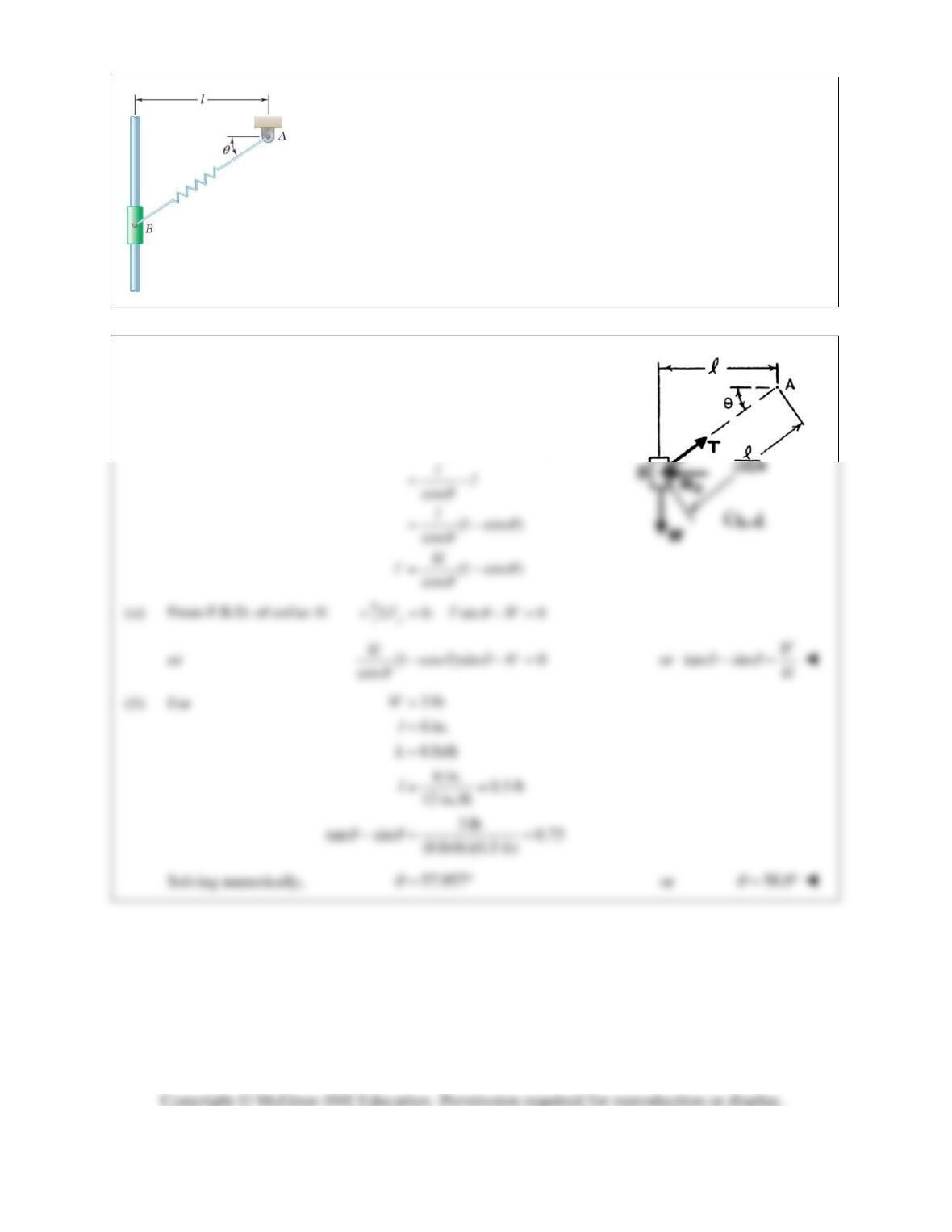
A collar B of weight W can move freely along the vertical rod shown. The
constant of the spring is k, and the spring is unstretched when
0.
(a)
Derive an equation in
, W, k, and l that must be satisfied when the collar is
in equilibrium. (b) Knowing that
300 N,W
l500 mm, and
800 N/m,k
determine the value of
corresponding to equilibrium.
SOLUTION
First note:
Tks
where
spring constant
elongation of spring
k
s
PROBLEM 4.57
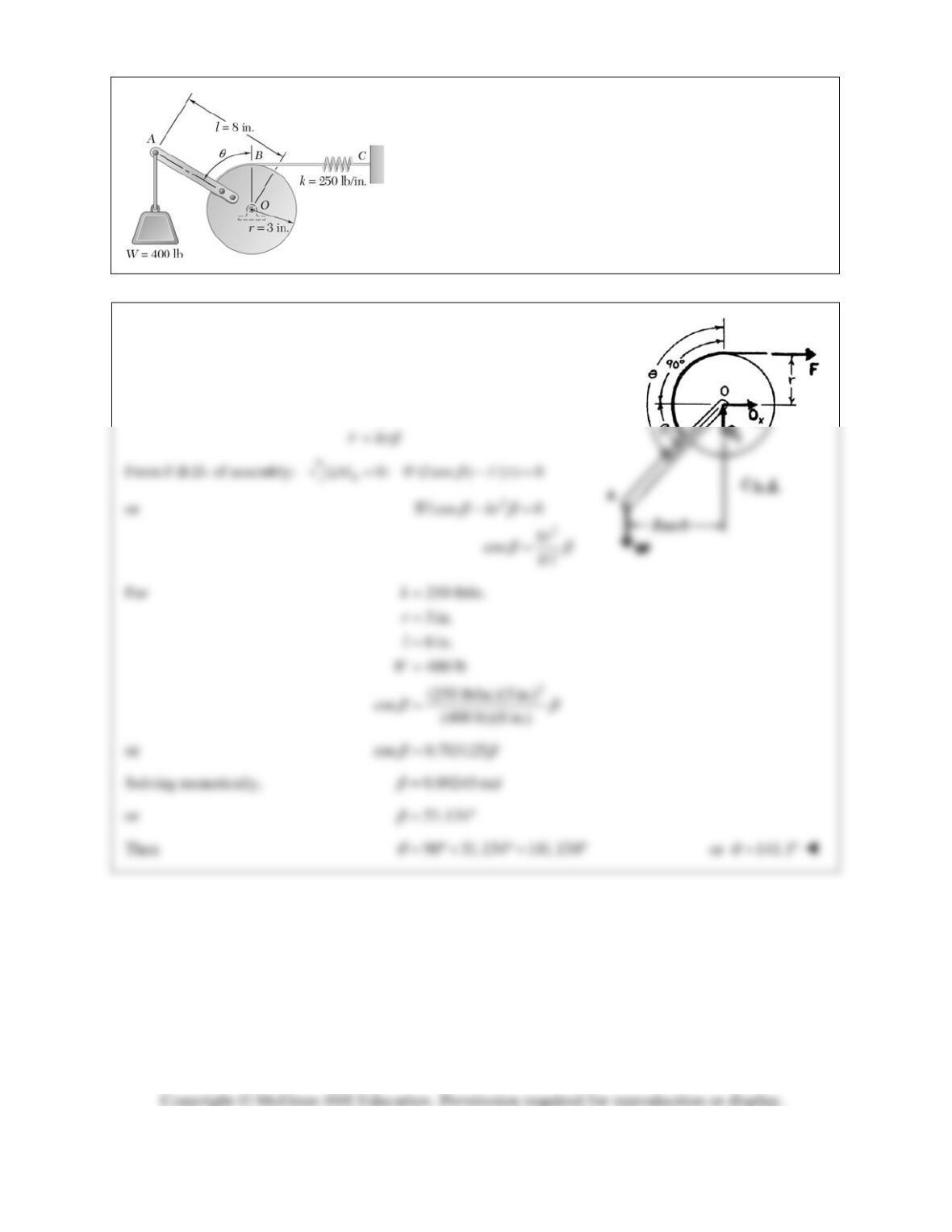
Solve Sample Problem 4.5, assuming that the spring is
unstretched when
90 .
SOLUTION
First note: tension in springTks
where
deformation of springs
r
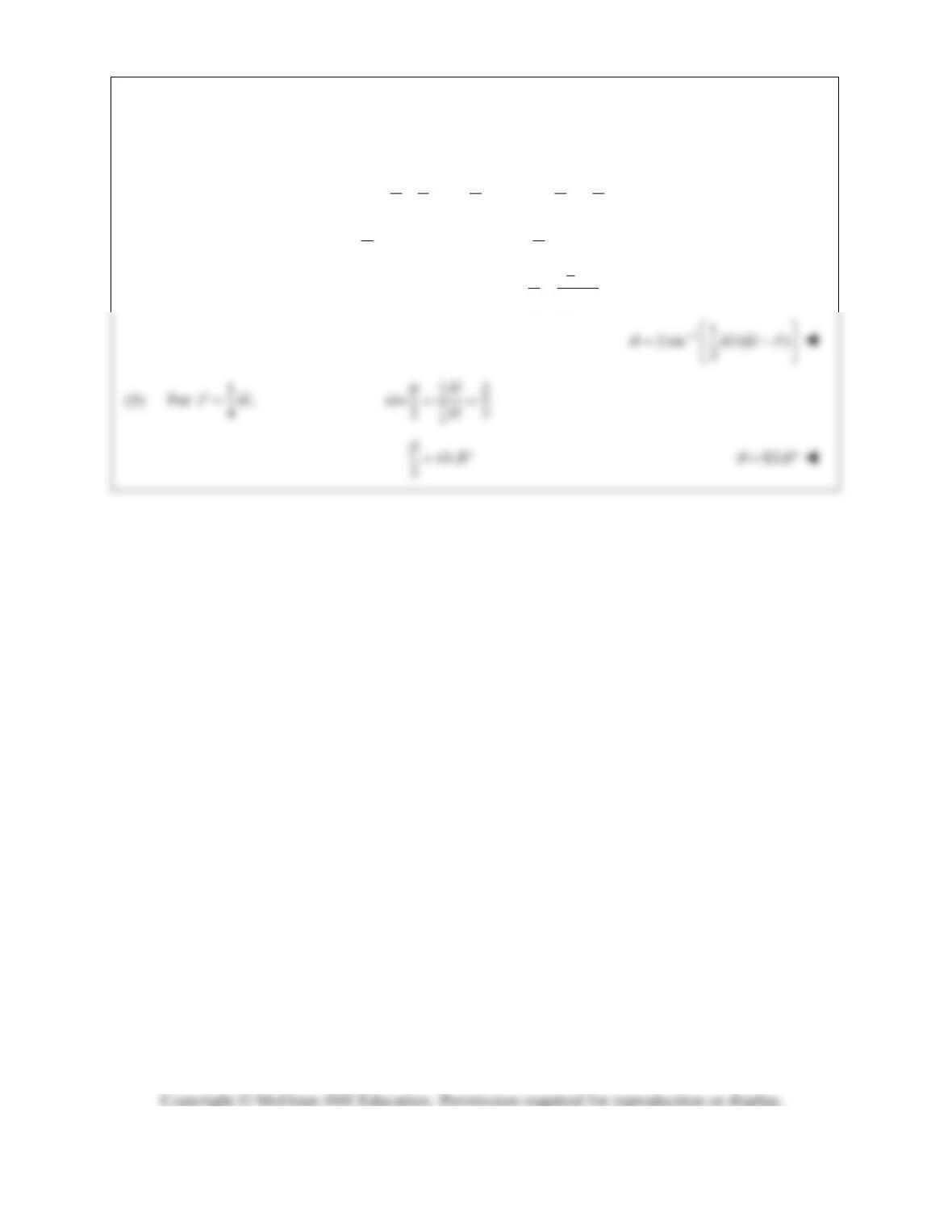
PROBLEM 4.58
A vertical load P is applied at end B of rod BC. The constant of the
spring is k, and the spring is unstretched when θ = 60°. (a) Neglecting
the weight of the rod, express the angle θ corresponding to the
equilibrium position terms of P, k, and l. (b) Determine the value of θ
corresponding to equilibrium if P = 4
1kl.
SOLUTION
Free-Body Diagram:
PROBLEM 4.58 (Continued)
1
2
1
2sin cos 2sincos 0
22 2 2 2
cos 0 or 2( )sin 0
22
180 (trivial) sin 2
kl l Pl
kl P kl
kl
kl P
PROBLEM 4.59
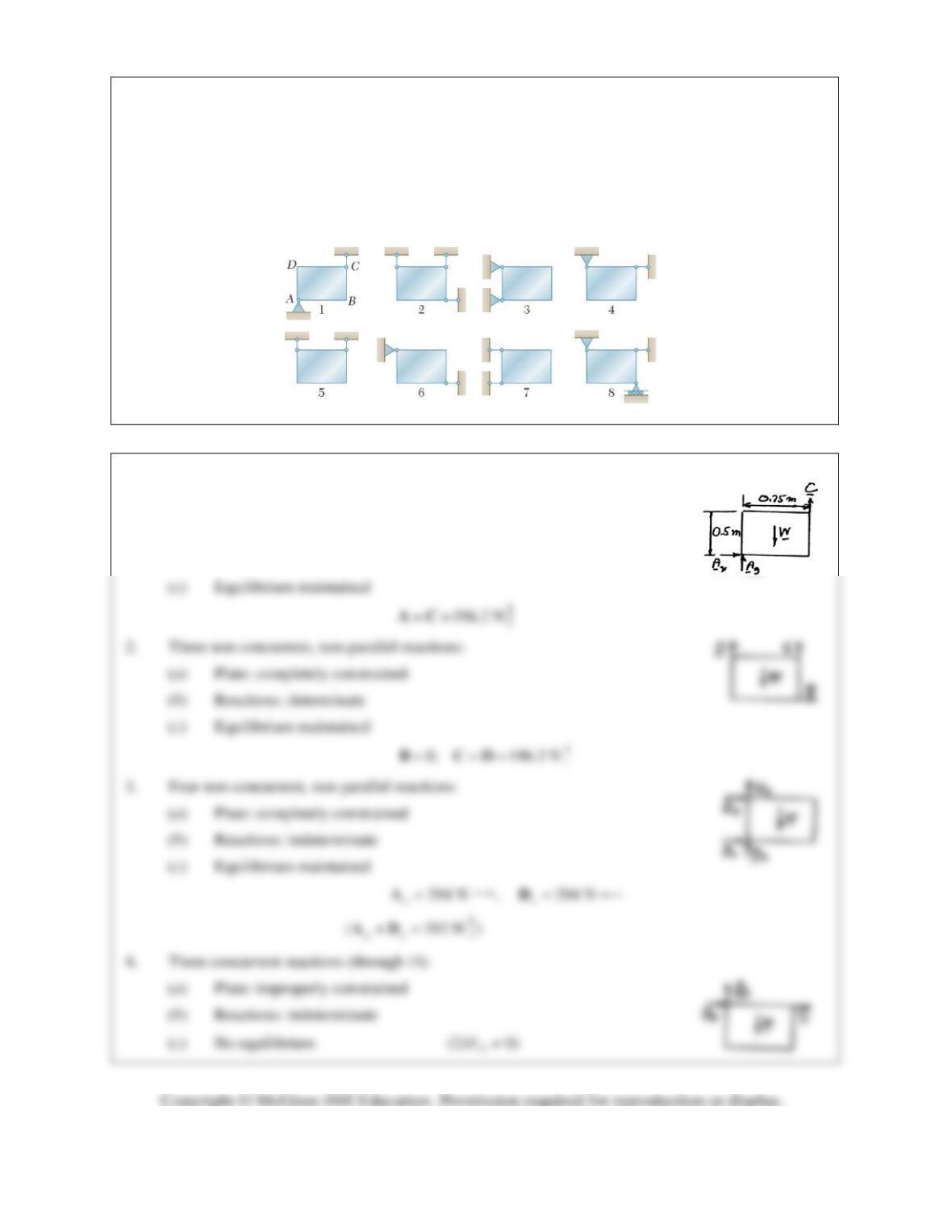
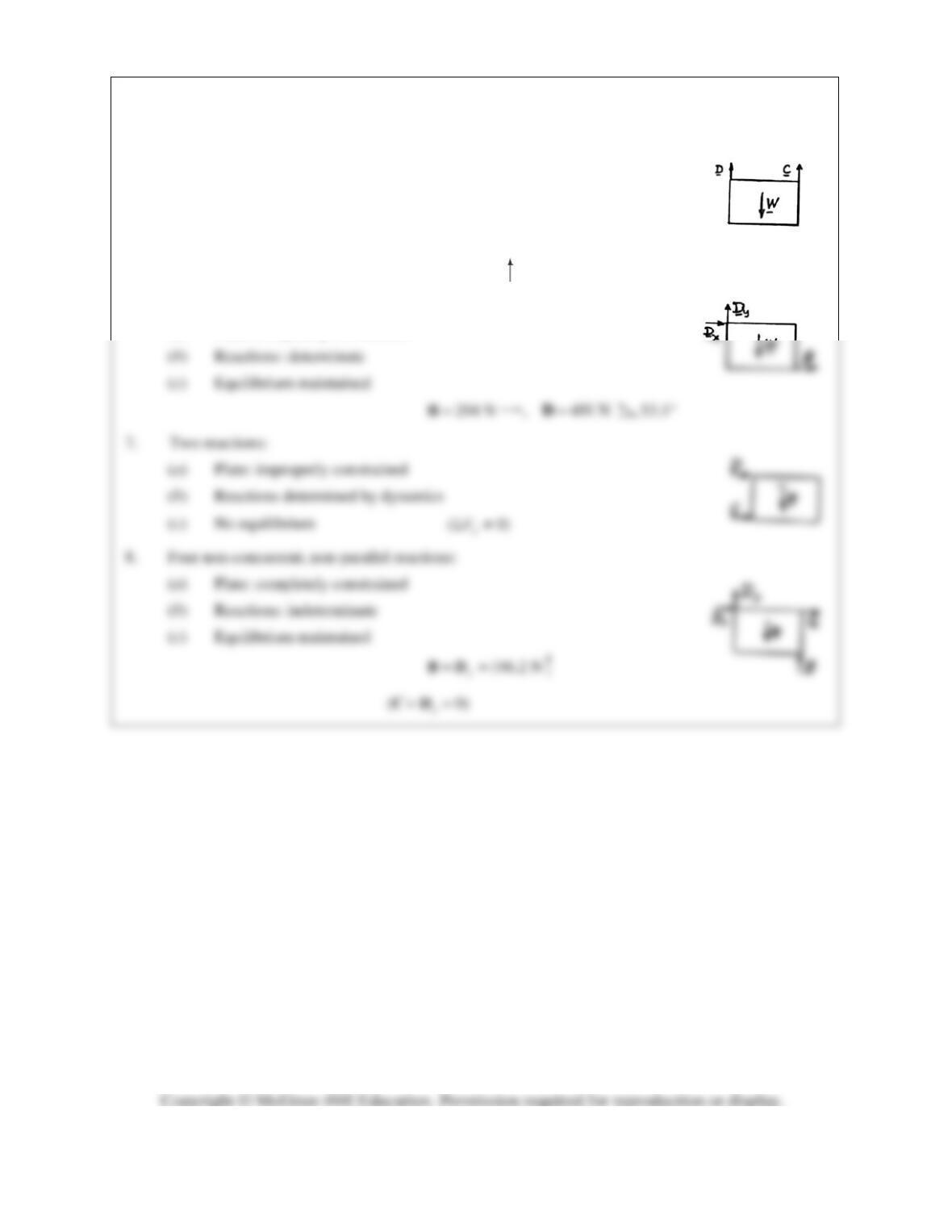
Eight identical 500 750-mm rectangular plates, each of mass 40 kg,m are held in a vertical plane as
shown. All connections consist of frictionless pins, rollers, or short links. In each case, determine whether
(a) the plate is completely, partially, or improperly constrained, (b) the reactions are statically determinate
or indeterminate, (c) the equilibrium of the plate is maintained in the position shown. Also, wherever
possible, compute the reactions.
SOLUTION
1. Three non-concurrent, non-parallel reactions:
(a) Plate: completely constrained
(b) Reactions: determinate
PROBLEM 4.59 (Continued)
5. Two reactions:
(a) Plate: partial constraint
(b) Reactions: determinate
(c) Equilibrium maintained
196.2 N
CD
6. Three non-concurrent, non-parallel reactions:
(a) Plate: completely constrained
PROBLEM 4.60
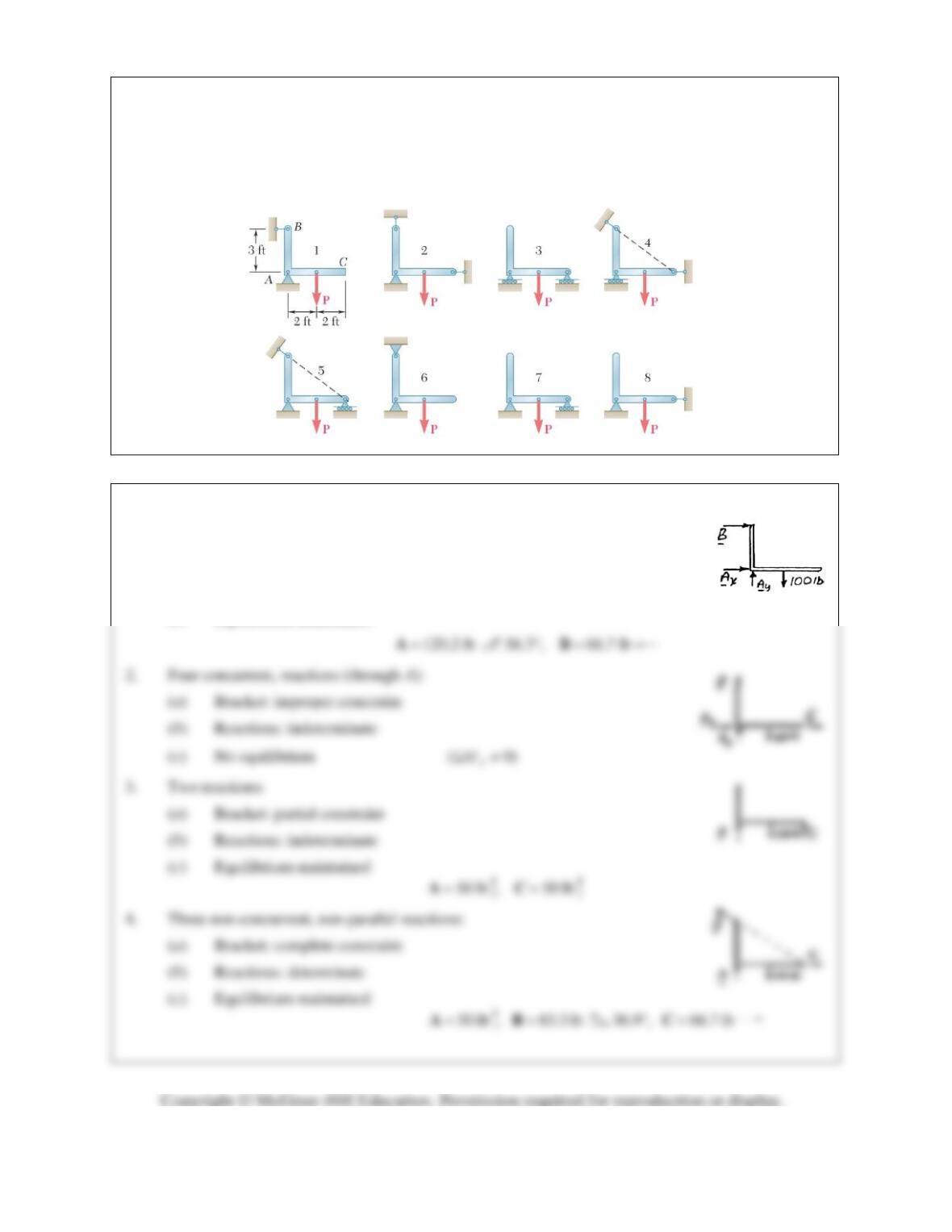
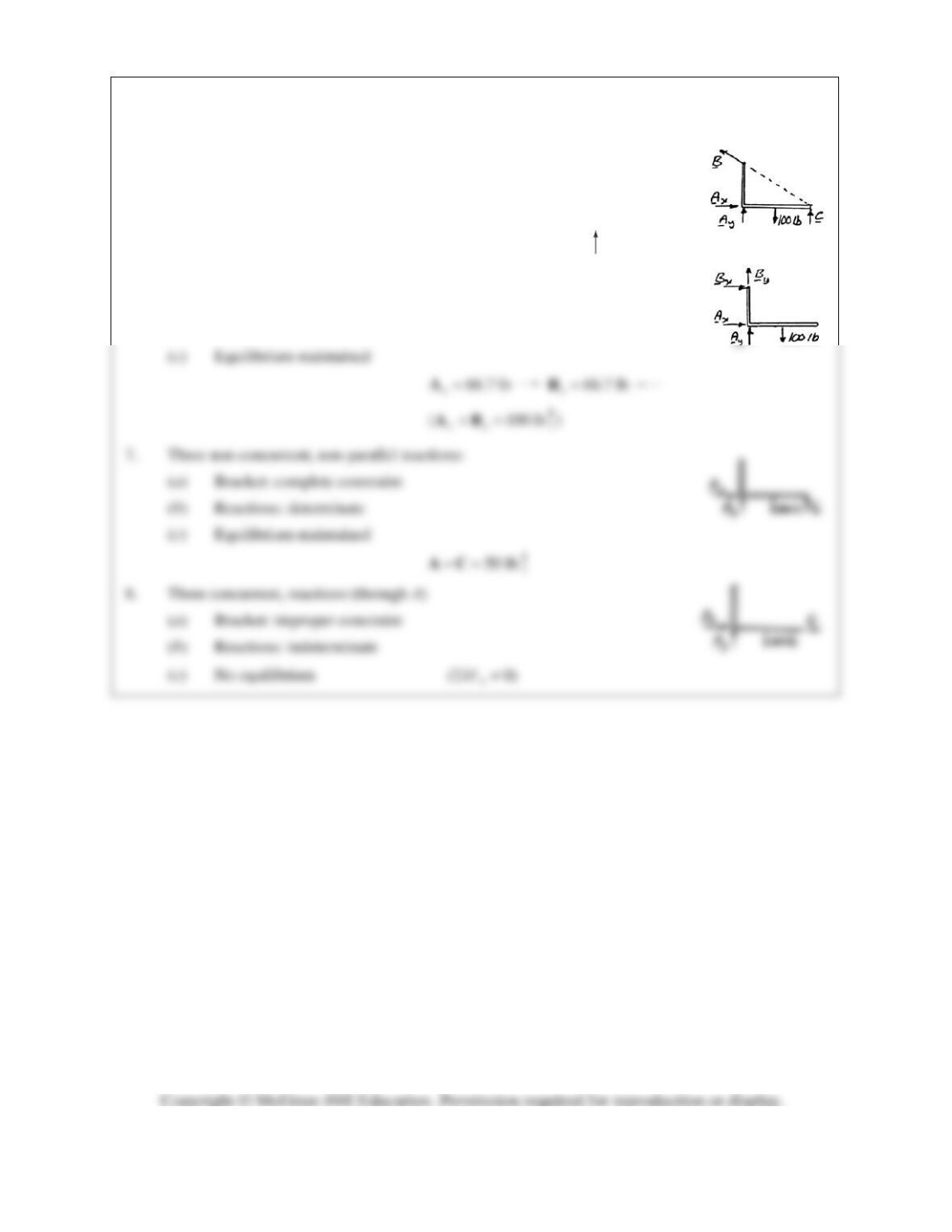
The bracket ABC can be supported in the eight different ways shown. All connections consist of smooth
pins, rollers, or short links. For each case, answer the questions listed in Problem 4.59, and, wherever
possible, compute the reactions, assuming that the magnitude of the force
P
is 100 lb.
SOLUTION
1. Three non-concurrent, non-parallel reactions:
(a) Bracket: complete constraint
(b) Reactions: determinate
(c) Equilibrium maintained
PROBLEM 4.60 (Continued)
5. Four non-concurrent, non-parallel reactions:
(a) Bracket: complete constraint
(b) Reactions: indeterminate
(c) Equilibrium maintained
(0) 50lb
Cy
M A
6. Four non-concurrent, non-parallel reactions:
(a) Bracket: complete constraint
(b) Reactions: indeterminate
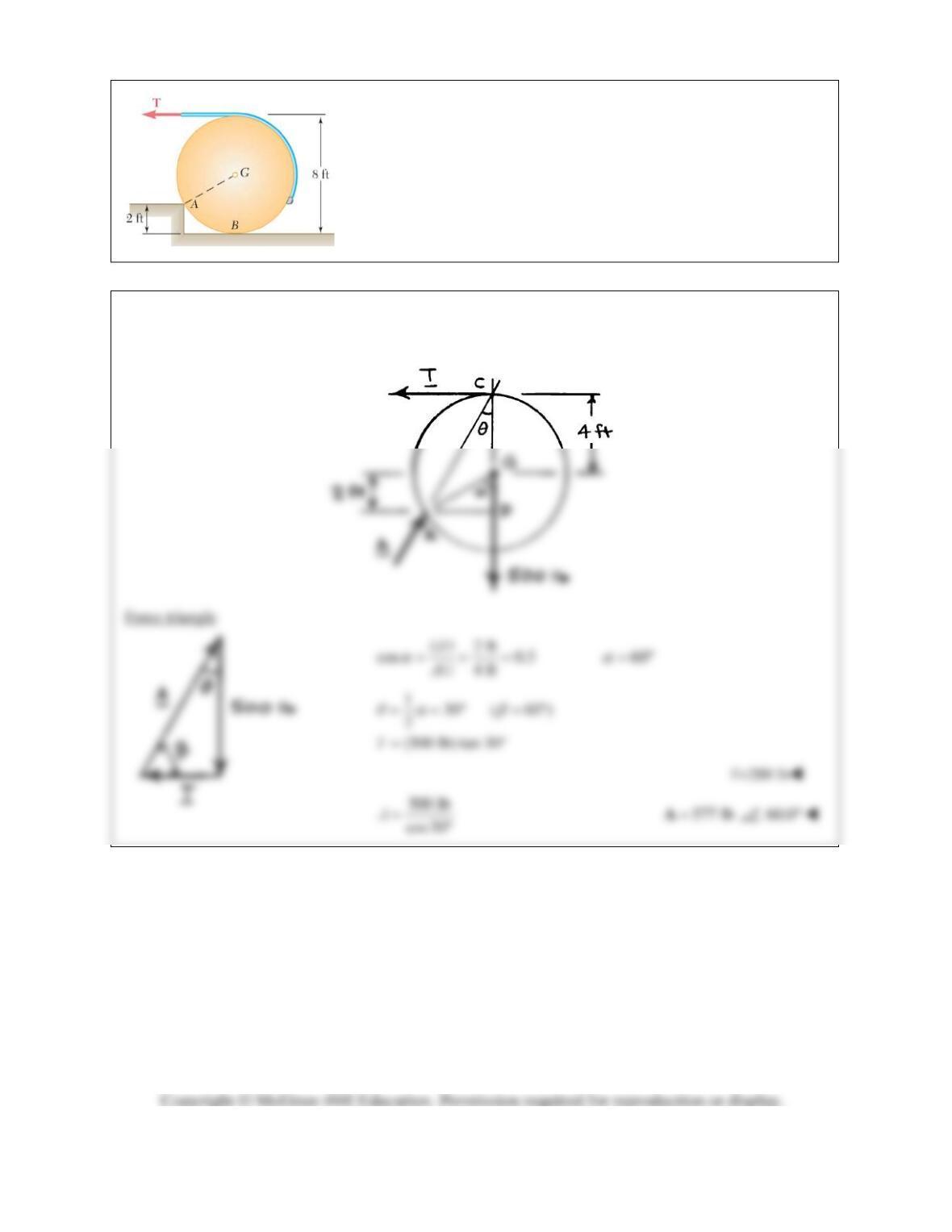
PROBLEM 4.61
A 500-lb cylindrical tank, 8 ft in diameter, is to be raised over a 2-ft
obstruction. A cable is wrapped around the tank and pulled
horizontally as shown. Knowing that the corner of the obstruction at A
is rough, find the required tension in the cable and the reaction at A.
SOLUTION
Free-Body Diagram:
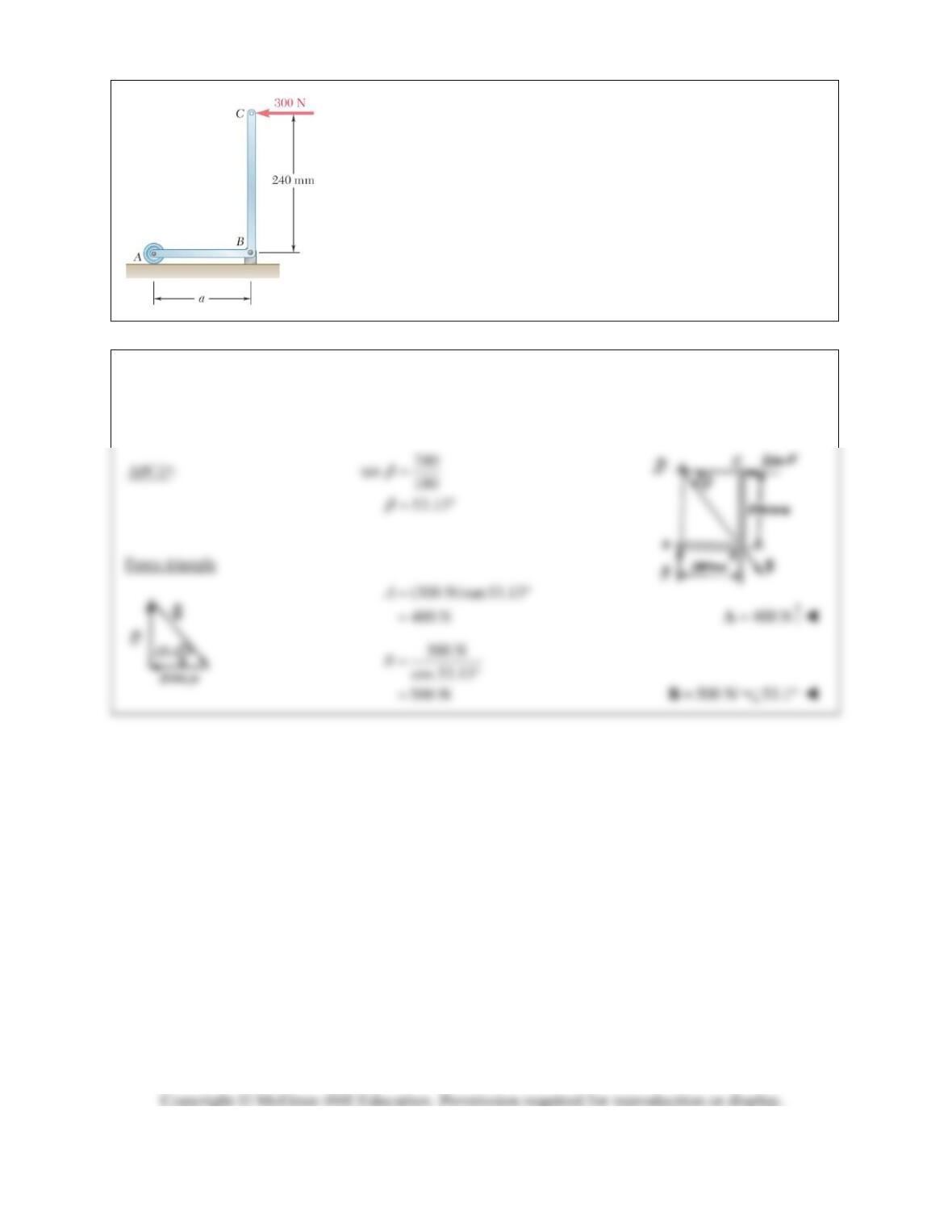
PROBLEM 4.62
Determine the reactions at A and B when
180 mm.a
SOLUTION
Reaction at B must pass through D where A and 300-N load intersect.
Free-Body Diagram:
(Three-force member)
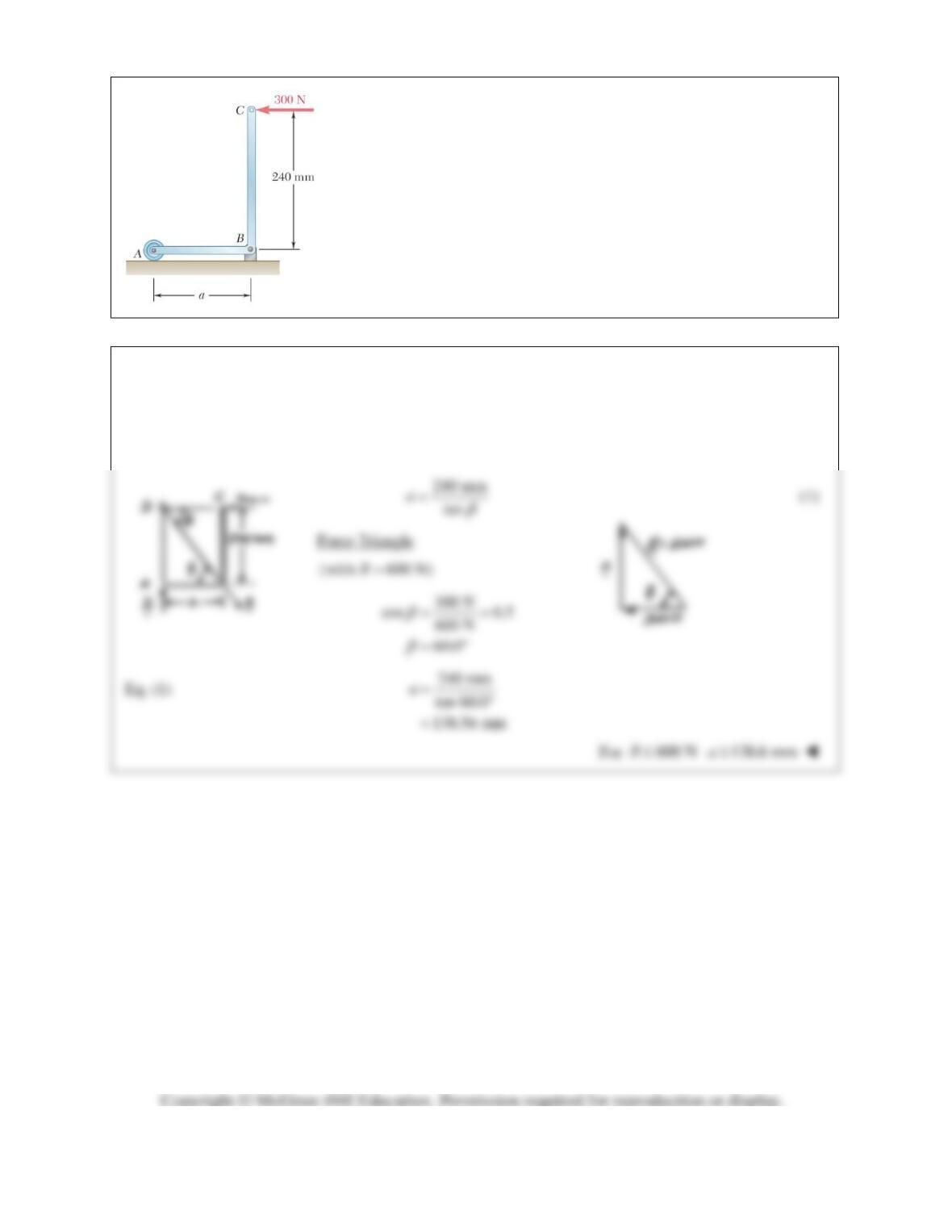
PROBLEM 4.63
For the bracket and loading shown, determine the range of values
of the distance a for which the magnitude of the reaction at B does
not exceed 600 N.
SOLUTION
Reaction at B must pass through D where A and 300-N load intersect.
Free-Body Diagram:
(Three-force member)
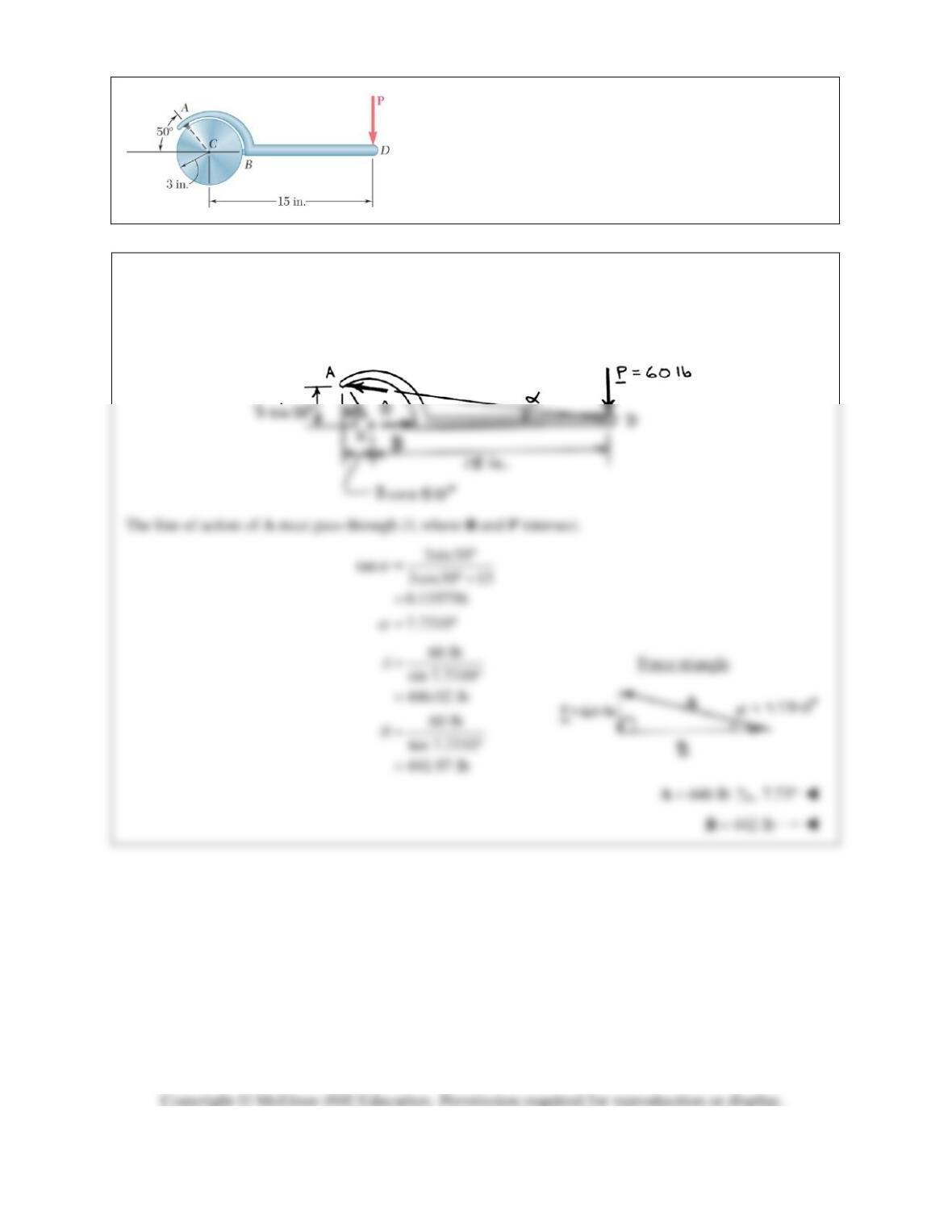
PROBLEM 4.64
The spanner shown is used to rotate a shaft. A pin fits in a
hole at A, while a flat, frictionless surface rests against the
shaft at B. If a 60-lb force
P
is exerted on the spanner at D,
find the reactions at A and B.
SOLUTION
Free-Body Diagram:
(Three-force body)
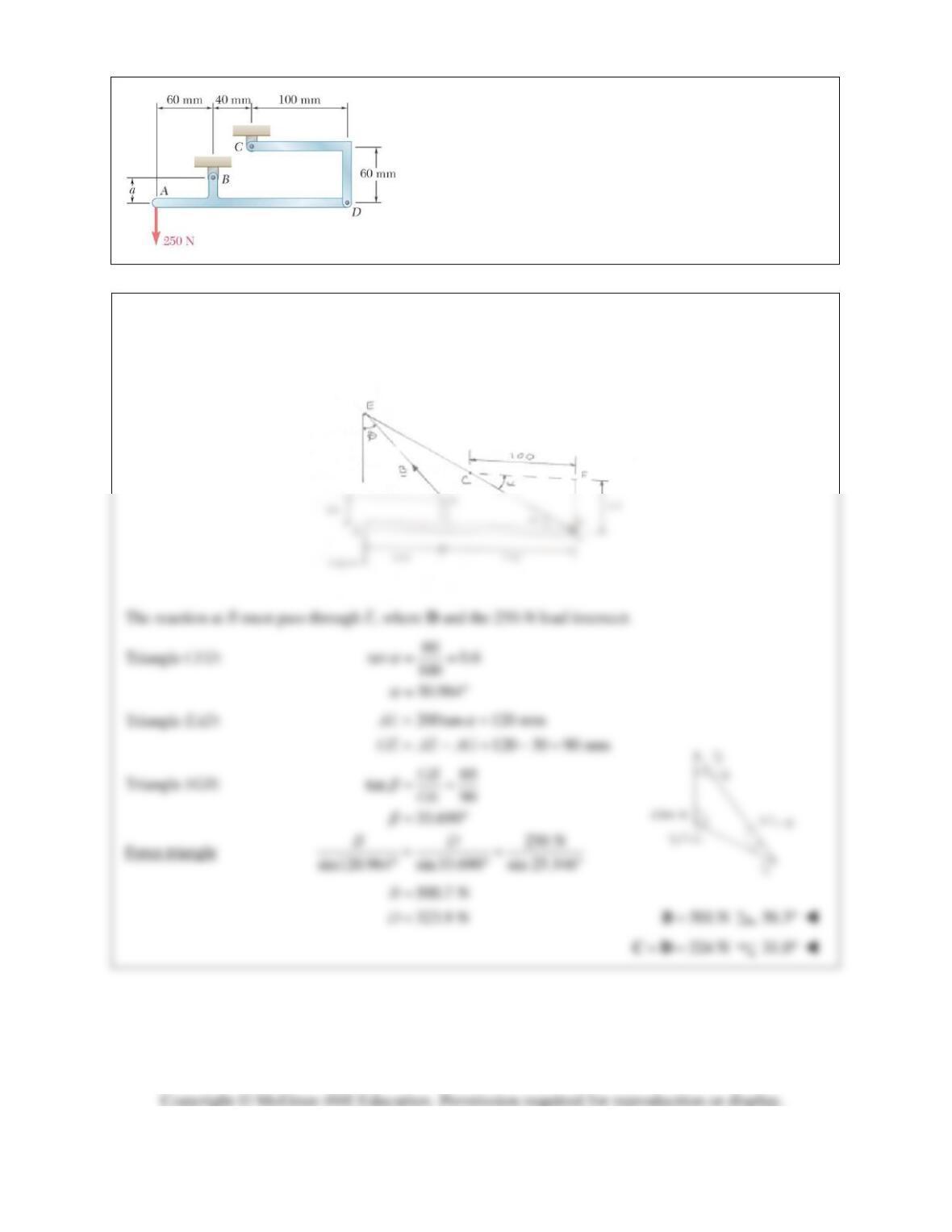
PROBLEM 4.65
Determine the reactions at B and C when a = 30 mm.
SOLUTION
Since CD is a two-force member, the force it exerts on member ABD is directed along DC.
Free-Body Diagram
of ABD: (Three-Force member)
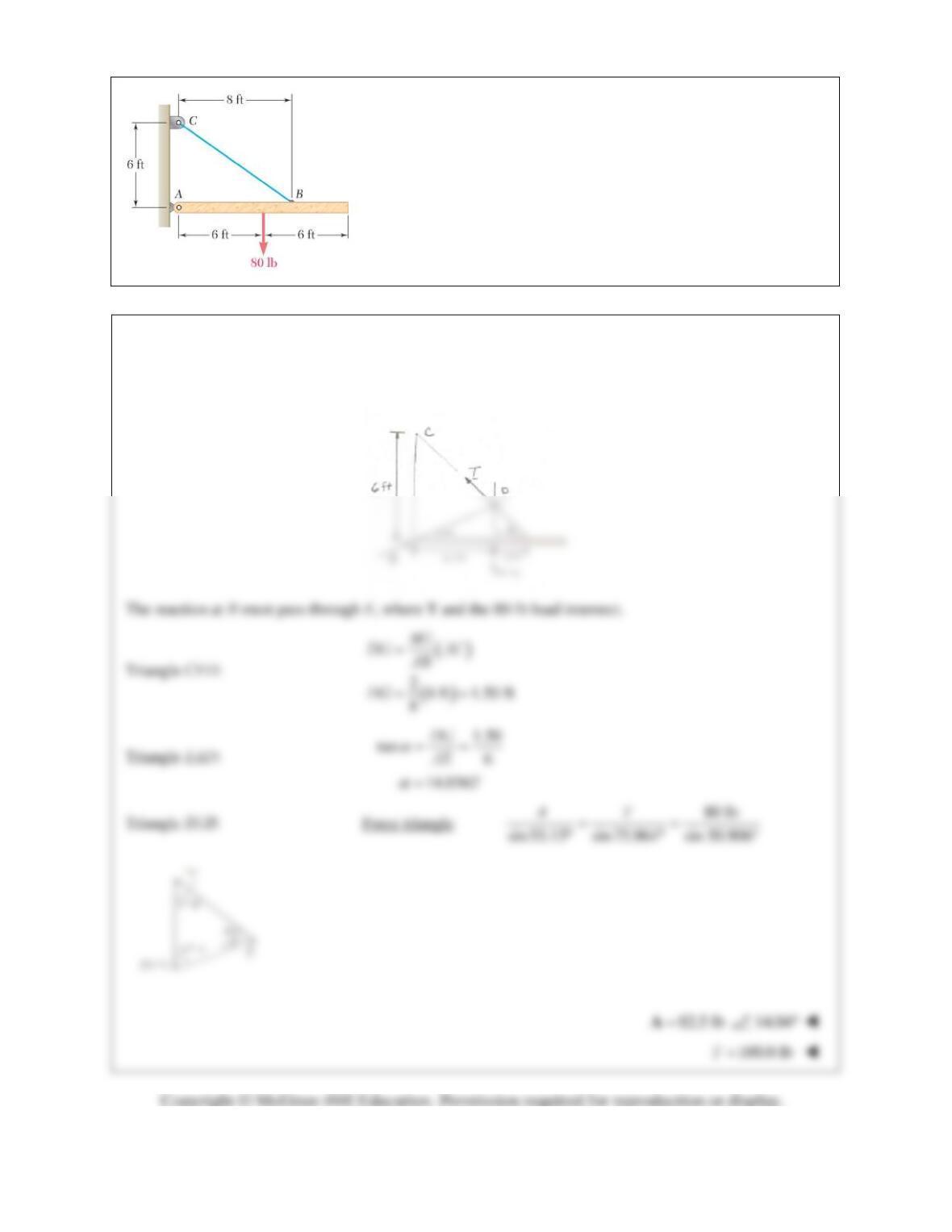
PROBLEM 4.66
A 12-ft wooden beam weighing 80 lb is supported by a pin and
bracket at A and by cable BC. Find the reaction at A and the tension
in the cable.
SOLUTION
Since CB is a two-force member, the force it exerts on member AB is directed along CB.
Free-Body Diagram
of AB: (Three-Force member)
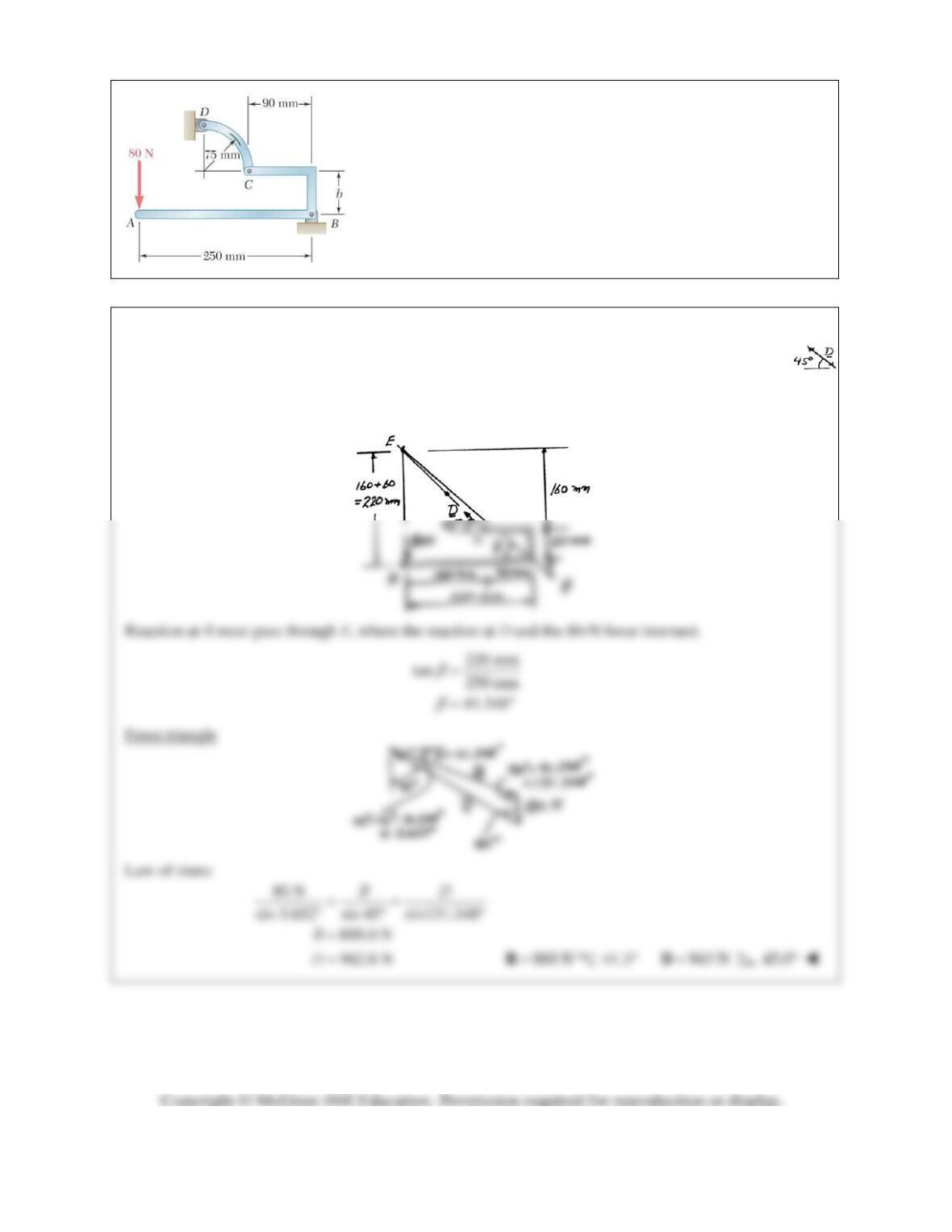
PROBLEM 4.67
Determine the reactions at B and D when
60 mm.b
SOLUTION
Since CD is a two-force member, the line of action of reaction at D must pass through Points C and D.
Free-Body Diagram:
(Three-force body)
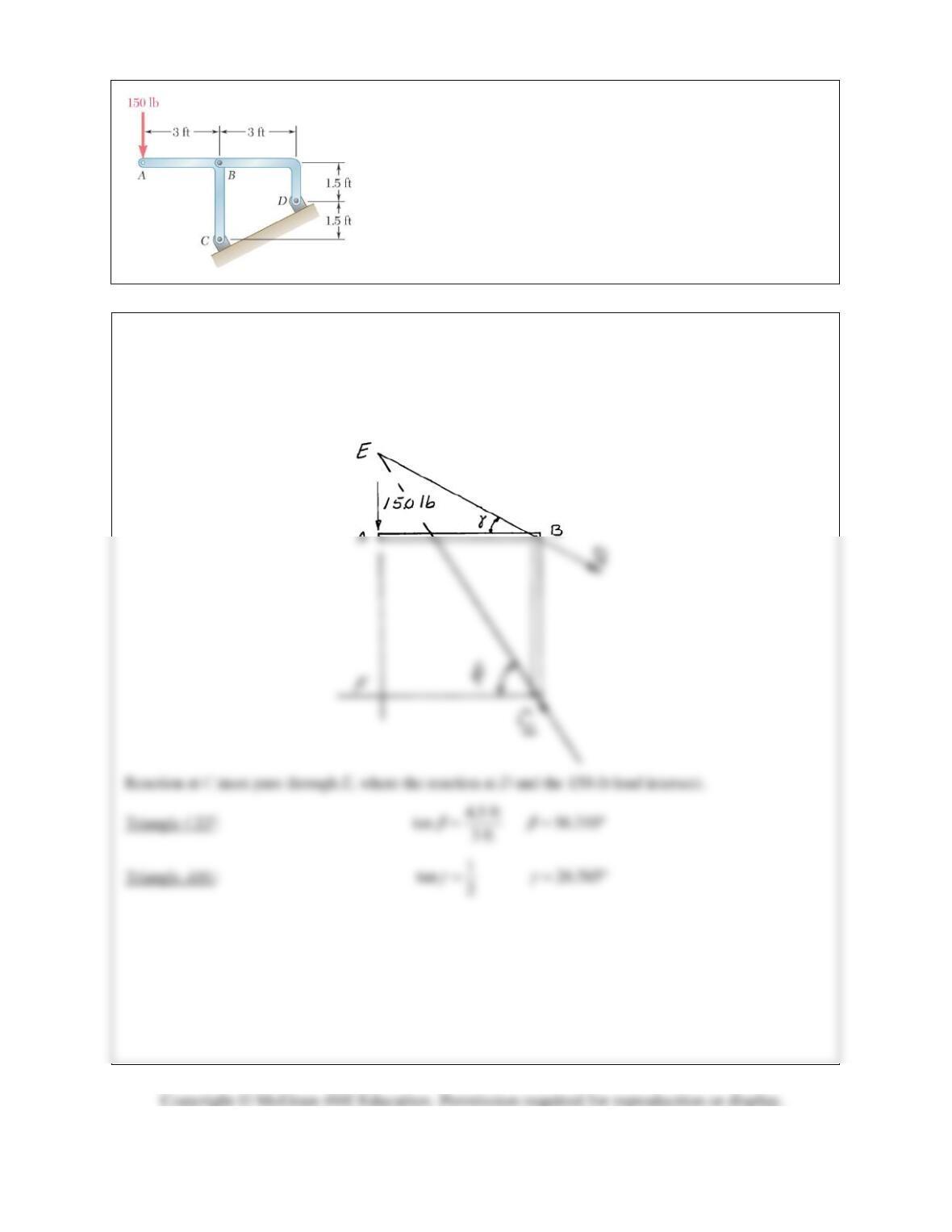
PROBLEM 4.68
For the frame and loading shown, determine the reactions at C and D.
SOLUTION
Since BD is a two-force member, the reaction at D must pass through Points B and D.
Free-Body Diagram:
(Three-force body)