CHAPTER 4
1. Are the two main differences in inventory accounting between U.S. GAAP and
IFRS?
2.What are the three major differences between U.S. GAAP and IFRS in the use of
market value in inventory accounting?
(1) Market is defined as net replacement value, not fair value, as defined by IFRS.
3.What is component depreciation and how do IFRS and U.S. GAAP differ
in application of component depreciation?
Component depreciation: The concept of component depreciation acknowledges
that each component of a building, production process, or other PPE asset has its
own useful life and fair value.
4.What is revaluation and how do IFRS and U.S. GAAP differ in application of
component depreciation?
The concept of revaluation recognizes a change in the fair value of an asset after its initial
acquisition.
5. To what does recalculation apply and how would it result in a revaluation
surplus? Where does the revaluation surplus appear in the financial statements?
When electing to revalue, the revaluation must be applied to the entire class or
6.What are the two methods that may be used to accomplish a revaluation?
(1) Proportional method: Accumulated depreciation is restated proportionately so that
7. What is derecognition and what eventually happens to the revaluation surplus?
8. What is recoverable amount and how is it computed?
9. What is value in use and how does it differ from fair value less costs to sell?
10.What are trigger events, how do they relate to impairment, and what are some
examples of trigger events?
A trigger event is an indication that impairment may have occurred. Indicators of impairment
11.To what business units does impairment test apply under U.S. GAAP and
IFRS? Why is the difference important?
Both U.S. GAAP and IFRS provide for impairment testing of long-lived assets
(tangible and intangible), the differences are significant:
12. When an impairment loss occurs under IFRS, who is the loss allocated to?
U.S. GAAP requires
IFRS test for impairment at the
13. How is accounting for intangible assets similar under IFRS and U.S.GAAP?
What is the major difference between IFRS and U.S.GAAP?
Intangible assets under IFRS are treated similarly to U.S. GAAP in several ways:
Initial recording of acquired intangible assets is at cost.
14. When is impairment of goodwill required to be tested and at what level
under IFRS? And how?
15. What are the three differences in accounting for research and development
cost between U.S. GAAP and IFRS?
U.S. GAAP requires both research and development costs to be expensed as incurred.
16. How is investment property defined and what is the major difference between
U.S GAAP and IFRS in accounting for investments?
Investment property is property held to earn rentals from outside parties or held for
17. What are the categories of financial instruments under the new IAS 9? How is
each measured and how do they differ from the current measurement under IAS
39?
Financial instruments consist of both assets and liabilities and currently have similar
requirements, with some exceptions, under IAS 39:
Financial assets (investments) held for trading at fair value with changes in profit
18. How would the new IAS 9 change the accounting for financial instruments?
Why are banks in particular opposed to the new standard?
Under the new IAS 9, the debt of countries owned by the banks fail to meet the
business model approach-the banks may sell the bonds and may have derivatives-and
losses), and possibly causing them to fail.
19. What is a defined pension plan and what are the two most important
considerations in determining whether a plan is properly funded?
A defined benefit plan promises to pay retirees a fixed (or defined) amount in their
retirement years based on their earnings.
20. What role does the discount rate play in considering whether a defined benefit
pension plan is properly funded and how do IFRS and U.S. GAAP differ in
determining the rate to be used?
Significant differences can occur in required funding of pension funds due to different
21. What is the difference between an operating lease and a financing lease? Why do
most companies prefer to structure leases as operating leases?
22. How have the IASB and the FASB tried to resolve lease accounting for lessors
under the Convergence Project?
Financing leases: The lessor model requires that most leases be recognized as financing
leases. Under this concept, a lease is recorded as a receivable (and the asset is
23. How have the IASB and the FASB tried to resolve lease accounting for lessees
under the Convergence Project?
Financing leases: The lessee model uses a right to use concept, which means that the
length of the lease considers the length of the original lease plus rights of renewal. Thus,
24. What role does the difference between probable and more likely than not play in
the recognition of deferred tax assets?

25. What major difference in classification of deferred tax assets and liabilities exists
between IFRS and U.S. GAAP?
26. How do U.S.GAAP and IFRS differ with regard to recognition of purchase
commitments?
U.S. GAAP do not record commitments, such as purchase agreements, as liabilities even
though they have a legal basis since commitments do not meet the technical definition of
27. How do U.S.GAAP and IFRS differ with regard to recognition of contingencies?
Under U.S. GAAP, contingent assets and liabilities are recognized if they are probable
28. How do U.S. GAAP and IFRS differ in their definition of equity?
29. What is a mezzanine category and why is it an important classification issue?

30. What is a compound financial instrument and how do U.S. GAAP and IFRS
differ in handling it on the balance sheet?
Compound financial instruments have the characteristics of both debt and equity and
31. How does the classification of noncontrolling (minority) interests differ under
U.S. GAAP and IFRS?
32. How is treasury stock classified under U.S. GAAP and IFRS?
Treasury stock is shown as a deduction under both U.S. GAAP and IFRS but under
33. How are the terms reserves and surplus used differently under U.S. GAAP and
IFRS?
34. How is accounting for share-based payments similar under U.S.GAAP and IFRS
and what is the major difference?
U.S. GAAP and IFRS handle share-based payments13 (SBP) in a similar manner in
that both
recognize goods or services paid in shares or SBP;
35. What role does judgment play in deciding whether a controlling interest exists
for consolidation under U.S. GAAP and IFRS?
U.S. GAAP require a greater than 50 percent ownership before financial statements of
36. What are some indicators of the power to influence decisions and operating
policy of an investee company?
Representation on the board of directors
37. Discussion or group question: Among the differences between U.S. GAAP and
IFRS listed in this section, which two do you feel are the most difficult to reconcile
and why?
The differences in Inventory and PPE Accounting are hard to reconcile.
(1) For inventory, if GAAP have to forbid the use of LIFO, those LIFO companies would
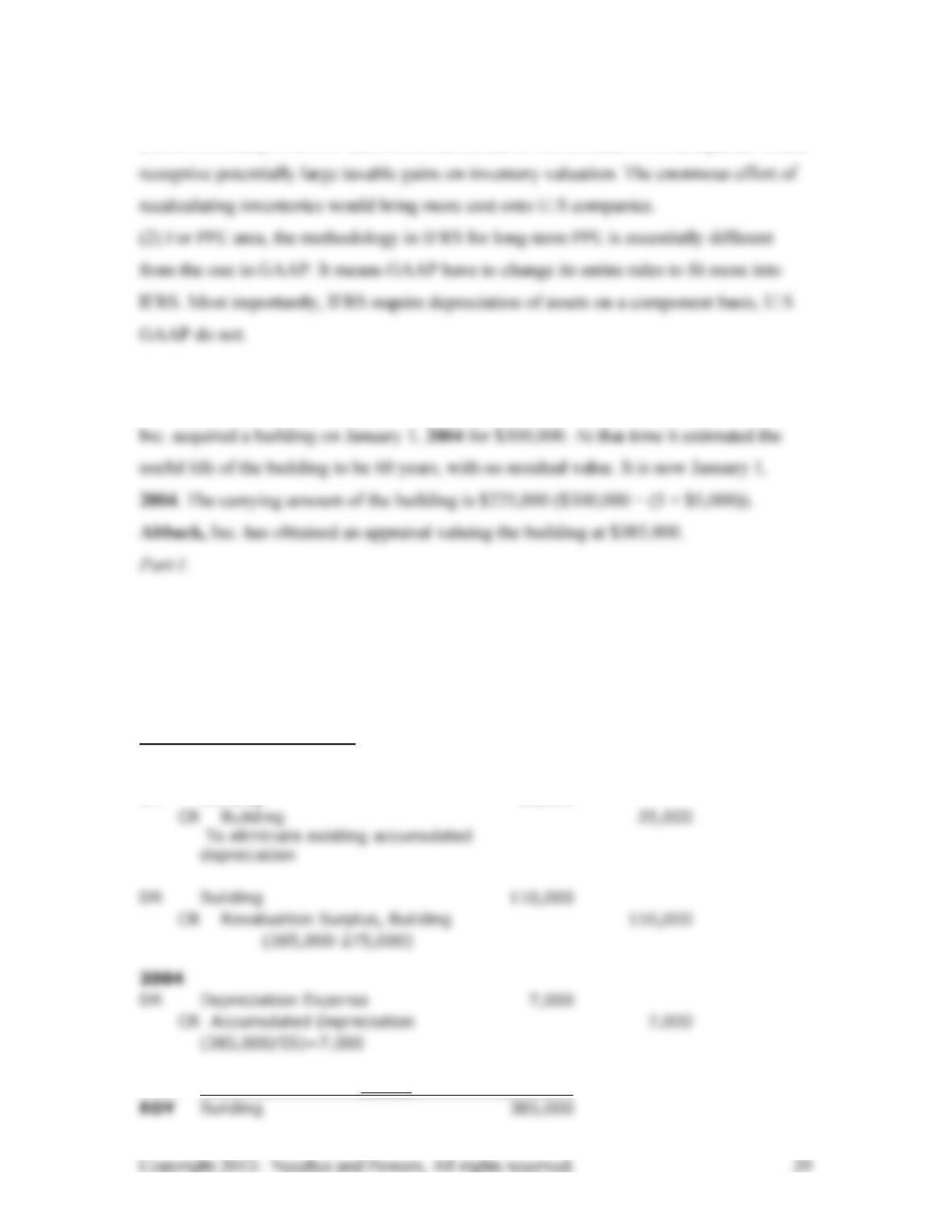
38. Exercise-Revaluation: Abback, Inc. prepares financial statements in accordance with
IFRS and has elected to use the revaluation model to account for its buildings. Abback,
1. Show the accounting entries to recognize the revaluation and corresponding
depreciation in 2004.
2. Show the balances on the building and revaluation surplus accounts as on
December 31, 2004.
Part I: 1. Initial revaluation
2004
DR
Accumulated Depreciation,
Building 25,000
2004 Assets
29
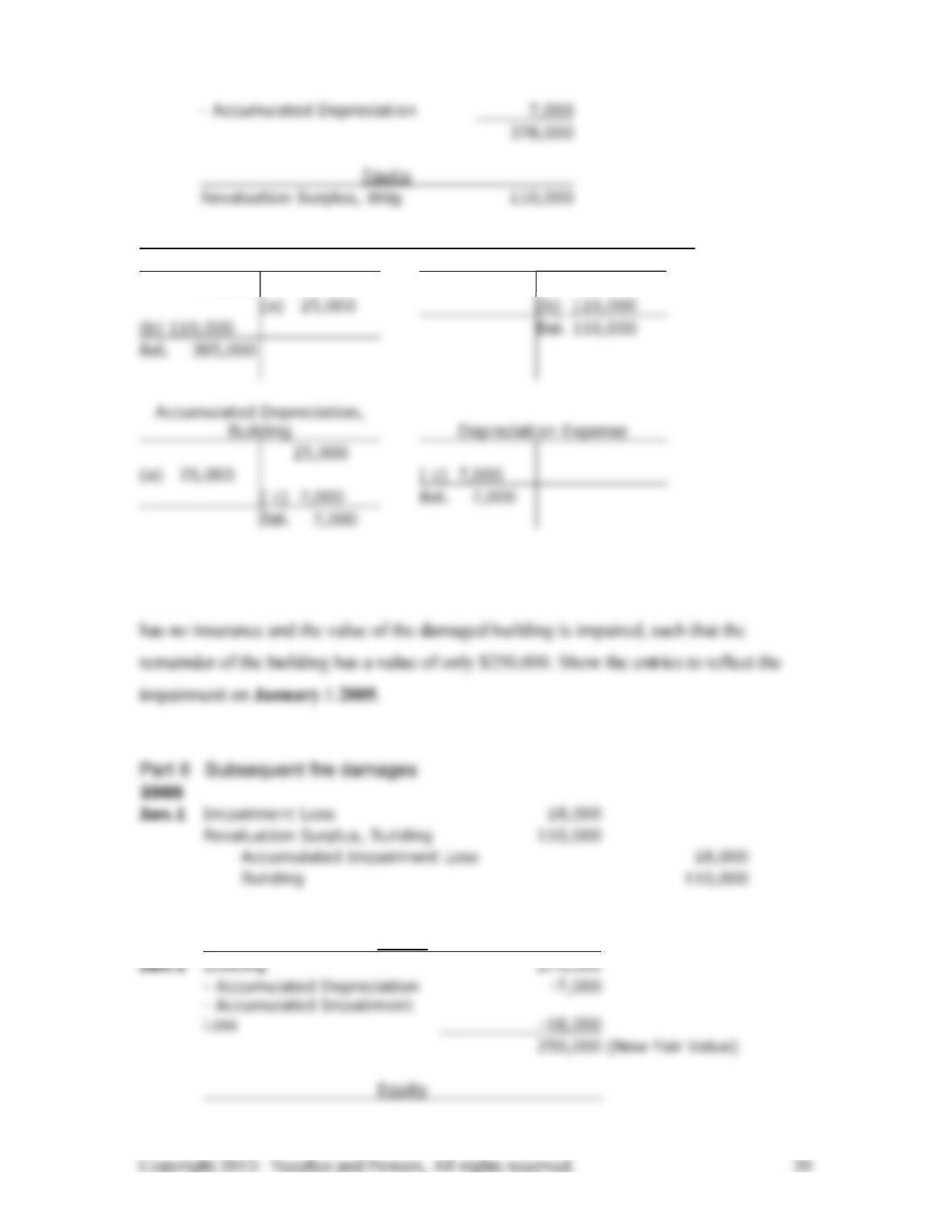
PART 1: 2. Entries and account balances also shown in t-accounts:
Building Revaluation Surplus, Building
300,000
Bal. 385,000
Part II:
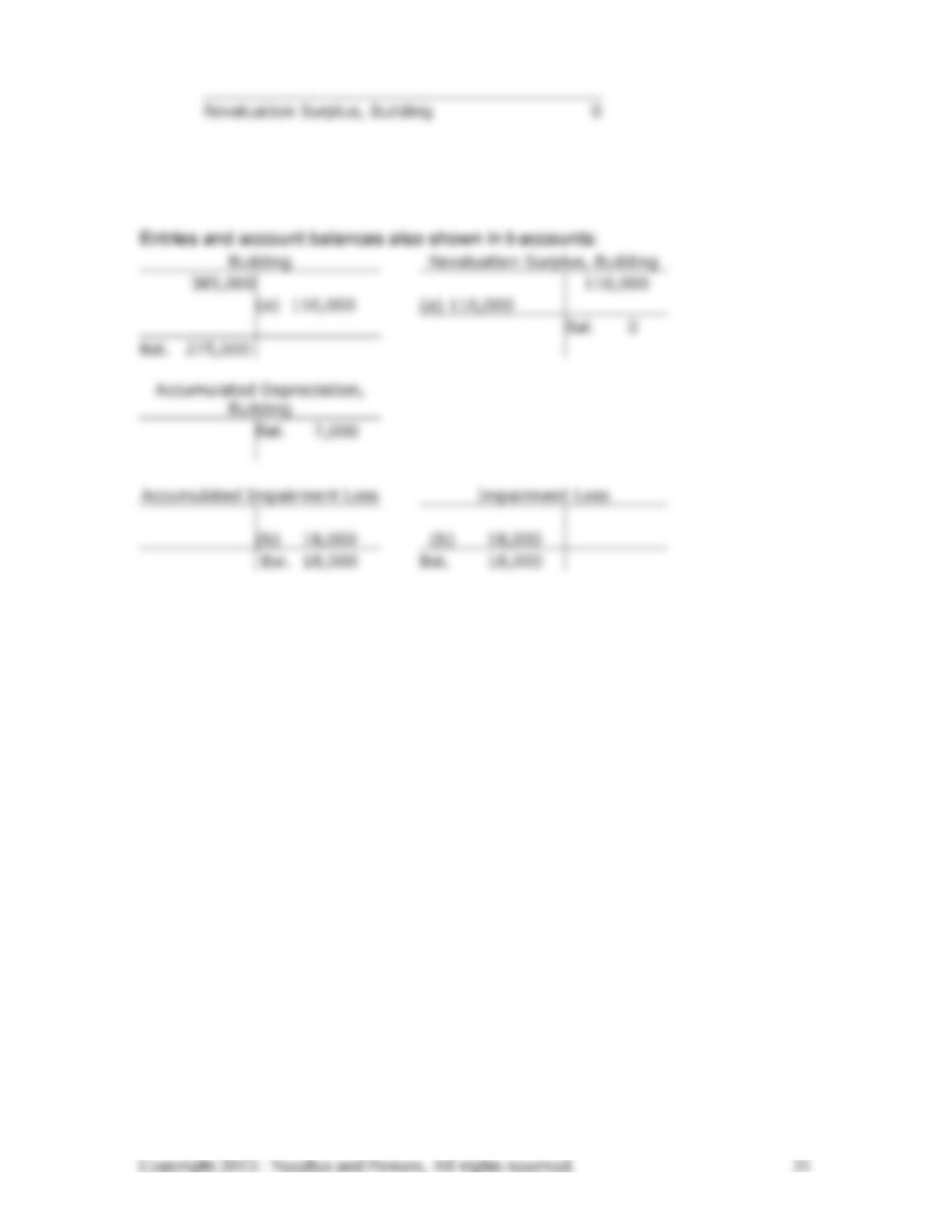
On January 1, 2005, a major fire damages a significant part of the building. Abback, Inc.
2005 Assets
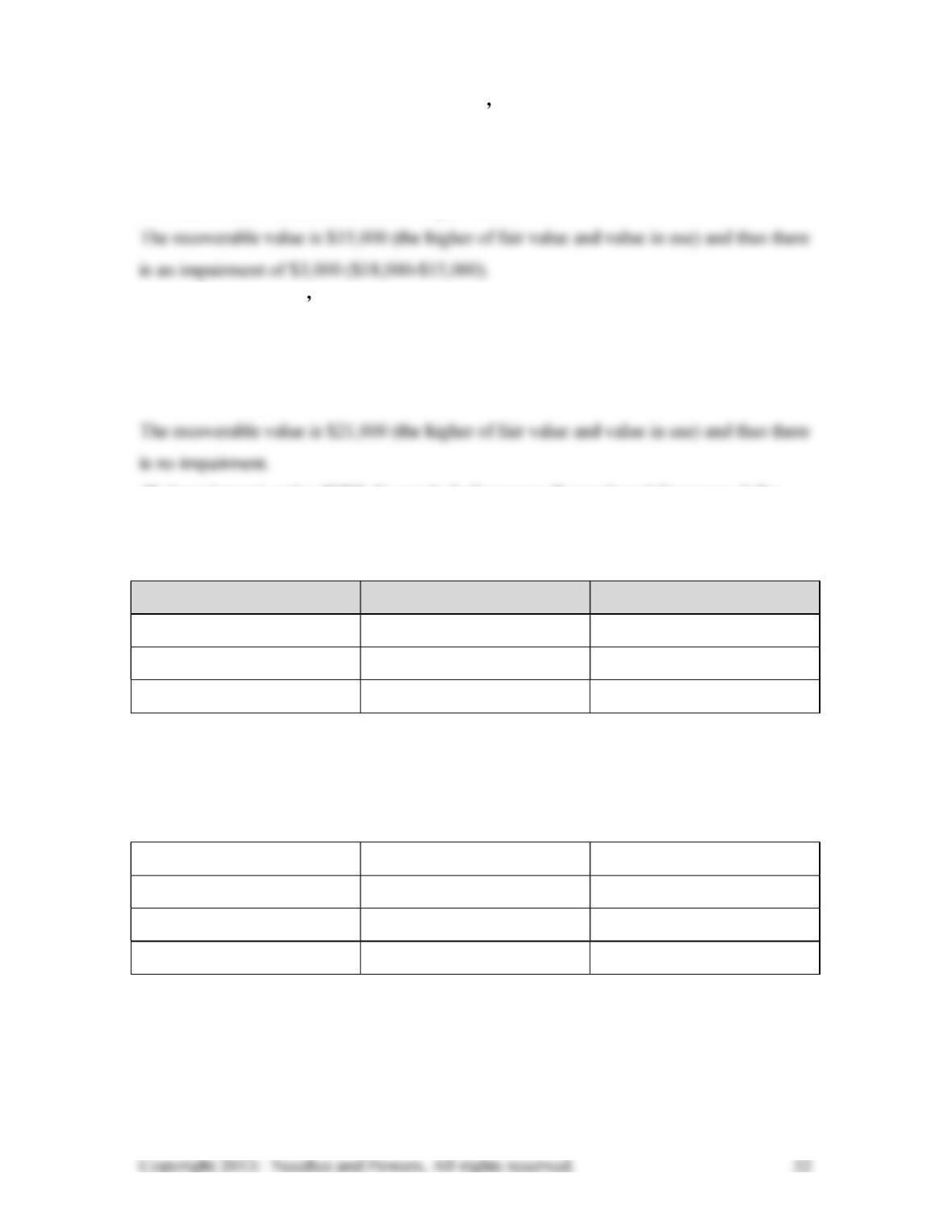
39. Recoverable value: Example 1: An asset s carrying value is $18,000 (cost of
$ 30,000 less depreciation of $12,000). The asset has fair value of $15,000 in a ready
external market and a discounted cash flow value (value in use) of $12,000. What is
the recoverable value, and is there impairment?
Example 2: An asset s carrying value is $18,000 (cost of $30,000 less depreciation of
$12,000). The asset has fair value of $12,000 in a ready external market and a
discounted cash flow value (value in use) of $21,000. What is the recoverable value,
and is there impairment.
40. Impairment under IFRS: Example 1: Company D purchased Company E for
$900,000. Company E has two cash-generating units: CGU1 and CGU2. The
carrying value is allocated as follows:
CGU 1 CGU2
Net assets $ 180,000 $360,000
Goodwill 120,000 240,000
Total assets $300,000 $600,000
One year later, an impairment test finds the fair value of Company E to be $720,000,
indicating an impairment of $ 180,000. After recording the impairment loss and
allocating it, show how the following accounts would appear:
CGU1 CGU2
Net assets $? $?
Goodwill ? ?
Total assets $? $?
After recording the impairment loss and allocating it proportionally against the goodwill
of the cash-generating units, the accounts would appear as follows:
CGU1 CGU2
Example 2: Assume that in a following year, the fair value of Company E continues
to decline and is now found to be $450,000. After recording the impairment loss and
allocating it, show how the following accounts would appear:
CGU1 CGU2
Net assets $? $?
Goodwill ? ?
Total assets $? $?
After recording the impairment loss and allocating it proportionally first ($180,000)
CGU1 CGU2
41. Exercise: Impairment:
Retail, Inc. has an operating segment (equivalent to an operating segment) that is
composed of three cash generating units:
CGU A CGU B CGU C
Identifiable long-lived assets $100,000
$250,000
$250,000
Other identifiable net assets 25,000
20,000
50,000
Goodwill 75,000
50,000
80,000
Book value $200,000
$320,000
$380,000
Undiscounted cash flows of CGU $225,000
$225,000
$700,000
Value in use of CGU 190,000
190,000
570,000
Fair value of CGU 185,000
185,000
560,000
1. Determine the amount of impairment loss to be recognized and the amount of any
impairment loss that is assigned to goodwill.
2. Determine what amount, if any, of the impairment loss potentially is available to
recover if the situation changes at a later point in time.
Under U.S. GAAP:
IFRS Impairment Loss by Cash Generating Unit
CGU A CGU B CGU C
34
US GAAP Impairment Loss by Reporting Unit (RU)