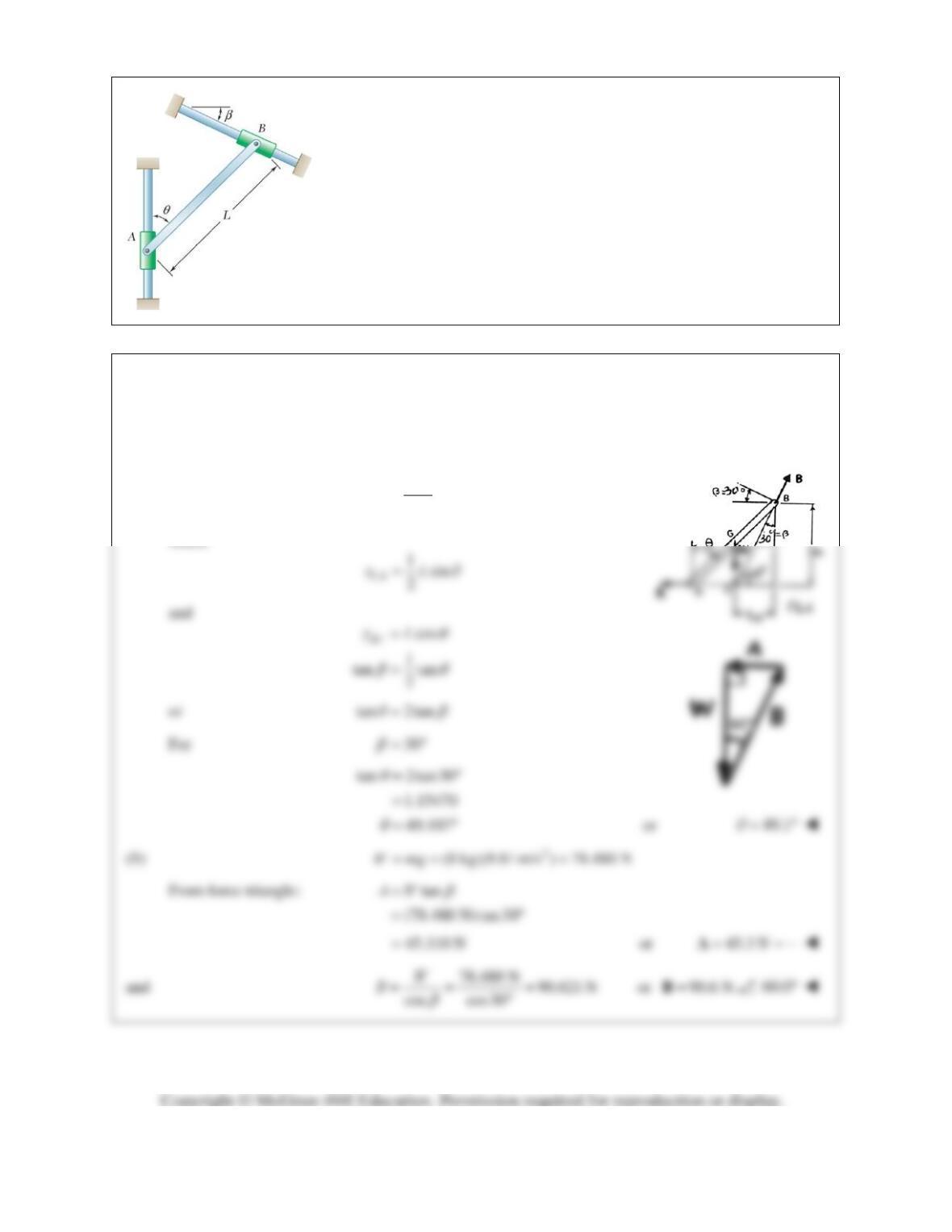
PROBLEM 4.85
An 8-kg slender rod of length L is attached to collars that can slide freely
along the guides shown. Knowing that the rod is in equilibrium and that
30, determine (a) the angle
that the rod forms with the vertical,
(b) the reactions at A and B.
SOLUTION
(a) As shown in the free-body diagram of the slender rod AB, the three forces intersect at C. From the
geometry of the forces:
Free-Body Diagram:
tan
CB
BC
x
y
where
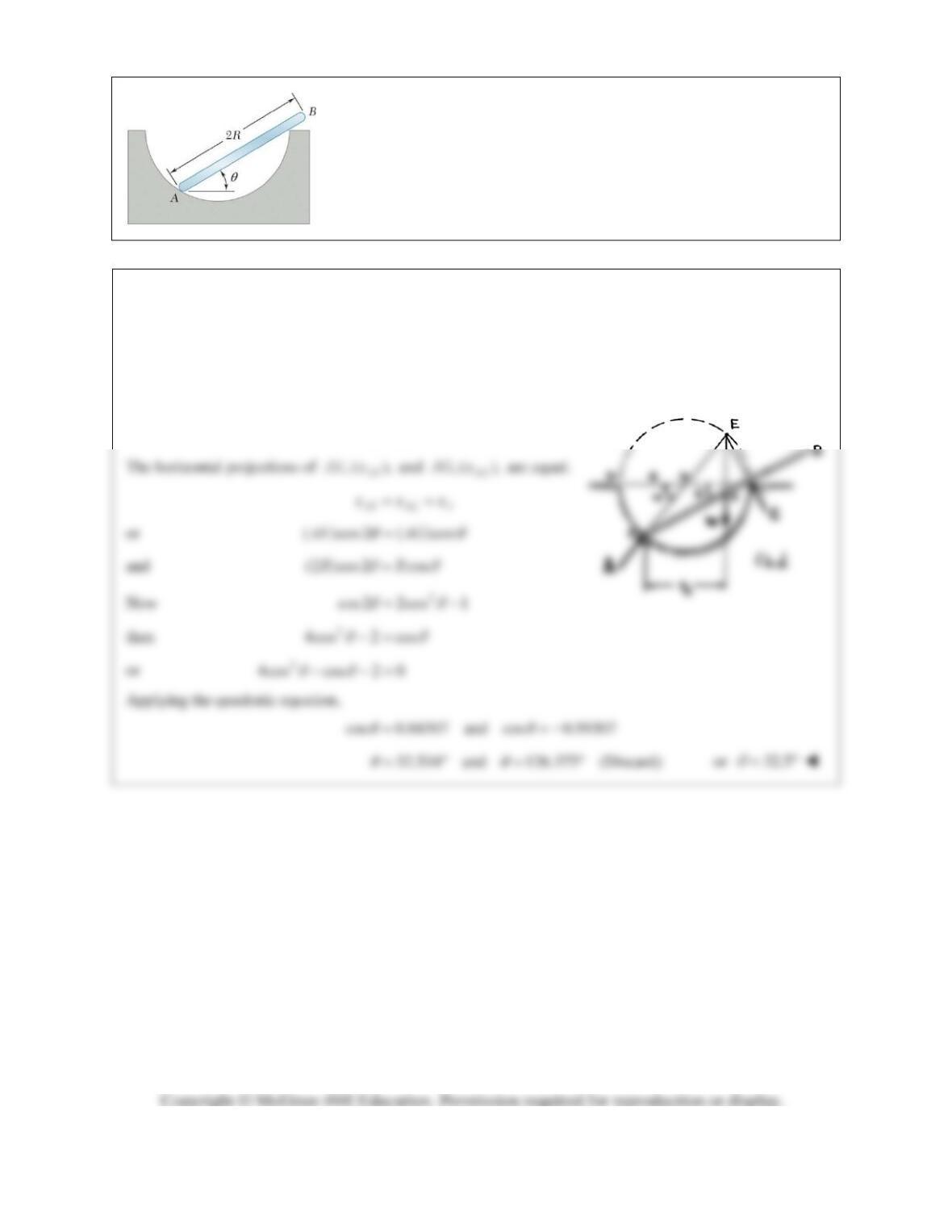
PROBLEM 4.86
A uniform rod AB of length 2R rests inside a hemispherical bowl of
radius R as shown. Neglecting friction, determine the angle
corresponding to equilibrium.
SOLUTION
Based on the F.B.D., the uniform rod AB is a three-force body. Point E is the point of intersection of the
three forces. Since force A passes through O, the center of the circle, and since force
C
is perpendicular to
the rod, triangle ACE is a right triangle inscribed in the circle. Thus, E is a point on the circle.
Note that the angle
of triangle DOA is the central angle corresponding to the inscribed angle
of
triangle DCA.
2
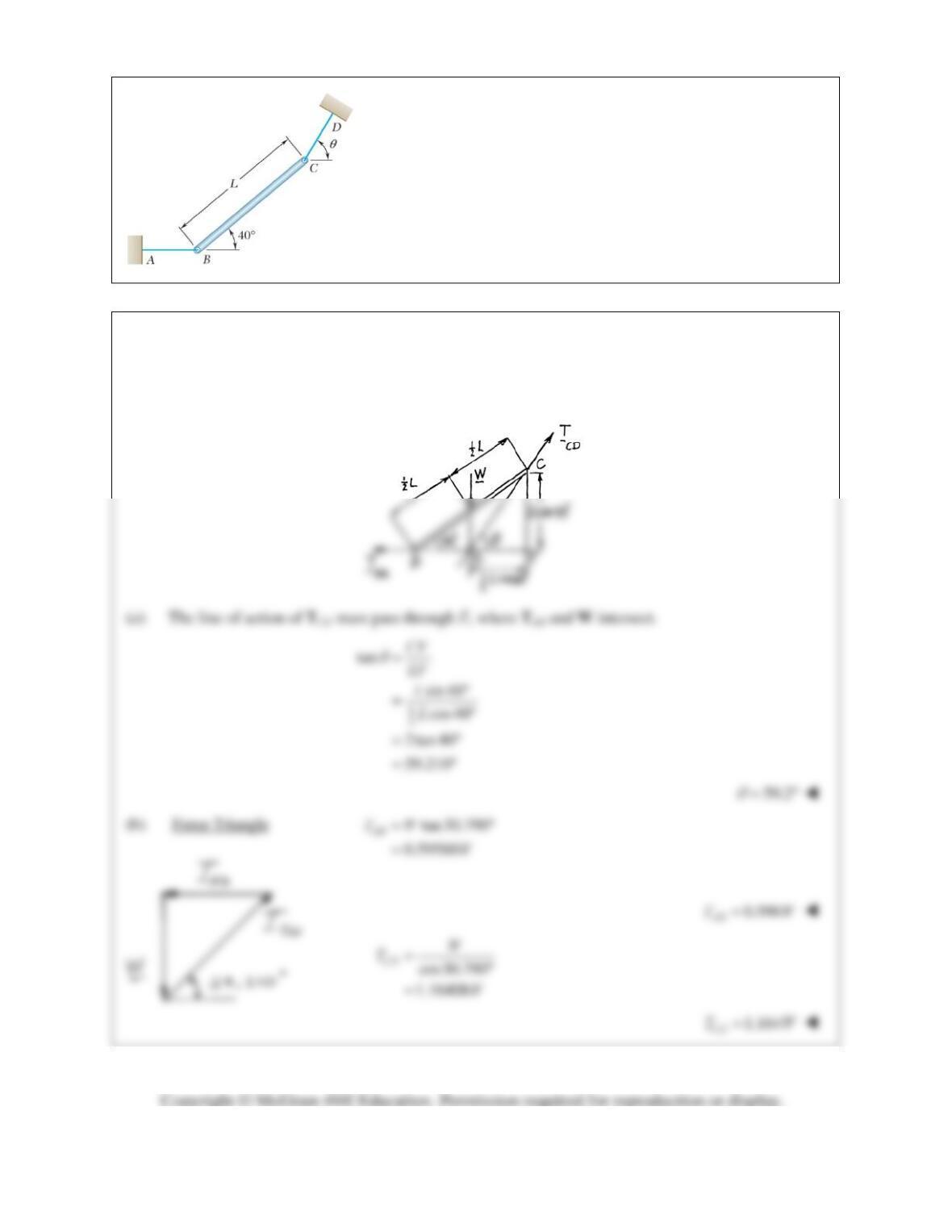
PROBLEM 4.87
A slender rod BC of length L and weight W is held by two cables as
shown. Knowing that cable AB is horizontal and that the rod forms
an angle of 40 with the horizontal, determine (a) the angle
that
cable CD forms with the horizontal, (b) the tension in each cable.
SOLUTION
Free-Body Diagram:
(Three-force body)
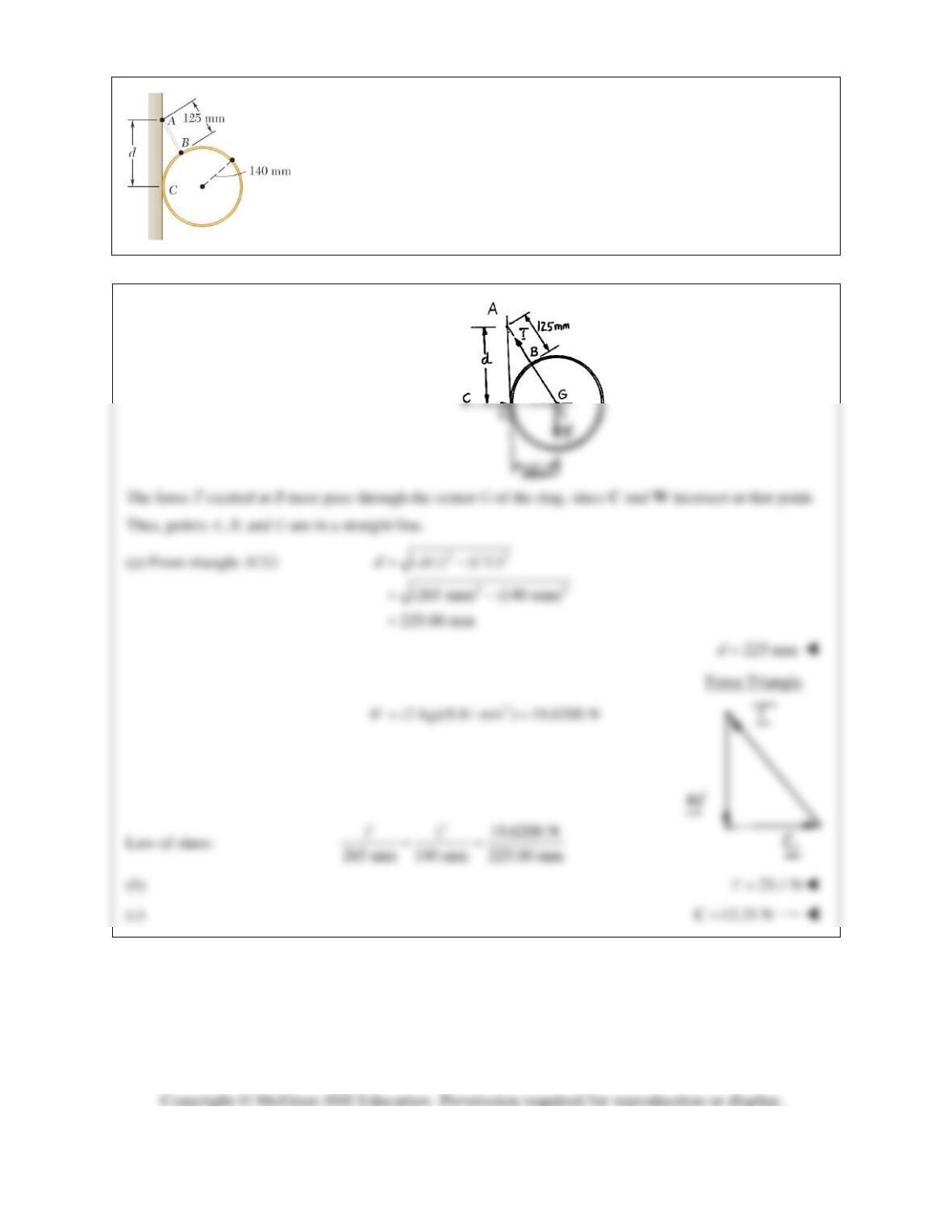
PROBLEM 4.88
A thin ring of mass 2 kg and radius r 140 mm is held against a frictionless
wall by a 125-mm string AB. Determine (a) the distance d, (b) the tension in
the string, (c) the reaction at C.
SOLUTION
Free-Body Diagram:
(Three-force body)
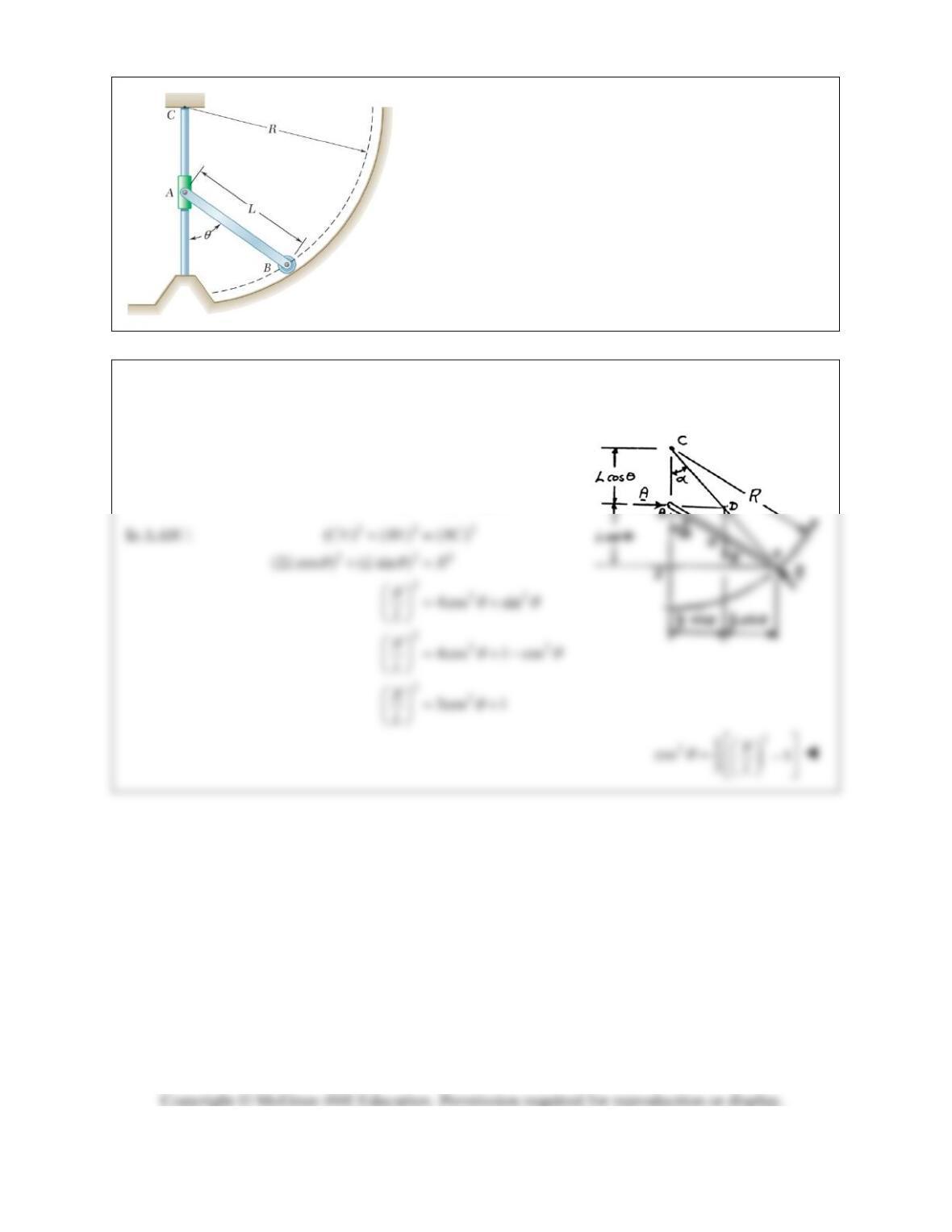
PROBLEM 4.89
A slender rod of length L and weight W is attached to a
collar at A and is fitted with a small wheel at B. Knowing
that the wheel rolls freely along a cylindrical surface of
radius R, and neglecting friction, derive an equation in
, L,
and R that must be satisfied when the rod is in equilibrium.
SOLUTION
Free-Body Diagram
(Three-force body)
Reaction
B
must pass through D where
B
and
W
intersect.
Note that ABC and BGD are similar.
cosAC AE L
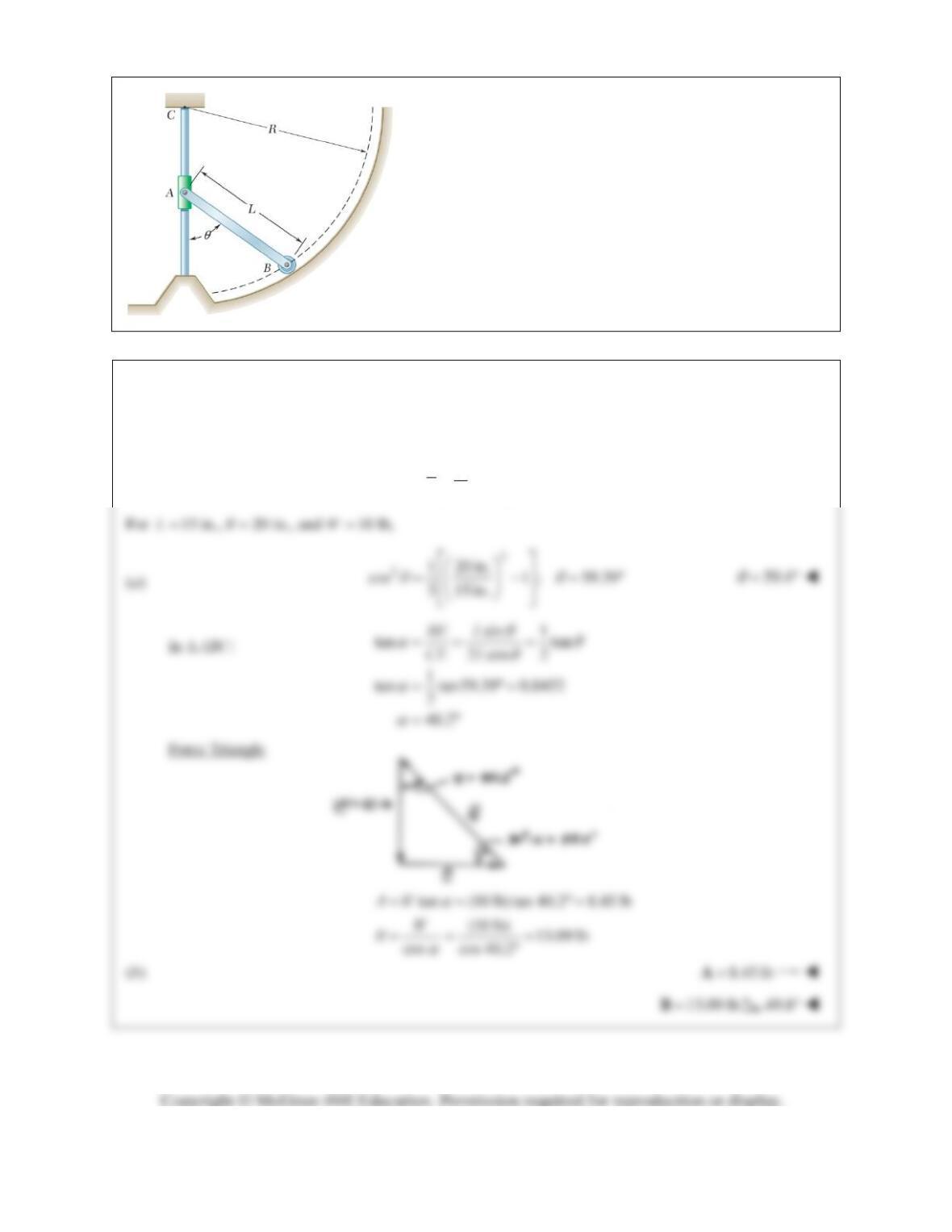
PROBLEM 4.90
Knowing that for the rod of Problem 4.89, L 15 in., R 20
in., and W 10 lb, determine (a) the angle
corresponding
to equilibrium, (b) the reactions at A and B.
SOLUTION
See the solution to Problem 4.86 for the free-body diagram and analysis leading to the following
equation:
2
2
1
cos 1
3
R
L
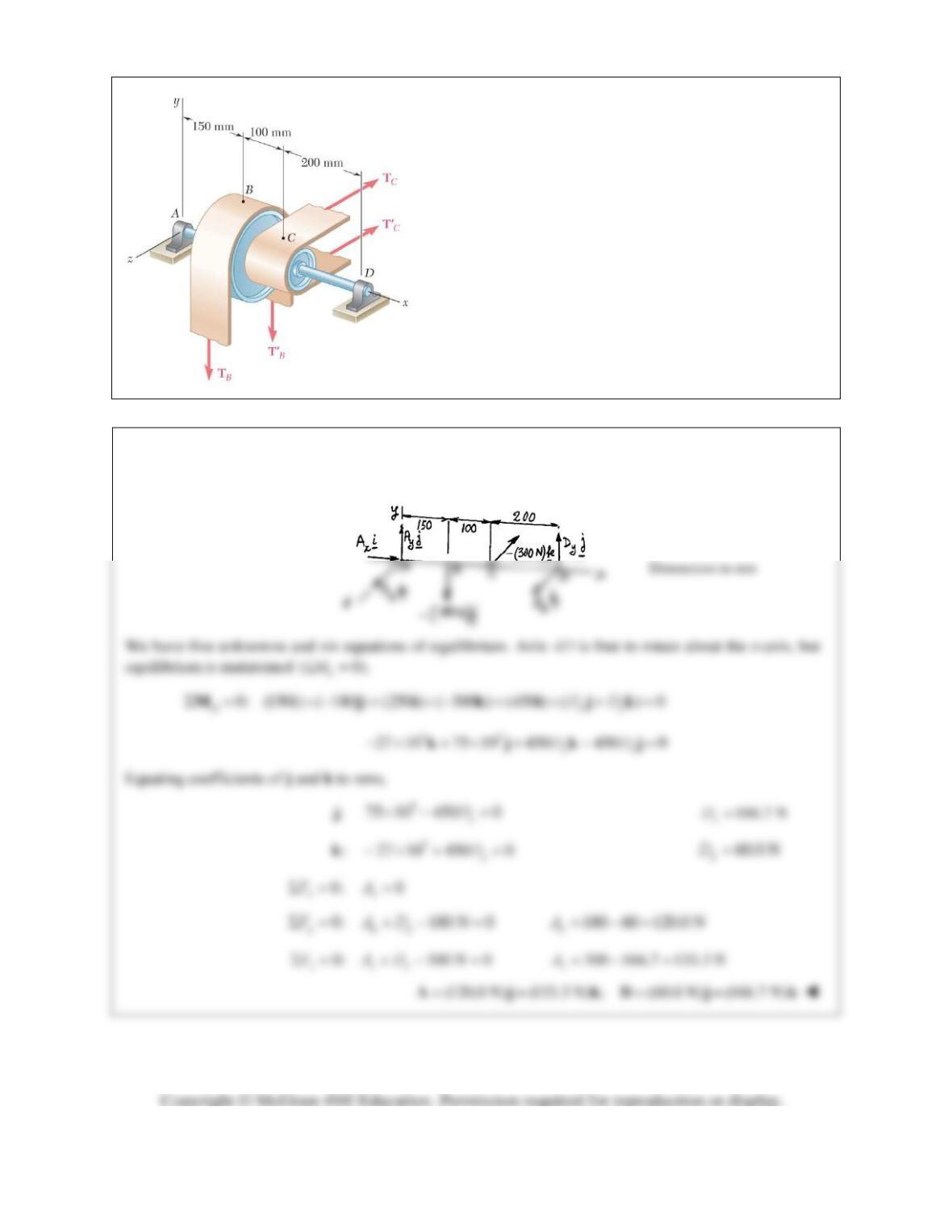
PROBLEM 4.91
Two transmission belts pass over a double-sheaved pulley
that is attached to an axle supported by bearings at A and
D. The radius of the inner sheave is 125 mm and the radius
of the outer sheave is 250 mm. Knowing that when the
system is at rest, the tension is 90 N in both portions of
belt B and 150 N in both portions of belt C, determine the
reactions at A and D. Assume that the bearing at D does
not exert any axial thrust.
SOLUTION
We replace B
T and B
T by their resultant ( 180 N)
j and C
T and C
T by their resultant ( 300 N) .k
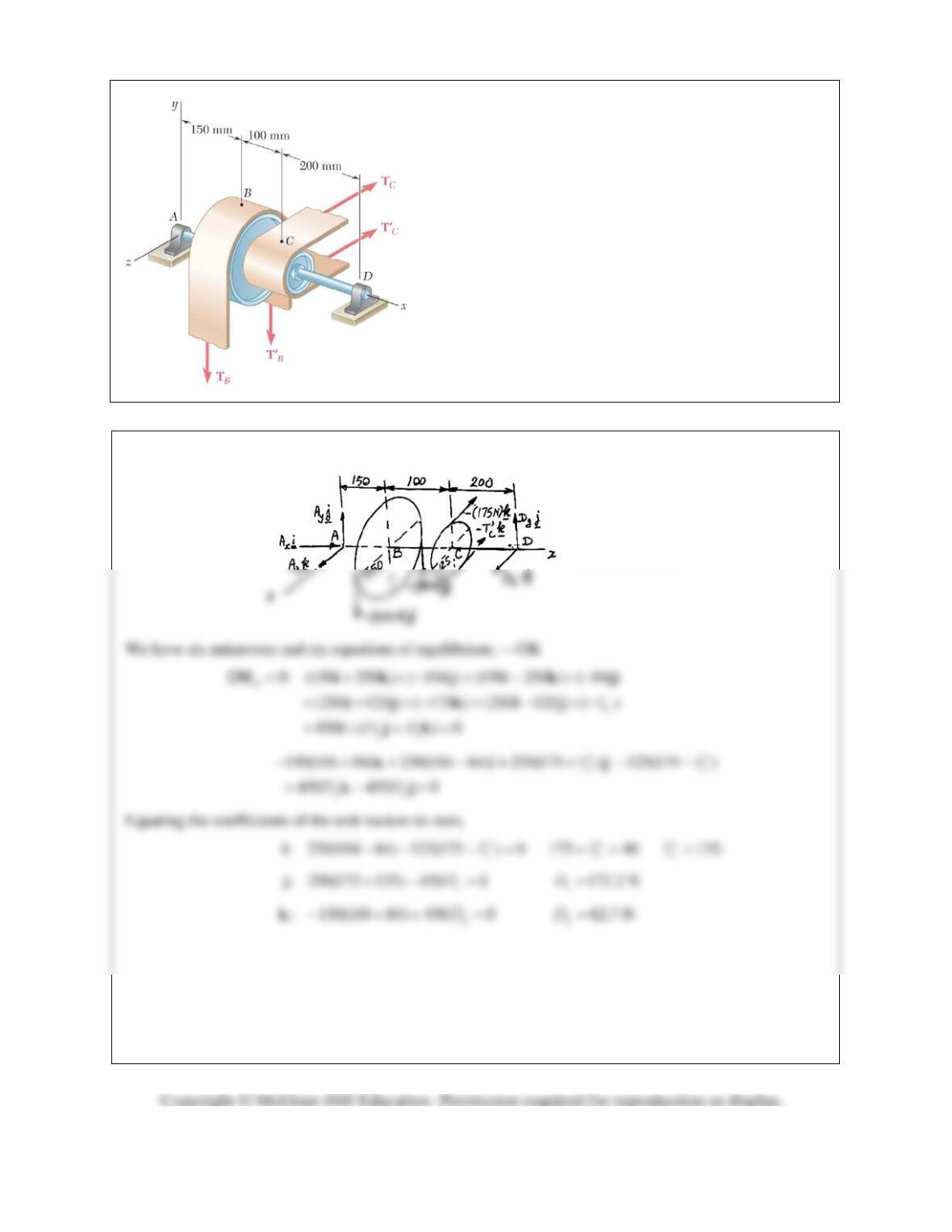
PROBLEM 4.92
Solve Problem 4.91, assuming that the pulley rotates at a
constant rate and that TB 104 N, T′B 84 N, TC 175 N.
PROBLEM 4.91 Two transmission belts pass over a
double-sheaved pulley that is attached to an axle supported
by bearings at A and D. The radius of the inner sheave is
125 mm and the radius of the outer sheave is 250 mm.
Knowing that when the system is at rest, the tension is 90 N
in both portions of belt B and 150 N in both portions of
belt C, determine the reactions at A and D. Assume that the
bearing at D does not exert any axial thrust.
SOLUTION
Dimensions in mm
PROBLEM 4.92 (Continued)
PROBLEM 4.93
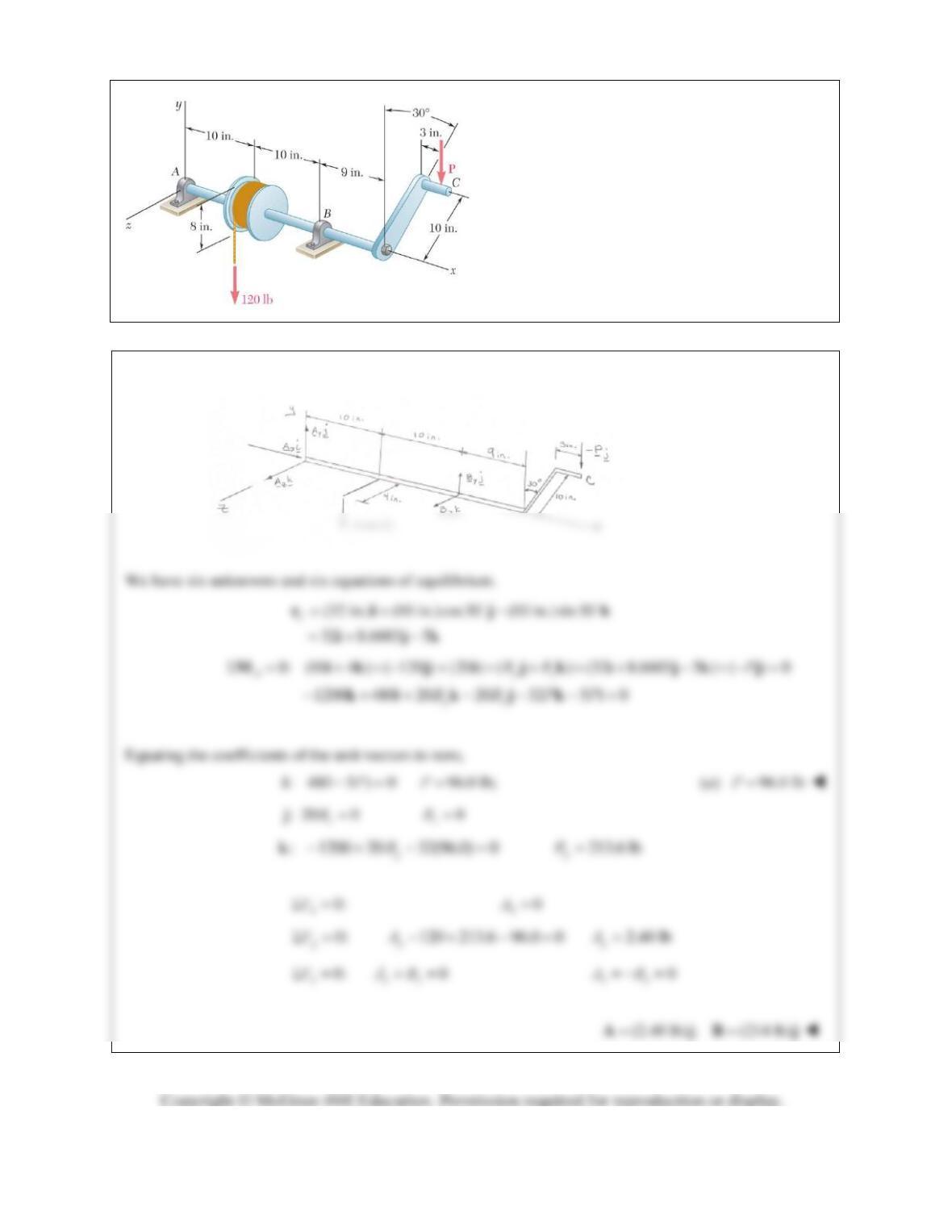
A small winch is used to raise a 120-lb load.
Find (a) the magnitude of the vertical force
P
that should be applied at C to maintain
equilibrium in the position shown, (b) the
reactions at A and B, assuming that the bearing at
B does not exert any axial thrust.
SOLUTION
Dimensions in in.
PROBLEM 4.94
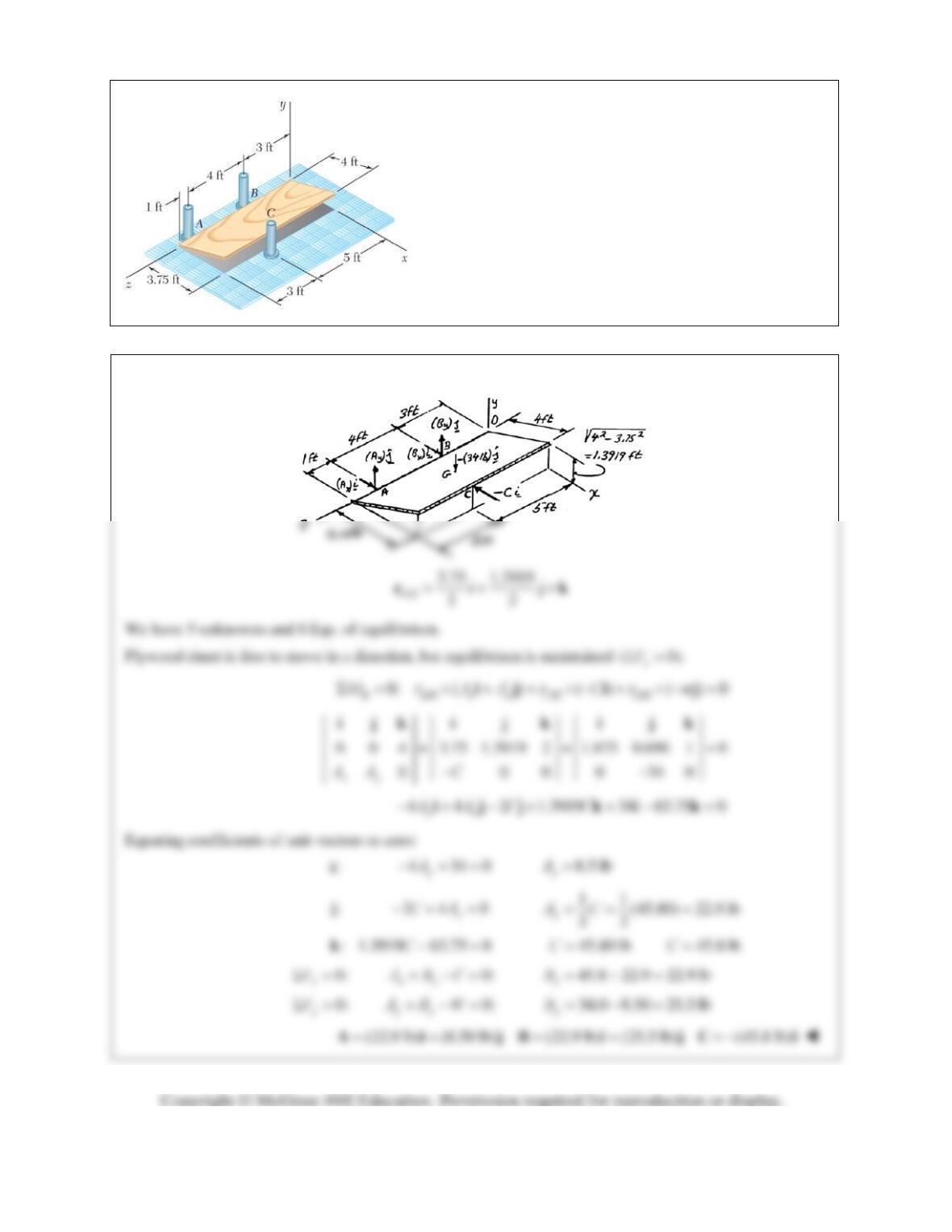
A
48–ft
sheet of plywood weighing 34 lb has been
temporarily placed among three pipe supports. The lower
edge of the sheet rests on small collars at A and B and its
upper edge leans against pipe C. Neglecting friction at all
surfaces, determine the reactions at A, B, and C.
SOLUTION
PROBLEM 4.95
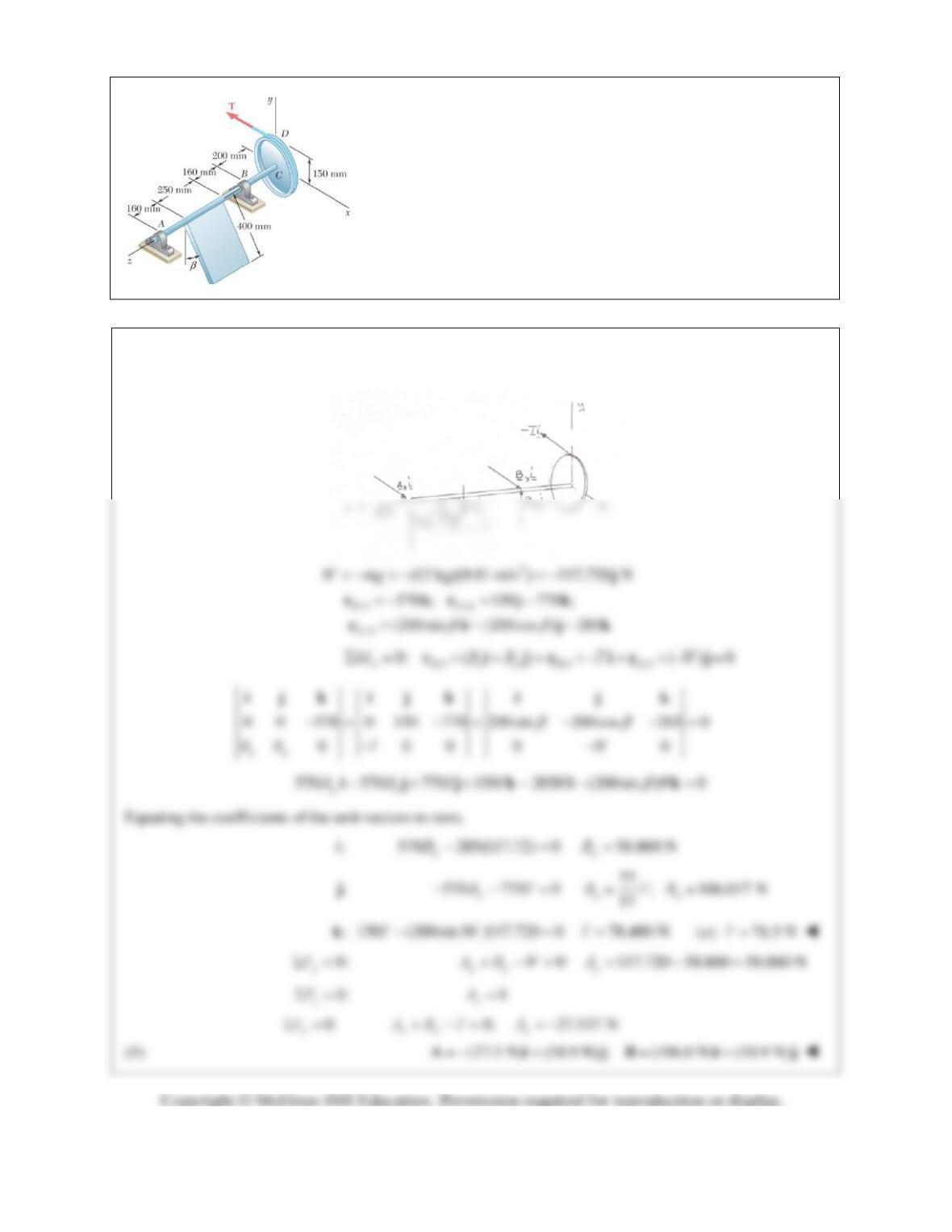
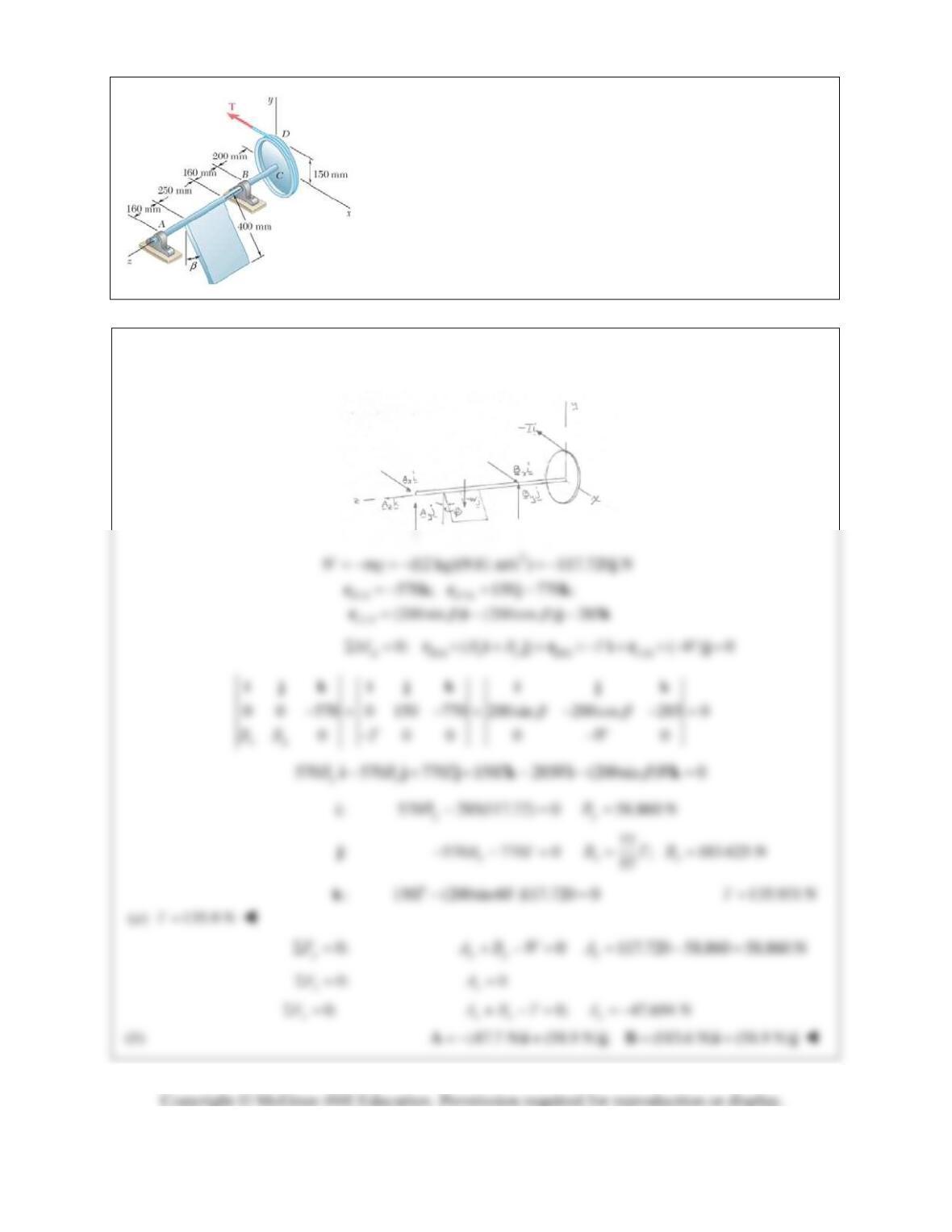
A 250 × 400-mm plate of mass 12 kg and a 300-mm-diameter
pulley are welded to axle AC that is supported by bearings at A and
B. For
= 30°, determine (a) the tension in the cable, (b) the
reactions at A and B. Assume that the bearing at B does not exert
any axial thrust.
SOLUTION
Free-Body Diagram:
PROBLEM 4.96
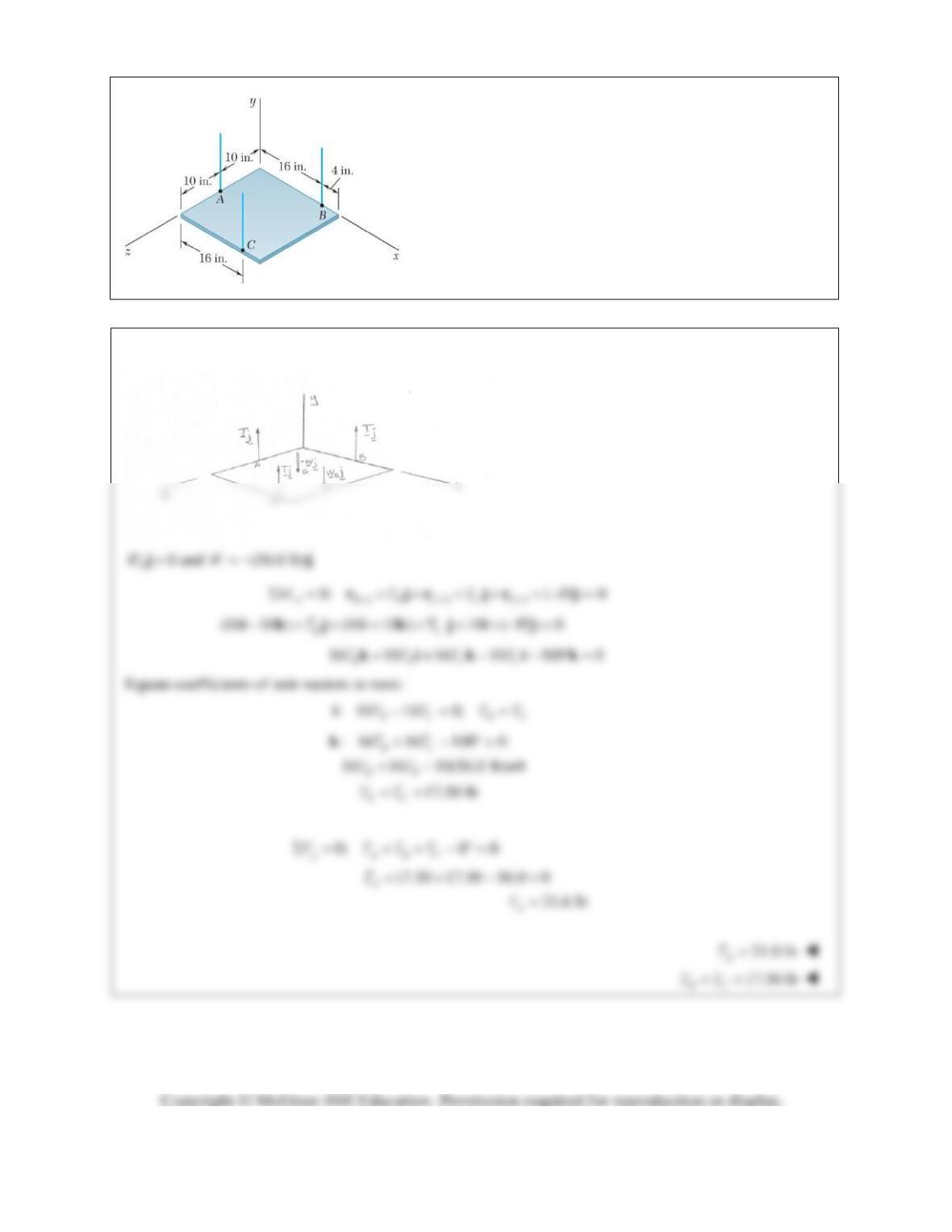
Solve Prob. 4.95 for
= 60°.
PROBLEM 4.95
A 250 × 400-mm plate of mass 12 kg and a
300-mm-diameter pulley are welded to axle AC that is supported
by bearings at A and B. For
= 30°, determine (a) the tension in
the cable, (b) the reactions at A and B. Assume that the bearing at
B does not exert any axial thrust.
SOLUTION
Free-Body Diagram:
PROBLEM 4.97
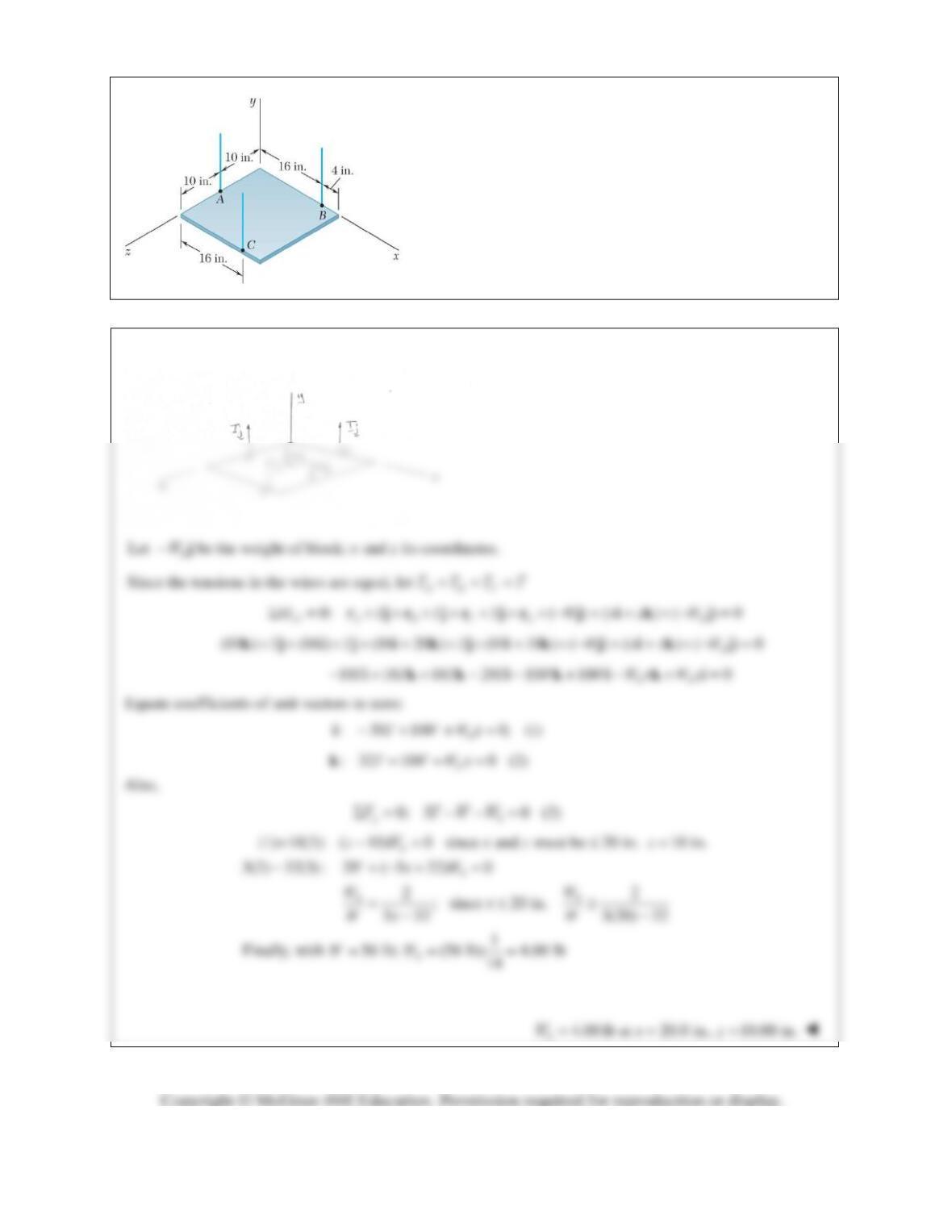
The 20 × 20-in. square plate shown weighs 56 lb and is
supported by three vertical wires. Determine the tension in
each wire.
SOLUTION
PROBLEM 4.98
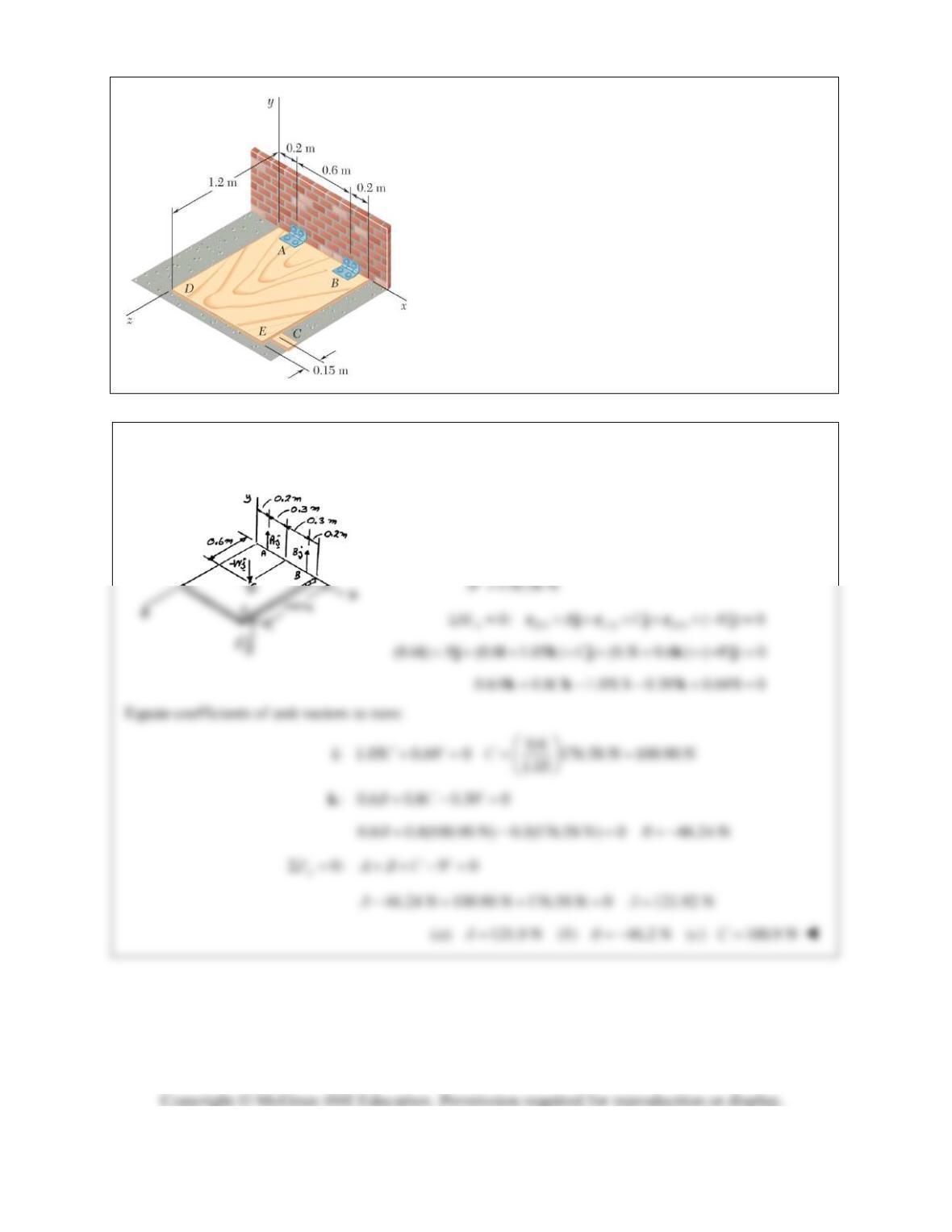
The 20 × 20-in. square plate shown weighs 56 lb and is
supported by three vertical wires. Determine the weight and
location of the lightest block that should be placed on the
plate if the tensions in the three wires are to be equal.
SOLUTION
PROBLEM 4.99
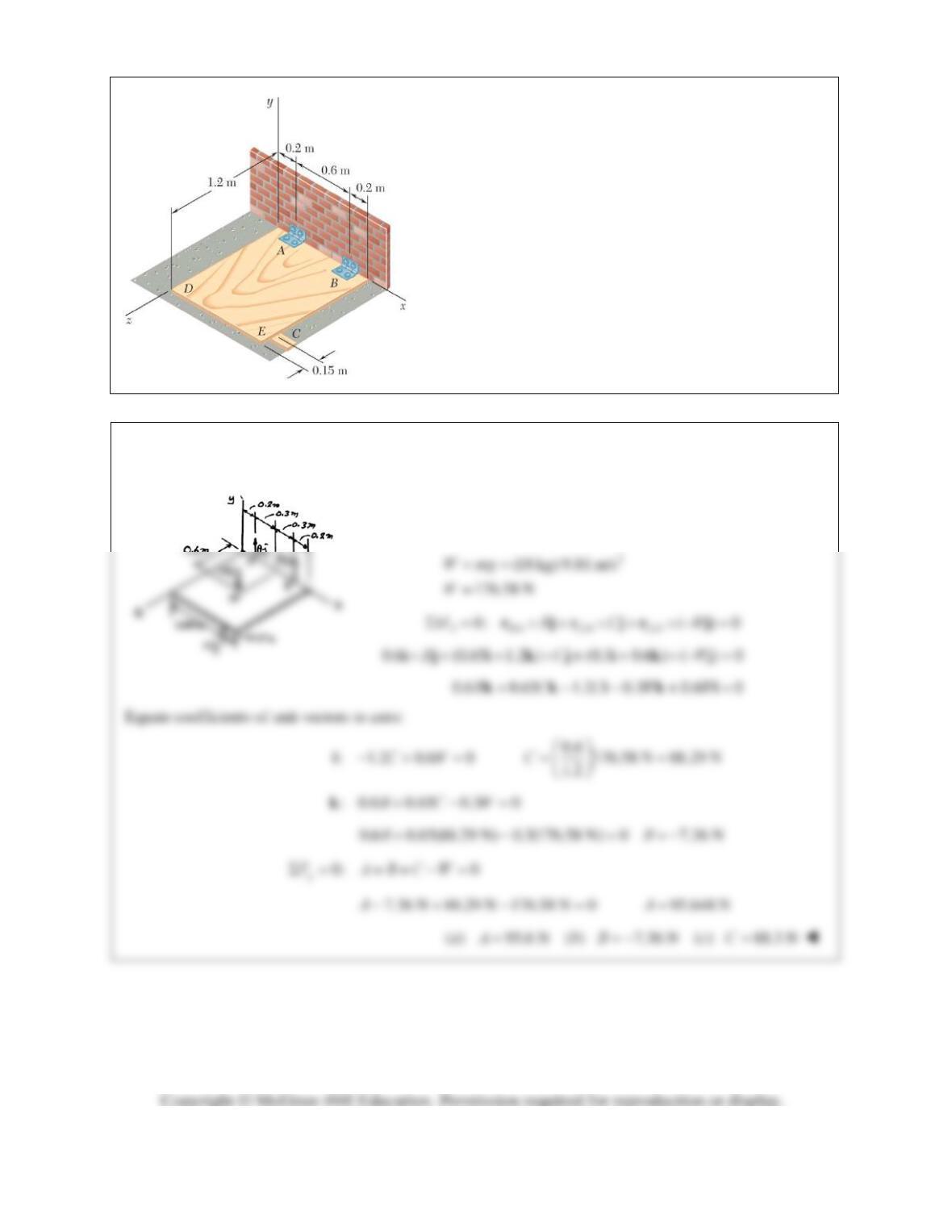
An opening in a floor is covered by a 1 1.2-m sheet of
plywood of mass 18 kg. The sheet is hinged at A and B and
is maintained in a position slightly above the floor by a
small block C. Determine the vertical component of the
reaction (a) at A, (b) at B, (c) at C.
SOLUTION
/
/
/
0.6
0.8 1.05
0.3 0.6
BA
CA
GA
ri
rik
rik
(18 kg)9.81
Wmg
PROBLEM 4.100
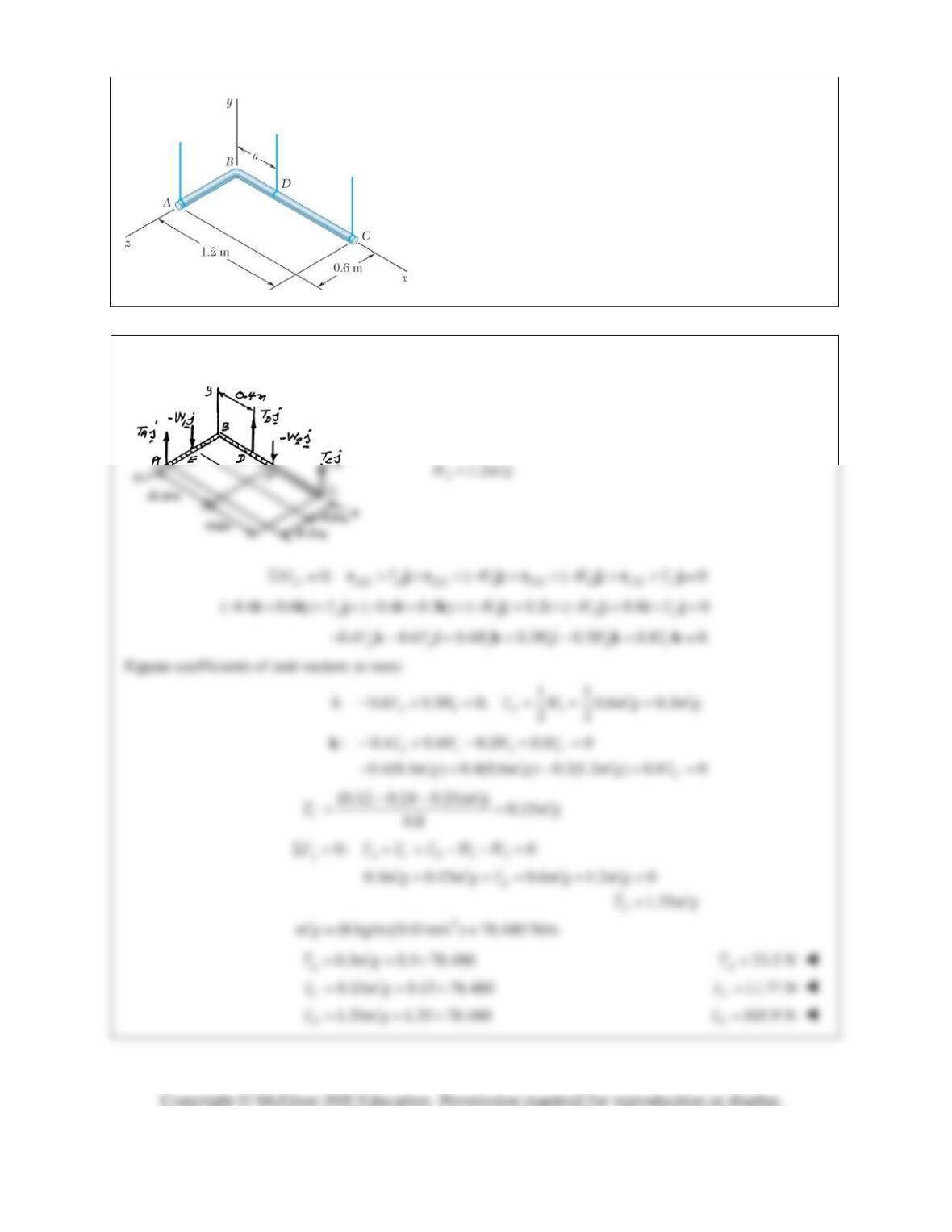
Solve Problem 4.99, assuming that the small block C is
moved and placed under edge DE at a point 0.15 m from
corner E.
PROBLEM 4.99
An opening in a floor is covered by a
11.2–m sheet of plywood of mass 18 kg. The sheet is
hinged at A and B and is maintained in a position slightly
above the floor by a small block C. Determine the vertical
component of the reaction (a) at A, (b) at B, (c) at C.
SOLUTION
/
/
/
0.6
0.65 1.2
0.3 0.6
BA
CA
GA
ri
rik
rik
PROBLEM 4.101
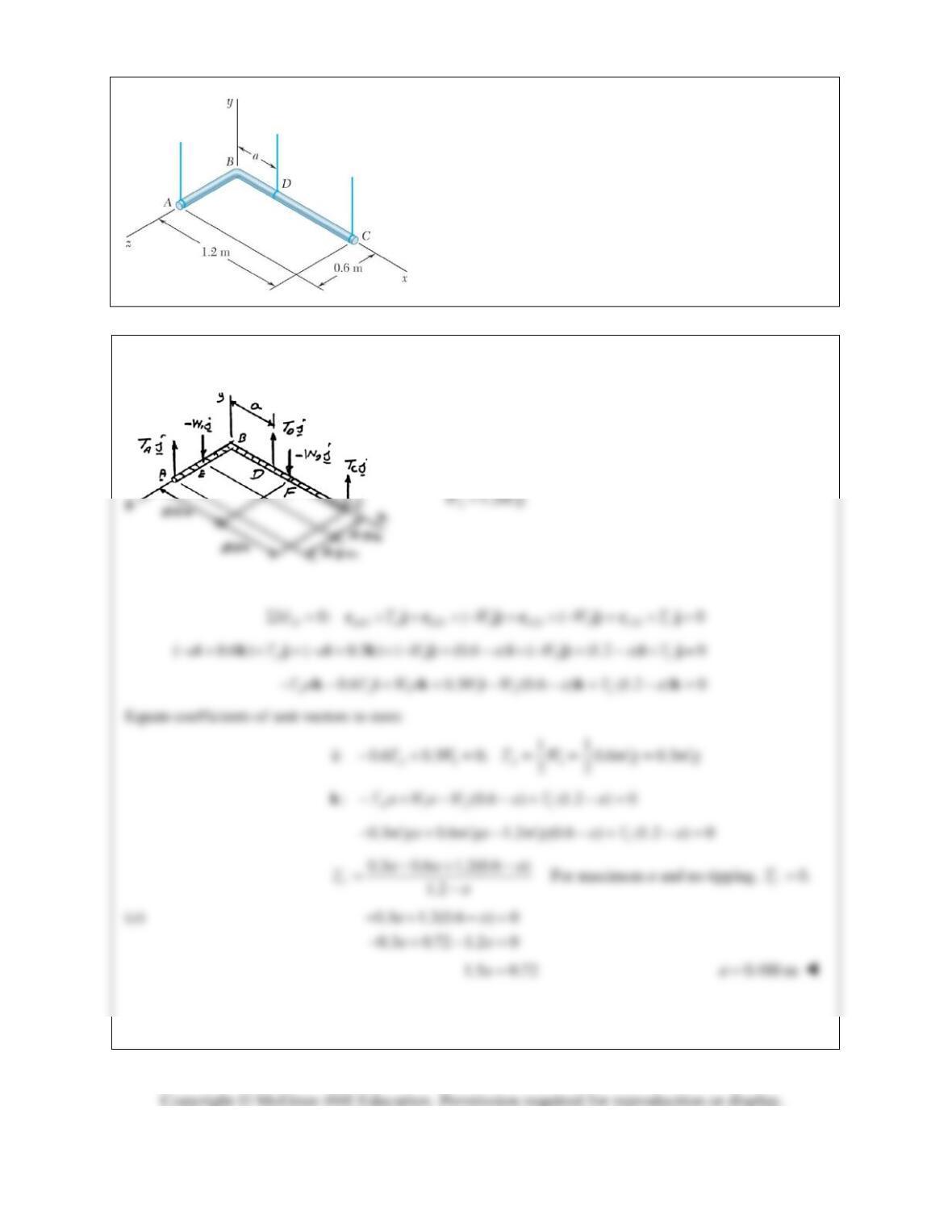
Two steel pipes AB and BC, each having a mass per unit
length of 8 kg/m, are welded together at B and supported
by three wires. Knowing that
0.4 m,a
determine the
tension in each wire.
SOLUTION
1
0.6
Wmg
PROBLEM 4.102
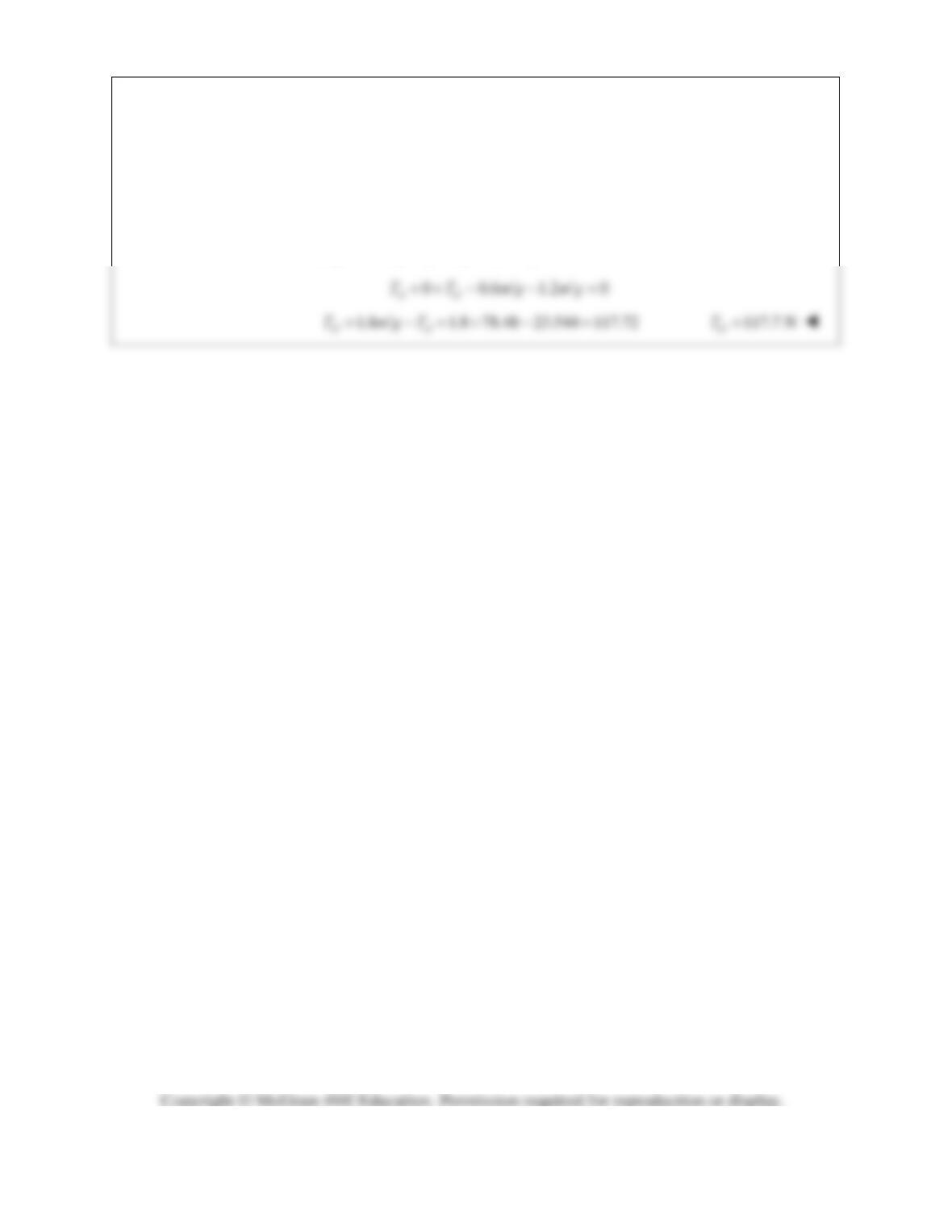
For the pipe assembly of Problem 4.101, determine (a) the
largest permissible value of a if the assembly is not to tip,
(b) the corresponding tension in each wire.
SOLUTION
1
0.6
Wmg
PROBLEM 4.102 (Continued)
(b) Reactions: 2
(8 kg/m) 9.81 m/s 78.48 N/mmg
0.3 0.3 78.48 23.544 N
A
Tmg
23.5 N
A
T
12
0: 0
yACD
FTTTWW