Problem 4-16 (continued)
2.
Accounts Receivable
Raw Materials
(g)
1,400,000
Bal.
198,600
(a)
192,600
Bal.
6,000
Work in Process
Blending Department
Work in Process
Bottling Department
Bal.
32,800
(e)
722,000
Bal.
49,000
(f)
920,000
(a)
147,600
(a)
45,000
(b)
73,200
(b)
(d)
(d)
Bal.
(e)
Bal.
21,000
Bal.
(g)
890,000
(c)
(d)
(f)
Bal.
Bal.
(c)
596,000
(b)
(g)
1,400,000
(g)
Problem 4-17 (60 minutes)
Weighted-Average Method
1. Computation of equivalent units in ending inventory:
Mixing
Materials
Conversion
Units transferred to the next department ……..
1.0
Equivalent units of production ……………………
2. Costs per equivalent unit:
Mixing
Materials
Conversion
Cost of beginning work in process inventory ….
$ 1,640
$ 26
$ 105
Total cost ………………………………………………
Equivalent units of production ……………………
Problem 4-17 (continued)
3. Costs of ending work in process inventory and units transferred out:
Mixing
Materials
Conversion
Total
Ending work in process inventory:
Equivalent units of production ………………..
1.0
0.2
0.1
Cost per equivalent unit ………………………..
$1,580
$140
$1,020
Units completed and transferred out:
Units transferred to the next department ….
Cost of units transferred out ………………….
4. Cost reconciliation:
Cost to be accounted for:
Cost of beginning work in process inventory
($1,640 + $26 + $105) …………………………
$ 1,771
Cost added to production during the period
Costs accounted for as follows:
164,400
Problem 4-18 (30 minutes)
Weighted-Average Method
1.
Total units transferred to the next department …
30,000
Less units in the May 1 inventory ………………….
Units started and completed in May……………….
2.
The equivalent units were:
Materials
Conversion
Transferred to next department ………………
30,000
30,000
Ending work in process:
Equivalent units of production ………………..
3.
The costs per equivalent unit were:
Materials
Conversion
Cost of beginning work in process …………….
£ 9,000
£ 4,400
Cost added during the period …………………..
Total cost (a) ……………………………………….
Cost per equivalent unit, (a) ÷ (b) ……………
4.
The ending work in process figure is verified as follows:
Materials
Conversion
Total
Ending work in process inventory:
(see above) …………………………...
Cost of ending work in process
Equivalent units of production
inventory ……………………………….
£6,000
£2,200
£8,200
5. Multiplying the unit cost figure of £3.10 per unit by 1,000 units does
not
provide a valid estimate of the incremental cost of processing an
Case 4-19 (90 minutes)
• This case is difficult—particularly part 3, which requires analytical skills.
1.
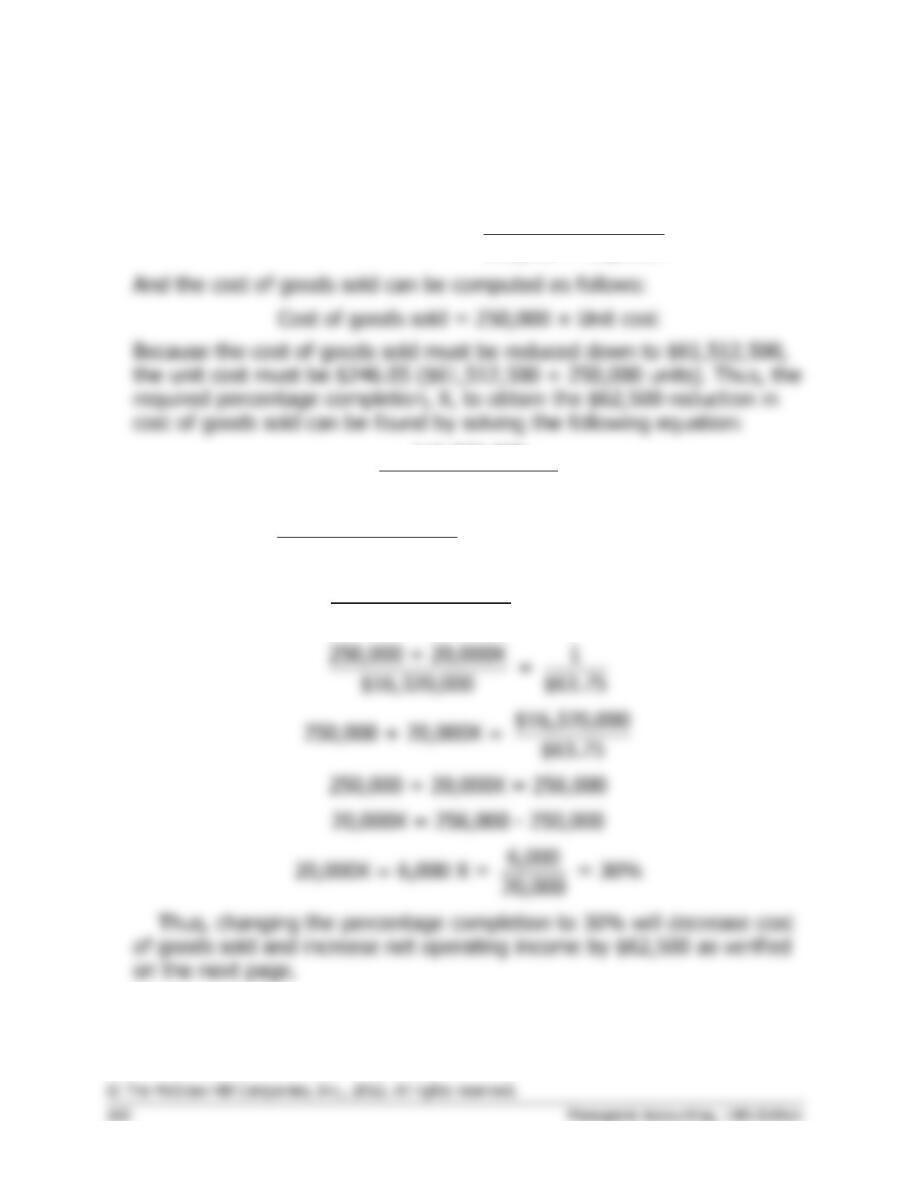
Computation of the Cost of Goods Sold:
Transferred In
Conversion
Units completed and sold …………………..
250,000
250,000
Ending work in process:
Transferred in:
20,000 units x 100% complete ………..
20,000
Conversion:
20,000 units x 25% complete …………
5,000
Equivalent units of production …………….
270,000
255,000
Transferred In
Conversion
Cost of beginning work in process ……….
Cost added during the period ……………..
Equivalent units of production (b) ……….
255,000
Cost per equivalent unit, (a) ÷ (b) ………
2. The estimate of the percentage completion of ending work in process
inventories affects the unit costs of finished goods and therefore the
3. Increasing the percentage of completion can increase net operating
income by reducing the cost of goods sold. To increase net operating
income by $62,500, the cost of goods sold would have to be decreased
by $62,500 from $61,575,000 down to $61,512,500. See the next page
for the necessary calculations.
Case 4-19 (continued)
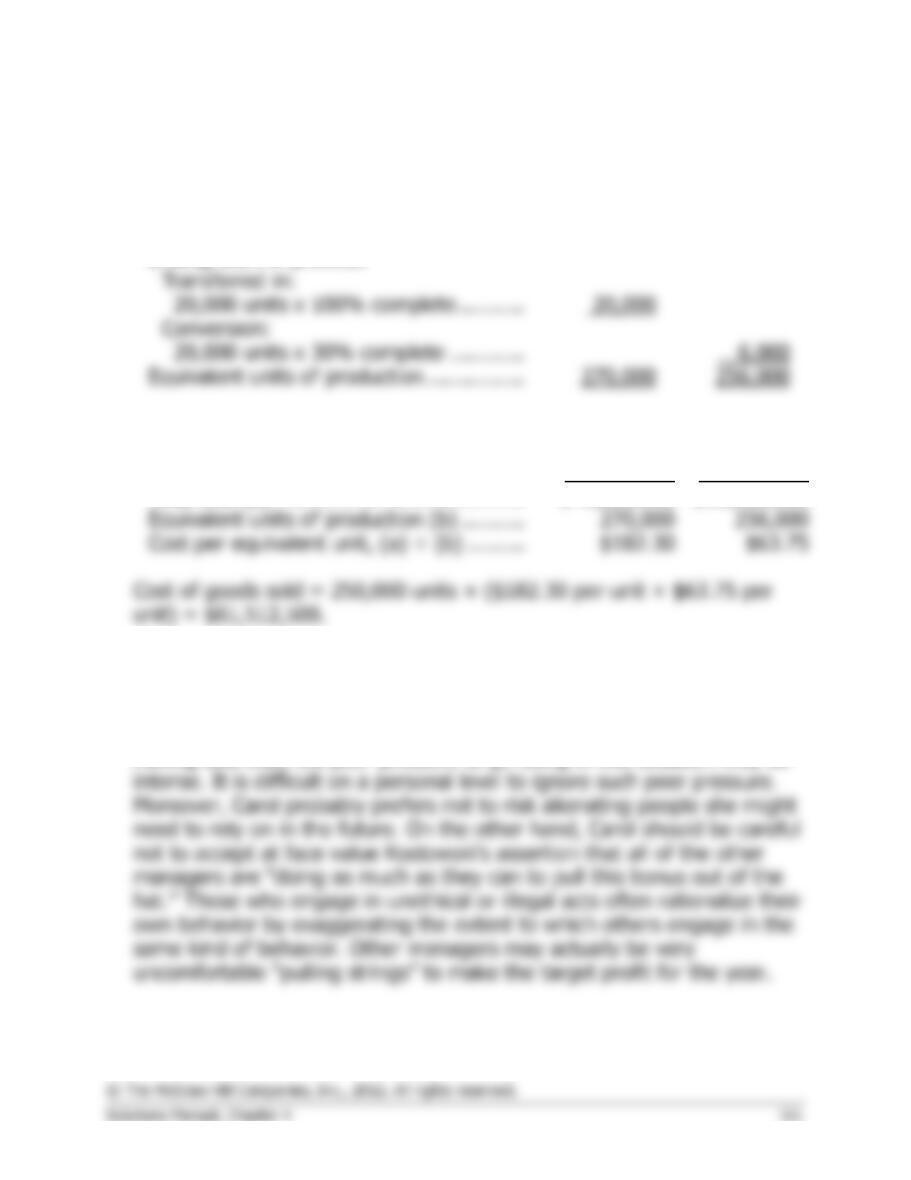
The percentage of completion, X, affects the cost of goods sold by its
effect on the unit cost, which can be determined as follows:
Unit cost = $182.30 +
$16,320,000
250,000 + 20,000X
$16,320,000
$182.30 + = $246.05
250,000 + 20,000X
$16,320,000 = $246.05 – $182.30
250,000 + 20,000X
$16,320,000 = $63.75
250,000 + 20,000X
Case 4-19 (continued)
3. (continued)
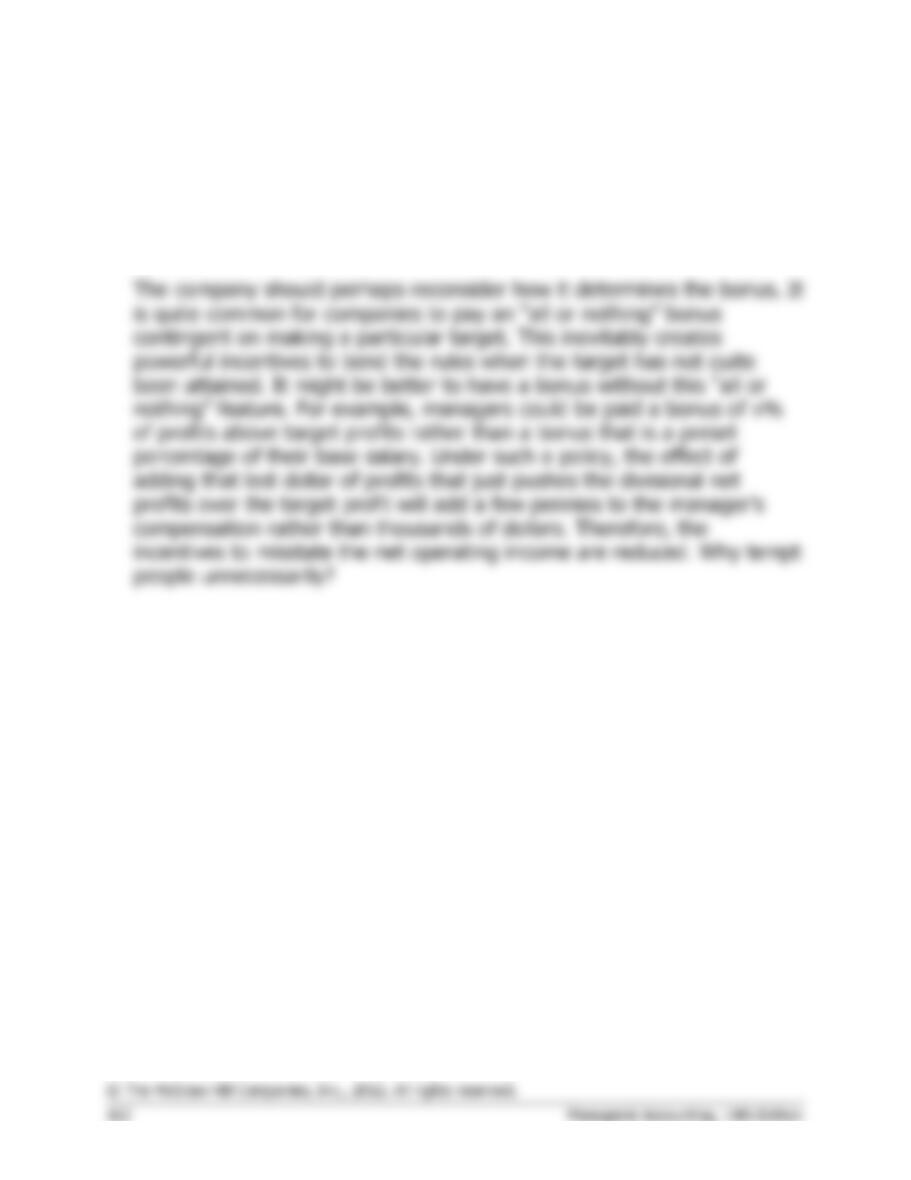
Computation of the Cost of Goods Sold:
Transferred In
Conversion
Units completed and sold …………………..
250,000
250,000
Ending work in process:
Equivalent units of production …………….
270,000
256,000
Transferred In
Conversion
Cost of beginning work in process ……….
$ 0
$ 0
Cost added during the period ……………..
49,221,000
16,320,000
Total cost (a) ………………………………….
$49,221,000
$16,320,000
Equivalent units of production (b) ……….
Cost per equivalent unit, (a) ÷ (b) ………
4. Carol is in a very difficult position. Collaborating with Thad Kostowski in
subverting the integrity of the accounting system is unethical by almost
any standard. To put the situation in its starkest light, Kostowski is
suggesting that the production managers lie in order to get their bonus.
Having said that, the peer pressure to go along in this situation may be
Case 4-19 (continued)
From a broader perspective, if the net profit figures reported by the
managers in a division cannot be trusted, then the company would be
foolish to base bonuses on the net profit figures. A bonus system based
on divisional net profits presupposes the integrity of the accounting
system.
Case 4-20 (45 minutes)
Weighted-Average Method
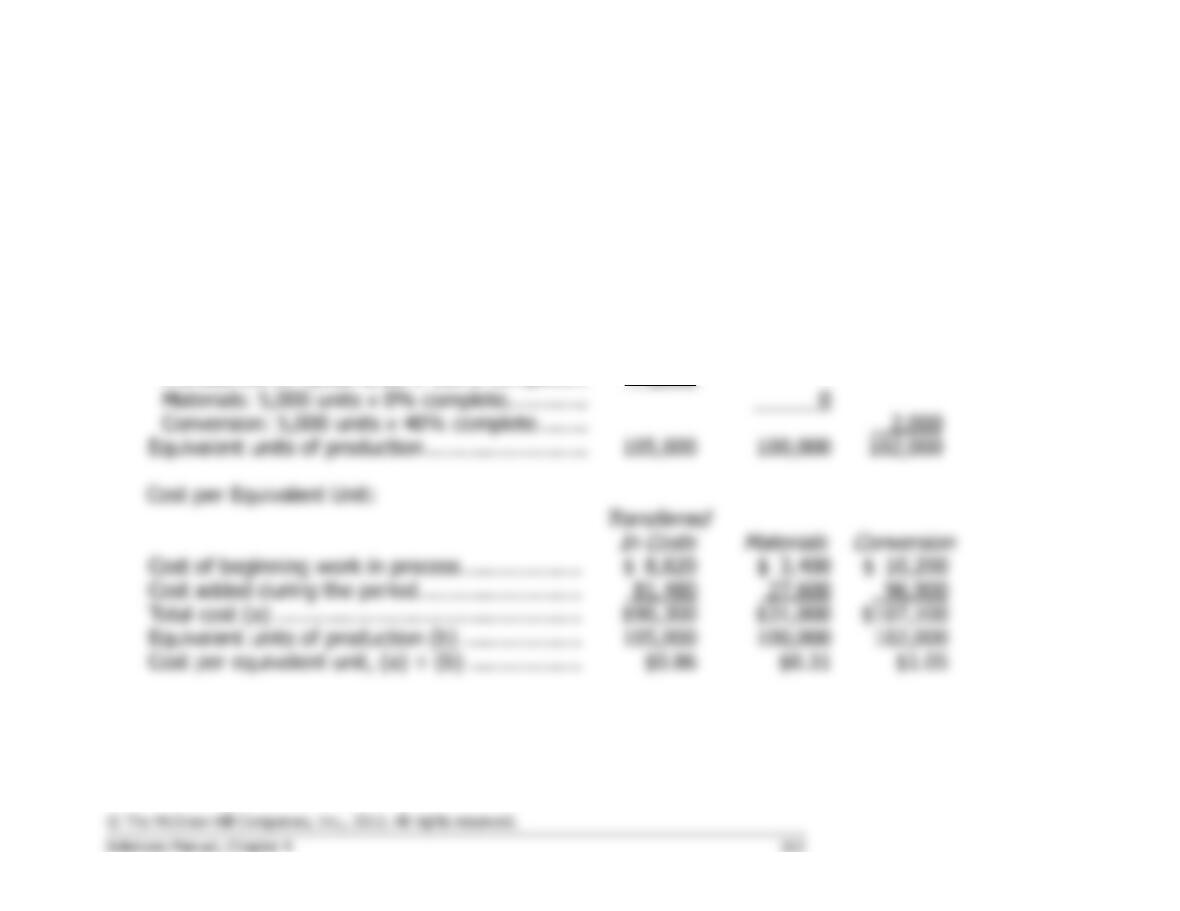
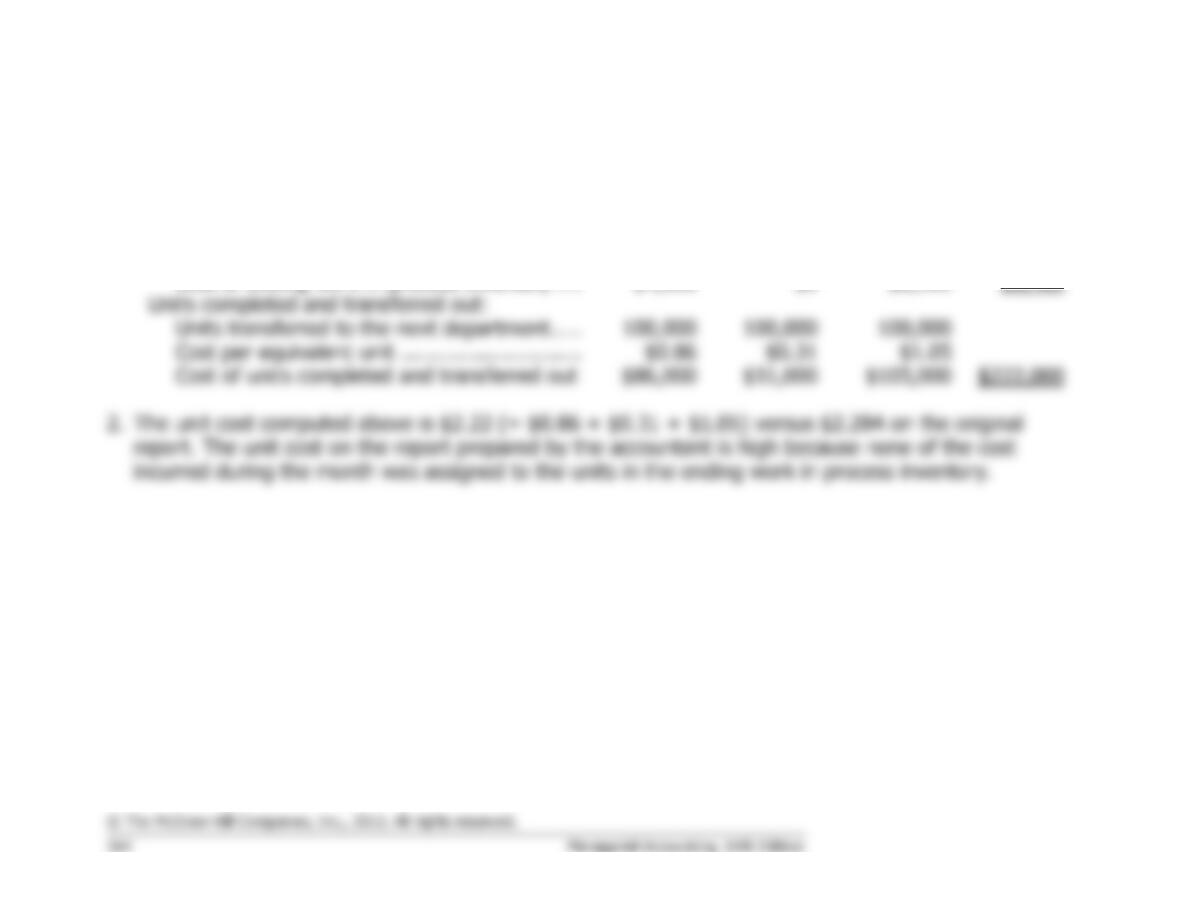
1. The revised computations follow:
Equivalent Units of Production:
Transferred
In
Materials
Conversion
Transferred to next department ……………………
100,000
100,000
100,000
Ending work in process:
Transferred in: 5,000 units x 100% complete ..
5,000
Materials: 5,000 units x 0% complete………….
Equivalent units of production ……………………..
105,000
100,000
102,000
Materials
Conversion
Cost of beginning work in process ……………….
Cost added during the period ……………………..
Total cost (a) ………………………………………….
$90,300
$31,000
Equivalent units of production (b) ……………….
Cost per equivalent unit, (a) ÷ (b) ………………
Case 4-20 (continued)
Transferred
In Costs
Materials
Conversion
Total
Ending work in process inventory:
Equivalent units of production (see above) ..
5,000
0
2,000
Cost per equivalent unit ………………………..
$0.86
$0.31
$1.05
Cost of ending work in process inventory ….
$4,300
$0
$2,100
$6,400
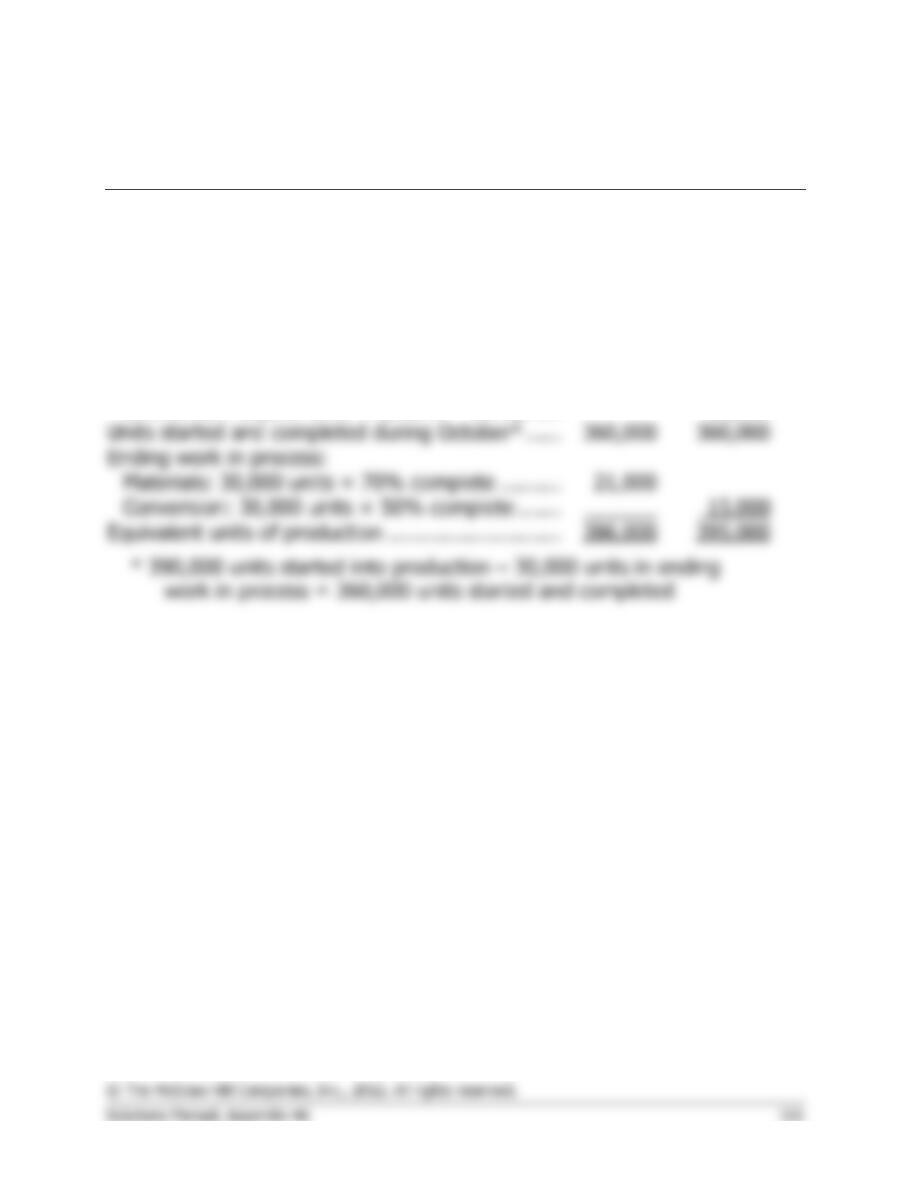
Units completed and transferred out:
Units transferred to the next department …..
Cost of units completed and transferred out
Appendix 4A
FIFO Method
Exercise 4A-1 (10 minutes)
FIFO Method
Materials
Conversion
To complete beginning work in process:
Materials: 50,000 units × (100% − 90%) …………………
5,000
Conversion: 50,000 units × (100% − 60%) ………………
20,000
Equivalent units of production …………………………..
Exercise 4A-2 (10 minutes)
FIFO method
Materials
Labor
Overhead
Cost added during May (a) …………….
$82,560
$52,920
$132,300
Equivalent units of production (b) …..
16,000
14,000
14,000
Cost per equivalent unit (a) ÷ (b)……
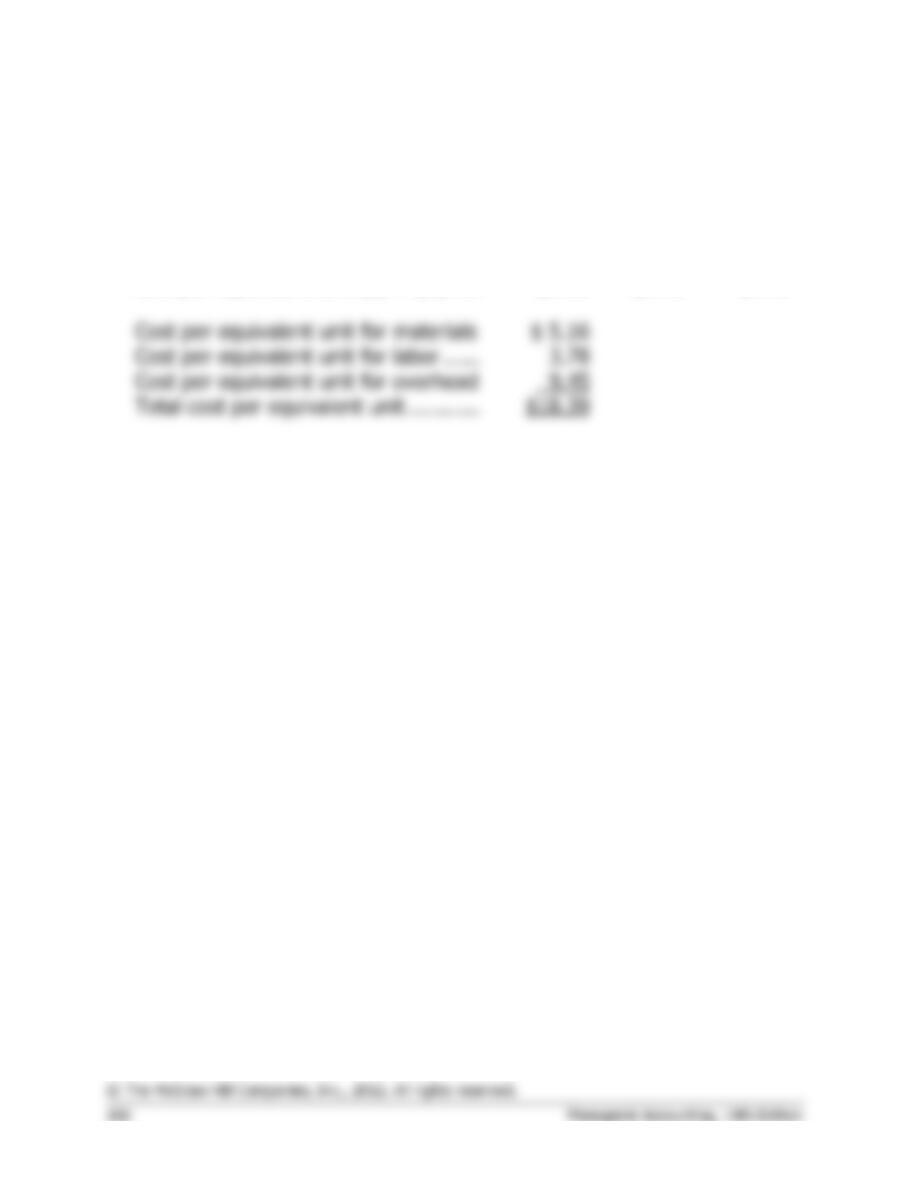
$5.16
$3.78
$9.45
Cost per equivalent unit for materials
Cost per equivalent unit for labor ……
Cost per equivalent unit for overhead
Total cost per equivalent unit …………
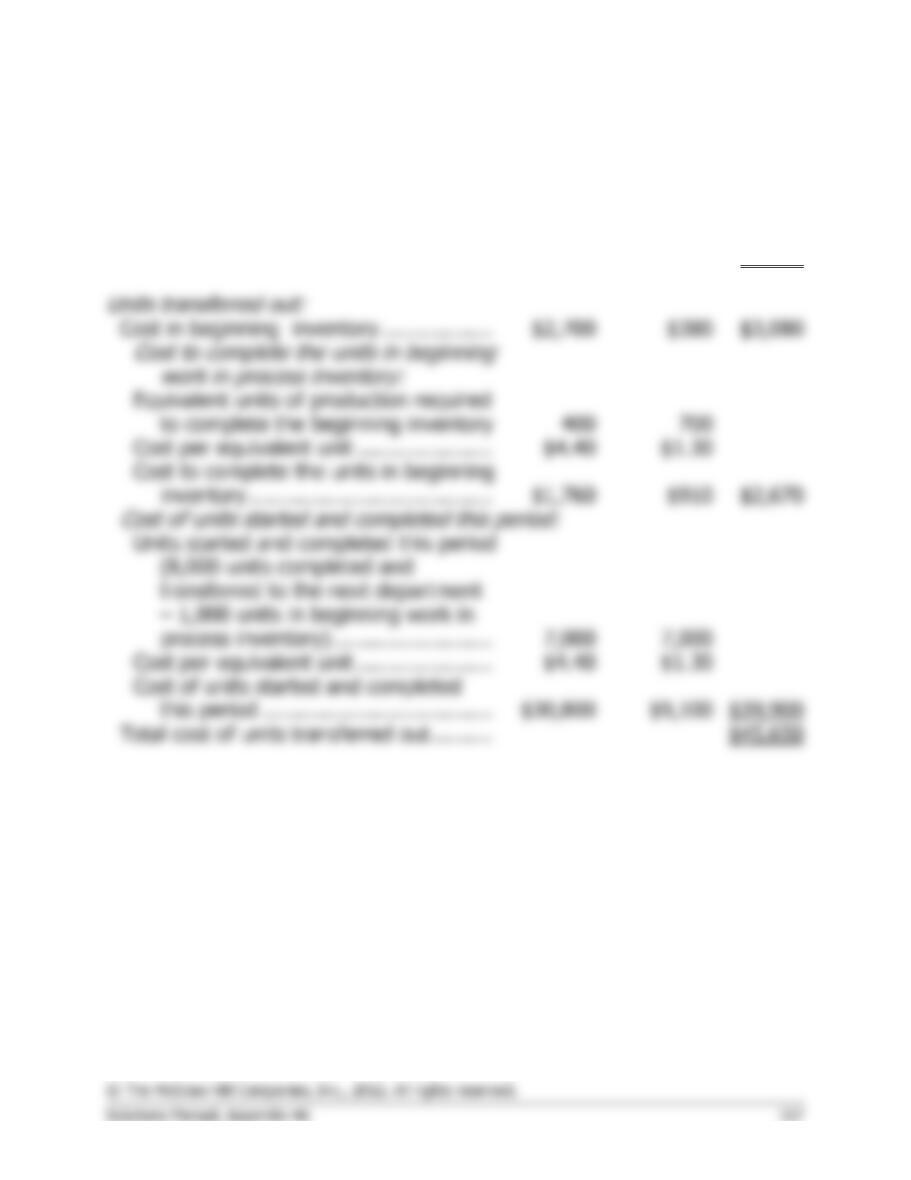
Exercise 4A-3 (15 minutes)
Materials
Conversion
Total
Ending work in process inventory:
Equivalent units of production ……………
800
200
Cost per equivalent unit ……………………
$4.40
$1.30
Cost of ending work in process inventory
$3,520
$260
$3,780
Units transferred out:
Cost in beginning inventory ………………
$2,700
$380
$3,080
400
700
$4.40
$1.30
$4.40
$1.30
Total cost of units transferred out ……….
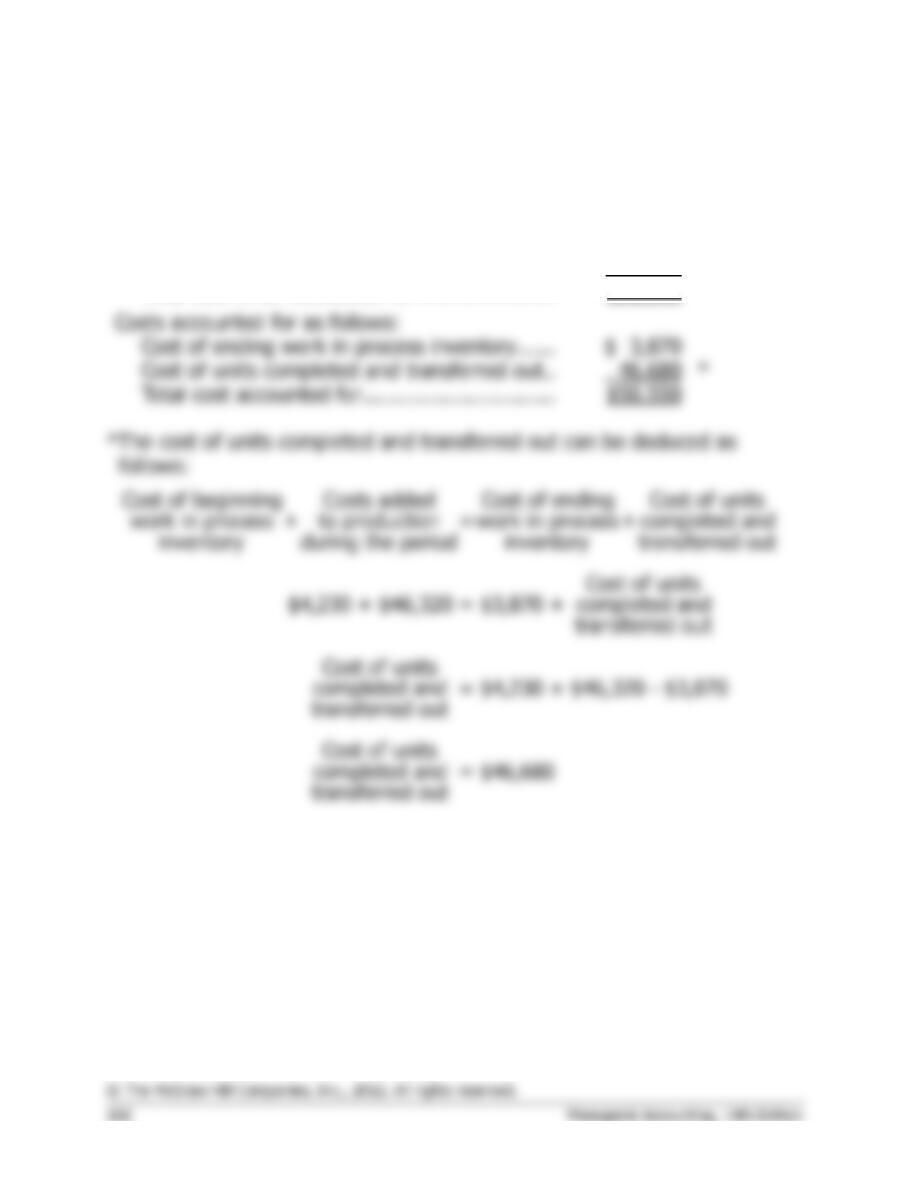
Exercise 4A-4 (10 minutes)
Baking Department
Cost Reconciliation
Costs to be accounted for:
Cost of beginning work in process inventory .
$ 4,230
Costs added to production during the period .
46,320
Total cost to be accounted for ………………….
$50,550
Costs accounted for as follows:
Cost of ending work in process inventory ……
Cost of units completed and transferred out ..
*
Total cost accounted for ………………………….
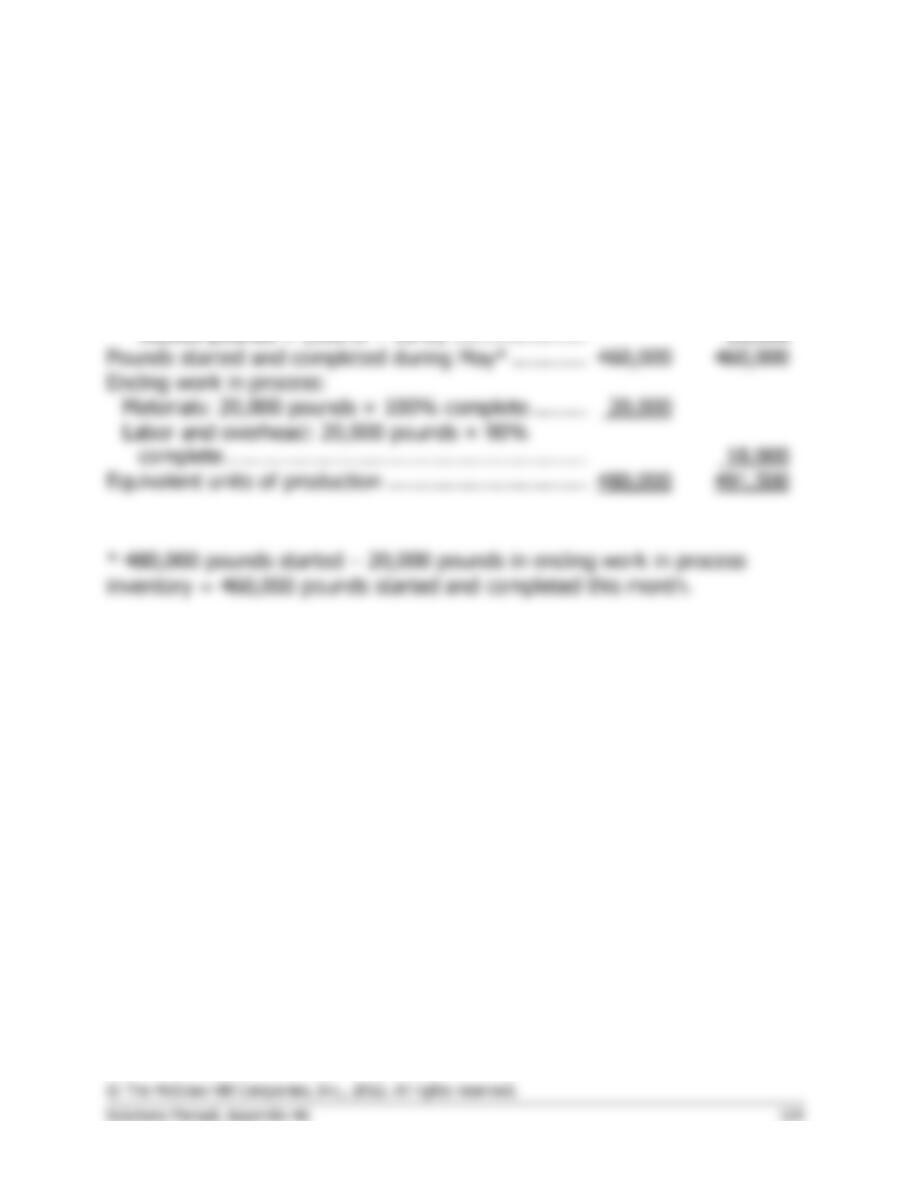
Exercise 4A-5 (15 minutes)
FIFO Method
Materials
Labor &
Overhead
To complete the beginning work in process:
Materials: 30,000 pounds × (100% − 100%) ……..
0
Labor and overhead:
30,000 pounds × (100% − 55%) ………………….
13,500
Pounds started and completed during May* …………
Ending work in process:
Labor and overhead: 20,000 pounds × 90%
Equivalent units of production …………………………..
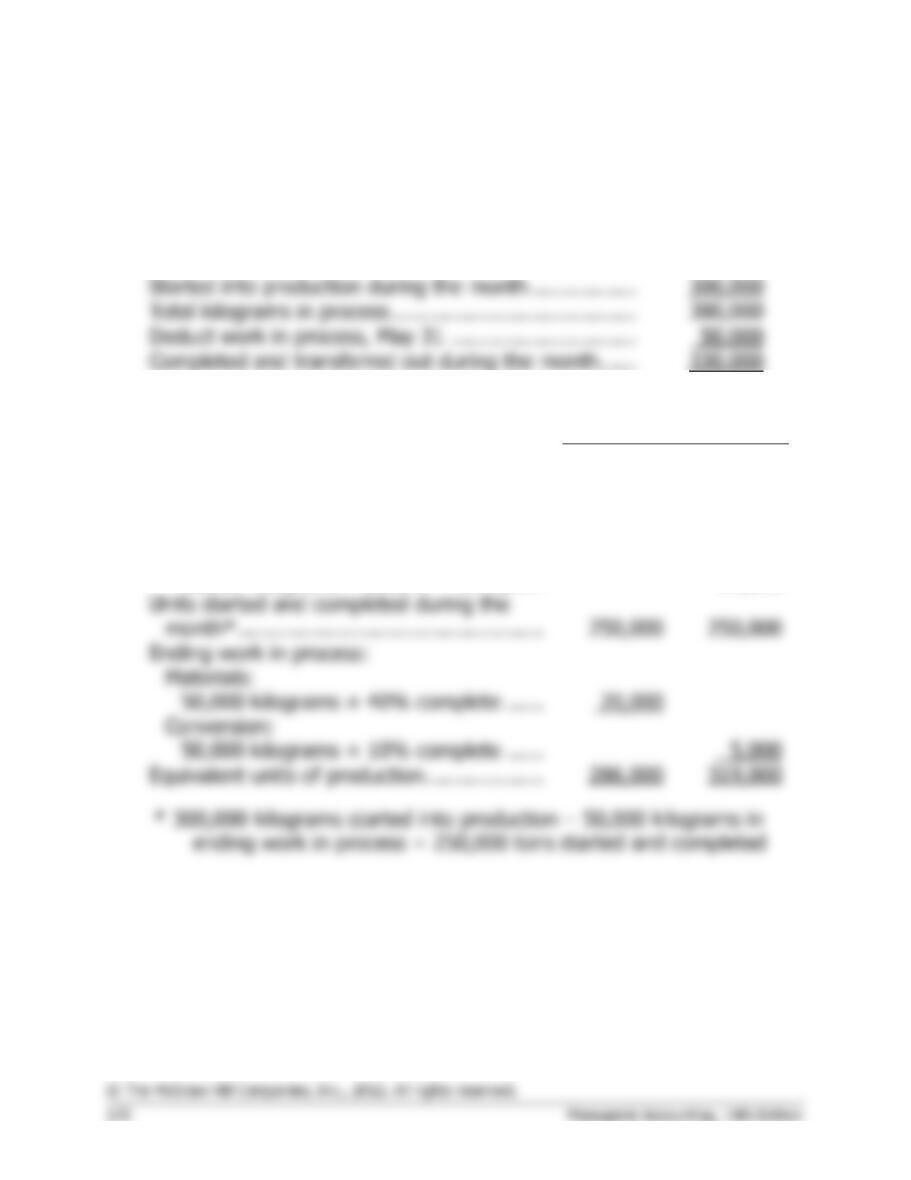
Exercise 4A-6 (15 minutes)
FIFO Method
1.
Kilograms of
Cement
Work in process, May 1 …………………………………….
80,000
Started into production during the month ……………..
Total kilograms in process …………………………………
Deduct work in process, May 31 …………………………
Completed and transferred out during the month ……
2.
Equivalent Units
Materials
Conversion
To complete beginning work in process:
Materials:
80,000 kilograms × (100% − 80%) …..
16,000
Conversion:
80,000 kilograms × (100% − 20%) …..
64,000
250,000
Ending work in process:
Materials:
Conversion:
Equivalent units of production ……………….
Exercise 4A-7 (20 minutes)
FIFO Method
1.
Materials
Labor
Overhead
To complete beginning work in process:
Materials:
80,000 gallons × (100% − 80%) …….
16,000
Labor:
80,000 gallons × (100% − 75%) …….
20,000
80,000 gallons × (100% − 75%) …….
Ending work in process:
10,000
Equivalent units of production …………….
2.
Materials
Labor
Overhead
Cost added during the period (a) …………
$907,200
$370,000
$592,000
Equivalent units of production (b) ………..
Cost per equivalent unit (a) ÷ (b) ………..
$0.80
Exercise 4A-8 (10 minutes)
Materials
Conversion
To complete beginning work in process:
Materials: 400 units x (100% – 75%) ……………..
100
Conversion: 400 units x (100% – 25%) …………..
300
Ending work in process
Materials: 500 units x 80% complete ………………
Conversion: 500 units x 30% complete ……………
Equivalent units of production …………………………..
Exercise 4A-9 (45 minutes)
FIFO method
Cost per equivalent unit of production for material ………….
Cost per equivalent unit of production for conversion ………
Total cost per equivalent unit of production …………………..
2. Computation of equivalent units in ending inventory:
Conversion
Units in ending inventory ………
Percentage completed ………….
80
%
40
%
Equivalent units of production ..
3. Computation of equivalent units required to complete the beginning
inventory:
Materials
Conversion
Units in beginning inventory …..
400
400
Percentage uncompleted ………
30
%
70
%
Equivalent units of production ..
120
280
Units transferred to the next department ………….
Less units from the beginning inventory …………..
Units started and completed during the period …..